
Rabbi Shmuel Kamenetsky On The Upcoming Elections: "Everyone Should Vote For Donald Trump!"
CLICK:


Body Count: U.S. Defense Secretary Robert McNamara briefing the press on Vietnam at the Pentagon in 1965.
Big data is poised to transform society, from how we diagnose illness to how we educate children, even making it possible for a car to drive itself. Information is emerging as a new economic input, a vital resource. Companies, governments, and even individuals will be measuring and optimizing everything possible.
But there is a dark side. Big data erodes privacy. And when it is used to make predictions about what we are likely to do but haven’t yet done, it threatens freedom as well. Yet big data also exacerbates a very old problem: relying on the numbers when they are far more fallible than we think. Nothing underscores the consequences of data analysis gone awry more than the story of Robert McNamara.
McNamara was a numbers guy. Appointed the U.S. secretary of defense when tensions in Vietnam rose in the early 1960s, he insisted on getting data on everything he could. Only by applying statistical rigor, he believed, could decision makers understand a complex situation and make the right choices. The world in his view was a mass of unruly information that—if delineated, denoted, demarcated, and quantified—could be tamed by human hand and fall under human will. McNamara sought Truth, and that Truth could be found in data. Among the numbers that came back to him was the “body count.”
McNamara developed his love of numbers as a student at Harvard Business School and then as its youngest assistant professor at age 24. He applied this rigor during the Second World War as part of an elite Pentagon team called Statistical Control, which brought data-driven decision making to one of the world’s largest bureaucracies. Before this, the military was blind. It didn’t know, for instance, the type, quantity, or location of spare airplane parts. Data came to the rescue. Just making armament procurement more efficient saved $3.6 billion in 1943. Modern war demanded the efficient allocation of resources; the team’s work was a stunning success.
At war’s end, the members of this group offered their skills to corporate America. The Ford Motor Company was floundering, and a desperate Henry Ford II handed them the reins. Just as they knew nothing about the military when they helped win the war, so too were they clueless about making cars. Still, the so-called “Whiz Kids” turned the company around.
McNamara rose swiftly up the ranks, trotting out a data point for every situation. Harried factory managers produced the figures he demanded—whether they were correct or not. When an edict came down that all inventory from one car model must be used before a new model could begin production, exasperated line managers simply dumped excess parts into a nearby river. The joke at the factory was that a fellow could walk on water—atop rusted pieces of 1950 and 1951 cars.
McNamara epitomized the hyper-rational executive who relied on numbers rather than sentiments, and who could apply his quantitative skills to any industry he turned them to. In 1960 he was named president of Ford, a position he held for only a few weeks before being tapped to join President Kennedy’s cabinet as secretary of defense.
As the Vietnam conflict escalated and the United States sent more troops, it became clear that this was a war of wills, not of territory. America’s strategy was to pound the Viet Cong to the negotiation table. The way to measure progress, therefore, was by the number of enemy killed. The body count was published daily in the newspapers. To the war’s supporters it was proof of progress; to critics, evidence of its immorality. The body count was the data point that defined an era.
McNamara relied on the figures, fetishized them. With his perfectly combed-back hair and his flawlessly knotted tie, McNamara felt he could comprehend what was happening on the ground only by staring at a spreadsheet—at all those orderly rows and columns, calculations and charts, whose mastery seemed to bring him one standard deviation closer to God.
In 1977, two years after the last helicopter lifted off the rooftop of the U.S. embassy in Saigon, a retired Army general, Douglas Kinnard, published a landmark survey called The War Managers that revealed the quagmire of quantification. A mere 2 percent of America’s generals considered the body count a valid way to measure progress. “A fake—totally worthless,” wrote one general in his comments. “Often blatant lies,” wrote another. “They were grossly exaggerated by many units primarily because of the incredible interest shown by people like McNamara,” said a third.
The use, abuse, and misuse of data by the U.S. military during the Vietnam War is a troubling lesson about the limitations of information as the world hurls toward the big-data era. The underlying data can be of poor quality. It can be biased. It can be misanalyzed or used misleadingly. And even more damning, data can fail to capture what it purports to quantify.
We are more susceptible than we may think to the “dictatorship of data”—that is, to letting the data govern us in ways that may do as much harm as good. The threat is that we will let ourselves be mindlessly bound by the output of our analyses even when we have reasonable grounds for suspecting that something is amiss. Education seems on the skids? Push standardized tests to measure performance and penalize teachers or schools. Want to prevent terrorism? Create layers of watch lists and no-fly lists in order to police the skies. Want to lose weight? Buy an app to count every calorie but eschew actual exercise.
The dictatorship of data ensnares even the best of them. Google runs everything according to data. That strategy has led to much of its success. But it also trips up the company from time to time. Its cofounders, Larry Page and Sergey Brin, long insisted on knowing all job candidates’ SAT scores and their grade point averages when they graduated from college. In their thinking, the first number measured potential and the second measured achievement. Accomplished managers in their 40s were hounded for the scores, to their outright bafflement. The company even continued to demand the numbers long after its internal studies showed no correlation between the scores and job performance.
Google ought to know better, to resist being seduced by data’s false charms. The measure leaves little room for change in a person’s life. It counts book smarts at the expense of knowledge. And it may not reflect the qualifications of people from the humanities, where know-how may be less quantifiable than in science and engineering. Google’s obsession with such data for HR purposes is especially queer considering that the company’s founders are products of Montessori schools, which emphasize learning, not grades. By Google’s standards, neither Bill Gates nor Mark Zuckerberg nor Steve Jobs would have been hired, since they lack college degrees.
Google’s deference to data has been taken to extremes. To determine the best color of a toolbar on the website, Marissa Mayer, when she was one of Google’s top executives before going to Yahoo, once ordered staff to test 41 gradations of blue to see which ones people used more. In 2009, Google’s top designer, Douglas Bowman, quit in a huff because he couldn’t stand the constant quantification of everything. “I had a recent debate over whether a border should be 3, 4 or 5 pixels wide, and was asked to prove my case. I can’t operate in an environment like that,” he wrote on a blog announcing his resignation. “When a company is filled with engineers, it turns to engineering to solve problems. Reduce each decision to a simple logic problem. That data eventually becomes a crutch for every decision, paralyzing the company.”
This is the dictatorship of data. And it recalls the thinking that led the United States to escalate the Vietnam War partly on the basis of body counts, rather than basing decisions on more meaningful metrics. “It is true enough that not every conceivable complex human situation can be fully reduced to the lines on a graph, or to percentage points on a chart, or to figures on a balance sheet,” said McNamara in a speech in 1967, as domestic protests were growing. “But all reality can be reasoned about. And not to quantify what can be quantified is only to be content with something less than the full range of reason.” If only the right data were used in the right way, not respected for data’s sake.
Robert Strange McNamara went on to run the World Bank throughout the 1970s, then painted himself as a dove in the 1980s. He became an outspoken critic of nuclear weapons and a proponent of environmental protection. Later in life he produced a memoir, In Retrospect, that criticized the thinking behind the war and his own decisions as secretary of defense. “We were wrong, terribly wrong,” he famously wrote. But McNamara, who died in 2009 at age 93, was referring to the war’s broad strategy. On the question of data, and of body counts in particular, he remained unrepentant. He admitted that many of the statistics were “misleading or erroneous.” “But things you can count, you ought to count. Loss of life is one.”
Big data will be a foundation for improving the drugs we take, the way we learn, and the actions of individuals. However, the risk is that its extraordinary powers may lure us to commit the sin of McNamara: to become so fixated on the data, and so obsessed with the power and promise it offers, that we fail to appreciate its inherent ability to mislead.
Kenneth Cukier is the data editor of The Economist. Viktor Mayer-Schönberger is a professor of Internet governance and regulation at the Oxford Internet Institute in the U.K. They are the authors of Big Data: A Revolution That Will Transform How We Live, Work, and Think (Houghton Mifflin Harcourt, 2013), from which this article was adapted.

ELECTORAL MAP ANALYSIS:
https://www.youtube.com/watch?v=dmo61G_pPEg&feature=emb_logo
Final NPR Electoral Map: Biden Has The Edge, But Trump Retains Narrow Path | ||||
Did battleground states see the swift economic recovery that Trump promised? (People Vote By"Are We Better Off Now Than We Were 4 Years Ago?) | ||||
AMERICA ON THE BALLOT WITHOUT TELLING YOU WHO TO VOTE FOR: | ||||
| (What Kind Of Jew Does Not Look at Both Hands?) |


TEL AVIV — In early October, Gov. Andrew Cuomo of New York ordered schools to close in some areas with large populations of ultra-Orthodox Jews because of coronavirus outbreaks.
Some of the schools refused, and the governor threatened as a consequence to withhold state funding. At about the same time in Israel, a rabbi commanded his followers to open ultra-Orthodox schools, in defiance of government shutdown orders. Israel’s health minister warned these schools that they could face “heavy fines.” Two countries, two different systems of government — and a similar challenge: how to deal with ultra-Orthodox Jewish communities that while having high infection rates also refuse to take the necessary precautions.
Jews and gentiles must be careful not to single out the ultra-Orthodox, who look different and act different from most of us. I will try my best to be cautious. I will also state that I see much to admire in the ultra-Orthodox way of life: the sense of community and mutual responsibility, the emphasis on study, the devotion to tradition. And yet, I also feel an urgent need to advise ultra-Orthodox Jews to adapt to a new reality, one in which ultra-Orthodoxy’s great success — its ability to thrive in a modern world — has become its great challenge. Ultra-Orthodox Judaism today is based on strict adherence to Jewish law, a highly conservative worldview and a rejection of many components of the modern world (from evolutionary science to television), with the aim of erecting a shield against secularization and assimilation. In shorthand, the ultra-Orthodox are called Haredi — based on the Hebrew word for “trembling,” because these Jews tremble before God. On its own terms, ultra-Orthodoxy in Israel and the United States has been highly successful in achieving its goals.
What were those goals? To establish an undisturbed and vibrant community of mitzvot (commandments) and Torah study. Seventy years ago, with the destruction of most ultra-Orthodox communities in Europe in the Holocaust, some assumed that the end of this branch of Judaism was near. However, with stubbornness and sophistication, high birthrates and social cohesion, ultra-Orthodox communities are growing and thriving. This success hasn’t come without many challenges.
The first is economic: Ultra-Orthodox Jews tend to be poor by design. They prioritize study over work, and thus rely heavily on philanthropy and public support. The second is civil. Especially in Israel, where Haredi Jews both rely on public funds and still enjoy exemption from military service, there is a general feeling that this community does not pull its weight. Editors’ Picks On ‘S.N.L.’, Jim Carrey Reads a Spooky Election Update of ‘The Raven’ Will ‘Mank’ Be Netflix’s First Best-Picture Winner? A Podcast Answers a Fast-Food Question That Nobody Is Asking The third challenge is the relationship Haredi communities have with their surroundings.
A demographic rise of the Haredi world makes the population both more noticeable and more influential. In a democracy, numbers have meaning, and in Israel and New York, the Haredi are a highly effective voting bloc. Socially, Haredi neighborhoods and towns tend to be less than hospitable to outsiders, and as the neighborhoods expand, clashes with neighbors are common. So these communities are gradually becoming harder to ignore. And the pandemic might be the ultimate demonstration of the emerging problem. In Jerusalem and New York, where these Jews live in great and fast-growing numbers, a puzzled public begins to feel these communities have become too independent. Haredi Jews have large families and live in densely populated areas.
This enhances their model of togetherness and separateness. It also makes them more vulnerable to the coronavirus. By and large, like many closed communities, Haredi Jews are suspicious of outside institutions. (Some of this is born of a long history of persecution.) When outsiders demanded they shut down schools or cancel weddings or stop attending their synagogues, many of the leaders were thinking that such a decree could come only from people who do not understand the importance of these practices. They refused to comply. To these characteristics we must add Haredis’ suspicion of science (a feature of modernity) and their general stiff-necked mentality — the essence of resisting the temptations of a changing outer world. So it is not surprising that a sudden demand to change their community’s behavior was met by many Haredi Jews — and, notably, by many important Haredi leaders — with suspicion and open revolt. Some of them refuse to wear masks; some evade testing. Others send their children to school even when it is prohibited or attend mass funerals, where they clash with the police in New York and Jerusalem. Many attend crowded synagogues.
No wonder that the rate of infections in ultra-Orthodox communities has skyrocketed. Haredi Jews are well practiced in defying the larger society in which they live, and defiance is the tool they pulled out when new pandemic rules were dictated. They did it by using political clout and harsh rhetoric, arguing that the authorities were being discriminatory.
Of course, they have every right to use political clout to make their case. It is also reasonable to assume that in some cases Haredi Jews are being singled out. (The fact that they are easily identifiable because of their distinctive clothing makes it almost inevitable.) And yet it is time for Haredi leaders to realize that their model of isolation from the larger public is becoming archaic. Not because it failed, but because it succeeded. The Haredi model in Israel and the West over the past century was meant to keep a threatened enclave from being wiped out by a cultural tsunami. It was tolerated as such by a generally indifferent public in relatively tolerant countries, and in Israel, where Jewish sentimentality added another layer of commitment of the state to the survival of the Haredi world.
In short, it was designed for a weak group attempting to prevent decline. But as a model for a strong and thriving community it is flawed and dangerous. The thriving of the Haredi world in recent decades was made possible by an ability to be different, without being threatening; to reject the influence of the outside world, without being disruptive. Indeed, the disobedience of a weak minority can be tolerated.
But the disobedience of a strong community — particularly one that could affect the health of the larger public — is more difficult to defend. Few things prompt hatred, fear and vengefulness like a pandemic. What we have witnessed in recent months is dangerous, first and foremost for the future of the ultra-Orthodox world. If Israelis completely lose patience with the Haredi lifestyle, the consequences for the community could be drastic. If Americans become hostile to the community, the consequences could be even graver. Anti-Semitism, already on the rise, feeds on fear and suspicion.
So Haredi Jews are playing with fire. That is because they are not truly that powerful. Not if the world turns against them. No wonder that those of us who see value and beauty in the Haredi world — those of us who watch with admiration their prioritization of compassion over personal success, who identify with their prioritization of study over wealth and who respect their resistance to assimilation look at recent events with a growing sense of apprehension.
Shmuel Rosner (@rosnersdomain) is a contributing opinion writer, a senior fellow at the Jewish People Policy Institute and the author, most recently, of “#IsraeliJudaism: Portrait of a Cultural Revolution.”
https://www.nytimes.com/2020/10/29/opinion/ultra-orthodox-jews-coronavirus.html
Today, 3:43 PM
To:Paul Mendlowitz
(email truncated)
|


The ultra-Orthodox “revolt” of the last lockdown, which continues until today, is most clearly expressed in the opening of their elementary schools for boys.
This violation of the rules brings to light two phenomena: the first is the unmistakable priority granted to abiding by communal and religious values over complying with the laws of the state. Second, and just as strong, is fear. The behavior of the ultra-Orthodox, as some of their leaders candidly acknowledge, stems from the recognition that if they leave their flock without supervision, even briefly, the whole system is liable to fall apart. This insight, which shows ultra-Orthodox society in a sad light, reveals that it is clearly in need of internal soul-searching. But it also sprouts hope for the integration of the ultra-Orthodox into Israeli society in the future.
The conduct of the ultra-Orthodox since the onset of the pandemic, and all the more so during the recent lockdown, has left many Israelis rubbing their eyes in disbelief. Besides the anger at the irresponsibility and flagrant lack of solidarity displayed by most of the ultra-Orthodox, many outside the community simply cannot understand why its rabbis and leaders, who certainly do not want their followers to fall sick or die, are knowingly endangering their health. Indeed, the morbidity and mortality figures among the ultra-Orthodox have skyrocketed, to the point where this sector has become a world leader in coronavirus infections.
One possible explanation — admittedly, rather shaky — is that Jewish values oblige us to continue public prayer and Torah study in a public setting, whatever the health risk. This is a dubious explanation, since one need not be a great talmudic scholar or an eminent halakhic adjudicator to understand that, in Judaism, the supreme value, overriding all else, is the sanctity of life. This is expressed in the halakhic dictum that the precepts (mitzvot) were given to live by (meaning that individuals must live in order to fulfill them), rather than to die for (as a result of keeping them). This principle is the beacon that lights the path of each and every Jew.
The second explanation, less obvious but more convincing, is fear. There are two ways to enforce an ascetic lifestyle that demands personal sacrifice, of the sort followed by the ultra-Orthodox. One is an ardent belief, shared by all members of the community, that theirs is the right path; the other is by building up high walls to insulate the community and — enforce a draconian regime within them. The COVID-19 pandemic makes it glaringly clear that the ultra-Orthodox community’s existence and sustainability is grounded in rigid and uncompromising regimentation, as well as in fear.
Ultra-Orthodox life revolves around a close-knit community framework that defines the parameters of its members’ lives and their choices, from the cradle to the grave. Prayers, group study, the rabbis’ gatherings and receptions for their followers, and all the other community events guarantee that individuals will be under close supervision at almost every moment of their lives. The rabbi, the teacher, the spiritual supervisor in the yeshiva, the man in the next pew in the synagogue, the neighbors in the park — all of them are always watching, keeping their eyes on everyone else, making sure that they toe the line, and do not deviate in the slightest bit from the straight and narrow path. Every wig that does not keep a married woman’s hair wholly out of sight; every failure to show up for daily services, is cause for concern. Any seriously deviant behavior constitutes the grounds for harsh community sanctions, ranging from exclusion from the synagogue to condemnation and ostracism of the “criminal” and his family. For those born into this communal reality, this is a punishment too cruel to bear.
And then came the coronavirus pandemic. To comply with the rules of social distancing imposed by the government, the ultra-Orthodox, like all other Israelis, have to stay home and manage without key elements of their community life. Yes, you can pray with a minyan of only 10 men in the courtyard of your apartment building. Yes, you can study Talmud at home. But when men of all ages are at a distance from the community circle, its watchful eye no longer has them in constant view. Confined at home, without the rabbi or neighbor to keep tabs on them, they are liable to go downhill, discover that there are other ways to live, and to find their way out of the community.
This truth, which most rabbis have preferred to keep under wraps, was revealed by several among them who openly acknowledged that their followers are too weak to stay within the fold without close supervision. Their calculation was simple. There is no doubt that the pandemic endangers life; but the threat of dropout from the community and of spiritual damage that cannot be remedied is far greater and far more terrifying. Such a threat may shake the foundations, the regime, the community. The rabbis are assigning higher priority to “customer retention” than to the clear halakhic imperative to preserve health and life.
This fear, which lies behind the willingness of many ultra-Orthodox rabbis to sacrifice their followers’ lives — and those of other Israelis — is clear evidence of their doubt as to their followers’ commitment to the path, and of their sense that without close supervision and high walls, everything could fall apart. From a broader Israeli perspective, if this is indeed the true picture, perhaps there is hope for the future. Perhaps the broader and deeper integration of the ultra-Orthodox into Israeli society is not impossible after all.

In the course of about a month, the Hasidic village of Kiryas Joel, N.Y., managed to drop its rate of positive tests for coronavirus infection by a dramatic 30 points — from 34.2% in the last week of September, to 4.2% this week, according to state data released Wednesday.
Town leaders and New York Gov. Andrew Cuomo chalked the change up to the effect of coronavirus restrictions in Kiryas Joel, after Cuomo designated it a “red” zone on October 6, requiring schools and nonessential businesses to close, and for worship services to be capped at 10 people.
But Dr. Irina Gelman, the health commissioner for Orange County, which includes Kiryas Joel, a dense town of 26,000, has a different explanation: Village residents with coronavirus symptoms are refusing to get tested.
She said in emails to the Forward that doctors from hospitals, primary care providers and urgent cares have told her, as well as the state’s task force to stem the spread of coronavirus, that people showing coronavirus symptoms are foregoing tests altogether, including for flu and strep throat.
“This is not a typical declination in percent positive rate, which would be more gradual and over a longer period of time,” Gelman wrote in response to emailed questions. “I suspect there is some degree of correlation between the physician reported patient refusal to test and the dramatic decline in the currently reported test positive percent.”
Gelman says further investigation is needed before she can determine what exactly caused what she called the “drastic” drop in Kiryas Joel’s positive rate.
But she said that the village has seen a decline in the overall number of coronavirus tests administered to residents, even as hospitalizations have increased — two signs that the actual rate of coronavirus infection in the village has either not decreased at the rate suggested by the reported percentage of positive tests, or is in fact increasing.
Gelman’s office did not provide recent data on hospitalizations, total test volume or percent positive test rate from Kiryas Joel or its ZIP code, which includes the largely non-Hasidic town of Monroe.
Publicly available data for all of Orange County shows that overall tests have dropped somewhat over the past two weeks. The county’s rate of hospitalizations related to COVID-19, the disease caused by the novel coronavirus, has also ticked up since the middle of September.
A representative for the New York Department of Health did not respond to emailed questions about Kiryas Joel’s data or Gelman’s assertions.
Gedalye Szegedin, the town administrator for Kiryas Joel, did not comment after being contacted by the Forward.
Two major health providers serving Kiryas Joel did not respond to requests for comment.
Joel Petlin, the head of Kiryas Joel’s public school, which serves children with special needs, said that even if some residents are refusing coronavirus tests, discomfort with the tests is widespread.
“I don’t know that that problem is a uniquely KJ issue,” he said, using a common abbreviation for Kiryas Joel. “It’s probably a problem throughout the state and the country, for people who don’t want to be tested because of the intrusion, or don’t feel they’re overly sick.”
When asked why a Kiryas Joel resident might refuse a coronavirus test, Petlin said, “Because they’re human.”
Kiryas Joel is one of several designated red zones throughout the New York City region with high rates of positive coronavirus tests, all of which center around areas with large Orthdoox communities. Red zones face the harshest restrictions, with “orange” and “yellow” zones facing somewhat relaxed restrictions.
Orthodox Jews have repeatedly expressed frustration and anger at the restrictions, saying that the community felt unfairly singled out by Cuomo, and that the restrictions were unnecessary and overly burdensome.
On Wednesday, Cuomo relaxed restrictions on two once-red zones, in the borough of Queens. The red zones in Kiryas Joel, as well as the ones centered on the upstate Hasidic community of Monsey and in South Brooklyn, will remain intact, Cuomo said, because they did not fall below the state’s designated 3% threshold for positive coronavirus tests. Orange zones around those red zones have been downgraded to yellow, allowing schools and nonessential businesses to open.
“We have it managed,” Cuomo said. “We know how to do this.”
Despite Kiryas Joel’s reported drop in positive coronavirus cases, its positive test rate suggests that the village is still in a precarious place, and requires continued restrictions, said David Abramson, a professor of public health at New York University.
“The 34 number is an extremely high number. In fact it’s a set-your-hair-on-fire number,” Abramson. “The four is still much higher than we’d be comfortable with.”
Abramson said that in this second wave of the virus in the New York City region, younger people are expected to be infected at a higher rate than older people. In an overwhelmingly young, densely populated village like Kiryas Joel — about 61% of the village is under 18, according to Census data from 2019 — that could mean wide infections with few hospitalizations.
But, Abramson said, “If the number of hospitalizations is not going down, but the test rate is dropping, they’re probably trying to limit the number of tests that they take.”
Orthodox neighborhoods in New York City have seen less testing than others, despite having high rates of positive coronavirus tests, which health experts worry could mean that these hotspots are hotter than the data suggest.
Orthodox residents have received robocalls and text messages urging them to avoid testing so as to game the health data, according to audio and text messages obtained by the Forward.
In Brooklyn’s Borough Park, home to a diverse Orthodox Jewish community, one Yiddish robocall told residents that “even if they force you, even if they beat you like the Jews in Israel, and especially not voluntarily, and one must also not go get tested because this raises the statistics in our neighborhoods.”
Gelman said that doctors have told her that their patients are refusing tests for many reasons. Some believe their community either has or should achieve herd immunity, the point at which enough people in Kiryas Joel have contracted the coronavirus and developed antibodies to prevent its spread.
Others may have heard misinformation that one cannot be infected twice with the disease, or are simply experiencing “pandemic-related fatigue” over medical intrusions, Gelman said.
Health experts have said that herd immunity from the coronavirus is likely impossible, since antibodies developed by those who have it often wear off after several months. Abramson said that trying to achieve herd immunity is akin to playing “Russian roulette.”
Petlin suggested that Gelman’s statements might stoke antisemitism, pointing to early spikes in the virus in upstate Hasidic communities in the spring that led to instances of antisemitism in the area and an anti-Orthodox backlash on social media, even though he said he did not believe that was her intention.
In an emailed response to the question of whether she is concerned that her statements could stoke antisemitism in the county, Gelman said that the county’s health department “takes the health and safety of all of our residents very seriously, even more so during the worst public health crisis in a century.”
“These are not anecdotal accounts, and there is an inherent, serious population-wide health risk that impacts all residents of our county,” Gelman added.
Ari Feldman is a staff writer at the Forward. Contact him at feldman@forward.com or follow him on Twitter @aefeldman

On The Rabbi's Knee:
“Does it hurt?” the boy recalls the teacher saying, over and over. His voice was urgent but also oddly indifferent, as if he were asking about the weather. “Does it hurt?”
The boy was panicked now, desperate to open the car door and run into the school for help. But he was 12 years old, and the teacher was older and stronger, and, after all, he was a teacher.
All the boy wanted was to fit into his new world. The sooner this ended, he thought, the sooner he could forget it ever happened.
READ IT ALL:
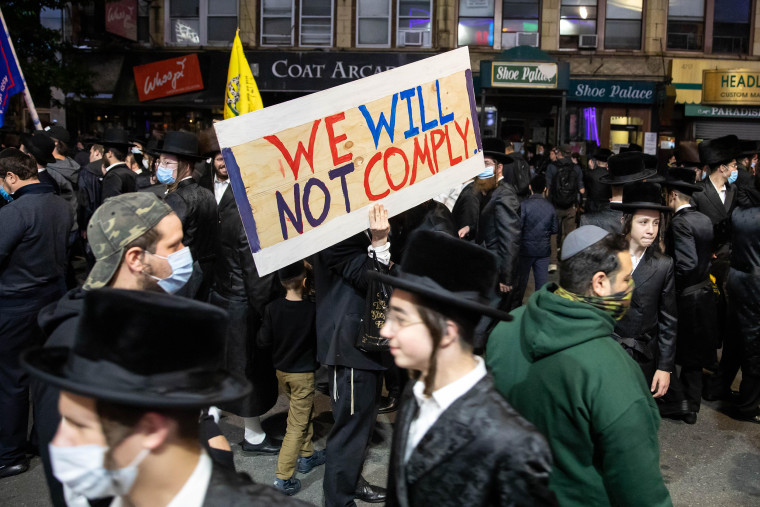
As authorities scramble to confront a second wave of Covid-19 building across America, anger is mounting against government efforts to stop the spread within a population among those hardest hit by the pandemic: the sprawling ultra-Orthodox Jewish community of metropolitan New York.
For the ultra-Orthodox to complain that they're being discriminated against when they come under extra scrutiny is essentially to complain that it's anti-Semitic to notice what they're doing.
With the pandemic in its eighth month and restrictions cutting into the religious practices of the tight-knit, strictly observant subculture, it's understandable that weariness and impatience would set in. Unfortunately, that's leading to a growing sense in the community that it is being singled out unfairly for deprivation of its religious rights, often accompanied by open complaints of anti-Semitism as the cause for the lockdowns.
It's
a dangerous misperception, for both the ultra-Orthodox and their
neighbors. The virus doesn't single out groups by religion, race or
national origin; it's an unbiased scourge. Nor are New York officials'
containment efforts guided by any such bigoted motives. Enforcement goes
where the germs are. And the germs, tragically, are hitting
ultra-Orthodox Jews with special fury.
From the beginning of the crisis in March, densely populated ultra-Orthodox neighborhoods in Brooklyn, Queens and key suburbs emerged as leading viral hot spots in hard-hit New York. Their outsize vulnerability was due in large part to a traditional religious culture built on a continuous cycle of obligatory, large-scale gatherings for prayer, study, weddings and funerals, all cherished rituals that can and apparently did serve as super-spreader events.
Compounding these risks has been the mundane physical structure of the insular ultra-Orthodox lifestyle, built on large families' living in cramped homes packed into dense neighborhoods, making social distancing extraordinarily difficult.
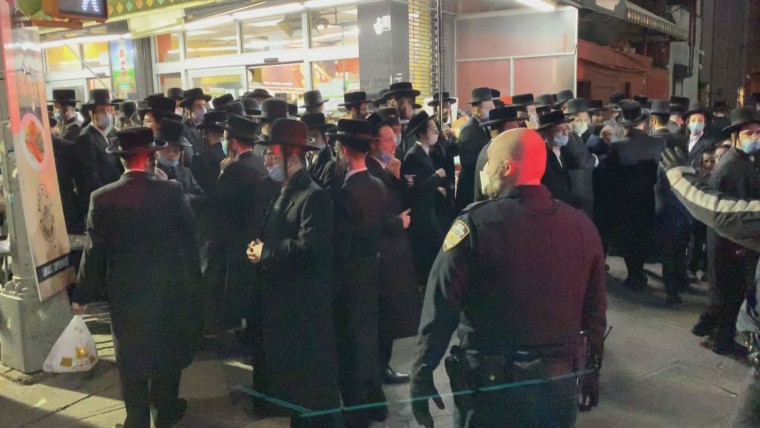
But because those are religious obligations and cornerstones of their Jewish identity structure, government-mandated lockdowns and social distancing can and too often did look from an ultra-Orthodox perspective like government assaults on the religion itself.
It might seem surprising that the community's behavior hasn't been dictated from start to finish by the fundamental Jewish principle known as "protection of human life" — the commandment that nearly all religious rules be suspended if a human life is the balance. And, indeed, while many respected rabbis urged members of the community to follow that guidance, it appears that the principle was hard to visualize when the threat wasn't an enemy gun or a car crash — events that Jews regularly violate religious restrictions to address — but an invisible bug.
That difficulty wasn't helped by a small but influential minority within the community that has been nodding toward a competing principle — that of sanctifying God's name by openly defying oppressors' bans, even at risk to one's own life and limb. While rarely stated aloud right now, this notion has been encouraged by a handful of well-known rabbis, most of them Israelis with strong followings in the United States, and, more subtly, by a deep-seated distrust of the modern world and its dictates, which often take the form of medical directives.
After a long spring of cat-and-mouse police chases after clandestine synagogue services and other attempts by the ultra-Orthodox to evade quarantine, followed by the summer slowdown in infections, the New York City health department reported startling new statistics in late September showing that certain neighborhoods in Brooklyn and Queens, most of them featuring large ultra-Orthodox populations, were reporting virus test results averaging 4.7 percent positive, compared to just over 1 percent in the rest of the city. Two weeks later, the average jumped to more than 6 percent.
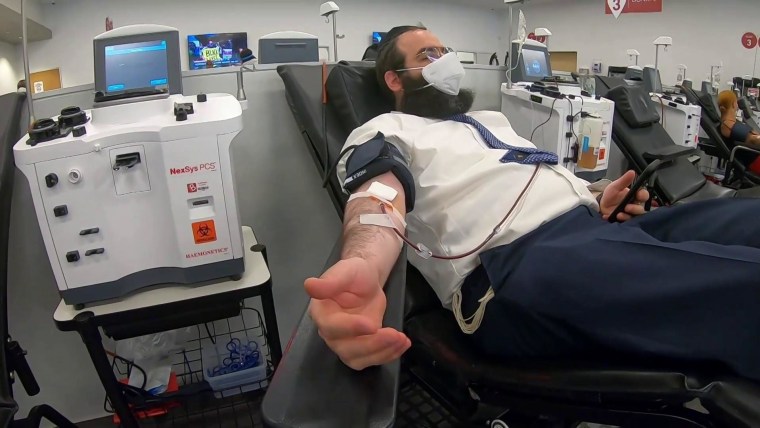
The nine "red zone" ZIP codes on the state map of the highest infection rates at that time — which carried the heaviest public restrictions as a result — were nearly all major ultra-Orthodox population centers. Among other things, houses of worship in red zones were limited to 10 attendees at a time under a policy announced by Gov. Andrew Cuomo.
Ultra-Orthodox community leaders maintain — and government authorities largely agree — that most ultra-Orthodox Jews are following government mandates and that violators represent only a minority. That minority, however, seems to be large enough to push the entire community into vastly disproportionate infection territory, given that observance by a vague "most" isn't sufficient to stop the virus.
Yet the reaction of much of the ultra-Orthodox community has been to protest the lifesaving government restrictions — sometimes violently — and to paint them as anti-Semitic. In a typical example, a weekly tabloid with a mostly Orthodox readership touted on its front page an essay headlined "De Blasio And Cuomo Have Declared War On Us," which accused the governor and New York Mayor Bill de Blasio of "treachery and blatant anti-Semitism" and claimed that they "want to destroy our schools and way of life."
And in a toned-down critique, Agudath Israel of America, the main advocacy body representing ultra-Orthodox Jews, argued that while the ban on large services "discriminates against all religions," it "disproportionately impacts the religious services of Orthodox Jews," who would be shut out from traditional synagogue observance of two major religious holidays.
But for the ultra-Orthodox to complain that they're being discriminated against when they come under extra scrutiny is essentially to complain that it's anti-Semitic to notice what they're doing. And in this case, defiantly maintaining tradition doesn't risk just their own lives, which is their prerogative, but their neighbors' lives, as well. The trap they're caught in is tragic, but society has a right and an obligation to protect its people's welfare.
Indeed, the greater anti-Semitism threat likely comes not from failing to defend Jewish rights but from trying too hard. When Jewish communities, Orthodox or not, ask for special accommodations to meet their particular needs, it's often seen by other communities as cutting in line, wheedling extra privileges while broader needs go unmet.
To be sure, part of the ultra-Orthodox misperception that anti-Semitism is at work comes from memories of long centuries when anti-Jewish powers forced Jews to give up their traditions or take them underground. These memories, and the alarms they trigger, are familiar to Jews of every religious and ideological stripe.
Throughout their history, Torah-observant Jews have faced emergencies that have forced them to compromise and bend some laws, sometimes permanently.
At the same time, it's precisely this history that should serve as a guide for the ultra-Orthodox community today in combating Covid-19. Throughout their history, Torah-observant Jews have faced emergencies that have forced them to compromise and bend some laws, sometimes permanently.
Disasters, usually in the form of anti-Semitic persecution, have forced them to drop some practices and amend others to survive until better times returned. So it was after the Roman destruction of Solomon's Temple in ancient Israel and during the Spanish Inquisition, the medieval Polish-Ukrainian pogroms, the Soviet era and the Holocaust.
But America isn't any of those things. Instead, it is the ultra-Orthodox community itself that right now poses the most danger to its own continuity.


