%20(1).jpg) |
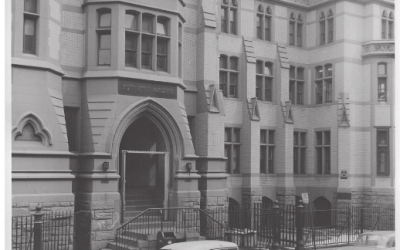
| Beth Medrash Elyon in the early 1940s - Mendlowitz Family Archives |
 |
| Beth Medrash Elyon: Looking at Monsey today, it's hard to imagine it all started with one yeshiva:Watch Video Clip https://fb.watch/IVNFRJ6T8p/ |
The Post-Holocaust Jew and the Jewish Recovery, Continued...
Part four in a series of five, in commemoration of his yahrzeit the third day of Elul
There was another dimension to Rabbi Mendlowitz's educational vision that is sometimes lost when his legacy is reduced to Torah Vodaath and Torah Umesorah. He understood that a Jewish educational revolution could not end when a student graduated from high school. If Jewish education was to become the foundation of Jewish survival in America, there had to be a place where young men could continue serious Torah study after their secondary education and, just as importantly, where future teachers and communal leaders could be prepared for the responsibilities of building Jewish life in America. This conviction led to one of Mendlowitz's most visionary undertakings, Beth Medrash Elyon.
In 1943, Mendlowitz purchased a substantial tract of land in Monsey, (the William Heidgerd residential estate and its active farm outbuildings historically spanned roughly 24 to 28 acres), then a largely undeveloped and decidedly non-Jewish area, with the intention of creating an institution that would raise the educational level of Torah teachers. The first institution established there was Aish Dos, a teachers' institute whose very name, "Pillar of Fire," expressed the mission. The idea was daring. Why build a Torah institution in a place where there was scarcely a Jewish community? Because Mendlowitz was not merely reacting to existing Jewish geography. He was creating the geography of the Jewish future. In 1944, the institution was reorganized as Beth Medrash Elyon. It became one of America's earliest post-graduate yeshivot and an important center for advanced Torah learning.
The significance of Beth Medrash Elyon goes well beyond the walls of the institution itself. Mendlowitz understood that schools cannot exist without teachers, communities cannot exist without leaders, and a Torah civilization cannot reproduce itself without scholars capable of transmitting its intellectual tradition. The creation of Beth Medrash Elyon was therefore the logical next step in his educational architecture. Torah Vodaath could educate the child. A national day-school movement could bring Jewish education to communities across America. But where would the teachers come from? Where would the next generation of Torah educators be trained? Where would young men develop the depth of learning necessary to become the intellectual leadership of a growing American Jewish community? Beth Medrash Elyon was part of Mendlowitz's answer.
This is why describing Beth Medrash Elyon simply as a "post-graduate yeshiva" understates its historical significance. Mendlowitz was attempting to create an American Torah elite that would not merely preserve European scholarship but would transmit it into a new environment. He understood that the American Jewish community could not indefinitely depend upon importing rabbis and teachers from Europe. The future required Americans educated to the highest levels of Torah who understood the realities of American Jewish life. The institution was designed to help produce precisely that kind of leadership.
There was also something characteristically Mendlowitzian about the location. Monsey was not yet the Orthodox Jewish center that subsequent generations would know. His decision to establish Beth Medrash Elyon there reflected the same instinct that would later shape the growth of Orthodox communities throughout the region. He was willing to invest in Jewish infrastructure before the Jewish population existed in sufficient numbers to make the investment seem obvious. He understood that institutions could create communities just as communities created institutions. The vision came first; the population followed. Later, Monsey would become one of the most significant centers of Orthodox Jewish life in America, but Mendlowitz was thinking in terms of that future when the landscape still looked remarkably different.
Beth Medrash Elyon also reveals something essential about Mendlowitz's understanding of American Jewish psychology. He knew that American Jews respected education. America was becoming a society in which education was increasingly associated with advancement, professional achievement, and social mobility. Rather than treating that American instinct as a threat, Mendlowitz harnessed it. His answer was, in effect, to say that the Jewish community must become equally serious about Jewish education. If America expected its children to pursue higher education, Jewish society had to create institutions in which the highest levels of Torah scholarship were equally imaginable and equally attainable.
The genius was in refusing to present Torah and education as competing concepts. Torah itself was education. Torah scholarship was intellectual achievement. The yeshiva was not an escape from intellectual life. It was an institution of intellectual life. Mendlowitz wanted American Jews to understand that serious Jewish learning belonged among the highest aspirations of an educated person.
That philosophy also explains why Beth Medrash Elyon belongs in the same historical narrative as Torah Umesorah. These were not unrelated projects. They were different components of one educational system. One institution addressed the creation of advanced Torah leadership. The other addressed the creation of a broad educational network. Together they reflected Mendlowitz's understanding that Jewish continuity requires both depth and breadth. A civilization cannot survive on mass education without scholars, but neither can it survive on scholars without an educated population capable of sustaining them.
The sequence is therefore revealing. Torah Vodaath represented the development of a serious American yeshiva. Beth Medrash Elyon represented the creation of an advanced level of Torah scholarship and teacher formation. Torah Umesorah represented the expansion of Jewish education into communities throughout America. Each answered a different part of the same question: How can Torah become a permanent feature of American Jewish civilization rather than a fragile remnant of European Jewish life?
Mendlowitz's answer was institutional rather than rhetorical. Build the elementary school. Build the high school. Build the advanced yeshiva. Train teachers. Create communities. Establish a national educational organization. Develop the infrastructure necessary for Jewish children to encounter Torah at every stage of life. He was constructing an educational ecosystem decades before the language of "systems" and "networks" became fashionable in organizational thinking.
There is another reason Beth Medrash Elyon deserves a central place in the story of the post-Holocaust Jew. Mendlowitz understood that the Holocaust had created a catastrophic vacuum in Jewish leadership. Europe had not merely lost millions of Jews. It had lost generations of teachers and scholars. If America was going to become a major center of Torah life, it would need to produce its own leadership. The answer could not be perpetual nostalgia for the great European yeshivot. The answer was to create American institutions capable of producing scholars of comparable seriousness.
That was an audacious proposition. And it worked.
Beth Medrash Elyon became associated with major Torah scholars and educators, including Rabbi Reuven Grozovsky. Its graduates and students included figures who would become influential in American Orthodox scholarship and communal life. The institution thereby became part of the emerging infrastructure of postwar American Torah leadership.
Seen from the perspective of the twenty-first century, the achievement can almost seem inevitable. It was anything but inevitable. There was no guarantee that an American-born Orthodox community would produce a sustainable scholarly elite. There was no guarantee that parents would send their children to full-time Jewish schools. There was no guarantee that day schools would spread beyond a handful of communities. There was no guarantee that serious Torah learning would flourish in a country whose economic and cultural incentives pointed so powerfully toward assimilation.
Mendlowitz did not wait for guarantees. He built.
That word may ultimately be the best description of his career. He built institutions before the need was universally recognized. He built in places where others saw empty land. He built educational systems when others saw isolated schools. He built advanced Torah institutions when others questioned whether American Jewry could sustain them. And he built with the assumption that the future would belong to those who educated the next generation rather than those who merely complained about the decline of the previous one.
Beth Medrash Elyon therefore belongs at the center of the Mendlowitz story. It demonstrates that his vision was never simply to preserve Orthodoxy. His objective was to create an American Torah civilization capable of reproducing itself.
That distinction is enormous. Preservation looks backward. Mendlowitz was looking forward.
He was not asking how to keep alive the Judaism of the old country for another generation. He was asking what institutions would be necessary for Judaism to flourish in a new country, under new economic conditions, within a new culture, and among children who would think and speak differently from their grandparents.
The answer required a complete educational architecture: Torah Vodaath for foundational formation, Beth Medrash Elyon for advanced Torah scholarship and leadership, Torah Umesorah for the expansion of day-school education, and ultimately a new educational frontier in Eretz Israel.
The pieces were beginning to fit together. And the most extraordinary part of the story is that Mendlowitz understood the architecture while much of it still existed only in his imagination.
Yet his vision was never confined to America. This is where the story takes a remarkable turn.
To Be Continued....
 |
| REPUBLISHED |
https://blogs.timesofisrael.com/the-post-holocaust-jew-and-the-jewish-recovery-continued-part-four/