EVERY SIGNATURE MATTERS - THIS BILL MUST PASS!

EVERY SIGNATURE MATTERS - THIS BILL MUST PASS!
CLICK - GOAL - 100,000 NEW SIGNATURES! 75,000 SIGNATURES HAVE ALREADY BEEN SUBMITTED TO GOVERNOR CUOMO!

EFF Urges Court to Block Dragnet Subpoenas Targeting Online Commenters

EFF Urges Court to Block Dragnet Subpoenas Targeting Online Commenters
CLICK! For the full motion to quash: http://www.eff.org/files/filenode/hersh_v_cohen/UOJ-motiontoquashmemo.pdf

Sunday, February 02, 2014

"Tawdry Tales"


Better Tracking of Sex Abuse in Schools Recommended


 Federal agencies aren’t doing enough to track incidents of sexual abuse committed by school personnel and should better educate districts and states about how to handle such cases, congressional investigators say.

While the breadth of the problem is unclear, the Government Accountability Office noted there have been numerous media reports of such cases and referenced a 2004 Education Department report that estimated nearly 10 percent of students are victims of sexual abuse by school personnel sometime during their school career.
 
One of the most high-profile sexual abuse cases was in Los Angeles, where a once-respected teacher was sentenced in November to 25 years in prison after entering the legal equivalent of guilty pleas to 23 counts of committing lewd acts on children.

In January alone, teachers have faced sex crime charges in Phoenix, Provo, Utah, and Elizabethtown, Ky., according to news reports.

The GAO, the investigative arm of Congress, challenged the departments of Education, Health and Human Services and Justice to do more.

“Although several federal agencies collect related data, none systematically identify the extent of sexual abuse by school personnel, and efforts to address this data gap are limited,” the report said.

In response, Education Department official Deborah Delisle told the GAO “to the extent possible” the department will explore ways to better track the problem. She said the agency is updating its sexual misconduct training and will explore ways, “given available resources,” to collaborate with the other agencies.

Rep. George Miller, D-Calif., who requested the GAO review, said the issue is often “treated as something that isn’t discussed,” but schools have a legal duty to keep students safe from such abuse and that includes a responsibility to ensure such cases don’t happen. He’s seeking congressional hearings on the issue.

“We know that it is a very real and serious problem and it’s fairly prevalent throughout the nation’s schools, in different degrees,” said Miller, the minority leader of the House Education and Workforce Committee.

The report is a follow-up to a 2010 GAO report that explored 15 cases in which individuals with histories of sexual misconduct were hired or retained by public and private schools as teachers, support staff, volunteers and contractors. In some cases, districts knowingly passed a potential predator to another district, the GAO said. The House passed a bill last year that would create consistency across states in criminal history background check policy.

One issue the GAO focused on in the new report was “grooming” in which perpetrators get to know students or their families to first build trust. The growing use of technology and social media makes the issue particularly relevant, the report said. It said knowing early signs of such inappropriate behavior can help stop sexual abuse before it happens, but that only 18 states require school districts to provide training on sexual abuse and misconduct.

In the report, the GAO highlighted five cases, including one in North Carolina in which a teacher was sentenced to prison time for indecent liberties following an allegation that the teacher had engaged in inappropriate touching of students. An investigation determined that the teacher had taken female students out to dinner and purchased gifts such as a necklace and camera.

Federal law establishes minimum standards for state mandatory reporting laws regarding known or suspected child abuse, but states primarily define the requirements, the GAO said. While most states have laws requiring school personnel to report sexual abuse, school districts may have their own policies that can sometimes create challenges, the agency found. It said, for example, that three districts it visited have policies requiring suspected abuse to be reported to school administrators.

“This can result in a failure to report to the proper law enforcement” or child protection authority, the report said.

Among the GAO’s findings:

- Even though 46 states require criminal background checks of school employees, methods and sources used vary, with some state and employee group officials telling the GAO they have questioned the accuracy of the background checks.

- Forty-two states have professional standards or codes of conduct, and 22 of those included information on appropriate boundaries between personnel and students.

- While education regulations require schools to have procedures in place to protect students from sexual abuse by school personnel, many local school officials told the GAO they are unsure how to apply these requirements.

http://www.claimsjournal.com/news/national/2014/01/31/243751.htm

Friday, January 31, 2014

Really, Rabbi Perlow - Head Of Agudath Israel - Don't you get it?


CLICK ON IMAGE TO ENLARGE:


E-mail by Anonymous

Dear Rabbi Perlow,

Permit a small man to speak a word in the ears of my lord, and let my lord not be angry with his servant, for you are great.

Please, let me speak my mind freely.

"First, however, he reminded his listeners that what makes Agudas Yisroel special is that “it seeks the truth of Torah” and discerns it in the understanding of Gedolei Torah. That determination to divine what is proper for Klal Yisroel “resists even well-meaning daas baalei batim,” Rabbi Perlow proclaimed, and certainly “the bloggers and the picketers, presumptuous promoters” of the notion that “they know better what is good for the Jews.”

Really, Rabbi Perlow. Don't you get it?

 You're publicly acknowledging a burning fire in your community, a chillul Hashem of epic proportions, allowed to continue by...the Agudah and its leaders. If not for UOJ, a big, bad blogger, who singlehandedly raised and fought this issue into the consciousness of the charedi public, you would never have discussed it. It would have remained, as it was for 50 years, our dirty little secret. So, kol Hakavod to UOJ and all of us bloggers and readers, who have forced this unto the front pages, to finally be discussed and dealt with once and for all. But, knowing the Agudah, it won't be.

Amazingly, by virtue of your discussing this crisis at an Agudah dinner, UOJ has won. We have all won. The Agudah lost.

Don't you see that, too? You tried to keep it quiet, off the front pages. We wouldn't let you. So now you discuss it as the very first topic at your dinner. And bloggers shouldn't take credit? Then who should? The Agudah? After silencing students and parents for 50 years?

They will now try to deal with it. Let them try. They have a lousy track record so far on legislation. And they're in bed with the Catholic Church on Markey. What the RCA understands, the Agudah doesn't. What any baal habos understands, the Agudah refuses.

“Individuals have been hurt and deserve redress, acknowledgment and empathy.” There is a need, the Rosh Agudas Yisroel continued, “for tikkun ha’ovar” - correcting the past - and for addressing the future, “creating means to guide against wrongdoing to children.”

What does this mean? Are you agreeing you made serious mistakes for 50 years? You need to "correct the past"? Really? Why? Everything you've ever done has been Daas Torah, right? So how, where, did you go wrong? If you blew it, SAY SO: loudly and clearly: "We blew it, big time. Had no idea what we were doing. Always did the wrong thing, made the wrong decisions, for 50 years. Uhh, very sorry." That would be a step in the right direction.

"Not many people, Rabbi Perlow noted, know of the countless hours spent by the Moetzes Gedolei HaTorah of Agudas Yisroel and the Vaad Roshei Yeshiva of Torah Umesorah over the past two years discussing the many complex facets, including the implications “for mosdos haTorah.”

“ 'No one really knows the sensitivity that went into this entire process,” over the course of many meetings regarding “this painful parsha.' ”

That's the problem. We never elected you. You feel no need to communicate with American Jewry. There's no transparency. We have no idea if you're continuing to ignore the crisis---as you did for so long---or if you're trying to fix it. So we're supposed to believe you're attempting to fix it. But there's no evidence of any attempt to fix it, so what should people believe? That nothing is going on, that's what. But nice to hear that hours were spent trying to...fix it. Can you please show us the fruit of those meetings, other than climbing into bed with the Catholics?

"He called his listeners to carefully read and comprehend the joint statement that was issued several weeks ago by Agudas Yisroel and Torah Umesorah, reflecting the conclusion of the rabbonim at their helms. “ 'It was carefully drafted,” he averred, “and is not to be misread or treated cavalierly.' ”

Noone is reading it cavalierly, we just don't agree with it. You were wrong in the past---you just admitted it---and you're wrong now. That's ok. It's not a sin to be wrong. Just listen to baaleibatim who know more than you and try to lead.

"That statement made clear that the signatory organizations fully acknowledge the horror of abuse, “the devastating long-term scars it all too often creates,” and the fact that “'for too long many victims have suffered alone.'"

No! Are you kidding? Rabbi Shafran once called these incidents "tawdry tales"! Who could believe these children? Agudah rabbis never did. NOW you admit that long term scars result? Really? Who told you? Why believe him?

Your humble servant.

Shmuel

Thursday, January 30, 2014

The story today is that these documents reveal that leadership did engage in the systemic cover-up of these matters.


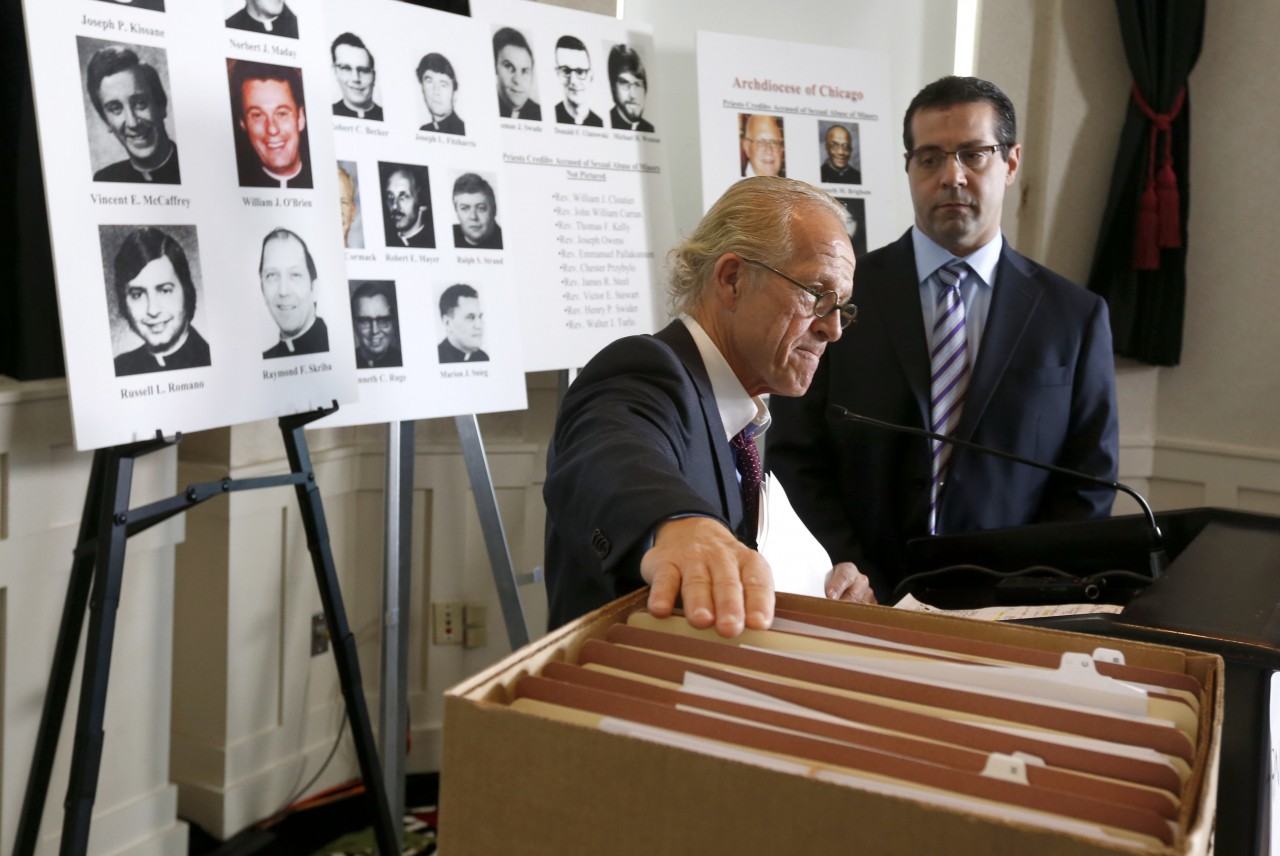
Chicago Clergy Sex Abuse Files Published Online


Attorney Jeff Anderson, left, places his hand on the files of Catholic priests credibly accused of sexually abusing minors in the Archdiocese of Chicago, prior to a news conference Tuesday, Jan. 21, 2014, in Chicago. Joining Anderson is attorney Marc Pearlman. (Charles Rex Arbogast/AP)
          

Rev. Thomas Doyle is a canon lawyer who has been an expert witness on behalf of clergy sex abuse victims. He joins Here & Now’s Robin Young to discuss the contents of the documents.

Guest

  • Thomas Doyle, priest and canon lawyer who has been an expert witness on behalf of clergy sex abuse victims. He also served in the Chicago Archdiocese for seven years.
 Transcript

ROBIN YOUNG, HOST:

And now, a conversation that may not be for all ears. We're going to go to Chicago, where thousands of documents detailing clergy sex abuse allegations were made public just a little while ago today as part of a legal settlement. Attorney Marc Pearlman represents about 200 abuse victims in Chicago.

MARC PEARLMAN: The story today is that these documents reveal that leadership did engage in the systemic cover-up of these matters.

DEBORAH AMOS, BYLINE: They reveal that priests were moved from parish to parish, that they were sent off for treatment and then reassigned, that clerics' histories were hidden from the public. Victims spent nine years pushing for the release of these documents. The AP is calling it the broadest look yet at how one archdiocese responded to the scandal.

YOUNG: Father Tom Doyle is a canon lawyer who's testified as an expert witness on behalf of victims. He worked in the tribunal of the Chicago archdiocese for seven years. He joins us from his home in Virginia. And Father Doyle, obviously so important to the victims, to their backers, but it's almost become a cliche, you know, documents released revealing a cover-up and a scandal. What say you? Why do you see these as important?

THE REV. THOMAS DOYLE: Well, I believe they're important because they continue to report a situation that exists, not just in Chicago but throughout the Catholic Church. And, you know, maximum attention has to be given to the sexual abuse itself but also to the criminal response of the ecclesiastical leadership. This response has caused tremendous harm and pain to the victims. And now in Chicago we see 30, which is less than half of the documented cases that they have on record, 30 files released, which document will prove the legacy of mishandling and dishonestly by the ecclesiastical leadership in the archdiocese for decades, not just now.

YOUNG: Let's hear from one victim, Joe Iacono. He said he was abused by Father Thomas Kelly, whose name is on that list released today.

JOE IACONO: These files - what they mean to me is the truth, not what's coming from the archdiocese even as early as last week when the vicar stood up and said there was no cover-up. Maybe we didn't know what to do, but there was no cover-up. When are they going to learn? There was a massive cover-up.

YOUNG: Father Doyle, who was a part of the cover-up?

DOYLE: I beg your pardon? Who was a part of the cover-up?

YOUNG: Yeah.

DOYLE: The cover-up has to be attributed to the ecclesiastical leadership, to the archbishops and to those who worked closely with them. There would have been no cover-up had the archbishops, from Cardinal George going back as to Cardinal Cody, as far as I know, had they said we'll be completely open and honest, but they didn't. They engineered the cover-up.

YOUNG: Well, you...

DOYLE: They engineered the lying.

YOUNG: You mention Cardinal George, current cardinal. This does not include, this list and these documents that were released today don't include the case, for instance, of Father Daniel McCormack, who pled guilty in 2007 to abusing five children. He is not included in this list.

DOYLE: He is not included in this list. And ironically, when the cardinal sent a letter to his diocese on the 12th of January, he gives - paid specific attention to the case of Dan McCormack. And in that letter, he sent - he told his people things that were simply not true about the McCormack case.

The fact is, is that the review board of the archdiocese very clearly advised the archbishop - urged him not to place McCormack in pastoral ministry, for the welfare and safety of children. This was in 2005. And Cardinal George, against their advice, placed McCormack in ministry. And two to three months later McCormack was arrested for the second time, and that was the end of his career in Chicago.

But the cardinal claimed that he tried to dance around having gone against his review board's advice by saying, well, the investigation wasn't completed. It was confusing. None of this was true. And the review board sent him a letter complaining to him about the fact that his responses were not true.

YOUNG: Well, you talked about who was responsible for a cover-up. The documents don't include Vatican communiques. That was part of the deal the church struck with victims' lawyers. We know the Vatican is being questioned by a U.N. committee. We may someday see those files, what the Vatican said about these cases.

But in the meantime, how angry - in about the minute we have, how angry does this make up priest like you apparently working side by side at one point with one of the accused, not knowing?

DOYLE: How angry does it make - I think from my experience, it makes the good guys very, very angry because they're betrayed essentially by their archbishops. And these are the men whose first focus is the welfare of their people - the spiritual and emotional welfare of the people who they are trying to lead. And when this is violated by the men at the top, it makes - it leaves the priests in the trenches in a very vulnerable position. It's very embarrassing. It's very contrary to everything that's promised to the faithful and to the priests by the bishops and the archbishops.

YOUNG: You worked with Robert Mayer - Bob Mayer, I believe, who was known as Satan. And you were told...

DOYLE: Yeah. He was - that was one of the nicknames I heard given to him when I worked in the archdiocese. I wasn't sure then.

YOUNG: But no one ever told you it was because he was an abuser of minors.

DOYLE: No. No one ever told me that.

YOUNG: Yeah, yeah.

DOYLE: And I never knew about the sexual abuse that he perpetrated until the late '80s.

YOUNG: Yeah. Father Tom Doyle, a canon lawyer who testifies as an expert on behalf of victims as documents are released in Chicago today. Father Doyle, thanks as always.

DOYLE: Thank you.

YOUNG: It's HERE AND NOW.

Transcript provided by NPR.
 

Wednesday, January 29, 2014

But what human skills will be more valuable?


The Opinion Pages| Op-Ed Columnist

What Machines Can’t Do 
As this happens, certain mental skills will become less valuable because computers will take over. Having a great memory will probably be less valuable. Being able to be a straight-A student will be less valuable — gathering masses of information and regurgitating it back on tests. So will being able to do any mental activity that involves following a set of rules.
 
But what human skills will be more valuable?
 
More generally, the age of brilliant machines seems to reward a few traits. First, it rewards enthusiasm. The amount of information in front of us is practically infinite; so is that amount of data that can be collected with new tools. The people who seem to do best possess a voracious explanatory drive, an almost obsessive need to follow their curiosity. Maybe they started with obsessive gaming sessions, or marathon all-night study sessions, but they are driven to perform extended bouts of concentration, diving into and trying to make sense of these bottomless information oceans.
 
In his book, “Smarter Than You Think,” Clive Thompson describes the work of Deb Roy, who wired his house with equipment so he and his team could monitor and record every word he and his wife uttered while his son was learning to speak. That is total commitment and total immersion in an attempt to understand the language learning process.
 
Second, the era seems to reward people with extended time horizons and strategic discipline. When Garry Kasparov was teaming with a computer to playing freestyle chess (in which a human and machine join up to play against another human and machine), he reported that his machine partner possessed greater “tactical acuity,” but he possessed greater “strategic guidance.”
 
That doesn’t seem too surprising. A computer can calculate a zillion options, move by move, but a human can provide an overall sense of direction and a conceptual frame. In a world of online distractions, the person who can maintain a long obedience toward a single goal, and who can filter out what is irrelevant to that goal, will obviously have enormous worth.
 
Third, the age seems to reward procedural architects. The giant Internet celebrities didn’t so much come up with ideas, they came up with systems in which other people could express ideas: Facebook, Twitter, Wikipedia, etc. That is to say they designed an architecture that possesses a center of gravity, but which allowed loose networks of soloists to collaborate.


A young New Square man claims the highly-regarded rabbi and mentor sexually abused him for five years after he went to him for solace after Sept. 11.


New Square sex abuse case of Rabbi Moshe Taubenfeld adjourned for two months

 
Rabbi Moshe Taubenfeld is accused of molesting a boy for five years. (1/28/14)
 
NEW SQUARE - The case of a rabbi accused of molesting a young man in New Square over five years has been adjourned for two months. 

Activists showed up at the first public court appearance last night of Rabbi Moshe Taubenfeld. A young New Square man claims the highly-regarded rabbi and mentor sexually abused him for five years after he went to him for solace after Sept. 11. The allegations reignited claims that other sexual abuse cases have been covered up.

"It's clear that many victims of child molestation in New Square are getting angry at the corruption that allows child molestation to continue," says Rabbi Noson-Leiter of Monsey. Noson-Leiter attended the hearing with other activists who say they want to make sure justice gets served for the alleged victim.

Also at the hearing was Yossi, who shared his story with News 12 last year. Yossi became the first sex abuse victim from New Square to ever seek justice through the courts. Taubenfeld's younger brother, Hershel, was convicted of molesting Yossi, but managed to avoid prison time.
Taubenfeld's attorney is urging the judge to resist comparing his client to his younger brother, saying he's innocent. If Taubenfeld is found guilty, he would likely become the first sex offender from New Square to serve prison time.


Tuesday, January 28, 2014

“It could be a teacher, a neighbor, rabbi, or a priest,”

Orthodox Forum hosts panel on sex abuse


The Jan. 11 event, hosted by the Orthodox Forum of Edison/Highland Park at Congregation Ohr Torah in Edison, featured a four-person panel of law enforcement professionals and child-abuse prevention and prosecution experts.

They laid out a grim picture of the traumatic effect such abuse has on young victims and outlined legal initiatives designed to protect them.

Rabbi Yaakov Luban of Ohr Torah said the panel wasn’t planned in response to any specific cases, but in the interest of community education.

“There are no problems, or at least not any that I’m aware of,” said Luban in a telephone interview after the event. “Fortunately, we don’t have any serious problems in this area, but from time to time the problem comes up, and we felt it was important to keep people informed.”

In the past year, a number of abuse and cover-up cases involving Orthodox clergy and institutions in the New York area have been widely reported in the Jewish and general press. A few of these reflected a reluctance in some fervently Orthodox communities to report abuse to law enforcement.

“One of the things this session addressed was that sex abuse is consistent across the spectrum of religious beliefs,” said Luban. “Religiously and morally, the Orthodox Jewish community abhors this behavior, as should everyone else. We are not insulated.”

Luban, saying he was concerned about cases where false allegations are made, posed a question to the panel about whether every allegation or suspicion should be brought to the authorities.

Union County assistant prosecutor John Esmerado explained that state law requires reporting any suspected sexual abuse of a child to authorities. It is one of a phalanx of initiatives implemented in New Jersey that have cut the number of cases of child sex abuse in recent years.

“Everything done in child protective services is secret,” said Esmerado, a member of the New Jersey Task Force on Child Abuse and Neglect. “Everything the county prosecutor’s office does is secret until the indictment.”

New Jersey has some of the nation’s most comprehensive laws regarding child sexual abuse cases, including placing convicted offenders on lifetime parole.

Citing the massive sex abuse cover-up by the Catholic Church in Boston, Esmerado said, “It couldn’t have happened in New Jersey because of our full disclosure laws. I am asking you to trust our process.”

Lt. Randi Colatrella, who supervises the sex and child abuse, domestic violence, and Megan’s Law units for the Middlesex County Prosecutor’s Office, said in the many years she has worked in the field she has seen offenders come from all ethnicities and walks of life.

“It could be a teacher, a neighbor, rabbi, or a priest,” said Colatrella, who identified herself as Jewish. She said her own Orthodox cousins in New York always ask her what they should tell their children.

Sgt. Raj Chopra, an investigator in the sex crimes unit of the prosecutor’s office, said the hundreds of cases of child sex abuse handled annually by his team are investigated “fairly and thoroughly” with great effort to shield the child, who is identified only by initials.

Shari Reiss, a chaplain at Robert Wood Johnson University Hospital in New Brunswick who has served in administration at several Jewish day schools, served as chair of the event.

“Little data exists, but it seems that while we have not been immune, we haven’t been especially stricken either,” she told NJJN, referring to the Jewish community. “We organized this program hoping to raise awareness of both the problem and of opportunities for prevention by way of education for young people, parents, and their educators.”

Reiss said she was pleased about how the panelists responded to concerns within the community about the rights of alleged abusers, by explaining the system of “checks and balances” used by investigators to protect both the accused and victim.

Reiss said she had received positive feedback from the community. “Numerous questions were asked, and a good number of people asked to speak with the presenters privately after the event. My understanding is that some of our local Jewish schools are now taking steps toward bringing in prevention programs,” she said.

More than 30 percent of victims never disclose their abuse to anyone and as many as 80 percent of cases are never reported to authorities, according to the Middlesex County Child Assault Prevention Project. According to Middlesex CAP, in nearly 70 percent of all reported sex assaults, the victims are children 17 and under and 30-40 percent of those abusers are family members. Another 50 percent are abused by a non-family member they know and trust.

“Three out of four times the child has a relationship with the abuser,” said Esmerado, “and in 96 percent of all sex abuse cases, there is no physical evidence .

“I’ve had children who were raped, burned with cigarettes, tied up, and tortured,” said Kathi Indiviglio, Middlesex County coordinator for NJCAP , who said that in 24 years in child abuse prevention she has learned “the number one thing you can tell your child is that it is not their fault.”
Indiviglio said that “the greatest evidence” that a child has been the victim of sexual abuse is having an unusual amount of knowledge about sexual matters.

“A child that young doesn’t or shouldn’t have experience to know about these things,” she said. “You need to believe them…. You have to provide that safe place where they can tell you anything.”


Wednesday, January 15, 2014

Next year was no better. I had Rabbi Lamm and he would always make me sit on his lap as he would tickle me. It seemed that when I was good, I would get tickled and if I was bad I would also get tickled unless I was really bad.


My name is Shlomo Silber and I am a frum Jew living in Queens. I have a wonderful wife, two beautiful children and, God-willing, another one on the way. I love my job and the community I live in. Recently I have been going through the dilemma of trying to find a school for my older son and I find I am stuck with the hardest decision of my life. When I think of my yeshiva experience, my heart tightens in my chest as I recall those terrible memories.
 
I went to a couple of people and told them that I wanted to write an article, using my name, in which I will would graphically state what was done to me. It is my hope that maybe it will help some of the tortured souls (child or adult) who feel what I felt; it is my hope that it will raise awareness in our community and give strength to those suffering, to open up, come forward and get help. I thought that I would be encouraged. I thought that they would say “We will support you”, and that it is a very brave and admirable thing that I am doing by sharing my pain and experiences, yet the response I got was shocking. I was told they will ruin my business; they will threaten my family, or just get ready for the lawsuits.

 This was very disturbing to me, considering I am just trying to spread a message of awareness to our community. What has become of us if we have this code of silence? And if that silence is broken, will the one who speaks be muzzled with whatever it takes? I have been meaning to write this article for a long time but have always pushed it off. Yet with recent events leading up to the Asifa and hearing the outcry of many children who are now adults who have been abused physically, emotionally and sexually, having seen exposes on TV of entire communities protecting people who hurt children, I thought it is time for me to stand up and speak out and if this has some repercussions, then so be it. Someone has to support those downtrodden and abused souls who are just looking for closure and validation for what has happened to them so they can begin to heal. Minimizing this issue is like telling a Holocaust survivor that the Holocaust never happened or that they should, “Just get over it”. I know this is an extreme statement but unfortunately, it’s true. I get emotional just writing this, thinking back to the days when I was a scared, defenseless child who had no one to turn to. I am writing these events not so that I can defame the frum community, but so that we can rise as a community to protect our children.

 I also would like to shed light on what I feel are misguided solutions to these problems. It is very important to regulate our schools and to bring those responsible for the abuse to justice. But I would like to add one element. How do we as parents respond to the needs of our children, especially while they are dealing with emotional trauma? Most of the articles I have read are based on bringing the abusers to justice. I think this is very important and must be done. While I am saddened by the Mafia-like tactics being used in our communities by those we are supposed to trust and admire, let’s not forget that no matter how bad the world around us is, we are the ones responsible for protecting our children. We must make sure they are safe, always. We must show our children that we trust them and will be there for them if something goes wrong. It is extremely important that your children feel that they can trust you and that they won’t be punished if they open up to you with an issue they are having even if they are in the wrong.

It’s time for me to let you all know what it was like growing up as a child in a “frum” household attending Bais Mikroh of Monsey. The saddest part about this story is that it is not a unique story- it is the story of countless frum children. As I close my eyes I recall the feelings of shame, uncertainty, and terror of my surroundings. I remember walking down the halls of my new school, nervous about starting with a rebbe instead of a morah and meeting so many new kids. I will never forget my first grade substitute, Rabbi Rosengarten, who would snap his belt in our faces and say, “I’ll give you an injection for your infection”. One day with Rabbi Rosengarten I spoke out in Rabbi Rosengarten’s class and he hit me with his belt. Later on that day I went home and told my parents about what had happened and they decided to come down the next day and talk to him. Afterwards, Rabbi Rosengarten came back to class, reached into his desk drawer and took out a marker.

 On the board he drew a straight line bent over at the top half and said, “If a tree is bent over to one side and you want to straighten it out, it’s not enough to just bend it straight because then it will just bend right back. In order to get it straight, you would have to bend it all the way to the left and then it will come back to the middle. So too, if a boy is laughing in class, it is not enough to make him stop laughing because he will just start laughing again. But if you make him cry then he will not laugh again”.

In second grade when I had Rabbi Braun, he would hold our fingers together with one hand and hit the tips of our fingers with a piece of wood that he would kept in his desk solely for this purpose. One day I said something he considered Chutzpahdik and was told to come to the front of the class to receive my punishment. I didn’t want to go up, so he decided to come to my desk. Knowing what was coming, I ducked under my desk. Suddenly, I felt a stinging pain on my backside and shot my head up into the bottom of the desk. A sharp exposed piece of metal cut into my head. When Rabbi Braun saw that blood was dripping down my face, he picked me up and ran me to the bathroom, where he held my head under the faucet. He then brought me back to class with no apology and continued teaching while I held a paper towel to my head. This time, I knew better than to tell my parents. About a week later at home, I bent over to pick something up and my yarmulke fell off. My mother gasped “What is that gash on your head?  to which I replied that I was playing at recess, fell on the wood chips, and cut my head. She said it looked like I should have gotten stitches; I shrugged and went on with my day.

Next year was no better. I had Rabbi Lamm and he would always make me sit on his lap as he would tickle me. It seemed that when I was good, I would get tickled and if I was bad I would also get tickled unless I was really bad. Then he would grab hold of both sides of my cheeks between his thumb and index finger and violently shake my head back and forth. I was not alone in this treatment. I recall many kids in my class getting the tickles and head shakes on a daily basis. By this point in my life, I was far behind my peers in learning and was struggling just to read Hebrew. I would spend most of my days in class daydreaming about being in another place. I was creative and had a strong imagination and yet there was no place for me. Not only was I ridiculed and hit by my Rebbeim, but I was made fun of by my classmates for not being able to read Hebrew. No one ever stepped in to protect me. In class, whenever I was not daydreaming, I was praying that I would not be called on to read the next posuk.

Rabbi Lamm knew that I was struggling and so he called my parents. He told them about a friend who was a great Rebbe and was willing to tutor me at night for free. My parents thanked him and set up an appointment. His friend’s name was Rabbi Shafer.

 I remember my father bringing me to an empty Shul where Rabbi Shafer sat alone under a single dim light and smiled at me as I walked toward him. He told my father to pick me up in an hour. He sat me down, then he got up and locked the front door. He sat back down next to me, put his arm around me, and asked me to read from the Chumash for him. I began to read as he leaned over me. I was a little scared and read nervously for him. My father had gone home and told my mother that it was weird because there was nobody else in the Shul with him. My mother must have had a premonition and told my father to run back and get me. When my father came back to the Shul and the front door was locked, he began to pound on the door. I remember being startled from the inside as Rabbi Shafer got up to see what the banging was about. My father came in and said we had to leave. I was too scared to ever go back, so my parents canceled my tutoring.

By the time I was ten, and I knew that I would run as far away as I could from this lifestyle.

I was very excited to start fourth grade. Rabbi Halpert was a new rebbe and all the kids loved him. Rabbi Singer was the rebbe of the other class and we all knew him as the rebbe who smoked during recess. Rabbi Singer was our substitute rebbe when Rabbi Halpert didn’t come. That year baseball cards were the coolest thing to be into, and we would trade them at recess. I brought all of mine in an empty baby wipe container to show all the kids in class. Rabbi Singer came in and caught us trading cards and confiscated them. He told me they were “Goyish” and he was giving them to Rabbi Bodenheimer the principal.

In the middle of that year I got into a fight at school. They called my parents to come pick me up. I cried to my parents that it wasn’t my fault. My father claimed I was being Chutzpadik and just trying to manipulate the situation and hit me so hard, it left a bruise below my eye. The next day, I told the kids in my class that I had gotten into a fight with Goyim on my block and played myself up as a tough guy. As I came in from recess, Rabbi Halpert stopped me before I entered the classroom. He asked me “How did you get that bruise?” I started to blush and lowered my head. He asked me, “Did your father do this to you”? I mumbled yes. He replied “Good. A father only hits because he loves you. It must mean he really loves you”.

I looked up to some of my friend’s brothers who were “off the derech” and daydreamed about someday being like them. I would fantasize about having friends and actually being loved by someone. I remember pleading with my parents to switch me out of my Yeshiva, but my mother would tell me they would never accept me anyway. I was a disaster at home; I was a disaster at school. The only positive recognition I ever got was when I acted out as the class clown. It came with a heavy price but was worth it. That was the only time I actually existed.

In fifth grade, Rabbi Litmanowitz used to tell me that a Goy could read better than me. That stung me worse than any smack I ever got. That year my yeshiva hosted a Bar Mitzvah for a kid that lived in my neighborhood and I was invited. At the Bar Mitzvah, I went upstairs with a couple of other kids to hang out in my classroom during the speeches. One of the kids who was actually the son of the Rabbi in the Shul I davened at on Shabbos took a marker and wrote a curse word on my Rebbi’s desk. The next day, I was taken out of class by Rabbi Litmanowitz and my principle, Rabbi Bodenheimer. Rabbi Bodenheimer cornered me and asked if I knew anything about what was written on Rabbi Litmanowitz’s desk.

 At first, I said no. Rabbi Bodenheimer called me a liar. After being interrogated for a while I figured, what have I got to lose? The kid was not even in my Yeshiva so what could even happen to him? I told them it was Rabbi Shweitzer’s son. I remember Rabbi Bodenheimer towering over me as he made an astonished face and asked, “Rabbi Shweitzer’s son?” I nodded my head yes. He told me to go to his office and wait for him while he talked to my rebbe. As I walked down the hall, I felt relieved that I actually wasn’t the one in trouble this time. I waited for a couple of minutes outside his office. Rabbi Bodenheimer eventually came and motioned me to follow him into his office. I followed him in and instead of going to sit behind his desk, he closed the door and told me to take off my glasses. The second I removed my glasses, he slapped me hard across the face and told me what a liar I was and asked me how could I make up such horrible lies about such a Tzadick’s son. I was suspended for a week for a crime I did not commit.

I was so broken and damaged by this point that I would come home after getting in trouble and get screamed at and smacked by my parents. I would go up to my room take out my imitation Swiss army knife, carve symbols into my window sill and curse up at God, my parents and my Rebbeim. When I would get into an argument with my parents on Shabbos, I would run up to my room and switch the lights on and off repeatedly, as if I was punishing God for giving me this horrible life.

In the middle of my fifth grade year I found out there was a “special” class and where every day the kids went to 7/11 in their Rebbe’s car to get Slurpees. I went to Rabbi Bodenheimer and asked him if I could be put in the special class. He said to me, “Are you going to behave?” I said yes.

Rabbi Mendlowitz’s class was in a small room all the way at the end of the hall where the “computer room” was supposed to be. There were three other kids in the class and we would be told stories from the Parsha and then we would go in Rabbi Mendlowitz’s red Maxima to 7/11, get Slurpees and then go with him on whatever errands he had to run. We went shopping; we stopped by the occasional garage sale. Looking back I am shocked at how that class ran and that no adult took issue with it. Even in this class, I was not safe. I remember there were days where when Rabbi Mendlowitz would come to class in a bad mood and if I talked Chutzpadik I would get a smack across the face. Then I would not be able to go to 7/11 that day.

I wound up getting suspended a couple of weeks out of every year. It came to the point where as long as I didn’t bother anybody in class or cause trouble I wasn’t paid attention to. My parents were concerned about me getting into constant trouble, so they took me to see a therapist. I was soon diagnosed with ADHD and prescribed Ritalin. I remember taking it the first day and I paid so much attention in class that my Rebbe called my parents to tell them how good I was that day. I felt so terrible; I felt that the only way I could be good was if I took medicine that forced me to behave. I felt like I was crazy. Nobody ever asked me what was bothering me. Instead they just started medicating me so I could be handled. I started to pretend to take my pills and then just quit even pretending to take them. This sparked a feeling in me that I would suffer all throughout childhood and into adulthood. I was the “special kid” in the class and really, I was learning disabled. One Shabbos afternoon, my father was trying to learn with me. I was struggling to get the words out when he blurted out in frustration “Your sister reads better than you”. He was referring to my younger sister, who was mentally disabled.

I was always labeled as a liar and a manipulator in school and at home. Even when I was telling the truth I told I was a “Shokran” (liar). At some point I gave up even trying to argue and defend myself. It was no use and would probably get me into more trouble.

There was a kid in my class named Areah Krauss his whose mother was diagnosed with cancer. I remember how my whole school would say tehillem for her. I became friends with Areah. One afternoon we decided to cut class together and hang out in the back of the school behind the fence. Once things quieted down and all the classes were in session, we jumped back over the fence that separated us from the house next door. We were on the swings when we decided to play a game by tying my left shoe lace to his right shoe lace and swinging together. We were laughing and swinging when the side emergency exit door opened and Rabbi Bodenheimer came through it and screamed “Get to my office now!” We had no chance to run and hide because our shoes were tied together, so Areah took his right shoe off. I walked over to the Rabbi’s office with my friend’s shoe still tied to mine. Rabbi Bodenheimer took Areah into his office as I waited in the corridor. After a couple of minutes, Areah emerged and walked back to class missing one shoe. Rabbi Bodenheimer signaled me to come in to his office. By this point I knew what was coming. Standing before him as he towered over me, he looked eight feet tall. He began to scream at me and tell me how Areah’s mother has “yenah machlah” (Cancer) and that by corrupting Areah, I am making his mother sicker. He then told me in disgust to bend down and untie my shoe. I got down on one knee and began to untie the laces. Next thing I knew I was being struck from every side and I didn’t know what was happening as Rabbi Bodenheimer smacked me with both hands and kicked me. I left his office that day a boy who was evil, learning disabled and in the middle of committing a murder.

I had been left back in pre-1A and therefore I was one of the older kids in my class. I started putting on Teffilin at the end of 7th grade. I was embarrassed about the fact that I was left back because I was older than everybody else yet they all seemed smarter than me and could learn better. It’s such a shame that so many moments and milestones that I should have enjoyed and been proud of in my life, I spent feeling embarrassed and ashamed. One day at Mincha, I was talking to a kid next to me.

Rabbi Gobioff was the eighth grade rebbe who was also in charge of davening decorum. He saw me talking, clopped on the Bimah and told the whole Yeshiva to stop davening. He called me up to the Bimah. Standing up there, he screamed at me in front of my entire yeshiva. He said, “A bochur who puts on teffilin but has no respect for the Kiddusha of davening!” Then he looked at the rest of the Yeshiva who were now all staring at me and said loudly “Bochorim, this is a Perah Adam!” I walked back to my seat smiling like I was proud of what had just taken place, but inside I was slowly dying. It wasn’t soon after that I started day dreaming about taking my own life.

On the first day of eighth grade, I was assigned to a desk in the corner of the room and I was allowed to play video games as long as the sound was off and I didn’t disturb any of the kids in my class. I don’t remember what day it was exactly that I stopped caring and really started looking for the trouble I had been accused of making for all my years of elementary school. Maybe I’d lost my innocence the first time I’d been struck by a teacher when I was small and helpless. Maybe it was during all those endless hours of playing Tetris in the corner in eighth grade, while the sounds of my class around me learning and growing together danced tauntingly on the edge of my awareness. It doesn’t really matter. In March of that year, I was thrown out of Bais Mikroh for good, for a fight I got into with Menachem Garfinkel. I slammed his head into a cinder block wall, and then threw all the contents of his desk out of the classroom window. I spent the end of my eighth grade year sitting in my house, fantasizing about becoming a “Bum”.

My parents told me that I would be going to Adelphia for high school and that I had to promise not to make trouble. I looked them straight in the eye and lied to them with relish. I knew that I had one destiny and that was to be the biggest “Bum” Monsey had ever seen. I started smoking cigarettes and drinking whenever I could get my hands on alcohol. There were some older kids who would go into Lakewood and shoplift. I would go with them and steal things that I didn’t need, just giving the items away when I got back to the dorm. I was finally making friends. On the first night of Chanukah of my ninth grade year, I was woken in the middle of the night by a couple of the cool tenth graders. They told me they were going to the Wawa on Rt. 9 to shoplift. They wanted me to join them. For the record, it’s not very easy to walk into a local Wawa at two o’clock in the morning with three other teenagers to steal candy. This was the first of my many arrests. All I could remember was sitting in the back seat of the police car and feeling that I have finally accomplished something. I was officially a “Bum” and it was the first time I felt accepted as a part of something. That night, I was told to pack my bags and that was the last day I was ever in school.

My parents did not react well to my early departure from high school. They screamed, yelled, threatened, they threw things and they hit me. I would soon be smoking marijuana, snorting cocaine and popping any combination of pills and alcohol at the age of fourteen. I was thrown out of my house at fifteen. In the beginning, I would get calls from my parent’s friends and even a local Rav. I was told to get a haircut and to recognize how much I was making my parents suffer. My older brother’s friend once told me to continue to do what I was doing but to be more secretive about it so I don’t embarrass everybody who knows me.

 By sixteen, I had racked up five arrests. I became a drug mule for a “frum” drug dealer. I was sent to Amsterdam and brought back four hundred thousand dollars’ worth of ecstasy taped to my body with duct tape. When I got back the first time, the drug dealer gave me a hug and a kiss on the cheek and told me that I did a “Great job” and that I’m part of his “family”. He handed me eight thousand dollars cash saying, “Don’t worry; I already took out maaser” (He had also bought me a Tehillem and told me to read it the whole way back on the plane.) A few months later, the drug dealer got arrested and my world crumbled around me.

Somehow I wound up at a Kiruv Yeshivah and became “Shtark”. I got a haircut, grew payos, and started learning three sedarim a day (even though I still had trouble reading Hebrew and had only been keeping Shabbos for about three weeks). I lived this way for a while but still felt a major void in my life, no matter how Frum I was or how much Chessed I did. A friend who had been in therapy was able to see that I was struggling and convinced me to go to therapy as well. When I discussed this with my Rosh Ha-yeshiva, he responded to the therapy with opposition. Thankfully I had one Rebbe who stood by me and helped me make this brave decision and face the demons of my past. After many years of therapy, sorting through my life and facing the past, I have come to realize that I am a person of self-worth and that I genuinely want to do good. This is what gives me the strength and courage to write to you about what I have experienced.

Therapy for me has opened my eyes to what really motivates me. I am able to strip down all the roles I have assumed in life and see the child inside me looking for love and approval from those who were supposed to provide it . It is a grueling process of taking myself back to that classroom, my home and seeing that I was not a bad child, a “shockrin”, a “Mechutziv”. I was placed in those roles by the ones I trusted and loved unconditionally. I was acting the way I did because that’s the only way I knew how to survive. I didn’t know any better and would have believed whatever they told me I was. If only they would have told me that I was smart, kind, and lovable then things would have been very different. Therapy, if done the right way, is an extremely hard and painful process. But the benefits well outweigh the disadvantages and it has enhanced my life as well as the lives of those around me. If someone is suffering from his past and it’s holding him back from living a fulfilling life and being who he wants to be, I would encourage this person seek help.  Seek a therapist that will help him face his past and let go of whatever is holding him back from living a healthy, productive life.

Unfortunately my story is not unique. Even from out of the relatively small group of friends and acquaintances I grew up with in Monsey, many lives are still in shambles. It is our responsibility as parents to stand up for our children and listen to what they have to say. You may think that the Rabbis are to blame for my suffering. That is incorrect, Yes, they were terribly wrong in what they did and have no business being Mechanchim, yet it all begins at home. I was compelled to write this article because I read so many articles with similar stories to mine and all the blame is placed on Teachers, Rebbeim, Gedolim, Alcohol at kiddushim and of course the latest one, the Internet.

 These above items are a danger to a child once he or she is vulnerable to these dangers due to a lack of self-worth- which is cultivated in the home. If I would have had the proper tools and felt safe at home, I would have come to my parents at the first sign of trouble. They would have protected me properly and helped me cope with what I was going through. They didn’t and it snowballed into this tragedy. No school will ever be perfect and there will always be sickos out there looking to hurt our children physically, emotionally and sexually, no matter what community we are in. The only way to protect ourselves is from within. We must face our own demons and work on ourselves. Only then can we pass feelings of self-worth onto our children. My parents each have their issues and only started sorting them out when things started to go very wrong. They have come a long way and are great grandparents to my children but unfortunately, much damage has been done that could have been avoided. We are still slowly putting the pieces back together.

We need to educate our teachers, parents and community leaders about the warning signs of abuse (of every form). We need to educate our children about sex (in the proper way for their age) and that their body is theirs and no one can abuse it ever and if someone ever does, they come to you, the parent. They need to know that they will be listened to, believed, and that they will not get into trouble no matter what the circumstances are. Our children need to feel safe and protected.

After going through all this and sorting out all my issues, I can’t imagine what would have happened had I not gotten help. I am really thankful to all those that have helped me realize the good within myself. I never knew what real happiness was until I went to therapy and faced my issues. I think that it is important to get rid of the stigma that we don’t need help and all we have to do is not speak Loshon Hara, learn, daven and give Tzeduka.

These are important elements but we must know that it is important to face specific issues that we are having trouble with. Sometimes these issues can only be resolved with the help of professionals. Judaism is a beautiful way of life for some and a daunting task for others, one filled with guilt and shame due to their upbringing. We have to stop pretending that we are a perfect people and that nothing is wrong with ourselves or our communities. The only way that we will ever progress is if each and every one of us looks in the mirror and decides to love and accept the person staring right back at them. Love the imperfections, accept the uncertainty and not judge one another. We should greatly respect any person who tells us he has demons and that he is working on accepting himself for who he is right now, and is striving to grow, on whatever level he is at.

Trying to cover up the issues in our community and in ourselves is just foolish and will only backfire. I hope this article helps us come together and start taking the steps we need to accept ourselves, one another, and to start healing as individuals and as a people.

This post originally appeared on Facebook here.
This post may be shared in its entirety .

Sunday, January 12, 2014

A cancer that threatens the clergy sex abuse victims: Religious believers are lobbying to build barriers around themselves and their institutions so that they can operate autonomously from the law.


2013: The Year in Review for Child Sex Abuse Victims’ Access to Justice

Blind Justice

                                                                                                                                                                 Child sex abuse victims, their families and friends, and, frankly, everyone except perpetrators and those who enable them, should be pleased about the progress toward victims’ access to justice in 2013. This past year, the pace of the movement quickened remarkably.

Sadly, though, religious groups have gone back to the drawing board to find new ways to protect themselves from the law, so there is also a cloud on the horizon for victims as well.

We need civil-rights advocates, children’s advocates, and survivors and their communities to work hard to make 2014 even better than 2013, and if we all work together, the prospects of our doing so are good.

The New Barriers Appearing in Some States for Clergy Abuse Victims

While survivors break down barriers to justice for all victims in many states, there is a disturbing new development spreading across the country like a cancer that threatens the clergy sex abuse victims: Religious believers are lobbying to build barriers around themselves and their institutions so that they can operate autonomously from the law.

As I have discussed in many columns, the Religious Freedom Restoration Act (RFRA) is sheer folly, and the state versions of the legislation are no better. They give religious actors who otherwise would be liable for breaking the law a defense that makes it easier for them to violate just about any law they prefer to ignore. (As I discuss in this column, the federal RFRA is the operative law in the contraception mandate cases pending at the Supreme Court.)

New iterations of the state RFRAs are even worse than the original versions. In the vast majority of the state RFRAs, believers at least have to show that a law imposes a “substantial burden” on their religious exercise. That has been a standard that has made it unlikely that they can overcome every law they challenge.

Courts have read the word “substantial” as though it has meaning, which means believers have not always won under the RFRAs. That has not satisfied the apparently insatiable demand by believers to be laws unto themselves. In new iterations, therefore, religious lobbyists have removed “substantial.” So any burden, however minor, could trigger the right to overcome the law. Kentucky actually passed such a misguided bill over the saner veto of its Governor. For good reason, this version of a state RFRA got no traction in Texas. Other states are considering it, though. Currently, in Ohio and Maine, the state legislatures are considering similar legislation that would create a new RFRA without the requirement of the term “substantial” modifying “burden.” This reduction in the burden on the believer would increase litigation, endanger the vulnerable, and further lead United States religious believers down the dangerous path of the Me-Me-Me generation I described in this column.

There seems to be no limit on the creativity of religious lobbyists in this era to find new ways to permit religious groups to break the law; there is yet another new and troubling RFRA mutation pending in Tennessee. This bill would build even higher walls around religious believers intent on breaking the law.

Under the typical RFRA, if the believer succeeds in proving that the law imposes a “substantial burden” on religious conduct, the burden shifts to the government to prove that the law serves a “compelling interest” by the “least restrictive means.” That is an extremely difficult burden for the government to carry, which means if the believer prevails in proving his or her burden, the odds are high the believer will not be required to abide by the law, no matter what the law is. The new Tennessee RFRA bill would pile yet another requirement onto the government: It would also have to satisfy its heavy burden with “clear and convincing evidence.” This is a formula for religious groups to simply ignore all state laws.

These new additions to these extreme religious liberty bills will make religious organizations and believers virtually bulletproof from the claims of the victims of clergy abuse in these states. Make no mistake about it: religious lobbyists fighting for RFRAs believe that believers belong above the law, and don’t want to talk about the vulnerable who are inevitably hurt by such regimes.

The harm arising from RFRAs doesn’t stop with child-sex-abuse victims, though, as these extreme state RFRAs will also open doors to immunize religious believers (whether they are parents, or institutions like churches, schools, or camps) from medical-neglect and child-abandonment claims, and a host of other crimes and torts.

 The sponsors of the legislation in each state appear to be sincerely interested in doing good, but in fact, they are paving the way to extraordinary harm and evil, and the last people who will explain to them what religious believers have done and can do to children and others are those lobbying for the RFRAs.

In sum, 2013 was a good year in a number of states where child sex-abuse victims will find it easier to get to court in the future. 2014 should be even better. The remaining concern, though, is that once clergy-sex-abuse victims get there, extreme religious liberty statutes will immunize believers and their institutions from being legally responsible for the crimes that they have committed and the harm they have done. For this and other reasons, there is still much work to be done by good people.
 
Marci A. Hamilton

Marci A. Hamilton is a professor of law at Cardozo School of Law, and the author of Justice Denied: What America Must Do to Protect Its Children, which was just published in paperback with a new Preface. She also runs two active websites on issues she writes about frequently, www.sol-reform.com and www.RFRAfolly.com. Her email address is Hamilton02@aol.com.


READ MORE: