EVERY SIGNATURE MATTERS - THIS BILL MUST PASS!

EVERY SIGNATURE MATTERS - THIS BILL MUST PASS!
CLICK - GOAL - 100,000 NEW SIGNATURES! 75,000 SIGNATURES HAVE ALREADY BEEN SUBMITTED TO GOVERNOR CUOMO!

EFF Urges Court to Block Dragnet Subpoenas Targeting Online Commenters

EFF Urges Court to Block Dragnet Subpoenas Targeting Online Commenters
CLICK! For the full motion to quash: http://www.eff.org/files/filenode/hersh_v_cohen/UOJ-motiontoquashmemo.pdf

Tuesday, February 03, 2015

Another One For You *Sam* Measles Hurts Children Bad! Your Stupidity & Recklessness With People's Lives Are Well Documented - ONCE AGAIN!


Dr. Michael Tosi, chief of pediatric infectious diseases at the Kravis Children's Hospital at Mount Sinai in New York City, said, "Any concerns or claims about a connection between measles vaccine and autism in young children have absolutely no scientific basis and have been entirely discredited."

Centers for Disease Control and Prevention (CDC) Director Tom Frieden on Sunday warned that the U.S. could see a "large outbreak" of measles.

"We are very concerned by the growing number of people who are susceptible to measles, and the possibility that we could have a large outbreak in this country as a result," Frieden said on CBS's "Face the Nation."

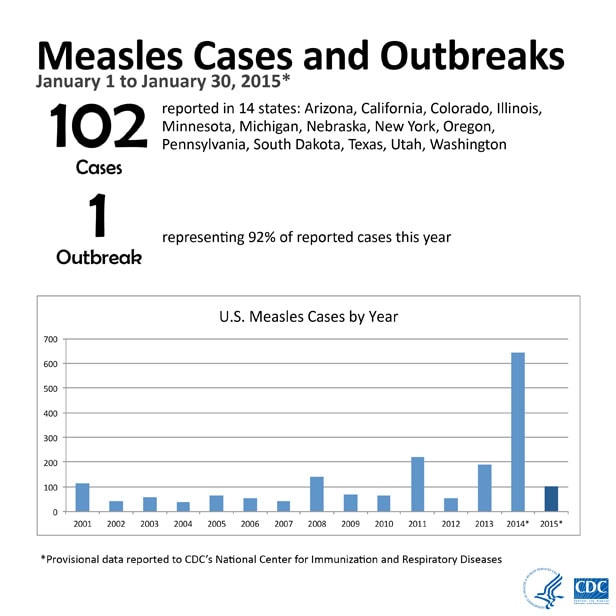
 There are at least 102 reported cases in 14 states, according to the CDC. Frieden said that the U.S. is "likely to see more cases."

Frieden said there is "aggressive public health action" to identify those with measles, isolate those sick and quarantine those who have been exposed.

But he said the best way to prevent the spread of measles was vaccination.

Frieden said despite the U.S.'s 92 percent vaccination rate, there is growing evidence more parents are not vaccinating their children.

"What we’ve seen is, as over the last few years, a small but growing number of people, have not been vaccinated. That number is building up among young adults in society, and that makes us vulnerable," he said.
Frieden acknowledged that some parents are concerned about the safety of vaccines, or think measles no longer exists.

"One in six kids could have a fever ten days after, but the vaccine is safe and effective. And for those parents that may think that measles is gone, it’s still here, and it can be quite serious," he said.

Frieden also appeared on ABC's "This Week," urging parents to vaccinate their children.

"What you do for your own kids doesn't just affect your family. It affects other families as well," he said. "The more kids who are not vaccinated, the more they're at risk and the more they put their neighbors' kids at risk as well.”

http://thehill.com/policy/healthcare/231394-cdc-director-warns-of-measles-outbreak


State Vaccination Requirements

In the U.S., the Food and Drug Administration (FDA) regulates and licenses all vaccines to ensure safety and effectiveness. No federal vaccination laws exist, but all 50 states require certain vaccinations for children entering public schools. Depending on the state, children must be vaccinated against some or all of the following diseases: mumps, measles, rubella, diphtheria, pertussis, tetanus, and polio.

State Vaccination Requirements

  • Database of State Immunization Laws for Healthcare Workers and Patients 
    This tool contains results from a 50-state legislative review of laws requiring assessment of vaccination status and vaccine administration for healthcare workers and patients/residents. The review was conducted by CDC in 2005 and collected data on laws for the following types of facilities: hospitals, ambulatory care facilities, individual providers' practices, correctional facilities, and facilities for the developmentally disabled.

School Entry Requirements -- By State or By Disease


Related Pages

Measles Cases and Outbreaks

Measles Cases

From January 1 to January 30, 2015, 102 people from 14 states were reported to have measles*. Most of these cases are part of a large, ongoing multi-state outbreak linked to an amusement park in California. On January 23, 2015, CDC issued a Health Advisory to notify public health departments and healthcare facilities about this multi-state outbreak and to provide guidance for healthcare providers nationwide. For more information see CDC Press Briefing Transcript:Measles in the United States, 2015, January 29, 2015.
* CDC will update this data weekly on Mondays.
The United States experienced a record number of measles cases during 2014, with 644 cases from 27 states reported to CDC's National Center for Immunization and Respiratory Diseases (NCIRD). This is the greatest number of cases sincemeasles elimination was documented in the U.S. in 2000.
Measles cases and outbreaks from January 1-November 29, 2014. 610 cases reported in 24 states: Alabama, California, Connecticut, Hawaii, Illinois, Indiana, Kansas, Massachusetts, Michigan, Minnesota, Missouri, Nebraska, New Jersey, New Mexico, New York, Ohio, Oregon, Pennsylvania, Tennessee, Texas, Utah, Virginia, Wisconsin, and Washington. 20outbreaks representing 89% of reported cases this year. Annual reported cases have ranged from a low of 37 in 2004 to a high of 220 in 2011
  • The majority of the people who got measles were unvaccinated.
  • Measles is still common in many parts of the world including some countries in Europe, Asia, the Pacific, and Africa.
  • Travelers with measles continue to bring the disease into the U.S.
  • Measles can spread when it reaches a community in the U.S. where groups of people are unvaccinated.

Monday, February 02, 2015

“It’s not just about you. You’re part of a social order. You’ve got to make your own contribution to it. You can’t opt out.

Should Vaccination Be a Personal Choice?

By 
WebMD Health News
Reviewed by Hansa D. Bhargava, MD
Jan. 29, 2015 -- As a measles outbreak linked to Disneyland continues to spread, a backlash against parents who refuse or delay vaccination for their children has risen to a fever pitch.
More and more pediatricians say they are "firing" patients who decide not to vaccinate. On social media, angry parents engage in heated debates about the decision not to vaccinate. One columnist suggested parents who don’t vaccinate their kids should go to jail. And at least one well-known infectious disease expert called for states to make it tougher for parents to opt out of the shots.
“It’s not just about you. You’re part of a social order. You’ve got to make your own contribution to it. You can’t opt out. This is a stronger statement than I’ve ever made to the media. But I think we should become increasingly intolerant of parents opting out,” says William Schaffner, MD. He's a professor of preventive medicine at Vanderbilt University in Nashville, TN.
There’s good reason to be angry. Diseases like whooping cough and measles, which had been all but wiped out in this country, are making a comeback. In 2014, 644 people caught measles in the U.S., the most in more than two decades, according to the CDC. With nearly 60 cases in seven states connected to Disneyland so far this year, 2015 might be on pace to be even worse.
“It’s only January and we’ve already had a very large number of measles cases. This worries me,” says Anne Schuchat, MD. She's the director of the CDC’s National Center for Immunization and Respiratory Diseases. She spoke at a press briefing on the outbreak and urged children and adults to get vaccinated.
Experts say preventable diseases like these are gaining a foothold again because many parents have taken advantage of laws in 48 states that allow families to skip or delay the shots for religious or personal reasons.
“Ten to 20 percent delay the shots. One to 2 percent choose not to vaccinate at all,” says Paul Offit, MD, director of the Vaccine Education Center at The Children’s Hospital of Philadelphia.
That wouldn’t be so bad if they were evenly distributed across the U.S., putting an unvaccinated kid here or there. But people who decide to go unprotected tend to cluster in groups.
1 | 2 | 3 | 4 | 5 

Sunday, February 01, 2015

Vaccines help develop immunity by imitating an infection, but this "imitation" infection does not cause illness...

How Vaccines Prevent Diseases

The diseases that vaccines prevent can be dangerous, or even deadly. Vaccines reduce the risk of infection by working with the body's natural defenses to help it safely develop immunity to disease.
When germs, such as bacteria or viruses, invade the body, they attack and multiply. This invasion is called an infection, and the infection is what causes illness. The immune system then has to fight the infection. Once it fights off the infection, the body is left with a supply of cells that help recognize and fight that disease in the future.
Vaccines help develop immunity by imitating an infection, but this "imitation" infection does not cause illness. It does, however, cause the immune system to develop the same response as it does to a real infection so the body can recognize and fight the vaccine-preventable disease in the future. Sometimes, after getting a vaccine, the imitation infection can cause minor symptoms, such as fever. Such minor symptoms are normal and should be expected as the body builds immunity.
Read more about how vaccines work in the Parents Guide to Childhood Immunizations Adobe PDF file [1.84 MB, 6 pages].
http://www.cdc.gov/vaccines/parents/vaccine-decision/prevent-diseases.html
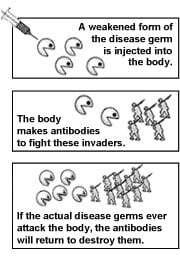
Look at these illustrations to better understand how vaccines protect children from diseases:
A weakened form of the disease germ is injected into the body.  The body makes antibodies to fight these invaders. If actual disease germs ever attack the body, the antibodies will still be there to destroy them.

Friday, January 30, 2015

Measles is no harmless little illness. Around the world it causes 400 deaths a day, 16 deaths an hour. It’s one of the leading causes of death among children. Among those who survive, it can cause pneumonia, brain damage and hearing loss....

Low Vaccination Rates at Jewish Schools in CA

Is putting other kids’ health at risk really a Jewish value?


As you surely know by now, measles—once essentially eliminated in America—is again becoming an epidemic. According to the Centers for Disease Control and Prevention, the number of cases in the U.S. is at a 20-year high. In the recent outbreak at Disneyland, the vast majority of the victims were unvaccinated.

California in general is chock full of crunchy clusters of people who refuse to vaccinate. A study published earlier this month found five areas in the Golden State with stratospheric rates of unvaccinated or under-immunized kids: Northeastern Sacramento County and Roseville (5.5 percent); Marin and Southwest Sonoma (6.6 percent); Northeast San Francisco (7.4 percent); an area from Alameda to El Cerrito (10.2 percent) an area south of Sacramento (13.5 percent). The statewide average vaccine refusal rate, outside these areas, is 2.6 percent.


 To achieve herd immunity, in which the percentage of people who are vaccinated is high enough to protect the unvaccinated, 94 percent of the population has to be immunized against the measles.

Measles is no harmless little illness. Around the world it causes 400 deaths a day, 16 deaths an hour. It’s one of the leading causes of death among children. Among those who survive, it can cause pneumonia, brain damage and hearing loss. As health writer Dan Diamond pointed out in Forbes yesterday, you’re 35,000 times more likely to die from measles than to win at Powerball. An unvaccinated baby in a room with someone who has measles, however, has way more impressive odds: he has a 90 percent chance of developing the virus. (Crowded places like Disney and or a classroom mean a fabulous chance of transmission. And if you have measles, you have four glorious days in which you’re contagious before you even develop symptoms.)

Pertussis is a terrible disease too. Before the availability of a vaccine in the 1940s, it was a major cause of child mortality in the U.S.; in developing countries it still causes 195,000 deaths a year. And it’s miserable: The disease makes children cough so hard they may break ribs. And yet in 2014 there were 8,000 pertussis cases in California. Two babies died.

You would think that Jews, with our values of tzedek, tzedek tirdof (“righteousness, righteousness shall you pursue”) and al tifrosh min hatzibur (“don’t view yourself as separate from your community”), as well as our general proficiency in the areas of health and medicine, would be all over vaccination. You would think that since our sage Reb Nachman of Breslov (who died in 1810 of tuberculosis, back in pre-TB-vaccine times) wrote, “One must be very, very careful about the health of children… One must inoculate every baby against smallpox before one-fourth of the year, because if not, it is like spilling blood,” we’d be vaccinating fiends all up in this joint.

You would be wrong. As I’ve written repeatedly in Tablet and elsewhere, Jews are opting out of vaccination—either partially or entirely—in serious numbers.

There’s no halakhic (Jewish law-based) reason for this. In 2005, the Conservative Movement’s governing body, the Rabbinical Assembly, ruled that Jewish Day Schools can, in accordance with halakha, make immunization compulsory. And Orthodox Jews who believe Judaism encourages opting out should heed the full-throated call to vaccinate from David Shabtai of Boca Raton Synagogue: “Jewish law cannot serve as a basis for a religious exemption for vaccination. Claiming that it does is a perversion of both logic and religious law.”

And yet. Jewish actresses, from Big Bang Theory co-star Mayim Bialik (who has a Ph.D. in neuroscience!) to Lloyd-Dobler-pen-bringer Ione Skye (author of a children’s book about Yiddish, and married to Jewish musician Ben Lee), have turned up their noses at evidence-based medicine. (Skye has stated that skipping some vaccines makes “instinctive sense”: “As a mother, it just felt better to me—and my kids never had any reaction.”) Thank heaven for Amanda Peet! Author of a forthcoming children’s book about being Jewish at Christmastime, wife of novelist and Game of Thrones showrunner David Benioff, activist with the United Nations Shot@Life campaign, and star of the new HBO series Togetherness, she’s also the parent of a child who contracted pertussis between her second and third doses of the vaccine. “I know a lot of parents who stagger their kids’ vaccines,” she told The Hollywood Reporter last year. “Their position is, ‘Hey, why are you so gung ho on tanking your kids with all those vaccines?’ They act almost concerned for me, and I want to say, ‘Wait a minute, your children are actually benefiting from the barrier I’m putting in place for them, and now you’re questioning my soundness of mind for doing that?’”

Alas, Peet often seems to be a voice in the wilderness. The California Department of Public Health recently created a public database of immunization levels in all California schools, public, private and parochial, and KQED’s California Report turned it into an easily searchable tool.


 I plugged in the names of the 68 schools in Private School Review’s list of Jewish elementary schools in the state and found 14 with nosebleed-inducing levels of vaccine refusal. Here is the list of schools (only elementary schools that have kindergartens are in the database) and their Personal Belief Exemption (PBE) rates. Remember, six percent is the threshold for herd immunity. 

Abraham Joshua Heschel Day School, Northridge: 18 percent
Adat Ari Day School, Valley Village: 13 percent
Bais Chaya Mushka Chabad, Los Angeles: 11 percent
Brandeis Hillel, San Rafael, 8 percent
Cheder of Los Angeles, Los Angeles: 12 percent
Cheder Menachem, Los Angeles 9 percent
Contra Costa Jewish Day School, Lafayette: 19 percent
Emek Hebrew Academy Teichman Family Torah Center, Sherman Oaks: 8 percent
Hebrew Academy Huntington Beach: 18 percent
Harkham Hillel Hebrew Academy: 10 percent
Ilan Ramon Day School Agoura: 13 percent
Kabbalah Jewish Academy, Los Angeles: 75 percent
Tehiyah Day School in El Cerrito: 13 percent
Valley Beth Shalom Day School, Encino: 18 percent

Three more schools had no data available: Oakland Hebrew Day School, Torat Hayim Academy and Yeshiva Rav Isacsohn Torath Emeth.

As Diamond points out in Forbes, the work of Dartmouth political scientist Brendan Nyhan has shown that presenting credible scientific evidence to anti-vaccine parents only makes them dig in their heels. American Journal of Public Health editors Dr. Kenneth Camargo Jr and Roy Grant have proposed a different approach: using pro-vaccine experts and activists who are not scientists as educators. People who get PBEs are people who tend to distrust public health experts, so using people with “interactional expertise” as communicators, instead of relying on doctors and scientists to spread public health messages, might be effective.

If the carrot doesn’t work, perhaps the stick will. Lawmakers are discussing tightening the rules for receiving PBEs. Ethicist Arthur Caplan has explored the idea of suing or criminally prosecuting non-vaccinators for causing illnesses. Me, I’m open to suggestions.

Come on, Jewish parents. Let’s be a light unto the nations.

http://tabletmag.com/scroll/188686/low-vaccination-rates-at-jewish-schools-in-california?utm_source=tabletmagazinelist&utm_campaign=a2954f780a-Friday_January_30_20151_30_2015&utm_medium=email&utm_term=0_c308bf8edb-a2954f780a-206530521

Thursday, January 29, 2015

Muslim Demographics!

 This is a must hear and send to every person we know and it still might be too late for our children

Subject: How the world is changing Muslim world population dominance

 This is a very frightening video...a must see !!
 

Wednesday, January 28, 2015

Saudis & Women... No different than the "ultra"- Orthodox crazies!

SAUDI ARABIA TV BLURS OUT FLOTUS MEESKITE FACE


A small furor has erupted over whether a Saudi television station blurred out the image of U.S. first lady Michelle Obama in the broadcast of her and President Barack Obama’s meeting with new Saudi King Salman today in Riyadh. Saudi officials deny the claim.
The new king shook hands with President Obama at the Erga Palace but didn’t acknowledge the first lady during a brief meeting at the funeral for King Abdullah. Barack and Michelle Obama cut short their trip to India to attend the funeral.  
Several videos posted on Saudis' Facebook pages obscured Michelle Obama's face. They were removed shortly after they were posted. I captured a screenshot of one such video before it was taken down. The Arab news service Mashahead posted on YouTube a video allegedly taken from the Saudi government television broadcast showing the blurred spot.
However,  Nail al-Jubeir, information director at the Saudi Embassy in Washington, e-mailed me that "Saudi TV has been showing the total arrival ceremony at the airport and at the Palace and nowhere is anything blurred." CNN's Hala Gorani tweeted that her colleague Nic Robertson, in Riyadh, saw non-blurred images on Saudi TV. Other news organizations, such as Al Jazeera, showed the meeting without obscuring Michelle Obama’s face.

The alleged blurring wasn't the only controversy.  Some Arab media outlets criticized Michelle Obama for wearing a blue dress, rather than a black one. Videos of the short meeting between Salman and President Obama showed the king leaving in the middle of the protocol, abruptly turning around and walking away, in order to go to prayer.
After the meeting, Barack Obama and Salman held a bilateral meeting that included Secretary of State John Kerry, Senator John McCain, National Security Adviser Susan Rice, Ambassador Joseph Westphal and CIA director John Brennan.
According to the White House pool report, “Obama and Salman sat in gold chairs. A small table in front of them held a spray of white flowers.”
Obama praised the late king in a statement following his death, saying “King Abdullah's vision was dedicated to the education of his people and to greater engagement with the world.” In an interview with CNN before the visit, Obama explained why he was hesitant to press the new king about Saudi Arabia’s human rights record, which includes restricting the rights of women.
"Sometimes we have to balance our need to speak to them about human rights issues with immediate concerns that we have in terms of countering terrorism or dealing with regional stability," Obama said.
(Updates with comment from Saudi embassy in third paragraph.)
To contact the author on this story:
Josh Rogin at joshrogin@bloomberg.net
To contact the editor on this story:
Tobin Harshaw at tharshaw@bloomberg.net


Newspaper in Israel Scrubs Women From a Photo of Paris Unity Rally


JERUSALEM — Chancellor Angela Merkel of Germany was right there next to the president of France on Sunday, marching through the streets of Paris for all the world to see — all the world, that is, except the readers of an ultra-Orthodox newspaper in Israel.

MORE:
http://www.nytimes.com/2015/01/14/world/newspaper-in-israel-scrubs-women-from-a-photo-of-paris-unity-rally.html?_r=0

Tuesday, January 27, 2015

Even a small number of unvaccinated people (Jews Included) can make it much easier for a disease to spread.


On the heels of the measles outbreak at Disneyland, Melinda Gates of the Bill and Melinda Gates Foundation took aim at the vaccine naysayers who make these types of disease outbreaks more likely.
"We take vaccines so for granted in the United States," Gates told the Huffington Post in a prerecorded interview published on Thursday. "Women in the developing world know the power of [vaccines]. They will walk 10 kilometers in the heat with their child and line up to get a vaccine, because they have seen death. [Americans have] forgotten what measles deaths look like."
She added, "I'd say to the people of the United States: we're incredibly lucky to have that technology and we ought to take full advantage of it."
In response to the Disneyland outbreak, pediatric infectious disease specialist James Cherry told the New York Times the outbreak was "100 percent connected" to the anti-vaccine movement. "It wouldn’t have happened otherwise — it wouldn't have gone anywhere," he said.
The key is what the scientific community calls herd or community immunity. If every American of age was vaccinated, measles wouldn't spread much further even if foreign travelers came into the country with the disease — as appears to be the case with measles. Vaccinated people essentially act as barriers to measles outbreaks, since the disease can't pass through them and infect other people. The awful truth of the anti-vaccine movement is that it puts the most vulnerable populations at risk: infants under 12 months of age, who can't get vaccinated and are more susceptible to infection, and the elderly, who have a higher risk of death if they contract these illnesses.

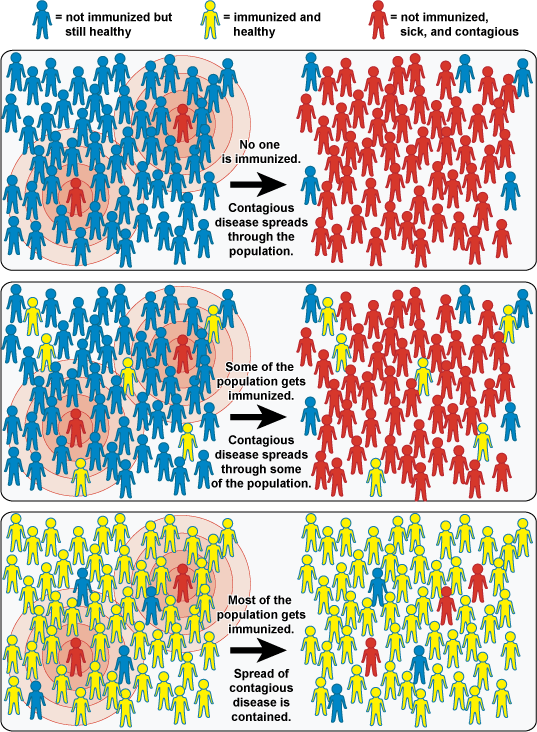
What happens when some people don’t get vaccinated?

Even a small number of unvaccinated people can make it much easier for a disease to spread.
To explain this phenomenon, scientists often refer to herd or community immunity, a coverage threshold that effectively prevents an illness from spreading.
If no one is immunized, a disease can easily bounce from person to person until it reaches everyone. If some people are immunized, the immunized people act like buffers that prevent a disease from spreading through them. If enough people are immunized, the buffers essentially become impenetrable and a disease can't realistically spread at all.
community immunity
The threshold for community immunity depends on the disease and how it's transmitted. In an analysis of several vaccine-treatable illnesses, the CDC setthe lowest threshold of vaccine coverage at 75 percent — for mumps — and the highest at 94 percent — for measles and rubella. Even the low-end threshold requires at least three in four people — and often children in particular — to get vaccinated.