EVERY SIGNATURE MATTERS - THIS BILL MUST PASS!

EVERY SIGNATURE MATTERS - THIS BILL MUST PASS!
CLICK - GOAL - 100,000 NEW SIGNATURES! 75,000 SIGNATURES HAVE ALREADY BEEN SUBMITTED TO GOVERNOR CUOMO!

EFF Urges Court to Block Dragnet Subpoenas Targeting Online Commenters

EFF Urges Court to Block Dragnet Subpoenas Targeting Online Commenters
CLICK! For the full motion to quash: http://www.eff.org/files/filenode/hersh_v_cohen/UOJ-motiontoquashmemo.pdf

Thursday, February 05, 2015

What about students who are not learning disabled, but are just not interested in academics? What about students who may not have the aptitude or desire for schoolwork but have other skills and interests? Are their parents’ goals and aspirations congruent with their desires and abilities? Must every child go to college? Can Jewish parents handle a successful child who doesn’t have a college degree?

The Non-Academic Child: Is It Time to Create Kosher Vo-Tech Schools?

We’ve all heard the old jokes about proud Jewish mothers bragging about “my son the doctor, my son the lawyer,” etc. We also know the widespread belief that Jews are smart and, truth be told, we do have a disproportionate percentage of Nobel Prize winners relative to our numbers. We ought to be proud of our children who go on to distinguished careers in so many professions. The nachas is always multiplied when that successful child is also proud and unashamed of his/her heritage.
Educators can always spot children with great potential early on. Not just the rare gifted and talented students, but those with great aptitude, motivation, and love of learning—be it for math, science, Talmud, art, or creative writing. Schools have made great progress in the area of differentiated learning to provide for the individual needs of all students.
Many parents want their children to go to college and follow a career path that includes graduate school. This is as it should be for the average and above average student. Students with developmental issues will follow a different path. There is still much to be done in this area, but progress is being made.
What about students who are not learning disabled, but are just not interested in academics? What about students who may not have the aptitude or desire for schoolwork but have other skills and interests? Are their parents’ goals and aspirations congruent with their desires and abilities? Must every child go to college? Can Jewish parents handle a successful child who doesn’t have a college degree?
In many countries only those who are academically qualified by virtue of a standardized examination are allowed to enter university. Those who do not qualify follow another career path. In the pre-modern era it was called an apprenticeship. Young men and women learned a trade and developed skills that led to a livelihood. Today we call it a trade school or vocational training.
Not every child is college material. Literature, math, and science—not to mention rigorous Talmud study—may not be relevant to many children, as important as they may be in general. Why doesn’t the Jewish community operate schools to train young men and women in various trades and occupations that are needed and used by everyone? They can attend secular vocational training schools, but a Jewish school would be sensitive to issues of kashrut, Shabbat and holidays, co-ed classes, mincha breaks, etc. If there were a Jewish vocational high school, courses would include practical limudei kodesh. In addition, a Jewish school in a Jewish community provides many opportunities for networking and employment.
Many of these occupations can yield a very good income: computer repair, website design, diamond sorting and cutting, electricians, plumbers, graphic designers, contractors, HVAC engineers, auto repair, beauty, grooming and fashion trades, real estate brokers, insurance agents, appliance repairmen, civil servants, building trades, food service, agricultural careers, and the list goes on. It is not at all unusual to find Orthodox and ultra-Orthodox Jews in these professions.
We tend to think of vocational education as being outside educational enterprise and often in pejorative terms. The result is that vocational schools are underutilized. If Jewish stand-alone vocational schools are too far off on the horizon, vocational training can become an acceptable track in our high schools. We can restructure the relationship between academic and vocational education. Integration need not focus heavily on “high tech” vocational programs to the exclusion of more traditional vocational education. Mainstream educational and cognitive research has just started to address the potential value of efforts to integrate or align academic and vocational curricula.
Educational researchers, theorists, and policymakers have thus far failed to consider vocational education seriously—in combination with applied academics—as part of the solution for improving educational outcomes for non-college-bound youth. Perhaps because of the stigma attached to vocational education—or more likely because vocational education does not typically show up on the mainstream education or psychology researcher’s radar screen—the logical connections between theories or observations and the types of learning opportunities offered by vocational education are overlooked.
Many years ago, Dr. Howard Gardner of Harvard University challenged the idea that human intellect is a unidimensional, overarching faculty. Instead, he articulated a theory of “multiple intelligences,” suggesting that, at a minimum, there are seven different ways in which an individual can be intellectually talented. Gardner does not dispute the need for a core curriculum that transmits the critical elements of our common culture to all students. He argues that our tunnel vision in how we deliver the common culture in the classroom is costing us a great loss of human talent. So long as a uniform curriculum is embraced, most individuals are destined to emerge as untalented. Not only is there little room at the top, but standardized regimens tend to favor individuals who exhibit certain intellectual profiles, ones which may be valuable for the aforementioned curricula but need not signal success outside the school setting.
This is not a novel idea, but we as a community—and especially the ultra-Orthodox community— have failed this segment of the population. Surely somewhere out there is an investor or group of investors who see the business potential of operating such a school or network of schools. It could help the Jewish community in myriad ways.
Suffice it to say that our future poets and artists, musicians and authors, salesmen and shopkeepers, builders and fixers are the square pegs that don’t always fit into our round holes. Isn’t it time that we as a community offer them the means to further their dreams?
Rabbi Dr. Wallace Greene has had a distinguished career as a Jewish educator. He is currently a consultant to schools and non-profit organizations, and serves as Executive Secretary of The Alisa Flatow Memorial Scholarship Fund. He can be reached at wmg14c@gmail.com.

Wednesday, February 04, 2015

Just How Dumb & Dangerous Is Sam?


In 1998, an esteemed medical journal published a paper with a startling conclusion: that the measles, mumps, and rubella vaccine — administered to millions of children across the globe each year — could cause autism.

This study, led by the discredited physician-researcher Andrew Wakefield, is where the current vaccine-autism debate started. It has since been thoroughly eviscerated: The Lancet retracted the paper, investigators have described the research as an "elaborate fraud," and Wakefield has lost his medical license.

But public-health experts say that Wakefield's false data and erroneous conclusions, while resoundingly rejected in the academic world, still drive some parents' current worries about the MMR shot.

Here are five reasons — and many links to further reading — that should remind you just how terrible his research was.

1) Forget the fraud and data manipulation: the MMR vaccine-autism study was bad science

To begin with, Wakefield's association between the MMR vaccine and autism was based on a case report involving only 12 children. "Case reports" are detailed stories about particular patients' medical histories. And — because they basically just stories — they are considered among weakest kinds of medical studies.

In this case, many children have autism and nearly all take the MMR vaccine. Finding, among a group of a dozen children, that most of them happen to have both is not at all surprising and in no way proves that the MMR vaccine causes autism. (Wakefield also proposed a link between the vaccine and a new inflammatory bowel syndrome, which has since been called "autistic enterocolitis" and also discredited.)

But don't stop with the retracted study. The totality of the evidence opposes this vaccine-autism theory. Large-scale studies involving thousands of participants in several countries have failed to establish a link between the MMR vaccine and the mental developmental disorder. As one of the most thorough studies to date showed, nearly half a million kids who got the vaccine were compared to some 100,000 who didn't, and there were no differences in the autism rates between the two groups. "This study provides strong evidence against the hypothesis that MMR vaccination causes autism," the authors wrote in The New England Journal of Medicine.

Studies published in The Lancet, The Journal of Pediatric Infectious Diseases, PLoS One, and — among others — The Journal of Autism and Developmental Disorders have also found no association between the vaccine and autism.

2) Study author Andrew Wakefield manipulated and misrepresented his data

retracted
(The Lancet)
A British investigative journalist, Brian Deer, followed up with the families of each of the 12 kids in the study. He concluded, "No case was free of misreporting or alteration." In other words, Andrew Wakefield, lead author of the original report, manipulated his data. (See the popup chart in this report for details.)

In The British Medical Journal, Deer spells out exactly what he found, and it's rather shocking that this study was ever published in the first place. You learn that the parents of many of the kids deny the conclusions in the study; some of the kids who Wakefield suggested were diagnosed with autism actually weren't; others who Wakefield suggested were "previously normal"  actually had pre-existing developmental issues before getting their shots.

3) The paper is based on blood samples Wakefield drew at his kid's birthday party

Even more absurdly, when the General Medical Council (the UK's medical regulator) began to investigate Wakefield, they found that he had paid children at his son's 10th birthday party to donate their blood for his research. That isn't exactly a controlled and ethical setting.

In fact, in deciding to take his UK medical license away, the GMC said Wakefield acted with "callous disregard for the distress and pain the children might suffer."

4) Wakefield filed a patent for an MMR vaccine alternative

Wakefield also had financial conflicts of interest. Among them, while he was discrediting the combination measles-mumps-rubella vaccine, and suggesting parents should give their children single shots over a longer period of time, he was conveniently filing patents for single-disease vaccines.

"For the vast majority of children, the MMR vaccine is fine," he said, "but I believe there are sufficient anxieties for a case to be made to administer the three vaccinations separately." He also suggested the long-term safety studies of the MMR shouldn't be trusted.

Brian Deer
's investigation revealed that, in June 1997, he had filed a patent for a supposedly "safer" single measles vaccine. Deer writes, "Although Wakefield denied any such plans, his proposed shot, and a network of companies intended to raise venture capital for purported inventions — including 'a replacement for attenuated viral vaccines', commercial testing kits and what he claimed to be a possible 'complete cure' for autism — were set out in confidential documents."

5) Wakefield has refused to replicate the paper's findings

At the very bedrock of science is the concept of falsification: a scientist runs a test, gathers his findings, and tries to disprove himself by replicating his experiment in other contexts. When that's done, only then can he know that his findings were true.

autism wakefield
Callous Disregard, Wakefield's book. (Image via Amazon.)

Wakefield has never done this. As the editor of The BMJ points out, "Wakefield has been given ample opportunity either to replicate the paper's findings, or to say he was mistaken. He has declined to do either." In 2004, 10 of his coauthors on the original paper retracted it, but Wakefield didn't join them, and he has since continued to push his views, including doing the rounds on the anti-vaxxer speakers' circuit and publishing books.

On his own website, he portrays himself as an embattled hero: "In the pursuit of possible links between childhood vaccines, intestinal inflammation, and neurologic injury in children, Dr. Wakefield lost his job in the Department of Medicine at London’s Royal Free Hospital, his country, his career, and his medical license." He even tried to sue the BMJ and Deer, suggesting they were going after him in some sort of vendetta. So far, these lawsuits have gone nowhere.

WATCH: 'Vaccines do not cause autism, they save lives'


What is a vaccine?
Vaccines are drugs that bolster the body's immunity to particular diseases. They work by imitating — but not causing — an illness in a way that forces the body to develop a supply of defensive cells. These cells can then recognize and fight off a future infection, should it occur.
Vaccines have eliminated some of the most dangerous, fatal diseases in human history. The World Health Organization in 1979 declared smallpox globally eradicated, and the Centers for Disease Control and Prevention (CDC) that same year proclaimed polio eradicated in the United States. Other vaccines have managed to push various diseases to the brink of extinction, including tetanus and whooping cough.
The scientific community widely supports vaccines, seeing them as one of the most crucial medical breakthroughs of the past few centuries. At the same time, some groups generally oppose vaccination — both now and historically. Most recently, some vaccine opponents argued that vaccines may cause autism, although the link is not supported by current scientific research.

Tuesday, February 03, 2015

Another One For You *Sam* Measles Hurts Children Bad! Your Stupidity & Recklessness With People's Lives Are Well Documented - ONCE AGAIN!


Dr. Michael Tosi, chief of pediatric infectious diseases at the Kravis Children's Hospital at Mount Sinai in New York City, said, "Any concerns or claims about a connection between measles vaccine and autism in young children have absolutely no scientific basis and have been entirely discredited."

Centers for Disease Control and Prevention (CDC) Director Tom Frieden on Sunday warned that the U.S. could see a "large outbreak" of measles.

"We are very concerned by the growing number of people who are susceptible to measles, and the possibility that we could have a large outbreak in this country as a result," Frieden said on CBS's "Face the Nation."

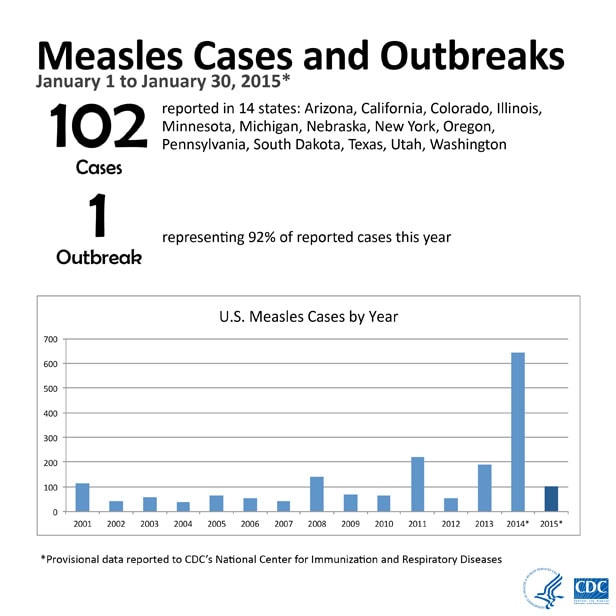
 There are at least 102 reported cases in 14 states, according to the CDC. Frieden said that the U.S. is "likely to see more cases."

Frieden said there is "aggressive public health action" to identify those with measles, isolate those sick and quarantine those who have been exposed.

But he said the best way to prevent the spread of measles was vaccination.

Frieden said despite the U.S.'s 92 percent vaccination rate, there is growing evidence more parents are not vaccinating their children.

"What we’ve seen is, as over the last few years, a small but growing number of people, have not been vaccinated. That number is building up among young adults in society, and that makes us vulnerable," he said.
Frieden acknowledged that some parents are concerned about the safety of vaccines, or think measles no longer exists.

"One in six kids could have a fever ten days after, but the vaccine is safe and effective. And for those parents that may think that measles is gone, it’s still here, and it can be quite serious," he said.

Frieden also appeared on ABC's "This Week," urging parents to vaccinate their children.

"What you do for your own kids doesn't just affect your family. It affects other families as well," he said. "The more kids who are not vaccinated, the more they're at risk and the more they put their neighbors' kids at risk as well.”

http://thehill.com/policy/healthcare/231394-cdc-director-warns-of-measles-outbreak


State Vaccination Requirements

In the U.S., the Food and Drug Administration (FDA) regulates and licenses all vaccines to ensure safety and effectiveness. No federal vaccination laws exist, but all 50 states require certain vaccinations for children entering public schools. Depending on the state, children must be vaccinated against some or all of the following diseases: mumps, measles, rubella, diphtheria, pertussis, tetanus, and polio.

State Vaccination Requirements

  • Database of State Immunization Laws for Healthcare Workers and Patients 
    This tool contains results from a 50-state legislative review of laws requiring assessment of vaccination status and vaccine administration for healthcare workers and patients/residents. The review was conducted by CDC in 2005 and collected data on laws for the following types of facilities: hospitals, ambulatory care facilities, individual providers' practices, correctional facilities, and facilities for the developmentally disabled.

School Entry Requirements -- By State or By Disease


Related Pages

Measles Cases and Outbreaks

Measles Cases

From January 1 to January 30, 2015, 102 people from 14 states were reported to have measles*. Most of these cases are part of a large, ongoing multi-state outbreak linked to an amusement park in California. On January 23, 2015, CDC issued a Health Advisory to notify public health departments and healthcare facilities about this multi-state outbreak and to provide guidance for healthcare providers nationwide. For more information see CDC Press Briefing Transcript:Measles in the United States, 2015, January 29, 2015.
* CDC will update this data weekly on Mondays.
The United States experienced a record number of measles cases during 2014, with 644 cases from 27 states reported to CDC's National Center for Immunization and Respiratory Diseases (NCIRD). This is the greatest number of cases sincemeasles elimination was documented in the U.S. in 2000.
Measles cases and outbreaks from January 1-November 29, 2014. 610 cases reported in 24 states: Alabama, California, Connecticut, Hawaii, Illinois, Indiana, Kansas, Massachusetts, Michigan, Minnesota, Missouri, Nebraska, New Jersey, New Mexico, New York, Ohio, Oregon, Pennsylvania, Tennessee, Texas, Utah, Virginia, Wisconsin, and Washington. 20outbreaks representing 89% of reported cases this year. Annual reported cases have ranged from a low of 37 in 2004 to a high of 220 in 2011
  • The majority of the people who got measles were unvaccinated.
  • Measles is still common in many parts of the world including some countries in Europe, Asia, the Pacific, and Africa.
  • Travelers with measles continue to bring the disease into the U.S.
  • Measles can spread when it reaches a community in the U.S. where groups of people are unvaccinated.

Monday, February 02, 2015

“It’s not just about you. You’re part of a social order. You’ve got to make your own contribution to it. You can’t opt out.

Should Vaccination Be a Personal Choice?

By 
WebMD Health News
Reviewed by Hansa D. Bhargava, MD
Jan. 29, 2015 -- As a measles outbreak linked to Disneyland continues to spread, a backlash against parents who refuse or delay vaccination for their children has risen to a fever pitch.
More and more pediatricians say they are "firing" patients who decide not to vaccinate. On social media, angry parents engage in heated debates about the decision not to vaccinate. One columnist suggested parents who don’t vaccinate their kids should go to jail. And at least one well-known infectious disease expert called for states to make it tougher for parents to opt out of the shots.
“It’s not just about you. You’re part of a social order. You’ve got to make your own contribution to it. You can’t opt out. This is a stronger statement than I’ve ever made to the media. But I think we should become increasingly intolerant of parents opting out,” says William Schaffner, MD. He's a professor of preventive medicine at Vanderbilt University in Nashville, TN.
There’s good reason to be angry. Diseases like whooping cough and measles, which had been all but wiped out in this country, are making a comeback. In 2014, 644 people caught measles in the U.S., the most in more than two decades, according to the CDC. With nearly 60 cases in seven states connected to Disneyland so far this year, 2015 might be on pace to be even worse.
“It’s only January and we’ve already had a very large number of measles cases. This worries me,” says Anne Schuchat, MD. She's the director of the CDC’s National Center for Immunization and Respiratory Diseases. She spoke at a press briefing on the outbreak and urged children and adults to get vaccinated.
Experts say preventable diseases like these are gaining a foothold again because many parents have taken advantage of laws in 48 states that allow families to skip or delay the shots for religious or personal reasons.
“Ten to 20 percent delay the shots. One to 2 percent choose not to vaccinate at all,” says Paul Offit, MD, director of the Vaccine Education Center at The Children’s Hospital of Philadelphia.
That wouldn’t be so bad if they were evenly distributed across the U.S., putting an unvaccinated kid here or there. But people who decide to go unprotected tend to cluster in groups.
1 | 2 | 3 | 4 | 5 

Sunday, February 01, 2015

Vaccines help develop immunity by imitating an infection, but this "imitation" infection does not cause illness...

How Vaccines Prevent Diseases

The diseases that vaccines prevent can be dangerous, or even deadly. Vaccines reduce the risk of infection by working with the body's natural defenses to help it safely develop immunity to disease.
When germs, such as bacteria or viruses, invade the body, they attack and multiply. This invasion is called an infection, and the infection is what causes illness. The immune system then has to fight the infection. Once it fights off the infection, the body is left with a supply of cells that help recognize and fight that disease in the future.
Vaccines help develop immunity by imitating an infection, but this "imitation" infection does not cause illness. It does, however, cause the immune system to develop the same response as it does to a real infection so the body can recognize and fight the vaccine-preventable disease in the future. Sometimes, after getting a vaccine, the imitation infection can cause minor symptoms, such as fever. Such minor symptoms are normal and should be expected as the body builds immunity.
Read more about how vaccines work in the Parents Guide to Childhood Immunizations Adobe PDF file [1.84 MB, 6 pages].
http://www.cdc.gov/vaccines/parents/vaccine-decision/prevent-diseases.html
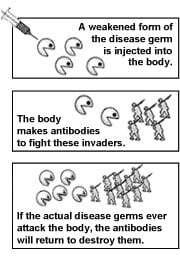
Look at these illustrations to better understand how vaccines protect children from diseases:
A weakened form of the disease germ is injected into the body.  The body makes antibodies to fight these invaders. If actual disease germs ever attack the body, the antibodies will still be there to destroy them.

Friday, January 30, 2015

Measles is no harmless little illness. Around the world it causes 400 deaths a day, 16 deaths an hour. It’s one of the leading causes of death among children. Among those who survive, it can cause pneumonia, brain damage and hearing loss....

Low Vaccination Rates at Jewish Schools in CA

Is putting other kids’ health at risk really a Jewish value?


As you surely know by now, measles—once essentially eliminated in America—is again becoming an epidemic. According to the Centers for Disease Control and Prevention, the number of cases in the U.S. is at a 20-year high. In the recent outbreak at Disneyland, the vast majority of the victims were unvaccinated.

California in general is chock full of crunchy clusters of people who refuse to vaccinate. A study published earlier this month found five areas in the Golden State with stratospheric rates of unvaccinated or under-immunized kids: Northeastern Sacramento County and Roseville (5.5 percent); Marin and Southwest Sonoma (6.6 percent); Northeast San Francisco (7.4 percent); an area from Alameda to El Cerrito (10.2 percent) an area south of Sacramento (13.5 percent). The statewide average vaccine refusal rate, outside these areas, is 2.6 percent.


 To achieve herd immunity, in which the percentage of people who are vaccinated is high enough to protect the unvaccinated, 94 percent of the population has to be immunized against the measles.

Measles is no harmless little illness. Around the world it causes 400 deaths a day, 16 deaths an hour. It’s one of the leading causes of death among children. Among those who survive, it can cause pneumonia, brain damage and hearing loss. As health writer Dan Diamond pointed out in Forbes yesterday, you’re 35,000 times more likely to die from measles than to win at Powerball. An unvaccinated baby in a room with someone who has measles, however, has way more impressive odds: he has a 90 percent chance of developing the virus. (Crowded places like Disney and or a classroom mean a fabulous chance of transmission. And if you have measles, you have four glorious days in which you’re contagious before you even develop symptoms.)

Pertussis is a terrible disease too. Before the availability of a vaccine in the 1940s, it was a major cause of child mortality in the U.S.; in developing countries it still causes 195,000 deaths a year. And it’s miserable: The disease makes children cough so hard they may break ribs. And yet in 2014 there were 8,000 pertussis cases in California. Two babies died.

You would think that Jews, with our values of tzedek, tzedek tirdof (“righteousness, righteousness shall you pursue”) and al tifrosh min hatzibur (“don’t view yourself as separate from your community”), as well as our general proficiency in the areas of health and medicine, would be all over vaccination. You would think that since our sage Reb Nachman of Breslov (who died in 1810 of tuberculosis, back in pre-TB-vaccine times) wrote, “One must be very, very careful about the health of children… One must inoculate every baby against smallpox before one-fourth of the year, because if not, it is like spilling blood,” we’d be vaccinating fiends all up in this joint.

You would be wrong. As I’ve written repeatedly in Tablet and elsewhere, Jews are opting out of vaccination—either partially or entirely—in serious numbers.

There’s no halakhic (Jewish law-based) reason for this. In 2005, the Conservative Movement’s governing body, the Rabbinical Assembly, ruled that Jewish Day Schools can, in accordance with halakha, make immunization compulsory. And Orthodox Jews who believe Judaism encourages opting out should heed the full-throated call to vaccinate from David Shabtai of Boca Raton Synagogue: “Jewish law cannot serve as a basis for a religious exemption for vaccination. Claiming that it does is a perversion of both logic and religious law.”

And yet. Jewish actresses, from Big Bang Theory co-star Mayim Bialik (who has a Ph.D. in neuroscience!) to Lloyd-Dobler-pen-bringer Ione Skye (author of a children’s book about Yiddish, and married to Jewish musician Ben Lee), have turned up their noses at evidence-based medicine. (Skye has stated that skipping some vaccines makes “instinctive sense”: “As a mother, it just felt better to me—and my kids never had any reaction.”) Thank heaven for Amanda Peet! Author of a forthcoming children’s book about being Jewish at Christmastime, wife of novelist and Game of Thrones showrunner David Benioff, activist with the United Nations Shot@Life campaign, and star of the new HBO series Togetherness, she’s also the parent of a child who contracted pertussis between her second and third doses of the vaccine. “I know a lot of parents who stagger their kids’ vaccines,” she told The Hollywood Reporter last year. “Their position is, ‘Hey, why are you so gung ho on tanking your kids with all those vaccines?’ They act almost concerned for me, and I want to say, ‘Wait a minute, your children are actually benefiting from the barrier I’m putting in place for them, and now you’re questioning my soundness of mind for doing that?’”

Alas, Peet often seems to be a voice in the wilderness. The California Department of Public Health recently created a public database of immunization levels in all California schools, public, private and parochial, and KQED’s California Report turned it into an easily searchable tool.


 I plugged in the names of the 68 schools in Private School Review’s list of Jewish elementary schools in the state and found 14 with nosebleed-inducing levels of vaccine refusal. Here is the list of schools (only elementary schools that have kindergartens are in the database) and their Personal Belief Exemption (PBE) rates. Remember, six percent is the threshold for herd immunity. 

Abraham Joshua Heschel Day School, Northridge: 18 percent
Adat Ari Day School, Valley Village: 13 percent
Bais Chaya Mushka Chabad, Los Angeles: 11 percent
Brandeis Hillel, San Rafael, 8 percent
Cheder of Los Angeles, Los Angeles: 12 percent
Cheder Menachem, Los Angeles 9 percent
Contra Costa Jewish Day School, Lafayette: 19 percent
Emek Hebrew Academy Teichman Family Torah Center, Sherman Oaks: 8 percent
Hebrew Academy Huntington Beach: 18 percent
Harkham Hillel Hebrew Academy: 10 percent
Ilan Ramon Day School Agoura: 13 percent
Kabbalah Jewish Academy, Los Angeles: 75 percent
Tehiyah Day School in El Cerrito: 13 percent
Valley Beth Shalom Day School, Encino: 18 percent

Three more schools had no data available: Oakland Hebrew Day School, Torat Hayim Academy and Yeshiva Rav Isacsohn Torath Emeth.

As Diamond points out in Forbes, the work of Dartmouth political scientist Brendan Nyhan has shown that presenting credible scientific evidence to anti-vaccine parents only makes them dig in their heels. American Journal of Public Health editors Dr. Kenneth Camargo Jr and Roy Grant have proposed a different approach: using pro-vaccine experts and activists who are not scientists as educators. People who get PBEs are people who tend to distrust public health experts, so using people with “interactional expertise” as communicators, instead of relying on doctors and scientists to spread public health messages, might be effective.

If the carrot doesn’t work, perhaps the stick will. Lawmakers are discussing tightening the rules for receiving PBEs. Ethicist Arthur Caplan has explored the idea of suing or criminally prosecuting non-vaccinators for causing illnesses. Me, I’m open to suggestions.

Come on, Jewish parents. Let’s be a light unto the nations.

http://tabletmag.com/scroll/188686/low-vaccination-rates-at-jewish-schools-in-california?utm_source=tabletmagazinelist&utm_campaign=a2954f780a-Friday_January_30_20151_30_2015&utm_medium=email&utm_term=0_c308bf8edb-a2954f780a-206530521