EVERY SIGNATURE MATTERS - THIS BILL MUST PASS!

EVERY SIGNATURE MATTERS - THIS BILL MUST PASS!
CLICK - GOAL - 100,000 NEW SIGNATURES! 75,000 SIGNATURES HAVE ALREADY BEEN SUBMITTED TO GOVERNOR CUOMO!

EFF Urges Court to Block Dragnet Subpoenas Targeting Online Commenters

EFF Urges Court to Block Dragnet Subpoenas Targeting Online Commenters
CLICK! For the full motion to quash: http://www.eff.org/files/filenode/hersh_v_cohen/UOJ-motiontoquashmemo.pdf

Friday, June 24, 2016

Why do so many Orthodox Jews choose to leave Orthodoxy?

 The formerly Orthodox American Jews: The stricter they were, the farther away they run 


885 formerly Orthodox Jews responded to a survey published today by Nishma Research.

It is not a scientific sample of the formerly Orthodox. But it is still the best available survey of such people, one from which we can learn a little bit about their lives and decisions. It is still a somewhat melancholic read – not because it is better to be Orthodox and hence sad that people choose to leave Orthodoxy, but rather because leaving something is often a sign of crisis and a generator of more crisis. Thus, the people who participated in this survey are ones who had to face a crisis, or are still in a state of crisis.

Take, for example, the relationships between the formerly Orthodox and their still Orthodox families. The study highlights the fact that “respondents’ relationships with their family were more positive than negative, especially with children and younger siblings.” Yet the reality for many of these formerly Orthodox men and women is still complex. 57% of respondents say that their relationships with their fathers are very positive or somewhat positive, but 19% say “mixed,” 11% “somewhat negative,” and 13% “very negative.” Relationships with their mothers are slightly better. 62% define them as “very” or “somewhat” positive.

But these definitions are the average of many types of Orthodox people. It’s the average of the combined group of the formerly modern-Orthodox, the formerly Yeshivish-Orthodox, and the formerly Chasidic-Orthodox. This average doesn’t reveal the fact that for a formerly-Chasidic Orthodox it is apparently much less likely to have good relations with her father (49% “very” or “somewhat” positive). It doesn’t reveal the much easier path of the formerly modern-Orthodox, whose relations with their families seem to be less complicated – 69% have positive relations with their fathers, 74% with their mothers.

The easier path means a lesser crisis for the formerly Modern-Orthodox. 65% of them feel that their families “accept them as they are,” compared to 53% of former-Yeshivish, 55% of former-Chabad, and 41% of former-Chasidic. A lesser crisis means less alienation and hence, the survey reveals an irony: the stricter the group from which the “former” Jew emerges, the less the “former” is inclined to keep some Orthodoxy in his or her life.

Only 29% of former-Chasidic keep Kosher after they choose to leave. Of the former Modern-Orthodox, 36% keep Kosher. Asked whether “it would upset them if a child of theirs intermarried,” 46% of former Modern-Orthodox said yes, compared to 32% of former Yeshivish and 26% of former Chasidic. The more insular you were, the farther away you wish to travel. 17% of former modern-Orthodox still say they are “traditional,” compared to just 6% and 7% of former Chasidic and Yeshivish. 78% of former Modern Orthodox say that being Jewish is important for them, compared to 56% of former-Yeshivish and 49% of former-Chasidic.

The Pew study of American Jews from three years ago showed that there is “a high rate of attrition from Orthodox Judaism, especially among older cohorts.” In other words: many Orthodox Jews become formerly Orthodox along the way, which makes studying their ways important. According to Pew, “among those 65 and older who were raised as Orthodox Jews, just 22% are still Orthodox Jews by religion. And among those ages 50-64 who were raised Orthodox, just 41% are still Orthodox Jews by religion. In stark contrast, 83% of Jewish adults under 30 who were raised Orthodox are still Orthodox.”

Why do so many Orthodox Jews choose to leave Orthodoxy? The new study gives us more detailed clues than previous, more general studies of American Jews. For the former-Chasidic and former-Yeshivish, the top reason for leaving was “influence of outside knowledge, such as reading or learning things that contradicted what had been believed.” 15% of the former-Chasidic had “doubts” and “lose faith.” Former-Chabad complain about the lack of secular education as a reason for leaving (10%), about doubts (10%) and about “wanting more control in life” (12%). The former Modern-Orthodox are different: their top reason is “the role and status of women” in Orthodoxy. Theirs – and this is also generally the reason given by women who choose to quit Orthodoxy.

Men say they left because of new knowledge they acquired and because of intellectual doubts (37% combined). Their motivations – or the motivations they share with the researchers – were grounded in thought. Women say they left because of societal reservations: because of the role of women, because of judgmentalism, and because of community hypocrisy (20%, 9%, 12%).

The research argues that “more people feel they have been “pushed off” rather than “pulled off.” Namely, they cite internal conditions – such as the status of women, perceptions of hypocrisy – that pushed them out, rather than cite reasons related to the lure of the outside world. I wonder what this means: it could mean that Orthodoxy is not attuned enough to the needs of its members, or that those who left feel more comfortable saying that it was Orthodoxy’s “fault” and not their “fault” that they ended up leaving.

As they leave Orthodoxy, they tend to also leave the community (70%), and they need support (the Haredis more than the Modern Orthodox). They wish for additional support (67%). They are – as we have said – transitioning and going through a crisis. That is, except for those who choose to live a double life: “Those who are no longer ‘believers’ but still live in the community are an interesting group.” the study says. An interesting group indeed – and to some degree one that evokes even more sympathy than the other groups. 33% of respondents to the survey, who no longer feel a part of Orthodoxy, have yet to completely sever their ties with the Orthodox community. Most of them think that they will never leave (61%).

They have higher levels of participation in visible practices – for obvious reasons. More of them, compared to other groups, still say they “believe in God” (37%). Their “relationships with their family are virtually the same as those of all others.” This probably means that their families know who they really are. Not just the group is interesting – the decision to give them a voice in a study about the formerly Orthodox is interesting too. It raises the possibility that the researchers – much like formerly Orthodox men do, but not like formerly Orthodox women – see Orthodoxy as an intellectual state of mind more than as a social situation. A perception worthy of debate.

http://www.jewishjournal.com/rosnersdomain/item/the_formerly_orthodox_american_jews_the_stricter_they_were_the_farther_away

Thursday, June 23, 2016

The sad story of the charismatic Rabbi Meir Pogrow who is alleged to have preyed on young women for about two decades brings to light once again the power and danger of a charismatic personality....

I was informed Meir Pogrow, allegedly, was a sexual predator many years ago, and asked to post about him...The issue was, at the time, I could not get written and signed testimony from at least 2 women/girls that were willing to put their names on the allegations. I did all I could do in private communications with various people to stop Pogrow from remaining a teacher.  I believed them, people do not make these things up. I am happy that they found the strength to come forward with their stories. I wish them all the very best in their healing process and the best life has to offer.
Paul Mendlowitz
*
by Rabbi Heshie Billet

The Danger of Charismatic Personalities

Meir Pogrow

The Founder of Master Torah
From his website:


Rav PogrowRabbi Meir Pogrow is the founder of the unique Master Torah learning system. Currently, Rav Pogrow offers over 6000 shiurim on the mastertorah.com website, and new shiurim are added daily!

Besides several prestigious Semichot (rabbinical ordinations), including from the Chief Rabbinate of Israel and from the Institute of Science and Halacha, Rav Pogrow has a Ksav Dayanus as a Religious Judge (Dayan) from the Religious Supreme Court in Jerusalem, Israel.

For 5 years Rav Pogrow also served as the Rosh Kollel (head of intensive post-graduate Torah-study fellowship) of Aish Hatorah in Jerusalem. He has taught Tanach, Mishna, Gemara, Jewish Law, Psychology, and Philosophy at a variety of institutions ranging from elementary schools to his own Kollelim, in Israel and the USA.

Rav Pogrow has been a featured speaker at many events and conferences worldwide. He frequently travels abroad to help schools maximize their curricula, and to offer his unique resources. 

Additionally, he meets and coaches new and existing Torah study groups worldwide, both "online" and conventional. Even during his extensive travels, Rav Pogrow keeps pace with many of his shiurim via interactive video conferencing. All of Rav Pogrow's programs and shiurim are ongoing 12 months a year.

Rav Pogrow and his family have lived for the past 17 years in Ramat Beit Shemesh, Israel.
 
*

The sad story of the charismatic Rabbi Meir Pogrow who is alleged to have preyed on young women for about two decades brings to light once again the power and danger of a charismatic personality.

Of course, there are many fine and upstanding people of charisma. But there are some who take themselves too seriously. If in addition, they are emotionally ill or have a personality disorder, then they are dangerous.

Too often, we have seen such men (too often Rabbis, teachers of Torah) use their position and charm to take advantage of vulnerable women. The Pogrow story is such an instance.The Pogrow story afflicted the Orthodox community across the hashkafic divisions. The Meisels affair was in the charaidi community. The Berland story is in the Chassidic community. They are not the first and I fear, not the last.

It is not only women who fall victim to such people. There was the Alon case about a superstar in the religious zionist community who was alleged to have preyed on young men under his spell. He was convicted in an Israeli court.

This is not a hashkafic matter. It is a problem of the human condition. Charisma sometimes leads to avoda zara. When a person surrenders their freedom of choice to the charms of a human being, that is a form of idol worship, literally and figuratively.

Parents, Rabbis, and educators must train our children in the art of protecting their bodies and souls from such people. Out of line comments and advances should be signs to run away and not come closer to the person who is grooming his/her next victim.

All contact with such people must be immediately severed. The event or remarks should be reported to parents and administrators and Rabbis. If indeed the alleged behavior is deviant, then they must be reported to the police. School administrations must, of course, be responsible. But they should not dismiss or penalize a victim or someone who feels like a victim.

If we do not take decisive action, these stories will repeat themselves over and over again. The perpetrators and the victims will have different names. But the script will tell the same horrific story.

https://www.facebook.com/heshie.billet?fref=nf

Young Israel of Woodmere
859 Peninsula Blvd
Woodmere, NY 11598
Phone: (516) 295-0950
Fax: (Monday to Thursday): (516) 295-4212
E-mail: yiw_office@yiwoodmere.org

Rabbi Hershel Billet
RabbiBillet@yiwoodmere.org

*

Another scandal; let’s not miss the point this time around


Another scandal. Another rabbi/educator accused of all kinds of outrageous, inappropriate behavior with female students. This time it is severe enough that rabbis who live across the world, in Israel, New York and Los Angeles, and who span the Modern Orthodox-Chareidi-Chasiddishe spectrum, have come together to sign a letter warning the public to stay away. This time the person involved is thought to have performed hundreds (!) of indecent acts and to have ruined countless lives.

And yet with all the talking, I feel that the real issue is not being spoken about at all. And therefore, despite my deep reluctance to write publicly about any person or place, I want to tell another part of this story. 

I knew this rabbi. Eighteen years ago, I came to Israel for the year to study Torah in a seminary where he taught. He lived on campus with his young family in the apartment right beneath mine. From the first time I met him, my overwhelming gut instinct was to stay away. There was something creepy about the way he knew all of our SAT scores by heart, even before we arrived. The way he knew exactly who was registered for an Ivy League college. The way he pursued and initiated chavrutot (study sessions) with very specific girls. Never the weak ones. Only the “best and the brightest.” It felt like a kind of game for him. A challenge. Could he crack the toughest ones? Break them down and then rebuild them? By some, it was considered flattering if he chose you. And there were girls who were hurt and devastated because they didn’t make the cut.

Once he forged that connection, he was manipulative, he played mind games, and he fostered dependence and hero worship. He was sarcastic, biting, and cynical, and he used his sharp mind and his Torah knowledge in cunning ways. He was brilliant, absolutely brilliant. He knew Torah by heart, and, of course, his way of looking at things was always “right.” You could never really challenge his read or his understanding because he was held up by everyone as the ultimate talmid chacham (scholar). He had mastered Torah. And he was only 27.

I stayed far away, and yet the experience of coming into even limited contact with him was incredibly painful. There were a couple of times that he threw out such nasty lines to me that I was left crying so hard that I couldn’t breathe. And then there were the difficult feelings of confusion and abandonment that arise when you try to raise concerns with friends and teachers and, instead of taking you seriously, they make you doubt yourself.

This is the real issue that has plagued my mind for so long. The fact that this man was never, ever fit to be an educator. The fact that knowing all the Torah in the world does not on its own make you trustworthy enough to be given a classroom’s worth of young, impressionable souls. The fact that long before anyone suspected inappropriate sexual behavior, it was glaringly clear that this person employed all kinds of unhealthy teaching methods in order to cultivate relationships with students. And the fact that no one but a few innocent teenage girls seemed to notice.

And so I want to talk about it. I want to talk about teachers who use fear and guilt frequently and indiscriminately in order to motivate and inspire. Teachers who deliberately try to alienate their students from everything they come from — their parents, families, homes, previous schools, communities, shuls, and even shul rabbis. Teachers who break students down so that they can recreate them in their own images. Teachers who cultivate groupies and are dependent on their students for self-esteem. Teachers who lack real relationships with their own peers because they are “so devoted” to their students. Teachers who teach students not to trust themselves, not to rely on their instincts, and not to listen to their inner voices.

Unfortunately, teachers like this are not uncommon, and we don’t talk enough about the damage that they do. About the fact that the rapid growth and change that they foster usually doesn’t last or, if it does, comes at a heavy price. About the fact that their students, years later, often find themselves empty and lost. About the guilty feelings that can stay with a person forever. About the relationships that are ruined in the process. And about the dependence that has been formed.

We don’t talk about it because, in the moment, the picture is so rosy. The teacher is charismatic, “his” classes are well attended, “she” is so devoted to her students, and the growth seems so exciting and real.

There are healthy and positive ways to educate and to inspire growth, whether the trajectory in mind is chareidi, “modern,” or something else. These ways are usually rooted in respect, humility, responsibility and trust.

Deeply respecting our students means wanting to understand and appreciate where they come from and who they are. It means valuing their relationships with family and friends and encouraging positive interactions as much as possible. It means wanting growth to be organic and slow, to follow a continuum and to not demand a total break with the past.

Humility includes being able to admit our own failings and limitations. It is the ability to tell our students when we don’t know something. Humility also means realizing that our way is not the only way, and that sometimes someone else might know more, or know better, or simply have a different take on things. Humility means understanding that each person is an individual; that it is important for students to cultivate and develop that individuality and not suppress it; and that the goal is not to create miniature versions of ourselves.

Responsibility is required with regard to the teaching methods that are employed. Fear and guilt work effectively for inspiring quick change, but, in the long run, they often lead to self-doubt, resentment, and depression. Responsibility means being honest about the ups and downs of life. It means describing hard moments that might arise and preparing students to deal with them. It means letting our students know that we also have challenges, questions, struggles and doubts. Teaching with responsibility means having patience, because real growth is a process that takes a long time. It means understanding that in order for something to be truly internalized, a student needs to work hard to make it that way.

Finally, we should educate our students to develop trust in themselves. Trust in their ability to think, to weigh things, and to make good decisions. Trust to pay attention to their gut and to notice when something doesn’t feel right. We should trust that our students are good at heart and want to do the right thing. And we should not betray their trust when they come forward with a concern, but should listen very, very closely to what they are telling us.

Even if we want to disagree about what exactly constitutes a healthy education, let’s at least agree on what does not.

I hope that in the wake of this scandal, we don’t just talk about one outed, sick educator and then move on as if everything were okay. Let us not get so distracted by the outrageous details that we forget what was so grossly inexcusable about his conduct as a teacher, even had he never touched anyone.

People like this are facilitated by an educational culture that celebrates and rewards brilliant and charismatic figures, despite the fact that they are often highly problematic and leave silent trails of ruin in the shadows of their successes.


As a community, we can be aware of this and do a lot to change it. Our schools, administrators, and lay leaders can think, and think again, about our educational goals and about the healthy ways in which to help our students reach them. And, in the event that there are staff members whose behavior is wholly inconsistent with our conclusions, then it’s time that we put our children’s well-being first.

Let’s talk about that.

Shayna Goldberg Shayna Goldberg teaches both Israeli and American students in the Beit Midrash l'Nashim-Migdal Oz which Is part of Yeshivat Har [More]

Wednesday, June 22, 2016

A program aimed at helping abused and neglected children and their families is improving outcomes for kids and providing children with stable home environments as their cases move through the courts...

Psychiatric help for families prevents continuing child abuse, neglect

Kids whose families received psychiatric support have better-than-expected outcomes


Aimed at helping abused and neglected children and their families, a program is improving outcomes for kids. The program is run by child psychiatry researchers at Washington University School of Medicine in St. Louis.

A program aimed at helping abused and neglected children and their families is improving outcomes for kids and providing children with stable home environments as their cases move through the courts.

The five-year-old program is for children and families whose cases ended up in St. Louis County Family Court. Researchers at Washington University School of Medicine in St. Louis have found that kids whose families received psychiatric help and educational support during the years since the program began have better-than-expected outcomes compared with kids who faced comparable levels of risk and whose cases went through the court system before the program was launched.

The findings are published in the June issue of The American Journal of Psychiatry.

“Abuse and neglect are linked to some of the worst outcomes in life,” said Washington University child psychiatrist John N. Constantino, MD, who authored the publication and oversees the program. “But if the abuse is halted and addressed after a first incident, the children, on average, aren’t at significantly greater risk than anyone else for poor outcomes later in life. We began this program to help kids who are in protective custody as a result of abuse to ensure they aren’t abused again and to improve the odds that their families will stay on a safe and healthy path.”

One in eight children in the United States will be a victim of abuse or neglect, increasing the risk for psychiatric disorders, substance abuse, suicide, becoming an abusive adult and a host of other negative outcomes, especially if there are multiple incidents of reported maltreatment.

To help prevent further episodes of childhood abuse and neglect, Constantino and his colleagues in the Division of Child Psychiatry — Neha Navasaria, and Mini Tandon, DO — have been working with St. Louis County Family Court since 2011 to provide two-generation psychiatric care and parenting education to families involved in maltreatment cases. The team found that children who participated in the project are at lower risk of future abuse and neglect and that they make greater progress emotionally and developmentally than expected, and more progress than children who were involved in the court system before the project was initiated.

“Through this collaboration, we have been able to provide educational and psychiatric services that would not have been available to the families otherwise,” said Constantino, the Blanche F. Ittelson Professor of Psychiatry and Pediatrics. “And those services have had a profound impact.”

The program, called the SYNCHRONY Project (Strengthening Young Children by Optimizing Family Support in Infancy), is based on a similar program created several years ago by a child psychiatry group at Tulane University, and is funded by the St. Louis County Children’s Service Fund, a sales-tax fund.

The Washington University psychiatrists followed 119 children from 106 families. The kids’ ages ranged from only a few months to 5 years. All had been placed in protective custody due to substantiated cases of abuse or neglect.

If the court determined there were unmet mental health needs the system couldn’t address, or if it recognized the need for parent training and education, such cases were referred to Constantino’s team.

The project addresses the unmet mental health needs of both generations of a young family, by assessing not only the children, but their parents, as well as the relationship between children and parents. The goal is to implement an approach to intervention that fully encompasses all of the components that can contribute to child abuse and neglect. In more traditional models of care, these different aspects of intervention tend to be fragmented and rarely available as a comprehensive package for struggling families.

Examples of referrals include a case involving a 3-year-old girl who witnessed her father in a protracted episode of rage. After the girl was removed from her home, clinicians identified and successfully treated a psychiatric condition that had affected father for years but had never been addressed, and the family later was reunited.

In another case, the team provided family therapy to a couple whose 2-year-old girl had been sent to live with an aunt due to problems related to severely dysfunctional communication between members of the household. That family later was reunited as well.

Another case involved a 5-year-old boy with anxiety that was precipitated by psychiatric symptoms a parent was experiencing but concealing. Constantino’s team worked toward ensuring the child’s safety, clarifying the magnitude of the parent’s symptoms and creating an opportunity for intervention for the parent, who never had received treatment.

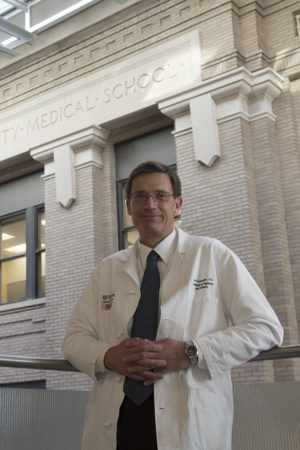
Constantino
Constantino (Photo: Robert Boston/School of Medicine)

Using standard assessments of psychiatric health and emotional development, the research team found that children in the program experienced significant improvements in the months after referral. The children experienced steady improvement in behavior and adaptive functioning from the time they were enrolled in the project, sometimes months or even years after having been placed in protective custody by the courts.

“These types of gains are one of the most important markers of well-being,” said Constantino, who also directs the William Greenleaf Eliot Division of Child and Adolescent Psychiatry. “The program is identifying unmet needs and allowing kids to get to a better place, either by virtue of improved functioning of their birth parents, careful decision-making about when a home environment is safe, or more appropriate therapeutic or environmental interventions for the children to help them achieve higher levels of behavior and functioning.”

Constantino JN, Ben-David V, Navsaria N, Spiegel E, Glowinski AL, Rogers CE, Jonson-Reed M. Two-generation psychiatric intervention in the prevention of early childhood maltreatment recidivism. The American Journal of Psychiatry, vol. 173 (6), pp. 566-573, June, 2016. DOI: 10.1176/appi.ajp.2015.15070944
This work was supported by the St. Louis County Children’s Service Fund and an anonymous gift to Washington University School of Medicine.
Washington University School of Medicine’s 2,100 employed and volunteer faculty physicians also are the medical staff of Barnes-Jewish and St. Louis Children’s hospitals. The School of Medicine is one of the leading medical research, teaching and patient-care institutions in the nation, currently ranked sixth in the nation by U.S. News & World Report. Through its affiliations with Barnes-Jewish and St. Louis Children’s hospitals, the School of Medicine is linked to BJC HealthCare.
Originally published by the School of Medicine

https://source.wustl.edu/2016/06/psychiatric-help-families-prevents-continuing-child-abuse-neglect/

Tuesday, June 21, 2016

..."I'll tell you why: the Church and Agudah (Agudath Israel of America) are lies. They lied to you, hiding behind their pious long white beards, while claiming they are Gd's representatives to you. They opposed it, because they don't support the cause or the issue. They believe that predators are fine and that you are the problem. It's time to stop supporting them in return."

There are 3 considerations when discussing a change to Statutes of Limitations.

1) Criminal - change to the age for when a victim may press charges

2) Civil - same as above, but for lawsuits. Affects the perpetrator and potentially the assisting institutions.

3) Retroactive Civil - allowing suits that have lapsed the Statute to retroactively proceed.

For years, NY has had the most egregious of Statues for sex crimes. For years, everyone in the "know" was aware that the reason for this was powerful lobby groups that included the Catholic Church and Agudath Israel. 

When recently pressed, leadership from Agudah claimed that they wouldn't be opposed to a changed in the criminal statute, but they were worried about bankrupting Jewish institutions for long-passed acts of negligence.

Putting aside the sheer insensitivity of institutional protectionism vs victim assistance and rehabilitation, it requires many factors to hold an institution responsible, including that the act occur at the institution, be a result of the institutions failures, be done by someone working for or allowed onto the institutional premises, etc.

Nevertheless, despite the claim of outward support for a Criminal Statute change, the NYS Legislature failed to act and pass it.

I ask you, if victims and victim advocacy groups support it (non-stop lobbying officials and making numerous public entreaties), news media supported it, regular folks supported it, AND on top of all that, the 2 primary historical opposers claimed they supported it, why didn't it pass?

Why would an elected official ignore every relevant group on an issue and oppose a change in the criminal statute? Do they want to commit career suicide?

I'll tell you why: the Church and Agudah are lies.

They lied to you, hiding behind their pious long white beards, while claiming they are Gd's representatives to you. They opposed it, because they don't support the cause or the issue. They believe that predators are fine and that you are the problem. 

It's time to stop supporting them in return.

 ***

https://www.facebook.com/benny.forer.3?fref=ts


ALBANY — In the end, state lawmakers protected the predators.


The state Legislature ended the 2016 legislative session about 5 a.m. Saturday without acting on legislation to help survivors of child sex abuse.

An all-night session to wrap up up the legislative year did not lead to a last-minute miracle that victims and advocates were hoping for.

"The survivors were thrown a tattered raft in this stormy session," said Kathryn Robb, an advocate and sexual abuse survivor.....

READ IT ALL:

http://www.nydailynews.com/…/n-y-legislature-gov-cuomo-aban…

Friday, June 17, 2016

And Now We Have Elly Kleinman's Shulchan Aruch - Code of Jewish Law! The List of Jewish Midgets $upporting This Menuvel!

Breaking Ground And Sharing Memories At Kleinman Family Holocaust Education Center 

JUST SPEAK AT A KLEINMAN PARTY!
On a brisk and sunny Sunday afternoon two weeks before Pesach, the weather was perfect for the Kleinman Family Holocaust Education Center’s groundbreaking ceremony. But despite the cloudless skies, it felt as though a pall had descended upon our community. Less than a dozen blocks away, preparations were under way for the funerals of the seven Sassoon children killed in a horrific fire the day before, and the unspeakable tragedy weighed heavily on everyone’s mind. Nevertheless, throngs of people converged on 50th Street between 15th and 16th Avenues in Boro Park for the event marking the beginning of construction of the KFHEC’s new building, which will eventually transform the Agudath Israel shul building there into a modern five-story facility.

At Sunday’s groundbreaking ceremony for the KFHEC in Boro Park

The Kleinman Family Holocaust Education Center is the first of its kind: a Holocaust institution that is much more than a museum. As the name indicates, it is first and foremost an education center, where the story of the Holocaust will be told from a frum perspective. To many survivors and their families, Sunday was a tremendous step forward in breaking ground for shared memories.

Members of the Kleinman family

The director and CEO of the KFHEC, Rabbi Sholom Friedmann, introduced Mr. Shlomo Werdiger, chairman of the groundbreaking event and a KFHEC board member. The program began with recital of Tehillim, which took on new meaning as Mr. Werdiger asked the assemblage to daven for the mother and daughter who survived the blaze the day before but were still in critical condition and in need of prayers for a refuah sheleimah.

Popular singers Eli and Rivie Schwebel, along with the Mezamrim Choir, performed two heartfelt songs—“In a Vinkele” and “Acheinu Kol Bais Yisrael.”

Mayor Bill de Blasio, who was in Boston for a conference, sent a recorded video in which he spoke about the rampant anti-Semitism taking place today around the world and stressed the necessity of studying history. The mayor went on to congratulate KFHEC founder and president Elly Kleinman and predicted that in a city that has always been a home to so many immigrant groups, KFHEC will play an important role in serving the community and the city.

This was clearly a momentous occasion for Mr. Kleinman, who has nurtured and supported this project for more than seven years. He thanked Shlomo Chaimovitz, KFHEC’s vice-president, for shouldering the burden with him to make the KFHEC a reality. He praised Rabbi Eliezer Horowitz and the members of Agudath Israel Zichron Moshe for their vision in incorporating a Holocaust education center into their shul’s building. He acknowledged Rabbi Friedmann’s directorship of the KFHEC and thanked the organization’s talented staff.

In his remarks, Mr. Kleinman cited a chilling halachic question posed to Rav Ephraim Oshry, z’l, by a 12-year-old boy in the Kovno Ghetto who wanted to begin putting on tefillin even before his bar mitzvah. He then spoke about the KFHEC’s international projects already in development that will have a worldwide impact. Mr. Kleinman became visibly moved when speaking about his family’s Holocaust experiences and about his mother, Mrs. Ethel Kleinman, who survived Auschwitz and was in attendance at the groundbreaking event. Elaborating on the responsibility of educating our children and grandchildren about the Holocaust, he stated, “It’s not enough to say ‘Never again’—we must also never give up.”

Rav Aryeh Malkiel Kotler, rosh yeshiva at Beth Medrash Govoha in Lakewood, referring to the tragedy of the previous day, linked the seven young “korbanos” to the six million kedoshim killed by the Nazis. It was a “mini-Holocaust,” he said, giving us just a tiny glimpse of what happened to our nation 75 years ago. He was followed by Rav Yaakov Perlow, the Novominsker Rebbe, who stressed the importance of feeling another Jew’s pain.

At the close of the event, Kaddish was recited by Mr. Benny Fishoff, a Holocaust survivor and major KFHEC benefactor. Mr. Fishoff has explained his dedication to the KFHEC project by saying, “I waited all these years to be able to tell my story so that it will be remembered not just by my own grandchildren and great-grandchildren, but by Klal Yisrael.” Three generations of Fishoff family members and four generations of Kleinman family members attended the event. Finally, Abish Brodt sang “Ani Ma’amin” in his inimitable fashion.

In addition to Rabbi Kotler and Rabbi Perlow, the list of distinguished speakers also included Rav Mechel Steinmetz, the Skverer Dayan, and NYC Councilman David Greenfield. The front section designated for VIPs was graced by a number of other rabbanim and admorim, including Rabbis Yaakov Bender (rosh yeshiva of Yeshiva Darchei Torah), Yitzchok Isaak Friedman (Tenker Rav of Flatbush), Aryeh Zev Ginzberg (rav of the Chofetz Chaim Torah Center), Chaim Meir Hager (rav of Vizhnitz Bnei Brak in Boro Park), Eliezer Horowitz (rav of Agudas Yisroel Zichron Moshe), Mordechai Zev Jungreis (Nikolsburg Rebbe of Boro Park), Amram Klein (Ungvar Rav), Shmuel Yaakov Klein (of Torah U’Mesorah), Moshe Tuvia Lieff (rav of Agudas Yisroel Bais Binyomin), Dovid Schustal (rosh yeshiva at Beth Medrash Govoha), Yosef Ungar (son of the Bobov-45 Rebbe and rav of Apirion Shel Shlome), and others.

Government officials in attendance included Members of Congress Yvette Clarke and Jerry Nadler; NY State Senator Simcha Felder; NYS Assembly Members Joseph Borelli and David Weprin; NYC Councilmen Chaim Deutsch (the son of a Holocaust survivor), Mathieu Eugene, David Greenfield, Brad Lander, and Jumaane Williams; Staten Island District Attorney Daniel Donovan; Deputy Chief of Police Steven M. Powers, CO for Brooklyn Borough South; and Community Board 12 chairman Yidel Perlstein and district manager Barry Spitzer.

As Mr. Kleinman said in his speech, this event was only the beginning. (More Mexican kids on the way). Those who witnessed this groundbreaking are surely awaiting the next phase, when KFHEC iy’H opens its doors next year.

Fernando Maria Kleinman


http://5tjt.com/breaking-ground-and-sharing-memories-at-kleinman-family-holocaust-education-center/

Thursday, June 16, 2016

Standing in solidarity with Muslims after Orlando makes as much sense as standing in solidarity with Klansmen after the Charleston massacre. No one should be standing in solidarity with hate groups. Omar wasn’t radicalized by the “internet”. He got his ideas from Islamic clerics who got their ideas from Islam. He was “radicalized” by the holiest texts of Islam. Just like every other Muslim terrorist. His actions weren’t “senseless” or “nihilistic”, he was acting out the Muslim privilege of a bigoted ideology.

Muslim Privilege Killed 49 People in Orlando

Islamophobia kills… non-Muslims.


The deadliest mass shooting in American history happened because of Islamophobia.

Islamophobia killed 49 people in Orlando. It didn’t kill 49 Muslims. Instead it allowed Omar Mateen, a Muslim terrorist, to kill 49 people in the name of his Islamic ideology and the Islamic State.

Omar, like so many other Muslim killers, could have been stopped. He talked about killing people when he worked at G4S Security, a Federal contractor that provided services to the Department of Homeland Security and the State Department. But, according to one of the co-workers he stalked, a former police officer, his employers refused to do anything about it because he was a Muslim.

The FBI conducted an investigation of Omar Mateen. They put him on a watch list and sent informants. They interviewed him and concluded that his claims of Al Qaeda ties and terrorist threats were reactions to “being marginalized because of his Muslim faith.” Omar told the agents that he said those things because “his co-workers were discriminating against him and teasing him because he was Muslim.”

And they believed him.

Poor Omar wasn’t a potential terrorist. He was just a victim of Islamophobia.

Omar got away with homophobic comments that would have gotten Americans fired because he was Muslim. He weathered an “extensive” FBI investigation because he was Muslim.

Anyone who says that there is no such thing as Muslim Privilege ought to look at Omar Mateen.

There is a direct line between Omar’s Muslim privilege and the Pulse massacre. Omar Mateen’s Muslim privilege protected him from consequences. While the media studiously paints the image of a beleaguered population of American Muslims suffering the stigma of constant suspicion, Omar’s Muslim background actually served as a shield and excused behavior that would have been unacceptable for anyone else. Omar Mateen’s Muslim privilege shielded him until he was actually murdering non-Muslims.

And Omar’s case is not unique. The Fort Hood killer, Nidal Hasan, handed out business cards announcing that he was a Jihadist. He delivered a presentation justifying suicide bombings, but no action was taken. Like Omar, the FBI was aware of Hasan. It knew that he was talking to Al Qaeda bigwig Anwar Al-Awlaki, yet nothing was done. Instead of worrying about his future victims, the FBI was concerned that investigating him and interviewing him would “harm Hasan’s career”.

One of his classmates later said that the military authorities, “Don't want to say anything because it would be considered questioning somebody's religious belief, or they're afraid of an equal opportunity lawsuit.”

Would the FBI have been as sensitive if Nidal Hasan had been named Frank Wright? No more than Omar Mateen would have kept his security job if his name had been Joe Johnson.
It’s an increasingly familiar story.

The neighbors of San Bernardino killers Syed Rizwan Farook and Tashfeen Malik noticed that something strange was going on, but they were afraid of profiling Muslims. If they had done the right thing, the 14 victims of the two Muslim killers would still be alive. If the FBI had done the right thing with Nidal Hasan, the Fort Hood victims would still be alive and whole. If the FBI had done the right thing with Omar Mateen, his 49 victims would still be alive and those he wounded would still be whole.

We have some basic choices to make. We can empathize with Muslims or with their victims.

We cannot however do both.

After 9/11, Muslims somehow became the biggest victim group in America. And even if you contend that most Muslims are not responsible for the actions of Islamic fundamentalist groups, even if you believe that most Muslims are being wrongly blamed for the actions of a smaller group of radicals, the pernicious myth of Muslim victimhood has become a distorting force that protects terrorists.

Muslim victimhood has elevated Islamist groups such as CAIR to the front row of political discourse alongside legitimate civil rights organizations, despite their terror links and history of obstructing law enforcement efforts to fight Islamic terrorism, while mainstreaming their Islamist agendas.

Muslim victimhood has silenced the victims of Muslim terrorism. Every Muslim terror attack is swiftly diverted to the inevitable “backlash” narrative in which the media turns away from the bodies in the latest terror attack to bring us the stories of the real Muslim victims who fear being blamed for it.

This obscene act of media distraction silences the victims of Muslim terrorism and rewards the enablers and accomplices of Muslim terrorism instead. It is every bit as terrible as claiming that the real victims of a serial killer are his family members who are being blamed for not turning him in, instead of the people he killed and the loved ones they left behind.

Muslim victimhood protects Muslim terrorists like Omar Mateen. It shields them from scrutiny. It invents excuses for them. While Omar made his preparations, while the FBI investigation of him was botched, the media leaped nimbly from a thousand petty claims of Muslim victimhood. And the worst of them may have been Tahera Ahmad, a Muslim woman who claimed she was discriminated against when a flight attendant poured her soda in a cup instead of being given a can. This insane nonsense received days of media coverage. That’s more airtime than any American victim of Islamic terrorism has received.

The media will wait as short a period as it can and turn away from Orlando to some manufactured viral media claim of Muslim discrimination that will be unbearably petty. Meanwhile the next Omar Mateen will be plotting his next act of terror.

It’s time to tell the truth.

Islamic terrorism is caused by Muslim privilege. These acts of violence are motivated by racism and supremacism in Islam. Allahu Akbar, the Islamic battle cry often associated with acts of terror and ethnic cleansing since its origin in Mohammed’s persecution of the Jews, is a statement of Muslim superiority to non-Muslims.

Muslim terrorism is not the groan of an oppressed minority. Its roots run back to racist and supremacist Islamic societies in Saudi Arabia and Egypt where non-Muslims have few if any civil rights. Muslims are a global majority. Islamic terrorism is their way of imposing their religious system on everyone.

Standing in solidarity with Muslims after Orlando makes as much sense as standing in solidarity with Klansmen after the Charleston massacre. No one should be standing in solidarity with hate groups.

Omar wasn’t radicalized by the “internet”. He got his ideas from Islamic clerics who got their ideas from Islam. He was “radicalized” by the holiest texts of Islam. Just like every other Muslim terrorist. His actions weren’t “senseless” or “nihilistic”, he was acting out the Muslim privilege of a bigoted ideology.

Even in this country, the majority of hate crimes are not directed at Muslims. Instead Muslims have disproportionately contributed to persecuting various minority groups. Orlando is only the latest example of this trend. In Europe, Jews are fleeing Sweden and France because of Muslim persecution. In Germany, gay refugees have to be housed separately from Muslim migrants. So do Christian refugees.

This isn’t the behavior of victims. These are the actions of oppressors.

Muslims are not part of the coalition of the oppressed, but of the oppressors. The sooner we recognize that, the sooner we can deal stop Islamic terrorism and protect the victims of Muslim terrorists.
Muslim privilege killed 49 people in Orlando. How many people will it kill next week or next month? How many will it kill in the next decade or the next century?

The Muslim genocide of non-Muslims is already happening in Syria and Iraq. Islam has a long genocidal history. And if we continue to confuse the oppressors and the oppressed, the next genocide we fail to stop may be our own.

http://www.frontpagemag.com/fpm/263201/muslim-privilege-killed-49-people-orlando-daniel-greenfield

Wednesday, June 15, 2016

"Yes, you heard me correctly: 1 in 5 adults in the Orthodox Jewish community also suffers from some form of mental illness."


My Plea To The Jewish Community

Written Anonymously


Although I am only 24 years old, I see myself as having achieved more than most young adults.  A college graduate with a 3.94 GPA who balanced school, extracurricular activities, and other life responsibilities, I never could have predicted that I would one day be subject to a shidduch crisis of a different caliber.  I never imagined that I would be seen as incapable, damaged, and unworthy of the same life experiences as anyone else.

Although I may have spent six months in treatment for an eating disorder during my early college years, and three months in treatment for anxiety and depression post-college, I always believed that my experiences have made me stronger and more capable of coping with the challenges of life.  To me, recovery means the ability to live a meaningful life, a life that I would fill with passion, joy, and hobbies, most of which were lost in the throes of mental illness.  As part of my meaningful life, I’ve always looked forward to the day every little girl dreams of.  I looked forward to the day of my wedding – the day I would walk down the aisle in my white dress, walking around my chasan seven times, the day I would begin building my home on the foundation of Torah.

Little did I know what I would face when I would enter the dating turf of Orthodox Jews.  While in treatment, I was empowered to be open and honest about my struggles, and I was taught the importance of owning my past.  However, upon my return home, mentor after mentor, friend after friend, family member after family member encouraged me to keep these experiences a secret.  After all, how would I get a job?  How would I get a shidduch?  Besides one public speaking stint, I listened to these recommendations.  It was only as I worked my way through my first job that I began to understand the implications of my struggles on my life as an Orthodox Jew.

As a teacher, the way I represent myself is of utmost importance to my being a role model.  When it came out that I had struggled from mental health issues, a member of the administration politely told me that no student should ever find out.  Professionally, I understood this.  Personally, as someone who serves as a role model to vulnerable teenagers, I questioned if this was the correct approach.  Shouldn’t we be teaching our youth that it’s okay to struggle?  Shouldn’t we be showing them living proof that it is possible to overcome one’s obstacles?  What better role model than one whom they can potentially relate to and be empowered by?  While it is not easy to feel judged due to my past, I am grateful for the opportunity to break the stigma and prove to my colleagues that individuals who have suffered from mental illness can often be just as valuable and successful as anyone else.

Research done by the National Alliance on Mental Illness shows that approximately 1 in 5 adults in the US – 43.8 million, or 18.5% – experiences mental illness in a given year.  In fact, approximately 1 in 25 adults in the US – ten million, or 4.2% – experiences a serious mental illness in a given year that substantially interferes with or limits one or more major life activities.  You might be surprised, but these statistics don’t discount Orthodox Jews.  Yes, you heard me correctly: 1 in 5 adults in the Orthodox Jewish community also suffers from some form of mental illness.

Unfortunately, the general population is still fairly skeptical of those who suffer or have overcome mental illness, not realizing how complex it is.  People associate mental illness with homeless people walking the streets of New York City, psychiatric institutions, and a host of pills that may or may not help.  What we as a community have to come to understand is that not all forms of mental illness are the same.  Yes, some may need to be hospitalized.  Others may need to take medication to maintain their recovery.  That does not mean that individuals who suffer from mental illness do not deserve to live the same enjoyable, fulfilling lives as anyone else.  What many don’t realize is that mental illness can also affect people who have high-ranking jobs, loving families, and gratifying social lives. 

 Chances are you know someone who suffers from mental illness on some level.  It’s just not spoken about.

That is why people like me, whether recovered from mental illness, or suffering from just some anxiety, have a shidduch crisis of our own.  I have unfortunately been privy to the ups and downs of the “dating world” for the past four years and it has truly been a roller coaster.

Let us start with the first “serious” guy I dated.  He seemed slightly nervous when I told him about my history, but told me we would get through it and that everything would be okay.  The next thing I knew, his mother was calling individuals in my community to find out about me – individuals who had no idea about any of my struggles and now knew way more about my personal life than I was comfortable with.  His mother even went through the grapevine to find out who my therapist was and called her!  Don’t you think that’s taking things a little too far?  If her son is old enough to be getting married, shouldn’t he be making these phone calls himself?  His mother ended our relationship on account of not being comfortable with my history.

Enter a few other guys I dated within the next few years.  There were obviously the guys with whom things just didn’t work out.  I am okay with that.  Everyone experiences that.  Don’t get me wrong, I didn’t tell every guy I dated about my struggles.  I only revealed the information when the relationships got to the point where I was halachically obligated and felt comfortable doing so.  Then entered the guys who claimed they were okay with my past, but proceeded to end the relationship the date after they found out.  At this point I knew I hit a roadblock.  These guys were not comfortable with my past but felt too uncomfortable to tell me that.  I can understand that.  It must be awkward for them.  I always took these “rejections” in stride, believing that one day I would meet someone who would accept me.

Enter a serious marriage prospect: This guy was different from the others.  Being that we knew each other since the age of nineteen, he was no stranger to my history and had always been a supportive friend throughout my struggles.  Everyone who heard we were dating encouraged me to “make it work” because he already accepted me for all I had been through.  We had the same values, enjoyed each other’s company, and as the phrase goes, “we clicked.”  As the months went by and we continued to spend time together, he opened up to his parents about our next step: his plans to marry me.  After watching us date for five months, his parents were happy for him and completely supported our plan to build a home and spend the rest of our lives together – that is, until they asked the magic question: Does she take any medication?

I do not believe in lying.  I told him he had to tell his parents, especially since my recovery was such a large part of my past and made me who I am today.  I feared holding back this information would lead to issues in the future, if his parents found out about my past later on in our lives.  Upon hearing my struggles, his parents made a complete 180.  They were no longer supportive.  They wanted to do research and find out everything about anything I had ever struggled with.  I sat on a chair while they asked me question after question about both my past and my present, listening for any red flags that may come up.  I offered them to speak to my therapist and psychiatrist, but they had no interest.  They believed my therapist would only be trying to “sell” me and would have no concern for the wellbeing of their son.

They took a different approach.  They Googled my medications, printing out the side effects and showing them to the man I thought I would marry, making it seem like every side effect must affect me.  They estimated the cost of therapy for a year, telling him I was very expensive and that he wouldn’t have to worry about these costs with another girl.  Wow.  I am now an object.  I am expensive.  What if my taste in clothing was expensive?  They blamed my excellent organization and time management skills on my anxiety, while those are truly just basic elements of my temperament that some people struggle with their whole lives!

Yes, you heard me correctly: 1 in 5 adults in the Orthodox Jewish community also suffers from some form of mental illness.

We spoke with rabbis, mentors, and even psychologists in the field.  Nothing seemed to help.  His parents would return to the same arguments over and over, as to why my condition was concerning, despite the fact that no professional deemed it so.  The guy I was seeing tried his hardest to defend me, yet also knew in the end of the day that he would have to respect his parents’ wishes.

After two and a half weeks of waiting for his parents to make their decision, I began to question some of their behaviors.  Why was all this research necessary?  Why did they have to read article after article when these articles were prototypes, barely applicable to my experiences?  Why couldn’t they just look at me without my diagnostic label, and appreciate me for what I have to offer?  Why can’t they see that I am a successful teacher devoted to a life of Torah, family, and tikun olam?  Why can’t they look at the fact that I love their son and he loves me?  Why can’t they trust him that he knows what he’s “getting himself into,” that despite the challenges I’ve been through, he wants me to be his wife?  Why couldn’t they let him make the most important decision of his life?

After everything I had been through in life, I couldn’t allow myself to be treated like damaged goods.  I could not stick around and continue to be insulted, viewed as an object for sale, with each and every flaw being scrutinized.  I do not suffer from severe mental illness that affects my daily living.  So I have occasional bouts of depression and generalized anxiety.  Yet, I also hold down a job.  In fact, I even get promotions.  I have friends.  I have a loving and tight-knit family.  I do not deserve to be treated as a pariah, an unwanted nuisance, and interloper to a perfect family.

If I didn’t believe in Hashem to the extent that I do, if my faith in Judaism wasn’t as strong as it is, I can tell you that after my experiences in the dating world, I would no longer want to be frum.  I have friends outside the Orthodox world, and while there is still stigma surrounding the topic of mental illness, it does not exist to the same degree.  There is more education, awareness, and sensitivity towards those who struggle or may have struggled in the past.  Parents are not as involved in their children’s dating lives and don’t end relationships that are on the path to marriage.  Couples who want to get married do so with or without parental support, knowing that in the end of the day they are at least getting to spend the rest of their lives with the persons they love.

Our relationship ended two weeks ago and I don’t write this as a plea to his family.  This is a plea to the Jewish community at large.  Don’t wait until your child comes home and says he or she wants to marry someone who has been diagnosed with depression.  Don’t wait until you are set up on a date with a guy or girl who you soon find out has anxiety.  Educate yourself now.  Learn about what it means to suffer from these disorders on a daily basis.  Understand that just because one suffers from a mental illness, it doesn’t mean that the person is unable to take care of him or herself and live a stable, happy, productive life.  The “buzzwords” of mental illness are nowhere near as scary as they sound.

I often read articles about the “shidduch crisis” and marriage horror stories.  Numerous shiurim and dating books describe red flags and obstacles that lead to unhealthy marriages.  None of them (at least that I’ve come across) have described what to do when the person you are dating is everything one is looking for but comes with one – just one – of these red flags.  Depression, anxiety, and other mental illnesses are all seen as red flags.  Does this mean people with the slightest case of depression are not marriage material?  What if a woman has a baby and gets postpartum depression?  Is she no longer marriage material?  Is a divorce in order?  I can assure you that numerous people with some form of mental illness get married every day and do just fine.

Instead of looking at mental illness as a red flag, we need to view it on a spectrum.  I am not going to lie.  Some forms of mental illness are in fact red flags, and do need to be evaluated as such.  When searching for a spouse or “investigating” your child’s future partner, keep in mind that medication does not mean mediocrity.  Remember to be sensitive in the questions you ask and the way you go about your questioning.  Speak with a psychologist or doctor trained specifically in the illness your loved one suffers from, preferably one who works with him or her.  You will need your partner’s permission due to confidentiality, but I can assure you that if he or she loves you, permission will be granted.  The doctor will not only be looking out for his patient’s welfare.  In fact, once speaking with you, the doctor is obligated to tell you the truth about your loved one and you do not have to worry about lies.  Speak to a rabbi who works with and understands mental illness.  Find a neutral party to help guide you in this process.  If you truly love someone, it will be worth it.

I have a challenge for the Jewish community.  We need to open up a dialogue – a dialogue about dating and mental health in an open-minded, calm, and sensitive manner.  We need to raise awareness about the challenges of dating when diagnosed with mental illness, and educate our community that the nature of a diagnosis is different for everyone.  The Jewish people are a nation built on the foundation of Torah, avodah, and g’milus chasadim.  As we navigate the dating world, let us keep in mind some of the most basic bein adam l’chaveiro tenets and limit the lashon ha’ra that comes out of our mouths.  I urge you to do your avodah, but do it properly.  Make sure to reach out to the proper people and take advantage of the correct resources.  Lastly, be kind.  Do not forget that you are dealing with another person’s emotions, self-respect, and dignity.  I plead to you: If confronted with a situation related to shidduchim and mental health, act with kindness, sensitivity, and understanding.  In this way, we will together be addressing a different aspect of the shidduch crisis – one that often goes misunderstood, unrecognized, and unheard.  Let us be a light unto the nations by being a light unto ourselves.

http://www.queensjewishlink.com/style-and-living/dating-marriage/plea-jewish-community/

65 MILLION! WOW!

CLICK:https://plus.google.com/106580239978263655484/posts

The problem with Obama’s attitude is that they are coming here to chop our heads off, only they’re not doing it one by one with kidnapped Americans...

No One’s Looking for ‘Magic Words’


A
After the president’s statement on Sunday, which focused on the anti-gay “hate crime” aspect of the attack on Pulse and disregarded the specific fact that the shooter pledged his fealty to ISIS before and during his monstrous spree, the counterattack on those of us appalled by the astounding gap in the president’s words was perfectly captured by Jeffrey Goldberg’s tweet: “If Obama invokes the magical incantation ‘radical Islamic terrorism,’ will the problem go away? If yes, then he should do it right away.”

And though Hillary Clinton herself mentioned “radical Islamism” as a cause of the attack on Monday, she oddly echoed Goldberg on Tuesday by saying Donald Trump seemed to think they were “magic words.” So did the president, who said, “There’s no magic to the phrase  ‘radical Islam.’ It’s a talking point.”

This is all an effort at misdirection. The problem with Obama’s conduct isn’t that naming radical Islam would solve the problem. Of course, it wouldn’t solve the problem. The issue is that the refusal to name radical Islam is part of the problem. Obama’s refusal speaks to the mindset at work in the White House about the threat we face.

Ironically, we’ve learned a great deal about this mindset from none other than Jeffrey Goldberg, whose stunning piece “The Obama Doctrine” essentially made the case that the president is almost clinically allergic to viewing the threats posed by these incidents as major national-security issues:
He has never believed that terrorism poses a threat to America commensurate with the fear it generates. Even during the period in 2014 when isis was executing its American captives in Syria, his emotions were in check. Valerie Jarrett, Obama’s closest adviser, told him people were worried that the group would soon take its beheading campaign to the U.S. “They’re not coming here to chop our heads off,” he reassured her. Obama frequently reminds his staff that terrorism takes far fewer lives in America than handguns, car accidents, and falls in bathtubs do. Several years ago, he expressed to me his admiration for Israelis’ “resilience” in the face of constant terrorism, and it is clear that he would like to see resilience replace panic in American society. Nevertheless, his advisers are fighting a constant rearguard action to keep Obama from placing terrorism in what he considers its “proper” perspective, out of concern that he will seem insensitive to the fears of the American people.
Here the blindness is staggering. Israeli resilience doesn’t involve ignoring terrorist acts. If Israel’s leaders went around saying “they’re not coming here to chop our heads off,” they would not be its leaders any longer. Israeli resilience in the face of constant terror involves moving against terrorists constantly in a multiplicity of ways, including the use of the military. Israel has fought four wars in the past 15 years to deal with “terrorism,” and quite successfully, I might add.

The problem with Obama’s attitude is that they are coming here to chop our heads off, only they’re not doing it one by one with kidnapped Americans. They’re shooting up their fellow workers in San Bernardino and a bar in Orlando. They may or may not be under foreign direction, but they are self-proclaimed jihadists. Obama won’t say it because saying it would oblige a kind of action he does not wish to take. That refusal is crystallized in his unwillingness to name the enemy. It’s proof of a deep ideological choice.


https://www.commentarymagazine.com/politics-ideas/radical-islam-magic-words/


Tuesday, June 14, 2016

Everyone is talking about it on the street and in synagogues. Teachers and parents are talking about it at schools. No one can ignore it, and many people are terrified....

Web Teaches ultra-Orthodox Israelis About Sex Crimes in Their Midst

A 15-page indictment filed last month against a well-known ultra-Orthodox rabbi included detailed descriptions of sex crimes he allegedly committed against female relatives over many years. The indictment, filed in the Jerusalem District Court, caused an earthquake in ultra-Orthodox society.

The affair has been covered with unprecedented intensity on news sites for the Haredi community, but most of the ultra-Orthodox media – newspapers and radio stations – haven’t even hinted that such an affair exists.

The indictment has been shared on Haredi Facebook pages and in internet forums. It has been sent out via email and WhatsApp, and has penetrated the layer that has thickened in the ultra-Orthodox community over decades, if not generations.

The dissemination of the indictment hasn’t just broken down conspiracies of silence, it has ended the automatic lack of trust against the complainants and the accuser – the Israeli government.

Everyone is talking about it on the street and in synagogues. Teachers and parents are talking about it at schools. No one can ignore it, and many people are terrified.

The Bais Yaakov girls school in Elad sent parents a note with instructions on how to be cautious against any threats. “In case of any doubt, refuse and say no categorically,” is rule number seven out of 10.

Rule nine advises girls: “Be careful of people you know or don’t know, and don’t be tempted to go with them. Even if they approach you in a friendly way, break off contact, keep away from them and tell your parents.”

The defendant has only been known as “anonymous,” but now everyone knows who the 50-year-old is. He was a “supervisor” – a mentor in a renowned yeshiva in Jerusalem for older boys, whom it seems he has not harmed.

Some of the acts described in the indictment were allegedly committed in his office at the yeshiva. His fame as a member of the elite of the yeshiva world – with family connections that reach the highest levels of the so-called Lithuanian, non-Hasidic community – was a disadvantage in this case.

The names of three sisters, his relatives, have also passed by word of mouth; the indictment describes how he allegedly raped them hundreds of times. Two were victims starting in their childhood, and the violence allegedly continued after they were married, even in their parents’ home and while they were recovering from childbirth.

These purported acts against the two sisters are detailed in wording that is painful to quote. Still, the allegations have made their way in full to huge numbers of Haredim.

In fact, the Haredi community is agitated over a number of affairs that have been made public, including an indictment against another Jerusalem rabbi for extreme violence and sex offenses against his wife and other women. Also, footage has been taken that seems to expose sex offenders in the largely ultra-Orthodox city of Bnei Brak near Tel Aviv.

Such revelations were exposed on the Hebrew-language Thou Shalt Not Be Silent Facebook page, which has been operating for about six months to let Haredi victims of sexual abuse tell their stories and receive help.


Slowly, and many years too late, the community’s leaders are beginning to respond.

Two months ago, the police held a conference of senior rabbis from Haredi towns on “modesty and holiness in the community” in order to combat sex offenders. Programs for students have been launched in a number of schools on the matter.

These are just the first signs of people speaking out openly, but over the past three weeks the best-known Haredi websites such as Kikar Hashabbat and Behadrei Haredim have followed the “supervisor” affair closely with both news stories and opinion pieces. They have also followed three other cases of sexual assault in the Haredi community, with some of the alleged attackers coming from the school system.

“We must talk about it!” wrote Avigayil Karlinsky, one of the women behind Thou Shalt Not Be Silent. “Every time such a case is publicized is one small step in a great, blessed process of increasing awareness and bringing this burning matter to the forefront,” she wrote for the Haredim 10 website.

Karlinsky told Haaretz that the “supervisor” affair has brought her and three colleagues on the Facebook page a new wave of complaints from victims, including against “figures even more senior and better-known.”

Haredi society is opening up to the existence of sex crimes, which Karlinsky partly attributes to the programs that have been introduced in the schools. In the “supervisor” case, no rabbi has come out in defense of the accused or claimed that the charges were a fabrication, which Karlinsky says is probably due to the accessibility of the indictment.

The case of fugitive Rabbi Eliezer Berland, who fled Israel after being suspected of sex offenses, is different. In Berland’s case, the Haredi websites and media have let his followers claim that he was falsely accused. This is almost certainly linked to Berland’s standing and his followers’ influence, and maybe to the fact that no indictment has yet been filed.

by Yair Ettinger
http://www.haaretz.com/israel-news/.premium-1.723948