So there I was, sitting in my pew, 1,500 people around me, all
singing Carlebach. I couldn’t help myself. It’s impossible not to sing
along. The melodies are beautiful in their simplicity, saturated with
soul, and electrifying in crowds. It’s impossible not to be swept up in
the frenzy. My fingers drumming along to the melody, my feet tapping, a
smile tugging at the corners of my mouth despite my best efforts to the
contrary, I sang along with everyone else. How could I deny it? In a
room filled with people from the far-right to the far-left to the
non-observant, all singing the same music, all united in a way they have
never been before, and will likely never be again, how could I not be
swept up by the crowd? Men in
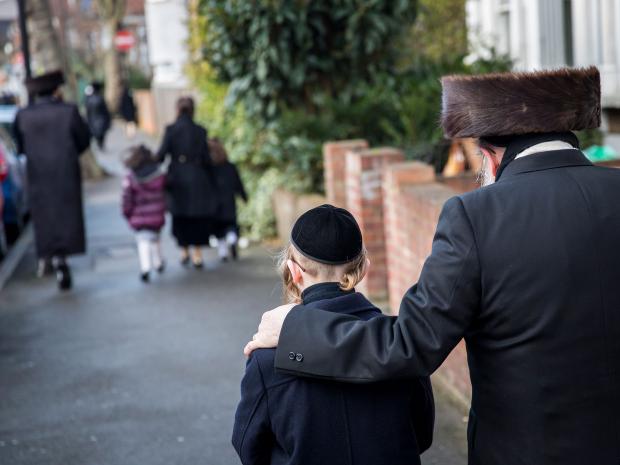
shtreimels (circular fur hats worn by Hasidic men) with long, untrimmed beards, dancing with their fellow Jews, some wearing knit
kippot (skull caps),
some with ponytails, some in suits, some in jeans and a t-shirt; has
anything, in the history of the Jewish people, ever united people so
different, than the music of Shlomo Carlebach?
Following the service was a Carlebach dinner held at a local catering hall, with our scholar-in-residence,
Rabbi Sammy Intrator,
Carlebach’s long time right hand man. He started the night off with a
song, and once the crowd was warmed up, he began to talk about Reb
Shlomo. He told us story after story about Reb Shlomo’s compassion, his
love for his fellow Jew, how deeply his desire to foster peace and love
in this world ran, and how in-tune his soul was with God and the world.
In true Carlebach style, he told us some of the stories that Carlebach
used to tell, singing them exactly as Carlebach used to, bringing them
to life with as much of the emotion and heart as he could. Carlebach’s
stories always make me cry. As hard as I try not to, they always manage
to get me.
Carlebach had an amazing gift for touching the souls of people with his stories of
Chassidus (a more spiritual and mystical approach to Orthodox Judaism),
and how the simplest Jew could have the greatest impact; his stories
keep alive the memories of fallen communities and dynasties that
perished with time and in the Holocaust, and the memories of the great
men and women that would otherwise be forgotten. You would have to be
lacking a soul not to tear up at the story of
Chatzkele Lekavod Shabbos.
And as I sat there listening to Sammy Intrator reincarnate Carlebach so
beautifully for his very captive audience, I felt a little dirty. My
holy brothers and sisters, I remember—I REMEMBEEEEEEEEEER—the Shlomo
Carlebach that I grew up hearing so much about, the great man who
reunited Judaism in the Diaspora,
but
I also remember the Shlomo Carlebach who fondled women who came to him
for guidance, who masturbated on women who worshipped him, and who
covered it all up by telling them that they were holy, and special. I
remember the stories I’ve heard firsthand from people who experienced
the darker side of Carlebach. And as I sat there laughing and crying as
Sammy Intrator spoke, I felt myself tearing apart.
A battle was raging in my head: How can you sit there and listen to
this when you know what he really was, and what he did to those women?
But, but, look at the holiness he brought to this world, the people he
united, the masses he returned to Judaism, the power of his music, and
the strength of his enduring legacy! Yeah, but his legacy was built on
the backs of an endless string of victims! But, but look! Look at all
these people, singing, and crying, and laughing, and loving, and opening
their hearts to one another! Surely that must count for something!
Maybe, but who will remember the victims, and how is it right to sit
there and tacitly support a man who caused so much damage?
I don’t know.
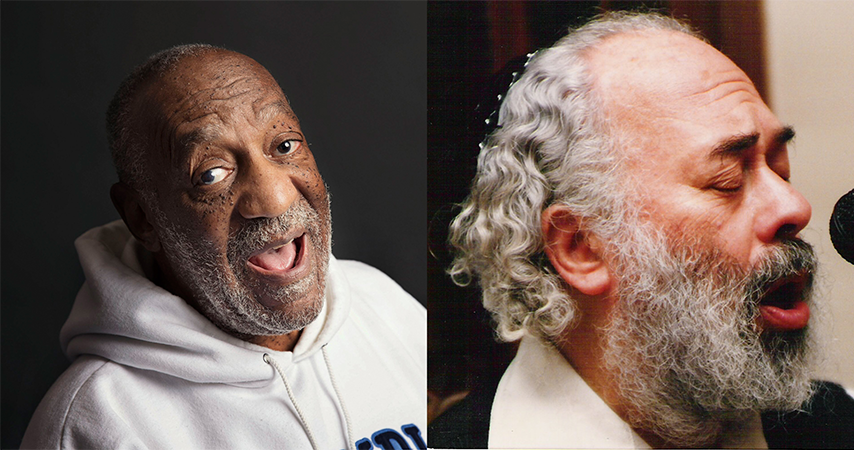
Honestly, Carlebach is a difficult subject for me. My inner conflict was punctuated by the
recent resurgence of rape allegations against Bill Cosby.
I loved Cosby. I loved his show, I loved his comedy, I loved his smile,
I loved what he represented. Just like I loved Carlebach. It’s always
this way. It’s always the people you love the most who hurt you the
worst. Of all the people who had to be sexual abusers, of course, it had
to be Shlomo Carlebach, and Bill Cosby. Right in the childhood. Right
in the heart. Cosby is easier for me to throw under the bus, because
while I’ve enjoyed his work, it’s never touched my soul. Carlebach is
special to me. Carlebach represents a Judaism I’d love to see in this
world. I mean, I suppose he would, if not for the small matter that he
was a sexual abuser. Why does it have to be so difficult.
Both Cosby and Carlebach got away with what they did for so long
because of how loved and cherished both they and their work were. But
can their work stand alone? Is it possible to separate the art from the
artist? It’s an ongoing question for me. On the one hand, I see the
beauty that Carlebach brought into the world, and I don’t want the world
to suffer the loss of what Carlebach gave it because of his sins.
Perhaps the beauty, and holiness he facilitated was there already,
waiting only to be discovered and brought to light, and he was only a
conduit. Perhaps we would have had it through someone else, someone less
flawed. Perhaps we should therefore allow what he revealed to stand
while we leave him to rot.
On the other hand, as blogger
Elan Morgan pointed out on a
friend’s Facebook page:
IMPORTANT: We cannot separate the men from their art when
they used their status from that art both to commit and conceal their
violent behaviour. To continue to share their art is to continue to
share one of the weapons they used to commit their crimes.
Perhaps we do more harm than good by perpetuating the tools of these
people’s abuse. Perhaps we are contributing to the pain felt by
Carlebach and Cosby’s victims, who for so long were denied justice, by
touting the instruments of their abuse as something worthy of praise and
enjoyment. Perhaps we make those men that much more acceptable by
refusing to give up what they created simply because our lives are
enriched by the fruits of those poisonous trees.
Or maybe there’s a baby to be saved somewhere in the putrid
bathwater. Maybe there’s a message, some truth, a little good that can
be salvaged from these men’s abominable lives. Might the message not be
valid regardless of its source? Can we not keep the moral values Cosby
preached while damning the damaged he caused to 17 (and counting) women,
or the love and acceptance exhorted by Carlebach while distancing
ourselves from the man himself and his actions.
There are a million answers to these questions, and frankly I haven’t
found mine yet. It’s something I struggle with every time I hear one of
Carlebach’s songs, or see the popularity people like Eitan Katz, or
Yehuda Green have because of their similarities in musical style to
Carlebach. I still feel dirty and conflicted when I sit in
shul and hear one of Carlebach’s tunes used for
lecha dodi (Song to greet the Sabbath sung by Friday night prayers),
finding myself at once moved and repulsed. To be honest, I still use
those tunes myself when I lead the prayers, because I know the
congregation likes them and will sing along. I don’t know what the
balance should be, or if there even is one to be had. Maybe you people
can help me out; what do you all think?
https://hareiani.com/2014/12/07/carlebach-cosby-and-separating-art-from-its-artist/