
Anthropologist Heidi Larson explores how medical rumors originate, spread and fuel resistance to vaccines worldwide. While vaccines cannot escape the "political and social turbulence" that surrounds them, she says, the first step to stopping the spread of disease is to talk to people, listen and build trust.
EVERY SIGNATURE MATTERS - THIS BILL MUST PASS!

CLICK - GOAL - 100,000 NEW SIGNATURES! 75,000 SIGNATURES HAVE ALREADY BEEN SUBMITTED TO GOVERNOR CUOMO!
EFF Urges Court to Block Dragnet Subpoenas Targeting Online Commenters

CLICK! For the full motion to quash: http://www.eff.org/files/filenode/hersh_v_cohen/UOJ-motiontoquashmemo.pdf
Friday, August 14, 2020
Why do people distrust vaccines? "The Local Religious Leaders"......
Anthropologist Heidi Larson explores how medical rumors originate, spread and fuel resistance to vaccines worldwide. While vaccines cannot escape the "political and social turbulence" that surrounds them, she says, the first step to stopping the spread of disease is to talk to people, listen and build trust.
Wednesday, August 12, 2020
חסידים נכנסים לתוך קברו של האדמו"ר מסדיגורא

CULT:
- a system of religious veneration and devotion directed toward a particular figure or object.
- a relatively small group of people having religious beliefs or practices regarded by others as strange or sinister.
a misplaced or excessive admiration for a particular person or thing.
Tuesday, August 11, 2020
The hate of BLM leaders is especially fraught with anti-Semitism: calling for the destruction of Israel, repeating ancient anti-Semitic tropes, and purposefully planning their riots in Jewish neighborhoods.
Rabbi Calls for Baseball Boycott Until MLB Disengages from Hate-Filled Politics of BLM
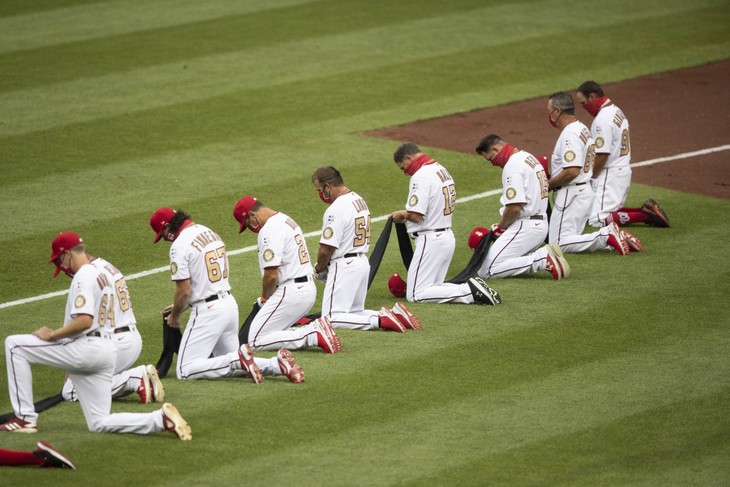 |
| Members of Washington Nationals kneel and hold a piece of black fabric before an opening day baseball game against the New York Yankees at Nationals Park, Thursday, July 23, 2020, in Washington. (AP Photo/Alex Brando |
And yet, Major League Baseball placed the BLM logo on the pitchers’ mounds on Opening Day.
Instead of MLB bringing people together through honest sports competition, baseball has now become like the 1936 Olympics in Berlin: an opportunity for the politics of hate to become more important than the athletic competition. Dr. King taught that we should all judge people “not by the color of their skin, but by the content of their character,” and Jackie Robinson said, “I’m not concerned with you liking or disliking me…all I ask is that you respect me as a human being.” BLM as an organization, as well as its local and national leaders, is committed to its agenda rather than the content of a person’s character. They have no respect for anyone who thinks differently than they do.
It is an organization founded on racist hate.
The hate of BLM leaders is especially fraught with anti-Semitism: calling for the destruction of Israel, repeating ancient anti-Semitic tropes, and purposefully planning their riots in Jewish neighborhoods. Melina Abdullah, the head of BLM Los Angeles and a devotee of hate-monger Louis Farrakhan (a man who has called Jews “termites” and desires the death of Jews, homosexuals, and any whites not willing to agree with him) proudly admits that she chose these Jewish neighborhoods for their marches and riots so that the people there would feel pain.
It is difficult to understand how MLB can support this hate-filled anti-Semitic organization, especially given that so many Jews are involved in baseball, ranging from executives like Paul Godfrey (Toronto Blue Jays), the Lerner family (Washington Nationals), Jerry Reinsdorf (Chicago White Sox), Lewis Wolff (Oakland Athletics) and Jon Daniels (Texas Rangers) to players such as Alex Bregman, Joc Pederson, and Max Fried to name a few.
And yet, Major League Baseball promoted an anti-Semitic organization to fans, especially children, via TV and online broadcasting.
If enough of us refuse to watch Major League Baseball (on TV or especially online, where data is easily tracked) until MLB officially refuses to promote or even allow political endorsements of the hate-filled BLM organization on the ball field, the advertisers will pay less for their ads, the teams will lose income, and the owners will be guided into getting baseball out of politics and back into athletics exclusively. But it will take a large and noticeable effort, and the conviction to temporarily give up our beloved sport, to get owners to decide that baseball belongs on the field—separate and away from any politics, especially from supporting an organization of hate like BLM.
I enjoin each of us to push our beloved baseball back into the arena of home runs and outs, and pray that we will soon return to a national pastime that is devoid of politics—and where people are not judged by the color of their skin, the politics of their party, or their religion, but rather are respected for the content of their character and their ability on the field.
Until then, I will stay away from MLB and hope I am joined by many others as we “stare out the window” waiting for baseball without hate-filled politics to return.
Monday, August 10, 2020
The late scholar will be remembered for his Talmud translation and commentary, but also for his call to avoid idealizing anyone, including him. The Many Faces of Genius...
Rabbi Adin Steinsaltz PhD 2019 from Weizmann Institute on Vimeo.
How Rabbi Steinsaltz’s whiskey shenanigans changed Judaism for me
The late scholar will be remembered for his Talmud translation and
commentary, but also for his call to avoid idealizing anyone, including
him
It was one of my most memorable interviews. Rabbi Adin Steinsaltz, the world renowned Talmudist who died on Friday, sat opposite me, puffing away on his pipe, regaling me with the tale of a drinking escapade with two friends
“Between us, we finished about three bottles of whisky,” he said, telling me what an “experience” it was.
One of the friends was Conor Cruise O’Brien, the late Irish politician and writer who once famously tried to use the might of the United Nations to keep his glass charged, writing a resolution that insisted the UN headquarters guarantee “the free flow of wholesome beer at a temperature appropriate to the present thaw in international relations.”
But Steinsaltz intimated that he drank O’Brien and his other friend under the table. “In fact, I have a better head for drinking than they have,” he told me.
If it seems galling to share this recollection soon after his death, that’s precisely why it should be shared. Steinsaltz was a great scholar. With his mammoth Talmud translation and commentary, he made the seminal work of rabbinic wisdom accessible to all. In other books he provided valuable insight into a range of other topics, from Passover to prayer.
And it was all done with a view to empower Jewish people to feel connected to our tradition. “What I am doing,” he told me, “is changing the melody of one simple sentence, which is: ‘I am a Jew.’
“The sentence has two possible melodies. One is the tune of: ‘I have an inherited disease.’ The meaning is: ‘I’m not guilty, I didn’t do anything. I acquired it. I try as much as I can to hide it. And if I have a way of getting rid of it, though I probably cannot, I will try.
“The other is to sing ‘I am a Jew’ in the same way you’d sing: ‘I am a royal prince – it’s not my doing, I inherited it.’ The point lies in what your attitude is towards this inheritance.”
Nu, Nathan? You interview this great thinker, twice, for conversations that lasted hundreds of pipe-puffs, and decide upon his passing to share a drinking story?
Absolutely. Because his unusual choice of conversation topic during our interview was no mere amusement. It was a profound lesson we can hold onto, long after his passing.
Steinsaltz was not just being charming. He was laughing in the face of a culture where some religious leaders take on superior airs, dressing in royal garb and claiming VIP connections to the Almighty.
In his scholarship, Steinsaltz was manning the barricades against the trend of hagiography – depicting our great Jews as one-dimensional saints.
One of many lessons he taught us was that when we record the lives of our heroes, we need to remember them as three-dimensional beings. That doesn’t mean dishing dirt; it means remembering them as relatable and deeply human characters.
He controversially insisted that even Biblical characters should not be idealized. He sharply dismissed the view that any person “is a saint so you shouldn’t say something.”
As a scholar of such enormous standing, it was easy to put Steinsaltz on a pedestal. But both times I met him, he steered the conversation to ensure this could not happen.
At our second meeting, in 2011, he insisted on interviewing this interviewer before talking about himself, and went on to be frank about his own personality, saying the task he had just finished, the first ever translation of the Talmud into Modern Hebrew, “was in many ways to keep myself in rein.”
He was tempted to write “astonishing” and “novel” works, but that would have put him at the center. “Working on this kind of thing you are far more thinking about the readers, whoever they are, than you are thinking about what I can do to glorify myself,” he said.
At our first interview, in 2005, the 26-year-old journalist in front of him was awestruck. I wrote in my article at the time that, given the authority he had as a reference resource on the page, meeting him “feels as unreal as, say, going for tea with the Oxford English Dictionary.”
He wanted none of that. If we were spending time together, I was to take him as he was, complete with a drinking story, and an admission amid his long, winding sentences that he was “very un-user friendly.” We talked about his interests at the time, as an amateur detective novelist, sculptor and zoologist.
He criticized the adulation of rabbis, saying that “whether you worship Michael Jackson or Rabbi So-and-So it is sometimes the same need to be dependent.”
I was reporting on religious affairs and these cookie-cutter accounts of great sages were all around me at the time, so it was refreshing to meet one who gave such a rounded view of himself, and urged doing so with other figures we encounter as we delve into Jewish study.
I went to hear about Steinsaltz the Talmudist, but in his worldview, if you only bother to listen when a person is answering the questions you think are important, you miss some of the best and most interesting bits.
“People are intrinsically complex, complicated, so to make a hagiography is to take a real person and to overcast him with plastic cladding,” he said in a video interview.
There is next-to-no importance in the fact that Steinsaltz went drinking with Conor Cruise O’Brien and they finished three bottles of whisky. What’s important is that he was the type of person who would tell such a story, and speak of much else that made him relatable, when being quizzed on his magnum opus by an admiring young journalist.
Just as his Talmud translation and commentary is part of his lasting legacy to the Jewish People, so is his clarion call against hagiography. And the way he made sure there was no pedestal in sight when I interviewed him, makes me think about this now.
It makes me think that, as the great and the good are giving him well-deserved plaudits for his earnest achievements, he would like to also be remembered as he taught us to remember others. I’m convinced that he would crack a smile if he could see that, as Israel’s Prime Minister and President are eulogizing him, it’s also being noted that he could hold his drink better than Conor Cruise O’Brien could.
Our image of people can quickly fade to the sum part of their Wikipedia entries, or the hallowed pages of rabbinically-sanctioned biographies. I hope our memories of Steinsaltz capture something of the three-dimensional man.
https://blogs.timesofisrael.com/how-rabbi-steinsaltzs-whiskey-shenanigans-changed-judaism-for-me/?utm_source=The+Daily+Edition&utm_campaign=daily-edition-2020-08-09&utm_medium=email
Sunday, August 09, 2020
These Wise Guys Thought They'd Beat The Virus and Governor Cuomo - Check With Your Attorneys For Their Potential Liability!
Outbreak of COVID Cases in 5 Towns, Due to a Camp Exposure From PA (Camp Shoresh)

The following is an urgent letter from Dr. Glatt:
The Commissioner of Health of Nassau County just called me and asked for our assistance regarding 8 cases of newly diagnosed COVID-19 in our community in campers returning from Camp Shoresh in Pennsylvania.
In addition, many other campers there had symptoms and were not tested for COVID-19. The PA DOH is already involved as well.
Based on significant concerns that the Governor and the NY State DOH have regarding this exposure, they have asked, and I fully agree, that all campers returning from that camp self quarantine immediately. All family members exposed to those campers likewise should be quarantined pending further evaluation.
As I mentioned, the Governor himself is aware and has expressed great concern about this exposure and the potential this might have regarding delaying school openings.
It is critical that we do everything possible to abort this potential outbreak before it spreads further and potentially impacts school opening.
These campers and all exposed family members should not be attending shul or any community events, and should be quarantined in their houses. Medical advice and COVID-19 testing should be sought as appropriate.
Please spread this information to your congregations.
Thank you, may Hashem help us stem this potential serious outbreak.
Aaron Glatt
https://5townscentral.com/2020/08/07/outbreak-of-covid-cases-in-5-towns-due-to-a-camp-exposure-from-pa/?fbclid=IwAR3hBTl9Cu_sFiHYDO3E3hiNWKaU3Fj5usRiWFUA4mBoj_mnKhhzYNxbxsQ
OWNERSHIP INFORMATION:
https://www.shoreshsports.com/leadership
"Daas Torah" Told The Camps To Move Out of New York State ---- Daas Torah Also Told Yeshiva Torah Temimah To Keep Yudi Kolko as Rebbe and Principal Until The Lawyers Stepped In:

Friday, August 07, 2020
Thursday, August 06, 2020
Wednesday, August 05, 2020
"Survivors of childhood sex abuse can breathe a sigh of relief now that the lookback window of the Child Victims Act has been extended for one more year"
A measure that makes it easier for the
survivors and victims of childhood sexual abuse was extended by Gov.
Andrew Cuomo on Monday, signing a measure that expands the window for
filing cases to Aug. 14 of next year.
The Child Victims Act, first approved in 2019, was due to have its window for filing lawsuits expire this month. Now claims will be able to be made for another 12 months.
"The Child Victims Act brought a long-needed pathway to justice for people who were abused, and helps right wrongs that went unacknowledged and unpunished for far too long and we cannot let this pandemic limit the ability for survivors to have their day in court," Cuomo said. "As New York continues to reopen and recover from a public health crisis, extending the look back window is the right thing to do and will help ensure that abusers and those who enabled them are held accountable."
The look-back window's expiration took on added urgency this year as the coronavirus pandemic closed courthouses around New York and slowed the legal process for civil cases.
"Survivors of childhood sex abuse can breathe a sigh of relief now that the lookback window of the Child Victims Act has been extended for one more year," said Assemblywoman Linda Rosenthal.
"After fighting for the law's passage for 13 long years, many feared the COVID-19 pandemic and the closure of the courts meant that the clock had run out on their opportunity to seek justice. I thank the Governor for signing this bill into law, thus ensuring that all those seeking redress for the heinous abuse perpetrated against them will have until August 14, 2021 to do so."
The extension approved by Cuomo builds on the measure that allows survivors to file suits before they reach the age of 55 and increases the amount for perpetrators being held criminally accountable.
"I'm extremely grateful to Governor Cuomo for signing our legislation extending the Child Victims Act for an additional year and the leadership of Senate Leader Andrea Stewart-Cousins for making the rights of survivors a priority, along with the Assembly sponsor, Linda B. Rosenthal," said Sen. Brad Hoylman. "Most of all, credit goes to the fearless survivors of child sexual abuse, who courageously shared their personal stories in order that more New Yorkers would have the chance to hold their abusers and the institutions that harbored them accountable."
https://spectrumlocalnews.com/nys/hudson-valley/ny-state-of-politics/2020/08/03/cuomo-approves-extension-for-child-victims-act
The Child Victims Act, first approved in 2019, was due to have its window for filing lawsuits expire this month. Now claims will be able to be made for another 12 months.
"The Child Victims Act brought a long-needed pathway to justice for people who were abused, and helps right wrongs that went unacknowledged and unpunished for far too long and we cannot let this pandemic limit the ability for survivors to have their day in court," Cuomo said. "As New York continues to reopen and recover from a public health crisis, extending the look back window is the right thing to do and will help ensure that abusers and those who enabled them are held accountable."
The look-back window's expiration took on added urgency this year as the coronavirus pandemic closed courthouses around New York and slowed the legal process for civil cases.
"Survivors of childhood sex abuse can breathe a sigh of relief now that the lookback window of the Child Victims Act has been extended for one more year," said Assemblywoman Linda Rosenthal.
"After fighting for the law's passage for 13 long years, many feared the COVID-19 pandemic and the closure of the courts meant that the clock had run out on their opportunity to seek justice. I thank the Governor for signing this bill into law, thus ensuring that all those seeking redress for the heinous abuse perpetrated against them will have until August 14, 2021 to do so."
The extension approved by Cuomo builds on the measure that allows survivors to file suits before they reach the age of 55 and increases the amount for perpetrators being held criminally accountable.
"I'm extremely grateful to Governor Cuomo for signing our legislation extending the Child Victims Act for an additional year and the leadership of Senate Leader Andrea Stewart-Cousins for making the rights of survivors a priority, along with the Assembly sponsor, Linda B. Rosenthal," said Sen. Brad Hoylman. "Most of all, credit goes to the fearless survivors of child sexual abuse, who courageously shared their personal stories in order that more New Yorkers would have the chance to hold their abusers and the institutions that harbored them accountable."
https://spectrumlocalnews.com/nys/hudson-valley/ny-state-of-politics/2020/08/03/cuomo-approves-extension-for-child-victims-act
Tuesday, August 04, 2020
A New Low For The OU (Union of Orthodox Rabbis) --- Kosher Certified Face Masks!

https://oukosher.org/product-search/#s=Bleach&dpm%5Bm%5D=false&dpm%5Bd%5D=false&dpm%5Bp%5D=false&prod%5Bpas_yisroel%5D=false&prod%5Bcholov_yisroel%5D=false&prod%5Byoshon%5D=false&prod%5Bgluten_free%5D=false&passover=false
KOSHER LAUNDRY DETERGENT:
https://oukosher.org/product-search/#s=Laundry%20Detergent&dpm%5Bm%5D=false&dpm%5Bd%5D=false&dpm%5Bp%5D=false&prod%5Bpas_yisroel%5D=false&prod%5Bcholov_yisroel%5D=false&prod%5Byoshon%5D=false&prod%5Bgluten_free%5D=false&passover=false
KOSHER TABLECLOTHS:
https://oukosher.org/product-search/#s=Tablecloths&dpm%5Bm%5D=false&dpm%5Bd%5D=false&dpm%5Bp%5D=false&prod%5Bpas_yisroel%5D=false&prod%5Bcholov_yisroel%5D=false&prod%5Byoshon%5D=false&prod%5Bgluten_free%5D=false&passover=false
ALL THINGS CHINA KOSHER:
http://www.oukosher.org.cn/
Monday, August 03, 2020
A Georgia sleepaway camp's coronavirus outbreak is a warning for what could happen when schools reopen, CDC says

The
camp had followed some but not all of the CDC mitigation steps against
the spread of the new coronavirus -- but was not enough to keep campers
and staff free of illness.
"Settings,
like multi-day, overnight summer camps, pose a unique challenge when it
comes to preventing the spread of infectious diseases considering the
amount of time campers and staff members spend in close proximity," the
CDC wrote in a statement.
"Correct
and consistent use of cloth masks, rigorous cleaning and sanitizing,
social distancing, and frequent hand washing strategies, which are
recommended in CDC's recently released guidance to reopen America's
schools, are critical to prevent transmission of the virus in settings
involving children and are our greatest tools to prevent COVID-19," the
CDC said.
According
to the study, published Friday in the CDC's Morbidity and Mortality
Weekly Report, the camp adopted most of the components outlined in the
CDC document "Suggestions for Youth and Summer Camps," but it did not
make campers wear cloth face masks -- only the staff.
Nor did the camp open windows and doors for increased ventilation In buildings.\
Additionally, camp attendees engaged in "daily vigorous singing and cheering," which might have contributed to transmission.
The
study breaks down what happened at the camp when it opened its doors in
mid-June to more than 600 campers and more than 120 staffers.
Five
days after the start of orientation and two days after the start of the
camp session, a teenage staff member fell ill and left camp; the next
day that person was confirmed to have Covid-19. Officials began sending
campers home that day and closed the camp three days later.
The
Georgia Department of Health was notified and began its investigation
the day after the first teenage staffer fell ill. All in all, test
results were available for 344 (58%) of the 597 attendees from Georgia;
among these, 260 (76%) were positive. At least 44% -- 260 of 597 -- got
infected, although the researchers say not everyone was tested so the
rate could be even higher. The 27 out-of-state attendees were not
counted in this preliminary analysis.
Asymptomatic
infection was common and may have played a role in the spread, the
study authors said. Among 136 cases with available information on
symptoms, 36 patients -- 26% -- reported no symptoms. Of the 100 who
reported symptoms, those most commonly reported were subjective or
documented fever, headache and sore throat.
Interestingly,
a higher percentage of the youngest children tested positive: 51% among
those age 6-10 years, 44% among those age 11-17 years, and 33% among
those aged 18-21 years tested positive.
"This
investigation adds to the body of evidence demonstrating that children
of all ages are susceptible to SARS-CoV-2 infection and, contrary to
early reports, might play an important role in transmission," the study
authors wrote.
They also found the
attack rate increased with increasing length of time spent at the camp,
with staff members having the highest attack rate at 56%.

"These
findings demonstrate that SARS-CoV-2 spread efficiently in a
youth-centric overnight setting, resulting in high attack rates among
persons in all age groups, despite efforts by camp officials to
implement most recommended strategies to prevent transmission," the
study authors wrote.
The CDC study didn't name the camp.
CNN reported on an overnight camp
with locations in north Georgia that earlier this month closed after
positive Covid-19 tests, and have reached back out to ask if it was the
camp in the study.
Friday, July 31, 2020
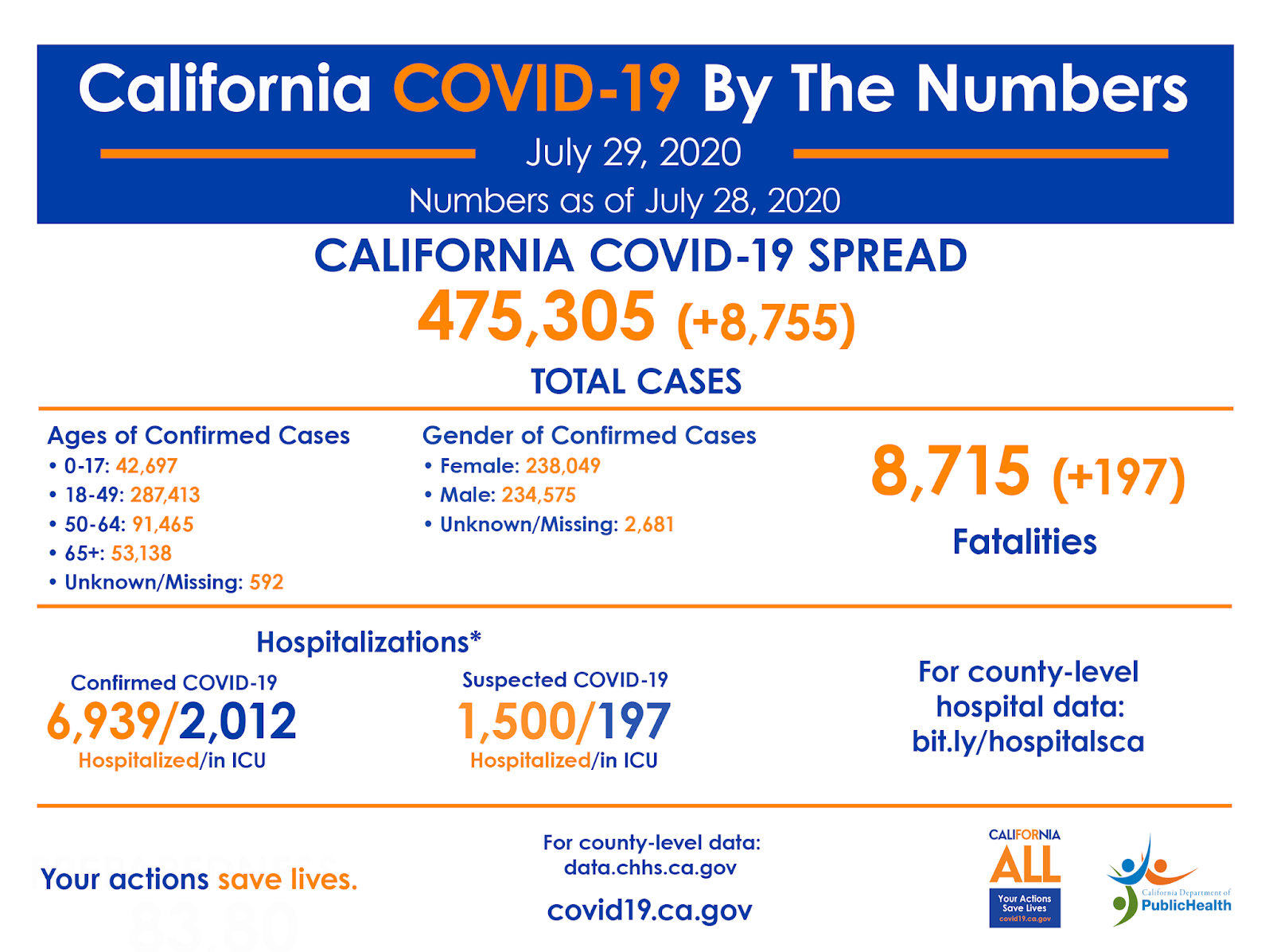
42,697 Confirmed Cases of Children 0-17 Years of Age in California Infected With Covid-19! Agudah is Telling the Governor Jewish Kids Don't Get Sick only the "Other" Kids.
 |
| Add caption |
Agudath Israel of California Statement on Schools
Agudath
Israel of California represents the Orthodox Jewish community in the
State, including more than 25 Orthodox Jewish day schools with over 7000
students in an effort to reopen K-12 schools for face to face learning
in the fall. The Orthodox Jewish community fully understands the threat
of the COVID -19 virus in the State of California. We place safety first
in any action we take.
During the first months of the pandemic our community experienced hospitalizations, the need for long term ventilator care, and even death. Our community took strong action to follow governmental guidelines. In May we were able to reopen synagogues adhering to the state and county protocols. In July, we opened day camps, again following state and county guidelines. To date, we have had no infection traceable to our synagogues or day camps. (Flat Out Lie!)
Sadly, we have not been able to reopen our schools. From March until the end of the academic year, our students, like all students throughout the State, participated in distance learning only. Each of our schools invested hundreds of thousands of dollars in a heroic effort to obtain the necessary technology, set up and train users, and to implement a robust distance learning program.
Despite these efforts, our educators feel, as do educators throughout the State, that the distance learning model was not successful. The thought of limiting instruction to home based computer learning in the coming academic year is untenable. The model is an academic failure and a financial impossibility. Many prominent physicians, including pediatricians, agree that schools can be safely opened for face to face learning if proper guidelines are followed.
We applaud the Governor’s inclusion of a waiver option in the State guidelines that would allow an elementary school to petition to reopen. We strongly contend that the waiver process should be expanded to secondary grades. There is no conclusive science to make such an arbitrary distinction. (ANOTHER LIE)
It should also be possible for a consortium or group of schools to batch their applications and submit them together.
Agudath Israel of California wants all Californians to stay safe and healthy. Part and parcel of that is to enable our children to learn. It is imperative to allow those willing to take the necessary steps to ensure a safe learning environment, the ability to reopen schools for the coming academic year, for face to face instruction.
https://www.cdph.ca.gov/Programs/CID/DCDC/Pages/Immunization/ncov2019.aspx
During the first months of the pandemic our community experienced hospitalizations, the need for long term ventilator care, and even death. Our community took strong action to follow governmental guidelines. In May we were able to reopen synagogues adhering to the state and county protocols. In July, we opened day camps, again following state and county guidelines. To date, we have had no infection traceable to our synagogues or day camps. (Flat Out Lie!)
Sadly, we have not been able to reopen our schools. From March until the end of the academic year, our students, like all students throughout the State, participated in distance learning only. Each of our schools invested hundreds of thousands of dollars in a heroic effort to obtain the necessary technology, set up and train users, and to implement a robust distance learning program.
Despite these efforts, our educators feel, as do educators throughout the State, that the distance learning model was not successful. The thought of limiting instruction to home based computer learning in the coming academic year is untenable. The model is an academic failure and a financial impossibility. Many prominent physicians, including pediatricians, agree that schools can be safely opened for face to face learning if proper guidelines are followed.
We applaud the Governor’s inclusion of a waiver option in the State guidelines that would allow an elementary school to petition to reopen. We strongly contend that the waiver process should be expanded to secondary grades. There is no conclusive science to make such an arbitrary distinction. (ANOTHER LIE)
(Older Children Spread the Coronavirus Just as Much as Adults, Large Study Finds:
https://www.nytimes.com/2020/07/18/health/coronavirus-children-schools.html)
It should also be possible for a consortium or group of schools to batch their applications and submit them together.
Agudath Israel of California wants all Californians to stay safe and healthy. Part and parcel of that is to enable our children to learn. It is imperative to allow those willing to take the necessary steps to ensure a safe learning environment, the ability to reopen schools for the coming academic year, for face to face instruction.
https://www.cdph.ca.gov/Programs/CID/DCDC/Pages/Immunization/ncov2019.aspx
Wednesday, July 29, 2020
To combat the deadly disease, even with scant resources, Hirszfeld and other Jewish doctors sponsored hundreds of public lectures, offered sanitary and hygiene courses, and set up an underground medical university to train young medical students on the co-occurring effects of starvation and epidemics.

How a Public Health Campaign in the Warsaw Ghetto Stemmed the Spread of Typhus (No Agudah "Torah Protects" intervention in Warsaw or anywhere in Europe)
A new study shows how life-saving efforts by Jewish doctors helped curb an epidemic during World War II
:focal(748x360:749x361)/https://public-media.si-cdn.com/filer/9e/1e/9e1e54d3-b9c7-4738-aff1-0a1e02d818e7/gettyimages-56462756_forweb.jpg)
While historians have long understood this to be the case, a new mathematical modeling study, published last week in Science Advances, brings together information from across a spectrum of sources including daily journals, government rationing records, reported case numbers and biostatics, and posits that a vibrant public health campaign was at the root of the efforts to curb the spread.
In the fall of 1940, the occupying Germany army blockaded the Polish city of Warsaw, sealing the city’s more than 400,000 Jews into a 1.3 square mile area. (For comparison, the population density of New York City is about 27,000 people per square mile.) The Germans excused and codified the containment under the guise of isolating disease-carrying individuals; Polish Jews were depicted in Nazi propaganda posters as lice, or typhus vectors.
“It's eye-opening to realize how the question of epidemics informed various decisions, including the German decision to create ghettos, and paved the way to genocide,” says Holocaust historian Tomasz Frydel, who was not involved with the study.
German officials knew enough about the spread of typhus to know that by overcrowding, starving and depriving the Jewish residents of basic necessities, the ghetto would become a breeding ground for infection. Additional food supplies were blocked until May 1941, at which point rations provided by authorities amounted to no more than 200 calories per day, per person. The starvation made fighting any disease that did emerge near impossible, and louse vectors spread easily due to a lack of adequate sanitation and an abundance of hosts.
More than 100,000 Jews were infected by typhus and at least 25,000 died directly from it. But, just before the winter of 1941, as an epidemic in the ghetto was breaking out, something remarkable happened: cases dropped exponentially when they should have continued to rise.
“My greatest surprise was realizing that the typhus epidemic died out at the very beginning of winter just when I would have expected it to accelerate,” says study author Lewi Stone, a mathematician and disease modeler with RMIT in Australia and Tel Aviv University in Israel. “For a year I thought this was likely just a corrupted dataset. But then I checked with the diary of [famed ghetto historian Emanuel] Ringelblum, who documented daily events in the ghetto, and he himself corroborated what I had seen.”
Ringelblum wrote in his diary that cases fell by 40 percent. Stone and his team set off to quantify what happened between the time the ghetto was sealed off in November 1940, until July 1942, when it was liquidated and more than 250,000 remaining Jews were sent to the Treblinka death camp.
 |
| New disease model shows predicted cases (black line) matching actual typhus cases (red line) on the left, and predicted cases if there were no intervention (right) |
When the researchers compared their run to the actual data available from a variety of reports and medical and historical accounts from the ghetto’s records, the numbers matched. Having shown the model was reliable, they next used it to predict the trajectory of the typhus spread with a constant rate of infection, which they would expect when no preventive measures are put in place. The run showed that cases would have exceeded 190,000, an outbreak two to three times higher than what occurred.
Since the number of susceptible Jews remained relatively high during the test run period, the authors said the epidemic was unlikely to have dropped for a lack of hosts. They concluded there must be other factors at play. “And so, we hypothesized that the epidemic crashed actually due to the community's efforts, which were substantial in the end to try to bring that epidemic down,” says Stone.
Among the Jewish public health officials working within the ghetto was epidemiologist Ludwik Hirszfeld, who co-discovered the inheritance of blood types. Hirszfeld had helped establish the National Institute of Hygiene in the Polish state that existed between the world wars and played a major role in establishing public health initiatives within the ghetto. In his memoir, Hirszfeld wrote, “typhus is the inseparable companion of war and famine… This disease destroys more people than ‘the most brilliant’ commander. It often decides the outcome of wars.”
To combat the deadly disease, even with scant resources, Hirszfeld and other Jewish doctors sponsored hundreds of public lectures, offered sanitary and hygiene courses, and set up an underground medical university to train young medical students on the co-occurring effects of starvation and epidemics. Because no antibiotic was available for typhus at the time, the best treatments included de-lousing and staying clean. Stone says doctors and public health workers encouraged people to monitor for lice, change and iron clothes and wash as much as possible. While those efforts extended throughout the ghetto, volunteer agencies took advantage of a meager influx of food that came after May 1941 and set up a feeding program that helped to moderately quell some of the starvation.
/https://public-media.si-cdn.com/filer/48/96/48961a8d-4306-464c-9229-8e05ca54242f/jews_in_warsaw_ghetto_soup_kitchen.jpg)
While typhus had devastating effects in the ghetto, Frydel notes ways that righteous gentiles used public health information about typhus outside of the ghetto as a means to help save Jews in hiding. “We find moving stories of rescuers using typhus to scare off the German police,” he says.
Rescuers could keep authorities at bay by telling the Gestapo that typhus-infected individuals were inside. Some Polish doctors figured out how to forge positive tests to save lives. When workers with fake typhus-positive tests showed up to a factory or forced work site, Germans sent them home to quarantine, where they had a chance to escape being worked to exhaustion.
The case of the Warsaw ghetto is not the first or only example of the interplay between politics and disease, but the study does provide illuminating evidence in favor of the efficacy of public health campaigns and the need for novel ways to assess disease risk factors, especially in light of the ongoing coronavirus pandemic.
Lynn Goldman, the dean of George Washington University’s Milken Institute of Public Health, says the study’s combination of history, medicine, epidemiology and first-hand accounts is rare and the methodology could be hugely important to containing coronavirus and other diseases, especially in high-risk, low resource populations.
“Around the world, some refugee camps are as bad or worse, in terms of public health, and the ability to get in there and assess what's really going on and then to control pandemics is very difficult,” Goldman says. “This kind of paper, we could use it to teach humanitarian assistance, disaster response. But also, it could be used to teach history, to teach political science.”
https://www.smithsonianmag.com/science-nature/how-a-public-health-campaign-warsaw-ghetto-stemmed-spread-typhus-180975418/?utm_source=smithsoniandaily&utm_medium=email&utm_campaign=20200727-daily-responsive&spMailingID=43054427&spUserID=MTAwOTA4NTE0MjE5MQS2&spJobID=1802138283&spReportId=MTgwMjEzODI4MwS2
Tuesday, July 28, 2020
Camp Shoresh Parents - Check On The Safety Of Your Children!
Campus
New Location for Summer 2020
This summer Shoresh will be in a beautiful
spacious campus in Pennsylvania
15 Camp Wayne Road
Preston Park ,PA 18455

-
Indoor gym
-
Spacious bunkhouses
-
football fields
-
basketball courts
-
hockey rinks
-
lit sand volleyball courts
-
Large dining hall
-
Lake
-
swimming pool
Yeshivas Don't Have Unions - Only Gedolim!
"About 65 percent
of public school teachers in the U.S. belong to unions, and despite the
myriad challenges of teaching and learning remotely, it’s possible for
them to do their jobs online."
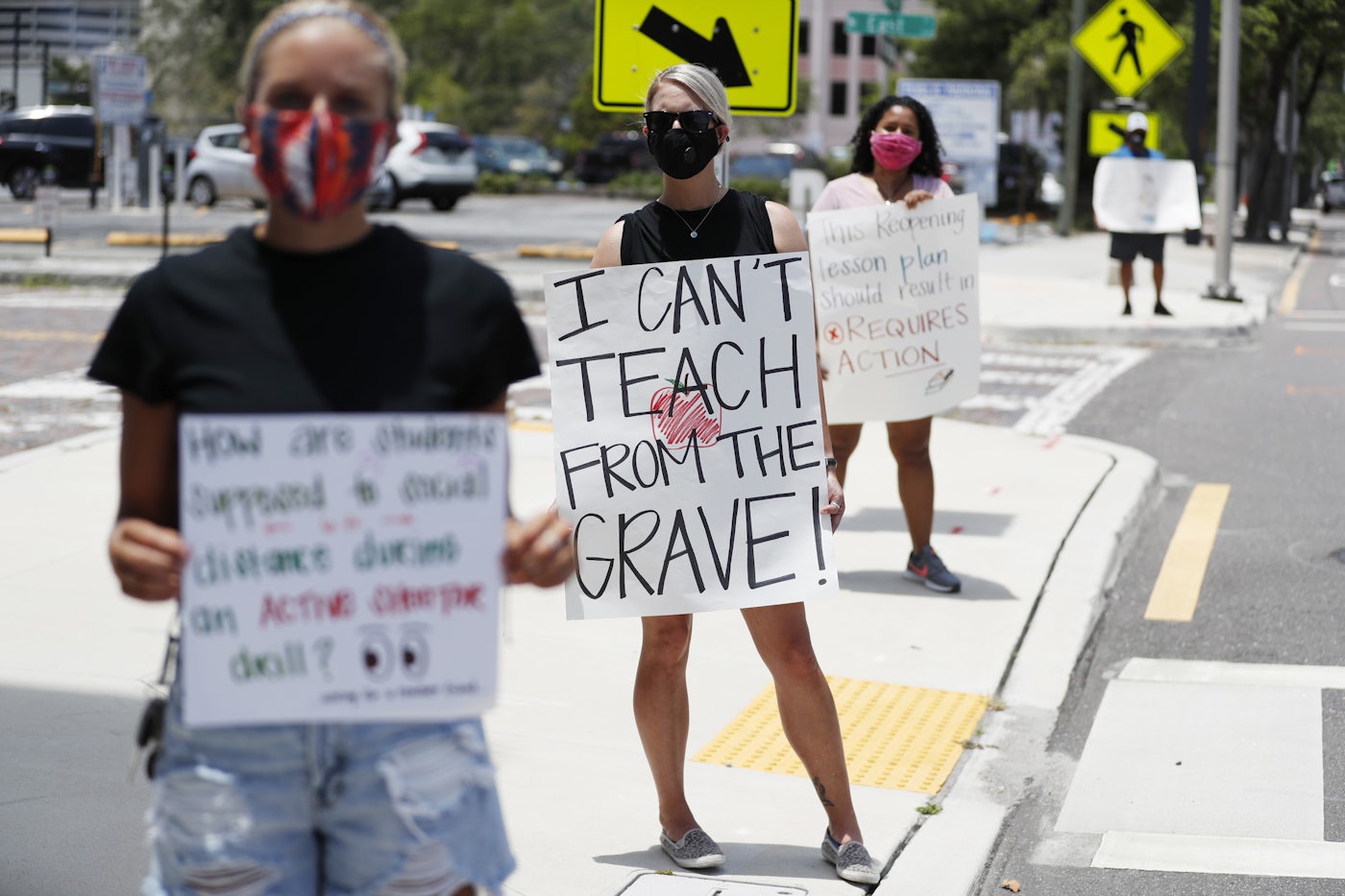
“It is our responsibility to exercise our power as workers to force our leaders to do what they have refused: end this pandemic,” Refuse to Return’s sample resolution reads. “Our demands are intrinsically tied to the movements for racial justice, as Black and Brown communities have disproportionately borne the brunt of this pandemic and will continue to do so if elected officials force students and staff to return to campus before it is safe.” According to CDC data, Black and Latinx people in the United States are three times as likely to contract Covid-19 as white Americans and almost twice as likely to die from it. Litzelman sees connections between the pandemic, school shootings, and the water crisis in Flint, Michigan—all lethal failures of a capitalist system in which leaders “acclimate Americans to the idea that this is just something that we deal with.”
Litzelman points out teachers have more leverage to stay home than many American workers, including other school employees. About 65 percent of public school teachers in the U.S. belong to unions, and despite the myriad challenges of teaching and learning remotely, it’s possible for them to do their jobs online.
In contrast, Sequoia, a nonunion health tech who works alongside the school nurse at an elementary school in Aurora, Colorado, is “between a rock and a hard place” this fall. If a student or staff member becomes infected, “I will be coming in direct contact with them when they come to the clinic, and I will be around them for an extended amount of time,” she said. But if her school doesn’t open for in-person learning, she doesn’t get paid.
Sequoia’s paychecks continued after the school shut down this spring, since her position was already budgeted, but her district, like many around the country, is now facing a deficit. Some of the ideas floated to reduce costs include “charging children to use the school bus, upping athletic fees, getting rid of nurses and replacing them with my position, which I think is completely crazy, especially during a pandemic.”
She and the school nurse share a small clinic and will have to borrow an isolation room from another department. If they have more than two people at the school showing symptoms, Sequoia doesn’t know what they’re going to do. But at the same time, she can’t imagine not coming back to her students if the campus opens. “It would be like abandoning the Titanic as it goes down. I’m like, that’s my ship, I’m going to go down with it,” she said.
Sequoia joined a Facebook group affiliated with Refuse to Return and has emailed Governor Jared Polis, asking him to make a decision about reopening because she feels Colorado’s school districts are dragging their feet. When the school year starts on August 17, she’d ideally like to begin remotely, despite the fact that her son, who has autism and is nonverbal, has struggled with online learning. “It is easier to bring a child back up to their level than it is to bury a child,” she said. “So if it means keeping the kids safe and they’re behind a little bit, then so be it.”
Covid-19 is already killing school workers, even before the doors open for fall. In Arizona, three teachers shared a classroom to give virtual summer school lessons. Despite wearing masks, sanitizing, and maintaining distance, all of them tested positive for the virus, and one, Kimberley Chavez Lopez Byrd, died in June. In Florida, Jordan Byrd (no relation), a 19-year-old college student who worked as a school custodian, recently died after contracting the virus. The school’s principal and his wife, who is the principal of another school in the area, both tested positive and experienced “relatively mild” cases.
“Our school family is devastated,” a teacher at Jordan Byrd’s school wrote on Facebook, according to a report in the Tallahassee Democrat, “and this occurred with no teachers, paraprofessionals [or] students on campus. If this disease spread in the school where masks were required, social distancing, and other safety measures were in place, imagine what it will look like when kids are arriving on buses, sitting in classrooms, walking the crowded halls, and eating lunch with no masks.” The Florida Education Association, which represents around 150,000 educators, including public school teachers and staff, is suing the state, arguing that returning to school before the virus is under control violates the state’s constitution.
The Growing Fight Against the School Death Trap
Teachers, bus drivers, health aides, and other school workers are organizing against a culture that is trying to feed them into the jaws of the pandemic.
A
special education teacher at a public high school in Queens remembers a
week in April when, almost every day, she learned another student at
her school had lost a parent or grandparent to Covid-19. Now she fears
reopening this fall—even with a hybrid learning model like the one proposed in New York—will trigger another wave of grief.
“I feel like they’re sending me back to orphan my kids,” she told me, asking to remain anonymous because she fears professional repercussions for speaking out. She misses seeing her students in person, but all the talk around opening in a masked, socially distanced, constantly sanitized environment reminds her of “The Emperor’s New Clothes.” None of the plans she’s seen seem realistic for her overcrowded school, and she’s worried teachers will spread the virus to students and their families, many of whom live in multigenerational households. She lost a parent in high school and is horrified by the prospect of more kids going through the same—and feeling complicit as “a vector of death.”
With more than 144,734 Americans lost to Covid-19, teachers and school staff around the country share her worries. A recent study from South Korea found that young children can infect others, and kids over 10 can spread the virus as effectively as adults. Of course, schools cannot open without the workers who keep our education system running—teachers, bus drivers, custodians, food service personnel, paraprofessionals, school nurses, and others. Many fear that going back will put them, their families, their students, and their communities at risk. According to an Ipsos poll conducted in May, nearly one in five teachers would quit if they had to return to school this fall, and around half have considered leaving their jobs. Some are writing their wills.
A growing number of education workers are asking their school and union leaders and elected officials to postpone reopening until the virus is under control. A national movement, Refuse to Return, calls for staff and students not to come back in person “until our counties report no new cases of Covid-19 for at least 14 consecutive days,” the outer window in which experts say 99 percent of symptomatic people will develop signs of infection. Since Harley Litzelman, a high school history teacher and union organizer in Oakland, California, launched the campaign in late June, affiliated Facebook groups have formed in 26 states and the District of Columbia, and more than 80,000 people have signed the Refuse to Return petition. On July 27, local organizers are planning a Day of Action Against Pandemic Inaction, with car caravans, remote protests, and phone and email drives targeting their school superintendents and local and state officials.
Much of the discussion around reopening has worked backward from the premise that schools must provide in-person learning in some capacity. Litzelman wants to flip that logic. For him, it’s not just about refusing to put himself, his students, and his fiancée, who has asthma, at risk: It’s a rejection of the idea that Americans must “normalize the constant death of our neighbors” to keep the economy running as the pandemic rages on. While an initial call to action directly addressed teachers, Refuse to Return aims to engage nonteaching staff, parents, students, and “even people unrelated to education, because ultimately this campaign is about preventing greater community transmission everywhere.”
“I feel like they’re sending me back to orphan my kids,” she told me, asking to remain anonymous because she fears professional repercussions for speaking out. She misses seeing her students in person, but all the talk around opening in a masked, socially distanced, constantly sanitized environment reminds her of “The Emperor’s New Clothes.” None of the plans she’s seen seem realistic for her overcrowded school, and she’s worried teachers will spread the virus to students and their families, many of whom live in multigenerational households. She lost a parent in high school and is horrified by the prospect of more kids going through the same—and feeling complicit as “a vector of death.”
With more than 144,734 Americans lost to Covid-19, teachers and school staff around the country share her worries. A recent study from South Korea found that young children can infect others, and kids over 10 can spread the virus as effectively as adults. Of course, schools cannot open without the workers who keep our education system running—teachers, bus drivers, custodians, food service personnel, paraprofessionals, school nurses, and others. Many fear that going back will put them, their families, their students, and their communities at risk. According to an Ipsos poll conducted in May, nearly one in five teachers would quit if they had to return to school this fall, and around half have considered leaving their jobs. Some are writing their wills.
A growing number of education workers are asking their school and union leaders and elected officials to postpone reopening until the virus is under control. A national movement, Refuse to Return, calls for staff and students not to come back in person “until our counties report no new cases of Covid-19 for at least 14 consecutive days,” the outer window in which experts say 99 percent of symptomatic people will develop signs of infection. Since Harley Litzelman, a high school history teacher and union organizer in Oakland, California, launched the campaign in late June, affiliated Facebook groups have formed in 26 states and the District of Columbia, and more than 80,000 people have signed the Refuse to Return petition. On July 27, local organizers are planning a Day of Action Against Pandemic Inaction, with car caravans, remote protests, and phone and email drives targeting their school superintendents and local and state officials.
Much of the discussion around reopening has worked backward from the premise that schools must provide in-person learning in some capacity. Litzelman wants to flip that logic. For him, it’s not just about refusing to put himself, his students, and his fiancée, who has asthma, at risk: It’s a rejection of the idea that Americans must “normalize the constant death of our neighbors” to keep the economy running as the pandemic rages on. While an initial call to action directly addressed teachers, Refuse to Return aims to engage nonteaching staff, parents, students, and “even people unrelated to education, because ultimately this campaign is about preventing greater community transmission everywhere.”
“It is our responsibility to exercise our power as workers to force our leaders to do what they have refused: end this pandemic,” Refuse to Return’s sample resolution reads. “Our demands are intrinsically tied to the movements for racial justice, as Black and Brown communities have disproportionately borne the brunt of this pandemic and will continue to do so if elected officials force students and staff to return to campus before it is safe.” According to CDC data, Black and Latinx people in the United States are three times as likely to contract Covid-19 as white Americans and almost twice as likely to die from it. Litzelman sees connections between the pandemic, school shootings, and the water crisis in Flint, Michigan—all lethal failures of a capitalist system in which leaders “acclimate Americans to the idea that this is just something that we deal with.”
Litzelman points out teachers have more leverage to stay home than many American workers, including other school employees. About 65 percent of public school teachers in the U.S. belong to unions, and despite the myriad challenges of teaching and learning remotely, it’s possible for them to do their jobs online.
In contrast, Sequoia, a nonunion health tech who works alongside the school nurse at an elementary school in Aurora, Colorado, is “between a rock and a hard place” this fall. If a student or staff member becomes infected, “I will be coming in direct contact with them when they come to the clinic, and I will be around them for an extended amount of time,” she said. But if her school doesn’t open for in-person learning, she doesn’t get paid.
Sequoia’s paychecks continued after the school shut down this spring, since her position was already budgeted, but her district, like many around the country, is now facing a deficit. Some of the ideas floated to reduce costs include “charging children to use the school bus, upping athletic fees, getting rid of nurses and replacing them with my position, which I think is completely crazy, especially during a pandemic.”
She and the school nurse share a small clinic and will have to borrow an isolation room from another department. If they have more than two people at the school showing symptoms, Sequoia doesn’t know what they’re going to do. But at the same time, she can’t imagine not coming back to her students if the campus opens. “It would be like abandoning the Titanic as it goes down. I’m like, that’s my ship, I’m going to go down with it,” she said.
Sequoia joined a Facebook group affiliated with Refuse to Return and has emailed Governor Jared Polis, asking him to make a decision about reopening because she feels Colorado’s school districts are dragging their feet. When the school year starts on August 17, she’d ideally like to begin remotely, despite the fact that her son, who has autism and is nonverbal, has struggled with online learning. “It is easier to bring a child back up to their level than it is to bury a child,” she said. “So if it means keeping the kids safe and they’re behind a little bit, then so be it.”
Covid-19 is already killing school workers, even before the doors open for fall. In Arizona, three teachers shared a classroom to give virtual summer school lessons. Despite wearing masks, sanitizing, and maintaining distance, all of them tested positive for the virus, and one, Kimberley Chavez Lopez Byrd, died in June. In Florida, Jordan Byrd (no relation), a 19-year-old college student who worked as a school custodian, recently died after contracting the virus. The school’s principal and his wife, who is the principal of another school in the area, both tested positive and experienced “relatively mild” cases.
“Our school family is devastated,” a teacher at Jordan Byrd’s school wrote on Facebook, according to a report in the Tallahassee Democrat, “and this occurred with no teachers, paraprofessionals [or] students on campus. If this disease spread in the school where masks were required, social distancing, and other safety measures were in place, imagine what it will look like when kids are arriving on buses, sitting in classrooms, walking the crowded halls, and eating lunch with no masks.” The Florida Education Association, which represents around 150,000 educators, including public school teachers and staff, is suing the state, arguing that returning to school before the virus is under control violates the state’s constitution.
Chuck
Paquette, a veteran school bus driver near Syracuse, New York, who’s
been in public school transportation for over 30 years, knows three
drivers who’ve decided to retire early rather than chance their health
going back to work. He says he’s no alarmist but is taking the risk
seriously: Though he recovered from Covid at home in March, he deals
with lingering effects and understands there’s a risk he could become
infected again. Even with a mild case, “I’ve never been that kind of
sick in my life.”
Paquette wonders about the logistics of going back: What happens when a kid on his bus tests positive? If he has to quarantine, will he be forced to use his sick days? Will he be given masks to hand out when students inevitably arrive at the bus stop without one? “What do I do when I’m driving down the road and Johnny says, ‘Susie took off her mask?’” he said.
In Detroit, protesters blocked school buses from transporting students to summer school, which was offered in person on a voluntary basis. Two students were confirmed positive for the virus after an activist group, By Any Means Necessary, sued, and a judge ordered the Detroit Public Schools Community District to test those attending face-to-face classes. “There should have been a foot put down, children’s lives in danger,” Todd Weems, a bus driver who quit, told Detroit TV station WXYZ.
Refuse to Return’s messaging doesn’t call for an actual strike—which is illegal for public school teachers in many states, though that didn’t stop a wave of walkouts in 2018—but Litzelman wanted the name to convey “a commitment to militant action.” While some unions, including United Teachers Los Angeles and the Chicago Teachers Union, have called for a fully remote reopening and are advocating for broader social justice policies, many “have not wanted to take as aggressive a position as the one we have.”
However, he’s seeing the campaign language get picked up around the country, and groups including Louisiana’s Jefferson Federation of Teachers and the Santa Rosa Teachers Association in California have adopted the central demand of “14 days, no new cases” before resuming instruction in person.
Paquette wonders about the logistics of going back: What happens when a kid on his bus tests positive? If he has to quarantine, will he be forced to use his sick days? Will he be given masks to hand out when students inevitably arrive at the bus stop without one? “What do I do when I’m driving down the road and Johnny says, ‘Susie took off her mask?’” he said.
In Detroit, protesters blocked school buses from transporting students to summer school, which was offered in person on a voluntary basis. Two students were confirmed positive for the virus after an activist group, By Any Means Necessary, sued, and a judge ordered the Detroit Public Schools Community District to test those attending face-to-face classes. “There should have been a foot put down, children’s lives in danger,” Todd Weems, a bus driver who quit, told Detroit TV station WXYZ.
Refuse to Return’s messaging doesn’t call for an actual strike—which is illegal for public school teachers in many states, though that didn’t stop a wave of walkouts in 2018—but Litzelman wanted the name to convey “a commitment to militant action.” While some unions, including United Teachers Los Angeles and the Chicago Teachers Union, have called for a fully remote reopening and are advocating for broader social justice policies, many “have not wanted to take as aggressive a position as the one we have.”
However, he’s seeing the campaign language get picked up around the country, and groups including Louisiana’s Jefferson Federation of Teachers and the Santa Rosa Teachers Association in California have adopted the central demand of “14 days, no new cases” before resuming instruction in person.
Around the country, educators are drawing on their collective power. In March, the threat of sick-outs
from rank-and-file teachers union members helped push New York City’s
schools to shut down as the virus spread. “When I look through the
literally thousands of posts in all of the different groups, we see
stakeholders and school staff of all varieties,” Litzelman said. “If we
all refuse to return, we will all protect one another.”
https://newrepublic.com/article/158625/growing-fight-school-death-trap?utm_source=newsletter&utm_medium=email&utm_campaign=tnr_daily

https://newrepublic.com/article/158625/growing-fight-school-death-trap?utm_source=newsletter&utm_medium=email&utm_campaign=tnr_daily
 |
Monday, July 27, 2020
Hands On Hershel Schachter Seems to Be Busy With Life Threatening Issues (Who can wash their hands?) --- Why Not Go Bold, Like... Certainly Anyone in Poor Health Over A Certain Age Should Not Fast Beyond Chatzos? In This Covid-19 Era, It is a Vadei Sakana For The Sick and Elderly...

Rabbi Shachter says that they view the virus as a Safeik Sakana, a potential danger and therefore during the present period they would be allowed to wash and use alcohol gel, whereas those who are not so stringent would be forbidden to use disinfectant or wash since during the year they rely on “Hashem preserves the simplehearted” (Tehillim 116:6). In other words one who is flippant and is careless about the other rules cannot say that he needs to wash his hands as protection against the virus. If someone is disregarding the other rules of the CDC, he cannot insist on this one, and washing would remain prohibited.

Sunday, July 26, 2020
Anybody See Chaim Dovid Zweibel?
Camp Bnos Closing Early Due to Two Confirmed COVID-19 Cases

Camp Bnos announced that due to two confirmed cases of coronavirus,
they are ending the first session of the summer two days early.
In a letter to parents, the administration informed the parents of their campers that due to the infections that were detected, the camp will close early, and that all who have been exposed to the infected parties have been notified and should quarantine for 14 days.
The campus, located in Ferndale, New York, has not yet determined if they will operate for the second session of the summer.
https://hamodia.com/2020/07/26/camp-bnos-closing-early-due-two-confirmed-covid-19-cases/
In a letter to parents, the administration informed the parents of their campers that due to the infections that were detected, the camp will close early, and that all who have been exposed to the infected parties have been notified and should quarantine for 14 days.
The campus, located in Ferndale, New York, has not yet determined if they will operate for the second session of the summer.
https://hamodia.com/2020/07/26/camp-bnos-closing-early-due-two-confirmed-covid-19-cases/
Friday, July 24, 2020
Some reports place children at the center of spreader events. In Israel, the number of new cases has risen from fewer than 50 per day two months ago, before schools reopened, to more than 1,500 per day now. Those numbers followed school outbreaks that infected at least 1,335 students and 691 staff. An overnight camp for 13-to-18-year-olds in Missouri closed after 82 children and staff became infected.
What Scientists Know About How Children Spread COVID-19
As communities struggle with the decision over whether to open up schools, the research so far offers unsatisfying answers
:focal(937x508:938x509)/https://public-media.si-cdn.com/filer/10/5a/105a636f-0de5-4d8a-ba65-5caee25114c8/gettyimages-1256366561_online.jpg)
Still, the question of how likely kids are to be vessels ferrying the infection to others remains a looming concern as school districts and states across the U.S. consider whether and how to reopen for the fall. “It's obviously one of the critical questions that we have to answer,” Hartert says. “We still don't have a lot of data.”
Hartert now leads a six-month study funded by the National Institutes for Health that looks to answer that question, among others. Called the Human Epidemiology and Response to SARS study (HEROS), it will sample 1,951 families every two weeks starting July 1. The families live mostly in urban areas like Chicago, New York and Denver, but the study also includes some from rural Wisconsin. The goal is to capture infections as they occur and track the transmissions patterns. “One of the problems with a lot of the studies that have been done is you really don't know who's infected and then who transmitted it to whom,” she says.
The first samples are being analyzed now. How informative the data set becomes depends on the subjects—whether it includes clusters of families who are infected and shows how the virus spreads. “It's a difficult thing to predict,” she says.
Elsewhere, researchers have teased out evolving and sometimes contrary answers to basic questions about COVID and kids, with only enough pieces fitting together to suggest the outlines of an image.
For one study, published in May, researchers analyzed reports from more than 600 people from two cities in China: Wuhan, the epicenter of the outbreak, and Shanghai. In this relatively small sample size, they found children were a little more than a third as likely to be infected as adults. But children had roughly three times as many chances to become infected when schools were open, effectively canceling the difference.
Another recent study by the London School of Hygiene & Tropical Medicine, which used data from China, Italy, Japan, Singapore, Canada and South Korea, found that people under 20 were about half as likely as adults to be infected. But the researchers qualified their findings, noting that there were variations among countries and age groups. Recent data in England, they noted, found little difference in infection rates among children and adults. Nicholas G. Davies, an epidemiologist and modeler who led the study, said what happens with kids and COVID remained a mystery.
The fact that children are less likely to exhibit symptoms while infected makes the problem of determining how well they spread the coronavirus even trickier to figure out. But emerging studies and the history of the common coronaviruses being transmitted by children makes for a compelling case they can spread the COVID-19 virus.
A recent study from South Korea of 5,706 infected people and their 59,073 contacts found children under 10 transmitted less often to adults while those between the ages of 10 and 19 spread the virus as well as adults do. Households with the older children had the highest rate of spread to other members—18.6 percent— of any age group while households with younger children had the least spread, just 5.3 percent. The overall average was 11.8 percent.
There’s evidence as well that children, including those without symptoms, are as likely to be infectious. Researchers in Berlin tested more than 3,700 COVID-19 patients, including 127 individuals under 20 years old. The study found that compared to adults, kids carried the same viral load, a signal of infectiousness.
Some reports place children at the center of spreader events. In Israel, the number of new cases has risen from fewer than 50 per day two months ago, before schools reopened, to more than 1,500 per day now. (Today it reached 2000) PM
Those numbers followed school outbreaks that infected at least 1,335 students and 691 staff. An overnight camp for 13-to-18-year-olds in Missouri closed after 82 children and staff became infected.
Yang Yang, a biostatistician at the University of Florida’s College of Public Health, is completing a study based on nearly 20,000 households. He says his preliminary results reveal that children do infect adults, especially in the same households. “Our analysis is that children are a little bit more infectious than adults with in-house transmission,” he says, but that may just be because they are tended to by parents or grandparents in homes.
/https://public-media.si-cdn.com/filer/ba/92/ba92ec37-03df-46bf-ab95-b157c1b41a2e/gettyimages-1226007156_online.jpg)
They found viruses moving from schools and daycare facilities, from children to parents, something any parent who sends their children to daycare or pre-kindergarten for the first time recognizes. However, the studies to date about COVID-19 and children have been too small or too compromised by factors such as school closings, lack of testing or much smaller community caseloads than the United States.
“The question is, what happens when the children get it? Are they effectively dead ends?” he says. “Or are they capable of communicating the virus and spreading it to other people? And I think the evidence is not conclusive. We don't know enough to know that children to some degree are less capable of transmitting this virus.”
Derek Cummings, an emerging pathogens expert at the University of Florida, says he’s not convinced by the evidence that children are less likely to transmit the disease. His work with the endemic coronaviruses, relatives of SARS-CoV-2, shows that children are infected with their first coronavirus by three and get all four of the common coronaviruses by 20. “Every other coronavirus infects kids and transmits among kids,” he adds, “so why would we assume this one doesn't?”
Hartert says that the research indicating children may not as often transmit the virus would, once again, make SARS-CoV-2 an outlier. She noted that studies show children are shedding a similar amount of COVID-19 virus as adults, which would suggest they were equally capable of transmittal. “So there are a lot of things that would make it surprising if we find out that children are less likely to transmit the virus,” she adds.
Back to school
Shaman says he understands the need to get children back to school, but it's hard to gauge the risk given the current state of knowledge and information slanted by governments looking to reopen schools. “We don't have a policy model and an experience model that allows us to understand what will be appropriate,” he adds. “We're dealing with a novel coronavirus. We don't fully understand how children are involved in the transmission cycle.”
Hartert, a former high school teacher, said that schools need to reopen for a number of reasons, including mitigating the inequities of staying at home for low-income students who need support for things like meals and after-school care. But in her opinion, reopening should only happen in states and communities where the virus is under control. (Other countries have reopened their schools, but only after the virus had been subdued and often with limited class sizes.)
“There aren't many other countries that have opened schools while rates of the virus are increasing exponentially,” she says. “If you live in a region where there's more spread of the virus, it's a lot more likely that you have an outbreak from a teacher, parent, or child who brings the virus to school.”
Mitigation strategies like masks, social distancing and ventilation need to be in place as well. “We're going to have to weigh the risks and benefits with the amount of data that we have at the point which we have to make decisions about opening schools,” she says. “We've got to get our kids back to school and we've got to open daycares for essential workers. I think everyone wants to do that. But it's not as easy as just mandating that it happen.
https://www.smithsonianmag.com/science-nature/what-scientists-know-about-how-children-spread-covid-19-180975396/?utm_source=&utm_medium=&utm_campaign=&spMailingID=43028347&spUserID=MTAwOTA4NTE0MjE5MQS2&spJobID=1801840301&spReportId=MTgwMTg0MDMwMQS2
Subscribe to:
Posts (Atom)