EVERY SIGNATURE MATTERS - THIS BILL MUST PASS!

EVERY SIGNATURE MATTERS - THIS BILL MUST PASS!
CLICK - GOAL - 100,000 NEW SIGNATURES! 75,000 SIGNATURES HAVE ALREADY BEEN SUBMITTED TO GOVERNOR CUOMO!

EFF Urges Court to Block Dragnet Subpoenas Targeting Online Commenters

EFF Urges Court to Block Dragnet Subpoenas Targeting Online Commenters
CLICK! For the full motion to quash: http://www.eff.org/files/filenode/hersh_v_cohen/UOJ-motiontoquashmemo.pdf

Tuesday, September 08, 2020

Convalescent plasma should not be considered standard of care for the treatment of patients with COVID-19. (When Advertising Your Brand Supersedes The Science! AgudahTuesday: Plasma Drive In Flatbush - Ignorance Required)


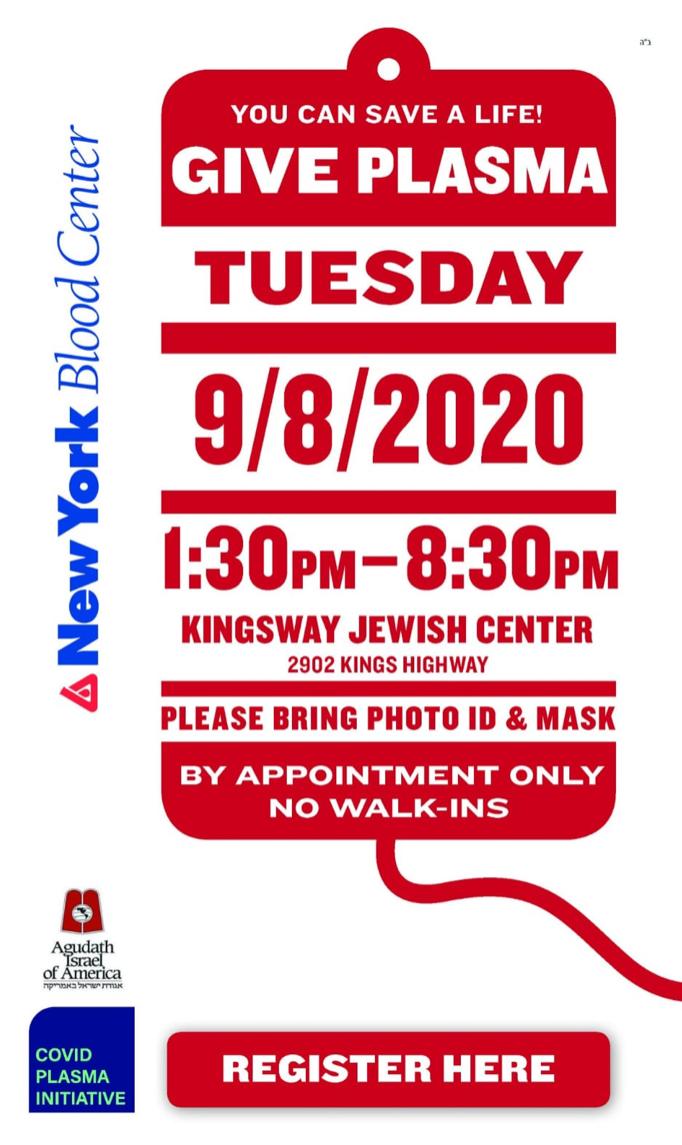
Agudath Israel of America is partnering again with the COVID Plasma Initiative and the New York Blood Center to host a COVID-19 plasma drive in the heart of Flatbush.  

The drive will take place this Tuesday, September 1st, 1:30 PM-7:30 PM, at the Kingsway Jewish Center, 2902 Kings Highway.  

Click here to register for a time slot to donate. This drive will be run by appointment only.  

If you have tested positive or displayed symptoms of COVID-19 then this event is for you. You can be of vital assistance to those still struggling with this dreadful disease. 
 

The COVID-19 Treatment Guidelines Panel’s Statement on the Emergency Use Authorization of Convalescent Plasma for the Treatment of COVID-19

Last Updated: September 01, 2020

On August 23, 2020, the Food and Drug Administration (FDA) issued an Emergency Use Authorization (EUA)* for COVID-19 convalescent plasma for the treatment of hospitalized patients with COVID-19.1,2 The COVID-19 Treatment Guidelines Panel (the Panel) reviewed the available evidence from published and unpublished data on convalescent plasma for the treatment for COVID-19, including the FDA analyses that supported the EUA.

There are currently no data from well-controlled, adequately powered randomized clinical trials that demonstrate the efficacy and safety of convalescent plasma for the treatment of COVID-19. The FDA analysis of data on a subset of hospitalized patients from the Mayo Clinic’s Expanded Access Program (EAP) compared outcomes in patients who received convalescent plasma with high titers of severe acute respiratory syndrome coronavirus 2 (SARS-CoV-2) neutralizing antibodies to outcomes in patients who received plasma with low titers and found no difference in 7-day survival overall. Among patients who were not intubated, 11% of those who received convalescent plasma with high antibody titers died within 7 days of transfusion compared with 14% of those who received convalescent plasma with low antibody titers. Among those who were intubated, there was no difference in 7-day survival. Although these data suggest that convalescent plasma with high antibody titers may be beneficial in nonintubated patients, uncertainty remains about the efficacy and safety of convalescent plasma due to the lack of a randomized control group and possible confounding in the Mayo Clinic’s EAP. Additionally, antibody levels in currently available COVID-19 convalescent plasma are highly variable, and assays to determine the effective antibody titers remain limited.3

Based on the available evidence, the Panel has determined the following:

  • There are insufficient data to recommend either for or against the use of convalescent plasma for the treatment of COVID-19.
  • Available data suggest that serious adverse reactions following the administration of COVID-19 convalescent plasma are infrequent and consistent with the risks associated with plasma infusions for other indications. The long-term risks of treatment with COVID-19 convalescent plasma and whether its use attenuates the immune response to SARS-CoV-2, making patients more susceptible to reinfection, have not been evaluated.
  • Convalescent plasma should not be considered standard of care for the treatment of patients with COVID-19.
  • Prospective, well-controlled, adequately powered randomized trials are needed to determine whether convalescent plasma is effective and safe for the treatment of COVID-19. Members of the public and health care providers are encouraged to participate in these prospective clinical trials.
  • The Panel will continue to evaluate emerging clinical data on the use of convalescent plasma for the treatment of COVID-19 and will update the Convalescent Plasma section of the Guidelines in the near future.

* The criteria for issuance of an EUA are not the same as the standards for FDA approval.4 There are currently no FDA-approved therapies for the treatment of COVID-19.

References

  1. Food and Drug Administration. Coronavirus disease 2019 (COVID-19) EUA information. 2020. Available at: https://www.fda.gov/emergency-preparedness-and-response/mcm-legal-regulatory-and-policy-framework/emergency-use-authorization#covid19euas. Accessed August 31, 2020.
  2. Food and Drug Administration. Convalescent plasma letter of authorization. 2020. Available at: https://www.fda.gov/media/141477/download. Accessed August 31, 2020.
  3. Food and Drug Administration. EUA 26382: Emergency Use Authorization (EUA) Request. 2020. Available at: https://www.fda.gov/media/141480/download. Accessed August 31, 2020.
  4. Food and Drug Administration. Emergency Use Authorization of Medical Products and Related Authorities: Guidance for Industry and Other Stakeholders. January 2017; Available at: https://www.fda.gov/media/97321/download. Accessed August 31, 2020.

https://www.covid19treatmentguidelines.nih.gov/statement-on-convalescent-plasma-eua/

Monday, September 07, 2020

Gamzu said last week that 80% of the most recent coronavirus cases occurred in ultra-Orthodox neighborhoods.


Ultra-Orthodox Jews clash with secular Israeli officials over coronavirus measures


JERUSALEM - Israel's rapidly escalating coronavirus crisis is aggravating a religious divide in the Jewish state, with ultra-Orthodox leaders accusing mostly secular health officials of discrimination and fostering anti-Semitism by focusing on outbreaks in highly observant communities.

As the government struggles to contain the outbreak, ultra-Orthodox Jewish rabbis, cabinet ministers and parliament members have resisted attempts to curtail activities in ultra-Orthodox areas, including many that have emerged as covid-19 hot spots.

Facing particular ire has been Ronni Gamzu, the pugnacious former hospital administrator appointed last month as the government's "corona czar." Gamzu has clashed with religious leaders over his efforts to impose targeted lockdowns on neighborhoods with high infection rates, block a yearly pilgrimage to the grave of a revered Hasidic rabbi in Ukraine and compel virus testing for thousands of foreign students who have recently arrived to attend religious schools, or yeshivas.

Gamzu said last week that 80% of the most recent coronavirus cases occurred in ultra-Orthodox neighborhoods. The government expects to enact targeted restrictions Monday in 10 hot spot communities, many of them ultra-Orthodox.

The tensions have riven Israel's coronavirus cabinet, the government body that sets policy. On Friday, one day after Israel recorded 3,141 new cases - the largest single day per capita increase in any country since the pandemic began - cabinet discussions grew heated over proposed lockdowns during the Jewish holidays of Rosh Hashanah and Yom Kippur later this month.

"You want a lockdown during the High Holidays because you don't want people praying," Housing Minister Yaakov Litzman said to Gamzu, according to Israeli media reports. "We will not let this happen."

Gamzu says that his recommendations are data-driven, applied equally to all sectors of Israeli society and designed to prevent the need for another nationwide lockdown. He has not hesitated to fire back at those want to avoid restrictions, including some business owners and school officials whom he has accused of hindering the country's recovery.

"Stop the insanity," he said in an emotional appeal to the public Thursday. "All Israel is at war."

In arguments that echoed those of some church leaders in the United States, a senior ultra-Orthodox rabbi, Chaim Kanievsky, accused Gamzu of wanting to keep yeshiva scholars from their religious studies even as secular Israelis are allowed to go to beaches and restaurants.

Gamzu, who was appointed by Prime Minister Benjamin Netanyahu in early August, was overruled during his first week on the job when he sought to block this year's crop of foreign yeshiva students from entering the country. But he insisted they be quarantined to start their stay and then tested and isolated if results are positive.

Several hundred boarding students, many of them teenagers from the United States, have tested positive in recent weeks, although most show no symptoms. The northern Israeli town of Karmiel reported last week that almost half the 400 students at a local yeshiva had tested positive.

Kanievsky, however, advised schools not to test even in cases when students showed symptoms because it would disrupt their studies.

Gamzu's blunt retort - "Rabbi Kanievsky's announcement endangers the ultra-Orthodox public" - sparked outrage, with one ultra-Orthodox newspaper calling for Gamzu's resignation over his "despicable defiance of the Torah's authority."

Gamzu faced another backlash when he lobbied Ukrainian officials to bar ultra-Orthodox Israelis from making their annual Rosh Hashanah pilgrimage to the Ukrainian town of Uman. The celebrations, involving crowds of dancing men, had super-spreader potential, he warned. Officials in the Ukrainian capital, Kyiv, announced the ban this week, but not before Ukrainian media reported that locals in Uman had attacked Jewish travelers who had already arrived.

Ultra-Orthodox leaders were furious with Gamzu, and several Israeli officials accused him of "fueling anti-Semitism" in the words of parliament member Miki Zohar, from Netanyahu's Likud party.

Gamzu declined to comment for this article.

The arguments between religious and secular camps are not new. Ultra-Orthodox Jews - or Haredim as they known in Hebrew - live in insular communities, putting higher priority on their religious practices than civic obligations. Many, for instance, don't celebrate Israeli patriotic holidays, and most don't serve in the military, a near universal requirement for other Jewish Israelis.

Health experts say the ultra-Orthodox are particularly susceptible to the spread of infection because they typically have large families, live in crowded neighborhoods and routinely gather in large numbers for worship and funerals.

Haredi distrust of the government runs deep, and initially their rabbis resisted orders that Israelis wear masks and avoid crowded indoor prayer. Minor clashes broke out when the Israeli army was deployed in a few high-infection Haredi areas to help enforce lockdown orders.

But religious leaders began complying after they saw Covid-19 deaths spiral elsewhere, including Hasidic communities in the United States.

"They were shocked by the casualties in New York among their own people and began taking it very seriously," said Tamar El-Or, an anthropology professor at Hebrew University who has studied Haredi culture.

Since the epidemic began, confirmed cases have topped 126,000 in a country of nearly 9 million people. About 22%of infections have been in ultra-Orthodox areas, according to health data, second only to 28% in Arab towns and neighborhoods. And the latest surge of infections, which came after Israel loosened its public health restrictions, has hit the ultra-Orthodox even harder.

But with total deaths remaining relatively low - less than a thousand - and hospitals so far able to handle the volume of seriously ill patients, many ultra-Orthodox are insistent that they be able to continue activities that are important to them.

"There is sickness yes, but it's not like we are piling up corpses," El-Or said of their attitude. "It's not that they want to go back to normal. It's about where to draw the lines."

Elimelech Lamdan, an ultra-Orthodox psychotherapist in the city of Givatayim, said his community is angry over the government dictates largely because they see Gamzu as a secular Israeli who would like the religious to disappear.

"In the eyes of many Haredim, these rules are applied selectively. They are a put-up job," said Lamdan, who noted that he agreed with some, but not all, of the criticisms leveled against Gamzu. "Life should be ruled by the Torah and not by the consensus of the governing body."


https://www.thehour.com/news/article/Ultra-Orthodox-Jews-clash-with-secular-Israeli-15545201.php

Sunday, September 06, 2020

Covid Spike Alert!


New York City is urging vigilance as it sees an increase in coronavirus cases in Orthodox Jewish communities.

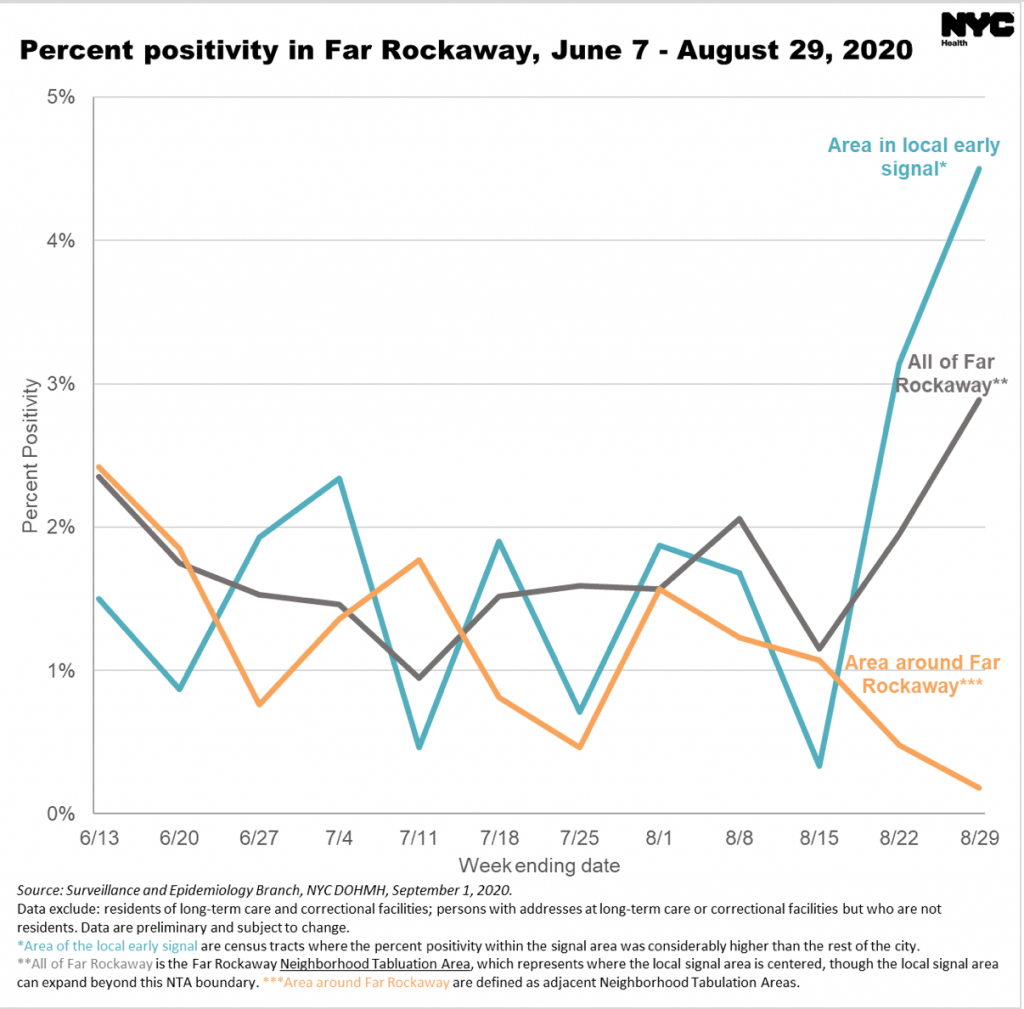
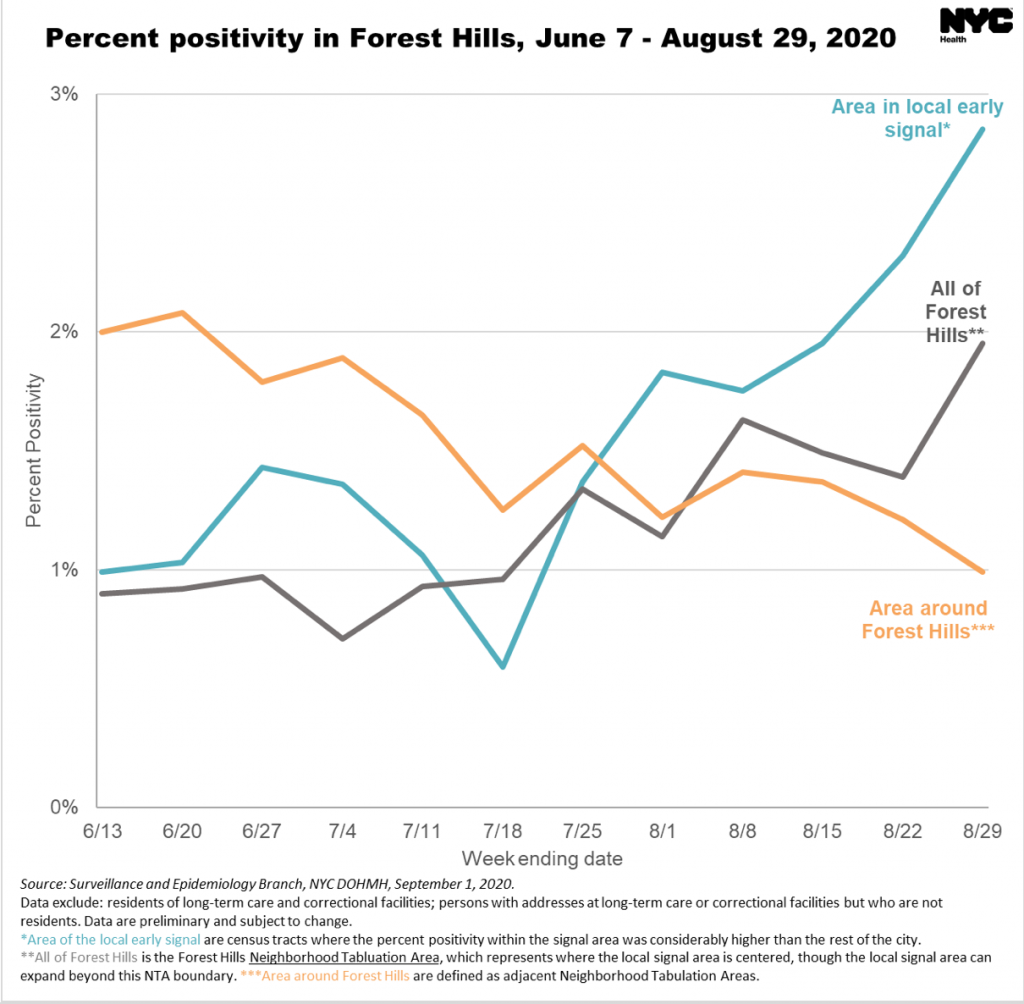
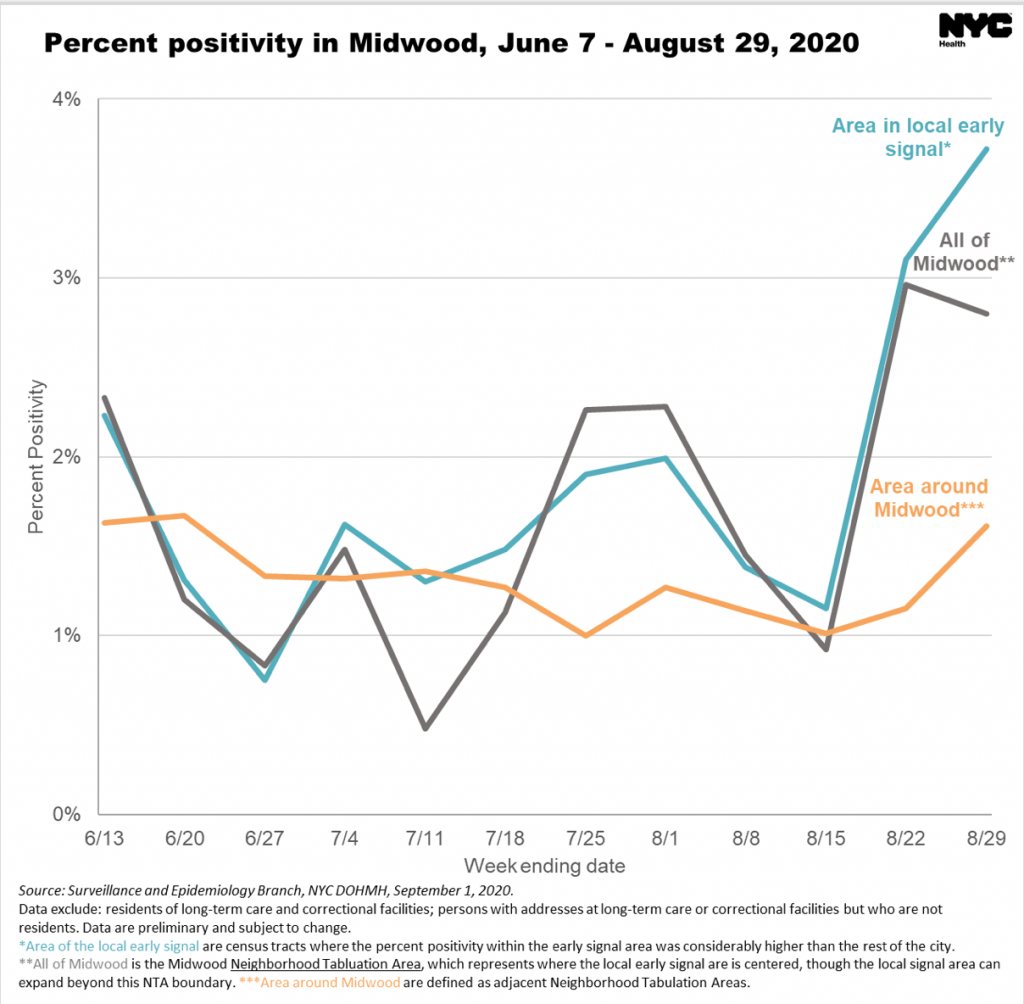
“In recent days, we have observed heightened rates of COVID-19 in many neighborhoods with large Orthodox Jewish populations,” New York City Health Commissioner Dr. Dave Chokshi wrote in an email to Orthodox outlets Sunday evening. “The neighborhoods that have presented higher proportions of positive COVID-19 tests — when compared to adjacent areas — include the Forest Hills and Far Rockaway sections of Queens as well as the Midwood, Williamsburg and Borough Park sections of Brooklyn.”

The Orthodox communities were hit hard by COVID-19 in March and April, but the disease then seemed to have nearly disappeared. A source in Hatzalah told Hamodia that the organization received virtually no COVID calls for the four month period prior mid-August. Some community members believed it had reached herd immunity.

But during the past two weeks, Orthodox communities once again started seeing a spike in cases. Mayor Bill de Blasio said some cases in Boro Park had been linked to a wedding that violated the 50-person limit. Chokshi held a conference call with Orthodox outlets to warn against complacency, and encourage people to continue to wear masks, maintain social distancing, wash hands, avoid large gatherings, getting tested for the virus, and communicating and cooperating with Test & Trace officials about possible exposures.

A source with knowledge of the community told Hamodia on Sunday evening that whereas there had been hardly any COVID-related hospitalizations during the prior four months, in the past two weeks both the number of positive tests and percentage of tests with positive results have been spiking, and that there have been approximately 10 COVID hospitalizations in the community, including serious cases and intubations.

Below is the full text of Chokshi’s letter to Orthodox media Sunday evening:

Dear Colleagues,

I am writing to share concerning COVID-19 news that I hope you will convey to your readers in your ongoing coverage.

In recent days, we have observed heightened rates of COVID-19 in many neighborhoods with large Orthodox Jewish populations. The neighborhoods that have presented higher proportions of positive COVID-19 tests—when compared to adjacent areas—include the Forest Hills and Far Rockaway sections of Queens as well as the Midwood, Williamsburg and Borough Park sections of Brooklyn.

Moreover, we are receiving what we refer to as “signals,” in smaller sections of these neighborhoods where there are anomalous spikes in cases.

Following up on our conference call, we continue to see transmission in New York City and it appears to be happening more in communities that encompass your coverage areas than in many other parts of the city. COVID-19 can be transmitted from an adult to a child and we are seeing transmission within households from adults to children in some of these communities.

The neighborhoods experiencing transmission were particularly hard hit in the worst weeks of the pandemic this past spring and we never want to return to those awful days.

We also must emphasize that these communities’ past experience with COVID-19, does not guarantee immunity from future transmission. The science has not yet established that any section of New York City has reached herd immunity or even how long immunity lasts after someone has recovered from COVID-19.

All New Yorkers, including children, must adhere to the Core 4, which includes washing hands, wearing face coverings (if older than two years of age), maintaining distance and staying home if ill. Everyone must also avoid large gatherings and safely isolate if exposed to someone who was found to have COVID-19. If safely isolating at home is difficult, the city can provide accommodations or additional resources. All New Yorkers should be getting tested. To find a testing site go to nyc.gov/covidtest or call 311.

We know everyone in these areas shares our deep concern for their families, friends and neighbors and we urge all New Yorkers to do their part to help us keep COVID-19 at bay.

Thank you.

With appreciation,

Dr. Dave A. Chokshi, NYC Health Commissioner

Below are tables showing the increased numbers in the five neighborhoods:

new york city jewish community coronavirus

Friday, September 04, 2020

On August 3, 2020, Governor Cuomo signed another extension giving survivors of childhood sexual abuse an additional year to bring their cases. This extension creates a final deadline of August 14, 2021. Supporters argued that the extra time was needed because of the court disruption brought by COVID-19.


As Lawsuits Increase, N.Y. Extends Look-Back Window for Child Sex Abuse Cases


According to a recent article in The Washington Post, the number of child sexual abuse allegations against Catholic clergy more than quadrupled in 2019 compared to the average in the previous five years. In 2015, there were 903 reports, and by 2019, that number had increased to 4,434.

Meanwhile, New York has seen at least 1,000 new child sexual abuse lawsuits filed since May 2020, with hundreds more expected before the “look-back window” deadline, which has now been moved to August 14, 2021.

New York Extends Filing Deadline to 2021


In February 2019, New York Governor Andrew Cuomo signed into law the Child Victims Act. This new law provided a short-term expansion of the state’s statute of limitations on child sex abuse claims, creating a one-year look-back window during which victims could file claims that had previously been barred.

Starting August 14, 2019, victims could bring lawsuits against the perpetrators and related institutions, regardless of when the abuse occurred. The law also extended the statute of limitations for future civil cases until the victim reaches the age of 55, a significant increase from the previous limit of age 23. For criminal cases, victims can seek prosecution until they turn 28.

The one-year grace period was scheduled to end on August 14, 2019, but in May 2020, Governor Cuomo announced an executive order extending that deadline until January 14, 2021, mainly because of court delays caused by the COVID-19 pandemic.

Then on August 3, 2020, Governor Cuomo signed another extension giving survivors of childhood sexual abuse an additional year to bring their cases. This extension creates a final deadline of August 14, 2021. Supporters argued that the extra time was needed because of the court disruption brought by COVID-19.

“The Child Victims Act brought a long-needed pathway to justice for people who were abused,” Governor Cuomo said, “and helps right wrongs that went unacknowledged and unpunished for far too long and we cannot let this pandemic limit the ability for survivors to have their day in court.” According to Senator Brad Hoylman, 3,000 survivors have filed claims so far.

Catholic Dioceses and Boy Scouts of America Create Victims’ Compensation Funds


Several other states have also opened look-back windows for child sex abuse victims, including New Jersey, California, Arizona, Montana, Hawaii, Vermont, North Carolina, and the District of Columbia. In all of these states, victims that were previously barred from filing lawsuits because of the statutes of limitations can now come forward and seek justice.

Multiple dioceses around the country have created compensation funds for victims, including those in California, New Jersey, Pennsylvania, and more.

In addition to sexual abuse claims against Catholic clergy and related dioceses, many victims of sexual abuse occurring within the Boy Scouts organization have come forward to file lawsuits. The Boy Scouts has created a victims’ compensation fund—survivors who wish to file for damages within the fund have until November 16, 2020 file claims in federal bankruptcy court.

https://newyork.legalexaminer.com/home-family/as-lawsuits-increase-n-y-extends-look-back-window-for-child-sex-abuse-cases/

Thursday, September 03, 2020

“I didn’t want to get involved”

 “For more than half an hour 38 respectable, law-abiding citizens in Queens watched a killer stalk and stab a woman in three separate attacks in Kew Gardens,” the Times article began (there were actually only two attacks). “Twice the sound of their voices and the sudden glow of their bedroom lights interrupted him and frightened him off. Each time he returned, sought her out and stabbed her again.”


Sophia Farrar Dies at 92; Belied Indifference to Kitty Genovese Attack 


For decades, the conventional narrative that defined urban anomie overlooked a good Samaritan who heeded a dying woman’s cries for help.

The story of Kitty Genovese, coupled with the number 38, became a parable for urban indifference after Ms. Genovese was stalked, raped and stabbed to death in her tranquil Queens neighborhood.
Two weeks after the murder, The New York Times reported in a front-page article that 37 apathetic neighbors who witnessed the murder failed to call the police, and another called only after she was dead.

It would take decades for a more complicated truth to unravel, including the fact that one neighbor actually raced from her apartment to rescue Ms. Genovese, knowing she was in distress but unaware whether her assailant was still on the scene.

That woman, Sophia Farrar, the unsung heroine who cradled the body of Ms. Genovese and whispered “Help is on the way” as she lay bleeding, died on Friday at her home in Manchester, N.J. She was 92.

Her son, Michael Farrar, said the cause was pneumonia.

At around 3 a.m. on March 13, 1964, the 28-year-old Ms. Genovese was stabbed repeatedly, raped and robbed of $49 in two separate attacks by the same man as she returned home to leafy Kew Gardens from her job as a bar manager.

The murder was reported in a modest four-paragraph article in The Times. Two weeks later, its interest piqued by a tip from the city’s police commissioner, The Times produced a front-page account of the killing that transformed the murder into a global allegory for callous egocentrism in the urban jungle and undermined the innocent-bystander alibi.

“For more than half an hour 38 respectable, law-abiding citizens in Queens watched a killer stalk and stab a woman in three separate attacks in Kew Gardens,” the Times article began (there were actually only two attacks). “Twice the sound of their voices and the sudden glow of their bedroom lights interrupted him and frightened him off. Each time he returned, sought her out and stabbed her again.”

That account — epitomized by one neighbor’s stated excuse that “I didn’t want to get involved” — galvanized outrage, became the accepted narrative for decades and even spawned a subject of study in psychology: how bystanders react to tragedy. Except that with the benefit of hindsight, the number of eyewitnesses turned out to have been exaggerated; none actually saw the attack completely; some who heard it thought it was a drunken brawl or a lovers’ quarrel; and several people said they did call the police.

And there was Mrs. Farrar.

According to police accounts, trial testimony and interviews for “The Witness,” a 2016 documentary about the case, Mrs. Farrar, her husband and her son were awakened by, in Michael Farrar's words, “a loud, bloodcurdling scream.”

“The whole neighborhood had to hear it,” he said. The Farrars looked out the window, saw nothing, and went back to sleep.

Mrs. Farrar said a frantic neighbor called her after 3 a.m. and reported that Ms. Genovese was in distress in a vestibule in the back of the two-story building where she and her partner, Mary Ann Zielonko, lived on the second floor, across the hall from the Farrars.

Without hesitating, Mrs. Farrar dressed, raced through a circuitous alleyway and reached the vestibule just moments after the killer had left.

The door was jammed; Ms. Genovese’s body was wedged against it from the inside. Mrs. Farrar finally opened the door and found Ms. Genovese in a pool of blood, moaning and gurgling and barely conscious, Mr. Farrar says in the film. Mrs. Farrar cradled her, offered words of comfort, promised that help was on the way and yelled for another neighbor to call the police.

It was too late. Ms. Genovese died in the ambulance before reaching the hospital.

“I only hope that she knew it was me, that she wasn’t alone,” Mrs. Farrar says in “The Witness.”
That film, produced and directed by James Solomon, traces an investigation by Ms. Genovese’s younger brother, Bill, into the murder and the mind of Winston Moseley, the psychopathic killer who stalked his victim and died in prison in 2016 while serving a life term.

After the murder, Bill Genovese volunteered for the Marines and served in Vietnam, where he lost both his legs.

“It would have made such a difference to my family knowing that Kitty died in the arms of a friend,” Mr. Genovese, who was also the film’s executive producer, says in “The Witness.”

Mr. Solomon said in an email: “Sophia Farrar’s heroic actions complicate an overly simplified parable of urban apathy. Her story does not fit neatly with the notion that no one helped.”

Ms. Genovese and Mrs. Farrar were not anonymous neighbors. Ms. Genovese sometimes drove young Michael Farrar to school in her red Fiat. Mrs. Farrar would occasionally care for Ms. Genovese’s poodle.

“It’s clear she went to great efforts to save and comfort Kitty, giving the lie to the idea that no one helped and no one cared,” Jim Rasenberger, an author who reviewed the case 40 years later in The Times, said by email. “There ought to be a statue to her in Kew Gardens.”

Sophia Veronica Laskowski was born on Jan. 11, 1928, in Brooklyn, one of 10 children of Polish immigrants: Victoria (Bartold) Laskowski and Edmund Laskowski, a truck driver.

After graduating from Queens Vocational High School, she worked for the Army Signal Corps and Western Union during World War II. She later managed a doctor’s office and performed secretarial and communications work for the American Cancer Society.

In 1949 she married Joseph Farrar, a sheet metal worker for the Long Island Rail Road. The couple remained in Kew Gardens for about six years, then moved to the Richmond Hills section of Queens.
In addition to her son, Mrs. Farrar is survived by her husband; their daughter, Deborah; four grandchildren; a great-grandson; and a brother, Richard Laskowski.

In several retrospectives decades after the murder, The Times reassessed the original account, concluding that more neighbors might have heard Ms. Genovese’s screams than actually witnessed the attack. But only one Times article, during Mr. Moseley’s trial, even mentioned Mrs. Farrar’s name, reporting that she and Ms. Zielonko found the victim in the vestibule.

Since Mrs. Farrar was interviewed on camera in “The Witness,” though, among those who criticized The Times’s failure to report her presence in earlier accounts of the crime was Joseph Lelyveld, who was the executive editor of The Times in the 1990s. He has called the omission “inexcusable.”

Charles E. Skoller, the prosecutor who handled the case, described her role in his book “Twisted Confessions: The True Story Behind the Kitty Genovese and Barbara Kralik Murder Trials” (2008).

Mrs. Farrar, “a petite woman in her early 30s with a young baby at home, fell to her knees and cradled Kitty in her arms,” he wrote. “The police documents confirmed that Sophie was the only person to show concern or compassion for Kitty Genovese during the early morning hours of March 13, 1964.”


https://www.nytimes.com/2020/09/02/nyregion/sophia-farrar-dead.html?action=click&module=Well&pgtype=Homepage&section=Obituaries

Wednesday, September 02, 2020

“As current contact tracing evidence has shown, many of the new cases of infection have arisen from large gatherings (weddings, bar and bat mitzvah, concerts …) where social distancing and/or mask wearing was not strictly observed,” they wrote.


Citing COVID uptick, 138 Long Island Jewish doctors ask community to trust medical experts (Thanks to the Rabbis For Creating Such Confusion, Doctors are Pleading To The Community To Trust Medical Science)

(JTA) – As Jewish day schools begin in-person classes, a group of 138 Jewish doctors on Long Island are sounding the alarm over an uptick in COVID cases and a relaxing of precautions in local Orthodox communities.

“After a quiet summer, cases are now on the rise, specifically in our community. COVID-19 is not a political issue, nor is it old news,” the doctors wrote in an open letter. “If our goal is to keep shuls and schools open and our neighborhood stores in business, we need to recognize that the uptick demands that we take it seriously and follow appropriate precautions.”

Local doctors in several Orthodox communities have noticed slight upticks in COVID cases, with many resulting from summer camps, travel, bungalow colonies and particularly large weddings. Last month, New York City Mayor Bill de Blasio announced that 16 new cases were confirmed in Borough Park, home to the city’s largest Hasidic population, with several of those Brooklyn cases connected to a large wedding.


The doctors’ letter explicitly referenced large weddings and other celebrations as events with potential to spread the virus within the community.

“As current contact tracing evidence has shown, many of the new cases of infection have arisen from large gatherings (weddings, bar and bat mitzvah, concerts …) where social distancing and/or mask wearing was not strictly observed,” they wrote.

Dr. Annie Frenkel, an obstetrician and gynecologist in Nassau County and one of the initiators of the letter, noted a widespread relaxing of precautions, like mask wearing and social distancing, over the past several weeks. Frenkel said she had several patients cancel appointments in the last week due to exposure to someone with COVID.

“Everyone was pretty much compliant in the beginning,” she said, “but in the last two to three months, the tide seemed to change. There was a sense that people felt like it was over, they didn’t need to worry anymore.”

Frenkel said she saw people on Central Avenue, the main street that runs through several large Orthodox communities in Nassau County, gathered in groups without masks. But she pointed to the resumption of large weddings as a particular problem. 

“It’s gotten out of hand,” she said.

Even more worrying to Frenkel is what she calls an “anti-mask movement” stoked by influential figures within the community on social media who view masks as an infringement of their freedom of expression.

The doctors concluded the letter asking for the community to trust in medical experts to guide them through the pandemic.

“You trust us to take care of you when you are sick and at your most vulnerable, and in life and death decisions. … We collectively request that you trust us in this, as well,” they wrote.


Friday, August 28, 2020

בשר שנתעלם מן העין


הבעלזער כבר שבוע סגור בחדרו - סידרו בית חולים בחדרו


מאת בעלזער

היסטוריה בבעלזא שבוע שהאדמור מבעלזא לא נראה לעין. מאז האדמור מבעלזא למעלה מ-55 שנה התמנה לאדמור לא היה בהיסטוריה שהאדמור סגור שבוע בבית ולא נראה לעין של אפילו מאחד מחסידיו כך מספרים זקני החסידים שזוכרים את האדמור למעלה מ55 שנה משמש כאדמור

המצב מדאיג מאוד, לכן למי שיש שכל קצת והבנה ללא דמיונות סרק מבין שמשהו לא טוב מתחולל אצל הרבי ולכן עצתי הוא להתפלל על הרבי ישכר דוב בן מרים אף אחד לא מגלה מה המצב של הרבי באמת וזה הכי מדאיג

כמו כן השבת לא יהיו תפילות וטישים במחיצת הרבי שליט"א אשרי המאמין שהכל בסדר והכל תקין אבל צריך להיות חסיד שוטה בשביל לחשוב שהרבי לא חולה והלוואי והוא לא חולה

ממקורות פנימיים נודע כי סידרו לו בית חולים מאולתר בבית ונקווה שייצא מזה בקרוב ממש

Thursday, August 27, 2020

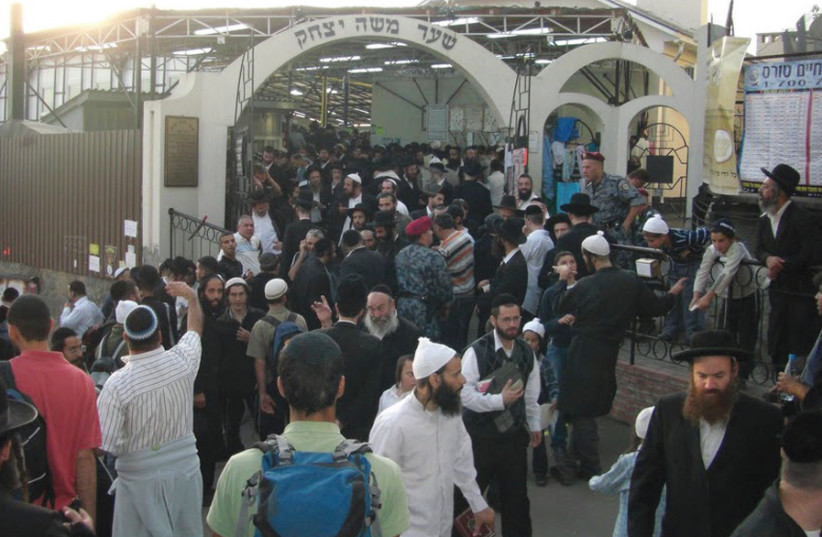
Grave Rabbi & Gravely Mentally Ill --- Rabbi who runs the synagogue at the grave of Rebbe Nahchman of Breslov in Uman, Ukraine, claimed in an interview with Channel 12 that he found a natural medicine for the coronavirus.


Uman rabbi claims he developed a 'cure' for coronavirus


Speaking with Rafi Reshef, an Israeli journalist, the rabbi said his natural medicine has supposedly helped cure 50 people who were infected with the coronavirus.

Jews are pictured making the pilgrimage to the grave of Rabbi Nachman of Breslov in Uman, Ukraine. (photo credit: Wikimedia Commons)
Jews are pictured making the pilgrimage to the grave of Rabbi Nachman of Breslov in Uman, Ukraine.

Rabbi Israel Elhadad, who runs the synagogue at the grave of Rebe Nahchman of Breslov in Uman, Ukraine, claimed in an interview with Channel 12 that he found a natural medicine for the coronavirus.

Speaking with Rafi Reshef, an Israeli journalist, Elhadad claimed that his medicine "with the help of heaven" helped cure "some 50 people in London."

Elhadad further explained the drug, saying that he invented it four months ago. He even provided information about its ingredients which include magnesium sulfate, coneflower, vitamin C and other components. However, he was not keen on divulging  the exact quantities needed to properly concoct the medicine.  

Despite Elhadad's efforts to get recognition for the his newly invented drug, including a letter he claimed to have sent to British Prime Minister Boris Johnson, it does not seem that anyone is aware of his invention.

"I sent a letter to the British Prime Minister Boris Johnson, but he did not reply," added Elhadad.

Elhadad's claims as pharmaceutical companies around the world are working day and night to produce a vaccine that could help stop the spread of the coronavirus.


He also spoke about the upcoming annual pilgrimage to Uman, during which thousands of Haredi (ultra-Orthodox) Jews are expected to visit on Rosh Hashana to commemorate the Breslov Rebe.

"I am not sure that this year I will prostrate myself before the grave of Rebe Nachman. It might just be enough for me to stand at the court below and recite the Tikkun," said Elhadad.

As the coronavirus spreads, this year's commemoration ceremonies have the potential to be extremely problematic, given the fact that many seek to stand near the grave of the deceased rabbi, thus increasing the risk for getting sick with the virus.

Wednesday, August 26, 2020

I Believe The First Wave Of Covid-19 Never Ended....Just Carried To The Catskills And Back To Brooklyn....


Brooklyn synagogue and Orthodox ambulance corps warn of new COVID cases amid rising fear of a second wave

(JTA) – With cases of COVID-19 rising over the last several weeks in Orthodox communities in the New York City area, a synagogue in Brooklyn and a Jewish ambulance group issued warnings for people to continue taking precautions against the virus.

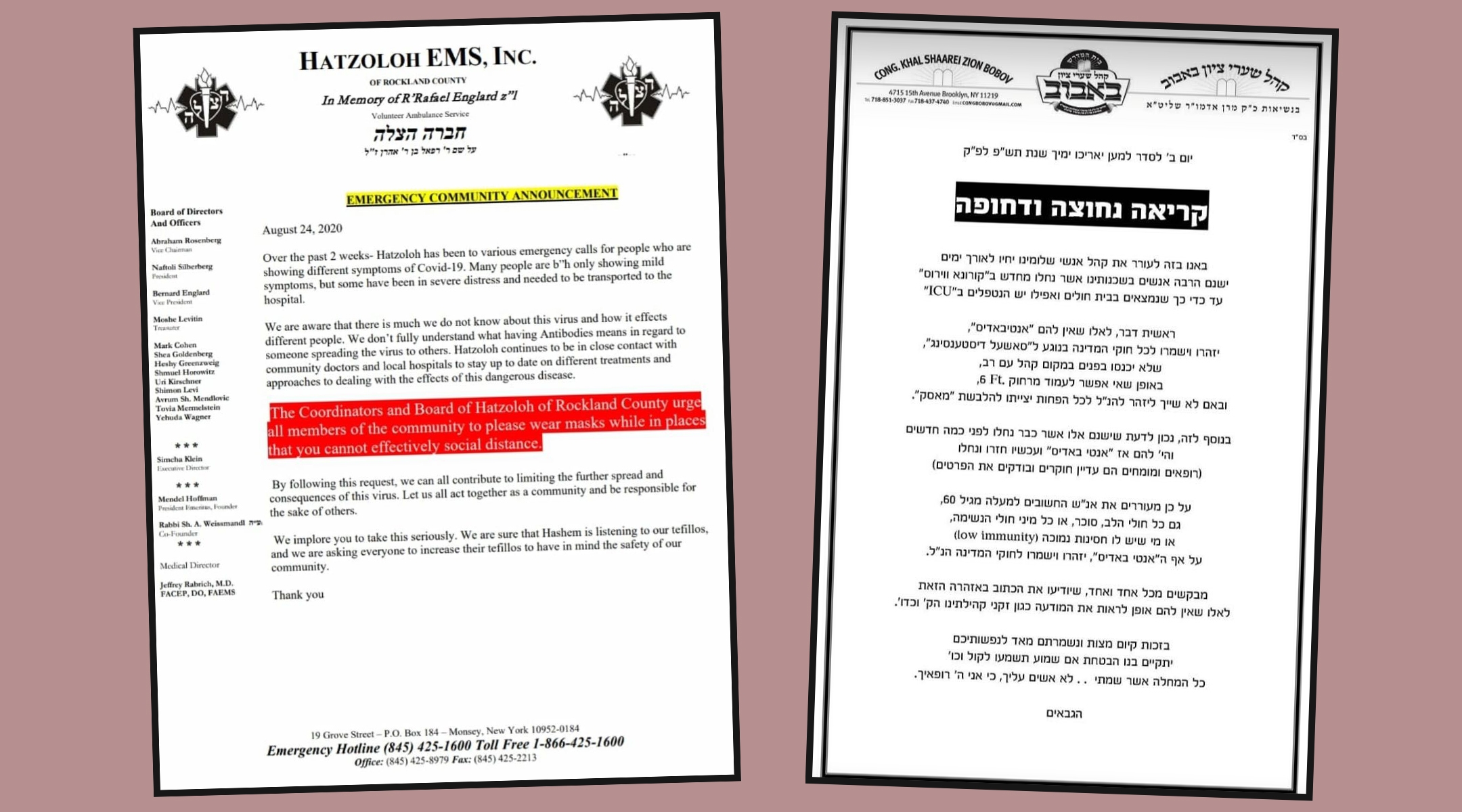
Hatzoloh of Rockland County, which serves a number of large Orthodox communities in Monsey, New York, and the surrounding areas just north of New York City, said it had received a number of calls from people reporting COVID-like symptoms and requiring hospitalization.

“The Coordinators and Board of Hatzoloh of Rockland County urges all members of the community to please wear masks while in places that you cannot effectively social distance,” they wrote in a letter Monday.

Meanwhile, Congregation Khal Shaarei Zion Bobov, a Brooklyn synagogue of the Bobover Hasidic movement, warned the community that several people in the neighborhood had contracted the coronavirus, with some ending up in the intensive care unit. The notice, written in Hebrew, warned those who do not have antibodies or those who are older or have underlying health conditions to maintain social distancing or wear masks where distancing is not possible, practices that have not been common lately in the community.

THIS WAS FRIDAY IN BOBOV
 SEE ALL THESE MESHUGOYIM  JUST ON FRIDAY AUGUST 21:
https://boropark24.com/news/rosh-choidesh-elul-in-bobov

The notice also mentioned cases of reinfection after several months. Local doctors in Orthodox communities in Brooklyn have seen cases of suspected reinfection, causing them to warn that those who were sick in the first wave of cases should not assume that they are safe. Those cases have been milder in their symptoms so far, the doctors have said, in keeping with what would be expected from a typical immune response.

The warnings come after an announcement last week by New York City Mayor Bill de Blasio of 16 new cases in the Brooklyn neighborhood of Borough Park, home to the city’s largest Hasidic community, with several of the cases connected to a large wedding. In other communities in the New York City area and down the East Coast, doctors and local rabbinical associations warn of worrying upticks in COVID cases that threaten the safe reopening of schools and in-person services on the High Holidays.

Several Orthodox communities were hit particularly hard by the virus earlier in the pandemic, with members of some even believing that their communities may have achieved some measure of herd immunity as a result. Even so, large numbers of people who have not contracted the virus and recovered still remain vulnerable.

https://www.jta.org/2020/08/25/health/brooklyn-synagogue-and-orthodox-ambulance-corps-warn-of-new-covid-cases-amid-rising-fear-of-a-second-wave?fbclid=IwAR11npuyKJO55wvNp6fH-2OWorXVOSkRb7o-U4dc3uOZIGabEdELMjFc-0g#.X0VPze1kE2c.facebook

Tuesday, August 25, 2020

Agudath Israel Reminds You How Important They Are To You! Give Them Your Money So They Can Replace Your Doctors With Their Deadly Medical Advice!


Mon, Aug 24 at 5:33 PM
The vital importance of Agudath Israel of America cannot be understated. Our future, just as our past and present, is ensured by the Agudah’s tireless efforts on the frontlines and behind the scenes.

As the Agudah is vital to you, in 1 week YOU ARE VITAL to the Agudah! Bez”H on Tuesday, September 1, the entire Agudah family will launch a national fundraising campaign, entitled YOU ARE VITAL.

For over 100 years, the Agudah's vital nature was felt, directly or indirectly, across all aspects of your Jewish life. The vital importance was especially acute during the pandemic, as all aspects of life-health, education, advocacy, work, community, religion, family-were suddenly upended.
 
More than the past and present, the Agudah is vital to our future. The Agudah’s increased vitality will ensure that each individual Jew in America and the collective family of Am Yisroel will have a vibrant tomorrow.


Thursday, August 20, 2020

“The Department of Health has the right, the jurisdiction, to say we’re closing down schools, we’re closing down minyanim if there’s a big enough uptick,” Glatt said.


New COVID-19 cases in Orthodox communities elicit concern as school year and High Holidays near

(JTA) – Over the past week, the reports have come fast and furious.

One overnight sports camp for boys in Pennsylvania had an outbreak of COVID-19, sending eight boys back to their home communities on Long Island and several more to Baltimore, where others had contracted the virus after attending weddings or coming into contact with those who did.

Bungalow colonies in the Catskill Mountains saw an outbreak among families, many of whom were summering there away from their homes in Brooklyn.

And New York City Mayor Bill de Blasio announced Wednesday that 16 new cases were found in the Brooklyn Hasidic neighborhood of Borough Park, with some traced back to a large wedding there.

As the summer comes to a close and families prepare for a new school year and the High Holidays, government officials and leaders in the Orthodox community are monitoring new cases in Orthodox communities across the New York City area and down the East Coast. They say the cases, though small in number at the moment, could spiral out of control, derailing plans to reopen schools with in-person instruction and hold in-person services for the holidays.

Left unchecked, the increasing cases also have the potential to turn next month’s gatherings in schools and synagogues into superspreader events, reversing the progress made over the past few months.

“It has the potential to be a perfect storm,” said Rabbi Dr. Aaron Glatt, the chief of infectious diseases and hospital epidemiologist at Mount Sinai South Nassau on Long Island and an assistant rabbi at the Young Israel of Woodmere, a large Orthodox synagogue in Long Island’s Nassau County. “The question everyone has to ask themselves is: Is not wearing a mask that critical that they’re willing to risk everything?”


It Feels Like He Put On A Few Pounds In The Hospital

Glatt said the New York City and Nassau County health departments have been in touch with him about a slight uptick in cases in several communities in the New York City area, including some related to wedding celebrations. He cautioned that a further rise could jeopardize schools, which are set to reopen in person for the first time since March, and in-person High Holiday services, which Orthodox Jews cannot replace with virtual services.

“The Department of Health has the right, the jurisdiction, to say we’re closing down schools, we’re closing down minyanim if there’s a big enough uptick,” Glatt said. 

Doctors in Orthodox communities have pointed to a number of sources for the new cases. Vacationers are coming into contact with people from other communities and therefore risking exposure. 

Overnight camps, which were not allowed to open this year in New York state but were allowed in other states, including Pennsylvania, have seen some outbreaks as well, with the infected campers or staff members sometimes being sent back to their home communities to quarantine.

And while the pandemic seemed to put an end to the large weddings typical of Orthodox communities – guest lists of 400 people or more are not uncommon – the smaller outdoor weddings that have replaced them are still bringing together guests from different places, sometimes in large numbers, while mask wearing and social distancing are inconsistent. In some communities large weddings, whether indoors or outdoors, have resumed.

That has been the case especially in some Hasidic neighborhoods of Brooklyn, where life largely returned to normal as early as May and June as many in these communities, including some doctors, believed they had achieved a level of herd immunity — meaning a large enough percentage of the community had acquired immunity after recovering from the virus to significantly slow the transmission of disease.

As early as June and July, local health clinics serving Brooklyn’s Hasidic communities performing antibody tests for the coronavirus were seeing a much higher percentage of positive antibody tests there than in the city overall.

New data from the city released Tuesday seemed to support the claim that some Hasidic neighborhoods had higher levels of immunity than other parts of the city. According to those figures, 46.8% of people in one Zip code in Borough Park, the Brooklyn neighborhood with the largest Hasidic population, tested positive for coronavirus antibodies. The only other neighborhood with a higher rate of positive antibody test results was Corona, Queens, one of the hardest-hit parts of the city. Across Brooklyn as a whole, 27.9% of people tested positive for coronavirus antibodies, the second-highest rate among the five boroughs.

But even some level of herd immunity does not mean that there can be no cases. 

I think I Heard Him Say "OK, I'll Wear A Mask"

“Herd immunity is a relative concept,” said Dr. Gary Slutkin, an epidemiologist who worked with the World Health Organization for over 10 years on AIDS programs in Africa.

While a large percentage of people having immunity to a virus can help reduce transmission in a group, he said, it does not bring the risk to zero for anyone who has not contracted COVID-19.

“You’re still at risk of being around anyone who’s still infectious, that has not changed for you,” Slutkin said. “So if you’re at a gathering and there’s someone who is infectious, nothing has changed for you.”

De Blasio, speaking of the new cases confirmed in Borough Park, called it “an early warning sign.”
“Some of these 16 cases are linked to a recent wedding, a large wedding, in fact, in the community,” he said. “We are working quickly to galvanize community leaders.”

In response to a question about whether the new cases threaten the idea that there could be herd immunity in parts of New York City, de Blasio dismissed the theory.

“I don’t think we have any evidence of herd immunity anywhere in New York City,” he said.

On a blog used to disseminate information about local coronavirus numbers, doctors in Crown Heights, who as early as May were pointing to the results of a survey they disseminated showing that approximately 70% of the local Orthodox community had been infected with COVID, said they’ve seen cases “gradually increasing.” 

They also noted the new case of someone who had not traveled, been in contact with any travelers or attended a large celebration, leading the doctors to surmise that the person became ill through “community spread” — meaning the virus is still spreading in Crown Heights despite the large numbers of people there who had recovered from the virus.


To what degree immunity to the virus can be relied upon remains unclear. While the CDC advised this week that there have been no confirmed cases of reinfection among those who initially contracted the disease in the previous three months, much remains unknown about immunity resulting from previous infection.

But among the new cases in Crown Heights, the local doctors said, were two cases of “presumed reinfection.”

“Both had antibodies but upon recent retesting had ‘lost’ their antibodies, and now, after being exposed to Covid, these people became sick again and tested positive,” the doctors, part of the Gedaliah Society, a group of medical professionals in the Chabad community of Crown Heights, wrote in a blog post Tuesday. “These two new cases are so clear in their course as to take reinfection from a probable phenomenon to a reality (albeit difficult to prove as we don’t have initial viral samples to compare).”

In a letter to the Nassau County Orthodox community, Glatt said there are cases of possible reinfection being assessed, but they appear to be rare. 

“It still remains very reassuring, that with upwards of 20 million COVID-19 cases worldwide, there are very few proven reinfection cases,” Glatt wrote. “This is critically important for herd immunity, and partially explains why certain communities have very few new COVID-19 cases despite not adhering to masking guidelines.”

Rabbinical councils in several communities have put out community notices asking people to act with caution as the communities prepare for the reopening of local schools.

The Vaad HaRabonim of Cleveland, an Orthodox rabbinical group, sent a notice last week asking anyone returning from camps where campers or staff tested positive for coronavirus to quarantine for 14 days.

The Rabbinical Council of Bergen County, which was the first such group to shut down its large Modern Orthodox communities in Northern New Jersey back in March, sent a letter to the community Tuesday warning of the dangers of unchecked celebrations.

“While such an event, first and foremost, constitutes a threat to the health of those in attendance, the risk to the institutional health of our community created by such an event should not be minimized,” the group wrote. “Indeed, even one such event could easily result in the full closure of an entire yeshiva, or multiple yeshivot across our community.”

And the Vaad Harabanim of Baltimore sent a letter to the community last week asking people to act with greater caution at weddings. 

“While in the shuls this vigilance is still evident, one area where laxity has sometimes set in is at weddings,” the Vaad wrote. “This is not only a threat to our continued health, but it Chas v’Shalom could set us back in our quest to be able to open the schools.”

Dr. Avi Rosenberg, an assistant professor of pathology at The Johns Hopkins School of Medicine in Baltimore who has become a go-to resource for Orthodox camps, synagogues and schools in Baltimore and across the country, said weddings were his biggest concern. (Rosenberg is involved in a study on the use of convalescent plasma to treat COVID patients that has recruited a large number of Orthodox plasma donors.)

“We have people who are clearly running unmitigated simchas,” said Rosenberg, using the Hebrew word for celebration.

He said he learned of approximately 25 new cases of COVID in the Orthodox community in Baltimore last week, most of which were connected to weddings in Brooklyn or Lakewood, New Jersey, home to large Orthodox communities. Weekly cases had remained in the single digits from May until last week, he said.

“People really need to understand that this upsurge in simcha-related community spread is what’s putting the success of school reopenings at risk,” Rosenberg said. “If it continues at the rate it’s currently going in, I don’t know how we’re going to open schools safely.”


https://www.jta.org/2020/08/19/health/new-covid-19-cases-in-orthodox-communities-elicit-concern-as-school-year-and-high-holidays-near

Wednesday, August 19, 2020

“Humankind cannot bear very much reality.”

It’s Simple. Contain the Virus. The Economy Will Come Back.

We need to get real about reality.
“Humankind cannot bear very much reality.”

So said the poet T.S. Eliot. It’s an apt explanation for the White House’s failure to respond adequately to the pandemic that has swept across America and the rest of the world.

Even as reality continues to intrude, President Trump has either largely dismissed or ignored his science and medical advisers. And the result is that the economy, the one thing he seems to care most about, and which he hoped would escort him to a second term, has been devastated.

As both history and data from today demonstrate, health and the economy are not antagonistic; they are dance partners, with public health taking the lead. The safer people feel, the more they will engage in economic activity.

A recent study of the 1918-1919 influenza pandemic by a member of the Federal Reserve board and economists at the Fed and M.I.T. compared cities that imposed stringent public health measures — including school and church closings, public gathering bans, quarantines and restricted business hours — with cities that opened faster and imposed fewer restrictions. The more stringent cities not only had fewer deaths but experienced “a relative increase in economic activity from 1919 onward.”

Containing the virus has allowed many European economies to recover far better than the U.S. Look at Germany, which has an unemployment rate of 6.4 percent. The rate in the U.S. is 10.2 percent. In March and April, according to OpenTable, the reservation booking company, business in restaurants in Germany and the U.S. were in the identical place, down over 90 percent year over year. Since then they have diverged widely: data for Aug. 16 (the latest data at this writing) shows German restaurants enjoyed 9 percent more business than last year, before the pandemic, while U.S. restaurants were down around 50 percent.

And in a report last week, the National League of Cities said that precipitous declines in tax revenues were forcing cities to “severely cut services at a time when communities need them most, to lay off and furlough employees who make up a large share of America’s middle class, and to pull back on capital projects, further affecting local employment, business contracts and overall investment in the economy.”

In June the World Bank estimated that global G.D.P. this year would decline by at least 5.2 percent and possibly much more. The Congressional Budget Office expects G.D.P in the U.S. to fare worse, down 5.9 percent for the year, even after factoring in projected third quarter growth of more than 20 percent. But that projection assumes the containment of the virus, a huge assumption.

Indeed, a Morgan Stanley model predicts that under current policies the U.S. is currently on track to have 150,000 new cases a day later this year. And that number is not even a worst case. If we do suffer case counts anything like those, dramatic growth in the economy simply won’t happen.

Bad as the virus has been this summer, it actually spreads better in low temperatures, and when temperatures fall, more people will be inside in poorly ventilated areas where transmission is also more likely. If the U.S. goes into the fall with new daily cases in the tens of thousands, as they are now, then the numbers could explode and the Morgan Stanley prediction could come true. Considering our containment efforts to date, there is little reason for optimism.
If that occurs, the economy will not come back. Jerome Powell, the chairman of the Federal Reserve, said as much recently. “The path forward for the economy is extraordinarily uncertain and will depend in large part on our success in keeping the virus in check,” he said at a July 29 news conference. He added: “A full recovery is unlikely until people are confident that it is safe to re-engage in a broad range of activities.”

But containment, and the confidence that goes with it, is not remotely where we are at the moment. Among developed nations, the U.S. ranks first in categories one would prefer to be last in: number of cases and number of deaths. It lags well behind in economic recovery as well. As of this writing, the European Union and Britain combined have a population of about 510 million, and 1,924,569 Covid-19 cases. They have had around 8,000 cases for the latest daily count. The United States, population 328 million, just passed 5.4 million cases, with 42,303 the latest daily case count.
Bringing the economy back requires precisely the same three measures that controlling the virus does: First, better compliance with social distancing, wearing masks, personal hygiene and avoiding crowds; second, finally — finally — getting the supply chain and personnel infrastructure in place to support the necessary testing and contact tracing; and, third, the bitter medicine of regional shutdowns.

The same Morgan Stanley model that predicts that the U.S. is on track to reach 150,000 cases a day also has a “bullish” scenario in which the U.S. case counts decline to European levels. But for that to happen, the modelers assumed “more strict restrictions and broader interventions” such as lockdowns “similar” to those imposed by China and major European Union countries.

Without active, aggressive White House leadership we cannot achieve that and — reality again — there isn’t the slightest hint that will happen. But in 1918 leadership came from cities and states. If governors and mayors act aggressively, especially if they act jointly, we can still make significant progress.

In April, I predicted that summer would not bring relief from the virus, and that we would experience not a second wave but continuous swells, depending on how well we complied with public health measures. Unfortunately too many states eased up too early or did little or nothing to control the virus. On the day that prediction was published, April 30, the seven-day average of new cases was 28,943. On Aug. 16, the seven-day average was 51,523.

I also warned of not simply swells but a viral hurricane-like storm surge if the country does not act aggressively and the public fails to comply. I stand by that prediction. Tens of thousands more will die on top of the more than 170,000 already lost in the U.S., and millions will suffer economic devastation.

And, in reality, all of it will be unnecessary. God help us.

John M. Barry is a professor at the Tulane University School of Public Health and Tropical Medicine and the author of “The Great Influenza: The Story of the Deadliest Pandemic in History.”