Judge rules sex abuse lawsuits against Yeshiva University can proceed
New York Supreme Court Judge
Alexander M. Tisch rejected Yeshiva University’s motion to dismiss two
lawsuits related to the allegations, opening the way for trial.
Yeshiva University
NEW
YORK (RNS) — For decades, students and their parents at a prominent
Jewish high school on Manhattan’s Upper West Side have been seeking
accountability from Yeshiva University, which runs the school, for
allegations of sexual abuse by a former school administrator and other
staff.
On Tuesday (April 2), their case received a boost from a New York state court.
In the April 2 ruling, New York Supreme
Court Judge Alexander M. Tisch rejected Yeshiva University’s motion to
dismiss two lawsuits related to the allegations, opening the way for
trial.
More than 50 former students of the Yeshiva
University High School for Boys allege they were sexually abused by the
former principal, Rabbi George Finkelstein, and other staff at the
prestigious high school from 1971 through 1992.They allege that more
than 20 students and parents alerted the school to the abuse but that no
action was taken to safeguard the students studying there.
The plaintiffs want
Yeshiva University to share thousands of pages of documents in order to
learn “the identity of individuals at Yeshiva University who had
knowledge of sexual abuse, individuals who received reports of sexual
abuse, individuals identified as perpetrators, along with names of
administrators made aware of abuse, and individual school officials and
administrators who failed to protect students or did not respond to
abuse allegations,” a statement said.
The child sexual abuse case is one of several brought by Jews against
Jewish leaders and institutions during the past couple of decades. The
subject, once considered taboo, was first broached by Jewish community
newspapers.
In 2000, an investigation by the New York Jewish Week alleged that
Baruch Lanner, an Orthodox rabbi and educator, had physically, sexually
and emotionally abused young people when he worked as the principal of
Hillel Yeshiva High School in New Jersey, a Jewish school, and later as a
regional director of the National Conference of Synagogue Youth.
Two years later, Lanner was sentenced to seven years in prison. An
official in the Orthodox Union, NCSY’s parent organization, resigned,
and the case spurred a reckoning within the wider Jewish community.
An analysis
by the Jewish Telegraphic Agency found that at least 150 child sex
abuse lawsuits were filed against Jewish institutions in New York from
2019 to 2021, due to the state temporarily abolishing the statute of
limitations for sexual abuse claims. It was in this window that the
Yeshiva lawsuits were revived, having been previously dismissed on
statute of limitations grounds.
The Yeshiva University High School for Boys, also known as the Marsha
Stern Talmudical Academy or MTA, was founded in 1916 by the
then-president of the Yeshiva University (under a different name at the
time) and was the first academic Jewish high school in America. An
Orthodox Jewish day school in the Washington Heights neighborhood of
Manhattan, it operates as a prep school for Yeshiva University, whose
buildings surround its campus.
A 2018 study found
that childhood sexual abuse in the Jewish community occurs “across the
spectrum of Jewish religious affiliation and greater prevalence among
formerly Orthodox individuals. Furthermore, history of childhood sexual
abuse was associated with greater risk for psychiatric distress and less
religious involvement, however spiritual/religious engagement and
belief appeared to facilitate resilience in the context of abuse.”
Mordechai Twersky, the original lead
plaintiff who attended the high school in the early 1980s, told Religion
News Service that he and the other plaintiffs, some of them with
grandchildren of their own, are gratified by the judge’s ruling, but
also weary. He first filed suit more than a decade ago.
“We victims, tormented and tired, with some
of us quite ill, see a ray of hope in this ruling that justice will be
served. The road is still long — perhaps years long — but we will
prevail.”
This article was adapted from a transcript of the November 7, 2023, episode of the author’s podcast, Making Sense. Needless to say, but I'll say it anyway, I have differences of opinion on many views of Sam's; on Religion of Judaism in Toto, and on Israel's right to settle the entire land. But I respect him as a brilliant scientist, thinker and philosopher. PM
We have witnessed extreme moral confusion since Hamas attacked Israel
on October 7, 2023, killing approximately 1,200 people and taking over
200 hostages. Some of it has been just frank anti-Semitism, but much is
actual confusion. Most people in the West still don’t understand the
problem of jihadism. We often speak about “terrorism” and “violent
extremism” generically. And we are told that any link between these
evils and the doctrine of Islam is spurious and nothing more than an
expression of “Islamophobia.” Incidentally, the term Islamophobia
was invented in the 1970s by Iranian theocrats to do just this: prevent
any criticism of Islam and to cast secularism itself as a form of
bigotry. Islam is a system of ideas, subscribed to by people of every
race and ethnicity. It’s just like Christianity in that regard. Unlike
Judaism, Christianity and Islam are both aggressively missionary faiths,
and they win converts from everywhere. People criticize the doctrines
of Christianity all the time and worry about their political and social
influences—but no one confuses this for bigotry against Christians as
people, much less racism. There’s no such thing as “Christophobia.” As
someone once said (it was not Christopher Hitchens, but it sure sounds
like him): “Islamophobia is a term created by fascists, and used by cowards, to manipulate morons.”
In any case, fundamentalist Christians and Orthodox Jews don’t tend
to be confused about the problem of jihadism because they understand the
power of religious beliefs, however secular people generally are. We
imagine that people everywhere, at bottom, want the same things: They
want to live safe and prosperous lives. They want clean drinking water
and good schools for their kids. And we imagine that if whole groups of
people start behaving in extraordinarily destructive ways—practicing
suicidal terrorism against noncombatants, for instance—they must have
been pushed into extremis by others. What could turn ordinary human
beings into suicide bombers, and what could get vast numbers of their
neighbors to celebrate them as martyrs, other than their entire society
being oppressed and humiliated to the point of madness by some malign
power? So, in the case of Israel, many people imagine that the ghoulish
history Palestinian terrorism simply indicates how profound the
injustice has been on the Israeli side.
Now, there are many things to be said in criticism of Israel,
particularly its expansion of settlements on contested land. But
Israel’s behavior is not what explains the suicidal and genocidal
inclinations of a group like Hamas. The Islamic doctrines of martyrdom
and jihad do.
These are religious beliefs, sincerely held. They are beliefs about
the moral structure of the universe. And they explain how normal
people—even good ones—can commit horrific acts of violence against
innocent civilians on purpose, not as collateral damage, and still
consider themselves good. When you believe that life in this world has
no value, apart from deciding who goes to Hell and who goes to Paradise,
it becomes possible to feel perfectly at ease killing noncombatants, or
even using your own women and children as human shields, because you
know that any Muslims who get killed will go to Paradise for eternity.
If you don’t understand that jihadists sincerely believe these
things, you don’t understand the problem Israel faces. The problem isn’t
merely Palestinian nationalism, resource competition, or any other
normal terrestrial grievance. In fact, the problem isn’t even hatred,
though there is enough of that to go around. The problem is religious
certainty.
It really is possible to be critical of Israel, and to be committed
to the political rights of the Palestinian people, without being
confused about the reality of Islamic religious fanaticism—or the threat
that it poses not just to Israel but to open societies everywhere. My
friend Christopher Hitchens was extremely critical of Israel and openly
supportive of Palestinian statehood. But he wasn’t even slightly
confused about the problem of jihad.
There have been nearly 50,000 acts of Islamic terrorism in the past
forty years—and the French group that maintains a database of these
attacks considers that an undercount.1 Ninety percent of them
have occurred in Muslim countries. Most have nothing to do with Israel
or the Jews. There have been eighty-two attacks in France and over 2,000
in Pakistan during this period. Want France to be more like Pakistan?
You just need more jihadists. You just need more people susceptible to
becoming jihadists, which is a transformation that can happen very
quickly—just as quickly as new beliefs can take root in a person’s mind.
You just need a wider Muslim community that doesn’t condemn jihadism
but tacitly admits the theology that inspires it will be true and
perfect until the end of the world. You just need millions of people who
will protest Israel for defending itself, or call for the deaths of
cartoonists for depicting the prophet Muhammad, and yet not make a peep
about the jihadist atrocities that occur daily, all over the world, in
the name of their religion.
In the West, there is now a large industry of apology and obfuscation
designed to protect Muslims from having to grapple with these facts.
The humanities and social science departments of every university are
filled with scholars and pseudo-scholars—deemed experts in terrorism,
religion, Islamic jurisprudence, anthropology, political science, and
other fields—who claim that Muslim extremism is never what it seems.
These experts insist that we can never take jihadists at their word and
that none of their declarations about God, Paradise, martyrdom, and the
evils of apostasy have anything to do with their real motivations.
When one asks what the motivations of jihadists actually are, one
encounters a tsunami of liberal delusion. Needless to say, the West is
to blame for all the mayhem we see in Muslim societies. After all, how
would we feel if outside powers and their mapmakers had divided our
lands and stolen our oil? These beleaguered people just want what
everyone else wants out of life. They want economic and political
security. They want to be free to flourish in ways that would be fully
compatible with a global civil society, if only they were given the
chance. Secular liberals imagine that jihadists are acting as anyone
else would given a similar history of unhappy encounters with the West.
And they totally discount the role that religious beliefs play in
inspiring groups such as Hamas and al-Qaeda, or even the Islamic
State—to the point where it would be impossible for a jihadist to prove
he was doing anything for religious reasons.
Apparently, it’s not enough for an educated person with economic
opportunities to devote himself to the most extreme and austere version
of Islam, to articulate his religious reasons for doing so ad nauseam,
and even to go so far as to confess his certainty about martyrdom on
video before blowing himself up in a crowd. Such demonstrations of
religious fanaticism are somehow considered rhetorically insufficient to
prove that he really believed what he said he believed. Of course, if a
white supremacist goes on a killing spree in a Black church and says he
did this because he hates Black people and thinks the White race is
under attack, this motive is accepted at face value without the
slightest hesitation. This double standard is guaranteed to exonerate
Islam every time. The game is rigged.
Do not mistake what I’m saying now for anti-Muslim bigotry. I’m
talking about the consequences of ideas, not the ethnic origins of
people. Not a word I’ve said, or will ever say on this topic, has
anything to do with race. And the truth is, I’m not remotely xenophobic.
I’m a xenophile. The Middle East has produced some of my favorite parts
of culture—some of my favorite foods, music, and architecture. Despite
my better judgment, I absolutely love the sound of the Muslim call to
prayer. Everything I’m saying about the problem of jihadism is about the
problem of jihadism—the triumphal belief by some percentage of the
world’s Muslims that they must conquer the world for the one true faith
through force and that Paradise awaits anyone who would sacrifice his or
her life to that end.
Of course, many religions produce a fair amount of needless
suffering. Consider the pedophile-priest scandal in the Catholic Church,
which is something I’ve written and spoken about before, I hope with
sufficient outrage. One can certainly argue, as I have, that Catholic
teaching is partly to blame for these crimes against children. By making
contraception and abortion taboo, the Church ensured there would be
many out-of-wedlock births among its faithful; by stigmatizing unwed
mothers, it further guaranteed that many children would be abandoned to
Church-run orphanages, where they could be preyed upon by sexually
unhealthy men. I don’t think any of this was consciously planned; it’s
just a grotesque consequence of some very bad ideas. And yet the truth
is that there is no direct link between Christian scripture and child
rape. However, imagine if there were. Just imagine if the New Testament
contained multiple passages promising Heaven to any priest who raped a
child. And then imagine that in the aftermath of an endless series of
child rapes within the Church, more or less every journalist,
politician, and academic denied that they had anything whatsoever to do
with the “true” teachings of Catholicism. That is the uncanny situation
we find ourselves in with respect to Islam.
" Deterrence theory refers to the scholarship and practice of how
threats or limited force by one party can convince another party to
refrain from initiating some other course of action. The topic gained
increased prominence as a military strategy during the Cold War with regard to the use of nuclear weapons and is related to but distinct from the concept of mutual assured destruction, according to which a full-scale nuclear attack on a power with second-strike capability
would devastate both parties. The central problem of deterrence
revolves around how to credibly threaten military action or nuclear
punishment on the adversary despite its costs to the deterrer.[1] Deterrence is one strategy to achieve peace and avoid conflict escalation in peace and conflict studies. "
Israel’s nuclear
capabilities, though never officially confirmed, are widely recognized
as part of its national defense strategy.
US SECRETARY of State Antony Blinken arrives for the
Summit for Democracy, in South Korea this week. The gradual shift in the
historic US-Israel alliance has been partly influenced by a greater
influence given to the State Department under Blinken, the writer
maintains.
The alliance between the United States and Israel,
established shortly after Israel’s founding in 1948, is a cornerstone
of their foreign policies. Rooted in shared democratic values, strategic
interests, and a dedication to Middle Eastern security, this
partnership has been instrumental in ensuring Israel’s security through
military aid, diplomatic support, and collaborative efforts in military
exercises, intelligence sharing, and technology. This relationship
underscores a mutual commitment to regional peace and stability.
Israel’s
nuclear capabilities, though never officially confirmed, are widely
recognized as part of its national defense strategy. It is generally
understood that Israel possesses a sophisticated arsenal, including
nuclear warheads, which serve as a cornerstone of its deterrence policy.
Despite the policy of ambiguity, or “nuclear opacity,” this unconfirmed
arsenal is a critical element of the Middle Eastern security landscape. It underscores the strategic depth Israel maintains in defense of its sovereignty and security interests in a volatile region.
Shifts in US-Israel ties
However,
during the administrations of President Joe Biden and his predecessor
Barack Obama, we have witnessed a gradual shift in this historic
alliance, diverging from the longstanding support that Israel has
traditionally received.
This
shift is influenced by evolving demographics and opinions within the
Democratic Party and the greater influence afforded to the State
Department under Secretary Antony Blinken. A series of recent actions
and statements by the Biden administration during the October 7 War
underscores this concerning trend.
These
include providing Iran with a $10 billion sanctions waiver, imposing
sanctions on Israeli Jews, pushing aggressively for a ceasefire,
suggesting that Israel’s top priority should be aiding Gazans rather
than winning the war, limiting the supply of weapons and munitions, and
Senate Majority Leader Chuck Schumer’s unprecedented call for the ouster
of Prime Minister Benjamin Netanyahu. Such actions are proactively
undermining Israel’s security and sovereignty and signal a potential
shift in the foundational support from its most significant ally.
View of the nuclear reactor in Dimona, Southern Israel.
In
light of these concerning developments, Israel must swiftly enhance its
strategic defense capabilities to solidify its military self-reliance.
This necessitates dramatically increasing the number of nuclear warheads
in Israel’s arsenal and advancing and diversifying their delivery
systems. Such expansion would ensure a robust, multifaceted deterrent
capable of securing Israel’s sovereignty and protecting its citizens in
an increasingly uncertain geopolitical landscape.
Simultaneously,
Israel must strive to maintain and strengthen its alliance with the
United States, leveraging diplomatic avenues to revitalize this
essential relationship. Enhancing Israel’s defense capabilities and its
international alliances are complementary strategies that safeguard its
national security interests.
In
an era marked by shifting global alliances and uncertainties, expanding
and augmenting Israel’s nuclear arsenal is crucial for safeguarding its
future. This strategic imperative would ensure that Israel remains a
significant power in the Middle East, capable of defending its interests
and ensuring the security of its citizens, regardless of the changing
geopolitical dynamics.
Like it or not, Haredim who live in Israel are as Zionist as any secular
Tel Aviv Jew -- they are integral to the Zionist project
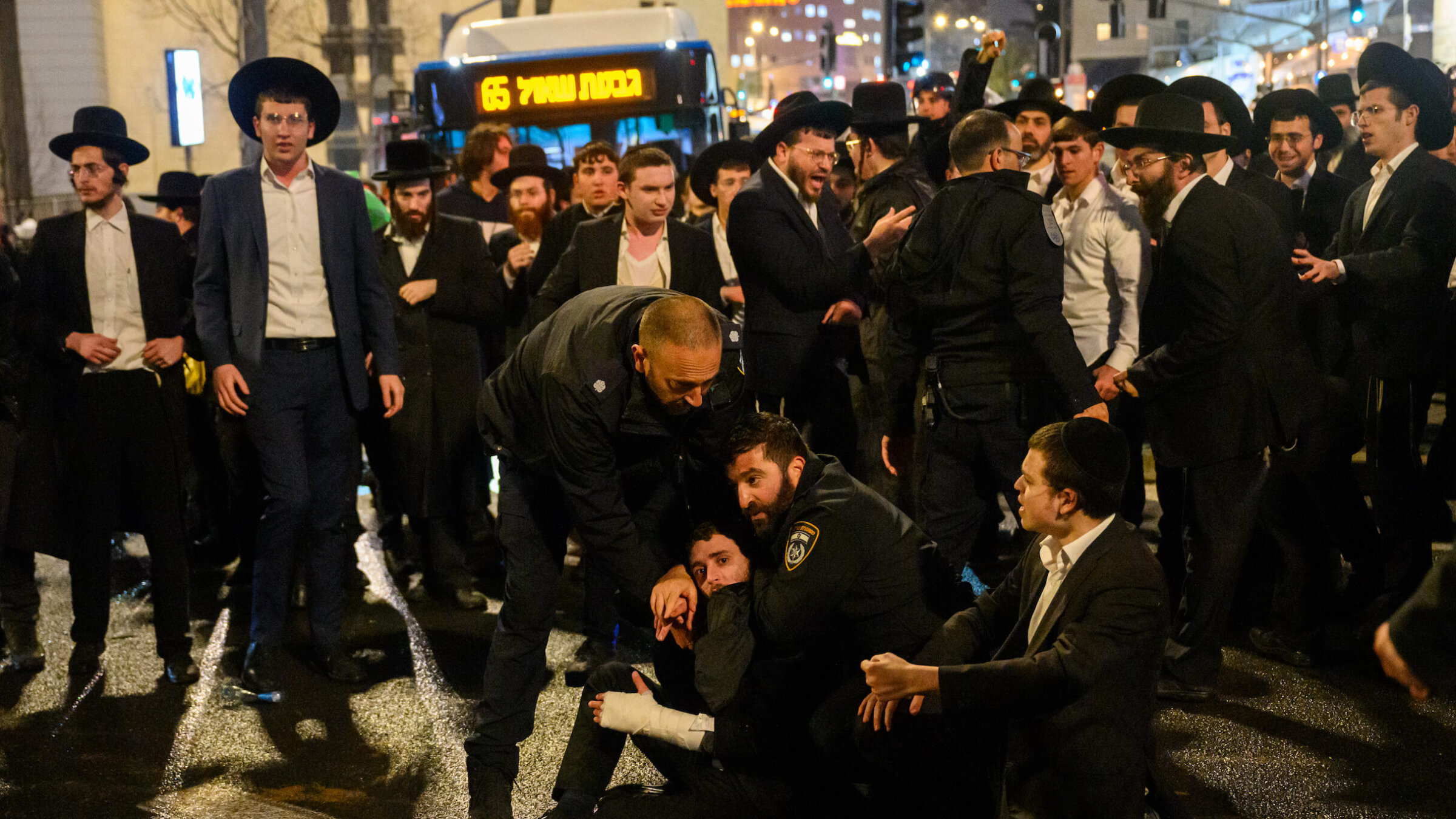
Ultra-Orthodox
Jews block a road and clash with police during a protest against the
drafting of Ultra orthodox jews to the Israeli army, on road number 4,
outside the city of Bnei Brak, April 1
In his op-ed, titled “One Haredi man’s view on drafting yeshiva boys,”
Dovid Kornreich claims to articulate a perspective that is deeply
rooted in the ideological and religious convictions of the Haredi
community, which he says holds a principled opposition to their
conscription into the Israeli Defense Forces (IDF). Kornreich’s argument
pivots on the premise that Haredi non-Zionism dismisses the notion of
any significance in Jewish territorial sovereignty over the Land of
Israel, and therefore prioritizes the preservation of Jewish life above
the nationalist ambitions of the Israeli state.
While Kornreich does acknowledge the benefits derived from the
state by the Haredi community, he nonetheless critiques the moral and
historical underpinnings of Zionism, suggesting it has imperiled Jews
globally, and of course in Israel. And although he recognizes that there
are existential threats facing Israel, he contends that the refusal of
Haredi men to serve in the military is not based on a disregard for
national security but in a steadfast adherence to religious ideals and
ethical principles.
Kornreich also insists that Haredi reluctance to formally engage
with the state’s institutions or to participate in any state-related
activities is based on a deeply held view that to do so would be to
endorse Zionist ideology and the premise of a Jewish national home in
pre-Messianic times. Instead, says Kornreich, if Haredi Israelis are to
be a part of Israeli society, they must be allowed to interact with the
state strictly on their own terms, without compromising their
fundamental beliefs.
I have never met Dovid Kornreich, nor had I ever heard of him before
encountering his op-ed. But as one Haredi man to another – albeit as a
Haredi who resides outside Israel – I feel compelled to express my
profound disagreement with the views he has articulated. Rarely have I
encountered arguments in favor of a point-of-view as deeply problematic
and as misguided as the ones presented by Kornreich. If I were to be
unkind, I would merely dismiss his article as a meaningless “word salad”
– but that would underestimate the serious implications of his stance,
and the many readers who might take it seriously.
Although, to be perfectly clear: Kornreich’s article is a “word
salad” – nothing more, nothing less. The confusion and lack of
constructive direction in his arguments is beyond obvious, while the
high-handed conviction of their accuracy only makes it worse. His
perspective, while claiming to represent a principled stand ingrained in
Haredi ideology, is first-and-foremost remarkably self-serving. But
what makes it far worse is that it is detached from the complex
realities faced by Israel in particular, and the Jewish world as a
whole.
Let’s begin with Kornreich’s assertion that “Haredim are not
Zionists.” Really? Can one truly argue that disengagement from national
symbols, such as not knowing the national anthem or participating in
national observances, equates to a complete detachment from the identity
of your country? If you vote, hold a passport, speak the language,
engage in business, and eagerly avail yourself of the country’s
amenities, does this not indicate a form of affiliation?
Like the proverbial ostrich burying its head in the sand as it
attempts to convince itself that danger doesn’t exist, Kornreich’s claim
that “Haredim are not Zionists” is a facile but ultimately transparent
attempt to ignore the perhaps unpalatable requirement for societal
participation and obligations that is no less true for Haredim than it
is for every Israeli citizen. Bottom line: Haredim who live in Israel
are as Zionist as any secular Tel Aviv Jew – because, like it or not,
they are an integral part of the Zionist project that has produced a
country and society made up of Jews of all stripes and colors.
Indeed, the Haredi community’s deep engagement with Israeli life
suggests a form of Zionism rooted not in political ideology but in a
shared commitment to the welfare and future of the Jewish people in
their homeland. This engagement is evident in areas ranging from
healthcare, where Haredi professionals play key roles, to education and
social services, highlighting a broader definition of national
contribution.
Then there is Kornreich’s argument that the Zionist movement and
the establishment of the State of Israel have escalated the risk to
Jewish lives and spurred the greatest source in anti-Jewish violence
since WWII. This argument is equally one-dimensional because it simply
overlooks the broad spectrum of antisemitism’s long and painful history.
It also fails to account for the persistent nature of Jew-hatred, which
has continually adapted over centuries, always finding new pretexts for
old prejudices.
The implication that Jews seeking to return to, and assert
sovereignty over, their ancestral homeland constituted and continues to
be the primary provocation for modern antisemitism, neglects the broader
context of historical reality. Moreover, to suggest that this somehow
excuses Haredim from serving in the military – because they were less
enthusiastic or even opposed to Jewish nationalist aspirations before
the creation of Israel – is jaw-dropping in its self-serving
navel-gazing superficiality.
Jews – both Zionist and non-Zionist – did not merely return to
their historical homeland after 1945, which they were fully entitled to
do whether they were nationalists or not. They returned to their
historical homeland after a serious attempt had been made to exterminate
Jews forever, and they sought a safe refuge where they could freely
practice their religion and affirm their identity without the shadow of
subjugation or discrimination or genocidal intent that had darkened our
history for thousands of years. And Haredim were as much a part of this
mass migration as every other type of Jew. To now claim that Haredim
have no part to play in or obligation towards the country that emerged
out of this phenomenon is simply ridiculous.
Kornreich also claims that Zionist Israelis and non-Zionist
Israelis are divided over the value of a Jewish state, and he suggests
that the non-Zionist Haredi community living in Israel has a dismissive
attitude towards the sacrifices that were made historically to establish
the State of Israel, and also towards the sacrifices that are made now
to maintain Israel’s sovereignty. But this claim is highly misleading,
not least because it smacks of raw self-interest. Kornreich seems to be
implying that because Haredim don’t value the existence of Israel or the
military efforts to secure Israel’s security, they will certainly have
no interest in serving in the army.
But the facts are quite different. Haredim, on the whole, are
very satisfied with life in Israel and are very eager for the Israel
they know to remain as it is. Indeed, the Haredim have never had it so
good. Their communities are flourishing in every respect: every aspect
of their lives is supported by an array of services and professionals,
religious life is rich and vibrant, Haredi numbers are growing
exponentially, and Haredi institutions are thriving.
The biggest proof that life is good for Haredim in Israel is that
none of them are leaving, even if they have foreign citizenship or can
obtain it easily. Kornreich suggests that Haredim, due to their “galut”
mindset, do not require statehood for self-worth or dignity. But this
overlooks the facts on the ground – Haredim love Zionist Israel, and
given the choice of living there or anywhere else, the vast majority of
these Israeli “non-Zionists” readily choose Israel as their home.
The idea, therefore, that more than 75 years of statehood hasn’t
shifted the Haredi disposition towards Jewish nationalism minimizes the
deep connections many Haredim have with the country as it is today,
including their own contributions to its society and cultural milieu. It
also neglects the fact that the State of Israel represents more than
just political sovereignty; it symbolizes a collective endeavor of
Jewish revival and resilience that the Haredim are a part of as much as
anyone else, even if they conveniently deny that when the topic of
military conscription becomes an issue. In which case, for Kornreich to
argue that Israel isn’t worth “any significant sacrifice”
opportunistically fails to admit the robust presence and success of the
Haredi community at the heart of the Zionist project.
Using tired anti-Zionist mantras to prop up an indefensible
objection to military service may make Dovid Kornreich feel good, but it
is nothing more than a hollow farce exploited to shore up an ideology
that makes absolutely no sense. And while it is true that Haredim do not
identify with Zionist nationalism in its political form, many if not
most of them still deeply value the security, community, and religious
freedoms the State of Israel provides, and see themselves as equal
citizens of the state along with all their co-citizens.
Kornreich cites historical conflicts and moral dilemmas as a
basis for Haredi non-participation in national defense by presenting a
selective reading of history that overlooks the inherent
responsibilities that come with being a part of a nation-state. Just as I
am obliged to fulfill my civic duties as an American citizen, despite
any discomfort I might feel regarding historical injustices against
Native Americans, so too Israeli Haredim must engage in their civic
responsibilities. Their objections to historical aspects of Zionism –
whether with reference to the Zionist treatment of fellow Jews, or of
Arabs – do not exempt them from the obligations that come with Israeli
citizenship.
Moreover, Kornreich’s argument relies on a narrow interpretation
of conscientious objection that seems to apply selectively when
convenient. If Haredim, as he suggests, are entirely disengaged from the
Zionist project, how does one reconcile this with their participation
in and benefit from the state’s provisions—be it benefiting from social
services and state provided medical services, visiting holy sites under
the protection of the IDF, enjoying the security and civic amenities
provided by the state, or indeed, the very act of residing within its
borders without seeking alternatives.
To claim a principled stance against military service on the
basis of historical grievances against Zionism, while simultaneously
partaking in the benefits and protections the State of Israel affords,
is to engage in a profound contradiction. True conscientious objection,
in the strictest sense, would necessitate a total withdrawal from all
aspects of society that are safeguarded or enhanced by the actions one
morally opposes. Yet, the reality is quite different. Haredim, like any
other group in Israel, are deeply intertwined with the state’s
fabric—economically, socially, and religiously.
Kornreich’s stance does not fully confront the complexity of
these relationships, nor does it account for the shared destiny that
binds all Israeli citizens together, regardless of their ideological
differences. The challenges faced by the State of Israel are collective
challenges, and the defense of the nation is not merely a question of
endorsing Zionism but of ensuring the safety and continuity of the
Jewish people in their homeland. And if Haredim don’t believe that the
Jewish people should live in their homeland under Jewish sovereignty,
let them take a principled stand, depart for diaspora shores, and make
their lives there.
Ultimately, the refusal to participate in Israel’s national
defense, based on historical grievances and ideological differences,
overlooks the potential for a more inclusive and multifaceted
understanding of Jewish identity and the reality of Jews having
sovereign control of Israel—one that transcends political disagreements
and religious objections, and recognizes the mutual interdependence of
all segments of Israeli society.
The conversation should not be about absolving oneself from
shared responsibilities, but about finding ways to contribute to the
collective well-being of the nation in a manner that respects diverse
convictions while upholding a commitment to the common good. Almost 76
years after the creation of the sovereign Jewish state, the discussion
should no longer be about Zionism, but about the future of Jewish life
in Israel with the participation and involvement of every segment of the
Jewish population. Biting that bullet couldn’t be more critical, and
the sooner it happens, the better.
Rabbi Pini Dunner is the Senior Rabbi at Beverly Hills Synagogue, a
member of the Young Israel family of synagogues. He lives with his
family in Beverly Hills, California.
Nobel Prize laureate: Israel must reoccupy Gaza Strip
At the Table: Prof. Yisrael
(Robert) Aumann, who won the Nobel Prize for work on conflict,
cooperation through game-theory, said Israel should establish military
presence in Gaza.
Prof. Yisrael Aumann in his Baka home in Jerusalem.
Israel must reoccupy the Gaza Strip
and consider rebuilding Jewish communities in the coastal terror
enclave if the country wants to prevent another Oct. 7, Prof. Yisrael
(Robert) Aumann says matter-of-factly.
Conversing over cups of slow-brewed, fresh filtered coffee, the 93-year-old Nobel Prize winner
is confident that not only must Israel “actually remove Hamas from
Gaza” but also learn from its mistake of withdrawing in the first place.
“The event that led to the current situation was the Disengagement,”
Aumann says of Israel’s 2005 unilateral withdrawal from Gaza that
uprooted 9,000 Jews from their homes – many of whom were once again
uprooted after the Hamas massacre. “Let’s draw conclusions from that. It
would be wrong to make a repeated mistake. Certainly, we should not do
that in the West Bank/Judea and Samaria – whatever term you prefer – and
we should not do it again in Gaza.”
Aumann,
who won the Nobel Prize alongside Thomas Schelling for their work on
conflict and cooperation through game-theory analysis, suggests that
Israel establish a military presence in Gaza and explore the possibility
of resettling citizens there, similar to what it has done in the West
Bank.
“There
are people who call what we are doing in the West Bank ‘occupation,’ and
it is,” he says. Aumann’s voice is sweet and calm; and the creases near
his eyes appear smiling, no matter the subject.
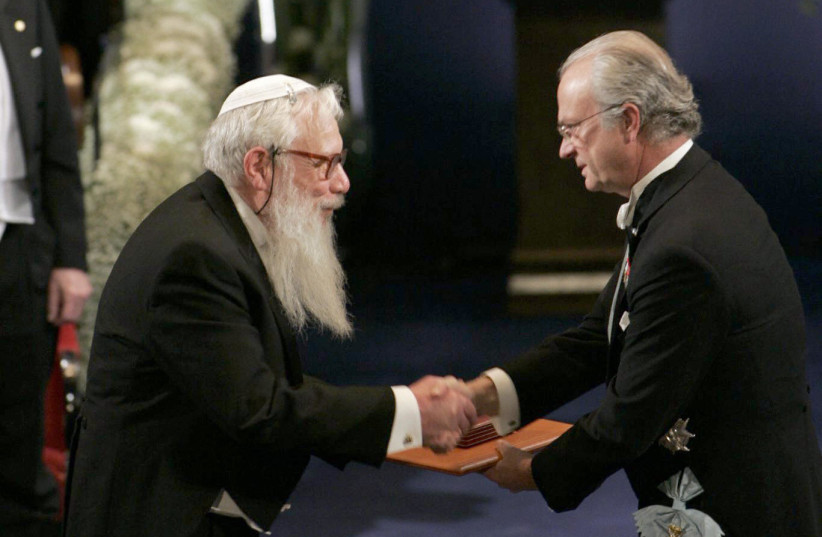
Prof. Yisrael Aumann is seen receiving the Nobel Prize in Economics
from King Carl XVI Gustaf of Sweden at the Concert Hall in Stockholm,
Dec. 10, 2005.
“We’ve
been [in the West Bank] for 57 years and still have not annexed it,” he
says, stroking his long white beard. “It’s not good. We should at least
declare our legitimacy. But at least we are there physically. It is
more difficult for us to pull out because of those people [living
there].
“That’s
game theory,” he continues. “We’re giving ourselves an incentive to
stay [in the West Bank]. One of the most important principles of game
theory is the principle of incentives.”
AUMANN
HAS graciously welcomed us into his spacious, well-appointed Baka home.
As we enter, we are met with the charm of three delicate white cups
adorned with tiny blue flowers, a bowl of buttery sugar cookies, and a
small plate of precious dried apricots brought from California by a
family member (“the only thing you can’t import from Amazon”). Despite
his remarkable intellect and extensive life experience, Aumann’s
demeanor remains humble and kind during our two-hour visit.
We
sip strong brew and discuss topics ranging from politics and warfare to
the Torah. Synchronicity seems to be in our favor: Asking how one who
subscribes to game theory would process a chok (Torah commandment
without a given/logical reason), we mention the prohibition of shatnez
(cloth containing both wool and linen). Aumann then opens a translation
of Shaarei Orah and quotes an esoteric passage on the subject he had
studied with his grandson that very day.
Aumann: The families of hostages may inadvertently strengthen Hamas
Aumann
believes that the intense campaign for the kidnapped is essential, but
he worries it may inadvertently strengthen Hamas by showing them the
extent of public concern. This could lead to Hamas making unacceptable
demands, ultimately harming our war efforts.
The
families “are making it clear to Hamas that this is very, very, very
important for us, and they are making it clear that it is even more
important than it is, and as a result of that, Hamas demands an end to
the war. They’re still in power in Gaza, which is something which we
cannot possibly agree to,” Aumann says.
“If
you want to buy a home at a reasonable price, and you visit the
apartment and the real estate agent is there, and the owner is there,
you do not go to the porch and say, ‘What a beautiful, grand view.’ That
is also game theory; you are giving an incentive to the other side to
charge more,” he says. “The families of the kidnapped are doing this.
They are shooting themselves in the foot. They’re shooting us in the
foot.
“I want the kidnapped returned, but not at the cost of losing the war.”
Aumann
admits that “The world is against us.” But he believes that “a bigger
problem is that we are against ourselves. We say, ‘Beyachad nenazeach’
[Together we will win]. But we are not beyachad.”
He
puts game theory in terms we can understand: A game can involve any
number of players, even up to a million, but it has to have at least
two, Aumann says. Each player influences others to varying degrees while
pursuing different, sometimes opposing, goals. The theory can be
applied in various scenarios, from sports like soccer (where teams
represent players) to geopolitical conflicts, like the “game” between
Israel and Hamas.
The essence lies in strategizing to maximize personal gains while recognizing that others are doing the same.
“You
want to do the best for yourself, taking into account that the other
players are also trying to do the same – doing what is best for
themselves and not for you,” Aumann says. “There are formulas and
strategies,” he adds, and as a general rule, you always want to get the
most information on your opponent possible.
But
the real-world application of game theory can be tricky. “People are
not necessarily doing what’s optimal,” he says with a smile.
AUMANN
IS the father of five adult children, two stepdaughters, 21
grandchildren, and 38 great-grandchildren. Sadly, his son Shlomo was
killed in the 1982 Peace for Galilee operation in Lebanon.
He says only one of his kids is into math; the rest are pursuing other careers. But he’s not disappointed.
“I
think people should do what they like to do because what they like to
do is what they do well, and what they do well is what they like to do,”
Aumann tells us, recounting his childhood in Brooklyn, New York. He
says his parents sent his brother to learn accountancy when he wanted to
be a journalist. Soon after his brother got his degree, he left
accountancy and became a journalist and editor.
“I told my children that we [as parents] had set the buffet: ‘Now you can choose whatever you want from it.’”
Aumann,
born in Frankfurt, Germany, says he was not raised in a Zionist
household. On the contrary, his parents, who were both religious and
educated, were part of Agudat Yisrael and “opposed to Zionism.” But
after the War of Independence and the struggle for the state against the
British and the Arabs, Israel “caught our imagination, and we made a
180-degree turn.”
His older brother moved to Israel in 1951, and Aumann came five years later. Soon after, his mother made aliyah as well.
“I
came at the height of the Sinai campaign, and we drove in a taxi from
the Lod Airport to Jerusalem in the middle of the night – a moonless
night – without lights,” he recalls. “We were concerned about being
bombed by the Egyptian Air Force.”
Then he laughs. Small in stature, his chuckle is soft.
“You
know,” he tells us, “it’s still the same road, more or less. Maybe it’s
been improved or widened a bit. And in Jerusalem at the time, there was
one traffic light on the corner of Jaffa and King George. And it didn’t
work. Nothing has changed.”
Aumann
takes us on a tour of his massive, seemingly museum-quality
Renaissance-era Italian paintings, each depicting a different biblical
scene. He points to the one depicting wise King Solomon “practicing game
theory,” illustrating the famous story of two women who both claimed a
baby as her own.
An
inherited Torah scroll sits in a small ark in the corner of his sitting
room; an engraved rendering of the Ten Commandments puts the spotlight
on the five dealing with bein adam l’chavero (interpersonal conduct). A
small desk houses his computer. Aumann learned to use Zoom during the
pandemic and has now perfected his lighting system to ensure he looks
his best in interviews, he tells us.
Despite the Gaza war, Aumann says he still believes that peace is possible.
“I
am tired of the fighting,” he says. “We’ve been fighting for more than
100 years, and the world has been fighting for thousands of years.
“War
has been the one cost of human history. It is terrible,” he continues.
“There is enough room for them and us in this country.”
He
says that one of the provisions of the Oslo agreement was education:
that Israel educate its children to get along with the Arabs and vice
versa. But Israel never insisted on this, and “it was a big mistake on
our part.”
“In
this conflict, both sides promote their goals to the best of their
ability, but what are the goals? Our goal is certainly not to destroy
the Arabs. Their goal is, but ‘they’ are not necessarily one entity.
“Their children are taught to hate us, they are taught to want to drive us out,” he concludes. “That is what we should change.”
We end the visit on a happy
Note:
In response to our question about whether he will be dressing up for
Purim, Aumann rummages around in a closet and comes back wearing a
colorful jester’s hat atop his head.■
Will Israel's government collapse due to the IDF haredi draft crisis?
With Netanyahu famous for
pushing off decisions, expect Israel to try to reach an agreement with
the bare minimum of haredi commitment.
זאלסט נישט זיין משוגע - לאָזן זיי גיין!
אל תהיה משוגע - תן להם ללכת!
The political ramifications of the High Court of Justice's ruling
on Thursday - that beginning on April 1, today, the state can no longer
refrain from drafting haredi men into the IDF, and that state funding
to yeshivot will cease beginning on April 1 as well - could go in a
number of directions depending on developments in the coming weeks.
The
previous situation was that yeshivot provided quarterly reports on the
number of students, and each student aged 18 and over received a yearly
deferral until age 26, after which they received a permanent exemption.
While
different sources include different numbers, the total number of
yeshiva students is somewhere in the range of 150,000, and the number of
students between the ages of 18 and 26 is in the range of 60,000.
How are ultra-Orthodox yeshivot funded in Israel?
The
haredi yeshivot have different sources of funding. In general, the
smaller a yeshiva is, the more it depends on state funding, a source
from one of the haredi parties explained. The funding is provided on a
monthly basis. While its cessation for the month of April is unlikely to
cause yeshivot to shut down, a few months of blocked funding could
cause many to collapse. However, the larger yeshivot that have name
recognition and donors will survive financially, the source explained.
State
funding for yeshivot is based on a per-student basis, and in many cases
yeshivot have students registered who do not actually study there, the
source said. He estimated that some 1,500 students in every age group
(approximately 12%) already did not qualify for yearly deferrals, and
could be drafted into the IDF relatively easily. Some of the yeshivot
are entirely fictitious and do not exist in reality, he added. Many
haredi businessmen make their livings off of these false reports, and
state oversight has not done enough to oppose the phenomenon.
According
to the source, one scenario is that the cut in state funding could
slice off this layer of "cream," simultaneously saving the state money
and freeing up thousands of haredi men for IDF service.
But
a different haredi source said simply that "no yeshiva shuts down due
to a lack of money," and a third source said that while cutting funds
from yeshivot will be difficult for some, most will adapt. This
indicates that the political reality is not so simple.
The
coalition may attempt to bypass the funding cuts in a number of ways.
The cut in funding is only for yeshiva students aged 18-26 who were not
given deferrals or whose deferrals have run out, and the coalition can,
for example, change the criteria for state funding and balance out the
loss by receiving more for students above the age of 26. Alternatively,
the state can attempt to funnel the funds to yeshivot via other avenues,
such as study grants or "Jewish identity" initiatives.
The
Attorney-General's Office addressed these options on Sunday, and
according to reports clarified that the state cannot compensate the
haredim by finding other funding avenues, and that doing so would
qualify as a violation of the High Court's directive to cease funding. A
"source close to Netanyahu" said in response on Sunday that it was
"unclear what was so urgent for the attorney general to create a schism
in Israeli society on the draft issue, after the High Court accepted the
prime minister's request to complete a new plan within 30 days with an
expanded bench of nine judges. The attorney general's office is not
authorized to empty the content of the High Court's decisions."
The
comment by this "source close to Netanyahu" referred to the fact that
the High Court's directive to cease funding was given as a temporary
measure, and that in May an expanded bench of nine justices will decide
whether or not to make the measure permanent. This means that while
yeshivot are likely to lose funding for the month of April, they can
begin to receive funding once again as soon as May if the government can
come up with a new proposal for the haredi draft that will earn the
support of the attorney general.
Knesset recess may bring about a plan
In the meanwhile, the Knesset will be on spring recess
between April 8 – May 19, and the government thus has at least until
then before the haredi parties can threaten to disperse the Knesset and
go to an election. The legal and political timetable thus gives the
government a few more weeks to work on a new, detailed plan for the
haredi draft, or, alternatively, figure out new ways to avoid it.
There
is room to believe that the government could come up with a plan by May
that will lead to more haredim joining national service, and passing it
into law in June or July. Netanyahu said in a press conference on
Sunday night that the haredi politicians had gone further in
negotiations than what he expected, and further than ever before, in
what they are willing to concede on the issue. A spokesperson for the
Likud said in a phone conversation earlier on Sunday that the government
would come up with a detailed plan with an array of options for haredi
national service, including IDF service but not exclusively, as well as
to offset the inequality of the remaining exemptions based on the
formula that "whoever gives more receives more."
On
the other hand, the devil is in the details. The result of intense
negotiations over the past few weeks was a plan that the finance
ministry's legal advisor said did not essentially differ from past plans
that failed in drafting haredim, and the attorney general's office said
that the plan lacked "basic professional foundations." If this is what
the government came up with after weeks of negotiation, there is no
guarantee that it will come up with a better plan in the coming weeks.
Another
political complication is legislative procedure. If the government
cannot come up with a plan that is accepted by the attorney general, it
could attempt to bypass the necessity of the attorney general's approval
by proposing the new plan as a private bill by one of the Likud's
members of Knesset. This is unlikely, however, as private bills face a
longer legislative procedure, which gives the opposition more time and
opportunities to slow or block it.
In
any event, no matter if the bill is sponsored by a private MK or by the
government, Knesset Foreign Affairs and Defense Committee chairman MK
Yuli Edelstein (Likud) demanded last week that the bill be prepared in
his committee, and not in an ad-hoc committee formed for the specific
purpose of a haredi service bill, like the Knesset has done in the past.
Edelstein is independent-minded and came out in the past against
government policies. He also wields some political clout and could try
to lead an attempt within the coalition to vote against the bill if it
does not go through his committee. Should the bill reach his committee,
he may attempt to alter it in a way that would no longer be acceptable
to the haredi parties, and the crisis could begin anew.
Even
if the government manages to bypass Edelstein, there are still a number
of Likud Knesset members who could oppose a bill that they believe is
unsatisfactory. According to a report by KAN News on Monday, Netanyahu
and Shas chairman MK Aryeh Deri discussed an option of having MKs from
both Israeli-Arab parties not be present at a vote on the bill, so as to
ensure that the coalition has a majority. One p[arty, Hadash-Ta'al,
responded on Monday that it would not agree to do so and would join the
efforts to bring down the government. The second Arab party, Ra'am, did
not immediately respond.
The
bottom line is that the current crisis is unlikely to bring down the
government at least until late May or June, and in the meantime the
outcome depends on the government's political will to have haredim
commit to national service. With the haredim in power and Netanyahu
famous for his knack for pushing off decisions, expect the government to
try to reach an agreement with the bare minimum of haredi commitment,
while attempting to delay court proceedings as much as possible.
Unlike
in the past, however, there is no longer a legal basis for the haredi
exemption, and coupled with the cessation of funding for yeshivot, the
security establishment in the meantime is required by law to begin
proceedings to call up haredi men for service. Without a legislative
solution, this could lead to a clash between military recruiters and the
haredi public, as well as to mass haredi protests and disruptions.
The Zvhil-Mezbuz Rebbe of Boston: By Jewish law, every able-bodied Jewish male from the age of 20 is required to serve – period
Ultra-Orthodox
soldiers stand on the stage at a Memorial Day service for fallen Haredi
soldiers in Jerusalem
I will undoubtedly be attacked, discredited and vilified in some
circles for expressing this, but I simply cannot remain silent, and
indeed I feel it is my obligation to speak out.
I am absolutely disgusted and repulsed by the position of some
elected officials, politicians and political parties that there should
be a blanket IDF service exemption for haredi men. There is absolutely
no justification for such an outrageous and unjustified blanket
exemption, either logically or halachically.
From a logical perspective, how can we expect “others” to protect
us, defend us, fight for us if we don’t do our part and contribute to
and be an active part of that existential requirement? Indeed, if these
proponents of an unlimited blanket exemption were to be fully successful
in achieving their expressed goal and vision that every Jewish man
should devote his life fully and exclusively to study and observance of
the Torah, and therefore in their opinion be exempt from IDF service,
then ultimately there would then be no “others” at all and who would be
left to serve in the IDF and defend Israel then? It makes no sense.
Fifty years ago, as a newly-minted rabbi and lawyer then writing on
the Jewish Law of War towards a Ph.D in International Law, I wrote that
from an Halachic perspective the Torah, from the Chumash to the Talmud
to the Rambam, is crystal clear. Every able-bodied Jewish male from the
age of 20 who is not from the tribe of Levi (which includes Cohanim) is
required to serve. Period.
There were no blanket exemptions, just various limited exemptions
based upon individual special circumstances (such as a husband in his
first year of marriage, etc.). And indeed even those limited individual
exemptions are only operative in the case of a Milchemes Reshus, a “permissible” or optional war (such as for elective territorial expansion). But critically, when it came to Milchemes Mitzvah,
an obligatory war for self-defense, for Israel’s very survival, such as
wars we are fighting today surrounded by enemies seeking to destroy us,
there were absolutely no exemptions whatsoever, least of all any
blanket exemption of an entire segment of the Jewish community. That
would be unheard of. Except, evidently, today in some circles.
In addressing the issue of exemptions who are we in the name of
the Torah, the Talmud, the Rambam to ignore those very authorities while
at the same time encouraging the study of and devotion to those same
holy texts?
I was so very heartened and thrilled to see so many haredi young
men enlisting in the IDF in the aftermath of the horrible tragedy of
October 7th, in the holy Torah-true tradition of Joshua, Yehoshua bin
Nun, the first General leading an Israeli army, applying Torah practices
to real life. Their actions were an important statement and example of
the true values of a Jewish nation and homeland, an example to be
encouraged and supported that also has the admirable side-effect of
bringing all our people together, healing rifts in our society, and
promoting cooperation and unity.
Certainly, accommodations can be made in the IDF, as they already
have been, for the needs of Haredi Jews. I understand the concern that
Haredi Jews may be exposed to less than authentic practices and views of
Judaism, a concern mitigated by the existence of IDF units such as
Nachal Chareidi, but even in “mixed” units it is equally possible that
the opposite will occur and fighting side by side they will by example
and with love attract the non-observant who will discover or rediscover
the beauty of the Torah. I was privileged to have a son serving in the
IDF, and subsequently fighting in Gaza, who did exactly that.
And if we have so little faith in the commitment and
steadfastness of our observant youth and their ability to resist such
influences, then the solution is not to isolate or exempt them from IDF
service, but rather to support them, prepare them, and strengthen them.
In the Tachanun supplications recited as part of Shachris service
each weekday morning, there are three verses addressing Shomer Yisroel,
the Guardian of Israel. The first prays that our Guardian protect
“she’aris Yisroel,” the remnant of Israel, the second prays to protect
“am echod,” one people, and the third prays to protect “goy kadosh,” the
holy nation. There is a deep reason for that particular intentional
sequence – from remnants to unity to holiness.
If, as the Haredi community and indeed all of us preach, we
aspire to be a holy nation, then we must first turn the remnant of
Israel that we are into “Am Echod,” a singular, unique, united, one
nation, united under the one G-d. One unity under The Unity – that is
how we will survive, defeat the enemies that surround us, and thrive.
Only as one united nation, with no divisions, no special treatment,
nobody exempt.
No, there should not and cannot be a blanket exemption for any
group among us. That simply increases divisiveness and discrimination
and engenders resentment and hatred. That is not the way of the Torah or
of Klal Yisroel.
Grand Rabbi Y. A. Korff, the Zvhil-Mezbuz Rebbe (Admor) of Boston, is
the Chaplain of the City of Boston, spiritual leader of Bnai Jacob
Synagogue in Boston, and also serves The Jerusalem Great Synagogue in
Israel.
Ashlag Rebbe In Telzstone: State Should Fund 2000 Yeshiva Students, The Rest Must Serve Community:
"He wrote that “In a time of war, even a groom must leave his chuppah
and go to help. Although other rabbis insist that we must not stop Torah
study, this is not the issue. Nobody wants to stop Torah study, but it
is “a time to do for Hashem and to ‘transgress’ the Torah.”
Rabbi Gottlieb suggests that yeshivos be established on the borders
in the north south and where required and study half day while spending
the other half on patrols and guard duty , in order to “take away from
the terrible burden on the general community in Israel.” He warns that
“The Israeli public will not forget if the yeshiva students won’t join
the war effort.”
He also admits that the yeshiva students are not all sitting and
studying day and night. “Not everyone has the strength for this, only a
small amount. Near my house there are all kinds of bakeries with food,
restaurants and eateries. I see the whole day long that there are quite a
few yeshiva students eating with great relish baked foods and other
items.” Rabbi Gottlieb concludes: “Do they have no shame?”
In another post Rabbi Gottlieb decries the funding of yeshiva
students, stating that it is a “custom whose time has passed”. From the
age of 18, he claims that “everyone must contribute their part for the
people of Israel and study in their “free time”. He adds that this was
the view of the Baal Hasulam, that people should work, should enlist and
take part of the burden on themselves. He was even against kollelim,
believing that Toraso U’Manuso is meant for a person’s free time, and
should not be for remuneration.
Rabbi Gottlieb concedes that the state should fund “some 2000 people
every year” as it is in the interest of the Jewish nation to have
Dayanim, Poskim, rabbis and Talmidei Chachamim. He believes this number
is enough to produce the requisite number of Torah leaders"
In ‘historic’ step, High Court orders halt to yeshiva funds for students eligible for draft
Attorney General tells court army will be
obligated to begin drafting Haredi men on April 1; judges shoot down
PM’s request for 30 more days to settle matter
Israeli High Court brings Haredi draft exemption to a legal end — with unclear consequences
Kol Isha Not Applicable!
The practical implications of the decision remain up in the air
Haredi
Jewish boys and men clashed with police earlier in March while
protesting against the expiration of a law preventing them from being
drafted into the IDF
JERUSALEM — A decision by Israel’s
High Court of Justice will bring the country’s 76-year-old policy of
excusing nearly all Haredi men from its compulsory draft close to an end
— at least on paper, and at least temporarily.
The Thursday night court order came
as Prime Minister Benjamin Netanyahu has so far failed to broker a
consensus within his government about continuing to exempt young Haredi
men from military service, prompting the court to rule the government no
longer has a legal basis to keep funding their yeshiva study.
Legally, it means some yeshiva
students could have to put down their scripture and take up arms as soon
as this Monday, April 1.
But practically, political and legal
experts say, questions remain about how Netanyahu’s coalition government
will respond to the ruling as its deadline for a new legislative
proposal approaches this Sunday. Questions also remain about how the
Israel Defense Forces might ultimately implement the legal — and
still-potential legislative — change in policy.
The draft exemption dates back to Israel’s founding in 1948, when founding
leader David Ben-Gurion agreed to exempt yeshiva boys from military
service as part of a deal to secure political support from Haredi
leaders. The Haredi community believes full-time Torah study protects the country more than its military ever could.
An estimated 66,000 Haredi Israeli
men between 18 and 26 years old are currently exempted from the draft
and receiving government subsidies to attend yeshivas — whether or not they’re actually doing so for at least 45 hours a week, as the law requires.
The United Torah Judaism Party on Thursday accused the court of waging “an all-out struggle” against Torah study.
A poll by the Israel Democracy Institute shows 70% of Israeli Jews support ending the longstanding blanket exemption from military service for Haredim, up from 60% in 2018.
The High Court had previously ruled
in 1998 and 2017 that the draft loophole violates the right of the
Israeli majority to equal treatment under the law. Several governments
since have tried but failed to come up with a fair and lasting solution.
The court gave Netanyahu’s government until June of last year to come
up with a new policy, but his coalition then gave itself until the end
of this month to do so. The issue played a part in last year’s judicial overhaul crisis, when Haredi politicians sought to override the High Court’s decision to strike down the exemption.
Netanyahu, in trying to broker a
consensus within his government, has not managed to break an impasse
between Haredi parties that want to extend the draft loophole, and ultranationalists opposed to their special treatment. His governing coalition relies on the support of both groups; the impasse threatens
to unravel it at a time when the war in Gaza and conflicts at the
Lebanon border and in the West Bank have left the IDF short on troops.
Critics of the exemption include
Defense Minister Yoav Gallant, a key architect of the Gaza operation,
and National Unity Party Leader Benny Gantz — both among the five
members of Netanyahu’s war cabinet. Gantz lauded the ruling via social
media late Thursday.
Three times in the last 24 hours,
Netanyahu sought a court extension to delay the deadline to come up with
a plan. The latest of those requests came Thursday afternoon, when, in a
rare letter directly to the court seeking a 30-day postponement, he
wrote that distractions created by overseeing the war have kept his
coalition government from reaching a consensus on a new policy.
The letter marked an end-run around Attorney General Gali Baharav-Miara, who represents the government but refused to ask for a delay as Sunday’s deadline nears. Baharav-Miara’s
office, in the meantime, wrote the court Thursday saying the state will
be legally obligated to start drafting Haredim on Monday, because there
no longer will be a legal basis for paying their monthly stipends for
the yeshiva study that exempts them from the draft.
The court agreed with Baharav-Miara in a ruling a few hours later.
Netanyahu and his right-wing
coalition notoriously antagonized Israel’s judicial branch by trying to
curtail its power last year. Those efforts triggered the biggest
anti-government protests in the nation’s history. Protests died down after Hamas’ attack and massacre on Oct. 7, but have been picking up as Sunday’s draft exemption deadline nears.
Meeting between Netanyahu, Haredi parties on conscription law ends without agreement
Justice Minister Levin also at sit-down where reps
of ultra-Orthodox parties reportedly assailed attorney general; United
Torah Judaism reportedly threatens to leave coalition
Prime
Minister Benjamin Netanyahu, left, and Housing Minister Yitzhak
Goldknopf, right, arriving for a cabinet meeting at the Prime Minister's
Office in Jerusalem
An hours-long meeting on Tuesday night between Prime Minister
Benjamin Netanyahu and representatives of United Torah Judaism and Shas,
the coalition’s two Haredi parties, over a contentious ultra-Orthodox
military draft bill came to an end without any major progress, reports
said.
According to the Kan public broadcaster, the sit-down ended unproductively and no additional meetings were scheduled.
Justice Minister Yariv Levin also attended the Tuesday night meeting
where, according to Kan, the ultra-Orthodox parties attacked Attorney
General Gali Baharav-Miara, who has told the government that she would
be unable to defend its initial proposal in court.
A law allowing young Haredi men to repeatedly push off their military
service for yeshiva until they reached the age of exemption expired
last year. The Supreme Court ruled that the current system is
discriminatory and has given the government until April 1 to present a
bill and until June 30 to pass it.
As the deadline drew nearer, the government was set to meet on
Netanyahu’s draft of the bill on Tuesday, but the meeting was pushed off
amid an outcry over the proposal.
After members of his government, including Defense Minister Yoav Gallant,
expressed strong objections to the original plan, Netanyahu postponed
the planned cabinet discussion on the issue and entered into marathon
talks within his coalition on the controversial reform.
Shas chair Aryeh Deri
The original outline did not set a quota of ultra-Orthodox men
enlisting per year. Instead, it raised the age of final exemption from
service to 35, apparently based on the claim — widely criticized — that
requiring young Haredi men to stay in yeshiva for decades instead of
entering the workforce in their 20s could deter them from signing up for
a lifetime of study, and instead encourage their enlistment.
It also ensured that Haredi men who don’t enlist would not personally
face financial sanctions. And it included a plan to set up special
ultra-Orthodox battalions in the IDF and add Haredi positions in the
country’s emergency services and government offices.
The Movement for Quality Government in Israel, which has petitioned
the High Court of Justice to compel the enlistment of the
ultra-Orthodox, accused the government of engaging in “the same shticks
and tricks” by floating and then reversing a change to the age of
exemption.
“Sharing the burden [of military service] equally is an existential
necessity for the State of Israel and Israeli society, and there is no
way to achieve it other than the enactment of a uniform and equal
enlistment law that will apply to all,” the watchdog group said in a
statement on Monday.
Channel 12 and Ynet reported on Tuesday that the attorney general had
requested that recruitment target figures be included in the
legislation, while ultra-Orthodox parties have rejected that proposal.
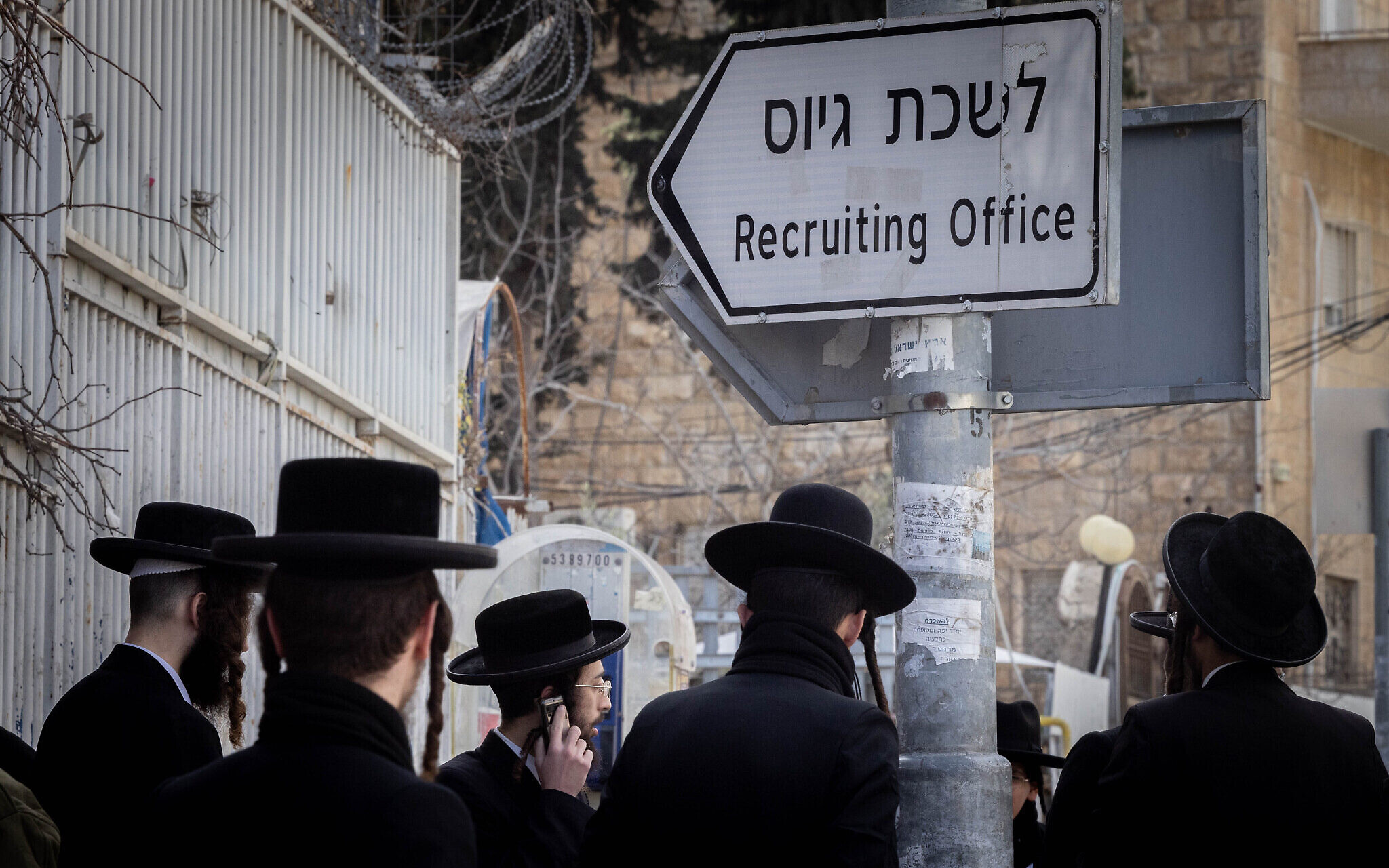
Ultra-Orthodox men protest outside the army recruitment office in Jerusalem
UTJ reportedly threatened to leave the Netanyahu-led coalition should
the proposal include annual recruitment targets for yeshiva students
and financial penalties for Haredi educational institutions that don’t
meet those quotas.
According to Channel 12, UTJ’s ultimatum was the reason for the
last-minute postponement of a cabinet meeting on the draft exemption law
earlier in the day.
A loss of the ultra-Orthodox parties could bring down Netanyahu’s
hardline coalition and plunge the country into new elections with he and
his Likud party trailing badly in opinion polls. UTJ has seven seats
and Shas 11, so their departure would leave the coalition, which
currently numbers 72 seats in the 120-member Knesset, without a
majority.
Baharav-Miara and Gallant were not alone in objecting to the original
plan, with war cabinet minister Benny Gantz, whose National Unity party
holds eight seats, threatening to leave the emergency government if the legislation passed.
Gantz, Netanyahu’s top political rival, said the premier’s outline
for a Haredi draft law was a “red line” and a threat to national
cohesion. Gallant said he’d support a new law only with the support of
all coalition parties, including Gantz and more centrist members of the
country’s emergency wartime government.
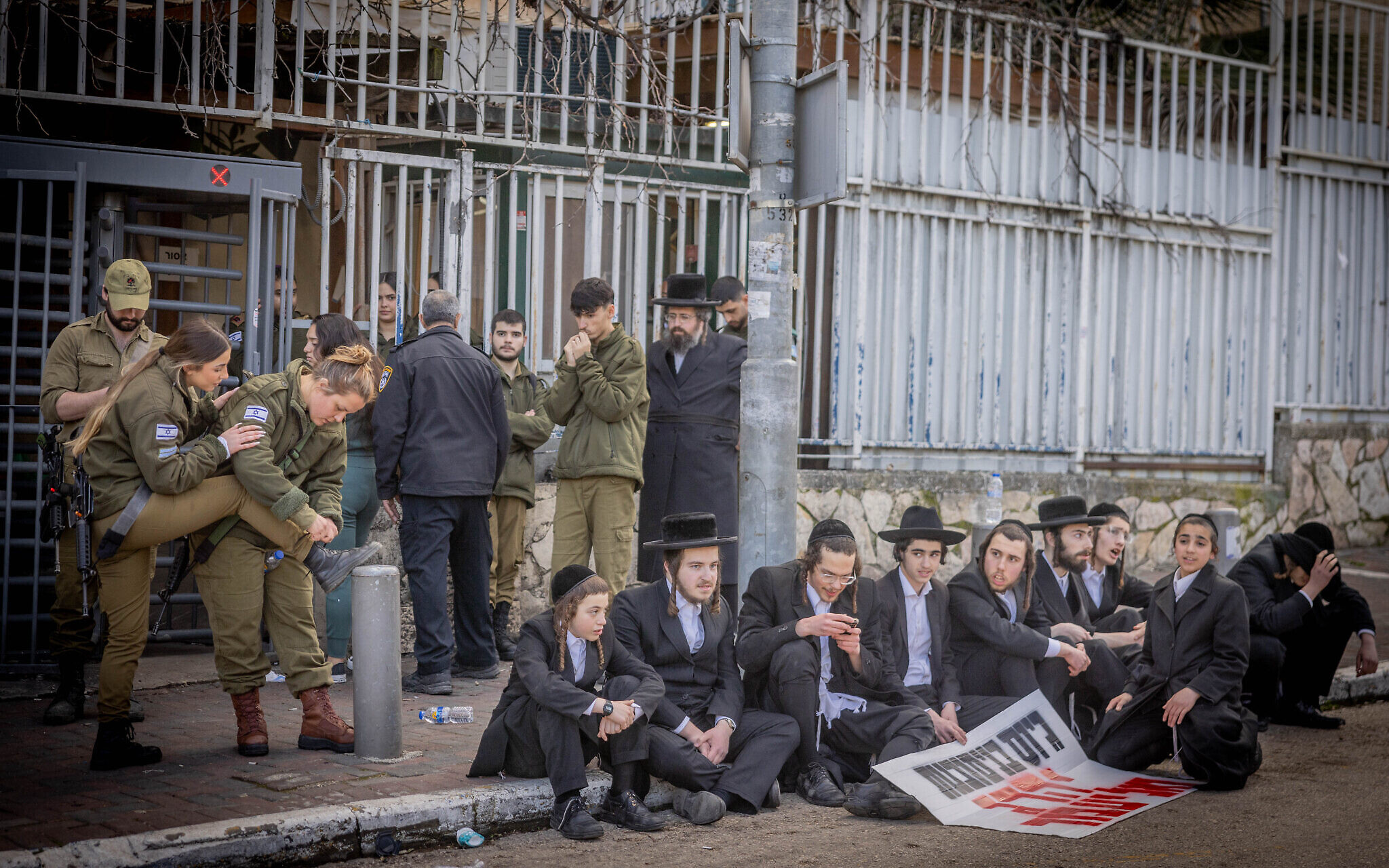
Ultra-orthodox men after clashes during a
protest outside the army recruitment office in Jerusalem, as a group of
male and female soldiers stand behind them
This week, dozens of commanders in the IDF reserves sent a letter to Netanyahu, Gallant
and other senior officials warning that the current proposal for the
draft bill will deepen inequality and harm national security.
The IDF’s plan to increase the time conscripts and reservists serve
in the military, combined with the Haredi enlistment law, which would
allow most ultra-Orthodox men to be exempt from military service, would
create an “extremely unequal” situation, the commanders charged in their
letter.
The commanders also warned that beyond the feeling of inequality,
there were concerns that under the new proposal, “the reserve system
will not be able to meet its requirements, to the point of difficulty in
manning operations.”
“We demand from you, the people responsible by law and by virtue of
your authority for our routine and emergency operation, to stand firm
and prevent any discriminatory and offensive recruitment plan of this
kind,” the commanders added.
Soldiers study religious texts in the IDF’s
ultra-Orthodox ‘Netzah Yehuda’ unit at the Peles Military Base in the
northern Jordan Valley
Senior Finance Ministry officials also expressed opposition to the
lack of personal financial sanctions in the government’s proposed draft,
arguing that they would be ineffective in persuading yeshiva students
to join the IDF.
According to Kan, ministry officials objected to financial penalties
being placed on yeshivas that fail to meet whatever enlistment quota is
ultimately approved instead of on individuals, and said that only
personal sanctions would have the desired effect.
Since the beginning of the war in Gaza, the government has called up a
total of 287,000 reservists, announced earlier-than-planned draft dates
for some 1,300 members of pre-army programs, and pushed to
significantly increase both conscripts’ and reservists’ periods of
service.
That latter plan, presented by the defense establishment last month,
generated fierce backlash among lawmakers from across the political
spectrum and encouraged multiple legislative pushes to end the de facto
exemptions for the Haredim.
According to the IDF’s Personnel Directorate, some 66,000 young men
from the Haredi community received an exemption from military service
over the past year, said to be an all-time record.