
EVERY SIGNATURE MATTERS - THIS BILL MUST PASS!

CLICK - GOAL - 100,000 NEW SIGNATURES! 75,000 SIGNATURES HAVE ALREADY BEEN SUBMITTED TO GOVERNOR CUOMO!
EFF Urges Court to Block Dragnet Subpoenas Targeting Online Commenters

CLICK! For the full motion to quash: http://www.eff.org/files/filenode/hersh_v_cohen/UOJ-motiontoquashmemo.pdf
Friday, January 24, 2025
Thursday, January 23, 2025
Married LI healthcare exec accused of preying on nearly a dozen teen girls to produce child porn - Prosecutors said at least 20,500 files of child porn were found in Walden’s cloud storage, court docs revealed. jakewlden.co
"Walden’s counsel, Benjamin Brafman, argued his client’s compulsions stem from his own abuse as a child, pressing the court that dozens of "religious" members of the Orthodox Community have begged for “leniency and compassion.”
“He has five children and a wife who is present in court,” Brafman said.
Judge Gary Brown, who presided over the arraignment, agreed Walden should remain locked up."
*
THERE IS SOMETHING ESPECIALLY DISGUSTING & SICK FOR "RELIGIOUS" PEOPLE PLEADING FOR LENIENCY AND MERCY FOR A CHILD MOLESTER! PM
*
Married LI healthcare exec accused of preying on nearly a dozen teen girls to produce child porn
A married Nassau County healthcare executive allegedly preyed on nearly a dozen teen girls to produce child porn over a four-year period — including two minors he ordered to call him “daddy” and paid in exchange for the sickening content.
Jacob Walden, 38, was arraigned Wednesday morning in Central Islip Federal Court on a six-count indictment charging him with the sexual exploitation of two teens — ages 16 and 17 — he pressured to create sexually explicit videos and photos, according to the US Attorney’s Office of the Eastern District of New York.
Feds recovered the disturbing images from Walden’s cell phone last April and identified at least 11 girls, as young as 14 years old, whom he contacted, coerced to send inappropriate content and paid, according to court documents.

The 16- and 17-year-old victims were located and interviewed during an investigation feds launched in September 2023.

Investigators further found Walden, a father of five, repeatedly purchased at least 500 images and 5,000 videos depicting rape, bestiality and the abuse of toddler-aged children from a large-scale production and distribution ring that advertised to adult male buyers in the US and aboard, according to court docs.
Law enforcement also recovered an encrypted conversation on Walden’s phone arranging the purchase of two child porn packages — one of which was advertised to include “4-19, FAMILY, SOLO, RAPE, MIXED” content, the documents state.
Prosecutors said at least 20,500 files of child porn were found in Walden’s cloud storage, court docs revealed.
Walden, the co-owner and managing partner of Emerald Healthcare, a company that manages nursing and assisted living facilities nationwide, remained in contact with his child victims between 2020 and 2024.

In his conversations with the two teens referenced in the indictment — referred to as Jane Doe # 1 and Jane Doe # 2 — Walden reportedly insisted he be addressed as “daddy” and provided directions on the sexual acts he wanted the victims to perform.
He then paid them electronically after he received the alarming content, according to court documents.
Walden was arrested on July 31, 2024, and was ordered to home confinement at his $2 million Valley Stream residence, with restrictions placed on his electronic devices and his contact with minors.
The accused sicko violated his conditions within a month of his arrest after investigators discovered he made an unauthorized stop at a Verizon store and offered a woman money for sex on WhatsApp, prosecutors said.

Walden is being held without bail until his trial at the Metropolitan Detention Center in Brooklyn, according to law enforcement sources, after prosecutors argued he is a flight risk and a danger to society.
He joins high-profile perps, Sean “Diddy” Combs and Luigi Mangione, who are also imprisoned at the Brooklyn facility.
“For years the defendant has enticed individuals, typically minor females in exchange for payment to produce child pornography for him,” US Trial Attorney Lenoid Sandlar said.
“The totality of the defendant’s voluminous submissions does not rebut the defendant’s motivation of flight. Or dangerousness.”
Walden’s counsel, Benjamin Baufman, argued his client’s compulsions stem from his own abuse as a child, pressing the court that dozens of religious members of the Orthodox Community have begged for “leniency and compassion.”
“He has five children and a wife who is present in court,” Baufman said.
“They are supportive even in light of the charges.”
Judge Gary Brown, who presided over the arraignment, agreed Walden should remain locked up.
Walden, on his personal blog, describes himself as an avid volunteer who is deeply committed to giving back to his community and a founding member of a local synagogue who launched his career in 2008 helping at-risk teens.

Walden described himself as a man of “diverse interest and hobbies that enrich his life and provide a sense of balance,” and said growing up in Monsey played “a significant role in shaping his values and character.”
“Jacob Walden’s life story is a powerful reminder that greatness is not defined by fame or acclaim but by the impact one has on the world and the people around them,” he wrote on his website.
“His unwavering commitment to his values, resilience in the face of challenges, and dedication to personal and professional growth make him a true example of what it means to lead an extraordinary life.”
Walden is charged with two counts of sexual exploitation of a child, receipt of child pornography, possession of child pornography, and two counts of access with intent to view child pornography, according to the indictment.
If convicted, he faces up to 30 years in prison, prosecutors said.
He is due back in court on Feb. 24.
If you have been sexually assaulted and live in New York, you can call 1-800-942-6906 for free and confidential crisis counseling. If you live outside the state, you can dial the 24/7 National Sexual Assault Hotline at 1-800-656-4673.
Federal Court after Jacob Walden’s arraignment for allegedly possessing and soliciting child pornography:
Long Island Man Charged With Sexual Exploitation of Children
Wednesday, January 22, 2025

Trump’s need to show off his masterful negotiation skills in achieving a ceasefire and the return of the Israeli hostages even before he had taken office — is not sufficient. It conveniently overlooks the game-changing geopolitical forces hidden beneath the glossy wrapper of “peace talks.”
How Trump Used Israel in the Game of Geopolitics — and How Israel Should Respond
Guest Post:
 by Amy Neustein

 |
| Thousands of supporters of hostage families gather in Hostages Square in Tel Aviv as three hostages are returned to Israel |
The US-brokered hostage-ceasefire deal — secured by fiat, not consensus — struck a harsh blow at the Jewish community this week. Notwithstanding the joy of finally seeing the hostages returned to their families and communities, many are questioning how President Donald Trump, who always claims to be a diehard supporter of Israel, could send an envoy to pressure Netanyahu into agreeing to suspend the campaign to extinguish Hamas and release convicted terrorists who pose an imminent danger to Israel’s security.
The simple explanation — Trump’s need to show off his masterful negotiation skills in achieving a ceasefire and the return of the Israeli hostages even before he had taken office — is not sufficient. It conveniently overlooks the game-changing geopolitical forces hidden beneath the glossy wrapper of “peace talks.” To begin with, it is no secret that Trump’s main objective is to have the US achieve economic superiority over China. He promised to set up the “External Revenue Service” on his first day in office to collect tariffs from Chinese imports that flood the US consumer markets. Because China represents to Trump the greatest existential threat to America, his policies, politics, and passions are principally geared toward facilitating America’s dominance in trade relations and in closing the US border.
It would be hard to ignore how Trump, in his mission to defeat his Chinese rivals, has tried to leverage the support of Russia, by displaying unusual comity and collegiality toward Putin. In essence, by showing fealty to Russia, Trump plausibly weakens the dyad between China and Russia. It is no secret that Russia wanted Israel to cease their combat operations in Gaza because continued fighting in the Middle East could endanger the survival of the Iranian regime. Not surprisingly, less than 48 hours after Israel announced its agreement to the hostage-ceasefire deal, Putin put on an amazing spectacle. Holding a joint press conference with his Iranian counterpart, President Masoud Pezeshkian, Putin applauded the deal and urged its immediate implementation.
Since it is no secret that Russia has vociferously supported Palestinian statehood (in fact, Putin reiterated those wishes at the press conference with Pezeshkian), it is concerning how easily Putin may try to exact compromises and concessions from Trump, who needs Russia to leverage America’s rival, China. Trump’s strong-arming of Israel into a terrible ceasefire-hostage deal, immediately followed by his stern warnings to the Jewish State regarding any possible violation of the 60-day Lebanon-Hezbollah ceasefire, has placed Israel on the altar of a dangerous geopolitical chess game. The Jewish State has been slid across the chessboard as a pawn of politics, while superpowers naturally take credit for their mastery of this game.
Similar to geopolitical jockeying, market dynamics likewise factor into the chess game of peace negotiations. Fitch — the first major credit rating agency to take a sledgehammer to Israel’s creditworthiness when it began its justified counteroffensive in Gaza against Hamas in 2023 — let out speculation shortly before Netanyahu accepted the hostage-ceasefire deal that Israel would enjoy a boost to its credit rating, thereby making the Jewish State more appealing to foreign investors. For a country already stressed by a 15-month multi-front war, dangling these promises of a much-needed credit upgrade is very tempting. All in all, the Latin Proverb Praemonitus Praemunitus (forewarned is forearmed) cannot be understated.
The geopolitics of peace negotiations, and the concomitant market undercurrents that resulted in the 11th-hour arm-twisting diplomacy in Israel, is a reminder that the Jewish State is a cog in a much larger system. To deny this reality leads to false hope, miscalculation, and much agony. All in all, the Ferris wheel of fate has played out, and arguably not to Israel’s benefit. The landslide victory of Trump had emboldened the Jewish State and Jews throughout the world. Those feelings were justified, considering the staunch support Trump had given Israel in his prior term, as well as his present appointment of former Arkansas Governor Mike Huckabee, an undeniably strong ally of Israel, to serve as the US ambassador to the Jewish State.
However, it’s time to get off the Ferris wheel and stand firmly on the ground. A steady mooring will make Israel less likely to be moved around as a pawn on a chessboard. And this augurs well for Israel’s long-term survival.
Amy Neustein, Ph.D., is a sociologist and author/editor of 16 academic books on socio-political institutions, a speaker on counter-terrorism, and the recipient of the Pro-Humanitate Literary Award.
https://www.algemeiner.com/2025/01/20/how-trump-used-israel-in-the-game-of-geopolitics-and-how-israel-should-respond/Tuesday, January 21, 2025
Monday, January 20, 2025
Bari Weiss: If TikTok is a national security threat, how can that national security concern be waived for 90 days? - Paul Mendlowitz: Because he's paving the way for the Tech Bros., probably Elon Musk, or his family to buy TikTok at a bargain basement price!
 |
| By The Free Press | PAID |
The Free Press is in D.C. for inauguration weekend, and the one thing dominating the conversation—even more than president-elect Trump—is TikTok.
On January 17, the Supreme Court ruled unanimously that Congress’s law forcing a divestiture of TikTok “is necessary to address [Congress’s] well-supported national security concerns regarding TikTok’s data collection practices and relationship with a foreign adversary” and thus did not violate the First Amendment. This meant that TikTok, since it had failed to secure a sale to a buyer not controlled by a “foreign adversary,” needed to shut down by Sunday.
On Saturday, TikTok announced that the app was going dark. Soon thereafter, news broke that president-elect Trump might even be open to nationalizing half the social-media app.
By Sunday around noon, after the previous night’s brief shutdown, Trump had promised to issue an executive order on Monday to “extend the period of time before the law’s prohibitions take effect.” TikTok announced that “In agreement with our service providers” the company “is in the process of restoring service. We thank President Trump for providing the necessary clarity and assurance to our service providers that they will face no penalties providing TikTok to over 170 million Americans and allowing over 7 million small businesses to thrive.”
Whew.
Left unexplained was how Trump could do this given the law’s plain language, which allows the president to grant such a reprieve for 90 days only if he can certify "evidence of significant progress" toward a sale. And that’s a big reason that, even before Trump takes office, disagreements are breaking out between Republican national-security hawks and tech-world interests that—for the moment—seem to have Trump’s ear. Of TikTok’s restoration of service in the U.S., Senator Tom Cotton said: “Any company that hosts, distributes, services, or otherwise facilitates communist-controlled TikTok could face hundreds of billions of dollars of ruinous liability under the law, not just from DOJ, but also under securities law, shareholder lawsuits, and state AGs. Think about it.”
In other words, TikTok may be pursuing a perilous path—regardless of any assurances Trump has just issued. Some are warning this all ends with a Meta monopoly on apps like TikTok.
What will happen next? For now, TikTok has restored service and posted the following message to its users, crediting Trump:
“As a result of president Trump's efforts, TikTok is back in the U.S."
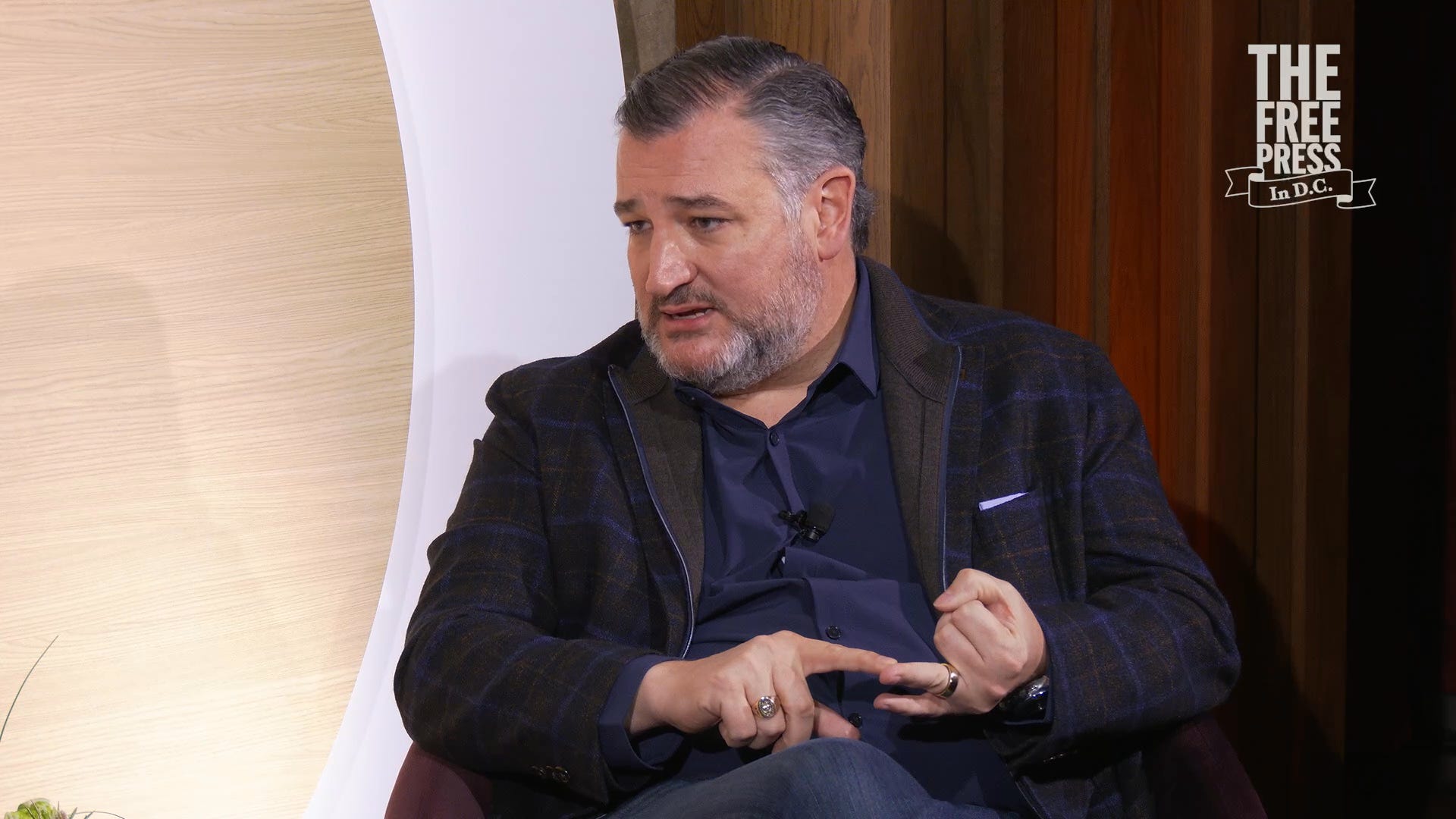
In a frank and freewheeling conversation with The Free Press on Saturday, Senator Ted Cruz (R-TX) weighed in on the fast-moving furor over TikTok’s legal status.
The below reflects Senator Cruz’s comments on TikTok’s future.
Bari Weiss: If TikTok is a national security threat, how can that national security concern be waived for 90 days?
Senator Cruz: Because the statute provides that it can be waived for 90 days. And the statute provides that it can be waived in order to facilitate a sale. So I don’t know what Trump is or isn’t going to do on this. If we are sitting here 91 days from now and TikTok is still live and China is still owning and controlling it, that will be a very dangerous situation because the Chinese communist government uses TikTok—number one for espionage, and number two to push propaganda and very harmful content to our children that pushes self-harm, suicidal ideation, substance abuse, antisemitism, anti-Americanism and anti-capitalism. It is a potent propaganda tool. The Chinese variant of TikTok, for their kids—number one, the hours they can use it are limited, and number two, they’re pushing things like math and hard work and discipline.
Weiss: It’s like Khan Academy.
Cruz: It really is astonishingly harmful. So their kids are studying calculus and our kids are being told to chew Tide Pods. That’s a problem.
Watch Senator Ted Cruz sound off on TikTok above. And watch Bari’s whole conversation with Ted Cruz hereSunday, January 19, 2025
President Rabbi Dr. Ari Berman is scheduled to deliver a benediction at the inauguration of President-elect Donald Trump. This choice, while perhaps politically expedient, raises troubling questions about the values that guide Yeshiva University today.
To YU’s Rabbi Ari Berman: The inauguration is not your stage
 |
|
Yeshiva University faces a pivotal moment that will define its legacy. |
President Rabbi Dr. Ari Berman is scheduled to deliver a benediction at the inauguration of President-elect Donald Trump. This choice, while perhaps politically expedient, raises troubling questions about the values that guide Yeshiva University today.
This is the same university that once conferred honorary degrees upon Albert Einstein, Nobel laureates, US presidents, and Israeli prime ministers — leaders who embodied the intersection of intellectual and moral excellence. Yet this president’s inaugural stage is not theirs, nor is it ours. It belongs to a man whose history of divisive rhetoric and actions — against women, minorities, the press, and even Jews — stands in stark contrast to the ethical and spiritual ideals YU was founded to uphold.
Perhaps the calculus is simple: Israel’s security and the fight against antisemitism demand pragmatic alliances. Throughout history, Jews and Jewish leaders have presented menorahs and blessings to various leaders under the guise of diplomacy. In darker times, rabbis acted as pawns for power, their prestige used to confer legitimacy upon troubling regimes. Is this another chapter in that story?
Maybe I don’t fully see the picture. Perhaps the moment requires alliances with imperfection. President-elect Trump’s past statements, dining companions, and veiled threats to Jews might pale in comparison to the perceived benefits: standing with Israel against its existential threats, confronting Iran’s nuclear ambitions, or addressing the surge of antisemitism in America. If those desirable deeds materialize, would YU consider honoring him, as it did other presidents? The irony would lie in honoring a man whose record also includes divisiveness, criminal conviction, and accusations of sexual misconduct. And that contrast is both painful and profound.
Elie Wiesel once implored Ronald Reagan in 1985 not to visit the Nazi cemetery at Bitburg, saying, “This is not your place.” I echo that sentiment. This stage, this moment, is not one for a rabbi, particularly one whose institution still wrestles with its own moral failures.
YU’s president leads a university embroiled in one of the largest alleged abuse scandals in New York State history — a scandal marked by decades of silence, alleged coverups, and continued apparent resistance to accountability. Survivors of abuse have watched their alma mater seemingly prioritize image over integrity, burying truths and deflecting justice.
The juxtaposition is striking: a university that once championed Jewish moral and intellectual leadership now standing on a stage that symbolizes anything but. That a Jewish university’s rabbi-president, who has presided over the alleged continued coverup of alleged abuse crimes would appear on this stage is as ironic as it is troubling.
And yet, on second thought, perhaps it’s a perfect match. This moment encapsulates what Yeshiva University has become: an institution willing to sacrifice its chartered values on the altar of expedience. It is a tragic reflection of how far the storied university has strayed from its mission to uphold Jewish moral and ethical principles.
The Yeshiva University charter, once a beacon of intellectual and spiritual integrity, now feels like a junk bond. The only question that remains is whether YU will recognize this moment as a call to reflection and redirection — or double down on its path toward moral bankruptcy.
Survivors, alumni, and history itself are watching.
https://blogs.timesofisrael.com/yus-rabbi-ari-berman-a-stage-that-isnt-yours/
Friday, January 17, 2025
Agudath Israel On Behalf Of Catholic Church ---- "WE DIDN'T KNOW" ---- More than $5 billion spent on Catholic sexual abuse allegations, new report finds
 |
| JUST SAY YOU DIDN'T KNOW - GOYISHE KUP! |
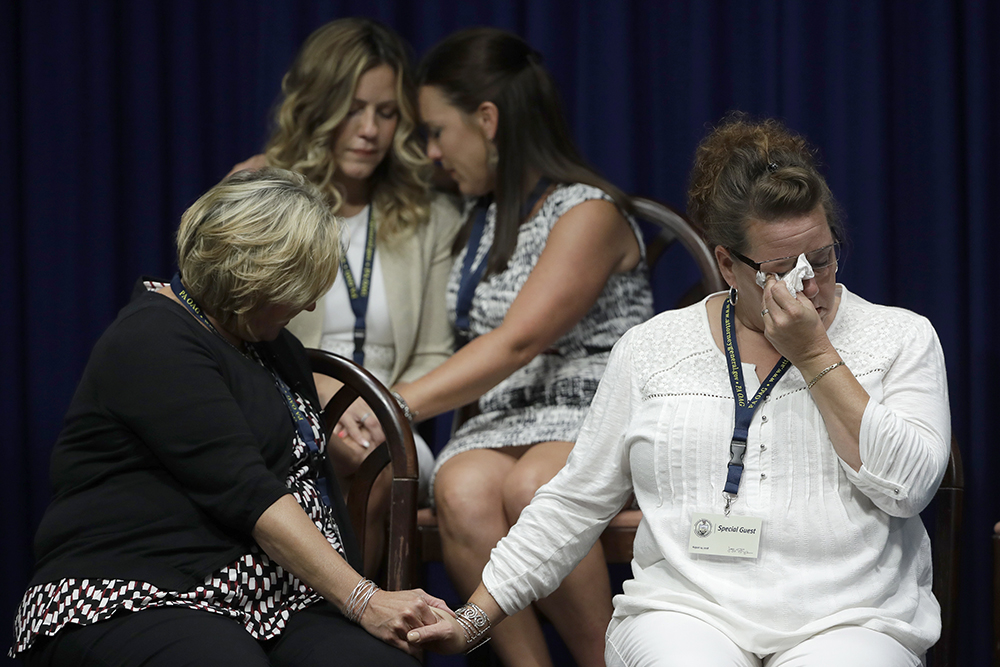
(RNS) — Over two decades, Catholic dioceses, eparchies and men’s religious communities spent more than $5 billion on allegations of sexual abuse of minors, according to a new report released Wednesday (Jan. 15) by the Center for Applied Research in the Apostolate at Georgetown University.
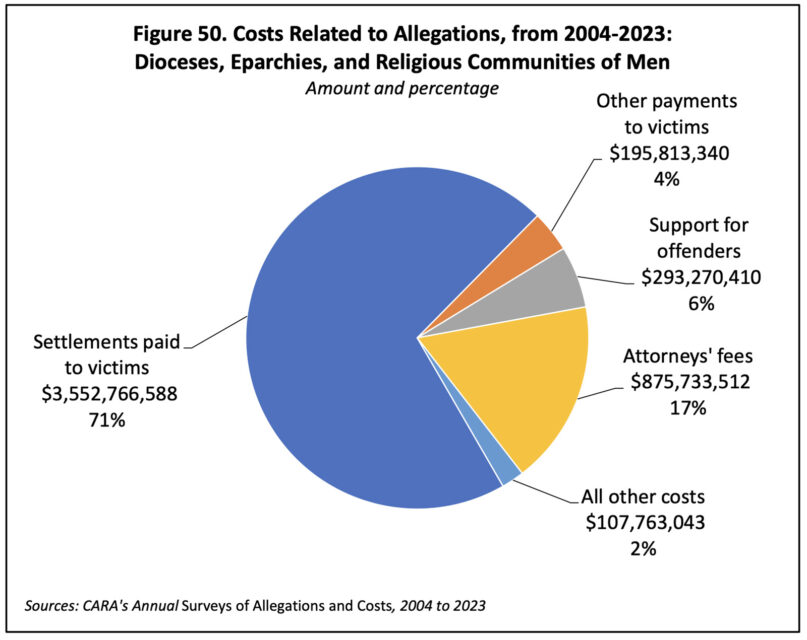
Between 2004 and 2023, three-fourths of the $5.025 billion reported was paid to abuse victims. Seventeen percent went to pay attorneys’ fees, 6% was in support for alleged abusers and 2% went toward other costs. On average, only 16% of the costs related to the allegations was borne by insurance companies.
The CARA report combined 20 annual surveys sent to dioceses and eparchies within the U.S. Conference of Catholic Bishops (which excludes some parts of the U.S., such as Puerto Rico, Guam and American Samoa), as well as U.S. religious communities belonging to the Conference of Major Superiors of Men. The report does note that some alleged perpetrators were assigned outside the U.S. The USCCB commissioned the survey in 2004.
Jonathon Wiggins, a lead researcher on the report, told RNS that the report represented the Catholic Church’s superlative commitment to transparency. The report “is unprecedented by any non-governmental organization and is the largest effort of its kind,” the report’s authors wrote in a statement.
Wiggins told RNS that this report may have some overlap in cases with the groundbreaking 2004 research study on the nature and scope of sexual abuse in the church, conducted by the John Jay College of Criminal Justice, but that it has a different methodology.
During the 20 years of the survey, the respondents reported 16,276 credible allegations of sexual abuse of minors by priests, deacons or religious brothers. Those allegations represent slightly less than two-thirds (65%) of total allegations that dioceses, eparchies and men’s religious communities reported receiving.
Though the surveys come from the 2000s, the majority of credible allegations were for abuse that began before 1980. Ninety-two percent of credible allegations were for abuse that began before 1989. In contrast, 542 credible allegations represented abuse that began after the year 2000. The report defines credible allegations as bearing the “semblance of truth” and having been sufficiently substantiated to forward the allegations to the Vatican’s Dicastery for the Doctrine of the Faith.
Of the credible allegations, 4 in 5 victims were male, and one-fifth were female. More than half were between the ages of 10 and 14. About a quarter (24%) of victims were between 15 and 17 years old and another 1 in 5 was age 9 or younger.
The response rate for dioceses and eparchies averaged 99%, while men’s religious communities had an average response rate of 72%.
In addition to tracking the money spent on allegations of abuse, the report totals the amount of money spent on abuse prevention, including for safe environment coordinators and victim assistance coordinator salaries, administrative expenses, training programs and background checks, totaling nearly $728 million.
The report tracks that the abuse prevention expenses have risen over time, with the amount spent from 2014 to 2023 representing an 80% increase compared with the expenses from 2004 to 2013.
 |
| “Costs Related to Allegations, from 2004-2023: Dioceses, Eparchies, and Religious Communities |
The financial costs of the abuse crisis have reshaped the Catholic Church in the United States. Marie T. Reilly, a professor at Pennsylvania State University Law School, has tracked 40 Catholic dioceses and religious organizations that have sought bankruptcy protection, and many dioceses have cited the expense of settling abuse claims as part of their decision to declare bankruptcy.
Those financial troubles have led dioceses throughout the country to sell diocesan property, including diocesan headquarters, seminaries, schools and churches. In the Diocese of Rockville Centre, New York, every parish had to pay amounts ranging from five figures to more than $1 million toward a bankruptcy settlement.
Of all the survey years, 2019 had the highest number of credible allegations reported, with 2,506 credible allegations reported that year. That year came after a flood of revelations about the extent of sexual abuse in the church.
Many state investigations were opened after an August 2018 Pennsylvania grand jury report found that there were more than 1,000 victims of child sexual abuse in that state and that Catholic bishops and other leaders had participated in a cover-up.
2018 was also the year that several dioceses found that the allegation that Cardinal Theodore McCarrick had sexually abused a minor was credible, leading to McCarrick’s removal from the clerical state in February 2019.
Over two decades, the survey’s questions changed in ways that may impact the total count of credible allegations. Before 2013, the survey did not include allegations of abuse by religious brothers, who are considered lay people in the Catholic Church.
Before 2016, all allegations were sorted into “credible” and “unsubstantiated/obviously false” categories. In 2016, a third category, “unable to be proven,” was introduced, which decreased the proportion of allegations deemed “credible.”
Based on the allegations deemed credible, the report estimates 4,490 alleged perpetrators, of whom 80% were diocesan priests, 15% were priests from religious orders, 4% were religious brothers and 1% were deacons.
In the years that the perpetrators were reported by dioceses, eparchies and men’s religious communities, 86% of the perpetrators were already dead, removed from ministry, laicized or missing. The other 14% were removed from ministry or retired from ministry during the survey year.
Thursday, January 16, 2025
1 Hostage Deal Conference, Jan 15 Einat Wilf 1

While 33 hostages will be released in the first stage, dozens—alive and dead—will remain in Gaza, prolonging their families’ suffering. The relatives of those killed by the Palestinian terrorists now going free will also be shattered. So, too, will the Israelis who still see soldiers dying in Gaza almost daily while Hamas rocket fire continues. What were all of Israel’s sacrifices for, they will ask. As with previous deals, this one will only encourage further terror and hostage-taking, they’ll warn, and set the stage for a future attack, like October 7.
 |
| By Michael Oren |
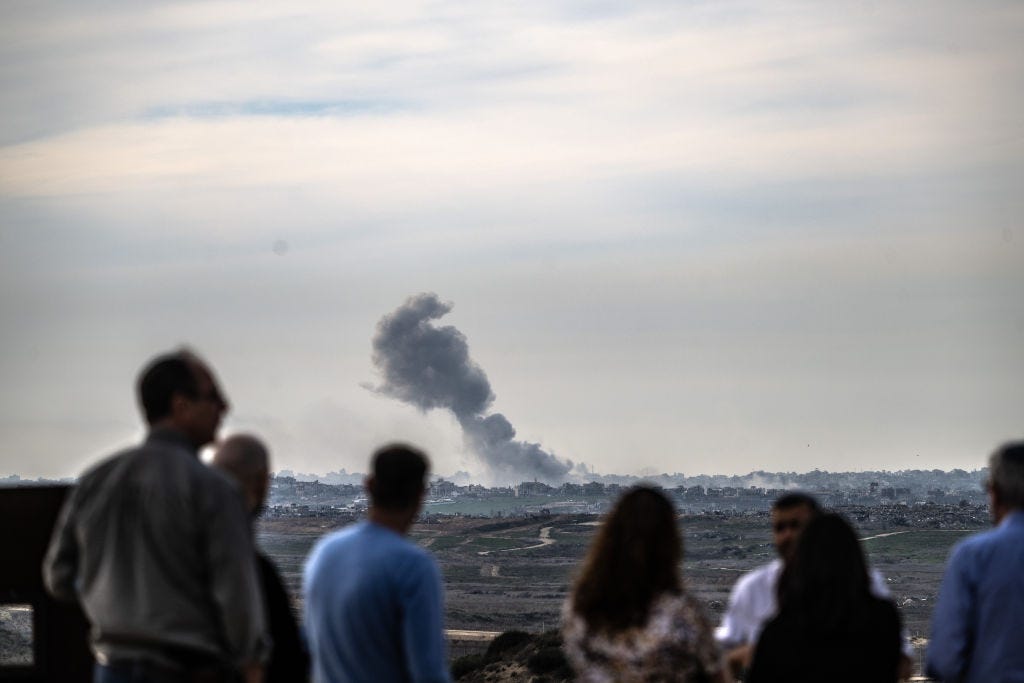
Israel is on the brink of striking a deal with Hamas. After more than a year of on-and-off negotiations, hours ago came the news that Hamas’s military leader, Mohammed Sinwar, had approved the agreement.
The deal is complicated and is structured in three phases over a 42-day period. In the first phase, which can begin as early as Sunday, Hamas will release 33 hostages—women, the aged and infirm, and children, among them the Bibas babies. The subsequent two phases will see the release of all 98 hostages, living and dead, and the withdrawal of Israeli forces from the entire Gaza Strip. The war will officially end. But the fulfillment of the second and third phase is contingent on the successful implementation of the first.
Should it succeed, the deal will be greeted cacophonously in Israel. Boundless joy will mix with anger and pain, relief with fear and searing disappointment.
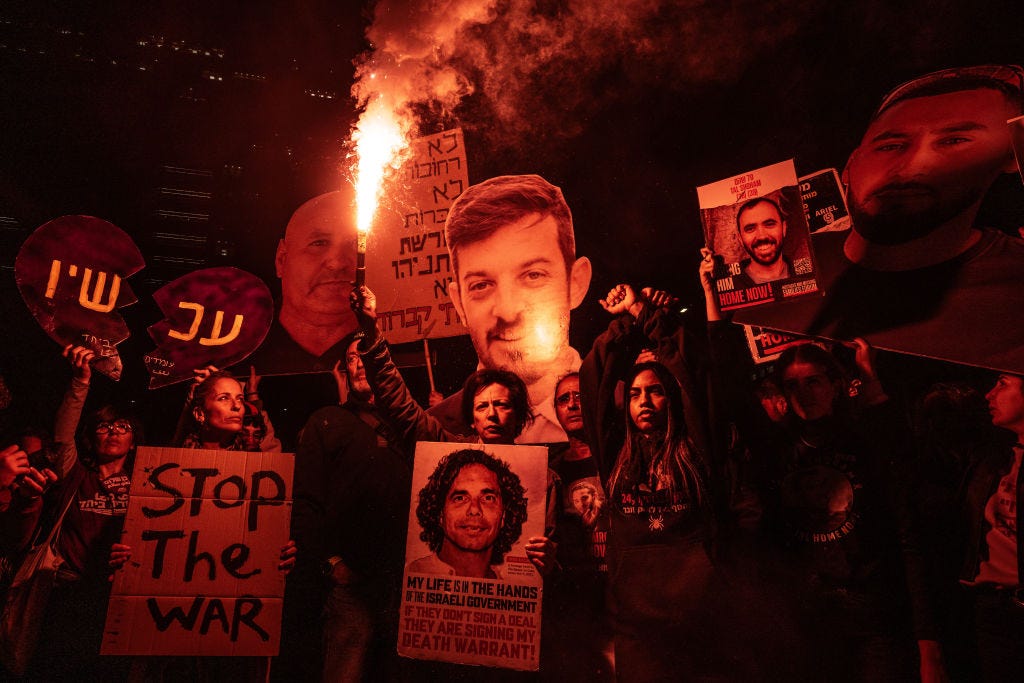
Rallies in favor and protests against the deal enveloped Tel Aviv and Jerusalem on Tuesday night. Broadly speaking, the Israeli left in Tel Aviv supports ending the war in Gaza in exchange for the release of hostages. The Israeli right welcomes the hostages’ return, but insists that Israel prioritize winning the war.
In Tel Aviv, crowds flooded the streets calling on the government to “seal the deal” and asking “how much blood must be spilled” before it does. In Jerusalem, demonstrators claimed the government had no mandate to “surrender” to Hamas. “A freed terrorist is tomorrow’s murderer,” right-wing opponents of the deal bellowed as they blocked traffic near the prime minister’s office.
Such discordance is inevitable.
From day one—October 7, 2023—Israel’s twin goals in Gaza were fundamentally irreconcilable. Israel could not, as its leaders pledged, simultaneously destroy Hamas and secure all of the hostages’ release. The terrorists who regarded the hostages as the key to their survival would hardly give them up for less than an Israeli commitment to end—and therefore lose—the war. Israelis, for their part, were torn between those who felt that they could not send their children to the army as long as hostages remained in captivity and those who held that, if Hamas wins, Israel will not have an army at all.
Still, Israel believed that by increasing military pressure on Hamas, it could compel the terrorists to free the hostages. The strategy appeared to work when, in November 2023, Hamas released 105 of its 251 hostages in exchange for a weeklong ceasefire and the freeing of 240 Palestinian prisoners from Israeli jails. Israel reasonably assumed that ratcheting up its operations in Gaza, especially in Hamas’s Rafah stronghold, would yield similar results.
But Hamas thought otherwise. Surprised by Israel’s determination to resume fighting after the ceasefire and convinced that mounting international condemnation of the war’s conduct would soon force the Israelis to surrender, the terrorist group dug in its heels. Israeli forces would enter Rafah and several refugee camps, kill senior Hamas leaders, and dispel the terrorists’ hope of the opening of a second front with Hezbollah in Lebanon—yet no new hostage deal ensued. Hamas still insisted on an unlimited ceasefire and a complete Israeli withdrawal from the strip. Instead of buckling to military pressure and releasing hostages, the terrorists shot them.
 |
The schisms within Israeli society meanwhile deepened. Tens of thousands took to the streets weekly not to protest Hamas’s inhumanity but their own government’s alleged intransigence. Prime Minister Netanyahu, they claimed, desperate to preserve his coalition with radical rightists opposed to any deal, blocked it by adding unreasonable preconditions. Netanyahu, they protested, doomed the hostages. Only the Biden administration, an often-fierce critic of Israeli policies in Gaza, placed the bulk of the blame on Hamas.
Other Israelis, mostly from the right, applauded the government’s refusal to accede to an agreement that rewarded terror and guaranteed Hamas’s victory. Many of Hamas’s leaders, they recalled, among them October 7 mastermind Yahya Sinwar, were released in previous hostage-for-prisoner exchanges. The terrorists freed in this deal, its opponents predict, will kill countless Israelis in the future.
Yet now, suddenly, a breakthrough deal is looming. Both Israel and Hamas have reportedly softened their positions and bridged formerly insuperable gaps.
What has changed? Although the White House deserves credit for persevering in the hostage-release talks, the deal probably owes much to the soon incoming president’s threats to visit “all hell” on Hamas and his ability to press Netanyahu.
President Biden could say “don’t,” and everybody in the Middle East—Iranians, Arabs, and Israelis alike—did. Not so with Donald Trump. One meeting with his special Middle East envoy Steve Witkoff reportedly persuaded Bibi to accept conditions he had long rejected.
Still, if and when the ceasefire breaks down, the Israeli government is counting on the Trump administration’s unbridled support in completing the destruction of Hamas. Hamas is banking on international action to prevent the war from reigniting. Most of the world will applaud.
The response of the Israeli public will, by contrast, be fragmented. While the vast majority will celebrate the homecoming, their joy will be tempered by the unspeakable tortures the hostages suffered and their long, if not endless, road to recovery.
While 33 hostages will be released in the first stage, dozens—alive and dead—will remain in Gaza, prolonging their families’ suffering. The relatives of those killed by the Palestinian terrorists now going free will also be shattered. So, too, will the Israelis who still see soldiers dying in Gaza almost daily while Hamas rocket fire continues. What were all of Israel’s sacrifices for, they will ask. As with previous deals, this one will only encourage further terror and hostage-taking, they’ll warn, and set the stage for a future attack, like October 7.
Perhaps this outcome was unavoidable from the beginning. Perhaps the deal is the only way of reconciling Israel’s mutually exclusive goals of annihilating Hamas and repatriating the hostages. Perhaps, despite Israel’s subsequent military triumph, this is the price for the failures of October 7.
 |
Michael Oren, formerly Israel’s ambassador to the United States, Knesset member, and deputy minister for diplomacy in the prime minister’s office, is the founder of the Israel Advocacy Group and the author of the Substack Clarity.
Wednesday, January 15, 2025
Trump forced Netanyahu to do the deal in order for Trump to brag that it happened because of his threat that "all Hell would break loose" if a deal was not done by January 20.
I am posting Rabbi Dov's essay after the ceasefire "deal" has been announced. As a parent and a human, of course, I am conflicted. Having said that, Dov's essay has very much merit in my eyes.PM
Catastrophe
To save 33 tragically kidnaped hostages (and they won't all be alive), Israel will be consigning thousands of Jews to their future deaths. This is not "maybe." This is guaranteed. It happens every time.
- 2 minutes

They are talking about inking a deal between Netanyahu and Hamas. As I write, the deal is not yet done. In the Talmud, Masekhet (Tractate) Brakhot, King Chizkiyah (Hezekiah) actually lectures the Prophet Yishaya (Isaiah), who had been sent to him by G-d to tell him that his life soon would be over.
The King, upon learning the sin for which he was being punished, declared his repentance. The Prophet said it was too late; the decree had been issued. The King responded with a fundamental Jewish concept: even when a Jew has a murderer’s knife pressed on his throat, it still is not too late to pray. Accordingly, until such a Netanyahu-Hamas deal is done, it is not too late to pray. Even if — G-d forbid — such a deal is inked, it will not be too late to pray.
Or to act.
The
media reports say Israel will be agreeing to a three-phase deal. Phase
One would include (i) an immediate six-week ceasefire, (ii) the Arab
release of 33 (but not all) of their kidnaped hostages, some alive and
some dead, and (iii) Israel releasing hundreds of convicted Arab
murderers. But, in Netanyahu’s show of great "fortitude", he will not
release the corpse of Yahya Sinwar under any circumstances. Only living
Arab murderers with documented blood on their hands, just waiting to get
back in the game.
Much of Israel will be celebrating wildly. Dancing in the streets. Champagne, though not from Milchin, will be flowing. Cigars, though not from Milchin, will be puffing. Channels 11, 12, and 13 will be leading the celebrations. Front pages will cheer at least from Haaretz to Maariv to Yediot and maybe Makor Rishon.
Those who would cheer are fools.
They cheered after Sharon’s 2005 Disengagement, and they lived to weep while burying their children who died for the moment of joy 18 years earlier.
It is a HORRIBLE, TRAGIC deal. One Hundred of Israel’s leading rabbinic authorities have publicly declared what almost every Torah scholar who supports IDF service knows: The Halakha (Judaic law) forbids endangering the nation even for the precious mitzvah of redeeming the captives. Tractate Gittin sets forth laws and limits on Pidyon Shvuyim (Redeeming Captives). One does not — may not — pay just any price. The Shulchan Arukh (Code of Jewish Law), at 252:4, declares: “Captives are not to be ransomed at an unreasonable cost, for the safety of society.” Read the letter of the 100 Torah Sages here and see the [Hebrew] letter of organizations such as the Heroism Forum, Hope Forum, Reservists Forum and more.
The
mainstream left-wing media in Israel, who brainwash half the
population, are thrilled with the agreement. Much of the Likud
government coalition love it, too, because Likud Members of Knesset
(MKs) follow Netanyahu like lemmings. He dispenses their crumbs,
committee assignments, ministries — even who gets to be a consul or
ambassador in a country although he barely speaks their language, who
gets a free trip to America at government expense, who gets to be on the
next election list in a safe spot so as to build up a millionaire’s
lifetime pension. So they will vote like lemmings as others did for
Sharon.
The Haredi parties in the government coalition will support the deal not because the halakha demands Pidyon Shvuyim “at any cost” — it does not and they know it — but because, as the IDF soldiers come back from Gaza, it will reduce pressure on Haredim to shoulder their proper responsibility in the defense of the nation, beyond their incredibly holy and blessedly critical Torah learning, as do Yeshivat Hesder boys. Israel cannot survive without their Torah learning, their yeshivot and kollelim. Absolutely. But they don't want even the haredi young men who are not learning, of which there are many, to join the army. But the return of the soldiers will relieve their shoulders.
Meanwhile,
Gideon Sa'ar's four votes will support it, too, so Sa'ar can remain
Foreign Minister and take a shot at Bibi’s seat some day.
That leaves the two on the right, Smotrich's Religious Zionist Party (RZP) and Ben-Gvir's Otzmah. One does not bring down a right-wing-oriented Israeli government over a budget cut. However, one does do so over a perfidy to the nation and to future generations. Smotrich and Ben-Gvir surely will denounce the deal and will have their 14 MKs vote against it. However, it is not clear whether they will quit the Coalition. If they do, great. But what will that achieve? Will it risk losing momentum on further building in Judea and Samaria? Does that matter enough?
If
Smotrich and Ben-Gvir remain in the Coalition but simply vote against
this deal, the deal would pass easily anyway. The leftist opposition all
will vote for it -- especially the two Arab parties. Lapid, who
promised a safety net for the vote, may even offer to hand over some
natural gas properties to Hamas. So, if Netanyahu proposes it, it will
pass smoothly with more than 100 votes of the 120. Think back to the
Gaza Disengagement. To all the retreats.
The
deal would free 300 or more Hamas murderers right away, some held in
prison for more than a decade. Some sentenced to 20 and more life
sentences without parole. (What a joke!) So, to save 33 tragically
kidnaped hostages (and they won't all be alive), Israel will be
consigning thousands of Jews to their future deaths. This is not
"maybe." This is guaranteed. It happens every time.
To
save one precious Jewish life who previously was taken hostage by Arabs
(not his fault at all, but his father and the willing media's fault,
and I feel bad for him that his name always is mentioned in this regard,
so I won’t), Israel ultimately released a lop-sided thousand of these
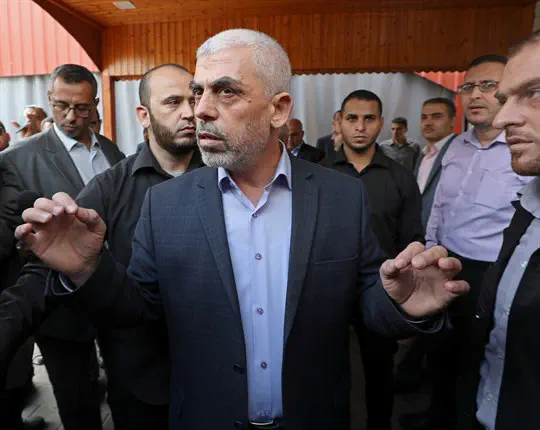
same types of Arab cutthroats. One was a guy named Yahya Sinwar. A whole
bunch of Arab psychopaths like him. That led to Intifada in Judea and
Samaria, to building of Hamas, to several deadly wars, and now to the
over 2,000 who have died since October 7, 2023 (1,200 that day and over
800 Israeli soldiers since).
It is a terrible
deal. It leaves Hamas alive to govern Gaza and to fight again in five
years, with all their old pals back in the fray. Hamas will dance in the
streets, a scene we see after every “ceasefire” that they regard as an
Israeli “capitulation and surrender.” It eliminates the restored specter
of Israeli invincibility and deterrence. It shows that Israel is afraid
to win. It emboldens other Arabs. So the question is "Why"? Netanyahu
always declared he would not leave without "Nitzachon Mushlam" ("Complete Victory"). My best guess:
Biden is irrelevant. He is out in less than a week. He cannot do anything. An embargo? Trump can overrule it his first day. A UN vote for a "Two State"? No UN vote matters, just as Obama's and Kerry's Security Council Resolution 2334 of December 2016 never ended up mattering, even though it was the Security Council, not just the General Assembly, declaring that Israel is barred from the eastern part of Jerusalem, even the Kotel. It meant nothing. Soon after, America was moving its embassy into Jerusalem and declaring that Israeli communities anywhere in Judea and Samaria are totally legal as long as Israel’s Supreme Court does not say otherwise.
So Biden and Blinken do not matter. Therefore, again, one asks: “Why the Netanyahu perfidy this time?”
I have only one guess that I can process. Nothing else is remotely conceivable to me. My guess. It is only a hunch:
Trump
forced Netanyahu to do the deal in order for Trump to brag that it
happened because of his threat that "all Hell would break loose" if a
deal was not done by January 20. (Biden will brag, too, but that was
like Jimmy Carter, of accursed memory, y'rakvu atzmotav, bragging that he freed the Iran hostages as Reagan was being sworn in.)
For
Netanyahu to agree to such a terrible thing -- and he knows how
disastrous this is -- I can only guess that, in return, Trump promised
Netanyahu that, if Israel does the deal to make Trump look good, then
Trump will assist Netanyahu in wiping out Iran's nuclear sites and maybe
even in assassinating Khameini and maybe even in taking down the whole
Iranian regime. (Trump would not send American troops because he is
committed to avoiding all future ruinous wars that other presidents
before him have entered. But he could send bunker-busting bombs and
aerial support and all kinds of stuff, and twist NATO arms including
Turkey, as when he assassinated Qassen Soleimani and Abu Bakr
al-Baghdadi.)
Thus, maybe Netanyahu
did an analysis: “If I let the 300 bestial Arab murderers out, that will
lead to, say, the murder of 3,000-5,000 Jews over the next 10 years. On
the other hand, if Iran's nuclear system is knocked out and Khameini is
assassinated and the Khameini regime taken down, that will save more
than multiples of 5,000 Jews who could get killed by Iranian nukes. It
also could strangle all the Iranian proxies (Hamas, Hezbollah, Houthis,
and Abbas in the AEJS, the Arab Entity in Judea and Samaria,)
That's
my best guess. It offers the only rationale I can grasp. Netanyahu’s
heart is in the right place, but Bibi likes to over-think himself into a
cleverness that means well and that makes him proud that he is the
smartest guy in the neighborhood — but is not. Like letting Qatar send
Hamas a billion shekels a year so that Gaza and the AEJS each would be
led by a competing murderous government that never would be able to
unite as a pretextual “Palestine.” Or clever ceasefires that always kept
the Arabs divided, with Hamas alive to threaten Abu Mazen (Mahmoud
Abbas). Clever. But it didn't work, did it?
A
further wistful thought: And maybe Trump would agree to recognize
Israeli annexation of Judea and Samaria? That would help make some sense
of all this, but I don't think so. Ambassador Mike Huckabee would push
for it. Secretary of State Marco Rubio would back it. So would Defense
Secretary Pete Hegseth. Vivek Ramaswamy supports it, too. Musk could be
persuaded. But I don’t think that’s in this deal’s background. Nor would
even that justify this catastrophic deal.
My
prayer is that Hamas somehow insanely will turn down and sabotage the
proposed deal at the last moment. A similar hopeless moment came when
Clinton forced an all-too-willing treacherous Ehud Barak to give Arafat
97% of the land he demanded for a country to be called "Palestine,"
including the eastern part of Jerusalem and the Temple Mount, plus land
within interior Israel in the primarily Arab-populated Galilee Triangle
comprising territory equal in size to the 3% of Judea and Samaria Barak
could not cede. Clinton and Barak offered Arafat -- on a silver platter
-- a nightmare of a deal.
And, by
G-d's miracle, He hardened the heart of Pharaoh, and Arafat turned down
the deal. That made no sense then and is one of the greatest Divine
Miracles I have seen in my lifetime, that Arafat turned down everything
he asked for.
That's my hope. But we do not rely on miracles. And lightning does sometimes strike twice. Especially when Israeli prime ministers get the insane idea that they will be advancing Israeli security by giving Arabs territory that belongs to Israel and that Jewish, Druze, and even some Arab boys and girls died for on Israel’s behalf.
Subscribe to Rav Fischer’s YouTube channel here at bit.ly/3REFTbk and follow him on X (Twitter) at @DovFischerRabbi to find his latest classes, interviews, speeches, and observations.
To be attend any of his three weekly Zoom classes — Sundays on the past week’s events impacting Israel and world Jewry, and Tuesdays and Thursdays on the Tanakh (Bible) and Jewish law — send a request to rabbi@yioc.org