EVERY SIGNATURE MATTERS - THIS BILL MUST PASS!

EVERY SIGNATURE MATTERS - THIS BILL MUST PASS!
CLICK - GOAL - 100,000 NEW SIGNATURES! 75,000 SIGNATURES HAVE ALREADY BEEN SUBMITTED TO GOVERNOR CUOMO!

EFF Urges Court to Block Dragnet Subpoenas Targeting Online Commenters

EFF Urges Court to Block Dragnet Subpoenas Targeting Online Commenters
CLICK! For the full motion to quash: http://www.eff.org/files/filenode/hersh_v_cohen/UOJ-motiontoquashmemo.pdf

Wednesday, April 16, 2025

Hang In There Hershel Schachter - Don't Let Anything Intefere With Your Twisted & Distorted View Of Halacha! If You Had Any Shame & Guts You'd Quit~

SCHACHTER'S RESPONSE - We created another club to counter the other club ---- SHAMEFUL SHGATZIM!


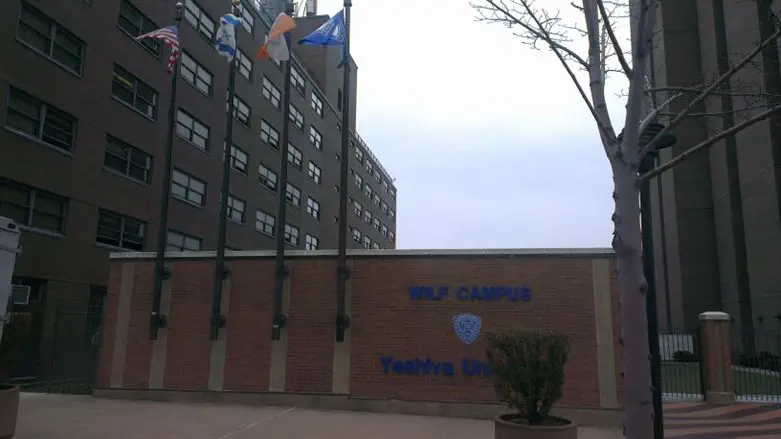
Yeshiva University’s inexcusable surrender


The prohibition against the homosexual act is clearly stated in the Torah. While that does not mandate ostracizing anyone, allowing an LGBT club is tantamount to approval of a way of life that is forbidden.
Yeshiva University
Yeshiva University

On Thursday, Yeshiva University (YU) caved to leftist lawfare and will now permit an LGBT club to operate on campus. I am not surprised – nor should anyone else be who has followed developments at YU in recent years.

After all:

• From 2008-2021, YU employed a transgender professor.

• It currently employs a Bible(!) professor who has publicly advocated that we ignore Judaism’s stance on homosexual “marriage.”

• In 2022, its social work graduate school held a pro-abortion event.

• That same year, it featured a lecture by a female Reform "rabbi."

YU safe zone
YU safe zone

In short, either YU lacks principles or, to borrow a line from President Theodore Roosevelt, it has the backbone of a chocolate eclair. Most likely, a combination of both.

YU’s surrender to students who demanded an LGBT club on campus is particularly inexcusable in the wake of Donald Trump’s victory in November and the concomitant cultural shift to the right. For the first time in decades, the LGBT movement is on the defensive. The federal government officially recognizes only two genders now and is pulling funding from any university that allows cross-dressing male students to play in female sports.

Even before Trump’s victory, the LGBT movement had suffered a setback with support for homosexual “marriage” in 2024 declining for the first time since 2015, according to mainstream news reports. Had YU continued battling the radical LGBT activists demanding a club, it very likely would have won in the Supreme Court considering the court’s 6-3 conservative majority.

Instead of fighting, though – instead of making a kiddush Hashem (sanctification of G-d's Name) before Christian and conservative America – it decided to make a chillul Hashem (Desecration of His Name). It decided to please the forces attacking Biblical morality rather than those defending it. Just as the LGBT movement was beginning to suffer losses on the cultural battlefield, YU decided to throw it a lifeline and give it a stunning victory and fresh impetus to fight further.

I don’t mean to give the impression that YU is entirely spineless. It is not. When it comes to the “far right,” it can be intransigent. For years now, it has refused to allow me to sell books by Rabbi Meir Kahane, z"l, even religious ones, at its annual Seforim (Book) Sale. You would think that October 7 might have softened its stance. But you would be wrong. YU is so angry that I protested its decision to ban Rabbi Kahane’s books from the Seforim Sale in 2016 (the same year it sold books by Mordechai Kaplan, the founder of Reconstructionist Judaism) that it won’t permit me to sell any books at the sale anymore.

If YU is going to ban books from the sale, you would think it would at least explain and permit an appeal of its decision. And surely, you would think, its decision-making process would be transparent since we all know that transparency is the hallmark of liberal institutions. But you would be wrong again. YU bans books without explanation, and the names of the people doing the banning are unknown.

I have appealed YU’s decision in the most respectful of tones many times. I have gotten nowhere. And when I distributed flyers on campus last year publicizing the university’s decision, YU reacted by banning me from campus.

I once liked Yeshiva University. I was frustrated by some of the close-mindedness I had experienced growing up in black-hat (haredi, non- Zionist) schools and found YU to be a breath of fresh air when I arrived on campus in 2002. But it turns out that YU is just as close-minded as the black-hat world. The only difference is that the black-hat world is intolerant of ideas it considers spiritually dangerous. YU is intolerant of ideas that violate the post-modern liberal ethos.

So Kahane? Absolutely forbidden. The LGBT agenda? Come right on in.


https://www.israelnationalnews.com/news/405796


YU’s LGBTQ shame, thus Modern Orthodoxy’s shame

This is a disgrace and it is a shame that we, the Nation who received the Torah at Sinai, will have to look to the Southern Baptists, the Vatican, and Muslim clerics for integrity on this matter. Opinion.

https://coalitionforjewishvalues.org/2025/04/rabbis-reject-an-lgbtq-club-at-a-torah-institution/

You Hire Clowns - Expect A Circus!


It’s a Mistake to Think the Biggest Problem With Iran Is (Just) Nuclear Weapons


In a black and white photo, Iranian flags surround a cooling stack.

Listen to this article · 5:26 min Learn more

President Trump said on Monday that he will “solve the Iran problem” and that “it’s almost an easy one.”

Almost.

What is “the Iran problem”? Trump seems to think it’s Iran’s efforts to obtain nuclear weapons, which, he has said, “they can’t have.” Iran has enriched uranium to 60 percent purity — close to weapons grade — and “might be able to enrich enough uranium for five fission weapons within about one week and enough for eight weapons in less than two weeks,” according to the Wisconsin Project on Nuclear Arms Control. It would take additional time to make the parts needed to turn this fissile material into a bomb, but this could be done in small, secret facilities.

Steve Witkoff, Trump’s emissary, said last week that the administration’s red line was “weaponization” of Iran’s nuclear capabilities. Incredibly, that conceded more to Tehran than Barack Obama’s 2015 nuclear deal — the one Trump correctly canceled in his first term for being too weak. After meeting with Iran’s foreign minister over the weekend, Witkoff appeared to walk back his original suggestion, posting on X on Tuesday that Iran must “eliminate its nuclear enrichment and weaponization program.”

Tehran has been playing Western diplomats for fools for decades — including through Obama’s much-ballyhooed Iran deal. That deal’s nuclear restrictions, had they remained in place, would soon be expiring; mostly, what the deal accomplished was to expand Iran’s regional power by lifting economic sanctions. Iran also has a richly documented record of cheating on its agreements, a fact that was exposed by Israel when it stole the regime’s nuclear secrets from a warehouse in Iran in 2018.

If Witkoff really thinks there’s any kind of inspection or verification process that will keep the regime in check, he’s naïve. But the larger mistake is to think that the Iran problem is fundamentally about nuclear weapons. France and Britain also have nukes, but not many people lie awake at night worried about them. The Iranian regime is different not because it might acquire nuclear weapons. It’s different because its ideological character, geopolitical ambitions and raging anti-Americanism and antisemitism, as well as its long record of supporting terrorism, might dispose the regime to brandish or even use them.

That’s what must change if the nuclear question is going to be fully resolved. Which brings us to something else Trump has said of Iran: “I want them to be a rich, great nation.” Good. The question is how.

There are two paths here. One is a reprise of some version of the sanctions-for-nukes deal that lay at the core of the 2015 agreement and that Iran says it wants today. But that deal is destined to fail because it does nothing to change the character of the regime.

The second path is more ambitious but also, potentially, more promising. It’s what I previously called normalization for normalization.

Here is what normalization would require of the United States: The resumption of full diplomatic ties between Tehran and Washington, including the reopening of embassies that have been shuttered for decades. The end to all U.S. economic sanctions, including secondary sanctions imposed on foreign companies for doing business with Iran. Direct, bilateral trade and investment. Thousands of student visas for Iranians wishing to study in the United States. The offer of U.S. arms sales to Iran, at least of a conventional kind.

And here is what normalization would require of the Iranian regime: It would have to start behaving like a normal country.

A normal country doesn’t finance and arm terrorist groups that start regional wars and disrupt global commerce, like Hezbollah, Hamas and the Houthis. A normal country with the world’s third-largest proven oil reserves but an otherwise collapsing economy doesn’t need to spend billions of dollars to enrich uranium or produce plutonium. A normal country doesn’t call for the elimination of other countries, even hostile ones. A normal country doesn’t take foreign nationals hostage as a routine part of its diplomacy. A normal country doesn’t seek to assassinate former U.S. government officials or dissident exiles. A normal country doesn’t hang gay people. A normal country doesn’t gang rape women in prison to enforce a so-called modesty code.

If Iran wants to solve its pressing economic and strategic problems — a cratering currency, energy shortages, widespread popular opposition and the decimation of its regional allies — all it has to do is change its own behavior.

If Trump wants his own Reaganesque “Tear down this wall” moment, proposing normal for normal in an Oval Office address would be a good way to do it. Iran’s leaders would almost surely brusquely reject it. But Iran’s restive people would be inspired by it, and it would clarify the real nature of the crisis with the regime — a crisis that’s chiefly about values, not weapons.

And to give this rhetorical diplomacy some teeth? Trump can also lease modern aerial tankers and old bombers to Israel, which the Jewish state would need to carry out a comprehensive attack on Iran’s nuclear facilities. As negotiators like Trump and Witkoff should know, an olive branch is easier to accept when it is offered from the tip of a sword.

https://www.nytimes.com/2025/04/15/opinion/iran-trump-nuclear-deal.html

Tuesday, April 15, 2025

This Mechutzef (Wise Guy) From Yeshiva Torah Vodaath Looking To Establish His Charedi Credentials in "Yiddish" Of Course * Slamming The Views of His Grandfather & Father - Rav Joseph Ber Soloveitchik & Rav Aaron Lichtenstein Zichronam Levracha

Contrast His Older Brother's Views Consistent With Torah Values & Mesorah From The Avos. Rav Moshe Lichtenstein Served In The IDF Proudly, In Gaza & Lebanon!


Mosheh Lichtenstein (Hebrew: משה ליכטנשטיין; born July 7, 1961) is a co-rosh yeshiva of Yeshivat Har Etzion located in Alon Shvut.[1] He is the eldest son of Rabbi Aharon Lichtenstein and Dr. Tovah Soloveitchik.

Biography

Mosheh Lichtenstein came on Aliyah with his family in 1971 from New York, when his father Rav Aharon Lichtenstein was offered the position of Rosh Yeshiva at Yeshivat Har Etzion.[1] He studied at the Netiv Meir High School [he] in Jerusalem, and thereafter, spent a year studying with his grandfather, Rabbi Joseph B. Soloveitchik, in America from 1979 to 1980.[2] From 1980 to 1985, he did hesder at Yeshivat Har Etzion, serving in the Armored Corps.[2] He received Semicha from the Rabbanut and a degree in English Literature from Hebrew University.[1] Lichtenstein was hired as a Ram at Yeshivat Har Etzion in 1992.[2] He went on sabbatical during the 1997 and 1998 academic years and served as Rosh Kollel of the Torat Tzion Kollel in Cleveland.[1] He also taught at Bruria, an Advanced Program for Women in Jerusalem from 1992 to 1997.[2] At present, he is responsible for the Yeshivat Har Etzion's Kollel Gavoha, teaches Shiur Hei at Yeshivat Har Etzion, teaches an Iyun Shiur on Zevachim and gives a weekly Shiur for Shana Bet. He also teaches at the Beit Midrash for Women Migdal Oz. On September 25, 2008 (Tishrei 5769), Rav Yehuda Amital officially announced his retirement, to take effect on the last day of the Jewish month of Tishrei, in the year 5769 (October 28, 2008). He also announced that Lichtenstein would assume the position as the fourth Rosh Yeshiva on that same day. Lichtenstein was inaugurated as Rosh Yeshiva alongside Rabbis Aharon Lichtenstein, Yaakov Medan and Baruch Gigi.[1]

The Jewish World Is Impatiently Waiting To See Who Will Out-Krazzy This Krazzy! Don't Be Shy.....GO..... I Smell An Asifa....


Haredi Rabbi calls to divest from email


A Hasidic community announced that it will stop sending updates via email to its followers as part of its struggle against technology.


The Slonim Rebbe
The Slonim Rebbe

The Slonim Hasidic community announced on the eve of Passover the cessation of its weekly email service that had operated for about a decade.

The move was made under the direct instruction of the Rebbe and as part of a broader struggle against the dangers of technology.

The last email sent to hundreds of followers on the eve of the holiday contained the following message: "At the request of several individuals, from the Shabbat before the weekly Torah portion 'Vayigash' of 5774, and weeklyever since, we have provided pdates every Shabbat about good news, community announcements, the 'Chayenu' organization, and charity funds; we did not hold back from emphasizing the importance of donations to the Land of Israel."

"We have received guidance from our esteemed Rebbe, and we did not refrain from executing his holy words immediately. From now on, this weekly announcement will no longer be sent," the last message stated. "As we received reward for doing it, we will be rewarded for stopping, and we will lack for nothing."

This is an unusual step even within the Haredi framework, as the email service is seen as a 'clean' communication channel that does not require internet browsing.

In many Haredi communities, dozens of public computer points provide access to email only, and it serves as a central communication tool for transmitting community information, happy events, and announcements..

https://www.israelnationalnews.com/news/406792

Wednesday, April 09, 2025

CONCERNING THE JEWS...What is the secret of his immortality?" ...Chag Kasher V'Sameach...


Mark Twain

CONCERNING THE
JEWS...


The Essay - 1898


"If the statistics are right, the Jews constitute but one percent of
the human race. It suggests a nebulous dim puff of star dust lost
in the blaze of the Milky Way. Properly the Jew ought hardly to
be heard of, but he is heard of, has always been heard of. He is
as prominent on the planet as any other people, and his
commercial importance is extravagantly out of proportion to
the smallness of his bulk. His contributions to the world's list of
great names in literature, science, art, music, finance, medicine,
and abstruse learning are also away out of proportion to the
weakness of his numbers. He has made a marvelous fight in the
world, in all the ages; and has done it with his hands tied behind
him. He could be vain of himself, and be excused for it. The
Egyptian, the Babylonian, and the Persian rose, filled the planet
with sound and splendor, then faded to dream-stuff and passed
away; the Greek and the Roman followed, and made a vast
noise, and they are gone; other peoples have sprung up and held
their torch high for a time, but it burned out, and they sit in
twilight now, or have vanished. The Jew saw them all, beat them
all, and is now what he always was, exhibiting no decadence, no
infirmities of age, no weakening of his parts, no slowing of his
energies, no dulling of his alert and aggressive mind. All things
are mortal but the Jew; all other forces pass, but he remains.
What is the secret of his immortality?"


Mark Twain

https://staff-assets.ncsy.org/mark-twain-on-jews.pdf


The closing paragraphs are famous, but few have read Mark Twain's complete article. It's long but fascinating. 

 Print and read.

Harper's Magazine, March, 1898

https://aish.com/48931627/

Tuesday, April 08, 2025

The complaint alleges Rabbi Ephraim Shapiro, who is a former dormitory counselor at the school, groomed, raped and sexually abused the victim over years.


Rabbi - Congregation Agudas Achim, Baltimore, MD
Rabbi - New Rochelle, NY
Rabbi - Tifereth Israel Anshe Sphard Congregation, Baltimore, MD
Former Principal - Talmudical Academy (TA) - Baltimore, MD
 
Accused of molesting several boys for over a fifty year period.  Rabbi Shapiro was born in New York on July 22, 1916, and died April 7, 1989, in Baltimore, MD. There is at least  one alleged victim of Rabbi Ephraim Shapiro who committed suicide. It is unknown at this time how many more there are.
 
Rabbi Ephraim Shapiro was a graduate of the Rabbi Jacob Joseph School and Yeshiva University, New York, NY. He moved to Baltimore in 1941 to serve as the spiritual leader of Congregation Agudas Achim. In 1955 moved to New Rochelle, NY and then returned to Baltimore in 1957 to serve as rabbi at Tifereth Israel Anshe Sphard Congregation and also the principal of the Talmudical Academy until retiring in 1982.  While working at the Talmudical Academy, Rabbi Shapiro worked as a guidance counselor and dorm counselor.  Rabbi Ephraim Shapiro died in 1989 of amyotrophic lateral sclerosis also known as Lou Gehrig's Disease. 

Rabbi Ephraim Shapiro

Maryland Jewish boarding school sued over sexual abuse claims by former student from 1970s


*All The Local Baltimore Rabbis Knew * Rabbi Jacob Ruderman, Rabbi Herman Neuberger, Rabbi Emmanuel Polliakoff, Rabbi Jacob Weinberg, and Rabbi Ephraim Shapiro entering the Bet Hamidrash, 1980.
 
Rabbi Ephraim Shapiro officiating at the wedding of Rabbi Simcha Shafran is marrying Pauline Kahn on March 13, 1949 at Agudas Achim at 4239 Park Heights Avenue, Baltimore, MD.


A former student and resident at The Talmudical Academy, a Jewish boarding school in Baltimore County, filed a lawsuit against the school over claims of sexual abuse in the 1970s.


The complaint alleges Rabbi Ephraim Shapiro, who is a former dormitory counselor at the school, groomed, raped and sexually abused the victim over years.

"Rabbi Shapiro had unfettered access to our client and other children due to his role as a dormitory counselor at the Academy," the alleged victim's attorneys said. "Over several decades, there has been extensive news coverage of Rabbi Shapiro's sexual abuse of minors while employed at the Academy.  As a result, our client has endured years of suffering and trauma."

The lawsuit comes under the Maryland Child Victims Act, which was established in 2023 and eliminates the statute of limitations for child sexual abuse cases.

According to the attorneys, this is the first known civil lawsuit against The Talmudical Academy.

"By the time our client was ready to come forward as an adult, he was well beyond the statute of limitations," his attorneys said. "The Child Victims Act enabled our client to seek recourse."  

Lawsuit against The Talmudical Academy

The alleged victim was a student and lived at The Talmudical Academy, a Jewish Orthodox boarding school in Pikesville, from 1971 until 1974. He claims the abuse happened when he was 14 to 17 years old.

According to the lawsuit, Rabbi Shapiro was rehired by the Academy in 1972 despite allegations that he was sexually abusive to minor students during his first stint at the school in the 1960s.

The lawsuit claims Shapiro, who had direct oversight of minor students and unfettered access to them, groomed and manipulated the students until he gained their trust, which ultimately led to years of sexual abuse.

All of the sexual abuse -- which included molesting and forced kissing -- happened at The Talmudical Academy, the lawsuit claims.

The unnamed survivor, who now lives in Florida, also accused the school of negligence, citing that leaders allowed students to go off campus and hitchhike to get to stores in the area. 

The lawsuit alleges the survivor left campus, which staff members knew about, to go to a kosher grocery store nearby. While attempting to hitchhike, which was the recommended mode of transportation, a driver offered to drive him. Before taking the survivor to the store, the driver allegedly raped and abused the survivor. 

The lawsuit alleges that the school was negligent and did not adequately protect the students while they were in the care of the school. 

According to the lawsuit, other sexual abuse victims were chronicled in a 2007 article in the Baltimore Jewish Times.

The Talmudical Academy told WJZ in a statement that it is aware of the complaint.  

"The employee named in the suit is no longer living and has not been affiliated with the school for many decades," said Executive Vice President Rabbi Yaacov Cohen. "While we cannot comment on the details of the case due to ongoing legal proceedings, we want to emphasize that this allegation does not involve any current faculty, staff, or students. The safety and well-being of our students is always, and continues to be, our highest priority. As always, we will continue to focus on providing a safe learning environment, at all times, for each and every one of our students."

What is the Child Victims Act?

In 2023, the Child Victims Act, which removed the statute of limitations and allowed victims to receive up to $890,000 per occurrence of abuse, was made a law.

Since then, 4,500 victims have filed claims, potentially putting the state on the hook for billions of dollars.

Democratic Delegate CT Wilson, a victim of childhood sexual abuse, introduced amendments to House Bill 1378, which would lower the payout cap for each claimant to $400,000. 

It would also require an alternative dispute resolution process to promise transparency in these payouts.

"I wanted to make sure that whatever we do today, we don't so irreparably damage our state, that we must go to bankruptcy," Wilson said. "Because while the victims do need an opportunity to speak and they do need to come up in financial support, billions and billions of dollars is not what we can afford to do."  

Lawsuits filed against McDonogh School

Last month, more than a dozen former students at The McDonogh School, a private school in Baltimore County, alleged sexual abuse against former school leaders dating back to the 1960s.

The alleged victims claim to have suffered sexual abuse by former dean Alvin Levy, former Spanish teacher Robert Creed, and two more faculty members while attending the school between the 1960s and 1980s.

Four lawsuits have been filed against the school, claiming school leaders knew about the abuse but failed to protect the students.

A 10-page lawsuit details a former student's account of being sexually assaulted several times by former dean Levy, while alone on weekends. The lawsuit says the alleged victim was 10 years old at the time of the abuse.

In 1992, Levy was indicted on sexual abuse charges brought by another former student. However, Levy died before his scheduled trial. 

Attorney Ari Casper said an investigation into the McDonogh School decades later revealed that five former faculty members, including Levy and former Spanish teacher Robert Creed, allegedly sexually assaulted two dozen students between 1940 and 1980, with the Board of Trustees and former school administrators failing to take proper action.

Former student sues Baltimore Talmudical Academy, alleging rabbi sexually abused him

A man who attended the Talmudical Academy of Baltimore is suing the Baltimore County school for more than $3 million, alleging that he was sexually molested in the 1970s by a rabbi who was hired to work as a dorm counselor despite having a history of sexual abuse.

Rabbi Ephraim Shapiro convinced the victim, then 14, that he hoped to be his “mentor and friend,” and then used his “direct and unfettered access” to groom and ultimately sexually abuse the boy, according to the suit, which was filed Friday in Baltimore County Circuit Court.

The victim is not named in the suit, which was filed by attorneys Michael Belsky, Catherine Dickinson and Kellyn Wilcox of SBWD Law in Baltimore. In a news release, the attorneys wrote that they are conducting an investigation into the abuse and encourage anyone with knowledge of it to contact them.

“Plaintiff Doe has suffered and endured mental anguish and embarrassment,” has “incurred expensive psychological treatment” and “will continue to suffer mental anguish and require treatment for the rest of his life,” the suit states.

 https://www.thebaltimorebanner.com/community/criminal-justice/baltimore-talmudica-academy-sexual-abuse-E7VI56PMEZDYXAC7M4C7YDYSHQ/


CBS NEWS MAY HAVE BEEN PRESSURED TO REMOVE THE LINK:

https://www.cbsnews.com/baltimore/news/maryland-jewish-abuse-talmudical-child-viictims-baltimore-county-rabbi-shapiro/

A $4 Billion Sex Abuse Settlement in L.A., After Childhoods of ‘Pure Hell’

Thousands of plaintiffs, once children in Los Angeles County’s juvenile detention and foster care systems, are part of a record-breaking payout.

https://www.nytimes.com/2025/04/07/us/los-angeles-county-abuse-settlement.html


From the Pirkei Avot, a compilation of rabbinical ethical teachings: “Be cautious with governments, for they bring a person close to them only for their own needs. They appear as friends when it benefits them, but they do not stand by a person in his time of difficulty.” Some Jewish people feel gratified to hear the president say he’ll defend us, but today’s ruling authorities will not be good for the Jews.

 The enemy of our enemy was not our friend. There’s a lesson there, if we can heed it.


Trump Is Selling Jews a Dangerous Lie


An illustration of a Star of David that is barbed and set like a bear trap.

Listen to this article · 12:15 min Learn more

Taking a break from her work dismantling her own department, Secretary of Education Linda McMahon last week threatened roughly $9 billion of grants and contracts with Harvard because of “the school’s failure to protect students on campus from antisemitic discrimination.” As shocking as that threat was, it wasn’t entirely a surprise: Since the Justice Department convened its Task Force to Combat Antisemitism, 60 universities have received notice that they are being monitored or investigated.

With an administration seemingly determined to do everything, everywhere, all at once, discerning its true priorities can sometimes be challenging. But on this one point, Donald Trump wants no ambiguity: “My promise to Jewish Americans is this,” he said on the campaign trail. “With your vote, I will be your defender, your protector, and I will be the best friend Jewish Americans have ever had in the White House.”

As the first Jewish president of a formerly Methodist university, I find no comfort in the Trump administration’s embrace of my people, on college campuses or elsewhere. Jew hatred is real, but today’s anti-antisemitism isn’t a legitimate effort to fight it. It’s a cover for a wide range of agendas that have nothing to do with the welfare of Jewish people.

All of these agendas — from dismantling basic government functions to crushing the independence of cultural and educational organizations to criminalizing political speech to legitimating petty presidential vendettas — endanger the principles and institutions that have actually made this country great. For Jews, a number of these agendas do something more: They pose a direct threat to the very people they purport to help. Jews who applaud the administration’s crackdown will soon find that they do so at their peril.

Among the first high-profile targets of the anti-antisemitic push have been a recent Columbia graduate and a current Tufts University graduate student, one a lawful permanent resident of this country and the other one here on a student visa, who spoke out in favor of Palestinian rights. Both have been handcuffed, driven off and indefinitely detained. Neither has been charged with a crime.

Abductions by government agents; unexplained, indefinite detentions; the targeting of allegedly dangerous ideas; lists of those under government scrutiny; official proclamations full of bluster and bile — Jews have been here before, many times, and it does not end well for us. The rule of law and the right to freedom of thought and expression are essential safeguards for everyone, but especially so for members of groups whose ideas or practices don’t always align with the mainstream. As M. Gessen recently wrote in these pages, “A country that has pushed one group out of its political community will eventually push out others.” What our government is doing now is wrong in itself, but beyond that, it poses a bigger threat to Jewish people’s safety than all the campus protests ever could.

I’ve received a trove of emails asking whether Jews are welcome at Wesleyan. In my (lucky) 18th year as Wesleyan’s president, I am pleased to tell them that Shabbat dinners are well attended, the Israeli Film Festival is offering excellent cultural fare and Jewish studies courses — one on the archetype of the Jewish mother, taught by an Israeli — are oversubscribed. Of course we’ve had protests, with Jews on both sides of them. Some of the students having grown up in communities of like-mindedness are surprised there is more than one side of an issue. In some cases, that is enough to awaken their anxieties.

The situation was different at Columbia. Protests became violent (both in the actions of the participants and those of the police who were called in to quell them). Tensions between supporters of Palestinians and Israelis were at times extreme. In the pages of The Atlantic, Franklin Foer recently documented some serious antisemitic activity. All of which is presumably why Columbia was the first to be singled out by the forces of anti-antisemitism.

But in other ways, Columbia is an odd choice. It has the second highest percentage of Jewish students in the Ivy League. Secretary McMahon has said the government is cancelling $400 million of federal support for the school because of its failure to protect Jewish students. Federal cuts to Columbia, however, will disproportionately affect Jewish students.

And when the White House announced the cuts, it did so with a tweet that said “SHALOM COLUMBIA.” You don’t have to be Jewish to hear a large measure of sarcasm in those words.

That kind of tension — between championing Jews and ridiculing, reviling, or in some cases even threatening them — has been visible on the right for some time. Consider first the president: On the one hand, his daughter, son-in-law is Jewish. On the other hand, when neo-Nazis, Klansmen and others marched through Charlottesville, Va., carrying torches and shouting “Jews will not replace us,” Mr. Trump condemned the most extreme elements of the rally but observed that there were “some very fine people on both sides.”

A “Severance”-level disconnect between an image of Jews as both vulnerable people who must be protected and powerful people who must be defeated, is now widespread. Last year when Congress drew up a bill to oppose antisemitic speech on college campuses, many legislators raced to voice their support. But not some of MAGA’s most prominent representatives, including Matt Gaetz and Marjorie Taylor Greene, who had no objection to fighting antisemitism but observed that the language of the bill would interfere with Christians’ ability to accuse Jews of killing Christ. At other times, agreeing with Vladimir Putin, she has said that the Jewish president of Ukraine was running “a Nazi army.”

The prominent Trump supporter Candace Owens has said that Jeffrey Epstein was working for Israel, a nation that has gotten blackmail “down to a science.” The MAGA hero (and subject of sex trafficking charges) Andrew Tate has encouraged people to “question” their criticism of Hitler — and to bring back the Nazi salute, while they’re at it — and said that “the people who wrote the official story” of the Holocaust “have used it to subvert the consciousness of Western populations into mass genetic suicide.”

Elise Stefanik, the third-ranking House Republican, has ferociously defended Jews against antisemitism in higher education, leading intense questioning of three university presidents, two of whom soon after lost their positions. In other settings, however, she has used language similar to the “great replacement theory,” the same xenophobic conspiracy theory that the Unite the Right participants in Charlottesville were chanting about.

Nick Fuentes, who had dinner with Mr. Trump in 2022, lists “the influence of Jews” as one of the two biggest problems in the world, and announced that “Talmudic Jews” have to leave the country or be converted. As for Mr. Trump himself, he declared that Senator Chuck Schumer is “not Jewish anymore,” which reminded me of Karl Lueger, a raging antisemite and fin-de-siècle mayor of Vienna, who declared, “I decide who is a Jew.” Leo Terrell, the head of Mr. Trump’s antisemitism task force, shared a tweet by a prominent white supremacist that lauded the president’s “ability to revoke someone’s Jew card.”

As Oscar Hammerstein II put it in “The King and I”: “If allies are strong with power to protect me/Might they not protect me out of all I own?” These are our defenders? SHALOM, indeed.

In the Long Island town where I grew up, Jews were a minority. My father taught me how to punch antisemites before getting hit — when I was in elementary school! And he emphasized to me that I should expect to encounter such people wherever I went, especially as I moved into unfamiliar professional or social settings.

Today I encounter many young Jews who are shocked by anti-Israel attitudes (even from fellow Jews, part of the long history of Jewish antizionism). They are shocked by how many progressives decry ethnostates but somehow mention only Israel, or how readily people, when given half a chance, will express what the historian Deborah Lipstadt has called “clueless” antisemitism. Political events seem to expand their license to do so. If you feel righteous about being an anti-colonialist, why worry about a little antisemitism? Like the white supremacists liberated by mainstream anti-D.E.I. language, these antisemites hear perfectly legitimate criticism of, say, the Israeli government, and regard it as an opportunity to unfurl the true extent of their prejudice.

The novelist and scholar Dara Horn has speculated that as the memory of Nazis and the Holocaust dimmed, “the public shame associated with expressing antisemitism was dying too — in other words, hating Jews was normal.” Which means we should expect things to get even worse.

Given all this, there is a great temptation for Jews to embrace anyone who denounces antisemitism, regardless of the moral contradictions (or the dubious connection between protecting religious minorities and, say, cutting grants for cancer research). “We appreciate the Trump Administration’s broad, bold set of efforts to counter campus antisemitism,” the Anti-Defamation League said in response to the detention of Mahmoud Khalil, the legal permanent resident, “and this action further illustrates that resolve by holding alleged perpetrators responsible for their actions.”

As Sam Adler-Bell has recently noted, some American Jewish organizations have encouraged the erosion of rights and norms in exchange for support for Israel. The president hadn’t been in office a full day before the ADL spoke up to defend Elon Musk for throwing what sure looked to me like a Sieg Heil. After weathering intense criticism over its support for Mr. Khalil’s abduction, the organization’s chief executive last week restated the need for due process. How did we get to the point where that’s even in doubt?

The ADL was founded in 1913, in the wake of the case of Leo Frank, a Jewish man accused of murdering a 13-year-old Christian girl. Most historians today agree that Frank, who was lynched in 1915, was wrongly convicted after a sham trial, but the MAGA folks on X can’t help but celebrate the lynching of a Jew. “He got exactly what he deserved,” exclaimed Lauren Witzke, a 2020 Republican Senate nominee “and everyone in that crowd should have received medals for protecting their community.”

Kingsley Wilson, the 20-something deputy press secretary at the Pentagon, praised the far-right party Alternative for Germany by invoking the Nazi slogan “Ausländer raus!” (“Foreigners out!”). As the traditional conservatives at Bulwark put it, “The ‘vibe shift’ is not necessarily that more people on the right are antisemites compared to eight years ago, but that much of the right now appears to reject the basic notion that there should be any stigma against even the vilest bigotry.”

That’s why the “instrumentalization of Jewish fear” is so pernicious. Those who attack people like Mahmoud Khalil today will be breaking bread with the “Ausländer raus!” folks tomorrow. They will seek new targets. Who’s next?

In the second and first century B.C., the Jewish kingdom of Judea aligned itself with Rome to protect itself from the domination of Greek culture. Rome obliged, and conquered Judea for itself. The enemy of our enemy was not our friend. There’s a lesson there, if we can heed it.

Here’s another, from the Pirkei Avot, a compilation of rabbinical ethical teachings: “Be cautious with governments, for they bring a person close to them only for their own needs. They appear as friends when it benefits them, but they do not stand by a person in his time of difficulty.” Some Jewish people feel gratified to hear the president say he’ll defend us, but today’s ruling authorities will not be good for the Jews.

https://www.nytimes.com/2025/04/07/opinion/trump-jewish-antisemitism-wesleyan.html

  •  
  • H.L. Menken (H.L. Mencken (1880–1956) writing for the Baltimore Sun is appropriate: "Democracy is the theory that the common people know what they want and deserve to get it good and hard."
  • Monday, April 07, 2025

    What would it take for you to speak out and take action? What form will that action take? For some, the tipping point has already passed. For others, it is fast approaching. The collapse of the world's most formidable scientific enterprise will not happen overnight; history has taught us that existential threats are preceded by subtle shifts that are accommodated.


    Silence Won't Save Science


    — What will it take for you to speak out and take action?


    A photo of rally goers with homemade signs at a Stand Up For Science rally in New York City.
    Wilkinson is an associate professor of pediatrics and obstetrics & gynecology. Suneja is a professor of radiation oncology.

    In the first few months of the new administration, we have witnessed an unprecedented dismantlingopens in a new tab or window of the national scientific and research enterprise. While certain shifts were anticipated in the wake of the 2024 presidential election, the speed and scope of these changes have been alarming. The consequences are rippling across every domain of science and medicine, leaving the academic community grappling with how to move forwardopens in a new tab or window in a rapidly shifting landscape. While debate is integral to the advancement of science, division across partisan lines harms the advancement of science and our collective health.

    At a time when many individuals and organizations are unsure of how to respond, one thing is abundantly clear: silence will not protect science. As health equity researchers, our fields of science -- reproductive health, workforce diversity, and cancer disparities -- are once again at the center of conflict. One commonly observed response has been to obscure or rebrand "controversial" areas like diversityopens in a new tab or window or sexualityopens in a new tab or window in an attempt to avoid scrutiny. For example, researchers are considering and being asked to make changes to language in grants and manuscriptsopens in a new tab or window.

    This strategy is both ethically and strategically flawed. Obfuscation erodes public trust and weakens the integrity of scientific inquiry. The recent threat of NIH indirect cost cutsopens in a new tab or window and canceling of grantsopens in a new tab or window and public health programsopens in a new tab or window serves as a stark warning: when we permit vulnerabilities in one area of research, the resulting fracture inevitably undermines the entire scientific infrastructure.

    Another observed response is anticipatory obedienceopens in a new tab or window, where individuals and institutions preemptively shift their strategic priorities in an attempt to preserve stability. Websites are being scrubbed of words like "female" in an attempt to preemptively take action and lower the risks of future ire or attention. The notion that sacrificing one area of science to shield the rest, particularly as court proceedingsopens in a new tab or window and temporary injunctions challenge the recent executive orders, is shortsighted. As we have seen recently, no area of science is immune from attack. Vaccine science, once an area with bipartisan support, has been undermined by misinformation and politicization, leading to the resurgence of measles.

    We recognize that many wish to speak out but feel isolated, fear retribution, or are not accustomed to marrying advocacy and science.

    For health equity researchers, this is not the first time we have faced and surmounted obstacles. Work that examines the social, economic, environmental, and institutional factors driving differential health outcomes has received inconsistent attention over time. Historically, federal funding for health equity research has been precarious and in spite of some advances, health equity research accounts for less than 3%opens in a new tab or window of the federal research budget.

    Nonetheless, the field of health equity research has grown substantially in its scope and impact; equity innovations have not only reduced disparities but have also improved health outcomes for all. In response to political and funding pressures, researchers have sought alternative funding sources, built cross-disciplinary collaborations, and strengthened community partnerships. Health equity researchers have navigated the complex political landscape directly, adapting while advocating to ensure the field continues to progress, even when funding and favor were lacking.

    As we confront this new reality, we urge you as scientists, health professionals, and institutions to consider how you will operationalize your core values. What would it take for you to speak out and take action? What form will that action take? For some, the tipping point has already passed. For others, it is fast approaching. The collapse of the world's most formidable scientific enterprise will not happen overnight; history has taught us that existential threats are preceded by subtle shifts that are accommodated. If we fail to engage in meaningful dialogue and introspection now, we risk missing our opportunity to act until it is too late.

    As members of the scientific community, we share a responsibility to advocate for evidence-based inquiry and to promote its integrity in policy making. Standing together in solidarity can be a blueprint for action and mitigate current and future damage. Science and medicine are not immune to criticism; they must evolve to address critical flaws.

    Reform is urgently needed to reduce inefficiencies, accelerate the translation of research into practice, and to dismantle outdated systems that breed distrust. In clinical medicine, we need to address skyrocketing healthcare costs, reduce administrative bureaucracy, and shift from reactive care to disease prevention. Perhaps most importantly, we must center the communities we serve and rebuild public trust in science. But if we hope to reform and strengthen science tomorrow, we must resist its dismantling today. It is not too late to find our collective voice.

    This moment is a profound reckoning. Our institutions are being tested and our individual and organizational responses will define the future of science in this country. Our values are demonstrated by actions and cannot be legislated. The impact of our choices will persist long after the political tides have shifted. The question is not whether science can survive this moment; it is whether we, as stewards of science and medicine, have the courage to ensure its integrity and resilience.

    Tracey A. Wilkinson, MD, MPH,opens in a new tab or window is an associate professor of pediatrics and obstetrics & gynecology in the Department of Pediatrics/Children's Health Services Research at the Indiana University School of Medicine in Indianapolis. Gita Suneja, MD, MS,opens in a new tab or window is a professor of radiation oncology in the Department of Radiation Oncology at the University of Utah Spencer Fox Eccles School of Medicine in Salt Lake City.

    https://www.blogger.com/blog/post/edit/21519732/5438143514686238617?hl=en

    Sunday, April 06, 2025

    Trump’s tariffs and what they show - Facts!


    Lessons from 200 Years of Tariff History

    Tariff policy has been a contentious issue since the founding of the United States. Hamilton clashed with Jefferson and Madison over tariff policy in the 1790s, South Carolina threatened to secede from the union over tariff policy in 1832, and the Hawley-Smoot tariff generated outrage in 1930. Currently, Trump is sparking heated debates about his tariff policies.

     MORE:

    https://www.skeptic.com/article/lessons-from-200-years-of-tariff-history/?ref=skeptic-newsletter

    For every 1,000 children who get measles, one or two will die, according to the Centers for Disease Control and Prevention


    A Second Child Dies of Measles 


    It is the second confirmed measles death in the U.S. in a decade. If the outbreak continues at the current pace, the nation may lose its elimination status.

    Listen to this article · 4:46 min Learn more
    A billboard with a public health message saying that measles can lead to pneumonia.
    A billboard in Seminole, Texas, in February. Nearly 500 cases of measles have been reported since January in West Texas

    The measles crisis in West Texas has claimed the life of another child, the second death in an outbreak that has burned through the region and infected dozens of residents in bordering states.

    The child, an 8-year-old girl, died early Thursday morning of “measles pulmonary failure” at a hospital in Lubbock, Texas, according to records obtained by The New York Times. Her death is the second confirmed from measles in a decade in the United States.

    The hospital, part of UMC Health System, said on Sunday that the girl was unvaccinated and had no underlying health conditions.

    The first death in the West Texas outbreak was an unvaccinated child who died in February. Another unvaccinated person died in New Mexico after testing positive for measles, though officials have not yet to confirm that measles was the cause of death.

    Since the outbreak began in late January, West Texas has reported 480 cases of measles and 56 hospitalizations. The outbreak has also spread to bordering states, sickening 54 people in New Mexico and 10 in Oklahoma.

    If the virus continues to spread at this pace, the country risks losing its measles elimination status, a hard-fought victory earned in 2000. Public health officials in West Texas have predicted the outbreak will continue for a year.

    Shortly after the 8-year-old’s death, a prominent figure in the anti-vaccine community blamed the death on the hospital, which he claimed had “improperly medically managed” the case.

    Children’s Health Defense, an anti-vaccine group that Robert F. Kennedy Jr. helped establish years before he became health secretary, also claimed that a “medical error” at a different hospital in Lubbock had led to the state’s first measles death.

    These claims incensed experts, who emphasized that the measles, mumps and rubella vaccine is extremely effective at preventing measles infections and their complications.

    “These are not medical errors,” said Dr. Michael Osterholm, who is an epidemiologist at the University of Minnesota and a former official in the Department of Health and Human Services. “This sits squarely on the back of anti-vaccine voices that have continued to spread disinformation.”

    Mr. Kennedy has faced strong criticism for his handling of the outbreak. A prominent vaccine skeptic, he has offered muted support for vaccination and has emphasized untested measles treatments, like cod liver oil.

    According to doctors in Texas, Mr. Kennedy’s endorsement of alternative treatments has contributed to patients’ delaying critical care and ingesting toxic levels of vitamin A.

    “This is a tragedy, an absolutely needless death,” said Dr. Peter Marks, who was the nation’s top vaccine regulator until he resigned last week from the Food and Drug Administration, in part because of Mr. Kennedy’s handling of the measles outbreak.

    “To date, the federal response to the ongoing measles outbreak has been inappropriately focused on distracting and ineffective alternatives to the only truly effective prevention — measles vaccine,” he said.

    Experts also fear that the Trump administration’s recent decisions to dismantle international public health safeguards and pull funding from local health departments have made large, multistate outbreaks more likely.

    On Sunday, Senator Bill Cassidy, a Louisiana Republican who is a medical doctor and cast a critical vote to confirm Mr. Kennedy, encouraged the public on social media to get vaccinated, adding that “top health officials should say so unequivocally b/4 another child dies.”

    Measles is one of the most contagious pathogens. The virus can linger in the air for up to two hours after an infected person has left the room and spreads when a sick person breathes, coughs or sneezes.

    Within a week or two of being exposed, those who are infected may develop a high fever, cough, runny nose and red, watery eyes. Within a few days, a telltale rash breaks out as flat, red spots on the face and then spreads down the neck and torso to the rest of the body.

    In most cases, these symptoms resolve in a few weeks. But in rare cases, the virus causes pneumonia, making it difficult for patients, especially children, to get oxygen into their lungs.

    It may also cause brain swelling, which can leave lasting problems, like blindness, deafness and intellectual disabilities.

    For every 1,000 children who get measles, one or two will die, according to the Centers for Disease Control and Prevention. The virus also harms the body’s immune defenses, leaving it vulnerable to other pathogens.

    https://www.nytimes.com/2025/04/06/health/measles-death-texas.html