After two months of intensive operations on the Lebanese border, the
Haredi Netzah Yehuda Battalion has completed its mission in the north
and has now been redeployed to the Gaza Strip in preparation for the
next phase of ground operations.
During its time on the northern front, the battalion achieved a number
of operational successes, including the seizure of weapons caches
intended for use by terrorist cells. In several cross-border missions
into Lebanese territory, Netzah Yehuda soldiers displayed initiative,
resilience, and tactical skill, working closely with other units in the
division.
As they transitioned between two high-intensity combat zones, the
soldiers paused briefly to mark Lag B’Omer, drawing spiritual strength
before returning to the battlefield. Organized by the Netzah Yehuda
Association, the celebration honored Rabbi Shimon Bar Yochai and
featured a festive atmosphere: the completion of a Talmudic tractate, a
traditional mitzvah meal, singing and dancing, and the distribution of
tzitzit garments to the troops.
Rabbi Shaul Abdiel, a spiritual leader with the Netzah Yehuda
Association, joined the celebration and praised the battalion: “I was
privileged to meet fighters of great spirit—courageous in defending the
people of Israel, and equally committed to guarding their souls with
Torah, joy, and unity. This is the essence of the Netzah Yehuda vision:
the fusion of holiness and combat, spirit and strength, faith and duty.
They are the spiritual heirs of the Rashbi—fighters of light and valor.”
Sometimes,
you have to laugh at today’s headlines. Or maybe you don’t, but I do.
Since laughing helps ward off the wailing and gnashing of teeth. The
latter of which I try to only do behind closed doors, or at least behind
the paywall, in the interest of preserving what’s left of my dignity.
And so, I broke into hearty guffaws earlier this week when reading stories about Donald Trump being poised to receive a bribe
“gift” of a $400 million 747 jumbo jet from the royal family of Qatar
(“royal family” being an aspirational title for the Trumps these days).
The idea, aside from personally enriching Trump, is to temporarily
replace the aging Air Force One — still a luxe private plane by anyone’s
standards — with a “flying palace” that will eventually become the
property of Trump’s presidential library, the latter of which will
doubtless include works of high scholarship like Lee Greenwood’s God Bless The USA Bible
(“the only Bible officially endorsed by Lee Greenwood and President
Trump” — still available for a cool 60 bucks), along with Trump’s long
list of “authored” titles, such as Think Big And Kick Ass In Business And Life, one or two of which, he might have even skimmed before publication.
That’s
right. While you are being reduced to choosing between two dolls or
owning five pencils in Trump’s tariff-ravaged economy (according to his
own estimates), he needs a $400 million flying palace for all to be
right with the world. And you are a “world class loser” (again, his
words) if you criticize him for it. Go Populism!
The Grifter's New Home!
It’s
not that Trump’s grifterhood is particularly amusing. It’s old news,
and we’ve always known he’s a two-bit hustler, going back to his days
peddling Trump University (a scam so colossal it resulted in a $25
million settlement to students who were duped). Or Trump Vodka (the guy
doesn’t even drink, though he’s driven plenty of us to do so). Or Trump
ties (long enough to swaddle yourself like you were wearing a silky
diaper, but tailored with the finest American craftsmanship, if by
“American craftsmanship,” you mean “made in China”).
Not to
put too fine a point on it, but Trump’s a con man, and always has been.
But for the purposes of this piece, I’m more interested in his cast of
subordinate flimflam artists, with many articles taking note of all the
blowback Trump was getting even in usually friendly quarters for
violating the emoluments clause
of the Constitution. Though Trump’s bribe/gift passed muster with his
ethics czar/Attorney General, Pam Bondi, which is no great surprise
since ethics-wise, she doesn’t have any. For Trump wasn’t just taking
fire from fake-news libs and media types — always a redundant
classification in Trump’s world — but from reliable allies like Ben
Shapiro, who called it “skeezy stuff.”
Shapiro’s right, of
course. But news stories that breathlessly related his bold declaration
nearly portrayed it as an act of integrity. Which, sorry, it isn’t. If
you looked up the word “integrity,” you would not find a photo of Ben
Shapiro next to it, unless it was an antonym dictionary. It’s just that
the facts on the ground — the screamingly apparent corruption —
sometimes become so incontrovertible, that even Trumpy fan-fiction
writers like Shapiro occasionally have to acknowledge reality. Not to
pick on Shapiro — there are much more extreme examples of MAGA knob
polishers. See Benny Johnson, Speaker Mike Johnson (no relation), and
the entire Fox primetime lineup, for starters. But what the hell?
Shapiro’s a smart guy, which means he knows exactly what he’s doing. So
scratch what I just said. Let’s go ahead and pick on him for a while!
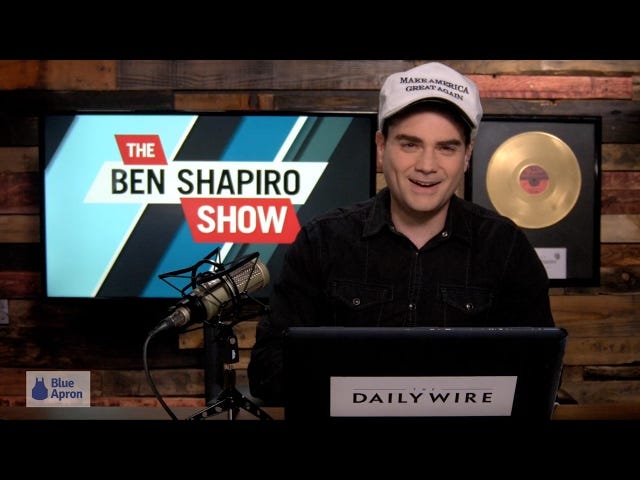
Shapiro, you probably know, is the founder and chief propagandist at the Daily Wire,
which, even after recent cutbacks and layoffs, has made more money than
the Sun King by milking MAGAbots until they moo. (Sample headline on
his current podcast: “Trump’s Saudi TRIUMPH”). And yet, like any
talented propagandist, Shapiro knows that the best way to push big lies
is to bolster credibility by telling small truths along the way. So
he’ll sometimes relate Trump’s unpardonable sins, which, of course, are
always subject to later pardoning, since no sin seems to be
disqualifying, and pointing out such iniquities doesn’t leave you in
good standing with the cult or the cult leader, upon whom your media
empire is financed.
Therefore Shapiro, who in 2016, wrote
“I will never vote for Donald Trump,” by 2020, was indeed voting for
Donald Trump, claiming “I wasn't really wrong about Donald Trump on
character, but whatever damage he was going to do has already been done,
and it's not going to help if I don't vote for him this time.” Whoops!
Guess he hadn’t counted on Trump trying to overturn an election that he
soundly lost, while sending his mob to invade Congress to reverse the
results. Character, or lack of it, tends to keep counting long after
you’ve counted it out. Which a screechy moralist like Shapiro knows, or
used to know, before pretending to fall in love with Donald Trump.
At the time, Shapiro called January 6 “the worst thing to happen to America since 9/11. It was cataclysmically awful.”
But by 2024, of course, a now amnesiac Shapiro — like most of the rest
of the GOP — was practically a wholly-owned MAGA subsidiary. He not only
voted for Trump, he co-hosted a fundraiser for him.
To illustrate Shapiro’s schizo behavior, I was prepared to delve deep into his recent oeuvre, though mercifully, Media Matters’ Jason Campbell spared me from that unenviable task by just cranking out a pretty handy one-stop-Shapiro-shopping guide.
I should add that I kicked around right-wing world long enough in my
former magazine-writer life to know that many old pals on the right
would say something like, “Jeez, Labash’s TDS is now so acute, that he’s
rewriting Media Matters press releases.” To which
I’d say — as I often do to lippy commenters — Trump Derangement
Syndrome is most evident when you tell obvious truths about Trump, and
his supporters become deranged upon hearing the unwelcome news. And I
will take truth wherever I can get it, since my old pals don’t seem to
be much in the business of telling it anymore. Therefore, I will do no
such thing as rewriting a Media Matters press release. Rather, I’ll reprint a large chunk of it verbatim.
Since
Trump’s inauguration in January, Shapiro has thumped Trump on
everything from his tariffs (“a massive tax increase on American
consumers”), to Trump suggesting Ukraine started the war with Russia
(“Ukraine absolutely did not start the war”), to Trump suggesting the
impeachment of a federal judge (“obviously I don’t think that President
Trump should be calling for the impeachment of judges based on decisions
not going his way”), to saying that Trump’s “skeezy stuff” — from his
free jet caper to his cryptocurrency schemes — “need to stop” (“I think
if we switch the names to Hunter Biden and Joe Biden, we’d all be
freaking out on the right”).
So far, so good! Or good
enough. To Shapiro’s partial credit, those are the closest
approximations of honest admissions you’ll get from anyone in the
MAGAsphere. And yet in spite of them — or perhaps because of them —
Shapiro always seems to comfortably land back in Camp Trump, no matter
how apparent it becomes that he’s backed a sleazy, self-dealing
charlatan masquerading as a populist avenger, and not
at-all-convincingly. Think I’m exaggerating? Here’s an abridged
chapter-and-verse sampling of Shapiro’s shilling, from Media Matters:
·
After Episcopal Bishop Mariann Budde urged Trump to show mercy to
migrants, Shapiro said, “Jesus was not in favor of free migration across
all borders.” [The Daily Wire, The Ben Shapiro Show, 1/22/25]
·
After Trump fired several inspectors general, Shapiro said, “These
inspectors general tend to be Democratic plants very often.” [The Daily
Wire, The Ben Shapiro Show, 1/27/25]
·
Early in the administration, Shapiro said Trump could be “the most
transformative president in American public life since LBJ, maybe since
FDR.” [The Daily Wire, The Ben Shapiro Show, 2/12/25]
·
Shapiro downplayed Trump administration cuts to national park workers,
saying, “You can cut all those people by just having an automatic
parking meter.” [The Daily Wire, The Ben Shapiro Show, 2/19/25]
·
Shapiro launched an effort to pressure Trump to pardon former
Minneapolis police officer Derek Chauvin for federal charges related to
George Floyd’s 2020 death. [CNN, 3/7/25]
·
Shapiro wrote, “The SignalGate story basically went nowhere because the
truth is that everybody has, at one point or another, included somebody
in a group chat by accident and it gets very awkward.” [The Daily Wire,
4/1/25]
·
When a Maryland father with protected legal status was sent to a
notorious megaprison in El Salvador, Shapiro said it was a “bureaucratic
screw-up” but not a “human tragedy.” [The Daily Wire, The Ben Shapiro Show, 4/1/25]
·
Shapiro praised Trump’s “u-turn” on tariffs following so-called
Liberation Day, saying the president showed “strength” in backtracking.
[The Daily Wire, The Ben Shapiro Show, 4/10/25]
·
Shapiro has been supportive of Secretary of Defense Pete Hegseth,
saying, “The White House should stand by Hegseth. He was their pick. He
was an out of the box pick, and he remains the right pick for secretary
of defense.” [The Daily Wire, The Ben Shapiro Show, 4/22/25]
·
Shapiro said, “I’m a voter for President Trump, supporter of President
Trump’s. I gave money to his campaign, fundraised for him, campaigned
with him. President Trump needs to succeed on the economy because if he
does not succeed on the economy, everything else goes down in flames.”
[The Daily Wire, The Ben Shapiro Show, 4/28/25]
·
Shapiro defended the Trump administration after a judge noted a
two-year-old U.S. citizen may have been removed from the country with
“no meaningful process.” [The Daily Wire, The Ben Shapiro Show, 4/28/25]
How
could a God-fearing winger with a healthy respect for our founders and
the Constitution still support a guy who has now said he’s not sure if
it’s his duty to uphold the Constitution (even if he swore to do so in
his presidential oath, twice)? A guy who regularly defies judicial
decisions including the Supreme Court’s, even though he appointed three
of the justices? A guy who is brokering deals with third-world dictators
to imprison those who have seen no due process? A guy who is
essentially running a White House extortion racket, targeting everyone
from law firms to media outfits, shaking down payments which directly
benefit Trump? (The kind of Big Government power move that so-called
conservatives like Shapiro used to decry before their favorite autocrat
retook the reigns.)
Again, I’m not picking on Shapiro because he’s
some notable exception, but because he’s become the rule in the
Republican Party, now so thoroughly corrupted that it can’t even
remember the once-cherished principles it’s aggressively thrown over.
Under Trump’s stewardship, it’s come less to resemble a political party
than a criminal syndicate or a cartoonishly corrupt pol’s vanity
project/slush fund.
As Shapiro himself had to recently admit:
Taking
sacks of goodies from people who support Hamas, Muslim Brotherhood,
al-Jazeera, all the rest, that's not America first. Like, please define
America first in a way that says you should take sacks of cash from the
Qatari royals who are behind al-Jazeera. It just isn't America first in
any conceivable way. So back to the original question — is this good for
President Trump? Is it good for his agenda? Is it good for draining the
swamp and getting things done? The answer is, no. It isn't. It isn't.If you want President Trump to succeed, this kind of skeezy stuff needs to stop.
Aside
from Shapiro’s misguided notion about Trump not fulfilling his agenda
(Trump’s agenda is to enrich Trump, which has been a stunning success by
any measure), he makes a fair point. And yet, if Shapiro wants to
pretend that he’s still interested in anything resembling swamp
drainage, he’s going to have to do two things that are utterly foreign
to him:
1. Stop backing the swampiest of all swamp creatures. 2. Become more honest, and stay that way.
Prominent neoconservatives
include figures who emerged as influential voices in the late 20th and
early 21st centuries, often associated with a strong foreign policy
stance, interventionism, and the promotion of democratic values
globally.Key figures include Irving Kristol, considered the "godfather" of neoconservatism.Other
notable neoconservatives include Paul Wolfowitz, Norman Podhoretz, William Kristol, Robert Kagan, Max Boot, Douglas Feith, Elliot Abrams, Richard Perle, Paul Bremer, David Frum,Charles Krauthammer, Dennis Prager.....
The speech in Saudi Arabia promised a new course for U.S. policy in the Middle East. Can He Provide Overnight Delivery With The Qatari Bribe?
President Donald
Trump has a vision of a "great transformation" in the Middle East. But
it's not the transformation that American leaders have talked about
bringing at gunpoint. At his Tuesday speech
at a U.S.-Saudi investment summit in Riyadh, the president denounced
the failures of "interventionists" and promised a future "where people
of different nations, religions, and creeds are building cities
together, not bombing each other out of existence."
Those words came with action. In his speech, Trump promised to lift all U.S. sanctions on Syria, and the day after, he shook hands with new Syrian President Ahmad al-Sharaa, who had a $10 million bounty on his head from the U.S. government just six months ago. In the weeks leading up to the summit, Trump ended the U.S. war in Yemen and negotiated the release of the last American in Hamas captivity. It remains to be seen whether he can follow through.
Riyadh was only the first stop in Trump's planned four-day tour of the Persian Gulf. He also plans to stop
in Qatar and the United Arab Emirates. In his speech, Trump praised the
oil-rich Arab monarchies of the Gulf—and used their success to attack
the architects of past U.S. policy.
"The
gleaming marvels of Riyadh and Abu Dhabi were not created by the
so-called nation builders, neocons, or liberal nonprofits like those who
spent trillions and trillions of dollars failing to develop Kabul,
Baghdad, and so many other cities," Trump said. "Instead, the birth of a
modern Middle East has been brought by the people of the region
themselves, the people that are right here, the people that have lived
here all their lives, developing your own sovereign countries, pursuing
your own unique visions, and charting your own destinies in your own
way."
He also offered Iran
"a much better path toward a far better and more hopeful future,"
emphasizing that "some of the closest friends of the United States of
America are nations we fought wars against in generations past."
Although Trump threatened Iran with more economic sanctions if it didn't
accept a deal, he didn't bring out his usual threats to bomb the country.
The Trump administration is currently negotiating with Iran over its nuclear program, and briefed the media that it was "encouraged" by the latest meeting in Oman last week. Iranian Foreign Minister Abbas Araghchi called the negotiations "more serious and more direct" than before.
If Trump's brief war in Yemen was a dry run for war
with Iran, his outreach to Syria demonstrated his eagerness to turn
enemies into friends. There were two issues at play. One was that
Congress and the White House had imposed intense economic sanctions on Syria designed to weaken the rule of Bashar al-Assad. Sharaa's new government inherited that embargo despite overthrowing Assad by force.
The
second issue was that Sharaa, formerly known as Abu Mohammed al-Golani,
was himself a former commander in Al Qaeda. (As Trump joked, Sharaa has
a "very strong past.") There was intense debate
in Washington about whether to continue pursuing economic pressure. In
the end, Trump decided to offer Syria a clean slate. During his
handshake, Trump asked Sharaa to join an alliance with Israel, deport
Palestinian rebels, and assume responsibility for accused Islamic State
supporters currently being held by Kurdish-led rebels, according to a White House statement.
"This is good for Israel, having a relationship like I have with these countries," Trump told reporters on the Wednesday flight from Saudi Arabia to Qatar.
But
the Israeli government and its supporters are pretty nervous about
being left behind by Trump's new policies. Sen. Lindsey Graham (R–S.C.)
stated in a press release
on Tuesday that he has "been in close contact with Israel, as they are
extremely concerned about the state of play in Syria." And Trump's peace deal in Yemen does not forbid Houthi forces from attacking Israel, which they did in the middle of Trump's speech.
Perhaps most concerning for Israel, the Trump administration has begun direct talks
with Hamas, via Arab Americans for Trump founder Bishara Bahbah. The
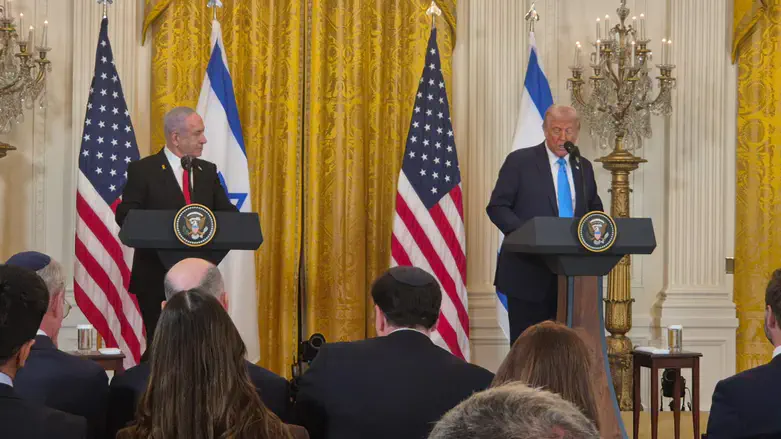
U.S. did not inform Israel, which only discovered this backchannel through spies, according to Axios. Although Israeli Prime Minister Benjamin Netanyahu vowed on Tuesday
that there is "no way we will stop the war," even if more hostages are
released, Trump said in his Tuesday speech that he would "work to get
that war ended as quickly as possible."
On Monday, Hamas agreed to release
Edan Alexander, an American teenager from New Jersey captured while
fighting for the Israeli army. Alexander "wouldn't be there if it
weren't for us, he wouldn't be living right now, probably none of the
hostages would be living right now," Trump said during the Wednesday
flight. Saudi Prince Faisal bin Farhan, who serves as foreign minister, told reporters on Wednesday that he was expecting "very courageous decisions" from Trump on "resolving the broader issues of Palestine."
The prince added
that he "fully supports nuclear talks between America and Iran and
hopes for positive results." Trump also joked in his speech that lifting
the sanctions on Syria was one of the "things I do for" Saudi Crown
Prince Mohammed Bin Salman.
Trump has always been close to the Gulf monarchies. Saudi Arabia has invested $2 billion into a business run by Trump's son-in-law, Jared Kushner. Just before the summit, Qatar gifted the White House a $400 million luxury airplane.
In the past, these states were an influence for more U.S. intervention.
They used much of their influence trying to incite Washington against
their mutual enemies, such as Iran and Syria, and against each other.
But
the Gulf states' outlook has changed. On one hand, they're satisfied
with the victories they've won so far; the Syrian government was overthrown and Iran was cut down to size. On the other hand, the success of Yemeni and Iranian missile attacks has demonstrated that even direct U.S. protection can't shield the Gulf states from the cost of further war. And the Gulf leaders seem genuinely scared that the Israeli-Palestinian conflict could spill over to threaten their rule.
Of
course, the Gulf states still fundamentally want U.S. protection,
despite their shifts on some issues. Along with his peaceful gestures,
Trump signed a new $142 billion weapons sale to Saudi Arabia. The next day, he publicly signed off on a previously agreed $2 billion drone sale to Qatar. While
Trump mocked the "Western interventionists flying people in beautiful
planes" to the Middle East, these arms deals historically bring hundreds of U.S. military advisers and defense contractors to the region—along with unspoken promises of more direct U.S. military assistance.
Before Trump soured on the Yemeni war, Saudi Arabia was reportedly egging on
U.S. escalation. The influence that the kingdom is now using to
encourage diplomacy could easily be used to encourage war again.
After all, former President Barack Obama made the same promises as Trump early in his presidency, telling an audience in Egypt that there would be "a
new beginning between the United States and Muslims around the world,
one based on mutual interest and mutual respect." Over the next eight
years, he ended up permanently entrenching U.S. military involvement in the region.
"In
a meaningful way, this is Trump delivering Obama's Cairo speech…only
this time in Riyadh, and with notable tweaks, of course. But at its
core, the message is much the same," wroteNew Lines Magazine Editor in Chief Hassan Hassan. The only question is whether Trump can succeed where his predecessor failed.
58.7 million US adults, or 22.8% of the adult population, experienced a mental illness.This translates to about 2 out of every 9 adults in the United States.Mental illnesses are common health conditions that affect a wide range of individuals, with various degrees of severity - and the American public chose one!
A Damning Portrait of an Enfeebled Biden Protected by His Inner Circle
“Original
Sin,” by Jake Tapper and Alex Thompson, depicts an aging president
whose family and aides enabled his quixotic campaign for a second term.
Jake Tapper and Alex
Thompson’s “Original Sin” chronicles a different fall from grace. The
cover image is a black-and-white portrait of Joe Biden with a pair of
hands clamped over his eyes. The biblical story is about the danger of
innocent curiosity; the story in this new book is about the danger of
willful ignorance.
“The original sin
of Election 2024 was Biden’s decision to run for re-election — followed
by aggressive efforts to hide his cognitive diminishment,” Tapper and
Thompson write. On the evening of June 27, 2024, Democratic voters
watched the first presidential debate in amazement and horror: A
red-faced Donald Trump let loose a barrage of audacious whoppers while Biden, slack-jawed and pale, struggled to string together intelligible rebuttals.
Trump’s
debate performance was of a piece with his rallies, a jumble of
nonsensical digressions and wild claims. But for many Americans, the
extent of Biden’s frailty came as a shock. Most of the president’s
appearances had, by then, become tightly controlled affairs. For at
least a year and a half, Biden’s aides had been scrambling to
accommodate an octogenarian president who was becoming increasingly
exhausted and confused. According to “Original Sin,” which makes pointed
use of the word “cover-up” in the subtitle, alarmed donors and pols who
sought the lowdown on Biden’s cognitive state were kept in the dark.
Others had daily evidence of Biden’s decline but didn’t want to believe
it.
Tapper is an anchor for CNN (and
also served as a moderator for the presidential debate); Thompson is a
national political correspondent for Axios. In an authors’ note, they
explain that they interviewed approximately 200 people, including
high-level insiders, “some of whom may never acknowledge speaking to us
but all of whom know the truth within these pages.”
The
result is a damning, step-by-step account of how the people closest to a
stubborn, aging president enabled his quixotic resolve to run for a
second term. The authors trace the deluge of trouble that flowed from
Biden’s original sin: the sidelining of Vice President Kamala Harris;
the attacks on journalists (like Thompson) who deigned to report on
worries about Biden’s apparent fatigue and mental state; an American
public lacking clear communication from the president and left to twist
in the wind. “It was an abomination,” one source told the authors. “He
stole an election from the Democratic Party; he stole it from the
American people.”
This blistering
charge is attributed to “a prominent Democratic strategist” who also
“publicly defended Biden.” In “Original Sin,” the reasons given for
saying nice things in public about the president are legion. Some
Democrats, especially those who didn’t see the president that often,
relied on his surrogates for reassurance about his condition (“He’s
fine, he’s fine, he’s fine”); others were wary of giving ammunition to
the Trump campaign, warning that he was an existential threat to the
country. Tapper and Thompson are scornful of such rationales: “For those
who tried to justify the behavior described here because of the threat
of a second Trump term, those fears should have shocked them into
reality, not away from it.”
President Biden’s Decline, Its Cover-Up, and His Disastrous Choice to Run Again
Biden announced that he would be running for re-election in April 2023; he had turned 80 the previous November and was already the oldest president
in history. Over his long life, he had been through a lot: the death of
his wife and daughter in a car accident in 1972; two aneurysm surgeries
in 1988; the death of his son Beau in 2015; the seemingly endless
trouble kicked up by his son Hunter, a recovering addict whose legal troubles included being under investigation by the Justice Department.
Yet
Biden always bounced back. The fact that he defied the naysayers and
beat the odds to win the 2020 election was, for him and his close circle
of family and advisers, a sign that he was special — and persistently
underestimated. They maintained “a near-religious faith in Biden’s
ability to rise again,” the authors write. “And as with any theology,
skepticism was forbidden.”
In
2019, when Biden announced a presidential run, he was 76. It was still a
time when “Good Biden was far more present than Old Biden.” By 2023,
the authors suggest, that ratio had reversed. Some of his decline was
hard to distinguish from what they call “the Bidenness,” which included
his longtime reputation for gaffes, meandering stories and a habit of
forgetting staffers’ names.
But people
who didn’t see Biden on a daily basis were increasingly taken aback
when they finally laid eyes on him. They would remark on how his once
booming voice had become a whisper, how his confident stride had become a
shuffle. An aghast congressman recalls being reminded of his father,
who had Alzheimer’s; another thought of his father, too, who died of
Parkinson’s.
The people closest to
Biden landed on some techniques to handle (or disguise) what was
happening: restricting urgent business to the hours between 10 a.m. and 4
p.m.; instructing his writers to keep his speeches brief so that he
didn’t have to spend too much time on his feet; having him use the short stairs
to Air Force One. When making videos, his aides sometimes filmed “in
slow motion to blur the reality of how slowly he actually walked.” By
late 2023, his staff was pushing as much of his schedule as they could
to midday.
When White House aides
weren’t practicing fastidious stage management, they seemed to be
sticking their heads in the sand. According to a forthcoming book
by Josh Dawsey, Tyler Pager and Isaac Arnsdorf, Biden’s aides decided
against his taking a cognitive test in early 2024. Tapper and Thompson
quote a physician who served as a consultant to the White House Medical
Unit for the last four administrations and expressed his dismay at the
idea of withholding such information: “If there’s no diagnosis, there’s
nothing to disclose.”
Just how much of
this rigmarole was desperate rationalization versus deliberate scheming
is never entirely clear. Tapper and Thompson identify two main groups
that closed ranks around Biden: his family and a group of close aides
known internally as “the Politburo” that included his longtime
strategist Mike Donilon and his counselor Steve Ricchetti. The family
encouraged Biden’s view of himself as a historic figure. The Politburo
was too politically hard-nosed for that. Instead, its members pointed to
Biden’s record in office and the competent people around him. The
napping, the whispering, the shuffling — all that stuff had merely to do
with the “performative” parts of the job.
Tapper
and Thompson vehemently disagree. They offer a gracious portrait of
Robert Hur, the special counsel who investigated Biden’s handling of
classified materials and in his February 2024 report
famously described the president as a “sympathetic, well-meaning,
elderly man with a poor memory.” Biden and his team were incensed and
tried “to slime Hur as an unprofessional right-wing hack,” but the
authors defend his notorious line. They emphasize that it is incumbent
upon a special counsel to spell out how the subject of an investigation
would probably appear to a jury — and that what Hur wrote about Biden
was true.
Of course, in an election
like 2024, when the differences between the candidates are so stark and
the stakes are so high, nearly every scrap of information gets viewed
through the lens of “Will it help my team win?” Even competently
administered policy could not compensate for a woeful inability to
communicate with the American people. In a democracy, this is a tragedy —
especially if you believe, as Biden did, that a second Trump term would
put the very existence of that democracy in peril.
Earlier this month, in what looks like an attempt to get ahead of the book’s publication, Biden went on “The View”
to say that he accepts some responsibility for Trump’s victory: “I was
in charge.” But he was dismissive about reports of any cognitive
decline. In “Original Sin,” Tapper and Thompson describe him waking up
the morning after the 2024 election thinking that if only he had stayed
in the race, he would have won. “That’s what the polls suggested, he
would say again and again,” the authors write. There was just one
problem with his reasoning: “His pollsters told us that no such polls
existed.”
Rabbi Yisroel Goldstein Sentenced to Prison for Multi-Million-Dollar Fraud Schemes
For Immediate Release
U.S. Attorney's Office, Southern District of California
Assistant U. S. Attorneys Valerie H. Chu (619) 546-6750 and Michelle L. Wasserman (619) 546-8314
NEWS RELEASE SUMMARY – January 4, 2022
SAN DIEGO – Rabbi Yisroel Goldstein, former director at Chabad of
Poway, was sentenced in federal court today to fourteen months in
custody for his years-long, multi-million-dollar schemes to defraud the
Internal Revenue Service, several San Diego Fortune 500 companies, and
multiple public and private agencies. He was also ordered to pay
restitution totaling $2,834,608.
According to his plea agreement, while Rabbi Goldstein was director
of the Poway synagogue, he received at least $6.2 million in phony
contributions to the Chabad and affiliated charities and secretly
refunded up to 90 percent of the donations to the “donors.” After Rabbi
Goldstein provided these donors with fake receipts, they illegally
claimed huge tax deductions for these nonexistent donations, and the
rabbi kept about 10 percent – more than half a million dollars over the
course of the fraud - for himself. Tax losses to the IRS were more than
$1.5 million.
Rabbi Goldstein also admitted that he defrauded three different
Fortune 500 companies by tricking them into matching supposed charitable
donations of their employees. Working with the employees, Rabbi
Goldstein fabricated receipts and then secretly returned their fake
“donations.” This allowed the employees to claim tax deductions for the
completely fabricated donations, and allowed Rabbi Goldstein to collect
the companies’ matching funds—including some that matched double their
employees’ donations. Rabbi Goldstein helped to orchestrate this scheme
with at least six taxpayer-employees and two other associates who helped
recruit new donors or conceal the true recipient of the funds. In
total, Rabbi Goldstein defrauded the companies out of at least $144,000,
and helped the taxpayer-employees to claim nearly as much in fictitious
tax-deductible charitable contributions to the IRS.
Rabbi Goldstein admitted that he also helped his brother Mendel
Goldstein conceal approximately $700,000 in income by allowing him to
use Chabad bank accounts to deposit his income, thereby hiding it from
the IRS. As his cut, Rabbi Goldstein kept 10 percent of this
individual’s income—more than $70,000.
Separate and apart from the tax evasion scheme, Rabbi Goldstein and
another defendant, Alexander Avergoon, used false information and
fabricated invoices and other records to pretend to be eligible for
emergency funds, grants or donations, and private loans. These frauds on
the Federal Emergency Management Agency (FEMA), the California
Governor’s Office of Emergency Services (Cal OES), and private
foundations resulted in losses to these programs of at least $860,000.
According to sentencing documents, the United States Attorney’s
Office recommended departures from the sentencing guidelines for
Goldstein because of his cooperation against other individuals, and
because of the extraordinary events he suffered as a victim of the April
27, 2019 shooting at the Chabad of Poway.
In imposing sentence, U.S. District Judge Cynthia A. Bashant
commented, “You dragged down so many congregants. Many of those
individuals thought that they were committing these offenses to benefit
the Chabad or the synagogue in general, when in fact it was to benefit
you. I just can’t ignore that. … I think time in custody is important.
It’s important to send a message to the community, and it’s important
to send a message to you.”
“Yisroel Goldstein exploited his position and stature as a faith
leader to commit well-planned and carefully executed crimes of greed,”
said U.S. Attorney Randy Grossman. “As his serious criminal conduct was
under investigation, the rabbi became a victim in a devastating attack
on the synagogue he led. Today’s sentence accounts for these
extraordinary circumstances and our office’s mission to always seek
justice.” Grossman thanked the prosecution team, the FBI and the IRS for
their excellent work on this case.
“The defendant used the Chabad of Poway’s tax-exempt status as a
religious organization to compile millions of dollars in fraudulent
‘donations’,” said FBI Special Agent in Charge Suzanne Turner. “This
scheme enabled Rabbi Goldstein to line his own pockets; reward his fake
‘donors’ with reimbursement for their contributions; and provided
receipts enabling the ‘donations’ to be written off as charitable
contributions, all in furtherance of the scheme. The FBI will continue
to root out fraud disguised as charitable donations which ultimately
hurts those organizations relying on the generosity of donors.”
“Rabbi Goldstein veiled over $2.8 million in fraud schemes he
perpetrated with at least ten other co-conspirators by exploiting the
non-profit statuses of the Chabad of Poway and the Friendship Circle of
San Diego, organizations entrusted to him to serve the community,” said
Special Agent in Charge Ryan L. Korner of IRS Criminal Investigation's
Los Angeles Field Office. “IRS Special Agents were proud to work
alongside the FBI and the U.S. Attorney's Office in this
multimillion-dollar tax and grant fraud investigation that uncovered
decades of illegal conduct. In addition to holding Rabbi Goldstein
accountable for cheating U.S. taxpayers and businesses for personal
gain, my fervent hope is that today's sentencing brings closure and
healing to all who were affected by his crimes.”
Rabbi Goldstein was ordered to surrender into federal custody by noon on February 23, 2022.
DEFENDANTCase Number 20CR1916-BAS
Yisroel GoldsteinAge: 60 Poway
SUMMARY OF CHARGES
Conspiracy to Defraud the United States and Commit Wire Fraud, in violation of Title 18, USC 371
Maximum Penalty: Five years in prison
‘Challah’ and ‘tefillin’ were code words in the Chabad of Poway’s fraud scheme
Former rabbi of the synagogue targeted in 2019
by an antisemitic shooter received a 14-month term for his part in the
scheme; as a co-conspirator is sentenced, new details emerge
it
seems that Trump’s grievance with Netanyahu is the PM's insistence on
safeguarding Israel’s vital interests in the case of Trump's
characteristic desire to 'strike a deal' - this time, with Saudi Arabia.
Understanding
Donald Trump is a hazardous sort of punditry as he is mercurial, a man
of contradictions, not entirely coherent in his policy pronouncements,
and given to abrupt changes without explanation.
That
he is now reportedly “frustrated” with Prime Minister Netanyahu is not
entirely surprising (join the club). The report may be untrue – the
media “reports” some rumor or scandal almost daily; most are usually
forgotten the next day when what was reported does not materialize – and
almost always are promoted by someone with an agenda. Stuff is made up
all the time and quickly forgotten after the initial shock and outrage
dissipate.
Nonetheless, if
Trump’s frustration with Netanyahu is real, why would that be? And
should it be a cause for concern? First, a word about Trump.
President
Trump is an AmericanTrumppatriot who rightly construes what he perceives as
the best interests of TRUMPUS as paramount in his considerations. He is
blustery but seldom acts on his threats. He is a materialist who thinks
that one’s primary objective in life is to obtain as much money and
become as wealthy as possible. He is not an ideologue and has little use
for ideology when it interferes with the pursuit of (personal) material gain. He
will passionately espouse and try to implement a particular policy, and
if it does not immediately bear fruit, he will abandon it for its
antithesis with the same ardor with which he first pursued it, and
without any explanation.
Trump
has a positive attitude towards Jews but properly puts America First.
He does not mind, and perhaps even enjoys, opposing views among his
staffers, but also enables the sparring sides to feel that they each
have Trump’s support. And he has always been against war, any war, which
he sees as bad for business.
Above
all, he prides himself on being a deal maker, with the art of the deal
being the heart of the deal – not so much its implementation or
consequences but the deal itself. As a real estate baron, Trump was
known to renege on agreements, to hondle merchants, workers, and
suppliers when the due date for payment came, and welcomed lawsuits – as
plaintiff or defendant – because those were just preludes to more
deal-making. Contracts and the written word were meaningful only as a
guide to general principles but did not bind him if circumstances
changed (which they always did, as in “the job is done, so why should I
pay you?”).
That is why
Trump did not hesitate to breach US trade agreements with other
countries. Circumstances, to wit: his election, changed. Paradoxically,
he is decisive until he changes his mind – but he does make decisions,
seeks finality, and will walk away from negotiations if the prospects
are strong for stalemate, no deal, or an inconclusive outcome.
Trump
also wants to be seen as a winner; hence the abrupt reversal of his
tariff plans when the stock market tanked. He ordered the justified,
targeted assassinations of Qassem Soleimani and Abu Bakr al-Baghdadi
(and good riddance to the both of them) and chalked those up as
victories, even though Iran has since become an even more nefarious
force and ISIS still exists. A deal with Iran, Syria, Russia, Ukraine,
Israel, Hamas, the PA, Saudi Arabia, the Houthis is the goal. The deal
is the win, whatever happens later is incidental. That is how Trump sees
the world.
Therefore, he
will not tolerate endless negotiations between Russia and Ukraine, with
sundry countries and their trade arrangements with the USA, or between
Israel and our many adversaries. For Trump, the deck is cleared once an
agreement is signed regardless of future consequences. He prides himself
on being a conflict solver, especially in the short term.
By
contrast, as stated here not long ago, PM Netanyahu is a conflict
manager, not a conflict solver. He has made an art form of kicking the
can down the road until there is no road left. What he may see as
caution has become a sort of paralysis – an inability to resolve
anything – which also cleverly enables him to prevail in every election
promising to resolve the problems that he never resolves.
For
the duration of Netanyahu’s long tenure – he has served as Israel’s
prime minister far longer than FDR served as US president – he has
dedicated his life to preventing an Iranian nuclear bomb, now closer
than ever. Rockets and missiles have been falling on our heads
incessantly throughout his term, the only change being their points of
origin. Repeated mini-wars have degraded the enemy’s capabilities but
never really change anything because he allows them to rebuild and
become more violent and dangerous. He is no closer to judicial reform
than he was fifteen years ago. And he still looks to others to fight our
battles – especially to the US, as if Trump will invade Iran and
destroy their reactors on our behalf. But we can rely only on our Father
in Heaven and ourselves.
When
the report emerged that Trump is “frustrated” with Netanyahu, I assumed
it was because of Netanyahu’s hesitations in Gaza and his reluctance to
do what is necessary to prevail. Even Netanyahu’s various choices for
senior positions – including head of the Shin Bet and the new Chief of
Staff – tend to impede his policies rather than strive to implement
them, and for that he too is to blame. So if Trump’s frustration with
Netanyahu stems from the latter’s inability to “finish the job,” it is a
frustration shared by many Israelis.
Yet,
it seems that Trump’s grievance with Netanyahu is not because of the
latter’s weakness and vacillation but because of his strength, and his
insistence in this case on safeguarding Israel’s vital interests. That
is, Trump is reportedly “frustrated” because his goal of expanding the
Abraham Accords to include Saudi Arabia is foundering because of
Netanyahu’s rejection of Saudi demands that Israel end the war in Gaza
short of victory and Israel publicly commit to the establishment of a
Palestinian Arab state. Both are rightly non-starters, and to his credit
– again, if the reports are accurate – Netanyahu has appropriately
dismissed them. Good for him, and for us.
In
the alternative, Trump has allegedly asserted, he will make a deal with
Saudi Arabia that includes strategic attainments for both countries,
but no recognition of Israel by the Saudis, to which I say, great. It is
far better to have shared strategic objectives and an unofficial
alliance with the Saudis than enter into an official agreement that
endangers our future. We have survived for 3700 years without peace with
the Saudis and can survive until Messiah comes without it as well.
Trump
may well feel that Israel should sign any agreement, end the war, get
the hostages out, withdraw from Gaza, make peace with the Saudis – and
then just renege on the agreement and do what is necessary, citing “a
change in circumstances.” The Saudis may want Israel’s commitment to a
Palestinian Arab state to mollify the Arab street, but I am more
concerned with the Jewish street, and the implications of agreeing to
allow a Nazi-like foe to survive as well as renouncing a signed
agreement, which will subject Israel to even more international
opprobrium but now with a tinge of legitimacy.
Moreover,
before these Abraham Accords are expanded, we would do well to remind
ourselves of the original Abraham Accords, the covenant our forefather
enacted with the Creator that promised and entrusted the descendants of
Abraham with the land of Israel. That is a religious right – and a
divine gift – that should not be repudiated even if Saudi Arabia agrees
to open a Chabad House in Mecca. The ancient Abraham Accords are far
more important, meaningful, and enduring than the current one may prove
to be.
Rapprochement
with the Saudis should be between two nations that respect each other’s
rights, interests, values, and heritage. It should not come at the
expense of the land of Israel, and certainly not by empowering an enemy
still sworn to our destruction. Having good relations with the USA is an
Israeli strategic interest that should not be dismissed lightly, but we
should have the fortitude to say to President Trump that certain
concessions are not worth our participation in any deal, and if the US
and the Saudis have their own agreement, that is fine by us.
We
should not say “no,” but we should say “no, thank you.” Mr. President,
make your deal, reap the Saudi investment in America, address Saudi
concerns about Iran, and feel like a winner. And if Trump still feels
“frustrated” with Netanyahu, so be it. In that, he will echo the
feelings of most Israelis and even many of Netanyahu’s supporters. At
least in this case, though, PM Netanyahu’s caution here is well founded.
Rabbi Steven Pruzansky teaches Torah in Modiin, and serves as the Senior Research Associate at the Jerusalem Center for Applied Policy (JCAP.ngo).
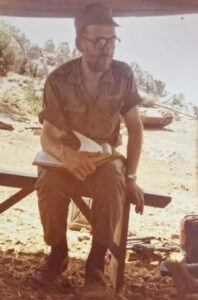
R. Aharon Lichtenstein, in uniform, delivering a shiur to Hesderniks in Lebanon, Summer 1982
In the ten years since the passing of my father, my teacher and master, Rabbi Aharon Lichtenstein zt”l,
we have faced difficult and challenging times, foremost among them the
massacre on Simchat Torah 2023 and the ensuing war. My father, now gone
for a decade and receding into the mist of the past, has not experienced
these ordeals together with us. Yet, although his voice has been
silenced, the influence of his consistent Torah-based ethical values has
not ceased.
I wish to present here a small selection of his vast worldview
related to an urgent issue in Israel’s public discourse—his clear
position obligating all yeshiva students to enlist in the Israel Defense
Forces and share the burden of combat. I will first present his
position on the damage done to Torah by those who remain exclusively in
the beit midrash at such an hour, and then propose a course of action,
based on his teachings, for expanding the circle of yeshiva students
enlisting. All this is offered with the hope that his words, spoken from
a pure heart, will enter the hearts of my readers.
In 1981, in the pages of TRADITION (19:3), my father published his essay “The Ideology of Hesder” (published the following year in Hebrew in Yeshivat Har Etzion’s journal, Alon Shevut
#100). True to form, he addressed the topic from multiple angles. He
presented military service as an urgent necessity, as a clear and
present mitzvah; laid out the justification for shortened military
service for yeshiva students; extolled the contribution of Hesder’s
combination of study and service to the nation and the IDF; pointed out
the difficulties inherent in the Hesder track; and offered solutions.
His primary halakhic argument presented Hesder as a clear fulfillment
of “Torah combined with acts of lovingkindness.” As one who
consistently followed the ways of Beit Hillel, giving precedence to his
opponents’ arguments before his own, he fairly and thoroughly presented
the views of those who exempt yeshiva students from military service. He
engaged with their arguments and sources, but ultimately concluded that
they do not provide a sufficient basis for a sweeping and definitive
exemption for Torah scholars.
The essay was published over forty years ago, closer in time to the
founding of the Hesder movement in 1953 than it is to our own day. It
expresses an original position that at that time was not accepted even
among other heads of Hesder yeshivot. Anyone reading the essay feels its
polemical tone—one that, as often happens, engages most ardently with
those closest to one’s own position. My father chiefly confronted the
track known as “Hesder Merkaz” (centered on Yeshivat Merkaz HaRav). He
argued that the key difference between the varieties of Hesder
experience was whether they viewed military service merely as a
necessary preparation for war, should it arise (as all in Israel reasonably suspected it would;
indeed, the First Lebanon War broke out less than a year after the essay
was published), or whether they also saw bearing the burden of ongoing
national security as an inherent obligation for Torah scholars.
Here, I will highlight a paradox in the positions of both sides.
Merkaz HaRav, which champions Rav Kook’s Torah—a Zionism of action that
sees the State of Israel as the realization of prophetic
vision—nevertheless supports shorter military service for yeshiva
students in favor of increased time on the benches of the beit midrash.
Meanwhile, my father, whose Zionism drew from entirely different
sources, called for longer military service for students of Torah. This
paradoxical reversal is rooted in a deep difference in worldview
regarding the sacred, the secular, and the nature of the State of
Israel. With the “image of father appearing before us in the window”
(cf. Sota 36b), I will attempt to offer an explanation and
reexamination of the issue through the lens of our present experience of
a year and a half of continuous warfare.
Hesder as an Ideal
When my father arrived in Israel in the summer of 1971 there were few Hesder yeshivot. Many of the roshei yeshiva and ramim
of that time had grown up in the Haredi system. How did they view their
Hesder students? I heard from Rabbi Haim Sabato that his teacher at
Yeshivat HaKotel, Rabbi Yeshayahu Hadari zt”l, described
Hesder’s goal as “to bring Torah to the boys of Bnei Akiva.” The
assumption behind that statement was that Hesder represents a compromise
or concession—a yeshiva for Religious Zionists (who probably couldn’t
handle a “real” yeshiva), where they could learn a bit of Torah
alongside serving in the army.
Such a yeshiva was seen as a realization of the Mizrachi movement’s
vision, emphasizing “Torah and…” In other words, much of the Hesder
leadership viewed its very own institutions as a bedi’avad
(less than ideal) option, meant for those who had already chosen the
path of Religious Zionism and its compromises. For a boy whose soul
thirsted for Torah and who aspired to grow in learning their
recommendation was to study full-time in a “proper” yeshiva, nicknamed
the “Holy Yeshivot,” and take the exemption from army service.
My father represented a completely different orientation: Hesder as an ideal (lekhathila).
Rabbi Re’em HaCohen told me that as he was finishing Netiv Meir high
school and was deliberating about his next step, he consulted with my
father. He asked him about the choice between a “Holy” and a Hesder
yeshiva. Father surprised him with his answer: He said that someone
unable to handle the dual challenge of serious Torah study along with
the military should opt for a yeshiva without army service. But one who
is strong and capable of both deep Torah study and army service should
choose Hesder—which he saw as the more challenging but preferred path.
Indeed, anyone who learned at Yeshivat Har Etzion knows that my
father viewed the yeshiva as a kind of Volozhin-like ideal in terms of
his expectations of us, his students. Those expectations were high—in
terms of diligence, academic level, and aspirations. He envisioned a
yeshiva where the sound of Torah would not cease for even a moment.
True, there were extended periods when students would leave the beit
midrash, but this did not diminish the vision that here, the banner of
Torah would be borne high—equal to or surpassing other yeshivot.
This worldview is expressed in the main argument presented in “The Ideology of Hesder,” regarding Torah combined with hesed (acts of kindness). My teacher and master, Rabbi Yehuda Amital zt”l,
shared this worldview, and that is why he drafted my father to stand
alongside him at the head of Yeshivat Har Etzion, so that the
institution would be led by a Torah role model of the highest caliber.
Despite their differences, they found common ground in many areas, among
them a shared vision regarding the mission of the Hesder yeshivot. The
difference between them, in form not in essence, is demonstrated in R.
Amital’s well-known expression of his worldview through a short Hasidic
story, while my father encapsulated his philosophy through a complex,
twenty-page scholarly essay. Nonetheless, the ideas are one and the
same.
R. Amital would often relate the tale of Rav Shneur Zalman of
Liadi, the Ba’al HaTanya, who lived for a time in a modest dwelling with
his son and infant grandson. The house had three rooms: The Ba’al
HaTanya sat and learned in the innermost room; in the middle room sat
his son, later known as the Mitteler Rebbe, also learning; and in the
outer room, the infant lay in his cradle. During his study, the Ba’al
HaTanya heard the infant crying, and, as he passed through the middle
room, noticed that his son was so engrossed that he did not hear the
baby. After comforting the child, he rebuked his son: “If one learns
Torah and does not hear the cry of a child, there is a flaw in his
learning.”
R. Amital’s message about personal responsibility is clear. My
father’s article expresses a similar worldview: One who studies Torah
without national responsibility, one who learns without combining study
with acts of kindness, one who walls himself inside the four cubits of
the beit midrash and does not hear the needs of the Jewish People—his
Torah is deficient. A moral obligation lies on every person, and
certainly every Torah scholar, to shoulder responsibility for society.
Since in the State of Israel the existential and security threat stands
at the forefront of our national challenges, yeshiva students must take
part in addressing it.....