EVERY SIGNATURE MATTERS - THIS BILL MUST PASS!

EVERY SIGNATURE MATTERS - THIS BILL MUST PASS!
CLICK - GOAL - 100,000 NEW SIGNATURES! 75,000 SIGNATURES HAVE ALREADY BEEN SUBMITTED TO GOVERNOR CUOMO!

EFF Urges Court to Block Dragnet Subpoenas Targeting Online Commenters

EFF Urges Court to Block Dragnet Subpoenas Targeting Online Commenters
CLICK! For the full motion to quash: http://www.eff.org/files/filenode/hersh_v_cohen/UOJ-motiontoquashmemo.pdf

Wednesday, August 05, 2026

The Big Lie Effect, In Reverse


WIKIPEDIA

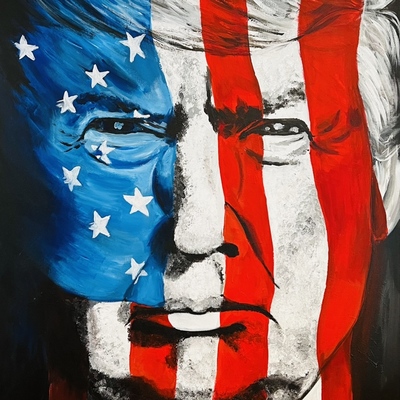
There are men who lie, and there are men who build systems around lying. Donald Trump belongs to the second category.

His “stable genius”, (pun intended), if that is the right word for a moral deformation, is that he has not merely told falsehoods. He has trained millions of Americans to treat truth as an act of hostility. In the Trump universe, reality is not something to be discovered. It is something to be crushed, mocked, or screamed down until it submits.

That is the Big Lie in reverse.

The old political lie said, “Believe this false thing.” Trump’s version says, “Do not believe anything that threatens me.” Every fact becomes suspect. Every critic is corrupt. Every judge is crooked. Every prosecutor is biased. Every journalist is lying. Every election loss is theft. Every embarrassment is sabotage. Every consequence is persecution. This is not skepticism. It is moral and intellectual arson.

A nation cannot breathe in such an atmosphere.
A society that learns to distrust every source of judgment except one man is not becoming strong. It is becoming childish, frightened, and easily manipulated. That is how demagogues operate. They do not simply lie. They destroy the public’s confidence that truth can even be known.

The Torah commands, Midvar sheker tirchak, “Distance yourself from falsehood.” The wording matters. Judaism does not merely prohibit lying. It recognizes that falsehood is a spiritual contaminant. Once it enters public life, it does not stay confined to one speech, one slogan, or one election. It spreads. It teaches people to lie to themselves. That is the great corruption. A person who lies occasionally is still reachable. A people that learns to prefer illusion over truth is already in danger.

Trump has weaponized this decay. He does not answer criticism. He mutilates it. He does not dispute evidence. He delegitimizes the existence of evidence. He does not accept accountability. He recasts accountability as conspiracy. This is the language of a man who cannot tolerate reality because reality is always a verdict. And he knows it.

The result is a political cult in which loyalty is measured not by principle but by surrender. To remain in good standing, one must not only support Trump. One must adopt his sense of reality, which is to say, abandon one’s own. That is why the damage is so profound. A movement that demands blind loyalty is not conservatism, and it is not populism. It is submission dressed up as rebellion.

Judaism has no patience for this disease. Our tradition does not worship power. It interrogates it. The Torah strips authority of its vanity and binds it to law. A ruler is not above scrutiny because a ruler is the one who most needs it.

Trump has tried to reverse that moral order. He demands immunity from judgment while handing out judgment on everyone else. He wants to be the prosecutor, the victim, the judge, and the winner in every case. It is an obscene fantasy of leadership. The man who cannot be questioned is the man who must never be trusted.

And yet millions do trust him, not because he is trustworthy, but because he confirms their worst instincts. He tells the angry they are right to rage. He tells the suspicious they are right to distrust. He tells the vain they are right to admire themselves. He tells the resentful that grievance is wisdom. He tells the weak that cruelty is strength. He tells the ignorant that ignorance is independence. This is how ruin enters a republic, not with a crash, but with applause.

The American Founders understood that human beings are not angels. That is why they built restraints into the Constitution. They feared ambition, vanity, faction, and concentrated power. They understood that a republic can survive bad weather, but it cannot survive the worship of a man who treats the nation as a stage set for his own moods. Trump is the very thing the system was designed to restrain: a personality who confuses himself with destiny.

The deeper tragedy is that his followers have been trained to reject the very faculty that could save them, judgment. They have been taught that if a fact is unpleasant, it must be false. If a report is damaging, it must be a plot. If a court rules against him, the court must be corrupt. If an election goes badly, the election must be rigged. This is the reverse Big Lie, not one lie told to conceal the truth, but a thousand accusations hurled to make truth itself seem impossible.

That kind of politics has a name in older texts. It is the war against discernment. It is the attempt to cloud the mind until falsehood and fact become indistinguishable. Once that happens, power is free to do whatever it wants.

The prophets would have recognized him instantly. They knew the type. They knew the ruler who wraps ego in grievance, who mistakes noise for greatness, who uses humiliation as a weapon, and who calls every rebuke a betrayal. They knew that such men are not merely flawed. They are dangerous because they turn the moral life of the public into a circus of instinct and spectacle.

Trump has done this to America at scale. He has taught a generation to sneer at evidence, to confuse performance with leadership, and to treat shamelessness as authenticity. The damage is not rhetorical alone. It is civilizational. Once citizens stop asking whether something is true and start asking only whether it helps their side, the moral framework of the nation has already begun to rot.

There is a reason Judaism places such weight on truth. Truth is not only a fact. It is a discipline. It requires humility. It requires restraint. It requires the courage to hear what one does not want to hear. Trump’s politics is the opposite. It rewards the abandonment of humility and the celebration of appetite. He is the patron saint of narcissism, and narcissism is a terrible basis for government.

History is brutal toward nations that confuse a showman with a statesman. The applause is loud at the beginning. It is usually followed by division, corruption, contempt for law, and eventual disgrace. That is the pattern. That is the warning. That is the road Trump invites people to walk while calling it strength.

The Big Lie in reverse is not simply that Trump lies. It is that he has made lying feel like survival, and truth feel like disloyalty. That is how a society begins to lose its soul. Not when falsehood is hidden. When falsehood is celebrated, defended, and crowned.

That is the real threat. Not one man’s dishonesty, but the crowd’s willingness to make peace with it.

*

The best Orthodox Jewish blogs curated and ranked based on multiple factors, including content relevancy, subject expertise, posting frequency, and freshness of content. Blogs with highest credibility within the Orthodox Jewish space are ranked higher. This list is updated regularly to ensure it reflects the most active, influential, and valuable Orthodox Jewish blogs on the internet today. https://bloggers.feedspot.com/orthodox_jewish_blogs/


REPUBLISHED

https://blogs.timesofisrael.com/the-big-lie-effect-in-reverse/


 *******************

 The President Of The USA 

Capital One closed hundreds of Trump bank accounts for 'anti-money laundering reasons,' lawsuit says - Snopes Verified It As True!

https://www.snopes.com/fact-check/capital-one-close-trump-accounts/?

Tuesday, August 04, 2026

Understanding Iranian Negotiating Behavior


 Dr. Harold Rhode, the author of "The Sources of Iranian Negotiating Behavior," served in the Office of the U.S. Secretary of Defense and as adviser on Islamic affairs on the Pentagon's policy planning staff. He believes the Iranians will say whatever is necessary to get to their goals. "The Iranian government would like to have nuclear weapons so they will say all kinds of nice things to pacify Western governments, to make those governments believe that there is progress. The Iranians are buying time to build that nuclear weapon." "The basis of Western dealings with Iran have been willful delusional behavior. The West has not been willing to do what is necessary to stop the Iranian government from developing a nuclear bomb." Read more on this topic from Dr. Rhodes at http://jcpa.org/article/the-sources-o...

Harold Rhode is a American specialist on the Middle East who has studied in and traveled extensively throughout the Islamic world. He also served as an advisor on Islamic Affairs in the U.S. Department of Defense for more then 25yrs while focusing on Turkey, Iran, and Iraq. He is currently a senior fellow at the Gatestone Institute. 

Monday, August 03, 2026

The Fauci Hearing: The Virus Was Real, and So Was the Damage to Medical Science


Science was never intended to become a religion, and scientists were never intended to become its High Priests.

There are two lies that America continues to tell itself about COVID-19. The first is that the virus was never real. The second is that our institutions emerged from the pandemic with their credibility intact. Both are demonstrably false.

The virus was real. Millions died worldwide. Hospitals overflowed. Families buried loved ones in isolation. Physicians and nurses exhausted themselves caring for the sick while medical science raced to understand a disease that was revealing its secrets one devastating chapter at a time. To deny the suffering is to deny history itself.

But there is another truth that deserves equal honesty. The damage inflicted upon medical science was also real. Not because science failed us, but because many institutions forgot what science actually is.

Science is not a priesthood. It was never intended to produce infallible men clothed with unquestionable authority. Science is a process—a perpetual argument conducted in good faith. It advances not through certainty but through skepticism, transparency, and humility. Its greatest strength is not that it is always right, but that it is willing to admit when it is wrong.

Somewhere during the pandemic, too many public institutions confused science with decree. “Trust the science” became a slogan when science itself demands questioning, testing, debate, and revision. What began as public health guidance often became public orthodoxy. Nuance became heresy. Legitimate questions were too frequently dismissed as dangerous merely because they were inconvenient or premature.

Anthony Fauci became both symbol and lightning rod for this transformation. To his admirers, he represented expertise under political assault. To his critics, he represented the arrogance of institutions unwilling to tolerate dissent. Both narratives contain elements of truth and both, standing alone, are incomplete.

The Fauci hearings should not have become political theater designed merely to canonize or crucify one man. They should instead serve as an uncomfortable national examination of how medicine communicates uncertainty, how governments exercise emergency powers, and how public trust is either earned or squandered.

Medicine suffered wounds that will not easily heal. Public confidence in physicians, scientists, and health institutions has diminished substantially. Once lost, trust is extraordinarily difficult to recover. The tragedy is that trust was often sacrificed unnecessarily. Americans proved themselves capable of enduring difficult truths. What they will not tolerate indefinitely are contradictions presented as certainties or questions treated as acts of disloyalty.

The most dangerous phrase in medicine is not “I don’t know.” It is “Do not question me.” Every great advance in medical history was born from questioning prevailing wisdom. From Semmelweis and handwashing to modern oncology and immunology, medicine progresses precisely because someone had the courage to ask whether yesterday’s consensus was incomplete.

Medical science does not become stronger when debate is silenced. It becomes weaker.

There is also a moral lesson here. Humility is not the enemy of expertise—it is its highest expression. A physician who acknowledges uncertainty inspires more confidence than one who pretends uncertainty does not exist. Public health officials need not possess all the answers. They need only possess the honesty to distinguish between what they know, what they suspect, and what remains unknown.

The greatest casualty of the pandemic may not have been our politics or even our economy. It may have been our relationship with truth itself. We have become conditioned to believe that if one side is correct, the other must be entirely wrong. Yet two things can simultaneously be true: COVID-19 was deadly and real, and serious mistakes were made in how medical science was communicated and institutional authority was exercised.

I have learned something else in my lifetime. The man who says, “I know,” is infinitely more dangerous than the man who says, “I do not know.” Whether he occupies the Oval Office, wears a white laboratory coat, or sits behind a rabbinical lectern, the danger remains precisely the same.

Similarly, The tragedy of modern Orthodoxy is that parts of our community have forgotten this lesson. Too many rabbis are treated not as teachers of Torah, but as owners of it. Communities surrender their moral and intellectual responsibilities to personalities clothed in scholarship. Questions are sometimes viewed as rebellion and disagreement as heresy. We have witnessed the consequences repeatedly throughout Jewish history. We have never believed in the infallibility of men.

America does not need less science. It needs better science—science that welcomes scrutiny rather than fears it. Science humble enough to admit its limitations and courageous enough to defend its discoveries. Science that remembers disagreement is not disinformation and that skepticism, properly exercised, is not betrayal.

The virus was real. The damage was real.

And if we learn nothing from either truth, then the next public health crisis will find us poorer—not merely in resources, but in the one currency upon which both medicine and democracy ultimately depend: trust.

–

The best Orthodox Jewish blogs curated and ranked based on multiple factors, including content relevancy, subject expertise, posting frequency, and freshness of content. Blogs with highest credibility within the Orthodox Jewish space are ranked higher. This list is updated regularly to ensure it reflects the most active, influential, and valuable Orthodox Jewish blogs on the internet today. https://bloggers.feedspot.com/orthodox_jewish_blogs/


REPUBLISHED


Sunday, August 02, 2026

"We Will Be Hitting Them Very Hard... Just Kidding"


"I have agreed, for the future benefit of the WORLD and, likewise, the survival of a successful and prosperous Iran, to cancel the attack, subject to being able to rapidly make a DEAL," the president wrote on his Truth Social account.

Friday, July 31, 2026

Trump Is Also Selling The Brooklyn Bridge.....


Avatar

@realDonaldTrump

Today, the Board of Peace reached a HISTORIC agreement for the COMPLETE DISARMAMENT of Hamas and all other armed groups in Gaza. This is a monumental step toward lasting PEACE and SECURITY.

This agreement is a critical step towards Gaza finally being governed by a new Palestinian government that will work closely with the Board of Peace to help the Palestinian people. At the same time, Israel will have the security it deserves, with Gaza no longer used as a base for terror attacks.

This is a major milestone in the implementation of the Trump 20-Point Plan. The agreement will be carried out in carefully structured phases. As disarmament is completed, Israeli forces will withdraw, and the International Stabilization Force will work with a new Palestinian police force to take responsibility for Gaza being safe for its residents and its neighbors.

One year ago there was a violent raging war, humanitarian crisis and hostages kept in brutal captivity. We have made historic progress and there is still much work to do.

I want to thank the mediators—Egypt, Qatar, and Türkiye—for their important efforts, and especially my outstanding team, whose tireless work made this historic breakthrough possible.

The threat that emerged from Gaza on October 7 will NOT be allowed to rebuild!

Under this agreement, Gaza will finally be in the hands of a new Palestinian government that serves its PEOPLE.

CONGRATULATIONS TO ALL ON THIS AMAZING DEVELOPMENT, THAT EVERYBODY SAID COULD NEVER BE ACHIEVED!

DONALD J. TRUMP
President of the United States of America

https://truthsocial.com/@realDonaldTrump/posts/117011270507732212  

Trump announces deal for Hamas to disarm; Israel ‘skeptical’

https://thehill.com/homenews/administration/6001151-trump-announces-deal-for-hamas-to-disarm-israel-skeptical/?

Thursday, July 30, 2026

An Unorthodox Theory: What Comes Next In The Iran War ---- Trump Waiting For His "Churchill" Moment


"Success is not final, failure is not fatal: it is the courage to continue that counts"


Donald Trump desperately wants his Churchill moment. The difference is that Churchill walked into the fire while Trump has spent his entire life waiting for the smoke to clear before entering the room.

That is not merely a criticism of his character. It is a criticism of his political instincts.

There is an unorthodox theory developing in my mind about what comes next in the Iran War. It is a theory based not upon military strategy, but upon understanding Donald Trump's political DNA. Throughout his business and political life, Trump has demonstrated a remarkable ability to avoid owning failure while simultaneously claiming ownership of success. Whether in business, politics or foreign affairs, he understands one immutable truth of public life—the man standing at the podium announcing victory is often remembered far longer than the men who sacrificed to achieve it.

I believe Donald Trump wants Iran defeated. I believe he wants the Iranian nuclear program destroyed. I believe he wants the Ayatollahs removed from power. More importantly, I believe he wants history to record that all of it happened under Donald J. Trump.

He simply does not want to own the risks associated with getting there.

Therein lies my unorthodox theory.

Donald Trump will ultimately want Israel to initiate the kinetic action. He will want Israel to absorb the military risks and the diplomatic isolation that inevitably accompanies existential wars. He will want Israel to destroy Iran's military infrastructure, decapitate its command structure and bring the regime to the precipice of collapse. He will want Israel to accomplish what few nations in history have ever been asked to accomplish—to destroy an enemy committed not merely to its defeat, but to its annihilation.

And if/when Israel succeeds?
If the Islamic Republic begins to collapse under the weight of military defeat and popular revolt? If Israel succeeds in capturing or neutralizing Iran's most fortified nuclear facilities, including Pickaxe Mountain? Then—and only then—I believe America enters the war.

Not to initiate it. To finish it.

The timing would be politically perfect. Donald Trump would become the President who destroyed Iran's nuclear ambitions without having begun another endless American war in the Middle East. America would be celebrated throughout the Western world as the indispensable ally that secured civilization's victory over one of the most dangerous regimes of the modern era.

And Donald Trump would receive precisely what he values most—the ownership of history's final chapter.

The cameras would belong to Washington. The speeches would be delivered from the White House. The world would hear that peace has finally come to the Middle East because of American strength and Donald Trump's leadership.

There would, of course, be truth in that claim. American military power remains indispensable to the security architecture of the free world. But there is another truth that history has too often forgotten—there is a profound moral distinction between climbing the mountain and planting the flag once others have reached the summit.

Israel has been here before.

In 1948, she fought alone. In 1967, she fought against impossible odds. In 1973, she paid for intelligence failures with the blood of her children. On October 7th, she once again learned that when existential threats emerge, she has only one guarantee—that she will bury her own dead before the world decides what position it wishes to take.

The Jewish people understand something about history that larger nations often forget. We understand that existential wars are never theoretical exercises conducted in think tanks and television studios. They are measured in funerals, not headlines.

This is why I worry that far too many Israelis and American Jews have once again fallen in love with personalities instead of interests. Donald Trump is not President of Israel. He is President of the United States. His obligation is to America's interests and to his political legacy. To expect otherwise is to fundamentally misunderstand both foreign policy and Donald Trump himself.

If American interests and Israeli interests converge—as they often do—that is a blessing. If they temporarily diverge, no one should be surprised when Washington acts accordingly. This has been true of every American President and will remain true long after Donald Trump leaves public life.

The problem with personality cults is that they inevitably produce strategic blindness.

There is another uncomfortable truth that must be said. Donald Trump has repeatedly demonstrated that patience in negotiation frequently masks impatience for political victories. He seeks grand moments that can be compressed into headlines and remembered by history. No headline is greater than this one: President Trump Ends Iran's Nuclear Threat and Brings Peace to the Middle East.

That headline has undoubtedly already been written somewhere in the imagination of Donald Trump.

But Churchill moments cannot be manufactured. Churchill earned his moment while London burned around him. Harry Truman earned his by making difficult and unpopular decisions. Great leaders do not merely arrive for history's closing ceremonies. They accept responsibility when history remains uncertain and failure remains possible.

Leadership is not standing beneath the banner of victory. Leadership is standing before one's people when defeat remains a possibility.

The Talmud teaches us that one who saves a single life saves an entire world. Judaism teaches something equally profound about leadership—that responsibility always precedes honor. First comes sacrifice. Only then comes glory.

Perhaps I am entirely wrong about Donald Trump. Perhaps America will stand shoulder to shoulder with Israel from the opening moments of any future confrontation with Iran. I pray that proves to be true.

But if my unorthodox theory is correct, Donald Trump is waiting—not for the beginning of the story—but for its final act.

He is waiting for Israel to bring down the curtain on the Islamic Republic, to scale the mountain, to absorb the risks, and to make victory possible. Only then will America arrive to deliver the final blow and claim its rightful share of the triumph.

And Donald Trump will finally have his Churchill moment. The irony, of course, is that Churchill never waited for one.


REPUBLISHED


https://blogs.timesofisrael.com/an-unorthodox-theory-whats-next-for-iran-trumps-churchill-moment/

Tuesday, July 28, 2026

Dozens of survivors have alleged that children were sexually abused within Yeshiva University-affiliated institutions during the very years the university was publicly presenting itself as a leader in Jewish ethics. Litigation concerning those allegations continues today. The university denies wrongdoing and continues to defend itself in court, while survivors continue to seek broader access to institutional records and a fuller accounting of what occurred.


The Ethics Yeshiva University Teaches—and the Ethics It Must Face

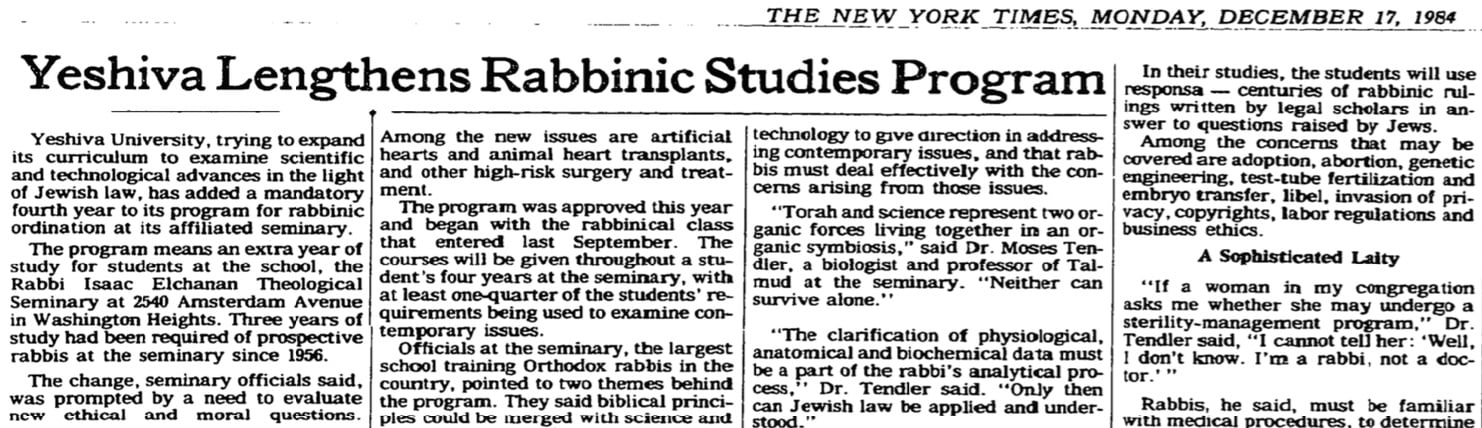
December 17, 1984: My New York Times report on Yeshiva University's decision to expand rabbinical education to address contemporary ethical issues.

by Mordechai I. Twersky - He was named to the Forward’s Top 50 in 2013 after he exposed decades of child sexual abuse at Yeshiva University.
 

‘A life of Torah cannot be compartmentalized,’ Yeshiva University declares in announcing its new ethics initiative. Forty-two years after covering a similar announcement for The New York Times, the author asks whether that principle also applies to the university itself.

Forty-two years ago, as a freelance reporter for The New York Times, I covered the announcement by Yeshiva University’s Rabbi Isaac Elchanan Theological Seminary (RIETS) that it planned to expand the curriculum of its Semikha (ordination) program to better prepare future rabbis for the ethical dilemmas of the modern world.

The message was inspiring. Jewish law, university leaders explained, could not remain frozen in an earlier age. Future rabbis would confront questions raised by medicine, technology, business and public life. Halakha had to engage the realities of contemporary society.

Last week, that same seminary announced another ethics initiative: a graduate program in Business Ethics and Jewish Law. Once again, the university and its affiliated seminary speak eloquently about responsibility, fairness, judgment and moral leadership.

Reading the announcement, I found myself returning to that article I reported in 1984.

Not because the university’s aspirations have changed.

But because history has.

In the decades since, dozens of survivors have alleged that children were sexually abused within Yeshiva University-affiliated institutions during the very years the university was publicly presenting itself as a leader in Jewish ethics. Litigation concerning those allegations continues today. The university denies wrongdoing and continues to defend itself in court, while survivors continue to seek broader access to institutional records and a fuller accounting of what occurred.

That history fundamentally changes how today’s announcement is read.

The question is not whether business ethics deserves serious study. It unquestionably does.

Nor is the question whether Jewish law has something meaningful to contribute to modern commerce. It unquestionably does.

The question is different.

Can an institution credibly teach ethical responsibility while continuing to resist full transparency concerning its own ethical decisions?

That question extends far beyond Yeshiva University. Every institution that claims moral authority—religious, educational, governmental or corporate—must ultimately be judged not only by what it teaches, but by what it is willing to examine about itself.

Ironically, the new program’s own philosophy captures the issue perfectly.

According to the university, “A life of Torah cannot be compartmentalized.”

I agree.

Neither can institutional ethics.

Ethics cannot be confined to classrooms, conferences or graduate curricula. They are tested when institutions confront their own failures—especially when those failures involve vulnerable children, public trust and the courage to pursue truth wherever it leads.

Forty-two years ago, I reported on Yeshiva University and RIETS’ vision of preparing rabbis for the ethical challenges of the future.

Today, with the benefit of hindsight, decades of reporting, publicly filed court records and personal experience, I find myself asking a far more difficult question.

Not whether Yeshiva University or its seminary can teach ethics.

Whether it has first demonstrated them. 


About the Author:
 
 Mordechai I. Twersky is a veteran journalist, essayist, strategic media consultant and community and social activist. He has reported for – and his essays and op-eds have appeared in -- the New York Times, Haaretz, the Jerusalem Post, and the New York Jewish Week. Mordechai earned a B.A in political science from Yeshiva University, an M.S. from Columbia University’s Graduate School of Journalism, and an M.A. in political communications from Tel-Aviv University. He was named to the Forward’s Top 50 in 2013 after he exposed decades of child sexual abuse at Yeshiva University. A social activist inspired by his great-uncle, Prof. Abraham Joshua Heschel, Mordechai is an advocate for the rights of foreign caregivers, the elderly and physically challenged, terror victims, and survivors of institutional abuse. A native of New York City, Mordechai is the scion of the 250-year-old Twersky-Heschel Rabbinic-Hasidic dynasty.

https://blogs.timesofisrael.com/the-ethics-yeshiva-university-teaches-and-the-ethics-it-must-face/

Monday, July 27, 2026

"Where does the Trump family business end and where does American foreign policy begin?"


XMAS CELEBRATION WITH ONE TOKEN JEW BY ACCIDENT OF BIRTH

The most important question facing Americans today is no longer, "What is Donald Trump's foreign policy?" It is, "Where does the Trump family business end and where does American foreign policy begin?" Increasingly, the answer appears to be nowhere.

There are no coincidences in foreign policy—only priorities.

Donald Trump could have chosen Canada for his first presidential trip abroad. He could have chosen Great Britain, America's oldest ally. He could have chosen France, Germany, or even Israel. Instead, he broke with decades of American presidential tradition and chose Saudi Arabia. The message was unmistakable. Before America had fully learned what Trumpism meant, Saudi Arabia already knew. Donald Trump was coming to do what Donald Trump has always done—make deals. Saudi Arabia was not merely his first foreign destination; it was the opening chapter of a new American foreign policy—one in which transactional relationships would replace enduring principles.

Americans are entitled to ask difficult questions. Would Donald Trump be pursuing precisely the same policies if his family possessed absolutely no business relationships throughout the Gulf? Would Saudi Arabia occupy precisely the same privileged position in American foreign policy if billions of dollars were not simultaneously flowing through investments, developments, and strategic partnerships connected to members of the President's family?

And now comes perhaps the most astonishing development of all—the willingness of the United States to provide Saudi Arabia with civilian nuclear technology and assist in the development of commercial nuclear reactors. Congress and nonproliferation experts have raised concerns that the agreement departs from previous American standards by permitting uranium enrichment under circumstances different from earlier "gold standard" agreements negotiated with allies. The implications are profound. Nuclear technology is not another hotel licensing agreement or golf course development. It represents one of the most consequential strategic decisions a nation can make. 

There was once an American principle, imperfectly observed but nevertheless sacred, that foreign policy belonged to the Republic and not to the ruler. Kings had family interests. Democracies had national interests. The President of the United States was expected to subordinate personal ambition, family enrichment, and political vanity to something larger than himself—the enduring interests of the American people and the world at large.

That line has not merely been blurred in the Trump era. It has been bulldozed.

For all of Trump's talk of putting America First, one is forced to ask whether America is first, or merely another subsidiary in the Trump family portfolio.

We are witnessing something unprecedented in modern American history—a foreign policy that simultaneously advances geopolitical objectives while creating extraordinary opportunities for family influence, business relationships, and private financial gain. The distinction between public service and private interests has become so obscured that future historians may conclude that Donald Trump's greatest diplomatic achievement was not redefining American foreign policy, but privatizing it.

When Saudi Arabia prospers diplomatically, does America win? Perhaps. When Saudi Arabia prospers financially while entering into multi-billion-dollar relationships with members of the Trump family, who exactly is winning? Americans deserve to ask the question without being accused of partisanship.

Trump's son in-law has cultivated extraordinarily close relationships with Gulf monarchies while his investment firm manages billions of dollars originating from sovereign wealth funds from Saudi Arabia, Qatar, and the United Arab Emirates. These are not casual business relationships. They are relationships with governments whose interests are frequently and directly implicated by American foreign policy decisions in the Middle East.

At precisely the same time, the Trump Organization continues expanding its enormous business relationships throughout the Gulf states. In 2026 alone, Saudi developer Dar Global announced additional Trump-branded projects in Saudi Arabia valued in the billions of dollars, including Trump Plaza Jeddah and developments in Riyadh.

Perhaps this presents no conflicts whatsoever. Americans are free to reach that conclusion. What they are not free to do is pretend these relationships do not exist.

The problem is not whether corruption can be conclusively proven. The problem is that a Republic should never require its citizens to become forensic accountants in order to determine whether their foreign policy is being conducted in Washington, Riyadh, or at the negotiating table of a private business venture.

Donald Trump promised Americans that he was too wealthy to be bought. America instead received something infinitely more dangerous—a President whose worldview suggests that everything and everyone is for sale. Allies are transactional. Enemies are transactional. Peace is transactional. War is transactional. Loyalty is transactional. Even truth itself appears transactional.

There was a time when Henry Kissinger was criticized because foreign policy was accused of being too cynical. Today's cynicism makes Kissinger appear almost philosophical by comparison. At least Kissinger believed history existed. Trump appears to believe only tomorrow's headline exists.

Foreign policy has become reality television masquerading as grand strategy. The world's most dangerous conflicts are treated as episodes awaiting their next ratings boost. One day there are threats of annihilation, the next day congratulations and celebrations. America's allies are insulted before breakfast and embraced before dinner. Policy changes not merely with circumstances, but frequently with mood, applause, and political necessity.

But perhaps the greatest tragedy is that Trump did not create America's moral vulnerability—he merely exposed it.

The Trump family instinctively understood that Washington had become transactional long before Donald Trump descended an escalator in Manhattan. They merely stripped away the euphemisms. Influence became influence peddling without embarrassment. Diplomacy became deal-making without apology. Foreign policy became branding without disguise. The family business simply became the national business.

America's founders understood precisely the same danger. They feared kings because kings always confuse themselves with their kingdoms. They feared aristocracies because aristocracies inevitably become family enterprises masquerading as governments. Their constitutional experiment was specifically designed to prevent public office from becoming private property.

The greatest irony of the Trump era may be this: Americans elected a President promising to drain the swamp and instead discovered that swamps can become family businesses.

Perhaps history will ultimately judge Trump's foreign policy as brilliant. Perhaps it will judge it catastrophic. That debate belongs to historians. But there is another judgment that need not await history.

No American should ever have to ask whether a foreign policy decision benefits the United States, benefits the Trump family, or conveniently benefits both simultaneously. The moment citizens cannot confidently distinguish between those three possibilities, something precious has already been lost.

A Republic cannot survive indefinitely when its diplomacy resembles a licensing agreement and its foreign policy resembles a family office investment prospectus. America deserves a foreign policy—not a family business plan.


REPUBLISHED

https://blogs.timesofisrael.com/donald-trumps-confusion-family-foreign-policy-are-one-and-the-same/