EVERY SIGNATURE MATTERS - THIS BILL MUST PASS!

EVERY SIGNATURE MATTERS - THIS BILL MUST PASS!
CLICK - GOAL - 100,000 NEW SIGNATURES! 75,000 SIGNATURES HAVE ALREADY BEEN SUBMITTED TO GOVERNOR CUOMO!

EFF Urges Court to Block Dragnet Subpoenas Targeting Online Commenters

EFF Urges Court to Block Dragnet Subpoenas Targeting Online Commenters
CLICK! For the full motion to quash: http://www.eff.org/files/filenode/hersh_v_cohen/UOJ-motiontoquashmemo.pdf

Monday, February 10, 2014

The Fragile Boundary Between Religion and Child Abuse!


Shedding Light on Religious Child Maltreatment
Posted on May 8, 2011 by Valerie Tarico

Valerie Tarico interviews Janet Heimlich, author of Breaking Their Will: Shedding Light on Religious Child Maltreatment. During eight years working for NPR, Heimlich never shied away from controversial topics. She won nine journalism awards, in part by doggedly exposing injustices in the death penalty and prison systems. Most recently she made her way behind another set of locked doors, into the inner sanctums of authoritarian religious communities.

Tarico: What got you focused on such a hot potato of a topic?

Heimlich: I came upon the idea rather gradually. As a first-time mother at the age of 41, I first simply became focused on children’s issues, such as compassionate parenting. I then started to notice high-profile stories in the news, such as the child sexual abuse scandal in the Catholic Church. One week in 2008 was particularly poignant: The pope came to the U.S. and spoke publicly about the scandal for the first time; meanwhile, authorities raided a polygamous fundamentalist Mormon group in west Texas, based on concerns that members were conducting marriages between men and underage girls. So, in some ways, my discovering the issue of religious child maltreatment was a personal venture, but, in other ways, it was very similar to how I come upon any story as a journalist.

Tarico: Some people would say that religion prevents child abuse – that a supportive spiritual community or a personal relationship with a higher power, or a strong moral core is the antidote to maltreatment.

Heimlich: As I state in the book, families generally benefit from participating in religious activities. Still, we are only beginning to understand how children are harmed in certain religious communities. In my research, I found that, in these problematic cultures, the good of the faith community as a whole takes priority over members’ individual needs, and this is particularly true with how those communities view children. I should also point out that, while many people of faith point to scriptural passages that appear to glorify children, those passages are few and far between. The Bible actually says very little about children being important people—for example, children are basically ignored in the Ten Commandments—and when children are discussed in the Bible, they are often portrayed as victims of violence.

Tarico: How did you go about your research?

Heimlich: Basically, I read everything I could get my hands on regarding the mistreatment of children in religious environments. I plowed through hundreds of news articles and studies. I also interviewed dozens of adults who had been victims, as well as the few experts who have studied and written about the issue. I’m still trying to keep abreast of it all. I’d like to believe that religious child maltreatment is not as bad today as it was years ago—and to some extent, I feel that that’s true—yet new cases continue to shock me on a weekly basis.

Tarico: What was the most heartbreaking story you encountered?

Heimlich: When I was still mulling over the idea of writing this book, I kept playing devil’s advocate with myself, questioning whether religious child maltreatment was, in fact, a serious problem today. One day, I noticed a brief news blurb in the New York Times that settled the matter for me. The article explained that a little boy, a toddler, had been starved to death by a small cult in Baltimore for failing to say “amen” at mealtimes. What was particularly shocking to me was that this was not just the work of one deranged person—four adults were implicated in the crime, including the boy’s mother. Later, I would learn just how persuasive cult thinking can be; I’ve since gotten to know the dead boy’s grandmother who has gone through much heartache.

The other case involved a man named David Yoder who grew up in a conservative Amish community and today works to try to reduce child abuse in Amish communities. The first time we spoke, David told me how, when they were boys, he and a friend were mercilessly beaten by their fathers at the same time for being disobedient. The “crime” was fighting, although the boys had done no more than toss a piece of wood at each other. (This was reported by their teacher, and David’s father never got his son’s side of the story.) Again, the violence these boys endured was not delivered by a sadistic or mentally ill individual—both adults colluded to whip the boys until they apparently were close to death. But it’s not only important to call attention to child abuse in religious communities. In each case, my book examines how the belief system of those communities leads to the abuse.

Tarico: At this point, how would you describe the relationship between child abuse and religion?

Heimlich: I think the most important message of my book is this: Religion can provide children with a wonderful upbringing, but it is naïve and irresponsible to see religion only as a force for good. We’ve all seen how religion can lead people to go to war and wage terror on others. In the same way, religion can be a source for child abuse and neglect. As I often say, religion can bring children great comfort, but it can also turn their lives into a living hell. The sooner we accept that, the sooner we can hope to reduce child suffering.

Tarico: Are some kinds of religious communities more prone to maltreatment than others? What are the patterns?

Heimlich: In writing Breaking Their Will, I felt it was imperative not to simply expose problems but answer the question: What makes religious experiences healthy and unhealthy for children? I came to the conclusion that children are more vulnerable to abuse and neglect if they live in religious authoritarian cultures. There are three perfect-storm factors that identify a religious culture or community as authoritarian: one, the culture has a strict, social hierarchy. Two, the culture is fearful. And three, the culture is separatist. The more intense these three factors are—the more authoritarian the culture is—the more likely children will be harmed. It’s important to note that it doesn’t matter whether the community is Christian, Jewish, or Muslim; whether people worship a deity called “God,” “Allah,” or “Jehovah”; or whether they read from the Bible, the Qur’an, or the Book of Mormon. Any religious culture has the potential to subscribe, and be subjected, to authoritarian “rule.”

Tarico: Is child maltreatment one of those areas where faith has “gotten a free pass?” – Can people can do things in the name of faith that would be considered unacceptable otherwise?

Heimlich: I can name many examples where child abuse in religious communities is more or less accepted, while the same maltreatment would never be tolerated in secular communities. Often, apologists for this abuse—even though these individuals would never call what is going on abuse—defend the actions of the faithful in the name of religious freedom. In other words, they claim that critics who advocate that children should be treated better are really attacking people’s right to practice their faith. A perfect example is faith-healing-related child deaths, where adults believe that they have a right not to take a sick child to the doctor based on their religious beliefs.

Tarico: What can people of faith do to address these problems?

Heimlich: In Breaking Their Will, I discuss a number of solutions that could help reduce religious child maltreatment. Real change is only going to come when faith communities face some truths that, traditionally, they have not faced. And it starts with recognizing that faith can both help and hurt children. I compare religion to cars, guns, and fire: They all have the potential to greatly help people, but they can also be extremely dangerous when precautions are not met. All that said, some religious leaders and other members of faith communities have taken bold stands against child maltreatment, including that which is motivated by religious belief. For example, leaders of the Church of Jesus Christ of Latter-day Saints have traditionally opposed the corporal punishment of children; some religious leaders have turned in to authorities adults who have been accused of abusing children; and many others try to educate their communities about the need to take the problem of child abuse seriously.

Tarico: Should secular authorities engage as well – or will that only result in “circling the wagons?”

Heimlich: Children in religious authoritarian cultures greatly need the help that is offered by secular agencies, such as law enforcement and child protective services. But, for a host of reasons, adults living in those cultures are unlikely to reach out to those agencies. Many mistrust anything related to government. Some even believe such agencies work for the devil. Therefore, it is imperative for police, social workers, and government officials to reach out to faith communities that they suspect are abusing children to try to bridge what has been a very big gap of mistrust and miscommunication. I interviewed two state attorneys general who are doing just that, and they have seen improvement. One is Utah’s Mark Shurtleff who decided that fundamentalist Mormon groups would no longer be prosecuted just for practicing polygamy, unless they stand accused of abusing children. Shurtleff has also offered these groups psychological counseling. One of the counselors told me that there have been reports of child abuse, whereas before, no one would have reported abuse. Also, Oregon’s John Foote has tried to make inroads with a sect that was allowing children to get very sick and die because of members’ zealous beliefs in faith healing. Foote told me how one member of the group, a father, even called Foote to get advice on what he should do if his children got sick. Of course, Foote told the man, who did not give his name, that he should call a doctor.

Tarico: Has your book aroused detractors?

Heimlich: It’s too early to tell, since the book has just become available. (The release date is June 1.) But as I was doing my research and telling people about the subject of the book, I found that liberal believers strongly agreed that religious child maltreatment is real and a serious problem. I can’t tell you how many people have expressed relief that I wrote this book. On the other hand, conservative believers have tended to reject the notion that anything bad could come from religion. Rather, they want to only blame individuals rather than seeing the systemic problems that plague communities, generation after generation. Many apologists say that people who abuse children in a religious context are not “true” believers, so we should ignore religion as an influencing factor. My feeling is, many of those naysayers are rather ignorant about what is contained in religious texts and doctrines, as some seem to condone authoritarian parenting if not abuse. But, more importantly, is anyone truly qualified to determine what makes a “true” Christian, a “real” Jew, or a perfectly devout Muslim? I think we’d be a lot better off if we focused less on judging people’s religiosity and focused more on whether children’s needs are being met in religious environments.

Valerie Tarico is a psychologist and writer in Seattle, Washington. She is the author of Trusting Doubt. Her articles can be found at Awaypoint.Wordpress.com.

High-profile cases such as the child sexual abuse scandals in the Catholic Church and "faith healing" deaths in certain fundamentalist Christian congregations have made the public aware that religion can sometimes mask deviant and harmful behavior. But the extent of the problem is far greater than most people realize. This revealing, disturbing, and thoroughly researched book exposes a dark side of faith that most Americans do not know exists or have ignored for a long time—religious child maltreatment. After speaking with dozens of victims, perpetrators, and experts, and reviewing a myriad of court cases and studies, the author explains how religious child maltreatment happens. She then takes an in-depth look at the many forms of child maltreatment found in religious contexts, including biblically-prescribed corporal punishment and beliefs about the necessity of "breaking the wills" of children; scaring kids into faith and other types of emotional maltreatment such as spurning, isolating, and withholding love; pedophilic abuse by religious authorities and the failure of religious organizations to support the victims and punish the perpetrators; and religiously-motivated medical neglect in cases of serious health problems. In a concluding chapter, Heimlich raises questions about children’s rights and proposes changes in societal attitudes and improved legislation to protect children from harm. While fully acknowledging that religion can be a source of great comfort, strength, and inspiration to many young people, Heimlich makes a compelling case that, regardless of one’s religious or secular orientation, maltreatment of children under the cloak of religion can never be justified and should not be tolerated.

http://www.amazon.com/Breaking-Their-Will-Religious-Maltreatment/dp/161614405X/ref=sr_1_1?s=books&ie=UTF8&qid=1392099565&sr=1-1&keywords=breaking+their+will

Thursday, February 06, 2014

So Pathetically Late! - How Much of a Beating Does One Group Need Until Someone Dares Speak Up?

A Long Needed Discussion

The lengthy Mishpacha piece on Rabbi Moshe Bak's Project Innocent Heart ("King of Hearts," January 1 2014) and the plethora of responses it generated in these pages last week are indicative of a positive trend in our community. Child abuse is no longer a taboo subject that can never be discussed. The numerous organizations in the field addressing various aspects of the problem indicate that it has moved to the top of the communal agenda.

That itself is an achievement. For years predators have been emboldened by the unwillingness of the community to discuss, much less address, the issue of abuse. Now that the issue is being discussed they can no longer hide in the shadows confident that a conspiracy of silence surrounds the issue.

The different emphases of Project Innocent Heart and groups like Magenu and Magen also remind us of an important truth: On very few complex and important issues is there one self-evident correct response. And often times the best response is a multi-layered one that combines the different expertise of the major actors in the field.

ONE LINE DID STICK OUT in Rochel Ginsberg's genuinely path-breaking interview with Rabbi Bak: Her statement that Project Innocent Heart "does not hunt predators." No organization in the field, as far as I know, focuses on hunting predators. Rather their concerns are education of children, parents, and teachers, prevention, early intervention, and treatment.

I should emphasize that I did not for a moment read Rabbi Bak's statement as one of a lack of concern with removing predators from our communities. Elsewhere he states, "We don't care who the predator is. It [the abuse] must stop and the abuser must be punished."

But I think it is important to emphasize that removing predators from our communities is inextricably related to the issues of prevention and successful treatment of victims. As Tanchum Burton, a therapist with a great deal of experience in the treatment of predators, wrote to Mishpacha last week, predators do take into account the likelihood of being caught, especially where detection entails the likelihood of a long prison term.

One of the many crucial points Rabbi Bak made was that pedophilia is a disease -- one that seems virtually incomprehensible to those not afflicted. Like any compulsion, it is difficult to treat, and we fool ourselves if we think that mere threats will be sufficient to deter predators. I know first hand of a case where a pedophile was repeatedly warned by neighbors, given a protocol that he was to follow, and pressured to enter therapy. In addition, neighbors informed one another that they should make sure that their sons stayed well clear of him.

No one wanted to see him go to jail, and there was widespread sympathy for his family. Yet, perhaps inevitably, there were those in the neighborhood not "in the loop" – new ba'alei teshuva, non-Hebrew speakers – who never received the message to protect their children and whose children may have been more vulnerable as well. The warnings were not heeded, the protocols not followed, and the therapy abandoned, with the result of damage to more precious souls.

NO LESS CRUCIAL is a point I have made before: Prosecution of predators is a crucial component of the therapeutic treatment of their victims. (Here I'm drawing primarily on "Treatment of Victims of Childhood Psychological Abuse" in Breaking the Silence by Dr. David Pelcowitz, the Orthodox community's go-to expert on the subject.)

Another of the very important points made by Rabbi Bak is that perpetrators are far more likely to be family members or those well-known to the victim than they are to be educators. But whether the perpetrator is a family member or an authority figure bearing the communal imprimatur, the inevitable result of abuse is for the child to experience a dramatic loss of trust in those structures to whom he looked for protection, whether they be communal or familial. Those structures have failed him by not protecting him.

Mrs. Debbie Fox, who developed the "Safety Kid" program being used in many Orthodox schools today, writes that victims often express greater anger towards those who failed to protect them than towards the perpetrators themselves.

If a child who has been victimized sees his abuser still walking free in the community, his generalized sense of betrayal is magnified. Even if the abuse has stopped, each time he views the perpetrator he experiences a fresh reminder of what happened to him. The trauma remains an open wound that cannot even begin to be healed. The perpetrators presence conveys a message to the victim that the "system" – in this case the religious community in which he lives – does not really care about what happened to him.

Dr. Pelcowitz emphasizes the crucial nature of "validation" of what the child has suffered for any therapeutic intervention to be successful. In other words, the child seeks support for his feelings of having been horribly wronged. Where parents or others show a reluctance to prosecute the perpetrator – sometimes out of sympathy for the perpetrator or his family – the child will experience that reluctance as minimizing the magnitude of what he has suffered. Indeed, writes Dr. Pelcowitz, it is relatively common for parents to downplay the significance of what has taken place, perhaps out of a misplaced feeling that doing so will make it less traumatic.

Victims of abuse typically experience feelings of worthlessness and are prone to faulting themselves in some way for what happened to them. That is one reason why it is so crucial that they be treated as victims and not as accomplices. Reporting and prosecution of predators is a crucial component of validating the child's status as a victim. "[W]hen the response of the community does not actively and unambiguously support the child by validating their feelings and ensuring that they feel safe," writes Dr. Pelcowitz, "feelings of guilt and worthlessness can be significantly exacerbated.

Those feelings of worthlessness are often expressed in patterns of hopelessness and passivity. When a child sees, however, that his complaints are acted upon, he realizes that he is an actor – not just a passive victim – and his generalized feelings of helplessness are alleviated.

TRANSPARENCY, it is said, is the best disinfectant. By opening its pages to this vital discussion, Mishpacha has gone a long way to bringing closer the day when "our community is [no longer] safer for a pedophile than for a kid," in Rabbi Bak's words.

by Jonathan Rosenblum
Mishpacha Magazine

February 6, 2014
 
http://www.jewishmediaresources.com/1666/parashas-ki-tetzave-5774

What it takes to be a great leader - "Great Leaders See Around Corners" - "Great Leaders Dare To Be Different"...

 CLICK: http://www.ted.com/talks/roselinde_torres_what_it_takes_to_be_a_great_leader.html

"It is the nature of the human species to reject what is true but unpleasant and to embrace what is obviously false but comforting"

H.L. Mencken

"The Vatican said it would study the report but complained that it interfered with church teaching and religious freedom"

The Same Mantra Used By The Ultra-Orthodox Jews --- Mesirah, Rechilus, Loshon Hara...etc.


Timothy J. McNiff - the Archdiocese Superintendent of New York schools cavorting with David Zwiebel of Agudath Israel Last Week at 42 Broadway
The documented evidence in recent decades shows the finding by the United Nations Committee on the Rights of the Child was a well-deserved judgment, particularly as Vatican officials continue to insist the many thousands of cases of child rape and abuse by clergy were a matter outside their domain and best left to the discretion of local civil authorities.
 
The United Nations panel went to the heart of the matter in rejecting the church officials’ claims that they were responsible for enforcing the United Nations Convention on the Rights of the Child only within the geographical limits of Vatican City and not globally through their power over the Roman Catholic diocesan hierarchy.
 
In practice, this policy fed the pattern of cover-up by local church officials who sent abusers to other parishes and ducked the obligation to notify civil authorities of crimes. Since it was the Vatican that ratified the children’s rights convention, it is responsible for ensuring its provisions are followed down to the parish level, the report said.
 
The panel demanded that the Vatican, which has been overseeing abuse cases in Rome in recent years, open its archives to identify not only rogue priests but their superiors who kept the crimes hidden from criminal prosecutors. The committee’s findings, while nonbinding, should be of considerable interest to those who say church officials have not done enough to disclose all the facts and make sure stronger protections are in place. For one thing, the Vatican could order all dioceses to notify local law enforcement of abuse cases, regardless of differing national policies.
 
In responding to the panel, the Vatican said it would study the report but complained that it interfered with church teaching and religious freedom — a reference perhaps to the panel’s comments on the church’s position on abortion, contraception and gay rights. The main issue of the report, however, was the protection of children from a scourge within the church that has damaged it severely. Dozens of predatory priests were found still working with children, the panel warned.
 
In responding to sharp questioning from the committee last month, Bishop Charles Scicluna, the Vatican’s former chief prosecutor of sexual abuse, flatly insisted: “The Holy See gets it.”
 
 That remains to be seen. The panel found some promise in the election of the “progressive” Pope Francis, but the powerful Vatican bureaucracy is far from demanding greater responsibility from diocesan leaders.
In practice, this policy fed the pattern of cover-up by local church officials who sent abusers to other parishes and ducked the obligation to notify civil authorities of crimes. Since it was the Vatican that ratified the children’s rights convention, it is responsible for ensuring its provisions are followed down to the parish level, the report said.
 
The panel demanded that the Vatican, which has been overseeing abuse cases in Rome in recent years, open its archives to identify not only rogue priests but their superiors who kept the crimes hidden from criminal prosecutors. The committee’s findings, while nonbinding, should be of considerable interest to those who say church officials have not done enough to disclose all the facts and make sure stronger protections are in place. For one thing, the Vatican could order all dioceses to notify local law enforcement of abuse cases, regardless of differing national policies.
 
In responding to the panel, the Vatican said it would study the report but complained that it interfered with church teaching and religious freedom — a reference perhaps to the panel’s comments on the church’s position on abortion, contraception and gay rights. The main issue of the report, however, was the protection of children from a scourge within the church that has damaged it severely. Dozens of predatory priests were found still working with children, the panel warned.
 
In responding to sharp questioning from the committee last month, Bishop Charles Scicluna, the Vatican’s former chief prosecutor of sexual abuse, flatly insisted: “The Holy See gets it.” That remains to be seen. The panel found some promise in the election of the “progressive” Pope Francis, but the powerful Vatican bureaucracy is far from demanding greater responsibility from diocesan leaders.


Wednesday, February 05, 2014

Agudath Israel's Attitude On The Welfare of Children - “I’m guessing that the answer is, some mohelim are complying and some are not.”


 ACTUAL SUMMONS
Perhaps New York City should summons the Agudath Israel to respond as to the biblical origins of "oral suction".

Keeping People In The Dark Is The Name Of The Game

Like The Forward on Facebook!
 

New York Fails To Enforce Consent Forms for Metzitzah B'Peh Circumcision Rite – Forward.com

Published Wednesday, February 5, 2014
 

New York Fails To Enforce Consent Forms for Metzitzah B'Peh Circumcision Rite


2 More Infants Contract Herpes But No Sign of City Action


By Paul Berger
It has been more than a year since New York City introduced a regulation requiring mohels to obtain written consent before performing a controversial rite that risks infecting infants with neonatal herpes.

The regulation put Mayor Michael Bloomberg at loggerheads with the ultra-Orthodox community. And it promises to be a headache for his successor, Bill de Blasio, who has said that he would maintain the consent form requirement.

Since the regulation was introduced, the city’s health department has warned of two cases in which infant boys contracted herpes following metzitzah b’peh, a rite in which the mohel places his lips directly on the circumcision wound to suck away blood. The most recent case was at the end of January.

Yet the city health department will not say whether it has ever enforced its own regulation by requesting copies of consent forms from a mohel. Nor has the city ever issued a warning to a mohel for failing to comply with the regulation.

A health department spokeswoman said the department has not warned or fined any mohels, because it “has not received a complaint about the failure to seek consent.”

That’s despite a case of neonatal herpes in the spring of 2013, in which health officials said the infected infant’s parents did not sign a consent form. In that case, the parents refused to name the mohel who performed the circumcision.

“It’s a real problem with the regime,” said Akiva Shapiro, a lawyer who represents several medical groups that support the city regulation. “There’s essentially no enforcement, and I’ve seen certain people in the community that practices MBP [metzitzah b’peh] thumbing their noses at the regulation for this very reason, saying it will never be enforced and it can’t be enforced.”

Rabbi David Zwiebel, executive vice president of America’s largest ultra-Orthodox umbrella group, Agudath Israel of America, said he had no hard evidence on compliance. However, Zwiebel added,

“I’m guessing that the answer is, some mohelim are complying and some are not.”

Fourteen babies have contracted herpes following MBP since 2000, according to city health officials. Two of those babies died, and two more suffered brain damage.

The health department issued its latest health warning related to MBP on January 28. An infant was diagnosed with a rash on his genitals five days after his circumcision. When cream failed to stop the spread of lesions, he was diagnosed with neonatal herpes and admitted to a hospital for treatment.

A health department spokeswoman declined to say whether a consent form had been signed in the most recent case or whether the infant’s parents had told officials the mohel’s name. “We are currently investigating the case and won’t discuss its details,” the spokeswoman said.

Health regulations stipulate that a mohel must keep copies of consent forms for one year. Asked whether the health department had ever requested that a mohel provide a copy of a signed consent form, the department spokeswoman said, “We are not commenting beyond what was in the [January] Health Alert.”

The ultra-Orthodox community vehemently opposed the consent form regulation when it was introduced in the fall of 2012.

The form asks parents to verify that they are aware that the city’s health department advises against MBP and that there is a risk of transmission of “herpes simplex virus infection, which may result in brain damage or death.”

The regulation was put on hold during its first few months, while a group of ultra-Orthodox organizations — Agudah, the Central Rabbinical Congress of the United States and Canada, and the International Bris Association — sought a preliminary injunction to prevent its implementation. The groups argued that because they do not agree with the information on the consent form, it violates their freedom of speech.

A district judge ruled against the injunction in January 2013, paving the way for the regulation to be enforced. An appeal is currently pending before the United States Court of Appeals for the 2nd Circuit.
For centuries, metzitzah b’peh was a common practice for cleaning the circumcision wound, until some rabbis ruled that a sponge, and later a sterile pipette, could be used instead. Zwiebel said that only some ultra-Orthodox groups use a pipette, while others insist on direct oral suction.

Ultra-Orthodox rabbis do not believe that MBP poses a health risk to infants. Instead, they believe that other caregivers may have been responsible for the infections recorded in New York.

In court papers, the ultra-Orthodox groups rely, in part, on the affidavit of Daniel S. Berman, chief of infectious diseases at the New York Westchester Square Hospital, who states that “the evidence does not show that MBP has ever resulted in transmission” of neonatal herpes.

An array of groups represented by Shapiro contradicted Berman’s testimony, among them the American Academy of Pediatrics and the Infectious Diseases Society of America.

“On one hand, the plaintiffs say the department of health hasn’t collected blood samples or gotten proof of contraction,” Shapiro said. “On the other hand, people are refusing to identify the mohel, and mohels are refusing to be tested. The community’s intransigence makes it impossible to obtain the proof they say is necessary” to show that MBP causes neonatal herpes.

During last year’s mayoral race, some ultra-Orthodox groups hoped that de Blasio would get rid of the consent forms. During the campaign, de Blasio said that Bloomberg had been “wrong to simply dictate to a community on a matter of religious tradition.”

At a January press conference after taking office, de Blasio said he would keep the forms in place “while searching for a solution that we think is more effective.”

De Blasio added: “I think it’s evident that because there hasn’t been the kind of dialogue necessary to get to common ground on this issue, [that DEL] we can do a better job of coming up with an approach that I think is much more effective at protecting the lives of our children.”

The mayor’s press office did not respond to a request to explain what a more effective solution might look like.

Zwiebel said it was unlikely that he would discuss the consent forms with the new mayor until the appeal is decided. But he said that he could meet with de Blasio ahead of time to discuss how the city investigates cases of neonatal herpes linked to MBP.

“Is there an automatic assumption it must have come from a mohel during metzitzah b’peh, or is there a readiness to consider other sources of transmission?” he said.

Zwiebel added that the ultra-Orthodox community sees the city’s attempts to regulate MBP in light of recent efforts to strictly limit or ban ritual circumcision, which are gaining traction in Europe.

“We fear a slippery slope that could lead in that direction,” Zwiebel said.

Contact Paul Berger at berger@forward.com or on Twitter, @pdberger
 

Tuesday, February 04, 2014

Yeshiva U. Accusers Claim Victory Despite Judge's Decision to Toss $680M Abuse Suit


Another plaintiff, who is an anonymous litigant in the lawsuit, said: “If I in any way helped one kid not get abused or one sicko person realize he’s in trouble if he does it, then it was worth all my emotional efforts.

7 Ex-Students Stand By Decision To Air Decades-Old Claims


By Paul Berger

Published February 04, 2014.
  • Print
  • Share Share

                            
    Related                  
Former students who say they were physically and sexually abused at Yeshiva University High School for Boys say they are disappointed but not surprised that a judge dismissed their $680 million lawsuit against Yeshiva University.

Seven ex-students told the Forward that despite the legal setback they achieved a tangible victory by witnessing their decades-old allegations aired — and acknowledged — in public.

Barry Singer, one of the 34 former students who sued Y.U. and one of two named in the suit, said: “To me, the victory is getting it out in the open.”

“The fact [is] that we could sit in the courtroom and have an advocate… stand up and accuse Yeshiva University of things I never dreamed we would get to accuse them of in public,” Singer said.

Another plaintiff, who is an anonymous litigant in the lawsuit, said: “If I in any way helped one kid not get abused or one sicko person realize he’s in trouble if he does it, then it was worth all my emotional efforts.

“Am I disappointed? Yes. Did I expect it? Yes.”

The lawsuit, which was filed in July, 2013, accused Yeshiva University of covering up abuses by Rabbi George Finkelstein, a high school administrator, Rabbi Macy Gordon, a Talmud teacher, and Richard Andron, a visitor to Y.U. high school’s dormitory.

All of the incidents were alleged to have taken place during the 1970s, 1980s and early 1990s.

United States District Judge John G. Koeltl, dismissed the lawsuit last month citing federal and state statutes of limitations. In a written decision, published January 30, Koeltl noted that “the statutes of limitations have expired decades ago, and no exceptions apply.”

Kevin Mulhearn, an attorney for the former students, has vowed to appeal.

Although most of the former students the Forward contacted seemed to take the decision in their stride, one former student was less sanguine.

“It was a travesty of justice,” said the man, who is an anonymous litigant in the lawsuit. “You will notice that not for a second did the judge or Yeshiva University deny any of the allegations or that any of these horrible incident ever occurred.”

“Law is law,” the former student added. “But the statute of limitations can’t possibly begin to apply to a 15 year old minor who has been molested and threatened not to talk. That minor lives his whole life with an incredible amount of doubt and uncertainty about whether he is crazy or not.”

He added: “It hurts so bad… But if I’ve survived the last 30 years, I’ll survive another 30 years if I have to see the enablers brought to justice.”

Contact Paul Berger at berger@forward.com or on Twitter @pdberger
http://forward.com/articles/192117/yeshiva-u-accusers-claim-victory-despite-judges-de/
 

Monday, February 03, 2014

This sinful cover-up occurred because of the erosion of a meaningful bais din process!

The UOJ Archives June 19, 2006

What has happened to good old-fashioned common sense? Most of us folk that make up the ranks of Orthodoxy crave the application of good judgment in our lives to the myriad of decisions that we are faced with every day. And when that judgment is applied to the welfare of our children, vigilance is the order of the day.

So how do we explain Kolko’s ability to stave off these persistent rumors that have dogged him for decades so effectively that he remained in the classroom until just a few weeks ago? We joked about our Cocoa Club and his Kolko Club. Rest assured, if these rumors reached the tender ears of a naïve thirteen year-old, they reached the hanhala of Torah Temimah as well. The previous failed bais din was more than enough for a thinking parent body to dispose of Yudi Kolko from the surroundings of children. Yet Kolko remained a rebbe, in class, enjoying unfettered access to young, vulnerable children entrusted to his care.

Lipa Margulies's crime was not only the lack of caring about your children, not only the pathetic trouncing of all that is sacred to mankind, but he literally spit in all the faces of his parent body, teachers, rebbes and the very foundation of Judaism; mentchlikeit. We were designated by God to set an example to the Nations of the world....oh what have we permitted to be done to us by one evil man?

Consider how this case would have played out if Torah Temimah were a public school. A complaint gets filed with the Board of Ed, and before an inquiry is conducted, Kolko is at the very least, removed from the classroom. Aren’t we supposed to be the smart ones?

Much of the blame lies in the basic human nature of people. We don’t want to believe that rabbis commit sins of moral turpitude. Nor do we want to find ourselves in the unenviable position of being betrayed by those we hope to admire and strive to emulate. It’s so much easier to shove aside the accuser because the alternative, acceptance, reflects so harshly on all of us, both as individuals and as a community. Had this gone on for a few months, or a year, perhaps such reason could be applied to the Torah Temimah hanhala.

But the sheer persistence of these rumors renders Marguiles and his minions absolutely responsible, as if they were in the room with Kolko b’shaas mayseh. Think for a moment what thirty years is. There is simply no excuse for not removing Kolko sooner. Sofek deorysah lchumrah should have been reason enough.

Ultimately, this cover-up may have occurred for no other reason than because it could. With the erosion of any sort of meaningful beis din process, until someone realized that catch phrases like “mesirah” and “rechilus” were just a smoke screen to pervert the truth and disguise the reality, there really is no hierarchy of accountability existing in Orthodoxy today. In fact, it’s become a joke. You don’t like a psak, buy another. For every rav that will tell you “no,” two more will not only tell you “yes” but tell you why the first rav is a lunatic. Sad, but the truth many times is.

I had a rebbe that once told me that mastering the four volumes of Shulchan Aruch were not nearly as important as the fifth – common sense. Our leaders, by failing to act sooner, have abrogated their thrones. We the people are on to them, and it will take more than reference to an obscure tosfos to regain our respect. There are more Kolkos out there. Let’s see who strives to fill the void at the uppermost echelons of Orthodoxy and exposes them.

Turning to the particulars of the case for a moment, let me state unequivocally that I believe David Framowitz. Common sense again dictates that a middle-aged man with a family doesn’t just come out of nowhere and make something like this up. And time does not dull every memory. I would venture that Framowitz remembers what happened to him in that old Plymouth like it was yesterday.

Indeed, Kolko’s belated removal from the classroom will reverberate through the Orthodox world the way Kennedy’s assassination changed the course of American history, and Framowitz is our Zapruder.

What Kolko’s removal says, regardless of the ultimate outcome of this case, to every Jew who has distorted our holy Torah to hide his behavior, to every Jew that fails to control the inclinations that drive them to sin at another’s expense, is that your days are numbered. We may take our licks for violating the laws of lashon harah. We may resort to profanity and less than sophisticated behavior. But we will not continue to enable those that prey on the weak by ignoring their cry. We will bring victims rights to the fore by aggressively pursuing those that prey on them.

If Orthodox "leaders" won’t say it, then the Orthodox will say to our so called leaders zero tolerance. If we are going to call ourselves the am hanivchar, then we are going to start acting like the am hanivchar.

We will start reforming the yeshiva system as the next phase of our crusade, as we know full well that this would never have happened in a public school. Mitoch shelo lishmah, bah lishmah. The fact that Torah Temimah put Kolko “on leave” only after the suits were filed is pathetic and shamefully irrelevant at this point. What is highly relevant is that UOJ has demonstrated that late is better than never!

What remains to be done immediately, is to have Lipa Margulies removed from this yeshiva if it wants to recapture the name of a makom Torah. There is no room among our arba koslei hayeshiva for an evil opportunist to be present.

The leadership of the Jewish people must do just that; lead..... or the rishaim among our community will view this as just another story that they think will go away in time.

It will not; the lawsuit against Torah Temimah will be ongoing, making headlines in the national and international media.

Ridding our community of Lipa Margulies is not optional, it is no less than a chiyuv D'oraisa...ubeartah hara m'kirbechaw.

An Ontario judge has decided to uphold a ruling removing 14 children from the ultra-Orthodox Jewish community of Lev Tahor.


Children to be removed from ultra-Orthodox Jewish community


Children to be removed from Lev Tahor community: Judge


 About 200 members of a Jewish sect — the Lev Tahor group have moved from Quebec to Chatham, Ont. The group is working at setting up their new homes.
 
MONTREAL — An Ontario judge has decided to uphold a ruling removing 14 children from the ultra-Orthodox Jewish community of Lev Tahor.
 
The order means the children must be removed from the sect and placed into the custody of foster families in Quebec.

The ruling at the Chatham-Kent Courthouse upholds a Nov. 27 ruling in St-Jérôme by Youth Court Judge Pierre Hamel, who ordered the children be placed in temporary homes for a period of 30 days.

On Monday, Ontario Judge Stephen Fuerth ruled the Quebec Court had jurisdiction in this case, and said not to uphold the decision would "create jurisdictional chaos."

The children were ordered back to Montreal where foster families have already been identified. Fuerth exempted the oldest of the 14 children, a 17-year-old mother of an infant from the judgment.

However, the ruling won't take effect for 30 days, so the families can have a chance to appeal the judgment, Fuerth ruled.

Ahead of the Nov. 27 court date, about 200 members of the 240-person community fled Ste-Agathe-des-Monts for Chatham-Kent. The case has been tied up in Ontario youth court since that time.

The Quebec hearing, which was carried out in the absence of Lev Tahor members, had heard from a witness, a former member of the sect, who said children were hit in the sect's schoolhouse with wire hangers. The witness also described how children were routinely taken away from their parents and placed with other families as a form of punishment.

Social workers from Quebec's Youth Protection Department had also described how one of the children targeted to be removed was married at age 14, two years younger than the minimum legal age in Canada. Social workers also noted fungus on the feet of most of the girls, ostensibly caused from adhering to strictly modesty rules that they always wear socks, stockings and shoes.

Known as the Jewish Taliban, because of the full-body cloaks warn by women and the sect's anti-Zionist ideals, Lev Tahor has been widely criticized as an extremist cult in Israel. Most of the community's members are either born in Israel or Monsey, N.Y. The sect relocated to Ste-Agathe in 2004 after Rabbi Shlomo Helbrans was granted refugee status in Canada. He claimed he would be persecuted in Israel if he returned there.

Francine Campeau, a spokesperson for Quebec's Youth Protection Department, said she was pleased with the ruling.

"We're happy the judgment was recognized, but we continue to be concerned for the children while they remain with their families," Campeau said.

A spokesperson for Montreal's Jewish community said back in November that several families came forward to act as foster homes for the children. The families are from ultra-Orthodox communities in and around Montreal, and they speak Yiddish, which is essential since Yiddish is the predominant language used in Lev Tahor.

"We welcome the ruling itself," said David Ouellette, the public affairs director at the Centre for Israel and Jewish Affairs, said the community is anxious to help. "This is the course of justice. They have the right to appeal. That can't be denied to them."

jmagder@montrealgazette.com

Twitter: JasonMagder

Sunday, February 02, 2014

"Tawdry Tales"


Better Tracking of Sex Abuse in Schools Recommended


 Federal agencies aren’t doing enough to track incidents of sexual abuse committed by school personnel and should better educate districts and states about how to handle such cases, congressional investigators say.

While the breadth of the problem is unclear, the Government Accountability Office noted there have been numerous media reports of such cases and referenced a 2004 Education Department report that estimated nearly 10 percent of students are victims of sexual abuse by school personnel sometime during their school career.
 
One of the most high-profile sexual abuse cases was in Los Angeles, where a once-respected teacher was sentenced in November to 25 years in prison after entering the legal equivalent of guilty pleas to 23 counts of committing lewd acts on children.

In January alone, teachers have faced sex crime charges in Phoenix, Provo, Utah, and Elizabethtown, Ky., according to news reports.

The GAO, the investigative arm of Congress, challenged the departments of Education, Health and Human Services and Justice to do more.

“Although several federal agencies collect related data, none systematically identify the extent of sexual abuse by school personnel, and efforts to address this data gap are limited,” the report said.

In response, Education Department official Deborah Delisle told the GAO “to the extent possible” the department will explore ways to better track the problem. She said the agency is updating its sexual misconduct training and will explore ways, “given available resources,” to collaborate with the other agencies.

Rep. George Miller, D-Calif., who requested the GAO review, said the issue is often “treated as something that isn’t discussed,” but schools have a legal duty to keep students safe from such abuse and that includes a responsibility to ensure such cases don’t happen. He’s seeking congressional hearings on the issue.

“We know that it is a very real and serious problem and it’s fairly prevalent throughout the nation’s schools, in different degrees,” said Miller, the minority leader of the House Education and Workforce Committee.

The report is a follow-up to a 2010 GAO report that explored 15 cases in which individuals with histories of sexual misconduct were hired or retained by public and private schools as teachers, support staff, volunteers and contractors. In some cases, districts knowingly passed a potential predator to another district, the GAO said. The House passed a bill last year that would create consistency across states in criminal history background check policy.

One issue the GAO focused on in the new report was “grooming” in which perpetrators get to know students or their families to first build trust. The growing use of technology and social media makes the issue particularly relevant, the report said. It said knowing early signs of such inappropriate behavior can help stop sexual abuse before it happens, but that only 18 states require school districts to provide training on sexual abuse and misconduct.

In the report, the GAO highlighted five cases, including one in North Carolina in which a teacher was sentenced to prison time for indecent liberties following an allegation that the teacher had engaged in inappropriate touching of students. An investigation determined that the teacher had taken female students out to dinner and purchased gifts such as a necklace and camera.

Federal law establishes minimum standards for state mandatory reporting laws regarding known or suspected child abuse, but states primarily define the requirements, the GAO said. While most states have laws requiring school personnel to report sexual abuse, school districts may have their own policies that can sometimes create challenges, the agency found. It said, for example, that three districts it visited have policies requiring suspected abuse to be reported to school administrators.

“This can result in a failure to report to the proper law enforcement” or child protection authority, the report said.

Among the GAO’s findings:

- Even though 46 states require criminal background checks of school employees, methods and sources used vary, with some state and employee group officials telling the GAO they have questioned the accuracy of the background checks.

- Forty-two states have professional standards or codes of conduct, and 22 of those included information on appropriate boundaries between personnel and students.

- While education regulations require schools to have procedures in place to protect students from sexual abuse by school personnel, many local school officials told the GAO they are unsure how to apply these requirements.

http://www.claimsjournal.com/news/national/2014/01/31/243751.htm

Friday, January 31, 2014

Really, Rabbi Perlow - Head Of Agudath Israel - Don't you get it?


CLICK ON IMAGE TO ENLARGE:


E-mail by Anonymous

Dear Rabbi Perlow,

Permit a small man to speak a word in the ears of my lord, and let my lord not be angry with his servant, for you are great.

Please, let me speak my mind freely.

"First, however, he reminded his listeners that what makes Agudas Yisroel special is that “it seeks the truth of Torah” and discerns it in the understanding of Gedolei Torah. That determination to divine what is proper for Klal Yisroel “resists even well-meaning daas baalei batim,” Rabbi Perlow proclaimed, and certainly “the bloggers and the picketers, presumptuous promoters” of the notion that “they know better what is good for the Jews.”

Really, Rabbi Perlow. Don't you get it?

 You're publicly acknowledging a burning fire in your community, a chillul Hashem of epic proportions, allowed to continue by...the Agudah and its leaders. If not for UOJ, a big, bad blogger, who singlehandedly raised and fought this issue into the consciousness of the charedi public, you would never have discussed it. It would have remained, as it was for 50 years, our dirty little secret. So, kol Hakavod to UOJ and all of us bloggers and readers, who have forced this unto the front pages, to finally be discussed and dealt with once and for all. But, knowing the Agudah, it won't be.

Amazingly, by virtue of your discussing this crisis at an Agudah dinner, UOJ has won. We have all won. The Agudah lost.

Don't you see that, too? You tried to keep it quiet, off the front pages. We wouldn't let you. So now you discuss it as the very first topic at your dinner. And bloggers shouldn't take credit? Then who should? The Agudah? After silencing students and parents for 50 years?

They will now try to deal with it. Let them try. They have a lousy track record so far on legislation. And they're in bed with the Catholic Church on Markey. What the RCA understands, the Agudah doesn't. What any baal habos understands, the Agudah refuses.

“Individuals have been hurt and deserve redress, acknowledgment and empathy.” There is a need, the Rosh Agudas Yisroel continued, “for tikkun ha’ovar” - correcting the past - and for addressing the future, “creating means to guide against wrongdoing to children.”

What does this mean? Are you agreeing you made serious mistakes for 50 years? You need to "correct the past"? Really? Why? Everything you've ever done has been Daas Torah, right? So how, where, did you go wrong? If you blew it, SAY SO: loudly and clearly: "We blew it, big time. Had no idea what we were doing. Always did the wrong thing, made the wrong decisions, for 50 years. Uhh, very sorry." That would be a step in the right direction.

"Not many people, Rabbi Perlow noted, know of the countless hours spent by the Moetzes Gedolei HaTorah of Agudas Yisroel and the Vaad Roshei Yeshiva of Torah Umesorah over the past two years discussing the many complex facets, including the implications “for mosdos haTorah.”

“ 'No one really knows the sensitivity that went into this entire process,” over the course of many meetings regarding “this painful parsha.' ”

That's the problem. We never elected you. You feel no need to communicate with American Jewry. There's no transparency. We have no idea if you're continuing to ignore the crisis---as you did for so long---or if you're trying to fix it. So we're supposed to believe you're attempting to fix it. But there's no evidence of any attempt to fix it, so what should people believe? That nothing is going on, that's what. But nice to hear that hours were spent trying to...fix it. Can you please show us the fruit of those meetings, other than climbing into bed with the Catholics?

"He called his listeners to carefully read and comprehend the joint statement that was issued several weeks ago by Agudas Yisroel and Torah Umesorah, reflecting the conclusion of the rabbonim at their helms. “ 'It was carefully drafted,” he averred, “and is not to be misread or treated cavalierly.' ”

Noone is reading it cavalierly, we just don't agree with it. You were wrong in the past---you just admitted it---and you're wrong now. That's ok. It's not a sin to be wrong. Just listen to baaleibatim who know more than you and try to lead.

"That statement made clear that the signatory organizations fully acknowledge the horror of abuse, “the devastating long-term scars it all too often creates,” and the fact that “'for too long many victims have suffered alone.'"

No! Are you kidding? Rabbi Shafran once called these incidents "tawdry tales"! Who could believe these children? Agudah rabbis never did. NOW you admit that long term scars result? Really? Who told you? Why believe him?

Your humble servant.

Shmuel

Thursday, January 30, 2014

The story today is that these documents reveal that leadership did engage in the systemic cover-up of these matters.


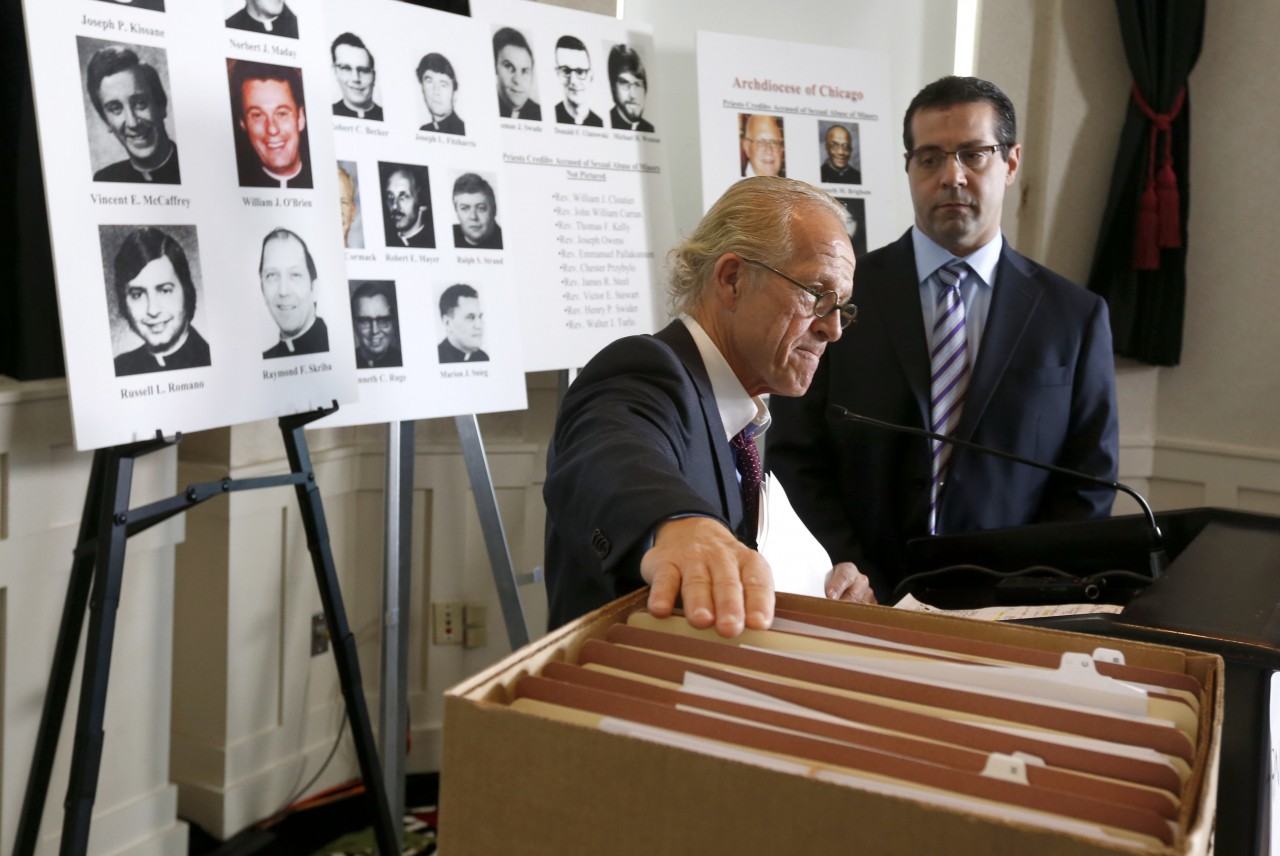
Chicago Clergy Sex Abuse Files Published Online


Attorney Jeff Anderson, left, places his hand on the files of Catholic priests credibly accused of sexually abusing minors in the Archdiocese of Chicago, prior to a news conference Tuesday, Jan. 21, 2014, in Chicago. Joining Anderson is attorney Marc Pearlman. (Charles Rex Arbogast/AP)
          

Rev. Thomas Doyle is a canon lawyer who has been an expert witness on behalf of clergy sex abuse victims. He joins Here & Now’s Robin Young to discuss the contents of the documents.

Guest

  • Thomas Doyle, priest and canon lawyer who has been an expert witness on behalf of clergy sex abuse victims. He also served in the Chicago Archdiocese for seven years.
 Transcript

ROBIN YOUNG, HOST:

And now, a conversation that may not be for all ears. We're going to go to Chicago, where thousands of documents detailing clergy sex abuse allegations were made public just a little while ago today as part of a legal settlement. Attorney Marc Pearlman represents about 200 abuse victims in Chicago.

MARC PEARLMAN: The story today is that these documents reveal that leadership did engage in the systemic cover-up of these matters.

DEBORAH AMOS, BYLINE: They reveal that priests were moved from parish to parish, that they were sent off for treatment and then reassigned, that clerics' histories were hidden from the public. Victims spent nine years pushing for the release of these documents. The AP is calling it the broadest look yet at how one archdiocese responded to the scandal.

YOUNG: Father Tom Doyle is a canon lawyer who's testified as an expert witness on behalf of victims. He worked in the tribunal of the Chicago archdiocese for seven years. He joins us from his home in Virginia. And Father Doyle, obviously so important to the victims, to their backers, but it's almost become a cliche, you know, documents released revealing a cover-up and a scandal. What say you? Why do you see these as important?

THE REV. THOMAS DOYLE: Well, I believe they're important because they continue to report a situation that exists, not just in Chicago but throughout the Catholic Church. And, you know, maximum attention has to be given to the sexual abuse itself but also to the criminal response of the ecclesiastical leadership. This response has caused tremendous harm and pain to the victims. And now in Chicago we see 30, which is less than half of the documented cases that they have on record, 30 files released, which document will prove the legacy of mishandling and dishonestly by the ecclesiastical leadership in the archdiocese for decades, not just now.

YOUNG: Let's hear from one victim, Joe Iacono. He said he was abused by Father Thomas Kelly, whose name is on that list released today.

JOE IACONO: These files - what they mean to me is the truth, not what's coming from the archdiocese even as early as last week when the vicar stood up and said there was no cover-up. Maybe we didn't know what to do, but there was no cover-up. When are they going to learn? There was a massive cover-up.

YOUNG: Father Doyle, who was a part of the cover-up?

DOYLE: I beg your pardon? Who was a part of the cover-up?

YOUNG: Yeah.

DOYLE: The cover-up has to be attributed to the ecclesiastical leadership, to the archbishops and to those who worked closely with them. There would have been no cover-up had the archbishops, from Cardinal George going back as to Cardinal Cody, as far as I know, had they said we'll be completely open and honest, but they didn't. They engineered the cover-up.

YOUNG: Well, you...

DOYLE: They engineered the lying.

YOUNG: You mention Cardinal George, current cardinal. This does not include, this list and these documents that were released today don't include the case, for instance, of Father Daniel McCormack, who pled guilty in 2007 to abusing five children. He is not included in this list.

DOYLE: He is not included in this list. And ironically, when the cardinal sent a letter to his diocese on the 12th of January, he gives - paid specific attention to the case of Dan McCormack. And in that letter, he sent - he told his people things that were simply not true about the McCormack case.

The fact is, is that the review board of the archdiocese very clearly advised the archbishop - urged him not to place McCormack in pastoral ministry, for the welfare and safety of children. This was in 2005. And Cardinal George, against their advice, placed McCormack in ministry. And two to three months later McCormack was arrested for the second time, and that was the end of his career in Chicago.

But the cardinal claimed that he tried to dance around having gone against his review board's advice by saying, well, the investigation wasn't completed. It was confusing. None of this was true. And the review board sent him a letter complaining to him about the fact that his responses were not true.

YOUNG: Well, you talked about who was responsible for a cover-up. The documents don't include Vatican communiques. That was part of the deal the church struck with victims' lawyers. We know the Vatican is being questioned by a U.N. committee. We may someday see those files, what the Vatican said about these cases.

But in the meantime, how angry - in about the minute we have, how angry does this make up priest like you apparently working side by side at one point with one of the accused, not knowing?

DOYLE: How angry does it make - I think from my experience, it makes the good guys very, very angry because they're betrayed essentially by their archbishops. And these are the men whose first focus is the welfare of their people - the spiritual and emotional welfare of the people who they are trying to lead. And when this is violated by the men at the top, it makes - it leaves the priests in the trenches in a very vulnerable position. It's very embarrassing. It's very contrary to everything that's promised to the faithful and to the priests by the bishops and the archbishops.

YOUNG: You worked with Robert Mayer - Bob Mayer, I believe, who was known as Satan. And you were told...

DOYLE: Yeah. He was - that was one of the nicknames I heard given to him when I worked in the archdiocese. I wasn't sure then.

YOUNG: But no one ever told you it was because he was an abuser of minors.

DOYLE: No. No one ever told me that.

YOUNG: Yeah, yeah.

DOYLE: And I never knew about the sexual abuse that he perpetrated until the late '80s.

YOUNG: Yeah. Father Tom Doyle, a canon lawyer who testifies as an expert on behalf of victims as documents are released in Chicago today. Father Doyle, thanks as always.

DOYLE: Thank you.

YOUNG: It's HERE AND NOW.

Transcript provided by NPR.