EVERY SIGNATURE MATTERS - THIS BILL MUST PASS!

EVERY SIGNATURE MATTERS - THIS BILL MUST PASS!
CLICK - GOAL - 100,000 NEW SIGNATURES! 75,000 SIGNATURES HAVE ALREADY BEEN SUBMITTED TO GOVERNOR CUOMO!

EFF Urges Court to Block Dragnet Subpoenas Targeting Online Commenters

EFF Urges Court to Block Dragnet Subpoenas Targeting Online Commenters
CLICK! For the full motion to quash: http://www.eff.org/files/filenode/hersh_v_cohen/UOJ-motiontoquashmemo.pdf

Thursday, July 11, 2019

Alexander Acosta Is A Liar!

Examining Acosta’s Claims on the Epstein Prosecution

R. Alexander Acosta, the labor secretary, defended his handling of a sex crimes case against the financier Jeffrey Epstein over a decade ago. 

The labor secretary, R. Alexander Acosta, rebuffed calls for his resignation by Democrats, who criticized his decision as a prosecutor in 2008 to accept a lenient sentence for the financier Jeffrey Epstein.


At a news conference in Washington, R. Alexander Acosta, the labor secretary and a former United States attorney in Florida, on Wednesday gave his account of how federal prosecutors dealt with allegations that Jeffrey Epstein had abused young women and girls, a case first handled by state prosecutors. Here’s how his version of events stacks up against what we know.
What Mr. Acosta Said
“Simply put, the Palm Beach state attorney’s office was ready to let Epstein walk free, no jail time, nothing.”
Prosecutors who worked with Mr. Acosta said that the federal case presented them with legal challenges that made the matter more suited to a state court. Federal laws, they said, would have required the United States attorney’s office to prove that Mr. Epstein, a financier, crossed state lines with the intent to commit the acts.

Nonetheless, federal prosecutors had legal firepower and resources not available to a local prosecutor. That was especially important for a case that presented such complex legal and logistical challenges, involved a large number of victims — up to 40 at the time of the deal — and the prospect of facing the best defense lawyers and private investigators Mr. Epstein’s money could buy. Local law enforcement officials and the F.B.I. referred the case to Mr. Acosta, in part because they feared Mr. Epstein would face no more than a single state charge related to prostitution, which warranted a fine and no jail time.

Investigators involved in the case were hoping Mr. Acosta could pursue a case that would impose a more substantial penalty on Mr. Epstein. The outcome negotiated by Mr. Acosta’s office was a plea deal with state prosecutors on two prostitution charges that led Mr. Epstein to serve 13 months in the Palm Beach County jail and be registered as a sex offender. During his sentence, he was permitted to participate in a work-release program that allowed him to go to his office six days a week for 12 hours a day. 


Barry Krischer, the former top prosecutor for Palm Beach County, said on Wednesday that Mr. Acosta was trying to “rewrite history” by suggesting that state prosecutors were going to be even more lenient toward Mr. Epstein.

“I can emphatically state that Mr. Acosta’s recollection of this matter is completely wrong,” Mr. Krischer said in a statement. “Federal prosecutors do not take a back seat to state prosecutors. That’s not how the system works in the real world.”

If Mr. Acosta believed the state deal was so terrible, he should have filed a federal indictment instead of conducting “secret negotiations,” Mr. Krischer said.
What Mr. Acosta Said
“She talks about the challenges faced, she talks about the victims being scared and traumatized, refusing to testify, and how some victims actually exonerated Epstein. Most had significant concerns about their identities being revealed. The acts that they had faced were horrible and they didn’t want people to know about them.”
Mr. Acosta was referring to a federal prosecutor on his staff and the possibility that victims might not be willing to testify against Mr. Epstein. Adam Horowitz, a lawyer who represented some of the victims, said that Mr. Acosta’s arguments at the news conference were disingenuous.
He said that the young women were scared to testify, but that it was because the prosecutors had terrified them.


“The prosecutors were saying, ‘These defense lawyers are going to go through your whole personal life, dig up your bad acts and your sex life. When they heard that from prosecutors, sure, they were intimidated,” Mr. Horowitz said. “They kept saying, ‘Are you sure you want to do this?’”

Eventually, after years and under different circumstances, many of the victims did talk — to a Miami Herald reporter — telling the paper that they were dissatisfied with the efforts of Mr. Acosta’s office. 

In a pool of victims so large, it is inevitable that some of them will resist going through to trial, said Spencer Kuvin, a lawyer for three of the victims. But two of his three clients gave depositions and were “willing and ready” to testify, he said.
What Mr. Acosta Said
“We believe that we proceeded appropriately, that based on the evidence and not just my opinion but I have shared the affidavit. Based on the evidence, there was value to getting a guilty plea and having him register.”
It is impossible to know how members of a jury might have responded to the evidence if it had been presented to them in a federal trial — or whether efforts by Mr. Epstein’s team to pressure the victims or intimidate prosecutors would have worked. But Mr. Acosta’s decision to accept a plea deal was widely — but not universally — supported by his own team at the time.
A. Marie Villafaña, the lead prosecutor in the case and one of the few women in Mr. Acosta’s leadership team, pushed him to bring charges even if it risked losing in court. She was eventually overruled, and helped Mr. Acosta work out the logistics of the plea deal.
What Mr. Acosta Said
“When it was finally clear that Epstein would comply with the agreement, she talks about how she made efforts to notify the victims, how that was a Friday afternoon at 4:15 and that she learned that the state had scheduled the plea for 8:30 the following Monday. And she talks about how over the weekend, she made every effort to notify the victims at that time.”
Mr. Acosta was referring to efforts by Ms. Villafaña to reach the victims. His office began directly negotiating a plea agreement with Mr. Epstein’s lawyers in August 2007, according to The Miami Herald. They reached an agreement on Sept. 24 of that year, but talks continued until June 2008, when Mr. Epstein pleaded guilty in court.

From the time the F.B.I. began investigating Mr. Epstein in 2006 to Sept. 24, 2007, Mr. Acosta’s office “never conferred with the victims” or informed them that such an agreement was under consideration, a 2019 federal court ruling shows. The ruling notes that Mr. Epstein’s lawyers sought assurances that the victims would be kept in the dark.


Mr. Acosta cited an affidavit from Ms. Villafaña, who stated that she did not notify victims because she was worried about negotiations over a provision that would allow the victims to obtain monetary damages. She said she was concerned that Mr. Epstein’s lawyers would undermine the credibility of the victims if negotiations fell through and the case went to trial.

Even after the agreement was reached with Mr. Epstein, the prosecutors kept the details from victims.
The victims received letters from the F.B.I. in January 2008 informing them that the case was still under investigation, but not disclosing the agreement. Six months later, a lawyer for the victims, Bradley Edwards, met with a prosecutor to discuss the case — again, the agreement was left unmentioned.

On June 27, 2008, Mr. Edwards was informed that Mr. Epstein would plead guilty in court, but was not told that the state plea would be the resolution to the federal case. Mr. Horowitz said nobody reached out to any of his seven clients before Mr. Epstein pleaded guilty on June 30, 2008. And Mr. Kuvin said that lawyers had to fight in court for months to learn the details of the deal.
What Mr. Acosta Said
“The meeting that was alleged was a breakfast meeting that took place after the agreement was negotiated, not before. The agreement was signed in September.”
Mr. Acosta is correct that the meeting he had with Jay Lefkowitz, one of Mr. Epstein’s lawyers, took place about two weeks after the plea agreement was reached in September 2007. It is less clear what they discussed.

In a letter to Mr. Acosta, Mr. Lefkowitz noted the meeting took place on Oct. 12, 2007, and thanked Mr. Acosta for his “commitment” to not contact any victims or witnesses.

After the meeting, Mr. Epstein’s lawyers continued to negotiate an addendum and objected repeatedly to notifying the victims.

https://www.nytimes.com/2019/07/10/us/politics/acosta-epstein-fact-check.html


Wednesday, July 10, 2019

Sexual assault of children “like an epidemic,” rape crisis centers says ---- The Association of Rape Crisis Centers runs about 100,000 education workshops each year to teach students how to respond to sexual assault.


One out of every five children in Israel is a victim of sexual assault, according to Orit Sulitzeanu, executive director of the Association of Rape Crisis Centers in Israel.

Of the 50,000 calls Israel’s rape crisis centers receive annually, Sulitzeanu said 60% are from people who were assaulted as minors and are reporting a case years later, reflecting the inadequacy of support systems in communities and school.

In the widely followed investigation into the rape of a seven-year-old girl from a West Bank settlement whose main suspect was released on Tuesday due to a lack of evidence, 10 days passed between the time the girl first reported the incident to her mother, her mother reported it to the school, and the case reached the police.

“We are going to approach the minister of education very urgently because we think there’s a big failure in the system,” Sulitzeanu said. “We want him to have a very clear protocol so every teacher will know exactly how to behave.”

In Israel, 84% of sexual assault cases that are reported to the police are closed without indictments, with more than two-thirds of those cases closed due to a lack of sound evidence.

In the recent case, five days passed between the time the girl reported the assault to her parents and a doctor at a local clinic examined her.

“You need all of the systems to synchronize in order to help this child,” Sulitzeanu said, emphasizing that the quicker a school reports a sexual assault case to the police, the quicker the victim can be supported, evidence can be collected, and the perpetrator can be located.

According to the Association of Rape Crisis Centers, which runs just nine centers across Israel and is one of the few organizations in Israel collecting data on sexual assault, only 30% of callers file a report with the police, and fewer than that number reach the legal system.

“The numbers are very, very low,” Sulitzeanu said. “People are ashamed. People sometimes take many years to report. All of these things deter many, many women and men to report to the police.

The Association of Rape Crisis Centers runs about 100,000 education workshops each year to teach students how to respond to sexual assault, but courses that address sexual assault are not mandatory for students studying to be teachers, social workers or psychologists in Israel, she said.

“If the Ministry of Education would indeed open the schools and let our workshops enter all of the schools in Israel, it will be very, very helpful,” said Sulitzeanu, noting that the high-profile nature of the case involving the seven-year-old may spur governmental action.

“In Israel today, there is no systematic, governmental plan to prevent sexual abuse and detection of children who are abused, and this is a must,” she said. “I really hope that this child gets care and a lot of emotional support from her surroundings because this is the most important thing.”


https://www.jpost.com/Israel-News/Sexual-assault-of-children-like-an-epidemic-rape-crisis-centers-says-593649?fbclid=IwAR2kIjAKG6B3l-RnA0gslg3kl9-q-UKYm15Lz7Jhif49AFUCeiPWylvDLuQ

Tuesday, July 09, 2019

Thus, if you must focus on a California earthquake, that is where the focus should lie. The Democrats have destroyed so much that once was Golden. They have micturated our money on Trains-to-Nowhere, on medicare and medicaid and medics for Imported Voters....

The 6.4 California earthquake that should have been getting covered

Decades of Illegal Immigration changed California,perhaps irrevocably. For once and for all, let’s stop calling them “Illegals.” They are not “Illegals.” Let’s start calling them what they really are:  Imported Voters.


Friends call. Acquaintances email. (I don’t text, Facebook, or Tweet.) (But my students still are shocked that I know what’s what.) The message of concern: “Dov, I heard about the earthquake. Are you OK?”

Yes, I’m OK.

It was a 6.4, but I slept through this one.  Before I moved from the New York City area to The Homeless State thirty-some years ago, back when it was called The Golden State, I used to think that earthquakes were like the Torah’s description of what became of Korach and his rebellion against Moses:

Scarcely had he finished speaking all these words when the ground under them split asunder, and the earth opened its mouth and swallowed them up with their households, all Korach’s people and all their possessions. They went down alive into Sheol, with all that belonged to them; the earth closed over them, and they vanished from the midst of the congregation. (Numbers 16:31-33)

I thought — no fault of mine — that was how California earthquakes were: the earth splits and opens, and buildings and houses fall in. I arrived here and — whew! — learned quickly enough: Not so!  Rather, the earth shakes a few moments, sometimes for seconds, rarely even a minute.  And then it is over.  The game then immediately begins, as we argue with each other and even lay bets over the exact number: Was it a 2.8?  A 3.2?  No way over a 4.0!

Well, this one was a 6.4, but its epicenter was outside California’s largest media markets of Los Angeles, San Francisco, and San Diego.

When I first moved here, I remember walking one day in a multi-level indoor parking lot to retrieve my car. As I walked along the ramp, I felt the floor rattling, hovering up and down a bit, as each car raced by, some driving up the ramps, others down. I immediately hustled to the security station to report my sense that the ramps and the structure were about to collapse.  The security guard knowingly laughed:

“You’re new to California, huh?” he giggled.
“Yeah, how did you know?”
He laughed.

It turns out that California really has earthquakes figured out.  The parking lots, the bridges, the roadways, residential buildings — all are built on a foundation and with construction that is ever-so-slightly less rigid than elsewhere in the universe. It is constructed with a bit of “give” so that any time the earth shakes, the ramp / bridge / building can rattle a bit and yet not crack from rigidity. It really is brilliant.  That is why earthquakes of such smaller magnitude kill so many hundreds and thousands in India, Iran, Iraq, and other places spelled that way, as well as in Mexico and other places to our south, while they barely register on the catastrophe scale in California. California learned from the Great San Francisco quake and others later how to alleviate the quakes.

Likewise, the way we set up and furnish our homes.  I have a personal library of more than 4,000 books — Torah, Talmud, Judaic Legal Code (halakhic), and Rabbinic Responsa literature in Hebrew, Aramaic, and English; scores of secular American law horn books and legal treatises; a full library of American history and American civics; another of Jewish history and sociology; another of broad-based theology; and a copy of Hitler’s “Mein Kampf” that I keep amid a shelf of books about the Irgun and the Jewish Underground’s fight for Israel independence.

 That means I have approximately 15-20 full-height bookcases. In California, the day after the movers settle you into a home with such a library, you have the Handyman or Earthquake Guy come over and bolt each bookcase into the wall.  They find the wall’s wood beams with the “geiger counter” thing a person can buy in any hardware store. They nail one end of a very strong strap or other slightly flexible securing device into the beam, and they nail the other end into the bookcase. 

When a shaker hits, the bookcase maybe rattles a bit, maybe a few books fall out, but it withstands the quake because the bookcase is secured firmly even as the strap has that flexible “give” that prevents it from snapping.  Likewise, you keep your expensive Baccarat crystal vases and Kosta Boda crystal bowls away from the edges of your surfaces.  That’s it.

The only ones who take a really nasty hit are the owners of liquor stores. Ouch!

Sure, when the epicenter is closer to a heavily populated and more concentrated metropolis — like the 6.9 Great World Series Quake of 1989 that hit, of all times, amid the Fall Classic’s third game between the San Francisco Giants and the neighboring Oakland Athletics — that has a more devastating impact. Likewise, the 6.7 Northridge Quake of 1994 that hit the San Fernando Valley of Los Angeles particularly hard.  But even then, even with bridge and road damage, with structures ruined and injuries, the sophistication in earthquake preparedness alleviates catastrophe and  results in comparatively minimal human loss of life.

We Californians are amazed, given the relative infrequency of earthquakes here and even greater infrequency of destructive ones, how our non-California friends, relatives, and associates get freaked-out when they hear about a quake.  We look at each other and wonder how people, whose truly deadly and perilously fatal Midwestern tornadoes, Southeastern hurricanes, Heartland floods, Northeastern ice storms and blizzards, and Urban Democrat-Controlled Inner-City Mass Shootings can sit there, fretting over a shaker that comes once every, oh, whenever.

The reality is that people concerned about California earthquakes focus on the wrong 6.4 temblor.  Don’t worry about the shakers; they can be minimized, and they pass. The ones that are toxic and endemic are the Democrats who turned California into a one-dog town and destroyed the Golden State.
The reality is that people concerned about California earthquakes focus on the wrong 6.4 temblor.  Don’t worry about the shakers; they can be minimized, and they pass. The ones that are toxic and endemic are the Democrats who turned California into a one-dog town and destroyed the Golden State.  Not all that long ago, California elected great governors like George Deukmejian and Pete Wilson, and they gave us great judges and courts. This state elected Ronald Reagan as governor. If he does get elected governor, he does not emerge with the “bona fides” to make it to President. If he does not make it to President, we now could be in either our tenth or twentieth year under some Ayatollah or President Vladimir Putin or in the eighth term of Tsar Bernie the Breadline. (Breadlines are a good thing.)

When I arrived here in 1987 to become rabbi of, like, a congregation in, like, Woodland Hills in, like, The Valley — What . . . eh . . . ver! — Southern California still had its Golden sheen. People were so polite that they did not even jaywalk; they were not in such a rush anyway.  And if some visiting rude New Yorker did jaywalk, cars stopped in the middle of the street to let them cross. It was not New York City. It really was La-dee-da.  La-La Land.

Decades of Illegal Immigration changed all that. In fact, for once and for all, let’s stop calling them “Illegals.” They are not “Illegals.” Let’s start calling them what they really are:  Imported Voters.

Imported Voters changed all that.  The Imported Voters came from dire poverty, with limited English skills and limited passion for our Declaration of Independence and Constitution. They came to escape the dregs amid them in search of safety, free food, free shelter, free healthcare, free education, free college, free-free-free.  The Democrats promised them all that, and the Imported Voters reciprocated by giving the Democrats the only thing required: their votes. As a result, California underwent a 6.4 social earthquake — and the epicenter was anywhere and everywhere that people live.

When you offer free food, people lacking food flood in. Get it?  Offer free medical care, and guess what? Offer free this and free that, and guess what?

In the end, the Streets of San Francisco today are not what Karl Malden encountered in his 1970s TV show.  Rather, today’s modern Frisco is comprised of sidewalks filled with the mentally ill and the addicted — people to whom Lombardi Street seems straight. Likewise in Los Angeles.  Instead of extending compassion to The Homeless and bringing them in for mental care and addiction treatment, the Compassionate Progressives throw money at them on the sidewalks. Free needles. Free this, free that.

And guess what? The Sanctuary City Mayors can’t figure out why — but instead of the massive money allocations curing and reducing the homeless epidemics here, the cash infusions instead have attracted even more homeless from everywhere else, doubling and even trebling the street situation.  They are humans, and they need to defecate and micturate. Without toilets, they do so on the streets.  Their food left-overs, with their excretory by-products, brings rats and even typhus.

Remember when Hyphen-Cortez complained about that?  I don’t either.

This is the state that Gavin Newsom (rhymes with “gruesome”) governs and that Kamala Harris would ride to the White House.  They destroyed something beautiful for all but the wealthy. Under their Progressive Caring, The Homeless State now is populated primarily by the Very Wealthy and the Profoundly Destitute. The Middle Class has fled the high taxes, the crazy gasoline prices, the insane home costs exacerbated by the most exacting of zoning laws that the Very Wealthy impose to minimize new home construction in their neighborhoods and thereby maintain exorbitant real estate values.  In Silicon Valley, the very wealthy flourish.  They eat their meals in their high-tech facilities to avoid the “riff raff” they Progressively and Compassionately despise.  They live in lily-white neighborhoods, surrounded by big beautiful walls and armed guards, to keep out the “riff-raff” and to assure that their children never have to encounter them in exclusive school.

They make movies in Georgia. Think about that Alyssa Milano boycott thing: The boycott threat arises because Hollywood makes its movies and TV shows in Georgia. Why? Does Idaho grow its potatoes in Florida? Why doesn’t Hollywood make films in Hollywood anymore?  Answer: Because they refuse to pay the exorbitant taxes they and their Compassionate Progressive failed social programs have imposed on everyone else. Therefore, they set up tax homes in nearby Arizona and Nevada, both tax-free states.

There remain pockets of California that remain what was.  Many parts of San Diego. And despite the ballot-harvesting fiasco of the 2018 bi-election, Orange County is Republican and conservative, except for a few pockets. I insisted this after the Democrats ballot-harvested the Congressional seats, and some on the Left challenged my assertion. Then the 2019 elections came — less than a year later — and the Republican conservative handily won the election for Orange County supervisor, beating the very famous Democrat Left Congresswoman Loretta Sanchez along the way. His biggest problem was that five other conservative Republicans also ran and split votes. The Democrat Sanchez? A bare 37 percent. The rest went to Republicans.

Thus, if you must focus on a California earthquake, that is where the focus should lie. The Democrats have destroyed so much that once was Golden. They have micturated our money on Trains-to-Nowhere, on medicare and medicaid and medics for Imported Voters, on free college for Imported Voters — at the expense of the children of taxpaying citizens who sustain those colleges, but who must either send their kids to colleges out of state or bribe athletic coaches to put their kids on the rowing teams. It is a shame that what once was, no longer is, and perhaps never shall be again.

Perhaps.

The writer is adjunct professor of law at two prominent Southern California law schools, Senior Rabbinic Fellow at the Coalition for Jewish Values, congregational rabbi of Young Israel of Orange County, California, and has held prominent leadership roles in several national rabbinic and other Jewish organizations.  Other writings are collected at www.rabbidov.com

http://www.israelnationalnews.com/Articles/Article.aspx/24116


Monday, July 08, 2019

"The Night We Lost The Messiah Rabbi Menachem Mendel Schneerson"....

MAN WORSHIP, CULT DELUSION OR GOD WORSHIP BY ANOTHER NAME? (UOJ SUB-TITLE)


The Night We Lost The Messiah Rabbi Menachem Mendel Schneerson by the Forward

The Night We Lost The Messiah Rabbi Menachem Mendel Schneerson


The balcony curtains suddenly parted. The Rebbe sat motionless surrounded by his three trusted rabbinical aides. On cue, the singing and chanting began: “Long live our Master, Teacher and Rebbe, King Messiah, Forever and Ever!” Hundreds of men dressed in black suits stood shoulder to shoulder on the synagogue floor craning their necks towards the balcony. I was determined to see for myself how the Rebbe really looked after his recent stroke, and was frightened to discover that the right side of his body was paralyzed. I had been taught that the Rebbe sustained the whole world. I couldn’t believe that he couldn’t even lift his own arm.

It was 1994, and I was fourteen years old and a member of the ten-thousand strong Lubavitch Hasidic community of Crown Heights, Brooklyn. For us, the Rebbe, Rabbi Menachem Mendel Schneerson, was not only a father figure, community leader, and rabbi, he was also the Messiah. The Rebbe and his emissaries around the globe were conquering country after country, setting up Chabad Houses in the most far flung places on earth. I looked forward to the day when I, too, would set up a Chabad House in some remote locale. Despite the Rebbe’s advanced age of 91 and his physical infirmities, there was no doubt in our mind that he was the long-awaited Messiah. The Rebbe’s success in reaching out to every Jew surely qualified him. We were just waiting for God to give him the sign to reveal himself.

Relating to my own father was awkward. My father grew up in Brooklyn, a secular Jew. Sure, he had a bar mitzvah, attended Hebrew Sunday school, but that was the extent of his Judaism. He excelled at his local public school in the Midwood section of Brooklyn, and even sang in the Metropolitan Opera Boys Chorus for three seasons. He loved opera. But following his graduation from Columbia College and Harvard Medical School, he chose a religious lifestyle and joined the Hasidic community. He was subsequently set up by a matchmaker with my mother who had also recently joined the community. Once ensconced in our insular neighborhood, his passion for opera and other non-Jewish hobbies faded away.

My parents didn’t speak Yiddish, but they sent me to a Yiddish-speaking school devoted exclusively to religious instruction. It was a sort of Sunday school that happened to last all week. We studied the Bible, Talmud, and the Code of Jewish Law from sunrise to sunset. There was no instruction in English, math, or science. With the Messiah on his way, what need was there for secular studies? But I was troubled. My father’s college and medical school diplomas hung on the wall of his small home office. He surely knew the value of a well-rounded secular education. I couldn’t understand how my learning the ABC’s would delay the arrival of the Messiah.

Whenever I thought about this disturbing question, I reminded myself, “We have the Rebbe… He is surely the Messiah…Any minute now he will reveal himself…”
Each night I struggled with the Yiddish homework. So, on the recommendation of a neighbor, my parents hired a private tutor named Levi. I was practicing my jump shot at a hoop in the backyard when Levi first came to our house. “Hey, Yossi, pass the ball!” he hollered. I had no idea who he was but he knew my name so I passed him the ball. Without any effort, he sent the ball sailing through the hoop. At that moment Levi became my model of a rabbinical student. My favorite part of Levi’s visits was when he would chat with my father while they tallied up his hours to determine how much he would be paid. Only with Levi, who was practicing to become a cantor, did my father feel comfortable discussing his youthful experiences on stage in the opera. With his kids, he feared such talk would negatively influence our religiosity. My father would discuss famous tenors who sang at the Met. “Have you ever heard a recording of Caruso?” he once asked. “Caruso, why of course, who hasn’t heard Caruso?” Levi admitted. Caruso died in 1921, but my father did perform on stage with Richard Tucker and Robert Merril, two of the greatest voices in operatic history.

The Rebbe had had a stroke a few months earlier, but he would join the evening services in the cavernous main synagogue from a specially built alcove with tinted windows. He could see the crowd below, but they couldn’t see him. Following the service, he would be wheeled onto an adjacent balcony overlooking the crowd. When the curtains were parted the Rebbe, with his long white flowing beard and wearing his customary black caftan and black fedora, came into view. The crowd would look up to him and sing, “Long Live the Rebbe,” over and over again, with the hope of ushering in the messianic age. From time to time, he would nod his head and wave his usable hand to encourage the singing. After a few minutes the curtains were closed and we, his faithful, would not see him again until the next evening’s service.

This particular night, the 19th of Kislev, was a mini-holiday in Crown Heights celebrating the release of the first Chabad Rebbe from a Russian prison in 1798. To get a better view of the Rebbe on the balcony, I climbed on top of a dozen stacked plastic milk crates. After the singing was over, the curtains closed and everyone headed towards the exits. I was nearly out the door, when I heard someone shout, “The Rebbe is on the balcony again!” Within an instant, the synagogue was packed. In a mad dash, I reclaimed my spot atop the milk crates. The Rebbe was seated in his wheelchair, looking down at his followers. No one knew what to do. A paralyzing fear began to set in. It was clear the Rebbe wanted something, but his recent stroke had taken away his speech. All he could do was nod.

The Rebbe’s three long-time aides couldn’t determine what he had in mind, so an elderly hasid wrote down suggestions. A small piece of paper was passed hand to hand until it reached the Rebbe’s main aide on the balcony. He bent down and whispered into the Rebbe’s ear, “Should we all move now to the Land of Israel?” The Rebbe shook his head. “Should we rebuild the Holy Temple in Jerusalem?” Again, the Rebbe shook his head. More men started scribbling suggestions. “Should we build a wall around Crown Heights?” “Should we study a particular Hasidic treatise?” After each suggestion, the Rebbe shook his head. The crowd below became frantic. The Rebbe, who guided the community for forty years, was never at a loss for words or indecisive. But now he couldn’t speak. His aides panicked and closed the curtains.

This time I did not budge. I had a feeling the curtains might open again, so I remained on the milk crates. The hundreds below also stayed. All of a sudden, my tutor, Levi, who now was a senior rabbinical student and a cantor, took a gulp from a bottle of vodka. Since the mood in the synagogue was anxious and gloomy, Levi took it upon himself to lift the spirit of the hasidim. He sang and recited words of Torah. He took a few more shots of vodka and his speech began to slur. He went from singing Hasidic melodies to reciting a Hasidic discourse in the same breath. Levi’s performance was a momentary distraction from the sad reality. The Rebbe was in pain. He couldn’t speak. And no one knew what he wanted.

Eventually, the curtains reopened, only to close again a few minutes later. This opening and closing went on for five hours. As I walked home later that night, I was deeply confused and scared.
The next day at yeshiva, our teacher tried to reassure us. “The Rebbe is still in charge of the world,” he insisted. “Even if he can’t speak, we know every generation can only endure due to its leader, the Moses of our generation.” I raised my hand and asked our teacher, “If the Rebbe couldn’t give directions anymore, how could he still be in charge of the world?”

He shrugged his shoulders. “We must continue to believe,” he said.

As the weeks and months wore on, the Rebbe’s condition deteriorated. He slipped into a coma and was moved to Beth Israel Hospital on the East Side of Manhattan.

The Rebbe’s worsening condition posed another difficulty for me. Ever since I turned bar mitzvah, I went with a classmate into the city every Friday afternoon to visit Jewish men at their workplace. We would go from office to office looking for secular Jews, and when we finally found someone Jewish, we would tell them about the Torah and have them put on tefillin.

The most important part of the visit was spreading the message that the Messiah was on his way. However, with the Rebbe lying in a coma, convincing people that the Rebbe was going to reveal himself as the Messiah was getting harder. One Friday, a friendly man who we visited regularly said to me, “You know, the Rebbe is very ill… maybe you shouldn’t put all your eggs in one basket.” I gave him the party line: “Just when the darkness seems impenetrable, the morning light shines through.”

On the subway ride back to Crown Heights, though, I kept thinking about what he said. Maybe he had a point. But my teachers and friends kept insisting the Rebbe must be the Messiah. He had no children. There was no one to take over after him. This being the case, God would surely not allow us to be left without a leader, a Rebbe. So it followed that the Rebbe would very shortly reveal himself as the Messiah. We must continue to believe in him.

Spring slipped into summer. Once a week, my friends and I would travel by subway to visit the Rebbe at Beth Israel Hospital. While his room on the seventh floor was off limits, we would join the older boys who were camped out in the tiny chapel on the first floor. Ever since the Rebbe was admitted to the hospital, a group of young students in their early twenties maintained a vigil in the chapel around the clock. They prayed, ate, and slept in the chapel. My friends and I would recite psalms in the small chapel for the Rebbe’s recovery.

The Sabbath of June 11, 1994, was hot and muggy. At sundown, I sat down at the small desk in my bedroom to go over the Talmud for the next morning’s final exam. At midnight I heard a loud siren. Usually, this siren only went off on the eve of the Sabbath, before sundown, to alert the community of the impending Sabbath. Why would the Sabbath siren go off Saturday night, I wondered. I raced outdoors to see what was going on. I saw men running in the direction of 770 Eastern Parkway, the Tudor style synagogue where the Rebbe had held court for the past forty years. I quickly put on my black jacket and fedora and joined the crowd converging on 770.

As I neared 770, I noticed men looking at their beepers called “Messiah beepers.” They had been introduced by an entrepreneurial Hasid who wanted to alert the faithful when the Rebbe would be making a public appearance. I asked the man next to me what the beeper message said? “It’s not for you,” he said. I felt there was trouble.

Without saying a word, I made eye contact with a man driving a Lincoln Town car on his way to Beth Israel Hospital and he stopped for me. I squeezed into his car. Not a word was uttered by the four passengers the whole way to the hospital.

When we arrived at Beth Israel, there was already a crowd of about 1,000 men milling around outside. I climbed onto the fence at Stuyvesant Park to get a better view. I saw the outlines of a stretcher as it was loaded into a waiting ambulance. I felt sure the Rebbe was still alive, and that he probably wanted to be back at his synagogue at this crucial moment. I hitched another ride back to Crown Heights with eight other young students crammed in the back of an old station wagon. The driver turned on 1010 WINS news. “The Lubavitcher Rebbe, age 92, passed away tonight at 12:30 AM,” the announcer said. No one in the car said a word.

“Could this really be true?” I thought. If the Rebbe had really died, that would mean he wouldn’t be the Messiah. If he wasn’t the Messiah destined to take us back to Israel, how would I ever make it in modern America? I had no secular education. My high school didn’t give out diplomas, as we only studied the Bible and the Talmud. In my head, I heard the old man’s voice, “Don’t put all your eggs in one basket.” We arrived back at 770 Eastern Parkway by 1:30 am.

When we arrived, I heard someone announce that men and boys over the age of thirteen could line up to pay their last respects at the Rebbe’s room I joined the hundreds already on line. When I arrived at the door to the Rebbe’s room, I saw the outline of a body lying on the floor — as is our custom to do with a dead body — covered in a prayer shawl, surrounded by ten candles. A number of elderly Hasidim were standing around the body reciting psalms. Was this form under the sheet the Rebbe? After walking past the room, I continued on into a small synagogue down the hall. I sat down on a crowded bench to collect my thoughts. Some men were reciting psalms, others were crying uncontrollably. I didn’t know what do, so I went outside to see if any of my school friends were there.

It was 3 am.

Outside, I saw a small group of about twenty men holding cups of whiskey and dancing. One of the leaders of this group was a former camp counselor who I respected for his knowledge and piety. If he was dancing, I thought, it must be the right thing to do. So I joined the dance, chanting with the others: “Long live the Rebbe, King Messiah, forever and ever.” We were convinced if we kept dancing, we could hold off the funeral. Surely the Rebbe would be resurrected and continue his leadership on earth, and not, heaven forbid, be buried in the ground. I continued dancing until 6 AM. With the first light of dawn I joined the morning service (Shacharit) getting underway inside the synagogue. Following the service, I walked home exhausted. I collapsed into bed at 9 am.

After a few hours of sleep, I was back at 770. Hundreds of men were inside the synagogue singing Hasidic melodies. They had no intention of joining the funeral procession which was scheduled for 4 pm. They felt that since the Rebbe was going to be the Messiah, attending the funeral would be wrong. He would come back to life. I wanted to stay with them, but I also wanted to follow my Rebbe. I waited and prayed and waited-but there was no resurrection. I slipped out and joined thousands of people gathered in front of the synagogue.

Thousands more lined up along Eastern Parkway. The women stood across the service road. It started drizzling. Some men opened umbrellas. The moment the casket came out of the front door of the synagogue, a ray of sun broke through the darkened clouds. The hysterical shrieking from the women’s side of the street was terrifying. The casket was passed shoulder to shoulder, across the packed crowd, until it made its way into the waiting hearse. The back door of the hearse was slammed shut and it slowly, fought its way through the crowd. I desperately tried to hold on to the sight of the hearse. I could barely breathe as the hearse carrying my Rebbe got smaller and smaller and disappeared in the distance.

As I stood paralyzed, a man came over to me holding a knife, pointing at my lapel. He wanted to cut my jacket as a sign of mourning. I hesitated. He insisted, “It’s the law, you must tear kriah for your Rebbe!” But I didn’t want to let go of my Rebbe. To no avail, he grabbed my lapel and started cutting. Every motion of his knife felt like a stab in my heart. My Rebbe was gone, my dream of a Messiah was gone, and I was left all alone.

After many twists and turns, I ended up in the legal field, where fealty to the text is what counts. To succeed in law, one must critically read all documents. I have no doubt that my youthful experience of coming face to face with my shattered hopes and dreams, has informed my decision to focus on verifiable facts. Ever since the Rebbe’s death, I am weary of any and all dogmatic pronouncements and predictions. Charismatic leaders, such as the Rebbe, have the capacity to inspire, but are also non-replaceable.

 There is no doubt, the Rebbe’s tremendous charisma informed his followers to believe he was the Messiah. To this day, many still cannot let go of this dream. For me, when I think back to the funeral, I like to believe, “We came so close.”

Send a 


https://forward.com/culture/427106/the-night-we-lost-the-messiah-rabbi-menachem-mendel-schneerson/?fbclid=IwAR02FVPxJEpZ9xxjtlwJ8ruSPUtqQ__uIryRdkxto4ZKOQ9YlMBP-RezfFU


Thursday, July 04, 2019

"Reb Shraga Feivel lived in fear of any trace of chillul Hashem"!


CLICK:
http://www.thejewisheye.com/rsfh17.html


"...Reb Shraga Feivel lived in fear of any trace of chillul Hashem, often saying that it would be better to close the Mesivta than for there to be a trace of chillul Hashem associated with it. During World War II, he forbade the talmidim from walking in large groups to Tashlich for fear that the sight of a large number of Orthodox boys not serving in the army, when so many families had sons serving overseas or who had been killed, would create animosity toward Orthodox Jews. For the same reason, he flew the American flag in Monsey"....
Rabbi Shmuel Mendlowitz

Clarifying the above:

Reb Shraga Feivel was a great American patriot, boys that didn't take learning seriously, he pushed them to go to work or to start a business. The Mesivta, and Bais Medrash Elyon in Monsey, were not hangouts for boys to evade the draft.

He hung the American flag not only at his house on Main St., but at Bais Medrash Elyon, out of love and respect for America, and G-D forbid that the umas haolam would think Jews were not true patriots.

In Monsey in the 1940s, Reb Shraga Feivel was "Orthodox Judaism".


There was a clergy deferment (4D) that Reb Shraga Feivel used only for the his best and brightest that he believed would go on to be rabbis and/or remain in chinuch.

At the time, YTV and YU were two of the Orthodox yeshivas that had their boys serve as chaplains.

PM


Tuesday, July 02, 2019

"There Are No Bad Kids Only Bad Rebbes!" Rabbi Dovid Trenk

Posted originally in 2011, reposted today after hearing of the passing of Rabbi Dovid Trenk zt"l.


The above quote was said to me by a popular educator, Rabbi Dovid Trenk, in a yeshiva a long time ago. He was attempting to shed some light on the problem of children getting lost and disillusioned in yeshivas and turned off by "bad rebbes".

Not that it is necessarily the fault of a rebbe or a parent when a child leaves the fold, children have their own minds, and many times we just are not in tune with their thought process. And when we do finally figure it out, in most cases, it is way too late. But one thing is definitely certain, a bad rebbe will wreak unbelievable havoc on many kids and their families. And the scars are permanent!

What is now smacking us across the face, that for the most important jobs in our community, no license or training is required. No license or formal training needed to be a rebbe in a yeshiva, no license or formal training to be a rosh yeshiva and no license or formal training to be a tatty or mommy. For every other major profession in this country, not only do you need a license, there are years of education required in that career path that goes along with the job! And if you fail, or don't do well, you won't get the job!

To be a rebbe today - you need to be someones son or son in-law, to be a rosh yeshiva, the same - and/or wait until your father dies, unless your name is Lipa Margulies -- all you need to do then is steal the name of the yeshiva you were a bus driver for, and ran errands -- and had access to their office files, and refuse to go to bais din. EVERY yeshiva in the ultra-orthodox community has an owner or de facto owner. And the real estate and bank accounts for the most part, are controlled solely by them except for that rare isolated case!

And what requirement do you need to father or mother a child? Never mind - let's not go there.

But the short answer is NOTHING! You just knock 'em out, and hope for the best! While the vast majority of Jewish parents are well-intended, many of them are clueless on child-raising. The nurturing and focus today required to be a good parent, is so much different than even a decade ago. The "street" is a much worse place, access to bad people and bad stuff is easier, and for bad people to have access to your children is unbearably easy. And that includes all types of bad people, even Jewish ones. Yes, surprise, there are bad Jews, some very bad ones!

Truth be told, parents are overburdened; with many if not most Jewish households requiring both parents to hold down full-time jobs. So what gives? The ability to focus on the physical and emotional needs and safety of your kids gives. How much time is left, quality time that is, to really understand what your child's day looked like. You come home beat, overworked and underpaid, trying to maintain some sort of semblance of self.

Are you really able to discern if your child had a bad day? Will he or she voluntarily tell you if they did? Or are they counting on you, the tatty or mommy, to just know. Is your child able to talk to you privately? Are they able to transmit to you their inner-most thoughts and feelings without you getting visibly upset at them? Would you listen to them if they just signalled you - that something that happened to them is just keeping them from expressing themselves out of fear or shame? You brought them on to this planet, you have an obligation to be there for them, and believe in them under any and all circumstances.

Getting back to the situation at the yeshivas (including girls schools)... what do you know about their teacher or rebbe? What do you know about the rosh yeshiva or principal other than what their PR machine will bellow out?

How much checking do you do about the car you intend to purchase? How much time goes into buying a dining room set or a mattress, before you commit? Who supervises your kids in camp? Who watches them in the playground? Do you let them walk free in the neighborhood by themselves, or do you at the very least make certain your older kids walk in groups on major thoroughfares. Yes, you may need now to drop themselves off as a group, and pick them up as a group. At what age does that happen?

These issues can not go without serious soul-searching any longer. One yiddishe neshama is tragically one way too much to lose. But how many have already died a spiritual death, falling prey to vile child molesters in their schools or families, the vilest of all two-legged creatures, and/or to drugs and alcohol?

Could you have prevented that from happening?

And once you knew something was terribly wrong, what real gut-wrenching action did you actually take? Did you go to a true professional for help? Or did you shmooze it up with your rav or rabbi; you know the guy, that in most cases, knows little more than trying to figure out his own survival technique. And does he really know the dynamics of your household? What does he know about your individual child?

Or will he urge you to use a cure-all generic band-aid that was prescribed by organizations and their fundraising specialists, also known as rosh yeshivas and gedolim -- who often soil their adult diapers with מי רגלים--"mei raglayim" and other "dvarim", and use your kids as inventory in their business warehouses?

Your children are at risk every single day, both in your home, and once they walk out the door. At risk children are ALL the kinderlach, not only the ones that may have strayed (hopefully temporarily) from the path you theoretically chose for them; and I say theoretically only because if you do not help them navigate through every single day, you actually only helped them be a theoretical mensch.

As some of our Chazal pontificate; Yaakov Avinu knew that Yosef was alive after the Shvatim sold him into slavery to the Egyptians, even though he had not heard from him in twenty two years. After all, he was Yaakov Avinu. When the brothers told him "Od Yosef Chai" -עוד יוסף חי in Parshat Vayigash -- ויגש --- what Yaakov Avinu really was concerned about --- "was Yosef spiritually alive?"

How would you answer that question about your "Yosefs"?

Chazak V'nischazek!

UOJ


Monday, July 01, 2019

What Hershel Schachter Can Learn From "Walter" & The Coen Bros. ----- "Saturday, Donny, is Shabbos, the Jewish day of rest. That means I don’t work, I don’t drive a car, I don’t f____ ing ride in a car, I don’t handle money, I don’t turn on the oven, and I sure as s_____don’t f_____ing roll…..I’m shomer Shabbos!"

I DON'T ROLL ON SHABBOS!

How “The Big Lebowski” Taught Judaism

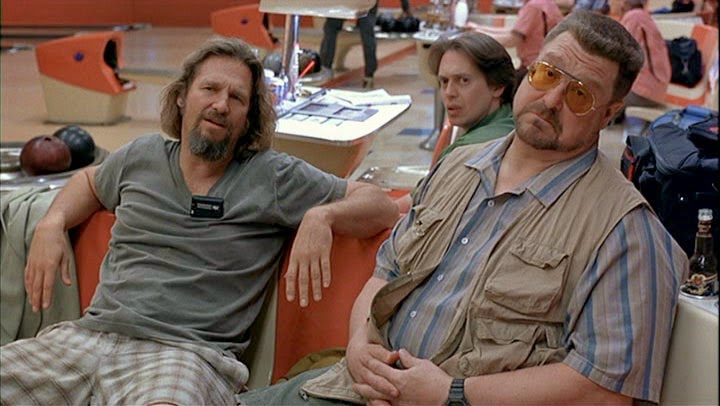
Jeff Bridges, Steve Buscemi, and John Goodman in "The Big Lebowski."

I know that you will kick yourself for not remembering, but yesterday marked the twentieth anniversary of one of the great cult films of our time, “The Big Lebowski.”

“The Big Lebowski,” directed by the Coen brothers, is the ultimate stoner classic – the shaggy dog story of the Dude and his quest to seek revenge for a urinated-upon rug. It has a great cast: Jeff Bridges, Steve Buscemi (“Shut the f_____ up, Donny!”) Sam Elliott, Julianne Moore, the late Philip Seymour Hoffman, and John Turturro.

But, Jews remember the film for yet another reason – and that would be the immortal performance of John Goodman as Walter.

Walter is a Viet Nam veteran (who cannot stop mentioning the war, inviting us to realize that he might be suffering from PTSD).

Walter is a convert to Judaism who must explain why he will not participate in a bowling tournament on Saturday:
Saturday, Donny, is Shabbos, the Jewish day of rest. That means I don’t work, I don’t drive a car, I don’t f____ ing ride in a car, I don’t handle money, I don’t turn on the oven, and I sure as s_____don’t f_____ing roll…..I’m shomer Shabbos!
(Walter’s second best line was the utterly incoherent non sequitur: “Etz chayim hi, Dude, as the ex used to say”).

The Coen brothers are proudly, consciously Jewish. If you don’t believe me, re-watch “A Serious Man.”

So, leave it to them to offer us one of the most profoundly Jewish characters in cinematic history.

Yes – up there with Tevye, Ari Ben Canaan in “Exodus,” Yentl – and more deeply Jewish than any character that Woody Allen has played.

So, let’s talk about Walter.

First, Walter is a convert, aka a Jew by choice.

The Coen brothers, therefore, introduced the American movie-going public to the idea that you don’t have to be born Jewish to do Jewish – and that, as American Jewish folk wisdom would have it, some of our best Jews are those who chose to join the Jewish people. Some people I love the most in the world fall into that category.

Second, Walter is a Jew who takes Jewish practice seriously – albeit in a loud and profane way.

It is remarkably rare for a figure in popular culture to proclaim any religious feeling (there are, of course, notable exceptions).

Even less common do we find a cinematic Jew, other than a noticeably Orthodox Jew, who takes Jewish observance seriously.

More than that: this is not just about lighting Shabbat candles, or attending a seder, or going to a bar mitzvah, or attending a Jewish funeral, or being married under a chuppah – all rituals that you can find in any number of movies.

Walter’s Shabbat observance is specifically one of withdrawing, temporarily, from the world – from the profane (even as he is profane) activities of the six days of creation. It is a Shabbat – not only of menucha (rest), but of kedusha (holiness).

(Now, as for not rolling on Shabbos: I will leave it to my more observant colleagues to discern whether or not this is really a violation of Shabbat. Yes, if you are paying money to the bowling alley. But rolling itself….?)

In which case, Walter has gone above and beyond the very strictures of Jewish law. Perhaps it is not about rolling a bowling ball on Shabbat. Perhaps it is about not having to compete on Shabbat – about not having to worry about personal achievement or glory, such as it might be in a bowling league.

Which brings me to my final point about Walter, and the Dude, and Donny. They are in a bowling league – and therein lies its own story.

The unheralded sweetness of “The Big Lebowski” is that, for the Dude, Donny, and Walter, their bowling team constitutes a small (eternally squabbling, but ultimately loving) family. Walter’s eulogy for Donny is absurd, comparing his death to the death of American soldiers in Viet Nam, but it is nevertheless heartfelt.

So, The Big Lebowski” ranks as one of the most Jewish films in the last few decades.

Yes – just for that one scene, in which Walter proclaims his fealty to Jewish law and practice.

We could do far, far worse than to produce Jews like Walter.


https://religionnews.com/2018/03/07/the-big-lebowski-twentieth/


 Hershel Schechter's Convert --- Rolls on Shabbos:


CLICK:
https://www.dailymail.co.uk/news/article-7191497/Ivanka-Trump-joins-father-meets-world-leaders-including-Russias-President-Putin-G20.html

The Words Of Wisdom & Psak Din Of Rav Moshe Feinstein Are Omnipresent: Hershel Schechter Shame On You!

Rabbi Moshe Feinstein states "the very marriage of a gentile woman to a non observant Jew, is equivalent to an open declaration that she will not observe the precepts. This is so, because it is highly unlikely that the gentile member of such a union, will be more committed to Judaism than her remiss Jewish husband (certainly when they are living together prior to their marriage). Unlike mental or tacit negations, explains Rav Feinstein, open declarations do invalidate conversions. When such cases appear before a rabbinical court, its members actually become witnesses to an acceptance declaration that is not sincere. Therefore, it is no longer a tacit insincerity, but rather an obvious one. As such, they are forbidden to sanction the conversion. Regardless of what this Jewish court may declare, the conversion is invalid and the person is not deemed a member of the Jewish nation. In Iggros Moshe, Letters of Moshe (Yoreh De’ah, no. 157), he writes that “According to the Law, it is certain that one who converts for the sake of marriage, does not intend to keep the commandments, and is not a proselyte at all.”


Friday, June 28, 2019

Yeah....Be Animals At Home, But Not In The Catskills! “The Jew invasion.”

Chillul Hashem Alert!


Rabbi Moshe Meir Weiss

Every summer, Orthodox Jews descend upon quiet rural towns like an avalanche with over half a million people driving up to the Catskills and filling places like Monticello, Woodbourne, Fallsburg, Ellenville, Kiamesha, Swan Lake, and Hurleyville.

With the summer having begun, now is a good time to remind ourselves how grave the sin of chillul Hashem (desecrating Hashem’s Name in front of others) is. The Gemara says this aveirah is so heinous that even repentance, suffering, and Yom Kippur combined do not fully atone for it. Only death does.

To convey how horrible chillul Hashem is, the Aleinu L’shabei’ach relates the following anecdote: A couple in Eretz Yisrael was suffering from terrible marital discord, and the husband, wanting to hurt his wife, decided to send their son to a monastery in Italy. Horrified, friends of the family decided to go to the government to foil his plans. Some were concerned that major news outlets would get hold of the story, which would result in a chillul Hashem, but others felt the risk was justified.

They consulted with Rav Shlomo Zalman Auerbach, zt”l. To their surprise, he told them they could not risk the chillul Hashem – even to prevent the loss of a Yiddishe neshama.

I know a family that was attacked in the newspaper over a nasty custody battle. The papers asked if they wanted to comment, but Rav Dovid Feinstein, shlit”a, ruled they couldn’t since it would create more of a chillul Hashem. It’s a lot to ask from a person – not to defend himself against public humiliation – but that’s how high the stakes are when it comes to chillul Hashem.

So let’s talk about how this subject applies to the many city folk who invade the peaceful mountains during the summer. First, we must eliminate honking. Many rural folk follow the rule of “early to bed and early to rise”; we have to be aware of their habits and, at night, avoid honking horns, slamming car doors, or just carrying on too loudly in a boisterous summer way.


DO NOT PUT YOUR WIFE IN THE SHOPPING CART NO MATTER WHAT HAPPENED AT THE BUNGALOW!

Then there’s our behavior in the supermarkets. If you ever visit the Catskills in the winter, you’ll see how nicely the shelves are set up and how orderly the store looks. So if you’re shopping and decide not to take an item, put it back in its place – especially if it needs refrigeration. Try to bring your cart back to the store or its designated spot so all the carts are gathered neatly and not left helter-skelter all over the parking lot.


DO NOT USE SHOPPING CARTS AS ENTERTAINMENT FOR YOUR KIDS!

And here’s something to really think about: Don’t go around tasting grapes or having your kids taste them in the supermarket. If there’s no sign posted that permits tasting fruit, doing so is theft. Even if some stores let you get away with sampling and won’t escort you out, it certainly is not the behavior of the Am Segula, a nation that is supposed to behave in a model fashion.

NO SPAM EVEN IF IT'S CHEAP

CAN WE EAT LUNCH NOW QUICKLY?
When I see a gentile in line who has only two items, I always let him go ahead of me so he doesn’t mutter under his breath about “the Jewish invasion.” Right or wrong, we need to be sensitive when trampling on others’ peace and quiet. Yes, some are looking for things to blame us for – but that just means we must be doubly careful not to give them ammunition.

JEW ALERT!
GENTILE ALERT!

In the car, we shouldn’t drive like we’re playing a video game, and we should shut off our bright headlights so as not to blind oncoming traffic. Let’s also remember that the locals are very proud of their pristine unpolluted environment, so don’t open the car window and carelessly toss a leftover drink, a bag with a dirty diaper, or a candy wrapper.

I can give many more examples, but the main thing is to heighten our awareness of possibly causing a chillul Hashem.

DO NOT BRING YOUR CHAMETZ TO THE CATSKILLS! NO MITZVAH BURNING IT IN JULY!
Finally, I’m sorry there’s a need to say this, but it should be obvious that before letting your children be around other children, they must be properly vaccinated. In Yiddishkeit, we follow the majority, especially in matters of danger and chillul Hashem. The overwhelming majority – over 90 percent of master physicians and gedolei Yisrael maintain that vaccinating is mandatory. We must repair the massive chillul Hashem that has already resulted because of the measles epidemic. Incidentally, as someone who had rubella, measles, and mumps as a child, I can say that only a criminally-negligent parent would abstain from vaccinating his or her children.

Smile at Your
Neighbors - & Invite Them For Shabbat Lunch
 One last point: A smile goes a long way towards improving relationships. When you pass a gentile in a store or parking lot, tilt your head in greeting or smile. If thousands of us took this not-so-little step, we would make a huge difference in others’ attitude towards us.

May Hashem bless us with the smarts to avoid chillul Hashem, and in that merit may we be blessed with long life, good health, and everything wonderful.

https://www.jewishpress.com/judaism/torah/chillul-hashem-alert/2019/06/27/?fbclid=IwAR29Vxh961lGPFpoD24KJpjaLBVOiaN7MBbW6HHs6kDQ92kKg9G95L3J4gQ


Thursday, June 27, 2019

Megan Twohey, an investigative reporter for The New York Times, spoke with Ms. Carroll, Lisa Birnbach and Carol Martin. Listen To The Podcast - You Decide!

E. Jean Carroll told two women that Donald J. Trump assaulted her in the 1990s. On "The Daily," the women discuss it publicly for the first time.

The writer E. Jean Carroll came forward last week with explosive accusations that Donald Trump sexually assaulted her in the 1990s. Today, the two women she privately confided in after the alleged attack discuss it publicly for the first time with our colleague.

On today’s episode:
  • Megan Twohey, an investigative reporter for The New York Times, spoke with Ms. Carroll, Lisa Birnbach and Carol Martin.


E. Jean Carroll in New York this week. She says that Donald Trump sexually assaulted her in the mid-1990s, and that she told two close friends at the time. He denies the accusation\


CreditCraig Ruttle/Associated Press
Background reading:
https://www.nytimes.com/2019/06/27/podcasts/the-daily/e-jean-carroll-trump-interview.html?campaign_id=60&instance_id=0&segment_id=14689&user_id=cd11df7e4826fae198be96d8f3a4bb15&regi_id=32999454ing-news


Wednesday, June 26, 2019

And I Thought 95% of Americans Are Idiots!

Surprising Survey Shows 45% Of Americans Doubt Safety Of Vaccines


CHICAGO — The latest measles outbreak that’s gripped communities across the country in recent months pushed the topic of vaccinations (and those who choose to forgo them) right back onto centerstage for many Americans. Now a new survey delving into feelings over immunizations finds the country may be more split on the issue than believed, with 45% of adults admitting to harboring some doubt about the safety of vaccines.

That said, the vast majority — more than eight in 10 surveyed — still view vaccines as effective and continue to support them, despite their concerns.

The survey, funded by the American Osteopathic Association, questioned 2,000 adults and asked doubters the source of their suspicions of the science-supported, long-established safety and importance of vaccinations. Of the nearly half who listed at least one source of doubt over vaccine safety, researchers found the most common sources came from online articles (16%), distrust of the pharmaceutical industry (16%), and information from medical experts (12%).

According to lead researcher Rachel Shmuts, a perinatal psychiatrist, widespread negative attitudes towards vaccines has become a phenomenon caused by human psychology and amplified by social media.

“From an evolutionary perspective, humans are primed to pay attention to threats or negative information,” Dr. Shmuts explains in a media release. “So it makes sense that people hold onto fears that vaccines are harmful, especially when they believe their children are in danger.”

Another factor in this phenomenon is that, since vaccines have effectively banished many once-common and deadly diseases, people fear possible side effects from the vaccines more than the diseases themselves.

“For some, it really might be that vaccines are viewed as the more salient threat,” says Shmuts.
Despite these concerns, 82% of respondents were still generally in favor of vaccines, while 8% showed serious doubts, and 9% said they were unsure.

Many people are uninformed about vaccines. The state of Michigan, for example, ended public education for vaccines in the mid-2000s. This, combined with legislation that allows for vaccine exemptions for religious and philosophical beliefs, led to Michigan being ranked 44th in the country in the number of vaccinated children between the ages of 19 and 35 months in 2015. In 2017, the state launched a new education program about vaccines, and immunization rates increased across all demographics.

Doctors warn that people with doubt only breed more people with doubt, and that can be dangerous when certain diseases require up to 95% of the population to be vaccinated in order to eliminate the threat of those diseases.

“Beliefs are hard to change especially when they’re based in fear,” adds osteopathic family physician Paul Ehrmann. “But, being responsible for our patients’ health and the public’s health, we can’t afford to give in to those fears. We must insist on evidence-based medicine.”

The survey was conducted on behalf of the American Osteopathic Association by the Harris Poll.

Editor’s note: An earlier version of this article that mentioned a measles “epidemic” was corrected to measles “outbreak.”


https://www.studyfinds.org/surprising-survey-shows-45-percent-americans-doubt-safety-vaccines/