EVERY SIGNATURE MATTERS - THIS BILL MUST PASS!

EVERY SIGNATURE MATTERS - THIS BILL MUST PASS!
CLICK - GOAL - 100,000 NEW SIGNATURES! 75,000 SIGNATURES HAVE ALREADY BEEN SUBMITTED TO GOVERNOR CUOMO!

EFF Urges Court to Block Dragnet Subpoenas Targeting Online Commenters

EFF Urges Court to Block Dragnet Subpoenas Targeting Online Commenters
CLICK! For the full motion to quash: http://www.eff.org/files/filenode/hersh_v_cohen/UOJ-motiontoquashmemo.pdf

Tuesday, May 10, 2022

Art Imitates Life --- Insanity!


Warhol’s ‘Marilyn,’ at $195 Million, Shatters Auction Record for an American Artist

At Christie’s sale for charity, the glamorous silk-screen beat out Basquiat’s skull painting that had set a record in 2017.


“Shot Sage Blue Marilyn,” a 1964 Andy Warhol silkscreen, was auctioned at Christie’s on Monday night.


Painting of The Rebbe - $7.70 - Go Figger (leitzonus) 

Satmar Rebbe - $1.99

 
COME GET IT FREE BEFORE IT GOES TO THE DUMP

UGLIEST GARBAGE YET LEROY!

Maybe the image is not racy, like the one of Marilyn Monroe with her dress flying up in the movie “The Seven Year Itch,” but on Monday night it became the priciest.

In under four minutes of bidding, Andy Warhol’s 1964 silk-screen of the actress’ face, “Shot Sage Blue Marilyn,” sold for about $195 million to an unknown buyer at Christie’s in New York, making it the highest price achieved for any American work of art at auction.

“We did sell the most expensive painting of the 20th century,” said the Christie’s specialist Alex Rotter. “This is a big achievement.”

The 40-inch-by-40-inch painting, a trophy given its vibrant colors and glamorous subject matter, eclipsed the previous high price of $110.5 million for a Basquiat skull painting at Sotheby’s in 2017 as well as Warhol’s auction high for a car crash painting that sold for $105.4 million in 2013. 


Jean Michel-Basquiat’s “Untitled” from 1982 in acrylic, spray paint and oilstick on canvas sold for $110.5 million in 2017.
Credit...Estate of Jean-Michel Basquiat, via Sotheby's
 

The sale on Monday kicked off a spring auction season in a city that has only begun to return to normal after two years of the coronavirus pandemic. Christie’s salesroom at Rockefeller Center was filled with the familiar faces of dealers and art advisers who clearly welcomed the opportunity to bid on blue-chip artworks in person again.

“There is a lot of appetite, there is a lot of money and there is a lot of quality,” said the Austrian gallerist Thaddaeus Ropac, who was at the sale. “With all these things, it should work.”

Philip Hoffman, the founder of the Fine Art Group, a New York advisory company, said that the upcoming two weeks of auctions could raise as much as $2 billion. “There’s been a huge amount held back for two years, and there’s a huge amount of pent-up demand from new clients,” he said. “Everyone was waiting for the right moment, and the right moment has come.”

The Christie’s auction was unusual in that none of the works were accompanied by a guarantee — a minimum price at which a third party or the auction house has committed to purchase the work. That is because the works were consigned by the estate of the Swiss dealers Thomas and Doris Ammann, with all of the proceeds going toward their foundation, which supports health care and educational programs for children. The estate wanted to maximize the charitable proceeds.

chief executive, reveled in the absence of guarantees, given the risky quality of flying without a net. “Like the old times,” he said. “Real sport.”

The buyer of the “Marilyn” will have a say in choosing to which charity 20 percent of the proceeds from that painting are allocated. The purchase is not considered a charitable donation, so it does not come with a tax deduction, Christie’s said.

In 1977, the Ammann siblings founded a Zurich gallery that specialized in Impressionist, Modern, postwar and contemporary artists. After Thomas Ammann’s death in 1993, his sister continued to lead the gallery. She died last year.

“The top of the market is still strong and there is a lot of demand for quality,” the art dealer Bill Acquavella said. “Look what real estate is selling for. There are other assets that are bringing prices that you haven’t seen before.”

The 36 works in the sale, which brought a total of $318 million (two lots did not sell), bore out the truism that top-quality works sell for top prices, however tumultuous the state of the world — be it a war overseas, a pandemic or a terrorist attack.

The auction, in Christie’s newly designed sales room with specialists positioned on the sides and reporters on stools in the back, was strong out of the gate. The energy crackled in the room as the veteran auctioneer Jussi Pylkkanen toggled between bidders on the phone and in the seats. “I have 15 bidders for this one!” he said as Ann Craven’s canvas of three birds, “I Wasn’t Sorry, 2003,” ultimately sold for $680,400 over a high estimate of $40,000.

The first lot, a work by the American conceptual artist Mike Bidlo, “Not Picasso (Bather with Beachball),” estimated at $60,000 to $80,000, went for $1.3 million with fees.

The collector Peter Brant, seated in the third row, bought the third lot, Francesco Clemente’s “Fourteen Stations, No. XI,” for $1.9 million, over an estimate of $80,000 to $120,000. Then the dealer Larry Gagosian purchased Cy Twombly’s blue, green and purple painting on a wooden panel for about $17 million, over the high estimate of $15 million.

By comparison, the Marilyn silk-screen — which Rotter recently called “the most significant 20th-century painting to come to auction in a generation” — felt like something of an anticlimax. Yes, it set a record, but speculation in advance of the auction had the painting soaring to as much as $400 million. Instead, the auctioneer seemed to wring the bids, with the painting ultimately going to Gagosian; it was unclear on whose behalf he was bidding.

“Expectation was very, very, very high,” the art adviser Abigail Asher said. “It was an incredibly healthy price, but at the same time I believe the buyer got a deal. It’s one of the icons of 20th-century art.”

The Warhol painting, one of five in a series, is based on a promotional photo from the actress’s film “Niagara,” part of a series of “Shot Marilyn” portraits. In 1964, a woman walked into Warhol’s Factory studio with a pistol and shot at a stack of four Marilyn paintings. (The canvas up for auction at Christie’s was not pierced by the bullet.)

The Ammann siblings bought the work from the media mogul S.I. Newhouse Jr., in 1998; that year, Newhouse purchased Warhol’s “Orange Marilyn” (1964) at Sotheby’s for $17.3 million. After Newhouse’s death, in 2017, the billionaire hedge-fund manager Ken Griffin bought that work privately for about $200 million.


A Cy Twombly painting, “Untitled,” one of the high-ticket works at the sale of the collection of Thomas and Doris Ammann, sold for about $17 million.
Credit...Cy Twombly Foundation; Christie's Images Ltd.
https://www.nytimes.com/2022/05/09/arts/design/warhol-auction-marilyn-monroe.html

Monday, May 09, 2022

What Took 800 Years - 41,742 Weeks - 292,194 Days - 7,012,656 Hours - 2.5245562 x 10¹⁰ Seconds ???


After 800 years, Church of England apologizes to Jews for laws that led to expulsion


Special service, attended by UK chief rabbi, marks anniversary of Synod of Oxford, aims to inspire Christians to reject contemporary antisemitism, archbishop of Canterbury says


Screen capture from video of a special Church of England ceremony to mark and apologize for the 1222 Synod of Oxford, held at Christ Church Cathedral in Oxford, May 8, 2022. (YouTube)
Screen capture from video of a special Church of England ceremony to mark and apologize for the 1222 Synod of Oxford, held at  Church Cathedral in Oxford, May 8, 2022. (YouTube)
 

The Church of England on Sunday apologized for anti-Jewish laws that were passed 800 years ago and eventually led to the expulsion of Jews from the kingdom for hundreds of years.

A special service held at Christ Church Cathedral in Oxford was attended by Britain’s Chief Rabbi Ephraim Mirvis and representatives of Archbishop of Canterbury Justin Welby to mark the Synod of Oxford, passed in 1222.

The synod forbade social interactions between Jews and Christians, placed a specific tithe on Jews, and required them to wear an identifying badge. They were also banned from some professions and from building new synagogues. The decrees were followed by more anti-Jewish laws, and eventually the mass expulsion of England’s 3,000 Jews of the time in 1290.

It would be another 360 years before Jews were permitted to return.

“Today’s service is an opportunity to remember, repent and rebuild,” Welby tweeted. “Let us pray it inspires Christians today to reject contemporary forms of anti-Judaism and antisemitism and to appreciate and receive the gift of our Jewish neighbors.”

“Our intention is for this commemoration to be a strong signal of such rich potential, reflected in the depth of interfaith encounter and service that increasingly exists in Oxford and across our society,” the Diocese of Oxford said in a statement last month ahead of the event.

The service was live-streamed on the internet.

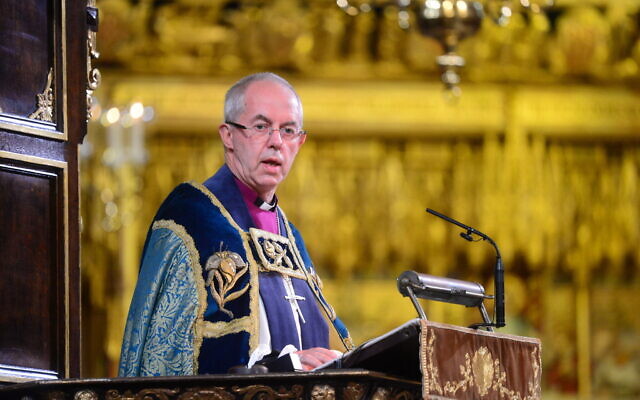
Archbishop of Canterbury Justin Welby makes an address at Westminster Abbey, London
 

Though the Church of England was formed in the 1500s when Henry VIII broke away from the pope, the Roman Catholic church was “fully in accord” with the apology. Jonathan Chaffey, archdeacon of Oxford, told the UK’s Guardian newspaper in a Sunday report.

He said the time had come for Christians to repent for their “shameful actions” and “reframe positively” their relations with the Jewish community.

Jews were readmitted to England by Oliver Cromwell in 1656.

Tony Kushner, professor of Jewish/non-Jewish relations at Southampton University, explained to the Guardian that, though the Church of England was not around at the time of the Synod of Oxford, “it regards itself as the leading voice of Christianity in Britain today” and, therefore, “the apology has some merit in recognizing injustices that were done.”

UK Chief Rabbi Ephraim Mirvis at the President’s Residence in Jerusalem, January 23, 2020
 

The church has taken steps to cultivate goodwill with British Jews in recent years.

In 2019, it released a document titled “God’s Unfailing Word” that outlined the importance of the Christian-Jewish relationship and acknowledged that centuries of Christian antisemitism in Europe laid the foundation for the Holocaust. At the time, England’s chief rabbi, Mirvis, said the document represented a step forward, but fell short because it did not reject the church’s history of seeking to convert Jews.


https://www.timesofisrael.com/church-of-england-apologizes-to-jews-800-years-after-laws-that-led-to-expulsion/?utm_source=The+Daily+Edition&utm_campaign=daily-edition-2022-05-09&utm_medium=email

Sunday, May 08, 2022

White yarmulkes, blue yarmulkes, exercise routines, ball playing....the "normal" that made Rabbi Shraga Feivel Mendlowitz ztvk"l a legend. Camp Mesifta (Torah Vodaath) 1942


 CLICK TO SEE WHEN ULTRA-ORTHODOX WAS NORMAL:

https://youtu.be/KpBhg209Do8

 IMAGINE: AN AMERICAN AND ISRAELI FLAG FLYING TOGETHER PROMINENTLY AT THE ENTRANCE OF CAMP MESIFTA TORAH VODAATH IN 1948!


 CLICK: https://youtu.be/QqJP8i1IC7A


 MORE OF NORMAL:

https://youtu.be/bVFva84EB3U


This footage is seeing the light of day after nearly 80 years. The original 8mm film was shot primarily by my grandfather Harry Haber. He was born in Pomorzany, Galicia, Austria on May 7, 1895, and immigrated to U.S. arriving in New York on February 1, 1910 aboard the S.S. Amerika.
 
 The ship manifest lists his last place of residence as Kadworna, Austria. His arrival in the U.S. was two years after his father's immigration to the U.S., and proceeded by one year his mother's and 5 siblings' immigration. (His parents had four more children once in the U.S.) 
 
 The film was stored in a box with other slides and family photos. Originally stored in Washington D.C. and Maryland until approximately 2000, at which time the box was stored in a garage in Florida until it was discovered in late 2020. Once digitized by DigMyPics.com.
 
 I was only able to identify my father, David Haber in the film. Only moments after posting a shorter version of the film to Facebook (to the group "Tracing the Tribe - Jewish Genealogy") I received a a message which led to a conversation with a gentleman who identified the location as Camp Mesivta in Upstate New York.
 
 This was the summer camp for boys of Yeshiva Torah Vodaath in Brooklyn, NY. The rabbi walking towards the camera on the path with other people at 4:14 in the video has been identified as Rabbi Yisroel Chaim Kaplan. The rabbi with the red-ish beard at 4:30 is Rabbi Shlomo Heiman.


Thursday, May 05, 2022

The Incredible Vision and Genius of Rabbi Shraga Feivel Mendlowitz ztvk"l on Full Display!

 While all the "gedolim" of that era, pre-war and post war, said it is assur to go to EretzYisroel and America, Rabbi Shraga Feivel Mendlowitz zt"l flew the American and Israeli flags together at Camp Mesifta in 1948 after the UN proclaimed Israel a State! 
 
Aaron Kotler was wrong, the Agudah was wrong, Satmar was wrong, Elchonon Wasserman was dead wrong! Among tens of others. That's when he sent Rabbi Alexander Linchner z"l, his son in-law, to Israel to "save the sephardic kids from secularism"


...He knew Zionism was imperfect, he chose to improve it rather than walk away from secular Jews. YEHI ZICHRO BARUCH!

R. Isaac Halevi Herzog (1888­–1959), the first Ashkenazi Chief Rabbi of Israel, says as follows: אפילו אם נדון בזה רק מתוך ההשקפה המצומצמת של הצלת ישראל מבחינת פיקו[ח] נ[פש] דרבים, עדיין יש לדון שעל מצוה כזו של פיקו[ח] נ[פש] של הישוב כולו כופין. …Even if we judge this [matter of war] only from the narrow viewpoint of rescuing Israel with respect to [the commandment of] saving the lives of many [individuals], the ruling would still be that with regard to this commandment, of saving the lives of the Yishuv (Jews living in Israel), we force [a person to perform the commandment].[13]


Israel’s Army: What Is the Basis for the Draft in Jewish Law?


Israel’s Army: What Is the Basis for the Draft in Jewish Law?


When the State of Israel was established, the leading figures in religious Zionism had to justify Israel’s right to conscript soldiers using Jewish legal sources.


The Biblical Laws of War

The most concentrated legal treatment of war is found in Deuteronomy 20:1–21:14.[1] These laws prescribe what to do with the people against whom Israel wages war: Canaanites living in the land must be annihilated, while people living outside the land may surrender and become subjects; otherwise, if they fight and are defeated, the males are killed and the women and children are taken as booty (20:10–18).

These laws also determine which soldiers should be exempt from entering battle (20:1–9), prohibit destroying fruit-bearing trees around a besieged city (20:19–20), and deal with a situation in which an Israelite solider is sexually attracted to a foreign captive (21:10–14).

Some of these laws—those dealing with the fate of enemy populations, and the female captive having to marry her captor against her will—are horrific from a modern moral standpoint. But I would like to draw attention to another matter, namely, the limited scope of these laws.

Limited Scope of War Laws in Biblical and Rabbinic Literature

The Torah’s laws on war are not at all comprehensive. This comes as no surprise to readers familiar with the Torah; no area of law in the Torah is treated in a thorough manner.

For this reason, rabbinic law tries to fill in the gaps. But the laws of war are something of an exception in this regard. The most extensive discussion of laws of war in the Talmud is in the eighth chapter of Tractate Sotah, the bulk of which deals with the instructions in Deuteronomy 20 concerning which soldiers are exempt from battle.

Otherwise, issues concerning war are treated tangentially, in relation to other issues. For example, as part of a discussion concerning carrying on Shabbat, the Babylonian Talmud (b. Eruvin 45a) states that if soldiers go out to save Jewish lives on Shabbat, they may return with their weapons in hand, even though this violates the laws of Sabbath limit (techum) and the prohibition of carrying. Medieval and early modern rabbinic literature also treat laws of war in a very cursory fashion.

Temple Laws vs. War Laws

It is not entirely clear why the rabbis did not have more discussion on the laws of war. It may be that because the rabbis lived at a time when Jews did not have a state or an army, they were not interested in these laws. Yet, there were other areas of Jewish law that were no longer practiced in the rabbinic and medieval times but received a great deal of attention from the rabbis, such as the laws of sacrifices and impurity that were in abeyance since the destruction of the Second Temple. Why were the laws of war different?

It may be that the rabbis never envisioned Jews having to fight wars again once the exile had begun. Jews would certainly have a state in messianic times, but God would pave the way for that era by directly punishing the nations who had oppressed the Jews. That is, God would wage war, not the Jews. Also, according to the biblical text, the messianic period would be one in which peace would reign between the nations, so there would be no need for wars then either.

Thus, the rabbis saw no need to discuss laws of war. Laws of sacrifices and impurity, by contrast, would certainly be relevant in the messianic period, since the Temple would be built again, and the rabbis were thus interested in laws pertaining to these issues. This may explain why we have tractates full of laws about impurity and sacrifices but just a handful of passages dealing with war.

The State of Israel

None of this would have mattered much had it not been for the establishment of the State of Israel in 1948. When Israel came into existence, religious Zionists, namely Orthodox Jewish Zionists living in accordance with Jewish law, were faced with an unprecedented challenge. Israel was at war from the moment it was established, and yet Jewish law provided little guidance on war, and practically none on wars of self-defense, the type of war that Israel had to fight in 1948 and would fight many more times thereafter.

Zionist settlers in Palestine, of course, had been attacked by Palestinians for decades prior to 1948; however, religious Zionist rabbis did not seem to consider these attacks to be a war in the formal sense because there was no Jewish state just yet. Therefore, this violence could be regulated by laws regarding violence in non-war situations of which there were plenty in Jewish law. The war of 1948 was an entirely new challenge.

The leading rabbis of the religious Zionist community therefore had to formulate an entire body of law on war,[2] displaying remarkable ingenuity and creativity in stretching the few sources in Jewish law about war as far as they could. They even made use of sources that had nothing to do with war originally. To illustrate the kinds of challenges that the religious Zionist rabbis faced here, and how they solved them, I will offer the single example of how they dealt with the issue of conscription, or the drafting of soldiers.

Conscription

Conscription is about as basic an issue as there is in laws of war.[3] Yet, the corpus of Jewish law presents a serious obstacle to it. On the one hand, Jewish law certainly permits an individual to kill in self-defense. As we are told in the Gemara (b. Berakhot 62b), הבא להרגך השכם להרגו, “He who comes to slay you, slay him first.”[4] Jewish law also requires a person to kill in defense of another individual who is being pursued by an assailant intent on killing them (ניתן להצילו בנפשו, “he may save him by taking the pursuer’s own life”; b. Sanhedrin 73a). On the other hand, that is only when a person does not have to put their own life in danger, which Jewish law does not require.[5] But if this is the case, Jewish law, in effect, prohibits a Jewish state from drafting soldiers for defensive wars, since these wars will require soldiers to risk their lives to defend their fellow countrymen.

From a modern academic perspective, the problem here seems to be an anachronistic one. In the Bible, an Israelite king was an autocrat who could conscript an army for any war at will. Thus, while technically the Torah never discusses defensive wars, only wars of conquest, surely the biblical authors saw no difference between defensive wars and aggressive wars with respect to conscription. Also, if conscription was allowed in wars of conquest, isn’t it clear that it would be allowed in defensive wars as well? Moreover, according to the Bible, the Israelites fought defensive wars. Was this not proof enough that conscription for such wars was permitted?

While these arguments may be persuasive to critical scholars, the religious Zionist rabbis did not think this way. For these figures, Jewish law is a divine and monolithic entity, functioning in all places and times, and thus, they felt the need to explain the requirement for conscription in defensive wars in light of the explicit law that prohibits forcing individuals to risk their lives to defend others.[6] Given that older sources do not tackle this problem explicitly,[7] these rabbis took the task upon themselves, since, without the conscription of soldiers, Israel could not survive.[8] To do this, they explored a number of possible precedents.

Precedent 1—Maimonides and Mandatory War

Moses Maimonides’ (1138–1204) treatment of war in the Mishneh Torah provides only one line about defensive war, but it has significance for conscription. According to Maimonides, wars of self-defense fall under the category of “mandatory war” (מלחמת מצוה), one of two major categories of war in rabbinic law, and in wars of this type all Jewish adults are required to fight (Mishneh Torah, Book of Judges, Laws of Kings, 5:1):

אין המלך נלחם תחלה אלא מלחמת מצוה, ואי זו היא מלחמת מצוה זו מלחמת שבעה עממים, ומלחמת עמלק, ועזרת ישראל מיד צר שבא עליהם, ואחר כך נלחם במלחמת הרשות והיא המלחמה שנלחם עם שאר העמים כדי להרחיב גבול ישראל ולהרבות בגדולתו ושמעו.
A king may initially wage only mandatory war. Which [war] is a mandatory war? It is a war against the seven [Canaanite] nations, a war against Amalek, and saving Israel from the clutches of the enemy that has attacked them. Subsequently, the king may wage discretionary war, which is war that he wages with the rest of the nations in order to widen the borders of Israel and to increase his greatness and prestige.

Because Maimonides deemed defensive wars to be mandatory wars, they ostensibly required all Jews to fight, and this requirement clearly overrode any difficultly regarding conscription. All the prominent religious Zionist rabbis made this argument.[9]

Precedent 2—Nahmanides and the Mitzvah to Conquer Israel

Another precedent to justify conscription is in Moses Nahmanides’ (1194–1270) commentary on Maimonides’ Book of the Commandments. He argues that God’s instruction to the Israelites to conquer the land of Israel and settle it is a positive commandment, even though Maimonides does not seem to think so[10] (Omitted Positive Commandments, #4):

מצוה רביעית שנצטוינו לרשת הארץ אשר נתן האל יתברך ויתעלה לאבותינו לאברהם ליצחק וליעקב ולא נעזבה ביד זולתינו מן האומות או לשממה. והוא אמרו להם (במדבר לג:נג) והורשתם את הארץ וישבתם בה כי לכם נתתי את הארץ לרשת אותה והתנחלתם את הארץ.
The fourth commandment [that Maimonides omitted] is that we are commanded to inherit the land that God, may He be blessed and exalted, gave to our forefathers—to Abraham, to Isaac, and to Jacob—and not leave it in the possession of others among the nations, nor [to leave it] desolate. This is [the meaning of] His statement to them, “And you shall take possession of the land and settle in it, for I have assigned the land to you to possess. You shall apportion the land among yourselves” (Num. 33:53)….[11]
ואל תשתבש ותאמר כי המצוה הזאת היא המצוה במלחמת שבע' עממים שנצטוו לאבדם... אין הדבר כן. שאנו נצטוינו להרוג האומות ההם בהלחמם עמנו ואם רצו להשלים נשלים עמהם ונעזבם בתנאים ידועים אבל הארץ לא נניח אותה בידם ולא ביד זולתם מן האומות בדור מן הדורות.
Do not be confused and say that this commandment is the commandment of [waging] war against the seven [Canaanite] nations that we were commanded to annihilate…. That is not the case. For we were commanded to kill those nations when they made war against us, but if they wanted to make peace, we were to make peace with them, and leave them alone, in accordance with explicit stipulations. But the land, we were not to leave in their hands nor [in the hands of] other nations in any generation.

According to Nahmanides, the commandment to conquer the land of Israel and settle it is meant not just as an imperative in the time of Joshua; it is applicable for all time. Thus, fighting in such a war is a positive biblical injunction, and all Jews must fight in it. Prominent rabbis in the religious Zionist community made this argument, including R. Isaac Halevi Herzog (1888­–1959) and R. Shaul Yisraeli (1909-1995).[12]

The strategy provided to modern rabbis by Nahmanides is completely different from the one that relies on Maimonides. Israel’s wars need not be purely defensive, since Jews settling and ruling the land fulfills an eternally-binding, biblical commandment, and viewed from this perspective, these wars entail no difficulty with regard to conscription. That problem arises only in purely defensive wars in which Jewish soldiers are being forced to risk their lives for the sole purpose of defending the lives of other Jews.

Precedent 3—The Survival of the Jewish People

Several religious Zionist rabbis believed that Israel’s War of Independence in 1948 was so critical for the survival of the Jewish people both physically and spiritually, that all Jews had to fight in this war, even if they did not regard it as a formal war according to Jewish law. For instance, R. Isaac Halevi Herzog (1888­–1959), the first Ashkenazi Chief Rabbi of Israel, says as follows:

אפילו אם נדון בזה רק מתוך ההשקפה המצומצמת של הצלת ישראל מבחינת פיקו[ח] נ[פש] דרבים, עדיין יש לדון שעל מצוה כזו של פיקו[ח] נ[פש] של הישוב כולו כופין.
…Even if we judge this [matter of war] only from the narrow viewpoint of rescuing Israel with respect to [the commandment of] saving the lives of many [individuals], the ruling would still be that with regard to this commandment, of saving the lives of the Yishuv (Jews living in Israel), we force [a person to perform the commandment].[13]

To support his view, R. Herzog invokes the opinion of his predecessor, the Chief Ashkenazic Rabbi of Mandatory Palestine, R. Abraham Isaac Kook (1865–1935). In one of his responsa, R. Kook claims that when the survival of the entire Jewish people is at stake, Jews have to risk their lives in order to remedy the situation. This rule, he argues, applies even in non-war situations.

To support this principle, R. Kook refers to the actions of Queen Esther: In order to save the Jewish people from destruction, she was willing to put her life on the line to bring about Haman’s downfall. Any Jew in a similar situation is obligated to do the same.[14]

The Non-War Precedent: Ideological Compromise

Why did R. Herzog, among others, insist on justifying conscription even if Israel’s wars were not formally recognized as “halakhic wars” in Jewish law? Was it not enough to simply argue that Israel’s wars were mandatory—whether according to Maimonides, or Nahmanides, or both—and therefore all Jews were required to fight in them?

The answer, I believe, has to do with fundamental divisions between religious Zionists and Charedi (Ultra-Orthodox) Jews regarding the status of the State of Israel. The Charedi community rejected Zionism and the State of Israel, and, as a result, it refused to have its constituents serve in the Israeli Defense Forces. This stance posed a serious challenge to the religious Zionist authorities.

Practically all the major rabbinic authorities in the religious Zionist camp in the early years of the state were connected in some way with the Charedi community. Most of them were brought up in that community and studied in its institutions. Therefore, they had personal as well as practical reasons to come up with a rationale for fighting in the army that would appeal ideologically even to this camp. At the very least, they had to convince themselves that their path was the correct one.

In other words, they had to demonstrate that from the standpoint of Jewish law, Jews were required to fight in Israel’s wars even if the person fighting did not regard these wars as “wars” with legal standing in Jewish law. These rabbis were intent on preempting the Charedi argument that since Israel could not be recognized as a legitimate Jewish state, from the standpoint of Jewish law, its wars were not legitimate either.

The Unique Challenge of Early Zionist Religious Leadership

The leading rabbinic authorities in the religious Zionist community were in a uniquely complicated position. Like most traditional religious authorities, they believed that their sacred books, the Torah and the Talmud, must be the source for questions of proper behavior. And yet, these sources were written in very different historical circumstances. The Torah’s laws are never systematic, and whereas rabbinic law is much more so, the ancient and medieval rabbis never lived in a country run by Jews and did not try to systematize the laws of war.

Thus, on the eve of Israel’s War of Independence, the religious Zionist rabbis needed to formulate laws from scratch while making sure they were both practical as well as grounded in precedent. In formulating laws of war for the State of Israel, these figures dealt not only with the question of conscription, but also a host of issues such as enemy civilian casualties and the observance of Sabbath law in the course of military service. This discussion about conscription provides an instructive illustration of the determination and ingenuity of religious Zionist rabbis to update Jewish law so that it would be relevant to a modern Jewish state.

View Footnotes
 
https://www.thetorah.com/article/israels-army-what-is-the-basis-for-the-draft-in-jewish-law

Wednesday, May 04, 2022

I'm a lifelong Conservative Republican (became an Independent in my voting post Trump) - I am a staunch Pro-Life guy --- But this is way too stupid!

 Yet the decision will also discredit the court as a steward of whatever is left of American steadiness and sanity, and as a bulwark against our fast-depleting respect for institutions and tradition. The fact that the draft of Justice Alito’s decision was leaked — which Chief Justice Roberts rightly described as an “egregious breach” of trust — is a foretaste of the kind of guerrilla warfare the court should expect going forward. And not just on abortion: A court that betrays the trust of Americans on an issue that affects so many, so personally, will lose their trust on every other issue as well.


Dear Chief Justice Roberts and Justices Barrett, Gorsuch, Kavanaugh and Thomas:

As you’ll no doubt agree, Roe v. Wade was an ill-judged decision when it was handed down on Jan. 22, 1973.

It stood on the legal principle of a right to privacy found, at the time, mainly in the penumbras of the Constitution. It arrogated to the least democratic branch of government the power to settle a question that would have been better decided by Congress or state legislatures. It set off a culture war that polarized the country, radicalized its edges and made compromise more difficult. It helped turn confirmation hearings for the Supreme Court into the unholy death matches they are now. It diminished the standing of the court by turning it into an ever-more political branch of government.

But a half-century is a long time. America is a different place, with most of its population born after Roe was decided. And a decision to overturn Roe — which the court seems poised to do, according to the leak of a draft of a majority opinion from Justice Samuel Alito — would do more to replicate Roe’s damage than to reverse it.

It would be a radical, not conservative, choice.

What is conservative? It is, above all, the conviction that abrupt and profound changes to established laws and common expectations are utterly destructive to respect for the law and the institutions established to uphold it — especially when those changes are instigated from above, with neither democratic consent nor broad consensus.

This is partly a matter of stare decisis, but not just that. As conservatives, you are philosophically bound to give considerable weight to judicial precedents, particularly when they have been ratified and refined — as Roe was by the 1992 Planned Parenthood v. Casey decision — over a long period. The fact that Casey somewhat altered the original scheme of Roe, a point Justice Alito makes much of in his draft opinion, doesn’t change the fact that the court broadly upheld the right to an abortion. “Casey is precedent on precedent,” as Justice Kavanaugh aptly put it in his confirmation hearing.

It’s also a matter of originalism. “To avoid an arbitrary discretion in the courts,” Alexander Hamilton wrote in Federalist No. 78, “it is indispensable that they” — the judges — “should be bound down by strict rules and precedents, which serve to define and point out their duty in every particular case that comes before them.” Hamilton understood then what many of today’s originalists ignore, which is that the core purpose of the courts isn’t to engage in (unavoidably selective) textual exegetics to arrive at preferred conclusions. It’s to avoid an arbitrary discretion — to resist the temptation to seek to reshape the entire moral landscape of a vast society based on the preferences of two or three people at a single moment.

Just what does the court suppose will happen if it votes to overturn Roe? Ending legalized abortions nationwide would not happen, so pro-lifers would have little to cheer in terms of the total number of unterminated pregnancies, which has declined steadily, for a host of reasons, with Roe and Casey still the law of the land.

But the pro-lifers would soon rediscover the meaning of another conservative truism: Beware of unintended consequences. Those include the return of the old, often unsafe, illegal abortion (or abortions in Mexico), the entrenchment of pro-choice majorities in blue states and the likely consolidation of pro-choice majorities in many purple states, driven by voters newly anxious over their reproductive rights. Americans are almost evenly divided on their personal views of abortion, according to years of Gallup polling, but only 19 percent think abortion should be illegal under all circumstances.

It shouldn’t be hard to imagine how Americans will react to the court conspicuously providing aid and comfort to the 19 percent. You may reason, justices, that by joining Justice Alito’s opinion, you will merely be changing the terms on which abortion issues get decided in the United States. In reality, you will be lighting another cultural fire — one that took decades to get under control — in a country already ablaze over racial issues, school curriculums, criminal justice, election laws, sundry conspiracy theories and so on.

And what will the effect be on the court itself? Here, again, you may be tempted to think that overturning Roe is an act of judicial modesty that puts abortion disputes in the hands of legislatures. Maybe — after 30 years of division and mayhem.

Yet the decision will also discredit the court as a steward of whatever is left of American steadiness and sanity, and as a bulwark against our fast-depleting respect for institutions and tradition. The fact that the draft of Justice Alito’s decision was leaked — which Chief Justice Roberts rightly described as an “egregious breach” of trust — is a foretaste of the kind of guerrilla warfare the court should expect going forward. And not just on abortion: A court that betrays the trust of Americans on an issue that affects so many, so personally, will lose their trust on every other issue as well.

The word “conservative” encompasses many ideas and habits, none more important than prudence. Justices: Be prudent.

https://www.nytimes.com/2022/05/03/opinion/abortion-supreme-court-conservative.html

Tuesday, May 03, 2022

Him/Her "Personal Example"?


In first, Israel to honor transgender soldier with medal of honor


Sergeant Noam Shahar, 20, from Home Front Command’s rescue unit, will be one of 120 soldiers who will receive the President’s Medal during Independence Day state ceremony due to excelling in fulfilling her role and setting a personal example


Israel for the first time ever will honor a transgender soldier with special medal of honor during the country's annual Independence Day state ceremony, it was revealed Tuesday. 
 
Sergeant Noam Shahar from Home Front Command’s mixed gender rescue unit will receive the President's Medal during the country’s 74th Independence Day celebrations on Wednesday. 
 
נועם שחר החיילת הטרנסגנדרית הראשונה בצהל שמשרתת בקרבי
Sergeant Noam Shahar

The 20 year-old soldier was chosen to be one of the 120 soldiers to receive the medal for “outstanding contribution to the State of Israel or to humanity”.
"I am very excited. My unit commander called me to his office, said I was unanimously selected as my platoon’s most outstanding soldier," said Shahar, adding she was then voted as the most outstanding soldier in her battalion.
 
"Finally they decided I will receive the President’s Medal. I was, and still am, in shock.”
 
Shahar will receive the award for excellence in fulfilling her role, going above and beyond her duties and setting a personal example for her fellow soldiers.
The soldier said she dedicated herself to setting an example even before joining Home Front Command. Last year, she chose to do her beret march- an arduous journey each IDF soldier goes through before being accepted to their respective corps - with the pride flag on her vest.
 
מצעד הגאווה

"Before I enlisted, it was clear to me that I would enlist in one of the combat units. I searched the Internet for information on transgender men and women and found nothing. I felt I had to prove it was possible," she said. "It was important to me to show our presence, that we are here," she added.
Shahar adds that while she was apprehensive at first, enlisting as a combat soldier was a dream she would not have given up on. “At first I was afraid of what they would say and how they would react, but I soon realized that most of the fears were in my head.”
"There are soldiers in the company with me who have never met a gay or a lesbian, and today one of them is my best friend."
To the Independence Day celebrations, Shahar will be accompanied by her parents.
"We salute her, she's amazing," said Shahar’s mother, Hedva. "I do not know how to contain all this excitement… Noam brings us a lot of pride, she loves what she’s doing, so I am happy. There is no one more worthy than her."

Monday, May 02, 2022

But Tatty...... Rabbi Shmuel Kamenetsky said "Even The Polio Vaccine Is A Hoax"

http://theunorthodoxjew.blogspot.com/2022/03/but-tatty-rabbi-shmuel-kamenetsky-said.html


 “I see vaccinations as the problem,” Rabbi Shmuel Kamenetzky told the Baltimore Jewish Times in a story published in late August. “It’s a hoax. Even the Salk [polio] vaccine is a hoax. It’s just big business.”

If you are, or anyone you know is a godol --- please register at https://gedolim.com/


Israel begins vaccination drive in Polio outbreak


The Health Ministry announced the arrival of millions of Polio vaccines to be administered mainly to children ages 3 months to 17 years after virus found in several cities. 


Two months after initial reports of the Polio outbreak in Israel, the Health Ministry said it will begin a widespread vaccination drive for children. 
 
 
Vaccines will be administered to children from ages 3 months to 17-years-old, with a focus on the age group who had not received the the inoculation by drops between the years 2005 and 2013, when the Polio vaccine was excluded from the Health Ministry's inoculation list.
 
 
Two drop Polio vaccine

Thus far, eight children were diagnosed with Polio, seven of whom were not vaccinated.
 
"It is not a reason to panic, it is a reason to get vaccinated. Like in any case of danger of disease spread," said Health Minister Nitzan Horowitz.
The first case of Polio in the recent outbreak was discovered an the beginning of March in a four-year-old girl in Jerusalem. Eight additional asymptomatic kids have been diagnosed with the virus since. "Except for one child, the kids are not fully vaccinated against Polio," Horowitz said.
ניצן הורוביץ בתדרוך עיתונאים בנושא חיסון נגד פוליו
Health Minister Nitzan Horowitz

Amid a sewage monitoring operation it regularly conducts, the health ministry found the Polio virus in several cities, including Bnei Brak and Tiberias.
"Unlike COVID, we've been familiar with the Polio virus for many decades and we have the option to completely eradicate it," the minister said. "Israel has done this a decade ago and 40 years ago and we will do it again now."
The health ministry emphasizes that most infected children are asymptomatic, but can spread the virus. 
 
The vaccination has been successful in containing the virus and stopping contagion for decades, the ministry underlines. 
 
"Like COVID, like all viruses and public health situations, there is a strong element of social solidarity," Horowitz said.
"When I get vaccinated or vaccinate my child, I protect him, prevent the spread of the virus to other people and prevent variants. We're launching the operation nationwide to reach every girl and boy and teenager that wasn't vaccinated. We need full cooperation of the public."
 
Director of the Health Ministry Nachman Ash it is important to prevent every single possible case of Polio. 
 
"Its a severe disease that we are familiar with unfortunately, and may cause severe handicap and also risk lives," he said. "In fact, we're in a race to prevent the next case. Everyone must assume that Polio can and must be eradicated," he said.
נחמן אש בתדרוך עיתונאים בנושא חיסון נגד פוליו
Director of the Health Ministry Nachman Ash

The Polio vaccination has been administered in Israel since the 1950's. The first round of vaccination is an injection given to babies, after which a weaker dose of two oral drops is administered. Between the years 2005 and 2013 the weaker dose was not given because no virus had been detected for years.
After the breakout in 2013, and the detection of the virus in sewage systems, the booster dose was resumed. 
 
Head of public health services Professor Sharon Alroy-Preis explained the procedure of vaccination, in which children receive both an injection and oral drops. 
 
"There is no chance a child will receive drops without having received the injection first, that's the mandatory order. In order to stop this outbreak and prevent Polio in Israel, we must also make sure that people can't infect each other... we can't have another child with paralysis, and there are unvaccinated children in Israel while the virus is currently circulating in several cities."
שרון אלרעי פרייס בתדרוך עיתונאים בנושא חיסון נגד פוליו
Head of public health services Professor Sharon Alroy-Preis

The Polio virus falls under the enteroviruses category. Infection of the virus takes place amid contact with saliva or excrement secretions. In 90% of cases the virus doesn't result in symptoms, and of the 10% that do show symptoms, they include- high fever, headaches, and muscle weakness. One percent of cases result in damage to the nervous system which leads to paralysis, mostly of the legs. In very rare cases, the virus may lead to extreme paralysis and death.
שיתוק פוליו
Polio paralysis

Similar to most infectious diseases, babies, elderly, and immunocompromised people are at higher risk.
According to the medical experts, the vaccination grants immunity for 20 years. However, vaccination of adults is not recommended in most places, unless there is widespread infection.