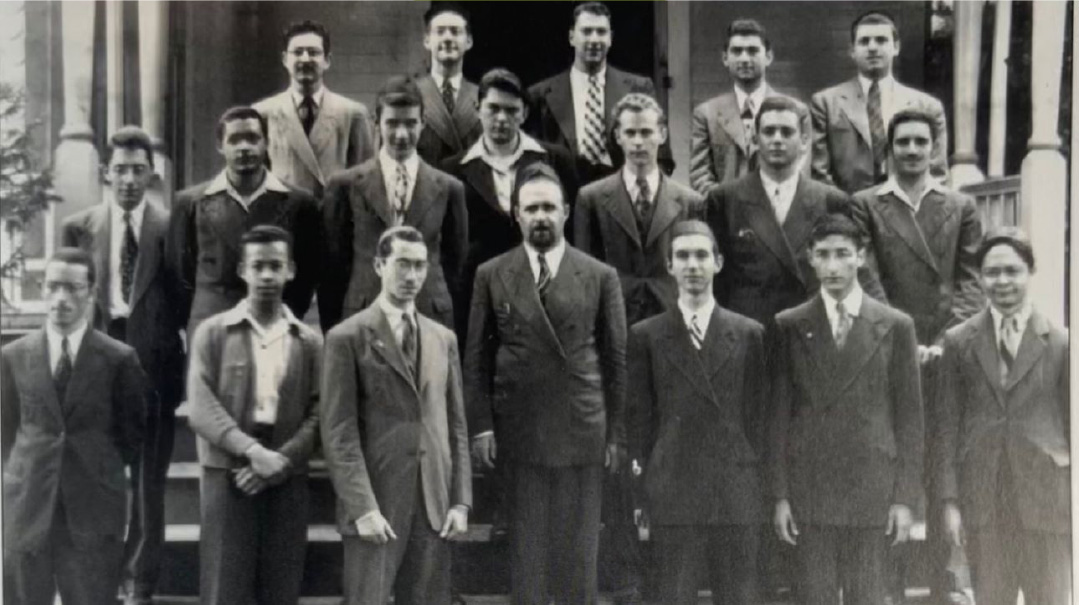
BD’E – Hagaon Harav Moshe Wolfson, Zt”l, Mashgiach Ruchni of Yeshiva Torah Vodaath and Rav of Beis Medrash Emunas Yisrael
A WARM MOMENT WITH MY REBBE
Klal Yisroel is saddened to learn of the petirah of Hagaon Harav Moshe Wolfson, zt”l, the longtime Mashgiach Ruchni of Yeshiva Torah Vodaath and Rav of Beis Medrash Emunas Yisrael. He was 99 years old.
Rav Wolfson collapsed on Motzaei Shabbos and was rushed to the hospital, as many of his talmidim and others stormed the Heavens for his him, but his holy neshamah ascended to Shamayim.
The levayah was scheduled for Sunday morning at 8:45 a.m. in New
Square; it will pass by Yeshiva Torah Vodaath, located at 425 East 9th
Street, at 10:25 a.m., and continue at 11 a.m. to Beis Medrash Emunas
Yisroel, located at 4310 16th Avenue in Boro Park. From there it proceeded to JFK airport for a 5:30 flight to Eretz Yisrael, where kevurah
will take place in Teveria.
Rav Wolfson was a talmid of Harav Shraga Feivel Mendlowitz, zt”l,
the legendary Menahel of Yeshiva Torah Vodaath. In 1943, he joined Aish
Dos, an innovative program that Rav Mendlowitz developed to train Rabeim
to fill positions in yeshivos and day schools across America. Thus
began Rav Wolfson’s long career in chinuch. He taught in Yeshiva Torah
Vodaath for many years, and was appointed as Mashgiach by Harav Yaakov
Kaminetsky, zt”l, in the 1960s.
Rav Wolfson was the marah d’asra of Camp Torah Vodaath for numerous summers, where he developed a close following of talmidim who eventually established Beis Medrash Emunas Yisrael, with Rav Wolfson as the Rav. The shul became a prominent makom Torah u’tefillah, and the Mashgiach addressed the tzibbur during seudah shlishis and other occasions. Many of his drashos were published over the years as Sefer Emunas Itecha.
Pain and Honor Mark BTJ Wartime Memorial Day Ceremony
Boys Town Jerusalem
The piercing pain and sorrow that marked Israel’s Memorial Day 2024 touched Boys Town Jerusalem students of all ages. At the school’s Memorial Day ceremony, over 20 recent grads now serving in IDF combat units – including many recovering from combat injuries – returned to pay tribute to fallen classmates.
Students spent Memorial Day visiting Mt. Herzl.
Earlier, BTJ students walked to the nearby Mt. Herzl Military Cemetery to recite prayers at the gravesite of IDF Corporal Ofir Testa, 21, killed at the war’s outbreak. Other BTJ grads killed in battle were Sgt. Benyamin Yona, 19, and Police Sgt. Gedif Mulugeta, 29. Current student Liel Gerafe, 19, was murdered by terrorists.
Ofir’s friends shared memories.
BTJ grad Yitzchak Marwani, 21, shared memories of his friend Ofir Testa with today’s students. “In his quiet way, Ofir tried to make a better world. This is the essence of what we were all taught at Boys Town Jerusalem.” Today Yitzchak serves in a Combat Engineering unit in Gaza, where he was recently injured.
BTJ grads have been fighting on the front lines
Yitzchak’s classmate, Infantry Unit Squadron Commander Amitay Cohen, 21, serves as a medic. At the war’s October 7th outbreak, Amitay headed south with his unit where he soon began treating injured civilians fleeing Hamas terrorists. “Once we reached the Nova Music Festival site, there were 250 dead bodies strewn everywhere. Our search found no survivors,” he said grimly.
Entering Gaza, Amitay bravely fought with his unit. In a recent clash with terrorists, Amitay’s unit entered a boobytrapped structure which exploded, killing three and injuring 15. Amitay gave immediate medical care to eight wounded comrades before tending to his own serious injuries. He has since been undergoing treatment in Jerusalem’s Shaarei Zedek Hospital.
It was important to come to the Memorial Ceremony
“I felt it was important to come to the BTJ Memorial Ceremony today,” Amitay shared. “My friend Ofir Testa was a happy, positive person who helped all. Today, we must believe that life will be better. We must continue living, while never forgetting the dead. Am Yisrael Chai.”
When you have sons fighting
in the IDF, you live in a state of personal and permanent emotional
conflict about the war and about the state of the Jewish people.
This is not an easy column to write, for several reasons. First,
my wife doesn’t want me to write it. She feels it’s too personal and
raises an issue that we find challenging to confront, namely, the safety
of sons at war.
Second,
the Jewish concept of Ayin Harah (the evil eye,) either real or an
imagined superstition, cautions against discussing certain issues so as
not to jinx them. Israel is at war. Let’s pray in general but not speak
about anything in particular. Third, I have a lot of anger about this
particular issue. How did God allow so many Jews to die in a single day
80 years after the Holocaust
and after the creation of a state and an army that are supposed to
protect them? And fourth, my thoughts on the subject are not in any way
fully formed.
When
you have sons fighting in the IDF, you live in a state of personal and
permanent emotional conflict about the war and about the state of the
Jewish people. Pride and fear. Defiance and surrender. Love and hate.
You’re confused. Better not to write, isn’t it?
On the one hand, we’re an American family. My son Mendy was born in Oxford, England,
where I served as the Rebbe’s shaliach (emissary) and rabbi at the
university, and my son Yosef was born in Englewood, NJ. What the heck
are my American sons doing at war in the Middle East against savage
terrorists?
On
the other hand (and I know I now sound like Tevye the milkman,) don’t
all Jews have to bear the burden of Israel and the Jewish people’s
security? Then again, why my sons, who actually had the choice not to
serve – especially our elder son, currently in an active war theater,
who sustained a serious training injury and was released from combat
duty only to spend years strengthening the injury in order to reenlist?
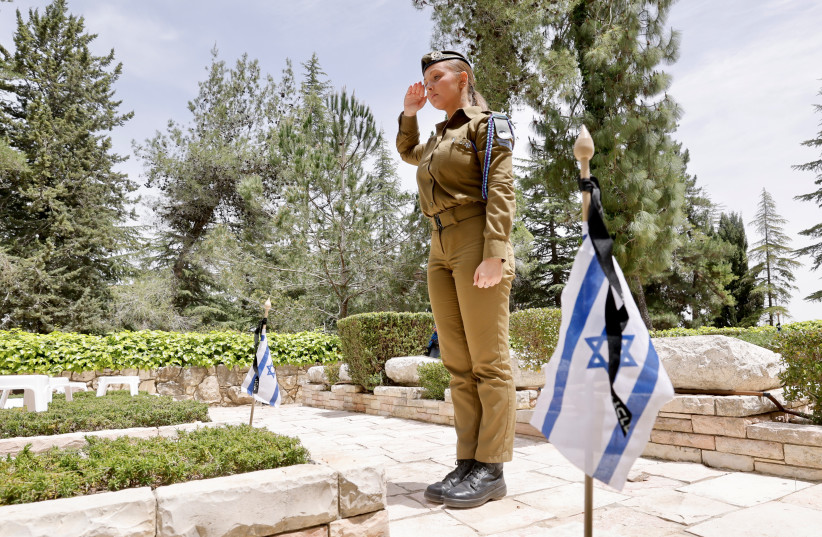
An IDF soldier salutes the grave of a fallen soldier at the Har Herzl
military cemetery
But after spending a day at the Nova festival site,
which my daughter Cheftziba said reminded her of our visit to
Auschwitz, and Kibbutz Nir Oz, near the Rafah border, where I saw the
charred ruins of homes that resembled the remnants of the Warsaw ghetto,
I returned feeling dejected and depressed. As we listened to the
non-stop booms of what appeared to be Israeli tanks and artillery
engaged in combat in Rafah, a mere five kilometers away, where the IDF
was striving to establish Never Again as a tangible policy rather than a
mere slogan, I found myself grappling with the question of why my own
sons are in such danger.
After
hearing the accounts of entire families burned alive and young women
raped, as well as visiting the freshly dug grave of Shani Louk, to whose
memory I dedicated a Torah – with Robert Kennedy, Jr. speaking with her
parents at their moshav – I had to come to terms with the reason why
every Jewish man and woman on Earth must be invested in the fight for
Israel’s survival.
What changes when you send your children to serve?
When
you have sons at war, your deepest values and political principles are
immediately compromised. I have been steadfastly opposed to any
ceasefire with Hamas for the most obvious of reasons. If Hamas survives,
there will be another October 7 – plain and simple. They say it
outright, and their barbarity and savagery easily equal that of the
Nazis, with one major difference: whereas the Nazis feared future
international tribunals and therefore covered their crimes, Hamas
broadcast their atrocities to the world, secure in the knowledge that an
immoral UN would later indict the Israeli prime minister and defense
minister rather than the terrorists.
However,
when it’s your sons fighting the terrorists, you pray for an immediate
ceasefire, whatever the cost. This is why I assume that it isn’t the
hostages’ families, facing something infinitely worse than we are, or
the IDF parents, who can make these decisions alone. Even concerning
odious, terror-funding Qatar, which I have fought for seven years in
global media and which, according to The New York Times, hacked my
emails in retribution, you start to think that even these monsters might
play some positive role in negotiating a ceasefire. (They won’t. They
are liars and murderers from whom the US must remove their Air Force
base, once and for all.)
Then
there’s the anger. I love the Jewish people, and I love being a Jew.
But when you return to the US and see how few of us American Jews
shoulder the burden of Israel’s defense, you become instantly
judgmental. Why were my sons naive enough to enlist? Why aren’t they
working on Wall Street, making money, or building a tech startup? And
how pathetic are we American Jews to believe that dining at plush,
five-star hotels in Jerusalem as smiling tourists and donating $1,000 to
Friends of the Israel Defense Forces, which hasn’t even bought a single
ballistic helmet or bullet-proof vest for the soldiers, somehow passes
for real support of Israel? (Strangely, the FIDF claims that their
lawyers don’t allow it, which begs the question: why do they exist at
all. Or maybe they should find new attorneys.)
YOU KNOW that these emotions are wrong, and you try and fight them.
But
the anger at God is real and, perhaps, justified. The word Israel
literally translates as “he who fights with God,” and it gives you a
mandate to do just that, much as my wife chooses the opposite approach
of complete trust in God, reciting Psalms for our sons throughout the
day. I’m angry at the Creator. What, Lord, do You want from the Jewish
people? Almighty God, are you serious that we alone, as a nation, must
die in order to live? Do we have to fight just to survive? Are Swedish
kids fleeing booby-trapped buildings in order to breathe? Are Australian
kids frolicking at Bondi Beach suddenly called to dodge drone strikes
at their borders? Are Belgian parents mourning their 20-year-old sons at
their graves? What do you want from us, Lord? And how long will this go
on?
For
thousands of years, God, we have been slaughtered, crucified, and
cremated. Can you tell us, Oh Lord, that there really is some higher
plan for this?
We
have visited so many families who have buried children in Israel.
Remarkably, they informed me that this is the “tax” they must pay to
restore ancient Israel and live in our ancestral homeland. Almighty God,
is such a tax fair in any way whatsoever? When the American colonists
faced a tax on their tea, they rebelled. What kind of God demands the
very lives of our children? Who can live like this?
On
Shavuot, just days after my father’s fourth yahrzeit (annual date of
death,) I read the Ten Commandments from a Torah with a crowd of some
100,000 people. As I did so, I began to believe that we Jews maintain
our Judaism solely to embarrass God into doing so Himself. We do not
murder, Oh Lord. So why do you? We keep Shabbat. So why don’t you?
October 7, 2024, fell on the Sabbath. Could you not, in your infinite
power, have prevented the desecration of the Sabbath on that horrific
day? We, Oh Lord, cradle your sacred Torah in our arms on the holiday of
Simhat Torah to show our adoration for its sacred text. Why, God, do
you not do the same? How will we ever enjoy Simhat Torah again? And even
as you allowed the sacrilege and defilement of your Torah on October 7 –
Simchat Torah – we will continue to dance. We will dance again, even if
you try to stop us. We will keep your Torah, Oh Lord, even when you
degrade it. And perhaps, as you watch us crying and dancing, you will
follow our lead and allow us to dance again, undeterred.
WE
ARE staying in a hotel where we are the only tourists. We are here in
Israel, hoping, God willing, that our son will be released from the
theater of war so we can see him. The rest of the hotel is populated by
refugees from the North – dozens of families who have lived there for
eight months. On Shabbat, a rumor began circulating throughout the hotel
that eight soldiers had been murdered. My wife and I began to shudder
and tremble.
The
news did not report what had occurred. The families, so many of whom
also have sons in harm’s way, told us not to worry; it was only a rumor.
I hurried to the residence of a government minister I am friendly
with, and he verified, while we sat trembling, which units had sustained
damage. We confirmed it was not our sons’ units. We wanted to feel
relief. We did. But at whose expense? Eight other families have been
destroyed. Are we Jews not all one family?
Miraculously,
after the Sabbath, our son, knowing that we were in hell, called us
from a military phone to tell us he was OK. The sound of his voice was
the sweetest thing I’d ever heard. I gave thanks to God for his
benevolence and kindness. However, not eight, but 10 families were
grieving because that was how many soldiers died in one day on Shabbat,
the day that God said was his sacred day. As we gave thanks to God for
the safety of our son, the earth swallowed those 10 soldiers whole,
putting their families in an everlasting hell.
And
so Jewish history continues, with no end in sight. We Jews live in a
land where, to survive, we pay with our lives, and in a world that
condemns us as Nazis even as we bury our children, who died in
self-defense.
When
my hero, mentor, and dearest friend Elie Wiesel died in 2016, I took my
children on a three-month trip to the killing fields of Europe. The
world’s most famous Holocaust survivor had died. The witnesses to the
Holocaust were disappearing, and my children, including our
seven-year-old daughter, needed to see what had happened before the
firsthand witnesses were all gone.
My
daughter Rochel Leah, today one of America’s most prominent Jewish
social media influencers and fighters for Israel, grew more upset as the
trip from hell, which would eventually be memorialized in my book
Holocaust Holiday, dragged on. In Budapest, which witnessed the complete
decimation of its community in the summer of 1944, she finally
confronted me. “Tatty, why did you bring me here? I just finished a year
of seminary in Israel, where I witnessed a living, joyous Judaism. But
you destroyed it. You brought me to a continent-wide cemetery of
Jewishness called Europe.” With futility, I attempted to comfort her. I
knew she was right. Were we a triumphant or a tragic nation? But at
least there was Israel. A Jewish rebirth. A reborn Jewish nation
reestablished in our ancient homeland with an army to protect us.
But
as I walked through the giant cemetery of Nova and looked at the
hundreds of faces of the beautiful young Jews slaughtered there, and as I
was led through the blood-soaked houses of Nir Oz, and as I prayed with
Nissim Louk at his daughter Shani’s freshly dug grave, it struck me.
Even Israel has become a giant Jewish cemetery.
And
I knew then that there was only one solution: fight, fight, fight.
Fight for Jewish survival. Fight for Jewish continuity. Fight the
terrorists. Fight the antisemites. Fight the UN. Fight the European
Union. Fight the vile, entitled Hollywood set who condemn our struggle
for self-defense as genocide. Fight the blood libels. Fight the haters.
Never capitulate. Never lose faith in God. And never give in.
Israel
is the greatest miracle of the Jewish people in 2,000 years. And no
matter how much the world wants to take it from us, we will never
surrender.
I'm Not A Fan Of The Writer - But I Share His Sentiments On This Topic:
For
Ḥaredim, this is an unbelievable trauma. Perhaps we don’t think about
this every day when we wake up, but ultimately the success of secular
Zionism in establishing the Jewish state is a real trauma in the ḥaredi
mind, because pre-state, one of the principle arguments against Zionism
was that it’s never going to work. (So said the Agudath Israel, R' Elchonon Wasserman, R'Aron Kotler - And no religious Jew should go there to escape the Holocaust) How can it possibly work, that a
bunch of secular Jews will establish the Jewish sovereignty, the
political representation of the Jews?
In
Israel, nearly all Jewish citizens are required to serve in the Israel
Defense Forces or to perform national service—nearly all, that is,
except for haredi (ultra-Orthodox) Jews. Instead, following a deal
worked out early on in the state's existence, young haredi men are
permitted to study in yeshiva after high school and thereby avoid
military service.
That
imbalance has been the source of much civil strife in Israel over the
years, but since October 7 it has taken on a different tone. Previously,
it was a question of fairness; now, it's one of military need. Israel
needs more soldiers, and haredi communities could provide them. This
issue is ostensibly part of what broke up Israel's unity government last
week.
Why
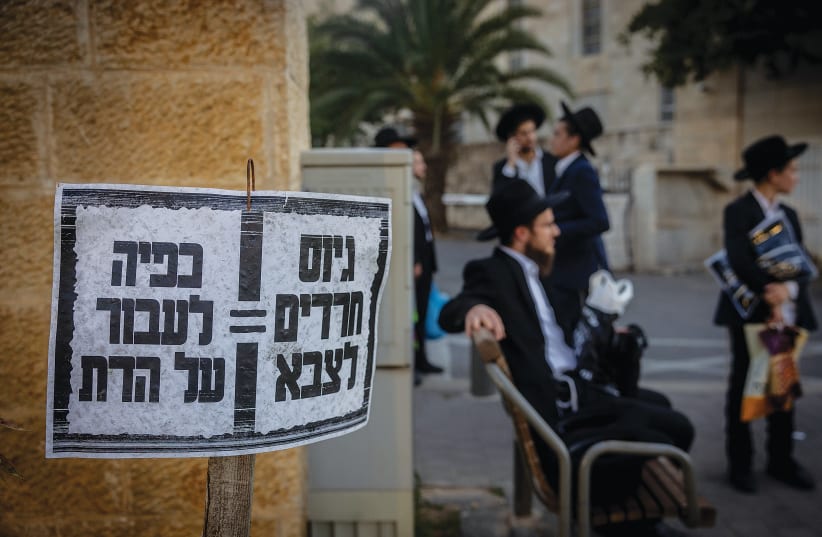
are so many Israeli Haredim—particularly haredi leaders—so opposed to
IDF service? And how could that change? Several years ago, Mosaic brought the haredi rabbi Yehoshua Pfeffer on its podcast
to answer these questions. In the wake of October 7, understanding the
haredi perspective on the IDF, and what might push it to evolve, is even
more critical today. Just click here to listen.
Mandatory army service plays an essential
function within Israeli civic culture, absorbing and equalizing
Ashkenazi, Mizraḥi (Middle Eastern), religious, secular, male, female,
Ethiopian, Russian, Druze and more. In the IDF, all of these identities
step back and create room for a national Israeli identity to step
forward.
“Rabbi Wasserman, Rabbi Kotler, Rabbi Rottenberg from
Antwerp, rabbis from Czechoslovakia and Hungary were unanimous in
rejecting any proposal for a “Jewish State” on either side of the Jordan
River, even if it were established as a religious state because such a
regime would be a form of heresy in our faith in the belief in the
coming of the Messiah, and especially since this little “Jewish” state
would be built on heresy and desecration of the Name of G-d.
*(The podcast was recorded July 2021 --- Some of the rabbi's ideas, while well-intentioned, have no place in today's need of every able young man to serve their country in this post October 7 world)* PM
Almost every Jewish community in Israel serves in the IDF, except one: the ḥaredi
(ultra-Orthodox) community. Seventy years ago, Israel’s first prime
minister, David Ben-Gurion, famously gave ḥaredi leaders an official
exemption from compulsory national service, an exemption that persists
to this day, along with much accompanying controversy. On this week’s
podcast, the ḥaredi leader Yehoshua Pfeffer, himself a rabbinic judge,
asks whether that exemption is just. In conversation with Mosaic’s
editor Jonathan Silver, he explores the background behind the
reluctance to serve, and brings us inside the debate currently unfolding
within Israel’s Orthodox communities about the fulfillment of civic
obligation and moral duty.
Excerpt (27:57-29:30):
The melting pot idea of the army
didn’t just evaporate into nothing. It morphed and changed, it evolved
over the years, but the army still remains very much a melting pot, it
still has an educational corps, it still has a vision. That vision has
shifted over the years, and now it includes a certain gendered vision,
it includes a whole plethora of other aspects, but once again, the
ḥaredi society that prides itself on its isolationism, that prides
itself on being an educational system that’s not exposed to all of these
trends and ideas, has a lot of trouble in going into the IDF.
Perhaps the final consideration,
which might be the main one, is this ambivalence towards engagement with
the state of Israel. The state of Israel is still a secular state. For
Ḥaredim, this is an unbelievable trauma. Perhaps we don’t think about
this every day when we wake up, but ultimately the success of secular
Zionism in establishing the Jewish state is a real trauma in the ḥaredi
mind, because pre-state, one of the principle arguments against Zionism
was that it’s never going to work. (So said the Agudath Israel, R' Elchonon Wasserman, R'Aron Kotler - And no religious Jew should go there to escape the Holocaust) How can it possibly work, that a
bunch of secular Jews will establish the Jewish sovereignty, the
political representation of the Jews?
But hey, they did, it worked, it
was successful. Not just was it successful, but it has long term
stability, it’s there. And to be engaged in the IDF is to be a part of
the state in the deepest possible way. It’s to be together, it’s to say
“we’re a part of this.” I think it’s a step that ḥaredi society needs to
go towards for its own sake and for the sake of Israel, but it’s a
tough step.
Meanwhile, over 60,000 Haredi men between the ages of 18 and 26, many
of whom fit for military service, avail themselves of the
Torah-is-my-profession exemption. Not all devote their productive hours
to Torah study.
The discrepancy has led to public outcry.
A video of hundreds of military-age Haredi men sitting in Ramat Gan’s
National Park on the evening of June 1, watching an open-air screening
of the UEFA Champions League final between Real Madrid and Borussia
Dortmund went viral on social media. Comments included, “Parasites,”
“Desecration of God’s name,” “My son is serving and didn’t get
permission to watch the game,” and, “So soccer takes precedence over
studying
'It was important to him to contribute to the Jewish people'
A yeshiva that preps Haredi men for IDF service mourns first graduate to fall in battle
As Israeli society debates mandatory
ultra-Orthodox enlistment amid war, Staff Sgt. Bezalel Kovach’s life and
death present a new view of what it means to belong to the community
On Wednesday, May 22, Staff Sgt. Bezalel Zvi Kovach, 20, was
critically wounded while fighting in Gaza. Four days later he succumbed
to his wounds at Soroka Medical Center.
Kovach was the first to fall in battle among graduates of Chedvata, a yeshiva that prepares Haredi men for IDF duty.
If fatal casualty rates are an indication which segments of
society are doing their fair share in Israel’s defense, the Kovach
family’s loss is a step toward balancing inequality between
ultra-Orthodox or Haredi and non-Haredi Israelis.
“The soldier Bezalel Kovach fought in Gaza out of a commitment to
being a part of the Israeli story, and he embodies the educational
legacy I want for our students,” said Rabbi Yonatan Reiss, who created
and runs Chedvata.
In recent months, as the uncompromising Haredi political leadership’s
opposition to a mandatory military draft threatens to topple Prime
Minister Benjamin Netanyahu’s government, Reiss, a member of the Belz
Hasidic movement, has been making frequent media appearances on Israeli
TV dressed in full Hasidic garb with long sidelocks framing his face.
Lawmakers early Tuesday voted 63-57 to apply “continuity” to a bill
from the previous Knesset dealing with the military service of yeshiva
students, reviving the contentious legislation amid the ongoing war with
Hamas in Gaza.
“As a member of the Haredi community, I can tell you that we excel at
volunteering and that’s really wonderful, but volunteering is not the
same as taking responsibility, with all due respect,” said Reiss.
“The day members of the Haredi community commit, truly commit to
three years of service, to being a part of what’s happening here — as
Bezalel did — the day they start serving their nation… or even commit to
working in a hospital, wherever they feel comfortable, wherever they
feel their Haredi identity is respected, that’s the day you’ll see
Haredim in the labor market, that’s the day Haredim will be fully
integrated and that’s the day they will understand what it means to be
an integral part of the Jewish people,” he said.
Kovach’s funeral was conducted in strict accordance with the
traditions of Jerusalem’s Perushim (separatists) community, founded by
disciples of the Vilna Gaon, Rabbi Eliyahu ben Shlomo Zalman, who
immigrated to Israel from Lithuania in the 1800s.
The three-volley salute, flower bouquets and other obsequies of IDF
burial protocol were absent. The funeral was conducted at the Givat
Shaul cemetery, not at Mt. Herzl Military Cemetery.
Kovach’s battalion commander, Lt. Gen. Shlomo Shiran, gave a eulogy
before a mostly male crowd, some dressed in black suits and hats, others
in olive green military uniforms.
One of the mourners present at the funeral was Yehuda Segal, a close
friend of Kovach who grew up in the same Haredi neighborhood, learned
with him in the Chedvata Yeshiva and served in the same battalion,
Netzah Yehuda, that was designed to cater to Haredi customs.
Segal said Kovach, a squad commander, was the most selfless person he had ever met.
“He was the type of guy who you could wake up at three in the morning
and he would be there with a cigarette and a can of Coke and encourage
you,” said Segal. “He had this amazing spirit, totally selfless, always
there for others, especially his soldiers. It didn’t matter whether that
person was Jewish or non-Jewish. ‘So what if he is a gentile,’ he would
say when guys pointed this out to him, ‘Hashem [God] created him too.’”
Segal recounted how, while visiting Kovach’s family during the week
of Jewish ritual mourning, he met a young Haredi man who had never heard
of the Netzah Yehuda battalion.
“I told him how we combine commitment to Judaism with army service,
the holy with the profane, contributing to the nation with learning
Torah — that the two don’t contradict each other,” said Segal.
“He looked at me like he couldn’t believe what I was telling him. I
showed him pictures of Bezalel — I guess he thought he would see someone
with dreadlocks and earrings, and suddenly he sees a guy in uniform
wearing a four-cornered garment with fringes, sitting during guard duty
learning [the teachings of Rabbi Nachman of Breslev],” said Segal. “The
guy said, ‘Wow, I didn’t know that was possible.’”
Segal noted that in the days between Kovach’s injury and his death,
prayer rallies for his recovery were held in Kovach’s strictly Haredi
Ramot Dalet Jerusalem neighborhood.
“It can tell you that there will be guys from the neighborhood, and
not just one or two, who will follow Bezalel’s example and enlist.
Attitudes are changing,” said Segal.
‘Parasites’ who ‘desecrate God’s name’
But if Haredi attitudes toward military service are changing, the pace is glacial.
In all, there are fewer than 300 students enrolled at Chedvata’s
different programs. Another 60 graduates are serving in the IDF.
Based on data provided by the Israel Democracy Institute and
statements made by IDF officials in Knesset meetings, despite annual
population growth of four percent — the fastest of any group in Israel —
Haredi IDF enlistment has remained relatively steady since 2018 at
about 1,200, just 10% of those eligible for service in 2023. And many of
these men come from the fringes of Haredi society — yeshiva dropouts,
children of newcomers to Orthodoxy, boys from modern-minded families
with high school matriculation, new immigrants from non-Haredi
communities.
Despite attempts by the IDF, public figures and social activists —
both Haredi and not — to encourage IDF enlistment, a painful chasm
separates those Israeli families who live in fear of the knock on the
door from an IDF death notification officer and the vast majority of
Haredi families who don’t.
Since the 1950s, a political arrangement anchored in a series of laws
and government decisions has allowed Haredi men to postpone mandatory
military service until they are too old to be drafted. They need to
declare Torah study to be their full-time occupation and commit to
remaining unemployed. The state provides those who study with modest
stipends. Yeshivot are supposed to be audited for attendance. But tens
of thousands of able-bodied men are said to be fictively registered at a
yeshiva in order to receive funds but never set foot inside.
For the embattled Jewish state, this arrangement has become increasingly untenable.
Israel faces myriad military threats: the war in Gaza, escalation on
the Lebanese border, drone and missile attacks by Iran-backed militias
in Yemen and Iraq, the threat of a nuclear-armed Iran, the uptick in
Palestinian terrorism in Judea and Samaria. Overwhelming defense burdens
are being shouldered by those who do serve — along with their spouses,
children and parents, who must cope with the economic, physical and
emotional stress of having a loved-one away from home for prolonged
periods of time exposed to existential dangers.
Since October 7, 299 soldiers and one police officer have been killed
during the ground offensive against Hamas and amid operations along the
Gaza border. A civilian Defense Ministry contractor has also been
killed in the Strip. About the same number of soldier deaths took place
during the October 7 invasion, when thousands of terrorists brutally
murdered 1,200 people in southern Israel, the vast majority of them
civilians, and kidnapped 251 to the Gaza Strip, where roughly 120 — many
of them soldiers — are still being held.
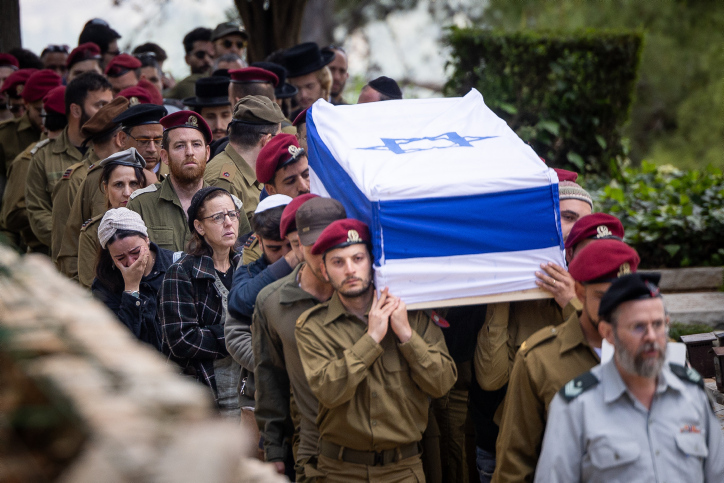
Family and friends of Israeli
soldier Master Sgt. (res) Nahman Natan Hertz, 31, attend his funeral at
the Mount Herzl Military Cemetery in Jerusalem on May 7, 2024. Hertz
was killed in a Hezbollah drone strike on Metula
Meanwhile, over 60,000 Haredi men between the ages of 18 and 26, many
of whom fit for military service, avail themselves of the
Torah-is-my-profession exemption. Not all devote their productive hours
to Torah study.
The discrepancy has led to public outcry.
A video of hundreds of military-age Haredi men sitting in Ramat Gan’s
National Park on the evening of June 1, watching an open-air screening
of the UEFA Champions League final between Real Madrid and Borussia
Dortmund went viral on social media. Comments included, “Parasites,”
“Desecration of God’s name,” “My son is serving and didn’t get
permission to watch the game,” and, “So soccer takes precedence over
studying Torah?”
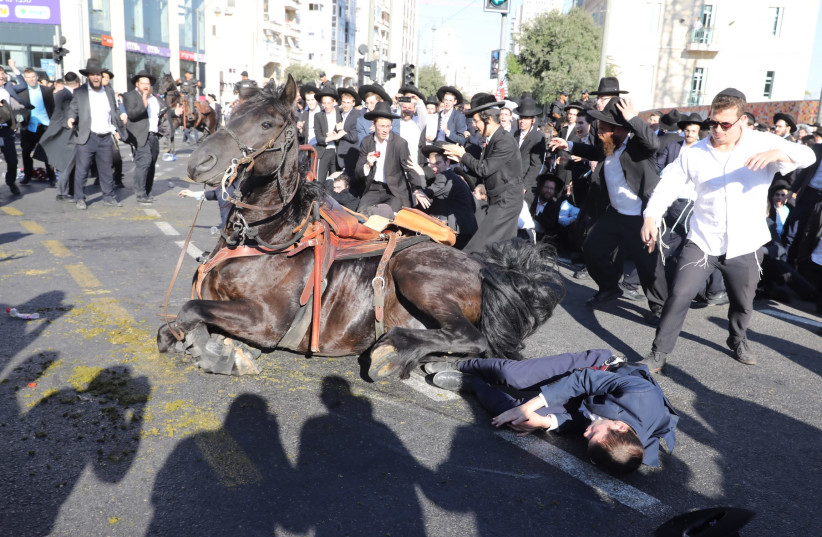
A Gathering (Asifa) of Horses' Rear Ends! "REMEMBER THE INTERNET"
Draft evasion is not God’s will, and shouldn't be treated as such
Monday’s draft-evasion vote was worthy of Sodom, which outlawed justice and legalized crime.
DESPITE THE IDF’s calculation that it needs 7,000 new
troops, Monday’s vote to revive an older haredi draft bill was approved
by the majority of the Knesset members.
They happened the same night, hardly 100 kilometers from each other, but one moral light-year apart.
In
Rafah, Givati troops entered a booby-trapped Hamas outpost that soon
blew up and caved in on them, killing four and wounding 11. In
Jerusalem, with news of the incident already known, 63 lawmakers
booby-trapped the Jewish state by voting to etch in stone
ultra-Orthodoxy’s evasion of service in the IDF.
Ultra-Orthodoxy’s
relationship with the Zionist enterprise has known many low ebbs, but
this one will be recalled as the lowest: for ultra-Orthodoxy’s leaders,
for their grand ally Benjamin Netanyahu, and for the Jewish state which
he purports to serve, and they so shamelessly abuse.
Essence of Zionism
ON THE face of it, the vote was procedural. That is also what Netanyahu,
the consummate spin doctor, ordered his troops to say; the vote – they
soon parroted him – was not about substance but merely about the renewal
of a previous legislation effort’s process.
Well,
this is not about procedure. It’s about substance, about the very
essence of Zionism, the basics of Judaism, and the most elemental
meaning of morality. It’s about Israelis who think that even as war
rages month after month, they can behave as if it is none of their
business.
Everyone
is at these harrowing times’ weekly military funerals: rich and poor,
natives and immigrants, city folk and villagers, observant and secular,
Jews, Druze, Christians, and Muslim Bedouin. Everyone, that is, except
the ultra-Orthodox.
Even
the IDF’s interim calculation that it needs 7,000 new troops did not
impress the people who want us to believe that by leaving the war for
the rest of us, they defend us and please God.
Under
the selfishness, cowardice, and eye-rolling that all this involves
sprawl layers of lies. The biggest lie is that military service
precludes observance. Thousands upon thousands of Modern Orthodox
soldiers have proven over the decades that there is no contradiction
between the two. Some even became great rabbis.
Equally
deceitful is the claim that conscription would end the study of Torah.
Wow. A man serves between ages 18 and 21 and then lives, God willing,
for another 60 years at least. Since only a fraction of the population
is aged 18-21, that means that the vast majority’s studying would
continue unimpeded if every ultra-Orthodox boy served. How dare anyone
say enlistment would end Torah studying?
Yet the biggest lie is that draft evasion is God’s will. It isn’t God’s will.
God’s
will is “you shall not stand against the blood of your neighbor”
(Leviticus 19:16). God’s will is what a fuming Moses told the people he
suspected of draft evasion: “Are your brothers to go to war while you stay here?” (Numbers 32:7)
God’s
will is what the Sages meant when they wrote: “In mandatory wars
everyone goes, even a groom from his room and a bride from her wedding
canopy” (Mishna Sota 8:7). “Mandatory wars” means wars of defense, which
is exactly what we face as southern communities’ scars glare and
Galilean forests flare.
In
the words of a petition circulated this week by prominent Modern
Orthodox rabbis, including Benny Kalmanson, president of the Otniel
Yeshiva, whose son Elhanan was killed on October 7 while fighting in
Be’eri, and Tamir Granot, head of the Orot Shaul Yeshiva, whose son
Amitay was killed in October while fighting Hezbollah:
“We
call on those who fear God’s word... to enlist... This is a duty not
only in terms of Jewish law and sheer morality, this is about national
lifesaving.”
The
petitioners hope to convince ultra-Orthodox rabbis and politicians to
abandon the path of draft evasion. But, alas, ultra-Orthodox leaders can
be counted on to ignore the petitioners’ stature, arguments, idealism,
patriotism, and pain.
As
this display of moral bankruptcy unfolds, the question is not how its
ultra-Orthodox engine continues to run, but how much longer its fuel –
the Likud’s cynicism – will continue to flow, and the answer is: until
the next election.THE ULTRA-ORTHODOX abuse of the Zionist enterprise evolved in three eras: Ben-Gurion, Begin, and Netanyahu.In
the first era all the ultra-Orthodox asked was an opportunity to
restore the Torah world the Holocaust consumed. The result was 500 draft
deferments. The figure slowly grew to 800, but the principle was the
same: ultra-Orthodoxy would rebuild the ghetto, and the rest of Israel
would not interfere.That
changed in 1977, when Menachem Begin removed the limit. That is how 800
annual deferments became more than 10,000. In addition, ultra-Orthodoxy
began receiving billions in taxpayer money. Now the Jewish state didn’t
merely tolerate the ghetto’s resurrection, it actively joined its
building.The
third phase came under Netanyahu. Now ultra-Orthodoxy emerged from the
ghetto and set out to reprogram the Jewish state. This meant joining
Netanyahu’s assault on the Israeli judiciary, in order to mock the law’s
principle of equality, so we will risk our lives defending this
country, and they won’t.The people of Sodom, who outlawed justice and legalized crime, could not have written this better.This
is not “a technicality.” It’s a unique Faustian bargain in which one
party buys power, the other buys life, and both shed their souls, but
instead of paying with their own blood and money, they pay with ours.As
in Sodom, there is one righteous man in the Likud – Defense Minister
Yoav Gallant, who defied the Likud in the draft evasion vote. In the
Knesset it seemed he was alone. But come the next election – Gallant
will not be alone. The nadirs of deceit, manipulation, and corruption to
which Netanyahu has led the Likud, and the brazen disparagement of
patriotism that culminated in this disgraceful vote, will finally result
in its engineers’ demise.
This is not only a prediction; it’s a wish, an outcry, and a curse.
DEFINITELY WORTH WATCHING TO UNDERSTAND WHAT IS REALLY GOING ON WITH THE WAR:
I see a profound connection between Matan Torah, Shavuot, and the ongoing war in Israel, integrating them into a unified narrative of faith, identity, and defense.
The concept of Milchemet Mitzvah underscores the sanctity of defending the land of Israel. The struggles and wars faced by Israel are not merely political but are imbued with spiritual significance. Defending the land and its people aligns with the Torah’s commandments to protect life and pursue justice.
The Mishna adds: In what case are all of these statements, with regard to the various exemptions from war, said? They are said with regard to elective wars. But in wars whose mandate is a mitzva, everyone goes, even a groom from his room and a bride from her wedding canopy. Rabbi Yehuda said: In what case are all of these statements, with regard to the various exemptions from war, said? They are said with regard to wars whose mandate is a mitzva. But in obligatory wars, everyone goes, even a groom from his room and a bride from her wedding canopy.
The concept of Milchemet Mitzvah (obligatory war) and Milchemet Reshut (optional war), as discussed in the Talmud (Sotah 44b), provides a framework for understanding the Jewish approach to warfare. Defending the land of Israel, especially in existential conflicts, is seen as a mitzvah, a divinely mandated obligation.
The current security situation in Israel is viewed through this lens. The continuous threats and acts of aggression necessitate a response that is both just and effective, aligning with the Torah’s teachings on preserving life and justice.
The interplay between Matan Torah, Shavuot, and the war in Israel encapsulates the holistic vision of the Orthodox Jewish perspective. It sees the divine revelation at Sinai and its annual commemoration during Shavuot as foundational to Jewish life and faith. Simultaneously, it recognizes the sanctity and necessity of defending the Jewish homeland, viewing these actions as a continuation of the covenantal relationship with God.
In this unified narrative, the Jewish people’s commitment to Torah and their resilience in the face of conflict are intertwined, reflecting an enduring legacy of faith, identity, and survival. This perspective not only honors the past but also provides a guiding framework for navigating contemporary challenges, ensuring the continuity and vitality of Jewish life in Israel and throughout the diaspora.
‘Hero of Israel’: Thousands pay last respects to officer killed in hostage rescue operation
Arnon Zmora’s widow eulogizes ‘a sweet man full of
laughter, sensitivity and compassion’; in tearful tribute, uncle of
rescued hostage says families have ‘unbreakable alliance’
People
wave the Israeli flag as they pay their respect to counter-terror
officer Arnon Zamora, who was killed in battle on June 8 during a
special operation to rescue four Israeli hostages from Gaza, outside his
family home in Mevasseret Zion, June 9, 2024. (Yonatan Sindel/Flash90)
Thousands of mourners, among them family members of hostages held in
Gaza, flocked to Jerusalem on Sunday to attend the funeral of Arnon Zmora, the police counter-terror officer killed Saturday during an operation that rescued four captives from central Gaza.
Zmora, an officer of the elite Yamam counter-terrorism unit, was shot
and critically injured by Hamas terrorists guarding three of the four
hostages. He succumbed to his wounds shortly upon arriving at a hospital
in Israel.
He was part of the mission to rescue Almog Meir Jan, Andrey Kozlov,
Shlomi Ziv and Noa Argamani, which was subsequently renamed “Operation
Arnon” in his honor.
Even before the arrival of the funeral procession at Jerusalem’s
Mount Herzl military cemetery, Israelis lined the street outside the
Zmora family’s home in the nearby town of Mevasseret Zion, waving
Israeli flags in tribute.
Inside the cemetery, Zmora’s mother Ruti eulogized her son, whom she
said was not only “your mother’s hero,” but also “an entire country’s
hero.”
“Your favorite movie as a child was ‘Robin Hood.’ In second grade,
you dressed up as a paratrooper. You looked up to Yoni Netanyahu for
Operation Entebbe,” Channel 12 news quoted Ruti as saying, referring to
the IDF hero — brother of the current prime minister — killed during the
1976 mission that saved over 100 Israeli hostages kidnapped to Uganda.
“My boy, full of joy, of life, with a kind gaze and a rolling laugh
that remains in my heart,” she said. “An imaginative, creative child who
knows that even if the road is difficult, the sky is the limit.
“My beloved child,” she continued, “I am so happy that last Friday I
was able to say to you: ‘Arnon, take care of yourself and your friends. I
love you.’ You answered me: ‘Mom, I love you too.'”
“I knew it was Russian roulette,” she said. “You sacrificed your life for the country.”
The head of the Yamam counter-terror unit said of Zmora that he was
“always first, and during the heroic operation he led, he acted with
courage and was a model for his fighters.
Chief Inspector Arnon Zmora, who was killed
in a mission to rescue hostages held in the Gaza Strip, June 8, 2024
“His actions brought light to the people of Israel and unfortunately
he paid for it with his life,” he added. “Instead of being part of the
national jubilation, we are going into deep mourning.”
The funeral was attended by Israel Police Commissioner Kobi Shabtai, who delivered a eulogy on behalf of the Israel Police.
“Arnon, I knew you and heard a lot about you. You fought on October 7
in the kibbutzim surrounding Gaza, you participated in countless
activities and operations that will forever be hidden from the public
eye,” Shabtai said. “You always understood the mission that was before
you, you strove for contact, you acted with the courage reserved for
outstanding people, and I believe you deeply felt the magnitude of the
hour.
“Arnon, we agreed that we would parachute together at the end of my
term,” said Shabtai, whose tenure will end on July 17. “Unfortunately,
we didn’t have time to do it.”
Among those paying tribute to Zmora was Aviram Meir, the uncle of
Almog Meir Jan, one of the hostages rescued during Saturday’s daylight
operation.
Arnon “brought joy to the families, you brought joy to the people of Israel,” Aviram Meir said through tears.
“I would like to address the Zmora family and tell you that the blood
of your children is mixed with ours. This is an unbreakable alliance. I
thank you from the bottom of my heart.”
Arnon’s widow Michal Zmora was the last to speak and said she had chosen to do so intentionally.
“I asked to speak last because the commanders were talking about how
much of a hero you are… now everyone knows about your heroism,” she
said. “More than everything, though, you were a sweet man, full of
laughter, sensitivity and compassion. You have been my spouse for the
last 12 years. For the last eight years, you have also been the perfect
father.
“It’s important that these things be said last, after the stories of heroism. That’s what will resonate from you.”
Michal continued: “There is no other love like ours, there isn’t any.
You don’t see that kind of love anymore, a love that involves choosing
each other every morning. A love that involves dialogue and listening —
with each passing day, we loved each other more.
“We raised two wonderful children together, my love, whose worlds
fell apart in an instant. I am enveloping them and protecting them. I
know you know that, and I also know that you thought about us in the
split second when you realized that death was coming.
“In the end, the children and I will be fine,” she said through
tears. “They will know how much of a hero their father was, how many
lives he saved… but much more than that, they will remember how much fun
they had with you. Riding bikes, playing the guitar, lighting a
bonfire, eating ice cream, having fun together, and being a family.”
Earlier on Sunday, Prime Minister Benjamin Netanyahu eulogized Zmora at the outset of the weekly cabinet meeting.
“The massive achievement yesterday caused the nation to stand up
taller,” said Netanyahu, “and I must say, it caused Israel’s supporters
around the world to stand taller as well.”
“But it came with great pain, the fall of the hero of Israel, the IDF warrior, the late commander Arnon Zmora,” he continued.
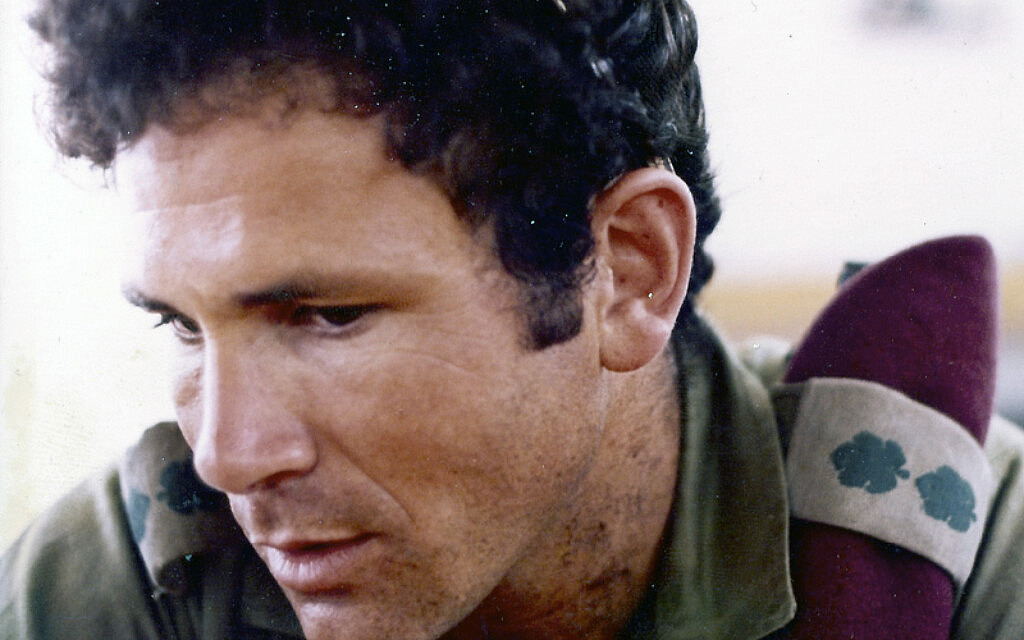
Yoni Netanyahu, in a photograph taken shortly before his death at Entebbe in 1976. (GPO, Wikimedia)
He related a story told by Amir Ofer, a commando who freed hostages
from Entebbe Airport in 1976 under the command of Netanyahu’s brother
Yoni, about meeting Zmora.
After October 7, Zmora called Ofer to recount the battles he took
part in against Hamas terrorists in Israeli towns and on roads near the
border. “How did you succeed and we didn’t?” Zmora asked Ofer.
“It took me a few hours to digest your story. You were really heroes
and you performed in an extraordinary way under the most difficult
conditions,” Ofer wrote to Zmora.
“Arnon will forever be remembered in the history of our people,” said
Netanyahu. “Just like the [Yitzhak] Rabin government supported the
proposal to call the operation to free the hostage in Entebbe ‘Operation
Yonatan,’ after the commander of the assault force who fell in battle, I
am sure that our government also unanimously supports the proposal to
name the operation to free the hostages in Gaza ‘Operation Arnon’ after
the commander of the force who fell in battle — the hero of Israel Arnon
Zmora.”
....It was first in 1921 that Reb Elchonon returned to Poland, to
Baranovitch, where he was asked to head the local yeshiva, Ohel Torah.
He was to head the yeshiva till the war years when he, together with
hundreds of his students sanctified the Almighty's name. Witnesses have
recounted that dreadful day--eleventh day in Tamuz, 5701 when the
murderers came in. He was in the midst of learning Tractate Nidoh. Reb
Elchonon spoke quietly and calmly, as was his practice. Not even the
sound of his voice was changed. On his face, his customary earnestness.
His tone betrayed no feeling for self, and he did not attempt to say
good-bye to his son, Reb Naftali. He spoke to everyone, to the whole
House of Israel.
"In Heaven it appears that they deem us to be righteous because our
bodies have been chosen to stone for the Jewish people. Therefore, we
must repent now, immediately. There is not much time. We must keep in
mind that we will be better offerings if we repent. In this way we will
save the lives of our brethren overseas. "Let no thought enter our
minds, G-d forbid, which is abominable and which renders an offering
unfit. We are now fulfilling the greatest mizvah. With fire she was
destroyed and with fire she will be rebuilt. The very fire which
consumes our bodies will one day rebuild the Jewish people."
In the summer of 1937 at the third convention of the rabbinical leaders
of Agudath Israel held in Mariband, which included hundreds of rabbis,
heads of yeshiva religious academies and grand rabbis of Chassidic
communities from a number of countries, Rabbi Elchonon Wasserman stood
out from among all of them.
Rabbi Shmuel Aharon Pardes of Chicago, the editor of the rabbinical
journal Hapardes, who participated at this convention and who was
present at meetings of the Council of Torah Sages that were held during
the convention, describes Rabbi Wasserman as follows: “Rabbi Elchonon
Wasserman, who stood above all the other participants walked with his
face towards the ground. His long beard has turned white, and his fear
of G-d preceded his scholarly wisdom. He reigns supreme above all the
other members of the Council of Torah Sages and the convention itself.
He intersperses his speech with simple metaphors hidden with great
wisdom that penetrates the hearts of each person according to his level.
He is the major disciple of Rabbi Israel Meir Kagan, the author of the
halachic work, Mishna Brurah, and every word he utters is spiced with
teachings and wise metaphors from his teacher. When Rabbi Wasserman
enters the meeting of the Council, everyone stands in respect, and he
asked to speak before anyone else.
On Sunday on the evening of 16th of the Hebrew month of Elul [August 23,
1937], the rabbinical leaders met to discuss the issue of a “Jewish
State.” The meeting was stormy, and it dealt with the issue of the Three
Oaths. A great dispute broke out in the session, and Rabbi Wasserman
expressed pungent words that shocked his listeners. The following is
what he said:
“We
must emphasize and declare the position of our holy Torah in order to
banish any confusion of ideas. Inasmuch as there are Jews who are
Torah-observant who say that a Jewish State would be the “beginning of
the Redemption,” we must inform them of the position of our Torah that
this is nothing less than the beginning of a new Exile! What do I mean?
After all, Jews have been living in Exile for some two thousand years,
so how can this be a “beginning” of a new Exile? My intention is to
expose the so-called Jewish Communists. An Exile such as this has never
existed until today. None of us can even describe such an exile, an
Exile under Jews! Only Jews from Russia have a slight sense of this
situation, even though the regime there is not a “Jewish” one. One of
the great rabbis of this generation recently told me that the term
“beginning of the Redemption” in reference to the Zionist movement makes
his hair stand on end!
In Hapardes (Year 11, Issue 7) Rabbi Pardes describes what he saw at the Convention:
“Rabbi Wasserman, Rabbi Kotler, Rabbi Rottenberg from
Antwerp, rabbis from Czechoslovakia and Hungary were unanimous in
rejecting any proposal for a “Jewish State” on either side of the Jordan
River, even if it were established as a religious state because such a
regime would be a form of heresy in our faith in the belief in the
coming of the Messiah, and especially since this little “Jewish” state
would be built on heresy and desecration of the Name of G-d.
Who Has Destroyed More, the Arabs or the Zionists? http://www.jewsagainstzionism.com/rabbi_quotes/WhoHasDestroyedMore.pdf (This
essay was written by Rabbi Elchonon Wasserman zt'l after the
disturbances in Hebron in 1929 which left some 50-60 yeshiva students
dead and is very apropos the most recent events on the West Bank. Ed.)
Haredi minister upbraids national religious for opposing military draft exemptions
Speaking at flagship yeshiva of religious Zionist
movement, Meir Porush says it ‘is not appropriate to criticize the order
of our conduct’
Minister
of Jerusalem Affairs and Jewish Heritage Meir Porush - Makes Arye Deri Look Like a Saint!
Addressing students at the flagship yeshiva of the religious Zionist movement on Wednesday, Jerusalem Affairs Minister Meir Porush
condemned members of the more modern religious community who criticize
the ultra-Orthodox effort to secure widespread military exemptions for
their youth.
“I don’t deny the complexities between us, the differences in
attitudes, but we need to resolve this between us. On both sides, there
are public figures of sufficient stature, who can gather in a room, and
reach a proper and respectful solution that preserves the world of Torah
and yeshivas,” the senior United Torah Judaism lawmaker declared during
a Jerusalem Day speech at Mercaz Harav Yeshiva in Jerusalem.
“But it is not appropriate for individuals from religious Zionism to
criticize our conduct and our policies of continuous Torah study,” he
insisted.
He added his best wishes to students of the yeshiva currently serving
and engaged in the “battle against the vile murderers” of Hamas.
Haredi women and male yeshiva students are generally exempt from
military service due to controversial longstanding arrangements that
have generated significant criticism and resentment among the general
population.
With the courts deeming those arrangements illegitimate, the
government is currently caught in a contentious public dispute over the
future of the Haredi draft.
Responding to Porush’s comments, Yehuda Veld, the director general of
the Religious Zionism party, tweeted a quote from Rabbi Zvi Yehuda Kook
— the former dean of the yeshiva and the son of its founder — stating
that exemptions from army service constituted a “dishonor of the Torah.”
“To come to his yeshiva and speak against him is simply impudence and contempt for scholars,” Veld declared.
In 2017, the High Court of Justice invalidated the Haredi draft
exemptions as discriminatory and ordered the government to pass a new
conscription law. The government has since been unable to agree on
legislation, repeatedly extending the non-conscription policy, while
Haredi politicians have sought to pass legislation cementing the
exemptions.
On March 28, the High Court ordered the state to cut funding for
yeshiva students eligible for the draft who do not enlist as of April 1,
prompting Porush to accuse it of “imposing economic sanctions against
those who chose to study the Holy Torah.”
“This is a serious violation of our right to exist in the Land of
Israel – the highest judicial authority of the State of Israel seeks to
throw Torah scholars into prison,” he declared at the time. “We will not
put up with this situation and will fight to cancel the decision
immediately, along with the effort to quickly regulate the status of
yeshiva members so that they can observe the Torah without
interruption.”
Students pray at Mercaz Harav yeshiva in Jerusalem
During a high-stakes hearing
Sunday on petitions demanding the immediate conscription of thousands
of yeshiva students, a panel of nine High Court justices was sharply and
unambiguously critical of the government’s claims that ultra-Orthodox
yeshiva students should not be drafted into the army.
The nine justices presiding over the hearing, including
conservatives, expressed intense skepticism — bordering at times on
anger — toward the claims and remarks of the legal representatives of
the government and the state-funded Haredi yeshivas, accusing them of
“word games” and “going round in circles,” and even appearing to mock
their arguments.
The sharp and at times caustic responses of the justices to the
government’s arguments appeared to suggest the court’s patience with the
decades-long failure of successive governments to deal with the Haredi
enlistment conundrum has run out.