"You
coYou could it in the way Rav Elya Brudny’s voice cracked as he said the
word “achim”, the love, emotion and heart with which he spoke of the
brotherhood that is Agudas Yisroel: he spoke about the bond between all
Yidden, crying at the plight of families devastated by war in Eretz
Yisroel, fallen soldiers, injured soldiers, newly bereaved parents, wife
and children….Hashem yishmor!
Rav Yosef Frankel, who discussed the fact
that every Yid carries the situation in artzeinu hakedoshah on their
hearts at all times, you could feel the sense of achrayus and
connection.
The
Kol Koreis and emails calling for tefillos, signed by the members of
the Moetzes Gedolei Torah, have been coming all year, but seeing their
anguish and distress up close is a reminder of how personal it is: this
year, the convention was one long tefillas rabbim as well."
The Chairman's Take - One Agenda
Shlomo Werdiger
From:news@agudah.org
Amid multi-front war: IDF sees 891 soldiers killed, 38 suicides over 2 years
Some 558 soldiers died in 2023 and 363 in 2024.
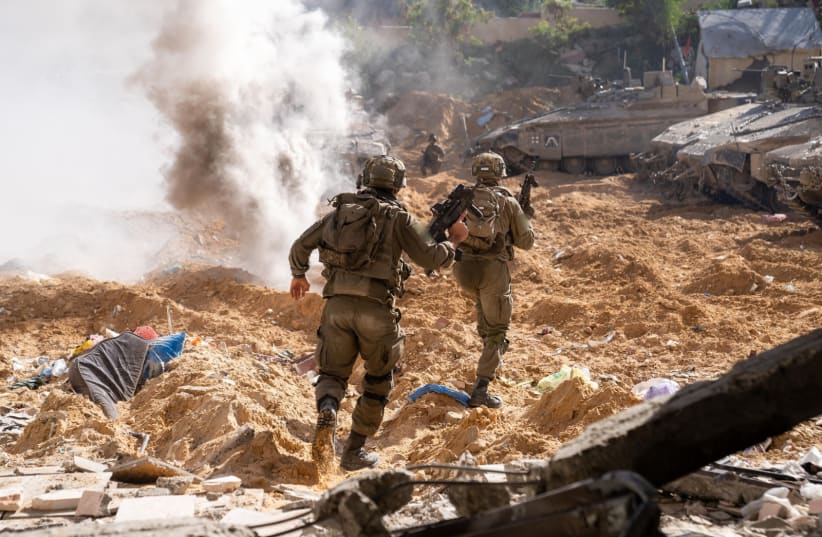
IDF soldiers in northern Gaza Strip conducting operation
in the area of the Indonesian Hospital, where a Hamas launch site was
located. IDF SPOKESMAN’S UNIT
The IDF said on Thursday that 891 soldiers have died during the war years 2023-2024, including a jump in suicides to 38 during that period.
Five
hundred fifty-eight soldiers died in 2023 and 363 in 2024. Of those,
512 were killed in fighting and operations, three in local terror
attacks, 10 from natural health problems, and 17 from suicide.
Of
the 363, 295 were killed in fighting and operations, 11 by local terror
attacks, 13 from natural health problems, and 21 from suicides.
Over 5,500 soldiers have been wounded during the war.
Sgt. Maj. (res.) Eliran Mizrahi's funeral at the Mount Herzl Military
Cemetery in Jerusalem
Of the 17 suicides in 2023, nine were mandatory service soldiers, four were officers, and nine were reservists.
Of the 21 suicides in 2024, seven were mandatory service soldiers, two were officers, and 12 were reservists.
In 2022, there were only 14 suicides, and none of them were reservists.
In
2013, 2018, and 2020, the suicide numbers were in single digits. The
highest number of suicides in the last 24 years was in 2005, with 36.
The
IDF said that all suicides were a problem and that the reservist army
had spiked considerably in size because of the war but that it was
throwing increased resources at addressing the problem for all soldiers
and, especially reservists.
However,
the negative trend created a hole in IDF arguments that it has done
enough in mental health areas to help soldiers, without even getting
into debates about how the IDF is handling post-traumatic stress
disorder on a broader scale.
Majority of soldiers killed in Gaza
Of the 891 deaths, 390 were mostly in Gaza in 2024, 329 were in 2023, including October 7, and others were in Lebanon, in the North, and in the West Bank.
In
terms of total losses, the 1948-1949 War of Independence was still the
worst, with over 6,000 Israeli deaths, including around 4,000 soldiers.
The
1973 Yom Kippur War is still second, with a loss of around 2,650
soldiers. However, if the current war continues, it could potentially
eventually pass this number given that 1,200, mostly civilians, were
killed on October 7, 2023.
Six hundred fifty-seven soldiers were killed during the First Lebanon War in 1982 and in the immediate years following.
In more recent years, the previous high in deaths of soldiers was in 2002, with 235.
Next, the IDF said that there were nine road accident deaths in 2023 and 20 in 2024.
The IDF said it is working on improving in that area but did not give much in terms of specifics.
The following is an edited transcript from the Making Sense podcast:
Well,
another year has elapsed, and 2025 is upon us. If you’re over a certain
age, every year now appears absurdly futuristic. (How young do you have
to be for 2025 to not look like the chyron at the start of a science
fiction movie?)
As
I look back over the year, and look ahead to what may be coming, it’s
hard to escape the sense that we are witnessing more than the usual
degree of change and chaos. Liberal democracies are under threat
globally. The conflict between Israel and her neighbors continues, and
there is the looming prospect of a proper war with Iran. There was the
fall of the Assad regime in Syria and uncertainty about what comes next.
The war in Ukraine continues to rage, and there is simmering hostility
between the US and China. Unlike most other periods in memory, if
someone came from the future and said, “Don’t you realize that World War
III started months ago?”—that would seem, if not plausible, at least
possible.
And
in this context, it remains hard to believe that we’re returning Donald
Trump to the White House. There are just so many reasons why this seems
like a bad idea. To name only one: He is the sort of president who
thinks that Pete Hegseth should run our Department of Defense. The list
of Hegseth’s disqualifying sins is so long and miscellaneous that it is
hard to perceive his nomination as anything other than a terrible
mistake—that is, until one recalls that Trump put forward Matt Gaetz to
run the Department of Justice. Happily, Gaetz is suffering the fate of
so many who come within range of Trump’s enthusiasm—humiliation and
oblivion (that is, until he resurfaces selling gold-plated rifles or
starts a podcast with Andrew Tate). These nominations really do seem
like some sort of troll or act of vandalism—both Gaetz and Hegseth could
be easily cast as villains in a Batman movie. Less obscene, but perhaps
even more dangerous, we have the prospect of Tulsi Gabbard serving as
Director of National Intelligence. Her well-documented patience, if not
fondness, for the Assad regime isn’t aging very well. Listen to her
describe her meeting with Assad on Joe Rogan’s podcast, where she directly responds
to all the criticism she received for speaking so diplomatically about
Assad. The level of naivete and frank delusion on display—given who we
knew Assad to be at that point—is just astounding.
When
the world could really use a shining city on a hill—that is, a healthy,
liberal democracy capable of leading, not merely by force, but by
example—we have decided to return a man to the presidency who refers to
his fellow citizens (Democrats who didn’t vote for him) as “vermin” and
“scum.” We can’t pretend that this is normal. And it has been, frankly,
nauseating to see the parade of business leaders—many of whom despise
Trump and his effect on our politics—race to Mar-a-Lago to kiss the
man’s ring (and much else). It’s tempting to ask these captains of
industry, all of whom are rich beyond imagining, “What’s the point of
having fuck-you money if you never say fuck you?” This was an
opportunity to say, “We’re rich enough, and our companies will be fine.
This is still a country of laws, and if the President targets us in any
way, our lawyers will be ready, and real journalists will be eager to
tell the story.”
I’m
not betting that everything Trump does in his second term will be
bad—and I’m certainly hoping for the best. But all these billionaires
should understand that normalizing Trump and Trumpism by purchasing
million-dollar tables at the Inauguration isn’t without risk of
embarrassment. Just take a moment to reflect on how this will look if
any of the darker possibilities of a second Trump term are realized.
Or just give another thought to January 6th.
It’s only decent to notice that no one is worried about what will
happen on that date this year. We won’t see Kamala Harris or Joe Biden
inspire a mob to attack the Capitol. How refreshing! Everyone who is now
sanewashing Trump and Trumpism should at least acknowledge the
difference here. And it’s worth reflecting on how much worse January 6th 2021 could have been, and how Trump played no role at all in preventing the worst possible outcomes.
If
you are someone who thinks that the significance of January 6th has
been exaggerated, what do you think would have happened if the people
who were chanting “Hang Mike Pence” had gotten their hands on him? Do
you actually think that people who had travelled halfway across the
country at the summons of the President, and just spent the previous
hours stabbing police officers in the face with flag poles—and who had
successfully breeched the Capitol as a result of this violence—and who
were now, by their own account, hunting for the Vice President and other
leaders in Congress—do you really believe that these people would have
suddenly turned docile and shown themselves merely eager to chat if they
had found their quarry cowering under a desk? What about the people
carrying zip ties, did they just want to talk to Nancy Pelosi? Do you
really not understand that what appears merely ridiculous in failure was
likely to have been horrific in success? Spend some time reading about
the French Revolution, or any other circumstance where the crowd
actually gets its hands on the people it is hunting. Perfectly normal
human beings regularly behave like monsters when they join a mob.
It
may seem strange to re-litigate an event from four years ago, but it
reveals the danger of treating Trump like a normal president. I really
think we escaped tragedy on that day as narrowly as Trump escaped
assassination in 2024. How strange would it be to normalize that? The
fact that Trump is still alive doesn’t make the attempts on his life any
less real, or disturbing, or significant of ongoing danger to him. Just
imagine if I said that the attempts on Trump’s life didn’t need to be
taken seriously—they’ve been blown way out of proportion—because the guy
was barely scratched. I know people who have been injured far worse in
their own kitchens! Would that make any sense? No. And yet no one who is
busy laundering Trump’s reputation seems to understand the obvious
parallel to January 6th.
How
would Trump and Trumpism seem if a couple of Senators had been beaten
to death or hurled out of windows on that day? How would Trump’s
continuous lying about the election having been stolen seem? Again, ask
yourself, what would have happened if the mob had gotten hold of Nancy
Pelosi or Mike Pence? It’s no credit to Trump that this didn’t happen.
He knew that the people he had turned loose on the Capitol were calling
for Pelosi and Pence to be killed—for hours, he
knew this, and he just sat on his hands. Whether he actually said that
Pence deserved to be hanged, as Cassady Hutchinson testified, will
surely be doubted by Trump’s defenders. But what cannot be doubted is
that he declined to lift a finger to defend his vice president, or any
other member of Congress, for hours. He just watched the violence on
television and refused to do anything useful. Of course, he has done
nothing but defend the rioters ever since and has promised to pardon
them. And he still claims that he won the 2020 election.
This
is the person who will be president of the United States in a few
weeks. This is the person you are honoring with your million-dollar
tables at the Inauguration. He is capable of making your efforts to
normalize him more than a little embarrassing.
Anyway,
stepping out of politics and looking ahead to the new year, I think
it’s worth reflecting on why we are tempted to reflect at all at the end
of each year. What is it about the calendar change that matters?
We may as well ask the question that lurks behind every New Year’s resolution: What is a good life?
Or, put another way: What makes life good? Or, with a slightly different emphasis: What is life good for?
Of
course, there are many answers—or parts of answers. Love and
friendship. Creative work and enjoying the creativity of others.
Learning—that is, growing in our understanding of some sliver of
reality. Or learning new skills—doing things that are hard or beautiful,
or are just fun. And, of course, there is pleasure, of all kinds. If
your life is full of laughter, sunsets, sex, ice cream, and rewarding
work—you’re probably not miserable. Though you might be—amazingly, you
might still be miserable. Of course, there is also compassion. There is
so much suffering in the world. Relieving some portion of it is one of
the good things we get to do here.
However,
there is a deeper answer to the question of what makes life good, and
one can be led to it if one interrogates any of the answers already
given. What makes love and friendship, or creativity, or learning, or
fun, or laughter, or compassion good? And how are
they different from all the things that seem to make life less than
good—hatred, terror, boredom, despair, envy, resentment, contempt…
There
is a deeper answer that is more philosophical, or spiritual—and,
therefore, tends to be unhelpfully bound up with religion. When I talk
about this, I tend to talk about meditation. And
while it is a helpful starting point, and even a necessary one, it is
also misleading. Meditation sounds like a practice—it is something you do,
something you add to your life. In the beginning, it certainly seems
this way. Did you meditate today? “No, I forgot.” Or, “Yes, for 10
minutes, right before lunch.” But meditation isn’t something you do—it
is something you cease to do. It is just non-distraction. It is the
freedom to notice what is already here. When you meditate, you’re not
changing anything about yourself—which itself is a profound change in
attitude. In real meditation, you are recognizing the condition in which
all apparent changes occur—the very nature of your mind.
So
the question about a good life becomes, what is there to notice, right
now, that matters? What is available to your powers of attention in this
moment that is important, or even sacred? (Again, the language one
reaches for begins to have religious connotations.) There is a freedom
to be found here in recognizing what it’s like to be you—what life is
actually like in each moment, rather than what you think it’s like, or
hope it’s like, or fear it’s like. Meditation is simply noticing what is
real, as a matter of experience, now and always—but always, and only,
now.
If you are alone in a room, what is in that room with you? What are you, really, as a matter of experience? And where are you? And where is the room? Are you in it, or is it—in some sense that is philosophically and scientifically interesting—in you?
Every
religion will tell you that there is something you have to believe at
this point—there is something to profess, if only in the privacy of your
mind—some set of propositions that must be added to your solitude to
redeem it and make it sacred. But this is demonstrably untrue. You can
believe all sorts of things, but belief is not enough. Ideas are not
enough. Thought is not enough to make solitude and silence matter. In
fact, thought is the very thing that makes the privacy of our minds
often feel like a prison.
What
is life good for when you are alone with your thoughts? And aren’t you
always alone with your thoughts? Even when you are out in the world with
other people, there is a veil of opinion, judgment, prejudice, and
pointless chatter that comes between you and everyone and everything.
Don’t you see how every experience, no matter how pleasurable or
intense, gets distorted by your mental efforts to grasp it, secure it,
prolong it, rehearse it, narrate it, compare it, or change it?
I’m
not saying that thoughts aren’t useful, or even necessary. They
obviously are. And their character matters, because we spend most of our
time lost in them. If we spent most of our time dreaming, our dreams
would determine the quality of our lives—so they, too, would matter. And
the truth is, dreams are nothing other than very vivid thoughts—and
ordinary thoughts are dreams, of a kind.
Meditation
is nothing other than the act of waking up properly, if only for
moments at a time. That’s why we called the app “Waking Up”—it’s more
than just an analogy. There really is something dreamlike about our
default state of thinking every moment of the day. I haven’t talked
about this topic much on the podcast of late, because it’s my whole
focus over at Waking Up. If you want to know more about meditation, and
why I think it’s important—and why much of what people think they know
about it is mistaken—you can find all of that at in the Waking Up app.
As
for New Year’s resolutions, I have one this year that I hope will cover
more or less every aspect of my life. It’s not a concrete resolution,
exactly—it’s more like a new conceptual frame that I will try to place
around everything. I’m going to try to live this year as though I knew
it would be my last. I’m perfectly healthy, as far as I know. And I
don’t mean to be morbid. But I think it is very powerful to put the
finiteness of life at the very center of one’s thoughts, more or less
all of the time. The question, “Would I do this if I knew I only had a
year to live?” is quite clarifying of one’s priorities. It might seem
like too stringent a filter—it would seem to prevent any long-term
planning, for instance. But I don’t think that’s necessarily true. I
have kids, and I obviously care about their future. And I care about the
future of society generally. There are many things I might do that
could, at least in part, be motivated by a time horizon that stretches
beyond 2025. For my New Year’s resolution, I’m going to work with this
thought: “Would I do this, would I pay attention to this, would I care
about this, if I knew that 2025 would be my last year of life?”
Would I watch a bad movie? Probably not. Would I watch a bad movie with my girls? Absolutely.
This
year, I’m going to do my best to live in a way that would be impossible
to regret. I know I can’t control everything. Almost everything that
will happen in the world, and much that happens in my life, will be
outside my control. But I can pay attention. I can cease to be
preoccupied with things that don’t really matter. I can let my hopes and
my fears vanish—I can notice that they are always in the act of
vanishing. And I can increasingly enjoy life as it is in the present.
Perhaps you’ll join me.
Let
us acknowledge the Hakarat Hatov that we as a people owe what Rav Moshe
Feinstein called a “Medina shel Chesed”. From the time of our first
exile, over 2,500 years ago, we have never been as welcomed as a people
as we have been in this country. Banishments, exiles, inquisitions
expulsions pogroms and worse, followed as wherever we went. In this
country, we never faced the ignominies that were heaped upon us in other
lands. No doubt, we faced difficulties like many other groups and
ethnicities, but we were given opportunity and we grasped it. My grandfather
felt as if the Statue of Liberty had spread out her arms to embrace him
as his ship sailed into Ellis Island in 1913.
Feds settle with Katz’s Deli over ADA violations
The kosher-style restaurant agreed to pay a $20,000 fine and improve its facilities for disabled people.
Katz's Deli (founded 1888) in New York City
The U.S. Attorney’s Office for the
Southern District of New York announced on Monday that it settled a
lawsuit with Katz’s Deli over violations of the Americans with
Disabilities Act at the Lower East Side landmark.
The kosher-style restaurant agreed to pay a
$20,000 fine and improve its facilities for disabled people through a
consent decree.
“The main entrance of Katz’s Deli is not
accessible, the restaurant does not provide sufficient dining surfaces
for persons with disabilities and despite having been renovated in 2018,
its restrooms fail to comply with the ADA,” the U.S. attorney’s office
stated.
“Notably, the consent decree provides for
staff to assist individuals with disabilities in using the main public
entrance, ensures that the required number of accessible dining surfaces
are provided and requires renovations to the men’s and women’s
restrooms at Katz’s Deli,” the Justice Department stated.
Founded in 1888 as Iceland Brothers across
the street from the current deli location, Katz’s bills itself as New
York City’s oldest deli and is famous for its towering pastrami-on-rye
sandwiches, matzah ball soup and other Ashkenazi staples in what was
once the center of Eastern European Jewish migration to the United
States.
It is also widely known for its depiction in the 1989 comedy “When Harry Met Sally….”
“During World War II, the three sons of
the owners were all serving their country in the armed forces, and the
family tradition of sending food to their sons became the company slogan
‘send a salami to your boy in the Army,’” per Katz’s site.
“During the peak of the Yiddish theater,
the restaurant was forever filled with actors, singers and comedians
from the many theaters on 2nd Avenue, as well as the National Theater on
Houston Street,” it adds. “Although the age of the Yiddish theater has
passed, Katz’s still has its fair share of famous customers, whose
photos now line our walls.”
The U.S. attorney’s office said that its
deal with Katz’s brings to a close its 13-year “Manhattan Restaurants
ADA Compliance Initiative,” which evaluated the accessibility of the 50
most popular restaurants in the borough, as rated by the 2011 Zagat
guide.
Versus A Country Run By Right Wing - Anti-Zionists - Ultra-Orthodox Jews:
Consumer body accuses Rami Levy supermarkets of violating bottle deposit law
Israel Consumer Council seeks court backing
for class action lawsuit after receiving over 1,000 complaints about
difficulties returning recyclables, getting refunds for deposits (OY VEY)
Israelis shop at a Rami Levy supermarket in Modiin
The Israel Consumer Council is seeking court approval of a class
action lawsuit against Rami Levy, after receiving more than 1,000
complaints about the supermarket chain’s stores refusing to accept
bottles for recycling and deposit fees.
The filing, submitted to the Beersheba District Court on December 18
and announced by the council this week, alleges that Rami Levy does not
allow bottles to be returned manually when collection machines are not
functioning, and limits the hours in which it accepts the recycled
bottles.
The request also cites cases in which stores have returned the
deposit through credit vouchers rather than cash, contrary to the law.
Since 2001, when the government passed the Deposit Law on Beverage
Containers, a refundable sum, usually of 30 agorot ($0.08), has been
added to the cost of all canned beverages, along with glass and plastic
bottles ranging from 100 milliliters to 1.5 liters in size, to encourage
people to return them after use. Since December 2021, the law has also
included containers of 1.5-5 liters.
But implementation has been anything but smooth.
According to a July 2023 report by the Knesset Research and
Information Center cited in the application, a bottle deposit complaints
hotline established by the Environmental Protection Ministry in
December 2021 and operated by the consumer council has received 9,010
complaints. Of these, 60 percent were filed over stores’ failure to
accept beverages marked with deposit labels.
Court rulings have since determined that the return of beverage
containers must not be limited to certain hours and that obstacles
should not be placed before those asking to return bottles in exchange
for a deposit.
The application said that between 2022 and 2024, the council received
1,017 complaints against Rami Levy — 139 in 2022, 323 in 2023 and 555
in 2024.
It alleged that Rami Levy stores refused to accept beverage
containers for which deposits had been paid on purchase, limited the
number of containers that could be refunded on a given day and the times
when bottles could be returned, issued refunds only as vouchers rather
than cash, and even refused to honor those vouchers after the day on
which they were produced. It further charged that the company refused to
accept beverage containers from minors, including in cases where
parents were present, and that customers had been subjected to
“humiliating and contemptuous behavior” by Rami Levy employees.
The council said requests to the company to change its behavior had
proved fruitless and that these were not one-off mistakes, or
oversights. “The evidence gathered indicates that the Deposit Law is
being systematically and intentionally violated by the respondent,” it
wrote.
The bottle deposit complaints hotline can be reached at 03-5100190.
A request for comment from the company’s legal adviser was not answered by press time.
Israel is rebuking Pope Francis for committing a “genocide blood
libel against the Jewish state” and reminding the pontiff of the
Vatican’s silence during the Nazi Holocaust amid an escalating
diplomatic row between the Holy See and Israel.
In a strongly worded letter to the pontiff dated December 18, Amichai
Chikli, minister of Diaspora Affairs and Combating Antisemitism,
reprimands Francis for his part in a recent display portraying Jesus as a Palestinian Arab and schools the pope on the Jewishness of Jesus.
“There is no other way to understand the decision to present his
image in a cradle, wrapped in a keffiyeh,” Chikli stresses. “Had this
been a one-time matter, I would not have written. However, just a few
weeks before this strange and false homage, in a more severe expression,
you echoed the new blood libel, insinuating that the State of Israel
‘might be’ committing genocide in Gaza.
“It is a well-known fact that Jesus was born to a Jewish mother,
lived as a Jew, and died as a Jew,” Chikli writes in his three-page
missive. He cites Matthew’s gospel, reminding Francis of the “well-known
fact” that “Jesus was born in Bethlehem of Judea.”
Lessons in Jewish and Roman History
Chikli quotes other biblical texts reiterating to Francis the
significance of “Bethlehem” and “Judah” in Jewish history. He notes that
Bethlehem is both the city of Rachel’s death and David’s birth,
explaining that Rachel is Israel’s matriach and David is Israel’s
archetypal king.
“It is also a well-known fact that the term ‘Jew’ originates from
Judah, the fourth son of Leah, from whom the Tribe of Judah descended,”
the minister points out.
Chikli proceeds to give the pope a lesson in Roman history and the
empire’s attempts “to eradicate the connection between the Jews and
Judah; one of the most prominent of these was Emperor Hadrian.” He
records details of Titus’s destruction of the Second Temple and the Bar
Kokhba Revolt, which resulted in the massacre of 580,000 Jews.
“Hadrian was not satisfied with the physical destruction of the
Jewish settlement; he anticipated the future, to the day when the Jews
would seek to return to Judea. Therefore, he renamed the province of
Judea ‘Syria Palestina,’ after the Philistines, the arch-enemy of
Israel,” he writes, explaining the origin of the name “Palestine.”
In a dig at Francis, Chikli also notes that the pope can verify the
evidence for himself by driving just “13 minutes by car from St. Peter’s
Basilica” and examining the Arch of Titus with its depiction of
Israel’s conquest and humiliation by the Romans.
Papal Rewriting of History
Referring to the pope’s recent comments calling for an investigation into the alleged genocide in Gaza, reported by The Stream, the minister contends: “This is a desperate and disgusting attempt to rewrite history.”
“As a nation that lost six million of its sons and daughters in the
Holocaust, we are especially sensitive to the trivialization of the term
‘genocide’ — a trivialization that is dangerously close to Holocaust
denial,” he notes.
Chikli details how the term “genocide” can be aptly applied to Nazi
Germany, which “for the first time in the history of nations, set as its
ultimate goal the complete annihilation of an unarmed people with whom
it had no conflict, and most of whom were not even living in its
territory.
“Let us recall that between the Jews, who made up less than 1% of the
population of Germany in the 1930s, and the Germans, there had been no
prior violent, territorial, religious, or political conflict,” he
notes.Recalling the “sickening strategy” of the “Final Solution,” the
minister cites as one example the Treblinka death camp, where 845,000
Jews from Poland, including children and elderly people, were murdered
in gas chambers and then dumped into execution pits, concluding: “This
is what genocide looks like.”
Vatican Silent During the Holocaust
“The Vatican’s silence during those dark days of the Shoah is still
deafening,” he writes, asking Francis to “clarify your stand regarding
the genocide blood libel against the Jewish state,” a “new blood libel”
recently promoted against Israel by the human rights organization
Amnesty.
Chikli concludes by drawing Francis’s attention to the the 60th anniversary of the Nostra Aetate Declaration
from the Second Vatican Council, which will be celebrated in 2025. The
declaration marked a “significant milestone in the relationship between
the Jewish people and Christianity,” he maintains, noting that Francis
is known to be “a close friend of the Jewish people.”
The Vatican has maintained a diplomatic silence on the minister’s letter, with neither Vatican News nor Avvenire, the Italian bishops’ media, reporting on it.
In response, the pope has doubled down on Israel since Chikli’s
letter, twice in public remarks last weekend accusing the Jewish state
of massacring children in Gaza.
Francis Falsely Claims Cardinal Banned from Gaza
On Saturday, in his annual Christmas greetings to the Roman curia, Francis claimed that the Latin Patriarch of Jerusalem, Cardinal Pierbattista Pizzaballa “was not allowed into Gaza, as had been promised.”
“Yesterday children were bombed. This is cruelty. This is not war. I
wanted to tell you this because it touches my heart,” the pope told
members of the Vatican bureaucracy.
Citing the monk Dorotheus of Gaza, Francis added: “Yes, Gaza, the
very place that is presently synonymous with death and destruction, is a
quite ancient city, where monasteries and outstanding saints and
teachers flourished in the first centuries of Christianity.”
However, a day later Vatican News confirmed that
Pizzaballa had visited Gaza and presided at Mass as well as
administered the sacrament of confirmation to several young people. The
pope’s media did not refer to the Israeli ban on the cardinal’s visit to
Gaza.
Instead, it acknowledged that “this is the second time that Cardinal
Pizzaballa has managed to enter Gaza and visit the community led by the
parish priest Fr. Gabriel Romanelli, following his visit on 16 May last.
“To ensure maximum security on the route, news of the visit was only given after arrival in the community,” Vatican News explained, hinting at the possibility that the pontiff may have been misinformed about Pizzaballa’s visit to Gaza.
The Holy Shmendrik mouthpiece also confirmed that the Latin Patriarch “will
make his solemn entry into Bethlehem, where he will be welcomed by
another suffering community and where he will celebrate Christmas Eve
Mass in St. Catherine’s Church,” debunking rumors that Israel was
restricting Pizzaballa’s visits to his Catholic flock in Judea and
Samaria or the Gaza strip.
Undaunted, in his Angelus address at St. Peter’s Square on Sunday,
Francis attacked Israel again, stating: “And with sorrow I think of
Gaza, of so much cruelty; of the children machine-gunned, the bombing of
schools and hospitals… So much cruelty!”
Severing Jesus from His Jewish Roots
Commentators previously slammed the de-Judaization of Jesus under the Francis pontificate.
Palestinian Authority President Mahmoud Abbas (aka Abu Mazen), a
holocaust denier and terrorism sponsor whom Francis warmly welcomed to
the Vatican on December 12 as The Streamreported, has redefined Jesus as “a Palestinian messenger” of hope in his 2023 Christmas address. Palestinian officials have also described Jesus as “the first Palestinian martyr,” and as a Palestinian jihadist.
“In the story of Christmas, Christ was born in modern-day Palestine
under the threat of a government engaged in a massacre of innocents,”
Rep. Alexandria Ocasio-Cortez, a Democrat activist and politician,
posted on social media on Christmas 2023.
“Rewriting history that Jesus wasn’t a Jewish resident of the Jewish
country of Judea but rather a Palestinian man who was persecuted by Jews
is gaining ground around the world, including in the Vatican,”
international relations expert Dr. Yvette Alt Miller wrote in response to the Vatican featuring Jesus on a keffiyeh.
“Jesus was a Jew. If he were alive today, the world’s elites would be
clamoring for him to be thrown out of Judea as a settler,” wrote British
columnist Melanie Phillips in 2015, after the Vatican agreed to
recognize Palestine as a state. “And Jorge Mario Bergoglio, aka Pope
Francis, would be amongst them.”
Dr. Jules Gomes, (BA, BD, MTh, PhD), has a doctorate in
biblical studies from the University of Cambridge. Currently a
Vatican-accredited journalist based in Rome, he is the author of five
books and several academic articles. Gomes lectured at Catholic and
Protestant seminaries and universities and was canon theologian and
artistic director at Liverpool Cathedral. This article was cross-posted
with the author’s permission from The Stream.
Carter descended into a dark obsession with Israel, casting it as the
source of all Middle Eastern instability and a world-leading violator of
human rights. His 2004 book, Palestine: Peace Not Apartheid, though
based on half-truths and outright lies, effectively legitimized Israel’s
delegitimization.
CARTER WASN’T satisfied with merely libeling Israel. His final decades
were devoted to whitewashing Hamas and presenting it as an organization
opposed to terror and dedicated to peace.
Ismail Haniyeh (L), meets with former U.S. President Jimmy Carter (R) June 16, 2009 in Gaza City
Dark obsession with Israel
That was the message he conveyed on the op-ed pages of The New York
Times and in public appearances worldwide. While shunning meetings with
Israeli leaders, he embraced Khaled Mashaal, Ismail Haniyeh, and other
terror chiefs.
He
supported the Goldstone Report that condemned Israel for committing war
crimes during the 2008-09 conflict with Gaza and accused Israel of
systematically starving Gaza’s civilian population. The terrorists’
attempts to bore under Israel’s border were, in Carter’s telling,
“defensive tunnel[s] being dug by Hamas inside the wall that encloses
Gaza.”CLICK: https://www2.ohchr.org/english/bodies/hrcouncil/docs/12session/a-hrc-12-48.pdf
In his 2007 forward to the book “The Deadliest Lies: The Israel Lobby and the Myth of Jewish Control,”
written by then-ADL director Abe Foxman, former Secretary of State
George Shultz slammed former President Jimmy Carter for “damaging the
well-being and security of the Jewish people and the State of Israel.”
Schultz’s assessment was on the money. Many Jews will remember former
President Jimmy Carter who died on Sunday at age 100 at his home in
Plains, Ga for his occasional use of antisemitic stereotypes, as Deborah
Lipstadt, Special State Department Envoy to Monitor and Combat
Antisemitism put it. But the damage Carter inflicted on the State of
Israel and consequently on world Jewry is only now fully coming to
light.
The reality of the Hamas atrocities of October 7, 2023, mushrooming
into a global campaign of rabid antisemitism can be traced back to the
Camp David Accords, which President Jimmy Carter forced with all the
power of an American president on the late Prime Minister Menachem Begin
in September 1978, established the framework for a treaty under which a
US-armed Egypt is now in a position to join forces with the US-armed
Turkey to deliver a devastating blow to Israel.
The Camp David discussions also covered the future of Israeli
settlements, and the most challenging issues were Gaza, Judea, and
Samaria. The Israeli and Egyptian delegations were particularly divided
on whether United Nations Security Council Resolution 242 should apply
to a long-term agreement in these territories and on the status of
Israeli settlements during the anticipated negotiations on Palestinian
autonomy following a peace treaty.
That was the beginning of the end. The Carter team attempted to force
Israeli withdrawal from the Sinai in favor of Egypt, and the other
liberated territories in favor of a Palestinian state. Egypt insisted on
an Israeli withdrawal to the June 4, 1967 borders in exchange for
security arrangements and minor border modifications. Israel rejected
Egypt’s insistence on withdrawal, especially from Judea, Samaria, and
Gaza.
The Begin team argued instead for a Palestinian autonomy during a
five-year interim period followed by the possibility of sovereignty
after the interim period expired.
Ultimately, the Summit “Framework” documents outlined the principles
for a bilateral peace treaty and proposed a framework for Palestinian
self-governance in Gaza, Judea, and Samaria.
On Dec. 18, 1978, the immortal William Safire wrote in the Times:
“The blame‐the‐Jews orchestration from the Carter men will continue
while the President himself refrains, Kissinger‐style, from saying so
publicly. Joel Sherman, the U.S. spokesman most despised by the
Israelis, is expected to let it be known on background that Mr. Begin is
a liar; White House aide Ed Sanders will dutifully bring in groups of
Jewish leaders to be told that Jimmy knows best about the survival of
Israel; and news manager Gerry Rafshoon will arrange for foreign policy
announcements — like the accommodation of China’s wish for us to
terminate our Taiwan defense agreement — to distract attention from the
failure of the last big stunt.”
GEORGIA NO PEACE I FIND
The mainstream media are flooding the airwaves this morning with
hails to the US president who succeeded in establishing peace between
the old enemies Israel and Egypt. But in reality, there is no peace
between the two countries, there are no cultural ties, no common
endeavors, it all remains on paper. And when President Mohamed Morsi, a
member of the Muslim Brotherhood, won the election in 2012, that peace
treaty was on its way to being torn up and dumped in the garbage if not
for the coup that reinstated military rule.
Israel has won nothing from the Camp David Accords, not even
militarily. For the past 50-some years, Egypt has been encouraging arms
smuggling into the Gaza Strip, bolstering daily attacks on Israel. Egypt
has also fostered one of the biggest armies in the region, some of it
with Israeli support. Meanwhile, Syria, which didn’t sign anything and
didn’t take back any land, has been subdued by the IDF to the point
where today it does not pose a threat – at least for the foreseeable
years.
Since October 7, we’ve been confronting the Iranian “Ring of Fire”
strategy of surrounding Israel with armed proxy militias that would
combine to incinerate the Jewish State. The groundwork for that strategy
was established in Camp David by Jimmy Carter. The next Democratic
administration, under President Bill Clinton, moved to develop
Palestinian self-governance into a detailed schedule for establishing a
Palestinian State that would choke Israel from the east and from the
west.
It took one selfish, idiotic move on the part of Prime Minister Ariel
Sharon to clear all Israeli presence from the Gaza Strip and northern
Samaria to usher in Hamas and the Islamic Jihad. It took a blind and
deaf––but oh, so chatty––IDF leadership to dwarf Israel’s security into a
complacent mechanism of containment while the plan to destroy the
country which was hatched in 1978 raged on.
“Under sharp reactive criticism, President Carter has disavowed his
choice of words, but the tendency of mind that lies behind such
repulsive analogies remains and is reinforced by the former president’s
views, spread across his book, which come down on the anti-Israel side
of every case.”
“Once false analogies start, it is only a short step to the cartoons
in the Arab press and European media which portray Israelis as
contemporary versions of Nazi stormtroopers.”
AL HET
In late 2009, just before Christmas, Jimmy Carter publicly sought
forgiveness from the Jewish community for any harm or negative
perceptions he may have caused toward Israel through his past statements
or actions.
“As I would have noted at Rosh Hashanah and Yom Kippur, but which is
appropriate at any time of the year, I offer an Al Het for any words or
deeds of mine that may have done so.”
By “Al Het” (“for the sin”) Carter was referring to the string of
confessions Jews utter on Yom Kippur while clapping their chests. There
were probably enough Jews in his administration to prepare him for his
bar mitzvah.
Abe Foxman responded, “As far as I’m concerned, there is no Al het.”
Foxman was reacting to a March 18, 2010 Carter speech at a conference on
US-Arab relations in Atlanta, in which the former president accused the
Obama administration of being “much more attuned to the sensitivities
of the Israelis” and of having “yielded excessively to the circumstances
in the Holy Land as Israel has confiscated several lands within
Palestine.”
Even Barack Obama was too pro-Zionist for the one-term peanut farmer
who lost his presidency to Ronald Reagan by a margin of 44 to 6. He
called Obama’s treatment of Israel “feeble.”
On March 25, Foxman wrote Carter, “I do not believe further
discussions between us will be fruitful. I continue to hope the day will
come when you have truly repented of your insensitive views of Israel
and the Jewish people.”
It is time for the Haredi leadership to come to its senses and
recognize the moral and national importance of meaningful military
service by its followers, and to reach a compromise that will benefit
the entire population of Israel and provide opportunities for those
young Haredim who are not natural Torah scholars and who thus find
themselves without a promising spiritual or material future.
Don’t Let Haredi leadership block the way of Haredim who want to enlist
More than a few ultra-Orthodox young men feel pangs of conscience
pushing them to help shoulder Israel's defense burden - they need
encouragement
Ultra-Orthodox
Israeli Air Force technicians are seen at the IAF's technical school in
Haifa, upon completing their training, December 3, 2024. (Israel
Defense Forces)
The former Sephardic chief rabbi Yitzhak Yosef recently issued a
religious prohibition (PULLED OUT OF HIS YASHVAN יַשְׁבָן) PM - against serving in the Israel Defense Forces
(IDF), even if the alternative is complete idleness on the part of those
registered yeshiva students who have no real interest in full-time
Torah study. His announcement seeks to protect young Sephardic Haredim
from secularization, as some claim would occur when exposed to the
diversity of the IDF. It may be, however, that in practice,Rabbi Yosef
is too late.
At a grassroots level, a sea change is already underway among
young Haredim in terms of motivation and desire to perform meaningful
military service. Even if Rabbi Yosef’s concerns relate to the drafting
of Sephardic yeshiva students in place of their Lithuanian and Hasidic
counterparts, a sober and cautious examination of developments, along
with growing testimonies from the field, indicate that the traumatic
events of the last year deeply shook parts of the Haredi public, and
especially the Sephardi public.
Many young men from the more modern and integrationist elements
of Haredi society have experienced considerable pangs of conscience and
doubts about their lack of participation in shouldering the country’s
defense burden, and about the price in blood and fear paid by the
Israeli public who do serve in the military.
Some of these young Haredim — most of them married fathers, long
past the age of exemption from military service (26) — have volunteered
to serve in the IDF and pay their part in the collective effort. These
are mostly men on the margins of the isolationist Haredi community, in
which the majority of the rabbinical and political leadership
consistently and stubbornly opposes any move to draft yeshiva students.
Almost 1,150 have volunteered for “Stage 2” service, which
involves a rapid two-week military training course, followed by reserve
duty as medics or ambulance drivers, in IDF Home Front units responsible
for identifying bodies and more. In addition, hundreds of younger
Haredi men, aged 18–24, have signed up for combat and combat-support
roles, including in specially tailored Haredi service tracks.
There is no doubt that, in the current painful and entirely
unequal circumstances, this number of enlistees is a drop in the ocean
compared to the more-than-60,000 Haredi men who still avoid any kind of
military service by remaining under the aegis of their yeshivas. The
public and political anger at this frustrating situation is entirely
justified. Despite that, we should all pay attention to those sections
of Haredi society that are largely hidden from public view. That is
where there have been major shifts recently, and in which there are now
cautious and hesitant relations with mainstream Israeli society,
including some turning to serve in the military. Indeed, these are the
sections of the Haredi world from which Rabbi Yosef wants to protect his
flock, lest they stray and (heaven forbid) enlist in the IDF, enter
higher education, or gain an occupation outside the world of Torah.
Despite Rabbi Yosef’s pronouncement, there are various Haredi
organizations, entrepreneurs, and leading public figures who are well
aware of the historic nature of the current hour. They are advancing
unique new initiatives and investing every effort along every possible
avenue of activity, in order to identify and assist Haredi men who wish
to undertake high-quality and meaningful military service. These include
a Haredi youth movement, special pre-military academies for Haredi
young men, Haredi yeshivot hesder (combining military service with high-level Torah study), and programs to prepare mentally for combat service.
Some of these initiatives are meeting with growing interest and
success among young Haredim, while others have experienced challenges
related to lack of motivation, cultural and social fears, lack of
community legitimacy, and organizational and budgetary difficulties.
Over the last year, various civil society organizations have also joined
this effort, preparing work plans and guidelines to help the IDF
improve its mechanisms for enlisting and integrating Haredim.
Needless to say, these activities have aroused fierce opposition
from the Haredi leadership and the majority of the Haredi public. Those
working to advance military service are seen as undermining the
traditional Haredi ethos, and are often subjected to being denounced and
condemned by the broader community.
The strongest oppositional forces against these changes are to be
found, of course, among the Haredi religious and political leadership,
with Rabbi Yosef as just one example. These leaders are making every
effort to fend off a political and public compromise that will result in
Haredi 18-year-olds — who now constitute 18 percent of the military
draft year cohort — fulfilling their moral and ethical social duty.
Unfortunately, these Haredi leaders are being backed by the government
of Israel, which is prepared to have the general public pay the price of
endless reserve duty, while simultaneously erecting bureaucratic and
budgetary hurdles against Haredi initiatives promoting military service.
Thus, the government is providing de facto support for the line taken
by the Haredi leadership, which runs counter to the public interest,
and, some would say, counter to Torah values too.
It is time for the Haredi leadership to come to its senses and
recognize the moral and national importance of meaningful military
service by its followers, and to reach a compromise that will benefit
the entire population of Israel and provide opportunities for those
young Haredim who are not natural Torah scholars and who thus find
themselves without a promising spiritual or material future.
Only a combination of balanced, fair, top-down primary
legislation with bottom-up grassroots initiatives can resolve one of the
most painful issues that is harming Israeli solidarity at a time when
it is so desperately needed. After all the pain and loss endured, we can
only hope that this time, the representatives of the Haredi public will
rise above the familiar petty politics and take brave and honorable
decisions. The Haredi street is already prepared for the next step.