It’s the early evening in
Eliezer Berland’s
residence in “Shomrei Hahomot” (Guardians of the Walls), his small
territory at the end of Mea She’arim, on the way to the Musrara
neighborhood. The afternoon prayer comes to an end, and a young woman
spots me and screams, “She’s a reporter.” Now’s the time to make myself
scarce.
“She’s not allowed to be here,” I hear people cry out. Three men
with cameras move closer in an intimidating manner. “Don’t worry,” they
say, “we’ll expose your identity.” The police are already on the line,
as I hear angry shouts in the background: “It’s the last time you come
here.”
A group of Hasidim chases me up the narrow alley. “She posts
things against the rabbi,” one of them says. “Get out of here, shiksa!”
An older woman approaches me, spits and shouts, “You b*tch, don’t you
dare come anywhere near here.”

Rabbi Berland with paper bills received from his followers
The woman who started the commotion by identifying me as an
investigative reporter tries to help me now. “Go into the gas station,”
she instructs me. “I have to run back to the prayers.”
Meanwhile, the men around me keep offering blessings, their way.
“She smells like rabies,” one of them shouts. “She’s recording
everything, beware.”
One of the few women in the group screams and warns me: “Tell
all your girlfriends that whoever comes here will be lynched. We’ll
carry out a lynch against her.”
The police are still on the line—it’s been six minutes, and the
station is hundreds of meters away—but there isn’t a single policeman in
sight.
A tall thug approaches me. “This is the first and last time we
restrain ourselves, I can assure you,” he announces, as one of his
Hasidic friends shouts: “She has full of pictures on her phone.” Several
moments later, one of the men snatches my phone violently, and I
finally hear police sirens in the background. Twenty-four hours later,
the police return my iPhone.
Berland, 80, is the founder and head of the Shuvu Banim Yeshiva,
which is affiliated with the Breslov Hasidic movement. Over the years,
he gained a following of thousands of Hasidim, many of them newly
religious Jews.
Six years ago, one of his followers claimed to have seen him
from the window in an intimate situation with a woman from his
congregation. When testimonies of sexual harassment were received from
other women, Berland fled the country with dozens of his followers,
moving from Morocco to Zimbabwe to South Africa to Holland, before being
extradited to Israel.
In November 2016, as part of a plea bargain, Berland was convicted of
two counts of indecent acts and one assault.
He was
sentenced to 18 months in prison
but served less than 12 months. About a year ago, he was
released from jail
on medical grounds.
]
Last month, 30 Breslov rabbis issued a scathing manifesto
renouncing Berland and calling on their followers to stay away from him.
“He is one of the evils of the generations,” they wrote. “One of the
destroyers of Torah and destroyers of the world.” Berland’s presence
creates quite a stir and sparks protests almost everywhere he goes.

Berland
performs the upsherin haircutting ceremony. ‘We grew his hair long
again, because when he was three years old the rabbi was absent’
On the backdrop of these protests, Yedioth Ahronoth sent three
female investigative reporters into the rabbi’s congregation. One after
the other, without revealing the link between us, we spoke to his
followers, men and women, witnessed the horrible neglect and were
introduced to the dark and violent aspects as well as to the positive
elements of community life and mutual responsibility.
We witnessed Berland’s complete control over his followers,
their minds and their feelings. They see him as the doctor, the
psychologist, the leader. They live for him, sometimes in disgracefully
poor conditions and in medical and physical neglect. Many of them shower
him with all their money, and sometimes they even take loans and pay
him for blessings. And so, as he becomes richer, they become poorer. We
were also exposed to additional testimonies on his dubious sexual
conduct.
We joined the congregation’s prayers and meetings, wearing
clothes that wouldn’t disclose the fact that we were outsiders. They
were usually held in the outskirts of the Musrara neighborhood, where
they live in small apartments and in high density.
Every morning, afternoon and evening—on irregular hours,
according to “Berland time”—they gather for prayers at the synagogue
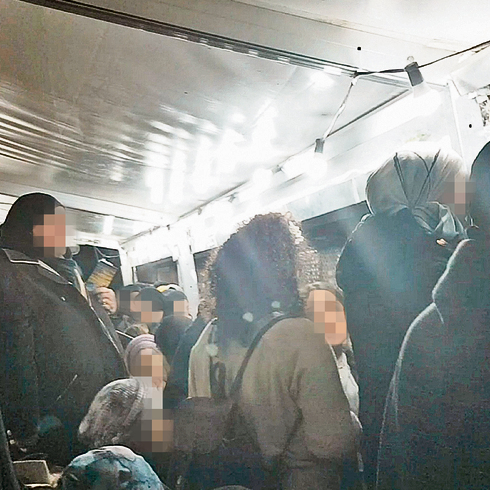
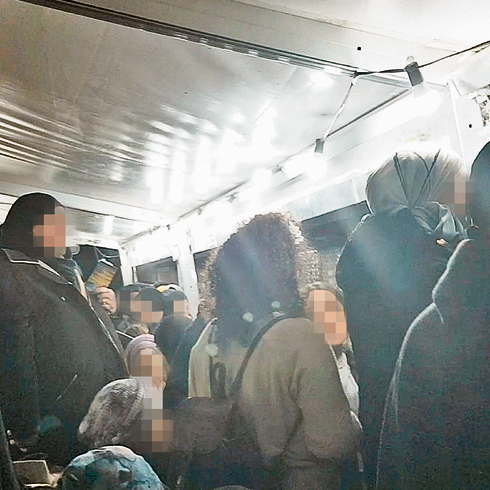
under his house. The men convene in a spacious, air-conditioned room,
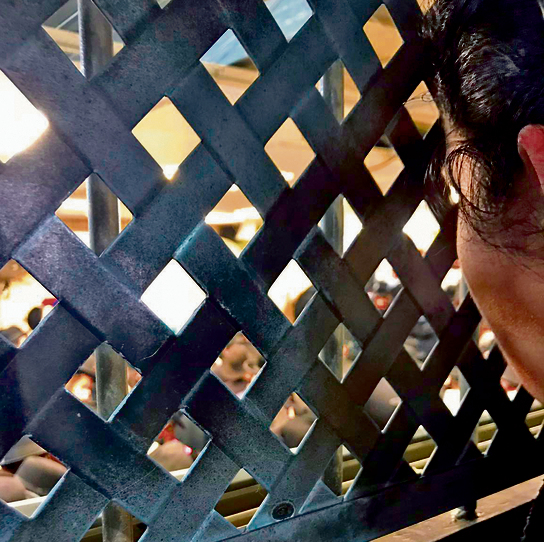
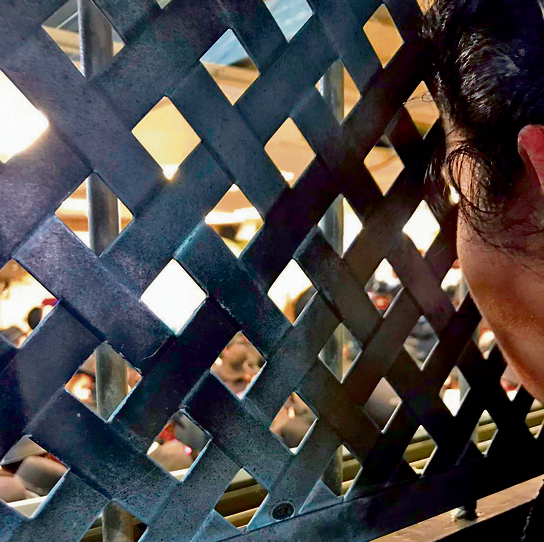
and the women gather in a tent outside the synagogue, standing on sort
of stools with their eyes directed at the rabbi’s seat, watching him
through a screen with small holes.
Hodaya, a 23-year-old newly religious woman, crosses the street
and stops, staring into space.
Where’s the women’s gallery, I ask her.
“At Rabbi Berland’s? Come on,” she points. “I don’t understand how I got
to pray with the rabbi. It’s such a great privilege, and I don’t
understand why I deserve it. it’s a special rabbi, a special prayer.
Come, you’ll see.”
We enter the women’s gallery tent, which isn’t particularly
clean and strongly reeks of food. Food leftovers are scattered on the
floor, alongside children’s drawings, books, and more.
As we sit down, Hodaya pulls out a pen and a paper and starts
writing. “It’s a request for a full recovery from the rabbi,” she
explains. “Do you want to write to the rabbi?” She turns to me. “We’ll
give it to him now, during the prayer.”
She tears a piece from the paper in her hand and encourages me
to write something. “He’s a righteous man!” she says. “He’ll give you
good advice. I didn’t know him either, and I sent him things about him
and he knows how to reply.” How does he reply? “Through the warden, if
you put down a phone number. you can write a question or ask for a
blessing.”
After I am convinced, Hodaya guides me through the wording of
the letter. “For Rabbi Eliezer Berland, may he live a good and long
life, Amen. And now ask for something,” she instructs. I say, “A request
for a decent shidduch (match).” Hodaya recommends that I ask the rabbi
specifically if he has someone to offer me. “Imagine you’re writing a
letter to the most righteous man in this generation.”
The same story repeats itself several days later. This time, one
of us, who is really about to undergo a complicated operation and is
experiencing pain, ask for the rabbi’s blessing. One of the women says
she suffered a serious illness and received drops from the rabbi that
saved her life. “Give it a try,” she suggests.
The note is handed over to Berland through one of the holes in the
screen, and in the middle of the prayer he opens it, stops the warden
and signals him to give me a call. “You don’t have to be afraid of the
surgery,” the rabbi says. “I’ll be with you the entire time, and I’ll
operate on you myself.”
Several minutes later, we are secretly handed a small bottle
with drops—which, according to a Health Ministry investigation, is
imported illegally and contains different botanicals—as well as old,
moldy bread, which the women say I should eat, because “it’s a remedy.”
In Hasidic lingo, it’s called “shirayim” —the rabbi’s food leftovers.
The human diversity in the synagogue is surprising. On one corner,
there are “Taliban women,” whose entire body and face is covered with a
shawl. Next to them sit elegant women wearing expensive golden jewelry,
from the Jerusalem Hasidic community in which women shave off all their
hair. On another bench, there is a group of modern, fashionable women,
wearing makeup. Most women, however, are Breslov Hasidic women covered
in many layers of cloth, with a neglected general appearance. Many
children run around the tent, sharing Jerusalem Kugel (noodle-based
pudding) which has been placed on one of the benches.
“Rabbi, come on, Rabbi. I can’t take it anymore, come on,”
shouts a woman standing next to the screen, staring into the men’s hall.
“Come on, rabbi, come out already, I can’t take it. No matter what I
eat, I cough. It’s such a pity I didn’t ask you what to do yesterday.”
Her name is Shira and she is in her 40s. “The rabbi told me not
to go back to my ex-husband,” she says. “But they’ve been causing me
trouble here, because I arrive early. They forbade me to come at 12.
They said I should only come from 2 o’clock. I don’t ask them and come
whenever I feel like it.”
Women
peek through a screen at the women’s gallery in the synagogue under
Berland’s house. ‘It’s a special rabbi and a special prayer’ (Photo: Ariela Sternbach, Nina Fuchs)
Like many of the Hasidim, Naomi also has a slew of tales about
the rabbi’s miracles. “For example, a barren woman who got pregnant,”
she says, and shares her own personal case: “The rabbi saved my tooth.
We were with the rabbi in exile in Johannesburg, and my tooth hurt at
the time. I didn’t tell him, I didn’t ask. He stood like that and
suddenly his hand started doing like this,” her hand strokes her cheek.
“He caressed me exactly where it hurt, protected my tooth for three
years. The rabbi didn’t know I was in pain. It was really strong pain.”
The “exile” issue is repeated quite often, mainly by Hasidim
from the close circle who were with him when he fled the Israeli law and
wandered around the world. He had about 40 families with him, but many
others brag about escorting and meeting him there, in an attempt to
demonstrate how close they are to him. These stories join a slew of
other tales shared by the rabbi’s followers.
“We followed the rabbi wherever he went,” says Hanni, who is in
her 20s. “He sentenced himself to exile because he is a great scholar.
It’s true that things were slightly rough financially, but we wouldn’t
give up being in the rabbi’s company. He performs great miracles and
even saved my sister from death in Morocco. She stayed alive thanks to
him.”
Back to the prayers, which are at the center of the
congregation’s life. The sun has set a long time ago, and the rabbi has
yet to come out. A woman from the congregation explains that there is no
way of knowing when he will come out.
When we try to understand how they can pray Minhah (the
afternoon prayer, is recited from the afternoon hours until sunset) when
it’s already dark outside, she replies: “The rabbi directs the sun and
the moon. The times are set by the rabbi.”
So dozens of Hasidim, who define themselves as ultra-Orthodox,
recite a prayer long after its time according to every Jewish-halachic
criterion.
As they wait for the rabbi, the women register for vegetable
deliveries. As most of them are extremely poor, the congregation takes
care of all their needs. That’s one of the nice social aspects of
communities of this kind, where everyone takes care of everyone. The few
members with a stronger financial basis take care of the weak majority.
Suddenly, there is a whisper in the crowd. Berland appears to be
coming out, and all the women around us start pushing and stepping on
each other to see him. To an outside observer, they might look like
young girls standing next to the stage during a rock concert, shouting
the rock star’s name and passing out from all the excitement.
“Look! It’s the rabbi,” one of them screams. “The rabbi, the
rabbi, the rabbi,” another one has trouble breathing. “Oh my God, the
rabbi,” a third woman’s face is red from excitement.” There is something
about that strength, about that belief in a person’s power. That in
itself may be enough to improve a person’s mood and health.
When Berland starts talking, the girls around him cry out in
amazement and admiration. One of them hands him jellybeans, hoping he
will touch and bless them. We follow the box of candy with our gaze as
it makes its way from the hands of three men into Berland’s hands. He
holds it for a minute and then tosses it at us. As new members of the
congregation, we are given precedence.
At this stage, it’s as if the signal has been given for an
onrush: The women send a slew of notes, and the men pass notes and paper
bills. From this moment until the end of the prayer, he already has a
handsome sum of cash and an impressive collection of notes in his
pocket.
“It’s enough to ask for a blessing, and it’s already working,”
one of the women explains. “They say that the lowest rank is a response
from the rabbi. The higher and holiest rank is dreaming about the
rabbi.”
Have you dreamt about the rabbi?
“Several times,” she replies with shining eyes. “You have to beg
and pray before you go to sleep that the rabbi will appear in your
dream. He actually guided me. He told me in the dream to stop drinking
Nestea because it’s not sufficiently kosher. In another dream, he told
me he refused to meet with me because I had to quit my studies. A day
after I quit my studies, he waved at me at the traffic light.”
Shira silences us. “The rabbi is reading my note,” she cries
out. “There, it’s only the fourth note I sent him. Now he’ll tell me
what to do.” A few seconds later, her phone rings. The warden is on the
line. It turns out that she is waiting for the rabbi’s instructions on
whether she should take antibiotics prescribed by the doctor to treat a
bacterial disease she is suffering from.
As soon as the prayer ends, they all rush outside to get a good
place in the “chases.” Naomi explains, “I don’t wait next to the rabbi’s
house like everyone else but run past several traffic lights to catch
up with him.”
There are hundreds of people standing around the house right
now—men, women and dozens of children, waiting to catch a glimpse of
Berland through the car’s window. When he emerges with his car, we burst
out of the alley towards the busy main street, along with dozens of
men, women and children. An outside observer may mistake the scene for
the scene of a terror attack. Two minutes later, his luxurious car
approaches, and he opens the window and waves goodbye. The fans are
beside themselves.
This admiration for the rabbi is likely one of the reasons for the
complexity of the investigation into the sex offenses he was convicted
of. The congregation’s women believe in him blindly. With such absolute
control over them, most of them have trouble acknowledging his
misconduct. Others are afraid to speak out against the man they admired
for years.
“Up until five years ago, we saw him as one of the righteous men
in our generation,” admits one of the people on the independent Haredi
panel that collected the complaints against him. “And then we began
hearing about different incidents, including death threats. It’s
difficult, but when I receive threats I realize they have to be fought.
The public has to understand that this person harms everything that is
sacred and important to the Torah.”
The first complaints he received, he says, had to do with
financial matters. “They established an unbelievable financial empire,”
he says. “For years, people had to pay extremely large sums to get in,
and I know people who gave him huge sums in exchange for ‘treatments.’”
In this context, a former Hasid told us: “I personally gave the
rabbi $300,000 in cash as part of proceeds alone, at the rabbi’s
specific order.”

(Photo: Ariela Sternbach, Nina Fuchs)
Nechama, who barely made it out of the congregation, says the
friends she left behind are repeatedly asked to transfer money to the
rabbi in exchange for different blessings. Despite being penniless, they
take loans and get into debt, “because the rabbi means everything to
them,” she explains.
“Then their parents pay. It has created a rift in quite a few
families, but the rabbi and the people around him don’t care. They’ll
tell you that this money goes to charity and welfare, but won’t be able
to present you with a shred of evidence supporting this claim. There’s a
reason why the Berland family got so rich, and this wealth has created
internal disputes. After all, someone will have to inherit the empire.”
The more dramatic issue, from a public perspective too, has to
do with complaints against Berland’s sexual conduct, an affair which
prompted the independent panel of Haredi judges to issue a scathing
manifesto against the rabbi.
“We sat in the court and received horrible testimonies from
women,” one of the people on the panel says. “We helped the them file a
civil claim against Berland, against his wife and against their son.”
Another issue the authorities are dealing with is the neglect of
some of the children in the community: The clothing, the nutrition, the
physical state. Some of the newborn babies are not given proper care
and are not supervised by the authorities. The medical dependence on the
rabbi could be particularly dangerous when it comes to people who are
ill and may give up treatment if advised to do so by the rabbi.
The congregation members are well aware of the welfare
discussions. As soon as we pull out a phone from our pocket and try to
take pictures, women storm at us from every direction: “Where are you
from? Why did you take pictures? Delete them! People come here and take
pictures for the social services. Whoever takes pictures for them will
be hanged.”
Berland’s associates, on the other hand, present an entirely
different picture: Thriving educational institutions, children whose
needs are taken care of, and an internal welfare project that supports
the poor and the weak.
“You’re invited to take a tour,” they said to us several times.
“You’ll see the work being done in the congregation, the mutual
responsibility, the good education the children receive in the Talmud
Torah school. There is no distress.”
It should be noted, however, that many of Berland’s followers
come from weak populations and rely on the support they receive from
Berland and his congregation. Moreover, many of them aren’t interested
in “nonsense” like earning a living, stylish clothes or things which may
seem trivial to us. As far as they are concerned, they have everything
they need—a connection to the rabbi.
It’s late in the evening in a big synagogue near Derech HaTayasim in
Tel Aviv. Many of the congregation members are excited ahead of
Berland’s arrival at a conference. They have come here from all over the
country and include some exceptions—traditional, nearly secular, people
who have come to hear what everyone is talking about.
These conferences, which are held in different places in Israel
every few days usually attract demonstrators as well, protesting the
fact that Berland is still honored and invited to preach his doctrine.
Inside, there is a festive atmosphere inside. After about an
hour of speeches from different rabbis who still support him, Berland
enters the room like a king to the sound of loud applause from the women
sitting next to us in the women’s gallery. Being charismatic, Berland
knows how to draw the attention of his fans and followers. He is
surrounded by an entourage of security guards and associates who prevent
anyone from approaching anyone. At first, he stands up and dances for
several minutes to the sound of Hasidic songs.
As soon as I pull out my smartphone to take a picture, a young
woman snatches it and asks, “Who are you?” Their fear of the media is
hard to miss. The Hasidim repeatedly warn of “a female journalist who
infiltrated our community,” without knowing that we work together.
“Don’t let them scare you,” says Ora, who escorted me to the
conference. “They’re traumatized by every new woman that arrives,” she
says about the hostile girls. “They’re afraid of the media and they
suspect everyone.”
Women peek beyond the women’s gallery screen at the synagogue under Berland’s house (Photo: Ariela Sternbach, Nina Fuchs)
Despite their hostility, the Berland women reveal their caring
and compassionate side later on. When I leave the conference after
feeling unwell, they call me one after the other to make sure that I’m
okay, that nothing bad happened to be. Their concern continues in the
following days, when I undergo surgery and while I recover. It’s real,
sincere concern, with a slight attempt at turning me into one of the
rabbi’s believers too.
Back to Jerusalem. We decided to try to get a blessing directly
from Berland, to try to talk to him for a few seconds. This time,
following the girls’ recommendation, I specifically write in the note
that I need advice on using a certain medication, an ointment, as well
as a shidduch if possible. As we wait, we spot a sticker reading “A
prayer for the wellbeing of the Rabbi and Rabbanit.” That makes sense,
considering his status—practically a god.
Shortly after 6 pm, the rabbi comes out. After the prayer, two
toddlers are brought to the stage and the rabbi cuts their hair. It’s
the famous ushperin ceremony which is held when a boy turns three years
old. One of the children, however, is already four years old. “We grew
his hair long again, because when he was three years old the rabbi was
absent,” his mother explains happily.
An older woman approaches us, asks where we’ve come from and
where we’re going. Quietly, she shares a secret with us. “You can get to
see the rabbi if you buy 100 letters for the Torah scroll,” she
promises. “It’s a standing order, 100 shekels a month for 36 months.
It’s quite a lot, but it guarantees that the rabbi will see you.”
One of the leaflets scattered around us includes a phone number
for urgent medical cases. I dial the number and tell the secretary once
again that I have a skin disorder and need to know what I should do. An
hour later, the rabbi’s warden calls and passes him the phone.
The rabbi’s unclear words are translated by his secretary: “How old are you?”
25.
“Married?”
No, single.
“A meeting with Yitzhaki. Will Yitzhaki be good for you?”
Who’s that?
“He studies 24 hours. Are you ready for a guy who studies 24 hours?”
Ready for what?
“He’ll work for you to have a child… So we’ll arrange the
meeting today. You’ll meet him on Sunday. A fine young man, charming,
blue eyes, just the way you like it.”
Can I meet the rabbi too?
“Be here tomorrow at 4 pm.”
As for the “skin disorder,” the rabbi recommends applying
ointment every hour and promises it will pass by Saturday. In this case,
nothing happened. The rabbi wasn’t present during the surgery either,
as far as we know, neither physically nor in spirit. That’s the thing
with religious clerics like him—their followers see the rabbi as a
sacred, righteous man who always speaks the truth, even if in reality
the exact opposite happens.
An associate to Berland offered the following response: “The rabbi
engages in charity activities, among other things, and often receives
donations for the needy. These donations are usually handed out to the
poor on the same occasion. The rest of the money and donations through a
standing order are directed to the congregation’s charity
organizations.
“In recent years, the rabbi hasn’t been receiving women in his
home and has been escorted by security guards 24/7 on behalf of a former
deputy police commissioner to prevent a disaster or slander by the
rabbi’s persecutors.
“As a man of the world, the rabbi acknowledges the global
epidemic of an over-prescription of painkillers. However, there is no
recommendation to avoid medical care, and all Shuvu Banim associates see
doctors when necessary.
“As for the claims of violence, Rabbi Berland has been working
for years to bring every Jews closer to the Jewish tradition. The rabbi
is famous for appealing to the hearts of people with a violent past and
mental stability issues as well. Nevertheless, members of the
congregation have been feeling persecuted by the media in recent years
following many negative reports. Although there is no justification,
this is reflected in intolerance towards the media. We reject this
behavior.”

Berland's car arrives at the Western Wall in early April
The Ministry of Social Affairs directed us to the Jerusalem
Municipality’s Social Services Department, which offered the following
response: “Significant cooperation has been advanced in recent years
between representatives of the municipality’s Social Services Department
and representatives of the Shuvu Bnaim congregation, thanks to great
efforts to build a relationship of trust, after the congregation had
segregated itself and rejected any contact with the state’s institutions
for years.
“The Jerusalem Municipality has allocated special social workers
to care for the families, opened workshops for parents in crisis and
made them accessible, created a basket of modified responses for poor
families, built a ‘warm home for girls,’ introduced specific programs
for children and youth at risk, including a summer camp for young
children, and incorporated special care teams in the educational
systems. In addition, truant officers and youth advancement workers have
been introduced into the educational institutions.”
The Israel Police offered the following response: “The Israel
Police enforce the law and maintain public order wherever necessary, in a
professional, impartial manner and proportional manner, and using
constant discretion concerning the use of the arrest authority and use
of force. In this case, thanks to the police’s determination, the
cellphone was located and returned to the reporter by the police
officers.”
Eight women testified against Berland in the special tribunal
appointed by the Breslov Hasidic movement. According to one of the
rabbis, they received complaints from other women who claimed to have
been abused by the rabbi. Talia, in her 20s, is one of them. Here is a
refined version of part of her testimony:
“The rabbi took me to the apartment down there,” she said. “He
sat on the bed, made me sit on him, hugged me and inserted his hands. He
said to me, ‘It was so horrible, so horrible. I didn’t get to see you
for 72 hours! I thought I would die.’”
When she asked him if it was okay that she had spoken, he said
to her: “The rabbi said no talking, not a sound! You know what? You can
talk, but not about what happens between us, nothing about what happens
between us!... You don’t know the rabbi, you don’t know who the rabbi
is. You know nothing.” She said she had felt as if he was preparing her
for a police interrogation.
In separate case, she testified: “Each time he orders me to sit
on him, and that day he sat down and I stood next to him, and he
inserted his hands and it was just like… he was doing something! In that
direction and in the other direction… He was with me for a long time,
and then he possibly made me sit on him.”
In another incident, she said, he took his clothes off and
undressed her completely, “and that was the first time we were
intimate,” she said. “He sort of hugged me and lay down in the bed,
simply swinging me over him, I don’t even know how I got there… That
time he inserted his… And I don’t know, I did nothing, I froze my mind.”
Talia, a married woman, described how in one case Berland read “Tikkun
Haklali” (The General Remedy, a text attributed to the Breslov Rebbe)
with her as his hand caressed her body, and how she and Berland had
sexual intercourse. “I don’t (know) anything,” she said. “It’s not a
husband and wife being intimate. I don’t know how it’s supposed to be.”