Here Are Horrifying Photos Of Obama’s Illegal Alien Facilities The Media Refuses To Show You
The media and political class
become more and more outraged over the Trump administration’s decision
to detain and prosecute immigrants illegally crossing the border.
Lost in the debate is any acknowledgement that President Obama’s administration also used detention facilities.
Current
U.S. immigration laws, when enforced, have the consequence of
temporarily separating families that arrive with children into separate
detention facilities in order to prosecute the adults. The policy of
prosecuting immigrants for crossing the border illegally has been in
place for multiple administrations. The Obama administration prosecuted half a million illegal immigrants and similarly separated families in the process. So did the Bush administration. Personal accounts
from immigration lawyers tell a tale of Obama being equally concerned
about unaccompanied minors traveling to the border and wanting to create
a deterrent.
Photos of border detention facilities from the
Obama-era, taken during 2014, look nearly identical to the ones taken
during the Trump era.
You never see
them, however. Here they are, taken in 2014 during a media tour of an
Obama-era detention facilities in Brownsville, Texas, and Nogales,
Arizona.
I miss the "olden times"...where the YUTZ stood out so apparently! He'd do anything to get attention!
He would be the guy that would wait all year to daven Mussaf on Simchat Torah. (Looking forward to getting drenched...the recipient of flying objects to his head...carried out to the street...etc..)
He would be the guy bullying the kid doing Galilla (tying the Torah strap)...not high enough or tight enough. The loudest SHUSHER at krias haTorah...chastising the congregants to have respect for the Torah...and after shul, he'd go home to physically abuse his wife. The guy who would hold up his pinky finger the longest...at hagbaos haTorah.
The guy that stood closest to the baal koreh - to catch any mispronounced word at the speed of sound. Made sure everyone saw him putting the siddurim on the shelves...chastising the guys who wouldn't. Left his talis on the longest after Mussaf.... Ah...those were the days my friend.
NEW YUTZ
OLD YUTZ
Today, the NEW YUTZ is more subtle.
He cloaks himself as some sort of self-descriptive ombudsman to nobody groups. He could be an adviser to a Jewish death museum to the stars (who isn't an anti-Semite?),...a spokesperson for a group United Jewish Mental Midgets of America,...another person who agrees with everyone that has a beard, even if these beards have conflicting opinions that are rooted in ignorance, he agrees with both sides of the issue as far apart as they may be. And these "new yutzes" ...get forums to present their rubbish, because anyone titled "rabbi" must know what they're talking about.
These NEW YUTZES even get credit for speaking to people who have differing opinions than theirs. Oh my! Historic!
I yearn for the good ol' days...a yutz's behavior was local and limited. His buffoonery was only an embarrassment to those that could physically see him.
Over the weekend I read Think Like a Freak ---"Now, with Think Like a Freak, Steven D. Levitt and Stephen J. Dubner have written their most revolutionary book yet. With their trademark blend of captivating storytelling and unconventional analysis, they take us inside their thought process and teach us all to think a bit more productively, more creatively, more rationally—to think, that is, like a Freak"
I enjoyed their story --- how they gave wine mavens the opportunity to identify the most expensive wines from the cheapest - they got itwrongan astounding amount of time.
The NEW YUTZ is the above wine maven. They could not tell right from wrong, truth from fiction, history from fable, if their entire self-created job description depended on it.
The importance of the smallpox vaccination tends to go unnoticed
in modern society, as the disease was officially eradicated by the
1980s. But Internet users were reminded of this terrible disease, the
medicine that helped eliminated it, and the utility of vaccinations in
general in June 2018, when a shocking photograph purportedly showing two
children who had been exposed to the same smallpox source was posted to
Reddit:
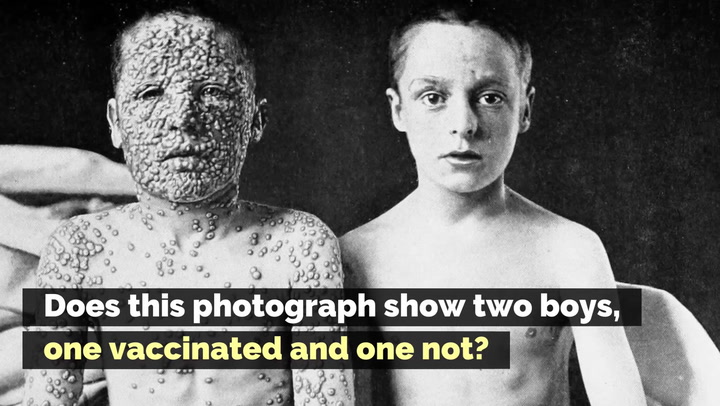
These two boys had been exposed to the same smallpox source. One had been vaccinated, the other hadn’t.
This is a genuine photograph that was taken in the early 1900s by Dr.
Allan Warner of the Isolation Hospital at Leicester in the UK. Warner
photographed a number of smallpox patients in order to study the
disease. In 1906, the Scottish Medical and Surgical Journal noted the importance of Warner’s work:
Smallpox of all the eruptive fevers best lends itself to
illustration by photograph, and the photographs in this fasciculus of
the eruption of smallpox which it has been our good fortune to see. They
are the work of Dr. Allan Warner of the Isolation Hospital at
Leicester, and they show very distinctly the different stages and
varieties of the small pox eruption. Their value is enhanced by the fact
that the progress of the eruption is illustrated by a series of plates
of one and the same patient, both in the discrete and in the confluent
variety of the fever.
Other plates are given showing cases of mild smallpox as it occurs in
the vaccinated, and we are particularly impressed by the concluding
series of photographs in which the advantages of vaccinations are well
brought out by the method of showing side by side individuals infected
from the same source, of whom one has been vaccinated and the other not.
These pictures would be of the greatest use to those who give popular
lectures on vaccination, and are also very useful as illustrations of
modified smallpox.
The medical journal here is referring to a series of photographs by Warner that were published in the Atlas of Clinical Medicine, Surgery, and Pathology
a few years previously, in 1901. This particular photograph was
originally accompanied by a caption which stated that both children were
13 years old, that they had both been infected by the same smallpox
source on the same day, but that only one had received a vaccination in
infancy:
Shows two boys, both aged 13 years. The one on the right
was vaccinated in infancy, the other was not vaccinated. They were both
infected from the same source on the same day. Note that while the one
on the left is in the fully pustular stage, the one on the right has had
only two spots, which have aborted and have already scabbed.
More photographs of this nature can also be found in this volume. For
instance, the following photograph shows two sisters aged 21 and 15 who
were exposed to the same source of smallpox on the same day. Again,
only one of the sisters had received a vaccination:
Two sisters infected with smallpox on the same day from the same
source. Upper figure. Girl aged 21 years, vaccinated in infancy. Lower
figure. Girl aged 15 years, unvaccinated.
A vaccination for smallpox was developed by an English doctor named Edward Jenner
in the late 1700s. It would eventually lead to the eradication of
smallpox, but in the 1700s as in the first decades of the 21st century,
physicians faced opposition from anti-vaccination groups.
Professor Gareth Williams, chair of the Jenner Trust, used Warner’s
photographs during a presentation
at Gresham University about the history of the anti-vaccination
movement. According to Williams, the parents of the boy on the left in
the viral image were swept up by anti-vaccination fervor when they
decided not to inoculate their child:
The Members of Parliament were anti-vaccination.
Gloucester, which of course was Jenner’s own county town, was one such
centre. So to were Leeds, Leicester, Glasgow and Liverpool amongst
others.
Here is one magnificent demonstration of the fact that vaccination
works, but only if you have it. If you do not have it, it is not going
to work. The lad on the left and the lad on the right were members of
the same class at school, and they met the same index case who was
brewing up smallpox on the same day. The lad on the right, obviously,
had been vaccinated. The lad on the left, his parents, who had been
whipped up by the local MP, had refused to have their son vaccinated,
with obvious consequences.
Chaim Dovid Zwiebel, executive vice president of Agudath Israel
America, said that he was pleased to hear that protocols approved by
Torah leaders were being put in place to protect children from predators
throughout the year.
“Agudath Israel has long promoted the
abuse-related behavioral standards developed by Torah Umesorah for
implementation in yeshivos and day schools, and the guidelines we
developed for implementation in our camps and youth programs,” said Zwiebel. “We look forward to working with Torah Umesorah to study
the details of the protocols developed for use in Bais Sarah with an
eye toward possible application on a broader scale in the yeshiva
community.”
Malky Wigder Alleges Sexual Harassment by Rabbi Ephraim Bryks
by Yerachmiel Lopin
Rabbi Ephraim Bryks (born around 1954) was accused of sexually abusing boys and girls in Canada in cases that got a lot of publicity on CBC and American media.
He dodged conviction but also lost libel cases against the networks
that broadcast the story. Eventually, his former synagogue in Winnipeg
stripped him of his emeritus title. and removed a plaque commending his
service to them.
After returning to the US he ran a yeshiva for children from the former Soviet Union.
Eventually he was cut off from pulpit positions because of his
reputation. He was also induced to resign from the Rabbinical Council of
America (RCA) in 2003 and the Rabbinical Board of Queens (Vaad
Harabonim) rather than face charges according to a report in the Jewish Week (NY) in 2010.
Nevertheless he presents himself as a rabbi, a marriage counselor and
a convener of his own rabbinical court (though no other rabbis are
listed by name). Stories of his attempts to use these roles to sexually
exploit women are widespread on the grapevine.
Approximately ten years ago, Rabbi Yosef Blau, the senior spiritual
advisor at the Yeshiva University seminary, publicly declared:
Ephrayim Bryks has become a rabbinic marriage counselor.
The term marriage counselor or life coach can be used by anyone. He is
not the only “rabbi” suspected of sexual abuse using one of these titles
to access vulnerable individuals or couples both here and in Israel.
Consulting actual professionals is expensive and unless the community
publicly warns against going to these charlatans (often worse) many
innocents will continue to be hurt.
Rabbi Blau confirmed to me that he still stands by that position in emails and discussions over the last 3 months.
Malky Wigder posted (6/10/18) on Facebook
this description of his sex harassment and behavior after he offered
her free help in dealing with a rabbinical court in connection with her
divorce. With her consent I am posting her full account.
About a year after my divorce, my ex-husband summoned me to bais din (a
pattern of court-bais din- rinse-repeat that lasted for about a
decade). I couldn’t afford a toen, which is why I had been stuck with an
atrociously unfair and unenforceable separation agreement in the first
place. At that time I somehow got in touch with an attorney who was
doing pro bono work for women in need of a get. She referred me to a
toen whom she recommended highly, and indicated he sometimes reduced his
fees for single moms. I reached out to him, and he said that in my
case, he would waive the fee altogether. We agreed that he would pick me
up from my home to appear in front of Bais Din. His name was Ephraim Bryks.
On the day of the hearing, as I was getting into his car, out of habit I
went to sit in the backseat, as I always would with an unrelated male
driver. He told me he wasn’t a Chossid and I should go sit in the front.
That must be normal for more modern people, I surmised, and complied
(compliance was a lifelong habit I had yet to kick).
As we drove to
the bais din, he said something strange. “Let’s make a deal,” he
proposed. “I won’t believe anything they say about you, and you won’t
believe anything they say about me.” RED FLAG RED FLAG! Well... not to
naive, innocent, twenty-eight year old me. I didn’t even wonder what
they might be saying about him. I knew my ex was going around saying I
went to “bad places,” and when pressed he admitted it was the Lakewood
Public Library. So I wasn’t too concerned.
Somewhere in a container
filled with legal papers, I have a notebook where Bryks jotted down
little quips and jokes to crack me up during the proceedings. I felt
reassured that I was in good hands. The hearing went well for me, and
there was going to be a follow-up.
Some days later, he called to say
he had some papers to drop off, or pick up, or review - some pretext
that didn’t quite make sense in the age of fax machines and him living
in Queens while I lived in Boro Park. But once again I agreed,
unsuspecting.
He drops the papers on the dining room table, grabs
my hand, and begins to pull me towards the bedroom. I’m so disoriented
and confused, it takes me a minute to process what’s happening, and by
then he’s throwing me onto my bed and trying to kiss me.
That
snapped me out of my inertia, and I jumped up, telling him to get out of
my house. The next few minutes are a blur, as I was in utter shock, but
he did leave and I sat behind the locked door, shaking, still
bewildered.
For days and nights he called and called and called,
left messages, banged on my door, left a case of wine at my door, walked
all around the perimeter of the house, knocking on windows, yelling
into my bedroom window to let him in. I never responded, but I also
didn’t report this to a soul. I was ashamed and horrified and
overwhelmed by a sense of powerlessness. I have words for these
behaviors now - assault, harassment, stalking. I didn’t then. Or it just
didn’t compute. This incident had followed years of harassment,
stalking and terror by my ex and his stooges, and I just accepted that
all I could do was hide and shudder.
I hired a new toen. Everyone
wanted to know what happened to that really good one who was working
for free. Why am I asking for loans to pay for the new guy? (Fun fact: I
had sold my engagement ring, the only piece of jewelry I had been given
as a kallah, for $500 to pay a well-known toen, who took my money and
then spent the hour telling me that my ex had already approached him and
I was screwed).
Here’s the thing I didn’t know at the time, and
only found out as my ex-husband and his family began to tell this to
everyone who would listen, as proof of my irresponsible parenting. He
told it to my daughter’s therapist, the judge, the bais din - he just
didn’t think to tell me. It seems I had unwittingly hired a known and
prolific sexual predator. My daughter’s therapist accosted me one day,
handed me a video tape and ordered me to go and watch it in the rec
room. It was a horrific documentary about this man’s past, which I was
ordered to sit and watch while my little kids were in the room with me.
The therapist demanded to know why I was exposing my children to a
pedophile. I assured her my children never met him. I never told her
what had happened to me.
(On that note, keep your kids away from Bilah Bendet at the JBFCS).
I’ve reached out to a contact at the CBC to see if he can get his hands
on a copy of the video I saw that day, but meanwhile this link contains
a transcript.
From the above article, from 2010: “Rabbi Bryks has held leadership
positions at two Queens yeshivas, but left for unspecified reasons. He
now makes his living as a mortgage broker, has a blog seeking to field
questions on halachic issues and is said to involve himself in marriage
counseling, advocacy for women seeking religious divorces and in a
rabbinical court, the Queens Beth Din, which he convenes with other
rabbis.”
- - -
Back in January, I was asked if I would
report my experience with Bryks to someone from JCW, and I did tell her
this story. I don’t know what, if anything, was done with it. After my
three posts last Thursday, I was again contacted by the same abuse
blogger, who advised me to “space my further revelations...hold on.” I
informed him my next post will be about Bryks, but I did intend to wait a
few days. He proceeded to write a post about Bryks on Friday. Asked
what that was about, he explained that he wanted to “take the heat off
me” because people were already saying that someone with so many
complaints of abuse, maybe there is something wrong with me.
Or maybe there is something else wrong with this picture. Hard to know.
****
DEADLY SILENCE: THE MOVIE
While the film’s story is told in an oblique, artistic style, it is very
much based in the real case of Rabbi Ephraim Bryks, who, as principal
of the Torah Academy in Winnipeg, was investigated on charges of child
molestation in 1988. Never charged, Bryks had moved to New York in 1993
when a former student in Winnipeg, Daniel Leven, accused the rabbi of
having fondled him at the school when he was eight years old.
Americans are depressed and suicidal because something is wrong with our culture
On average, there are 123 suicides per day in the United States. If
you or someone you know needs help, call theNational Suicide Prevention
Lifeline--- 1-800-273-TALK
Don't
pathologize the despair that is a rational response to a culture that
values people based on ever escalating financial and personal
achievements.
In
September of 2004, I received the call that every person dreads: my
father had dropped dead of a heart attack at the age of 61. It came at a
time I was already grappling with other issues, including watching my
mother fight breast cancer for the preceding six months, a breakup with a
boyfriend and a lack of structure in my life as I was freelancing as a
consultant while I tried to determine what I wanted to do next with my
career.
I was in an emotional
free-fall, so I visited a psychiatrist. He said the antidepressant my
general practitioner prescribed to help with my life-long struggle with
anxiety wasn't what I needed, so he prescribed a new one. This seemed to
only make things worse. Within a few days, I found myself thinking the
unthinkable: I want to die.
I couldn’t imagine a
life without my father and our hours-long conversations about, well,
everything. The pain was debilitating, getting out of bed was an
Olympian event, and life was utterly devoid of meaning. I stopped eating
and shed 15 pounds in a month. I couldn’t see any reason to be alive.
I’ve
thought a lot about this period following the suicides of Kate Spade
and Anthony Bourdain, two people who by public appearances seemed to be
living their best lives. We also learned this week that suicide rates increased 25% nationally, making it a national crisis.
I decided to share my story after interviewing John Draper, director of the National Suicide Prevention Lifeline,
who happens to be my future brother-in-law. “What people don’t really
know is that there is research that shows the media can reduce suicide,”
Draper told me. “What creates a contagion effect is when the media
focus mostly on the suicide and the way the person killed themselves. If
people are more open about talking about coping through suicidal
experiences, and the media highlight those stories, the evidence is very
clear that this has a very positive effect on getting people through a
suicidal crisis.”
So
it might help a person contemplating suicide to read that I am thankful
I didn’t succumb to my suicidal impulses. Or to learn that people like Halle Barry, Elton John and Drew Barrymore attempted and survived suicide. Or that Oprah, Olympian Michael Phelps and singer Demi Lovato considered suicide but didn’t go through with it.
Many factors in suicide
We often assume that people who commit suicide are mentally ill, but this isn’t always the case. There are many factors that can contribute to suicide
that have nothing to do with mental illness, including loss of a
relationship, loneliness, chronic illness, financial loss, history of
trauma or abuse and the stigma associated with asking for help.
Even
for those who do ask for help, friends and family can be flummoxed by
“successful people” planning their own deaths. My family and friends
told me I was “living the dream” and that I was “too strong” to succumb
to suicide. Even my psychiatrist didn’t take my complaints seriously,
saying I didn’t present as a suicidal person who was more likely to show
up disheveled and unbathed than with a blowout and a fresh manicure.
Never
mind that the day before, I had stood pressed against the 20th floor
bathroom window of a building where I was consulting for a campaign,
sobbing and wishing I could open it and jump to my death. Or that a few
days before that, I had turned on the oven and put my head in, pulling
it out only when an image of my younger brothers, also grieving my
father’s sudden death, flashed in my mind.
Despite
my doctor’s claim that nothing was wrong, I insisted that he change my
anti-depressant, and within a few weeks my suicidal thoughts
diminished. I’ll never know if the anti-depressant was the cause of my
suicidal thoughts or not. What I do know is that every day I didn’t kill
myself felt like a victory.
Though my suicidal
thoughts passed, an oppressive depression ground me down that year. Life
was an agonizing and daily struggle. So, when I hear that Kate Spade
was reportedly fighting depression and anxiety for five years, all I can think is that it was nothing short of heroic for her to stay alive as long as she did.
Why we suffer emotional despair
“What
a lot of people don’t understand is that a person contemplating suicide
is in overwhelming emotional pain and they think very differently than
people who are rational,” Draper told me. “It’s cognitive constriction.
Your pre-frontal cortex goes off line and you have a flight, fight or
freeze impulse. In that case suicide seems like the best way out or the
best way to fight for your survival. They think, maybe my afterlife will
be better.”
But why are so many more Americans
getting to this level of emotional despair than in the past? As
journalist Johann Hari wrote in his best-selling book Lost Connections: Uncovering the Real Causes of Depression — and the Unexpected Solutions,
the epidemic of depression and despair in the Western World isn’t
always caused by our brains. It’s largely caused by key problems in the
way we live.
We exist largely disconnected from our
extended families, friends and communities — except in the shallow
interactions of social media — because we are too busy trying to “make
it” without realizing that once we reach that goal, it won’t be enough.
If
only we get that big raise, or new house or have children we will
finally be happy. But we won’t. In fact, as Carrey points out, in many
ways achieving all your goals provides the opposite of fulfillment: it
lays bare the truth that there is nothing you can purchase, possess or
achieve that will make you feel fulfilled over the long term.
Rather
than pathologizing the despair and emotional suffering that is a
rational response to a culture that values people based on ever
escalating financial and personal achievements, we should acknowledge
that something is very wrong. We should stop telling people who yearn
for a deeper meaning in life that they have an illness or need therapy.
Instead, we need to help people craft lives that are more meaningful and
built on a firmer foundation than personal success.
Yes,
there are people who have chemical imbalances who should be supported
and treated with medicine. But most Americans are depressed, anxious or
suicidal because something is wrong with our culture, not because
something is wrong with them.
Changing our culture
is critical. Being honest with others about our own personal struggles
and dark nights of the soul is the first step. People on the edge need
to hear stories that assure them there is a way through the
all-consuming pain to a meaningful life.
David Rosmarin: studying sexual abuse and religion
David H. Rosmarin
David H.
Rosmarin is an assistant professor in the department of psychiatry at
Harvard Medical School and the founder and director of the Center for
Anxiety in New York. He is a board-certified psychologist, clinical
innovator and prolific researcher who has authored over 50 peer-reviewed
articles, focused on spirituality and mental health. He is also the
author of Spirituality, Religion, and Cognitive-Behavioral Therapy: A Guide for Clinicians.
Rosmarin recently published a research study on sexual abuse in the Jewish community in the journal Child Abuse and Neglect. He spoke with The CJN about his findings.
What prompted your interest in a study on religiosity and sexual abuse?
I have been doing research for the last
10 to 15 years on spirituality and mental health. That’s my area of
study. Sexual abuse has been a subject that I’ve avoided, as it’s very
political and charged. It hasn’t been a subject I wanted to get involved
in, because I really saw it as not relevant to my program of research,
until I realized that in certain groups, it can have relevance to both
spirituality and mental health. Most of all, I had several patients who
had experiences with sexual abuse and I found that spirituality played
an important role.
How did you go about the study?
Sexuality is a very sensitive subject,
especially among more religious Jews, so we had to be very careful how
we did the study. The main purpose of the study was not to focus on
sexual abuse. Back in 2013, we launched the Harvard Medical School Study
on Judaism and Mental Health, to assess for various facets of Jewish
spiritual/religious life and emotional wellbeing/distress over a
three-year period with nearly 500 Jewish individuals from the United
States and Canada. We recruited participants with the help of pretty
much every major organization in the Jewish world – from both ultra and
centrist Orthodoxy, to the United Synagogue of Conservative Judaism, to
the Union of Reform Judaism and specialty organizations which help
individuals who convert to and from Orthodoxy. Then, we only asked
participants about sexual abuse after they were in the study for two
full years. As such, we had the trust of these people who gave us their
information, and they weren’t recruited for the particular subject of
sexual abuse. So, we think our findings are valuable.
Does religious association or observance get affected by sexual abuse incidents?
We found childhood sexual abuse to occur across the
spectrum of Jewish religious affiliation, yet there was three times as
much prevalence among formerly Orthodox individuals. That suggests that
those who went through a childhood sexual abuse experience while
Orthodox find it harder to relate to religion later in life.
Interestingly, we also found that across the board – for Orthodox and
non-Orthodox Jews, irrespective of how they were raised – individuals
with a history of childhood sexual abuse had lower levels of religious
belief, practice and value. In other words, our findings suggest that
going through childhood sexual abuse may make it harder for someone to
relate to religion.
Yet, your study seems to indicate that religion does act as a buffer against the effects of sexual abuse?
Correct. Despite lower prevalence of
religion among abuse victims, we still found that religious engagement –
higher levels of belief and practice – were negatively correlated with
emotional distress and lower odds of having a psychiatric diagnosis.
Does that seem to be a paradox in terms of religion and sexual abuse?
Not really. The two main findings of the
study are that: 1) history of childhood sexual abuse was associated with
greater risk for psychiatric distress and less religious involvement,
however; 2) spiritual/religious engagement and belief seem to act as a
buffer and facilitate resilience in the context of abuse. What this
suggests is that sexual abuse may alienate victims from spiritual tools
that could help them to heal. It’s more of a tragedy than a paradox.
Is spirituality and religion being integrated into sexual abuse treatment?
Slowly, this is becoming the norm, but
there is an old guard within the field of psychotherapy that views
spirituality as pathological and irrelevant to mental health. Quite
frankly, that camp is wrong and such an approach can cause damage to
patients. If our findings tell us one thing, it’s that clinicians need
to be able to address both the positive and negative aspects of
spirituality with their patients. If we ignore it, or pathologize it, we
are doing many people a disservice.
What are the take aways from the study?
We found that 16.1 per cent of males and 25.4 per cent of
females had at least one incident of inappropriate genital contact as a
child. Those are staggering numbers that are on par with what research
has found in the general population. And to clarify, the prevalence of
sexual abuse in our study was the same among individuals who were raised
Orthodox and remain Orthodox, individuals who were raised non-Orthodox
and are now Orthodox and individuals who have never been Orthodox.
However, those who were raised Orthodox and no longer affiliate with
Orthodoxy had much higher levels of abuse. Further, as we’ve discussed,
it seems that spirituality can be negatively impacted by the experience
of sexual abuse, yet it remains an important resource for a lot of
people who have abuse history.
So, I guess the most important take away
is that sexual abuse is unfortunately quite common and can have a lot of
negative effects, so it our duty to address this issue.
All of a sudden --- Agudath Israel is "confident" a (secular) judge is going to make the right decision for underage Jewish kids!
Why New Jersey’s Haredi Orthodox stalled a bill banning child marriages
A New Jersey bill seeks to outlaw marriage for teenagers under 18
(JTA) — A bill that would ban
teenagers under 18 from marrying in New Jersey has been stalled because
of opposition from the state’s haredi Orthodox community.
Agudath Israel of America, the national haredi organization, says it
supports the bill but that its provisions are too strict. Citing child
marriages that take place in observant Jewish communities, it wants to
see an exemption made for older teenagers who want to wed.
“[Saying] any marriage under the age of 18 is illegal seems a bit
extreme,” said Rabbi Avi Schnall, Agudah’s New Jersey director. “It’s a
cultural thing, mostly in the Sephardic community. Culturally they tend
to get married younger. It’s not a biblical obligation — most of our
girls don’t get married under 18 — it’s a cultural thing. It’s part of
their heritage.”
Jewish activists are driving both sides of the debate. The main group
lobbying for the bill is Unchained at Last, a nonprofit that opposes
underage marriage. The group’s founder, Fraidy Reiss, who grew up
haredi, says child marriage, primarily of girls to older men, is an
abusive practice that can damage children emotionally and physically.
“Marriage before 18 can so easily be a forced marriage or it can turn
into a forced marriage,” Reiss told JTA. “You’re subjecting this girl
to a human rights abuse. It destroys girls’ health, their education,
their economic opportunities. It significantly increases the risk that
they’ll be beaten by their spouse. It literally destroys girls’ lives.”
Under current New Jersey law,
16- and 17-year-olds are allowed to marry with parental consent, and
children 15 and younger are allowed to marry with permission of a judge.
The bill would outlaw both of those practices.
If the bill passes, it would make New Jersey only the second state in
the country to ban child marriage. Delaware banned the practice earlier
this year.
A majority of the General Assembly, the state legislature’s lower
house, is backing the measure. A similar bill passed both houses of the
state legislature last year, but then-Gov. Chris Christie required that
the bill include the amendment Agudah is seeking, which would allow 16-
and 17-year-olds to wed with the permission of their parents and a
judge.
“Minors must be protected, and we applaud the attempt of the sponsors
to protect children and underage girls from very unfortunate
situations,” Schnall said. “A 17-year-old girl shouldn’t be getting
married by herself, on her own. Take her before a judge. We have
confidence that the judge will make the right decision.”
AVI SCHNALL AWARDEE - XXL
But the sponsors of the bill disagree and have reintroduced their
measure with Phil Murphy, a Democrat, succeeding Christie as governor.
The current bill was set to come to a vote last week, but was removed
from the agenda after Assemblyman Gary Schaer, who has spoken with
Agudah on the issue, raised concerns. Schaer, who is Orthodox, has said
he opposes the bill because of Agudah’s objections.
Speaking to JTA, Schaer avoided discussing religion, and said he just
believes the bill is too absolute.
To illustrate his qualms, he spoke
of a hypothetical example of a 17-year-old girl who is pregnant but
cannot marry the baby’s father because of the law.
“To have a situation where we’re creating an absolute — if you’re 18
you can get married, if you’re under 18 you can’t — that to me is a
problem,” he said. “There needs to be some room for maneuvering, for the
reality of the human condition.”
Despite Schaer’s opposition, the bill is expected to pass the
Assembly vote this week, and once it clears both houses, Murphy is
expected to sign the legislation. The lead sponsor, Assemblywoman Nancy
Munoz, noted that of more than 3,000 minors married in New Jersey
between 1995 and 2015, 95 percent were 16 or 17. So creating an
exemption for those ages, she said, would make the bill pointless.
Munoz, a nurse by profession, told JTA that guarding the rights of
children is a focus of hers as a legislator. She said religious concerns
should not trump protections afforded by secular law.
“We’re doing the bill so there won’t be exceptions to it,” she said.
“Much of my legislation has to do with protecting the people from abuse
and put them in a safe situation. We don’t allow 16-year-olds to drive a
car. We don’t allow 17-year-olds to vote. The age of majority in New
Jersey is 18.”
Reiss, who attended a haredi Orthodox high school, remembers
attending parties for classmates who married while still in school. She
says entering a marriage as a child is a situation fraught with danger,
as children are not allowed to leave home, enter into their own
contracts or retain an attorney.
She said it’s unclear if a child is
allowed to file for divorce in New Jersey. She also noted that the State
Department considers child marriage to be gender discrimination and a human rights issue.
Given how vulnerable children are, Reiss said, it would be wrong to
make child marriage subject to the review of a judge — no matter the
child’s age.
“We know the judicial review process is not protecting children,” she
said. “We’re going to apply that flawed process to the 95 percent of
children affected by the exemption? It’s like banning age discrimination
practices, except for job candidates over age 50.”
Thousands of Satmar Hassidim gathered in Nassau Coliseum Sunday evening for a rally led by Satmar Rebbe Aharon Teitelbaum.
The staunchly anti-Zionist Satmar movement, one of the largest
Hassidic movements in the world, has been split for more than a decade
between the “Williamsburg Faction”, led by Rabbi Zalman Teitelbaum, and
the “Kiryas Joel Faction”, headed by Zalman,’s older brother Rabbi
Aharon Teitelbaum.
On Sunday, some 15,000 Satmar Hassidim and other supporters of the
movement gathered in Long Island for an event hosted by Rabbi Aharon
Teitelbaum and featuring Rabbi Moshe Sternbuch, a senior member of the
anti-Zionist Edah Haharedit organization in Israel.
During the keynote address, Rabbi Teitelbaum lashed out at his own
followers, charging them with implicitly supporting the State of Israel
and Zionism by expressing satisfaction with recent ‘Zionist successes’.
“In recent years, Satmar Hassidim have expressed happiness with the
successes of Zionism, Heaven help us,” said Rabbi Teitelbaum, according
to Kikar Hashabbat.
“Anyone who joins in celebrating the successes of the Zionists will
not merit to celebrate the coming of the Messiah,” he continued, citing a
teaching of the first Satmar Rebbe, Rabbi Yoel Teitelbaum.
Rabbi Aharon Teitelbaum also warned of what he claimed was the
impending draft en masse of haredi yeshiva students into the IDF, should
the Knesset fail to pass a new draft law, replacing amendments to the
existing law struck down by the Supreme Court in 2017.
“The terrible decree is hovering over every yeshiva student this
September, when the Supreme Court ruling goes into effect, meaning that
50,000 haredi men will be drafted into the IDF.”
“I’m really worried that the [haredi] Knesset members will compromise
on this, and if they do compromise on this we’ll be forced once again
to team up with other communities to fight against this terrible
decree.”
Zwiebel said that the
organization still opposes a broad opening of the statute of limitations
for civil cases. “We have always explained that our concern was for the
viability of yeshivas and shuls and summer camps,” Zwiebel said. “We
have said that to open up old claims in situations where it could even
be that the administration has turned over five times since the incident
has occurred… we’re opposed to that.”Read more: https://forward.com/news/362747/has-ultra-orthodox-group-agudath-israel-changed-its-tune-on-sex-abuse-lawsu/
Zwiebel said that the
organization still opposes a broad opening of the statute of limitations
for civil cases. “We have always explained that our concern was for the
viability of yeshivas and shuls and summer camps,” Zwiebel said. “We
have said that to open up old claims in situations where it could even
be that the administration has turned over five times since the incident
has occurred… we’re opposed to that.”Read more: https://forward.com/news/362747/has-ultra-orthodox-group-agudath-israel-changed-its-tune-on-sex-abuse-lawsu/
Zwiebel said that the
organization still opposes a broad opening of the statute of limitations
for civil cases. “We have always explained that our concern was for the
viability of yeshivas and shuls and summer camps,” Zwiebel said. “We
have said that to open up old claims in situations where it could even
be that the administration has turned over five times since the incident
has occurred… we’re opposed to that.”
According to its 2011 statement, Agudah’s ancillary concern is the
financial trauma that schools and synagogues would suffer in the event
of successful lawsuits brought against sexual predators and the
institutions that tolerate them. As Rabbi Shafran wrote, “What Agudath
Israel and Torah Umesorah [an Orthodox Jewish organization promoting
Torah-based religious studies] must object to… is legislation that could
literally destroy schools and houses of worship… Legislation that would
do away with the statute of limitations completely, even if only for a
one-year period, could subject schools and other vital institutions to
ancient claims and capricious litigation, and place their existence in
severe jeopardy.”
(Agudath Israel), Bill Clinton and Donald Trump, the Sultans of Self-Pity - Grifters gonna grift for their own self-preservation - Victims be damned!
Former President Bill Clinton during an interview on Sunday
Move over, Alec Baldwin. Bill Clinton does a much better impersonation of Donald Trump.
The
hair is wrong but the air is right — self-righteous, self-pitying and
suffused with anger that anyone would peddle a version of events less
heroic than the one that he prefers. We’re shaming him about ancient
groping when we should be showering him with eternal gratitude. And what
about his pain?
“I
left the White House $16 million in debt,” Clinton said in an interview
that NBC’s “Today” aired on Monday, batting back questions about
whether he had demonstrated sufficient contrition for converting a
22-year-old’s romantic idolization of him into sexual favors and setting
off a sequence of events that savaged her. I don’t know what legal
bills have to do with a moral ledger. But I can see that his fixations
on money and martyrdom are intact.
Before
cries of “false equivalence” shatter windows and startle forest
creatures, I should make clear that I’d take Clinton over Trump in any
role on any day. Trump is the Everest of delusion and depravity; Clinton
ascended only a bit beyond base camp.
But
at an honor-starved moment when most of our politicians are quicker to
shirk responsibility than to shoulder it, I cringe at his evasions,
elisions and rationalizations. Is he taking a cue from Trump or showing
us where Trump got some of his moves and inspiration?
Granted,
Clinton is venturing in front of cameras this week to discuss a book he
wrote, not the book on him. So he’s frustrated and flustered.
And
at 71, he’s not the talker or the actor that he used to be. Those eyes
don’t mist as wetly. That lower lip isn’t as ripe for penitential
chewing.
But hasn’t he or anyone
around him, in response to the #MeToo movement, thought to prepare a
script in which he says something brave and healing about his own
mistakes, the lessons he learned and how all of us can apply and benefit
from them?
He’s correct that he has
gone through the motions of saying that he’s sorry for the Monica
Lewinsky scandal before. But that preceded the fall of Harvey Weinstein,
the recognition of sexual misconduct’s pervasiveness and the damning
circus of Trump, whose allergy to apology gives Clinton a chance to
model a more generous, better way. He sure as hell isn’t seizing it.
He
grows visibly annoyed when journalists are so petty as to bring up the
past and the pesky fact that he’s one of only two American presidents
ever impeached. He raged when Craig Melvin of NBC News breached this
territory. And he promptly turned into Trump.
He
pointed fingers elsewhere, excusing his own erotic exploits by
insinuating that his Oval Office forebears were no less randy. “Do you
think President Kennedy should have resigned?” he challenged Melvin. “Do
you believe President Johnson should have resigned?” Give Clinton a
break. He was merely playing follow the libido.
He
cited polls, outsourcing discernment and judgment to the crowds.
“Two-thirds of the American people sided with me,” he told Melvin. They
thought that Republicans’ impeachment of him went too far. But that
doesn’t mean that he’s innocent — or virtuous.
He accused Melvin of sloppy journalism, though there wasn’t a scintilla of sloppiness in the portion of the interview that “Today” shared. “You, typically, have ignored gaping facts,” he said. I myself gaped — at the Trumpian magnitude of Clinton’s ire.
Those
ignored facts were the most ignoble part of his rant. He mentioned how
many women he had put in top jobs, presenting the roll call as a
counterweight to — or absolution for? — the infidelities, the
accusations of sexual harassment and Juanita Broaddrick’s claim of rape. Does Madeleine Albright’s ascent redeem Monica Lewinsky’s evisceration? Was Janet Reno a get-out-of-jail-free card?
What
a queasy-making calculus. And what foreshadowing. Decades before many
of Trump’s enablers edited out huge chunks of his behavior to rally
around his policies, many of Clinton’s fans made a similar if less
egregious bargain.
The Venn diagram
of the 42nd and 45th presidents overlaps not only where hormones rage
but also where entitlement roars. And that entitlement is antithetical
to a world in which women get the respect and equality that they deserve
and Americans get the leadership that we sorely need.
Clinton’s
new book, a thriller written with James Patterson, is called “The
President Is Missing.” That could also be a title for his book tour —
and for a real-time chronicle of the Trump administration. If the
president is supposed to be someone more focused on his obligations than
on his reputation, on his duty than on his due, then we lack one now,
and Clinton isn’t filling the void.
He’s warbling a tune that we’re sick and tired of. Woe is him. Woe is Trump.


 True
True