EVERY SIGNATURE MATTERS - THIS BILL MUST PASS!

EVERY SIGNATURE MATTERS - THIS BILL MUST PASS!
CLICK - GOAL - 100,000 NEW SIGNATURES! 75,000 SIGNATURES HAVE ALREADY BEEN SUBMITTED TO GOVERNOR CUOMO!

EFF Urges Court to Block Dragnet Subpoenas Targeting Online Commenters

EFF Urges Court to Block Dragnet Subpoenas Targeting Online Commenters
CLICK! For the full motion to quash: http://www.eff.org/files/filenode/hersh_v_cohen/UOJ-motiontoquashmemo.pdf

Thursday, October 11, 2018

....And the next predator in our midst is likely also someone of good standing, who also seeks to groom his victims by engaging in exemplary behavior. Had the report sought to understand the totality of Rosenfeld’s behavior, readers of the report could have developed a more refined sense of how such predators work, and sharpen awareness for the future.

What the SAR sex abuse report didn’t say 

 
Stanley Rosenfeld was a pedophile. He was also inspirational, and that's no minor detail, it's a key lesson for today 

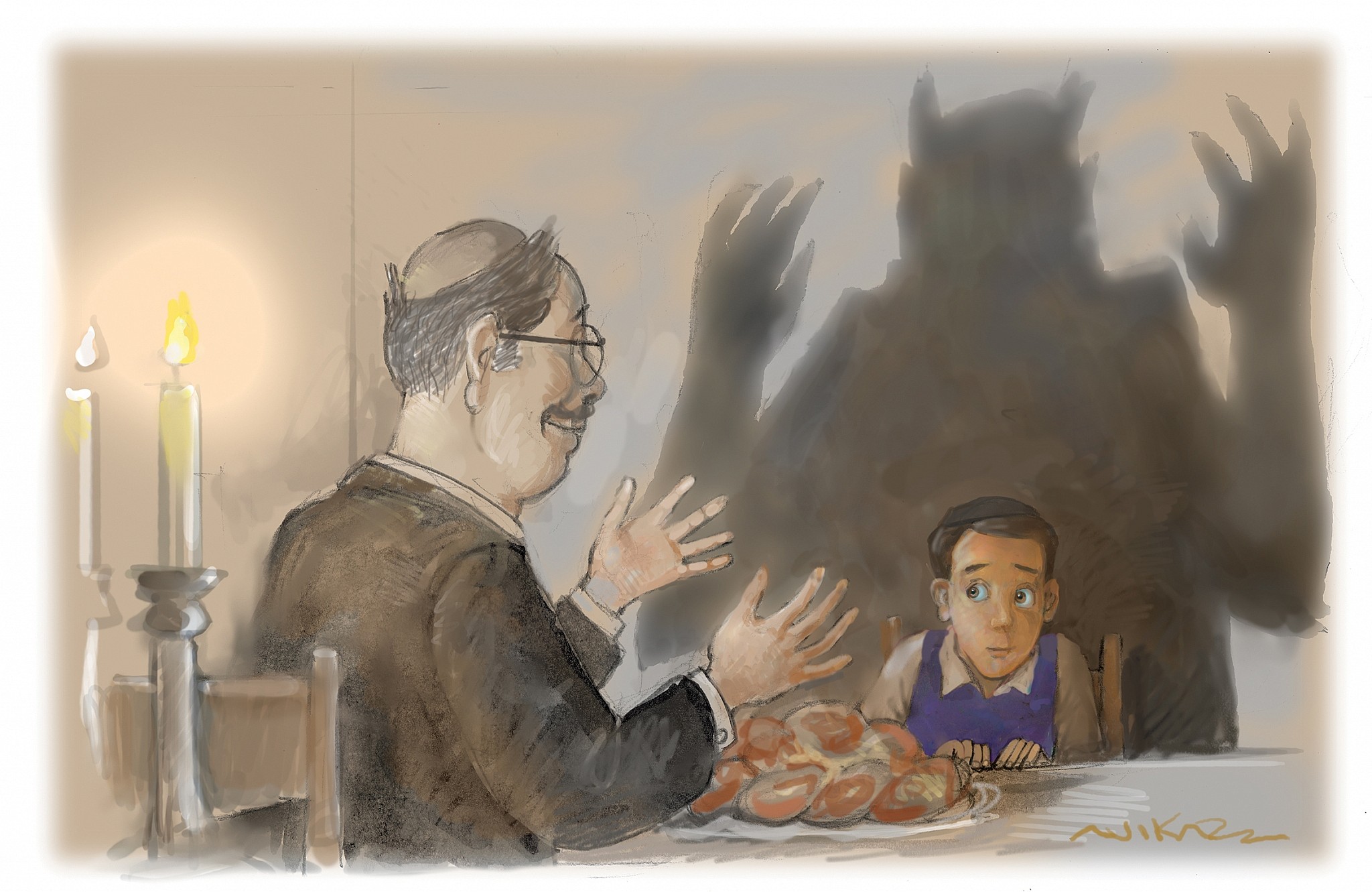
I will never forget the Shabbat I spent at the home of convicted pedophile Stanley Rosenfeld while he was an administrator at the SAR Academy in Riverdale, NY and I was a fifth grader in the school, in the mid-1970’s. SAR has just released its report outlining in graphic detail how these Shabbat invites became the staging grounds for horrific episodes of molestation. I was one of twelve students who provided accounts of these events to T&M Protection Resources, whose investigators penned the report the school sent out. The report, I’m sorry to say, omits valuable parts of my testimony. 

It was the first time I ever experienced a full, orthodox Shabbat experience. I remember the savory chicken fricassee that Rosenfeld prepared for the four of us for Friday night dinner. I remember singing zemirot at the Shabbat table for the first time, especially the spirited tune for zur mi-shelo.

Rosenfeld had a terrific tenor voice, and served as a cantor. I remember playing scrabble Shabbat afternoon and how taken I was that you could keep score by using a fat dictionary, and inserting a page-marker as the score progressed. I also remember the pillow fights and play wrestling that went on, which included Rosenfeld grabbing me in an area of the thigh that seemed a bit too high up. But I thought nothing of it at the time. All in all I had a beautiful Shabbat experience, and would tell many people thereafter that it was a catalyst toward my taking on Shabbat observance.

You can find reference to the pillow fights and thigh-grabbing on p. 10 of the T&M report, but no mention of any of these other details. Why are they important? Why remotely suggest anything positive about a monster?

If we are to prevent these events from recurring, we need to understand how they were allowed to happen in the first place. The literature of sexual abuse teaches us that predators go to great lengths to groom victims and that one of the central pillars of this activity is to engage in activity that builds trust and reverence in the eyes of the community. The moral of Little Red Riding Hood is not to trust strangers. The moral of Rosenfeld’s shabbat invites is how to not to fall victim to precisely those in whom we trust. Could it be that my Shabbat was a “decoy” designed to lull the school and community into a sense of trust, so that on another Shabbat he could attack his favored prey?

The school’s mandate to T&M was to investigate allegations of misconduct and to determine whether anyone within the SAR community had knowledge of such misconduct. Thus formulated, the mandate focused on past guilt. The picture it paints of Rosenfeld is that of the monster that he truly is.

But Rosenfeld was not perceived by the community as such, and the next predator in our midst is likely also someone of good standing, who also seeks to groom his victims by engaging in exemplary behavior. Had the report sought to understand the totality of Rosenfeld’s behavior, readers of the report could have developed a more refined sense of how such predators work, and sharpen awareness for the future.

The SAR report follows on the heels of a similar report from the Ramaz School just a few weeks earlier. Taken together, the two reports reveal a remarkable phenomenon: the circle of people who knew or had heard of sexual abuse was incredibly wide. In both schools it included administrators, teachers, parents, and students. And yet in neither school (nor in similar episodes elsewhere in the orthodox community) did anyone report the allegations of misconduct to law enforcement, nor to the press, nor to the wider Jewish community alerting to the presence of predators in our midst.

These reports copiously document what seem in hindsight a series of missed signals and opportunities to prevent further damage. How could all of these people – administrators, teachers, parents and even students once they got older – have failed to act to protect others? It is so easy to stand in self-righteous judgment of an entire generation of our community – but foolhardy to do so.

How apt that this question of judgment comes to the fore of our community, in this week that we read Rashi’s famous comment at the beginning of the story of Noah and the flood. Noah, the Torah says, was “a righteous man in his generation.” Rashi brings two interpretations that correspond to two views of moral agency. One view says that at all times all individuals have the same moral faculties and the same potential for moral greatness. By this view, had Noah lived in the generation of the great Abraham, his own “righteousness” would have appeared entirely unremarkable. But another view says that had Noah lived in the time of Abraham, surrounded by people of that stature, he would have been ever more righteous. By this view, we live in splendid delusion when we think we are really thinking and acting as free, autonomous individuals. Rather, all of our habits and attitudes are socially influenced. The generation makes the man.

And, likewise, the generation makes the administrator, the teacher, the parent and the student. Were all of those who failed to act in the 1970’s to face those same issues today, I suspect they would act differently. And conversely, let us not fool ourselves; had we been the ones to face these issues forty years ago, we likely would have taken – or failed to have taken – the same steps they did. There is no exoneration here. Those that knew had a responsibility to act. But let us learn from those mistakes in humility rather than in self-righteousness. Perhaps most of all let us try to understand how an entire generation got this wrong. If we do that, then maybe – just maybe – we will be able to train a critical eye on our own behavior, so that a generation from now, no one asks us how we got it all wrong ourselves.

https://blogs.timesofisrael.com/what-the-sar-sex-abuse-report-didnt-say/?utm_source=The+Daily+Edition&utm_campaign=daily-edition-2018-10-10&utm_medium=email


Wednesday, October 10, 2018

Finally, scholars have determined that people don’t use rational, instrumental reasoning when they deal with religious beliefs....

Faith vs. Facts


JERUSALEM — MOST of us find it mind-boggling that some people seem willing to ignore the facts — on climate change, on vaccines, on health care — if the facts conflict with their sense of what someone like them believes. “But those are the facts,” you want to say. “It seems weird to deny them.”

And yet a broad group of scholars is beginning to demonstrate that religious belief and factual belief are indeed different kinds of mental creatures. People process evidence differently when they think with a factual mind-set rather than with a religious mind-set. Even what they count as evidence is different. And they are motivated differently, based on what they conclude. On what grounds do scholars make such claims?

First of all, they have noticed that the very language people use changes when they talk about religious beings, and the changes mean that they think about their realness differently. You do not say, “I believe that my dog is alive.” The fact is so obvious it is not worth stating. You simply talk in ways that presume the dog’s aliveness — you say she’s adorable or hungry or in need of a walk. But to say, “I believe that Jesus Christ is alive” signals that you know that other people might not think so. It also asserts reverence and piety. We seem to regard religious beliefs and factual beliefs with what the philosopher Neil Van Leeuwen calls different “cognitive attitudes.”

Second, these scholars have remarked that when people consider the truth of a religious belief, what the belief does for their lives matters more than, well, the facts. We evaluate factual beliefs often with perceptual evidence. If I believe that the dog is in the study but I find her in the kitchen, I change my belief. We evaluate religious beliefs more with our sense of destiny, purpose and the way we think the world should be. One study found that over 70 percent of people who left a religious cult did so because of a conflict of values. 

They did not complain that the leader’s views were mistaken. They believed that he was a bad person.

Third, these scholars have found that religious and factual beliefs play different roles in interpreting the same events. Religious beliefs explain why, rather than how. People who understand readily that diseases are caused by natural processes might still attribute sickness at a particular time to demons, or healing to an act of God. 

The psychologist Cristine H. Legare and her colleagues recently demonstrated that people use both natural and supernatural explanations in this interdependent way across many cultures. They tell a story, as recounted by Tracy Kidder’s book on the anthropologist and physician Paul Farmer, about a woman who had taken her tuberculosis medication and been cured — and who then told Dr. Farmer that she was going to get back at the person who had used sorcery to make her ill. “But if you believe that,” he cried, “why did you take your medicines?” In response to the great doctor she replied, in essence, “Honey, are you incapable of complexity?”

Moreover, people’s reliance on supernatural explanations increases as they age. It may be tempting to think that children are more likely than adults to reach out to magic to explain something, and that they increasingly put that mind-set to the side as they grow up, but the reverse is true. It’s the young kids who seem skeptical when researchers ask them about gods and ancestors, and the adults who seem clear and firm. It seems that supernatural ideas do things for adults they do not yet do for children.

Finally, scholars have determined that people don’t use rational, instrumental reasoning when they deal with religious beliefs. The anthropologist Scott Atran and his colleagues have shown that sacred values are immune to the normal cost-benefit trade-offs that govern other dimensions of our lives. Sacred values are insensitive to quantity (one cartoon can be a profound insult). They don’t respond to material incentives (if you offer people money to give up something that represents their sacred value, and they often become more intractable in their refusal). 

Sacred values may even have different neural signatures in the brain.

The danger point seems to be when people feel themselves to be completely fused with a group defined by its sacred value.

 When Mr. Atran and his colleagues surveyed young men in two Moroccan neighborhoods associated with militant jihad (one of them home to five men who helped plot the 2004 Madrid train bombings, and then blew themselves up), they found that those who described themselves as closest to their friends and who upheld Shariah law were also more likely to say that they would suffer grievous harm to defend Shariah law. These people become what Mr. Atran calls “devoted actors” who are unconditionally committed to their sacred value, and they are willing to die for it.

One of the interesting things about sacred values, however, is that they are both general (“I am a true Christian”) and particular (“I believe that abortion is murder”). It is possible that this is the key to effective negotiation, because the ambiguity allows the sacred value to be reframed without losing its essential truth. 

Mr. Atran and his colleague Jeremy Ginges argued in a 2012 essay in Science that Jerusalem could be reimagined not as a place but as a portal to heaven. If it were, they suggested, just getting access to the portal, rather than owning it, might suffice.

Or then again, it might not. The recent elections in Israel are a daunting reminder of how tough the challenge is. Still, these new ideas about religious belief should shape the way people negotiate about ownership of the land, just as they should shape the way we think about climate change deniers and vaccine avoiders. People aren’t dumb in not recognizing the facts. They are using a reasoning process that responds to moral arguments more than scientific ones, and we should understand that when we engage.

T. M. Luhrmann is a contributing opinion writer and a professor of anthropology at Stanford.

http://www.nytimes.com/2015/04/19/opinion/sunday/t-m-luhrmann-faith-vs-facts.html?emc=edit_tnt_20150418&nlid=32999454&tntemail0=y


Tuesday, October 09, 2018

גם אני --- #מיר אויך# “The story wouldn’t go away and I wanted to put it behind me. I didn’t complain because I was in a closed Haredi community and thought it was wrong, but I had to do something. So I confronted my grandfather and told him I thought he should stop working with children. He told me I had dreamt it.

 My grandfather the Rosh Yeshiva molested me

#מיר אויך


Eli Hirschman was sexually abused by his grandfather, the Rosh Yeshiva of the Matmidim Yeshiva and leader of the Eidas Yerushalayim community while studying at his grandfather’s Yeshiva. He kept quiet for years, but when he finally went public, he was excommunicated, along with anyone who believed him. This is his story as shared in Hebrew on his Facebook page:


“My grandfather, Laibel Mintzberg, is the leader of a large community and a greatly respected Torah scholar. He has many followers, and will sometimes hint that he is Meshiach. I used to idolize him as a boy. When the time came for me to begin studying at a Yeshiva Gdola, he asked me to study at his Yeshiva, instead of the one I had already signed up for. He told me that I should receive “our” education. Shortly after beginning my studies at his Yeshiva, I moved in with him.

“One night while I was in bed, I heard footsteps, and then heavy breathing in my room. It was my grandfather, arched over me and touching me. He pulled off my blanket and pulled down my pants and underwear, did as he pleased, and then dressed me again and covered me in the blanket. This routine was repeated night after night, dozens of times. I would freeze, not moving a muscle, waiting for him to leave.

“He abused me when my cousins stayed at his house and I slept in the living room. One time, someone called for him while he was in my room. He hurriedly dressed me and left. Once, I spent Shabbat with him in the community in Beit Shemesh. I remember in his Drasha after dinner how he spoke about “feeling the holiness of Shabbat.” Later that night, he felt me.

“In the mornings, I felt distressed and agitated. I decided to tell my close friend, and swore him to secrecy. He told. Everyone knew about it, including my family members, who were shocked by what they heard. I denied everything and continued to be active in the community. I published some pamphlets, including ones with my grandfather’s teachings.

“The story wouldn’t go away and I wanted to put it behind me. I didn’t complain because I was in a closed Haredi community and thought it was wrong, but I had to do something. So I confronted my grandfather and told him I thought he should stop working with children. He told me I had dreamt it.


“He hadn’t taken me seriously, so I wrote him a letter and sent him the results of a polygraph test I had taken. I hoped he would take responsibility for his actions and apologize to me. But instead, he attacked me, called me evil and corrupt, and told me to mind my own business. That was the last time I saw him.

“A few days later, one of his students called me and asked me to apologize to my grandfather. “What do I need to apologize for?” I asked. “I don’t know,” he said, “but your grandfather is very hurt and you should apologize immediately,” I said if he wanted me to apologize, he would have to explain what for.

“My grandfather distributed flyers in the community pressuring me to apologize, but I didn’t give in. So I was excommunicated, along with my immediate family and anyone else in the community who believed me. Some Rabbis from the community resigned their positions in the organization, including the head of the Yeshiva. My grandfather hired new Rabbis and changed the name of the Yeshiva. He completely isolated us from the community, and some found signs posted on their doors at night reading “Here lives a traitor”. Some of his students threw eggs at my father’s Kolel.

“Things have been like this for several years now. My family is torn apart. My cousins didn’t attend my siblings’ weddings, out of fear of my grandfather. He banned them from doing so. My immediate family is very supportive of me, though they don’t like to bring up what happened. It’s embarrassing for them and hard to talk about. I understand them and love them very much.

“Last year, I finally mustered the courage to go to the Police. After my grandfather was questioned, I was told that the case had been closed due to a lack of evidence. But he and I both know exactly what happened, and as he taught me, the truth is more important than anything.

“So dear grandfather, Meshiach you are not. You are a subpar grandfather with serious problems. You hurt me. I want to believe that you didn’t abuse anyone else, but you probably did. I saw you brush your hand over a waiter’s back at a wedding when he bent over and his shirt came untucked. And everyone in the community knows the story of how decades back you appeared before a Beit Din because a student of yours “tried to frame you.” Somehow, that story went away.


“It’s a shame you haven’t sought treatment. You are a great scholar, full of wonderful insights about the Torah, and full of flaws as well. I’m at peace with who I am. It’s a shame that you have chosen to wage a cruel, childish, and stupid war against hundreds of your students, including your own children and grandchildren. As if it will change what you did. I dream that you might one day take responsibility for what you did, apologize, and work to fix yourself.

“And to the community, be alert and don’t turn a blind eye to abuse. There’s no reason why anyone would fabricate a story about being abused. Would you? No, certainly not about a close family member. If someone comes forward with a story like this, the only reason is because it happened.

“It’s important to clarify that not all Rabbis are abusers, and many members of Haredi communities are good people. There are good and bad ones, like any other place. But this can’t keep getting swept under the rug. It’s time to fix this problem.”

http://www.jewishcommunitywatch.org/when-my-grandfather-the-rosh-yeshiva-molested-me/


Monday, October 08, 2018

Stanley Rosenfeld, a convicted sex offender, has admitted to molesting hundreds of boys throughout his life, including at SAR, according to the report.

NY Jewish school officials knew of abuse by teacher who molested 12 students


Outside investigation finds that administrators at SAR Academy were warned about Stanley Rosenfeld’s sexual assault of young boys, but re-hired him a decade later anyway!


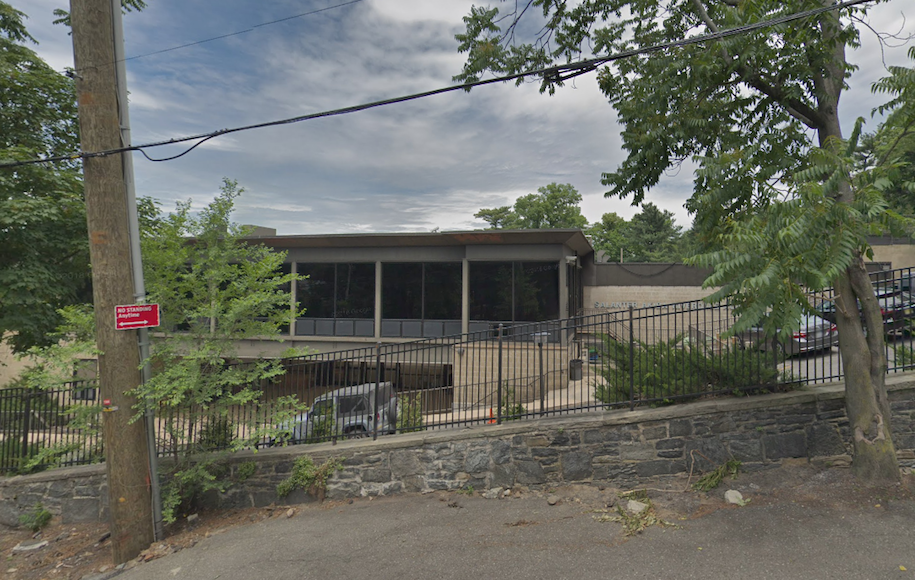
A view of SAR Academy in the Bronx, NY, June 2018. (Google Street View)
A view of SAR Academy in the Bronx, NY, June 2018


NEW YORK (JTA) — Officials at a New York Jewish day school knew of allegations against an administrator who abused at least a dozen of the school’s students, according to an investigation.

The report, which was published Friday, found that Stanley Rosenfeld sexually abused at least a dozen students at SAR Academy, a Modern Orthodox school in the Riverdale section of the Bronx.

Another teacher, Rabbi Sheldon Schwartz, was found to have acted inappropriately with at least four students.

Rosenfeld, a convicted sex offender, has admitted to molesting hundreds of boys throughout his life, including at SAR, according to the report.

JTA has reached out to Schwartz through his attorney seeking comment on the accusations against him.

T&M Protection Resources, an external firm with experience investigating sexual assault allegations, conducted the probe that examined allegations of child sex abuse by Rosenfeld, an assistant principal at SAR in the 1970s who also taught English there a decade later. The school commissioned the investigation in January, soon after learning of the allegations.

The firm interviewed nearly 40 witnesses, as well as both Schwartz and Rosenfeld. T&M was able to interview Schwartz, however, only before hearing allegations of his inappropriate behavior.

“We want to extend our most sincere gratitude to the individuals who came forward to report instances of inappropriate behavior and abuse,” SAR’s leadership wrote in an email sent Friday linking to the report. “We remain heartbroken that our alumni suffered abuse while in SAR’s care, but we also are deeply inspired by their bravery.”

SAR’s announcement of the inquiry in January prompted two other Jewish day schools that had employed Rosenfeld to launch their own investigations: the Ramaz School, an elite Modern Orthodox Jewish day school in Manhattan, and Westchester Day School, in New York City’s northern suburbs.

Ramaz published its external investigation in August, which found that administrators learned of Rosenfeld’s abuse after he had left the school but failed to act on the information.

Rosenfeld, now 84, was convicted of child molestation in 2001 for abusing a boy while employed at a Rhode Island synagogue. The Forward, which has investigated Rosenfeld’s abuse in a series of articles, discovered that he is living in a nursing home and is a registered sex offender.

The T&M report found that Rosenfeld would abuse young boys by inviting them to his home for Shabbat, where they would sleep over for one or two nights. At night, he would hover over their beds and fondle their genitals or other parts of their bodies. Some former students said Rosenfeld would stop the abuse after boys made it clear that it made them uncomfortable. Others reported laying motionless until the ordeal ended. Former students said the abuse caused them emotional suffering.

“One former student explained that during the night, he awoke to Rosenfeld’s hands on the former student’s penis inside the former student’s pajama bottoms, that Rosenfeld quickly removed them and then justified his presence in the twinbedded room where the boys were sleeping by saying that he heard the former student make a noise and wanted to check on him,” the report said.

The report also says that former students remember feeling as if Rosenfeld had drugged them while sleeping at his house. During those sleepovers, the report says, former students remember Rosenfeld urging them to wrestle with him while both he and the student were in their underwear. Rosenfeld would use the wrestling as a way to molest the boys. He also molested boys on the weekend retreat he would hold after they graduated from the eighth grade.

Rosenfeld, according to the report, also would abuse boys while at school, in addition to molesting at least one girl there. He asked a student to sit on his lap, where he fondled him, and also drew close to students or would corner them in public spaces before molesting them. In addition, the report says he physically abused students, slamming them against the wall and, in one case, grabbing a student’s face and putting it in the snow.

“Some of these students also reported that they heard their classmates talk about Rosenfeld and comment that they had also been touched or fondled by him and heard others more generally joke with one another about Rosenfeld’s fondling of boys,” the report says.

T&M found that at least one faculty member alerted the principal at the time, Rabbi Sheldon Chwat, that she had seen Rosenfeld touch a boy’s groin in a school office. In addition, the investigation found that two parents of former students may have told SAR administrators about Rosenfeld’s misconduct, though no parents reported that directly to T&M. Chwat left the school in 1983 and died in 2014.

It is unclear whether Rosenfeld left the school in 1977 due to these reports. But someone the report identified as a “senior member” of SAR recalls Chwat saying that Rosenfeld was leaving because he was “the kind of person that has a proclivity or interest in students” and “not the person who should be with kids full time.”

Regardless, Rosenfeld was rehired to teach sixth-grade language arts part time in 1986 for one year. SAR’s assistant principal at the time, Rabbi Joel Cohn, asked the principal at the time, Rabbi Yonah Fuld, if there were any concerns regarding Rosenfeld. Cohn recalled that Fuld, who had been an associate principal while Rosenfeld was employed at SAR, eventually said “for a short amount of time, I think it’s OK.”

Fuld does not recall that exchange, nor does he recall Rosenfeld returning to teach at the school, the report says. It is unclear whether the administrators who hired Rosenfeld in 1986 knew of the abuse allegations. Fuld no longer works at the school and now lives in Israel.

In addition to its findings on Rosenfeld, the report found that Schwartz, a Judaics teacher, acted inappropriately with at least four students during the 1970s. The report said Schwartz would wrestle with boys and also draw uncomfortably close with students and have them sit on his lap.


Rabbi Yonah Fuld, the former principal of the SAR Academy in New York, in 2018


Schwartz, according to the report, also would act as an enabler for Rosenfeld’s abuse, urging students to stay with Rosenfeld for Shabbat while frequently staying there himself as well. Two former students said they separately told Schwartz that Rosenfeld had abused them — one following a Shabbat and the other immediately after the abuse occurred.

In both cases, the former students recall Schwartz telling them that the experience was a dream. In the latter case, Schwartz played board games with the student to calm him down.

Schwartz’s attorney told JTA that he fully denies having known about Rosenfeld’s abuse.

Schwartz taught at SAR until January, when he was suspended pending the investigation. He was later fired and is now suing SAR for wrongful termination.


http://www.paroleboard.ri.gov/sexoffender/olist/listing.php?id=92&level=III

https://www.timesofisrael.com/ny-jewish-school-officials-knew-of-sex-abuse-by-teacher-who-molested-12-students/

REPORT TO THE BOARD OF SAR:
https://www.saracademy.org/uploaded/2015_Redesign/Academy/Report_to_the_Board_of_Trustees_of_SAR_10.5.18.pdf

Friday, October 05, 2018

“He stole my innocence, and my childhood. I was 10-years-old at the time he started to sexually abuse me. He groomed me to the point where I didn’t know it was wrong or, at 10-years-old, how sick it was,” she stated.

Man who sexually assaulted young family member sentenced to 8 years


A Brooklyn man who admitted to sexually assaulting a 10-year-old family member was sentenced to 8 years in prison Wednesday, but not before the woman he preyed on confronted him over the years of abuse.

“He has absolutely no morals,” Samuel Israel’s now-grown victim told the packed courtroom, as her abuser hung his head at the defense table, avoiding eye contact.

“He stole my innocence, and my childhood. I was 10-years-old at the time he started to sexually abuse me. He groomed me to the point where I didn’t know it was wrong or, at 10-years-old, how sick it was,” she stated.

The woman, who is now married with two children, said Israel molested her until she was 16, taking her on trips with his family and buying her silence with lavish gifts. She told Judge Matthew D’Emic she felt alienated from her peers, because while they were talking about school or their weekend plans, Israel “was having oral sex with me.”

“I felt like it was my fault,” she said “I felt dirty.”

Israel, who declined to speak before sentencing, pleaded guilty to charges of criminal sex act and witness tampering in July in exchange for the lesser sentence.

He also confessed to hiring onetime reality TV gumshoe Vincent Parco to try to scare his victim out of taking the stand.

Israel was led out in handcuffs Wednesday after D’Emic sentenced him to 8 years behind bars. He’d faced up to 25 years in prison prior to cutting the deal.
Defense attorney Susan Necheles declined to comment on Israel’s behalf as she left court.

Prosecutors say Israel paid Parco $17,000, and in turn the P.I. set up video cameras in hotel rooms, and plied the victim’s relatives with hookers in order to record them in compromising situations.

Israel was originally scheduled to head to trial on the sex assault case in June 2017, but two days before jury selection, a stranger approached a member of the victim’s family to show him footage of another relative having sex with a prostitute, and warned him against cooperating.

But the relative went to authorities, and videos of the blackmail tryst were found on Parco’s computer, prosecutors said.

Parco, who starred on two seasons of the reality show Parco P.I., remains charged with various counts of unlawful surveillance and promoting prostitution.


Share this article:

Thursday, October 04, 2018

We are called to plant these seeds in our world: to dare to tell every living soul that they already matter, that their seemingly mundane lives are a slowly unfolding mystery, that their small choices and acts of generosity are vitally important....


The Miracle of the Mundane

In an excerpt from her new essay collection, Heather Havrilesky calls for tuning out the online cacophony telling us we aren’t enough, and tuning in to the soul-affirming, quiet truth of the present moment.

We are living in a time of extreme delusion, disorientation, and dishonesty. At this unparalleled moment of self-consciousness and self-loathing, commercial messages have replaced real connection or faith as our guiding religion. These messages depend on convincing us that we don’t have enough yet, and that everything valuable and extraordinary exists outside of ourselves.

Many of us learn to construct a clear and precise vision of what we want, but we’re never taught how to enjoy what we actually have. There will always be more victories to strive for, more strangers to charm, more images to collect and pin to our vision boards. It’s hard to want what we have; it’s far easier to want everything in the world. So this is how we live today: by stuffing ourselves to the gills, yet somehow it only makes us more anxious, more confused, and more hungry. We are hurtling forward — frantic, dissatisfied, and perpetually lost.

It’s not surprising that in a culture dominated by such messages, many people believe that humility will only lead to being crushed under the wheels of capitalism or subsumed by some malevolent force that abhors weakness. Our anxious age erodes our ability to be open and show our hearts to each other. It severs our ability to connect to the purity and magic that we carry around inside us already, without anything to buy, without anything new to become, without any way to conquer and win the shiny luxurious lives we’re told we deserve. So instead of passionately embracing the things we love the most, and in so doing reveal our fragility and self-hatred and sweetness and darkness and fear and everything that makes us whole, we present a fractured, tough, protected self to the world. Our shiny robot soldiers do battle with other shiny robot soldiers, each side calling the other side “terrible,” because in a world that can’t see poetry or recognize the divinity of each living soul, fragility curdles into macho toughness and soulless rage. All nuance is lost in a fearful rush to turn every passing thought or idea or belief into dogma.

Against this landscape, anything that celebrates the wildness and complexity of the human soul is worthy of celebration. This is true in a global sense, in communities, and it’s true within a single human being. The antidote to a world that tells us sick stories about ourselves and poisons us into thinking that we’re helpless is believing in our world and in our communities and in ourselves.

We must reconnect with what it means to be human: fragile, intensely fallible, and constantly humbled. We must believe in and embrace the conflicted nature of humankind. That means that even as we stop trying to live our imaginary, glorious “best lives,” we still have the audacity to believe in our own brilliance and talent and vision — even if that sometimes sounds grandiose, delusional, or unjust. We have to embrace what we already have and be who we already are, but we also have to honor the intensity and romance and longing that batter around inside of our heads and our hearts.

We have to honor the richness of our inner lives and the inherent values that are embedded there. But we should also aim to create a self and a life and an artistic vision that aren’t an escape from ordinary life, but a way of rendering ordinary life for people of every color, shape, size, and background more magical to them. In order to do that, we have to see that every human is divine. 

We have to train ourselves to see that with our own eyes. It will fuel us, once we see it. The ordinary people around us, the angry ones and the indifferent ones, the good ones and the bad ones, will start to glow and shimmer.

We have to recognize that when we feel conflicted and sick about our place in the world, that’s often true because our world was built to sell us things and to make us feel inadequate and needy. As the art critic John Berger puts it, in Ways of Seeing:

It is necessary to make an imaginative effort which runs contrary to the whole contemporary trend of the art world: it is necessary to see works of art freed from all the mystique which is attached to them as property objects. It then becomes possible to see them as testimony to the process of their own making instead of as products; to see them in terms of action instead of finished achievement. The question: what went into the making of this? supersedes the collector’s question of: what is this?

We are called to resist viewing ourselves as consumers or as commodities. We are called to savor the process of our own slow, patient development, instead of suffering in an enervated, anxious state over our value and our popularity. We are called to view our actions as important, with or without consecration by forces beyond our control. We are called to plant these seeds in our world: to dare to tell every living soul that they already matter, that their seemingly mundane lives are a slowly unfolding mystery, that their small choices and acts of generosity are vitally important.

 READ IT ALL:
https://longreads.com/2018/09/14/the-miracle-of-the-mundane/


Wednesday, October 03, 2018

Rabbi$ ---- With Too Much Time On Their Hand$!


 RABBI MOISHELE  PIGSTEIN - CHIEF CHAZER AT THE OU

Meat Labs Pursue a Once-Impossible Goal: Kosher Bacon

Rabbi Gavriel Price is in charge of figuring out how the Orthodox Union, the largest kosher certifying organization in the world, should deal with meat that is grown in laboratories from animal cells.CreditCreditMark Abramson for The New York Times


BERKELEY, Calif. — Rabbi Gavriel Price has thousands of years of Jewish religious law to draw on when he is on the job, determining whether a new food item can get a kosher certification from his organization, the Orthodox Union.

But all the rules about meat and milk, and the prohibitions on eating pork and sciatic nerves, are of limited use for Rabbi Price’s latest assignment.

The rabbi is in charge of figuring out how the Orthodox Union, the largest kosher certifying organization in the world, should deal with what is known as clean meat — meat that is grown in laboratories from animal cells. This brings him in touch with a possibility for Jewish cuisine that had previously seemed impossible: kosher bacon.

Clean meat is still not available in stores, but start-ups working on it say it could be by next year. When it is, they want a kosher stamp on their product, which indicates it adheres to quality and preparation standards and follows a set of biblical laws. That brought Rabbi Price, a tall, lanky father of eight, to Berkeley recently, to meet with companies in the business.


Clean meat, also known by names like cell-based agriculture, begins with cells taken from an animal, often stem cells that are primed to grow. Once these cells are isolated, they are put into a solution that mimics blood and encourages the cells to replicate.

This process is very new. The first hamburger produced in a lab was served with great fanfare in 2013 and cost $325,000. But the number of companies competing to create the first commercially available product is growing rapidly.

Rabbi Price’s investigation touches on questions that anyone might have when confronted with clean meat. What exactly is it? And should we want to eat it someday?


Viktor Maciag, who works for the start-up Mission Barns, with flasks containing cell cultures. The Mission Barns laboratory is growing duck, chicken and pig meat.CreditJim McAuley for The New York Times
His first stop was a lab operated by Mission Barns, a start-up with six employees and millions of dollars in funding. It is growing duck, chicken and pig meat in clear flasks, lined up inside temperature-controlled incubators.


He looked through a microscope at a dish of long, pointy duck cells and peppered the scientists with basic questions about where the cells had come from, and what was in the red liquid that was helping the cells to replicate and grow.

“I’d like to spend more time, because I think it’s an important process to understand in a deep way, and there’s no precedent for it really,” Rabbi Price said after the tour.

The issue he is addressing is much more complicated than the kosher designation of plant-based meat substitutes already available in grocery stores.

Perhaps the best known company of its kind, Impossible Foods, has created a burger that is made from all-vegetarian ingredients but tastes more like meat thanks to a chemical process involving yeast and soy. Like most vegetarian foods, these burgers have received a kosher stamp.

Mission Barns, the start-up in Berkeley, is focused on creating animal fat, where much of the distinctive flavor of meat resides. It recently mixed the fat with other ingredients to create duck sausages that it served to investors and employees. Creating more structured meat products, like a duck breast or a steak, is expected to take much longer.

Environmentalists and animal activists are proponents of the technology because it could produce the flavor of hamburgers and sausages without the greenhouse gases and animal suffering of the factory farming system.


“I’m extremely excited about it,” said Rabbi Menachem Genack, who leads the kosher certifying division of the Orthodox Union. “The impact for us will be very profound, in terms of the economics of kosher meat.”

There are polls that show that many Americans are turned off by the prospect of lab-grown meat. And the technology has already generated questions far beyond the Jewish community.

The United States Cattlemen’s Association requested this year that American authorities allow the meat label only on products that come from slaughtered animals. While large meat companies have pushed back against the cattle ranchers, in part because they are developing their own clean meat products, it is unclear if regulators will handle lab-grown meat with the same rules they use for traditional meat.

Jewish authorities have been studying this because several synthetic meat start-ups are based in Israel.

A number of Israeli rabbis told one start-up, SuperMeat, that previous rulings in religious law might allow clean meat to be categorized as pareve, a religious label that is applied to things that are kosher but not derived from animals.

A pareve label would mean that observant Jews could eat it with dairy products, like cheese, which cannot be eaten with traditional meat. In other words, a kosher cheeseburger might be possible.

Rabbi Genack, Rabbi Price’s boss at the Orthodox Union, initially thought clean meat could be pareve, based on his belief that clean meat was created from an animal’s genetic code. But because the process involves an animal cell, replicating itself millions of times, he now believes the product should be thought of as meat.


Mr. Shahrokhi prepares feedstock for the growing cells.CreditJim McAuley for The New York Times
When Rabbi Price visited the Mission Barns labs, he asked questions specific to kosher certification. 

He wanted to be sure, for instance, that the pork cells growing in one incubator never come into contact with the duck cells in the incubator next to it, and that the centrifuge where the meat cells are processed is cleaned thoroughly between processing.

He also wanted to know if the cells in the flasks changed as they replicated, to be sure that they do not morph into something that no longer resembles the original animal cells.

“The identity of a given cell, and ensuring that its identity is preserved and verifiable, would be crucial to our being able to certify a product,” the rabbi said.

The day after his visit to Mission Barns, Rabbi Price attended a conference held by the Good Food Institute, an organization that is encouraging the move away from animal meat.

He dived into long conversations with people working for the food start-ups. They discussed topics as diverse as the kosher status of gelatin, the religious rulings of venerated medieval rabbis and the ingredients of the solution that encourages lab-grown meat to grow.

“Does that cell need to consume all kosher ingredients for it to be kosher?” the rabbi was asked by Aryé Elfenbein, the founder of Wild Type, a start-up in San Francisco that is focused on lab-grown salmon.


The rabbi explained that just as kosher cows can eat non-kosher insects, he is working from the assumption that the growth solution will not have to be certified as kosher as long as it is cleaned from the surface of the final cells.


Flasks of cell culture media at the Mission Barns lab. When Rabbi Price visited the lab, he wanted to know if the cells in the flasks changed as they replicated, to be sure that they don’t morph into something that no longer resembles the original animal cells.CreditJim McAuley for The New York Times
 
Many of the questions came back to the original cells that go into the solution. The rabbi said those cells would have to be kosher, from an animal that was properly slaughtered and not scraped off a live animal. (There is a Jewish law against eating live animals.)

This was not well received by some of the clean meat companies, which want to produce something that does not involve killing any animals.

The liveliest conversation grew out of research that is looking into whether clean meat might be derived from cells in animal saliva or hair.

The rabbi said those substances are not meat, so they might be used to produce clean meat that would not be categorized as meat by Jewish law.

Eitan Fischer, the chief executive of Mission Barns, said he was hopeful that through some creative chemistry, his company could grow pork that would get a kosher designation.


“If we can create kosher bacon one day, as weird as that sounds, I think there is going to be so much excitement around that,” he said.

Rabbi Price was cautious. In addition to the kosher laws, there are Jewish rules that warn against doing anything that would make people look as though they were violating the rules.

The rabbi added that there are religious texts that discuss the possibility of kosher pigs, once the Jewish messiah arrives and ushers in an age of universal peace. But he is skeptical.

“I’m looking around, and I don’t see much evidence we are in messianic times,” he said.


Thursday, September 27, 2018

Beware Of The Glib Frauds!


MARVIN SCHICK


 UOJ ARCHIVES OCTOBER 2008 (10 LONG YEARS AGO)

Excerpts of The Forward's interviews with David Zwiebel and Marvin Schick...

....“Until not terribly long ago, the issue was very much in the shadows,” said David Zwiebel, director of government affairs and general counsel of Agudath Israel of America. “The fact that there were isolated reports here and there of cases arising in yeshiva settings, it was known, but they were very isolated.”

“Sometimes they were dealt with correctly and sometimes incorrectly,” Zwiebel added, “but the severity of the problem and the possible magnitude were really things that most people, including myself, just didn’t understand.”

Marvin Schick, who has written extensively about Jewish affairs in his position as president of four Orthodox Jewish day schools, one of which is ultra-Orthodox, believes that Orthodox Jews at large are following the trends of larger society. Because there is greater attention being paid to this problem in the secular world, the Orthodox community is just following suit, he said.

Asked whether more people are now realizing that sexual abuse is a real problem, Schick said: “I don’t think [that’s] fair. I’ve been president of four schools for 36 years, and there hasn’t been a single situation.”

He also warned against the possibility of false accusations, which could ruin the lives of those unjustly punished.

*****

My Turn:

From the distance, Zweibel and Schick seem like ordinary Homo sapiens. I do not believe that they run around naked at night in the streets of New York - or go dumpster-hopping for their lunch --- or urinate on fire hydrants... (I could be wrong on this last one.)

What did Zwiebel and the Agudath Israel do about the cases they were aware of? The cases that were handled improperly, did they intervene to right a horrible wrong? Did they apologize to Robert Kolker of New York Magazine for outright slander and character assassination? Will they publicly address the child-rape problem at this year's Agudah convention? Will they work with rabbis and lawmakers feverishly - to implement laws that will always put our childrens' safety first? Are they publicly going to admonish and even expel rabbis from their organization that knew and facilitated the child-rapist epidemic by covering-up for child-rapists?

Teach us O' wise ones! How were the cases that you claim were handled "correctly" --- tended to? Share with us O' great ones from 42 Broadway! How many cases were handled correctly? Where are the perpetrators? Are they still around kids? Are they being monitored by anyone? The last time I checked - the former rabbi employee of Torah Umesorah, who spent five years in jail for Internet predatory crimes against children - was up to his old tricks! Your Gedolim - what sayeth them? We want answers...! Your version of "trust daas Torah" is gone forever for the too few thinking Jews among us! We don't, and will  never trust you - we despise you for the churban that flamed under your tenure!

The human condition means nothing to you loathesome frauds. Your values are all tied to symbols, meaningless rituals and manufactured hardships - eccentric posturing; - a herd of moving mouths with no meaningful words.

Will Shmuel Kaminetzky publicly apologize for sending Moshe Eisemann from Philadelphia to Baltimore's Ner Israel some forty years ago - after numerous complaints from students that Eisemann, allegedly, not only fondled them, but actually "penetrated" them and had oral sex with students? Will he apologize along with his son in-law Tzvi Berkowitz of Ner Israel, for the child-rape of God knows how many students in Ner Israel over that forty year period?

Will the Agudath Israel expel Eisemann from their sister organization - Vaad L'Hatzolas Nidchei Yisroel - that sends Eisemann around the globe - promoting "Torah values" to unsuspecting teens? Will they follow the lead of the Yeshiva of Berlin, Germany ---- that terminated Eisemann " without government intervention" - knowing that a "shmua or verified rumor" is enough for them to keep Eisemann away from kids?

Let me get to Mr.RJJ - Marvin Schick - the lawyer putz who is in love with himself. You're a pathetic shyster excuse of a human being. This is not the time to play word games! There's a huge difference between not being aware of child-rape incidents and "never having any incidents."

Hey Marv, - by now you know that 95% of child-rape victims never come forward, and I'll take an educated guess - backed up by hard data, that in the Orthodox Jewish community, that number rises to greater than 99%!

Both of you - Schick and Zwiebel - had an opportunity - erev Yom Kippur - to - at the very least - acknowledge the pain of the victims and their families, and promise to "get involved" in addressing this most painful subject. Instead --- more of the same!

I'm deleting from my machzor (prayer book) and my tefillot - "k'rachem av al banim kein t'rachem Hashem aleinu" - I would not want the mercy, that we as a nation, extended to our children - bestowed by God on us!

We've failed our children - we've self-poisoned our genetic bloodline as a nation of baishonim and rachmonim - We have no right to expect God to extend us any kindness, more than we ourselves have extended to our children - His children - the future of the Jewish people.

Wednesday, September 26, 2018

State officials want parents to know: Possible sex predators are using apps to lure children across New Jersey --- "We want child predators to know that we are on social media too – and the child they target may be the undercover officer who puts them in handcuffs."

NJ Parents, Beware: Child Predators Use 19 'Apps' To Get Children 

Authorities just made a bunch of arrests of alleged child predators who used a slew of apps that are well known to parents and children.


NJ Parents, Beware: Child Predators Use 19 'Apps' To Get Children

State officials want parents to know: Possible sex predators are using apps to lure children across New Jersey.

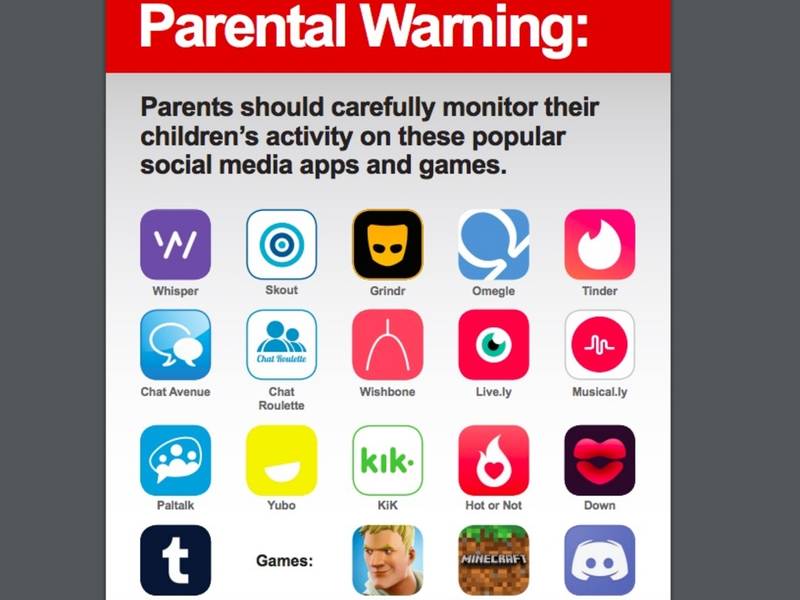
Following the recent arrests of 24 alleged child predators, the Office of Attorney General alerted New Jerseyans this past week that potentially dangerous people are using as many as 19 apps to lure children to have sex.

The New Jersey Regional Internet Crimes Against Children (ICAC) Task Force, which is led by the New Jersey State Police, and the Ocean County Prosecutor's Office, recently arrested 24 people who allegedly used a slew of apps that are well known to parents and children.


They include the following chat apps: Kik, Skout, Grindr, Whisper, Omegle, Tinder, Chat Avenue, Chat Roulette, Wishbone, Live.ly, Musical.ly, Paltalk, Yubo, Hot or Not, Down, and Tumblr.
Arrests also have been made involving the gaming apps Fortnite, Minecraft, and Discord, according to the Office of Attorney General.

Read more: 24 Alleged Child Predators Arrested In Big Statewide NJ Bust

Attorney General Gurbir S. Grewal urged parents to familiarize themselves with these apps and warn their children about sharing information with strangers.

"It is a frightening reality that sexual predators are lurking on social media, ready to strike if they find a child who is vulnerable," said Grewal. "To counter that threat, we are working collaboratively and aggressively across all levels of law enforcement to apprehend these sex offenders.

"We want child predators to know that we are on social media too – and the child they target may be the undercover officer who puts them in handcuffs."

Col. Patrick Callahan of the New Jersey State Police said predators work behind closed doors "through great lengths to avoid detection online," frequenting social media sites with the sole purpose of targeting unsuspecting children. He said parents should closely monitor their child's online activity.

"Our troopers and partners on the ICAC Task Force are unfazed by the outward appearances of sex offenders and will continue to turn the tables on predators by luring them out of hiding and bringing them to justice," he said.

Some of the apps have an 18+ age requirement, according to nj.com, even though users are able to enter a birthdate that's older or younger. With Tinder, up until June 2016, a user only had to be 13 to sign up, but the company changed its requirement after being criticized by parents, according to nj.com and parentinfo.com.

Tumblr, Instagram and Snapchat also have a minimum age requirement of 13, according to nj.com. Some apps, however, don't have a guaranteed way of keeping children off the app.

Last week's arrest of 24 alleged child predators from across New Jersey – including a police officer who headed a county SWAT team – was part of a statewide bust known as "Operation Open House."
The multi-agency undercover operation targeted men who allegedly were using social media in an attempt to lure underage girls and boys for sexual activity, according to a release from the Office of Attorney General.

The underage "children" were, in fact, undercover officers, according to authorities. Most of the defendants were arrested when they arrived at a house in Toms River, where they allegedly expected to find their victim home alone.

One of them was Richard C. Conte, 47, who was busted earlier this month in Toms River as the result of the undercover operation, police said. Conte, who was off-duty at the time, believed he was going to be meeting a 15-year-old girl, police said.

"This investigation is one of countless examples highlighting the outstanding proactive cyber enforcement' capabilities developed through the partnership between the state and the Ocean County Prosecutor's Office," Ocean County Prosecutor Joseph D. Coronato said.

"We thank the Attorney General's Office and the New Jersey State Police for their constant investigative support aimed at apprehending sexual predators targeting our youth," he said. "When law enforcement works together seamlessly, as we did in this investigative effort, the safety of all citizens increases tenfold."

https://patch.com/new-jersey/lakewood-nj/s/gioht/nj-parents-beware-child-predators-use-19-apps-to-get-children?utm_source=alert-breakingnews&utm_medium=email&utm_term=weather&utm_campaign=alert


"AMERICA'S DAD"! Bill Cosby Sentenced To 3-10 Years Behind Bars For Sexual Assault!


 READ IT ALL - VIDEOS:
https://philadelphia.cbslocal.com/2018/09/25/bill-cosby-prison-sentence-sex-assault/


Judge declares Cosby a 'sexually violent predator' 
 
(CNN)Andrea Constand was drugged and sexually assaulted by Bill Cosby at the TV icon's home outside Philadelphia in 2004, and she has testified about it several times, including in two criminal trials over the past year and a half.

Ahead of Cosby's sentencing, she wrote a 5-page letter to the court explaining how the assault -- and the nearly 15 years of legal battles since then -- have upended her life. 
 
"Bill Cosby took my beautiful, healthy young spirit and crushed it," she writes.
 
Here is her full victim impact statement:
 
To truly understand the impact that sexual assault has had on my life, you have to understand the person that I was before it happened.
 
At the time of the assault, I was 30 years old, and a fit, confident athlete. I was strong, and skilled, with great reflexes, agility and speed. When I graduated from high school in Toronto, I was one of the top three female high school basketball players in Canada. Dozens of American colleges lined up to offer me basketball scholarships, and I chose the University of Arizona.
 
For four years, I was a shooting guard on the women's basketball team, scoring up to 30 points a game. It was an amazing time in my life, and I learned a lot, developed a circle of really good friends, many of them teammates, and traveled around the US to compete.
 
The only down side was that I missed my family, and developed severe homesickness. When it started to affect my studies and my training, my Dad came up with the idea to move his own father and mother to Tucson.
 
My grandparents were in their late 60s when they gamely agreed to move more than 2,000 miles to help me adjust to life away from home. They were retired after selling their Toronto restaurant business, and figured the warm, dry climate would suit them anyway. I had always enjoyed a special relationship with my grandparents. Not only had I grown up in their home, but I spoke Greek before I spoke English. They got an apartment close to mine, and I was there most days, talking and laughing over my favourite home-cooked meals. The homesickness quickly evaporated.
 
After I graduated from the University of Arizona with a degree in Communications, I signed a two-year contract to play professional basketball for Italy. Going pro took my athletic training to a whole new level. Once again, I thrived in the team atmosphere, and enjoyed traveling Europe although we rarely saw more than the basketball venues and the hotel rooms where we slept.
 
When my contract ended, my former coach from the University of Arizona encouraged me to apply for a job as Director of Operations for the women's basketball team at Temple University in Philadelphia. It was a busy, challenging position that required me to manage a lot of logistical details so that others could focus on training the team for competition. I also made all the travel arrangements and went to tournaments with the team and support staff.
 
It was a great job but after a few years, I knew I wanted to pursue a career in the healing arts, my other passion. I also wanted to work closer to home, where I would be reunited with my large, extended family, and many friends.
 
I knew who I was and I liked who I was. I was at the top of my game, certain that the groundwork provided by my education and athletic training would stand me in good stead whatever challenges lay ahead.
 
How wrong I was. In fact, nothing could have prepared me for an evening of January, 2004, when life as I knew it came to an abrupt halt.
 
***************
I had just given my two-month notice at Temple when the man I had come to know as a mentor and friend drugged and sexually assaulted me. Instead of being able to run, and pretty much do anything I wanted physically, during the assault I was paralyzed and completely helpless. I could not move my arms or legs. I couldn't speak or even remain conscious. I was completely vulnerable, and powerless to protect myself. 
 
After the assault, I wasn't sure what had actually happened but the pain spoke volumes. The shame was overwhelming. Self-doubt and confusion kept me from turning to my family or friends as I normally did. I felt completely alone, unable to trust anyone, including myself.
 
I made it through the next few weeks by focusing on work. The women's basketball team was in the middle of the Atlantic 10 tournament, and was traveling a lot. It was an extremely busy time for me, and the distraction helped take my mind off what had happened.
 
When the team wasn't on the road, however, I was in the basketball office at Temple, and was required to interact with Mr. Cosby, who was on the Board of Trustees. The sound of his voice over the phone felt like a knife going through my guts. The sight of the man who drugged and sexually assaulted me coming into the basketball office filled me with dread. I did everything my job required of me but kept my head down, counting the days until I could return to Canada. I trusted that once I left, things would get back to normal. 
 
Instead, the pain and anguish came with me. At my parents' house, where I was staying until I got settled, couldn't talk, eat, sleep or socialize. Instead of feeling less alone because I was back home with my family, I felt more isolated than ever. 
 
Instead of my legendary big appetite and "hollow leg" — a running joke in my family — I picked at my food, looking more like a scarecrow with each passing week. I was always a sound sleeper but now I couldn't sleep for more than two or three hours. I felt exhausted all the time. 
 
I used the demands of my new courses to opt out of family gatherings and events, and to avoid going out with friends. As far as anyone could tell, I was preoccupied with my studies. But the terrible truth about what had happened to me — at the hands of a man my family and friends admired and respected — was swirling around inside me.
 
Then the nightmares started. I dreamed that another woman was being assaulted right in front of me and it was all my fault. In the dream, I was consumed with guilt, and pretty soon that agonizing feeling spilled over into my waking hours too. I became more and more anxious that what had happened to me was going to happen to someone else. I grew terrified that it might already be too late, that the sexual assaults were continuing because I didn't speak out.
 
Then one morning I called my mother on the telephone to tell her what had happened to me. She had heard me cry out in my sleep. She wouldn't let me put her off, and insisted that I tell her what was wrong. She wouldn't settle for anything less than a complete and truthful explanation.
 
****************
 
Reporting the assault to the Durham Regional police in Toronto only intensified the fear and pain, making me feel more vulnerable and ashamed than ever. When the Montgomery County District Attorney outside Philadelphia decided not to prosecute for lack of evidence, we were left with no sense of validation or justice. After we launched civil claims, the response from Mr. Cosby's legal team was swift and furious. It was meant to frighten and intimidate and it worked.
 
The psychological, emotional and financial bullying included a slander campaign in the media that left my entire family reeling in shock and disbelief. Instead of being praised as a straight shooter, I was called a gold digger, a con artist, and a pathological liar. My hard-working, middle-class parents were accused of trying to get money from a rich and famous man.
 
At the deposition during the civil trial, I had to relive every moment of the sexual assault in horrifying detail in front of Mr. Cosby and his lawyers. I felt traumatized all over again and was often in tears. I had to watch Cosby make jokes and attempt to degrade and diminish me, while his lawyers belittled and sneered at me. It deepened my sense of shame and helplessness, and at the end of each day, I left emotionally drained and exhausted.
 
When the case closed with a settlement, sealed testimony and a non-disclosure agreement, I thought that finally — finally — I could get on with my life, that this awful chapter in my life was over at last. These exact same feelings followed me throughout both criminal trials. The attacks on my character continued, spilling over outside the courtroom steps, attempting to discredit me and cast me in false light. These character assassinations have caused me to suffer insurmountable stress and anxiety. which I still experience today.
 
I still didn't know that my sexual assault was just the tip of the iceberg. 
 
Now, more than 60 other women have self-identified as sexual assault victims of Bill Cosby. We may never know the full extent of his double life as a sexual predator but his decades-long reign of terror as a serial rapist is over.
 
I have often asked myself why the burden of being the sole witness in two criminal trials had to fall to me. The pressure was enormous. I knew that how my testimony was perceived, that how I was perceived, would have an impact on every member of the jury and on the future mental and emotional well-being of every sexual assault victim who came before me. But I had to testify. It was the right thing to do, and I wanted to do the right thing, even if it was the most difficult thing I've ever done.
When the first trial ended in a mistrial, I didn't hesitate to step up again. 
 
*************
I know now that I am one of the lucky ones. But still, when the sexual assault happened, I was a young woman brimming with confidence and looking forward to a future bright with possibilities. Now, almost 15 years later, I'm a middle-aged woman who's been stuck in a holding pattern for most of her adult life, unable to heal fully or to move forward.
 
Bill Cosby took my beautiful, healthy young spirit and crushed it. He robbed me of my health and vitality, my open nature, and my trust in myself and others.
 
I've never married and I have no partner. I live alone. My dogs are my constant companions, and the members of my immediate family are my closest friends.
 
My life revolves around my work as a therapeutic massage practitioner. Many of my clients need help reducing the effects of accumulated stress. But I've also trained in medical massage at Memorial Sloan-Kettering Cancer Center in New York, and often help cancer patients manage the side effects of chemotherapy and radiation. I help many others too — people with Parkinson's, arthritis, diabetes, and so on. Some of my clients are in their 90s. I help them cope with the ravages of old age, reducing stiffness, aches and pains.
 
I like my work. I like knowing that I can help relieve pain and suffering in others. I know that it helps heal me, too. I no longer play basketball but I try to stay fit. Mostly, I practice yoga and meditation, and when the weather is warm, I like to pedal my bike up long steep hills.
 
It all feels like a step in the right direction: away from a very dark and lonely place, toward the person I was before all this happened.
 
Instead of looking back, I am looking forward. I want to get to the place where the person I was meant to be gets a second chance.
 
I know that I still have room to grow.
 
**************
I would like to acknowledge some of the people who have helped me get here today. I will always be grateful for their counsel, friendship and support.
 
First of all, my lawyers, Dolores Troiani and Bebe Kivitz. These two smart, courageous women have been there for me since the beginning. Without them, I would never have been able to navigate this legal and emotional minefield. 
 
I will also be eternally grateful to Kevin Steele, the District Attorney of Montgomery County, who had the guts to believe in me, in the truth, and for trusting that the justice system could get things right — even if the process had to be repeated. I also want to thank Mr. Steele's incredible team of professionals, including assistant district attorneys Kristen Feder and Stewart Ryan, detectives Richard Shchaffer, Mike Shade, Harry Hall, Jim Reape, Erin Slight, Kiersten McDonald, victims services, and many others, for their passion for justice, their skill, and their hard work and perseverance despite the odds. 
 
Thank you to the jurors for their civic duty and great sacrifices. 
 
Thank you to all of the friends, old and new, who have stood by me. You know who you are, and each and every one of you has made a huge difference. Please know that. 
 
Last but not least, I want to thank my incredible family: my mother, Gianna, and my father, Andrew, my sister Diana, her husband Stuart, and their beautiful daughters — my nieces Andrea and Melanie. Thank you for proving over and over again that if there's one thing in life you can always count on, it's family.

https://www.cnn.com/2018/09/25/us/andrea-constand-bill-cosby-victim-statement-trnd/index.html