It took a measles epidemic to change the perceived dynamic
between city officials and Brooklyn’s ultra-Orthodox community,
at least
for now.
The central narrative over the last few years has pitted city
education officials together with a small band of former yeshiva
students who are challenging yeshivas to follow state law and offer a
more rigorous secular education for their students.
Charedi leaders in Brooklyn have cried foul, citing an infringement
on their religious liberty and claiming that the secular education they
offer is good enough for their community. That contentious dynamic was
also at play a few years earlier in the battle over a controversial
circumcision technique favored by many in Brooklyn’s charedi precincts;
city officials
argued that metzitzeh b’peh was a danger to infants while charedi leaders thought attempts to regulate it breached their religious rights.
Now, following a rash of measles infections in Brooklyn yeshivas,
city officials quietly sent a letter to yeshiva principals in
Williamsburg, Borough Park and surrounding neighborhoods announcing that
children who aren’t vaccinated for the disease are no longer allowed to
go to school.
Even though some of the ads in Orthodox papers urging parents to
vaccinate their children were poorly translated into Yiddish, according
to a community leader, the response has been a far cry from recent
controversies.
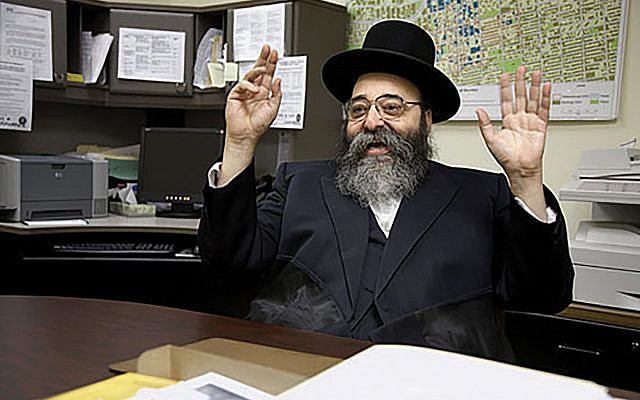
Rabbi David Niederman, executive director
and president of the United Jewish Organizations of Williamsburg, said
the community and the city are working closely together “to figure out
how to stem the outbreak.”
“Eradicating measles is the community and the DOH’s [Department of
Health’s] central concern,” Rabbi David Niederman, executive director
and president of the United Jewish Organizations of Williamsburg, told
The Jewish Week in an email. “For many months we have been actively
working with the yeshivas and DOH to ensure parents understand the need
to get their kids immunized. We are redoubling our efforts to put an end
to this terrible outbreak. We have educated the schools on the serious
dangers of measles and brought them together with the DOH to figure out
how to stem the outbreak.”
A New York State law requiring every public and private school
student to be vaccinated has long been on the books, but some schools
enforce it better than others. Since measles, mumps and rubella have
nearly been eliminated in the United States, the decision by a small
minority of parents not to vaccinate is usually not a problem. But the
diseases are still common in other parts of the world, and currently
Israel is experiencing an outbreak that, as of Sunday, has sickened
1,334 people. One toddler in Israel has died from the disease. Orthodox
Jews here travel to Israel regularly, and city officials believe that is
how the disease was introduced here.
We are redoubling our efforts to put an end to this terrible outbreak.
In Brooklyn, 39 children in the heavily Orthodox neighborhoods of
Williamsburg and Borough Park have been hit with measles as of Dec. 5.
In Rockland County, 91 children, teens and adults have come down with
the disease as of Monday, and eight more people are being tested for the
disease. In the Lakewood area of New Jersey, which has a significant
charedi population, 18 people had been diagnosed with measles as of
Sunday. So far no measles cases have been reported in Crown Heights,
which is also chasidic, but not strongly connected to the communities in
Williamsburg and Borough Park. And so far nobody in the U.S. has died
of measles in the current outbreak.
While the vast majority of yeshiva students are vaccinated — a search
of New York State vaccine rate records had nearly all Brooklyn yeshivas
sampled well above 90 percent — there has been a growing movement
against vaccination, led, among the New York-area charedi set, by an
organization called PEACH, Parents Educating and Advocating for
Children’s Health. PEACH tries to stay under the radar. It has no
website, save for a PDF version of their 40-page booklet entitled “The
Vaccine Safety Handbook: An Informed Parent’s Guide.” The booklet
includes two email addresses, messages to which had not yet been
returned as of press time. It also has a list of editors, but notes that
some of the names listed are pseudonyms. (The Jewish Week hasn’t
received a response to a request for comment from either address.)
But the area’s charedi communities vaccinate at a much higher rate
than other tiny subcultures in the city. A sampling of area progressive
schools and yeshivas, found 13 progressive-leaning schools and one
yeshiva with vaccination rates below 95 percent. Yeshiva Bnos Spinka
Boys School had a vaccination rate of 90.1 percent. The 13 progressive
schools ranged from Manhattan Country School, with a rate of 94.7
percent to Brooklyn Free School with a vaccination rate of 61.8
percent. The 13 progressive schools ranged from Manhattan Country
School, with a rate of 94.7 percent to Brooklyn Free School with a
vaccination rate of 61.8 percent. The other schools’ vaccination
percentages are as follows: Bushwick School For Social Justice (92.8),
Brooklyn Heights Montessori School (92.6), Greene Hill (90.3), The
Studio School (90.2), Special Music School (90.0), Windmill Montessori
(85.9), Progressive School Of Long Island (83.1), The Blue School
(76.6), Brooklyn Waldorf School (71.4) and Sarah Lawrence Early
Childhood Center (66.7).
While non-yeshivas have some of the lowest vaccination rates in the
city, most people don’t mind the city targeting yeshivas for enforcement
of the rule excluding unvaccinated children from school, community
leaders said.
“I believe a number of the schools had already adopted the exclusion
policy even prior to the Health Department’s directive, and I believe
that there has been broad compliance after its publication. For now, at
least, I think there have been only a small number of complaints about
the exclusive focus on Jewish schools,” said Rabbi David Zwiebel,
executive vice president of Agudath Israel of America, an umbrella
organization for charedi Jews.
Alexander Rapaport, the co-founder and CEO of the Masbia Soup Kitchen
Network in Brooklyn, who often acts as a liaison from the Borough Park
chasidic community, said he’s not surprised that the current measles
outbreak has stayed limited to the charedi community, given an insular
nature so strong, that the measles epidemic is spreading from Israel to
Brooklyn before it will spread to someone outside of the community.
Calling the phenomenon akin to the community having “invisible ghetto
walls” around communities and “invisible bridges” connecting them with
each other, he said: “We keep to ourselves to the extent that a
cotangent will spread to Rockland before it spreads to the person next
door. It’s the most stark real-life gauge of how we keep to ourselves.”
While community members don’t seem to mind the exclusive focus on
unvaccinated yeshiva students, that doesn’t mean the move would
necessarily pass muster if legally challenged, said Mark Stern, general
counsel of the Jewish advocacy group AJC. While on the one hand, it
makes sense to limit the rule to yeshivas because they are the only
schools that have students coming down with measles, “the drawing of
religious lines comes with a very heavy burden of unconstitutionality,”
he said in a telephone interview. “I don’t mean to say that it’s clearly
illegal, but it’s at least eyebrow raising.”
“The overwhelming majority of the Williamsburg community vaccinates
their children.
Unfortunately, the anti-vaccine movement that effects
the broader public has its supporters in the Jewish community as well
and that is why we see a small part of the community not vaccinating,”
Rabbi Niederman told The Jewish Week via email.
He said he thinks the cooperation between the government and the charedi community is working.
“I know according to the DOH the numbers of those choosing to
vaccinate in Williamsburg have gone up since the outbreak started and
that is because the minority of people that were not vaccinating are
educating themselves on the importance of having their kids vaccinated,”
Rabbi Niederman wrote.
Rabbi Zwiebel agreed that charedi Jews are choosing not to vaccinate for the same alleged-but-now-debunked health risks.
Both the city and state health departments have made a concerted
effort to reach out to charedi communities, making sure they know about
the epidemic and urging people to get vaccinated. City health officials
have put ads on targeted social media sites, distributed posters, sent
information materials home to parents through yeshivas, asked doctors to
make sure their patients are up-to-date on shots, placed targeted
Yiddish robocalls to 70,000 households and placed Yiddish and English
ads in eight newspapers, seven of which were Jewish and five of which
are written in Yiddish, a health department spokesman said.
State health officials have also been advertising, placing a
full-page ad in both English and Yiddish in the well-respected Ami
Magazine. Rapaport praised health officials for the extensive outreach,
and said he hopes that next time the state uses a native Yiddish speaker
to translate the materials.
They’re trying to convince people who are still convincible.
In the Ami Magazine ad, for example, the English text: “Measles is
spreading in our community. It can be dangerous for anyone who is not
vaccinated. Protect yourself and your family. Talk to your health care
provider,” was translated as “Measles is spreading in our land. It can
be terrible for anyone who is not vaccinated. Protect yourself and your
family. Talk to your food provider,” he said.
“They’re trying to convince people who are still convincible,” he
said in a telephone interview. “And so you need to have something that’s
convincing. … If you look like you don’t know what you’re doing, how
are you going to convince someone that you know what you’re talking
about on medical issues.”