EVERY SIGNATURE MATTERS - THIS BILL MUST PASS!

EVERY SIGNATURE MATTERS - THIS BILL MUST PASS!
CLICK - GOAL - 100,000 NEW SIGNATURES! 75,000 SIGNATURES HAVE ALREADY BEEN SUBMITTED TO GOVERNOR CUOMO!

EFF Urges Court to Block Dragnet Subpoenas Targeting Online Commenters

EFF Urges Court to Block Dragnet Subpoenas Targeting Online Commenters
CLICK! For the full motion to quash: http://www.eff.org/files/filenode/hersh_v_cohen/UOJ-motiontoquashmemo.pdf

Thursday, June 16, 2022

GREAT STORY TO TELL YOUR KIDS AT BEDTIME!---- Bleich told Haaretz that the misconduct allegations are part of a smear campaign against him by members of the Karlin-Stolin Hasidic dynasty, with which Bleich used to be affiliated. He has fallen out with the movement and has a real estate dispute with it, he told the Israeli newspaper.


A chief rabbi in Ukraine denies sexual misconduct allegations - I say put him on the frontlines against Russia in a mitzva tank permanently, with glatt kosher food and tefillin of course!


Yaakov Dov Bleich, a chief rabbi of Ukraine.

(JTA) — The main organization representing British Jews has suspended its ties with the European Jewish Congress over unspecified “misconduct” allegations against the Congress’ treasurer, Yaakov Dov Bleich, a chief rabbi of Ukraine.

The Board of Deputies of British Jews announced the move on Twitter May 31 without naming Bleich. In the tweet, the group said the EJC did not respond satisfactorily to “misconduct allegations,” whose exact nature has not been reported in the media or specified by the Board.

Bleich, who has been featured in news coverage of the war in Ukraine, has denied all allegations against him, Haaretz reported on Tuesday.

“Anyone in public life, over five to six years, you’re going to make changes, especially at my age, where I am less active,” Bleich told Haaretz. “If you come with something concrete, OK, but everybody who investigated said there’s nothing concrete behind these allegations.”

The Haaretz report was based on correspondence between EJC interim president Ariel Muzicant and Marie van der Zyl, the president of the Board. Those emails, obtained by the Jewish Telegraphic Agency, neither name Bleich directly as the accused nor specify the nature of the allegations.

The Jerusalem Post reported June 2 that the British Board of Deputies had acted over sexual abuse allegations, also without naming Bleich. On social media, reports have swirled before and after the board’s announcement alleging sexual misconduct by Bleich, an American citizen who lives mostly in Monsey, New York. 

Bleich told Haaretz that the misconduct allegations are part of a smear campaign against him by members of the Karlin-Stolin Hasidic dynasty, with which Bleich used to be affiliated. He has fallen out with the movement and has a real estate dispute with it, he told the Israeli newspaper.

Another email obtained by JTA, by Jonathan Arkush, a former president of the Board of Deputies, does name Bleich as the reason for the board’s suspension of ties with the EJC.

“The correct action would have been to suspended [sic] R Bleich immediately if he did not agree to step aside and then consider any representation from him against the evidence,” Arkush wrote to EJC President Muzicant on June 1. In the email, Arkush said he supported the board’s suspension of ties with EJC, citing how “troubling matters circulating publicly” create the impression that the EJC is ignoring the problem.

Arkush’s email was in response to an earlier email sent by Muzicant to van der Zyl, who had demanded Muzicant “carry out an internal investigation into these serious allegations against an officeholder” at EJC. Van der Zyl threatened to go public about the issue.

Muzicant replied that his group had in fact looked into the allegations and said that “going public is irresponsible.” (Muzicant was appointed interim president of the EJC in early May after the previous president, Moshe Kantor, resigned after being placed under sanctions in the United Kingdom over his ties to Russia.)

“The investigation we were able to do so far shows: There are no victims or first-hand witnesses which went to the police or to court,” he wrote. “The allegations are dramatic but are second and third parties (hearsay!) and they are three years old.”

Attempts by JTA in recent weeks to contact complainants have not been successful.

Contacted by JTA, Bleich declined to comment on the dispute. The British Board of Deputies has also declined to comment.

The scandal is not the only one unfolding in Europe right now over the handling of allegations against Jewish leaders. Liberal, or Reform, Judaism in Germany is also being roiled by allegations against Rabbi Walter Homolka, the founder and rector of the Abraham Geiger College, a 23-year-old rabbinical school, and against the college for how it has handled them.

https://www.jta.org/2022/06/14/global/a-chief-rabbi-in-ukraine-denies-sexual-misconduct-allegations?utm_source=JTA_Maropost&utm_campaign=JTA_DB&utm_medium=email&mpweb=1161-45142-462090

Wednesday, June 15, 2022

‘I am just looking for a human being’


The Hypersane Are Among Us, If Only We Are Prepared to Look


Sometimes those who seem a little crazy are the ones who really get it.


‘Hypersanity’ is not a common or accepted term. But neither did I make it up. I first came across the concept while training in psychiatry, in The Politics of Experience and the Bird of Paradise (1967) by R D Laing. In this book, the Scottish psychiatrist presented ‘madness’ as a voyage of discovery that could open out onto a free state of higher consciousness, or hypersanity. For Laing, the descent into madness could lead to a reckoning, to an awakening, to ‘break-through’ rather than ‘breakdown’.

A few months later, I read C G Jung’s autobiography, Memories, Dreams, Reflections (1962), which provided a vivid case in point. In 1913, on the eve of the Great War, Jung broke off his close friendship with Sigmund Freud, and spent the next few years in a troubled state of mind that led him to a ‘confrontation with the unconscious’.

As Europe tore itself apart, Jung gained first-hand experience of psychotic material in which he found ‘the matrix of a mythopoeic imagination which has vanished from our rational age’. Like Gilgamesh, Odysseus, Heracles, Orpheus and Aeneas before him, Jung travelled deep down into an underworld where he conversed with Salome, an attractive young woman, and with Philemon, an old man with a white beard, the wings of a kingfisher and the horns of a bull. Although Salome and Philemon were products of Jung’s unconscious, they had lives of their own and said things that he had not previously thought. In Philemon, Jung had at long last found the father-figure that both Freud and his own father had failed to be. More than that, Philemon was a guru, and prefigured what Jung himself was later to become: the wise old man of Zürich. As the war burnt out, Jung re-emerged into sanity, and considered that he had found in his madness ‘the primo materia for a lifetime’s work’.

The Laingian concept of hypersanity, though modern, has ancient roots. Once, upon being asked to name the most beautiful of all things, Diogenes the Cynic (412-323 BCE) replied parrhesia, which in Ancient Greek means something like ‘uninhibited thought’, ‘free speech’, or ‘full expression’. Diogenes used to stroll around Athens in broad daylight brandishing a lit lamp. Whenever curious people stopped to ask what he was doing, he would reply: ‘I am just looking for a human being’ – thereby insinuating that the people of Athens were not living up to, or even much aware of, their full human potential.

***

Jung and Diogenes came across as insane by the standards of their day. But both men had a depth and acuteness of vision that their contemporaries lacked, and that enabled them to see through their facades of ‘sanity’. Both psychosis and hypersanity place us outside society, making us seem ‘mad’ to the mainstream. Both states attract a heady mixture of fear and fascination. But whereas mental disorder is distressing and disabling, hypersanity is liberating and empowering.

After reading The Politics of Experience, the concept of hypersanity stuck in my mind, not least as something that I might aspire to for myself. But if there is such a thing as hypersanity, the implication is that mere sanity is not all it’s cracked up to be, a state of dormancy and dullness with less vital potential even than madness. This I think is most apparent in people’s frequently suboptimal – if not frankly inappropriate – responses, both verbal and behavioural, to the world around them. As Laing puts it:

The condition of alienation, of being asleep, of being unconscious, of being out of one’s mind, is the condition of the normal man.
Society highly values its normal man. It educates children to lose themselves and to become absurd, and thus to be normal.
Normal men have killed perhaps 100,000,000 of their fellow normal men in the last 50 years.

Many ‘normal’ people suffer from not being hypersane: they have a restricted worldview, confused priorities, and are wracked by stress, anxiety and self-deception. As a result, they sometimes do dangerous things, and become fanatics or fascists or otherwise destructive (or not constructive) people. In contrast, hypersane people are calm, contained and constructive. It is not just that the ‘sane’ are irrational but that they lack scope and range, as though they’ve grown into the prisoners of their arbitrary lives, locked up in their own dark and narrow subjectivity. Unable to take leave of their selves, they hardly look around them, barely see beauty and possibility, rarely contemplate the bigger picture – and all, ultimately, for fear of losing their selves, of breaking down, of going mad, using one form of extreme subjectivity to defend against another, as life – mysterious, magical life – slips through their fingers.

We could all go mad, in a way we already are, minus the promise. But what if there were another route to hypersanity, one that, compared with madness, was less fearsome, less dangerous, and less damaging? What if, as well as a backdoor way, there were also a royal road strewn with sweet-scented petals? After all, Diogenes did not exactly go mad. Neither did other hypersane people such as Socrates and Confucius, although the Buddha did suffer, in the beginning, with what might today be classed as depression.

Besides Jung, are there any modern examples of hypersanity? Those who escaped from Plato’s cave of shadows were reluctant to crawl back down and involve themselves in the affairs of men, and most hypersane people, rather than courting the limelight, might prefer to hide out in their back gardens. But a few do rise to prominence for the difference that they felt compelled to make, people such as Nelson Mandela and Temple Grandin. And the hypersane are still among us: from the Dalai Lama to Jane Goodall, there are many candidates. While they might seem to be living in a world of their own, this is only because they have delved more deeply into the way things are than those ‘sane’ people around them.

Neel Burton is a psychiatrist and philosopher. He is a fellow of Green Templeton College at the University of Oxford, and his most recent book is Hypersanity: Thinking Beyond Thinking (2019). 

https://getpocket.com/explore/item/the-hypersane-are-among-us-if-only-we-are-prepared-to-look?utm_source=pocket-newtab

Tuesday, June 14, 2022

“The list of coincidences is getting verrrrrrrrrrry long.”


Jeffrey Sachs Presents Evidence of Possible Lab Origin of Covid-19


An article in the Proceedings of the National Academy of Sciences calls for an independent investigation of information held by U.S.-based institutions that could shed light on the origins of Covid.

In an article published Thursday, economist Jeffrey Sachs called for an independent investigation of information held by U.S.-based institutions that could shed light on the origins of the Covid-19 pandemic. Writing in the Proceedings of the National Academy of Sciences, Sachs and his co-author, Neil Harrison, a Columbia University professor of molecular pharmacology and therapeutics, said that federal agencies and universities possess evidence that has not been adequately reviewed, including virus databases, biological samples, viral sequences, email communications, and laboratory notebooks. Sachs and Harrison also highlighted a tantalizing scientific detail that may be an indication that SARS-CoV-2, the coronavirus that causes Covid-19, originated in a laboratory: a sequence of eight amino acids on a critical part of the virus’s spike protein that is identical to an amino acid sequence found in cells that line human airways.

Sachs and Harrison are hardly the first to suggest that SARS-CoV-2 might have been created in a lab. Since its genetic sequence was first published in February 2020, scientists have puzzled over the furin cleavage site, an area on the virus’s spike that allows it to be cleaved by a protein on the membrane of human cells and makes the coronavirus particularly dangerous to people. Once split, the virus releases its genetic material into the cell and reproduces. While attaching to cells and spike cleavage is part of how all coronaviruses work, SARS-CoV-2 is the only one of its class, sarbecoviruses, that can use furin for the cleavage.

As with past discussion of a possible lab origin of SARS-CoV-2, this latest theory has already been met with considerable pushback. Even some scientists who are open to the idea that a lab accident could have sparked the pandemic remain unconvinced by the particular trail of evidence laid out by Sachs and Harrison.

The journal article offers a scientific road map for how this unusual sequence of amino acids could have made its way into the furin cleavage site, or FCS, of the virus. Sachs and Harrison acknowledge that the sequence could have arisen naturally. But they also lay out another possibility: that scientists might have purposefully inserted this particular string of amino acids into a bat coronavirus in the course of their work. They focus particularly on scientists who submitted an unfunded grant proposal to a division of the Defense Department called the Defense Advanced Research Projects Agency, or DARPA, laying out plans to insert a furin cleavage site into a bat coronavirus.

“We do not know whether the insertion of the FCS was the result of natural evolution — perhaps via a recombination event in an intermediate mammal or a human — or was the result of a deliberate introduction of the FCS into a SARS-like virus as part of a laboratory experiment,” Sachs and Harrison write. “We do know that the insertion of such FCS sequences into SARS-like viruses was a specific goal of work proposed by the EHA-WIV-UNC partnership within a 2018 grant proposal (“DEFUSE”) that was submitted to the US Defense Advanced Research Projects (DARPA).”

EHA is a reference to EcoHealth Alliance, a nonprofit research group based in New York City that has received more than $118 million in grants and contracts from federal agencies. WIV, or the Wuhan Institute of Virology, is a Chinese research organization that collaborated with EcoHealth Alliance in the past and was listed as a subcontractor on the DARPA grant. UNC is mentioned because Ralph Baric, a molecular biologist at the University of North Carolina, Chapel Hill, was to have conducted part of the work pitched to DARPA. The grant proposal touted Baric’s “two-decade track record of reverse engineering [coronavirus] and other virus spike proteins.”

The intent of the DARPA proposal was to prevent emerging pathogenic threats, but the work, if conducted, could have created a novel virus capable of infecting humans. “We will introduce appropriate human-specific cleavage sites and evaluate growth potential in [a type of mammalian cell commonly used in microbiology] and [human airway epithelial cell] cultures,” the proposal stated.

Several scientists interviewed about the DARPA proposal in September told The Intercept that scientists often begin research before seeking funding and thus that some of the experiments described in the proposal could have already been completed. But when asked about that possibility in an interview, Peter Daszak, the president of EcoHealth Alliance, rejected it: “The DARPA proposal was not funded. Therefore, the work was not done. Simple.”

A Rational Choice

As Sachs and Harrison note, the part of a protein on the cell membrane that shares its amino acid sequence with the bat coronavirus is critical for lung function. Known as an epithelial sodium channel-alpha, or ENaC-alpha, it is found in human airway cells, as well as in human kidneys and colons. Intriguingly, like SARS-CoV-2, ENaC-alpha, which facilitates the absorption of fluid in cells, is also activated by the unusual furin cleavage site. Harrison, a physiologist affiliated with Columbia’s Department of Molecular Pharmacology and Therapeutics, studies ion channels, the larger category to which ENaC-alpha belongs.

Other scientists have already pointed out the match between the amino acid series in the furin cleavage site of SARS-CoV-2 and the ENaC-alpha found in human airways. In 2020, a team from the biomedical company Nference suggested that the overlap between the virus and the sequence found in human lungs is part of the reason that Covid-19 is so damaging to the respiratory system. Those scientists described the sequence as having evolved naturally.

Sachs and Harrison, in contrast, suggest that researchers may have inserted the string of amino acids into a bat coronavirus precisely because of its known importance to lung function. “For a research team assessing the pandemic potential of SARS-related coronaviruses, the FCS of human ENaC — an FCS known to be efficiently cleaved by host furin present in the target location (epithelial cells) of an important target organ (lung), of the target organism (human) — might be a rational, if not obvious, choice of FCS to introduce into a virus in order to alter its infectivity, in line with other work performed previously,” they write.

Such a choice, they point out, would have been in keeping with another viral research project on which EcoHealth Alliance, the Wuhan Institute of Virology, and UNC’s Baric collaborated: a 2014 grant from the National Institute of Allergy and Infectious Diseases that involved increasing the transmissibility and pathogenicity of bat coronaviruses.

Growing List of Coincidences

The intriguing theory of viral engineering hinges on two observations: that the amino acid sequences match and that experts in both the ENaC-alpha furin cleavage site and the insertion of genetic sequences into bat coronaviruses happen to work at the same academic institution: the University of North Carolina, Chapel Hill.

Baric, whose work aims to prevent and create treatments for viral outbreaks, has previously inserted segments of DNA and RNA into viruses and created an infectious clone of SARS using his own patentedNo See’m” method of inserting genetic materials without a trace. He has also collaborated on coronavirus research with scientists from a center for lung studies at UNC-Chapel Hill who are knowledgeable about ENaC-alpha. In one 2016 study, the scientists created a new virus using the spike of a bat coronavirus that had been isolated and characterized by the Wuhan Institute of Virology. The experiment found that the new virus “replicated efficiently” in human airway cells that were cultured in a lab.

In another paper, published a year earlier, Baric, along with the Wuhan Institute of Virology’s Shi Zhengli and a lung expert UNC-Chapel Hill’s lung institute, described creating a hybrid virus using a SARS-like virus from a bat and a “mouse-adapted” coronavirus. The new virus caused mice to get sicker than those exposed to the original virus. The goal of these experiments was to prepare for the possibility that a virus might jump naturally from animals to humans, as SARS had in 2003. But even before the pandemic, the experiment drew criticism from other scientists, who were concerned because the researchers had created a virus that was able to spread in humans.

Sachs and Harrison note that the scientists who co-authored the DARPA grant proposal would have been aware of research on coronavirus furin cleavage sites, including one 2006 experiment in which a furin cleavage site was inserted into a coronavirus. “The research team would also have some familiarity with the FCS sequence and the FCS-dependent activation mechanism of human ENaC, which was extensively characterized at UNC,” they write.

“The list of coincidences is getting verrrrrrrrrrry long.”

Still, both the overlap in the amino acid sequence and the fact that experts in the furin cleavage site of the ENaC-alpha and insertion of genetic material into bat coronaviruses work at the same university could be coincidental, as Harrison and Sachs acknowledge. Some virologists, though, say that the coincidence strains credulity.

“Could be,” Richard Ebright, a molecular biologist at Rutgers University, wrote in an email to The Intercept when asked about the possibility that these things are both chance occurrences. “But the list of coincidences is getting verrrrrrrrrrry long.”

Ebright, a proponent of investigating the origin of SARS-CoV-2 and of investigating both natural-spillover and research-related-spillover, whom Harrison and Sachs thank “for helpful commentary on the manuscript,” spelled out some of the other Covid coincidences that he considers questionable, including its initial outbreak in a city that, well before 2019, had already been pegged as a biosafety risk. Ebright also noted Wuhan’s 1,000-mile distance from the nearest wild bats that carry the type of SARS-related coronaviruses that caused the pandemic. And he pointed to the particular coding of the amino acids in the furin cleavage site of SARS-CoV2.

“The sequence encoding the FCS of the pandemic virus contained two consecutive CGG arginine codons,” Ebright explained in his email. (A codon, or a combination of three nucleotides, supplies the genetic code for a single amino acid, though most amino acids can be represented by multiple different codons. Each nucleotide is represented by a letter — for RNA, either A, C, U, or G.) “This codon usage is unusual for a natural bat SARS-related coronaviruses (for which fewer than 1 in 30 arginine codons are CGG) but is optimal for humans (for which most arginine codons are CGG codons).”

Still, Ebright said that at first he didn’t see the identical amino acid sequences as particularly suspicious. “I had known for more than a year that there was a perfect match to an eight-amino acid sequence present in human ENaC. What I had not known was that the sequence was known to be a functional furin cleavage site and that it was a sequence extensively studied at UNC,” he said. “The crucial point that the ENaC sequence was a known functional site, not just that there happens to be a match to a protein that happens to be in humans. … That suddenly turned it from what I thought to be largely irrelevant to being a logical and obvious choice to proceed.”

Ralph Baric and the University of North Carolina did not immediately respond to requests for comment.

Name Calling

Other scientists dismiss the idea that the ENaC sequence might have been purposefully inserted into a coronavirus. Scientists who are already convinced that the new coronavirus emerged naturally are unlikely to be persuaded by Sachs and Harrison’s article, which appears in the opinion section of the esteemed journal. Over the past year, many scientists involved in the debate over the origins of the pandemic have settled into an increasingly acrimonious, coarse, and unyielding opposition.

Some proponents of the natural origin theory became particularly dismissive of those open to the possibility of a lab leak after the February release of two pre-print studies mapping the early spread of the virus at the Huanan market in Wuhan. Angela Rasmussen, one of a team of virologists who worked on the project, described it on Twitter as “dispositive evidence of a zoonotic origin” that will “drive those with personal interest in the lab leak hypothesis out of their goddam minds.” In another tweet, Rasmussen referred to proponents of the lab-leak theory as a “pack of ghouls, who through gullibility, stupidity, & conspiracist thinking have decided this is their thing despite zero expertise.”

Although the pre-prints had not been peer-reviewed and may have simply illustrated the spread of the virus rather than its original outbreak, the New York Times ran a front-page story about them that quoted an epidemiologist as saying that the origins debate “has been settled with a very high degree of evidence.” The story, which was announced by a push notification from the paper, also noted a lack of direct evidence for a lab leak.

Meanwhile, Kristian Andersen, another co-author of the pre-prints and a virologist at the well-regarded Scripps Research Institute, used the “poop” emoji to criticize a deeply researched article by Katherine Eban about EcoHealth Alliance. On Twitter, Andersen tarred Eban, New York Times columnist Zeynep Tufekci, and others reporting on biosafety issues that could have led to the release of SARS-CoV-2 as “deep in conspiracy theories” and on the other side of “a clear split” from journalists who dismiss the possibility of a lab origin, whom Andersen referred to as “science-based.”

Even some scientists who have been vocal about the possibility that the pandemic may have been sparked by research have expressed skepticism about the theory suggested by Harrison and Sachs. “The pandemic virus might have been genetically engineered. However, this could have been done in various ways not limited to the specific theory by Harrison and Sachs. I’m not convinced that their hypothesis is the most plausible one,” said Alina Chan, a scientist who laid out a number of possible routes for how the coronavirus might have emerged through research-related incidents in her recent book “Viral: The Search for the Origin of Covid-19.”

“There’s no need for them to go hunting inside the human protein catalogue to look for cleavage sites to put into viruses.”

While she is open to the possibility that the furin cleavage site might have been purposefully inserted into the coronavirus, Chan said there was no reason to think that researchers would mine humans for such material. “These scientists literally had access to hundreds of SARS-like viruses and sequences,” said Chan, referring to the vast collection of coronaviruses from bats and other animals that researchers amassed at the Wuhan Institute of Virology. “There’s no need for them to go hunting inside the human protein catalogue to look for cleavage sites to put into viruses.”

Jack Nunberg, a virologist at the University of Montana, was also not immediately persuaded by the theory of engineering suggested by Sachs and Harrison. “It’s possible,” Nunberg said of the idea that the ENaC segment was inserted into a bat coronavirus as part of research designed to gauge the pandemic potential of a virus. “But I don’t find their evidence on ENaC compelling because furin cleavage sites have a lot of common amino acids, and therefore it may just have happened by chance.”

Others say that the article adds noteworthy information to the public conversation about the origins of the pandemic. “The defenders of the natural origin indicate that the virus on which this type of experiment could have been done — the backbone — has never been published and that specialists in the furin cleavage sites would have chosen a more commonly used furin cleavage site like RARR rather than PRRAR. The Proceedings of the National Academy of Sciences article contradicts this argument and indicates that specialists knew that the RRAR’SVAS site was efficiently cleaved by furin,” Etienne Decroly, director of virology research at the Aix-Marseille Université in France, wrote in an email to The Intercept.

Decroly added, “It is impossible to decide on the basis of the information currently available and it is urgent that the WHO Special Advisory Group for the Origins of Novel Pathogens investigate this question.”

On the suggestion of an investigation, Nunberg is in agreement. “You can’t argue with that,” he told The Intercept. “Who’s going to argue for burying one’s head in the sand?”

For their part, Sachs and Harrison emphasize that they’re not saying laboratory manipulation was involved in the emergence of the pandemic virus, only “that it could have been.” They also give a nod to other possibilities, including that an airborne virus might have infected a laboratory worker. Rather than argue that any of these conceivable scenarios happened, they present the clues of the matching amino acid sequences to argue for an independent and transparent scientific investigation of the U.S.-based evidence related to the origins of the virus.

Among the institutions that Sachs and Harrison list as possibly having “knowledge of the detailed activities that were underway in Wuhan and in the United States” are the National Institutes of Health; the Defense Threat Reduction Agency, which has provided grant funding to EcoHealth Alliance; the Department of Homeland Security; DARPA; the U.S. Agency for International Development, which funded the $200 million PREDICT program that catalogued potential pandemic viruses; and the University of California, Davis, which participated in that program.

The authors suggest that EcoHealth Alliance and UNC may have particularly important untapped resources. “The exact details of the fieldwork and laboratory work of the EHA-WIV-UNC partnership, and the engagement of other institutions in the US and China, has not been disclosed for independent analysis,” they write. “The precise nature of the experiments that were conducted, including the full array of viruses collected from the field and the subsequent sequencing and manipulation of those viruses, remains unknown.”

A Reversal

The publication in the prestigious Proceedings of the National Academy of Sciences marks a reversal of sorts for Sachs, the chair of the Lancet Covid-19 Commission who, in November 2020, appointed Daszak, the EcoHealth Alliance president, to lead a task force to investigate the origins of the pandemic. Earlier that year, Daszak had signed on to a public statement published in The Lancet on behalf of scientists who said they “condemn conspiracy theories suggesting that COVID-19 does not have a natural origin.”

Yet that early certainty about the pandemic’s origins — and the sense of shared civic responsibility among members of the Lancet task force — soon disintegrated. In February 2021, emails revealed that Daszak coordinated the public statement in The Lancet tamping down suspicions of a lab leak. And by June 2021, Sachs was expressing his openness to the possibility of a lab origin, writing that NIH-funded research at the Wuhan Institute of Virology “deserves scrutiny under the hypothesis of a laboratory-related release of the virus.” Three months later, he disbanded the task force that had been organized to “carefully scrutinize the origin of the SARS-CoV-2 virus” in the hopes of preventing future disease outbreaks, explaining that he had concerns that several members of the commission had conflicts of interest because of their ties to EcoHealth Alliance.

After leading the mainstream scientific inquiry into the origins of the pandemic, Sachs is now skewering it. “A steady trickle of disquieting information has cast a darkening cloud over the agency,” he and Harrison write of the NIH, going on to accuse the entire federal government of not doing enough to explore the possible role of its grantees in the emergence of SARS-CoV-2 and investigate “overlooked details” such as the matching amino acid sequences.

Noting that the NIH has insisted that “the pandemic virus could not have resulted from the work sponsored by” the agency, Sachs and Harrison write that “blanket denials from the NIH are no longer good enough.”

https://theintercept.com/2022/05/19/covid-lab-leak-evidence-jeffrey-sachs/?utm_medium=email&utm_source=The%20Intercept%20Newsletter


https://en.wikipedia.org/wiki/Jeffrey_Sachs

Friday, June 10, 2022

The Agudath Israel & The OU Should Have Thrown The Chassidishe Yeshivas & Their Crackpot Leaders Under The School Bus!


State Supreme Court sides with mother in dispute over son’s yeshiva education

(New York Jewish Week) — A New York State Supreme Court justice ruled in favor of an Orthodox Jewish mom who said her son was denied an adequate secular education at his Brooklyn yeshiva.

This week’s ruling directs the state’s Education Department and the city’s Department of Education to complete a long-stalled investigation into the school, Yeshiva Mesivta Arugath Habosem in Williamsburg. 

Proponents for improving secular education at yeshivas hailed the ruling. They said it provides momentum in their efforts to get the New York State Education Department to implement proposed regulations meant to ensure that all students receive the education to which they are entitled under the law.

The yeshivas and their advocates say their right to establish their own curricula is a religious liberty issue

The case heard by the Supreme Court was brought in 2019 by Beatrice Weber, a member of Brooklyn’s Hasidic community, who claimed her youngest son, then 9 years old, wasn’t receiving a “substantially equivalent” — that is, equivalent to public schools — education under the law. A lower court directed her back to a family court. Justice Adam W. Silverman’s ruling on June 7 upheld her appeal.

Weber received assistance from Yaffed, an activist group that is seeking to improve secular education at the Jewish parochial schools. Yaffed helped match her with a lawyer and file the petition. 

“We hope this does send a clear message to the city that they must complete their investigation and produce their findings and be transparent about how they’re going to remediate these issues,” Naftuli Moster, founder and executive director of Yaffed, told the New York Jewish Week. 

Silverman ruled that the city’s investigation into Weber’s son’s yeshiva, which has been ongoing since 2015, must come to a conclusion within the next four months. This is the first time a judge has formally ordered the city agency to conclude its investigation, according to David Shapiro, Weber’s lawyer.

Critics and defenders of the yeshivas have been weighing in on a new set of proposed guidelines released in March that would direct private schools to show that they meet secular curriculum standards; the public comment period ended May 31. Agudath Israel of America, which represents haredi Orthodox Jews, urged its members to fight the proposed oversight. “We cannot allow the government to come in and unreasonably control how and what we should be teaching our children,” Rabbi Chaim Dovid Zwiebel, Agudah’s executive vice president, said in a statement.

Weber acknowledged that ruling may have come too late to ensure that here son gets a “substantially equivalent” secular education at his yeshiva, where, she said, only one hour a day is allotted towards secular subjects.


Thursday, June 09, 2022

Guess What? Litzman Lied --- Litzman said in December that he would not run for the Knesset again. However, UTJ sources said he does not plan to quit political activity and, like Dery, plans to attend his party’s Knesset meetings and run it from the backseat.


Haredi Lawmaker Convicted Under Plea Deal Over Malka Leifer Affair


Former Health Minister Yaakov Litzman pleaded guilty to breach of trust in the sex abuse case of Malka Leifer, but is expected to remain politically active


Yaakov Litzman yukking it up in court in Jerusalem on Thursday
 

The Supreme Court approved the plea deal of former Health Minister Yaakov Litzman on Thursday for breach of trust in the Malka Leifer case.

Litzman, of the United Torah Judaism party, retired from Knesset last week as part of the plea bargain signed with former Attorney General Avichai Mendelblit and the Jerusalem Prosecutor’s Office. By resigning, Litzman evaded the court’s ruling on whether his conduct constitutes moral turpitude, which can only be made if he is still a lawmaker. As per Israeli law, such a ruling would forbid him from holding public office for seven years.

Under the lenient deal, he will also confess to committing breach of trust in the sex abuse case of Malka Leifer, a former school principal. Furthermore, he will be fined 3,000 shekels (about $900) and given a suspended sentence.

In the Leifer case, Litzman is suspected of attempting to thwart Leifer's extradition to Australia – where she is charged with raping and sexually assaulting her former students at a Jewish school – by pressuring the Jerusalem District Psychiatrist to change his opinion and deem her mentally unfit to stand trial.

In his statement released in January, former Attorney General Avichai Mandelblit said Litzman used his position as deputy health minister "with the intention of preventing or thwarting a judicial proceeding." By acting "contrary to the persecution and public interest," Litzman committed a breach of trust, he said.

The deal also includes closing an investigation into Litzman's alleged offering of perks to Health Ministry officials in order to keep them from shuttering a restaurant run by an associate of his, despite serious sanitation violations.

By leaving the Knesset, Litzman will be following in the footsteps of Shas Chairman Arye Dery, who was convicted of tax offenses as part of a plea deal in January.

Litzman said in December that he would not run for the Knesset again. However, UTJ sources said he does not plan to quit political activity and, like Dery, plans to attend his party’s Knesset meetings and run it from the backseat.

https://www.haaretz.com/israel-news/2022-06-09/ty-article/.premium/haredi-lawmaker-convicted-under-plea-deal-over-malka-leifer-affair/00000181-487a-deea-add9-d9fff6160000?utm_source=mailchimp&utm_medium=Content&utm_campaign=haaretz-news&utm_content=8b3221b00a

Wednesday, June 08, 2022

They dedicated their lives to a gospel that says that every human being is made in the image of God. And yet when allegations of sexual abuse came, the leaders of the ......

 Fill in the blanks...of the religion of your choice....


They dedicated their lives to a gospel that says that every human being is made in the image of God. 

They dedicated their lives to a creed that commands one to look out for the marginalized, the vulnerable. The last shall be first. The meek shall inherit the earth.

And yet when allegations of sexual abuse came, the leaders of the Southern Baptist Convention betrayed it all. Those men — and they seem to have all been men — must have listened to hundreds of hours of pious sermons, read hundreds of high-minded theological books, recited thousands of hours of prayer, and yet all those true teachings and good beliefs had no effect on their actual behavior.

Instead, according to an independently produced report released by the convention this week, those leaders covered up widespread abuse in their denomination and often intimidated and belittled victims. More than 400 people believed to be affiliated with the church, including some church leaders, have been accused of committing abuse.

One woman, Jennifer Lyell, said she’d been sexually abused while a student at a Southern Baptist seminary. In an article, the church’s communications arm made it sound as if she were confessing to a consensual affair. Paige Patterson, then the head of one seminary, told one student not to report a rape, according to the report, and later, at another seminary, “emailed his intention to meet with another student who had reported an assault, with no other officials present, so he could ‘break her down.’”

Those leaders’ stated beliefs and sacred creeds had zero effect on their actual behavior, just as similar creeds and beliefs had zero effect on the Catholic bishops who behaved in much the same way when they learned of abuses years ago.

How can there be such a chasm between what people “believe” and what they do? Don’t our beliefs matter?

The fact is, moral behavior doesn’t start with having the right beliefs. Moral behavior starts with an act — the act of seeing the full humanity of other people. Moral behavior is not about having the right intellectual concepts in your head. It’s about seeing other people with the eyes of the heart, seeing them in their full experience, suffering with their full suffering, walking with them on their path. Morality starts with the quality of attention we cast upon another.

If you look at people with a detached, emotionless gaze, it doesn’t really matter what your beliefs are, because you have morally disengaged. You have perceived a person not as a full human but as a thing, as a vague entity toward which the rules of morality do not apply.

In 2007 a woman named Christa Brown had the courage to testify before Southern Baptist officials that her youth pastor had repeatedly sexually assaulted her when she was 16. She reported that one official turned his back, literally refusing to look at her, refusing to see her. That is the sort of dehumanization that creates indifference that enables rape, abuse and all the other horrific dehumanizing acts down the road.

Character is not measured by a person’s beliefs but by the ability to see the full humanity of others. It is not automatic. It’s a skill acquired slowly. It’s about being able to focus on what’s going on in your own mind and simultaneously focus on what’s going on in another mind. It’s about learning how to minutely observe, absorb and resonate with other people’s emotions.

It comes about through years of shared experiences, decades of other-centered attention, engagement with the kind of literature that educates you in what can go on in other people’s heads. It’s spiritual training to get out of your own egotistic self-referential thinking and into the habit of asking what’s this moment like for that other person.

As social scientists have shown in one experiment after another, it’s very easy to get people to dehumanize each other. You divide people into in-groups and out-groups. You spread a tacit ideology that says women are less important than men or Black people are less important than white people. You use euphemistic language so that horrific acts can be abstracted into sanitized jargon.

You tell a victimization story: We are under attack. They’re out to get us. They’re monsters. They deserve what they get. You tell a righteousness story: We do the Lord’s work. Our mission is vital. Anybody who interferes is a beast.

You bureaucratize: You create a system of nonresponsibility in which rules and procedures matter, not people. When you read the report on the Southern Baptists you realize, once again, how much horror can be done by dutiful functionaries who focus on minimizing legal liabilities but not honoring human beings.

The scholar Simon Baron-Cohen calls this “empathy erosion.” In his book “Moral Disengagement,” Albert Bandura detailed how Catholic leaders put a lot of effort into not knowing what was going on. After this shameful warning, Southern Baptist leaders did something quite similar.

We’re living in a period awash in cruelty — not only with abuse scandals, but also with mass shootings, political barbarism and the atrocities in Ukraine. How much will the pummeling act of experiencing the news these days lead to empathy erosion? Where will the forces of re-humanization come from? 

Apparently not from our religious elites.

https://www.nytimes.com/2022/05/26/opinion/the-southern-baptist-sexual-abuse.html

Tuesday, June 07, 2022

This rabbi told the young woman that she would not be able to call her parents and talk to them about the violation that had just occurred to her under the camp aegis. Why? Better for her to forget about it and not provide an opportunity for others to gossip so she could enjoy the rest of the summer, the suit claimed the rabbi stated to this young woman.


What Jewish Law Says About The Alleged Camp Ramah Assault - (Where is Pinchos Sheinberg When His Expertise In These Matters Are Vital To The Health of Children)


What Jewish Law Says About The Alleged Camp Ramah Assault


If a fifteen-year-old male camper sneaks into a girl’s bunk and sexually violates her, what might happen next?

Clearly, an assault has occurred.  How to proceed and how to treat each of the parties?

Jewish law, based on the Mishna of Bava Kama 8:1 suggests that there are five kinds of damages that one who injures another must pay: Injury, pain, medical costs, loss of livelihood, and shame.  All of these categories are included in damages for a sexual crime as well.  

In a case elucidating this Mishna, in Bava Kama 84a, Rav Ashi says that these damages include the damages for rape, as discussed in Deuteronomy 22:29.  Earlier in that passage of Bava Kamma 83b, a discussion of shame and how it can be measured and paid for, the following judgment is made: “How is payment for humiliation assessed? It all depends on the stature of the one who humiliates the other and the one who is humiliated.” For adolescents, especially in a closed environment such as a camp setting, the costs of shame are enormous. 

Jewish law is clear both here and in other passages such as Yevamot 54a and Ketubot 39a-b that the damages for sexual assault must be gauged both in terms of the physical damage caused, the intent with which the attack occurred, and the pain suffered both physical and mental.  The case in Yevamot, which seems an impossible hypothetical concocted to make a point, is about someone who fell from a roof and inserted his sexual member into a woman.  In this case, no damages of liability for shame are necessary, though the other four are, because he did not intend the act. (The point is not how awkward a scene this is or whether it is physically possible but that if non-consensual intercourse occurred somehow by accident no damages of shame need to be paid.  In fact, in Yevamot 53b the rabbis do say that for a man to have an erection, which occurs willingly, he must be intending the act.)  In the Ketubot passage, there is discussion of the pain of the coercion itself.  

Sadly, the circumstance we opened with is not a hypothetical case, but one that occurred at the Conservative Camp Ramah in the Berkshires in the summer of 2018 according to a recently filed lawsuit.  What is as horrific as the assault itself, is the response of the rabbi who directed the camp at the time and the fact that until a few days after the suit was filed, the board of the camp and the national organization it is affiliated with did not see it necessary to remove the rabbi from his position of authority for the insensitivity with which he treated the matter, according to the wording of the civil suit.    

After the assault, the female camper spoke to her counselor, who went up the chain of command to the rabbi in charge of the camp.  The  lawsuit attests, according to the reporting of the JTA, that the rabbi allegedly told the girl that “I don’t really think this is that big of a deal, he [the assailant] is just a horny little boy.” 

This rabbi told the young woman that she would not be able to call her parents and talk to them about the violation that had just occurred to her under the camp aegis.  Why?  Better for her to forget about it and not provide an opportunity for others to gossip so she could enjoy the rest of the summer, the suit claimed the rabbi stated to this young woman.

I wish that this camp director had studied the laws about damages and sexual violations a bit more closely.  It is clear that Jewish law regards sensitivity and awareness of all the types of pain a victim suffers to be paramount.  I can’t imagine a text anywhere teaching a person in pain that her suffering is not important, clearly never encountered in Jewish law around this issue. 

I would think that the young man who perpetrated the assault should be removed from the group, questioned, and sent home if he is guilty.  There is no reason that a camp should harbor or abet campers who don’t know boundaries or how to reasonably interact with others.  This was not the case, as the details that have been reported on say; the young perpetrator remained at camp for over a month until local police came for a second time to the camp.  

How could the director possibly think that by telling the girl not to talk to her parents she could enjoy the rest of the summer and forget about the attack?  What about the next night when she can’t sleep, afraid she will be violated again?  Or the one after that knowing the perpetrator is still nearby?

At Camp Ramah in the Berkshires, women, half the camper and staff population, are the items seen as dispensable.  From the name of the prayer services, something I have never encountered in any other context, and the attitude of the man in charge that it is his decision what a camper experiences as a “big deal” or not, rather than the camper herself, this camp environment is not a positive one.  Nor, I would submit, does it reflect Jewish values. So the fact that there is now a lawsuit which states, that the camp ” acted with deliberate indifference to known acts of discrimination, retaliation, sexual assault, gender-based violence and harassment” seems of a piece with the culture of the camp.  The fact that until May 2022 a few days after the filing of the suit did the rabbi at its center get removed from his position demonstrates the lack of comprehension on the part not only of the director but those who employ him.  

Why should it take a lawsuit to get a Jewish camp to be aware of the Jewish laws on how to treat those who have been raped?  The Talmud and the later Jewish law based on it, all see assault and rape as acts of violence whose perpetrators  should be punished, not its victims told their experiences are “not a big deal.”  

Let us hope that no camp creates a culture where one camper can assault another and that if a similar situation does come up, the camper attacked will be comforted and helped to heal rather than silenced and disparaged.  It shouldn’t take a lawsuit to get a Jewish camp to behave;  if that is what it takes then let the courts begin their work.  Knowledge of the value Jewish law accords to sensitivity for all of the pain and damage caused to a victim, psychic as well as physical, will help all of us recognize how important it is to regard with care the experiences of all those in pain.  


http://thewisdomdaily.com/what-jewish-law-says-about-the-alleged-camp-ramah-assault/

Friday, June 03, 2022

Stupid people share several identifying traits: they are abundant, they are irrational, and they cause problems for others without apparent benefit to themselves, thereby lowering society’s total well-being.


The Five Universal Laws of Human Stupidity


We underestimate the stupid, and we do so at our own peril.


Not just a danger to themselves.

In 1976, a professor of economic history at the University of California, Berkeley published an essay outlining the fundamental laws of a force he perceived as humanity’s greatest existential threat: Stupidity.

Stupid people, Carlo M. Cipolla explained, share several identifying traits: they are abundant, they are irrational, and they cause problems for others without apparent benefit to themselves, thereby lowering society’s total well-being. There are no defenses against stupidity, argued the Italian-born professor, who died in 2000. The only way a society can avoid being crushed by the burden of its idiots is if the non-stupid work even harder to offset the losses of their stupid brethren.

Let’s take a look at Cipolla’s five basic laws of human stupidity:

Law 1: Always and inevitably everyone underestimates the number of stupid individuals in circulation.

No matter how many idiots you suspect yourself surrounded by, Cipolla wrote, you are invariably lowballing the total. This problem is compounded by biased assumptions that certain people are intelligent based on superficial factors like their job, education level, or other traits we believe to be exclusive of stupidity. They aren’t. Which takes us to:

Law 2: The probability that a certain person be stupid is independent of any other characteristic of that person.

Cipolla posits stupidity is a variable that remains constant across all populations. Every category one can imagine—gender, race, nationality, education level, income—possesses a fixed percentage of stupid people. There are stupid college professors. There are stupid people at Davos and at the UN General Assembly. There are stupid people in every nation on earth. How numerous are the stupid amongst us? It’s impossible to say. And any guess would almost certainly violate the first law, anyway.

Law 3. A stupid person is a person who causes losses to another person or to a group of persons while himself deriving no gain and even possibly incurring losses.

Cipolla called this one the Golden Law of stupidity. A stupid person, according to the economist, is one who causes problems for others without any clear benefit to himself.

The uncle unable to stop himself from posting fake news articles to Facebook? Stupid. The customer service representative who keeps you on the phone for an hour, hangs up on you twice, and somehow still manages to screw up your account? Stupid.

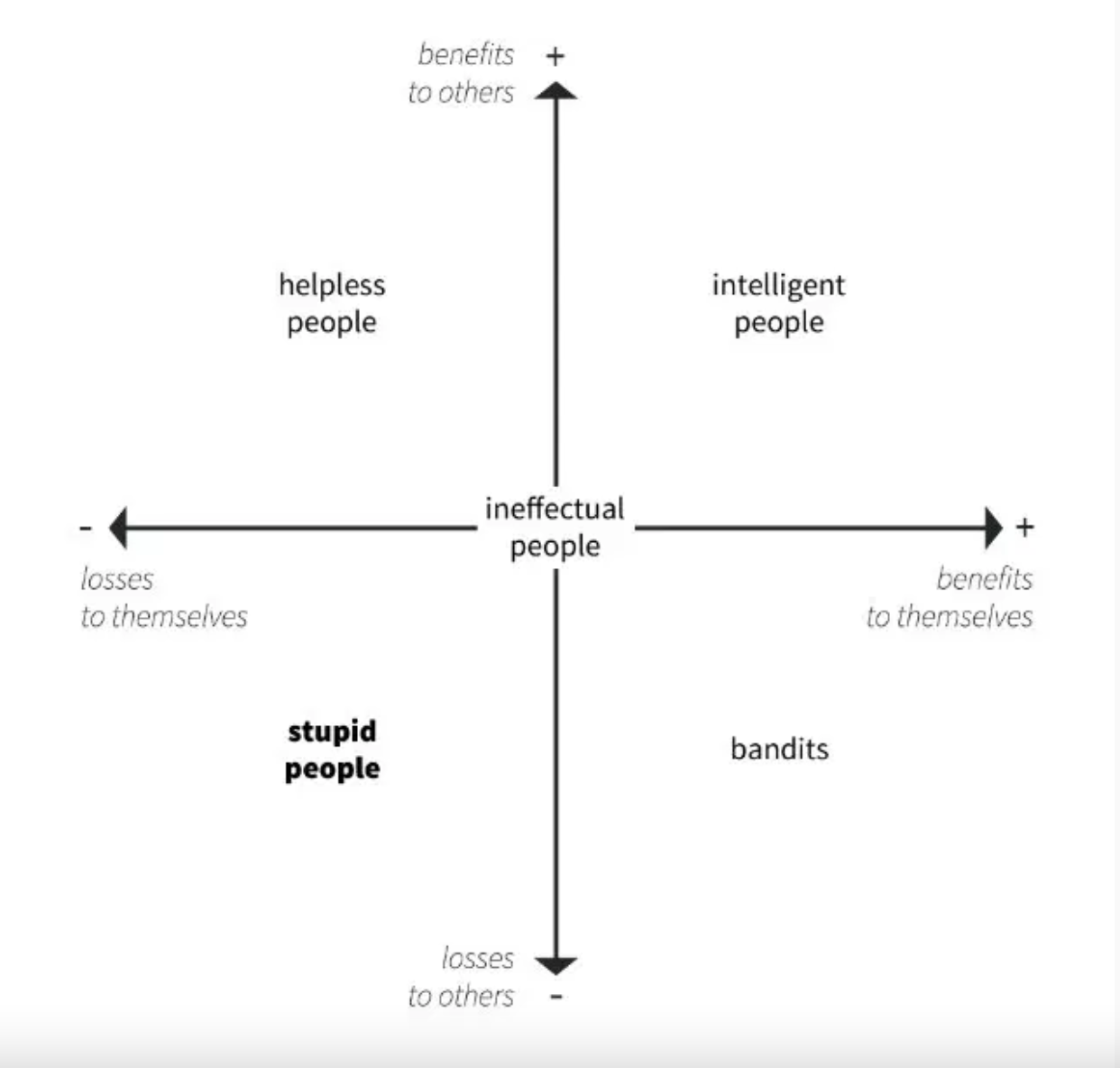
This law also introduces three other phenotypes that Cipolla says co-exist alongside stupidity. First there is the intelligent person, whose actions benefit both himself and others. Then there is the bandit, who benefits himself at others’ expense. And lastly there is the helpless person, whose actions enrich others at his own expense. Cipolla imagined the four types along a graph, like this:

a chart of ineffectual people from helpless people to bandits
Stupidity, graphed


The non-stupid are a flawed and inconsistent bunch. Sometimes we act intelligently, sometimes we are selfish bandits, sometimes we act helplessly and are taken advantage of by others, and sometimes we’re a bit of both. The stupid, in comparison, are paragons of consistency, acting at all times with unyielding idiocy.

However, consistent stupidity is the only consistent thing about the stupid. This is what makes stupid people so dangerous. Cipolla explains:

Essentially stupid people are dangerous and damaging because reasonable people find it difficult to imagine and understand unreasonable behavior. An intelligent person may understand the logic of a bandit. The bandit’s actions follow a pattern of rationality: nasty rationality, if you like, but still rationality. The bandit wants a plus on his account. Since he is not intelligent enough to devise ways of obtaining the plus as well as providing you with a plus, he will produce his plus by causing a minus to appear on your account. All this is bad, but it is rational and if you are rational you can predict it. You can foresee a bandit’s actions, his nasty maneuvres and ugly aspirations and often can build up your defenses.

With a stupid person all this is absolutely impossible as explained by the Third Basic Law. A stupid creature will harass you for no reason, for no advantage, without any plan or scheme and at the most improbable times and places. You have no rational way of telling if and when and how and why the stupid creature attacks. When confronted with a stupid individual you are completely at his mercy.

All of which leads us to:

Law 4: Non-stupid people always underestimate the damaging power of stupid individuals. In particular non-stupid people constantly forget that at all times and places and under any circumstances to deal and/or associate with stupid people always turns out to be a costly mistake.

We underestimate the stupid, and we do so at our own peril. This brings us to the fifth and final law:

Law 5: A stupid person is the most dangerous type of person.

And its corollary:

A stupid person is more dangerous than a bandit.

We can do nothing about the stupid. The difference between societies that collapse under the weight of their stupid citizens and those who transcend them are the makeup of the non-stupid. Those progressing in spite of their stupid possess a high proportion of people acting intelligently, those who counterbalance the stupid’s losses by bringing about gains for themselves and their fellows.

Declining societies have the same percentage of stupid people as successful ones. But they also have high percentages of helpless people and, Cipolla writes, “an alarming proliferation of the bandits with overtones of stupidity.”

“Such change in the composition of the non-stupid population inevitably strengthens the destructive power of the [stupid] fraction and makes decline a certainty,” Cipolla concludes. “And the country goes to Hell.”

https://getpocket.com/explore/item/the-five-universal-laws-of-human-stupidity?utm_source=pocket-newtab

Thursday, June 02, 2022

Gur Perverts - Healthy Normal Conjugal Relationship With Wife, Abnormal Restrictions And With Permission Only From A Madrich - Sexual Abuse of Kids By A Member Of Their Cult --- Go For It and We'll Protect You!


Twisted Haredi leader Litzman departs Knesset as part of plea deal


23-year veteran of parliament and ex-minister for the United Torah Judaism party, quits before court hearing over involvement in Leifer sexual abuse case


UTJ MK Yaakov Litzman arrives for a meeting with leaders of opposition parties at the Likud headquarters in Tel Aviv on May 8, 2022. (Avshalom Sassoni/Flash90)
UTJ MK Yaakov Litzman
 

United Torah Judaism’s Yaakov Litzman, a 23-year veteran of the Knesset and former minister, resigned his seat Wednesday as part of a plea deal over his involvement in the Malka Leifer sexual abuse case.

Litzman’s resignation is tied to his upcoming end-of-June court date, according to his office. The politician must leave Knesset before the hearing, as part of a negotiated plea deal for a single charge of fraud and breach of trust in relation to the Leifer case.

His resignation will become official 48 hours from its Wednesday afternoon submission, though Litzman vowed to “stay in politics” during a final speech on the Knesset floor.

“I am staying for a few things in which I can help,” he said, without elaborating.

Vocal in his distaste for the ruling coalition, Litzman expressed disappointment that he was resigning before being able to vote to dissolve the current Knesset and hold new elections.

“This Knesset is not what’s supposed to be and you all know this,” he told his colleagues in the plenum.

Closing his remarks, Litzman recalled a vote on funding for yeshivas at an unspecified date, saying he could have used his influence to “have gotten anything,” but instead decided to split the pot.

“Prime Minister [Naftali Bennett] and Interior Minister [Ayelet Shaked] need to put very well into their heads how I behaved then and how they’re behaving today,” he said.

The current government has worked to pass measures against and slash funding for issues close to the Haredi community and is currently working on a budget expected to close Haredi politicians’ access to the coalition’s discretionary funds.

His plea bargain, which has come under public criticism as a sweetheart deal that is expected to drop an obstruction of justice charge, eliminates prison time for the lawmaker and includes a nominal fine of NIS 2,800 ($865). It also does not include the designation of moral turpitude, which would have blocked Litzman from Knesset office for seven years.

Leifer, a former principal of a Melbourne Orthodox girls’ school, is charged with sexually assaulting minors. Litzman is accused of using his former position as deputy health minister to block Leifer’s extradition to Australia, which ultimately came to pass in January of last year, 13 years after she fled to Israel to escape investigation.

Elected to the Knesset in 1999, Litzman was the de facto head of the Health Ministry for more than a decade, serving as either deputy or full health minister from 2009 until mid-2020.

Last year, Litzman stepped down as chair of the United Torah Judaism party after 18 years at the helm, with Moshe Gafni taking the lead. Litzman is now the party’s No. 2.

Yaakov Tessler, a member of the Vizhnitz Hasidic stream, is expected to replace Litzman, a member of the Gur faction, once he vacates one of UTJ’s seven Knesset seats.

 https://www.timesofisrael.com/haredi-leader-litzman-departs-knesset-wednesday-as-part-of-plea-deal/?utm_source=The+Daily+Edition&utm_campaign=daily-edition-2022-06-01&utm_medium=email

Wednesday, June 01, 2022

"Mr." Mendlowitz זצוקייל - would be very saddened, grieved, pained, upset & disappointed with this ridiculous proclamation!


Top haredi rabbi grants top title to four others 


Rabbi Gershon Edelstein, last leader of Lithuanian-haredi sector, designates four additional rabbis as community leaders.


Rabbi Gershon Edelstein

Rabbi Gershon Edelstein, a leading Lithuanian-haredi rabbi, is the last in his sector to have been granted the title, "Maran," which signifies a community leader, by the Yated Ne'eman newspaper.

On Monday evening, Rabbi Edelstein decided to grant the title, "Maran," in Yated Ne'eman to four additional rabbis, Kikar Hashabbat reported.

Until today, the title used for HaRav Edelstein was “Rabbeinu Maran Rosh HaYeshiva HaGaon” “Rabban shel kol Bnei HaGolah” (‘רשכבה”ג’). and the other members of the Moetzes Gedolei HaTorah were called by the title only “HaGaon HaGadol”. After the death of HaRav Chaim, z’tl, the Yated staff consulted with HaRav Edelstein about the titles used for the members of the Moetzes. HaRav Edelstein instructed that the title “Maran” should be used for the members of the Moetzes who are over the age of 90, and “HaGaon HaGadol” for those under the age of 90.

Kikar Hashabbat was informed that Rabbi Edelstein decided to grant the title to all the elders of the Degel Hatorah party's Council of Torah Sages who are over age 90.

Under the decision, the ones who will receive the title are Rabbi Baruch Mordechai Ezrachi, Rabbi Baruch Dov Povarsky, Rabbi Dov Landau, and Rabbi Meir Zvi Bergman - all over 90 years of age.


The Maran 3 and one ‘רשכבה”ג  - R' Landau is napping! Someone wake up R' Povarsky to tell him he is now a "Maran" -  getting him a 10% discount at Yankel's Pizza Place!

This is a dramatic and unusual decision, since in the past, no more than one person was named by Yated Ne'eman as, Maran," and now there are a total of five with the title.


https://www.israelnationalnews.com/news/328505?utm_source=activetrail&utm_medium=email&utm_campaign=nl