EVERY SIGNATURE MATTERS - THIS BILL MUST PASS!

EVERY SIGNATURE MATTERS - THIS BILL MUST PASS!
CLICK - GOAL - 100,000 NEW SIGNATURES! 75,000 SIGNATURES HAVE ALREADY BEEN SUBMITTED TO GOVERNOR CUOMO!

EFF Urges Court to Block Dragnet Subpoenas Targeting Online Commenters

EFF Urges Court to Block Dragnet Subpoenas Targeting Online Commenters
CLICK! For the full motion to quash: http://www.eff.org/files/filenode/hersh_v_cohen/UOJ-motiontoquashmemo.pdf

Wednesday, September 14, 2022

Everyone Of The Member Rabbis of These 2 Groups Had A Minimum of a High School Education, Some are College Graduates! (Except Malkiel Kotler).

ALWAYS A DAY LATE AND A DOLLAR SHORT ON EVERY IMPORTANT ISSUE!


Do religious Jews have a right to reject basic secular education?


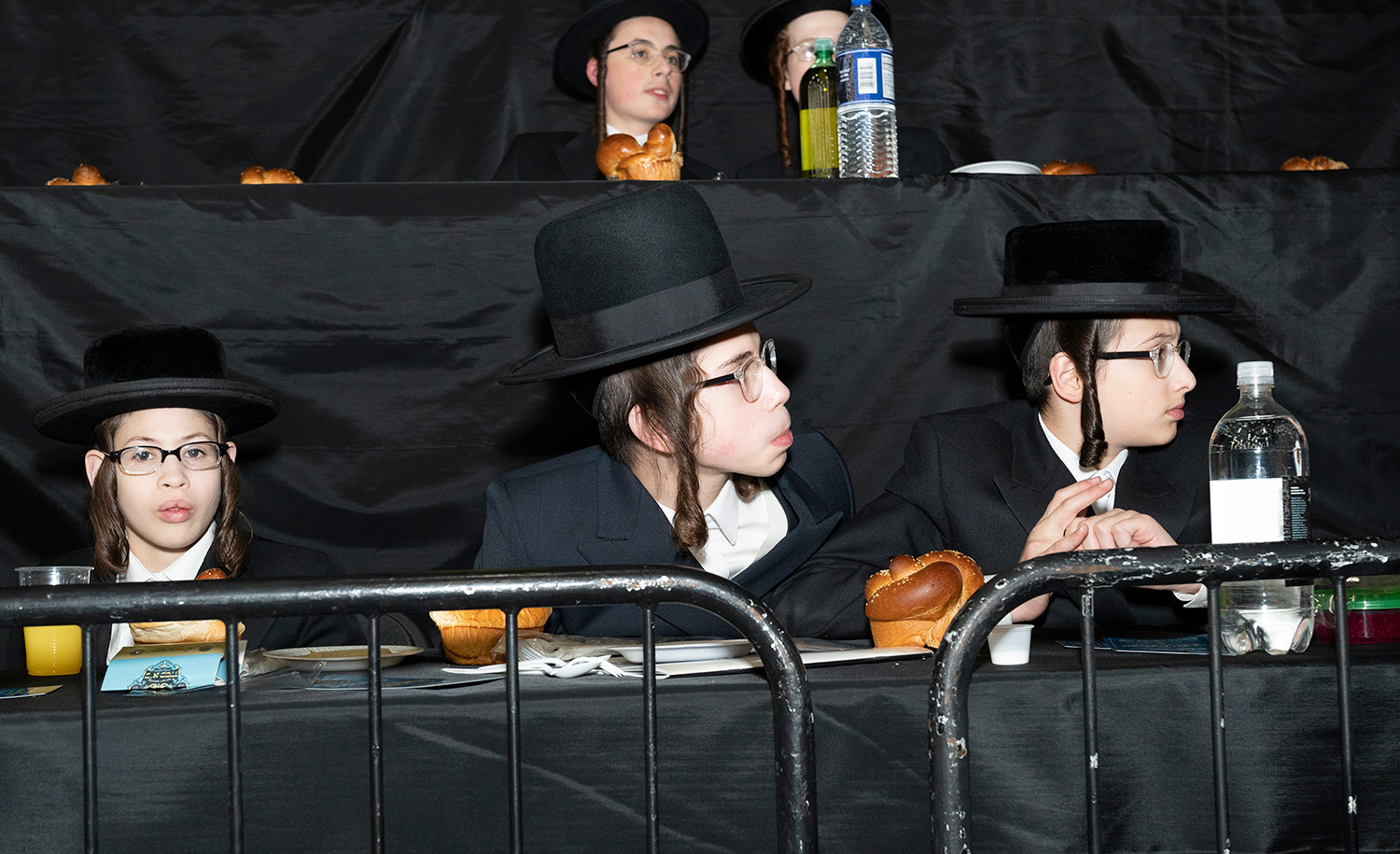
Chassidic communities are entitled to isolate their children from the secular world. Does that mean scrutiny of their schools’ alleged failures by “The New York Times” is anti-Semitic?


After more than a century of biased reporting about Israel, contempt for Zionism, and a lack of interest in reporting about anti-Semitism, readers are right to regard any coverage of the Jewish community by The New York Times with skepticism, if not justified suspicion, of ill intentions. So, after the Times invested a year of the time of two reporters and who knows how many researchers in investigating conditions in schools run by the ultra-Orthodox community and Chassidic sects in the greater New York area, the assumption on the part of many Jews was that the product of this effort would reek of prejudice.

That explains why the reaction from many Jews to the massive front-page feature published on the subject by the Times this past Sunday was intense and angry. They wondered why, in an era when inner-city public schools are notoriously failing their students, the newspaper thought that schools run primarily by Chassidic Jews in Brooklyn and Rockland County were deserving of so much scrutiny. That much of the reporting seemed to be driven by criticisms of these communities by former members who complain that they emerged from these schools lacking basic skills in English or math, as well as with stories about suffering beatings by teachers, also left many Jewish readers thinking that an anti-Orthodox agenda rather than justified concerns were behind the decision to report and publish the piece.

That the Times also took the extraordinary step of publishing the story in Yiddish and included a form response for those with experiences in these schools to send in their thoughts also seemed to indicate that the goal of the project was to disparage the Jewish community. That it came after the last two years when politicians and news outlets unfairly scapegoated the ultra-Orthodox for spreading COVID-19 deepened the hurt. The fact that the Times continues to ignore an epidemic of anti-Semitic attacks on this community from African-American assailants has also created a situation in which nothing the paper is likely to publish on related subjects will be taken as anything other than an attack by many Jews.

But even if all that is true, and the Times’ reporting does betray a cultural bias and condescension on the part of its staff and the overwhelmingly liberal readership of the paper, does that mean any scrutiny of ultra-Orthodox schools is inherently anti-Semitic?

As much as it would be easy to dismiss the story, if test scores and reports from other sources, including from Jews who are deeply worried about the failure of this system to prepare its students for any sort of a productive life other than Torah scholarship—are to be trusted, then there is more here than cultural or religious bias.

The ultra-Orthodox community under scrutiny here has seemed to adopt the same model as their haredi counterparts in Israel, where educational standards in their schools on secular subjects are abysmal. While most of the discussion about the haredim in Israel has focused on their refusal to do their fair share in defending the Jewish state by refusing military service, the fact that their rapidly growing ultra-Orthodox schools are solely focused on religious education while producing people who lack the rudimentary skills to support themselves is an even greater challenge for Israel.

A situation where Torah study is the only respectable profession for haredi men is one that is a recipe for endemic poverty. Nevertheless, the political muscle of Israel’s religious parties has not only guaranteed funding for these schools but also ensured that the state is never going to require that their students are given even minimal adequate instruction in non-religious subjects.

While politics has created a daunting economic challenge that poses huge dilemmas for Israel’s future, it appears a similar situation has unfolded in New York. Observers of New York politics have long understood that the ultra-Orthodox communities vote as blocs with members apparently doing the bidding of their rabbinic leadership in much the same way as in Israel. In this manner, New York politicians like disgraced former Gov. Andrew Cuomo and his successor, Kathy Hochul, have obtained the lockstep support of Chassidic enclaves in exchange for their influence in ensuring that no one looks too closely at what happens in their schools.

The result is that these institutions are turning out students who lack rudimentary skills in English and math. You don’t have to share the contempt for religious Jews that may be widespread in the Times newsroom to be alarmed by the fact that test scores in these subjects at ultra-Orthodox schools for boys (girls, who are expected to get jobs rather than merely study sacred texts, get slightly more instruction and do marginally better) appear to be the lowest in the state. That means that they are worse than those at public schools in New York where poor and minority students are being short-changed by a system that is resistant to change, as well as those at other religious institutions.

As philanthropist Michael Steinhardt wrote last week in the New York Post, the failure of these schools is a Jewish tragedy. That is why he and others have been urging greater state scrutiny of these schools, and forcing them to change to improve their secular education. To that the communities and many of their defenders, such as the editors of the New York Sun, cry foul.

They believe that the issue here isn’t so much poor education as the refusal of the secular state—cheered on by secular Jews—to accept the desire of the ultra-Orthodox community to opt out of society. The point of the education they are giving their children is not, after all, to produce productive members of a secular society—let alone, as is the case with many schools, to prepare children for college — but for religious lives as separate as possible from their non-Jewish neighbors. Their fear of assimilation—and the toll it takes on Jewish and religious identity—is such that in some quarters, there is not only hostility to Internet use and secular subjects but also English as an everyday language. Under those circumstances, it’s little wonder that these schools must be understood as playing a role in the growth of Jewish poverty. But their defenders seem to be taking the position that any interference in their curricula is a denial of their right to religious freedom.

The secular left has been waging war on public religious observance and seeks to marginalize people of faith. The hostility on the part of newspapers like the Times and mainstream liberal Jewish groups, like the American Jewish Committee and the Anti-Defamation League, to recent Supreme Court decisions that defend the rights of religious believers is lamentable. But the attempt to shoehorn this controversy into the broader debate about religious freedom is unpersuasive. Those who want to ensure that ultra-Orthodox schools give students at least the basics of English and math—something that is required by the New York State Constitution—are not attempting to infringe on their right to worship or have schools dedicated to their faith. The haredim are fully entitled to live and worship as they please, and to isolate themselves from the secular world as much as they want. But it is both reasonable and necessary for the state to ensure that their schools do not turn out students that are functionally illiterate in English and unable to do basic math.

Even if we were to dismiss the Times’ focus on the use of corporal punishment at Chassidic schools, which is deeply problematic if true but tangential to the question of their academic failures, as a function of the paper’s bias, it is not anti-Semitic to worry about the role that schools are playing in fomenting poverty. The reality of a population that is not only growing at exponential rates due to large family sizes—something that those who care about the shrinking non-Orthodox population applaud—but also increasingly dependent on state welfare programs paid for by taxpayers, is something that must be addressed.

Nor does anyone need to be caught up, as is the Times, in the drama surrounding defectors from the ultra-Orthodox world. The literary genre of the memoirs of such rebels against religious life is, as scholar Ruth Wisse has discussed, not new. It’s been going on since the late 19th century. One can sympathize with such people or revile them as turncoats who are besmirching their origins, but that has nothing to do with whether Chassidic schools are fulfilling their obligations to provide a minimal decent secular education along with their focus on Judaism.

As some point out, institutions that produce students capable of understanding and studying the Talmud and other sacred texts are learning advanced reasoning skills that are often missing elsewhere. Yet as even a defender of these schools, like Mosaic columnist Eli Spitzer notes, it is something of a fairy tale to pretend that such instruction is a substitute for teaching Jewish children the basic English and math they need to survive outside of a yeshivah or kollel. These schools should neither be demonized nor idealized; however, the idea that any outside scrutiny is an attack on Judaism is not an argument that can be reasonably defended.

As much as it can be a mistake to generalize about conditions in these schools and as much as the Times’ motives are suspect, the willingness of many Jews to reflexively circle the wagons around them and to defend the resistance of the ultra-Orthodox leadership to even minimal scrutiny or accountability for their failures in secular subjects is not merely a mistake. It’s consigning a large and important part of the Jewish community to a future of poverty that would be indefensible if we were describing any other group.

https://www.jns.org/opinion/do-religious-jews-have-a-right-to-reject-basic-secular-education/?utm_source=The+Daily+Syndicate&utm_campaign=41d9853d55-Daily+Syndicate+09-11-22+%28copy+2%29_COPY_01&utm_medium=email&utm_term=0_8583953730-41d9853d55-%5BLIST_EMAIL_ID%5D&ct=t%28Daily+Syndicate+09-11-22+%28copy+2%29_COPY_01%29

Jonathan S. Tobin is editor-in-chief of JNS (Jewish News Syndicate). Follow him on Twitter at: @jonathans_tobin.

Tuesday, September 13, 2022

“It is entirely possible for yeshivas to offer enriching English, math, and science education at the same time as a strong grounding in religious texts and Jewish tradition – indeed, many do. I know it personally, because many of my friends and colleagues are smart, well-educated yeshiva graduates".


Statement from Comptroller Lander on Board of Regents Vote on Academic Standards at Private Schools Receiving Public Funds


September 13, 2022
 

New York, NY – New York City Comptroller Brad Lander issued the following statement on today’s New York State Board of Regents vote to establish new regulations for holding private and parochial schools to substantially equivalent academic standards. The vote comes on the heels of The New York Times story outlining a lack of oversight of private Hasidic Jewish schools that fail to provide a basic secular education.“Every single New York City child is owed a solid education that prepares them to thrive – yet as The New York Times report this week made starkly clear, too many yeshivas are failing that essential task. That so many young people have been denied the necessary skills they need to succeed in the higher educational opportunities, jobs, and diverse cultural and civic life of our city is a tragedy. That some of them may have been subjected to physical abuse is a shande.“It is entirely possible for yeshivas to offer enriching English, math, and science education at the same time as a strong grounding in religious texts and Jewish tradition – indeed, many do. I know it personally, because many of my friends and colleagues are smart, well-educated yeshiva graduates.“It’s also true that too many of our public schools fail to provide the enriching education that every one of our students deserve. The answer, of course, is to do all we can to demand accountability from all our schools – not to use the shortcomings of some to excuse those of others.“Like all other private and public schools in New York State, yeshivas receive public funding to help meet the needs of and their obligations to their students. The government has an oversight responsibility to ensure those public dollars are spent as intended. Unfortunately, in recent years both the City and State have failed to hold yeshivas to appropriate educational standards. It is time for that to change. “Today, the Board of Regents adopted regulations clarifying the City’s oversight responsibilities to ensure that private and parochial schools offer a substantially equivalent basic education. As Comptroller, I’ll work to make sure we meet them.”


https://comptroller.nyc.gov/newsroom/statement-from-comptroller-lander-on-board-of-regents-vote-on-academic-standards-at-private-schools-receiving-public-funds/

The purpose of the ḥasidic education system, beginning at age three and ending with marriage, is, quite simply, cultivating Ḥasidim. Lessons in the Pentateuch or Talmud are not primarily, often not at all, about developing academic skills—they are about molding a particular type of religious personality, one that will be comfortable in, satisfied by, and loyal to the ḥasidic community and way of life.


New York State vs. the (Hasidic) Yeshivas


Those who defend ḥasidic yeshivas against increasing state regulation have conjured up an unrecognizable fairy-tale world. 

 But the arguments of the state’s defenders are even worse.

In recent years, New York State has become the scene of an increasingly fierce battle over the provision of secular education in ḥasidic boys’ schools (yeshivas), a battle that brings to the surface many of the latent contradictions in liberal society. These contradictions, because of the ḥasidic community’s relentless growth, will soon enough have to be arbitrated one way or another both in New York and wherever else ḥasidic Jews can be found.

While there had been rumblings for decades about the quality of the secular education that ḥasidic yeshivas offer their students, the issue became one of state-wide political concern in New York after the founding of an advocacy group, Young Advocates for Fair Education (YAFFED), in 2011. The leaders of this organization—young Jewish men and women who had grown up in the ḥasidic community and made the decision to leave—alleged that they had been personally failed by an education that left them ill-equipped to pursue careers of their choice, and that many yeshivas were in flagrant breach of New York State laws requiring education provided by private schools to be “substantially equivalent” to that offered in the public-education system.

YAFFED successfully lobbied the New York State Education Department (NYSED) to change its laissez-faire policy and enforce rules that would require yeshivas to teach the full secular curriculum—which includes social studies and computer skills as well as English, math, and science—or face legal sanctions. The ḥasidic community has responded in two ways: by challenging the sanctions in the state senate, and by filing legal challenges alleging that the state’s behavior infringes on its First- and Fourteenth- Amendment rights. In so doing it has successfully leveraged a coalition of Jewish and non-Jewish religious schools for whom the proposed regulations pose no direct threat but who are concerned about potential long-term ramifications for the independence of religious schools. Most legal experts concur that these constitutional challenges to state regulation of ḥasidic education will ultimately prove unsuccessful, but the wheels of justice grind slowly and the community is counting on a mayoral or gubernatorial candidate looking for the support of the ḥasidic bloc to save the day before that happens.

Legal arguments that turn on the precise significance of a comma in the Bill of Rights will, of course, not be of much relevance when the same issues rear their head in other countries where the ḥasidic community is growing—especially since few countries define religious liberty so broadly as does the U.S. More importantly, both parties have framed their cases in legal language that obscures and distorts the genuine ethical and philosophical issues involved. Much of what has been said on both sides to date is spurious, and even where it isn’t, it fails to cut to the heart of the issue. Since that issue turns out to be a crucial matter of religion and state, it behooves us to try to see clearly what’s going on.

Let us start with arguments made by those who defend the yeshivas—advocates who have conjured up a fairy-tale world that I, as a graduate of the ḥasidic school system, barely recognize. These defenders argue that ḥasidic schools are so dedicated to talmudic and biblical learning that they simply have no time available to teach secular subjects. The reality at elementary and middle school is much different: many hours are spent singing songs, listening to stories, and repeating material that has already been learned. In high school, meanwhile, most of the day is devoted to unstructured learning. This, for many students, consists primarily of socializing while absorbing a tiny amount of material. The system, which eschews academic selection and testing, is the polar opposite of one designed to churn out elite talmudic scholars, and, unsurprisingly, it doesn’t. (Precisely what it is for will become clear in due course.) Indeed, it is well known, within the ḥaredi world at least, that graduates of non-ḥasidic ḥaredi yeshivas—those in New York make up something like a third of the total and have a strong secular-studies program—typically emerge with greater proficiency in Talmud than their ḥasidic counterparts.

Even more strained than the fantasies of impossibly busy students are claims that the yeshivas’ religious curriculum is so sophisticated that it achieves the goal of “substantial equivalency” by accomplishing everything the public system is designed to deliver. Plainly, yeshiva education does something that public-school education doesn’t: namely, providing students with the vocabulary, concepts, and background knowledge they need to study a page of Talmud. Claiming that on top of this it also fulfills the learning goals of the New York State curriculum really amounts to a claim that yeshiva education is superior to the mainstream version and has discovered an almost magical ability to level up the human brain. It’s an extraordinary claim, and extraordinary claims require extraordinary evidence, none of which is forthcoming. Yeshiva advocates point to the many ḥasidic Jews who are successful in business, or those who received a ḥasidic education and subsequently went on to distinguished academic achievements. The first only demonstrates that which is already widely known, namely that formal education is not necessary in many spheres of business. The second is not evidence of the power of ḥasidic education, but, rather, that overcoming educational deficits is easier and more common than often assumed. A Jew who grows up secular and chooses to become Orthodox will, if he is sufficiently intelligent and diligent, learn to read Hebrew and understand Talmud in one to two years. However, no one would take that as evidence that the public-school system is “substantially equivalent” to an Orthodox Jewish education.

Finally, yeshiva advocates argue that secular education in ḥasidic schools is not really that bad. Making this argument invariably involves blurring the boundaries of the discussion by including a wide range of non-ḥasidic ḥaredi schools that offer relatively good secular education, thus taking advantage of the fact that most outside observers find it hard to distinguish between one variety of black hat and another. The reality is that, with a few exceptions, most ḥasidic schools offer something like 90 minutes a day of secular studies to students ages six to twelve, the quality of which varies widely, but is mostly well below average; and these pupils then go on to high schools that provide no secular studies at all. I can tell you, as someone who attended mainstream ḥasidic schools, that by the age of fifteen I had forgotten almost entirely the smatterings of English and mathematics I had learned in elementary school and had to start again from scratch.

All this makes yeshiva advocates look pretty bad, but it turns out that the leading advocates for improved secular education offer up even poorer arguments. I have dedicated my career to ensuring that ḥasidic boys get better secular educations than I did, and was initially sympathetic to YAFFED’s arguments. In time, however, I realized that, as a result of relying on a shallow understanding of ḥasidic education and culture, the would-be reformers have maneuvered themselves into a foolhardy insistence on untenable claims.

First, YAFFED consistently tries to link the high rates of welfare dependency among Ḥasidim to poor education. But the relationship between educational deficits and reliance on the welfare system is much less direct than YAFFED asserts. Welfare dependency within the community is primarily the product of an expensive lifestyle caused by large family sizes, high property prices, private-school fees, wedding after wedding, and the cost of more than 60 Shabbat and Yom Tov meals a year (the equivalent of having Thanksgiving at least once a week)—all of which make welfare a rational economic choice for many people. I am personally concerned about the reliance of the ḥasidic community on welfare, and the kind of attitudes it fosters. But comparisons with non-ḥasidic ḥaredi communities, where welfare dependency is also common despite standards of secular education being better, do not indicate that education is the chief source of the problem or its solution.

Second, YAFFED has argued that the meager secular studies on offer in ḥasidic schools prevent young adults from pursuing college degrees, as if this were an unintended consequence of educational neglect in childhood. In reality, preventing college is the point. Ḥasidic parents are absolutely opposed to their eighteen-year-old sons or daughters attending college for the entirely rational reason that college consists of a complete immersion in a culture antithetical to Ḥasidism at the most formative stage of a person’s life. Other conservative subcultures within the United States have been doomed, more than anything else, by sending off their best and brightest to institutions that teach them to reject their upbringing as a condition of attaining the piece of paper that provides access to the socioeconomic elite. It is certainly true that having shaky English and math makes it an easier decision for young Shloime to continue with his talmudic education rather than majoring in gender studies at Yale. However, even if standards of secular studies in ḥasidic schools soared, ḥasidic parents would remain implacably opposed to their children pursuing degrees, at least until they are firmly anchored in the community through marriage and having children.

The most fundamental flaw, however, in YAFFED’s argument, is its failure—or inability—to acknowledge what ḥasidic education is and what it is for. Ultimately, the organization denies the existence of any kind of education at all outside the normative liberal form it advocates. Amid the frequent references in its reports to “educational neglect” and “denial of a basic education,” YAFFED ignores the matter of what ḥasidic children are doing for the nine or more hours a day they spend in school. Its flagship 2017 report limply claims that “boys . . . are expected to aspire to become rabbis” as an explanation of the curriculum. To understand the issue properly, we must move beyond such trite and specious answers and turn to a more essential question: what education—ḥasidic education and any education—actually is.

The purpose of the ḥasidic education system, beginning at age three and ending with marriage, is, quite simply, cultivating Ḥasidim. Lessons in the Pentateuch or Talmud are not primarily, often not at all, about developing academic skills—they are about molding a particular type of religious personality, one that will be comfortable in, satisfied by, and loyal to the ḥasidic community and way of life. The American sociologist Samuel Heilman, no friend to Ḥasidim but one of their most acute observers, describes lessons in ḥasidic schools as “far more than a literary foray into a text; . . . they were pretexts for passing along values, tools for deflecting heresies, and . . . means for helping give substance to what it means to be a Jew in the world they inhabited.”

This is the kind of definition that is calculated to offend liberal sensibilities: how can education, which is all about expanding boundaries, be about directing children towards a particular way of life? But this is what education has always been. The first known advocate of compulsory schooling, Plato, certainly did not think it was about imparting career skills. To him it was about developing the raw material of the human mind so that it became fit for citizenship in the perfected Greek polis. The spread of education in the Western world following the collapse of the Roman empire was everywhere connected with spreading and promoting Christianity. It took off following the Reformation, when reading the Bible, and hence literacy, was elevated to a basic religious duty of the ordinary believer. In the age of nationalism, education systems were designed to inculcate national identity and culture in what had previously been loosely bound, linguistically and culturally diverse areas.

Superficially, it looks like the liberal ideal of education as a way of promoting choice and individual autonomy is an exception to this principle. But this is only because choice and individual autonomy are the core cultural features of modern liberal society. No less than any other, the American public-school system has as its purpose the absorption of young human beings into a particular, historically contingent cultural and socioeconomic system. The endless controversies about American education are really controversies about what it means to be a good American. And so, the generic purpose of the tens of thousands of hours spent learning things that not one person in a hundred will ever use in pursuit of gainful employment is the same: cultivating the right type of American.

The extent to which academic education in the 21st-century liberal state can deliver on its own objective of social mobility is dubious. As the political philosopher Rita Koganzon powerfully puts it, liberalism “has valorized a kind of education that only a small elite can well afford—not simply financially but more important, psychically—because it is designed to weaken, in the name of autonomy, the sorts of commitments—to family, religion, and place—that anchor life for the vast majority of citizens.” Every single American can and should, under the liberal theory of education, grow up to be a highly skilled professional, untethered from parochial commitments and loyalties, while imported helots do all the grunt work. But it doesn’t quite work out that way in practice. The ḥasidic education system, by contrast, is markedly successful in achieving its goal of cultivating and retaining Ḥasidim. Ḥasidic Judaism today is a postmodern movement that has selected and adapted elements of East European Judaism to create a model that can withstand the forces that have—generally without direct coercion—ravaged every pre-modern form of social organization, the Amish excluded. And the lynchpin of that ḥasidic success is its school system.

What the dispute about ḥasidic yeshivas is really about, then, is something much more critical than instruction in secular studies. It’s about whether the liberal state is willing to let a countercultural social movement that bends the rules of the liberal order grow up in its midst. From the perspective of the state, and those loyal to it, there are reasonable grounds to prevent that. What is not reasonable, however, is the sort of liberal triumphalism that imagines that, under the pretext of implementing minor or neutral reforms, Ḥasidim will simply be intimidated into dismantling their own social order. Those among YAFFED’s supporters who understand what is at stake and want to disable the ḥasidic community’s ability to ensure generational continuity should do them the credit of not imagining it will be so easy.

In the meantime, those who have the more modest goal of promoting better secular studies in the ḥasidic education system would be well advised to return to first principles and remember the distinction between education—the molding of an individual—and instruction—the imparting of specific skills. If they wish to get the majority of ḥasidic parents on board, then their most urgent priority is to demonstrate how specific forms of instruction can be introduced into ḥasidic schools without imperiling its overall educational purpose. In my own experience as a headmaster trying to do exactly this, I have found the task both easier and harder than you might think. Many seemingly impossible obstacles can be overcome when your goals are clear and defined, and many seemingly innocuous reforms actually have a destabilizing effect that ripples throughout the whole system.

Many features of a ḥasidic school seem pointless or bizarre to those who have not thought deeply about how they fit together, but it is precisely for that reason that reformers—assuming they want to succeed—must tread carefully. As G.K. Chesterton warned in his famous fence parable, you cannot fix what you do not first understand. 

The instinctive attitude of ordinary ḥasidic parents who would like better, more engaging, and successful secular studies for their sons, but who fear any tampering with the existing system, is wholly reasonable. Improving standards of secular education can be done only by those who have demonstrated their ability to tinker with the edifice of hasidic education without bringing the walls tumbling down. As for those who want those walls to fall so that poor, oppressed ḥasidic children can taste the pleasure of liberal autonomy—well, as we say in Yiddish, zol zayn mit mazel.


https://mosaicmagazine.com/observation/politics-current-affairs/2021/10/new-york-state-vs-the-yeshivas/?utm_source=Klaviyo&utm_medium=campaign&_kx=ayiklDSRLg4Hn-hHeSePGvfrcdXwGgISugwuAr3enVacORpjmVuv3tYH_4O1edfO.L87CGh

Monday, September 12, 2022

Rav Shraga Feivel believed this type of yeshiva was necessary in order to save Yiddishkeit in America and produce true bnei Torah. But was it permissible, was it Torahdig, to create a mesivta with a full range of secular studies according to this model?


Rav Shraga Feivel ztvk"l at his beloved Bais Medrash Elyon

 The idea of post-elementary Torah education might have been
new in America, but the
idea of a mesivta that would offer
also a full range of
secular studies was unheard of in the hallowed yeshivos of Eastern Europe.

 Rav Shraga Feivel believed this type of
yeshiva was necessary in order to save Yiddishkeit in America

and produce true bnei Torah. But was it permissible, was
it
Torahdig
, to create a mesivta according to this model?


Rav Shraga Feivel would not rely on his own thinking
for such
a monumental decision. Instead, he wrote to four
of the leading
gedolim of that time: Rav Chaim Ozer
Grodzensky of Vilna,
Rav Boruch Ber Leibowitz of Kamenitz, Rabbi
Yosef Rosen, the Rogatchover Gaon of Dvinsk,

and Rav Elchonon
Wasserman of Baranovitch.

Three out of the four responded that it was
difficult to issue a definitive ruling without being

in America to fully grasp the situation there. 

However, citing the urgent need for post-elementary Torah education as well as American laws that made secular education compulsory,they felt Mesivta Torah Vodaath should include secular studies in its curriculum.


Rav Shraga Feivel then presented his idea for a mesivta
to the
yeshiva’s board of directors. He was met
with stiff opposition.
It was difficult enough to finance an
elementary school, most
of them argued. To take on the
additional burden of a mesivta
that would be staffed with
both rebbeim and secular studies
teachers was unimaginable.

https://d1a8dioxuajlzs.cloudfront.net/accounts/7222/original/RavShragaFeivel.pdf?1628623851

Sunday, September 11, 2022

The investigation found that in a state-level test of math and reading within a Satmar Hasidic school, 100% of students failed the tests. A Cessspool of Ignorance From Top to Bottom!


New York Times publishes Hasidic school investigation in Yiddish, too


Likely the 1st time newspaper has published in Yiddish; article addresses major deficiencies in Hasidic education system that leave students unprepared for life in the US


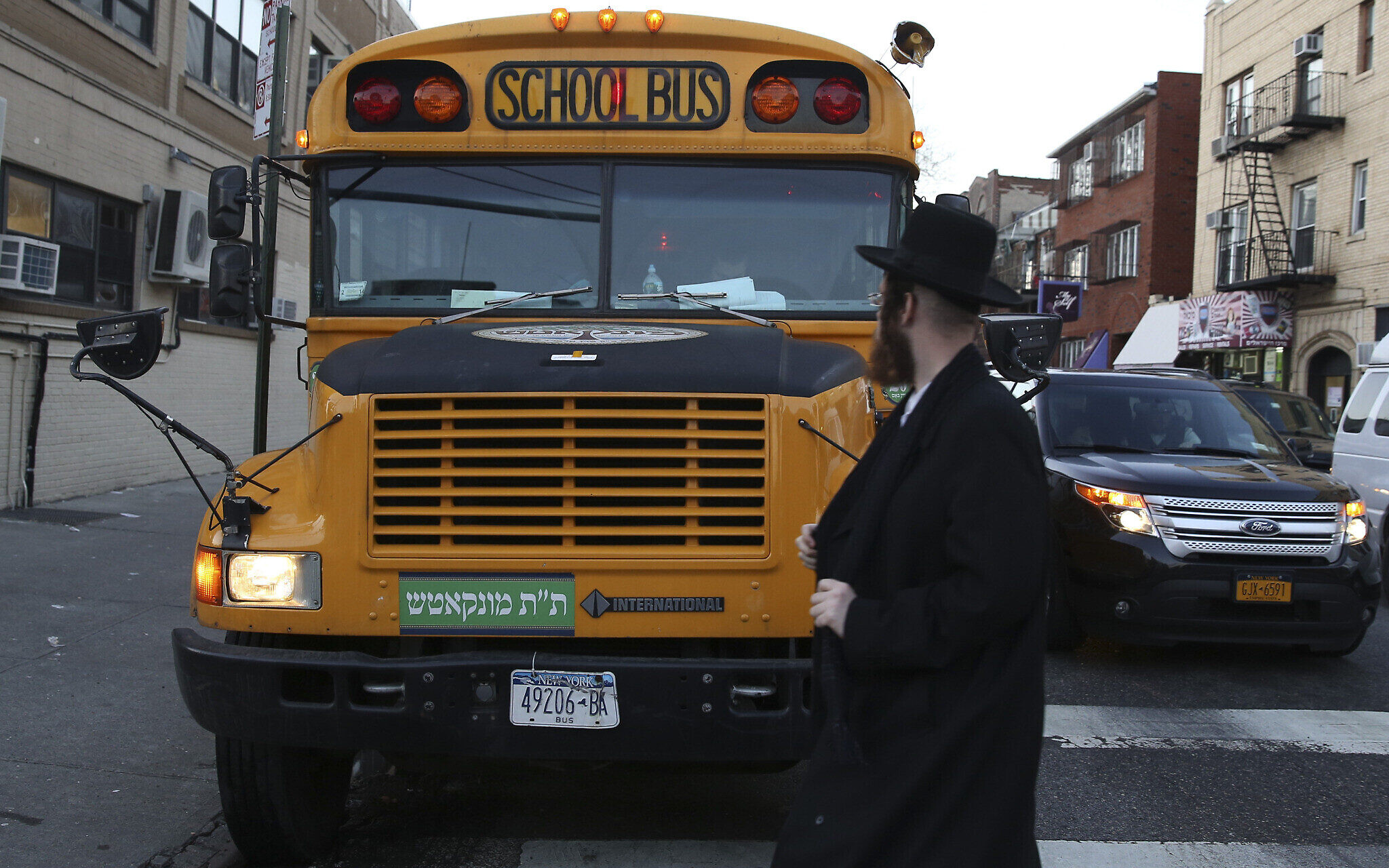
Illustrative -- A man walks by school bus with Yiddish sign in Borough Park, Brooklyn, New York City on January 1, 2014 (Nati Shohat/Flash 90)

In what is likely a first, The New York on Sunday published its investigation into the Hasidic school system in Yiddish as well as English.

The article, which features a probe into education standards within New York’s Hasidic Jewish community, was published in both Yiddish and English, most likely to allow the targeted community to access the findings of the investigation.

The population of Hasidim in New York is about 200,000, representing 10% of the state’s total Jewish population, the New York Times said.

Much of the community operates in Yiddish, the dominant language among pre-Holocaust European Jewry.

The newspaper has published stories in the past in languages other than English, but Sunday’s story appeared to be the first time it has published in Yiddish.

The investigation found that in a state-level test of math and reading within a Satmar Hasidic school, 100% of students failed the tests.


The newspaper’s investigation found that “generations of children have been systematically denied a basic education, trapping many of them in a cycle of joblessness and dependency” in the Hasidic communities.

“The schools turn out thousands of students each year who are unprepared to navigate the outside world, helping to push poverty rates in Hasidic neighborhoods to some of the highest in New York,” the report said.

Despite failing to live up to New York state education standards, The New York Times found that Hasidic schools in the city have received more than $1 billion in state funding over the past four years.

Hasidic community leaders say that their community receives far less public funding for education than their state school counterparts.

The article is available online without a paywall. However, many in Hasidic communities do not have any access to the internet or secular content.


https://www.nytimes.com/2022/09/11/nyregion/hasidic-yeshivas-schools-new-york.html?fbclid=IwAR3yr2_Vm35haB5WV-iVpDol48yNil0DpTqK-f3BUBlhXsRUoX2DbW1fKvk

https://www.timesofisrael.com/new-york-times-publishes-hasidic-school-investigation-in-yiddish-too/?utm_source=The+Daily+Edition&utm_campaign=daily-edition-2022-09-11&utm_medium=email

Friday, September 09, 2022

"We don't know exactly how it happened, but the baby is suffering from an almost complete amputation of his genitals," Asadi told N12. "This is a shocking case and the injury is very serious."


יענקל המוהל עיניים צולבות

Israeli baby requires complex surgery after circumcision gone wrong


The baby required long and complex surgery performed by three surgeons to treat the circumcision damage, but it is unclear if it was successful.


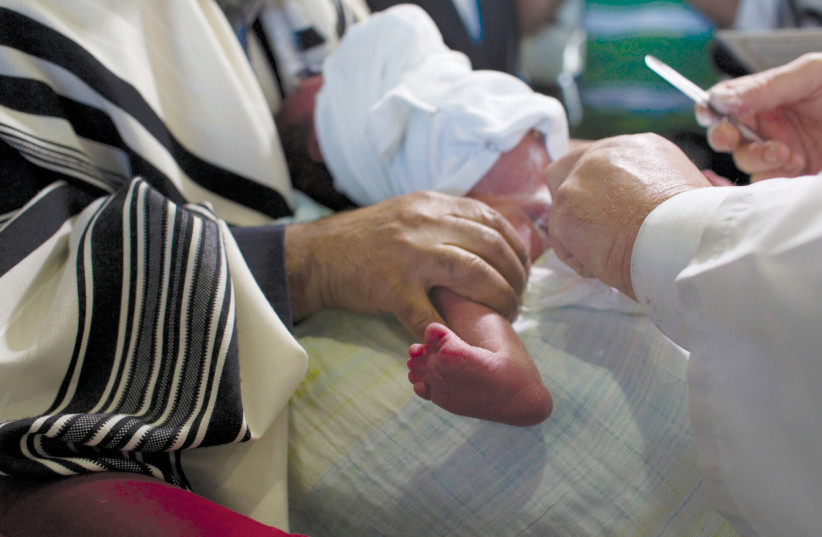
A ‘MOHEL’ holds a scalpel as he performs a circumcision (photo credit: RONEN ZVULUN/REUTERS)
A ‘MOHEL’ holds a scalpel as he performs a circumcision

A baby was rushed to the hospital in northern Israel on Monday after his circumcision went wrong, with his genitals being almost completely amputated during a brit mila - a Jewish ritual circumcision, Israeli media reported. The mohel was late found to be uncertified and did not undergo required training.

 The treatment required three surgeons to perform a long and incredibly complicated operation. 

According to Dr. Akram Asadi, he had never seen such a severe injury due to circumcision in his 20 years as a surgeon.

"We don't know exactly how it happened, but the baby is suffering from an almost complete amputation of his genitals. This is a shocking case and the injury is very serious."

Dr. Akam Asadi, Rambam Health Care Campus

"We don't know exactly how it happened, but the baby is suffering from an almost complete amputation of his genitals," Asadi told N12. "This is a shocking case and the injury is very serious."

Despite this, the injury wasn't life-threatening and the baby is in stable condition.


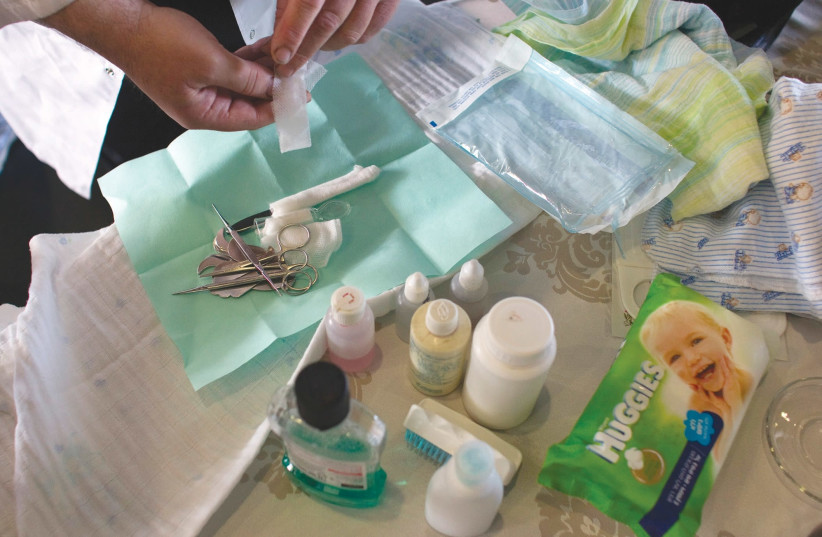
A man prepares the items needed for a circumcision. (credit: REUTERS)

This has long been a traditional practice that differentiated Jews from other peoples throughout history. 

According to Ynet, the mohel in this case was uncertified, and is being investigated by a Chief Rabbinate and Health Ministry inter-office committee, which is responsible for supervising and certifying mohels.

Israeli media reported that the baby's family knew this mohel, who also circumcised their eldest son. But these accidents can still occur, especially if the mohel wasn't well-trained.

"Circumcision is a surgical operation that requires skill and training," Asadi told N12. "Unfortunately, we come across cases where it is clear that there was negligence in the mohel's training. Anyone who performs circumcision must undergo full training and fully understand anatomy."

The committee reminded parents to only use certified mohels for circumcisions.


https://www.jpost.com/breaking-news/article-716445?_ga=2.120995848.1444973890.1662550695-1163418029.1645806768&utm_source=ActiveCampaign&utm_medium=email&utm_content=WATCH%3A+Ancient+Hebrew+letter+from+First+Temple+period+returned+to+Israel&utm_campaign=September+7%2C+2022&vgo_ee=Jn367jKILnpErXAAhCpdDovy7T5YEJ8ohjC9vauJg30%3D

Thursday, September 08, 2022

"They knowingly put hundreds of kids in potential danger" - A Jewish day school in New York secretly continued to employ a staff member whose resignation it had previously announced in the fallout of a child sex abuse scandal that rocked the community a year ago.


New York Jewish school secretly kept on staffer who ‘resigned’ over abuse scandal


Schechter principal, deputy directed creation of a corporation to keep paying student life director Mike Hirsch, who had also been written up for inappropriately touching students


The Schechter School of Long Island's building in Williston Park, New York. (Schechter LI/Facebook)
The Schechter School of Long Island's building in Williston Park, New York


A Jewish day school in New York secretly continued to employ a staff member whose resignation it had previously announced in the fallout of a child sex abuse scandal that rocked the community a year ago.

The secret employment of the Schechter School of Long Island’s director of student life Mike Hirsch was orchestrated by SSLI’s head of school Scott Sokol and associate head of school Ofra Hiltzik, one current and two former employees of the school confirmed to The Times of Israel.

The board of trustees at SSLI — which serves roughly 250 students between kindergarten and 12th grade and is part of the Conservative movement’s Schechter Day School Network — was made aware of Sokol and Hiltzik’s actions earlier this summer but has allowed both of them to remain in their positions, the three staffers said last month.

The revelation regarding the secret employment of Hirsch shows the extraordinary lengths to which SSLI’s senior leadership was willing to go in order to protect the problematic employee.

Hirsch allegedly failed to report repeated allegations of abuse made against a senior USY staffer that took place more than 15 years ago when Hirsch was a counselor for the Conservative denomination’s United Synagogue Youth (USY) movement.

Furthermore, Hirsch has himself been written up in his SSLI personnel file for inappropriate touching and behavior with male students.

Suspension, ‘resignation,’ employment

Hirsch, 43, was employed at both SSLI and USY when The Times of Israel published an exposé in August 2021 about decades-long abuse in the latter institution. A former USY member said he confided in Hirsch that another senior staff member in his mid-30s had masturbated in front of him in the bathroom and urged him to join when he was 15 years old. The former USY member said Hirsch urged him to continue relaying incidents of sexual misconduct by the senior staffer, which the teenager did, but that Hirsch never reported these incidents to his employers.

After The Times of Israel’s exposé was published, Hirsch was immediately suspended from both workplaces for allegedly not reporting the sexual abuse accusations.

A spokesperson for USY said Hirsch’s employment was terminated in December 2021 and that he had been barred from participating in any events of the youth movement, where he had most recently served as engagement associate. The Times of Israel spoke with two sources familiar with the matter who confirmed this to be the case.

SSLI, whose students returned to classes on Tuesday for the new school year, handled Hirsch’s case very differently.

Last October, SSLI head Sokol sent out an email to parents informing them that Hirsch had decided to resign from his position at the school, without elaborating on the reasons. He and Hiltzik then called in the school’s business staff and informed them that Hirsch would actually continue working but only during evenings and weekends when most people would not be in the building, two former staff members said. While several individuals in the room voiced their objection, the more senior Sokol and Hiltzik responded that the matter wasn’t up for debate.

Paychecks obtained by The Times of Israel showed that SSLI continued to pay Hirsch until the end of 2021, at which point a new corporate entity titled Hebrew Learning Services Inc was registered and replaced Hirsch’s name on paychecks. The address listed for Hebrew Learning Services is the same as Hirsch’s private residence and the salary remained roughly the same in 2021 and 2022.

Hirsch maintained administrative access to the school’s online portal and was tasked with sending out notices about births, weddings and deaths. He also handled the issuing of security ID cards to get into the building, the three staffers said, adding that Hirsch worked at a desk right next to Hiltzik’s and Sokol’s.

On several occasions, Hirsch was spotted by parents who approached Sokol or Hiltzik, asking what he was doing there. They were assured that Hirsch was just stopping by and that he was not still employed by the school, the former staff members said.

Alumni threaten legal action

The payments to Hirsch continued until July 2022, the three current and former staffers told The Times of Israel, at which point, a group of recent alumni sent an anonymous letter to select administrators, teachers, parents and donors describing and protesting the ongoing, secret employment of Hirsch.

The writers, who identified themselves only as “former USY youth members and victims,” demanded that Sokol resign within two weeks, threatening to go public with their allegations and evidence in addition to pursuing legal action against the school. As of this writing, they have yet to act on their ultimatum.

The board of trustees conducted an investigation into the allegations against Sokol and Hiltzik and received testimony from at least one employee who confirmed that Hirsch’s continued employment was Sokol and Hiltzik’s idea, the current and former staffers said. The head of school and his deputy both denied the allegations that they conspired to keep Hirsch on staff and have been allowed to remain in their posts.

Asked why Sokol and Hiltzik went to such lengths to help Hirsch, the former employees who spoke with The Times of Israel said Hiltzik had long treated Hirsch “like a son” while Sokol and Hirsch had been friends for decades, even before they began working together at SSLI.

Schechter School of Long Island’s head of school Scott Sokol speaks to prospective students on November 18, 2018. (Screen capture/YouTube)

These relationships helped Hirsch keep his SSLI job even though he was written up on at least three occasions for inappropriate touching and behavior with male students over the past several years, according to two former employees who reviewed his personnel file. One of the incidents took place in the student lounge, which Hirsch was tasked with running until his suspension.

Speaking on condition of anonymity, one former USY member with direct knowledge of the matter said Hirsch had acted sexually inappropriately with underage boys when he was a USY staffer.

“Bottom line is that Sokol and Hiltzik knew [about] Mike… and kept him working in the school for over a year, putting hundreds of kids in potential danger,” said one former SSLI employee.

The Times of Israel reached out to Sokol last month seeking his response to the allegations in the anonymous letter. Two days later, a lawyer from the Ruskin Moscou Faltischek law firm representing the school replied, “Mr. Hirsch is no longer in the employ of the school. We do not respond publicly to anonymous complaints.”

Later that day, Sokol emailed staff members “remind[ing them] that under no circumstances should anyone be giving any type of statements to members of the press regarding school or staffing situations.” Two sources said that individual employees had their jobs threatened if they made contact with the media.

‘Ongoing’ investigation

The Times of Israel reached out again last week to Sokol, Hiltzik and SSLI board chairman Jeffrey Shlefstein, presenting additional evidence of Hirsch’s continued employment and offering another opportunity to comment prior to publication of this article.


Shlefstein responded, “The allegations you refer to are not new to us. We took them seriously when they came to our attention, and they were investigated at our request by outside counsel before your inquiry was undertaken. That inquiry is ongoing and, as a result, our ability to comment is limited.

“Please know that following an investigation by outside counsel, Mr. Hirsch was suspended and he ultimately resigned,” Shlefstein said, seemingly denying the allegation that Hirsch continued working at SSLI after the October 2021 resignation announced by Sokol.

However, the school continued to send paychecks written out to Hirsch — and obtained by The Times of Israel — for two months after the resignation announcement. They included reimbursements for equipment and office supplies that Hirsch had purchased.

Asked to clarify the apparent discrepancy between Shlefstein’s characterization of the outside counsel’s investigation as “ongoing” and his subsequent explanation that the school suspended Hirsch “following” the investigation, an attorney for the SSLI board declined to do so.

“Payments at issue for Hirsch were made through an entity he formed with the assistance of our former CFO and remain a concern,” Shlefstein’s statement continued, apparently confirming the creation of “Hebrew Learning Services Inc” in order to continue paying Hirsch while placing the blame on former SSLI CFO David Ostrove, who was indicted in July for allegedly embezzling school funds.

However, paychecks obtained by The Times of Israel showed that payments to Hebrew Learning Services Inc continued for months after Ostrove was suspended in April and no longer had access to the school’s computer systems. The former SSLI CFO declined a request to comment.

“Our board is working with outside counsel and their auditors in reviewing all aspects in this matter,” Shlefstein said. “Our inquiries — both our own and those conducted for the board by various outside counsel — coupled with the action taken against Mr. Hirsch and others are emblematic of our longstanding commitment to provide a safe environment for our students, faculty and staff.”

Hirsch’s attorney Bruce Barket called the “baseless” allegations against his client “false and slanderous” in his response to The Times of Israel’s request for comment.

“We will have no further comment until after we read the article and then our response will be in court, not in your publication,” he added.


https://www.timesofisrael.com/new-york-jewish-school-secretly-kept-on-staffer-who-resigned-over-abuse-scandal/

Wednesday, September 07, 2022

When Herzl encountered the rise of modern anti-Semitism, rearing up out of an ostensibly liberal and enlightened world, he did not do what almost everyone else did, which was to pretend it wasn’t happening. He refused to lie to himself. He understood its terrible implications for the Jewish people and decided that he would resist it.


In Der Judenstaat he writes:

"The Jewish question persists wherever Jews live in appreciable numbers. Wherever it does not exist, it is brought in together with Jewish immigrants. We are naturally drawn into those places where we are not persecuted, and our appearance there gives rise to persecution. This is the case, and will inevitably be so, everywhere, even in highly civilised countries—see, for instance, France—so long as the Jewish question is not solved on the political level."[34]

The book concludes:

Therefore I believe that a wondrous generation of Jews will spring into existence. The Maccabeans will rise again. Let me repeat once more my opening words: The Jews who wish for a State will have it. We shall live at last as free men on our own soil, and die peacefully in our own homes. The world will be freed by our liberty, enriched by our wealth, magnified by our greatness. And whatever we attempt there to accomplish for our own welfare, will react powerfully and beneficially for the good of humanity.[35]


The enigma of Theodor Herzl


The Zionist founder’s photographs may tell us more about him than any of his writings or accomplishments.
 
 
 The ceremonies marking the 125th anniversary of the First Zionist Congress have recently concluded in Basel, Switzerland, and thus it seems an appropriate moment to contemplate the legacy of the organizer of that Congress: The founder of political Zionism, Theodor Herzl, who said, “At Basel, I founded the Jewish state.” It took some time, and he was not there to see it, but he was right.

Herzl was, without question, the most important Zionist leader who ever lived. But he is also the most inscrutable. He was an effective and inspirational leader, but also an impenetrable enigma, possessed of mercurial and mysterious moods and given to flights of fancy that baffled and frustrated many of those closest to him.

This enigmatic nature was epitomized by his greatest accomplishment, which was a very simple one: He, and in some ways he alone, refused to look away.

 When Herzl encountered the rise of modern anti-Semitism, rearing up out of an ostensibly liberal and enlightened world, he did not do what almost everyone else did, which was to pretend it wasn’t happening. He refused to lie to himself. He understood its terrible implications for the Jewish people and decided that he would resist it.

Like all great men, Herzl was wrong about many things, but in that moment, he was right when almost everyone else was wrong. And this was the essential thing. It was the only thing, in fact, that really mattered.

But does this bring us any closer to the real Herzl? Does it tell us who this strange and remarkable man really was?

The truth is that it does not. It does not explain how or why he was able to face what everyone else refused to face. How he had his great insight, and was willing to suffer opprobrium and ridicule for it. Why he gave himself over to a cause that almost everyone else at the time considered foolhardy and even insane.

In some ways, we will never penetrate this enigma. But if we want to understand the man himself, I believe we can come closest to it, ironically, not through his writings or his activism, but through his photographs.

I do not mean only the famous photograph of him on the balcony of his Basel hotel, leaning upon the railing, his hands clasped, staring off into the distance across the Rhine, like a man in another place, possessed by what may be waiting on the opposite bank, the other side. I mean all of his photographs, because he appears largely the same in all of them, and one does sense that—every single time—something like the essence of the man has been captured.

I will tell you what I see in those photographs. I see, first and foremost, his eyes. They are quite strikingly large, and always open wide with a stare that seems to pierce and unnerve the viewer. One can only imagine the extraordinary effect they must have had on those who fell under his uncanny gaze. There is no doubt as to the origin of his charisma.

But those eyes are also obscure and distant, giving above all a sense of rumination, of a relentless mind working slowly but steadily through other and abstract worlds. This, along with his enormous beard, gives him, despite his secularism, a distinctly rabbinical cast.


תמונתו האחרונה


I also see a man of considerable melancholy, who is not only lost in thought but also looking back through time into what he called his people’s “struggles and sufferings.” They are sad eyes because they are the eyes of a man who wishes, above all, to be free—free of history, free of suffering, free of the depredations of an unjust world.

Yet they are not despairing eyes. In all of his photographs, especially the one on the Basel balcony, Herzl appears resolute. He has the countenance of a man who believes with perfect faith that he has a destiny, though he doubts whether he will have the fortitude, skill and length of days to fulfill it—as he both did and did not. He looks like a man who knows that he will probably die young with his dreams unfulfilled (as he did) but is nonetheless determined to do what he can, and leave it to younger and healthier men to complete the task. He appears to know, as the sage put it, that it is not for him to finish the work, but nor is he free to desist from it.

It may be that this conviction came from the fact that while Herzl wished to be free from many things, he did not wish to be free of his people. In all his photographs, there is a distinct, trunk-like quality to Herzl’s physicality. He has the look of a great tree firmly planted in the ground. And that ground may have been the stark reality, which he did not, in the end, despise or neglect, that he was a Jew—and a different kind of Jew. He was no wanderer. The land beneath his feet was solid. Yet it was also, at that moment, incorporeal. So, he was determined to give it flesh and sinew, to struggle to bring it back to life like Ezekiel’s dry bones in the desert.

And that is what I see above all: a man of the struggle. A man who is contending mightily with an evil world. A man who knew that he would lose that struggle, but others after him might win it, and thus he was not free to desist from it. And if those staring eyes seek to tell us anything, it is that we, too, are not free to desist from it. For this, and this alone, the Jewish people owe him everything.


https://www.jns.org/opinion/the-enigma-of-theodor-herzl/?utm_source=The+Daily+Syndicate&utm_campaign=4f90bf1e38-Daily+Syndicate+09-05-22+%28copy+02%29_COPY_01&utm_medium=email&utm_term=0_8583953730-4f90bf1e38-%5BLIST_EMAIL_ID%5D&ct=t%28Daily+Syndicate+09-05-22+%28copy+02%29_COPY_01%29

Friday, September 02, 2022

When they write the history of Torah Jewry in America, honest historians will record the dereliction of duty of parents, rabbis, and irresponsible and destructive Jewish organizations who promote "minimal if any" secular education for the chidren of Klal Yisroel!


Outraged, Pleading, Defiant New York Yeshivas Brace for Vote on Education Regulations


new york yeshiva regulations


NEW YORK — Yeshivas statewide are bracing for a Board of Regents vote on regulations that would for the first time allow the government to approve or reject private schools’ secular-studies curriculum.

The Board of Regents meeting scheduled for mid-September would be the first time such regulations have been subject to a vote, during a seven-year state battle over what secular education a child deserves.  

The battle has pitted those who allege some yeshivas offer a poor secular education that inadequately prepares students for life and livelihood, against those who say the totality of a yeshiva education is actually superior to that offered in public schools and that yeshiva graduates live more productive lives than public-school graduates.

“This is no trivial matter: when government dictates to us what and how we must teach our children in our yeshivas, it attacks our most fundamental freedom,” says Rabbi Chaim Dovid Zwiebel, executive vice president of Agudath Israel of America. “If the Board of Regents votes to authorize such an attack, we dare not — we will not — stand idly by.”

Rabbi Zwiebel, who is also on the executive board of the pro-yeshiva organization PEARLS (Parents for Education and Religious Liberty in Schools) was one of several community leaders who spoke with Hamodiathis week in advance of the impending vote, likely to be held at the September 12-13 Regents meeting.

“We beg government to take a step back and change course,” says Rabbi Moshe Dovid Niederman, president of the United Jewish Organizations of Williamsburg and an executive board member of PEARLS. “Government should accommodate, not obstruct, the quality education that we provide our children.”

For more than a century, state law has required that private schools provide an education “substantially equivalent” to that offered in public schools — but the law never delineated how “substantial equivalency” is determined.

In 2015, some former New York City yeshiva students who have left the Orthodox community began alleging that they had received an inferior secular education, and the State Education Department (SED) has since been deliberating over specific regulations to certify substantial equivalency. But yeshivas, Catholic and other private schools have opposed what they deem an infringement on religious liberties and parental rights.

The new rules being voted on in September were released in March of this year, and were the third attempt by the state during the past four years to pass regulations on private schools’ secular studies curricula.

The first iteration of proposed regulations, released in late 2018, mandated specific courses of study and the minimum number of hours to be dedicated to each subject. Private schools would have been placed under the purview of the local school authority (LSA) — the schools chancellor in New York City and local school boards elsewhere — which would have to assess each school for substantial equivalency.

Those proposed regulations were struck down by a judge on procedural grounds in April 2019, then released again under proper procedures in July 2019. But during the subsequent 60-day public-comment period, about 140,000 comments were submitted to SED, nearly all from yeshiva parents and graduates opposing the rules. SED then withdrew the proposed regulations and conducted meetings with stakeholders before releasing the new proposed regulations in March.

Under these latest proposed regulations, private schools may avoid the LSA review if they have a Regents program. If a yeshiva’s high school offers Regents exams, the entire school, including its elementary grades, is deemed substantially equivalent. But a school that is elementary-only (as are many yeshivas outside Brooklyn) wouldn’t have this option.

Another option for a yeshiva to avoid LSA review is receiving accreditation by a government-approved accrediting body. Currently, there are virtually no accrediting agencies that have dealt with the yeshiva community. So if the regulations pass, yeshiva groups will likely renew efforts to establish accrediting agencies dedicated to serving their community.

A school that has no Regents program and doesn’t receive accreditation will be subject to the LSA review — which must be conducted no later than the end of the 2024-2025 school year, and every seven years thereafter.

The regulations don’t give hard criteria for how a school passes an LSA review, but mentions factors  that “must be considered,” including:  whether English is the language of instruction; students who have limited English proficiency are provided with instructional programs enabling them to make progress toward English lproficiency; the math, science, English language arts and social studies curriculum is substantially equivalent to that offered in public schools; there are courses similar to that provided in public schools in subjects including patriotism and citizenship, the U.S. and New York constitutions, state history and civics, physical education, driving safety, fire drills and fire and arson prevention, injury prevention, life safety education, CPR and defibrillator use, and abuse of alcohol, drugs and tobacco.

It is unclear whether a school must provide courses in each of these subjects, or can omit or substitute several. 

After the LSA determines that a school is substantially equivalent, “persons considering themselves aggrieved” by this determination — even if they are not school students or parent s— may file an appeal to the education commissioner, and the school would have to be re-examined.

Children attending a school deemed non-substantially-equivalent would be considered truant, and the parent may be jailed.

Yeshiva advocates consider these 2022 proposed regulations somewhat less intrusive than the 2018-2019 iterations, but object strongly nonetheless. 

Those advocates argue that government oversight of private-school curricula violates religious and parental rights and improperly focuses on inputs rather than outputs, and that outcomes among yeshiva graduates compare favorably with those of public schools’.

“The notion that our precious yeshivas are not providing an education that is substantially equivalent to the public schools — the public schools — would be comical if it wouldn’t be so harmful,” says Rabbi Zwiebel. “Even viewed from a secular perspective, the yeshivas’ dual education program of both religious studies and secular studies is a rigorous academic program that develops true educational skills which far surpass those offered in public schools.

“The purpose of education ought to be developing a student’s ability to use his mind, which is the ultimate guarantor of a positive educational outcome. It’s precisely for this reason that graduates of our yeshivas have achieved such tremendous success in all walks of life.”

While yeshiva groups universally oppose the new regulations, their objections have differed. Groups representing most yeshivas, like Agudath Israel, UJO and PEARLS, have taken a pragmatic approach of discussing and negotiating with education officials over proposed regulations, some form of which may be inevitable. A substantial minority, however, led by the Satmar community of the Rebbe Harav Aaron Teitelbaum, have opposed the notion of LSA oversight whatsoever.

During a public-comment period in April and May, about 300,000 comments were submitted, once again nearly all opposing the regulations. The comments were collected by groups like Agudah, Satmar, PEARLS, Torah Umesorah and Chabad, and written by yeshiva parents, students, teachers, alumni and administrators. A number of letters were submitted by professionals — both individuals and groups — arguing that their yeshiva education did not hinder, but in fact laid the groundwork, for their successes in various professions and industries. 

SED is required to gather, review and provide a report on the comments prior to a final vote on the regulations by its governing body, the Board of Regents.

When it released the regulations in March, SED said it anticipated that the guidelines would be presented for a final vote at the September 2022 Board of Regents meeting. 

SED typically releases the agenda for each Regents meeting just days before the meeting. But a source familiar with the proceedings told Hamodia that at the upcoming meeting, to be held September 12 and 13, the Board is indeed planning to provide a report on the hundreds of thousands of comments it received in April and May, and to vote on adopting the regulations.

SED would not respond to Hamodia’s requests for detailed information on the agenda of the upcoming meeting, but a statement issued on behalf of spokeswoman Emily DeSantis said, “Department staff are reviewing public comments and developing a draft item that will include an assessment of public comments for consideration by the Board of Regents. Any proposed regulation will be made public on the Department’s website at least 24 hours prior to the Board of Regents meeting where it will be considered, in accordance with the Open Meetings Law.”

Yeshiva advocates say the battle over curricula is among the most consequential issues to have faced Orthodox Jews in postwar United States.

“When they write the history of Torah Jewry in America, a prominent chapter will be about substantial equivalency,” says Rabbi Zwiebel. “Certainly in the nearly 40 years that I have been privileged to work for Agudath Israel, there has been no greater challenge.”

Though they have held meetings with SED officials, the yeshiva leaders allege the officials have not made a good-faith attempt to understand and acknowledge the uniqueness of a yeshiva education.

“We held so many rounds of discussions with various Regents and SED staff to engage them on the issue, but unfortunately, we haven’t found a listening ear,” says Rabbi Niederman.

“The massive outpouring of public comments surely has some influence on the public perception of what’s happening, but it’s disturbing that the people in charge of education in the state do not seem to be treating it as anything significant,” says Harav Yisroel Reisman, one of the roshei yeshivah who represented Torah Umesorah in talks with SED officials. “We still don’t know what they will do, or if they will adjust the proposed regulations, but we find it disturbing that they haven’t reached out to us yet for a substantive discussion, and it would be inconceivable for them to ignore these comments.”

Orthodox Jewish activists who have spoken with Hamodia have also expressed frustration that while Gov. Kathy Hochul, a Democrat, has conveyed support for yeshivas generally, she has not taken a position on these proposed regulations.

Though SED and the Board of Regents operate independent of the governor — Regents are appointed by the state Legislature, and in turn appoint SED officials — the governor has influence over SED through her role in setting the state budget, and through her bully pulpit. 

When the proposed regulations were released earlier this year, Hamodia reached out to the governor’s office as well as her reelection campaign for comment; the former directed Hamodia to SED, and the latter did not reply.

When a Hamodia reporter asked Gov. Hochul at an April appearance in Boro Park about the proposed regulations, the governor did not respond directly, saying that she’s “visited many yeshivas” and noting the “quality” of their education and “how important that is.” 

However, she said, “the state Education Department operates 100% independently from the administration. It is not an agency that I have jurisdiction or oversight over. But I’m also listening to the concerns of the community and I’m taking them very seriously.”

Gov. Hochul’s  Republican opponent in the upcoming November election, U.S. Rep. Lee Zeldin, has expressed opposition to the proposed regulations, telling a Hamodia reporter in July, “The state is wrong to be pushing the substantial-equivalency standards” and that “yeshiva education is a high-quality education that should be embraced, should be rewarded.”

Avi Schick, an attorney who has represented yeshiva groups in their battle over the education regulations and is a former Deputy Attorney General of New York, says Gov. Hochul may pay a political price for her non-stance.

“There are two Gov. Hochuls: one who has rebuffed every effort by leaders of the yeshiva community to engage with her on the state’s efforts to regulate yeshiva education, and the other who has her hand out for donations and votes from that same community,” says Mr. Schick. “She is gambling that the community will forego their principles come November. That is a bad bet. People might vote for an elected official whose views on social issues diverge from theirs, but intruding in yeshiva curriculum is entirely different.”

As the clock ticks toward a vote that may dramatically alter the relationship between government and private schools in New York, yeshiva advocates express sentiments ranging from outrage to pleading to defiance.

“By moving forward in this way, SED demonstrates not only its disregard for the rabbinic leadership of the yeshiva community, which has made many attempts to substantively engage, but also its disrespect for the hundreds of thousands of community members who made their voices heard through their public comments,” says Mr. Schick. “SED would never treat any other community the way it is treating Orthodox Jews, but its leadership is cynically wagering that in 2022 New York there will be no price to pay for trampling over the Orthodox community.”   

“The indications that SED is about to totally disregard the hundreds of thousands of community members who voiced their concerns with the proposed regulations, are deeply disappointing,” says Rabbi Niederman. “We still hold out hope that the Board of Regents won’t rubber stamp the regulations but will realize that the regulations will have a seismic impact on hundreds of thousands of New Yorkers, and will agree to real engagement.

“But we stand ready either way. The proposed regulations are unacceptable. We will not waver. And with G-d’s help, we will prevail.” 

According to a person familiar with Regents traditions, while only a simple majority is required to pass the regulations, the Board typically prefers to pass items unanimously, so strong opposition from just one or two Regents may postpone a final vote.

https://hamodia.com/2022/08/30/new-york-yeshivas-brace-vote-education-regulations/?utm_source=Hamodia&utm_campaign=577aeebbb3-EMAIL_CAMPAIGN_2022_08_31_01_54&utm_medium=email&utm_term=0_38220288c3-577aeebbb3-219715976