EVERY SIGNATURE MATTERS - THIS BILL MUST PASS!

EVERY SIGNATURE MATTERS - THIS BILL MUST PASS!
CLICK - GOAL - 100,000 NEW SIGNATURES! 75,000 SIGNATURES HAVE ALREADY BEEN SUBMITTED TO GOVERNOR CUOMO!

EFF Urges Court to Block Dragnet Subpoenas Targeting Online Commenters

EFF Urges Court to Block Dragnet Subpoenas Targeting Online Commenters
CLICK! For the full motion to quash: http://www.eff.org/files/filenode/hersh_v_cohen/UOJ-motiontoquashmemo.pdf

Thursday, March 23, 2023

Here we have a subspecies of that bias evinced by a Jewish rabbi and gender activist, who claims that Judaism has long recognized a whole range of genders—six, to be exact.


Rabbi’s NYT op-ed misleadingly claims that Jews recognized six genders

Here we have another example of what I call the "reverse appeal to nature", except that it's a "reverse appeal to Judaism". The former trope goes like this, "What my ideology says is good is what I must find in nature." That is, if you're a gender activist, you must argue that since there is no sexual binary in humans (a false assertion, of course), then there is no sexual binary in animals in general (another false assertion).

Here we have a subspecies of that bias evinced by a Jewish rabbi and gender activist, who claims that Judaism has long recognized a whole range of genders—six, to be exact.  This is also false, for the "genders" adduced by rabbi Elliot Kulka, a transgender man, are not socially enacted sex roles but what doctors call "disorders of sex development"( DSDs): very rare conditions when the development of sexual characteristics goes wrong (DSDs, despite Anne Fausto-Sterling's claim, are not "new sexes"). These ancient Jewish categories do not correspond to the kind of genders people recognize today—and Rabbi Kukla admits it.  The fallacy here is imposing onto one's historical religion what what sees as good today: the recognition and approbation of different genders. (Unlike biological sex, which comes in only two forms in humans, genders can be multifarious, as they are social roles or identities assumed by biological males or females.) Somehow the Rabbi thinks it gives succor to the social justice movement to show that Jews recognized people who were victims of sex-trait development gone awry.

The article identifies Kukla as "a rabbi who provides spiritual care to those who are grieving, dying, ill or disabled. He is working on a book about grief in a time of planetary crisis." Wikipedia also notes that he's "the first openly transgender person to be ordained by the Reform Jewish seminary Hebrew Union College-Jewish Institute of Religion in Los Angeles."

Read his op-ed by clicking on the screenshot below, or you can find an archived copy here for free.

Wednesday, March 22, 2023

“The Orthodox community, including the Modern Orthodox community, has had their fair share of scandals dealing with abuse. Everybody’s aware. There’s no hiding anything today.”


Rooting out abuse is a rapidly growing Orthodox communal concern, survey finds


“Children and education are top priority. Therefore, anything that puts that priority at risk is taken very seriously,” Rabbi Yehuda Stern told JNS.
 
A haredi Jewish man waits for a traffic light on Jaffa Street in Mekor Baruch neighborhood in Jerusalem. Credit: defotoberg/Shutterstock.

A new Nishma Research profile of U.S. Orthodox Jewish communities shows growing acceptance of women leaders and growing concern about child abuse.

Nishma, which deals exclusively with Orthodox communities, polled nearly 1,900 people, who self-identified as Orthodox—whether Modern Orthodox, Chassidic or yeshivish.

Dealing with those who commit physical, mental or sexual abuse is an issue that the “community must address in the next decade,” said 82% of respondents. That issue was one of the least concerning to respondents in Nishma’s 2017 poll, which mainly focused on Modern Orthodoxy. In the 2023 data, released on March 1, addressing abuse was almost tied with the No. 1 concern, the cost of Jewish education.

“There are more breaking stories of abuse, and once there is an awareness of it, there is a reaction against it,” Chaim Waxman, professor emeritus of sociology and Jewish studies at Rutgers University told JNS. “The Orthodox community, including the Modern Orthodox community, has had their fair share of scandals dealing with abuse. Everybody’s aware. There’s no hiding anything today.”

Rabbi Yehuda Sarna, executive director at the Bronfman Center for Jewish Student Life at New York University, told JNS that for the Orthodox community, “children and education are top priority. Therefore, anything that puts that priority at risk is taken very seriously.”

Sarna agreed with Waxman that Orthodox parents are more aware of the problem of abuse and “really want to make sure the educational structures are dealing with the issues properly.”

‘Increased expectation of women in congregational life’

One of the most dramatic areas of differences between Nishma’s 2017 and 2023 surveys was in the area of women serving in the clergy.

Some 38% of Modern Orthodox respondents strongly agreed that women should have the chance to serve in “clergy-related” positions, while 31% somewhat agreed. In 2017, 34% strongly agreed and 22% somewhat agreed, so those who agreed at least somewhat that women should have clergy-related positions increased by more than 23% in the six years.

Three-quarters of Modern Orthodox respondents said women already hold lay leadership positions in their synagogues. Only 16% of Chassidic and 21% of yeshivish respondents said the same. Women cannot serve in the clergy in haredi (yeshivish and Chassidic) communities. They cannot be rabbis in almost all Modern Orthodox communities, although some have positions of rabbanit or yoetzet halachah, which are clergy-related.

“The increased expectation of the role of women in congregational life, even in leadership life, is not something I’m surprised by,” said Waxman, who noted that he pointed out the pattern at an online conference a few years ago.

Waxman attributes the uptick in part to increasing numbers of Modern Orthodox women taking part in higher Jewish education, which commands respect. “It’s easier to talk to women on certain issues. I think there will be a greater acceptance of it,” he said. “It’s not a revolution, but it is increasing.”

The trend has “taken different manifestations in different sub-communities within Orthodoxy,” added Sarna.

Whether an Orthodox woman is called maharat (an acronym denoting a female leader of Jewish law, spirituality and Torah), rabbanit or rebbetzin (Hebrew and Yiddish, respectively, for the wife of a rabbi), women are taking on more significant roles.

Rabba Sara Hurwitz, co-founder and president at Yeshivat Maharat in New York City, told JNS that the work of organizations like hers has been “normalizing Orthodox women in positions of leadership.”

The facts on the ground are changing, and “as more women assume those leadership roles in the community and become more visible, I think the community is recognizing the added value that they bring to the table, to the Torah, to the tradition,” she said.

Even in the more stringent haredi world, there has come to be a recognition that “women are not looking to throw out halachah,” bringing greater acceptance, according to Hurwitz.

Hurwitz described a ripple effect taking place among Orthodox women, who are coming to recognize “their internal ability, and potential and power. And within the confines and context of a community, they’re figuring out how to serve in their own way and in a way that’s appropriate for their community.”

Immigration to Israel

Emotional attachment to Israel remained strong across all points of Orthodoxy in Nishma’s survey, but only between 5% and 9% of the sectors surveyed said it is very likely it will make aliyah in the next five years. Respondents cited spiritual; religious; and communal and family connections most as explanations for making aliyah.

Antisemitism, which has been steadily rising in the United States, garnering increasing headlines, does not appear to drive religious Jews to consider immigration to Israel. That doesn’t surprise Sarna.

“When you talk about physical safety, I don’t know if people perceive living in Israel as being safer than living in America. Yes, they’re surviving antisemitism, but there are also increasing attacks in Israel,” he said.

The cost of education is a determining factor, he said. “When people do the math on their family expenses and see they’re spending $100,000 to $200,000, which I will not need to spend when I go to Israel, that makes a big difference.”

‘Turning the lights on in a room’

Waxman was taken aback by the relative lack of concern among Modern Orthodox respondents about what he calls the “dropout rate” or what the survey calls “off the derech,” Hebrew for “path” or “road.” This is the rate of formerly-observant Jews moving to a non-observant life.

“I was very surprised that the Modern Orthodox seem to be less concerned about it,” said Waxman. “They’re quite optimistic given that the dropout rate among the Modern Orthodox is high relative to the haredi Orthodox.”

Communal priorities were somewhat similar across the sectors surveyed, but “off the derech” was a top four concern for haredim, but just No. 12 for Modern Orthodox respondents.

Other topics that all strains of Orthodoxy saw as important were the cost of maintaining an Orthodox home, intermarriage and assimilation.

All sectors find their lifestyle fulfilling, with increasing levels of Orthodoxy common across the board.

Sarna said he would like to see further exploration of economic matters and of the migration of Orthodox Jews to low-tax states.

Most importantly, these types of studies need to be conducted, he said.

“So many studies, for one reason or another, purposely neglect the Orthodox community. So this is like turning the lights on in a room,” he said. “That’s essential as that community is growing in numbers and in influence.”

“Unless we understand ourselves—and unless we enable other people to understand our own priorities—then we are not going to get the resources that we need in an efficient way,” added Sarna. “We’re not going to have the impact that we’d like to have.”

https://www.jns.org/rooting-out-abuse-is-a-rapidly-growing-orthodox-communal-concern-survey-finds/

Tuesday, March 21, 2023

How an Ancient Story of Renegade Rabbis Caught With "Black Market Technology" Can Help Us Navigate ChatGPT’s Apocalyptic Aura


The promiseand the threatof artificial intelligence is that the world as we know it is ending. Even Sam Altman, the creator of ChatGPT, recognized that behind economic promise glows an apocalyptic aura: “AI will probably most likely lead to the end of the world, but in the meantime, there’ll be great companies.” 

It’s not just tech leaders who feel this way. Even the most casual users of ChatGPT feel this dread. Will teaching become untenable? Will my job be filled by a computer? Will robots rule the world? While these questions may not quite seem apocalyptic, the fear they express echoes Sam Altman’s comment.

From fountain pens to movable type, major technological advances always precipitate crises. At the time, the looming change seems to threaten our way of life. But, in hindsight, the changes are drained of their emotional charge and often appear to have altered the world for the better. 

As astute observers of human nature have noted, the technology that was new when our parents were children is an accepted fact of life in our adulthood, while the new gadget just around the bend terrifies us as we catch a glimpse of it. How might we bridge the gap from our current threatened moment to a better future?

We might begin by looking to the past for sources of wisdom. The struggle to reconcile our past human experiences with the promise of the new tools we create is as old as the history of human invention. The Talmud, the ancient record of law and lore studied by Jews for generations, includes a powerful story about the potential and pitfalls of new media. 

In the story, two renegade rabbis are caught with black market technology: a written scroll of rabbinic stories. Handwritten scrolls of rabbinic thought may seem like a far cry from AI—or, indeed, from the category of technology itself—but just like the tools of the digital age, writing was a human-made tool designed to make life easier. Yet much like AI today it sparked panic. 

These rabbis were crossing a technological red line: All religious teachings other than the Bible itself were to be transmitted orally, from teacher to student. According to this section of the Talmud, it was forbidden to write down any religious teaching outside of the text of the Bible. 

And yet, despite the clear prohibition articulated in this passage, some scholars were so excited about the promise of a new technological frontier for their material they committed their ideas to writing. By applying the technology of writing to rabbinic teaching and learning, their own ideas would be better preserved, and future generations would gain access to unprecedented riches of learning, as each new scholar’s wisdom could be passed on to new communities. 

The Talmud is a heavily edited literary compilation, not a record of a single conversation, so even though it’s presented as a live issue in the story, the very fact that readers are encountering the tale in the Talmud—a work literally made possible by the technology in debate—means that writing down rabbinic teachings is a foregone conclusion. 

The narrator’s voice, which initially forbids this kind of writing, eventually relents, rationalizing that such dissemination is simply impossible without writing technology. Caught between a theological commitment and a pragmatic need, the Talmud yields to practical progress.

But the Talmud doesn’t completely yield to the inevitability of technological development. Instead, it investigates this new technology. And that’s ultimately what we can learn from it. We can ask ourselves what’s at stake in adopting this new technology. Although Altman is happy to state his fears about AI out loud, for most of us it’s hard to do so without sounding hyperbolic. 

The Talmud has no such qualms. Regarding the technology of the written word, theologically, the Talmud contends, what was at stake was no less than the opportunity for a relationship with the Divine. When thoughts are written down, they lose their flavor, their spirit, their intentionality.

Strengthening bonds between individuals and making knowledge accessible to entire communities are both core missions of human civilization. At the heart of Jewish learning is a tension between deep, intensive knowledge that builds relationships on the one hand, and a desire for the democratization of knowledge on the other. The spoken word, the word that goes back to the first moment of revelation, connects people to one another and to their past but is limited and unreproducible; the written word is not designed to create personal relationships between individuals, but is more easily disseminated to a greater number of people.

We experience AI as a crisis because, like the rabbis of the Talmud, we actually have conflicting needs and desires. We crave the efficiency of AI because it can save time and effort, helping us write emails, make phone calls, and recall and summarize information. At the same time, we’re seeking human connection when we do reach out, and AI fails to provide that soul-to-soul contact. Jewish authorities accept writing as a viable mode of transmission rather than lose knowledge to the inconsistencies of human memory. Yet even while accepting this technological shift, they make sure to place value on the human transmission that’s being at least partially replaced by this change.

We can negotiate a non-apocalyptic future of living with AI only by having open and honest conversations about this tension. Successfully navigating what seems like an earth-shattering transition depends not on creating “great companies,” but on empowered citizens who decide what values to prioritize when building new technologies. 

At the heart of this sense of impending doom that surrounds current AI models is our fear of lost engagement. We’re less afraid that we’ll be ruled by robots, and more frightened that talking to ChatGPT might keep us from talking to our friends or creating meaningful connections with people whose emotions are as real as ours. The final lines of this Talmudic story, the mic-drop moment, express a version of this fear. According to the Talmud, the Divine Being itself worries about the danger of estrangement inherent in over-reliance on written text. “Should I write the greater part of my Torah? In that case the Jewish people would be considered like strangers.” 

Quoting the Deity is the strongest possible way for the Talmud to state its concern about what happens when new technologies develop for disseminating knowledge. We need not quote a deity, but as we head toward new frontiers of AI, we do need to heed the warning and prioritize the need to form meaningful human connections. 


https://religiondispatches.org/how-an-ancient-story-of-renegade-rabbis-caught-with-black-market-technology-can-help-us-navigate-chatgpts-apocalyptic-aura/?utm_source=rss&utm_medium=rss&utm_campaign=how-an-ancient-story-of-renegade-rabbis-caught-with-black-market-technology-can-help-us-navigate-chatgpts-apocalyptic-aura&utm_source=rss&utm_medium=rss&utm_campaign=how-an-ancient-story-of-renegade-rabbis-caught-with-black-market-technology-can-help-us-navigate-chatgpts-apocalyptic-aura

Monday, March 20, 2023

A Yid With No Sechel & No Credibilty - Even If Trump Is The Most Disgusting Sub-Human On The Planet! (He Is) --- Sharpton noted that he’s been a spiritual advisor of sorts to Cohen for years. “You called me to have prayer with you before you went to jail, and I talked to you while you were in jail,” Sharpton said, adding, “a lot of anguish.”


Ex-Trump Lawyer Michael Cohen Says Evidence Against Former Boss Is ‘Irrefutable’


Michael Cohen sat down with Al Sharpton on MSNBC to discuss the case against former President Donald Trump on Saturday, March 18, 2023. (Credit: MSNBC)

 https://twitter.com/TheRevAl/status/1637543859679813632?ref_src=twsrc%5Etfw%7Ctwcamp%5Etweetembed%7Ctwterm%5E1637543859679813632%7Ctwgr%5E8592647342eb21d7cf0776ad5fe0b9e98ac3bb0a%7Ctwcon%5Es1_c10&ref_url=https%3A%2F%2Furbanhollywood411.com%2Fattorney-michael-cohen-says-evidence-against-trump-is-strong%2F

Michael Cohen, the ex-personal attorney for former President Donald Trump, said prosecutors in New York have “irrefutable” evidence against Trump.

Cohen made the statement during an interview Saturday, March 18, on Rev. Al Sharpton’s MSNBC show, Politics Nation.

Trump faces what’s been described as an imminent indictment over a hush-money payment made to adult film star Stormy Daniels, to keep quiet about an alleged affair with Trump.

“No one is above the law,” Cohen said in the interview.

The attorney pleaded guilty and was sentenced to three years in prison in 2018, for arranging the payment to Daniels.

“So if it was good enough for me to go, it should be good enough for him,” he said about Trump.

The interview was recorded shortly after the former president posted a statement on social media saying he expects to be arrested within days, and urged his supporters to “Protest, take our nation back!”

“Illegal leaks from a corrupt & highly political Manhattan district attorney’s office … indicate that, with no crime being able to be proven … the far & away leading Republican candidate & former president of the United States of America, will be arrested on Tuesday of next week,” Trump wrote Saturday on his Truth Social app, according to Reuters.

Cohen compared the case against the former president to the one against late gangster Al Capone, who was convicted in 1931 of tax evasion.

“The law is the law, the same way under the Capone, the Al Capone theory. They couldn’t get him for murder, racketeering, extortion, they couldn’t get him for bootlegging or any of the other crimes. They got him for [tax evasion].”

Cohen added that Manhattan District Attorney Alvin Bragg “is not making a mistake.”

“The team that is putting this case together, they’re very competent. They know all the facts,” he said.

Cohen, who served as Trump’s fixer for years, acknowledged that he’s being attacked by conservative media outlets for doing interviews criticizing Trump. But the attorney seemed unfazed.

“That’s okay. Very much like when I went and I testified before the House Oversight Committee, I come with the facts,” he said. “I come with the documentary evidence.”

Sharpton noted that he’s been a spiritual advisor of sorts to Cohen for years.

“You called me to have prayer with you before you went to jail, and I talked to you while you were in jail,” Sharpton said, adding, “a lot of anguish.”

The full interview with Michael Cohen can be viewed here.


https://urbanhollywood411.com/attorney-michael-cohen-says-evidence-against-trump-is-strong/

Sunday, March 19, 2023

.... And Pray Tell, Why Not Inform The "Ultra-Orthodox" Guy The Girl Is Singing, HE Has the Option Of Not Attending!


Teen girl’s song nixed from municipal show over (ONE) ultra-Orthodox man in audience


Merom HaGalil Regional Council education chief apologizes for snap decision to drop 13-year-old from event, says he was only trying to protect her from offense if people walked out (BS OF COURSE)


Undated photo of Eliyana Hayut. (Used in accordance with Clause 27a of the Copyright Law)
Undated photo of Eliyana Hayut.
 

A teenage girl was told she couldn’t sing in a municipal show on Sunday because it would offend an ultra-Orthodox man in the audience.

The head of education at the Merom HaGalil Regional Council later apologized for his decision to remove a singing performance by Eliyana Hayut, 13, in a musical interlude during an education conference organized by the council, and said it was a wrong decision made under pressure.

The council, which administers an area of northern Israel, said the incident was due to a “misunderstanding,” and also apologized.

Under Israeli law, gender discrimination is prohibited in the public arena or at municipal events.

“It really upset me that I was canceled from the conference,” Eliyana told Channel 12 in a Monday report. “I feel that it’s wrong to discriminate, it’s wrong that I couldn’t go to sing.”

Her mother, Avigail Hayut, explained that her daughter attends a local music conservatory and is “something of a star” at her school where she is known for her singing talent.

Last week, her teacher asked her to perform at the conference held in the conservatory and the teen spent time preparing for the event. But just before the family was set to leave home for the conference, Avigail received a Whatsapp message telling her that Eliyana could not sing due to a “halachic problem.”

Orthodox Jewish law prohibits men from hearing women sing in many contexts, considering the female voice immodest. The issue has previously created uproar in Israel, specifically when it comes to public performances.

“To my regret, they haven’t approved of women singing,” the teacher wrote to the mom in the WhatsApp message.

“That is not normal,” the teen’s mother told Channel 12. “It can’t be that at the school she attends they take her off the stage because she’s a girl.”

Avigail said she quickly organized a few women to turn up at the conference where they confronted the head of the council’s education department, an ultra-Orthodox man who told them he had not approved for women to sing at the conference.

The education chief, identified by Haaretz as Avi Chipnik, explained that an ultra-Orthodox man was expected to attend and he didn’t want Eliyana to be offended if the man got up and left when she started to sing. Instead, he decided to drop her from the show.

Eliyana’s father who described himself as “traditional” said such incidents only push people further away from religion.

“We respect religion and traditions, but what happened was not decent,” he said.

Chipnik sent an apology Monday to the family saying that “in the heat of the moment” while organizing the event he was told that Eliyana would be singing.

“Since I knew that the audience would also include ultra-Orthodox [members]” who would leave the room when Eliyana began to sing “I was afraid that Eliyana would be offended and hurt by this and I wanted to spare her that.”

“I was wrong, it would have been more correct to enjoy Eliyana’s talent and see at the time if anyone from the audience would leave,” he wrote. “I hurt a precious and talented girl and I’m sorry for that.”

The Merom HaGalil Regional Council said in a statement that “in last night’s event, there was a specific and unfortunate misunderstanding that is in no way… the council’s policy.”

“We apologize to everyone who was harmed,” the statement said. “[We] will continue to maintain a policy of inclusion, acceptance and mutual respect between all the different sectors that live in it.”

The Israel Women’s Network activist group tweeted the Channel 12 report about the incident with the remark “reading but not believing. Again we are removed from the public space because of a ‘halachic problem.'”

The council covers an area along the northern border with Lebanon that includes 24 communities spanning the spectrum from ultra-Orthodox to national religious, and secular.


https://www.timesofisrael.com/teen-girls-song-nixed-from-municipal-show-over-ultra-orthodox-man-in-audience/?utm_source=The+Weekend+Edition&utm_campaign=weekend-edition-2023-03-19&utm_medium=email

Friday, March 17, 2023

Daas "AI" Rabbi BotWitz....


"Ultimately, the decision to pursue Torah study without a real job is a personal one that must take into account individual circumstances and responsibilities." UOJ & ChatGPT.

On Torah Misinai

Torah Misinai (תורה מסיני) is the belief in traditional Jewish theology that the entire Torah was given to Moses at Mount Sinai, including both the written Torah (the Five Books of Moses) and the oral Torah (the interpretation and application of the written Torah as transmitted through the generations).

According to Jewish tradition, the Torah was given to Moses by God at Mount Sinai, and it has been transmitted faithfully from generation to generation through the study and teaching of Torah scholars. This belief is central to Judaism, and it forms the foundation of Jewish law, ritual, and tradition.

The idea of Torah Misinai also emphasizes the importance of oral tradition and the role of Torah scholars in interpreting and applying the written Torah. This tradition has allowed for the development of Jewish law and customs over time, as well as the creation of a rich and vibrant Jewish culture.

While the belief in Torah Misinai is central to traditional Jewish theology, there are differing interpretations and understandings of what exactly this means and how it applies to modern times. Some modern Jewish scholars have suggested that Torah Misinai is not meant to be taken literally, but rather as a metaphor for the ongoing process of interpreting and applying Jewish law and tradition in each generation.

Overall, the belief in Torah Misinai serves as a foundation for Jewish faith and practice, emphasizing the importance of both the written and oral Torah in shaping Jewish life and identity.*

Torah Revelation or Legislation?

The Torah can be seen as both a revelation and legislation. On one hand, the Torah is believed by Jews to be a divine revelation given by God to Moses on Mount Sinai. According to this belief, the Torah represents God's will and wisdom, and its teachings and laws are binding on Jews as part of their covenant with God.

On the other hand, the Torah also contains a large amount of legislation. It provides detailed instructions on how to live a just and ethical life, as well as laws governing everything from worship and sacrifice to interpersonal relationships and commerce. Many of these laws reflect the historical and cultural context in which they were written, and some have been modified or reinterpreted over time.

Ultimately, the Torah can be understood as both a revelation and a body of legislation that guides Jews in their religious and ethical practices. Its teachings continue to be studied and debated by scholars and practitioners alike, and its influence extends far beyond the Jewish community to other religions and cultures around the world.*

On Learning Torah Without A Real Job

Learning Torah is a noble pursuit and a worthy goal for anyone, regardless of their employment status. In fact, in many traditional Jewish communities, there is a strong emphasis on Torah study as a central part of a person's daily routine.

However, it is important to recognize that in our modern society, it may not always be practical or feasible to devote oneself entirely to Torah study without a means of financial support. It is certainly possible to combine Torah study with part-time or full-time work, and many people successfully balance both.

Additionally, many Torah institutions offer support and resources for individuals who wish to engage in serious Torah study but lack the financial means to do so. These can include stipends, scholarships, and other forms of assistance.

Ultimately, the decision to pursue Torah study without a real job is a personal one that must take into account individual circumstances and responsibilities. While it is important to prioritize Torah study and spiritual growth, it is also important to be responsible and realistic about financial needs and obligations.*

Parashat Vayakhel-Pekudei

Parashat Vayakhel-Pekudei is a double Torah portion that is read in the annual Jewish cycle of reading the Torah. It is typically read together on the same week and concludes the book of Exodus.

The portion of Vayakhel begins with Moses assembling the Israelites and commanding them to observe the Sabbath as a day of rest. He then tells them to bring offerings for the construction of the Tabernacle, a portable sanctuary that will serve as God's dwelling place among the Israelites.

The Israelites respond generously, bringing a wide range of materials and offerings. Skilled artisans then begin to craft the various elements of the Tabernacle, including the Ark of the Covenant, the table, the menorah, and the curtains.

The portion of Pekudei continues with a detailed description of how the Tabernacle was constructed and assembled. Moses inspects the work of the artisans and sees that everything has been done exactly as God commanded. The Tabernacle is then erected and filled with the various objects and furnishings that had been made for it. The text concludes with God's presence filling the Tabernacle and the cloud covering it by day and the fire by night.

The themes of Vayakhel-Pekudei include the importance of observing the Sabbath, the skill and craftsmanship required to build the Tabernacle, and the importance of following God's instructions carefully and precisely. The portion also emphasizes the concept of God's dwelling place among the Israelites and the importance of the Tabernacle as a physical representation of this idea. Overall, Vayakhel-Pekudei serves as a pivotal moment in the relationship between God and the Israelites, as they work together to create a sacred space where God's presence can dwell among them.*

Talmud Bavli Nazir 53 - Daf Yomi

Talmud Bavli Nazir 53 is a page of the Babylonian Talmud that discusses the laws of the Nazirite, a person who takes a vow to abstain from wine, grape products, and haircuts for a period of time.

The first part of the page (53a) discusses the case of a Nazirite who is unable to bring the required sacrifices at the end of his vow due to financial hardship. The Talmud suggests that such a person can bring lesser sacrifices instead, but only if he was genuinely unable to afford the full sacrifices.

The second part of the page (53b) discusses the case of a person who takes a Nazirite vow for an indefinite period of time. The Talmud suggests that such a vow is not valid, since the Torah specifies a minimum and maximum period of time for a Nazirite vow.

Overall, Talmud Bavli Nazir 53 deals with some of the practical implications and limitations of the Nazirite vow, and illustrates the Talmudic approach to interpreting and applying biblical laws.*


COMING TO A DRASHA NEAR YOU


 ChatGPT Mar 14 Version.

Thursday, March 16, 2023

Eli - Have A Beer On Me!


‘I Can’t Prevent Death Completely But I Can Really Help a Lot of People’: United Hatzalah of Israel Founder Discusses Future of the Life-Saving EMS Volunteer Group


United Hatzalah of Israel Founder and President Eli Beer with one of the organization’s ambucycles


Eli Beer, the founder and president of United Hatzalah for Israel, has big hopes for the national emergency rescue organization he started as a mere local community project in Jerusalem as a teen.

“I want to make sure Israel has the fastest and most professional life savers. I want to make sure every street in Israel has a [United Hatzalah] volunteer and a defibrillator,” he told The Algemeiner. “Every time someone needs help, someone will be there immediately. That’s my goal, to secure the country this way. I’m trying to [make Israel] a place where no one will die unnecessarily. I can’t prevent death completely but I can really help a lot of people.”

Beer, 49, was five-years-old when he witnessed a bus explode during a terrorist attack in his neighborhood in Jerusalem while on his way home from school. He decided at that moment that he wanted to do something to help save lives.

“It was chaos in our neighborhood,” he recalled.”Everyone heard the bombing. People heard the screaming. We smelled the smell of flesh, and that impacted me a lot, seeing people on the floor … It was a trauma for me and instead of looking for revenge, it led to something beautiful: saving people’s lives.”

City Harvest, one of New York’s largest food rescue organization, started on Monday its annual city-wide Passover Food Drive to...

When he was 16, while volunteering with an ambulance in Jerusalem, Beer started a neighborhood-based service of volunteer medics who would arrive at a scene and begin first aid until ambulances arrive. His goal was to have these volunteers arrive within 90 seconds, solely around his neighborhood in Jerusalem, because if a person is suffering from oxygen deprivation longer than that brain damage can occur.

That local community project Beer started as a teen had 15 volunteers and now United Hatzalah of Israel has over 6,500 volunteers from all backgrounds. The volunteers hail from different religions, cultures and professionals; some are lawyers, accountants, garbage truck drivers and handymen. They arrive at the site of terrorist attacks across Israel before ambulances and last month a United Hatzalah volunteer delivered a baby boy a few blocks away from a Palestinian terror attack where two young Israeli brothers were killed.

With the help of its unique peer-to-peer GPS technology and innovative ambucycles — which are motorcycles used by United Hatzalah volunteers throughout Israel to ensure that they arrive at a scene within minutes — the organization’s average response time is less than 3 minutes across Israel and 90 seconds in metropolitan areas, according to its website.

Beer said that last year alone, United Hatzalah of Israel treated close to 800,000 people and since its founding in 1989 it has treated more than 6 million people. Its volunteers save over 150 people in Israel daily. Beer also travels to help communities around the world establish their own emergency response systems based on the United Hatzalah model and is currently working on doing so with the state of Iowa.

That evolution is chronicled in Beer’s biography, 90 Seconds: The Epic Story of Eli Beer and United Hatzalah. 

“We see United Hatzalah as a shining example to the world to copy,” he said. “As a tikkun olam.”

International response

Although based in Israel, United Hatzalah also helps with global emergencies. A team of volunteers stayed for over a year in Ukraine helping those affected by the country’s war with Russia and they were most recently in Turkey to help in the aftermath of last month’s deadly earthquake.

Beer said that while locals in Turkey were deeply appreciative for assistance, United Hatzalah volunteers also faced security threats from residents who were getting frustrated as their family members remained missing.

“Five or six days after [the earthquake] they were losing hope and they saw the government of Turkey giving up and they were getting so upset,” Beer explained. “We had a situation where guns were pulled – not because they wanted to hurt us, but they were threatening us that if we don’t help them they’re going to do something.”

Beer said despite the threats and difficulties that come with the job, the life-saving work that United Hatzalah does is what pushes him to keep going and growing the organization further.

The father-of-five had his own near-death experience in March 2020 when he was diagnosed with coronavirus and put into an induced coma and then intubated — twice. He was hospitalized for a month and told The Algemeiner that his battle with COVID-19 gave him the push he needed to keep moving forward with United Hatzalah.

“I almost died and said goodbye to everyone,” he said. “I got charged up after what I went through and I said I’m gonna continue for another 50 years.”

He then added: “After I’m 100, I’m gonna retire and just sit on the beach.”


https://www.algemeiner.com/2023/03/15/i-cant-prevent-death-completely-but-i-can-really-help-a-lot-of-people-united-hatzalah-of-israel-founder-discusses-future-of-the-life-saving-ems-volunteer-group/

Wednesday, March 15, 2023

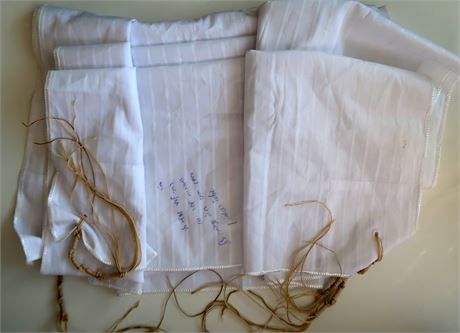
Talit Katan with Tzitzit of R. Hayyim Kanievsky -- Sold Winning Bid: $1,926.00 Reserve Price Met


Talit Katan with Tzitzit of R. Hayyim Kanievsky, Bnai Berak 20 th cent. 


טלית קטן עם הציצית של ה"ר חיים קניבסקי - Manuscript

Listing Image


Details
  • Lot Number 53334
  • Title (English) Talit Katan with Tzitzit of R. Hayyim Kanievsky
  • Title (Hebrew) טלית קטן עם הציצית של ה"ר חיים קניבסקי
  • Note Religous Article
  • City Bnai Berak
  • Publication Date 20th century
  • Estimated Price - Low 1,000
  • Estimated Price - High 3,000

  • Item # 2364009
  • End Date Tuesday, March 14, 2023 12:38 PM
  • Start Date Monday, February 13, 2023 8:45 AM

Physical Description

The tzitzit affixed to new cloth with authentication by his grandson,  R. Gedaliah Honigsberg in ink.


Detail Description

The tzitzit from a talit katan of R. Shmaryahu Yosef Chaim Kanievsky (1928-2022) affixed to a new talit katan cloth. Indeed the tzitzit are the original tzitzit that Reb Chaim blessed and kissed each morning.

R. Knievsky was a great rabbinic scholar, posek, and a leading authority in Haredi Jewish society. R. Kanievsky was born in Pinsk to R. Yaakov Yisrael Kanievsky (also known as the Steipler Gaon) and Rebbitzen Miriam Karelitz, sister of R. Avraham Yeshayahu Karelitz (also known as the Chazon Ish). He married Batsheva, daughter of R. Yosef Sholom Eliashiv (grandson of Rav Shlomo Elyashiv, also known as the Leshem) and granddaughter of R. Aryeh Levin.

During the 1948 Israeli War of Independence, R. Kanievsky, then a student at the Lomza Yeshiva, was conscripted for temporary army service in the general mobilization. He was assigned to stand guard on a large hill near Jaffa.

Rav Chaim's wife died in 2011. He received thousands of visitors every year from Jews seeking religious advice. R. Kanievsky was the official rabbi and spiritual guide for the nonprofit organization Belev Echad which was founded in Israel on 2011 and is dedicated to assist sick and disabled children and adults.

https://www.virtualjudaica.com/Listing/Details/2364009/Next-Auction


STARTING BID $2501 - NO HAGGLING OR OFFERS - AUTHENTICATED BY THE BNEI BRAK MIKVE GABBAI


Tuesday, March 14, 2023

Idiot [ id-ee-uht ] - a person of the lowest order in a classification of intellectual disability, having a mental age of less than three years old and an intelligence quotient under 25.


29 Years Later: Haredi rabbi lauds Baruch Goldstein

 
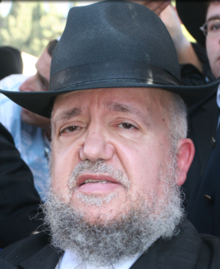
Meir Mazuz

'Thanks to him, a great danger was averted,' says Rabbi Meir Mazuz, dean of the Kisse Rahamim yeshiva.


A prominent haredi Israeli rabbi praised Baruch Goldstein, telling followers that the late doctor’s shooting attack in the Tomb of the Patriarchs 29 years ago spared Hebron Jews from an impending danger.

Rabbi Meir Mazuz, spiritual leader of the Tunisian Jewish community in Israel, dean of the Kisse Rahamim Yeshiva in Bnei Brak and rabbi of former minister Eli Yishai’s Yahad party, referenced Goldstein during his weekly lecture last week, on the eve of the Purim holiday, Walla reported.

Goldstein, Rabbi Mazuz argued, “prevented a very great danger,” referencing reports prior to Goldstein’s shooting at the Tomb of the Patriarchs of a planned Arab terror attack in Hebron.

“The Arabs were bringing in axes and hiding them under the rugs in the Tomb of the Patriarchs, along with rifles, knives – there was a terrible danger at the time.”

“Thanks to this Jew [Goldstein], that danger was averted.”

“On the day of Purim, one Jewish man went in that morning to the Tomb of the Patriarchs and shot thirty Arabs to death, which made quite a stir across the country.”

“The Prime Minister at the time, Yitzhak Rabin, called him a ‘dirty Jew’. When they [Arab terrorists] kill many people, they are clean. Its fine for the gentiles, but the Jew is ‘dirty’. Why ‘dirty’?”

“What do you call a ‘gold stone’ in Yiddish? Goldstein. That is what this man was. He did it by himself, he didn’t ask anyone, he did it all by himself. They investigated and investigated and investigated, but found that he had acted alone. He told his wife: ‘I am going to pray.’ He went, carrying a rifle.”

Goldstein, a 37-year-old New York-born doctor and IDF reservist, was beaten to death during Purim in February 1994, after he opened fire with his army-issued assault rifle on Arab worshippers who had gathered in the Tomb of the Patriarch.

Twenty-nine Arabs were killed, and over 100 more were wounded.

A resident of the neighboring town of Kiryat Arba, Goldstein had been a supporter of the late Rabbi Meir Kahane, founder of the Jewish Defense League and the right-wing Kach party, which had advocated the transfer of Israel’s Arab population.

While the Israeli government and the Yesha Council (the umbrella organization representing Israeli towns in Judea and Samaria) strongly condemned the shooting, Goldstein received praise from some on the Right, including Rabbi Dov Lior – the chief rabbi of Hebron - and many other Jewish residents of Hebron and Kiryat Arba, who claimed that Goldstein’s attack had prevented a large-scale terrorist attack planned by Hamas.

A government inquiry into the shooting attack, the Shamgar Commission, found some evidence for claims of an impending Hamas attack.


http://www.israelnationalnews.com/news/368624?utm_source=activetrail&utm_medium=email&utm_campaign=nl

Monday, March 13, 2023

BD"E - Horav Meier Weinberg zt"l

https://zkstream.com/ytv/  ---- LIVESTREAM LEVAYA


 Rav Meier ZT”L one morning came over to me in the Bais Medrash Koton and said “we need to brush up on hilchos Shabbos”. For the next two years at 8 AM we learned through the entire hilchos Shabbos/Orech Chaim. When I brought him a gift, he told me ” I should give you a gift, I learned more from you than you from me”. That in essence was the greatness of Rav Meier, there was no “Ich”; a personal loss for me, the yeshiva, and Klal Yisroel. A giant of a man! Yehi Zichro Baruch

TO LISTEN TO THE LEVAYA LIVE - CALL

718-906-6400 PRESS * THEN 2

Friday, March 10, 2023

When Rabbi Adin Steinsaltz added nekudot to the Talmud text, it took herculean effort, as it was done manually. Now, using artificial intelligence, you can take a new text that has never been seen by the computer, and without any manual intervention all the nekudot can be inserted.


For all who missed a yeshiva education and are learning to read Hebrew

https://korenpub.com/ Ask for the "nekudot" edition.

*

RB: Give us an example of a sefer you did this with.

PK: We’ve done it on hundreds of sefarim, but I’ll choose one that’s particularly interesting—Avkat Rokhel, the teshuvot of the Beit Yosef. The version of Avkat Rokhel that’s available was originally printed circa 1865. The Rashi typeface is hard to read, the words are close together, and like many classic rabbinic texts, Avkat Rokhel has very long paragraphs with minimal punctuation. We scanned the sefer and converted it into digital form. The OCR was very accurate. We then inserted nekudot, and after that, we used AI methods to automatically add punctuation.


Artificial Intelligence: The Newest Revolution in Torah Study?


Rabbi Dovid Bashevkin recently had a conversation with Professor Moshe Koppel at OU headquarters in downtown Manhattan on how digital technology, specifically artificial intelligence, is being applied to Torah study with new and unprecedented techniques, ultimately changing the way we approach and relate to Jewish texts.

Rabbi Dovid Bashevkin: Let’s start with the basics. What exactly does the term “artificial intelligence” mean? When I think of artificial intelligence, I think about 2001: A Space Odyssey or about robots coming to life and taking over Earth. But AI also makes me think of Gmail and how it’s able to fill in missing words and predict how my sentences are going to end.

Prof. Moshe Koppel: In the early days of computers, back in the fifties, the kinds of things computers were designed to do on a regular basis were boring tasks, such as sorting, alphabetizing or searching for something in a file. That was the bread and butter of what computers did.

In 1956, there was a scientific conference at Dartmouth College that is widely regarded as the founding of artificial intelligence. The idea was to try to get computers to do the kind of things people do, such as game playing. Scientists wanted to know—can you get a computer to be a chess champion?

RB: What would make it more difficult for a computer to master a game than to alphabetize or search for a piece of information?

PK: It’s not fundamentally different. But if you think about it, there are lots of obvious methods for sequencing, classifying or searching for things. The trick is just to do it efficiently.

However, to get a computer to play chess effectively, you need to really think through the various steps to figure out what you’re trying to optimize and how to optimize it from among so many possibilities. It’s not obvious what the right technique is.

In 1959, Arthur Samuels, a pioneer in AI, published a paper demonstrating how computers can learn from past mistakes; the vehicle he used to prove it was a game of checkers. Over time scientists were able to get computers to play chess, which is a much more complicated game. In 1996, IBM’s supercomputer Deep Blue defeated world champion chess player Garry Kasparov.

There are many different areas in which AI can revolutionize Torah study and, in fact, already has.

RB: I was a kid during Deep Blue. But bring it back to the foundational question, which is: is all of this artificial intelligence?

PK: The truth of the matter is that if you ask somebody where the line is between what we call artificial intelligence and what we simply call computer programming, there’s no big red line between them. In a colloquial sense, if you can get computers to do the kind of tasks people do as well as or better than people do them, that’s called artificial intelligence.

RB: During the last few months, we’ve been hearing about Open AI’s groundbreaking ChatGPT, a program that generates amazing responses to any prompt. Some have prompted the chatbox to write a sermon for the parashah in the writing style of this or that rabbi, for example, and it actually came up with derashot that were new and innovative.

PK: Yes. You could ask ChatGPT for something on the parashah written in the form of rap and it will deliver.

RB: Exactly. So something like ChatGPT raises the following question: how do you see AI revolutionizing the world of Torah study?

PK: That’s a great question. There are many different areas in which AI can revolutionize Torah study and, in fact, already has. Looking toward the future, one can imagine all kinds of virtual reality content for learning korbanot, something I hear is already happening. But, of course, we can do much more than that.

RB: Right. But let’s focus on what we are doing presently to make Torah texts more accessible, things like very advanced text processing.

PK: At Dicta—The Israel Center for Text Analysis, a research institute devoted to developing tools for computational analysis of Jewish texts, we recently came out with a new app called Dicta Maivin (“Dictation Expert”).

Here’s how it works: Take any sefer. On your phone, go to illuminate.dicta.org.il, and take a picture of any page. Using our own version of OCR (optical character recognition), specifically adapted to the fonts typical of rabbinic works, Dicta Maivin will convert the text into digital form. We have the capability of taking a photo of a rabbinic text printed in the nineteenth century in cramped, difficult-to-read Rashi script and converting it into text that is legible and easier to understand. Dicta can also insert nikud (vowelization) into a text; it’s hard for some people to read a sefer that doesn’t have nekudot since many words are ambiguous.

When Rabbi Adin Steinsaltz added nekudot to the Talmud text, it took herculean effort, as it was done manually. Now, using artificial intelligence, you can take a new text that has never been seen by the computer, and without any manual intervention all the nekudot can be inserted.

RB: Give us an example of a sefer you did this with.

PK: We’ve done it on hundreds of sefarim, but I’ll choose one that’s particularly interesting—Avkat Rokhel, the teshuvot of the Beit Yosef. The version of Avkat Rokhel that’s available was originally printed circa 1865. The Rashi typeface is hard to read, the words are close together, and like many classic rabbinic texts, Avkat Rokhel has very long paragraphs with minimal punctuation. We scanned the sefer and converted it into digital form. The OCR was very accurate. We then inserted nekudot, and after that, we used AI methods to automatically add punctuation.

RB: In addition to nekudot and punctuation, there is the challenge of abbreviations. Acronyms are all over rabbinic literature, and some of them are very obscure.

PK: True, kaf-hei-gimmel could either be k’hai gavna (Aramaic for “in such a case”) or it could be kohen gadol. In many cases, abbreviations or even words are ambiguous. Should daled-beit-reish be vocalized as davar, dever or dabeir?

RB: Exactly. Those are great examples.

PK: You need to be able to distinguish between them. Now we have this very advanced AI system that’s able to figure out the intended meaning of the abbreviation based on context.

RB: So all of this is making the text easier, more accessible and more approachable. Torah scholars no longer have to decipher the nekudot or the punctuation, or ambiguous words and abbreviations. I wonder, however, if scholars are welcoming all of this, since I don’t think they want to be replaced.

PK: You’re making a valid point. But there’s something for scholars here too. Let’s say you are learning Chiddushei HaRamban, and Ramban quotes a Sifra or a Sifri, or a gemara or a midrash. If you’ve run the sefer through Dicta Maivin, every time the text cites an earlier source, an automatically generated footnote will provide the original source. For example, it might say: see the gemara in Pesachim on page x. The app basically recreates a scientific edition of rabbinic texts. At the swipe of an icon you can open abbreviations and see footnotes identifying sources and subsequent quotations of the text. For example, there are later commentators who quote the Ramban. If I’m learning a line in the Ramban and I want to know every single Acharon who quoted this particular Ramban, I can now easily access that information. You can also see the different ways the Ramban has been quoted. Maybe Rabbi Moshe Feinstein quoted it one way in a responsum, while the Minchat Yitzchak quoted it slightly differently. You can actually compare all the different versions with the differences highlighted. Notes and paraphrases of later sources can be systematically identified, and digitized manuscripts can be compared. All of this is surely of interest to scholars.

RB: Your description of Dicta Maivin reminds me of the Shazam app, where you play a few seconds of a song and it’ll tell you what song you’re listening to, what album it’s on, who composed it, et cetera. This is Shazam for Torah.

Do you think a time will come in our lifetime when the role of the posek, the halachic decisor, is going to be replaced? Already now, I don’t need to call the rav of my shul to find out what berachah to make on a bowl of corn flakes.

But there are halachic questions involving contingencies. For example, if I want to know if my knife is still kosher, there are a lot of follow-up questions involved in such a question. What did I slice with it? What was I washing it with? How hot was the water? et cetera. Do you think AI will be capable of being taught the guidelines of halachah so that it can pasken she’eilot?

PK: I would divide the world of she’eilot into two parts. It’s really a continuum, but let’s talk about two parts. One is straightforward questions, like what berachah do I say on a bowl of corn flakes, or can I put a teabag into a kli sheini on Shabbat.

RB: That is similar to alphabetizing. Those answers are already out there. A computer simply makes it easier to find them.

PK: Exactly. However, with the existing technology and search engines, such as Sefaria, the Bar-Ilan Responsa Project or Otzar HaHochma, you would not be able to get the answer even to the most simple halachic question. That’s because a keyword like “teabag” or “kli sheini” will generate 1,000 responses and you would have to spend hours sorting through them, which is not very helpful.

But it’s clear that not only in our lifetime but in short order, we are going to be able to find answers to these basic questions. Anyone who’s played around with ChatGPT and seen how astonishing it is knows that you could probably put in some very simple she’eilot and get a fairly reasonable answer.

We have the capability of taking a photo of a rabbinic text printed in the nineteenth century in cramped, difficult-to-read Rashi script and converting it into text that is legible and easier to understand.

I should warn you that while ChatGPT is really good at giving clear and coherent answers, it’s not very good at reliably giving accurate answers. And that’s something we should be concerned about. You would not want to trust ChatGPT with anything really important, whether it’s halachah or anything else that’s really important to your life. ChatGPT is an astonishing parlor trick, in the sense that it could explain game theory’s Nash equilibrium with a more or less reasonable Wikipedia-like answer. What’s remarkable about it is that it’s a text generator, not a text copier. The paragraphs it gives you don’t actually exist anywhere; it has actually created them.

But while it’s an amazing thing, you wouldn’t want to rely on everything it says as being absolutely true. But it’s clear that in a few years, we’ll be able to ask the kind of straightforward she’eilot about which there are no heated arguments among rabbanim. You’ll put in a question such as, “Can I pour the hot water into the cold water on Shabbat?” and it’ll provide a good answer. But the fact of the matter is that such she’eilot were never what rabbanim were for. What you really need rabbanim for are the second kind of questions, where the rav needs to see the person in front of him and understand the situation.

RB: It’s what I’d call sha’at ha’dechak issues, pressing circumstances with life situations. And there’s a difference depending on the questioner. Is the questioner a millionaire or somebody who’s broke and the response might affect his ability to send his kids to yeshivah?

PK: Right. A she’eilah could involve serious concerns such as one’s health, or even be a life-and-death issue. Less serious she’eilot also require a posek who could understand the bigger picture; sometimes it could just be a matter of “it would be very expensive for me to have to do this.” At times, marital conflict might be a factor. For example, a spouse has become less frum or more frum than the other spouse and the couple needs to resolve the issues between them. It’s a matter of shalom bayit. They need to know that maybe they could use a particular kula [halachic leniency] in order to save their marriage. You would not want ChatGPT answering that question.

RB: Do you think there’s going to be a future where AI will be able to factor in these human elements or be able to explore people’s facial expressions?

PK: Yes, for sure. But that will take time and require appropriate caution.

It’s important to add a somewhat obvious thought: it’s crucial for those who pasken she’eilot to have a very broad and deep knowledge of halachah even if the actual material is easily accessible at the click of an icon on their smartphone. A rav often needs to pasken on the basis of intuition because he’s not going to find every individualized question he’s faced with in the Shulchan Aruch or the Mishnah Berurah or the Iggerot Moshe. The only way to develop a strong intuition is through internalizing a tremendous amount of information.

RB: People have this sense—and I certainly have it—they don’t want to be replaced. I want to always feel like I am able to contribute to Torah. I think a part of Torah is the human interpretation, the human partnership with the Torat Hashem. As the gemara in Kiddushin (32b) begins, “u’veTorato yehegeh yomam va’laylah—in his (that is, each person’s) Torah I will meditate day and night,” expounding on the verse in Tehillim 1:2.

I’m wondering what advice you would give to an emerging talmid chacham who sees where things are headed and is concerned that his massive breadth of knowledge is going to be easily replaceable. What skills should he invest in that will be least likely to be replaced by a computer?

PK: The answer is, as I said, developing healthy intuition. You need to understand what’s going on behind the halachah. What are its underlying principles? What moral ideas are there?

More importantly, you need to understand people. A real talmid chacham doesn’t treat someone who’s down on his luck, doesn’t have parnassah, and has shalom bayit problems the same as a person who is wealthy and has minimal stress. A true posek understands what each person needs. He can’t make up halachot, but there’s a certain amount of leeway. He needs to know: where is there room for flexibility and where do you have to be rigid? What does this particular person sitting in front of me need to be able to flourish and live a healthy Torah life? What some other person needs might be very different.

A rav often needs to pasken on the basis of intuition because he’s not going to find every individualized question he’s faced with in the Shulchan Aruch or the Mishnah Berurah or the Iggerot Moshe.

RB: Have you had anyone reach out to you saying, “I don’t like what you’re doing here,” or push back saying, “We’ve got to draw a line”? There’s so much work being done in AI safety to make sure that we’re not literally replaced by computers. So I’m curious, have there been people in the Torah world who are, so to speak, concerned about the safety of AI Torah?

PK: Interestingly enough, that hasn’t been the case. I’m not one to shy away from controversy, but the fact of the matter is that Dicta cooperates with Orthodox Jews across the specturm. We work with with a lot of Chareidi groups, as well as with Sefaria and other organizations, and we really haven’t gotten any push back at all. So far, nobody has told us they’re frightened by what we’re doing because for the most part, we’re just providing a service to people.

RB: Give me one moment in your career where you saw a computer do something and you gasped and said, “Wow, I didn’t think I’d see this in my lifetime.”

PK: Well, that happened some months ago with ChatGPT. I put some questions into ChatGPT, and I was shocked. It’s jaw-dropping. You can literally say: tell me the halachot of bishul on Shabbat and do it in limerick. And it does it.

RB: What’s next for AI? What do you predict the world will look like in twenty-five years from now?

PK: Well, first of all, we’re going to be facing the kinds of halachic questions that we really haven’t thought about a lot. Consider the halachic area of grama, an indirect action on Shabbat. Technological inventions like those by the Zomet Institute in Israel use grama as the basis for allowing certain things that people need for medical or other reasons, such as motorized wheelchairs.

In the future, you are going to think that you would like your driverless car to pull up in front of your house and take you somewhere, and it will do that. You’ll have cars coming exactly when you want them to come and taking you anywhere.

What we’re accustomed to now is that if you want to get a certain consequence, like you want to get yourself in your car from here to there, you need to perform an action. As far as we know, what is forbidden on Shabbat are those actions. You can’t drive your car because of the combustion engine. But what happens when you can get the consequences—such as getting from here to there in your car—just through your thoughts or by preprogramming something before Shabbat?

To put that more broadly, what you’re really doing is separating actions from consequences of actions. You’ll be able to get the consequence without the action. Will that be forbidden on Shabbat as well because we’re trying to avoid those consequences? Or is it just purely a technical matter, that is, if you’re not performing the actual action, then it’s perfectly okay?

RB: Final question: on a personal level, do you like learning digitally?

PK: No. I never learn from a computer. I open up an old-fashioned Gemara and just learn straight from the Gemara.

RB: Professor Koppel, thank you so much for your time.

https://jewishaction.com/cover-story/artificial-intelligence-the-newest-revolution-in-torah-study/?utm_source=SilverpopMailing&utm_medium=email&utm_campaign=March%202023_Spring%20issue_Pre-Pesach%20(1)&utm_content=&spMailingID=34835331&spUserID=Mzc0Njg4NTUwNDk0S0&spJobID=2383382670&spReportId=MjM4MzM4MjY3MAS2