In the immediate aftermath of the Oct. 7
Hamas massacre, the Patriarchs and Heads of the Churches in Jerusalem,
an ecumenical group of Christian leaders that includes the Latin
Patriarch of Jerusalem, Cardinal Pierbattista Pizzaballa, issued a joint
statement in which they made no explicit mention of the Hamas
atrocities. They included only a vague condemnation of any act that
targets civilians.
The Israeli embassy to the Holy See
criticized the statement’s “immoral linguistic ambiguity,” which failed
to be clear about “what happened, who were the aggressors and who the
victims. … It is especially unbelievable that such a sterile document
was signed by people of faith.”
This controversy is only the latest in the
fraught history of Israel-Vatican relations, which were officially
established in Dec. 1993. Besides the Catholic Church’s historical
antisemitism, the Vatican was long reluctant to formally recognize
Israel for several reasons: Israel did not have internationally
recognized borders, the status of Jerusalem and access to its holy sites
had not been internationally guaranteed, and Catholics and their
institutions were, the Church claimed, not adequately protected under
Israeli law.
In addition, the Vatican had concerns
about the treatment of Palestinians in the disputed territories and
feared that relations with Israel could have negative repercussions for
Catholics in Arab countries.
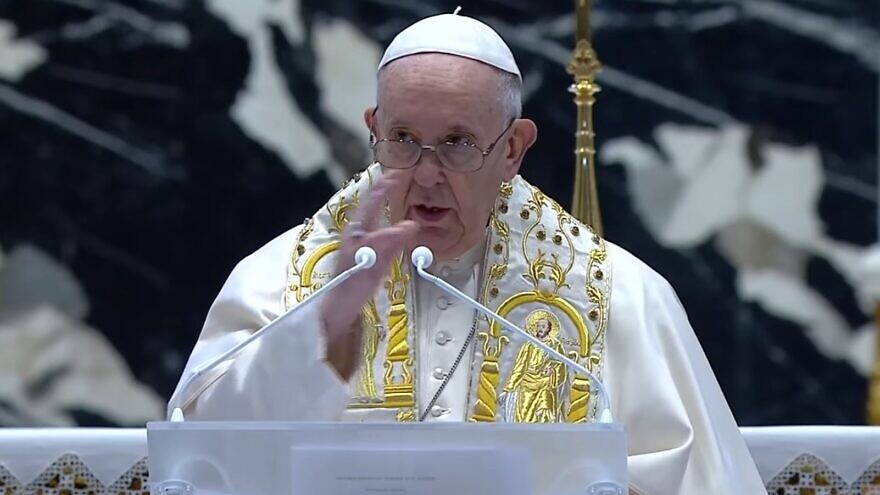
This may explain why, to date, Pope
Francis has not labelled Hamas a terrorist organization and has not met
with families of Israeli hostages. The latter has not gone unnoticed,
especially because the families were received by many leading national
figures, including Italian Prime Minister Giorgia Meloni.
According to the Catholic news site Cruxnow,
the pontiff’s behavior can be explained as “positioning the Vatican
potentially to play a mediating and peace-making role.” In addition,
“The bulk of the Christian population in the Holy Land is Arab and
Palestinian, so Middle Eastern bishops and clergy tend to be strong
supporters of the Palestinian cause.”
Moreover, Cruxnow sees a historic
shift underway in terms of the Vatican’s interfaith priorities: “Since
the Second Vatican Council in the mid-1960s, Judaism has been the
Church’s primordial relationship, unquestionably the highest priority in
inter-religious dialogue. Under history’s first pope from the
developing world, that’s no longer necessarily the case, as other
relationships, especially the dialogue with Islam, have become at least
an equally compelling perceived priority.”
Given this, it is not surprising that,
since war broke out, Pope Francis has spoken with numerous world
leaders, including U.S. President Joe Biden, but there are no reports
that Israeli Prime Minister Benjamin Netanyahu has been among them.
The larger Catholic world has shown equal
ambivalence towards the war. Among Eastern Catholic leaders, the Latin
Catholic and Eastern churches in communion with Rome have issued what
Israel deems a lukewarm and insufficient condemnations of Hamas. Their
first communiqué, issued on Oct. 8, contained a generic statement
“against any acts that target civilians, regardless of their
nationality.” The next, on Oct. 13, decried the humanitarian situation
in Gaza and called for de-escalation. It singled out only Israel in
connection with humanitarian issues.
Putting geopolitics aside, Pope Francis’s
refusal to firmly condemn Hamas as a terrorist group is a moral failure.
If he did so, it would demonstrate a serious commitment to combat
antisemitism by action rather than vague ritual condemnations.
This is part of a larger problem. For
example, the Vatican has yet to adopt the IHRA definition of
antisemitism, which is opposed by many antisemites for including
antisemitic tropes targeting Israel. In an interview with the Italian
newspaper La Stampa this past May, the American Jewish
Committee’s Representative in Italy and Liaison to the Holy See, Lisa
Palmieri-Billig, asked Archbishop Paul Richard Gallagher, the Holy See’s
Secretary for Relations with States, if it might adopt the IHRA
definition in the future. He responded, “The answer is no, there isn’t
any possibility. We feel that what comes out of Nostra Aetate and the position of the Popes for many decades now is very clear.”
Nostra Aetate famously condemned
the Church’s historic antisemitism and rescinded the charge of deicide.
This was commendable, but fossilizing the relationship between Jews and
Catholics in a document that is now almost 60 years old does not help
further that relationship.
Moreover, the current wave of antisemitic
hatred involves tropes rooted in centuries of Catholic antisemitism. As
an Italian Jew living in a predominantly Catholic country, I have seen
this firsthand, such as images of a crucified Jesus used as a metaphor
for the supposed plight of the Palestinians and Hamas. Together with
statements like Gallagher’s, this puts the future of Catholic-Jewish
dialogue in question.
On Oct. 27, Pope Francis issued a prayer
for peace that also failed to condemn Hamas and its atrocities. As Chief
Rabbi of Rome Riccardo Di Segni rightly stated in the Italian newspaper
La Repubblica on the same day, “Prayer is a weapon even if it
does not shoot and its morality depends on its content. It is good to
see multitudes gathering to ask for peace, looking beyond the terms of
conflicts, wanting an end to suffering, but one must consider whether
looking beyond does not mean flattening differences and making everyone
equal; in every conflict there are not all the good guys on one side and
all the bad guys on the other, but certainly there are those who are
better and those who are worse. Prayer can become an alibi for
unburdening one’s conscience, for establishing inappropriate
equidistance, for erasing moral evaluations.”
Despite Francis’s problematic conduct,
however, there are some courageous Catholic voices that have
unequivocally condemned Hamas and expressed solidarity with Israel.
For example, the Vatican’s Secretary of State Cardinal Pietro Parolin stated in the Vatican newspaper L’Osservatore Romano that Hamas’s attack was “inhuman” and “it is the right of those who are attacked to defend themselves.”
Similarly, on Oct. 11, Archbishop of
Boston Sean O’Malley said, “This act of aggression requires a clear
condemnation in human, moral and legal terms. Both the purpose of the
attack and its barbaric methods are devoid of moral or legal
justification. There is no room for moral ambiguity on this issue.
Resisting such terrorism and aggression is the moral duty of states to
be carried out within moral limits.”
The Vatican should listen carefully to
O’Malley and Parolin, because not just its relationship with the Arab
world and other political considerations are at stake. The Vatican’s
reaction to the Oct. 7 massacre and its aftermath will play a decisive
role in the future of Catholic-Jewish dialogue. If it continues to
maintain its ambiguous position, the Holy See risks its entire
relationship with Israel and world Jewry.
https://www.jns.org/the-vatican-is-risking-its-relationship-with-the-jewish-world/?_se=YW5uZS1tYXJpZS5mYXJvdXpAbGFwb3N0ZS5uZXQ%3D&utm_campaign=Morning+Syndicate+Thursday+16112023&utm_medium=email&utm_source=brevo










#/media/File:Bundesarchiv_Bild_183-N0827-318,_KZ_Auschwitz,_Ankunft_ungarischer_Juden.jpg)