Nepotism at work: The committee to appoint rabbinical judges
How can Israelis trust the courts they need for divorce and other legal
matters, when they have become a job factory for the committee's
relatives?
Sephardi Chief Rabbi Yitzhak Yosef meets with newly appointed Supreme
Rabbinical Court judges in Jerusalem
Over the next two weeks, at least 15 new rabbinical court judges will be chosen by the Council for Appointing Judges (Vaadah le-Minui Dayanim).
These appointments have broad implications for the approximately 10,000
couples who get divorced each year in Israel’s rabbinical courts and
tens of thousands of others who find themselves in the halls of Israel’s
religious justice system for issues of inheritance, proving Jewishness,
or proving personal status.
It would be unfortunate enough if these appointments were being
made by the outgoing chief rabbis on the final days of their serving in
office. But what is significantly more problematic and an ethical
travesty is that many of the appointments will be family members and
close friends of members of the committee — something that may end up
being challenged in Israel’s Supreme Court. The judges with the most
likelihood of being appointed are sons-in-law, brothers, cousins, and
close friends of the families of the chief rabbis and their inner
circle. Rather than being a force of justice and Jewish law, the
rabbinical courts have become a job factory for relatives.
Both democratic tradition and Jewish tradition look unfavorably
at nepotism. Moving forward now with these appointments will clearly be
an ugly stain on the Israeli Rabbinate and the future of these judges.
The Talmud inBava Metzia 85b (tomorrow’s daf yomi)
describes how two young scholars who were both sons of great Jewish
leaders were given opportunities to rise quickly to positions of
leadership in the beit midrash (study hall). Both Rabbi Judah
Hanasi (son of Rabbi Shimon Ben Gamliel) and Rabbi Elazar (son of Rabbi
Shimon Bar Yochai) impressed the sages with their acumen and ability,
and the sages sought to promote them.
According to the Talmud, they literally were “taken off the
floor” and given seats of power. But the Talmud recounts that Rabbi
Shimon ben Gamliel, who was well aware of his son’s abilities, demanded
that his son be demoted for fear of the evil eye — which, in other
contexts, means that he was afraid that it would look inappropriate for
his son to rise to power because of his father’s power. And in fact,
Rabbi Judah the Prince was demoted.
How far Jewish history has come! It would be appropriate now for
all the fathers and fathers-in-law, all the cousins and brothers-in-law,
in fact, all the family members of any of these prospective rabbinical
court judges to ask their relatives and friends to excuse themselves
from this round of promotion.
This should not be an issue for the Supreme Court; it’s a basic Jewish halachic value.
Measles Is Preventable. How Did the World End Up Back Here?
—
Health professionals must encourage vaccination and fight misinformation
I remember being very sick when I had measles as a
child. I was confined to a darkened room for more than a week, and
there was concern that it would affect my vision. Decades later, I work
with patients who have had encephalitis as a result of measles, and
families who are left bereaved by the disease.
Because of the successopens in a new tab or window
of the measles, mumps, and rubella (MMR) vaccine, most people have
never seen a case of measles and think it is just a rash that clears up
in a few days. But measles is not the innocuous childhood illness that
the unfamiliar or vaccine deniers believe.
Let's look back to a time before the vaccine existed.
Take the case of Barbara Leonhard, who contracted measles along with
her siblings when she was 6 going on 7 years old. Her siblings
recovered, but she developed encephalitis, was totally paralyzed, and
spent 30 days hospitalized in a coma. She was lucky: doctors said she'd
never walk again, but she learned how to walk. Though the disease left
her with memory and learning issues, she excelled and became a sign
language instructor at the University of Missouri, as well as a poet,
author, and editor.
That was in 1958 -- 66 years ago -- when Leonhard became one of 763,094 peopleopens in a new tab or window
in the U.S. to contract measles, the highest number of cases in a
single year. In 1963, when the measles vaccine became available, her
parents jumped at the chance to have their children vaccinated. Viewed
as a miracle, the vaccine reduced measles cases by 95% over the next 5
years; by 2000, the disease was declared eliminated in the U.S.
Fast forward. Since October 2023, there have been 1,109 confirmed measles casesopens in a new tab or window
in England. Meanwhile, in 2022-2023, MMR vaccinations for children
under 2 had fallen to 89.2% (herd immunity requires 95% of the
population be fully vaccinated). In the U.S., the CDC reports that MMR vaccination ratesopens in a new tab or window
fell from 95% in 2019-2020 to 93.1% for the 2022-2023 school year; this
two-point drop means 250,000 kindergartners are at higher risk for
developing measles. Herd immunity is critically important because it
allows us to accommodate people who can't be vaccinated for medical,
personal, or religious reasons.
How Did We Get Here?
One of the primary contributors to the current anti-vaccine movement was the 1998 publication of a now-retracted paperopens in a new tab or window in The Lancet by disgraced former physician Andrew Wakefield, who inaccurately linked the MMR vaccine to autism.
In addition to misinformation about vaccine safety, the current
crisis has been fueled by complacency, vaccination delays during the
pandemic, lack of access to vaccines in some cases, international
travel, mistrust in the government and the pharmaceutical industry, and the expansionopens in a new tab or window of medical and religious exemptions.
The biggest hurdle we face is convincing skeptics that most vaccines
are safe. This is despite the fact that the science is clear: only one
or two people in a million develop some kind of adverse eventopens in a new tab or window because of vaccination.
But sometimes parents who have lost children or whose children have
life-changing disabilities may believe vaccination was the cause. I have
seen and heard from these parents -- their loss and distress are
palpable and heartbreaking. In addition to the patients and families
affected by the complications of measles, these parents are victims of
erroneous and misguided information.
The MMR vaccine prevents hundreds of thousands of deaths and
disabilities, but the vaccine-hesitant voices are very loud. To combat
them, healthcare and public health professionals can show patients data
demonstrating that vaccines are safe and effective.
Efforts to Encourage Vaccination
In the U.K., the government is conducting a highly successful national catch-up campaignopens in a new tab or window
to encourage parents to vaccinate children between 6 and 11 years old
who missed their MMR vaccines. It is also targeting unvaccinated
adolescents and adults. There are many forms of encephalitis that cannot
be prevented, but there is no reason anyone should get encephalitis from measlesopens in a new tab or window.
There is still time for the U.S. to prevent the more extreme
situation we are experiencing in Europe and around the world. Most
measles cases in the U.S. appear to be the result of an infected person travelingopens in a new tab or window from a country where measles is endemic or where there is an outbreak. In fact, just this week, CDC published a Morbidity and Mortality Weekly Report article on 57 measles casesopens in a new tab or window tied to a migrant shelter in Chicago.
Healthcare professionals should speak to parents to make sure
children are up to date on vaccinations. This is particularly important
for families who plan to travel internationally, especially to areas
where there are measles outbreaks.
I've heard some stories about physicians refusing to treat patients
who are not vaccinated against MMR. While it can be difficult to
maintain patience and compassion when faced with parental resistance, we
must remember that many of these parents come from a legitimate place
of fear for their child's health. Listening to and addressing their
concerns may go a long way in convincing them that vaccines are safe.
It is heartbreaking to know that children are being needlessly
affected by this terrible disease. We must make vaccinations more
accessible and fight vaccine misinformation by overpowering it with the
truth: that vaccines save millions of lives around the world each year.
Easton does not
receive any personal grants or honoraria from corporate or
pharmaceutical companies. Encephalitis International does receive
grants, expenses, and honoraria from a range of corporate partners,
including those in pharmaceutical and diagnostic technology.
Why Does Gaza Appear in This Antique Hebrew Scroll?
Jerusalem, Hebron, Safed, the tombs of the righteous in the Galilee,
and... Gaza? Jewish scrolls from the 16th and 17th centuries offer an
interesting selection of holy places in the Land of Israel. How did the
city of Gaza end up on this list?
In earlier and more ancient versions of the Yichus Ha’Avot scrolls,
Gaza does not appear at all. Why suddenly in the 16th and 17th centuries
was Gaza included on the map of holy places? Why is it described as a
“beautiful country”, and why is the city where Samson the biblical hero
met his death suddenly named after him – “Samson’s city”?
Illustration of the city of Gaza in the 17th century Yichus Ha’avot Scroll, which is kept at the National Library of Israel
A complete road atlas for the holy sites in the Land of Israel, an
advertisement brochure, or a travel book? From the Middle Ages to the
16th and 17th centuries, written and illustrated compositions were
circulated in the Land of Israel and in the Jewish Diaspora, claiming to
present those abroad with descriptions of the Jewish holy places found
throughout the land. Three of these, which were copied as illustrated
scrolls, are preserved at the National Library of Israel.
These items were copies of what’s known as the Yichus Ha’Avot scroll,
or in its full name as it appears in the first part of the manuscript:
“Lineage of the Forefathers and the Prophets and the Righteous and the
Tana’aim and the Amora’im, May They Rest in Peace, in the Land of Israel
and Outside the Land, May God Establish Their Merit for Us, Amen.” As
its name indicates, this scroll is mainly focused on the burial places
of our ancient ancestors – from those buried in the Cave of the
Patriarchs(Ma’arat Ha’Machpela) to the later tombs of
the Amorites which were spread throughout the Land of Israel, and
sometimes even outside of it (such as the tombs of Mordechai and Esther,
Daniel, and others).
But then, in one of the copies, above the illustration depicting a
city surrounded by a wall, the following Hebrew inscription appears:
“Kfar Gaza, the city of Samson, a beautiful country”
This particular copy of Yichus Ha’Avot was copied and illustrated in
Casale Monferrato in northern Italy, in 1598. As mentioned above, the
illustration depicts a walled city with many towers covered with domes,
some alluding to their status as mosques, some reminiscent of churches.
The whole city is surrounded by a wall, and a (very) large domed gate
with no doors symbolizes the entrance to the city.
Another illustration very similar in its characteristics – in which
Gaza is referred to as “the land of Samson, a beautiful country” –
appears in another Yichus Ha’Avot scroll from the National Library
collection, this one dating to the 17th century. Here, the illustrator
imagined Gaza as an even greener and more colorful city, with the
mosques appearing more prominently. The city gate is still broad and
impressive, lacking doors and wide open.
Shlomo Zucker, a former member of the National Library’s manuscripts
department, researched the composition and described it as follows:
“The drawings are spectacular; green and red for the trees and
flowers, gold for the domes and some of the columns of the buildings […]
However, the buildings – with vaults, gables, columns, and crowns in
the classical style – are completely imaginary, and have nothing to do
with the actual shape of the sites described in the text.” (S. Zucker, Yichus Ha’Avot or Elleh Massai, Ariel, 123-122, 5757, p. 206 [Hebrew])
Is this really how Gaza looked in those days?
Written testimony, archaeological findings, and descriptions in various travel books present a different picture of the city.
But the very fact that the descriptions and illustrations in the
Yichus Ha’Avot scroll are imagined is not surprising or unusual.
Scientific or geographical accuracy was not necessarily at the forefront
of the minds of the writers and artists of the time. Maps and
illustrations based on imagination or various graphic ideas disconnected
from reality were quite common.
One of the interesting examples is the “Clover Leaf Map” by Heinrich
Bünting, one original copy of which is preserved in the Eran Laor
Cartographic Collection at the National Library.
The map depicts the old world in the form of a clover leaf on which
three continents are represented: Asia, Europe, and Africa. Jerusalem,
by the way, is located in the center of the world according to this map.
On the map itself, Bunting explains the reason for his artistic choice:
“The whole world is in the shape of a clover leaf, which is a symbol of
the city of Hanover, my beloved birthplace.”
Like the famous Clover Leaf Map, the Yichus Ha’Avot scrolls also
weren’t trying to be realistic or to reflect actual geography and
topography. The scrolls and the illustrations inside them tried to
express a visual-imagined space, emotional at its core, which made it
possible to browse through them and feel like someone who was walking in
the footsteps of our ancestors, as someone who is faithful and
connected to the “lineage of the fathers”.
The much more surprising fact is that Gaza was added to the map of holy places at an unknown time.
In earlier and more ancient versions of the Yichus Ha’Avot scrolls,
Gaza does not appear at all. Why suddenly in the 16th and 17th centuries
was Gaza included on the map of holy places? Why is it described as a
“beautiful country”, and why is the city where Samson the biblical hero
met his death suddenly named after him – “Samson’s city”?
It should be noted that Gaza was not one of the four traditional
Jewish holy cities in the Land of Israel. Moreover, various halachic
discussions raised the question of whether Gaza is part of the Land of
Israel, and whether the commandments that are dependent on the land must
be observed there. According to most opinions, the answer is no.
So what suddenly changed at the end of the 16th century?
The fluctuations in Gaza’s status as an important or backwater city
over the years stemmed from its location on the coastal road leading
between the Land of Israel and Egypt. When the Crusaders conquered the
Holy Land, there were no trade relations between the Crusader Kingdom of
Jerusalem and Muslim Egypt, and Gaza was a ruined and largely abandoned
city. But then the Mamluks conquered the region, and with the increased
stability, the status of Gaza, which had been rejuvenated into an
important roadside trading city, rose as well.
Towards the end of the Mamluk period, in 1481, Rabbi Meshullam of
Volterra, a Jewish banker from Florence, visited Gaza, and his
descriptions corroborate the literal description in the Yichus Ha’Avot
scroll which states that Gaza is a “beautiful country”.
According to Rabbi Meshullam, Gaza was “a good and fat land”, with a
small Jewish community that produced wine. But unlike the illustrations
in the Yichus Ha’Avot scroll, Rabbi Meshullam described Gaza as so
self-confident that it had no wall at all: “Aza is called Gaza by the
Ishmaelites, and it is a good and fat land, and its fruits are very
fine. And there is good bread and wine, although the wines are only made
by the Jews. Its perimeter is 4 miles long and it has no walls […] it
is surrounded by blue on the shore of the sea. And has about 60 Jewish
homeowners […]”
Samson
carries off the gates of Gaza, a mosaic from the synagogue in Hukok,
Byzantine period / Photo: Jim Haberman, courtesy of Jodi Magness
Rabbi Meshullam also notes the fragment of Jewish history that is
connected to the city of Gaza: It is the city where the biblical hero
and judge Samson lived for part of his life, together with his wife
Delilah, who ultimately brought on his demise out of greed. It is also
the city where Samson was imprisoned and killed, and which he destroyed:
“And at the top of the Judaica [mound] was the house of
Delilah, and Samson the hero lived in it. And near there […] I saw the
great court which he overthrew with his strength and power” (Abraham
Yaari, Masa Meshullam MeVolterra, Mossad Bialik, 599, p. 64 [Hebrew]).
About thirty years after Rabbi Meshullam’s visit, in 1517, an event
occurred that further affected Gaza’s status in the following centuries:
The war between the Mamluks and the Ottomans ended in an Ottoman
victory. The Ottoman Sultan Selim I conquered the entire region,
including the Land of Israel, the shores of the Red Sea, Mecca, and
Medina, as well as the southern connection to the African continent –
Egypt. The victory of the Ottomans strengthened the position of Gaza.
From a peripheral border city, it became a city perfectly situated in
the center of a vast empire.
The Ottoman victory also had additional significance. All the holy
places of Islam and Judaism and most of the holy places of Christianity
now fell under the control of a single regime. The Ottoman Empire
developed, improved the access routes, and ensured the safety of the
Muslim pilgrims who set out for the Hajj to Mecca, while also offering
safety to the Jewish and Christian pilgrims. The security resulted in
economic growth and the improvement of roads, which contributed to a
significant increase in the volume of pilgrimage.
As it turns out. even though Gaza was not one of the four Jewish holy
cities in the Land of Israel, it became a popular place to visit when
making the long journey to the Holy Land.
Why?
Those who embarked on a pilgrimage for religious reasons were
specifically interested in the holy places, especially in the tombs of
biblical figures and righteous sages, which Gaza could not claim to
have. But Samson “came to her aid”.
This is perhaps the reason why Gaza is depicted in illustrations as a
walled city with its mighty gates open. The illustrators of the scrolls
didn’t illustrate Gaza, the prosperous trading city without a wall, but
rather as a city whose doors Samson had uprooted, leaving it with wide
open gates. That’s also why they call it the “Land of Samson.”
The illustrators of the Yichus Ha’Avot scrolls knew that many of the
immigrants, especially those from Italy, would pass through Gaza anyway
on their way to or from Egypt. As such, they indicated to the pilgrims
that although there were no tombs of note in Gaza, there was indeed a
history of Jewish heroism there.
This article is based on an article
by Dr. Chaim Meir Neria, curator of the Haim and Hanna Solomon Judaica
Collection at the National Library of Israel, published in Etmol, issue 286 February 2024
COVID Still Deadlier Than the Flu -- But the Gap Is Narrowing
—
VA study finds 35% higher mortality rate in hospitalized patients
Patients hospitalized with COVID-19 were
more likely to die than those hospitalized with influenza during the
fall and winter of 2023-2024, according to an analysis of Veterans
Affairs data.
Among over 11,000 patients hospitalized for either illness during
this past fall and winter, 5.7% of patients with COVID-19 died within 30
days of admission versus 4.24% of patients with influenza, reported
Ziyad Al-Aly, MD, of the VA St. Louis Health Care System, and
colleagues.
After adjusting for variables, the risk of death in people
hospitalized for COVID-19 was 35% higher (adjusted HR 1.35, 95% CI
1.10-1.66), the authors detailed in a research letter in JAMAopens in a new tab or window.
Al-Aly told MedPage Today that his group was actually
surprised by the results. "We pretty much bought into the public
narrative and drank the Kool-Aid like everybody, thinking that COVID is
no longer [more deadly than the flu], although ... there was no data,"
he said. "But the verdict is out now, because we've analyzed the data
from the 2023-2024 COVID season and clearly COVID mortality is still
higher than the flu."
However, the results did reveal that the risk of mortality in
patients hospitalized with COVID-19 had fallen when compared to the
previous 2022-2023 season. In their 2023 study, using the same database
and methods, Al-Aly's group found that in the fall and winter of
2022-2023, COVID was about 60% more deadly than the fluopens in a new tab or window in patients hospitalized for the illnesses.
"We should continue to take COVID seriously," Al-Aly emphasized. "I
know we're all sick and tired of this pandemic and all of us have
pandemic fatigue, but COVID is still more of a threat to health than the
flu."
Reassuringly, there appeared to be no significant difference in the
risk of death among patients hospitalized for COVID-19 before and during
the emergence of the JN.1 variant of SARS-CoV-2 (adjusted HR 1.07, 95%
CI 0.89-1.28), suggesting that JN.1 may not be more severe than other
recent variants, they posited. The JN.1 variant became predominant
beginning in late December 2023.
The study looked at data from VA electronic health records across all
50 states. Researchers identified people admitted to the hospital with a
diagnosis of COVID-19 or influenza between Oct. 1, 2023 and March 27,
2024, along with a positive test 2 days before or up to 10 days after
admission. Patients with either illness who were hospitalized for
another reason were excluded. The study's cohort included 8,625
participants hospitalized for COVID-19 and 2,647 participants
hospitalized for seasonal influenza.
After propensity score weighting, the mean age of the two cohorts was
about 74 and 95% were male. About 19% were Black and 65% were white.
Approximately 47% were infected before the JN.1 variant emerged. Also,
of patients hospitalized for COVID-19, about 65% had received three or
more shots of a COVID-19 vaccine, but approximately 15% had not received
any COVID-19 vaccine. Approximately 44% of the study population had
been vaccinated for influenza.
Only about 5.3% of people with COVID-19 had been treated with an
outpatient antiviral, such as nirmatrelvir-ritonavir (Paxlovid),
molnupiravir (Lagevrio), or remdesivir (Veklury). In contrast, 8% of
patients hospitalized with the flu had received outpatient oseltamivir
(Tamiflu).
The authors acknowledged that the VA study population was older and
predominantly male, so the results may not be generalizable to other
populations. Also, the causes of death were not examined.
Donald Trump’s hush-money trial was already strange enough. A former president and a porn star walk into a Manhattan courtroom. But
an additional cast of characters have recently inserted themselves into
the drama. During this week’s testimony from Trump’s former attorney
Michael Cohen, Republican politicians of many different ranks donned
their courtroom best and headed downtown to put on a show for the boss.
Although these particular charges could be the weakest
of the many indictments Trump faces, one got the sense that none of his
party allies was there to discuss the finer points of the law.
Speaker of the House Mike Johnson, who quite famously opposes pornography on religious grounds,
nevertheless accompanied the man accused of cheating on his wife with a
porn star to his trial yesterday. Outside the building, Johnson told
reporters that the case is a “sham” and a “ridiculous prosecution.”At
Monday’s session, Senators Tommy Tuberville of Alabama and J. D. Vance
of Ohio apparently adopted the roles of Tom Servo and Crow T. Robot for
the event, each offering running commentary on the “dingy” courtroom,
with its “depressing” vibes; the disturbing number of mask-wearing
attendees; and the “psychological torture” being inflicted on Trump
(who, as a reminder, has been charged with 34 felonies in this case
alone).
The
former presidential candidates Vivek Ramaswamy and North Dakota
Governor Doug Burgum took turns bemoaning the state of the justice
system. Even a few bit players wanted in on the action, including
pro-Trump Iowa Attorney General Brenna Bird, who flew all the way from
Des Moines to stand before the news cameras and remind viewers that “politics has no place in a criminal prosecution.”
You might be wondering: Don’t these people have anything better to do? The answer is that, in today’s Republican Party, prostration before Trump is as much part of the job as anything else.
All
of this showboating has been happening for several reasons. “At its
most tangible level, what we’re seeing is a work-around to the gag
order,” Sarah Isgur, a former senior spokesperson for the Trump-era
Justice Department, told me. The ex-president was warned by the
presiding judge, Juan Merchan, that if he talks or posts any more about
the jury or the judge’s family, he could face jail time. So, just as in a
political campaign, Trump’s surrogates are stepping up to stump for him.
Legally, Trump can’t ask
these politicians to violate the order on his behalf. But why would he
have to ask when they know exactly what he wants from them? “The
playbook that Trump expects party members in good standing to follow is
in public,” Amanda Carpenter, a former GOP staffer and now an editor at
Protect Democracy, told me. Trump’s given these acolytes their cues with
his posts on Truth Social, and they’re dutifully following them.
Lower
Manhattan has, over the past week, become a pilgrimage site for those
vying to be in Trump’s inner circle, with a court appearance carrying
the promise of a holy anointing. You could also think about this
courtside display as another audition in the early veepstakes.
For Ramaswamy, Burgum, and Vance, in particular, this moment is a
chance to demonstrate their abiding loyalty to Trump in the hopes of
being selected as his running mate. Others may have reasoned that a
little time in front of the cameras yelling “Sham trial!” will go a long
way toward snagging a plum Cabinet position in a second Trump
administration. (A virtual unknown such as Bird, of course, probably
doesn’t expect to get either of these things. But, as every climber
knows, one must never miss an opportunity to ingratiate oneself with the
boss.)
Which
brings us to one final observation. “There’s a larger, more
philosophical reason they’re all there,” Isgur said. “That’s what the
Republican Party stands for now.” There is no real platform, no
consistent set of principles. There is only Trump, and degrees of
loyalty to him. These courtroom groupies are simply responding to the
obvious incentives—“If you didn’t know that the Republican Party is now
focused on Trump,” Isgur said, “I’ve got an oceanfront property to sell
you in Arizona.”
That’s
their deal, but what about the boss’s? Trump no longer appears
concerned only with shielding himself from political accountability. Now
that he has almost clinched the nomination, he’s using the party to
shield himself from criminal accountability, too. This has given the GOP
a new rallying cry. “The Big Lie in 2020 was that the election was
stolen,” Carpenter said. “The Big Lie 2.0 is that justice has been
weaponized against him to deprive him of the presidency.”
Established in 1948 to provide a home and
education for young immigrants to the newly-created State of Israel,
Boys Town Jerusalem provides an outstanding education that integrates
Jewish heritage and advanced technology.
Through educating, caring, and
innovating, Boys Town Jerusalem transforms the lives of Israeli youth
from diverse backgrounds, inspiring our students to serve as productive
citizens and defenders of Israel. We offer grades 7-12 and a College of
Applied Engineering, certified by Israel’s Ministry of Education.
Approximately 950 students study and live on the campus. The children of
immigrants from 45 countries on six continents, they mirror Israel’s
ethnic diversity. Our 7,500 graduates serve in top positions in the IDF
and Israeli companies.
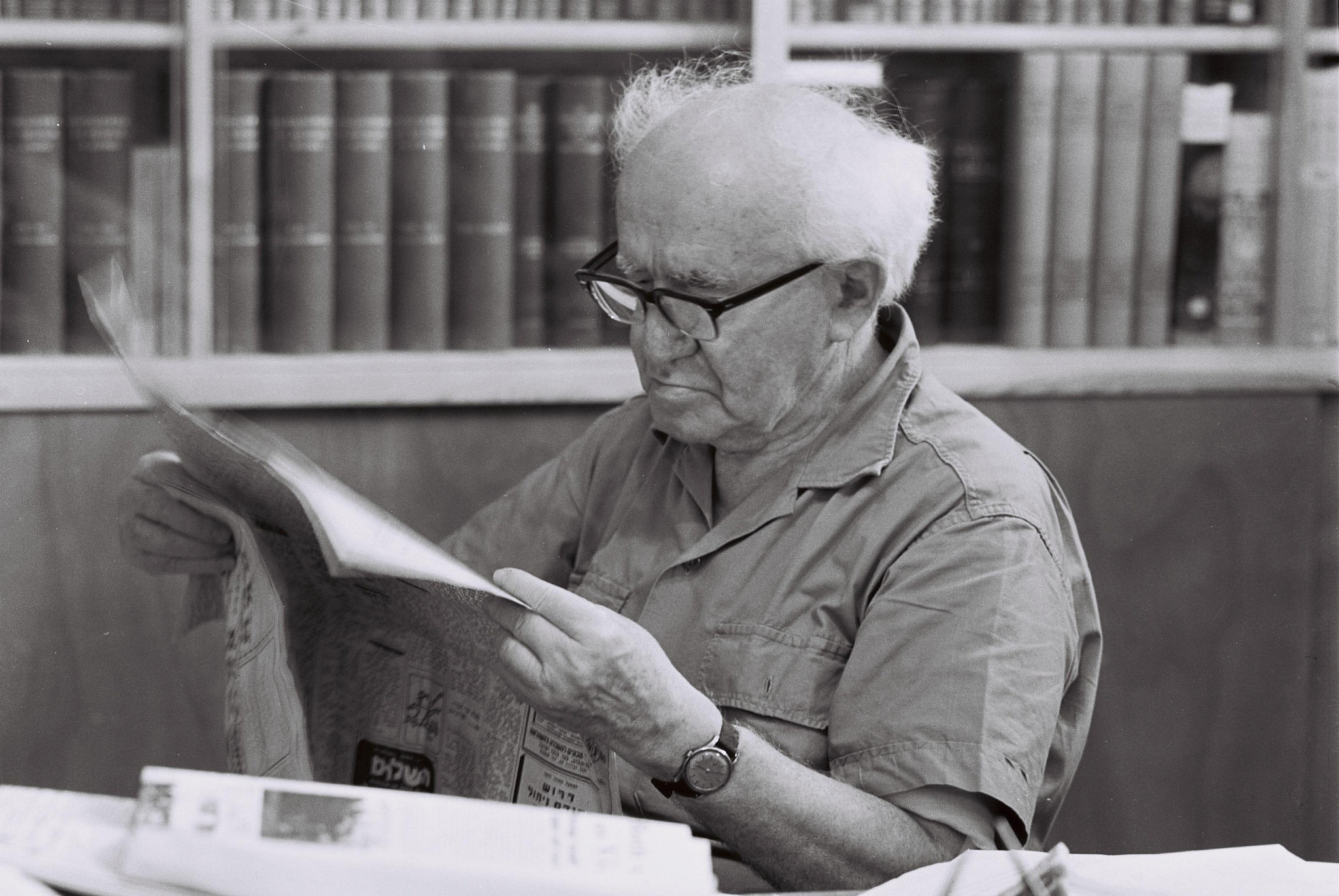
If Ben-Gurion went too far in implying that Jews must live in Israel,
insisting that Jews have the right to live Jewishly there was exactly on
target
David Ben-Gurion in his library in Sde Boker.
Yom or Chag HaAtzmaut is this coming week. I don’t give a toss for what the world thinks. For me, it is a day to celebrate.
But there are issues worth dwelling on.
Once that anti-Zionism and antisemitism were two different pathologies.
After all, on the right and the left, the secular, and the religious
there have always been Jews who have opposed Zionism as a political
movement on principle.
Sadly, as a general rule, it is now
clear that is not the case. Bomb threats against synagogues, schools,
and Jewish institutions around the world are now everyday events. The
pretense, or perhaps the delusion, is over.
I was brought up in a passionately
religious Zionist family. My late father objected to religious parties
on principle because of the inevitable corruption that is always
associated with politics. At the same time, his religious inspiration
came from what we would call the Haredi world, which certainly did not
describe itself as Zionist. However, not all of them are opposed to the
idea of a Jewish state. My father was not blind to Israel’s faults and
fissures, but he was completely committed to the idea of a Jewish return
to Zion. He insisted that we speak Hebrew and that even in prayer we
used modern Hebrew or Ivrit, as opposed to the old Ashkenazi
pronunciation that he was brought up on. And in the year before he died,
in 1962, he had already decided to set up a Jewish school similar to
Carmel outside Zichron Yaakov in Israel.
I went to a yeshiva in Israel first in
the late 1950s. I witnessed then the divide that existed between the
parties on the left and those on the right. The secular and the
religious. In the early years of the state, Ben-Gurion, the prime
minister held the view that now that political Zionism had achieved its
aim of a Jewish state it was no longer necessary to preserve the
distinction between Zionism and Judaism. But largely as a result of
pressure from the United States of America and a reluctance to change,
he was forced to backtrack on his assertion that what defined a Jew was
whether he or she came to live in Israel in a Jewish homeland.
I too always had deep reservations
about Israeli politics. I identified with the worldview of the great
Chief Rabbi Avraham Isaac Kook (1865-1935), who tried to reconcile
Jewish spiritual universality with deep religious commitment. I
wholeheartedly supported the idea of a Jewish homeland not just for the
negative reason that Jews needed somewhere to escape to when the world
turned against us, but as a return to the biblical ideal of a holistic
nation with its own traditions in an alien world. Over my career both in
Israel and the Diaspora I have worked for reconciliation and
understanding between Jews and other religions and between Israelis and
Palestinians, both organizationally and personally. I have always been a
peacenik and believed in exchanging land for peace and reconciliation. I
felt that occupation would have a negative impact on the occupiers. But
one needed a willing peaceful partner and I have yet to be convinced
that so far there has been one.
I was always aware of both Jewish and
non-Jewish antisemitism in Britain. And political opponents of Israel
both from Fascists and the Marxists. At Cambridge University, we had to
defend our right to a homeland at Union debates. I recall a conference
organized by the British Foreign Office I attended 30 years ago between
Jewish and Palestinians, including Hamas representatives, that aimed to
increase understanding on both sides. The Hamas spokesmen admitted quite
openly that there would never be a lasting peace until Israel was
destroyed and the most they would ever agree to, was a hudna, a ceasefire, no more.
I realized then that war, hot or cold,
hatred for our very existence, would wax and wane, but never go away.
Two families inhabiting the same house who will neither compromise nor
fight. Intransigence and violence have always been at the root of the
issue. From the era of Trumpeldor through the Arab massacres and riots
in 1929 and declarations of war, violence has never ceased. And now
more than ever it is clear that it never will. When all nations lay down
their swords, when all nationalism is abolished, then perhaps we may
enter a messianic perfect world. But as long as hatred, competition, and
ideological conflict persist we will never know permanent peace. That
is the sad and at the same time the noble reality of being Jewish.
Ben-Gurion was wrong to imply one
cannot be a Jew outside Israel. But he was right to stress that it was
the Jewish right to live Judaism in their own land (in whatever degree
they chose), without having to live under other nations. This is why
Israel’s independence is so important and worth fighting for no matter
whether we agree or not or what the rest of the world may think.
Politics is corrupt and culture is both creative and divisive. This is
probably why all religions have some form of messianism that looks to a
supernatural force to bring everyone together. It hasn’t worked so far.
But we must not give up the idea or stop fighting for it.
I do incline to retire Zionism as a
separate ideology. But either way and regardless we celebrate Yom
HaAtzmaut this year, even as we are also experiencing universal hatred
as never before in our lifetime. Which only reinforces how important it
is for us to be strong. And combat negativity with joy, celebration, and
optimism.
How America is using ex-IDF Chief Benny Gantz as its Trojan horse to impose U.S. demands—and ensure Israel’s defeat in Gaza
Israeli
war cabinet member Benny Gantz arrives at the U.S. State Department in
Washington ahead of a meeting with U.S. Secretary of State Antony
Blinken on March 5, 2024
In
the eyes of the Biden administration Hamas is the smaller problem. The
bigger problem is Benjamin Netanyahu. The U.S. is willing to live with
Iran’s proxies everywhere, as part of its “regional integration”
policy—i.e., appeasing Iran. But they are unwilling to live with
Benjamin Netanyahu’s coalition. The stubborn Netanyahu clearly does not
want to learn from his would-be tutors like U.S. Secretary of State
Antony Blinken how to “share the neighborhood” with genocidaires in
Gaza, Judea and Samaria, Lebanon, and Tehran, whom his electorate
understands to be bent on murdering them.
If
the Netanyahu problem is too big to contain, then it follows that it
must be solved. And it seems that the Biden administration has zeroed in
on what Tony Badran has called a Herodian solution: finding a local proxy who will impose the U.S. agenda on a reluctant Israeli electorate.
King
Herod the Great won his throne because the Roman Empire stepped in and
helped him defeat his Israelite adversaries. The American empire wants
to help install Benny Gantz as Israel’s next prime minister for the same
reason: The plan is for the administration to help him defeat
Netanyahu, then for him to assemble a dovish coalition that will return
Israel to the two-state track negotiations—which, though unlikely to
produce two states, would nevertheless help “de-escalate” in Gaza, the
last hot spot in the region where Iran’s power is actually challenged.
Since
the whole Democratic Party’s Middle East policy is at stake, the
pressure on Israel has been relentless. Never before has an American
administration worked so systematically to undermine Israeli democracy
and sovereignty, an effort that is especially shocking in the context of
an existential war for survival following a heinous, large-scale
terrorist murder spree. Wars provide opportunities, and it seems clear
that the opportunity that the Biden administration saw in the Oct. 7
attacks had less to do with ensuring Israel’s security than it did with
stifling any remaining resistance to Washington’s pro-Iran regional
integration policy.
If
it is to survive at all, Israel must break the noose that Iran is
assembling around us, and which the Biden administration is actively
promoting and protecting.
The
U.S. is holding Israel on a leash by rationing the American-made
ammunition on which the war effort depends; it has forced us to supply
our enemies with “humanitarian aid” which Hamas controls and which
sustains its ability to fight; the U.S. is building a port to subvert
our control of the flow of goods into Gaza; it refrained from vetoing an
anti-Israel decision at the U.N. Security Council at the end of March;
it leaked its intention to recognize a Palestinian state unilaterally;
it allowed Iran to attack us directly with a barrage of over 300 rockets
and drones without paying any price whatsoever; and then told us that
Israel’s successful defense against that strike (which was mostly
stopped by a combination of superior Israeli tech and faulty Iranian
missiles that crashed all over the Middle East, and to some extent by
U.S. interceptors) should be considered “victory”; it consistently
protects Hezbollah from a full-fledged Israeli attack; it did all it can
to prevent the ground invasion of Rafah, which is necessary for winning
the war; it is trying to stop the war with a hostage deal that would
ensure Hamas’ survival.
The
U.S. is not protecting Israel from the kangaroo courts in The Hague
which now threaten to issue arrest warrants against Netanyahu and
others. Instead, it is goosing those warrants, in part by itself
threatening to impose sanctions on a unit of the IDF, thus subverting
the chain of command and pressuring IDF units to comply with American
demands rather than with orders from their superiors. At one point,
Secretary of State Blinken outrageously asked for a one-on-one meeting
with IDF Chief of Staff Herzi Halevi (he was refused), treating the
commander of Israel’s armed forces as if he was answerable to a delegate
of a foreign power.
Meanwhile,
the entire Democratic Party apparatus from Joe Biden on down has
continued directly attacking Netanyahu in the harshest, most personal
and demeaning terms, publicly proclaiming their contempt for Israel’s
wartime leader. Biden called Israel’s elected prime minister “a bad
fucking guy,” while Senate Majority Leader Chuck Schumer went so far as
to explain to Israelis they made the wrong choice in their elections.
Senior Democratic Congressman Jerrold Nadler went Schumer one step
better, proclaiming Netanyahu to be the worst Jewish leader in “2,000
years”—i.e., in the period since Herod.
The
White House appears to be pushing prominent Jewish Democrats to attack
Israel’s prime minister in order to avoid charges of being “anti-Israel”
or “antisemitic”—a charge that could damage Democrats in key states
like Florida, Arizona, and Michigan as Jewish voters see their children
pushed off campuses by a combination of anti-Jewish DEI bureaucrats and
pro-Hamas mobs. But it’s not hard to see through this ploy. In fact, the
White House has its own proxy mobs of demonstrators inside Israel,
which it regularly encourages to take to the streets at key moments.
According to the leaders of the Never-Bibi demonstrators, the White
House is in constant touch with them for coordination.
What
all of these shockingly openly subversive moves against a key U.S.
military ally have so far not produced is the desired result—a
subservient government run by the would-be King Benny. The American
candidate for the Herodian role kept straying from the script (which is reportedly why he was summoned to Washington to be reprimanded).
There
were reasons for his straying, though. Whenever the attack on Israel’s
sovereignty, democracy, or even on Netanyahu personally, became too
blunt, Gantz who understands his electorate well enough, rallied to
defend Israel’s sovereignty and our right to choose our own government.
This is not because Gantz has given up on replacing Netanyahu: It’s just
that he knows he cannot win an election in Israel by appearing to join
the U.S. in attacking Israel’s most vital interests or in undermining
our independence. Most importantly, any attempt to topple Netanyahu in
the name of imposing a two-state solution is bound to backfire,
especially with the post-Oct. 7 Israeli electorate.
Now,
however, it seems that Washington and its would-be Herodian candidate
are finally on the same page. This may be because the administration
learned how to drape its attacks in the clothes of Israel’s interest:
Emphasize “Saudi normalization” and “international coalition,” downplay
“two-state solution,” stress “saving the hostages,” tone down talk of
ending the war, and so on. Or it may be that Gantz has received
assurances from the U.S. that it will turn its maximum pressure campaign
against Netanyahu all the way up, by facilitating the delivery of ICC
indictments. Whatever the reason, Gantz has finally thrown down the
gauntlet.
Gantz announced his open challenge to Netanyahu in a strained, grammatically tortured tweet
burdened by the need to pretend that his new position is not a betrayal
of his old one. It is a jumble of contradictions revolving like space
debris around a dying star. It reads:
The
incursion into Rafah is important in the long struggle against Hamas.
Returning our hostages, who were abandoned by the government of October
7, is of far greater importance. If a responsible deal for the return of
our hostages, with the backing of the whole security establishment, and
not conditioned on ending the war, will be prevented by the ministers
who led the government on October 7, then the government would no longer
have the right to continue to exist and direct the war.
The
gist of it is not hard to decipher: Let’s end the war but call it
something else. Otherwise, we’ll topple Netanyahu. But the packaging is
no less instructive. First Gantz accepts the terminology of the
permanent Never-Bibi protest, which keeps blaming this government for
having “abandoned” us on that terrible Shabbat. Gantz further emphasizes
that the responsibility lies solely with Netanyahu and his government
of Oct. 7—that is before Gantz and his party joined the coalition.
That’s
precious, because Gantz himself was an active party to, and in
important cases the main author of, the misconceptions that led to the
failure of Israel’s defenses on Oct. 7. He was deputy IDF chief of
staff, IDF chief of staff, minister of security, and also “alternate
prime minister” with Netanyahu.
As
chief of staff, Gantz drastically cut the IDF’s ground forces in line
with the vision of “a small technological army” based on the false
assumption that large-scale ground wars are a thing of the past. He was
the highest-ranking member of a security establishment that pushed their
belief that Hamas could be pacified by allowing in Qatari money and
letting Gazans work inside Israel. As minister of security, Gantz
oversaw the inauguration of the high-tech security barrier on the Gaza
boarder, which he assured the West Negev residents will protect them
from Hamas and allow them to flourish, and that, he said,
will be “our great victory” over the terrorists. So confident was Gantz
in the effectiveness of the high-tech barrier that he ordered disarming
civil defense squads in small villages and kibbutzim in the Negev due
to repeated theft of assault firearms. We know what that led to. The
places that disregarded Gantz’s orders and retained their weapons were
able to hold out longer and save many more lives.
But
Gantz’s tweet was more than an exercise in self-absolution for people
with short memories. He also inched toward adopting the reframing of
Israel’s war aims so as to make returning the hostages Israel’s foremost
goal, even at the price of defeat in the war. Returning the hostages is
“of far greater importance” than invading Rafah now, he proclaimed,
offering the fig leaf that Rafah can be invaded at some other point in
time, “in the long struggle against Hamas.”
Lastly,
Gantz created a dichotomy between “the whole security establishment,”
which endorses a deal, and the “ministers who led the government on
October 7,” who are against it. The security establishment is presumably
rational and professional, and the “ministers who led the government on
October 7”—including Defense Minister Yoav Gallant, it seems—are a
bunch of heartless right-wing amateurs. Except, of course, the job of
the security establishment is to be in charge of security. After Oct. 7,
the massive failure of 20 years of security establishment doctrine is
fully out in the open. Unsurprisingly, Gantz’s tweet received a very
uncomfortable ratio of comments to likes.
Still,
Tony Blinken had reason to be satisfied. At long last, Gantz seems
willing to play the role the administration has assigned him: exploiting
the rift in Israel’s society by unequivocally taking the side of the
small but powerful Never-Bibi faction, in a bid to replace Netanyahu at
the helm.
Tony
Badran wrote “The New Herodians” back in the days of the struggle over
the reform of the judiciary. Netanyahu was already a thorn in the side
of Biden’s “regional integration” policy, since he insisted that Iran’s
drive to attain nuclear weapons must be stopped by any means necessary.
The Biden administration pretended to care about judicial reform, but,
as the Democrats’ critique of the Dobbs decision by the U.S.
Supreme Court clearly suggests, it is not because they are for
all-powerful judiciaries. The issue was always Netanyahu.
What
Badran argued about the American intervention back then is doubly true
now that the interventions are so much more crude. But his argument was
not just a critique of American hypocrisy and anti-democratic tactics.
The comparison with Herod was meant to teach a lesson about the price
Judea paid for Herod’s strategy. The alliance with the Roman giant
ensured Herod’s victory over his Jewish rivals in internal Judean
politics, but the cost was the loss of Jewish independence altogether.
Herod
gained power and prestige, and his family became intimate with Rome’s
rulers—but none of that saved Israel. Instead, the Herodian policy
eventually turned the land of Israel into a province of the empire under
direct Roman rule. Judea’s loss of independence from Rome led in turn
to the destruction of the Second Temple and the exile for two millennia
for most of the Jewish people, leading to a situation of existential
powerlessness in the face of expulsions and pogroms which culminated,
within living memory, in the Holocaust. So how did the Herodian strategy
turn out for the Jews? Not well.
Can
such a nightmare return? Yes, it can. It is not at all clear that
Israel can survive four more years of a Democratic administration
determined to carve out a Palestinian terror state in the heart of the
land of Israel, as part of an “integrated”—that is,
Iran-dominated—Middle East. If it is to survive at all, Israel must
break the noose that Iran is assembling around us, and which the Biden
administration is actively promoting and protecting. Once Iran actually
gets nuclear weapons, the danger will increase exponentially.
But
it is also not clear that the attempt to install Benny Gantz at the
head of a dovish coalition, subservient to the administration, can
actually work.
True,
the U.S. has a lot to work with. Israel’s progressive elites are small
but formidable, as they have demonstrated in defeating an elected
government in the struggle over judicial reform. And that elite still
believes in a two-state solution and is very much on board with the
American plan to impose it against the majority’s will. Israel’s left
long ago gave up on persuading the electorate to support the creation of
a Palestinian state, and is entirely comfortable with the use of
extra-democratic means to impose its desired solutions on its domestic
foes. Like the Hellenized elites of Herod’s day, it sees imperial
domination as a way to support its own idea of Jewishness allied with
power against the retrograde elements in its midst.
Gantz’s
tweet underscores that the elite power base, which is entrenched in the
upper echelons of the military and security establishment, supports the
cease-fire plan. This group already exercises great influence on the
way the war is waged. It has worked to undermine the possibility of
Israeli long-term control of the Gaza strip and has dragged its feet
against Netanyahu’s promise to enter Rafah. Then there is also the
almost unanimous support of the press, whose major role here has been to
demonize anyone who opposes surrender to Hamas via a hostage deal as
heartless. There is also our all-powerful Supreme Court and highly
politicized law enforcement agencies, and finally, the business
community and especially its high-tech sector whose entrepreneurs tend
to lean to globalist views and are funding the ubiquitous billboard
campaign that blames Netanyahu for everything (and no one else for
anything).
But
there is also one deep flaw in the plan to impose the American policy
via an alliance of elites under the figurehead of Gantz. Gantz’s
popularity rests on ambiguity, which is why he persistently declined to
answer questions about his views on the question of a Palestinian state.
His only path to victory is by striking a hawkish security pose, and
remaining vague about two-state negotiations. That’s because the hawkish
majority in Israel has only grown after Oct. 7.
This
majority will be furious with Netanyahu if he does not deliver victory.
But to capture the disaffected vote, you can’t offer defeat, let alone a
nonexistent two-state solution. There are still some 100,000 evacuees
who cannot return home to the western Negev or to the north near the
border with Hezbollah in Lebanon. No hostage deal will convince them
they will now be safe. Moreover, Israelis saw what a determined band of
terrorists can do from tiny Gaza. They will not easily opt for a
government willing to give the much better armed and trained terrorist
Palestinian Authority a chance to do the same from the far bigger area
of Judea and Samaria, perched above Israel’s vulnerable coastal plain.
While
King Herod’s power relied on making his ties with the all-powerful Rome
as conspicuous as possible, rubbing shoulders with the would-be
rescuers of Hamas is bound to be a liability for Gantz with his
potential voters. And once the U.S. recognizes a Palestinian state, as
is rumored to happen this summer, Gantz’s electoral intrigues will
become a historical footnote—while the U.S. campaign against its Middle
Eastern ally continues.