Puritans in America
In the Massachusetts Bay, Plymouth, and other colonies,
Puritans set up new governments with the same source of power -
religious authority. These governments claimed that their right to rule
was granted to them by the Christian God, and therefore they had
absolute power to punish people for their thoughts, beliefs, words,
actions, and even their bad luck. People were humiliated, shunned out of
town, fined, beaten, mutilated, tortured, and killed. These acts of
punishment weren’t for violating civil laws, but interpretations of
divine laws.
Democracy
Most people believe their god is flawless. If a government claims to
derive its authority from a flawless God, then any decision made by the
head of state must also be flawless. Therefore, the power of that
government is unlimited....
The Constitution
Thomas Jefferson, in his letter to the Danbury Baptists reiterates that:
religion is a matter which lies solely
between Man & his God, that he owes account to none other for his
faith or his worship, that the legitimate powers of government reach
actions only, & not opinions, I contemplate with sovereign reverence
that act of the whole American people which declared that their
legislature should "make no law respecting an establishment of religion,
or prohibiting the free exercise thereof," thus building a wall of
separation between Church & State..
 |
| According to current estimates, approximately 0.2% of the world's population is Jewish. This means that out of the global population, only a small fraction identifies as Jewish |
The Jewish woman leading the fight against American Christian nationalism
Since 2018, Rachel Laser, the first Jew to
lead Americans United for Separation of Church and State, has worked
with Christian allies to keep religion from influencing US laws
JTA — For decades, Americans United for Separation of Church and
State called its adversaries “religious extremists.” Today, the group
has a more specific target: fighting Christian nationalism.
The decision to sharpen the language was made by Rachel Laser, the
group’s president for the last six years. A Jew and the first member of a
religious minority to lead Americans United since its founding in 1947,
Laser wanted the group to be more clear-eyed about what she sees as a
growing threat to religious pluralism in the United States: the belief
that American laws should favor Christian values over those of other
religions.
But it was not an easy decision for her to make.
“On some deep level, I worry about alienating Christians, as many
Jews do,” Laser wrote last year in the group’s magazine. “When you are
part of a mere 2% of the population, it can feel perilous to risk
fostering adversity with 65% of the population.”
That anxiety about the optics of her leadership surfaced even before
she took the job. During her interview, Laser recounted to the Jewish
Telegraphic Agency, she asked the board outright: “Why aren’t you hiring
Christian clergy?”
Americans United had always been led by pastors, but Barry Lynn, who
served as the organization’s previous leader, from 1992 to 2018, said he
welcomes a departure. If there were any concerns about having a Jew
lead a fight against Christian nationalism, Laser has proven it’s
possible to do so, he said.
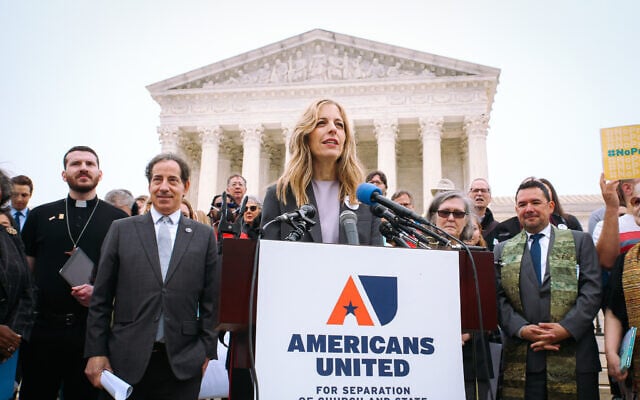
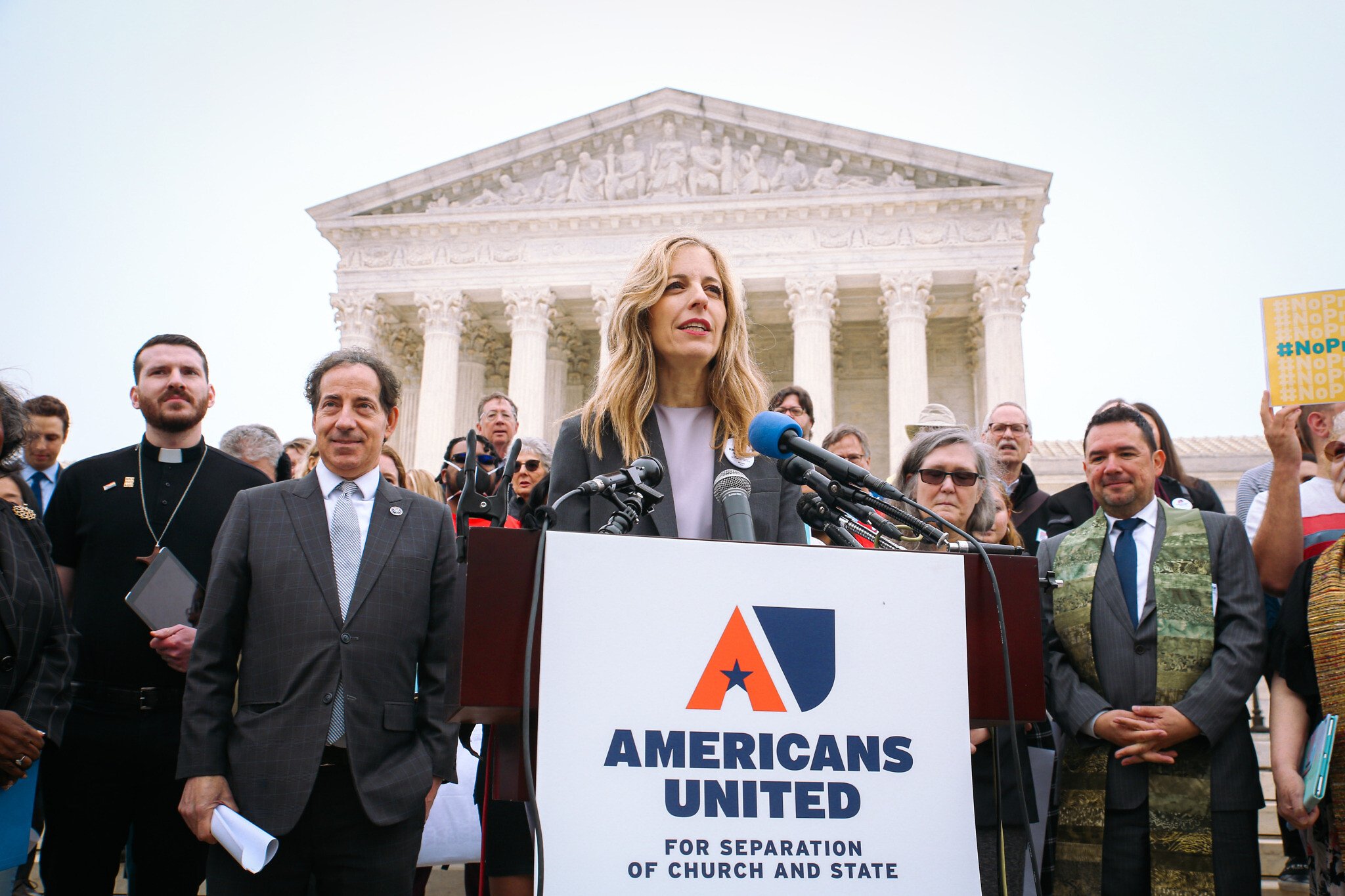
Rachel Laser, president and CEO of
Americans United for Separation of Church and State, speaks in front of
the US Supreme Court with Rep. Jamie Raskin
“I’ve thought about that a lot, but I just don’t think it’s a burden
or a problem because she works very collaboratively with board members
who are themselves Christians and she works in coalitions,” Lynn said.
“She understands the depths of the danger that Christian nationalism
presents to both Christianity and to religious minorities.”
Laser, 55, is married to intellectual property lawyer Mark Davies.
They have three children and the family belongs to Adas Israel, a
Conservative congregation in Washington, DC. She began her journey in
Chicago, where she grew up with Jewish activist parents who didn’t
prioritize religious life. But when she followed a friend to Sunday
school, she encountered Rabbi Arnold Jacob Wolf, a progressive Reform
Jewish leader who was deeply involved in civil rights and other social
justice causes.
“I was a very curious kid, and he encouraged me to ask questions,”
Laser said, fighting back tears as she recalled Wolf, who passed away in
2008. “The more questions I asked, the more he appreciated me. That’s
why I value being Jewish.”
Laser (her name is pronounced LAZZ-er) carried those values into a
career focused on public service. After earning a law degree, she held
senior roles in organizations advocating for reproductive rights, including as the deputy director of
the Religious Action Center.
“She’s a knowledgeable Jew who cares deeply about Jewish concerns,”
said Rabbi David Saperstein, who led the Religious Action Center during
Laser’s time there. “She fit very comfortably into the view that social justice was a central part of what it means to be a
Jew.”
He said he hired her because she was already a proven bridge builder,
and it was important for the organization to work across political and
ideological lines in Washington. It’s a skill that would be critical
when Americans United tapped her in 2018, tasking her with adapting the
group for a polarized era.
She took the helm during the second year of Donald Trump’s first
presidency, as debates over religion in public life were intensifying.
Laser commissioned research to gauge public attitudes and test Americans
United’s messaging.
The results were mixed. “Religious extremism” resonated with most
audiences, but “Christian nationalism” was less familiar — and even
sounded positive to some people.
“We didn’t want people to think we were insulting Christianity or
patriotism,” Laser said, so she decided against emphasizing the term.
Then came the January 6, 2021, assault on the US Capitol.
Laser saw the insurrection as a wake-up call. In the rioters’
biblical rhetoric and religious rituals, she recognized Christian
nationalism as a potent and underappreciated threat. She soon hired
Andrew Seidel, a prominent critic of Christian nationalism. On his first
day as the new vice president of strategic communications at Americans
United, Seidel testified before Congress about the role of Christian
nationalism in the Capitol insurrection.
Americans United began using the term regularly, aiming to educate
the public while highlighting church-state separation as a critical
countermeasure.

Violent rioters, loyal to President Donald Trump, storm the Capitol in Washington, January 6, 2021.
“The antidote to Christian nationalism is church-state separation,”
Laser said in an interview. “It’s the kryptonite that prevents Christian
nationalists from codifying their views into our laws.”
Under Laser’s leadership, Americans United has taken high-profile
legal actions, such as suing Oklahoma over its proposed religious
charter school and representing a Tennessee Jewish couple rejected by an
adoption agency due to their faith. The group also helped raise
awareness earlier this year about Project 2025, a detailed conservative
proposal for Trump’s second term from the Heritage Foundation.
Donors have responded to these efforts. In 2023, the organization
reported $17.9 million in revenue — almost triple what it was raising
before Laser took over.
But Laser’s tenure hasn’t been without controversy. The
organization’s employee union and some former board members have accused
her of fostering a toxic work environment and prioritizing publicity
over policy and legal work. After commissioning an outside investigation
of the organization’s work culture, the board said Laser has its full
support.
Laser’s efforts to counter Christian nationalism reflect broader
tensions in American society. While religious affiliation is declining,
Trump’s political alliance with the Christian right has energized a
vocal minority.
“I love you, Christians,” he said on the campaign trail. “In four
years, you don’t have to vote again, we’ll have it fixed so good you’re
not going to have to vote.” And the vast majority of them did vote for
him.
Since the election, Trump has put together for his next
administration a slate of deputies that reflects his strong political
alliance with the Christian right, from his nominee for White House
budget director Russell Vought to his preferred candidate for defense
secretary, Pete Hesgeth.
But while giving Republicans a resounding victory, American voters
also rejected many of the specific policies promoted by conservative
Christians. In seven states, including four won by Trump, voters
approved measures to protect abortion rights. All three state proposals
to allow public funding to flow to private and religious schools were
defeated. Laser calls these outcomes a rejection of Christian
nationalism and a continued endorsement of the principle of church-state
separation.
In saying that a solid majority of Americans agree with her
worldview, Laser relies on surveys like those from the Public Religion
Research Institute.
“We find that by a margin of about two to one, most Americans reject
Christian nationalism,” said PRRI’s president, Robert Jones.
He said he’s confident in the results because the statements the surveys test against are ”fairly unambiguous.”
“They’re things like, ‘US law should be based on the Bible,’ ‘To be
truly American, you must be Christian’ and ‘Christians should take
dominion over all areas of American society,’” he said.
As the term “Christian nationalism” has come into play in recent
years, Jones’s group has been studying how people respond not only to
the underlying attitudes, but also to the term itself.
“We are finding people who qualify as Christian nationalists based on
our criteria have a positive view of the term, and people who are
rejecting that worldview have a negative view of the term,” Jones said.
“So it’s not just a term used by one side to smear the other.”
The phenomena can be seen in the strong sales of a 2022 book called
“The Case for Christian Nationalism,” by conservative political theorist
Stephen Wolfe, and in prominent politicians, like US Rep. Marjorie
Taylor Greene and Sen. Josh Hawley, who have embraced the moniker.
But even as one term has become more common, the question of what
language to use is far from settled. Advocates on either side of the
debate over the place of religion in public life make various choices
for strategic or other reasons.
Sorting through the rhetoric has required substantial attention from
Ruth Braunstein, a professor of sociology at the University of
Connecticut. That’s because earlier this year, she was awarded a grant
from the Henry Luce Foundation to map out the individuals and groups
fighting Christian nationalism.
Many of the 100 groups added to the list so far don’t use the term Christian nationalism.
“Some, for example, talk about defending or promoting pluralistic
democracy,” Braunstein said. “Others talk about creating a more
inclusive vision of American identity.”
A growing bunch, including Americans United, do. And for Braunstein,
it was easy to figure out how Laser’s group fit into her project.
“They have a high profile, historical gravitas and respect, and the
resources to be able to provide support to other organizations,” she
said. “So I think of them as an important node in this broad network.”
A few weeks ago, Laser went on CNN to be briefly interviewed about
her opposition to plans in Oklahoma and Texas to bring Christianity into
the classroom. She didn’t mention anything about her identity. She
simply delivered Americans United talking points: Parents, not
politicians, should decide when and if children are exposed to religion;
state mandates sully rather than enhance religion; mixing church and
state goes against the country’s founding ideals.
But one viewer who contacted CNN to complain about Laser’s statements
discovered through Google, or correctly assumed, that Laser is a Jew.
He made her identity the center of a lengthy tirade, which he ended with
a broad threat.
“When Jews go into the public square to attack Christianity, then we
have a problem,” the angry viewer wrote. “Stop abusing the people that
treat you kindly because, eventually, the patience will run out.”
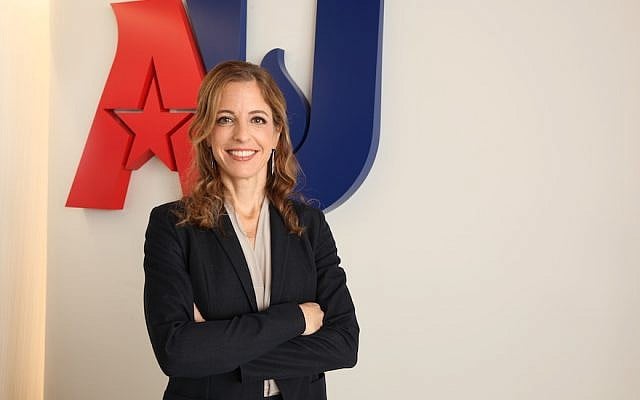
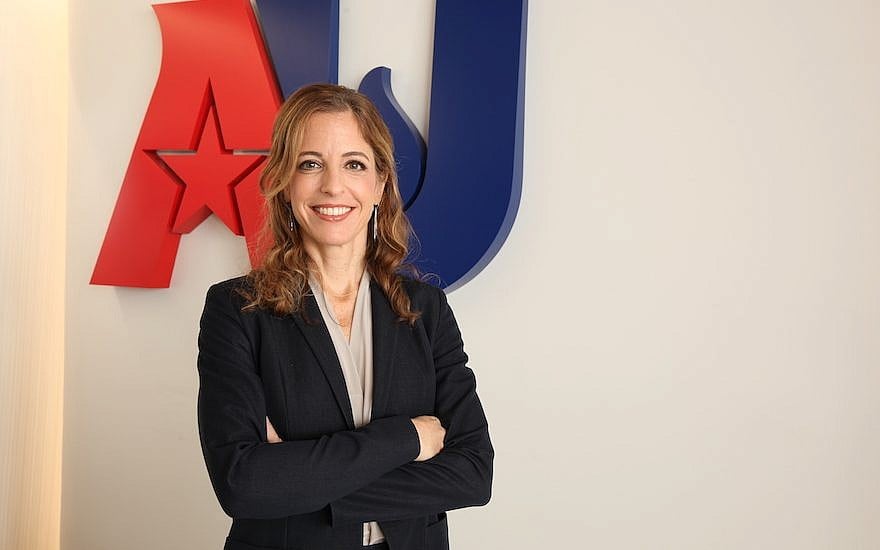
Rachel Laser, executive director of Americans United for Separation of Church and State.
Asked if this kind of threat gives her anxiety about the place of
Jews in the United States, she said, “Firstly, I’m Jewish. There’s
always anxiety. So, fair question.”
But then she went on to emphasize that she’s never felt alone in her activism. She’s always surrounded by Christian allies.
As soon as she took the helm, for example, she set up a faith
advisory for Americans United and packed it with pastors (as well as
other faith leaders). When her group files lawsuits against policies it
opposes, it always includes Christian plaintiffs.
“It’s more important to make it clear that Christians are leaders in
this cause,” she said. “In any case, however, I don’t plan to go
anywhere. This country has given so much to Jews and I feel gratitude
for that. I want to ensure that my kids and my kids’ kids can enjoy and
be proud of the same America.”
https://www.timesofisrael.com/meet-the-jewish-woman-leading-the-fight-against-american-christian-nationalism/?