


Chabad and the Bondi Shooting
By Michael Cohen
I was sitting in a restaurant and about to sing “Happy Birthday” for a relative when a message came through. I heard my brother’s voice, quivering. He told me not to worry, that he was okay — I could barely hear what he was saying because the line was muffled. I rang him straight back.
Minutes earlier, he had been watching the ceremonial Chanukah getting lit as waves crashed along Bondi Beach. His children had been playing on inflatable play equipment set up for the event when, all of a sudden, the sound of gunfire broke out. Somehow, and I still do not know how, he and his children managed to get away; witnesses have said that my brother was directly shot at and bullets landed near his children. Nevertheless, his quick thinking and swift movement saved them all.
By the time we spoke, his voice was calm enough. He had been changed as a person, but he was still alive. Two other people I’d known were not so lucky.
This article is written in the shadow of that day. Nothing I say here reflects the views of my brother. He is a deeply religious person with deeply held convictions. In this essay, I speak entirely for myself.
My roots in Sydney and Bondi go fairly deep. My mother was a Holocaust survivor from Poland, while on my father’s side I am a sixth-generation Australian. My great-great-grandfather, Maurice Abraham Cohen, came to Australia around 1893 to help establish the Sydney Chevra Kadisha, the organisation responsible for Jewish burials.
Through other ancestors, I can trace my roots in Bondi back to the 1850s.
Furthermore, Jews have lived in Bondi’s Art Deco apartment blocks for just as long the suburb has existed.
Simply put: As much as it is known for surfing, Bondi could be known for its Jewish population. Although it is rarely mentioned, the initial subdivision of Bondi was the work of the Hart family, a British–Portuguese–Jewish family. A surprising byproduct of the recent shooting is that Bondi’s identity as a Jewish suburb has now become firmly established in the international consciousness. Yet despite this recognition, a significant part of Bondi’s Jewish culture is slowly being chipped away.
Let’s be clear about this: Sydney is not a centre of Jewish culture — far from it. Although economically a highly prosperous community, its cultural output in regard to Judaism has never been much. Nevertheless, the city’s Jewish organic community in Bondi was built on the idea that it was not merely symbolic but a living culture, something to be argued, debated, and discussed.
Once, there was genuine debate within Sydney’s Jewish community about Israel — then Chabad arrived.
For those who may not know, Chabad is a Jewish outreach and education movement usually tied to more Orthodox Judaism. When Chabad took root in Bondi — an area with a Jewish presence but far from a Jewish identity — it introduced an absolutism that largely replaced the previous pluralism. Replacing debate with absolutism inevitably attracts the hostility of competing extremisms.
I unfortunately became involved with Chabad from a young age, albeit only for a short period. I experienced its disdain for secular education and knowledge, its hostility towards independent thought, and its cult-like conformity.
Nor, in my experience, did Chabad live up to the values it preached. I personally witnessed serious child sexual abuse while I was involved with them, which they attempted to cover up.
Over the past 40–50 years, this group that I regard as a cult has — synagogue by synagogue and organisation by organisation — taken over much of the Jewish community. It did not happen overnight but over decades. Unlike the development of Bondi’s Jewish communities, there was nothing organic about Chabad’s growth. As it came to control communal institutions, Chabad increasingly excluded those who were not part of the movement — those of us who are more Reformed or secular Jews. Community spaces became effectively monopolised, and viewpoints that diverged from the Chabad worldview were gradually pushed to the margins.
I believe many Jews take part in Chabad for honest reasons, but in practice, I think its influence is often pernicious. Chabad promises outreach and connection, and those it often connects to are Jews struggling with doubt or weighing the complexities of their identities. It takes advantage of the fact that many Jews have become alienated from their heritage — whether religious, philosophical, or cultural — and it replaces debate with certainty, questioning with obedience, and complexity with easy answers. It substitutes what was once Jewish culture with what I see as the cult of Chabad
No Jew takes pleasure maligning fellow Jews, and I certainly am not implying Chabad is to blame for the shooting, but the larger Chabad movement is something I think warrants skepticism. In my opinion, even its stated goal of increasing Jewish consciousness is largely disingenuous. Ultimately, Chabad functions more like a business than a genuine cultural revival, feeding off Jewish identity while replacing Judaism with shallow, easily digestible garbage.
Judaism is a living, breathing culture. Traditionally, you were Jewish because you lived as a Jew— through language, ideas, customs, argument and shared memory. The people drawn to Chabad believe they are experiencing authentic Jewish culture from Eastern Europe. In reality, it is anything but.
Chabad reduced Jewishness to a technical legal status. Most people are aware of the prevailing Orthodox view that Jewish status follows the mother. But Chabad elevated that principle into an absolute doctrine, making it the defining feature of Jewish identity. The culture, the intellectual tradition, the debate and the philosophy no longer mattered. What mattered was a single technical criterion: Your mother was Jewish, therefore you were Jewish. In doing so, Chabad transformed a living culture into a technical status, or worse, a kind of lowbrow mystical hocus-pocus.
In time, traditional Judaism was almost entirely replaced here by what I would call Chabad’s McDonald’s Judaism: a Judaism centered not on centuries of debate and scholarship but on the utterances of one man, the Rebbe. Increasingly, Judaism has itself come to be reduced to belief that one man was the Messiah who would one day rise from the dead — or, in the minds of some followers, something even greater.
Whatever creativity and independent thought had existed in Sydney’s Jewish community was replaced with Chabad’s psychobabble, pop psychology, and lowbrow mystical version of Judaism.
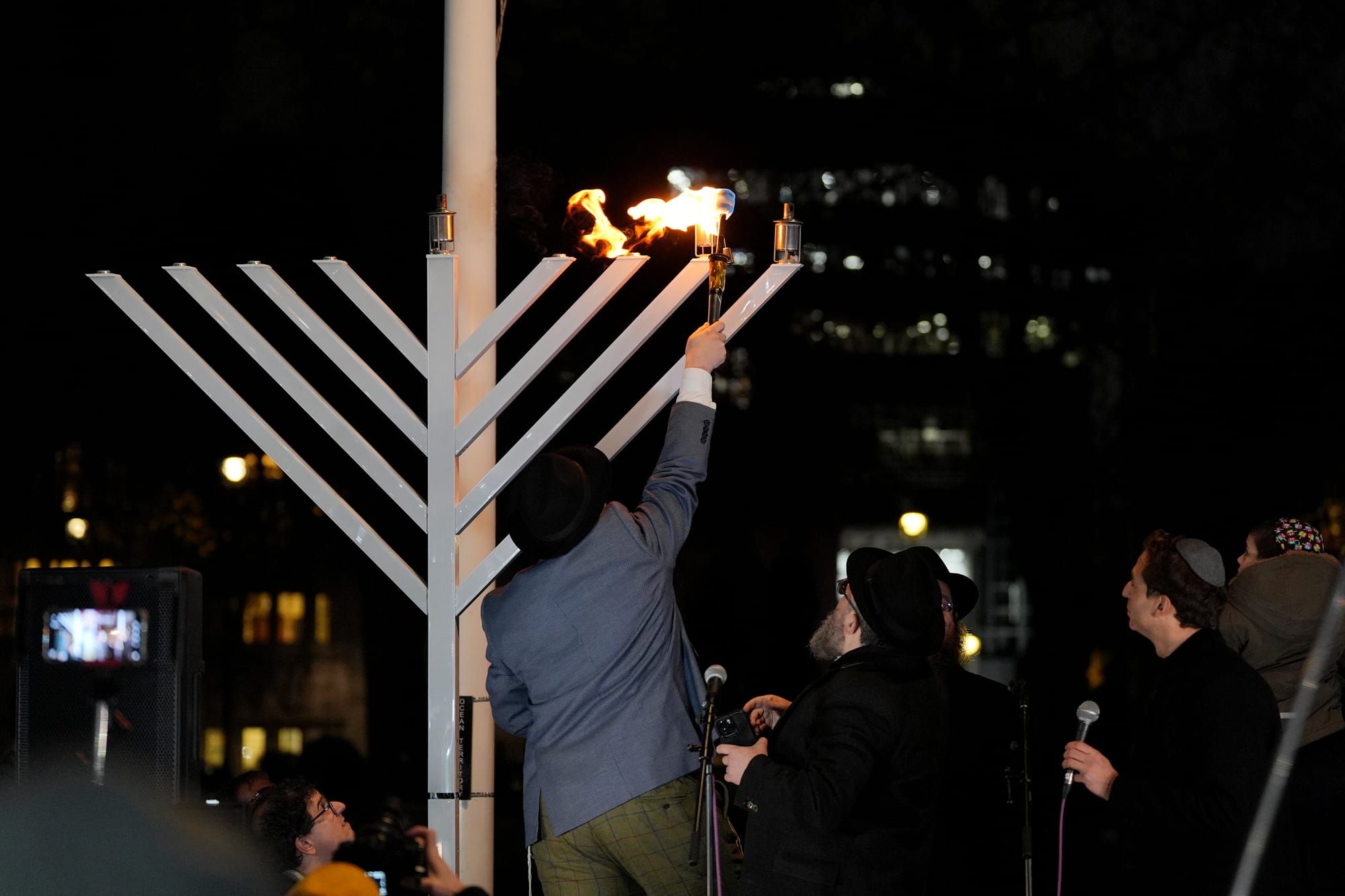
The Chabad Rebbe’s eccentric ideas about what constituted authentic Judaism became the status quo in Australia. The menorah, whose branches had almost always been depicted as curved throughout history, gave way to the baseless and far less elegant straight-branched version simply because the Rebbe believed that was how it should be. To me, the ugliness of the Chabad menorah reflects the ugliness of everything else the movement promotes.
Chabad behaved, metaphorically speaking, like the mafia, taking over institutions, eliminating rivals, and ensuring that everything within the Jewish community, financially and otherwise, benefited Chabad.
Chabad increasingly demands support for the most hard-line settler politics, embodied by figures such as Bezalel Smotrich and Itamar Ben-Gvir. Under its influence, the only acceptable position increasingly became unconditional support for right-wing Zionism, reflecting Chabad’s hostility towards anything progressive or left-wing. In the process, anything progressive — any voice advocating coexistence, peace, tolerance or basic human decency — is gradually pushed out of the community.
In fact, Chabad has openly declared on Chabad.org that the Lebanese, Gazans, Syrians and anyone else targeted by the governments of Netanyahu, Smotrich and Ben-Gvir are Amalek — that is to say, worthy of genocide. That is the group now running Sydney.
Synagogues are now heavily guarded by police. Barriers have been erected and security patrols are in place. Meanwhile, Chabad is milking the December shooting as hard as it can, presenting its movement as both innocent victims and the mouthpiece for Sydney Jewry. It is neither.
In my opinion, Chabad’s hijacking of this community, its hostility towards genuinely progressive values, and its contempt for politics centred on peace or coexistence plays a huge role in this state of affairs. If the Jewish community in Sydney is to continue, it must return to the pluralistic and moderate model it once had. Otherwise, I believe it is destined to slowly dwindle away.
Michael Cohen is a Sydney-based Australian journalist and writer published across a range of outlets. His work explores culture, identity, politics, history, and contemporary life.
https://www.readtangle.com/otherposts/chabad-and-the-bondi-shooting/