EVERY SIGNATURE MATTERS - THIS BILL MUST PASS!

EVERY SIGNATURE MATTERS - THIS BILL MUST PASS!
CLICK - GOAL - 100,000 NEW SIGNATURES! 75,000 SIGNATURES HAVE ALREADY BEEN SUBMITTED TO GOVERNOR CUOMO!

EFF Urges Court to Block Dragnet Subpoenas Targeting Online Commenters

EFF Urges Court to Block Dragnet Subpoenas Targeting Online Commenters
CLICK! For the full motion to quash: http://www.eff.org/files/filenode/hersh_v_cohen/UOJ-motiontoquashmemo.pdf

Monday, August 17, 2015

Obama's Lap Dog Barks --- Obama's Latest "Trade Deal" - Op Ed by Lew, Goes To Western Wall Incognito...

The High Price of Rejecting the Iran Deal


WASHINGTON — THE Iran nuclear deal offers a long-term solution to one of the most urgent threats of our time. Without this deal, Iran, the world’s leading state sponsor of terrorism, would be less than 90 days away from having enough fissile material to make a nuclear bomb. This deal greatly reduces the threat of Iran’s nuclear program, making Iran’s breakout time four times as long, securing unprecedented access to ensure that we will know if Iran cheats and giving us the leverage to hold it to its commitments.

Those calling on Congress to scrap the deal argue that the United States could have gotten a better deal, and still could, if we unilaterally ramped up existing sanctions, enough to force Iran to dismantle its entire nuclear program or even alter the character of its regime wholesale. This assumption is a dangerous fantasy, flying in the face of economic and diplomatic reality.

To be sure, the United States does have tremendous economic influence. But it was not this influence alone that persuaded countries across Europe and Asia to join the current sanction policy, one that required them to make costly sacrifices, curtail their purchases of Iran’s oil, and put Iran’s foreign reserves in escrow. They joined us because we made the case that Iran’s nuclear program was an uncontained threat to global stability and, most important, because we offered a concrete path to address it diplomatically — which we did.

In the eyes of the world, the nuclear agreement — endorsed by the United Nations Security Council and more than 90 other countries — addresses the threat of Iran’s nuclear program by constraining it for the long term and ensuring that it will be exclusively peaceful. If Congress now rejects this deal, the elements that were fundamental in establishing that international consensus will be gone.

The simple fact is that, after two years of testing Iran in negotiations, the international community does not believe that ramping up sanctions will persuade Iran to eradicate all traces of its hard-won civil nuclear program or sever its ties to its armed proxies in the region. Foreign governments will not continue to make costly sacrifices at our demand.

Indeed, they would more likely blame us for walking away from a credible solution to one of the world’s greatest security threats, and would continue to re-engage with Iran. Instead of toughening the sanctions, a decision by Congress to unilaterally reject the deal would end a decade of isolation of Iran and put the United States at odds with the rest of the world.

Some critics nevertheless argue that we can force the hands of these countries by imposing powerful secondary sanctions against those that refuse to follow our lead.

But that would be a disaster. The countries whose cooperation we need — including those in the European Union, China, Japan, India and South Korea, as well as the companies and banks that handle their oil purchases and hold foreign reserves — are among the largest economies in the world. If we were to cut them off from the American dollar and our financial system, we would set off extensive financial hemorrhaging, not just in our partner countries but in the United States as well.

Our strong, open economic relations with these countries constitute a foundation of the global economy. Nearly 40 percent of American exports go to the European Union, China, Japan, India and Korea — trade that cannot continue without banking connections.

The major importers of Iranian oil — China, India, Japan, South Korea, Taiwan and Turkey — together account for nearly a fifth of our goods exports and own 47 percent of foreign-held American treasuries. They will not agree to indefinite economic sacrifices in the name of an illusory better deal. We should think very seriously before threatening to cripple the largest banks and companies in these countries.

Consider the Bank of Japan, a key institutional holder of Iran’s foreign reserves. Cutting off Japan from the American banking system through sanctions would mean that we could not honor our sovereign responsibility to service and repay the more than $1 trillion in American treasuries held by Japan’s central bank. And those would be direct consequences of our sanctions, not to mention the economic aftershocks and the inevitable retaliation.

We must remember recent history. In 1996, in the absence of any other international support for imposing sanctions on Iran, Congress tried to force the hands of foreign companies, creating secondary sanctions that threatened to penalize them for investing in Iran’s energy sector. The idea was to force international oil companies to choose between doing business with Iran or the United States, with the expectation that all would choose us.

This outraged our foreign partners, particularly the European Union, which threatened retaliatory action and referral to the World Trade Organization and passed its own law prohibiting companies from complying. The largest oil companies of Europe and Asia stayed in Iran until, more than a decade later, we built a global consensus around the threat posed by Iran and put forward a realistic diplomatic means of addressing it.
The deal we reached last month is strong, unprecedented and good for America, with all the key elements the international community demanded to stop Iran from getting a nuclear weapon. Congress should approve this deal and ignore critics who offer no alternative.

Jacob J. Lew is the secretary of the Treasury.

http://www.nytimes.com/2015/08/14/opinion/the-high-price-of-rejecting-the-iran-deal.html?action=click&pgtype=Homepage&module=opinion-c-col-right-region&region=opinion-c-col-right-region&WT.nav=opinion-c-col-right-region&_r=0

Friday, August 14, 2015

Judaism's Power Struggle


Should the Jews have a pope? For most of the last 2,000 years, the answer has been “no.”

 Rabbinic authority has been decentralized, with each community choosing its own religious leaders to follow.

But now Israel’s Chief Rabbinate is seeking to monopolize and centralize control over Jewish law through the power of the state of Israel. A few Orthodox rabbis are fighting back, like those who announced a new conversion court this week. Because Israel won’t recognize the court, the battle is going to be joined in earnest.

And the stakes are big for 300,000 Israelis, descendants of immigrants from the former Soviet Union who identify as Jews but whose religious status under Orthodox Jewish law remains in question.

Start with the historical reasons Judaism doesn’t have a central authority like the Roman Catholic Church or a central leader like the pope. The answer isn’t in the Hebrew Bible, which has kings and high priests aplenty and envisions a functioning state, albeit one divided within a couple of generations into the separate kingdoms of Israel and Judah.

Decentralization within Judaism goes back to the rabbis who came to take a central position in Jewish religious life after the destruction of the Second Temple in 70 A.D., and the end of long-term Israelite sovereignty over what the Romans called Palestine. From the start, the rabbis had no Jewish state to call their own -- and if one had existed, they wouldn’t have ruled it.

With no state to enforce unity, it’s pretty hard for a religious authority to establish definitive control over believers. One of the brief moments in Jewish history in which rabbinic authority was somewhat centralized took place under the Abbasid caliphate in Iraq, where non-Jewish authorities recognized two chief rabbis, called Geonim, as the Jewish religious authorities. But it’s no coincidence that even then, there were two rabbis, not one, each the presiding authority over a separate Talmudic academy.

Thus, the rabbinic culture of disagreement and debate both fueled the diffusion of religious authority and also was shaped by it. Over the centuries, groups of rabbis would sometimes come together to issue collective legislation. But for the most part these were temporary coalitions.

In the 16th century, reacting to the Jewish expulsion from Spain in 1492, a handful of rabbis gathered in Safed, Israel, and dreamt of unifying Jewish religious authority. They hoped to re-establish a chain of rabbinic ordination that they believed would enable them to exercise universally accepted authority. But their dream never became an accepted reality, and their efforts were met with as much rabbinic opposition as approbation.

The modern state of Israel created a new opportunity for centralizing religious authority -- at least in theory. The state acknowledged two chief rabbis, one Ashkenazic (European) in origin, the other Sephardic (roughly, Mediterranean). More important, the state by legislative act created a “Chief Rabbinate” and gave it legal authority over marriage and divorce for all Jews, regardless of whether they were devout or secular, Orthodox or free-thinking.

To this day, no Jew in Israel can marry without the permission of the rabbinate. This real-world power gave the Chief Rabbinate a crucial foothold. Because the rabbinate doesn’t recognize or acknowledge marriage between Jews and non-Jews, the power over marriage is simultaneously a power over defining who counts as a Jew for the purpose of making this most basic life decision.

For the first several decades of its existence, the rabbinate faced ultra-Orthodox (Haredi) opposition to the idea that it had this overarching authority. Haredi rabbis were often skeptical of the state’s claims, and sometimes even opposed the Zionist project itself. Their insistence on controlling their own marriages (not to mention kosher supervision, another big business) ensured that the Chief Rabbinate wasn’t the only game in town.

Gradually over the past 20 years, however, the situation has been changing. Haredi attitudes toward the state of Israel have been softening as Haredi political parties have gained greater power and the Haredi population has grown. Haredi rabbis now play a far more significant role within the rabbinate and through influence from the outside. Rather than ignoring the Chief Rabbinate, prominent Haredi rabbis would now like to control it.

The Chief Rabbinate has never acknowledged the validity of conversions to Judaism performed by Reform, Reconstructionist or Conservative rabbis, a source of dissatisfaction among those denominations, which remain small and peripheral in Israel even as they make up the majority of Jews in the U.S. But it was some source of relief to know that even within the Orthodox fold, the rabbinate didn’t have total control.

Now that, too, is changing as the rabbinate, with Haredi support, asserts greater control over conversion.

Recently Israel was on the brink of adopting a slightly more liberal conversion process, intended to make it easier for the children of Soviet-origin immigrants to undergo conversion. But Haredi parties successfully blocked the move, ensuring that all conversion in Israel be centrally controlled by the Chief Rabbinate.

A group of more moderately oriented Orthodox rabbis have responded by creating their own independent conversion court, an exercise of the rabbinic diversity that has predominated in Jewish history. But because the rabbinate won’t recognize its conversions, people converted to Judaism by that court still won’t be able to get married in Israel.

Obviously, a liberal democratic state shouldn’t be giving any group of rabbis final say over who can get married. But liberalism isn’t the only reason to think that the Chief Rabbinate should be disestablished. Even from the standpoint of traditional rabbinic Judaism, the rabbinate is violating the spirit of rabbinic equality and diversity.

As a diaspora religion, Judaism survived and even prospered because of its lack of central authority. The existence of the state of Israel shouldn’t be used as an excuse to quash that diversity and the religious creativity it fostered.

This column does not necessarily reflect the opinion of the editorial board or Bloomberg LP and its owners. (or this Blogger).

To contact the author on this story:

Noah Feldman at nfeldman7@bloomberg.net

http://www.bloombergview.com/articles/2015-08-13/judaism-s-power-struggle

Thursday, August 13, 2015

14 Questions Democrats Should Consider on the Iran Deal


As Congress adjourns for its summer recess, Democratic lawmakers will be forced to assess and evaluate the Iran nuclear deal and its consequences. The Obama administration assured us on countless occasions that no deal was better than a bad deal, but in the words of Charles Krauthammer, the deal reached in Geneva with the mullahs represents the worst agreement in American diplomatic history. Here are some substantive and procedural points that congressional lawmakers will need to address when considering the merits of the Joint Comprehensive Plan of Action (JCPOA).

1) Under the JCPOA, Iran is permitted to have 24 days of advance notice before suspected nuclear sites can be inspected, giving them ample time to sanitize nuclear sites slated for scrutiny; does that sound intrusive?

2) Under the JCPOA, Iran is entitled to have access to intelligence information which leads analysts to suspect that the Iranians are cheating.  Will the Iranians be able to utilize that sensitive intelligence gathering information to circumvent detection methods in the future?

3) Article 10, Annex III of the JCPOA provides two clauses that compel the world powers to assist Iran in protecting its nuclear facilities against sabotage or other forms of attack. Does that mean that the United States must act to defend Iran against Israel if Israel decided to initiate a cyber or conventional attack against Iran’s nuclear facilities? And if the U.S. decides not to defend Iran, can Iran claim that the United States is materially breaching the terms of the JCPOA and unilaterally abrogate the accord, a scenario suggested by Senator Marco Rubio?

4) Secret agreements between the IAEA and Iran allow Iran to collect and hand over to the IAEA its own samples. Does that not materially taint the chain of custody?

5) Under the terms of the JCPOA, "snapback" sanctions can only be implemented after a lengthy and cumbersome procedure culminating in a UN Security Council vote and companies already doing business in Iran are retroactively exempted; does that sound like a "snapback" and is the U.S. willing to impose snapback sanctions for “minor,” incremental breaches or will it reserve its snapback sanctions for all but the most egregious violations?

6) Considering Iran’s past and its record of transferring of missile technology to Hezbollah, Syria and North Korea, why is Iran being entitled to sanctions relief from its ICBM program after 8 years? Why does Iran need ICBMs? What strategic purpose do ICBMs serve for Iran’s defense needs other than delivering a nuclear payload?

7) What will Iran do with the 150 billion dollars it receives when the JCPOA is implemented?

8) Have you considered the fact that Iran has been caught cheating during the interim accords on no less than four occasions and that Iran maintains a lengthy record of deceitfulness and treachery?

9) Have you considered the fact that Iran is currently sanitizing the Parchin nuclear site and claiming they're doing "road repair"?

10) Now that Charles Schumer, Eliot Engel, Steve Israel, Kathleen Rice, Nita Lowey, Grace Meng, Brad Sherman, Ted Deutch, Albio Sires as well as other Democrats have decided to vote in favor of a resolution of disapproval, does that mean that Democrats who are opposed to the JCPOA are caucusing with Iranian hardliners, as Mr. Obama implied about Republicans?

11) Now that Iran's military chief, Gen. Hassan Firouzabadi has issued his approval for the JCPOA, does that mean that Mr. Obama is caucusing with Iran's military chiefs?

12) Assuming Iran doesn't cheat, what will prevent Iran from legally becoming a threshold nuclear power after 8 to 10 years when most of the JCPOA's restrictions against Iran are lifted?

13) Mr. Obama referred the JCPOA for approval at the UN Security Council before Congress had a chance to review the accord; does that not demonstrate Mr. Obama’s contempt for Congress, the legislative process and the constitutional system of checks and balances?

14) The administration will not commit itself to following the law if Mr. Obama fails to override a congressional resolution of disapproval; see question thirteen.

Individually, each question raised presents serious flaws in the JCPOA and would justify voting in favor of a resolution of disapproval. Collectively, however, the issues raised present a damning indictment of a flawed negotiating process – some might classify it as a capitulation process – that gave the Islamic Republic everything it wanted on a silver platter and more. Questions surrounding the JCPOA also present a disturbing pattern demonstrating a level of contempt for the law, the legislative process and our constitutional system of government not seen since the Nixon administration.


http://www.frontpagemag.com/fpm/259770/14-questions-democrats-should-consider-iran-deal-ari-lieberman

Wednesday, August 12, 2015

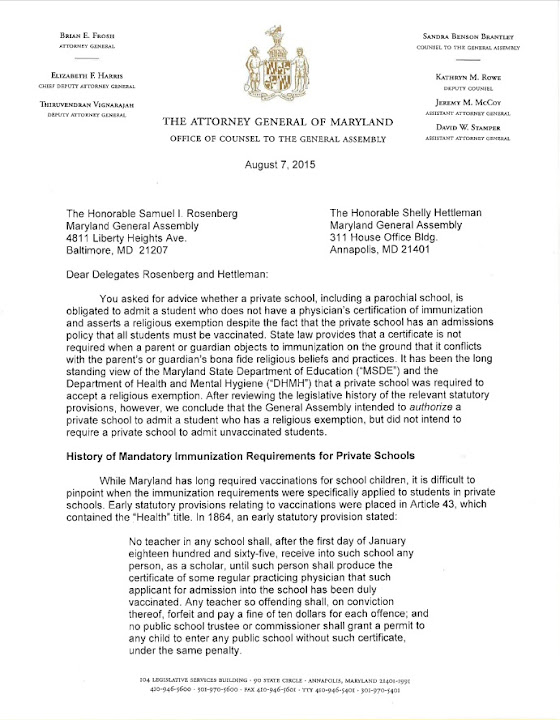
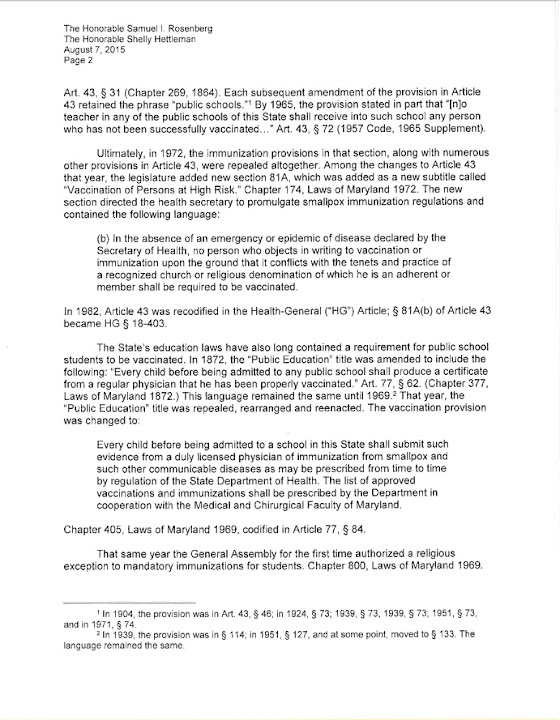
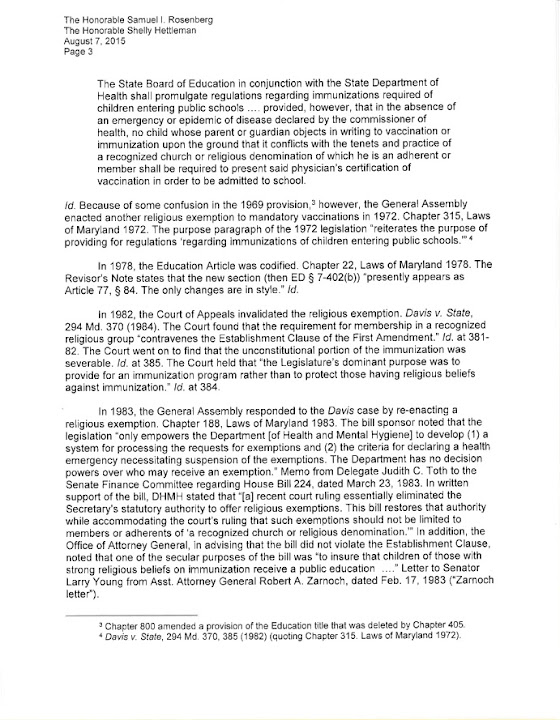
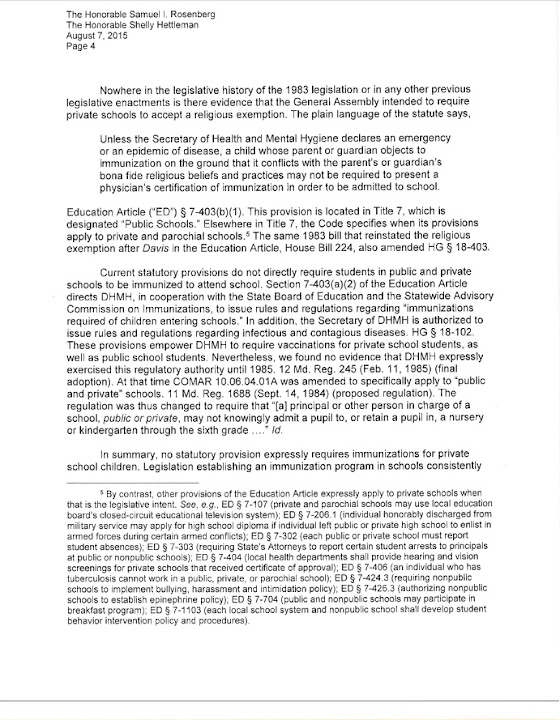
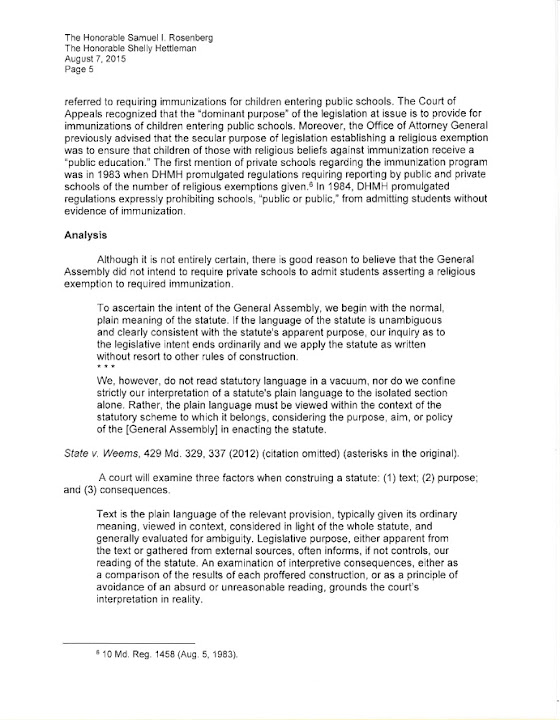
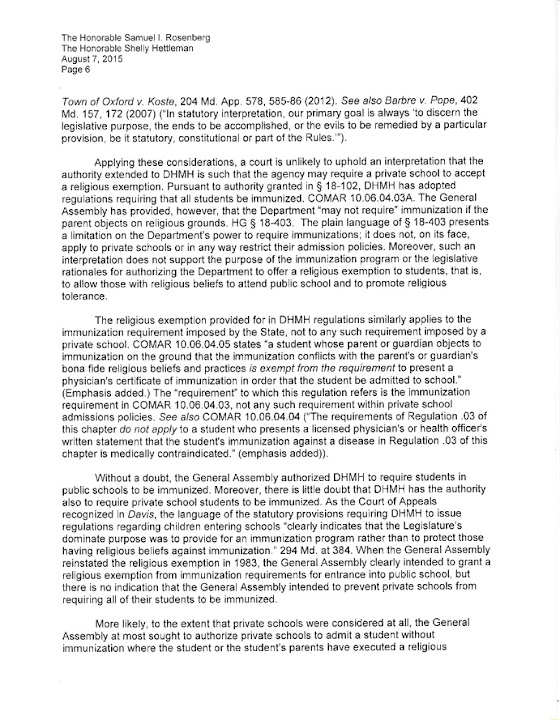
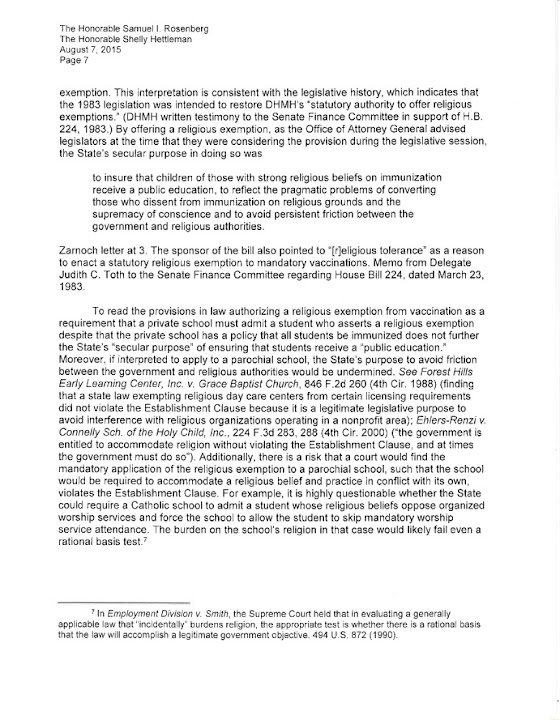
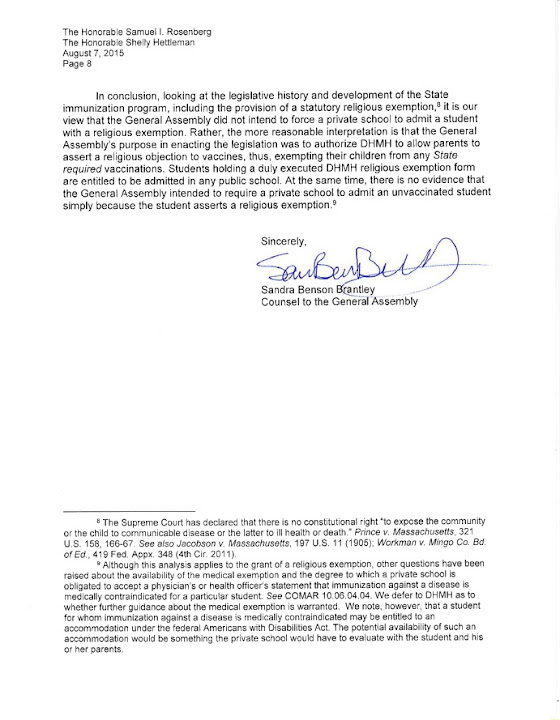
Landmark! Private and Parochial Schools NOT Required to Admit Unvaccinated Student By Attorney General of MD

Be on the lookout for an exclusive BJL interview on the subject of vaccinating children with world renowned Dr. Paul Offit, Chief of the Division of Infectious


A private or parochial school is not required to admit “an unvaccinated student simply because the student asserts a religious exemption,” according to the Office of Maryland Attorney General Brian Frosh.


Baltimore, MD - Aug. 11, 2015 - In a landmark clarification of Maryland law requested by the State Delegates serving much of Baltimore's Orthodox Jewish Community, Sandy Rosenberg and Shelly Hettleman, the Office of Maryland's Attorney General has advised our Delegates that a claimed "religious exemption" to the requirement that a child be vaccinated against specific childhood diseases is not applicable to private religious and other schools.

Be on the lookout for an exclusive BJL interview on the subject of vaccinating children with world renowned Dr. Paul Offit, Chief of the Division of Infectious Diseases and the Director of the Vaccine Education Center at the Children’s Hospital of Philadelphia.

This legal advice, in a letter to Delegates Shelly Hettleman and Samuel Rosenberg, addresses concerns raised by the Orthodox Jewish day schools in the metropolitan Baltimore area.  (Letter attached.)

A private or parochial school is not required to admit “an unvaccinated student simply because the student asserts a religious exemption,” according to the Office of Maryland Attorney General Brian Frosh.

This legal advice, in a letter to Delegates Shelly Hettleman and Samuel Rosenberg, addresses concerns raised by the Orthodox Jewish day schools in the metropolitan Baltimore area.  (Letter attached.)
“If the State were to require non-public religious schools to accept the religious exemption claimed by a parent of a child who is not vaccinated, the State would be requiring the religious school to go against its own religious convictions,” declared Hillel Tendler an attorney for the religious schools.  “A parent’s religiously based anti-vaccination views should not be forced on a non-public religious school which does not share those beliefs.”

The Attorney General’s Office agreed, writing that the General Assembly did not intend that non-public schools be included in the requirement that schools allow an unvaccinated child to be admitted if the child’s parent or guardian claims a “religious exemption” to vaccinations.  Furthermore, the letter states, if a parochial school would be required to accommodate a religious belief and practice in conflict with its own, there is a risk that a court would find that to be in violation of the Establishment Clause of the First Amendment.

“This is a very important health issue for the students, parents, teachers, and administrators in our schools,” stated Rabbi Ariel Sadwin, Annapolis representative for Agudath Israel of Maryland - Mid-Atlantic Region.  “Delegates Hettleman and Rosenberg understood the gravity of the concerns expressed by the schools and enabled them to convey those concerns directly to the Attorney General’s Office.”

 “Allowing an unvaccinated student to come to school poses a very serious health risk to everyone else in the school building and their families as well,” stated Delegates Hettleman and Rosenberg.  “We were glad to assist in making the case to Attorney General Brian Frosh that the existing policy should be reversed for private and parochial schools.”

 For further information:
Delegate Shelly Hettleman    410-608-8016   shelly@shellyhettleman.com
Delegate Sandy Rosenberg   delsandy@aol.com
###
Read the clarification below or click here


http://baltimorejewishlife.com/news/news-detail.php?SECTION_ID=1&ARTICLE_ID=63134

Tuesday, August 11, 2015

The myths the anti-vax movement is infamous for spreading....

Vaccines: Making strides in converting deniers


Source: American Academy of Pediatrics
Credit: American Academy of Pediatricians

August is National Immunization Month which seems as good a time as any to evaluate how we are doing at getting the science based message about vaccines out to the public. Numbers actually show we are doing a good job in converting anti-vaxxers. A poll conducted by the University of Michigan found that:
  1. 34 percent of parents think vaccines have more benefit than they did one year ago
  2. 25 percent of parents believe vaccines are safer than they were one year ago
  3. 35 percent of parents report more support for daycare and school vaccine requirements than one year ago
These data show that in the last year alone a lot of parents have changed their views on vaccines. A recent Pew study found that two thirds of the public supports mandatory vaccines. Although to some, this may sound high, in reality even one anti-vax can do too much damage. Look at the effect Andrew Wakefield has had on rejuvenating the anti-vax movement.

It’s therefore important to understand how these changes in the public perception of vaccines have occurred.

 One recent study found that the best way to change opinions on vaccines is to focus on the risks of not vaccinating, instead of focusing on correcting directly the myths the anti-vax movement is infamous for spreading.

Researchers working at the University of Illinois polled subjects on their vaccine views and then separated them into three groups: one received literature challenging the anti-vax group, one received literature focused on the diseases vaccines protect against and one received literature on a non-vaccine topic. After after parents read their respective literature, they were re-polled and the researchers found that many in the second group changed their opinions on vaccinations.

Lead researcher Zachary Horne said of their results: “We found that directing people’s attention to the risks posed by not getting vaccinated, like getting measles, mumps and rubella and the complications associated with those diseases, changed people’s attitudes positively towards vaccination — and that was for even the most skeptical participants in the study. Actually, the largest effect sizes were for people who were the most skeptical.”

This idea is not new and is often put in a historical context. People stood in long lines in the mid 20th century to get themselves and their children vaccinated against the flu and polio, but this was a time when both of these diseases caused very visible epidemics. Yet the last case of polio in the United States was in 1979, almost 40 years ago, so it is understandably harder for people under the age of 40 to grasp the risks of acquiring one of these vaccine preventable diseases.

Think about the aforementioned Michigan study in light of last year’s Disneyland measles outbreak. Measles became a more public, tangible disease to many people, in particular young parents. This outbreak and the publicity it garnered may explain why the Michigan study found such a drastic movement away from anti-vax views among parents.

With this idea in mind and in the spirit of National Immunization Month, the American Academy of Pediatrics has started a month long campaign to remind people of the risks of not getting vaccinated. The campaign, entitled “Medicine Before Vaccines” features a collection of stories from physicians who remember what pediatric medicine was like before vaccines. It should serve as a lesson to many young parents that vaccine preventable diseases are something to be feared, as they have been for most of human history.


http://acsh.org/2015/08/making-strides-in-converting-the-unconvertable/

Monday, August 10, 2015

That’s the best we can do to negotiate a deal (which the Iranians have already said they will break anyway) on which the life and death of Wendy’s people, the Jews of Israel, depends?


  by Ben Stein -

Ben Stein: I'm Not Sure Obama Is 'In Good Mental Health'


My mother, God rest her soul, went with my father to Red China in the mid 1970s, before the capitalist Revolution there. Mom and Pop were taken around the country by Communist Party cadres who lectured them about how great Communism was. Of course, this was after Mao had murdered about 80 million Chinese civilians.

My mother, an extremely astute observer politically, and a fervent anti-communist, wrote to me a letter noting that the look on the faces of the Chinese Red women cadres was extremely similar to the looks on the faces of the leftist women at Columbia in the 1930s and in Silver Spring in the 1940s and 1950s.

Since then, I have noticed that I can always, and I mean ALWAYS, tell a woman’s political orientation by her facial features, expression, hair, jewelry (always silver), and clothing.

I point this out because last night I watched C-SPAN and saw a woman named Wendy Sherman testify before a Senate committee about the Iran sellout. This woman, aged roughly fifty something, maybe a bit older, was cut from the cookie cutter mold of wealthy Jewish leftists, thought I as I watched. She looked like the identical twin of an extremely leftist close friend of my wife here in Beverly Hills.

I looked her up, and sure enough, she was a big time leftist, big time anti-life, big time community organizer, close pal of Hillary Clinton and Barry Obama, with long experience fighting for the “right” of women to murder their children. From a rich Jewish family.

Of course, she defended the sellout to Iran. She lied about every single detail, including about the notorious fraud of “inspections anytime, anywhere” and the secret protocols with the IAEA which supersede anything in the agreement with the USA. She was a pitiful, weak liar, though, and started to cry at one point when a Republican questioned her closely.

I had the horrifying thoughts go through my head: This is who we had negotiating for us in Austria? An American Princess named “Wendy” who cries when she is confronted? Who is acting explicitly as an advocate for the Iranians? Who is the Edward Bennett Williams of the Mullahs? That’s the best we can do to negotiate a deal (which the Iranians have already said they will break anyway) on which the life and death of Wendy’s people, the Jews of Israel, depends? This is just plain pitiful. Heart breaking.

Today, I felt ill most of the day. My wife has been extremely ill for days and maybe I have caught it. But I went all over town to fetch things for my wife, especially various kids of milkshakes. That’s all she’ll eat when she’s sick.

As I was coming back from a store called Millions of Milkshakes, I took a short cut through a Chase bank. I stopped to cash a check. An attractive blond woman stood near me and asked the teller if he would let her pay her bill in Serbian money.

I asked her if she were kidding. She said she wasn’t, that her father was just back from Serbia and she had dinars she wanted to use. I offered to lend her money for a taxi.

In the meanwhile, a homeless man came in and overheard the conversation.

“Serbia,” he said. “That’s where World War II began. The people there are all Nazis.”

“No, it was World War I and the Serbs were mostly anti-Nazis. The Croatians were close to the Nazis.”
“Well, then Communists,” he said. He glowered at the girl. “Is your father a Communist?” he asked.
“That was a long time ago,” I said.

“No. Once a Commie always a Commie,” he retorted, with some truth. “They killed the Archbishop of somewhere and that started the war.”

“No, the Archduke,” I said.

“Well, whatever, some big Arch something and now they’re all Communists.”

As I walked out of the bank with the young woman, I said to her, “This town, this whole town, is one big outdoor mental hospital.”

She agreed.

Okay. Topic A. The GOP debates. Fox should have kicked Trump’s pompous ass right off the stage as soon as he would not pledge to support the party and the candidate. Once he said he would consider running as a third party candidate, he proved what everyone is saying, that he’s just a hireling for the Clintons, just signed on to make trouble and get publicity.

Then, later he bragged about putting some of his companies into bankruptcy. Just so you know, he didn’t just do that because he lost his job. He didn’t just declare BK because Atlantic City was in trouble.

He went to great lengths to snooker his own stockholders, to whom he had a fiduciary obligation, and to be a deadbeat to his lenders, to whom he owed a contractual obligation. (I wrote about it in Barron’s in 1989.) This was fine, he said, because it made his family rich.

What a loathsome man. To even consider him as a President is deeply disturbing.

Everyone else was great. I especially like Ted Cruz and Mike Huckabee. Outspoken. Sensible. Fine men. Serious about standing up to the Russians and the terrorists.

The problem is that none of them has a solution. None has a plan. None will come out for higher taxes to pay for an adequate defense. The GOP has been hijacked by the tax cutters and it’s killing the national defense as the sequester bites ever deeper into the muscle and bone of the military.

“An idiot with a plan can beat a genius without a plan,” says Warren Buffett. And we in the GOP have no plans at all. Mr. Obama has plans for national suicide. We have words, but no plans, for national salvation.

No one said a word, not one single word, about the catastrophe in the black world. The black male kids are largely illiterate, almost totally unable to use math, for the most part unprepared for modern life, addicted to drugs and crime. They are our brothers and fellow Americans, and our politicians — especially Mr. Obama and Mrs. Clinton — whip them up to anger, but do nothing to prepare them for real life. Something has got to give or we are heading for anarchy.

Oh, by the way, this afternoon we had the lower-ranked GOP candidates debate, and they were great.

Especially Lindsey Graham and Rick Santorum. But they also said not a peep about raising taxes and not a peep about raising the lives of our black men from misery to prosperity. Is it possible there is nothing to be done? No, because blacks were making real progress until the mid 1960s. Then the attitudes of entitlement, blaming whitey, drugs, and a culture of irresponsibility set in. Mr. Obama could have done something about it. He didn’t. They say he plans to be the first billionaire ex-President.

http://spectator.org/articles/63721/wendy-sherman-tank

Friday, August 07, 2015

The President would be well advised to stop attacking his critics and to start answering their hard questions with specific and credible answers....

President Obama, in his desperation to save his Iran deal, has taken to attacking its opponents in personal ways. He has accused critics of his deal of being the same Republican warmongers who drove us into the ground war against Iraq and has warned that they would offer "overheated" and often dishonest arguments. He has complained about the influence of lobbyists and money on the process of deciding this important issue, as if lobbying and money were not involved in other important matters before Congress.


These types of ad hominem arguments are becoming less and less convincing as more Democratic members of Congress, more liberal supporters of the President, more nuclear experts and more foreign policy gurus are expressing deep concern about, and sometimes strong opposition to, the deal that is currently before Congress.

I, myself, am a liberal Democrat who twice voted for President Obama and who was opposed to the invasion and occupation of Iraq. Part of the reason I was opposed was because I considered, and still consider, Iran a much greater threat to the security of the world and to the stability of the Middle East than Iraq ever was. In my newly published e-book The Case Against the Iran Deal: How Can We Now Stop Iran From Getting Nukes?, I make arguments that I believe are honest, fair and compelling. I recognize some advantages in the deal, but strongly believe that the disadvantages considerably outweigh them and that the risks of failure are considerable. My assessment is shared by a considerable number of other academics, policy experts and other liberal Democrats who support President Obama's domestic policies, who admire Secretary Kerry for his determination, and who do not see evil intentions in the deal.

The President would be well advised to stop attacking his critics and to start answering their hard questions with specific and credible answers. Questions that need answering include the following:

1. Even after the expiration of the nuclear agreement, will American policy remain that Iran will never under any circumstances be allowed to develop nuclear weapons? Or is it now our policy that Iran will be free to do whatever it wants to do once the deal expires?

2. After the major constraints contained in the deal end, or were the deal to collapse at any point, how long would it take Iran to produce a deliverable nuclear bomb?

3. Would the United States allow Iran to begin production of a nuclear arsenal when the major constraints of the deal end?

4. Does the deal reflect a reversal in policy from President Obama's pre-reelection promise that "My policy is not containment; my policy is to prevent them from getting a nuclear weapon"?

5. If not, will President Obama now announce that it is still the policy of the United States that Iran will not be allowed to develop a nuclear weapon?

6. How exactly will the inspections regime work? Precisely how much time will the Iranians have between a request for inspection and the inspection itself? What precisely will they be permitted to do during this hiatus? And why do they need so much time if they don't plan to cheat?

7. What will President Obama do if Iran is caught cheating on this deal during his administration?

8. Precisely when will which sanctions be lifted under the agreement? Do provisions that prevent the P5+1 from imposing new sanctions apply even if Iran is found to be in violation of its commitments under the agreement? When exactly will sanctions prohibiting the sale of weapons, and particularly missile technology, be lifted?

If and when these and other important questions about the deal are answered — directly, candidly, and unambiguously — Congress will be in a better position to answer the fundamental questions now before it: would rejecting this deeply flawed deal produce more dangerous results than not rejecting it? If so, what can we now do to assure that Iran will not acquire a nuclear arsenal? The answers to those questions may profoundly affect the future of the world.

So the President should spend more time on substance and less on personal attacks.
Alan Dershowitz is an emeritus professor of law at Harvard Law School. His new e-book, The Case Against the Iran Deal: How Can We Now Stop Iran From Getting Nukes?, is now available.
  • Follow Alan M. Dershowitz on Twitter
http://www.gatestoneinstitute.org/6297/obama-personal-iran-deal

Thursday, August 06, 2015

THE TALE OF TWO AMERICAN TRAITORS CONTINUES UNABASHED - "Secretary of State John Kerry reveals in a new interview with The Atlantic’s Jeffrey Goldberg that he doesn’t think Iran is serious about wiping Israel off the map and thinks the entire discussion is a waste of time..."

Obama’s Heavy Handed and Misleading Iran Deal Advocacy Isn’t Working


President Obama isn’t sitting back and simply letting critics of his Iran deal have their way. 


Yesterday, he summoned the leaders of 20 Jewish groups to the White House for what he described as “blunt” talk aimed principally at intimidating AIPAC into backing down on its all-out push against the nuclear pact. 


While conceding that pro-Israel activists had the right to campaign against the deal, he claimed they were distorting the truth about its content but doubled down on is charge that opponents were seeking a war. But rather than merely repeat his favorite talking point about deal critics producing recycled arguments in favor of the Iraq War, he asserted that the war he thinks will result from a defeat of the deal will result in “missiles raining down on Tel Aviv” rather than more bloodshed for Americans.


 But missing from his heavy-handed pressure tactics is a more honest explanation for why he is so determined to push through an agreement that fails to meet the standards that he originally set for the talks. For that we have to turn to Secretary of State John Kerry who reveals in a new interview with The Atlantic’s Jeffrey Goldberg that he doesn’t think Iran is serious about wiping Israel off the map and thinks the entire discussion is a waste of time. That rather lazy justification for détente with the Islamist regime should motivate Jewish groups to redouble their efforts to fight the president’s policy. 


A good sign that the Jewish establishment isn’t being intimidated came today with the announcement that the liberal-leaning American Jewish Committee is joining the ranks of those opposed to the Iran deal. Coming as it does the day after the Obama meeting, the AJC’s move is a sign to wavering members of Congress that even organizations whose members are basically sympathetic to the president aren’t buying his arguments.
Since the signing of the deal last month, the president hasn’t hesitated about throwing some sharp elbows in the direction of the pro-Israel community. He has spoken openly about standing up to the power of lobbyists and big money in a way that was an unmistakable shot fired over the bow of AIPAC and an echo of anti-Semitic tropes. An earlier generation of American Jews responded to similar talk from President George H.W. Bush with revulsion but as a liberal Democrat, Obama gets cut slack from the organized Jewish world that no Republican would get.

In his meeting with the Jewish groups (those in attendance included some of the president’s sycophantic supporters from J Street and the National Jewish Democratic Council), Obama tempered some of this rhetoric but didn’t entirely walk back his charges that seemed to be dog whistles to Democrats about not letting moneyed Jews interfere with the measure that he considers to be integral to his foreign policy legacy.
But his effort to transform this argument from one between those concerned about the threat from Iran and those in favor of diplomatic engagement with the Islamist regime into a Jewish civil war is particularly insidious. Instead of owning up to his own demonization of deal critics as warmongers, with the help of his supporters in the room he attempted to change the discussion. He claims that opponents of the deal are dividing American Jewry and undermining the U.S.-Israel relationship. The warning is clear: back my deal against the complaints of Israel’s government or see the alliance you’ve worked to build start to unravel. The upshot of the discussion was that despite claiming to have a thick skin when it comes to criticism (perhaps the biggest lie he has told during his entire presidency), Obama takes opposition to his plans on Iran as a personal affront and he will stop at nothing to delegitimize their efforts.

The claim that critics are distorting the terms of the deal is patently disingenuous. The president has been offering deceptive descriptions of the deal throughout this debate. But the most important point is that by agreeing to something that leaves Iran’s nuclear infrastructure in place, allows it to continue research, provides inadequate inspections and will expire in a decade, the president hasn’t met his own goal of ensuring that it won’t get a bomb. Just as important, contrary to the president’s warnings, the alternative to the deal isn’t war but the sort of tough-minded diplomacy that he chose to discard when he entered negotiations with Iran.

How then to explain the administration’s decision to discard the enormous political and economic leverage it had over Iran in 2013 and begin making the series of far reaching concessions that led to the agreement? The answer comes from Kerry who not only dismisses Iran’s ideological obsession with destroying Israel as not serious but also thinks the fact that it will continue to fund Hezbollah and Hamas (something that the $100 billion in unfrozen assets it is getting in the deal as well as the profits from the business boom that will follow the pact’s ratification as American and European companies flock to Tehran to make nice with the ayatollahs) as no big deal.

Though in his speech today at the American University in Washington, D.C., he represented his Iran diplomacy as merely another version of the tough tactics that won the Cold War against the Soviet Union; that is utterly untrue. Ronald Reagan didn’t win the Cold War by appeasing Communism but by confronting it and convincing Moscow it could never overcome the West. What Obama has done is a repeat of the failed détente tactics pursued by Richard Nixon and Henry Kissinger. They based their policy on the notion that the Soviet Union would never fall and must be accommodated. Obama and Kerry feel that way about Iran but then compound the mistake.

 They actually think it doesn’t mean what it says about seeking Israel’s destruction and regional hegemony and that it is can be transformed into a partner for the United States.

Prime Minister Netanyahu’s prediction that instead of a rejection of the deal bringing on war, its adoption will make conflict more certain seems a more sensible evaluation of the situation. Iran has given us many proofs of its seriousness about backing terror and its evil intentions toward Israel. But for Obama’s Iran deal advocacy, the main foe seems to be a pro-Israel community that isn’t prepared to bow to liberal partisanship and affirm that a naked emperor is wearing clothes. Though the odds remain in the president’s favor, as the announcements from AJC and various Democrats coming out against the deal show, muscling American Jews and even members of his own party isn’t working as well as he might like.

https://www.commentarymagazine.com/2015/08/05/obama-iran-deal-advocacy/

Tuesday, August 04, 2015

Urge Senator Schumer to stop this bad Iran deal!


We’ve listened to Senator Schumer for years and how he takes every opportunity to explain the origin of his name Schumer and what it means for him to be a proud “Shomer”—which in Hebrew means protector.

From your time as Congressman to one of the most powerful members of the Senate, Senator Schumer, you have repeatedly called yourself our "shomer" (protector). Now is the time to live up to your claim and put your words into action. We need you to demonstrate leadership on one of the most critical foreign policy issues of our time. Be our protector and stop this terrible deal.

Senator Schumer says he will “do the right thing.” These are unprecedented times and it’s time to stop this deal, which is disastrous for America and our allies in the Middle East. This will define your legacy. Please do not allow partisan politics or any other considerations to cloud your judgment.

We urge Senator Schumer to stop this bad Iran deal. 


MUST WATCH - WILL MAKE YOUR DAY!


Monday, August 03, 2015

What's Wrong With The Jews?


Dear fellow Jews, I'm compelled to ask: What the bleep is wrong with you?  Friday morning I was about to post a thank-you note to my Christian friends for standing with Israel against the nuclear deal, when I saw a poll revealing that the majority of American Jews support it. Yes, we are a stiff-necked tribe, but never did I imagine we were such dunderheads.

What part of “they want to kill you” don’t you understand? Our president has just signed onto a deal that poses an existential threat to Israel—you know, that small country bequeathed to us by G-d, which is approximately 76 times smaller than Iran. It’s that same small country that when we didn’t have it, six million Jews were murdered by a very honest man named Hitler who said he wanted to kill Jews—and did. Today we have another slew of “honest” men who while signing a nuclear deal simultaneously declared death to Israel and death to America. 

Twice you elected a president who professed to have Israel’s back while he was machinating behind it. The first time Mr. Obama attended an AIPAC conference, prior to his presidency, he said in no uncertain terms that Jerusalem should remain the undivided capital of Israel. The next day, with centrifuge speed, he spun his words. And, ever since, he has been spinning Israel. 

AIPAC, that well known and very powerful Jewish lobbying group, helped bring President Obama to power, so obviously they are not the racists all Jews are branded to be whenever they disagree with the president’s policies. Today, at the forefront of the fight against Obama’s nuclear deal, is that very same AIPAC.  Why? “Because this deal is a deadly deal: It legitimizes Iran as a nuclear threshold state and once restrictions are lifted, Iran would then have the ability to produce enough fuel for a nuclear bomb within days; it raises the prospect of war; it will spur a nuclear arms race in the Middle East; it fills the Iranian coffers with over a $150 billion that predictably will augment their sponsoring of terrorism; it strengthens the Iranian regime, and it destabilizes and threatens regional allies.” 

And yet with all that on the nuclear hot plate Jewish Democrats are allegedly upset with Netanyahu—not Obama or the Ayatollah—but with Netanyahu for addressing Congress on the issue of Iran and then using some of the footage in a self-endorsing ad prior to the Israeli election.  It’s mind boggling that they would take umbrage against a tacky tactic, but they are not going ballistic (every pun intended) over a regime that calls Jews pigs and dogs reminiscent of the Nazi’s crossbred categorization of Jews as schweine-hunde, pig-dogs. Where is the ire for a deal so dire with a regime that calls for the extermination of Jews and Israel? Are these powerful officials not aware that the Iranian regime hates them most of all as they typify the “powerful Jews” which all anti-Semites exaggeratingly claim are taking over the world (while Jews comprise only 0.2% of the world population)? It is this same hateful, murderous regime whose declared goal is to establish a caliphate (which is itself an expansionist agenda), but yet the "Zionist regime" is deemed colonialist. Colonialist? If Israel is a colonialist country, I must say it has failed miserably, seeing that even before its enemies wipe it off the map, the tiny country can hardly be found on it.    

American Jews need to wake up, speak up, and stop being afraid of their own shadows. Stop saving the arts and the ballet and start saving Jews. Stop trying to get everyone to like you. They just don’t. Appeasement is the dry hose that has historically never put out a single fire, including those in the crematoria.   Senator Schumer is among those Jews too who need to stop being afraid to stand up for their own side in an argument. Useless are the refrains of “never again,” which have become as honorable as the statement "the check is in the mail." If you really don’t want another Holocaust, pick up the phone, call your representative and tell him/her to block the deal!
 
Much of the fate of this deal now lies in Schumer’s hands. Will he further his career on the ashes of his people? The long-time senator is eyeing the seat of Senate Minority Leader once Senator Harry Reid steps down.  He needs Obama to like him to get that job. Undoubtedly, Schumer sees himself in a difficult spot and may jeopardize his entire hard-earned career by blocking, and galvanizing support to, block the deal. And therein lies the answer: If Schumer won’t back down from his own political ambitions in order to save his own people, what makes him think the Iranian leaders, hardened foresworn ideologues, will give up their hard earned nuclear ambitions and dogmatic dreams of annihilating the Jewish people. They’ve all worked too hard to stop now. 

And, of course, there is that ever-present concern which also serves conveniently as a safety bunker: Will Schumer be accused of dual loyalty? After all, he is an American senator, not an Israeli one.  Well, here are a few bunker buster realities that penetrate Schumer’s not so intractable problem and reveal why this is an American problem not an Israeli one: 

Firstly, Iran’s ICBM (Inter-Continental Ballistic Missile) program clearly tells America that Iran not only has long-term objectives, but long-distance ones as well. The Jewish state is Iran’s neighbor. Long range missiles are redundant for such a proximate neighbor. These missiles have a more distant three-letter target: the U.S.A.   

Secondly, Iran is the foremost sponsor of terrorism around the world, supplying America’s declared enemies with arms. The United States State Department qualifies Iran as an “active state sponsor of terrorism.” Once Iran becomes a nuclear state, it will have the ability to export not only arms, but weapons of mass destruction. We are putting “nuclear” bullets in guns aimed at us, evermore insane. 

Thirdly, even after signing the nuclear deal, Iran’s supreme leader declared that hostility between the Islamic republic and the “arrogant” United States will not abate. 

Fourthly, the nuclear deal also has a clause that the P5+1 would come to the aid of Iran in the event its nuclear program was attacked. That could very well pit America against Israel—its ally—in defense of Iran if Israel takes pre-emptive action. This deal, in snow globe fashion, has shaken up the world as we know it and catapulted countries into new and unprecedented alignments. The “axis of evil” has seismically shifted. 

And a fifth reason this deal is an American concern is that it has a secret annex that the president of the United States did not present to Congress as was required. It was only discovered by Congressman Mike Pompeo (R-KS) and Senator Tom Cotton (R-AR) at a meeting they had in Vienna with the International Atomic Energy Agency. 

It becomes very clear that the only dual loyalty our Jewish representatives have to really consider is whether they are loyal to America and its ideals, or to Iran’s—for this deal is contrary to what America stands for. Standing with Israel can’t be deemed dual loyalty because Israel, our ally, mirrors everything we stand for, fight for and die for: freedom, dignity, equality, and the pursuit of happiness.   Iran wants to end our way of life and all of Arak's heavy water hardly washes that truth away.

http://www.jpost.com/page.aspx?pageid=13&articleid=410231

Sunday, August 02, 2015

The voice of child sexual abuse


IDF soldier David Menahem Gordon

 First day at a new school. A fair haired lad of thirteen stands anxiously before the portals. Will he be accepted by others? Will he make friends? Entering the school grounds he does get some “new kid in town” looks, but finds that the children are friendly. By the end of the day he discovers that his teachers are patient and his peers have accepted him.

By the morning of the third day, he is already into a routine. He wakes up early, eats a quick breakfast, kisses his mum goodbye. Upon arrival at school he joins with his new friends in greeting one another. Amidst the back-slaps and shouting, he feels an alien chill pass through him and looks around to find its source. There. One of the older students is looking directly at him with a deep, unwavering cold stare. He shrugs it off, figuring it’s only his imagination. After all, there is nothing to distinguish him from the other older students. Anyway, class is beginning and, until recess later that afternoon, he thinks nothing more of it. 

In the yard with his classmates, the same older boy who had been staring at him called him over. He felt a kind of pride that an older student was paying attention to him. As he walked over, he reckoned that he’d just misinterpreted the earlier stare as being cold. “My uncle gave me a Nintendo,” the older teen said, “Would you like to see it?” Of course, he wanted to see it. This was too neat to pass up. Students weren’t allowed computer games! On the way to the dormitories, the older chap tells the boy that he’s got to pick something up first and motions for him to accompany him. He leads the boy to a side room and once inside, locks the door behind them. Hidden from view, the older student brushes his hand over the lad’s privates. Shocked and scared, the young boy passes it off to himself as a mistake. It was not a mistake. It was too late. He was trapped and the real abuse began.

Over the next few months, the abuse only gets worse. He knows he should probably tell his parents or his teachers, but what will they think of him? A voice inside whispers to keep silent, to avoid attracting attention to himself. No one needs to know; to expose the acts perpetrated on him would be breaking the rules of modesty.

The assaults do not end, but come more frequently and the boy feels powerless to break away. The older boy not only physically overpowers him, but is also crafty and persuasive.

Deeply conflicted, the boy begins to question his own motives: is it I who’s leading him on? Perhaps I’m not the innocent victim, here, after all? Maybe this is all my fault?! The boy falls into despair. He has lost all motivation to learn and has drawn away from his real friends. He finds no reason to wake up in the morning, nor any pleasure in his daily activities. School has stopped being fun and his nights are filled with bad dreams.

While friends and family blame his odd behavior on teenage rebellion, he continues suffering in silence. On the outside, he appears normal, but after months in this trap, he’s bleeding and crying on the inside. He is afraid he would not be believed. It would be the word of an attention-grabbing youngster against that of a respected young adult. Even if he were inclined to tell someone, who could that possibly be?

When he can bear it no longer, he works up the nerve to confide in a teacher he feels he can trust. Hearing him out, the teacher promises him that the situation will be dealt with. After some time, however, it becomes obvious that the adult has turned a blind eye to his plight and has defaulted on his word, choosing the reputation of the school — his meal ticket — over his student’s welfare. Things continue as they were.
After two school years, the abuser finally graduates and the abuse ceases. However, life for the boy is forever changed. He is still popular, but his scars do not heal and he is hardly aware of it. Once burned and knowing he now must protect himself, his lips remain sealed.

Years pass and now, as a young man, he sets out to travel the world. He thought he had left those episodes behind him, buried deep and all but forgotten. Until he happened to meet an activist for victims and survivors of child sexual abuse. The activist’s words sting and ring all too true. While still unwilling to open up to another, he does visit the activist’s website. He is amazed at how many thousands of other children have undergone similar ordeals. For the first time in all these years, he does not feel alone. A new chapter in his life begins.

“Blush for a few moments so others don’t have to bleed.”


I was that lad who, between the ages of 13 and 15, had been taken advantage of and abused. I kept that unfortunate, mistreated child locked up within me for six years, but now, confronted with a practical avenue for help, I found myself still too ashamed to reach out. I thought that if I told friends they would doubt my sexuality or would disbelieve me. Worse, perhaps they would even suspect me of being a perpetrator! My thoughts were a jumble of confusion — vulnerability, guilt, anger.

The doubt and self-recrimination ended for me the day I visited Jewish Community Watch online. I found myself in the company of many other innocents who have fallen prey to this cruelty.

A year or so ago, I came across an article written by a victim of child sexual abuse who lost his life in a tragic way. It was the most powerful article I’d ever read; David Gordon, z”l, penned for the Huffington Post, as follows: “Blush for a few moments so others don’t have to bleed.” He is calling to all those who have suffered abuse, yet felt compelled to keep silent. David wrote:
If we keep sweeping our problems under the rug we will eventually trip over them. The time has come for us to stand up for ourselves, our children and our communities. It’s time to sacrifice the comfort of not tackling serious issues that are awkward and embarrassing and focus on the dignity of human life. If I can have a voice you can too. Take a stand and be a real leader. Blush for a few moments so others don’t have to bleed. One reason why victims of abuse are also called survivors is because so many don’t make it. So many are too ashamed to reach out and frequently fall into depression, violence, addiction and ultimately into deaths arms. But we can be brave and stand up for what we know is right. Together our voices can be louder than ever. I know that I alone cannot change the world, but together we can make a difference. ”
I don’t often cry. But upon reading these words, I broke down in tears. Not only for myself. My physical trial had long passed, but thousands of children the world over are suffering in silence, living continuously with the thoughts of suicide. To numb the pain, they turn to alcohol and drugs, often having to contend with the very real risk of perpetuating unhealthy relationships.

We all have a voice. A voice rooted in a truth stronger than illusory schemes which whisper to avoid embarrassment. Still, how many of us are willing to speak out? Sharing your darkest secrets to the world is, to be sure, uncomfortable and awkward. Or worse. But, As David said, “If I can have a voice you can too. Take a stand and be a real leader.” You don’t have to be a victim of abuse to address this issue; all one needs is clarity and morals. Leadership springs from clarity more than it does from bravery. Moreover, it is clarity which fuels the action that is considered to be bravery. My mind does not allow David’s words to escape my thoughts. I go to sleep and wake up pondering his message to us: what am I going to do about it? What influence can I have? What is clarity?

Abuse and clarity


Every child deserves a future. Yet, shocking statistics show that 1 in 4 females, and 1 in 6 males, will be sexually abused before the age of 18. The time for action to preserve that inalienable truth is here. Don’t wait for someone you love to disclose to you they have been abused before you believe abuse exists. I promise you it does. Parents, educate yourself and your children. You have nothing to lose. On the contrary. What is a sacrifice of one’s honor and comfort when it comes to saving the future of a child at risk. If your children have been informed and should they, God forbid, encounter abuse, they will then be less vulnerable and more likely to reach out to you.

There is no time to waste. Know that you, one individual among many, can make a change. Take the initiative to speak up for yourself and you will be taking the lead in bringing others to do the same for themselves or their loved ones. I have learned that there is nothing to be ashamed about. Suppressing these dark scars only holds you back from utilizing and achieving your personal potential and goals, so take the burden from your shoulders and you will be free of them, as I am now. Sometimes you have to let go. Maintaining exclusive ownership of past abuse and its scars means that they actually own you. Freeing yourself from their hold is not easy, but it’s easier to succeed once you have let go of them. Then, like mine, your scars will make you stronger. An unbreakable chain links us survivors. Every time another person shares his or her story, another link is added to that chain and they, too, can literally empower others to do the same. Together, our voices will be heard louder than ever.

Find that friend with whom you can share what you’ve hidden even from yourself. If there is no one you can trust at the moment, contact Jewish Community Watch. Your journey can begin now, at this moment. I promise, you are stronger, braver and more beautiful than you give yourself credit for. All it takes is that one ounce of courage to admit to yourself that you’ve been a victim of abuse. You will be believed. Your voice be heard. You will be a survivor.

I now go about life secure in the knowledge that I’m taking positive action, doing for others — especially for those who were robbed of their innocence by child abusers — what could have once made a big difference in my life. I can and will use my voice for others who have yet to find theirs; to be there for those who need someone to hear them, and believe them. Brothers and sisters, wherever you are, if you are a victim of any type of abuse, I beg you, for your own sakes: reach out! As Dave Gordon said, “Secrets don’t get better with age.”
Dedicated to David M. Gordon, z”l.

http://blogs.timesofisrael.com/the-voice-of-child-sexual-abuse/#.VbuwgdXID30.facebook