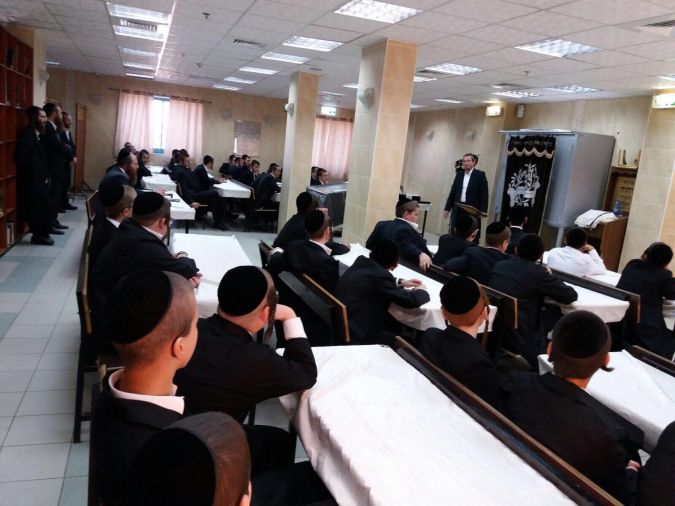
Hundreds of ultra-Orthodox Jews scuffled with police in Jerusalem on Sunday in protest against a court ruling that could require them to serve in the army like secular Israelis.
The
demonstration in an ultra-Orthodox neighbourhood of the city was
organised by a particularly hardline group known as the Eda Haredit.
Rabbis
gave speeches in Yiddish in the Mea Shearim neighbourhood, while a
banner read: 'We're Jews and therefore will not enlist in the Zionist
army.'
Israeli police use water cannon
to disperse Ultra-Orthodox Jewish demonstrators blocking a main junction
as they protest against army recruitment in Jerusalem on Sunday
+32
The protest (pictured above)
came after the Israeli Supreme Court rejected a goverment bill exempting
Haredi service from the Israeli army
+32
The demonstration in an
ultra-Orthodox neighbourhood of the city was organised by a particularly
hardline group known as the Eda Haredit
+32
Israeli ultra-Orthodox Jewish
men are sprayed with water during clashes with police at a protest
against the detention of a member of their community who refuses to
serve in the Israeli army
+32
Israeli Border Police arrest an
Ultra-Orthodox Jewish demonstrators blocking a main junction as they
protest against army recruitment in Jerusalem
+32
Israeli policemen carry an
ultra-Orthodox Jewish youth during clashes at a protest against the
detention of an ultra-Orthodox man who refuses to serve in the Israeli
army
The protest became violent when
demonstrators blocked roads and resisted efforts to disperse them by
riot police, mounted officers and water cannon.
'Eight rioters who used violence against police were arrested,' a police statement said in Hebrew.
'They lay down in the road, shouting slogans against the police, some of them threw stones at police,' the statement added.
Last
week's Israeli Supreme Court decision strikes down a law exempting
ultra-Orthodox men engaged in religious study from military service,
saying it undermines equality.
I was deeply distressed to discover recently that someone that I used to
know is suffering from a very serious illness. It was further told to
me that the person has to make a choice between two radically different
courses of action to deal with this illness. It's a very difficult
decision to make, with significant pros and cons on each side. So the
person has decided to ask Rav Chaim Kanievsky.
Rav Chaim Kanievsky is 89 years old. He has spent virtually his whole
life insulated from the outside world. He is a selfless person who has
dedicated his entire life to the study of Torah (apart from a very brief
period during the War of Independence when he served on guard duty).
Many people, following the contemporary charedi notion of Daas Torah (in
which the less a person knows about the world, the purer is his
wisdom), believe that this makes him uniquely suited to give guidance.
But it goes even further. People consider even a word of blessing from him to be guidance. Consider the following story
from Mishpacha magazine, about one of the many people who go to Rav
Chaim for his guidance (note for those thinking of doing this: his
trusted aides are people who will give you preferential treatment if you
give them money):
Guessing by the radiant smile on the man who emerged from behind the
white wooden door, one might think that he had just won the lottery in
the tiny apartment. Moments before (emphasis added - N.S.), he
stood at the head of the line, conversing on the cell phone — probably
with a worried wife — about every minute and a half. Posture bent,
overwhelmed by the pressing concerns he did not share with fellow
visitors, he conducted simulations, finalizing a presentation of the
question, and promised his family — bli neder, of course — that he would
present all of the arguments, both for and against, and that he would
remember to mention Shoshke bas Mindel, desperately in need of a
shidduch.
Upon emerging from the inner sanctum, he wears the look of a man
relieved of a heavy load. “We have a yeshivah!” he hisses into the
phone. The crowded conditions in the corridor, and the brotherly
atmosphere that characterizes the local citizenry, turn his whispered
words into public fodder.
“What did Rav Chaim say?” someone asks.
The man reveals the question that brought him there: They weren’t sure
which yeshivah their Yossi should attend the following year. “Nu, and
what did Rav Chaim say?”
“He said, ‘Brachah v’hatzlachah.’ Now we’re sure: Yossi will attend the yeshivah where he already took a bechinah (exam).”
In this story, Rav Chaim did nothing at all other than offer two
words of blessing. Yet the questioner read into that as being a weigh-up
decision as to which yeshivah his son should attend! And the magazine
printed this story as an example of Rav Chaim's wisdom!
Last week there was another example of this, and it's on video
for everyone to see. Someone went to Rav Chaim and told him that there
is a deadly storm headed for Miami, of a kind that has killed many
people. They asked: Should people flee? And he replied: Sakanah! ("There's a danger!"). And that was the end of the conversation. ( How come he had to be told that Miami was in America? PM)
This brief interaction is viewed very differently by different people.
Some people genuinely see it as a demonstration of Divine Daas Torah.
"Rav Chaim Kanievsky has ordered people to evacuate Miami!" Others see
it as a tragic example of nothingness. He was told that there is a
life-threatening danger, so he said that it's dangerous. You can get the
same answer from a five-year-old.
Is there any way to prove to people that Rav Chaim's answers are not
worth what these people think they are worth? Actually, there is. Or at
least, there ought to be; the following two instances should prove it to
anyone with a modicum of intellectual honesty.
One was the well-publicized case
of Rav Chaim pronouncing a berachah, with Shem u'Malchus, on a king.
Except that the person was not a king at all, and was simply a
fraudster. Anyone with critical thinking skills (or access to Google) could have figured that out in less than a minute.
The second, and much more serious, instance was when Rav Chaim signed a letter
attesting to the righteousness of Elior Chen - the worst child abuser
in the history of Israel. Perhaps even more disturbingly, when a
neighbor of mine asked him why he signed such a letter, Rav Chaim
absolved himself of all responsibility and authority, saying that he
signed because his rabbonim signed.
I am sure that Rav Chaim's blessings can be a wonderful placebo for many
people and are psychologically reassuring for them. But it's a tragedy
that people see him as providing meaningful guidance on important life
decisions.
So this is one of those moments that call for calm, which is really
to say, that I’m not feeling very calm at all, and I’m telling myself,
“Calm down.” I start there, because one of the things I do know is
that urgency, even when justified, can get away from us in a heartbeat.
So, with that in mind, here’s the deal:
Israel’s Supreme Courts struck down a law which largely protected
Israel’s ultra-Orthodox community from the country’s otherwise
compulsory national service system. There were, and continue to be,
exceptions, but they are few and far between.
The law which was struck down, was actually a relatively new statute –
one passed as a compromise between an older iteration of the same
protection afforded ultra-Orthodox men and an effort to end that
protection, by trying to encourage greater ultra-Orthodox participation
in the system. The newer, and just struck-down, law was based on the
premise that sought to get a few more of these previously exempted guys
in to service every year, then that would be good enough for the time
being.
It turns out however, that over the last number of years the
number of ultra-Orthodox Jews participating in national service in
Israel not only has not gone up, it has actually gone down.
A lawsuit was brought in light of that trend, and the Supreme Court
ruled that if the basis of the new deal was that increasing numbers of
citizens would participate and, in fact, fewer are, the law is a failure
and can be struck down.
The ultra-Orthodox rabbinic establishment is going crazy about this,
but that is neither surprising nor the real story here. The real story
lies in the specific responses of those leaders, not the circumstances
to which they’re responding, because within their responses, there are
lessons for all of us, however we feel about this issue.
Now, to be clear, I’m thrilled with the court’s decision. I am
thrilled because it shatters a deal made 70 years ago to exempt 400 men
from service because they were actively involved in religious study,
ended up exempting between tens of thousands and hundreds of thousands
of people, depending upon how you count. The deal, as originally
brokered, had become absurd when applied to contemporary reality. But
as I have already pointed out, that is not the real story. What is?
First, it’s the quotes coming out of the ultra-Orthodox leadership,
including one leading rabbi who commented, “We’ve had just about enough
of this.” And another who said, “Now they will see what is coming.” My
response is, “I would love that. I would love to see what is coming, if a
million people in the community would suddenly start participating more
fully. I would love to see what is coming if an increasing number of
Jews in Israel actually participated in the modern state.” And I would
also suggest that I would love to see what is coming if, moving beyond
the ultra-Orthodox community, we began to examine what it means for
non-Jewish citizens of the state of Israel, beyond the small number of
volunteers – Druze and other — to also participate in national service
of one kind or another.
When someone says they’ve had just about enough I say, “Bring it on.”
I would absolutely love that. But that’s even not the biggest story
here.
The really big story here is that emissaries of the ultra Orthodox
leadership have already been in touch with Israel’s Prime Minister,
Benjamin Netanyahu – reaching out to him even as he is currently
traveling in South America — and submitted draft texts of a replacement
law. That draft text of that law includes the fact that, upon its hoped
for passage, not only will it guarantee the ongoing exemption system,
but that said new law will be beyond legal review by the Supreme Court.
That’s actually terrifying.
Whatever one thinks about this system of exemptions, good or bad, and
I’m clear about what I feel, the idea that the state could pass a law
in which the Supreme Court cannot act as corrective on what politicians
do, in which laws are not available for review, and specifically not
available for review when enacted by those who desire a theocratic
state. I hate to say it, but we have come to a place where Israel really
needs to ask whether it will simply be reduced to a Jewish Iran.
I don’t like saying that. I’m even a little scared to say that. I
know that other people will say, “We’ve been saying that for a long
time. You’re just waking up now, Brad?” I am saying it now, because this
is the first time when it’s not about a matter of policy, but when it
speaks to a much more significant principle which has implications for
all of us, and for all countries around the world, when that principle
is challenged. That principle is the need for checks and balances. We
all need them. All governments need them, and all people need them. And
what’s really at stake here is an attempt to circumvent a system of
checks and balances, which is most necessary at moments like this when
things get so polarized and the only thing we can see is what we already
believe.
The idea that a group of religious leaders could coercively make
rules, is bad enough. The idea that one could imagine encoding them as
law which is not up for review by an independent institution, is
actually kind of terrifying. But it’s not just terrifying for Israel.
Any time any of us supports a system, which has no checks and
balances, however well-intentioned we are, however well-meaning we may
be, whatever sources of authority we are invoking, it’s not going to end
well. So if we’re going to learn anything from this moment, it would be
where are the checks and balances in our own systems, — Systems of
government, systems of living, and in our own relationships — because if
we have them in place, we can actually afford to take all kinds of
chances. And if we don’t, we’re in big trouble.
Last year, I was a 45-year-old
married father of four children, a member of a large American Modern
Orthodox Jewish community, and I didn’t have a penny saved in the bank. I
decided to get serious about my finances and sit down with a financial
planner. He told me that in order for me to be able to pay for my four
children to go to college, and to have any semblance of a retirement for
myself and my wife, we would need to save 50 percent of our net income
for the next 20 years.
We began to itemize my family’s major expenses:
Day school tuition– approximately $80,000 post tax dollars a year. Currently consuming nearly 50% of our post tax annual take home pay.
Housing and utilities – near a synagogue, walking distance, big enough for 4 kids, another large sum of money.
Health insurance – my employer only pays 50 percent, leaving me with almost $900 a month to pay to cover the family
2 cars
Jewish Summer camp – with 4 kids in various combinations of summer camps, both home and away, plus all associated flights and gear, approx $20,000.
Kosher food – At times coming to more than $1,000 a month
Additional outlays: to Jewish charities, synagogue dues + building fund, and more, as well as life insurance, tolls, and random other surprises.
Dollars left for savings, investment, college tuition, wealth building: Zero
We reviewed this short list of items and my
advisor said, “You realize the greatest expense to your life is your
religion. It is consuming over half of your post tax take home pay. You
are paying almost $150,000 a year to ‘do Jewish.’”
And that’s when I realized I had forgotten to include Passover on the list.
I’m not alone
This was the wakeup call of the century for
me. I was raised to believe that religion came first; that everything
was ‘holy’ and a ‘mitzvah’; that the more you spent on your Judaism the
better it was in God’s eyes. And I now realized I had been completely
neglecting the financial health and future of my family.
The first thing I did was to ask around how
other people were managing it. Word on the street was that to do
everything on my list in a “second tier” community, not something in the
greater New York area, one would have to earn more than $500,000 a
year. Now I work very hard and I do pretty well, but I will most likely
never make half a million dollars a year. Granted, some people in the
community do, but not many.
What I saw was far more people who were – if
they were willing to admit it – getting steady monthly checks from their
parents to survive. Adult children 50 years old still living off
handouts from their parents in order to “do Jewish.” Some parents had
large fortunes and were easily able to afford to help several adult
children, but some were slowly being bled dry. I had one grandmother
tell me, “It’s wrong that the day schools are now trying to fund
themselves off the backs of the grandparents, now that they have already
broken the parents.”
Even more concerning, were the large number of
families, doctors, lawyers, investment professionals, who, when asked
in confidence, replied that they don’t have two pennies to rub together.
And that was before their children were setting off to years in Israel
and very expensive college in New York.
The day I left the synagogue forever was the
Saturday the rabbi preached that day school tuition does not fulfill the
obligation to give 10 percent of one’s income to charity — and that
from a rabbi making $350,000 a year, along with free tuition, free
housing, and free food expenses. As I angrily began to walk out of there
for the last time, my neighbor grabbed my tallis and told me “The day
the rabbis pay full tuition is the day that the tuition crisis will be
solved.”
‘You’re in or you’re out’
Let’s spend a little more time on the tuition
crisis in Modern Orthodox day schools, since this was the greatest
expense for me. With four kids in school and an upper middle class
income, I was told I had to pay full tuition for all four kids with no
sibling discounts (and no reprieve from constant fundraising calls).
At one point, I went to the school president, a
major donor (independently wealthy) to the school. I explained that
keeping all my kids in the school would mean never saving a penny for
retirement or college, and asked if there was any plan for helping
working middle class parents, such as capping tuition at a percentage of
income, or providing a sibling discount. His reply: “You’re in or
you’re out.”
So I took myself out.
I enrolled my kids in an excellent private
secular school for a third the cost of the “excellent” Jewish day
school. And now, a year later, you know what I’ve found? That my kids
are not running a year behind public school in their education; That
kids actually have discipline and respect for their teachers; And even
more importantly, that all children who misbehave are handled in the
same manner, instead of letting the children of the wealthy supporters
get away with murder. And even more interesting, this amazing secular
school had all of…drumroll…one principal — the Day School I left had
five. Enough said.
In hindsight, I remember when a Muslim I
worked with asked me one day why I was so stressed out. I said because I
have to make so much money to pay for my kids to go to school. He asked
me how much tuition I was paying per kid and when I answered $20,000,
he said, “Wow, you’re getting screwed. We in the Muslim school are
paying only $5,000.” Of course their school also had only one principal.
I had now left day school and synagogue, and
my life was only getting better. Not just financially, but emotionally
as well. I actually didn’t have to work as hard, and started to have
more time with my family. I knew fathers working five jobs to pay the
Jewish bills, or taking jobs out of town, showing up for weekends at
home, or even putting their families in Israel and flying back one week a
month.
This is no recipe for ‘Shalom Bayit.’
Kosher food came next. I set a $200 a month
limit for my wife on spending in the local Kosher butcher shop. Some
chicken breast, some wings. There is no health benefit to eating meat
more than maybe twice a month. Now that I look at the prices, I am
actually shocked the communities have not simply boycotted these
establishments en masse.
Passover? Forget about it. We just do it at
home now. I toss that one up there as a luxury on par with buying a
country club membership or a small yacht.
Summer camp? Chabad. In fact, we have been
getting more involved with Chabad. At least they don’t make Judaism all
about the money. Sure, they also need community support to exist, but in
return they provide full-service Judaism at a reasonable price. That in
my opinion, will effectively position Chabad as the ‘last man standing’
of US Jewish Orthodoxy, as the far right Jewish communities become
increasingly impoverished due to the failure to educate their kids for
the workforce, and as the Modern Orthodox numbers continue to dwindle
under lack of commitment, unbearable costs and attrition in the college
years and beyond.
Time for a revolution
Over the past year, our family has rewritten
our financial future. We now live on half of our income and invest and
save the rest. And thanks to this new president, the financial markets
have been doing great. We pulled our kids out of Jewish day school and
they are getting a better education in a better environment, and we
supplement their Jewish education via Chabad. I am now able to
comfortably “do Jewish” for $40,000 a year, the sum my financial planner
told me needed to be our limit. You know what, we may even be able to
go away next year for Passover!
The overpriced balloon of the Modern Orthodox experience rests on three core flaws:
Jewish organizations are too top heavy, with
too many positions filled by wives and cronies, and with amply-paid
rabbis who are out of touch with the financial woes of their
congregants.
There are too many very wealthy board members
controlling too much of the decision-making for the wider Jewish
community. It’s time to get some working class and even poor people on
the boards of schools and JCCs.
Too many sheep just go right along, with their
heads buried in the rear end of the sheep in front of them. It’s time
for a revolution.
What kind of revolution?
How about launching a month-long community
boycott of all neighborhood kosher markets? (Start two weeks before
Passover.) Or pulling the kids out of day school, demanding charter
schools, and insisting that the local rabbis earn their fat salaries by
holding lowcost Jewish after-school programs in the synagogue.
As we gear up for the High Holidays – by the
way, my Chabad doesn’t charge mandatory ticket fees – it’s time to take
an honest look at where Modern Orthodox Judaism is going. For me it was a
$150,000 a year post tax commitment, a sum of money that most people never even come close to earning.
Religious leaders have no right to complain
about intermarriage rates in the US when the religion is being priced
out of affordability. And don’t even get me started on the shidduch
crisis, although if you look honestly at the problems of matchmaking
and failure to find a mate, there too you find that much of the problem
also comes back to who has the most money. It’s time to take back our
religion, to make it more accessible to Jews of all financial
situations.
Those who stand in the way of this progress
should be expelled from the community. The legacy rabbinate and
top-heavy institutions are not sustainable in the long term. They’ve
bankrupted the parents. They are now trying to bankrupt the
grandparents. That was never the way this religion was supposed to be.
***
Can You Hear Me Now? - Part 4 - Taking Judaism Back From The Con-Artists!
THE UOJ ARCHIVES - MARCH 2008
6-Stop purchasing and eating all meat and poultry products - for one
week - starting Sunday - the week of March 30 - until they drop their
prices by 25% - and Yisroel Belsky is removed from the OU! You
can survive on fish, dairy products, fruit and vegetables for a week!
Pigs! That's just before Pesach when the Jewish Cow Mafia jack up their
prices by 25%! Tell them you will now take control of the "kosher" meat
industry, by regulating prices and hashgochos!
In Israel’s ultra-Orthodox community, abused women are finding a way out
Ultra-Orthodox
Jewish men
JERUSALEM —
Two days after giving birth, Reut carefully swaddled her fifth child
and took a taxi from the hospital to a shelter for victims of domestic
abuse.
It was a journey filled with complicated emotions.
Vulnerable
and scared, she was heading to an unfamiliar place but finally was
escaping more than 10 years of humiliating verbal, physical and sexual
attacks by her husband. He was so controlling, she said, that he even
decided when she could use the bathroom, which forced her to wear
diapers.
Reut’s story might not be so different from many other
cases of domestic abuse. But what sets it apart is that Reut grew up in
Israel’s deeply devout and insular ultra-Orthodox community — and is
willing to talk about her experience so that other women like her know
there is a way out.
As she suffered for nearly a decade, Reut said, she believed it was God’s way of testing her.
“I
thought if I endured, I would find a better place in the world to
come,” said Reut, 32, who spoke on the condition that her full name not
be used.
Ultra-Orthodox Jews, also known as Haredim, make up
roughly 9 percent of Israel’s Jewish population of 6.5 million. But with
women having an average of nearly seven children, the community is
expected to grow rapidly.
Haredim are exempt from military service,
and many shun work to focus on religious studies. They largely
segregate themselves from the rest of society. That presents a challenge
for the Israeli government, which would like to see them sharing the
national burden.
Changes are happening, but slowly. More Haredim
are signing up for the army, and an increasing number of Haredi
women are working outside the home, giving them more contact with the
rest of the world.
In turn, abused women such as Reut are recognizing that they have options. And they are starting to seek help.
“Domestic
violence is universal — it happens in every part of society. But we
have noticed an increase in the number of Haredi women seeking help in
recent years,” said Ayala Meir, director of the family services
department at the Social Affairs Ministry.
Reut
and her children moved to Jerusalem to one of only two shelters in
Israel dedicated to Orthodox and ultra-Orthodox Jewish women. It
accommodates their dietary and religious needs.
The
shelter, which is run by the nonprofit organization Bat Melech under
the auspices of state welfare authorities, will soon expand from 17
spaces to 24.
There is already a waiting list.
Between 15
and 20 Israeli women are killed each year by their partners, but Meir
said religious women have not been included in those statistics until
now. In one grisly case this year, a husband said he had been directed
by God to kill his wife and walked through the neighborhood with her
severed head in his hands.
“The community is difficult to
penetrate. It is very insular — they try to solve problems inside the
community,” said Israeli police spokesman Micky Rosenfeld. He said the
police can get involved only when someone complains or provides
information. Often, people do not complain.
“All abused women
worry about leaving their husbands or breaking up the family, but in the
Haredi community, it is even harder. The community lacks understanding,
and the women can pay a high price,” said Orly Tobolski-Hadad,
spokeswoman for Bat Melech.
Often,
they have no one to whom they can turn. Discussing marital problems
with, say, a girlfriend or mother is viewed as inappropriate. Rabbis and
community leaders tend to turn a blind eye to the abuse, fearing that
bringing it to light might damage their community’s reputation. In some
cases, violent husbands and their abused spouses are counseled to stay
together and work out their “differences.”
“There are good people
in the Haredi world, but when it gets to domestic violence, no one
wants to know, and the rabbis do not have the time or tools to deal with
it,” said Heidi Moses,
a lobbyist for women’s rights who grew up in the Belz Hasidic sect.
“When a woman complains, she is told she must have dreamed it or that
she must give in more in bed, then her husband won’t be so frustrated.”
Moses,
the daughter of an ultra-Orthodox Knesset member, Rabbi Menachem
Eliezer Moses, said she became estranged for a while from her family
after she divorced her husband.
In Israel, rites of passage are
overseen by religious authorities. For Jews, the rabbinical authority or
rabbinical courts grant divorces.
One
woman at the Bat Melech shelter said her former husband was instructed
by the rabbinical authority to work out the couple’s problems. She spoke
on the condition of anonymity because, she said, he continues to stalk
her.
“He went there and said he still loved me, that he did not
mean to hurt me,” said the woman, a mother of three. “They said he had
one month to try to win me back.”
“I just can’t understand why they would try to set someone up for the cycle of violence again,” she said.
For
Reut, family intervention eventually saved her from her husband’s
abuse. When she became pregnant with their fifth child, he sent her out
to work as punishment. Her mother stepped in to care for the other
children and noticed something was very wrong.
With the help of
her family, Reut devised an escape plan: She would wait until the baby
was born, then go straight from the hospital to the shelter. Her mother
would bring the other children.
For the next 40 days at the shelter, Reut rested and began to deal with the trauma of her abuse.
“My
husband used to make me leave the hospital straight after each birth.
He immediately put me back to work,” she said. “It was amazing — I
didn’t really know what it meant to rest, because I didn’t have any for
10 years.”
The Mashgiach (Yeshiva school supervisor) from Jerusalem who was
arrested last year for sexually abusing three sisters from his own
family, has been sentenced today to 17 years in prison. He will also pay
145,000 Shekel in compensation to the victims.
The sentence was handed down by the Jerusalem District Court after
the Mashgiach admitted to some of the charges as part of a plea bargain.
The identity of the Mashgiach is under a gag order at the request of
the family of the victims.
The original 17-page indictment, obtained by JTA in May of last
year, accuses the Mashgiach of raping his alleged victims — sisters now
aged 24 and 28 — hundreds of times since they were 6 and 7, sodomizing
them, performing obscene acts on them and assaulting them while telling
them that the sexual contact was required by religious law, or halacha.
He also is charged with attempting to perform and performing an indecent
act under deceitful pretenses on a third sister, now 30, when she was
19.
The indictment said the alleged acts happened at the Mashgiach’s
home, at the homes of the complainants, at his office at the yeshiva and
in his car. Spanning over 20 years, his actions are said to have begun
in his alleged victims’ early childhood and continued until they were
young mothers in their 20s.
According to the indictment, the Mashgiach began molesting one of
the girls when she was 6, “turning her into an instrument for the
fulfillment of his sexual desires.”
“The defendant used his status in the family and the community, as
an authority on the Torah, and the fact that he supported financially
the families of the victim, while encouraging her sense of dependence
and duty,” the indictment said of one victim. “As she matured, the
defendant added to these manipulations, falsehoods and lies, claiming
halacha makes his actions not only permissible, but a mitzvah.”
The document also said The Mashgiach claimed his life and health
depended on the girl’s compliance and that his actions with her were
necessary to repair damages to her soul sustained during a previous
incarnation.
The Link Between Childhood Sex Abuse and Food Addiction
Gabby doesn’t remember if the sexual abuse came first or the
eating disorder. “In my mind,” she explains. “They began on the same
day.”
Gabby was a champion swimmer who, in her freshman year of
high school, began to be sexually assaulted by her long-term swim coach.
Now married and a mother of three, Gabby shares, “I thought I was
choosing to participate in the relationship. And I thought I was
choosing to binge and purge. I realize now I was just trying to control
something, since I really had so little control over what was happening
to me.”
According to a 2013 study,
women who had experienced physical or sexual abuse before the age of 18
were almost twice as likely to have a food addiction in middle
adulthood compared with women without a history of childhood abuse. The
study, done by Susan Mason, PhD, of Brigham and Women's Hospital and
Harvard Medical School in Boston and her colleagues, evaluated 57,321
adult participants by comparing physical and sexual child abuse
histories in 2001 and current food addiction in 2009.
In Gabby’s
case, the food addiction lasted far longer than the abuse, replacing the
original trauma with a lifelong battle against bulimia.
“I still
struggle with it,” Gabby admitted. “Even though I have managed to create
this incredible life, it feels like the minute something feels out of
control, I resort back to my eating disorder. It’s become an old friend
at this point, the one thing I can count on to provide me relief.”
For many food addicts, food is comfort. According to Tennie McCarty, founder and CEO of Shades of Hope,
an eating disorder treatment center in Texas, “Approximately 30% of
people we see have experienced sexual abuse as children, and sometimes
there will be other types of abuse, it can be overt or covert sexual
abuse. Sometimes it’s emotional. Anything that’s less than nurturing to
the child can be a form of abuse.”
As Tennie has seen over the
years of treating food addiction and in her own recovery, diet plays a
vital role for children growing up in abusive homes or experiencing
abusive relationships: “Food is the closet thing to mother’s love.
Sexual abuse creates a hole in the soul of the survivor, and food offers
the illusion of filling that void. For me, the sexual abuse started
very early and so, I had become a food addict by age four. The sexual
abuse creates a real emptiness in the person and the food fills it up.”
According
to the 2013 Harvard Study, these issues become compounded when people
have experienced multiple forms of abuse, “The likelihood of food
addiction was increased even further for women who had experienced both
physical and sexual abuse in childhood. The food addiction prevalence
varied from six percent among women without a history of physical or
sexual abuse to 16 percent among women with a history of both severe
physical and sexual abuse.”
But despite the study’s focus, food addiction doesn’t only
affect women. Paul was six-years old when he was first sexually
assaulted by a neighbor. “Up until that point, I had just been a normal,
curious kid, running around the neighborhood, enjoying life,” Paul
shares.
But then the first rape occurred, and everything changed.
“I didn’t get an eating disorder right away. I remember being a
normal-sized kid, but then a couple of years later, that neighbor caught
me again. The following year, we moved away and that’s when my
relationship with food began to change. My mom would go out all night,
and so I started overeating when I was home alone. She would let me get
whatever sugary foods I wanted at the grocery store. I would eat
whatever I wanted when I wanted. I would go to the pantry for love, and I
started gaining weight."
For many food addicts, the link between
their eating and the trauma they experienced in childhood isn’t a clear
one. The bulk of their work at Shades of Hope is around helping people
to see how their relationship with food is rooted in childhood traumas
and other ongoing abuse. As Tennie explains, “One of the things we have
them to do is write a very detailed history of their eating disorder,
how they use food, and then alongside that, we ask them to write an
autobiography. They begin to see the truth come out around the history
of their eating disorder and the history of their life. It’s important
for them to get the stories straight – and to see how the abuse affects
them today.”
As Tennie shares, food is often the safest way for
folks to self-medicate, at least when they are younger, and don’t see
its consequences as starkly, “A lot of times the abuse will start early
on, and had that person been using any other substance, they would be
dead by now. We do a lot of work around shame, because they use the food
to ease the shame. It’s important for people to be able to say out loud
I am a survivor of childhood sexual abuse and I have no shame.”
Paul
spent decades unaware of how his food--and later alcohol and drug
-–addictions were related to the abuse and neglect of his childhood, “By
the time I was 13 or 14, I went back down in weight again. Later, I
found diet pills and that helped for a few years too. But then I got
married, I ended up taking on a really stressful job, and [I became] a
drug addict. I don’t think I was ever [cognitively aware] enough to
understand my relationship with food. I knew it was stress related, but I
just couldn’t change my behaviors, even after my wife left me, and even
years later, after I had gotten sober from drugs and alcohol.”
As
Tennie explains, food can be one of the hardest addictions to treat.
“With drugs or alcohol or gambling addiction, you can put the tiger in
the cage and not let him back out,” she shares. “But with food, you have
to take that tiger out of the cage and walk it around your kitchen
three times a day. At Shades, we see it as an addiction and we treat it
as an addiction, which means like all addictions, we can recover. It
doesn’t have to be a lifelong battle but it does have to be a lifelong
recovery.”
For Paul, that recovery hasn’t always been easy. After
recently completing a stint at a long-term food treatment program, he
found himself relapsing after only a couple of weeks, “I know I’m still
out of control with food. I am choosing not to go to the OA meetings, I
am choosing not to see the dietician.
Right when I got back from food
treatment, the PTSD and panic disorder got stirred up. In two weeks, I
started eating again. It’s like I need the food so bad right now, and
once I start, I can’t stop.”
After years of struggling, Tennie was
finally able to get abstinent around her own food addiction, building
much of the program she offers to others based on her own success, “It’s
like diabetes. You will always have diabetes even after you recover,
but that doesn’t mean you can’t have a long and healthy life. I’ll soon
have 32 years free from compulsive eating. The working part of recovery
becomes a working part of your life, just as the addiction once was.
That is why it is so important to work on that core pain, at the same
time [you] work on your eating disorder. Because you will always go back
to the food if you don’t do both.”
According to Dr. Mason, there
are ways to recognize the signs of disordered eating and trauma, and to
start early treatment before someone is battling a lifelong addiction,
"Women with histories of trauma who show a propensity toward
uncontrolled eating could potentially be referred for prevention
programs, while obese women might be screened for early trauma and
addiction-like eating so that any psychological impediments to weight
loss could be addressed."
Mason shares that like most disorders,
prevention is always the best course. "Of course, preventing childhood
abuse in the first place would be the best strategy of all, but in the
absence of a perfect child abuse prevention strategy, it is important
that we try to head off its negative long-term health consequences.”
Gabby
can’t help but wonder what might have happened had she never been
abused by her swim coach, “So much of my life has felt like before and
after that time, as though my life had been whole and solid, and then at
fourteen, it became broken. I have worked hard to try to fix that
break, but that doesn’t mean I’m perfect at it. I’m not sure I’ll ever
be.”
Measuring Hair at NJ's Lakewood Girls School Bnos Yaakov.
How Long Should a Schoolgirl's Hair Be?
Modesty Clampdowns Spark Anger in Haredi Circles!
A video shared on social media shows teachers measuring students' hair in a New Jersey school, while an Israeli school monitors the parents' wardrobe.
Ultra-Orthodox society is becoming more open in many ways – for instance, by allowing the teaching of non-religious subjects in some schools – but two recent incidents in the United States and Israel show that this trend may have sparked a conservative backlash.
A video clip circulating on social media shows an incident in New Jersey, which piqued a flurry of comments among the local community: Female teachers are shown measuring the hair length of schoolgirls at Lakewood Girls School Bnos Yaakov to be sure the girls meet the strict Haredi standards of modesty (tsnius).
Bnos Yaakov administrators wrote a letter to the girls’ parents, declaring that their hair may not reach more than four inches below their collarbone, with the optimal length being two inches below. The length should be measured with the hair left loose, the school wrote, though naturally while in class, any girl with below shoulder-length locks must tie them up in some fashion. If their hair exceeds the limit, the girls will be forced to have it cut, according to the letter.
The Lakewood school is not associated with conservative sects like Neturei Karta or the Satmar Hasids, but rather belongs to the relatively moderate Lithuanian stream of ultra-Orthodoxy.
The letter and the Youtube clip showing hair being measured have sparked much debate in the Haredi world – and not for the first time: In 2012 the American Jewish community was roiled by the description of hellishly painful punishment meted out to immodest girls, courtesy of Bnos Yaakov.
At present, many people, even those subscribing to the principles of tsnius, have been outraged by the school’s conduct. One anonymous response to the video was, “If the school has an issue with a child’s hair length, it should be taken up privately between the administration and the parents. How DARE this school humiliate these girls in front of their classmates and teachers.”
Other commenters blamed such regulations for causing children to go “OTD” – off the derech, in Haredi parlance – meaning to go astray.
Moms and dads, too
A second recent incident involving modesty occurred in Israel and was reported on the local Haredi website Bhadrei Haredim. The Clal Hasidei Elad girls' school sent a letter to parents demanding that they abide by certain strict policies to ensure modesty in the home.
The mother, the letter said, must be sure the wig covering her hair will not reach the bottom of the nape of her neck. There are even directives for the wig itself: It must be of a certain quality suitable to those of fine Hasidic families and it cannot have any curls. If the mother wants to use makeup, it must be applied with a delicate hand but is forbidden on the eyes.
Mothers must also undertake to eschew nail polish and not wear skirts that are any shorter than halfway up their shins, let alone to wear any tight or gaudy apparel. Nor may they wear anything made of Lycra, or bandanas, in keeping with the precept that “I am careful that not even one single hair on my head shows."
The girls’ fathers, according to Clal Hasidei Elad's administration, must wear suits and hats when leaving the house, and “not touch the beard.”
The parents must declare that they follow these directives in order for their daughters to be enrolled and to remain in the school, but its administrators are not satisfied with a mere statement: A third party must guarantee that the families are indeed adhering to the rules, and must sign a document stating: “I the undersigned guarantee that the ___ family, the signatory, will comply ... and if heaven forfend they do not, I shall make sure to remove their daughter from the school."
Chaim Walder, a religiously observant author and educational consultant in Israel, says he personally can’t understand such policies and wouldn’t send his daughter to a school like that, but stopped short of condemning it in a conversation with Haaretz.
“I haven’t heard about things like this in the past, but the parents who send their children to such a place want the strict rules. Nobody forces them to send their children there. Just as I don’t understand a person who takes jeans, tears them up [before wearing them] and thinks that looks pretty, but I don’t have a problem with it – it’s the same here," Walder said. "In contrast to many liberals, I am also liberal toward people who are not liberal. To each his own.”
Walder does agree, however, that some of the liberal trends surfacing in the Haredi world today may be causing a conservative backlash – and justifiably so, in his view, because of the mounting worry in ultra-Orthodox society about the burgeoning influence of Western culture on life today.
Menachem Bombach is waiting behind the gate outside his school
building on a dusty hilltop: long black coat, short beard, thin-rimmed
glasses, the look of a refined yeshiva student, hands folded in front of
him. He smiles and says, “Welcome, welcome!”
It’s hard to believe that this gentleman’s home has become the site
of frequent demonstrations by religious zealots. His apartment door and
lock have been smeared with tar several times; his neighborhood was
covered in pashkevilim, posters, denouncing him as a Haredi
imposter and calling on him to “return to Tel Aviv.” And when he was
recognized upon a visit to his childhood neighborhood Mea Shearim,
locals threw bottles and diapers at him, tearing off his yarmulke.
Bombach has faced this sort of protest ever since he first opened his
school in Beitar Ilit three years ago — a high school for Hasidic boys
that teaches math and science, and offers bagrut matriculation,
exams. While this model has always existed in the Haredi Lithuanian
community, though on the margins, this school is the first of its kind
in the Israeli Hasidic world, and it’s quickly beginning to attract
attention from prospective parents. A Mea Shearim Boy
Beitar Ilit is a colorless metropolis rising out of the Judean Hills,
a settlement-city 10 kilometers south of Jerusalem with a rapidly
growing population. With rent a fraction of the Jerusalem rate, Beitar
Ilit has attracted both Hasidim and Lithuanian Haredim alike, desperate
for space to accommodate their growing families. Walk down Rabbi Akiva
Street, and watch the perpetual rush of the crowd, fathers in long black
coats and black hats, mothers in headscarves and stockings, more
strollers than cars, boys with curled side-locks and girls in long
pleated skirts.
ADVERTISEMENT
“It’s a liberal city,” Bombach says.
I laugh.
“Nu, in Haredi terms, liberal,” he says, smiling. “It’s all relative.”
The zealous demonstrators, Bombach explains, are not Beitar Ilit
locals. They’re imports — either residents of Beit Shemesh, who
originally came from Mea Shearim, or Lithuanian Jerusalemite Haredim,
who are affiliated with Rabbi Shmuel Auerbach. Nothing is truly
monolithic here.
But he pays the protesters no attention. “They don’t worry me,” he
says. “After all, it’s thanks to them that many more people know about
me!” He waves his hand, as if to dismiss the shouts echoing in his mind,
and smiles calmly. “Anyways, they keep me on my feet, they’re a
constant watchdog, they keep me accountable for my actions.”
Despite his innovative thinking, Bombach is no outsider.
Raised in Jerusalem’s Mea Shearim, with a Satmar Hasidic father and a
mother from a zealous Eda Haharedit family, Bombach did not speak
Hebrew — only Yiddish — until he turned 20. After studying in a local
heder, he went on to study in the Yeshiva Ktana of Vizhnitz and then at
the Lithuanian Mir Yeshiva. When he married at the age of 20, he left
yeshiva and eventually turned to education: He moved to Migdal Haemek,
where he started as a counselor at a boys yeshiva, and within four years
became vice principal. As his children grew, he sought a more Haredi
environment for his growing family, so he moved to Beitar Ilit, where he
began working in a yeshiva for Russian immigrants. It was here that he
began to dream of opening his own boys high school.
Tapped by an administrator at the Mandel Institute’s program for
leadership development in the Haredi community, Bombach completed the
institute’s leadership training program (of which he is now a senior
project director), and then went on to complete a degree in public
policy at Hebrew University, where he picked up a fluent English as
well.
His
dream was to open a school for Hasidic boys that taught secular studies
— a radical idea in this insular community. And three years ago, he
finally launched it, calling his project “Hamidrasha Hahasidit”: Not a
“yeshiva,” but rather a Hasidic “academy.” The curriculum includes the
usual schedule of hours spent on Talmud, the Bible, Halacha and Hasidic
thought — coupled with a packed schedule of classes in English,
mathematics, literature, Hebrew language, computer science and history.
Students are prepared to take the bagrut, Israeli matriculation
exams required for university entrance — a contentious issue in the
community, with many Haredi rabbis virulently opposed to religious
youths taking the exam at all.
Menachem Bombach
Menachem Bombach teaches students in his Midrasha Hahasidit in Beitar Ilit.
The school, however, is entirely in line with Haredi societal norms:
Teachers are all male, all Haredi or Hasidic. Eventual army service is
not discussed, and the school does not recognize Israel Independence Day
— though Bombach says the students do pray for fallen Israeli soldiers
on Memorial Day.
But this program isn’t just about secular studies, he says. “It’s
teaching them to be mensches, productive citizens of society. Not to
reject others.”
But how does one teach this, practically?
“Haven’t you seen my website?” he asks me.
You have a website? I am stunned. In a community where the internet
and smartphones are purportedly forbidden? What Israeli Haredi yeshiva
that wants to be taken seriously has a website?
He gives me an amused look. “Of course I have a website,” he says, and opens a sleek, well-designed page on his desktop.
Screenshot of the Midrasha Hahasidit website
On a page titled “Life Skills”,
a list of icons appears, subjects of seminars taught over the four
years: body language, the individual and society, team work, overcoming
preconceptions, personal hygiene, relationship with his parents,
relating to the state, citizenship, nutritious eating, personal finance,
personal boundaries.
Looking at the analytics, Bombach says 600 people enter the site daily to access information on education, parenting and recordings of lectures: “I think it’s becoming a resource for people, even those outside our school.”
But most community members don’t have internet, I counter.
“People ask me for information, and I tell them, go to my site,” he
says, simply. “They tell me they don’t have internet access. So I tell
them, find a way to get internet. I don’t have time for these games. I’m
very upfront.”
When Bombach opened Hamidrasha three years ago, the protests, the
angry articles and denouncements, were almost immediate. But so was the
demand.
Quietly, inquiries began to pour in. Parents were curious about this experiment.
Bombach takes only 20 students per year; for this incoming fall, he
says, there were 80 applicants for the 20 spots available. Half of the
students are local, the rest are from all over the country and live in a
dormitory nearby. About 60% of the funds come from the state, and the
rest from foreign donations. ‘There Is No Alternative’
Just this past week, after an article on Bombach appeared in the
Israeli magazine Makor Rishon, the Haredi daily Yated Neeman blasted him
as a “spiritual murderer.”
I ask him how it felt to be shamed in what is the most widely read paper in the Haredi Lithuanian community.
“I am blessed to have support from others,” he says. “But in the end
of the day, one must accept that one is alone. I am always walking on
eggs.”
“Most people tell me I’m making a mistake,” he says. “They tell me
that I have to work ‘under the radar’ [to improve my community]. But I
say that the radar is very, very high. Even if I work under the radar,
people will see me. It’s inevitable. People are just suspicious by
nature. But listen, Yated is the past. What I’m doing, this is the
future.”
Bombach is deeply concerned about the next generation of his
community. Between the ages of 0-14, there are approximately 500,000
Haredi children in Israel today, he estimates.
“If they don’t enter the workforce, we will become a Third World
country,” he warns. “And the Haredi world will be the first to suffer
for it. It’s hard for Haredim right now to understand how this can be.
But there’s no alternative. From here, we will have the future heads of
hospital wards, engineers, high-tech companies, scientists in the
service of the public. I really believe it. “
“Haredi society is a very good society,” he explains. “There is so
much idealism here, it is truly a world of chesed [acts of kindness], a
miraculous world. And it is turned to the future, it understands there
will be challenges. And we are figuring out how to protect our identity
throughout those challenges. You have to understand, I’m not changing
the community here. I’m protecting it.”
22 suspected pedophiles arrested in Israel nationwide raids
More detentions expected after undercover operation tracked individuals who allegedly harassed and abused children online
Police arrested 22 suspected pedophiles in raids overnight Monday across Israel.
The arrests capped a three-month-long undercover operation that identified 31 suspects, police said in a statement.
The evidence indicated crimes of indecent acts and sexual harassment against children on the internet.
“We take a very serious view of any harm to
minors or those who are helpless, and that includes crime in the virtual
space,” the statement said.
Dozens of officers raided the homes of the
suspects, arrested them, confiscated their computers and cellphones, and
gathered other evidence, police said.
Officers will later in the day request an extension of their detention and more arrests are expected. According to police, the suspects, all men, were aged 24-60 and most have no criminal record.
Israel Radio reported that there was apparently no coordination or other connection between the suspects.
Police said that despite the difficulties in
acting against cyber-criminals, it uses advanced technology to “bring to
arrest criminal pedophiles who prey on our children online and endanger
their physical and emotional welfare.”
Police
arrest 4 rabbis from various cities on suspicion of fraudulently
obtaining 'fitness certificates' qualifying them for title 'rabbi'
Police
arrested four rabbis from various cities today (Wednesday) on suspicion
of fraudulently obtaining police "fitness certificates" testifying to a
criminal-free past that would enable them to qualify for the post of
"City Rabbi".
The four allegedly fraudulently obtained the certificate
without having taken the rabbinic ordination exams. In addition they
falsified scores of tests they never took, sent impostors to sit for the
exam in their stead, and even appealed directly to the examiner to ease
the test process and scoring for them.
Detectives of the Lahav 433 unit arrested the four
suspects and searched their homes in order to seize documents that were
allegedly linked to the offenses attributed to them.
The rabbis are suspected of fraud and breach of trust,
receiving benefits fraudulently under aggravated circumstances,
falsifying corporate documents, impersonating another person, and
aggravated forgery.
Police emphasized that throughout the investigation they enjoyed the cooperation of the Chief Rabbinate of Israel. The
police also clarify that the suspicions are directed against the rabbis
themselves, and not at the Chief Rabbinate or anyone operating on its
behalf.
If the allegations turn out to be true, it will not the first time that
Chief Rabbinate qualifications have been fraudulently obtained for the
purposes of career advancement.
Four rabbis were arrested this morning on suspicion of fraud, breach of
trust, falsifying documents, and impersonation, in connection to
unlawful practices they employed in applying for municipal chief rabbi
positions.
The Jerusalem Post has learned that the rabbis ran or are running
for the chief rabbi jobs in the cities of Nesher, Pardes Hannah, Lod,
and Beit Shemesh. The police have not released the names of the rabbis
who were arrested.
According to the police, the rabbis were
arrested on suspicion of fraudulently obtaining qualification
certificates which would enable them to stand for municipal chief rabbi
positions.
Only rabbis who have passed higher level and exacting ordination
exams than the standard ordination tests are able to serve municipal
chief rabbis.
The police stated that the four rabbis in question
obtained these ordination certificates fraudulently; without having
taken the exams; falsifying the registration of test scores; sending a
different person to take the exams for them; and making contact with the
exam marker to try and persuade them to mark their papers more
leniently.
Police personnel from the Lahav 433 investigative
unit arrested the four men Tuesday morning and conducted searches of
their homes for documents tying them to their alleged crimes.
The
police emphasized that the Chief Rabbinate had cooperated throughout
the investigation and only the suspects themselves were under
investigation.
If the allegations turn out to be true, it will
not the first time that Chief Rabbinate qualifications have been
fraudulently obtained for the purposes of career advancement.
A
scheme which took place between 1999 and 2003 involved helping hundreds
of IDF, police and prison service officers fraudulently obtain
certificates from the Chief Rabbinate regarding the completion advanced
religious studies, entitling them to monthly salary bonuses of between
NIS 2,000 to NIS 4,000 each, while the coordinators themselves received
millions of shekels for their part in the scam.
Former Chief Rabbi Bakshi Doron, along with at least six other rabbinate officials, including two senior figures, were convicted over the affair.
The
Neemanei Torah Va’Avodah religious-Zionist lobbying group, which
several years ago was led a successful legal challenge to the way
municipal chief rabbis are elected, said that the allegations raised the
suspicion that such elections have become “fertile ground” for people
who are unsuited for such honorable positions.
“The status of
municipal chief rabbis has been at a nadir for many years, in part
because they serve without term limits and are unaccountable to the local community,” the group said in response to the arrests.
The
group called on Religious Services Minister David Azoulai to halt all
municipal rabbi elections currently being conducted and to establish
public committee to re-examine how such rabbis are elected and the terms
of their service.
DOES PORUSH GIVE A DAMN ABOUT THE DAMAGED KIDS? OF COURSE NOT! WHAT ABOUT THE KIDS' TRAUMA? 22 CHILDREN THAT WE KNOW ABOUT!
Deputy education minister testifies for Haredi teacher charged with sexual abuse
Meir Porush asks court to allow suspect,
accused of abusing minors at Tel Aviv institution, to attend daughter's
wedding to prevent her 'trauma'
Deputy
Education Minister Meir Porush
Deputy Education Minister Meir Porush appeared in court Monday
to request that an ultra-Orthodox teacher currently facing trial for
severe physical abuse of pupils and multiple incidents of sexually
assaulting minors, be temporarily released from custody in order to
attend his daughter’s wedding.
Avraham Rosenfeld, 49, was indicted in August last year for a series
of abuse charges, including sexual assault, indecent acts, extortion
under threats, and making threats against students at the Talmud Torah
Machzikei Hadass School in Tel Aviv.
Five
other teachers from the Belz Hasidic sect school were also indicted at
the time for attacks on minors in their care. In June this year, Yisrael
Haim Shapira, 65; Haim Fishgrund, 69; Moshe Hirsch, 39; Menachem
Alberstein, 62; and Avraham Pinhas Deitish, 53, were all sentenced to
community service and ordered to pay NIS 10,000 (USD $2,800) to the
victims.
Rosenfeld’s trial, however, focusing on more serious crimes, is still
ongoing. Upon indictment, the Tel Aviv District Court ordered he be
imprisoned until the end of legal proceedings.
Last month, he filed a request to leave police custody for one
evening to attend his daughter’s wedding. Speaking during the Monday
hearing, Porush implored the judges to accept the request “for the sake
of the daughter,” according to the Ynet news website.
“We have heard many things about the accused. We are today focusing
on a bride and the most important day of her life,” Porush reportedly
said. “It is a trauma to have a wedding without one’s father.”
The deputy minister from the United Torah Judaism party said that he
would personally commit to taking Rosenfeld from the prison to the
wedding “to check that nothing happens, God forbid.”
Rosenfeld also faces charges of abuse of his own son and extortion and threats against his own wife. The state prosecution argued Monday that allowing him to attend the
wedding would “give him the opportunity to influence and impair his
wife’s testimony.”
A statement from Porush said that he had appeared at the request of the daughter, who he said was in attendance at the hearing.
The incidents attributed to Rosenfeld are alleged to have happened
between the years 2000 and 2011. Some 22 students are suspected of
having suffered abuse during that time, beginning when they were aged
three to four, and continuing on until sixth grade, when they were
around 11-12 years old.
Rosenfeld allegedly ordered individual pupils to go alone with him
into a room, offering candies as an incentive. He would then allegedly
sexually abuse the children, according to the indictments. Afterwards,
he would give the children candies and release them.
He is also accused of punishing students by making them put a
spoonful of pepper or soap into their mouths, and of refusing to let
children take bathroom breaks, leading some to soil themselves.
Embattled Lakewood rabbi steps down from controversial school
The
School for Children with Hidden Intelligence on Oak Street in Lakewood
was founded and ran by Rabbi Osher Eisemann. On Tuesday, he announced he
was stepping down as director.
(NJ Advance Media file photo)
LAKEWOOD--The founder and director of
a Lakewood school for children with special needs has stepped down from
the institution, months after he was indicted on charges of stealing
more than $630,000 in public money from the school.
The School for Children with Hidden Intelligence announced
Tuesday that Rabbi Osher Eisemann is taking a leave of absence in order
to deal with the case being brought against him by the state.
"It is with sincere regret that I voluntarily will take a leave of
absence from the institution to which I have devoted my life for over 22
years," Eisemann said in a statement. "Regrettably, baseless
allegations made against me have resulted in this decision."
Authorities say Rabbi Osher Eisemann was laundering money meant for special needs kids at private school.
According to the state attorney general's office, Eisemann is accused
of using a fundraising foundation, Services for Hidden Intelligence, to
siphon $430,000 in operating funds from the school to invest in the
now-defunct clothing company, known as TAZ Apparel, LLC.
He is also accused of transferring another $200,000 belonging to the
school through a series of bank accounts into a personal account and
then back into the school's coffers "to create the false appearance that
he was using personal funds from independent sources to repay debts he
owed to the school."
Eisemann
pleaded not guilty in April to the charges against him and had
previously indicated that he would remain in charge of the school, which
he founded in a Lakewood strip mall in 1995. It has since moved to a
modern, multi-building campus on Oak Street and enrolls hundreds of
children.
SCHI (pronounced "shy") is regarded as one of the prominent private
special-education schools in New Jersey and it's also one of the most
expensive.
With Eisemann stepping down, James Delaney, SCHI's principal, will take over as interim director.
"Even though Director Eisemann has not been accused by the state
attorney general of appropriating SCHI funds for personal use, Director
Eisemann has once again put the interests of our students first so that
the school may move on from these scurrilous allegations," Delaney said
in a statement.
Eisemann's decision to step down comes as his legal battle is ramping
up. Last week, Eisemann's attorney asked the state to throw out the
evidence against the rabbi found when the state raided six locations in
the Lakewood area in 2016.
"I
think they have real issues here," said Lee Vartan, Eisemann's
attorney, about the evidence collected in those searches. Vartan says
the search warrants were too general and they allege wrongdoing they say
happened years ago.
The state is expected to respond to Vartan's motion to suppress the
evidence on Sept. 8. The motion and the state's response will be heard
in state Superior Court in Middlesex County on Sept. 29.