EVERY SIGNATURE MATTERS - THIS BILL MUST PASS!

EVERY SIGNATURE MATTERS - THIS BILL MUST PASS!
CLICK - GOAL - 100,000 NEW SIGNATURES! 75,000 SIGNATURES HAVE ALREADY BEEN SUBMITTED TO GOVERNOR CUOMO!

EFF Urges Court to Block Dragnet Subpoenas Targeting Online Commenters

EFF Urges Court to Block Dragnet Subpoenas Targeting Online Commenters
CLICK! For the full motion to quash: http://www.eff.org/files/filenode/hersh_v_cohen/UOJ-motiontoquashmemo.pdf

Wednesday, May 09, 2018

It is a mistake to think that abusers are easy to identify. They do not hide, nor do they dress in specific ways. They are often well-regarded individuals who take pride in giving the impression that they are engaged in charitable work and care deeply for children. Without proper screening and constant supervision, abusers will not be identified and will have open access to children...


Protecting Against Abuse At Summer Camps


CROPGilboa-boat-2


With summer on the horizon and talk about camp plans at a feverish pitch, this time of year is one of excitement for many. But it can be stressful for those of us who work with sexual abuse survivors. 

Just a few years ago I wrote about a man that I was treating who had been sexually abused by a counselor in a sleepaway camp when he was in his early teens. I never mentioned his name nor the name of the camp. But after the piece was published, I was inundated with letters, e-mails and calls from other men — older and younger than he — telling me about their similar experiences.

In all, more than 100 people contacted me. About 30 of them had been to the same camp and were abused by the same counselor who had been promoted over the years to head counselor. It was an open secret that he would select campers to go skinny dipping with him late at night and would abuse them. Still, he was revered by many at the camp. 

That abusive man has since passed on.  But stories like that do not. There are many similar cases, and while there is a significant effort to prevent abuse through stricter policies and more robust vetting, it is a given that abuse will likely continue to occur.

Last summer I was informed of two situations at sleepaway camps where abuse occurred. Both of those took place at camps that have anti-harassment and abuse policies – an absolute must. What is most often missing, though, is the necessary supervision of camp employees, the need to believe a person who finally feels strong and comfortable enough to report that he or she was abused, and the proper education of children who go off to camp. While it would be a fool’s errand to believe that all abuse can be eradicated, it is these three areas — staff supervision, believing victims and educating children that can provide the most effective buffer against abusers.

It is a mistake to think that abusers are easy to identify. They do not hide, nor do they dress in specific ways. They are often well-regarded individuals who take pride in giving the impression that they are engaged in charitable work and care deeply for children. Without proper screening and constant supervision, abusers will not be identified and will have open access to children.

Unfortunately, far too often children who are abused are not believed. As documented in the recent book “A False Report: A True Story of Rape in America” abused children are often bullied into recanting their reports of the maltreatment they received. It took many years and dogged determination of some of the survivors of Dr. Larry Nassar to finally have their day in court in the Olympic gymnast scandal. The Nassar case provides evidence that abusers tend to harm as many victims as they possibly can. It used to be estimated that men who abuse can have between 10 and 50 victims. Nassar may have had over 250 victims. Still, many of those victims were not initially believed despite the evidence, simply because Nassar was held in high esteem.

Preparing children to protect themselves under any circumstance is no easy task. It is often uncomfortable for a parent to be able to have a direct talk with their own child. Still it must be done in an age appropriate manner, using the correct bodily terms and instructing a child to turn to someone trustworthy should the child feel threatened – not always easy in a sleepaway camp. For that reason, it is imperative for parents to take their time selecting the best camping program with directors and counselors who have been evaluated and have a track record of running a well supervised program.

I went to sleepaway camp for several years as a pre-teen and teenager. At one of the camps I attended the camp directors floated in and out of camp activities on a regular basis and checked bunks, bathrooms and the areas around the fields every night at random times. They were diligent in taking care of their campers. At a different camp, one with more porous supervision, I heard later that several campers had been sexually molested by staff for several years after I had been a camper there.
To create a consistent approach to protect the wellbeing of campers, ASAP, a non-profit organization that addresses issues of abuse in the Jewish community, has several free guides available online for directors and counselors (www.asap.care)  Parents should request that camps they choose for their children adhere to the training and certification the ASAP program has promulgated.

Abuse can take place anywhere, anytime. We can do our best to prevent it if we, as parents, camp administration and staff do our diligence, follow through to create a safe environment and educate our children.

Dr. Michael J. Salamon is a fellow of the American Psychological Association and the author of numerous articles and books, most recently “Abuse in the Jewish Community” (Urim Publications).


Tuesday, May 08, 2018

“The causing of such extreme suffering to animals solely to satisfy our desire for fresh meat is not the way of Torah, and it is not human morality to permit such harsh cruelty to animals… in addition to which, the meat produced from them costs more than fresh meat that is imported to Israel chilled.”

Sixty senior rabbis call for end to ‘evil crime’ of live animal shipments


Chief rabbi of Beersheba says every rabbi should join protest; anyone buying such meat is complicit in activity that is against human and Torah morality


Screenshot from Australian TV's "60 Minutes" broadcast about live shipments, "Sheep, Ships and Videotape," shown April 8, 2018.
One of Israel’s most senior rabbis has ruled that anyone buying meat from animals shipped from overseas to Israel for slaughter in cruel conditions is a partner to a crime.

In a letter released Thursday by animal rights activists, Rabbi Yehuda Deri, chief rabbi of the southern city of Beersheba and a member of the Chief Rabbinate’s Council, called on every rabbi in Israel to protest the long-distance shipments of sheep and cattle for fattening and slaughter in Israel.
He said he planned to raise the issue at an upcoming meeting of the council.

“It is clear… that whoever buys this meat is a partner to and helps those committing an evil crime, ” he wrote. “Every rabbi in Israel must take part in this protest until the issue is resolved.”
The letter was released along with a petition against the shipments signed by 60 leading rabbis from across the religious spectrum.


Screenshot from Australian TV’s “60 Minutes” broadcast about live shipments, “Sheep, Ships and Videotape,” shown April 8, 2018.

 WATCH VIDEO:
https://www.facebook.com/pg/animal.org.il/videos/

It came in the wake of an exposé by Animals Australia, broadcast on Australian TV’s “60 Minutes,” into the appalling conditions in which sheep were shipped to the Middle East on five journeys.
The petition says it is “neither the way of the Torah nor of human morality to allow such cruelty to animals.”

The signatories include members of the Chief Rabbinate’s Council — Rabbi Deri, Rabbi Ratzon Arusi and Rabbi Shimon Elitov; as well as Israel Prize laureates Rabbi Prof. Daniel Sperber, Rabbi Avraham Steinberg and Rabbi Eli Sadan; and the late Rabbi Elyashiv Knohl, who died two weeks ago.

Among other names are Shmuel Rabinowitz, rabbi of the Western Wall; Avigdor Nebenzahl, a former chief rabbi of Jerusalem, who serves on the faculty of the Yeshivat HaKotel and is rabbi of the Ramban Synagogue in the Old City; kashrut expert and veterinarian Dr. Israel Meir Levinger; Itamar Wahrhaftig, a Bar-Ilan University expert on Jewish law; Ronen Neubert, a co-founder of the Beit Hillel organization; and Shlomo Sheffer, Bar-Ilan University’s rabbi.

“We were shocked to discover the harsh facts about the great suffering of calves and sheep, God’s creatures, sent by ships from Australia and Europe to be slaughtered in Israel,” says the petition, which reflects the biggest rabbinical mobilization to date to stop the shipments, which, from Australia, can take three weeks or more.

“The causing of such extreme suffering to animals solely to satisfy our desire for fresh meat is not the way of Torah, and it is not human morality to permit such harsh cruelty to animals… in addition to which, the meat produced from them costs more than fresh meat that is imported to Israel chilled.”

The petition concludes by saying that the shipments must be stopped.

Disturbing footage from the documentary, shot by a whistleblower on the ship and subsequently broadcast on Israel’s Hadashot news, showed overcrowding on board, with animals packed so tightly that many could not reach food and water.

Unable to sit or lie down, most stood covered in their own excrement, gasping for air in scorching temperatures — a sign that they were about to die from heatstroke.

“They literally cook from the inside while alive during the journey,” veterinarian Yuval Samuel told Hadashot TV news.

On one of the journeys documented, 2,400 sheep perished and were thrown overboard.

The rabbinical protest is being led by two Bar Ilan University professors — British-born Sperber, president of the Higher Institute of Torah Studies and a vegetarian, and Yael Shemesh of the Bible department and the center for women’s research, a vegan — in conjunction with the animal rights organizations Anonymous for Animal Rights and Let Animals Live.

Sperber said, “I have no doubt that anyone who sees these pictures will find that this situation is completely forbidden by [Jewish law]. This is indescribable animal suffering…it is so horrific and certainly absolutely forbidden.”

Rabbi Deri said in his letter that “there is no doubt that this phenomenon completely contradicts the spirit of our Holy Torah and stands in complete contradiction to certain mitzvot of what is and is not allowed and the many [Jewish ritual] laws that followed in the Talmud.”

Deri went on to quote examples from Jewish law prohibiting cruelty to animals and ruling that while Jews are allowed to eat meat, they must do everything they can to minimize suffering.

Following the broadcast in Australia, the Australian Agriculture Ministry said it would open an inquiry into the standards of livestock shipping from Australia to the Middle East.

Public Security Minister Gilad Erdan called for a complete halt, or at least a significant reduction, to what he termed the “cruel” shipments.
 
He told Hadashot that there was insufficient supervision of the conditions on the long-haul voyages, and that all effort should be made to reduce or preferably stop the shipments to Israel and the “serious abuse” of animals involved.

The prime minister’s wife, Sara Netanyahu, took to Facebook to register her “shock” after seeing the broadcast.

Last year, 499,265 live cattle and sheep were shipped to Israel for the meat industry from Australia and various European countries — a slight reduction from 2016, when 571,972 heads arrived at Israeli ports, but nearly double the number for 2015 — 292,274, according to Israel’s Agriculture Ministry.

Ships resembling multi-story parking lots carry from 1,000 to 20,000 cattle, or 100,000 sheep, or a combination.

Once in Israel, the animals are loaded onto trucks for journeys that can take hours to slaughterhouses or to pre-slaughter fattening facilities. They are treated with antibiotics against the infections that overcrowding causes.

While the Australian exposé did not directly relate to shipments to Israel, footage from a quarantine station at Kibbutz Eilot in the south of the country released at the same time by Anonymous for Animal Rights showed the same sort of abuse after ships’ arrivals to the country, with animals being whipped through a narrow passage.


A worker filmed beating a cow at a quarantine station at Kibbutz Eilot in Israel’s south after the unloading of cattle for slaughter at the Eilat port.(Anonymous/Hadashot News screenshot)

Lawmakers from the Knesset’s cross-party Lobby for Animal Rights said in a statement following the broadcast that despite “explicit promises” from the agriculture ministry that live shipments would be reduced and imports of chilled meat increased, “the investigation today shows that nothing has changed.”

At present, the government exempts totally or partially from tax the import of live animals for slaughter while imposing ceilings on tax exemptions for the import of chilled meat.
It has said in the past that it will gradually increase the amount of tax exempt chilled meat allowed into the country and phase out live shipments.

https://www.timesofisrael.com/sixty-senior-rabbis-call-for-end-to-evil-crime-of-live-animal-shipments/?utm_source=The+Times+of+Israel+Daily+Edition&utm_campaign=ff40095ae4-EMAIL_CAMPAIGN_2018_05_04&utm_medium=email&utm_term=0_adb46cec92-ff40095ae4-55186525


Monday, May 07, 2018

We witnessed Berland’s complete control over his followers, their minds and their feelings. They see him as the doctor, the psychologist, the leader. They live for him, sometimes in disgracefully poor conditions and in medical and physical neglect. Many of them shower him with all their money, and sometimes they even take loans and pay him for blessings. And so, as he becomes richer, they become poorer. We were also exposed to additional testimonies on his dubious sexual conduct...

Photo: Ariela Sternbach, Nina Fuchs
Rabbi Eliezer Berland
‘The rabbi directs the sun and the moon, he means everything to us’ 
A year after 80-year-old Eliezer Berland’s release from prison after being convicted of sex offenses against women from his congregation, the rabbi’s business is thriving. Three Yedioth Ahronoth and Ynet investigative reporters infiltrate the Shuvu Banim community, get a glimpse into the financial empire he built at his poor followers’ expense, and find out just how far his supporters are willing to go to defend him.
It’s the early evening in Eliezer Berland’s residence in “Shomrei Hahomot” (Guardians of the Walls), his small territory at the end of Mea She’arim, on the way to the Musrara neighborhood. The afternoon prayer comes to an end, and a young woman spots me and screams, “She’s a reporter.” Now’s the time to make myself scarce. 

“She’s not allowed to be here,” I hear people cry out. Three men with cameras move closer in an intimidating manner. “Don’t worry,” they say, “we’ll expose your identity.” The police are already on the line, as I hear angry shouts in the background: “It’s the last time you come here.”

A group of Hasidim chases me up the narrow alley. “She posts things against the rabbi,” one of them says. “Get out of here, shiksa!” An older woman approaches me, spits and shouts, “You b*tch, don’t you dare come anywhere near here.”



Rabbi Berland with paper bills received from his followers (Photo: Ariela Sternbach, Nina Fuchs)
Rabbi Berland with paper bills received from his followers

The woman who started the commotion by identifying me as an investigative reporter tries to help me now. “Go into the gas station,” she instructs me. “I have to run back to the prayers.”
Meanwhile, the men around me keep offering blessings, their way. “She smells like rabies,” one of them shouts. “She’s recording everything, beware.” 

One of the few women in the group screams and warns me: “Tell all your girlfriends that whoever comes here will be lynched. We’ll carry out a lynch against her.” 

The police are still on the line—it’s been six minutes, and the station is hundreds of meters away—but there isn’t a single policeman in sight. 

A tall thug approaches me. “This is the first and last time we restrain ourselves, I can assure you,” he announces, as one of his Hasidic friends shouts: “She has full of pictures on her phone.” Several moments later, one of the men snatches my phone violently, and I finally hear police sirens in the background. Twenty-four hours later, the police return my iPhone.

The holy magic potion

Berland, 80, is the founder and head of the Shuvu Banim Yeshiva, which is affiliated with the Breslov Hasidic movement. Over the years, he gained a following of thousands of Hasidim, many of them newly religious Jews.

Six years ago, one of his followers claimed to have seen him from the window in an intimate situation with a woman from his congregation. When testimonies of sexual harassment were received from other women, Berland fled the country with dozens of his followers, moving from Morocco to Zimbabwe to South Africa to Holland, before being extradited to Israel. 

In November 2016, as part of a plea bargain, Berland was convicted of two counts of indecent acts and one assault. He was sentenced to 18 months in prison but served less than 12 months. About a year ago, he was released from jail on medical grounds. ]

Last month, 30 Breslov rabbis issued a scathing manifesto renouncing Berland and calling on their followers to stay away from him. “He is one of the evils of the generations,” they wrote. “One of the destroyers of Torah and destroyers of the world.” Berland’s presence creates quite a stir and sparks protests almost everywhere he goes.

Berland performs the upsherin haircutting ceremony. ‘We grew his hair long again, because when he was three years old the rabbi was absent’

On the backdrop of these protests, Yedioth Ahronoth sent three female investigative reporters into the rabbi’s congregation. One after the other, without revealing the link between us, we spoke to his followers, men and women, witnessed the horrible neglect and were introduced to the dark and violent aspects as well as to the positive elements of community life and mutual responsibility. 

We witnessed Berland’s complete control over his followers, their minds and their feelings. They see him as the doctor, the psychologist, the leader. They live for him, sometimes in disgracefully poor conditions and in medical and physical neglect. Many of them shower him with all their money, and sometimes they even take loans and pay him for blessings. And so, as he becomes richer, they become poorer. We were also exposed to additional testimonies on his dubious sexual conduct. 
 
We joined the congregation’s prayers and meetings, wearing clothes that wouldn’t disclose the fact that we were outsiders. They were usually held in the outskirts of the Musrara neighborhood, where they live in small apartments and in high density. 

Every morning, afternoon and evening—on irregular hours, according to “Berland time”—they gather for prayers at the synagogue under his house. The men convene in a spacious, air-conditioned room, and the women gather in a tent outside the synagogue, standing on sort of stools with their eyes directed at the rabbi’s seat, watching him through a screen with small holes. 

Hodaya, a 23-year-old newly religious woman, crosses the street and stops, staring into space. 
Where’s the women’s gallery, I ask her. “At Rabbi Berland’s? Come on,” she points. “I don’t understand how I got to pray with the rabbi. It’s such a great privilege, and I don’t understand why I deserve it. it’s a special rabbi, a special prayer. Come, you’ll see.” 

We enter the women’s gallery tent, which isn’t particularly clean and strongly reeks of food. Food leftovers are scattered on the floor, alongside children’s drawings, books, and more. 

As we sit down, Hodaya pulls out a pen and a paper and starts writing. “It’s a request for a full recovery from the rabbi,” she explains. “Do you want to write to the rabbi?” She turns to me. “We’ll give it to him now, during the prayer.” 

She tears a piece from the paper in her hand and encourages me to write something. “He’s a righteous man!” she says. “He’ll give you good advice. I didn’t know him either, and I sent him things about him and he knows how to reply.” How does he reply? “Through the warden, if you put down a phone number. you can write a question or ask for a blessing.” 

After I am convinced, Hodaya guides me through the wording of the letter. “For Rabbi Eliezer Berland, may he live a good and long life, Amen. And now ask for something,” she instructs. I say, “A request for a decent shidduch (match).” Hodaya recommends that I ask the rabbi specifically if he has someone to offer me. “Imagine you’re writing a letter to the most righteous man in this generation.”
The same story repeats itself several days later. This time, one of us, who is really about to undergo a complicated operation and is experiencing pain, ask for the rabbi’s blessing. One of the women says she suffered a serious illness and received drops from the rabbi that saved her life. “Give it a try,” she suggests. 

The note is handed over to Berland through one of the holes in the screen, and in the middle of the prayer he opens it, stops the warden and signals him to give me a call. “You don’t have to be afraid of the surgery,” the rabbi says. “I’ll be with you the entire time, and I’ll operate on you myself.”

Several minutes later, we are secretly handed a small bottle with drops—which, according to a Health Ministry investigation, is imported illegally and contains different botanicals—as well as old, moldy bread, which the women say I should eat, because “it’s a remedy.” In Hasidic lingo, it’s called “shirayim” —the rabbi’s food leftovers.

‘Rabbi, come on’ 


The human diversity in the synagogue is surprising. On one corner, there are “Taliban women,” whose entire body and face is covered with a shawl. Next to them sit elegant women wearing expensive golden jewelry, from the Jerusalem Hasidic community in which women shave off all their hair. On another bench, there is a group of modern, fashionable women, wearing makeup. Most women, however, are Breslov Hasidic women covered in many layers of cloth, with a neglected general appearance. Many children run around the tent, sharing Jerusalem Kugel (noodle-based pudding) which has been placed on one of the benches.

“Rabbi, come on, Rabbi. I can’t take it anymore, come on,” shouts a woman standing next to the screen, staring into the men’s hall. “Come on, rabbi, come out already, I can’t take it. No matter what I eat, I cough. It’s such a pity I didn’t ask you what to do yesterday.” 

Her name is Shira and she is in her 40s. “The rabbi told me not to go back to my ex-husband,” she says. “But they’ve been causing me trouble here, because I arrive early. They forbade me to come at 12. They said I should only come from 2 o’clock. I don’t ask them and come whenever I feel like it.”
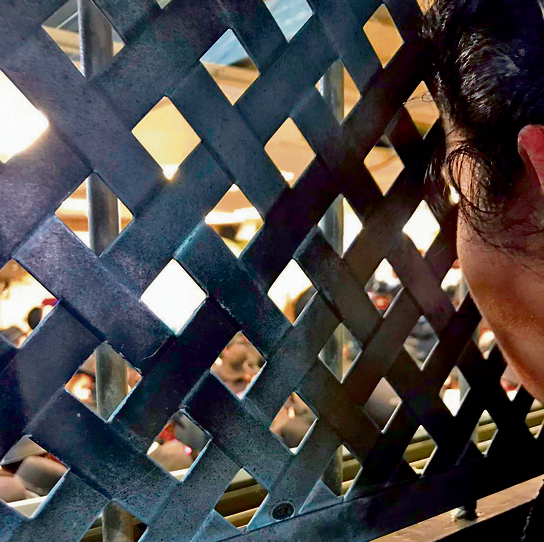
Women peek through a screen at the women’s gallery in the synagogue under Berland’s house. ‘It’s a special rabbi and a special prayer’  (Photo: Ariela Sternbach, Nina Fuchs)
Women peek through a screen at the women’s gallery in the synagogue under Berland’s house. ‘It’s a special rabbi and a special prayer’ (Photo: Ariela Sternbach, Nina Fuchs)

Like many of the Hasidim, Naomi also has a slew of tales about the rabbi’s miracles. “For example, a barren woman who got pregnant,” she says, and shares her own personal case: “The rabbi saved my tooth. We were with the rabbi in exile in Johannesburg, and my tooth hurt at the time. I didn’t tell him, I didn’t ask. He stood like that and suddenly his hand started doing like this,” her hand strokes her cheek. “He caressed me exactly where it hurt, protected my tooth for three years. The rabbi didn’t know I was in pain. It was really strong pain.” 

The “exile” issue is repeated quite often, mainly by Hasidim from the close circle who were with him when he fled the Israeli law and wandered around the world. He had about 40 families with him, but many others brag about escorting and meeting him there, in an attempt to demonstrate how close they are to him. These stories join a slew of other tales shared by the rabbi’s followers. 

“We followed the rabbi wherever he went,” says Hanni, who is in her 20s. “He sentenced himself to exile because he is a great scholar. It’s true that things were slightly rough financially, but we wouldn’t give up being in the rabbi’s company. He performs great miracles and even saved my sister from death in Morocco. She stayed alive thanks to him.” 

Back to the prayers, which are at the center of the congregation’s life. The sun has set a long time ago, and the rabbi has yet to come out. A woman from the congregation explains that there is no way of knowing when he will come out. 

When we try to understand how they can pray Minhah (the afternoon prayer, is recited from the afternoon hours until sunset) when it’s already dark outside, she replies: “The rabbi directs the sun and the moon. The times are set by the rabbi.” 

So dozens of Hasidim, who define themselves as ultra-Orthodox, recite a prayer long after its time according to every Jewish-halachic criterion. 

As they wait for the rabbi, the women register for vegetable deliveries. As most of them are extremely poor, the congregation takes care of all their needs. That’s one of the nice social aspects of communities of this kind, where everyone takes care of everyone. The few members with a stronger financial basis take care of the weak majority. 

Suddenly, there is a whisper in the crowd. Berland appears to be coming out, and all the women around us start pushing and stepping on each other to see him. To an outside observer, they might look like young girls standing next to the stage during a rock concert, shouting the rock star’s name and passing out from all the excitement. 

“Look! It’s the rabbi,” one of them screams. “The rabbi, the rabbi, the rabbi,” another one has trouble breathing. “Oh my God, the rabbi,” a third woman’s face is red from excitement.” There is something about that strength, about that belief in a person’s power. That in itself may be enough to improve a person’s mood and health. 

When Berland starts talking, the girls around him cry out in amazement and admiration. One of them hands him jellybeans, hoping he will touch and bless them. We follow the box of candy with our gaze as it makes its way from the hands of three men into Berland’s hands. He holds it for a minute and then tosses it at us. As new members of the congregation, we are given precedence. 

At this stage, it’s as if the signal has been given for an onrush: The women send a slew of notes, and the men pass notes and paper bills. From this moment until the end of the prayer, he already has a handsome sum of cash and an impressive collection of notes in his pocket. 

“It’s enough to ask for a blessing, and it’s already working,” one of the women explains. “They say that the lowest rank is a response from the rabbi. The higher and holiest rank is dreaming about the rabbi.” 

Have you dreamt about the rabbi?
 
“Several times,” she replies with shining eyes. “You have to beg and pray before you go to sleep that the rabbi will appear in your dream. He actually guided me. He told me in the dream to stop drinking Nestea because it’s not sufficiently kosher. In another dream, he told me he refused to meet with me because I had to quit my studies. A day after I quit my studies, he waved at me at the traffic light.” 

Shira silences us. “The rabbi is reading my note,” she cries out. “There, it’s only the fourth note I sent him. Now he’ll tell me what to do.” A few seconds later, her phone rings. The warden is on the line. It turns out that she is waiting for the rabbi’s instructions on whether she should take antibiotics prescribed by the doctor to treat a bacterial disease she is suffering from. 

As soon as the prayer ends, they all rush outside to get a good place in the “chases.” Naomi explains, “I don’t wait next to the rabbi’s house like everyone else but run past several traffic lights to catch up with him.” 

There are hundreds of people standing around the house right now—men, women and dozens of children, waiting to catch a glimpse of Berland through the car’s window. When he emerges with his car, we burst out of the alley towards the busy main street, along with dozens of men, women and children. An outside observer may mistake the scene for the scene of a terror attack. Two minutes later, his luxurious car approaches, and he opens the window and waves goodbye. The fans are beside themselves.

Where does the money go?

This admiration for the rabbi is likely one of the reasons for the complexity of the investigation into the sex offenses he was convicted of. The congregation’s women believe in him blindly. With such absolute control over them, most of them have trouble acknowledging his misconduct. Others are afraid to speak out against the man they admired for years.

“Up until five years ago, we saw him as one of the righteous men in our generation,” admits one of the people on the independent Haredi panel that collected the complaints against him. “And then we began hearing about different incidents, including death threats. It’s difficult, but when I receive threats I realize they have to be fought. The public has to understand that this person harms everything that is sacred and important to the Torah.” 

The first complaints he received, he says, had to do with financial matters. “They established an unbelievable financial empire,” he says. “For years, people had to pay extremely large sums to get in, and I know people who gave him huge sums in exchange for ‘treatments.’” 

In this context, a former Hasid told us: “I personally gave the rabbi $300,000 in cash as part of proceeds alone, at the rabbi’s specific order.”

 (Photo: Ariela Sternbach, Nina Fuchs)
(Photo: Ariela Sternbach, Nina Fuchs)

Nechama, who barely made it out of the congregation, says the friends she left behind are repeatedly asked to transfer money to the rabbi in exchange for different blessings. Despite being penniless, they take loans and get into debt, “because the rabbi means everything to them,” she explains.

“Then their parents pay. It has created a rift in quite a few families, but the rabbi and the people around him don’t care. They’ll tell you that this money goes to charity and welfare, but won’t be able to present you with a shred of evidence supporting this claim. There’s a reason why the Berland family got so rich, and this wealth has created internal disputes. After all, someone will have to inherit the empire.” 

The more dramatic issue, from a public perspective too, has to do with complaints against Berland’s sexual conduct, an affair which prompted the independent panel of Haredi judges to issue a scathing manifesto against the rabbi. 

“We sat in the court and received horrible testimonies from women,” one of the people on the panel says. “We helped the them file a civil claim against Berland, against his wife and against their son.”
Another issue the authorities are dealing with is the neglect of some of the children in the community: The clothing, the nutrition, the physical state. Some of the newborn babies are not given proper care and are not supervised by the authorities. The medical dependence on the rabbi could be particularly dangerous when it comes to people who are ill and may give up treatment if advised to do so by the rabbi. 

The congregation members are well aware of the welfare discussions. As soon as we pull out a phone from our pocket and try to take pictures, women storm at us from every direction: “Where are you from? Why did you take pictures? Delete them! People come here and take pictures for the social services. Whoever takes pictures for them will be hanged.” 

Berland’s associates, on the other hand, present an entirely different picture: Thriving educational institutions, children whose needs are taken care of, and an internal welfare project that supports the poor and the weak. 

“You’re invited to take a tour,” they said to us several times. “You’ll see the work being done in the congregation, the mutual responsibility, the good education the children receive in the Talmud Torah school. There is no distress.” 

It should be noted, however, that many of Berland’s followers come from weak populations and rely on the support they receive from Berland and his congregation. Moreover, many of them aren’t interested in “nonsense” like earning a living, stylish clothes or things which may seem trivial to us. As far as they are concerned, they have everything they need—a connection to the rabbi.

Paid meetings

It’s late in the evening in a big synagogue near Derech HaTayasim in Tel Aviv. Many of the congregation members are excited ahead of Berland’s arrival at a conference. They have come here from all over the country and include some exceptions—traditional, nearly secular, people who have come to hear what everyone is talking about.

These conferences, which are held in different places in Israel every few days usually attract demonstrators as well, protesting the fact that Berland is still honored and invited to preach his doctrine. 

Inside, there is a festive atmosphere inside. After about an hour of speeches from different rabbis who still support him, Berland enters the room like a king to the sound of loud applause from the women sitting next to us in the women’s gallery. Being charismatic, Berland knows how to draw the attention of his fans and followers. He is surrounded by an entourage of security guards and associates who prevent anyone from approaching anyone. At first, he stands up and dances for several minutes to the sound of Hasidic songs. 

As soon as I pull out my smartphone to take a picture, a young woman snatches it and asks, “Who are you?” Their fear of the media is hard to miss. The Hasidim repeatedly warn of “a female journalist who infiltrated our community,” without knowing that we work together.
“Don’t let them scare you,” says Ora, who escorted me to the conference. “They’re traumatized by every new woman that arrives,” she says about the hostile girls. “They’re afraid of the media and they suspect everyone.”

Women peek beyond the women’s gallery screen at the synagogue under Berland’s house (Photo: Ariela Sternbach, Nina Fuchs)

Despite their hostility, the Berland women reveal their caring and compassionate side later on. When I leave the conference after feeling unwell, they call me one after the other to make sure that I’m okay, that nothing bad happened to be. Their concern continues in the following days, when I undergo surgery and while I recover. It’s real, sincere concern, with a slight attempt at turning me into one of the rabbi’s believers too. 

Back to Jerusalem. We decided to try to get a blessing directly from Berland, to try to talk to him for a few seconds. This time, following the girls’ recommendation, I specifically write in the note that I need advice on using a certain medication, an ointment, as well as a shidduch if possible. As we wait, we spot a sticker reading “A prayer for the wellbeing of the Rabbi and Rabbanit.” That makes sense, considering his status—practically a god. 

Shortly after 6 pm, the rabbi comes out. After the prayer, two toddlers are brought to the stage and the rabbi cuts their hair. It’s the famous ushperin ceremony which is held when a boy turns three years old. One of the children, however, is already four years old. “We grew his hair long again, because when he was three years old the rabbi was absent,” his mother explains happily.
An older woman approaches us, asks where we’ve come from and where we’re going. Quietly, she shares a secret with us. “You can get to see the rabbi if you buy 100 letters for the Torah scroll,” she promises. “It’s a standing order, 100 shekels a month for 36 months. It’s quite a lot, but it guarantees that the rabbi will see you.” 

One of the leaflets scattered around us includes a phone number for urgent medical cases. I dial the number and tell the secretary once again that I have a skin disorder and need to know what I should do. An hour later, the rabbi’s warden calls and passes him the phone. 

The rabbi’s unclear words are translated by his secretary: “How old are you?”
25.
“Married?”
No, single.
“A meeting with Yitzhaki. Will Yitzhaki be good for you?”
Who’s that?
“He studies 24 hours. Are you ready for a guy who studies 24 hours?”
Ready for what?
“He’ll work for you to have a child… So we’ll arrange the meeting today. You’ll meet him on Sunday. A fine young man, charming, blue eyes, just the way you like it.”
Can I meet the rabbi too?
“Be here tomorrow at 4 pm.” 

As for the “skin disorder,” the rabbi recommends applying ointment every hour and promises it will pass by Saturday. In this case, nothing happened. The rabbi wasn’t present during the surgery either, as far as we know, neither physically nor in spirit. That’s the thing with religious clerics like him—their followers see the rabbi as a sacred, righteous man who always speaks the truth, even if in reality the exact opposite happens.

Berland’s associates: We’re being persecuted

An associate to Berland offered the following response: “The rabbi engages in charity activities, among other things, and often receives donations for the needy. These donations are usually handed out to the poor on the same occasion. The rest of the money and donations through a standing order are directed to the congregation’s charity organizations.

“In recent years, the rabbi hasn’t been receiving women in his home and has been escorted by security guards 24/7 on behalf of a former deputy police commissioner to prevent a disaster or slander by the rabbi’s persecutors. 

“As a man of the world, the rabbi acknowledges the global epidemic of an over-prescription of painkillers. However, there is no recommendation to avoid medical care, and all Shuvu Banim associates see doctors when necessary. 

“As for the claims of violence, Rabbi Berland has been working for years to bring every Jews closer to the Jewish tradition. The rabbi is famous for appealing to the hearts of people with a violent past and mental stability issues as well. Nevertheless, members of the congregation have been feeling persecuted by the media in recent years following many negative reports. Although there is no justification, this is reflected in intolerance towards the media. We reject this behavior.”

Berland's car arrives at the Western Wall in early April

The Ministry of Social Affairs directed us to the Jerusalem Municipality’s Social Services Department, which offered the following response: “Significant cooperation has been advanced in recent years between representatives of the municipality’s Social Services Department and representatives of the Shuvu Bnaim congregation, thanks to great efforts to build a relationship of trust, after the congregation had segregated itself and rejected any contact with the state’s institutions for years. 

“The Jerusalem Municipality has allocated special social workers to care for the families, opened workshops for parents in crisis and made them accessible, created a basket of modified responses for poor families, built a ‘warm home for girls,’ introduced specific programs for children and youth at risk, including a summer camp for young children, and incorporated special care teams in the educational systems. In addition, truant officers and youth advancement workers have been introduced into the educational institutions.” 

The Israel Police offered the following response: “The Israel Police enforce the law and maintain public order wherever necessary, in a professional, impartial manner and proportional manner, and using constant discretion concerning the use of the arrest authority and use of force. In this case, thanks to the police’s determination, the cellphone was located and returned to the reporter by the police officers.”

‘Don’t talk about what happened between us’

Eight women testified against Berland in the special tribunal appointed by the Breslov Hasidic movement. According to one of the rabbis, they received complaints from other women who claimed to have been abused by the rabbi. Talia, in her 20s, is one of them. Here is a refined version of part of her testimony:

“The rabbi took me to the apartment down there,” she said. “He sat on the bed, made me sit on him, hugged me and inserted his hands. He said to me, ‘It was so horrible, so horrible. I didn’t get to see you for 72 hours! I thought I would die.’” 

When she asked him if it was okay that she had spoken, he said to her: “The rabbi said no talking, not a sound! You know what? You can talk, but not about what happens between us, nothing about what happens between us!... You don’t know the rabbi, you don’t know who the rabbi is. You know nothing.” She said she had felt as if he was preparing her for a police interrogation. 

In separate case, she testified: “Each time he orders me to sit on him, and that day he sat down and I stood next to him, and he inserted his hands and it was just like… he was doing something! In that direction and in the other direction… He was with me for a long time, and then he possibly made me sit on him.” 

In another incident, she said, he took his clothes off and undressed her completely, “and that was the first time we were intimate,” she said. “He sort of hugged me and lay down in the bed, simply swinging me over him, I don’t even know how I got there… That time he inserted his… And I don’t know, I did nothing, I froze my mind.” 

Talia, a married woman, described how in one case Berland read “Tikkun Haklali” (The General Remedy, a text attributed to the Breslov Rebbe) with her as his hand caressed her body, and how she and Berland had sexual intercourse. “I don’t (know) anything,” she said. “It’s not a husband and wife being intimate. I don’t know how it’s supposed to be.”


Thursday, May 03, 2018

Sex offender rabbi Eliezer Berland to be honored at Lag B’Omer festival

Outrage as Eliezer Berland, who served time for indecent acts and assault, including of minor, set to light bonfire in Meron

Rabbi Eliezer Berland covers himself with his talit (prayer shawl) at the Jerusalem Magistrate's Court during his trial for sexual assault charges on November 17, 2016. (Yonatan Sindel/Flash90
Rabbi Eliezer Berland covers himself with his talit (prayer shawl) at the Jerusalem Magistrate's Court during his trial for sexual assault charges on November 17, 2016. 

A rabbi convicted of sex offenses, including against a minor, is set to be honored at the annual Lag B’Omer festival at a pilgrimage site in northern Israel on Wednesday night, sparking an outcry.

Eliezer Berland, 80, who served five months of an 18-month prison sentence after eluding arrest for three years, will be among the 20 rabbis who will light a bonfire at the tomb of Rabbi Shimon Bar Yohai in Meron, where hundreds of thousands of worshipers were expected to gather Wednesday evening and Thursday.

The Religious Affairs Ministry, which contributes some NIS 15 million ($4 million) in funding to the Meron ceremonies, condemned Berland’s participation, but insisted it was powerless to stop him as the annual festival fell under police purview.
Police, in a statement, disputed the ministry’s account, saying they were responsible only for securing the event. The Israel Police “doesn’t determine the identities of the participants and lighters, since [Berland’s inclusion] does not constitute a violation of the laws of the State of Israel, and therefore the claim regarding the police is out of place and wholly unclear,” it said.

One of Berland’s victims, identified only as Adele, told the Walla news website the decision to include the rabbi in the religious ceremony was a “disgrace,” and demanded the ministry and police block him from participating.

“It’s a disgrace that a convicted sex offender and an obsessive womanizer dares appear on the stage of honor at the grave of the man who, above all, symbolizes in the Jewish tradition the sanctity of modesty. Is there no limit to the absurdity?” she was quoted as saying.

The Beit Hillel rabbinical group called on Israel’s chief rabbis, as well as all Israeli rabbis, to join together “in a call to prevent the great desecration of God’s name of a public lighting at Rashbi’s [Rabbi Shimon Bar Yochai’s] grave by convict Eliezer Berland.”


Ultra-Orthodox Jews seen near a big bonfire, during celebrations of the Jewish holiday of Lag B’Omer 

Berland was sentenced to 18 months in prison in November 2016 after being convicted of two counts of indecent acts and one case of assault, as part of a plea deal. He was freed after five months, in part due to ill-health.

Long considered a cult-like leader to thousands of his followers from the Bratslav sect, Berland fled Israel in 2013 amid allegations that he had molested two female followers, one of them a minor.

According to the indictment, Berland would often receive people in his homes in Jerusalem and its suburb Beitar Illit and hold private meetings intended for spiritual guidance, counseling or benedictions. The rabbi would sometimes take advantage of the meetings and of his position in the community to engage in sexual acts with women, including minors, according to the charges against him.

He was on the run from authorities until 2016, avoiding several Israeli attempts to extradite him. He moved between Zimbabwe, Switzerland, the Netherlands and South Africa, accompanied by a group of devout followers numbering around 40 families. Berland was apprehended by South African authorities, extradited to Israel, and detained upon his arrival at Ben Gurion Airport in July 2016.

Lag B’Omer is a key holiday in the Jewish mystical tradition. It is said to be the day, in the 2nd century CE, of the death of Bar Yohai’s, and also the day when he first conveyed the text of the seminal Jewish mystical work, the Zohar.

Literally meaning the “33rd of the Omer,” Lag B’Omer is a day during the seven weeks between the holidays of Passover and Shavuot that is not considered a day of mourning for the students of Rabbi Akiva, Bar Yohai’s teacher, who tradition says perished in a plague during those weeks. The period before and after Lag B’Omer is thus traditionally a time when public celebrations are eschewed.
Hundreds of thousands of Jewish Israelis flock to Bar Yohai’s tomb, the second-most visited holy site after the Western Wall, on Lag B’Omer each year.

https://www.timesofisrael.com/sex-offender-rabbi-to-be-honored-at-lag-bomer-festival/

Wednesday, April 25, 2018

This Idiot Is Dead Wrong ....AGAIN!

Is Swordfish Kosher?

Photo Credit: Jewish Press
The commentaries on the Shulchan Aruch say dag ha’cherev [literally, “the fish of the sword”] is kasher.
Why is it widely considered to be not kosher, then?
Because around 60-70 years ago, they asked Rabbi [Moshe] Tendler if he could make a list of which fish are kosher and which aren’t. Rabbi Tender decided to list swordfish as a treife fish because he called up an expert who told him scales on a swordfish are a different consistency – or something like that – from those of other fish. So he decided it was a treife fish.
But that’s absolutely not correct. The commentaries on the Shulchan Aruch say dag hacherev is kasher. Professor [Shlomo] Sternberg, a big genius in learning and math, published an essay maybe 20 years ago in which he writes that Rabbi Soloveitchik asked him to conduct research on the status of swordfish. He did. He showed Rabbi Soloveitchik the scales of a swordfish and Rav Soloveitchik said, “It’s a kashere fish!”
Professsor Sternberg writes that he still has the envelope with the scales he showed Rav Soloveitchik in his Gemara Chullin.
If the commentaries on the Shuchan Aruch say dag ha’cherev is kosher, how can Rabbi Tendler claim it isn’t?
Rabbi Tendler claims “dag hacherev” is a different fish. It’s not true.
But Rabbi Tendler did a service to the Orthodox Jewish community because at the time there were Conservative rabbis who were giving hashgachas, so he laughed them out of existence and said they don’t know what they’re talking because [they were giving swordfish a hechsher when] swordfish is really treif. So the Orthodox realized you can’t rely on the Conservatives.
L’maaseh, the Conservatives were right on this issue, but Rabbi Tendler accomplished his goal.
******************************************************

Swordfish (Xiphias gladius) does not seem to have scales when one looks at a sample. Some say that it has scales that are embedded to such an extent that it is impossible to remove them without making a hole. Others say that it has kosher scales on parts of its body which fall off during its development. Still others claim that it may have some kosher scales even at the time of harvest.

The Orthodox Union traditionally treats swordfish as non-kosher.

(See Sh’ailos and Teshuvos Tzitz Eliezer 9:40 who discusses a statement made by the Knesses HaGedolah about “cherev hadag” and explains why we cannot use the statement to permit swordfish.)

https://oukosher.org/blog/consumer-kosher/consumers-faqs-on-kosher-fish/

https://www.kashrut.com/articles/fish/


Tuesday, April 24, 2018

Police arrest haredi man who hit Beit Shemesh women with pipe Extremist haredi man arrested after video showing him hitting women with pipe as part of 'modesty patrol' shocked the country.


Police have arrested a haredi man from Ramat Beit Shemesh who was videoed hitting women with a pipe as part of a vigilante 'modesty patrol'.

The man can be seen in the video ordering the horrified women to "go home" on the eve of Yom Ha'atzmaut while menacingly wielding a rubber pipe. The clip went viral in Israel, racking up hundreds of thousands of views and causing an outcry on social media.

On Saturday night, the man was arrested by police, who told the Behadrei Haredim website that he was well known to local authorities due to his radical activities. He was released shortly after on bail and police have opened an investigation.

Ramat Beit Shemesh has been the center of increasingly divisive battles over the past few years as a large influx of radical haredim have battled with the Religious Zionist and secular residents over the city's nature.

http://www.israelnationalnews.com/News/News.aspx/244799?utm_source=activetrail&utm_medium=email&utm_campaign=nl

Monday, April 23, 2018

“God can be incarnated in a human being, in the form of the tzadik,” one of his followers explained to Haaretz. This is a mantra for his most dedicated followers who see the rabbi as God incarnated, and state he is allowed to do anything....


We’ve met Rabbi Eliezer Berland, the tzadik (“holy man”) of the Shuvu Banim Hasidic sect, in these pages before. In 2015, after years of globetrotting while he was evading Israeli prosecutors, Berland was finally forced to return to his home country. There, he stood trial on three sex-crime charges, including sexual assault. A court in Israel sentenced him to 18 months’ imprisonment, but the rabbi served less than three in an actual jail cell on account of his poor health. After being under house arrest for another nine months, he was paroled.

Whatever his erstwhile medical issues, Berland, 80, is firmly back in the saddle these days:
“He can pray and study while standing for many straight hours without getting tired,” says one of those close to him. “Have we ever seen such things?”


That’s one of the tamer quotes in a new Haaretz article about Berland and his acolytes. To hear his delirious devotees tell it, Eliezer Berland is God made flesh. A glass of water he drank from cured a desperately sick patient when she put it to her lips. The rabbi can make his followers impervious to bullets. One time, Berland entered a hole in a frozen Ukraine river and didn’t come out. When his devotees began to fear he had drowned, recounts a sect member, “we turned around and saw him come out of the ground.”

Other religious people no doubt appreciate their clergy too, but the veneration for Berland is in a class by itself because he believes he is God — and thousands of believers think he’s right.
“God can be incarnated in a human being, in the form of the tzadik,” one of his followers explained to Haaretz. This is a mantra for his most dedicated followers who see the rabbi as God incarnated, and state he is allowed to do anything.
Whenever he makes his appearance among the faithful, the scene is barely distinguishable from a Justin Bieber autograph session.
The excitement hit its peak. One of the followers ran to him and managed to touch the rabbi’s tallit [prayer shawl]. The rest of the men pushed and shoved, climbed on chairs and even trampled those standing in the way between them and Berland. The few who succeeded returned to their seats beaming with excitement and with glazed eyes. …
When he leaves home, dozens of his supporters rush after him in their cars. When he leaves for events, they chase after him too. During Sabbath services he often throws slips of paper, newsletters, and spices at his followers — and the crowds fight and shove to have the honor of catching them, or just touching things that the rabbi has touched. The children present at such events hang on the railings, packed in tightly, even climbing over the heads of those praying to receive a white kippa from the tzadik.
Haaretz says that Berland lost some followers while the court case against him played out, but that only leaves the hardcore
beliebersbelievers who simply will not hear the slightest criticism of their idol.
“The rabbi didn’t do any of the things they say about him,” one of the women … told Haaretz, after she received permission from her husband to speak. “The rabbi is a supremely righteous man, whatever he does is all for the good of the heavens.”
That’s despite the fact that Berland confessed to rape. Clarifies one of his students,
“If people tell me that cats and elephants are dancing now outside, of course I will think they are crazy. This is exactly what I think when all sorts of people tell stories about the rabbi. It simply cannot be. Not possible.”
Not even damning audio recordings that Haaretz obtained can change their minds, though the god-man is revealed at his most murderous. At one point,
He can be heard raising his voice, and even screaming, at one of his followers concerning appointments in the community’s institutions. “I didn’t appoint them. They’re fired. I’ll shoot them. Bring me a pistol, I’ll shoot them. I’ll murder you too. If you didn’t understand that I’ll shoot you. I’ll serve a life sentence.
In another recording, Berland says about one of his opponents: “I’m going to sentence him to death now. I’m saying now that it is permitted to murder him.”
Totally holy.

Up to a thousand Israeli families are believed to be under his sway, and a few hundred of them are considered part of his “inner circle.” What craziness will they perform when he dies? What will they do if he tells them to obliterate the sect’s enemies? How will they respond if he begins spouting doomsday gibberish, Jim Jones-style?

Meanwhile, how will this serial sex offender behave around girls and women who are taught to believe that their holy man, their God, is allowed to do literally “anything”?

A great deal of concern is warranted.

 http://www.patheos.com/blogs/friendlyatheist/2018/04/20/hasidic-sect-sees-rapist-rabbi-as-god-believers-allow-him-to-do-anything/#wtbxLzJ1W0XJQiPY.99

Friday, April 20, 2018

If the message Trump is sending to Assad is that he can go on killing people — though not with chemical weapons — that is just as much of an abdication of America’s moral authority as Obama’s spineless responses....

Trump’s Syria Strikes Are Not Enough


The remains of the Syrian regime’s Scientific Research Centre in Damascus

JNS.org – If the sole criteria by which Donald Trump’s actions in Syria should be judged are to be compared with his predecessor, then perhaps the claim of “mission accomplished” might be accurate.
Stacked up against President Barack Obama’s epic failures in Syria, Trump doesn’t look so bad. But even if he were not describing the American-led strikes on Syrian dictator Bashar Assad’s chemical weapons capability with that cringe-inducing phrase, we would still have to judge Trump’s actions as — at this point in time — very much a mission left unaccomplished.

As the White House has made clear, the missile strikes were strictly a one-off event, entirely disconnected from any overall strategy to deal with the threat posed by a Syria dominated by Russia and occupied by Iranian forces determined to turn that country into a front against Israel. Just as troubling is the signal from Washington that the president is planning, despite appeals from his national-security team and American allies, to pull all US forces out of Syria after the defeat of ISIS is deemed complete.

While Trump was moved, as he should have been, by Assad’s atrocities against civilians — and decided to strike at the Syrian dictator’s forces — he isn’t prepared to do anything more than that or act in a meaningful way to stop the slaughter in that country.

Despite the missiles, Trump is maintaining Obama’s policy of punting Syria to Russia, and treating Iran’s takeover as something of no interest to the United States. He’s also apparently prepared to stand by and let a successor Islamist group fill the vacuum left by the United States withdrawal, just as happened after Obama pulled out of Iraq and stayed out of Syria — the exact events that led to the rise of ISIS.

Americans can take some satisfaction that the United States is not prepared to let the use of chemical weapons go unpunished, as was the case with Obama’s humiliating “red line” retreat. By the same token, they should applaud the progress that American-led forces have made in the fight against ISIS. Trump’s loosening of the rules of engagement transformed the stalemate he inherited from Obama into a rout of the Islamists.

But no one should be fooled by the spectacle of the allied attacks on Assad’s chemical-weapons capability into thinking that America is doing anything meaningful about what is arguably the worst human-rights catastrophe of the 21st century. Nor should it escape anyone’s notice that Trump’s policies are essentially leaving Israel alone to face a deadly threat on its northern border.

The problem here is just the opposite of the chaos obsessed over by the president’s detractors. The issue in Syria is Trump’s unwillingness to confront a basic contradiction in his foreign-policy outlook that has been glaringly obvious since he first began campaigning for the presidency. He still can’t seem to grasp that you can’t be tough on Iran while being soft on Russia.

If the United States is to mount a meaningful campaign — as Trump has often said he would — to roll back Iran’s efforts to achieve regional hegemony by a nuclear deal that has enriched and empowered it, this must be part of an approach that takes into account that Tehran’s most dangerous conduct is being enabled by Russia.

The other contradiction is that while Trump has been extremely supportive of Israel in many ways, he’s also ignoring what is rapidly becoming the most lethal threat to its security: Iran’s presence in Syria.

Friends of Israel should be grateful to Trump for discarding the foreign-policy establishment’s warnings about recognizing Jerusalem as the Jewish state’s capital, and for ending Obama’s policy of trying to put “daylight” between America and its sole democratic ally. He’s also right — and the supposed “adults” wrong — when he speaks of the dangers inherent in an Iran nuclear deal that must be renegotiated if Tehran is to be prevented from eventually gaining nuclear weapons.

But that doesn’t give him a pass for deciding that Syria is merely a theater for dramatic US gestures, rather than the pivotal issue that may decide whether another war in the Middle East is inevitable.
If the message Trump is sending to Assad is that he can go on killing people — though not with chemical weapons — that is just as much of an abdication of America’s moral authority as Obama’s spineless responses.

Just as troubling is the idea that the message Trump is sending to Russia is that it shouldn’t interpret the president’s histrionics as an indication that the United States is still interested in engaging in the region.

Worst of all is that Iran is likely interpreting Trump’s gestures as a sign that the United States doesn’t regard its building of military bases and weapons factories in Syria as an issue it cares about. If America is telling Russia that it won’t demand that Vladimir Putin restrain Iran or push it out of Syria, then Israel is being left to fend for itself as a problem the Americans helped create gets out of control.

For all of the good Trump has done for Israel in the last 14 months, leaving it alone to deal with Iran and Russia in Syria is simply too dangerous. Israel must balance the need to maintain relations with Russia — now the region’s leading power — with the imperative to prevent Iran from threatening its safety. If Trump doesn’t understand that simply abandoning Israel in this manner is an invitation to Iranian aggression and a new Middle East war, and that this is profoundly precarious for US interests and security, then he’s just as foolish as his enemies claim.

Jonathan S. Tobin is editor in chief of JNS — the Jewish News Syndicate. Follow him on Twitter at @jonathans_tobin.

 by Jonathan S. Tobin / JNS.org


Thursday, April 19, 2018

The Role of the Counselor in Keeping Camp Safe

ASAP - Jewish Sexual Abuse Prevention and Treatment - CLICK.

Camp can be an amazing experience.... or it can be a nightmare. Your actions are what will make the difference. Parents - learn more about how to protect your children from abuse this summer. Camp directors - create a safe camp environment with clear policies and training. Visit our website to access our free safety programs.

https://www.youtube.com/watch…


Wednesday, April 18, 2018

It is my impression that many Orthodox Jews (simply) lack information, exposure, and context, all of which would enable us to develop a more informed, nuanced, and accurate perspective of the reality. ...


In 1982, Nancy Reagan visited the Longfellow Elementary School in Oakland, CA, as she embarked on her historic national anti-drug campaign.  During this visit, she was asked by a young schoolgirl what she should do if she was offered drugs. The First Lady responded, "just say no."  The rest, as they say, is history. "Just Say No" clubs and organizations were established all over the country and one of the most famous slogans in modern times was born.  The "Just Say No" rallying cry has since become ingrained in the minds of hundreds of millions of people, spanning all races, ethnicities, and religions.

I wonder however if the Orthodox community has taken Nancy Reagan's instructions a bit too far. Indeed, we can all agree that the only proper response from one who has been solicited to accept drugs is "no." Too often, however, many of us express "no" to the mere suggestion that we discuss drugs at all. Many of us naively believe that the Orthodox community is, more or less, unaffected by the drug epidemic, which so dreadfully affects the general population.

Consider the manner in which many well-intentioned members of our community would likely respond to the following questions:
  • Do substance and alcohol abuse and addiction affect members of the Orthodox community, to any significant degree?
  • Should we, as a community, organize public gatherings to discuss how best to detect alcohol and substance abuse and introduce methods of intervention and treatment?
  • Do substance abuse and addiction afflict individuals who come from supportive families and functional households?
  • Do people who are committed to a life of Torah observance and seek to embrace Torah values abuse alcohol or drugs?
  • Do individuals who truly appreciate the value of self-control struggle with alcohol or drug addictions?
Did you answer "no" to any of these questions?  If you are like most of us, then you probably have.  The uncomfortable truth, however, is that the answer to all of these questions is a resounding "yes."
  • Yes, substance and alcohol abuse and addiction undeniably affect a significant population within the Orthodox community.
  • Yes, we must absolutely come together as a community and discuss methods of detection, intervention, and treatment of alcohol and substance abuse.
  • Yes, substance abuse and addiction often affect members of supportive families and functional households.
  • Yes, it is not uncommon for individuals who are genuinely committed to Torah observance and values to develop addictions to alcohol and drugs.
  • Yes, most often, individuals who struggle with alcohol and drug addictions thoroughly and deeply understand, appreciate, and value the virtue of self-control, despite their destructive behaviors.
But why the disconnect?  Why does our community so glaringly miss the mark on this particular issue? After all, our community consistently displays profound sensitivity to the needy and disadvantaged, demonstrates care and concern for the weak and vulnerable, and is typically proactive in addressing the myriad of social issues that affect the members of our community. Why then do we seem to possess a lapse in awareness and deficient sensitivity when it comes to the issue of alcohol and substance abuse and addiction?

It is my impression that many Orthodox Jews (simply) lack information, exposure, and context, all of which would enable us to develop a more informed, nuanced, and accurate perspective of the reality.  Our detachment from the facts on the ground does not reflect insensitivity or indifference. Rather, our disconnect is, among other things, a reflection of our limited exposure, inadequate education, and impaired understanding.

Whatever the underlying causes of our disconnect may be, its effects, albeit unintended, are no less harmful and destructive. The common misconceptions that we, as a community, continue to harbor and, at times promulgate, clearly and predictability obstruct our collective ability to responsibly and effectively address substance abuse and addiction. The longer we maintain the belief that members of our community are either immune to or unaffected by alcohol and drug abuse, we fuel the fires of stigmatization, causing our very own friends and neighbors to shoulder their hefty burden alone. The longer we allow ourselves to view the families of those who suffer from addictions with prejudice and presume their shared culpability in their child's/spouse's/sibling's/parent's addiction, the further we estrange those who desperately need comfort, support and reassurance.

The longer we view alcohol and substance addiction as a failure of character, rather than what it actually is - a physiological illness, we further alienate members of our community who may already feel helpless and ashamed.

As individuals, we must band together and inspire a paradigm shift in the way we approach alcohol and drug addiction, recognizing it for the illness it is.  As a community, we must hold ourselves accountable, knowing that there are those among us who are afraid to come forward and step into the light, lest they be unfairly judged, mislabeled, and misunderstood. We must learn to encourage and embrace those struggling with addiction, as well as their families, assisting and supporting them on their road towards healing and recovery.

Needless to say, success in achieving such a radical and fundamental shift in thinking and action will take time, effort, and coordination to actualize. But we need to start and that time is now.  Please join me on April 22 at 8 p.m. at TABC, for an important community awareness event, coordinated in conjunction with Amudim.  Participants of this event will become more informed and enlightened regarding the growing epidemic of substance abuse and addiction within our community.  With your participation, this event can be a major step forward for our community.  However successful this event may ultimately be, it will be a starting point, with more work to follow.  I hope this event will inspire our community to slowly but surely create an environment where families can comfortably seek and easily discover support.  And then we, a more attentive and informed community, will more naturally strive to sustain and nurture that supportive environment.  I hope and pray that we demonstrate the courage, commitment and resolve to restore peace and health to all in our midst.

https://www.jewishlinknj.com/op-eds/24411-don-t-say-no-to-drugs