EVERY SIGNATURE MATTERS - THIS BILL MUST PASS!

EVERY SIGNATURE MATTERS - THIS BILL MUST PASS!
CLICK - GOAL - 100,000 NEW SIGNATURES! 75,000 SIGNATURES HAVE ALREADY BEEN SUBMITTED TO GOVERNOR CUOMO!

EFF Urges Court to Block Dragnet Subpoenas Targeting Online Commenters

EFF Urges Court to Block Dragnet Subpoenas Targeting Online Commenters
CLICK! For the full motion to quash: http://www.eff.org/files/filenode/hersh_v_cohen/UOJ-motiontoquashmemo.pdf

Wednesday, October 21, 2020

For the ultra-Orthodox to complain that they're being discriminated against when they come under extra scrutiny is essentially to complain that it's anti-Semitic to notice what they're doing.


When Covid-19 rules are flouted by ultra-Orthodox Jews, it isn't anti-Semitism to call it out
When the Jewish community says that it is, it obscures true anti-Semitism while providing leeway not to comply with restrictions needed to stop the spread of the virus.
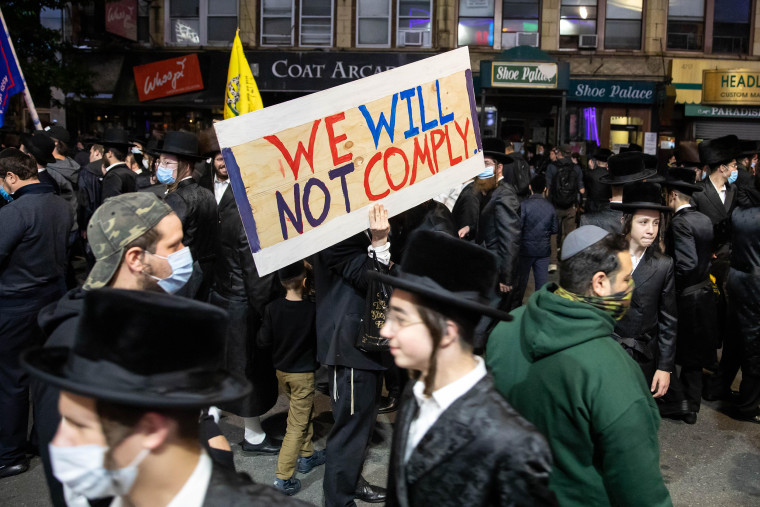
Image: COVID-19 Hotspot Protest in Borough Park, Brooklyn, NYC
A sign reads "we will not comply" at a protest against Covid-19 restrictions in an ultra-Orthodox Jewish neighborhood of New York City on Oct. 7.Michael Nagle / Redux

As authorities scramble to confront a second wave of Covid-19 building across America, anger is mounting against government efforts to stop the spread within a population among those hardest hit by the pandemic: the sprawling ultra-Orthodox Jewish community of metropolitan New York.

For the ultra-Orthodox to complain that they're being discriminated against when they come under extra scrutiny is essentially to complain that it's anti-Semitic to notice what they're doing.

With the pandemic in its eighth month and restrictions cutting into the religious practices of the tight-knit, strictly observant subculture, it's understandable that weariness and impatience would set in. Unfortunately, that's leading to a growing sense in the community that it is being singled out unfairly for deprivation of its religious rights, often accompanied by open complaints of anti-Semitism as the cause for the lockdowns.

It's a dangerous misperception, for both the ultra-Orthodox and their neighbors. The virus doesn't single out groups by religion, race or national origin; it's an unbiased scourge. Nor are New York officials' containment efforts guided by any such bigoted motives. Enforcement goes where the germs are. And the germs, tragically, are hitting ultra-Orthodox Jews with special fury.

From the beginning of the crisis in March, densely populated ultra-Orthodox neighborhoods in Brooklyn, Queens and key suburbs emerged as leading viral hot spots in hard-hit New York. Their outsize vulnerability was due in large part to a traditional religious culture built on a continuous cycle of obligatory, large-scale gatherings for prayer, study, weddings and funerals, all cherished rituals that can and apparently did serve as super-spreader events.

Compounding these risks has been the mundane physical structure of the insular ultra-Orthodox lifestyle, built on large families' living in cramped homes packed into dense neighborhoods, making social distancing extraordinarily difficult.
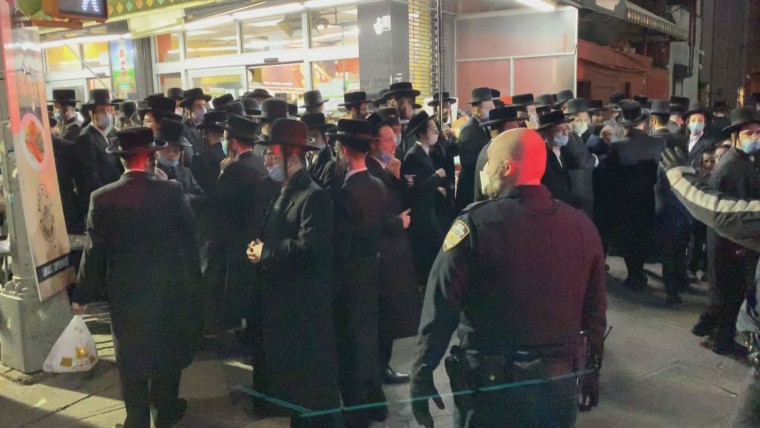

But because those are religious obligations and cornerstones of their Jewish identity structure, government-mandated lockdowns and social distancing can and too often did look from an ultra-Orthodox perspective like government assaults on the religion itself.

It might seem surprising that the community's behavior hasn't been dictated from start to finish by the fundamental Jewish principle known as "protection of human life" — the commandment that nearly all religious rules be suspended if a human life is the balance. And, indeed, while many respected rabbis urged members of the community to follow that guidance, it appears that the principle was hard to visualize when the threat wasn't an enemy gun or a car crash — events that Jews regularly violate religious restrictions to address — but an invisible bug.

That difficulty wasn't helped by a small but influential minority within the community that has been nodding toward a competing principle — that of sanctifying God's name by openly defying oppressors' bans, even at risk to one's own life and limb. While rarely stated aloud right now, this notion has been encouraged by a handful of well-known rabbis, most of them Israelis with strong followings in the United States, and, more subtly, by a deep-seated distrust of the modern world and its dictates, which often take the form of medical directives.

After a long spring of cat-and-mouse police chases after clandestine synagogue services and other attempts by the ultra-Orthodox to evade quarantine, followed by the summer slowdown in infections, the New York City health department reported startling new statistics in late September showing that certain neighborhoods in Brooklyn and Queens, most of them featuring large ultra-Orthodox populations, were reporting virus test results averaging 4.7 percent positive, compared to just over 1 percent in the rest of the city. Two weeks later, the average jumped to more than 6 percent.

The nine "red zone" ZIP codes on the state map of the highest infection rates at that time — which carried the heaviest public restrictions as a result — were nearly all major ultra-Orthodox population centers. Among other things, houses of worship in red zones were limited to 10 attendees at a time under a policy announced by Gov. Andrew Cuomo.

Ultra-Orthodox community leaders maintain — and government authorities largely agree — that most ultra-Orthodox Jews are following government mandates and that violators represent only a minority. That minority, however, seems to be large enough to push the entire community into vastly disproportionate infection territory, given that observance by a vague "most" isn't sufficient to stop the virus.

Yet the reaction of much of the ultra-Orthodox community has been to protest the lifesaving government restrictions — sometimes violently — and to paint them as anti-Semitic. In a typical example, a weekly tabloid with a mostly Orthodox readership touted on its front page an essay headlined "De Blasio And Cuomo Have Declared War On Us," which accused the governor and New York Mayor Bill de Blasio of "treachery and blatant anti-Semitism" and claimed that they "want to destroy our schools and way of life."

And in a toned-down critique, Agudath Israel of America, the main advocacy body representing ultra-Orthodox Jews, argued that while the ban on large services "discriminates against all religions," it "disproportionately impacts the religious services of Orthodox Jews," who would be shut out from traditional synagogue observance of two major religious holidays.

But for the ultra-Orthodox to complain that they're being discriminated against when they come under extra scrutiny is essentially to complain that it's anti-Semitic to notice what they're doing. And in this case, defiantly maintaining tradition doesn't risk just their own lives, which is their prerogative, but their neighbors' lives, as well. The trap they're caught in is tragic, but society has a right and an obligation to protect its people's welfare.

Indeed, the greater anti-Semitism threat likely comes not from failing to defend Jewish rights but from trying too hard. When Jewish communities, Orthodox or not, ask for special accommodations to meet their particular needs, it's often seen by other communities as cutting in line, wheedling extra privileges while broader needs go unmet.

To be sure, part of the ultra-Orthodox misperception that anti-Semitism is at work comes from memories of long centuries when anti-Jewish powers forced Jews to give up their traditions or take them underground. These memories, and the alarms they trigger, are familiar to Jews of every religious and ideological stripe.

Throughout their history, Torah-observant Jews have faced emergencies that have forced them to compromise and bend some laws, sometimes permanently.

At the same time, it's precisely this history that should serve as a guide for the ultra-Orthodox community today in combating Covid-19. Throughout their history, Torah-observant Jews have faced emergencies that have forced them to compromise and bend some laws, sometimes permanently.

Disasters, usually in the form of anti-Semitic persecution, have forced them to drop some practices and amend others to survive until better times returned. So it was after the Roman destruction of Solomon's Temple in ancient Israel and during the Spanish Inquisition, the medieval Polish-Ukrainian pogroms, the Soviet era and the Holocaust.

But America isn't any of those things. Instead, it is the ultra-Orthodox community itself that right now poses the most danger to its own continuity.


https://www.nbcnews.com/think/opinion/when-covid-19-rules-are-flouted-ultra-orthodox-jews-it-ncna1243590?fbclid=IwAR3YjnZjZYtkTrPHaIcfwZWHLarBhPv75IGnKVAVhrA4ylDXWPcReqTvyvo

Monday, October 19, 2020

Agudath Israel To Governor Cuomo: In Our Shuls There Iz Problem....

 CLICK: https://youtu.be/5MAiVi-l2hY

https://youtu.be/DcGvB8-s4Fg

https://youtu.be/094SZQBLNc8


Agudah Chorus: We throw our Jews down the well,

by telling you to go to hell,
so our shuls can be free
to make big  funeral "pardee"

We can not go to shul to shmooze,
 we miss the kiddush clubs and all the booze,
The dead Jews are not our problem
most never pay their dues,
This year cuz of you we can not make tenksgiving party,
oy vey, what to do?

 Agudah Chorus : Governor - In our shuls there iz problem,
we will tell you to go to hell,
So we can go to shul
and drop dead, because we are fools

Give us more reasons to sue,
so we can pray together not to lose,
 as we gather our idiot flock,
all around the Boro Park block,
so we give people around the world more reason to hate the Jew...


Agudah Chorus : Governor - In our shuls there iz problem,
we will tell you to go to hell,
So we can go to shul
and drop dead, because we are fools

Friday, October 16, 2020

TURNING BACK: THE PERSONAL JOURNEY OF A “BORN-AGAIN” JEW -- A Lesson of Courage, Determination, and Sheer Smarts - A Must Read For All In These Especially Troublesome Times!


TURNING BACK: THE PERSONAL JOURNEY OF A “BORN-AGAIN” JEW


          Popular media never seem to get their fill of stories about jaded young men and women born into Orthodox Jewish communities who emerge – spiritually deprived and intellectually hungry – into the “normal” world of pop culture, non-marital relationships and complex “gender expression.” Deborah Feldman’s Unorthodox: The Scandalous Rejection of My Hasidic Roots was greeted with ecstatic reviews (notwithstanding the book’s manifest factual problems) and remained so popular that, eight years later, Feldman’s autobiography reappeared as a Netflix miniseries. Shulem Deen likewise found a ready audience for his memoir All Who Go Do Not Return, in which he describes his painful exodus from a Hasidic hell.

          But what about travelers in the opposite direction? Though it’s no secret that a great many Jews raised in secular surroundings have adopted Orthodoxy over the last few decades – the making of B.T.s, or ba’alei t’shuvah (“those who return”) has even been described as a “phenomenon” – their stories, when written at all, are generally addressed to a narrow Orthodox audience and told in such a way that outsiders to that community will not find much of interest in them.

          Michael Lesher’s beautifully-written and provocative memoir, Turning Back: The Personal Journey of a “Born-Again” Jew, is so startlingly different that the book, though easy to love, is not easy to categorize. It’s not a typical “B.T.” book: there’s no cheerleading for Orthodoxy, and no shortage of questions about its culture or the behavior of some of its adherents. On the other hand, Lesher has little patience with secularist dogma, and his skewering of Jewish “liberals” who can tolerate anything except traditional Judaism will not win him many friends among the politically correct. I also doubt that Lesher’s descriptions of his painfully awkward (and sometimes hilarious) experiences with Orthodox dating, sprinkled with sentences like “I was just a Jew with his nose in the Talmud and his imagination in Last Tango in Paris,” are calculated to find admirers for the book in the ArtScroll/Feldheim crowd.

          Turning Back is really what every first-rate book about religious transformation ought to be: intensely personal, rich in human detail, and alive with the tensions of changing lifestyles, personal collisions, doubts, desires, disappointments, surprises – and, among all that, an inner drive to get hold of an elusive reality that only a certain kind of religious life seems to offer.

Those in search of comfortable answers won’t find them here. But Lesher’s journey into Orthodoxy is so full of unforgettable details that the reader is likely to be grateful Lesher’s ride wasn’t easy. In fact, the book contains a kind of metaphor for the journey. On a late-night subway ride over a bridge from Brooklyn into Manhattan, tired and jaded after an unsuccessful date, Lesher watches as the lights of the city below him “leave a tantalizingly abstract pattern of red and white in neon, fireworks accidental in their combinations and all the more astonishing for that.” From the bridge it seems as though “appetite writes itself gorgeously over the depths of river and darkness.” But later, walking through the Lower East Side, Lesher writes, “Now that I’m closer to the city buildings, their beauty when seen from above is gone, and I register the sinister drabness that was masked in shadow in the view from the bridge.” Again and again in Turning Back, Lesher experiences a similar pattern: things lose at least part of their magic as he draws closer to them.

Not all of it, though. Lesher’s enchantment with the Talmud is contagious, as is his fascination with some very unusual people he meets at Ohr Somayach, the B.T. yeshiva where he goes to study in Monsey, New York. (It’s hard to imagine another place where you’d find a Peruvian mindreader, an aging skeptic obsessed with anti-Semitism and a newly-religious Israeli who says, “Business and government in America pollute the ground. Scientists in America pollute the soul” – all in a few short months.)

And Lesher makes it clear that there’s no simple way out either, whatever outsiders may imagine: he has as much trouble with his family during his transition as he does with some of his zealous fellow students. One brother intermarries while Lesher is studying in yeshiva. His father visits him – stirring painful memories of his parents’ divorce. Another brother has become an evangelical Christian. It’s all here: everything that makes contemporary Jewish life so messy, so full of collisions and tangents, and – when seen from the perspective of someone who is both inside and outside the traditionalist camp – so thoroughly uncanny and unpredictable. Lesher gives voice to all of it, and whether you agree or not with all of his personal choices, it’s hard to resist the way he tells the tale.

As it happens, I’ve known Michael Lesher for years, particularly as a campaigner for victims of child sex abuse and as the author of Sexual Abuse, Shonda and Concealment in Orthodox Jewish Communities, the first (and still really the only) book-length analysis of sex abuse cover-ups among Orthodox Jews. In other words, I’ve always known that Michael isn’t afraid to speak his mind and doesn’t hesitate to take up a subject that won’t make his life simpler.

That same spirit is abundantly in evidence in Turning Back. But this isn’t a book of facts and figures, not a collection of essays, not even a provocative treatment of problems in Orthodox Jewish culture. This, in Lesher’s own words, “is a book about life – about my life, to be specific – and not about movements, statistics or trends.” It’s also a book filled with surprises, humor, sadness, sharp insights, and characters that Lesher’s treatment of them renders almost larger than life. And in his extended narrative about the Crown Heights riots of 1991, Lesher manages to combine all of these things into a riveting meditation about life and death, Jews and anti-Semitism, fear and hatred, hope and despair, religion and modern America.

What can I say? No two people can have exactly the same experience of life inside Orthodox Judaism. But whatever you know about that experience, you’ll gain something from seeing it as Lesher sees it. His writing is consistently superb, and some of his insights are so fine I’m tempted to quote bundles of them.

Here’s one that follows an incident where Lesher, heading home late one night, gives five dollars to a Jewish beggar who confronts him on a deserted Manhattan street and then disappears after trying (unsuccessfully) to wangle more money out of him. Lesher writes:

Most money is given to beggars out of cowardice, says Nietzsche. Was I a coward? Needless to say, before my conversion I wouldn’t have dreamed of giving such a creature five dollars. So why had I handed it over now? Had I done it only to prove (to him? To myself? To the invisible eye of Orthodox social opinion, watching at all hours?) that I really had changed – that my new lifestyle was more than a style? Or was I just an ordinary dumbbell, taken in as all dumbbells are taken in?


At one level, I guess, the religious life amounts to a new set of devices by which we can be manipulated. And against which we must therefore learn to toughen ourselves. At the risk – it sometimes seems – of losing touch with exactly the fire and tenderness that was behind the appeal of that life in the first place.


We want to be saints, and end up as calculating nebbishes. We want to transcend the limitations of ego, and we find ourselves struggling for some way to unscramble our own motives. People who think of Orthodoxy as a simplifying creed have never lived in our skins.


No, Orthodoxy – as Lesher sees it – is not a simplifying creed. And Turning Back is not a simplifying book. It’s only a great book. And a book everyone ought to read.


The link to the book on Amazon is:


https://www.amazon.com/dp/1947187058?ref_=pe_3052080_397514860


Thursday, October 15, 2020

Who are the ultra-Orthodox community fooling, who are they killing?


The streets of Williamsburg, Brooklyn, one of the Orthodox neighborhoods in New York City where COVID cases have increased recently. Few people are wearing masks. 


By Passover we knew for sure. We were mourning the deaths of our dear family and friends. We were recovering from the virus ourselves.


When it all began sometime around Purim, we did not understand how deadly this novel virus would be. We couldn’t know. We couldn’t be blamed for not knowing. We didn’t realize that eating together, and singing and dancing together were the easiest ways to transmit this deadly disease. But that was Purim. By Passover we knew for sure. We were mourning the deaths of our dear family and friends. We were recovering from the virus ourselves. 
 
Seven weeks later, on Shavuot, COVID-19 was still raging. And on Rosh Hashanah, Yom Kippur, Sukkot and Simhat Torah it still raged.It’s not what we wanted, it’s not what we expected, but it is – as the saying goes – what it is.So why can’t the Jewish world, the haredi, ultra-Orthodox world in particular, accept this hard truth? Why do some people think that they are different from everyone else?As Jews, we know how to abide by rules and regulations: Shabbat, kashrut, the 613 commandments we obey on a daily, weekly, monthly and yearly basis.
 
 How is it that people either don’t realize or don’t care that by flaunting the rules being imposed on us by medical professionals, they are risking their lives, the lives of people about whom they care, even the lives of people whose names they now know but whose lives they have – because of their own selfish and self-serving needs and desires – altered forever.I’m angry. I’m more than angry. I’m enraged, and I’m embarrassed.My fellow Jews are rioting. They are burning protective masks, mocking social distancing and fighting with police. And the whole world is watching.And it’s been going on this entire pandemic. 
 
How can such people – the “People of the Book” – not realize that instead of saving lives as we are instructed, they are causing the loss of lives?Weddings are celebrated and then, about five days later, the parents or grandparents of brides and grooms are testing positive for the virus. They might die. Thousands of people attend a funeral of someone who died from COVID-19, and then hundreds become infected. Again, they might die. People mourn, sitting shiva – not Zoom shiva but real shiva, where well-wishers enter their homes to share condolences – and the mourners themselves end up sick, hospitalized or dead. A grandmother contracts it from a grandchild. An uncle catches it from a nephew and is admitted to the ICU.
 
 It is a deadly cycle.INCONVENIENCING OURSELVES in order to respect and honor the elderly and those most at risk should not be treated as a burden, it should be treated as a gift. When we have the ability to help save lives, why would people – our people – choose instead to engage in acts that will, ultimately and inevitably, take lives? Why?The haredi community believes they are being singled out and even persecuted, in the United States as in Israel, because they are different, because they stand out. They are right. They are being singled out. But not for those reasons. They have thrown the health recommendations out the proverbial window and their number of coronavirus cases has skyrocketed. That’s why.When the number of cases declined in Orlando, Florida – the home of Disney World, “the happiest place on Earth” – until this past week, there has to be a reason.
 
 Maybe it’s because it’s Sukkot, and Orlando was the destination of choice for thousands of Jews from haredi communities across the USA.Do they not see the correlation or can they just not accept the truth?The riots I am seeing on television and social media, the open disregard for the law of the land, is the stuff of anarchists and hate groups, not the Orthodox Jewish community. The logic is warped. The violence is real.Synagogues, stores and restaurants in some Orthodox communities are pretending to comply. They are posting large signs on their doors that say “CLOSED,” and in smaller letters, in Hebrew or Yiddish they write, “Use the back door instead,” as if the police don’t know what’s happening. 
 
The haredi community might not be fluent in the use of Google Translate, but the police certainly are. And in the end, who are they hurting? Who are they fooling? More importantly, who are they killing? Against whom are they committing the ultimate sin?Doctors and scientists still do not fully understand this virus, but there are some things they know. They know that avoiding large groups save lives. They know that wearing masks save lives. They know that social distancing saves lives. And they know the importance of hand-washing. It’s not rocket science, but it is science.Maybe, just maybe – if we all do our best to follow the advice of the health professionals and others who know what they’re talking about – by next Purim we will be able to sing and dance and dine and rejoice with no fear of spreading the virus.

https://www.jpost.com/opinion/who-are-they-fooling-who-are-they-killing-645369?fbclid=IwAR3ysc1fGJ2l_uZP8nyrOQuUI6d1Cmly6Shd0IE8OachGASFOzn-SO4bojs


Wednesday, October 14, 2020

In the present crisis as well, the same approach seems to have been adopted — one law for citizens in general, and another — for the ultra-Orthodox, providing their rabbis agree. As we see, this approach has failed miserably.


What do you do when there’s a hole in the boat?


Israel must reclaim its relinquished sovereignty over the ultra-Orthodox and cancel their rabbis' unlimited power brokering between their flocks and the state
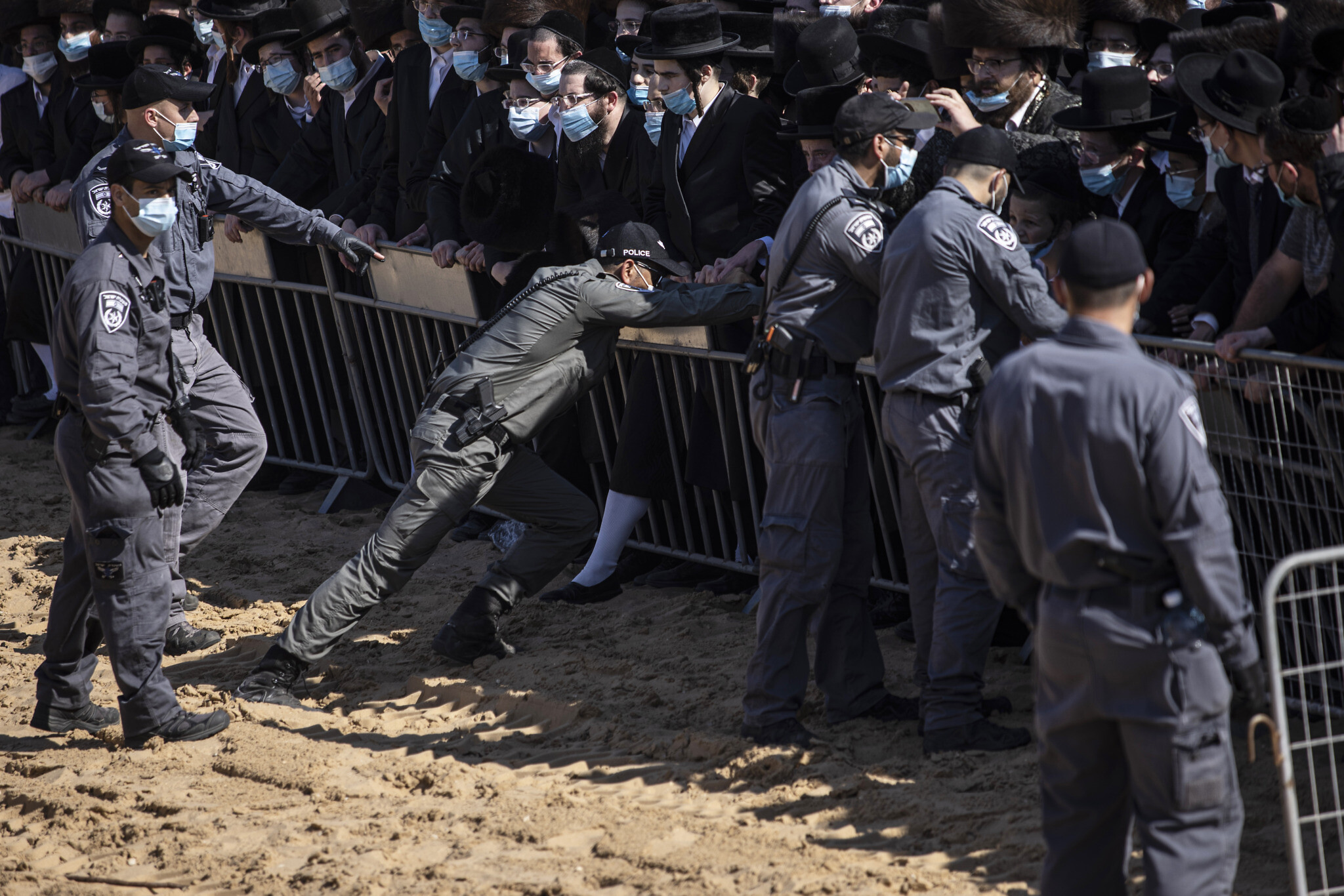
Israeli police try to control a crowd of mourners during the funeral of Rabbi Mordechai Leifer, the latest in a string of clashes between security forces and ultra-Orthodox Jews violating a national coronavirus lockdown order, in the port city of Ashdod, Israel, October 5, 2020. (AP Photo/Tsafrir Abayov)
Israeli police try to control a crowd of mourners during the funeral of Rabbi Mordechai Leifer, the latest in a string of clashes between security forces and ultra-Orthodox Jews violating a national coronavirus lockdown order, in the port city of Ashdod, Israel, October 5, 2020.
 

The recent data revealing that 40 percent of all confirmed cases of COVID-19 are members of the ultra-Orthodox sector impels all of us, and not just the ultra-Orthodox, to engage in serious self-scrutiny and soul-searching.

On the one hand, a fundamental principle of a pluralistic society respectful of human rights is honoring a minority’s right to its religion, its culture, and its language. Its members have a right to live according to their own values and culture, to conduct public prayers, and to educate their children as they see fit.

On the other hand, these rights, like all others, are not absolute. There are times when the minority’s autonomy must take a back seat in order to protect the citizenry as a whole.

Israel, like every other country, is battling the coronavirus pandemic. Extremely harsh restrictions on freedom of movement, on conducting business, and on the right to enjoy cultural events have been imposed on the public in recent weeks, in an attempt to curtail the spread of contagion and to ensure that it will be possible to provide proper treatment for those who contract the virus. From the start, the authorities defined certain exceptions to these restrictions in order to permit public prayer and Torah study in ultra-Orthodox yeshivot. In the last few days, we have seen that even the lenient rules set for services on Yom Kippur were brazenly flouted by many groups in the community, though not by all of the ultra-Orthodox.

We are not referring here to the behavior of individuals who decided to do whatever they please. And we must note that there are lawbreakers in every sector of the public. However, as the photos of the buses transporting yeshiva students home at the height of the strict lockdown reveal, in this case, we are dealing with organized activity. According to Major Gen. (res.) Roni Numa, in charge of overseeing the battle against the pandemic in the ultra-Orthodox sector, about 10,000 yeshiva students, out of the total of 40,000, did not adhere even to the rules adapted specifically to address their needs, and did not have themselves tested for the virus before they went home on vacation. In light of the high incidence of COVID-19 in the sector, there is a serious fear that the disease will spread to their families and to the public at large.

This isn’t a case of a handful of people who thumbed their noses at the restrictions, but rather a conscious decision by some of the ultra-Orthodox rabbis. The problem is that the risks involved do not threaten only the followers of that rabbi. They affect the public as a whole, the same public that will have to make use of the same limited resources available in the hospitals, if there is a sharp upswing in contagion. At this point, the self-segregation of ultra-Orthodox communities comes to a halt; most of their members will not hesitate to be admitted to public hospitals for treatment, if needed.

We must acknowledge that the handwriting was on the wall. Since the founding of the state, the “professional scholars” (“toratto omannutto”) deal, in its various forms, has made rabbis and yeshiva deans into middlemen between the state and the IDF on one side, and their students of draft age, on the other. A state’s sovereignty is expressed in the fact that all its laws apply to  all living within its territory. However, in many matters related to the ultra-Orthodox, the state seems to have pulled back from imposing its sovereignty, and accepted the convenience of “dialogue” and “consensus” with ultra-Orthodox leadership.

In the present crisis as well, the same approach seems to have been adopted — one law for citizens in general, and another — for the ultra-Orthodox, providing their rabbis agree. As we see, this approach has failed miserably.

Over the years, some have asserted that, in the name of tolerance towards the minority or in light of practical considerations, we must come to terms with the fact that young ultra-Orthodox men do not serve in the IDF and are exempted from having to do their part in rowing the national boat. But now we see that while most of us are frantically bailing the water out of the boat, many of the ultra-Orthodox are drilling holes in the hull, that may drown us all.

This situation requires a fundamental change of course — a U-turn — in the relationship between the state and the ultra-Orthodox. Developing a healthier relationship requires caution and consideration. Respect for the ultra-Orthodox lifestyle? Yes. Dialogue? That too is appropriate. The state renouncing its sovereignty and allowing rabbis to exercise unlimited power as the brokers between their flocks and the state? Absolutely not! We must put an end to this situation if we have the will to live.


https://blogs.timesofisrael.com/what-do-you-do-when-theres-a-hole-in-the-boat/?fbclid=IwAR3uB2krRZhWXQcfPdbT4Q05FTEJgkOyEnZJbAGka464tWqWx6CS9oEYEVE

Tuesday, October 13, 2020

The phenomenon is not unique to Israel: In the New York City metropolitan area, another region with a large population of ultra-Orthodox Jews, communities have also been hit hard by the coronavirus. In one, Kiryas Joel, about an hour north of the city, the average rate of positive test results recently was 28 percent, compared with 1 percent statewide.


Ultra-Orthodox Jews, some wearing face masks, pray during the Sukkot holiday at the Western Wall in the old city of Jerusalem, on Oct. 7 amid Israel's second coronavirus lockdown.

The Government Can’t Save Ultra-Orthodox Jews From COVID-19. Religious Leaders Can.


The coronavirus has hit Haredi enclaves hard, but without clear directives from rabbis, isolated communities from Jerusalem to New York will continue to suffer.

By every measure, Israel’s war against the coronavirus pandemic has been a miserable failure; it’s a stark turn after what appeared to be an initial success during a strict lockdown earlier this year. Last month, it was the first country in the world to go into a second general lockdown, just four months after the first one ended. In recent weeks, it has had one of the highest rates of COVID-19 deaths per capita in the world. Crisis management has been beset by confusion and petty politics, for which Prime Minister Benjamin Netanyahu deserves most of the blame.

But there’s another factor behind Israel’s stunning failure: While Israelis have generally abided by the lockdown rules, the ultra-Orthodox Jews known as Haredim who make up about 10-12 percent of the population have generally not, due their unique and jealously guarded lifestyle. The result is that they have accounted for as much as 40 percent of new daily confirmed cases.

The phenomenon is not unique to Israel: In the New York City metropolitan area, another region with a large population of ultra-Orthodox Jews, communities have also been hit hard by the coronavirus. In one, Kiryas Joel, about an hour north of the city, the average rate of positive test results recently was 28 percent, compared with 1 percent statewide.

In both Israel and New York, the question of how to address the problem has gotten enmeshed in politics. Never well-liked by Israel’s secular majority because of their refusal to serve in the army and their control over personal issues, such as marriage, Haredim have become a whipping boy in the mainstream media

Never well-liked by Israel’s secular majority because of their refusal to serve in the army and their control over personal issues, such as marriage, Haredim have become a whipping boy in the mainstream media
, which regales viewers with videos of mass gatherings in defiance of the rules and confrontations with the police.

In turn, Haredi leaders and apologists say they are being unfairly singled out. In New York, many claim they are being targeted due to anti-Semitism. More reasonably, they say that keeping the coronavirus under control is more difficult for them than for other populations.

To a degree, they have a point. Haredi Jews in Israel and to a lesser degree in the United States live in crowded conditions and have less access to information, not to mention fewer intellectual tools for fully understanding the pandemic by virtue of an education devoted almost exclusively to the study of religious texts. However, unlike any other impoverished, undereducated minority, the Haredim have consciously chosen this way of life by adhering to an ideology that looks upon the modern world as a threat. It undercuts the argument that they are blameless victims of a virus.

The crowding is one manifestation of a much bigger problem. In Israel—and increasingly in the United States—the ultra-Orthodox community is impoverished and uneducated in the skills that prepare them for life in the modern world. Over the last decades, the Haredi ideal has been to be a “society of learners,” where men pursue a life of religious study to the exclusion of everything else well into adulthood. In their role as sole family breadwinner, women get somewhat better schooling. But with a limited education and an average fertility rate of seven children per woman in Israel, their ability to sustain their families is severely limited.

However, their vulnerability has another, more troubling dimension that would be in their control if they chose. Much of ultra-Orthodox life revolves around being in public—long hours spent in schools and study halls, regular daily prayers in synagogues, and mass events like weddings and funerals

Much of ultra-Orthodox life revolves around being in public—long hours spent in schools and study halls, regular daily prayers in synagogues, and mass events like weddings and funerals
for rabbinic leaders that can draw thousands or even hundreds of thousands.

The Haredi world has been loath to give any of this up even though these activities act as virus hothouses. Even as the intensity of their religious observance makes them especially vulnerable to COVID-19, the ultra-Orthodox share the same attitude of distrust and resistance to the dictates of nonbelieving world as fundamentalist Christians.

The threat of death and disease should be a powerful countervailing force, but Haredi leaders live in perpetual fear of their followers’ religious observance slacking off and even of them leaving the community. If the momentum of prayer, study, and mass gatherings is halted for even a few weeks, no one can predict what the consequences would be. One study estimates that 15 percent of young Israeli Haredim leave the community.

Some Haredi leaders have urged the followers to be more cautious, but many more see these activities not only as critical to their way of life but also as an act of defiance against the outside world.

Some Haredi leaders have urged the followers to be more cautious, but many more see these activities not only as critical to their way of life but also as an act of defiance against the outside world.
Outsiders, be they the secular Israeli establishment or the New York City Department of Health, which has clashed with the ultra-Orthodox over circumcision and measles, are viewed as hellbent on disrupting the age-old patterns of Jewish life.

Given the insularity of the community, it’s not hard for Haredim to frame the pandemic as a political or religious dispute of us versus them, rather than as a public health challenge of everyone versus the virus. Strangely, this attitude has morphed into sentiment in favor of U.S. President Donald Trump in the ultra-Orthodox world that has grown even stronger as they see him opposing COVID-19 restrictions.

The coronavirus will eventually dissipate, but the conditions that made ultra-Orthodox communities so vulnerable to it will remain.

The American ultra-Orthodox world has increasingly mimicked the Israeli society of learners. In Israel, a life of learning is enabled by a government that subsidizes them. It doesn’t subsidize them enough to lift them out of poverty, but it does keep the community afloat.

In the United States, it’s more difficult because separation of church and state is strictly observed and access to government aid is severely constrained. Even so, poverty among the Hasidic stream of the ultra-Orthodoxy in the greater New York area was estimated a decade ago at more than 40 percent (the cutoff being annual household income of under $50,000). Today, it is almost certainly higher.

Like their Israeli counterparts, American ultra-Orthodox schools are depriving the young of the basic skills needed for the job market, an issue that came to the fore two years ago when New York state tried to enforce core curriculum standards on their schools. One study estimated that the youngest Haredi boys get about six hours a week of instruction of basic English and math, and even that paltry education comes to an end after they reach age 13.

https://foreignpolicy.com/2020/10/12/the-government-cant-save-ultra-orthodox-jews-from-covid-19-religious-leaders-can/

Monday, October 12, 2020

The Agudath Israel's Damage To Jews Worldwide Is Immeasurable - “Moreover, the right to practice religion freely does not include liberty to expose the community… to communicable disease.”


In their lawsuit, rabbis, leaders of synagogues and the national Orthodox Jewish group Agudath Israel had argued that Governor Andrew Cuomo was singling out Jews during the weeklong Sukkot holiday and this weekend’s Simchat Torah holiday, which marks the annual cycle of reading the Torah.

“That targeting of a religious minority on the eve of its holidays is reason enough to reject all of defendant’s arguments and allow plaintiffs to celebrate their holidays this weekend as they have for over 2,000 years,” the groups argued in a Friday court filing.

*

A federal judge refused on Friday to block New York’s plan to temporarily limit the size of religious gatherings in COVID-19 hot spots.

US District Judge Kiyo Matsumoto issued the ruling after an emergency hearing in a lawsuit brought by rabbis and synagogues, arguing the restrictions were unconstitutional. They had sought to have enforcement delayed until at least after the Jewish holidays this weekend.

The rules limit indoor prayer services to 10 people in areas where the virus is spreading fastest. In other areas within hot spots, indoor religious services are capped at 25 people.

Ruling from the bench, the judge said the state had an interest in protecting public safety.


New York Governor Andrew Cuomo

“And a mass gathering is not less dangerous simply because it is religious in nature,” reads Cuomo’s filing. “Moreover, the right to practice religion freely does not include liberty to expose the community… to communicable disease.”

Thursday, October 08, 2020

Torat Hashem Temima

Remember too, that there are lives at stake. We went through hell in March and April — I remember the horrors of that period all too well — and we will not go back. We are prepared to take all necessary steps to stop the spread and save lives.

Today, 4:23 PM

 To: Paul Mendlowitz


October 7, 2020.
 
Dear Paul,
 
We've seen time and time again throughout this pandemic that mass gatherings can spread this virus and result in clusters which can in turn become community outbreaks. While New York's numbers remain low across the most of the state, the positivity rate in "hot spot" ZIP codes was 5.1 percent yesterday — five times the rate in the rest of the state. We are moving quickly to stop further spread. Yesterday, we announced restrictions that will be enforced in these hot spot ZIP codes for a minimum of 14-days.
 
We know that some of these restrictions will be unpopular and difficult for many people. Still, these actions are far less restrictive than implementing a full shutdown, as some foreign countries and states have had to do following a resurgence of the virus. 
 
Remember too, that there are lives at stake. We went through hell in March and April — I remember the horrors of that period all too well — and we will not go back. We are prepared to take all necessary steps to stop the spread and save lives. 
 
Photo of the Day: I Love NY's Fall Foliage Report shows that leaves are starting to change in New York City and Long Island, while the most of the rest of the state is near, at, or past peak.
 
Here's what else you need to know tonight:
 
1. See the Cluster Action Initiative maps. Yesterday, we announced the implementation of Red, Orange and/or Yellow Zones in and around clusters in Broome County, Brooklyn, Orange County, Queens/Far Rockaway, Upper Queens and Rockland County. Click each county name to see the map for that cluster.  
 
In Red Zones, mass gatherings are prohibited, only essential businesses are open, schools are remote-only and houses of worship are limited to 25 percent capacity (up to 10 people maximum). In Orange Zones, mass gatherings are limited to ten people (indoor and outdoor), high-risk non-essential businesses are closed, schools are remote-only and houses of worship are at 33 percent capacity (up to 25 people maximum). In Yellow Zones, mass gatherings are limited to 25 people (indoor and outdoor), schools are open with increased testing, businesses are open and houses of worship are limited to 50 percent capacity. Read more here
 
2. We are carefully watching New York's total COVID hospitalizations. Yesterday, there were 748 total hospitalizations. Of the 108,246 tests reported yesterday, 1,360, or 1.25 percent, were positive. Sadly, we lost eight New Yorkers to the virus. 
 
Ever Upward,
 
Governor Andrew M. Cuomo


Wednesday, October 07, 2020

"Jewish Lives Matter" --- Except when they Don't! -----In a particularly violent episode, one man — the brother of Mordy Getz, a well-known Orthodox businessman who was outspoken about the need for masks and social distancing earlier in the pandemic — was beaten so severely by protesters after he took a video of the scene that he was taken to the hospital.

Orthodox residents of Borough Park burned masks and blocked city buses Tuesday night to protest Gov. Andrew Cuomo's announcement that he would impose new restrictions on areas with upticks in COVID

Orthodox Jews in Brooklyn burn masks during massive protest against New York’s new COVID rules

(JTA) – Protests by Orthodox Jews against New York’s crackdown on gatherings in their neighborhoods turned tense and at times violent Tuesday night as throngs of young men demonstrated in the streets of Borough Park.

The late-night protest in a heavily Orthodox area of Brooklyn took aim at new restrictions that would close schools, limit attendance at synagogues services and close nonessential businesses in areas with upticks in COVID-19. 

The protestors set fire to a pile of masks, at one point surrounded a city bus that was moving through the area and at another ran a reporter out of the area.

In a particularly violent episode, one man — the brother of Mordy Getz, a well-known Orthodox businessman who was outspoken about the need for masks and social distancing earlier in the pandemic — was beaten so severely by protesters after he took a video of the scene that he was taken to the hospital. Onlookers could be heard calling him a “moser,” one who informs on fellow Jews to the authorities and who some Jewish legal authorities say can be killed as a result, an insult applied to his brother back in April, as he was placed on a stretcher to be taken to the hospital.

The protests laid bare the frustration felt by local Orthodox Jews who are now at the center of the first widespread resurgence of COVID in New York since the spring. Many in the community believe that city and state officials are unfairly targeting Orthodox Jews, who are already vulnerable to anti-Semitism, in their pandemic response. Local elected officials and community leaders on Tuesday vowed to resist the latest rules, through litigation and civil disobedience.

“We will not close,” radio host and local celebrity Heshy Tischler proclaimed to cheers from the assembled crowds. Later, he told protestors, “You are my soldiers. We are at war.”

Dov Hikind, the former state Assemblyman who is a leader in the community, said the form the protests took were regrettable.

“I’m ashamed of what happened,” Hikind said. “To raise your hand and touch another person, Jew or non-Jew, to injure someone and have them end up in the hospital, what a tragedy.”

He added, “If there would have been a protest last night organized by community leaders and elected officials where everyone was wearing a mask, then of course there’s no problem. … There’s nothing wrong with expressing yourself.”

The protests came in response to New York Gov. Andrew Cuomo’s announcement Tuesday afternoon of new restrictions on a large swath of Brooklyn that is experiencing an uptick in COVID cases. His announcement followed a similar one by New York City Mayor Bill de Blasio, who on Sunday, during the Jewish holiday of Sukkot when Orthodox Jews do not use cell phones or computers, said he would move to close schools on Wednesday, pending the governor’s approval. The governor then announced Monday that he would close the schools Tuesday. (Most Orthodox schools are in fact closed this week for Sukkot.)

In a statement Tuesday evening, local Orthodox lawmakers accused New York Gov. Andrew Cuomo of “a duplicitous bait-and-switch.”

“The governor informed Jewish community leaders in a conference call that synagogues in ‘red zones’ would be permitted to operate at 50%, and he requested community cooperation (which he was assured would happen,” they wrote, referencing a call Cuomo held with Orthodox leaders Tuesday before he announced the new restrictions. 

“Outrageously, just hours later, Governor Cuomo announced a draconian return to restrictions that would shutter thousands of New York businesses and limit houses of worship to a maximum capacity of 10 (no matter the maximum capacity of the building).”

A statement from Agudath Israel, an organization representing haredi Orthodox communities, also expressed frustration with the lack of notice given about the restrictions in a call earlier in the day and suggested the new rules might be unconstitutional.

“Governor Cuomo’s surprise mass closure announcement today, and limit of 10 individuals per house of worship in ‘red zones,’ is appalling to all people of religion and good faith,” they said.

They seemed to be considering the possibility of challenging the governor’s new restrictions in court. “Agudath Israel intends to explore all appropriate measures to undo this deeply offensive action,” they said. A federal judge issued an injunction blocking New York State from imposing stricter standards on indoor gatherings at religious services than those imposed on other gathering places, citing religious liberty concerns. Agudath Israel filed an amicus brief in that case.

The protesters in Borough Park were joined Tuesday night by Tischler and their City Council representative, Kalman Yeger, who encouraged the crowd to stand up for religious freedom.

“We are not going to be deprived of the right that we have in America, like everybody else in America, the right to observe our religion,” he said in a video posted to Twitter by local news outlet BoroPark24. “I don’t care who in government thinks that they can stop us, they’re wrong. Let them try.”

Tischler also appeared later Tuesday night in Crown Heights, another heavily Orthodox Brooklyn neighborhood where there are no new restrictions but where de Blasio has identified a slight uptick in COVID test positivity rates. Tischler appeared at a Simchat Beit Hashoevah, a gathering on the holiday of Sukkot that is marked by singing and dancing, and addressed the crowd.

“We have a court order, we won, our schools and shuls are open, we will not close,” he said, seemingly referring to a court injunction over the summer issued by a federal judge that blocked New York State from imposing stricter rules on religious gatherings than in other indoor venues.

“And here’s the deal, I’m filing a new court order, I’m holding Cuomo and the idiot de Blasio in contempt,” he said. “We will civil disobedience…our amendments, our first amendments, our rights, we will not close our shuls Simchas Torah!”

Other videos circulated of protesters chanting, “Jewish lives matter.”

At one point, protesters set fire to a pile of masks in the middle of a street.

https://www.jta.org/2020/10/07/health/orthodox-jews-in-brooklyn-burn-masks-during-massive-protest-against-new-yorks-new-covid-restrictions?utm_source=JTA_Maropost&utm_campaign=JTA_DB&utm_medium=email&mpweb=1161-23464-462090

Tuesday, October 06, 2020

On Covid and Haredim....


Guest post by Professor Shaul Magid
 
On COVID and haredim:
This has become a national issue but is one that has persisted from the beginning of the crisis. Of late there has been much written by Modern Orthodox and non-Orthodox Jews about the haredim, how they are behaving and why they are behaving that way. While well-placed, I found a lot did not have a real foundational and experiential understanding of the haredi world. I lived in Boro for almost three years in the late 1970s. It was a long time ago but I think I came to understand and absorb that world and something of that remains.

This is NOT an apologia for the haredim; what is happening is horrible and will damage that community for years. They erred seriously and now are paying the price, as well as bearing responsibility for others. What I am trying to do, however, is understand what evoked this response in this way.

Yssocher Katz posted what I found to be the most thoughtful post on the haredim I have seen. Without apologies he tried to situated a value system in the orbit of behavior and  suggest that while this is a mistake, it comes from a place that is not unreasonable. He dealt mostly with religious practice and in a religious register.

I will offer a more societal, maybe sociological rendering that squares with to Yssocher's remarks.

The haredi community is a much more social community than most of us live in. By social I mean that the collective life is driven by social events, from as small as daily minyan, night seder, to as big as a hasidishe wedding or the rebbe’s table on Sukkos. These events don’t have the same values in our world as in theirs. For them, this is the crux of their “leisure” time, it is largely where people meet outside business or study. I recall being surprised when I entered the haredi world that children were always a part of that social world. The notion of children not being invited to weddings is unheard of. One often finds a family with small children in Boro Park walking home from some simcha at midnight. I recall being back in America and invited to a secular wedding where we were told we could not bring children. It was arresting.

As a result, having all that taken away is different for them than for us. It is wrong not to have done it, but viewing it from our frame of reference misses something crucial: you are taking away their whole social world. Now of course they use Whattapp etc. but more fundamentally, it demanded more of them then us. We were more equipped in part because we are less social.

One can also include that living in close quarters with many children (other high risk communities also share this problem), makes social distancing very challenging. Many of us have spacious and/or comfortable places to live, Netflix, plugged into all manner of technology to keep us connected to the world and our kids out of our hair. Generally, the haredi world doesn’t have that kind of man-made internal entertainment. Many have computers and are increasingly connected to the outside world but the community has an ethos to minimize that as much as possible, especially among the young. Television or Fortnight is not their babysitter.

Of course, one can see, for boys, that yeshiva education is a highly social thing. One doesn’t study regularly alone, or if he does, he does so in a room with 100 other young men. That creates an expectation of sociality that is almost unconscious. Girls, of course, are deprived of that educational experience but their lives are founded on social circles in very close ways.

In any event, even as many leading rabbis came out strongly for masks etc (they did so late, but that is another story) it never was able to filter down to the people perhaps in part because the sacrifices were quite difficult and they did not have the will to recognize they were going to have radically revise their social structure. That may be true for us as well, but not in the same way. Haredim have zoom but many of them never used it before COVID and it is a steep learning curve. This is just to say that the social structure of haredim, at least in American centers, presents certain challenges to them that it doesn’t quite present to us.

They failed. But one can also ask why. Science? Maybe a bit but not really. Most of us don’t know much science either. Its really about authority not science. We trust that authority. For them there are competing authorities that also play a role. They are paying a high price.

There is also remnants of mistrust of the “state” (even though the state protects their right to exist), and the way the community for complicated and fascinating reasons for another time, have become big fans of the state of Israel and in most cases, lean pretty right because their religious beliefs serve as the foundation of their views on the Jewish state. A hasid who will vote for Trump because he is good for Israel could be the grandson and a hasid in Poland who was vehemently anti-Zionist. The grandson could live the same lifestyle, in the same Hasidic court. The one big difference is that the grandson will be pro-Israel (albeit not a Zionist).

In this way they fell for Trump, saw in him someone they could lean on, they are people who can be taken by a certain kind of strength. Hasidism often liked strong leaders. Hillel Zeitlin writes about the admiration of Czar Nicholas and Rasputin. In any case, they were convinced that liberal was bad for them. This has its own history in Europe when it was communism.

The haredim will have to comes to terms with this. And they will do it. And yes, tragically more people will likely die first. That community has been devastated from this disease much more than upper-class Jews in the suburbs or “uptown.” Theirs more resembles poorer neighbors with diverse populations. So they don’t need to hear from us how many people died. They know. I think we can help, perhaps, by understanding their challenges in context; a world that seems very much like ours, and in some ways is, but is also very different is ways that have made this moment history difficult, and tragic.

Hag sukkos samaech

Shaul Magid is the Distinguished Fellow in Jewish Studies at Dartmouth College. From 2004-2018 he was a professor of religious studies and the Jay and Jeannie Schottenstein Chair of Jewish Studies in Modern Judaism at Indiana University

Monday, October 05, 2020

The "Energizer" Fake Jews.....They Keep Killing & Killing & Killling - Themselves!

Police, mourners clash as thousands crowd funeral of rabbi who died of COVID

Cops say procession for Pittsburgh Rebbe Mordechai Leifer was approved — but for far fewer numbers


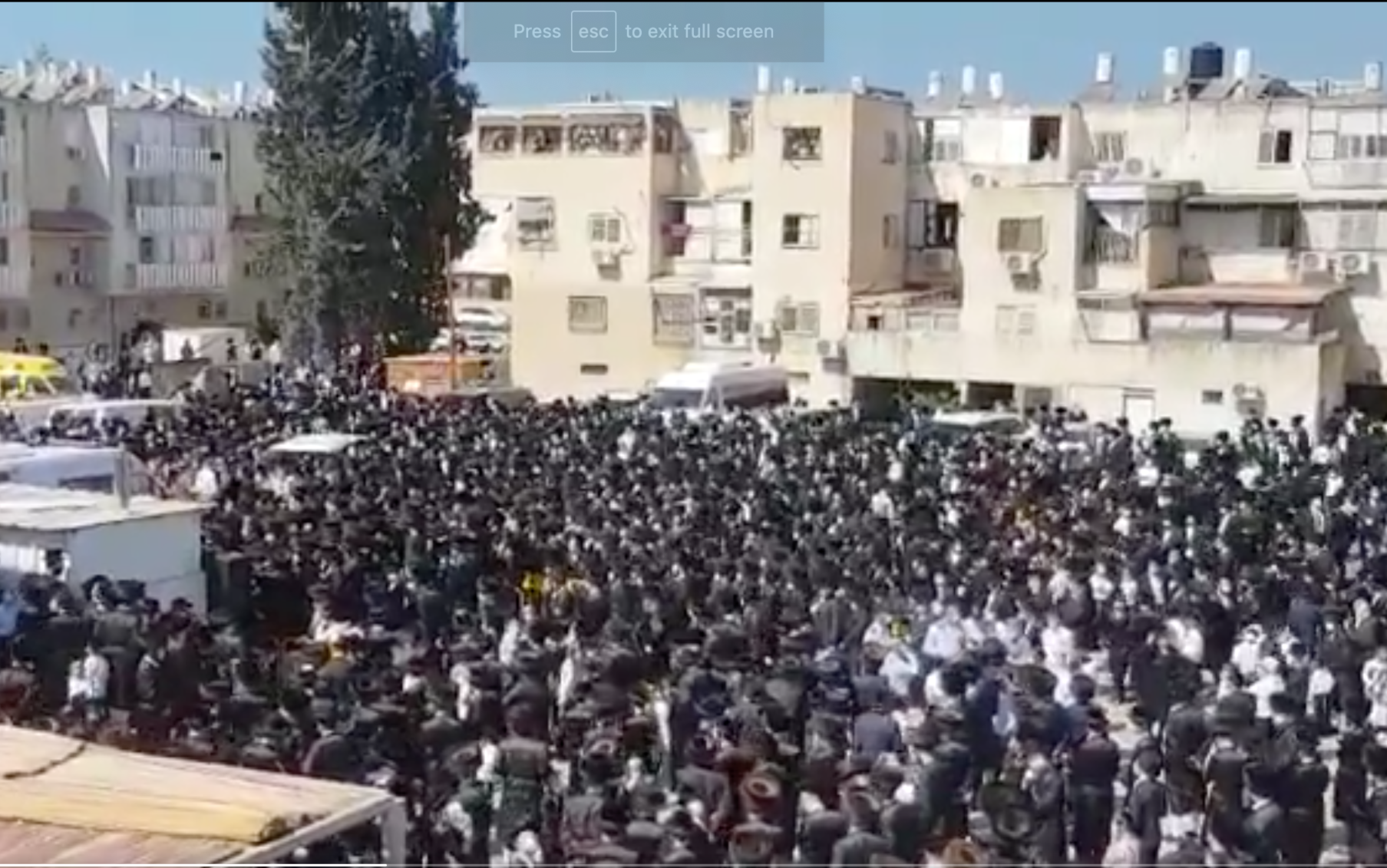
Screen capture from video of the funeral of Rabbi Mordechai Leifer, known as the Pittsburgh Rebbe, who died of the coronavirus and was buried in Ashdod, October 5, 2020. (Twitter)
Screen capture from video of the funeral of Rabbi Mordechai Leifer, known as the Pittsburgh Rebbe, who died of the coronavirus and was buried in Ashdod, October 5, 2020
 

Thousands of people gathered Monday at a funeral in Ashdod for a Hasidic rabbi who died overnight after contracting COVID-19, despite a national lockdown aimed at curbing infections that forbids such gatherings.

The ceremony ended with clashes between mourners and police seeking to disperse the crowds.

Video from the funeral showed that although most participants were wearing face masks, they were not keeping to required social distancing.

The Pittsburgh Rebbe, Rabbi Mordechai Leifer, 64, died overnight after a two-month battle with the virus. His title stems from the Hasidic dynasty founded in the US steel town some 100 years ago, and which today is centered in Ashdod.

He was buried in Ashdod, areas of which have been declared virus hotspots due to high infection rates.

Police said in a statement that the funeral procession had been approved in smaller numbers, and that attendees were expected to keep distance between each other and wear masks.

Police had permitted around 300-400 to take part in the event but estimates put the number of people who actually turned up at around 5,000, Channel 12 reported. According to the network, angry confrontations developed between police and participants.

Channel 12 said the overcrowding led eulogies for Leifer to be cut short.

Kan news published a video showing policemen in the midst of the massive crowd, making efforts to tell people to keep their distance from each other.

Opposition lawmaker Avigdor Liberman, who leads Yisrael Beytenu party, blamed Prime Minister Benjamin Netanyahu’s policies for the scenes, writing on Facebook that “the images we are seeing are a spit in the face of the entire country.”

“The ultra-Orthodox sector is trying to reach herd immunity because of surrender by Bibi and [Gantz] to the Orthodox parties,” he wrote, using a nickname for Netanyahu. “No leadership, no budget, no decisions, no policy, no enforcement.”

Criticism of the ultra-Orthodox community has been growing in recent days, with reports showing that a significant number have been disregarding lockdown restrictions during the Sukkot holiday, including by continuing to host mass gatherings.

As police have stepped up enforcement, there has also been increasing anger within the ultra-Orthodox community and accusations of disproportionate force, including against children.

Sunday saw violent clashes between police and ultra-Orthodox in Jerusalem and in Bnei Brak, where 13 people were arrested as officers broke up mass gatherings for the holiday. Besides violating the restrictions on gatherings in enclosed spaces, police said most worshipers were not wearing masks or adhering to social distancing rules. After cops started handing out fines, the worshipers “began resisting and disturbing public order,” according to police.

The ultra-Orthodox community has seen high coronavirus infection rates, with an assessment last week finding that the rate of infection in the community is 2.5 times that of the national average. The country’s coronavirus czar Ronni Gamzu said last week that 40 percent of recent virus cases were in the ultra-Orthodox community, which constitutes some 12% of the population.

https://www.timesofisrael.com/spurning-lockdown-thousands-gather-for-funeral-of-rabbi-who-died-of-coronavirus/?utm_source=The+Daily+Edition&utm_campaign=daily-edition-2020-10-05&utm_medium=email