![]() |
| There Is No Cure For Being A Fool & Misleading His Idiot Minions! Read The PDF Below - ALL 54 Pages Of Insanity! |
![]() |
| There Is No Cure For Being A Fool & Misleading His Idiot Minions! Read The PDF Below - ALL 54 Pages Of Insanity! |


By Dr. Carroll --- the chief health officer for Indiana University. He’s also a writer who focuses on health research and policy.
It would be nice if the United States could reach herd immunity with just vaccination incentives like tickets to ballgames and free beer. Americans don’t like to be told what to do, and public officials would almost always rather hand out cash than have to punish.
Some even view vaccine mandates as un-American, but they are part of our foundational fabric. During the Revolutionary War, inoculation against smallpox was common in Europe. Because of this, the British Army was largely safe from the disease, but the colonists’ army was not.
Gen. George Washington recognized that mandated mass inoculation was necessary to win the war, though, and told Congress so in 1777. Although he met resistance, his mandate worked. While smallpox outbreaks were common over the next few years and massively affected those who were susceptible to infection, no revolutionary regiments were incapacitated by the disease during the southern campaign, and the mandate arguably helped win the yearslong war.
Today, vaccination rates are stalling in many areas of the United States, and now nearly all Covid-19 deaths are among the unvaccinated. In Indiana, where I live, only half of people 18 or older are fully vaccinated.
Some states, including neighboring Ohio, have engaged in lotteries or prize giveaways in an attempt to entice people to get vaccinated. Those are carrots, or positive behavioral nudges. When it comes to incentives, most people like carrots. Sometimes, though, people need sticks.
When the United States was fighting smallpox long ago, it took mandates to get enough people vaccinated. To eradicate polio, the same was true. Nearly all major infectious diseases in the country — measles, mumps, rubella, pertussis, diphtheria and more — have been managed through vaccine mandates by schools. The result is that the vast majority of children are vaccinated, and in time, they grow into adults who are vaccinated. That’s how the country achieves real herd immunity.
But this process can take decades. Covid-19 is an emergency, and we don’t have that much time.
The mRNA vaccines, made by Moderna and Pfizer-BioNTech, will likely get full approval for use from the Food and Drug Administration soon, which may be necessary for broader vaccine mandates. Although the vaccines are already known to be safe and effective, after being given to hundreds of millions of people, with full approval, more groups will begin mandating that their employees get vaccinated. It’s unlikely the United States can overcome the pandemic without such actions.
The U.S. experience with diseases for which vaccination isn’t mandated is also instructional: In those cases, vaccination rates have remained much lower than desired. The human papillomavirus vaccine approved in the United States, for example, protects against an extremely widespread and often asymptomatic sexually transmitted disease that can lead to cancer. Despite calls to mandate HPV vaccination, it is required for school only in a few states; Washington, D.C.; and Puerto Rico and has never been mandated outside the school environment, where it would do more good.
Although the vaccine was approved in 2006, only about half of teens are currently covered. What’s worse, only 22 percent of 18- to 26-year-olds, who are most at risk for infection, are fully vaccinated. Influenza vaccination is another that has rarely been mandated, and the United States has never achieved anywhere near the rates of protection that health experts would like, even during pandemics.
When it comes to herd immunity, community matters. The rate of vaccination at the national or state level is less important than the rate among people you live or interact with. This means that smaller groups can still take action to protect themselves and those around them from Covid-19. A number of hospitals and health care settings have mandated vaccination because those settings involve higher risk.
Some colleges and universities have also required students, professors and other staff members to be vaccinated before returning to campus. The schools want to return to full classrooms, busy dining halls and a vibrant campus life. They want students to be able to go to football games, events and even parties without fear of outbreaks. The only way to do that is to achieve significant levels of immunity. The only way to do that quickly and safely is through vaccination.
More than 500 colleges and universities in the United States have mandated Covid vaccination so far. My school, Indiana University, where I am the chief health officer, is one of them. Schools like ours believe that the only way to get to the level of safety we need to reopen without outbreaks or worse is to get nearly everyone immunized.
Some private companies have done the same. Many of our health care systems in Indiana have mandated vaccination.
There will be pushback against mandates. (Some students have filed a lawsuit against Indiana University, for example.) But it’s important to understand that mandates don’t mean people will be held down and given shots against their will. The mandate for the Affordable Care Act was a tax. Other mandates, such as those imposed by cruise ship companies, mean you will be unable to take certain vacations this year without vaccination.
And there must be exemptions to vaccine mandates. Some people can’t be vaccinated for medical reasons. Others have religious objections, and such exemptions are protected by law as well as custom. We should all be comfortable with that. To get to herd immunity, even to eradicate diseases, we don’t need vaccination rates of 100 percent. We just need to get to high enough levels that those who are immune protect those who aren’t. And in much of the country, we’re not even close.
When vaccination is the default, most people will get vaccinated. Mandates still aren’t popular; few public health measures are. But they work.
https://www.nytimes.com/2021/06/28/opinion/covid-vaccine-mandate.htmlForeshadowing Covid-19’s devastating effect on the New York Haredi community, a measles outbreak occurred within Hasidic groups in the greater New York City area in 2018–2019. 93% percent of the measles cases during that outbreak were in the Orthodox Jewish community and 72% occurred within one Hasidic-predominant neighborhood of Brooklyn [11]. Of the cases for whom vaccination history was known, 85.8% were unvaccinated. To increase vaccination rates in these pockets, New York City government officials took actions that the Haredim experienced as curtailing individual liberties and threatening the integrity of the affected community. Unvaccinated children were banned from public places, including places of worship and schools. Schools that permitted entry of unvaccinated students were temporarily closed, and violations and fines were issued to those noncompliant with vaccination [12]. Though partnerships were formed between the local department of health and community stakeholders to enhance mutual understanding, the speed and ferocity with which Covid-19 took hold of Haredi communities less than a year later outpaced the public health response.
The significant impact of Covid-19 in Haredi-Orthodox Jewish areas has been attributed to high population density with large households and the maintenance of a highly communal lifestyle involving group prayer, learning and celebrations. Among the Haredim, extended families gather weekly to share meals at the Sabbath, men are obligated to pray in groups at synagogue three times daily, and children are schooled in-person given the paramount importance of student-educator and peer relationships in Torah education [13]. Despite Covid-19’s impact, little formal research has been conducted to elucidate how the Haredim perceive and negotiate the pandemic. Illuminating how these communities understand and prioritize Covid-19 can assist in the creation of sensitive recommendations that support community relationships with the public health establishment.
We conducted an observational study with a scored, closed-ended question survey within two primarily Hasidic neighborhoods in Brooklyn to explore responses of Haredi individuals to the Covid-19 pandemic and vaccines. We report on participants' personal experiences of Covid-19, knowledge about Covid-19 transmission and risk, sources of medical information, and perceptions surrounding Covid-19 and vaccines.
READ MORE:
https://link.springer.com/article/10.1007/s10900-021-00995-0#Fun
Margolis, a 32-year-old communications manager, says she met Roemer in 2009. She was a volunteer at a Jewish community center and was working on a project to award scholarships to teens to attend the Brilliant Minds festival. A few weeks after seeing him give a talk at his office, she was out walking with a friend when she spotted him seated at a café and approached to say hello. After briefly chatting, Roemer proposed that she drop by his house to interview for a position with the festival. Margolis thought this was a golden opportunity and accepted. Meeting in his home did not strike her as a concern. He was a trusted member of the Jewish community and she felt safe. On the appointed day, she sat in the entertainment room as Roemer asked about her studies and described the festival. Then—out of the blue, as she recalls it—he complimented her on her breasts, and later asked if she was clean-shaven in her pubic area. She cut the meeting short and left, feeling utterly humiliated. She never heard back about the job.
READ ARTICLE:
Some guys get it, most never will! (PM)
"* Every couple is assigned a Kommandant to whom the man turns for advice
and who exercises extreme control over the couple, essentially
dictating how they interact with each other and when they can have relations.
Some are more strict than others. The Kommandants rarely speak to the
wives, who usually turn to their kallah (marriage preparation) teachers
with questions. The Kommandant's word, however, is law. (Takanas - Takunnas)"

Israeli Housing Minister Yaakov Litzman (United Torah Judaism) will face charges in connection to two separate investigations, after Attorney General Avichai Mandelblit approved the preliminary indictment.
Mandelblit notified Litzman that he has signed off on the charge sheet; a necessary step for indicting an incumbent minister. A hearing must be held for the final indictment to be formally filed.
The preliminary indictment includes charges of obstruction of justice and breach of trust, and stems from two separate cases.
The first case relates to the disgraced former Australian educator Malka Leifer, who was extradited from Israel to Australia in January to face multiple counts of child sex abuse.
Leifer fled Australia in 2008, moving to Israel, where she was eventually found mentally unfit for extradition, before the case was reopened following the work of a private investigator who found evidence Leifer had faked her mental illness to escape extradition.
Litzman, who served as Deputy Health Minister (serving de facto as Health Minister) and later as Health Minister at the time, is suspected of taking improper steps to help Leifer obtain recommendations from mental health officials that she be deemed unfit to stand trial.
The second case revolves around accusations that as Health Minister, Litzman tried to help a delicatessen owned by a friend avoid forced closure over poor sanitary standards. The matter came to police attention after a pregnant woman who ate at the deli suffered a miscarriage, apparently as a result of a listeria infection in 2015, one of a number of bacterial infections reported at the deli.
“There are two cases which involve Minister Litzman apparently taking advantage of his position and governmental power in order to advance the interests of private individuals,” Mandelblit wrote, “during which he used his government power to back outside interest and against the interests of those he was tasked with serving as Deputy Health Minister.”
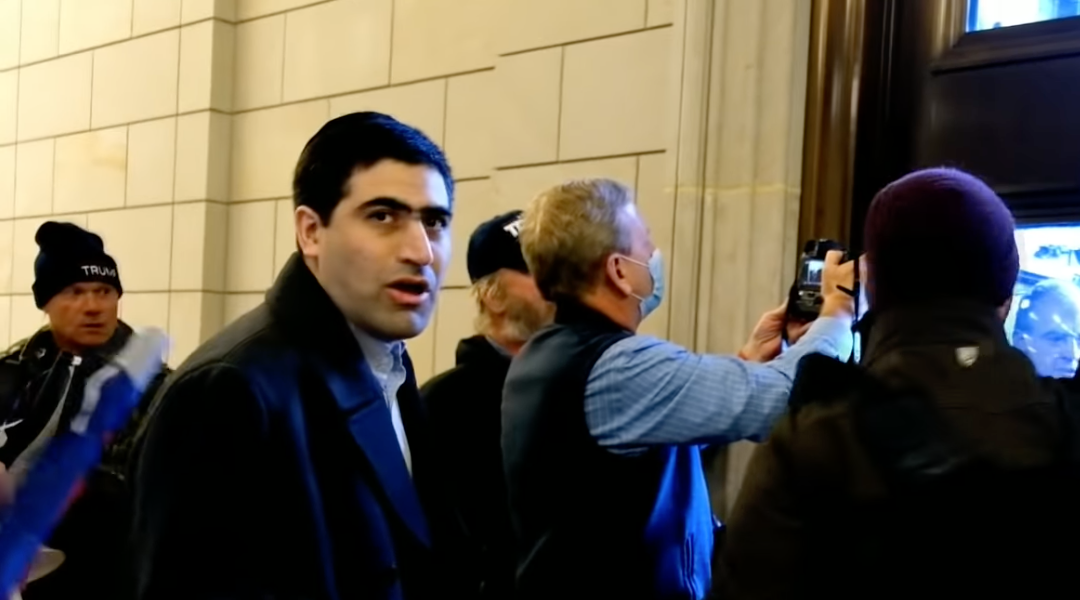
(JTA) — Elliot Resnick, the editor of a politically conservative Jewish newspaper who was identified among the crowd that breached the U.S. Capitol building on Jan. 6, is out of the job.
Shlomo Greenwald, a grandson of the founders of The Jewish Press who has worked at the weekly paper since 2004, announced in a Facebook post Wednesday morning that he would be assuming the role of senior editor at the paper, replacing Resnick.
“I am both exhilarated and daunted by the work ahead in building on the great things The Jewish Press has always done while making improvements,” Greenwald said in a statement to the Jewish Telegraphic Agency, declining to comment on the paper’s decision to replace Resnick. “The Orthodox Jewish community in the US is broad, and I hope to make a newspaper that will speak to and enlighten the community. The core interests of the community remain: fighting for a secure Israel and advocating for religious freedom at home, areas that The Jewish Press has always championed, and that I will continue to embrace in this role.”
Greenwald did not respond immediately to questions about the future political direction The Jewish Press would take under his leadership. But he takes over at a time when the political identity of the newspaper — and its editor — has been the subject of widespread attention.
Resnick was identified in YouTube videos of the Capitol breach by a researcher and first reported on by Politico in April.
A video from Jan. 6 shows Resnick stumbling as he enters the Capitol building through a doorway while a Capitol police officer tries to keep out the intruders. His face is clearly visible when he reappears a few minutes later, standing nearby as another person shouts at a Capitol police officer.
At the time Naomi Mauer, the publisher of The Jewish Press, appeared to stand behind Resnick.
“As we understand the facts, we believe that Mr. Resnick acted within the law,” Mauer told Politico in an email, declining to respond to follow-up questions.
Mauer did not respond immediately to a JTA request for comment.
Resnick assumed the position of editor at The Jewish Press in 2018. He has long had a history of using incendiary language and has called the gay rights movement “evil.” Under Resnick’s editorship, The Jewish Press was criticized by the Anti-Defamation League in 2019 after publishing an op-ed titled “The Pride Parade: What Are They Proud Of” comparing gay marchers in the New York event to animals, adulterers and thieves.
“If blacks resent America’s [sic] so much, let them discard Christianity (which the ‘white man’ gave them) and re-embrace the primitive religions they practiced in Africa,” Resnick wrote in a tweet in 2019.
“Can someone give me a coherent reason why blackface is racist?” he wrote in another tweet that year.
Resnick was not the only editor in Jewish Press history to espouse racist views.
The paper was edited in the 1960s by Rabbi Meir Kahane, a Jewish nationalist who advocated violence against Arabs and was banned from the Knesset, Israel’s parliament. Though the paper distanced itself from Kahane in 1969, it still lists him among the paper’s prominent past editors on its website.
In 2015, Resnick gave a glowing review to a Kahane biography written by Kahane’s wife and described his own experience of “near trance” while reading one of Kahane’s books in high school.
(New York Jewish Week via JTA) — In March 2005, I was on the verge of publishing an article that I knew would have a major impact. As the editor and publisher of The Jewish Week, I would be describing — for the first time — the true nature of the sexual misconduct that led one of the most prominent Reform rabbis in America to resign from his role as president of Hebrew Union College-Jewish Institute of Religion, the movement’s seminary.
Rabbi Sheldon Zimmerman had resigned from HUC in 2000 and been suspended for two years from the Central Conference of American Rabbis, the movement’s rabbinic organization. The group had said only that Zimmerman had engaged in unspecified ”personal relationships” that violated its ethical code, and many believed that he had a long-ago consensual affair with an adult woman in his congregation.
I found out that the allegations were far more significant. I had spoken to one of Zimmerman’s accusers, who told me that he had begun behaving inappropriately toward her when she was a teenage congregant. She told me that their intimate contact, which recent reports indicated included touching and kissing, began when she was 17 and was consummated when she was 20.
Some of those details were revealed recently in an investigation by Manhattan’s Central Synagogue — Zimmerman served there as senior rabbi from 1972 to 1985. On April 27, the synagogue revealed the damaging findings of an independent study it commissioned last fall, providing details of the behavior that the CCAR had described only vaguely.
Why didn’t I publish the story more than 15 years ago? I knew that I had important information — information that could protect others as Zimmerman regained influence in his movement. But I also did not have the full permission of my source, whom the CCAR had determined was trustworthy.
The following story explains why the facts remained a secret for all these years.
Credible allegations
Last month, Central Synagogue sent a letter to its community containing the results of an investigation into the events that led to Zimmerman’s suspension 20 years earlier. The investigation was prompted by a woman’s disclosure after last Rosh Hashanah that Zimmerman, now 79, “initiated an inappropriate relationship with her while she was a young religious schoolteacher and congregant at Central” in the 1970s.
The investigators found credible the allegations by this former teacher, as well as those of one women who came forward in 2000 and a third in 2020, of “sexually predatory behavior by Rabbi Zimmerman in the 1970s and 1980s.”
The current leadership of the congregation said it was never informed by the CCAR of the events that led to Zimmerman’s suspension in 2000. The leadership said it was “devastated” by the news and condemned Zimmerman for “a gross manipulation of his spiritual authority.”
My involvement and knowledge of these allegations began 20 years ago. I received a call in the spring of 2001 from a woman who identified herself at the time only as “Debbie.” She said she was the one who had approached the CCAR a year earlier with allegations about Zimmerman, dating back to her teenage years, that led to his resignation and suspension. She was calling me because she was upset that only a few months later, the rabbi had been named executive vice president of Birthright Israel, a move that was starting to cause controversy because of his recent misconduct.
She said she was torn between speaking out through a Jewish Week article or maintaining her public silence, but she clearly wanted to talk.
The woman asked if she could speak to me anonymously, and I agreed — an agreement that still holds today, though over time, and after extensive phone conversations, she revealed her true identity to me. Then as now, I also said I would not publish her story without her permission and would not reveal her identity.
The article I came close to publishing in 2005 would have included details of Zimmerman’s years-long relationship with Debbie, who first met him in the spring of 1970 when she was 15. As she described it to me, Zimmerman became her rabbi and teacher the following year when he was appointed assistant rabbi at Central Synagogue, and he soon began to relate to her in an inappropriate manner.
The article would have revealed that when she was 17 and studying privately with Zimmerman, who was 30 and married, he used Martin Buber’s “I and Thou” theology as a framework to explain or justify their intimate contact.
For the next decade, the nature of their relationship was a secret, given that their families were friendly and that she and her family viewed him as their rabbi, teacher and confidant.
The article also would have noted, for the first time and based on a copy of the committee’s never-released report obtained by The Jewish Week, that Zimmerman had an affair with at least one other woman, and that a CCAR investigative panel of its ethics and appeals committee found both women fully credible — and the rabbi far less so.
A ‘profound’ betrayal
I found Debbie thoughtful and articulate. She clearly had given much thought over the years to the unhealthy nature of the relationship that took place decades ago.
“What was so damaging is that this was the formative romantic relationship of my life,” she said at the time, adding that “the betrayal to me and my family was profound.” (Her parents were friends with Zimmerman and his wife.)
The story Debbie told me back then reflected her disappointment, frustration and anger with Zimmerman for being “manipulative — taking advantage of me and my being young and vulnerable — and for being untruthful.”
She also was upset with leadership in the organized Jewish community for focusing exclusively on the rabbi’s rehabilitation and reentry into Jewish public life without concern for the psychological and emotional damage done to her as a victim.
Debbie praised the CCAR investigating panel for its diligence in pursuing her allegations and, in effect, bringing down a major leader of the Reform movement. But she questioned why the gravity of Zimmerman’s violation of ethical and sexual boundaries did not seem to have been shared at least with other leaders within the Reform movement, which, it turned out, included HUC, Central Synagogue and the central body, now known as the Union for Reform Judaism, so others could be protected.
(In the wake of the 2021 Central Synagogue announcement, those other groups are launching their own investigations.)
Debbie first called me a few days after the announcement of the Birthright Israel appointment. She felt it was improper for the rabbi to be given a top position in an organization involving 18- to 26-year-olds. But she was wary of making her complaints public, concerned about “appearing vindictive” and fearful that her identity would become known.
Philanthropists Michael Steinhardt and Charles Bronfman, the co-founders of Birthright Israel, played a key role in hiring Zimmerman to help lead the organization professionally. In a news release announcing the appointment on April 5, 2001, Bronfman praised the rabbi as a “dynamic educator and leader whose talents will be a great blessing for Birthright Israel.”
Several years later Marlene Post, a lay leader of Birthright Israel who was one of several people who interviewed Zimmerman for the position, told me that “at that time we were unaware of the specifics” of his relationship. Post said she believed that the rabbi would not have been hired had the details been known.

Birthright Israel, which takes young Jews on trips to Israel, hired Zimmerman
All of this transpired at a different time. There was no #MeToo movement, and investigators habitually sought to protect the privacy of the accused as well as victims, and behaviors like “grooming” — in which someone in a position of trust and authority manipulates a minor for sexual purposes — were not part of the public vocabulary.
That put the burden on accusers like Debbie to convince the public that abuse had taken place. They also had a reasonable expectation that their accounts and character would be questioned. Meanwhile, Zimmerman was not only a leader of the Reform movement but a beloved spiritual leader and educator of great charm and charisma with a large and loyal following.
“I was single, I was very involved in my work and it seemed too risky to challenge him [the rabbi] publicly,” Debbie told me.
In the end, after much deliberation, she decided not to go public, and so did I. I agreed with Debbie that even revealing the contents of the CCAR committee report would have compromised her privacy, so I did not.
Readmitted to the CCAR
Four years later, Zimmerman was back in the news. After a brief stint at Birthright Israel, he had stepped down and held several non-pulpit posts, including two years as vice president of what is now the Jewish Federations of North America.
In 2005, after four years of suspension from the CCAR (two more than the original two years), the rabbi was readmitted to the Reform rabbinic group he once served as president.
Rabbi Janet Marder, then president of the CCAR, announced that following a “rigorous process” of counseling and mentoring, Zimmerman met all the requirements outlined and was reinstated to full membership. She said the CCAR board made the decision based on the recommendation of the committee on ethics and appeals.
That decision prompted Debbie to be back in touch with me. She felt his reinstatement was unearned, and she blamed the CCAR for not living up to the rules of its own ethics and appeals committee. These include “the making of restitution” and offering “an acceptable expression of remorse” with specificity of wrongdoings to all of those harmed, according to the guidelines.
“He should have been expelled, not suspended” by the CCAR, Debbie told me at that time, asserting, as is clear from the committee’s private report, that the rabbi did not admit to the nature of their relationship or the fact that he had relations with another woman until he learned that the CCAR committee already knew the facts.
“What kind of teshuva [repentance] is it,” she asked, “when he has advanced his career by lying about what he did?”
Debbie said she received no compensation for the therapy she underwent — only airfare to attend a meeting with the ethics committee. Zimmerman wrote an apology to her that she said was impersonal and did not take full responsibility for his actions. She felt he should have apologized to her family and others who were hurt or misled, and should have initiated a personal meeting with her without being prompted.
“That’s what a wrongdoer has to do,” Debbie told me. “It’s easy to say ‘I made a mistake,’ but it’s hard to say that directly to the victim.”
She criticized the ethics committee for allowing the rabbi to make his apology in writing rather than face to face.
“The process of teshuva should be a dynamic between people,” she told me, “but it’s been between the CCAR and him.” Debbie said she resented being left out of the process.
In a response to my queries in 2005, Zimmerman emailed me to say that an expert who was counseling him as part of the reinstatement process warned him against having any personal contact with Debbie. He maintained that his letter was “an act of teshuva,” and went on to point out that he had more than fulfilled the CCAR requirements for readmission.
Accusing Debbie of seeking revenge, he stated: “My career has been seriously damaged. This is about destroying me and my family. I have met every teshuva requirement, both of the CCAR and the tradition itself. She has made none to my wife and family, and in fact quite the opposite.”
Zimmerman threatened to out Debbie without her consent, telling me, “She may leave us no recourse but to respond to her in public and by name, and to lift the veil that has protected her and her actions.”
(On May 11, I sent an email to Zimmerman telling him I was working on this follow-up to Central Synagogue’s investigation, and that I would like to speak with him or get a statement from him with his response to the investigation and its findings. He has not replied.)
Soon after contacting me again, Debbie again decided, reluctantly, not to go public, fearful of public exposure and a possible lawsuit.
So the matter remained until it boiled up again last month with the Central Synagogue letter to its congregants and a report in the Forward.
Returning to the story
Debbie texted me two days before the Central Synagogue letter was made public last month. She was under the impression that I was writing an article on the latest development, but that wasn’t the case. In fact, I was unaware of it until I spoke with her the next day and she brought me up to date. Now that the Zimmerman chapter had been reopened, she was committed to having her story known — under the same conditions we agreed to more than 20 years ago, that her identity remain private.
“I’ve wanted at least the basic fact of my youth and his predatory conduct to be known,” she told me. “But Zimmerman put a lid on it by threatening me with litigation and [with] revealing my identity.”
Central Synagogue and others are faulting the CCAR for not sharing the extent of its findings with colleagues, even within the movement, and the organization is undergoing its own reexamination of practices now. But the CCAR’s policies two decades ago on dealing with sexual impropriety among its clergy were praised at the time, and many saw its decision to take action against Zimmerman as courageous.
To me, the episode underscores the difficulty, if not impossibility, for any peer group to pass judgment on one of its own, and suggests why experts in the field recommend that outside investigators probe misconduct at this level.
It also underscores the ways in which Jewish concepts about repentance may figure into #MeToo episodes in our communities.
Zimmerman insisted that he fulfilled more than the requirements for teshuva, including therapy, apology and time for self-reflection. But Debbie told me earlier this week that “at the heart of the issue” for her, even now, is whether the rabbi “could actually see the person he has wronged and understand how he harmed me.” That did not happen, she said.
In preparing this piece, I went back and found my “Zimmerman file,” a thick collection of printed out emails, notes of conversations with Debbie going back 21 years and a number of others, including Zimmerman. It took me nearly two hours to read through it all.
On the page that contained the rabbi’s email to me, cited above, I had written a note to myself: “Am I obligated to hold the story if she gets cold feet?”
That was the question I grappled with in 2001 and again in 2005. It seemed to pit journalistic responsibility against compassion for a self-described “damaged” victim of an abusive relationship. In the end, I felt that to tell Debbie’s story without her permission would be one more violation of her personal freedom.
Now, 21 years after we first spoke, I reviewed the contents of this article with her before publication to ensure its accuracy.
Gary Rosenblatt was editor and publisher of The Jewish Week from 1993 to 2019. Follow him at garyrosenblatt.substack.com.
Call them La Kosher Nostra.
A clique of rabbis on Long Island are being accused of Mafia-like tactics to maintain what amounts to a monopoly over the local kosher certification process — sparking a twisted turf war that has outraged local residents and businesses alike, The Post has learned.
A lawsuit filed last month by Chimichurri Charcoal Chicken — located on the busy Rockaway Turnpike across from a McDonald’s — claims the rabbis behind the Vaad Hakashrus of the Five Towns and Far Rockaway ordered observant residents to stop eating at the chicken joint last year after it started using a competing certification service.
The Vaad — led by Rabbi Yosef Eisen, who is also named in the suit filed in Nassau County — even killed Chimichurri’s lucrative catering work in a retaliatory move, court papers claim.
“The existing Vaad does not want competition, is afraid of the competition, and is trying to use its power to drive them — or attempt to drive them — out of business,” the lawsuit says.
The Vaad’s lawyer, Frank Snitow, told The Post the lawsuit “is entirely without merit,” adding that “Rabbis have an obligation and a right under the First Amendment to guide their communities with respect to religious issues and this does constitute a religious issue.”
The complaint offers a rare glimpse into a power struggle inside an Orthodox Jewish community that, until now, has been handled privately and by the rabbinical courts, sources said. But some residents are pleased to see it finally spilling into public view, claiming the Vaad has been abusing its authority to decide which establishments can claim to follow proper kosher dietary restrictions, including whether they correctly keep separate utensils for meat and dairy.
“Kosher supervising is a big business and for the rabbis it’s about power,” said one fed-up Five Towns resident. “This case is about injustice and bullying.”
Chimichurri claims its problems started last July after it dropped the Vaad — the dominant kosher certification operation in town — for a rival called Mehadrin of the Five Towns. Unwilling to accept the loss of business, the Vaad issued a “defamatory” statement blasting Chimichurri’s kosher food standards, the lawsuit claims.
The Vaad said it “must categorically and absolutely recommend to all of the members of our community that they avoid eating at the restaurants under that [new service],” court papers say. The Vaad specifically named Chimichurri as well as Keneret Fresh Market in Hewlett, NY, and a kosher steakhouse in Cedarhurst called Five Fifty Restaurant, according to the suit.
The Vaad’s actions carried weight in part because it won the support of 53 rabbis from Five Towns to support the move, sources said.
Many business owners refused to openly comment for this story, citing fear of retaliation. One exception was Arthur Ashirov, owner of Keneret Fresh Market, who said he’s seen revenues drop 10 percent since the Vaad’s letter denounced his small grocery in July.
“The Vaad doesn’t want to have competitors. That’s the bottom line,” said Ashirov, who says he’s unlikely to sue because it will cost too much. He said he’s sticking with the rival certification service because he thinks they are doing a good job and are less expensive.
“I have no issues with the Mehadrin,” Ashirov told The Post. “They are very attentive and they charge a flat fee while the Vaad charges extra for everything they do.”
Asked about the Vaad’s fees, its lawyer, Snitow, said, “I understand that people complain about the expense, but the Vaad would be hiring people with less qualifications” if it charged less.
Eisen did not return calls for comment. The Mehadrin also didn’t respond to requests for comment. The Vaad claimed in public statements last summer that it had a legitimate reason to ask observant Jews to stop patronizing certain businesses based on concerns about potential conflicts of interests, the complaint said.
Chimichurri, owned by businessman Zvi Ben-Yoseff, claims Vaad’s edict last summer had a chilling effect on business, with customers reaching out via text to say they were being pressured to stop eating there. Catering business in Westchester and Plainview also went away, it said.
In one instance, a customer who “previously organized an enormous volume of weekly deliveries” to Westchester “indicated via text message that he had to stop doing the deliveries due to pressure from his local rabbi,” the lawsuit claimed. A source told The Post the deliveries had been going to a Westchester school.
Chimichurri and Five Fifty Restaurant tried to settle the conflict last spring in rabbinical court, according to rabbinical court papers obtained by The Post. But the rabbis behind the Vaad, including Eisen, never showed up for the hearing.
Nearly a year later in April, the rabbinical court blasted the Vaad rabbis for having “brazenly abused their rabbinic pedigree by insisting that their actions and intentions are beyond mortal scrutiny,” rabbinical court papers show. Accordingly, the rabbinical court took the rare step of granting permission for the businesses to sue in secular court.
Chimichurri and its owner didn’t return requests for comment. The owner of Five Fifty Restaurant also declined to comment.
Tomer Tao, owner of Jerusalem Mini Market, a small corner shop in Cedarhurt that sells challah bread and Israeli-style salads, says he too believes he was retaliated against last year after he dropped the Vaad for a Brooklyn rabbi who was charging less.
“I got in a fight with one of their supervisors and it got nasty — I felt extorted,” Tao told The Post. The Vaad supervisor, he said, “would come in two or three times a day to check for bugs in the produce at $25 an hour. We couldn’t afford that.”
He claims the Vaad slandered him by telling people in the local synagogues not to shop at his store “because I’m ‘not kosher,’” he said.
“I defended myself and warned them that I would sue them for damaging my business. They don’t have a right to tell people not to shop with me.”
LAWSUIT LINK ATTACHED: H/T Professor Kenneth Ryesky - Israel
On May 14, 2018, the 70th anniversary of the birth of the state of Israel, a modern-day miracle, the U.S., under President Donald Trump, fulfilled a promise made by Congress in the 1995 Jerusalem Embassy Act, passed by a 95-3 vote in the Senate to move our embassy from Tel Aviv to Jerusalem, the eternal capital of the Jewish people. That bill unfortunately came with a presidential waiver, and every president since, including Bill Clinton, George W. Bush, and Barack Hussein Obama, promised to move the U.S. embassy to Jerusalem but failed to do so. Only one, Donald Trump, a modern-day Cyrus and eternal friend of Israel and the Jewish people, kept his promise.
Simultaneously, 45 miles away from the festivities in Jerusalem, at the Gaza border with Israel, the so-called "March of Return," an annual event inaugurated in 1998 by arch-terrorist Yasser Arafat, had been going on for weeks and culminated on May 14. It commemorated what the Palestinians call the "Nakba" or "Catastrophe," their self-pitying reference to Israel's Independence Day. Fifty thousand Palestinians, most of them Hamas terrorists, attempted to breach the border with Israel for the purpose of killing or kidnapping Jews in neighboring Israeli villages. Women and children, the "human shields" Hamas is famous for, accompanied the marchers to maximize civilian casualties for the compliant press.
The peaceful marchers, as instructed, brought guns, knives, pipe bombs, and grenades and hid them under their clothing. They also brought fire kites to inflict damage on Israeli fields and crops. More than sixty of the invading Palestinian terrorists were killed at the border, dutifully reported with glaring split-screen images of the chaos in Gaza and the events in Jerusalem, designed to tarnish the embassy event, President Trump, and Israel.
Israel abandoned Gaza in 2005. Every Jew dead or alive, including those buried, were evacuated. Israel left behind elaborate greenhouses and other infrastructure and synagogues, all which was destroyed in scenes reminiscent of Kristallnacht. In 2006, Palestinians in Gaza voted in Hamas over the Palestinian Authority. In June of 2007, Hamas launched its military takeover of Gaza, killing hundreds of its Muslim brothers in the Palestinian Authority by dragging them through the streets chained to cars, throwing them off roofs, and shooting them in the heads in front of their wives and children.
Hamas is a terrorist organization, recognized as such by the U.S. and the European Union. They call openly for the destruction of the state of Israel and do not recognize the right of Israel to exist within any borders. They are the Palestinian offshoot of the Muslim Brotherhood and as such seek not the destruction of not only Israel, but all of Christendom and Western civilization including the U.S. and the establishment of a global caliphate. Since taking over Gaza, they have done nothing to help their citizens build the institutions of a civil society, to promote normal democratic discourse, or to develop a free market economy, preferring instead welfare dependency based on international aid. In the process, they have inflicted great suffering on their citizens, running what is in effect an open-air prison state for 2 million people. There are high unemployment and poverty, poor sanitation, and inadequate health care. Gaza, with its proximity to Israel’s high-tech economy, ports, trade, beaches, and tourism, and a willingness by the nations of the world, business interests, and aid organizations to help them develop their private sector, should have been Singapore on the Mediterranean. Instead, it is Afghanistan. Israel blockades Gaza because Hamas is an Iranian-backed terrorist organization that engages in acts of terror. Hamas uses its assets and plentiful aid to build tunnels; fire missiles at Israeli civilians; and breach borders with armies of armed terrorists to kill, main, and kidnap. Egypt blockades Gaza for the same reason.
Israel is a first-world nation that provides for its citizens the highest standard of living in the Middle East, equivalent to that of Western Europe. It is an open democracy governed consensually by the rule of law, with human rights, free speech, religious freedom, a free press, and a world-class free-market economy. It boasts the best hospitals, universities, museums, and symphonies in the world and leads the planet in any number of cutting-edge technologies. Its more than one million Israeli-Arab citizens are the freest Muslims in the Middle East. None is interested in joining his Muslim brethren under the benighted Palestinian Authority or Hamas, preferring instead to keep his citizenship in the Jewish State — for good reason.
Hamas, on the other hand, like its secular terrorist counterpart in the West Bank (Judea and Samaria), the Palestinian Authority: corrupt, kleptocratic, genocidal extremists. Of all the nationalist movements around the world, the Palestinians, Hamas or the P.A., are the least deserving of a state — and should not be given one. The world scarcely needs another dysfunctional terrorist regime. There is no difference between either of them and ISIS or al-Qaeda except that for "intersectional" and anti-Semitic purposes, they enjoy good press from a left-dominated media — as long as it is Jews engaging them.
The Assad regime, for example, in the ongoing Syrian Civil War, has killed thousands of Palestinians in the Yarmouk Refugee Camp in Damascus, the largest Palestinian refugee community in Syria, transforming it into a "death camp," engaging in wanton acts of barbarity far worse than anything Israel has ever committed. But you never hear about this because it involved Arabs killing Arabs — not Jews, and therefore of no interest to the left.
There is one card the Palestinian jihadists know they can always play. That is the support and positive spin of their egregious behavior by the international left, including the media, the E.U., the U.N., the U.S. Democrat party, and many liberal-leftist American Jews and their various anti-Zionist organizations (J Street, Jewish Voice for Peace, and many others).
They will discredit the Israelis, delegitimize them, hold them to an impossible standard, and continually advance the Hamas narrative of brutal IDF soldiers cutting down innocent, defenseless Palestinian Muslims — despite Israel having the most moral and honorable military in the world, one that goes well beyond any other fighting force to protect innocent life, often at huge costs to its own soldiers.
The media and their political functionaries thus create and perpetuate the crisis. By supporting the jihadist narrative, they encourage more of the same and avoid putting pressure on Palestinians to create a functioning, viable state. The media and the rest of the anti-Israel cabal can be relied on to defend genocidal Islamic terrorists.
Hamas sees dead Palestinians as a photo op. No media, no dead Palestinians. Yes, our media and their leftist allies have blood on their hands, rivers of blood, most of it Palestinian. It is they, not Israel, who prolong the agony, suffering, and death.
Dr. Richard Moss is a board-certified head and neck cancer surgeon and was a candidate for Congress in 2016 and 2018. He graduated from the Indiana University School of Medicine and has been in practice in Jasper and Washington, Ind. for over 20 years. He is married with four children. For more information visit richardmossmd.com. Contact at richardmossmd.com. Find Richard Moss, M.D. on Facebook, Twitter, and Instagram.