EVERY SIGNATURE MATTERS - THIS BILL MUST PASS!

EVERY SIGNATURE MATTERS - THIS BILL MUST PASS!
CLICK - GOAL - 100,000 NEW SIGNATURES! 75,000 SIGNATURES HAVE ALREADY BEEN SUBMITTED TO GOVERNOR CUOMO!

EFF Urges Court to Block Dragnet Subpoenas Targeting Online Commenters

EFF Urges Court to Block Dragnet Subpoenas Targeting Online Commenters
CLICK! For the full motion to quash: http://www.eff.org/files/filenode/hersh_v_cohen/UOJ-motiontoquashmemo.pdf

Thursday, August 12, 2021

Get Vaccinated or Face Severe Consequences Here and in Israel!


Health officials predict thousands of seriously ill COVID patients within month


Bennett reportedly agrees to expand hospital capacity after being presented with numbers showing hospitalizations quadrupling by mid-September; funding for plan unclear
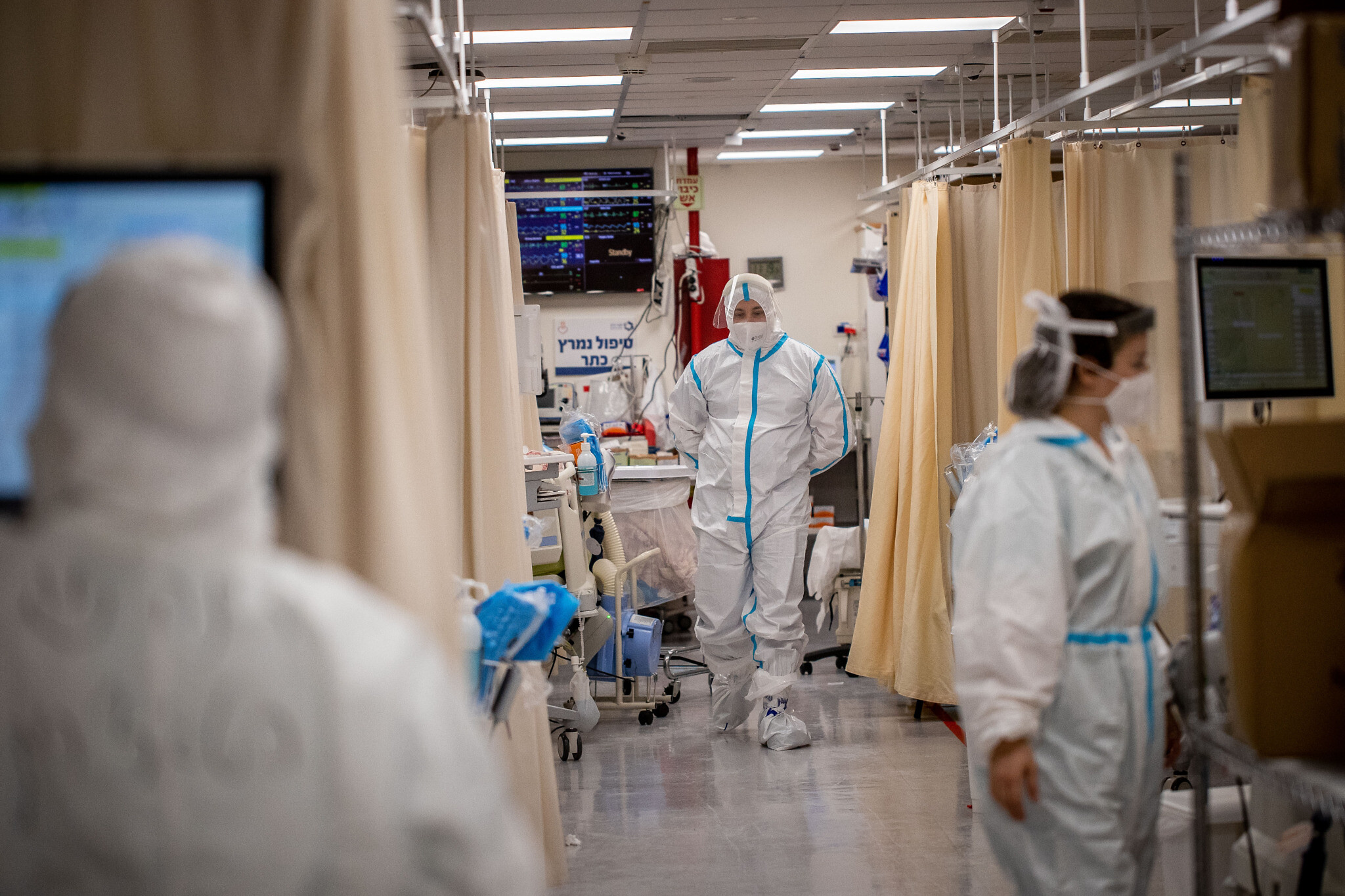

Shaare Zedek hospital team members wearing safety gear as they work in the coronavirus ward of Shaare Zedek hospital in Jerusalem on February 3, 2021. (Yonatan Sindel/Flash90)
Shaare Zedek hospital team members wearing safety gear as they work in the coronavirus ward
 

Israeli hospitals have to prepare for an influx of nearly 5,000 coronavirus patients within weeks, half of whom will need acute care to deal with severe bouts of COVID-19, health officials have warned Prime Minister Naftali Bennett, according to reports Wednesday.

The dire predictions came during a Tuesday meeting between Bennett and senior health experts amid a major influx of new cases, prompting the premier to back a plan to expand hospital capacity, a signal that the government will look to absorb the crush of severe cases head-on rather than attempt to swerve out of its way.

Senior Health Ministry officials and other experts presented Bennett with data forecasting some 4,800 coronavirus patients requiring hospitalization by September 10. The experts expect half of the patients to be seriously ill, putting a major strain on Israel’s health system, according to Hebrew-language media reports on the closed-door meeting.

Israel has seen new case numbers skyrocket in recent weeks from a few dozen a day to over 6,000 on Monday. Another 5,755 were diagnosed on Tuesday, the Health Ministry said Wednesday morning, bringing the number of active cases to 38,942.

Ministry numbers showed 694 patients hospitalized as of Wednesday morning, 400 of whom were listed in serious condition. Sixty-two people were being treated on ventilators.

The predictions from the health experts were based on a doubling of the number of hospitalizations and serious illnesses every 10 days.

Bennett and Health Minister Nitzan Horowitz agreed to pump money into the health system to bring in 100 more doctors, 500 nurses and 200 paramedical and support staff every 10 days to keep up with growing demand, according to a summary of the meeting drafted by the Prime Minister’s Office and published by the Ynet news site.
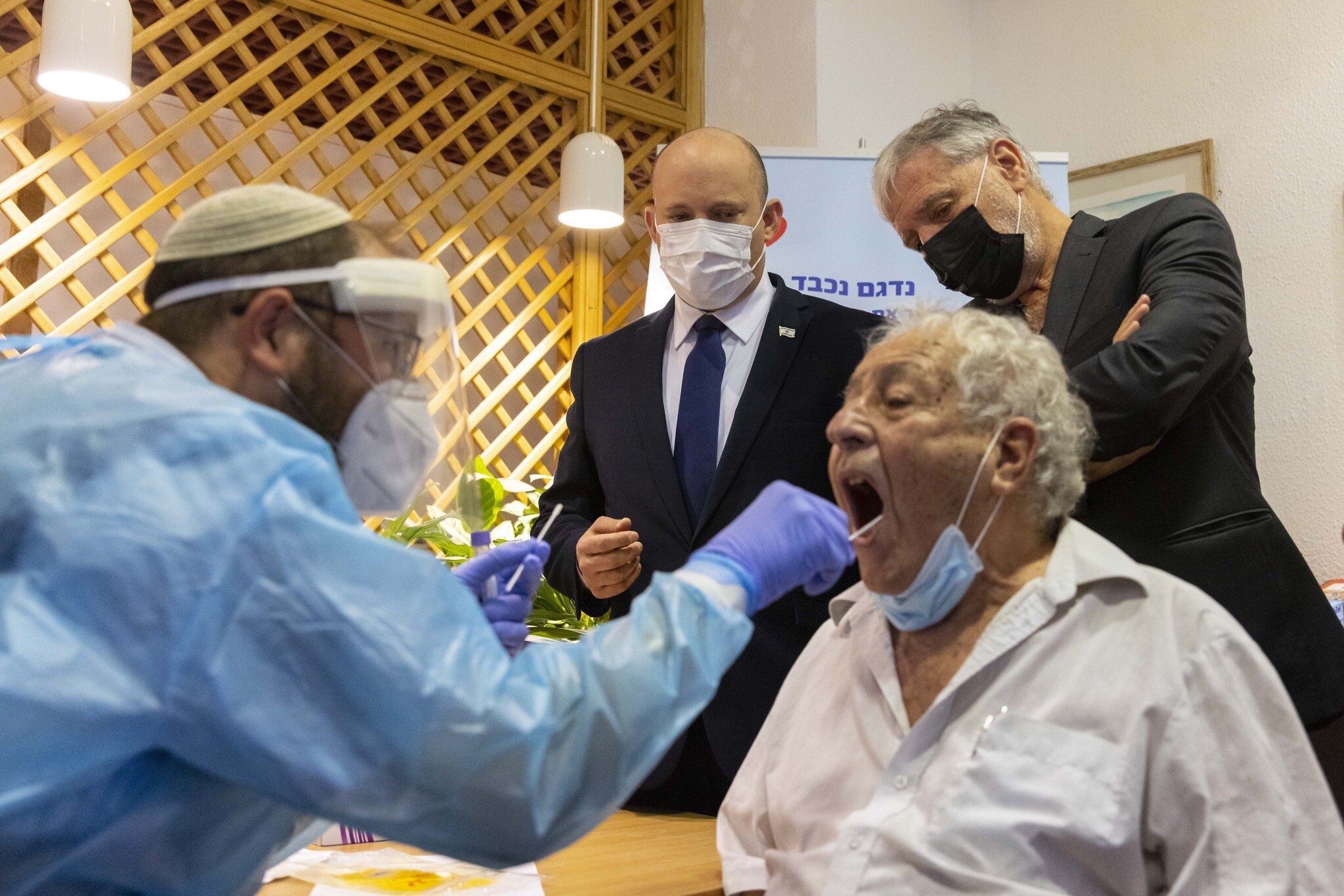
 

Prime Minister Naftali Bennett, center, watches a resident of the Migdal Nofim retirement home in Jerusalem be tested for the coronavirus on July 27, 2021
 

Some 3,000 students will also be hired and paramedics and military medics will be brought in to carry out home visits and assist in home treatment for coronavirus patients.

Special summer camps and afterschool care will be provided for the children of health workers to free up their time.

The plan will also increase the capabilities of the geriatric care system and boost the ability of HMOs to treat patients at home in order to ease the load on hospitals.

During the third wave of the virus, which crested in January with some 10,000 new daily cases, health officials warned that the health system would be unable to cope if the number of seriously ill patients rose above 800. At the pandemic’s peak, nearly 1,200 patients were listed in serious condition, and some 50 people died each day.

Hospital internal ward heads told Health Ministry Director Nachman Ash Wednesday that they were already dealing with “heavy crowding,” and feared beds in their units would be moved to coronavirus wards, worsening the pressure, the Health Ministry said in a statement.

 

A health care worker tests Israelis for coronavirus at a drive-through complex in Rehovot
 

The proposal is estimated to cost between NIS 1.5 billion to NIS 2 billion ($465 million to $620 million), Channel 12 reported. Bennett was to meet later Wednesday with the heads of the country’s hospitals to present them with the plan, Ynet reported.

While the source of the money has yet to be determined, Finance Minister Avigdor Liberman has promised on numerous occasions to fund hospitals in order to increase capacity and deal with the rising case numbers.

Liberman, who has likened COVID-19 to the flu, and other government officials see expanding the ability of the health system to deal with thousands more patients as key to pursuing its policy of avoiding lockdowns or strict restrictions that could harm the economy, seeking to “live with” the virus and vaccinate where possible rather than attempt to eradicate it from public life.

Interior Minister Ayelet Shaked came under fire Tuesday after appearing to brush aside the pandemic’s human toll while defending the government’s stance, telling Channel 13 news that “we have to to know how to accept severe cases and also to accept deaths, because this is a pandemic and in a pandemic people die.”

Ministers were to convene later Wednesday to discuss broadening the scope of the so-called Green Pass system to apply to most events and leisure activities. Under the system, Israelis seeking to enter most venues aside from stores will have to show proof they are vaccinated, have recovered from COVID-19, or tested negative for the virus in the past 72 hours.

KUDOS TO RAV YANKEL BENDER SHLITA


https://www.timesofisrael.com/health-officials-predict-thousands-of-seriously-ill-covid-patients-within-month/?utm_source=The+Daily+Edition&utm_campaign=daily-edition-2021-08-11&utm_medium=email

Tuesday, August 10, 2021

In the meantime, Jewish organizations should be devoting more resources to studying and combating pandemic-related antisemitism. Needless to say, Vocal Anti-Vaxxers are Dangerous and Must Never be Allowed to be Rolled Out as the Ugly Face of any Jewish Organization!


‘Not Vaccinated’ & Anti-Vaxxers: How Refusal Is Spreading the Virus of Antisemitism


NOTORIOUS ANTI-VAXXER "EVEN THE POLIO VACCINE IS A HOAX"    

More than 71,700 COVID-19 cases in people under the age of 18 were reported between July 22 and July 29, with kids and teens representing about one in five new cases that week, the data shows.

 A sad sight has returned to the streets of New York — and doubtless to other cities around the country in which a growing majority of residents have vaccinated themselves against COVID-19. People are wearing masks again inside residential and office buildings, in grocery stores and even outdoors in the heavy summer air.

I can only share impressions at this stage, but the atmosphere seems a little more relaxed than in 2020, when the absence of a vaccine meant that mask-wearing, however unpleasant, was a public-health requirement. At a bustling store I visited last week in Manhattan, I observed that approximately half the people there were properly masked, another third wore their masks dangled around their chins, and the remainder weren’t bothering at all. (Happily, no one was yelling at anyone else about it.)

If they are vaccinated, then they shouldn’t really need to mask. Of all the pandemic-related data that has surfaced in recent weeks, three conclusions stand out. First, that the vaccine has been phenomenally effective in those communities and localities where its availability has been embraced. Second, that the chance of a virus breakthrough in a fully vaccinated individual is extremely rare. Third, that the main reason for the continued spread and mutation of the pandemic, at least in the United States and in other Western countries where coronavirus vaccines are in plentiful supply, is the refusal of a significant minority of the public to do their civic and human duty by taking the jab.

It’s important not to portray opposition to the vaccine as an intellectually or morally legitimate opinion in the debate over how to comprehensively defeat the worst public-health crisis in a century. Simply, there are no “points of view” when it comes to vaccination. In support of vaccination, there is already a copious body of empirically verified evidence that continues to accumulate further scientifically valid insights, as researchers discover more about the variants of the virus. That sits alongside the dismal fact that unvaccinated individuals composed nearly 100 percent of COVID-19 hospital admissions nationally within the last month. Unsurprisingly, over on the vaccine refusal side, we find only a morass of superstition and paranoia rooted in conspiracy theories, ill-founded rumors and plain old misinformation.

All that being said, a Jewish audience doesn’t need much persuading of either the effectiveness of the vaccine or the myriad dangers posed by vaccine refusal, at least if a survey conducted by the Public Religion Research Institute (PRRI) at the end of July is anything to go by. Among its findings were that 85 percent of American Jews are either fully vaccinated or nearly there, and that more than 70 percent of the community “supports requiring proof of vaccines for activities like travel, work or school.” And, of course, in terms of speedy delivery of vaccines to its citizens, the State of Israel really did the lead the way, in full view of the rest of the world.

The introduction of vaccine passports, along with financial incentives (commonly known as bribes) to get vaccinated, may well leave a big dent in the vaccine refusal movement, as some of its adherents opt for the pragmatic approach to avoid their lives getting even harder. Media intervention is critical as well. A peer-reviewed study in May of COVID-19 vaccine rumors and conspiracy theories by a group of medical specialists discovered no less than 578 unsubstantiated rumors concerning the vaccine that had traveled across social media (“36 percent were related to vaccine development, availability and access; 20 percent related to morbidity and mortality; 8 percent to safety, efficacy and acceptance; and the rest were other categories,” noted the study, appropriately titled, “The need for cognitive inoculation against misinformation to improve vaccine adherence”). It went on to argue that “tracking COVID-19 vaccine misinformation in real-time and engaging with social media to disseminate correct information could help safeguard the public against misinformation,” an approach that would also help to break down vaccine refusal.

While we can be reasonably confident that, with the passage of time, more vaccine refusers will relent in the face of the health crisis they helped make much worse, we can be less confident that the hateful beliefs currently being spread among their ranks will follow suit.

As someone who writes regularly about global antisemitism, I’ve noticed that bigotry directed towards Jews as a result of the pandemic is a rapidly growing part of my workload. Essentially, it has taken two forms. To begin with, there is the nauseating use of the “Judenstern,” the yellow “Jews’ Star” the Nazis forced Jews to wear on their outer clothing, with the word “Jew” replaced by “Not Vaccinated.” This visual appropriation of Nazi genocidal policies towards Jews as an analog for the social difficulties that vaccine refusers are bringing upon themselves has been alarmingly widespread — so much so that in June, the city of Munich banned the display of the “Judenstern” from the vaccine-refusal demonstrations that have proven chillingly popular in Germany. Only last week, flyers bearing exactly this imagery were distributed on Manhattan’s Upper East Side.

Then there is the even less subtle rumor mill insisting that Jewish business moguls are getting fat off vaccine profits. A study conducted in June by a group of academics at the University of San Martin in Argentina revealed that more than 30 percent of Argentines strongly agreed with the statement that there are “laboratories of Jewish businessmen who seek to profit financially” from the vaccine, with another 7 percent concurring with that statement to a lesser extent.

It would be comforting to believe that in a few months, with a fresh wave of vaccinations in place, these calumnies will have faded from view. While it is reasonable to think that a decline in vaccine refusal will similarly impact pandemic-related antisemitic propaganda, these beliefs will always find a ready audience within the hardcore of remaining vaccine refusers, whose rhetoric will become even more violent and apocalyptic.

Some medical experts argue that, like influenza, the coronavirus will never truly leave us; only the degree of vaccination will determine whether the virus controls us or we control the virus. Similarly, the antisemitism whipped up during the pandemic, with its echo of the medieval slander that Jews spread the Black Death by poisoning wells, will also remain with us. How serious it becomes will depend on many factors, chiefly how the divide between the vaccinated and the unvaccinated plays out in the political realm.

In the meantime, Jewish organizations should be devoting more resources to studying and combating pandemic-related antisemitism. When the Boycott, Divestment and Sanctions movement targeting the State of Israel’s sovereign existence emerged in the early 2000s, some Jewish leaders argued, mainly in private, that depriving it of the oxygen of publicity was the best way to defeat it. Two decades later, the acronym “BDS” is still with us, albeit with a litany of failures and only a handful of successes to its name.

Whatever progress is made by the antisemitism of the virus, let’s not make that same mistake again.

https://www.algemeiner.com/2021/08/08/not-vaccinated-how-refusal-is-spreading-the-virus-of-antisemitism/


Monday, August 09, 2021

“The danger is that kosher certification probably needs to be rethought in the age of online sales and the internet,” Finkelman said. “With private label packaging, if Price Chopper had put an OU label on the turkey that wasn’t kosher, people would have eaten it.”


How the heck did a ham get a kosher certification? This man knows.


Paul Finkelman was shopping for groceries at Price Chopper supermarket in Albany, NY, when his son asked him to come over to the deli aisle. Finkelman’s son, who had been looking for turkey, found packages of Price Chopper’s store-brand PICS sliced ham stamped with the Orthodox Union’s (OU) kosher certification.

Finkelman was surprised that the relatively small, Jewish-owned supermarket chain, which sells a variety of kosher products would purport to sell “kosher” ham.

Amused, Finkelman snapped a picture of one of the packages. He sent the photos to a couple of friends and headed home. “I thought it was pretty funny,” Finkelman said. “I got responses like ‘What?????’” Later that day, he returned to the supermarket to get a better picture.

A professor of legal history and the President of Gratz College who studies the relationship between law and religion, Finkelman was fascinated by the larger implications of the certification beyond its humor.

On Sunday, June 6, Finkelman sent the picture of the ham to two academic email lists, one focused on religion and law and the other for constitutional law. “Most people who care would not be fooled by the OU on the package of ham. But I presume someone who does not speak or read English well might just know to look for the symbol to buy food thinking it is kosher,” Finkelman wrote. “Or, someone might think that ‘kosher ham’ is really just a turkey product.”

Finkelman discussed the issue with Jewish and non-Jewish law professors, as well as rabbis, all of whom were interested in kosher laws as a teaching tool for other kinds of law, he said.

Meanwhile, Finkelman’s kosher ham photo began to go viral, as it circulated throughout the Jewish corners of Twitter and Facebook. A tweet from law professor David Bernstein received 377 likes and 95 retweets.

Later that day, Finkelman received a phone call from Howard Katzenstein, the Director of Business Management and Trademark Compliance at the OU. “For a minute, I thought it must have been a joke. I thought it was a law professor pretending to be from OU.org, because why would OU.org be calling me?” Finkelman said.

When Katzenstein assured him that the call was real, Finkelman began the first in a series of long conversations with the kosher certification organization. The OU confirmed that the ham was wrongfully marked and began investigating the possible reasons behind its mislabeling, Finkelman said.

“As a professor, I think about hypotheticals,” Finkelman said. “Ninety-nine percent of people who keep kosher would not buy kosher ham, but it’s not impossible that somebody might be misled. Someone might have just seen the OU and bought it.”

“Having done trademark compliance for 25 years, there’s very little that shocks me. It’s just a growing aggravation,” Katzenstein said. “Even though it was a Sunday, I had to drop everything and deal with it.”

As the afternoon went on, Finkelman fielded calls from OU’s general counsel and sent pictures of the package to the organization. Later, he returned to the Price Chopper, where he bought a package of the ham to send the receipt to the OU, who wanted to contact the management of the supermarket chain.

“The danger is that kosher certification probably needs to be rethought in the age of online sales and the internet,” Finkelman said. “With private label packaging, if Price Chopper had put an OU label on the turkey that wasn’t kosher, people would have eaten it.”

Finkelman and the representatives of the OU talked to the head of the Golub Corporation, the company that runs Price Chopper. “It’s a closely held company, and they were very receptive,” Finkelman said.

Golub told Finkelman and the OU that the unauthorized certification on the packages of ham had been a mistake, Finkelman said.

By Monday afternoon, Price Chopper pulled the “kosher” ham from their shelves. Finkelman and his son couldn’t find the ham at the other two store locations they drove to that day, he said.

On Tuesday, the OU tweeted that they had not certified the ham and that the product was being withdrawn from Price Chopper’s shelves. Price Chopper tweeted a similar clarification.

“The OU.org did a superb job of fixing this,” Finkelman said. “It was clearly human error. There was no attempted fraud, but the question is how do we learn from human error?”

Finkelman was completely unaware of his mild internet fame until his son, who loves to cook and follows a number of kosher Facebook pages, told him he had seen the picture online.

“I started laughing. I like to see the humor in life, and I thought it was just so crazy!” Finkelman said. “Nobody knew it was my picture.”

https://forward.com/news/471338/how-the-heck-did-a-ham-get-a-kosher-certification-this-man-knows/?utm_source=Iterable&utm_medium=email&utm_campaign=campaign_2692647

Friday, August 06, 2021

Imagine These Guys Running The Dept. Of Health of Israel !


Chareidi Groups Declare They Will Not Obey Lockdown Earmarked For Jewish Festivals


Armed Israeli border Policeman and Policewoman inspect drivers in a checkpoint located at the exit of the Ultra-Orthodox city of Bney-Brak on April 03'rd, 2020. Israeli Police have set up checkpoints around roads leading in and out of Bnei Brak as the Israeli government declared the ultra-Orthodox city of Bnei Brak a "restricted zone" after invoking emergency powers to handle the coronavirus outbreak, which has massively spread throughout the city
 

 The Israeli government has announced its intention of imposing a lockdown over the course of the festival period in September if the coronavirus statistics continue to rise as they have been for the past month. Prime Minister Bennett has said that such a lockdown is dependent on the success of the vaccination drive in curbing the spike in infection but chareidi elements are incensed that the government did not even consider a lockdown during the vacation period but rather insisted on keeping the country and the borders open despite the significant rise in infections, many of which originated from abroad.

The Chatzros Kodesh organization which represents a number of Chasidic communities has declared that “as the festival period comes closer, we are witness to a worrying development. Despite the fact that there were numerous professional reasons to make a lockdown due to the spread of coronavirus a month ago, the Bennett government has acted nonchalantly and irresponsibly.

“Now it is clear to everyone that their goal was to delay the lockdown until the festival period. Apparently the “July-August vacation” is more important to them than prayers and supplications during the High Holidays.”

The organization issued a declaration, stating that “the chareidi public will wage a fierce war with all measures at its disposal to ensure that a lockdown during the festival period will not be relevant.”The director of the Chatzros Hakodesh organization, Rabbi Shimon Blau, told Bechadrei Chareidim that the organization has different methods of fighting the lockdown and called on the public to prepare as usual for the festival period, stating that “we won’t let infections and the lack of government response harm the holy aspects of our lives.”

The organization called on the public to be responsive to their directives regarding the festival period.

Some chareidi journalists have also stated that they will not obey a closure which is specifically earmarked for the festival period. However others explained that the threat of a closure is merely a ploy to persuade those who have not yet vaccinated to go and vaccinate, since this could lower serious infections and prevent the need for a further closure.


https://thejewishvoice.com/2021/08/chareidi-groups-declare-they-will-not-obey-lockdown-earmarked-for-jewish-festivals/

Thursday, August 05, 2021

But a community that directs its men to life-long study while its women are tasked with child rearing and providing an income for the household is doomed to live in poverty.

Israel's new government is redefining 'religion and state' 


Opinion: The capitulation of the former Netanyahu administration to the demands of Haredi politicians presented the country with economic and societal threats that the new coalition must take steps to reduce if it hopes to retain its legitimacy to lead


Perhaps the most prominent change between Israel's previous government and the new one is in its approach to matters of religion.
 
It is not a tactical shift in policy or the result of political or personal whims. The new government is changing strategy, dictated by the reality of life in Israel.
 
HAREDI JEWS AT THEIR HOLIEST TEMPLE IN JUDAISM

 
HAREDI KNESSET MEMBERS ON LUNCH BREAK


The previous government's extensive capitulation to the demands of the ultra-Orthodox parties presented Israel with two existential threats: one economic and the other societal.
 
The economic threat stems from the insistence of Haredi political leaders to perpetuate the state-financed yeshiva study adopted by Israel in the years after the Holocaust, when European Hassidic Judaism seemed in danger of disappearing altogether. 
 
But a community that directs its men to life-long study while its women are tasked with child rearing and providing an income for the household is doomed to live in poverty.
 
The victims are first and foremost the members of the Haredi communities themselves, of course. 
 
But the economic impact has spread to the entire population, which is required to subsidize an unproductive sector of Israeli society - an increasingly difficult and expensive task.
 
The societal threat comes from the clash between the conservative ultra-Orthodox worldview and secular Israel.
 
Haredi communities are hermetically sealed off from other sectors of society, even when they live in the same cities.
 
When a member of such a community ventures out into the world, they arrive with demands for their religious needs to be accommodated, most prominently separation of the sexes. 
 
Haredi men do not see images of women in the public sphere and women are even absent from advertisements on city buses and billboards in their communities.
 
This fact alone prevents ultra-Orthodox and secular Israelis from sharing the same public spaces even as their political leaders often work together to further mutual interests.
 
But now Prime Minister Naftali Bennett's government has announced a series of reforms that would lead to the privatization of Israel’s kosher certification process in order to increase competition in a field currently monopolized by the ultra-Orthodox Chief Rabbinate.
 
The announcement was met with fury from the Rabbinate, which has control over all aspects of Jewish life in Israel. 
 
But the Rabbinate cannot have sole authority unless it moves to represent a majority of Israeli society and the ultra-Orthodox alone do not determine who receives kosher certification and who is deemed as a successful convert to Judaism.
 
ישיבת סיעות בלוק הימין
United Torah Judaism leader Yaakov Litzman, Shas chair Aryeh Deri and former prime minister Benjamin Netanyahu at a meeting of the previous cabinet

Now that some ultra-Orthodox politicians are coming to terms with the fact that their benefactor, former prime minister Benjamin Netanyahu, is about to return to power, some are considering how best to promote dialogue with the new administration.
 
They also understand that if such a dialogue is allowed to proceed, at least some of the announced new policies could be reversed.
 
But if the government decides to suspend its strategic shift, it may also lose its legitimacy.

Wednesday, August 04, 2021

“No one holds a monopoly over Jewish traditions: not on Judaism, not on nationalism,” Bennett said, reprimanding the haredi MKs. “No one will preach to me or anyone else what loving other Jews means. We all love the Jewish people, we all love our country.”


Ultra-Orthodox histrionics over religion, state may backfire - analysis


Both ultra-Orthodox parties have denounced the government as “treif," have accused Bennett of being “a con artist” and repeatedly denounced the government for "destroying Judaism."

UNITED TORAH JUDAISM Party MK Ya’acov Litzman (left), UTJ MK Moshe Gafni and Shas head Arye Deri converse during a meeting at the Knesset earlier this month.  (photo credit: YONATAN SINDEL/FLASH90)
UNITED TORAH FRAUD JUDAISM MAFIA Party MK Ya’acov Litzman (left), UTJ MK Moshe Gafni and Shas head Arye Deri converse during a meeting at the Knesset earlier this month. 


“This is a black day for the state and the government… The State of Israel has lost the right to call itself a Jewish and democratic state,” said United Torah Judaism leader MK Moshe Gafni.
 
“The ultra-Orthodox public will not forget or forgive the prime minister and his partners,” he added.
 
These words were uttered not in August 2021 but in March 2014. And they were said not in reference to Prime Minister Naftali Bennett but rather regarding then-prime minister Benjamin Netanyahu.
 
The 36th government of Israel was sworn into office this June amid a bitter, rancorous political atmosphere that has gotten ever sharper and acrimonious.
 
The parties and MKs of the opposition are apparently in competition as to who can summon up the most splenetic accusations against the current coalition – and it is hard to say who is winning.
But the ultra-Orthodox MKs are certainly giving it all they have.
 
Gafni, in his enmity towards the current government, denounced Bennett as no less than a murderer over his handling of the latest COVID-19 outbreak, although he later retracted the remark.
 
The UTJ chairman has also labeled Religious Services Minister Matan Kahana “Antiochus,” the Seleucid Greek ancient enemy of the Jews in the time of the Hasmoneans who sought to eradicate Jewish practice.
 
On Monday afternoon, Gafni denounced Bennett as “destroying Judaism” while being ejected from the Knesset plenum for unruly behavior during the prime minister’s speech, while Shas chairman MK Arye Deri exploded with anger during the same speech and repeatedly called Bennett a liar.
 
Both ultra-Orthodox parties have denounced the government as “treif” – meaning non-kosher but with a sharper meaning of “impure” – have accused Bennett of being “a con artist” and repeatedly denounced the government for “destroying Judaism.”
 
SO WHAT explains this extraordinary outpouring of venom toward the prime minister and the government?
 
The reality is that much of the righteous anger expressed by the ultra-Orthodox MKs is mere theater, curated for their constituents and designed to inculcate how vital the haredi parties are to the well being of the haredi community.
 
Denouncing proposed kashrut reforms as “destroying Judaism” – as if Judaism only flourished in the 73 years in which the Chief Rabbinate of the State of Israel had a monopoly over kashrut licensing – is merely a way of ginning up the ultra-Orthodox street and creating the impression that the Jewish religion is under attack.
 
The budget cuts to the ultra-Orthodox sector, especially the cuts to child daycare subsidies for families in which the father studies full time in yeshiva, are actually a boon to UTJ and Shas and allows them to denounce the government as undermining Torah study and Judaism and seeking to destroy the haredi community.
 
The ferocious outbursts of Shas and UTJ in the opposition today serve the same purposes as the similar outbursts seven years ago in the face of government legislation to increase haredi enlistment: to make the ultra-Orthodox community feel under attack so as to impress upon it the importance of voting for the haredi parties as the protectors of their rights and budgets when the next elections come around.
 
When the government first took office, it was thought that there was a possibility to eventually bring the ultra-Orthodox parties in to stabilize the coalition, but the likelihood of such an outcome appears to be especially distant at present, with every vitriolic outburst from Gafni and Co. making it seemingly ever more unlikely.
 
Bennett himself has begun pushing back harder against the Gafni and Deri’s attacks, accusing Shas and UTJ on Monday afternoon of protecting a corrupt and mismanaged kashrut system and rejecting their scolding over the state of Judaism in the country.
 
“No one holds a monopoly over Jewish traditions: not on Judaism, not on nationalism,” Bennett said, reprimanding the haredi MKs. “No one will preach to me or anyone else what loving other Jews means. We all love the Jewish people, we all love our country.”
 
IF THE RHETORICAL battle between the prime minister, his government and the ultra-Orthodox parties continues its current level of intensity, it would appear hard for either to row back the situation, especially for Shas and UTJ.
 
How would it be possible for Gafni and Deri to now sit in a government they have attacked as undermining and destroying the Jewish religion in the Jewish state?
 
This state of affairs could in fact lead to an even greater schism between the two sides.
 
If it seems impossible to ever bring the haredi parties into the coalition to stabilize it, why bother trying to accommodate them when it comes to dealing with the sensitive issues they care about?
 
If they cannot be reasonable about kashrut reform, why bother being sensitive about implementing the Western Wall agreement?
 
If bringing in term limits for municipal chief rabbis – who would otherwise serve for decades on end with no accountability – is denounced as destroying Judaism, why worry about moderating reforms for the conversion system?
 
If Bennett’s government is going to be compared to the destructive enemies of the Jewish people, why worry about finding solutions for Israeli citizens who cannot get married in the State of Israel?
 
The dramatic and theatrical denunciations of the ultra-Orthodox parties will no doubt play well with their voter base and make the community well motivated for the next elections, whenever that might be.
 
But at the same time, it could provide Bennett, a known liberal and religious moderate, with the excuse and opportunity to enact more far-reaching changes to Israel’s religion and state model than he might have otherwise decided to make.
 

Tuesday, August 03, 2021

Following a meeting of the rabbis of the Council of the Chief Rabbinate on Monday, the organization’s executive arm, the body issued a decision stating that any rabbi utilizing the proposed reforms would violate Jewish law and said it would not accept the dictates of the religious services ministry on the issue.


Chief Rabbinate declares it will not cooperate with gov't kashrut reforms


Chief Rabbi Lau said that religiously traditional Israelis and foreign visitors will not be able to understand the differences between competing kashrut authorities


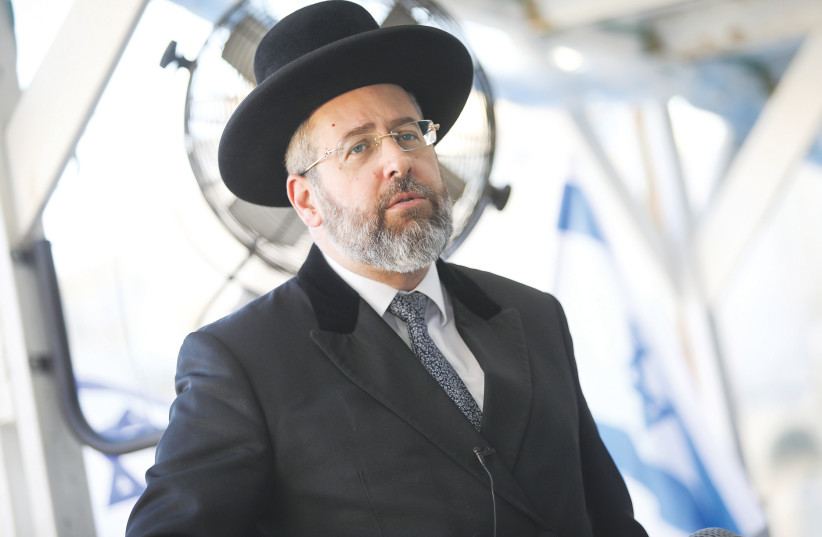
Chief Ashkenazi Rabbi David Lau.  (photo credit: NOAM REVKIN FENTON / FLASH 90)
Chief Ashkenazi Rabbi David Lau.

The Chief Rabbinate has declared it will not cooperate with the government’s proposed reforms to the kashrut supervision system, describing them as “dangerous” and “the destruction of kashrut and Judaism in Israel.”
 
Following a meeting of the rabbis of the Council of the Chief Rabbinate on Monday, the organization’s executive arm, the body issued a decision stating that any rabbi utilizing the proposed reforms would violate Jewish law and said it would not accept the dictates of the religious services ministry on the issue. 


The decision was signed by head of the council Chief Rabbi Yitzhak Yosef and the 11 other members of the council, while Chief Rabbi David Yosef, applauded the decision. 
 
Religious Services Minister Matan Kahana did not immediately respond to a request for comment. 
Last month, Religious Services Minister Matan Kahana announced a program of reform which would allow independent kashrut authorities headed by a Chief Rabbinate-qualified rabbi to provide kashrut supervision, with the Chief Rabbinate establishing standards and functioning as a regulator, including operating an inspection authority to oversee the work of the independent kashrut authorities. 
 
Additionally, if independent authorities seek to operate under alternative standards a municipal chief rabbi together with two other rabbis with qualifications to serve as municipal chief rabbis, could establish their own kashrut authority under their own guidelines, which would still be subject to the Chief Rabbinate’s inspection authority. 
 
These measures would abolish the Chief Rabbinate’s monopoly over kashrut licensing, which has been described by state comptroller’s reports as suffering from severe deficiencies and from corruption. 
 
“The Council of the Chief Rabbinate declares that according to Jewish law it is forbidden for a rabbi to give kashrut [certification] or deal with kashrut issues outside of his [municipal] boundaries in a place where another rabbi is serving,” wrote the council in its decision on Monday. 
 
The council was referencing the requirements of the proposed reforms in which the independent kashrut authorities which will be established must be headed by a rabbi with qualifications from the Chief Rabbinate to serve as a municipal chief rabbi. 
 
That authority will be able to provide kashrut licensing and supervision anywhere in the country, as opposed to the current system in which only the local municipal chief rabbi and rabbinate can grant a kashrut license. 
 
“The Council of the Chief Rabbinate was established (by law) in order to give instructions in Jewish law to the people, and will not cooperate with the decision to turn it [the Chief Rabbinate] to a council which accepts dictates in order to implement political policies which contravene Jewish law. Principles of Jewish law are not up for negotiation, the Torah of Israel cannot be changed.” 
 
CHIEF RABBI David Lau gave backing to the council’s decision, and also denounced the reforms.
 
Lau delineated his opposition to the reforms in a letter to his colleague Chief Rabbi Yitzhak Yosef welcoming the Council of the Chief Rabbinate’s opposition to the proposals on Monday. 
 
In  his letter, Lau claimed that religiously traditional Israelis and tourists would suffer from the reforms, which are now part of the state budget’s arrangements law, since they would not know how to discern between reliable and unreliable kashrut authorities. 
 
He also attacked the central notion of the reforms of creating competition between kashrut authorities, saying such competition would harm the level of kashrut.
 
And he also criticized Kahana’s proposals, without mentioning him explicitly, for not consulting with a committee of the Chief Rabbinate established to examine options to improve the quality of kashrut supervision in the country. 
 
The committee was established back in March 2016 and it made modest proposals for reform which were never implemented by the Chief Rabbinate. 
 
And he attacked the “three rabbis” alternative track for establishing a kashrut authority, saying such rabbis would lack experience in kashrut supervision, and compared the track to an alternative health ministry run by three coronavirus denying doctors. 
 
Lau also alleged that those who were happy with the proposals were among those who “harm the Jewish character of the State of Israel,” saying that this fact “proves the proposals are not designed to help Judaism.”
 
He said he hoped the Council of the Chief Rabbinate would convene shortly “to discuss how Israel’s rabbis should act on this issue,” as well as how to react to coming reforms to the conversion process that Kahana also plans to introduce. 
 

Monday, August 02, 2021

“Baruch atah Adonai, Eloheinu Melech ha’olam,” he began in Hebrew, the sterile divider behind him sealing off the patients with Covid-19 from the uninfected. “Blessed are you, Adonai our God, sovereign of all, who has kept us alive, sustained us and brought us to this season.”


A New Surge at a Santa Monica I.C.U.

They thought the worst of the pandemic was behind them. Then a new wave of cases arrived at the I.C.U. at Providence Saint John’s Health Center.


SANTA MONICA, Calif. — Two months ago at Providence Saint John’s Health Center, Dr. Morris Grabie stood at a makeshift plastic wall in the intensive care unit and prayed.

בָּרוּךְ אַתָּה ה' אֱ-לֹהֵינוּ מֶלֶךְ הַעוֹלָם, שֶׁהֶחֱיָנוּ וְקִיְּמָנוּ וְהִגִּיעָנוּ לַזְּמַן הַזֶּה ‎ 

“Baruch atah Adonai, Eloheinu Melech ha’olam,” he began in Hebrew, the sterile divider behind him sealing off the patients with Covid-19 from the uninfected. Blessed are You, Lord, our God, King of the Universe, who has granted us life, sustained us, and enabled us to reach this occasion.

Around the physician at the hospital in Santa Monica, Calif., a small army in scrubs — doctors, nurses, technicians — bowed their heads, bearing witness to what seemed to be the beginning of the end of the pandemic. Sixty-nine lives on the ward had been claimed by the virus. Pain and grief, life and death, fear and loss — month after grinding month — all of it had unfolded behind that thin divider.

And yet on this day, not a single patient in the Saint John’s I.C.U. had tested positive for the coronavirus. Dr. Grabie turned, and the I.C.U.’s medical director, helped by a respiratory therapist, zipped the wall open.

“We were all in awe,” recalled the medical director, Dr. Terese Hammond.

It was June 1 at 7:56 a.m., a Tuesday.

Now the ward’s Covid section is back and sealed off again.

Covid-19 is surging once more, at Saint John’s and in the world around it, driven by vaccine resisters and the virus’s hyper-contagious Delta variant. In California, new infections are appearing at a rate not seen since February. Governments, schools and businesses are starting to require masks indoors and vaccinations.


Vickie Gaddy, a nurse at the intensive care unit with a 44-year-old patient who later died. Doctors at the hospital say more younger people with Covid-19 are being sent to the I.C.U.


Los Angeles County is recording more than 2,500 new cases daily, and among the unvaccinated, hospitalizations and deaths are mounting. Even in affluent Santa Monica, where about 80 percent of residents are now vaccinated, dozens of people each day are testing positive for the virus, and hospitals like Saint John’s — a 266-bed facility that typically serves the ordinary needs of the beach communities around it — are being inundated again.

Last week, so many Covid patients were in intensive care that the space behind the plastic wall was not enough. The hospital had to reconfigure and expand the unit. Bonifacio Deoso, a nurse on the unit, was down to one weary question:

“When will this ever end?”

For the past three weeks, the 23-bed intensive care unit has been packed, Dr. Hammond said. Eight patients on the ward were being treated for the virus or related infections as of Sunday morning. Four were being treated with ECMO, a particularly labor-intensive, round-the-clock protocol.

Seven other patients were in the step-down I.C.U. on supplemental oxygen as they recovered from infections. “People are coming in sicker,” Dr. Hammond said. At least six people have died from Covid-19 in intensive care at St. John’s since June 1.

The wave of new cases is particularly challenging because it accompanies another surge — patients who had put off elective surgeries and other health care during the pandemic. In addition to the Covid-19 cases, Dr. Hammond’s staff has been caring this time for people with severe illnesses unrelated to the pandemic, except to the extent that missed doctor’s appointments and postponed routine screenings helped to land them in intensive care.

The patient demographics this time are different as well. Earlier in the pandemic, most were transfers from other Providence health care centers. Now many more are local and younger, Dr. Hammond said, and are being sent to intensive care after emergency room visits.

Given Santa Monica’s high vaccination rate, she said, the influx is “disconcerting.”

“Santa Monica was pretty protected,” she said.

While vaccinated people appear to be getting far less sick from infections, the superior powers of the Delta variant are allowing the virus to proliferate in their systems and to spread, lethally, to the unvaccinated. Some 20 percent of Santa Monica residents — and nearly 40 percent of those in the county around it — have not yet been fully inoculated, despite the entreaties of public health experts.

“You’re here to take care of the human regardless of the decision they make,” said Vickie Gaddy, a nurse in the unit. But the new rush of infected patients, so soon after the optimism of June 1, has been crushing for Dr. Hammond’s exhausted staff members.

“As an I.C.U. nurse, you know you’re going to see a certain amount of death,” said Masha Crawford, who also works with the hospital’s Covid-19 patients. But, she said, “in this pandemic, you see people who should not be dying die.”

Ms. Crawford said that before the pandemic, she loved working out. Now, she has no appetite for exercise or self-care.

“The new wave” of cases, she said, “has taken that energy.”

Dr. Brian Tu, an emergency medicine physician, says he is concerned about the hospital workers outside the unit who now are being exposed to the virus, a result of so many cases being detected through emergency room visits.

Dr. Stefania Pirrotta says the sheer relentlessness of the new surge has made her “angry.”

Just two months ago, she said, she was hopeful. Now there is no end in sight.


https://www.nytimes.com/2021/08/01/us/covid-santa-monica-icu.html