EVERY SIGNATURE MATTERS - THIS BILL MUST PASS!

EVERY SIGNATURE MATTERS - THIS BILL MUST PASS!
CLICK - GOAL - 100,000 NEW SIGNATURES! 75,000 SIGNATURES HAVE ALREADY BEEN SUBMITTED TO GOVERNOR CUOMO!

EFF Urges Court to Block Dragnet Subpoenas Targeting Online Commenters

EFF Urges Court to Block Dragnet Subpoenas Targeting Online Commenters
CLICK! For the full motion to quash: http://www.eff.org/files/filenode/hersh_v_cohen/UOJ-motiontoquashmemo.pdf

Tuesday, December 28, 2021

In Saudi Arabia, a rabbi angles to lead a Jewish community that doesn’t exist.....


meshuggener

noun
me·​shug·​gen·​er | \ mə-ˈshu̇-gə-nər
\

Definition of meshuggener

: a foolish or crazy person

Meshuggener Has Yiddish Roots

From bagel and chutzpah to shtick and yenta, Yiddish has given English many a colorful term over the years. Meshuggener is another example of what happens when English interprets that rich Jewish language. Meshuggener comes from the Yiddish meshugener, which in turn derives from meshuge, an adjective that is synonymous with crazy or foolish. English speakers have used the adjective form, meshuga or meshugge, to mean "foolish" since the late 1800s; we've dubbed foolish folk meshuggeners since at least 1900.


In Saudi Arabia, a rabbi angles to lead a Jewish community that doesn’t exist


Jacob Herzog is loudly trying to build Jewish life in a country where non-Islamic displays are forbidden, raising concerns among local Jews who prefer to stay under the radar


In late November, on the third night of the Jewish festival of Hanukkah, an ultra-Orthodox Jew from Israel lit candles in his Riyadh hotel room.

Displaying the holiday candles publicly, as Orthodox Jews traditionally do, could have landed the man in a heap of trouble. Even today, despite Saudi Arabia opening up significantly to the West, there is no open practice of Judaism in the country and proselytization of any religion but Islam is illegal and can carry harsh penalties.

So instead of displaying the candles for all to see, Jacob Yisrael Herzog drew the curtains in front of his window.

Then he posted a video of himself lighting the candles on Twitter.

For Herzog, the public-private act was just the latest move in a self-propelled campaign to become the chief rabbi of Saudi Arabia, a country that officially has no Jewish community.

Since the summer, Herzog has made five trips to Saudi Arabia in an attempt to establish a recognized Jewish presence in the kingdom. While the tangible impact of his efforts has seemingly been limited thus far, he is not shy about sharing his ambitious goals for the future, which run the gamut from drawing attention to kosher food in supermarkets via Instagram to opening Jewish community centers and a religious day school.

Herzog’s effort to make Jewish practice more accessible and carve out a space for communal Jewish life in one of the world’s most infamous bastions of religious persecution have won him plaudits from some and more than a dollop of positive media coverage, such as a Forward article that credited him with “bringing Judaism to Saudi Arabia.”

But to the small number of Jews who live in or frequently visit the deeply conservative petrostate, accustomed to flying under the radar and keeping their religious affiliation from becoming an affront to their hosts, his bombastic approach has sparked deep misgivings.

“This is not how things are done here,” four Jews who live in the Gulf and make frequent trips to Saudi Arabia said, using the same phrase almost verbatim. “He’s acting like a bull in a china shop.”
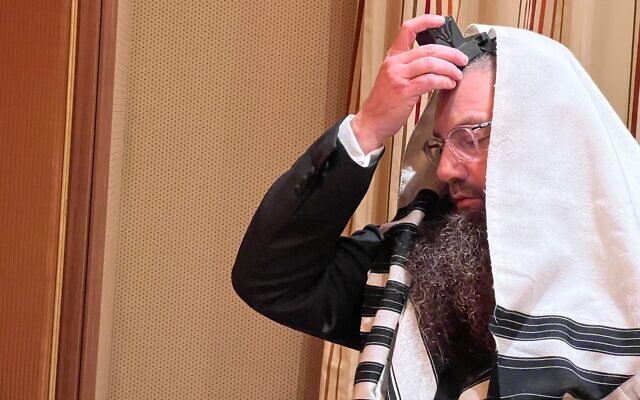
 

Rabbi Jacob Yisrael Herzog praying in his Riyadh hotel room, November 29, 2021. (Courtesy)
 

Herzog claims to be unbothered by critics who say his approach is unorthodox. Rather, he is focused on “getting stuff done.”

Fear has held other people back, and you don’t want to be held back by fear

“Fear has held other people back, and you don’t want to be held back by fear,” Herzog told The Times of Israel. “I’m not held back by fear… I’m not afraid.”

Planting the seeds

Herzog, 45, is an unlikely champion for a campaign requiring major religious policy reform in an ultra-sensitive setting. Born in the United States, he currently lives in Israel. His dual nationality allows him to visit Saudi Arabia despite Israel having no formal diplomatic ties with the kingdom. He is trained as a rabbi and ministered formally to Israeli soldiers, some of whom, he said, “still call me for advice.” But he has little Jewish communal experience beyond briefly serving as a chairman of a Chabad-Lubavitch synagogue in Jerusalem.

He has spent much more time in the business world, including stints in car tire recycling and agribusiness. Currently, Herzog owns ShneorSeed, which sells tomato and pepper seeds “to over 17 countries,” he said. And he hopes to add Saudi Arabia to that list.

“I’m very open about it. I have to make a living,” Herzog said.
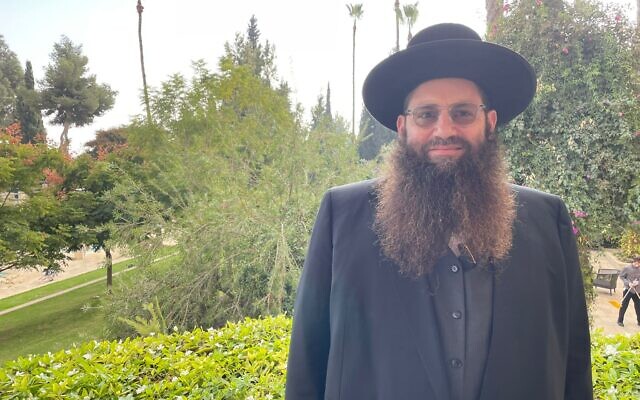
 

Rabbi Jacob Yisrael Herzog in Jerusalem, November 22, 2021. (Carrie Keller-Lynn/Times of Israel)
 

He describes himself on LinkedIn as “Rabbi and Business Entrepreneur in The Kingdom of Saudi Arabia,” specializing in “Deals and Transactions,” as well as “ritual circumcisions and interfaith dialogue.”

“There’s always things going on,” Herzog said of both his religious and business pursuits, “so I’m moving in both directions, parallel.”

Until recently, Herzog openly used his aspirational title of “Chief Rabbi of Saudi Arabia” on both LinkedIn and the website he opened for his rabbinic pursuits.

Herzog’s plan for the future, he makes clear, is for nothing less than building the country’s first modern, public Jewish community.

“The vision is [that Saudi Arabia] should have a few full communal services, everything from [Jewish] day school [and] Jewish high schools [to] synagogues, mikvaot [ritual baths] for both men and women, all the holiday services, communal holiday meals,” he said.

In addition to “offering the full range of Jewish services and a rabbi,” Herzog would like to establish Jewish community centers in the kingdom’s major expat cities.

He said his work thus far is self-funded, though he asks for donations via his website. Among other things, he is seeking money to build seven ritual baths in Saudi Arabia, each at over $1 million.

Although he and his family are part of the Chabad community, Herzog is clear that his efforts in Saudi Arabia are not linked to the organized Chabad movement. A Chabad spokesperson confirmed that the movement had not sent a representative to Saudi Arabia.

“Chabad-Lubavitch does not currently have an emissary to Saudi Arabia. The needs of Jews in Saudi Arabia are largely being met by Chabad in the UAE — from where kosher food and other needs are provided for,” said Rabbi Motti Seligson, a spokesman for the Chabad-Lubavitch movement.

Underground and out of trouble

The size of Saudi Arabia’s Jewish population is not formally known, but estimates range from the hundreds to low thousands of Jews living in the kingdom, all of whom are expatriates. There are few accounts of an indigenous community there following the advent of Islam in 632 CE, and what few Jews there were in the country fled to Israel along with Yemen’s Jews in 1949-1950.

Why draw fire? The regime won’t allow it

Today the kingdom legally forbids practicing a religion other than Islam, and there are no official synagogues or churches in the country.

“You won’t find a Jewish community here,” said Yoel Guzansky, a senior Gulf expert at the Institute for National Security Studies in Tel Aviv. “If it exists, it’s underground. Why draw fire? The regime won’t allow it.”

Similarly, an Israeli Foreign Ministry spokesman said his office had no comment on Herzog’s activities, noting that “there’s no Jewish community [in Saudi Arabia].”

Residents in the region describe a situation reminiscent of old “don’t ask, don’t tell” policies, where Jews living and working extensively in Saudi Arabia keep their religious affiliations to themselves.

Greg, a longtime Jewish resident of the Gulf who makes monthly business trips to Saudi and has Saudi-based Jewish friends, noted that Jews in Saudi Arabia are circumspect and cautious about their faith, and almost as a rule don’t advertise it. There’s no known organized community and Jews have no real way of finding each other.

Like other Gulf-based Jews quoted in this story, he requested a pseudonym for safety reasons.

“It would be very difficult to find people [who are Jewish],” Greg said. “It’s basically just word of mouth… You walk into a gym and you meet a guy called David and go, ‘hey, David, are you Jewish?’ And that’s sort of how it gets started.”

Sam, another longtime regional resident who does not live in Saudi Arabia but is involved in Gulf Jewish life, said that Jews in the kingdom aren’t looking to ruffle their hosts’ feathers.

“The Jews who live there are all there for business reasons. And they work for mainly international companies. They have to be kind of under the radar, or they at least feel they have to be,” she said.

“They’re real visitors. It’s like they’re really visitors in somebody else’s house,” she added, echoing a sentiment many Saudi-linked Jews expressed.

It is into this atmosphere that Herzog has inserted himself. While his critics are quick to note that he is well-intentioned, they fear that he is pushing the envelope of what the kingdom will tolerate and could end up hurting Jews who are quietly established there.

“I think he needs to understand the market that he’s getting into,” Greg said, comparing him to “an elephant in a china shop.”

“I think in the long term, he’ll be creating more damage to the Jewish community than anything else, because the Saudi public isn’t ready for another religion other than Islam to be publicly practiced,” Greg added.
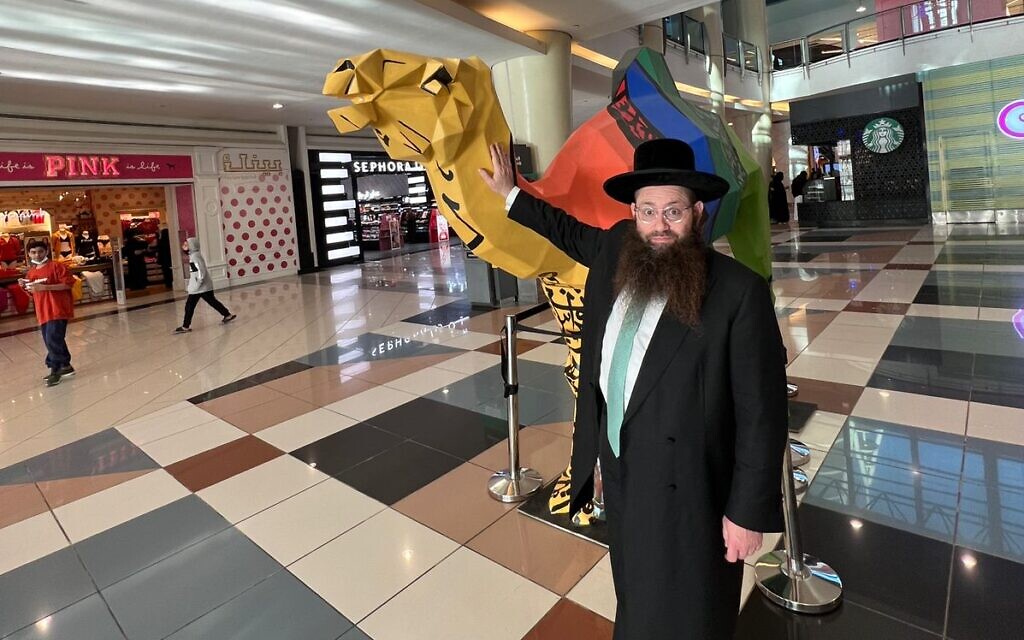
 

Rabbi Jacob Yisrael Herzog in a Riyadh shopping mall, November 2021. (Courtesy)

“I just don’t think the way forward is to be so in everybody’s face, knowing the Gulf people as I do now,” said Jon, a multi-decade Jewish resident of Saudi Arabia who now lives elsewhere in the region.

Sam noted that many were disturbed by a video that Herzog uploaded to social media in October of him dancing in the street with a local Saudi, as well as other posts flaunting his Jewishness.

“It scared the crap out of the Jews who are living there because they’re so under the radar about being Jewish,” she said.

Herzog offered the video as evidence that “they’re happy I’m here.”

While Herzog has had positive experiences with Saudi locals, there is not a uniformly positive attitude toward public expression of Jewishness in the Twittersphere.

Writing in Arabic, one commentator on his post warned Herzog that “someday…the stone and the trees will guide us to you,” an allusion to a Quranic verse that says that rocks and trees will expose Jews so they can be killed. This verse is also part of the Hamas charter.

I found him on Twitter and I just messaged him and he was straight back in contact, quite excited to have someone to help

Some people are excited about Herzog’s efforts, especially among travelers who said his involvement there made them feel more comfortable visiting the country.

“I was kind of Googling to see if I could find anything Jewish at all in Saudi Arabia,” said Noa Levy, 42, a London-based mortgage broker who reached out to Herzog before confirming a personal trip to Saudi Arabia. “I found him on Twitter and I just messaged him and he was straight back in contact, quite excited to have someone to help. I don’t think he has such a big demand there.”

Although they never did meet in person, Herzog helped Levy understand where she could “find kosher food in supermarkets” and he gave her the local Shabbat times.

“I think it’s quite brave,” Levy said of Herzog’s efforts.

M., a Jerusalem-based businesswoman who declined to use her name because Israeli travel to Saudi Arabia is still technically illegal, got help from Herzog on finding kosher food and electric candles she could use for Shabbat.
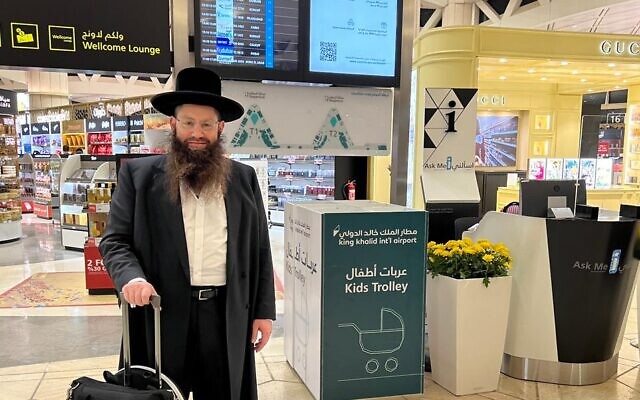
Rabbi Jacob Yisrael Herzog in Riyadh’s King Khalid International Airport, November 2021. (Courtesy)

“He’s been really amazing and really helpful,” she said.

Herzog is unfazed by the criticism from “those people sitting in Dubai and Bahrain,” and argues that staying underground is not helping Jews.

“When you do something time and time and over again and it doesn’t work, then if you keep on doing the same thing, you’re not going to get anywhere,” he said.

Herzog is adamant that he respects and obeys the laws of the kingdom and only operates within the bounds of what is legally permitted. But within those bounds, he’s willing to try new methods.

“There’s no law against walking around like this in Saudi Arabia, right?” Herzog said, referring to his distinct ultra-Orthodox dress.

No tolerance… yet

To Herzog and others, Saudi Arabia may seem ripe for opening up to the Jewish community. Driven by Crown Prince Mohammed Bin Salman, the kingdom has been undergoing a liberalization process in a bid to become a major international business hub, putting on a friendlier face toward Western visitors. The country has also been cooperating secretly with Israel against Iran for years, according to reports, and many saw it next on the normalization list after the United Arab Emirates and Bahrain established ties with Israel.

The UAE has indeed seen a blossoming of public Jewish life since the Abraham Accords, but the community there operated underground for over a decade before being able to step out into the sunlight.

A rabbi officiates under a traditional Jewish wedding canopy during marriage ceremony of the Israeli couple Noemie Azerad, left, seated under the canopy, and Simon David Benhamou, at a hotel in Dubai, United Arab Emirates, December 17, 2020. (Kamran Jebreili/AP)

“You’d arrive in the airport in Dubai with a kippa [religious skullcap] and the Emiratis would ask you to put a baseball cap on,” said Greg, a longtime resident. “It was for your own safety.”

Today the UAE community operates in the open, has multiple communities of worship and is serviced by three publicly prominent rabbis.

You can’t go to Saudi Arabia [a handful of times] and then be like, ‘I’m going to be the head of a religion that isn’t even recognized there’

A Gulf-based source familiar with the situation said Herzog was doing the opposite of what had happened in the UAE.

“You can’t go to Saudi Arabia [a handful of times] and then be like, ‘I’m going to be the head of a religion that isn’t even recognized there,’” the source observed. “Usually the way it works is you first kind of have to do the things below ground, establish relationships with the people who live there, with the government, with the business community. And then you could do it. But he literally just announced himself as a chief rabbi and figured based off of announcing himself, that he’s going to get these people to come out of the woodwork.”

Herzog, by his own admission, has not been in contact with members of the Saudi government, although he claims that “they hear me talking.”

Guzansky noted that the advances by Dubai and Bahrain may make it easier for Riyadh to open up by giving the move “more legitimacy.”

“It’s becoming the new normal,” he said.

But he cautioned that Saudi Arabia was still a long way off from normalizing true multi-faith practice and that any reforms would be incremental at best.

“You have to understand that the religious element is very, very conservative still,” Guzansky said. “Although we see changes, the changes are not toward other religions, yet. They are more internal to Islam, allowing couples to walk hand-in-hand and sit in cinemas.”

Beachgoers play at floating blow-up water park, at Pure Beach in King Abdullah Economic City, Saudi Arabia, on September 17, 2021 (Fayez NURELDINE / AFP)

“There’s no tolerance toward any religion in Saudi Arabia other than Islam, so far. You won’t find a synagogue. They had churches, but they were only inside American bases and they’re not there anymore. You won’t find any synagogue or church of any kind. Nothing, it’s forbidden, there’s no tolerance for that.”

The Saudi Embassy in DC did not respond to a request for comment, but The Times of Israel was able to review Herzog’s paperwork to confirm he has a tourist visa to Saudi Arabia via his American passport under his legal name, Jacob Levkoff Herzog.

A US State Department report on religious freedom states that Saudi Arabia “does not officially permit most non-Muslim clergy to enter the country for the purpose of conducting religious service.”

In a statement, the Association of Gulf Jewish Communities – a new organization representing Jewish communities from the GCC – said that it “recognizes Rabbis that have been appointed and selected to their position by the Jewish community and the governments of those countries.” While Herzog said he has been in touch with the AGJC on religious matters, he does not have a formal relationship with it.

Preparing to relocate

While Herzog has set his sights on serving as Saudi Arabia’s chief rabbi, he said he does not plan on waiting for the official title before moving there with his family full time.

“We can move there in any case,” Herzog said. “It’s more about doing what’s needed, being where people want us.”
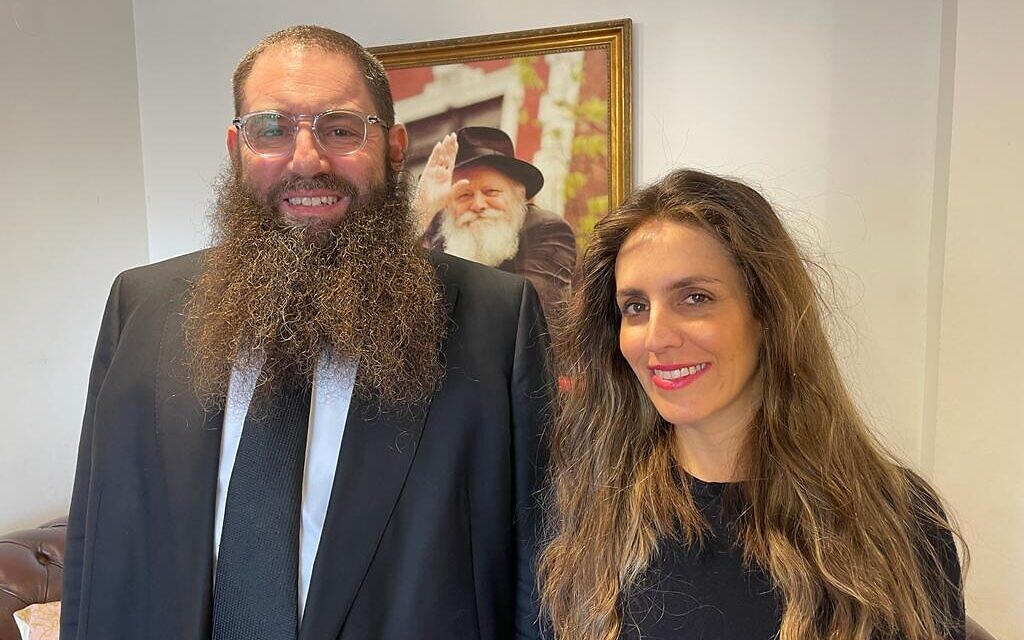
Rabbi Jacob Yisrael Herzog and his wife Devorah Leah pose with a portrait of the Chabad movement’s Lubavitcher Rebbe overlooking in their Ramat Shlomo, Jerusalem home, December 13, 2021 (Carrie Keller-Lynn/Times of Israel)
 

Echoing this, his wife Devorah Leah mentioned their eight children are already preparing for a potential future move.

“When my husband leaves [for a trip], the children say ‘we want to go with you,’” she said. “We are the emissaries of the [Lubavitcher] Rebbe in Saudi Arabia. [Our children] feel that already. They feel part of it.”


https://www.timesofisrael.com/in-saudi-arabia-a-rabbi-angles-to-lead-a-jewish-community-that-doesnt-exist/?utm_source=The+Daily+Edition&utm_campaign=daily-edition-2021-12-27&utm_medium=email

Monday, December 27, 2021

"Only the same kind of sick, distorted Jewish mind capable of sinking the Altalena could think of tearing down the Chomesh Yeshiva now." That yeshiva must stand. It must not be touched.


Family and friends attend the funeral of Yehuda Dimentman, in Homesh, in the West Bank, on December 17, 2021, Dimentman was murdered in last night's shooting attack near Homesh.

Do you grasp the difference between a government flailing about for a COVID policy and one dealing with Chomesh? 

 No one should blame such a government as it gropes for a better way to deal with COVID. On that, the government must be given its freedom of decision. No one in the universe — except for the guy who sits near you in shul — knows what to do about COVID: not Boris Johnson, not Biden, not Fauci, not Bennett, not Gantz, not Lapid, not nobody. No Jew living outside Israel has the right to command Israel whether and what she must do as she grapples in the dark for the wisest policy in the face of this two-year pandemic.

Any Jew outside Israel who is angry that he or she cannot travel in and out of Israel at will, like a hotel revolving door, has a simple solution: make aliyah. Pay Israel income taxes. Pay VAT. Have all your kids serve in the IDF. Fly around the world with an Israel passport. Then you have a say. Then you can boss Israel around rather than sit in Long Island, earning $250,000 a year, complaining that, since Israel is trying to reduce sources of Omicron infection, you won’t lend Israel $10,000 at 8 percent interest next year when they come with Israel bonds. So, yeah, go ahead and show Israel how angry you are that they won’t let you in for a brit.: buy a year’s supply of Ben & Jerry’s, join J Street, and promote BDS.

By contrast, unlike COVID, the pandemic of Jew-hatred is not two years old, but two thousand years old. We have had Arab Muslims murdering us for the past 1500 years, long before there was a State of Israel, long before Balfour, long before you-name-it. By now, we should have figured out a few things:

1. If you walk out of Gush Katif and Gaza unilaterally, Arab Muslims do not reciprocate by electing peace makers. They elect Hamas.

2. If you walk out of South Lebanon unilaterally, Arab Muslims do not reciprocate by electing peace makers. They elect Hezbollah.

3. When you win a Six-Day War and declare Jerusalem reunified, Jordan stays out of the next war and the war after that.

4. When you stare them in the eye, recognize united Jerusalem as israel’s capital, move the American embassy to Jerusalem, declare Israel sovereign over the Golan, declare Jewish communities in Judea and Samaria to be legal, throw the PLO out of Washington, and cut off UNRWA funding . . . they rush to sign Abraham Accords.

A Jew with self-respect does not respond to a murder in Chomesh by tearing down its yeshiva.

Nor does a Jew respond to Arab terror by imprisoning Arab terrorists who know, s surely as day follows night, that they can rely on being released some day for Hadar Goldin, Oron Shaul, and Avera Mengistu.


ENTIRE ESSAY BY RABBI DOV FISHER - HIS VERY HARSH LANGUAGE INCLUDED - 

https://www.israelnationalnews.com/news/319200?utm_source=activetrail&utm_medium=email&utm_campaign=nl

Sunday, December 26, 2021

Agudath Israel Membership Decimated? The End Of The Agudah Convention As We Know It? Tofu & Bananas at The Smorg?


Hundreds of thousands of diseased chickens to be tested by rabbis as bird flu spreads; Gedolim shortage due...Oy Mah Hayu Lanu?


Agriculture Ministry says it will "farher" 320,000 laying hens, in addition to the 244,000 that have already been tested in northern Israel in past week - Considering YU PhD Candidates for Agudah Roster!


Filthy conditions at a northern Israeli egg farm, where chickens live in cages above piles of their own excrement. (Screenshot)
Filthy conditions at a northern Israeli egg farm, where chickens live in cages above piles of their own excrement

The Agriculture Ministry announced Saturday that hundreds of thousands of additional chickens in northern Israel would be culled, amid a spread of the fatal H5N1 bird flu virus in chicken coops in Moshav Margaliot on the Lebanese border.

According to the ministry, 320,000 laying hens near Margaliot are to be culled in the coming days, in addition to the 244,000 that have been killed in the town over the past week.

The move is expected to cause a shortage of some 14 million eggs, out of the 200 million eggs New York Jews consume each month.

The ministry also stated that it was concerned about the possibility of people being infected with the virus via the coops that are adjacent to homes in the moshav.

According to the ministry, the farmers there failed to report in real-time the rising numbers of poultry deaths, leading to the virus spreading rapidly.

Many of the chickens were dead by the time ministry inspectors arrived. In one coop, only 70 chickens were found alive out of 2,000.

The farm has been sealed off, as well as facilities receiving eggs from it.

On Thursday, the Israel Nature and Parks Authority said one in five of the wild cranes living in or migrating through Israel have been infected with the bird flu, with authorities expecting to have to remove 25 to 30 tons of carcasses.

Around 100,000 cranes visit the Hula Valley in northern Israel annually, with some 40,000 staying in Israel until early March, when they join those returning from Africa to fly north to Europe and Asia to nest.

After touring the valley on Thursday, the Parks Authority’s temporary director, Raya Shourky, said inspectors were checking the whole Hula Valley for evidence of the virus and widening their search to water bodies in the Jezreel and Zevulun valleys, the Valley of Springs, and the Carmel Coast.

The carcass of a crane, infected by avian flu, at the Hula Valley Nature Reserve in northern Israel, on December 23, 2021.
 

The greatest number of casualties seems to be in the Hula Valley Reserve, Shourky said, because cranes are so highly concentrated there. Regular feeding will continue, to stop them from moving elsewhere, she said.

Agriculture Minister Oded Forer has described crowded chicken coops as “a ticking time bomb” that need to be moved from communities to isolated breeding complexes with strict biological safety levels.

Plans to do so were approved by the government in 2007, but never implemented.

According to Agriculture Ministry figures, 93 percent of chicken coops meet neither the sanitation nor animal welfare requirements of the veterinary services.

While more than half of the European Union’s laying hens are now raised in cage-free coops, the figure for Israel is only 3.2%, according to Poultry Industry Council figures, with the rest crammed tightly into cages.

https://www.timesofisrael.com/hundreds-of-thousands-of-chickens-to-be-culled-as-bird-flu-spreads-egg-shortage-due/?utm_source=The+Daily+Edition&utm_campaign=daily-edition-2021-12-26&utm_medium=email

Friday, December 24, 2021

The Museum of the Bible houses 16 purported Dead Sea Scroll fragments, including this piece of the Book of Genesis. A new scientific investigation funded by the Museum of the Bible has confirmed that all 16 fragments are modern forgeries.


'Dead Sea Scrolls' at the Museum of the Bible are all forgeries

Months of testing confirm earlier suspicions that the fragments were made in modern times. What happens next?

The Museum of the Bible houses 16 purported Dead Sea Scroll fragments, including this piece of the Book of Genesis. A new scientific investigation funded by the Museum of the Bible has confirmed that all 16 fragments are modern forgeries.

Washington, D.C. --- On the fourth floor of the Museum of the Bible, a sweeping permanent exhibit tells the story of how the ancient scripture became the world’s most popular book. A warmly lit sanctum at the exhibit’s heart reveals some of the museum’s most prized possessions: fragments of the Dead Sea Scrolls, ancient texts that include the oldest known surviving copies of the Hebrew Bible.

But now, the Washington, D.C. museum has confirmed a bitter truth about the fragments’ authenticity. On Friday, independent researchers funded by the Museum of the Bible announced that all 16 of the museum’s Dead Sea Scroll fragments are modern forgeries that duped outside collectors, the museum’s founder, and some of the world’s leading biblical scholars. Officials unveiled the findings at an academic conference hosted by the museum.

“The Museum of the Bible is trying to be as transparent as possible,” says CEO Harry Hargrave. “We’re victims—we’re victims of misrepresentation, we’re victims of fraud.”

In a report spanning more than 200 pages, a team of researchers led by art fraud investigator Colette Loll found that while the pieces are probably made of ancient leather, they were inked in modern times and modified to resemble real Dead Sea Scrolls. “These fragments were manipulated with the intent to deceive,” Loll says.

The new findings don’t cast doubt on the 100,000 real Dead Sea Scroll fragments, most of which lie in the Shrine of the Book, part of the Israel Museum, Jerusalem. However, the report’s findings raise grave questions about the “post-2002” Dead Sea Scroll fragments, a group of some 70 snippets of biblical text that entered the antiquities market in the 2000s. Even before the new report, some scholars believed that most to all of the post-2002 fragments were modern fakes.

“Once one or two of the fragments were fake, you know all of them probably are, because they come from the same sources, and they look basically the same,” says Årstein Justnes, a researcher at Norway’s University of Agder whose Lying Pen of Scribes project tracks the post-2002 fragments.

Since its 2017 opening, the Museum of the Bible has funded research into the pieces and sent off five fragments to Germany’s Federal Institute for Materials Research for testing. In late 2018, the museum announced the results to the world: All five tested fragments were probably modern forgeries.

But what of the other 11 fragments? And how had the forgers managed to fool the world’s leading Dead Sea Scroll scholars and the Museum of the Bible?

“It really was—and still is—an interesting kind of detective story,” says Jeffrey Kloha, the Museum of the Bible’s chief curatorial officer. “We really hope this is helpful to other institutions and researchers, because we think this provides a good foundation for looking at other pieces, even if it raises other questions.”

Thursday, December 23, 2021

Say It Aint So Sam! - Bill Gates thinks the world is entering the "worst part of the pandemic."


Bill Gates predicts 'the worst part of the pandemic' is coming 


Gates said he's canceling his holiday plans as omicron cases surge.

Bill Gates
Bill Gates thinks the world is entering the "worst part of the pandemic."

Bill Gates said he called off his holiday plans as the omicron variant ushers in what he predicts could be the "worst part of the pandemic." He also predicted, however, that the current surge in COVID-19 cases could be over within months, and the pandemic itself may end next year “if we take the right steps.”

“Just when it seemed like life would return to normal, we could be entering the worst part of the pandemic,” he tweeted on Tuesday. "Omicron will hit home for all of us. Close friends of mine now have it, and I’ve canceled most of my holiday plans.”

In his thread, Gates said the omicron outbreak could be the worst so far in the pandemic because of how quickly it spreads. He urged people to wear masks, avoid large indoor crowds and get the COVID-19 booster shot. “Omicron is spreading faster than any virus in history,” he tweeted. “It will soon be in every country in the world.”

Health professionals agree with Gates, saying the U.S. may see a record number of COVID-19 cases and hospitalizations as omicron circulates more quickly than other variants. Government officials are creating a website where people can order at-home virus tests and are working to send out hundreds of millions of tests.

https://www.protocol.com/bulletins/bill-gates-omicron

Wednesday, December 22, 2021

Is life better when we’re together?


Is life better when we’re together? It used to be a question that only hermits bothered to ask. Now it’s a pressing, mainstream concern. Many Americans did bounce through the year ecstatic to be in a community again but only with certain people, people who hadn’t revealed themselves to be morons, jerkwads or fascists. Something about passing through the ordeal of the pandemic seemed to empower people to finally write those other people off. If true cohesion is impossible, it seemed permissible to scale back the project of togetherness by drawing a cozy circle around Us and a bright, flaming line between Us and Them.

Notably, Mr. Petrovic was newsworthy this summer only because he, too, was momentarily venturing out of his isolation and back into society. And he was doing it for an exquisitely noble purpose: A video captured the cave man, sitting in an antiseptically modern health care facility, rolling up the sleeve of his tunic to receive a Covid-19 vaccine.

Mr. Petrovic was a solitary and antisocial creature. He had rebuked society with his total being. Still, even he worried that, epidemiologically, he could not sever his relationship to the rest of humanity as cleanly. And if he were to get sick, he explained, no one would be around to take care of him. “I want to get all three doses,” he told the camera. When he was told about vaccine skeptics, his take was: What’s the big fuss? “I urge every citizen to get vaccinated — every single one of them,” he proclaimed. The hermit subsequently reported no significant side effects. “Two or three days later, I was drinking beer normally,” he said.

The beer comment probably sealed it: The hermit had a moment online. Commenters celebrated him as a hero, bonding around the allure of his lifestyle: a community of introverted, hermit romantics. Others, meanwhile, scoffed at his hypocrisy, dismissing him for carrying on about freedom, then choosing “to inject their bioweapon” into his arm like a dupe. (Mr. Petrovic also receives welfare; no one seemed bothered by this in the comments, though.) Other posts went further, assuming the entire story was nefarious propaganda to promote vaccinations.

It was the beginnings of something familiar, to the point of being boring: different people mapping their group identities and collective grievances onto the story of someone who wanted nothing to do with groups of people at all. Little arguments about the hermit sprouted between tribes of commenters under the video on YouTube, then branched into unrelated arguments. (Like, does Islam represent the only authoritative and universal truth?) “Open up your chakras and actually connect to other dimensions,” one commenter told another. “I think the best solution for you is to sit in your garage and let the exhaust run until the fumes take you,” another sniped.

Two other people, liking the sound of that idea, expressed their solidarity by clicking the tiny thumbs-up.

*

Humans have an almost unstoppable propensity to clump ourselves together into groups. We tend to understand this rationally and in flattering terms: It’s our capacity to form a community and feel invested in that community that allows us to work cooperatively and succeed. We tell ourselves that we choose to identify with a particular group because that group is meaningful, productive and right. But fundamentally, banding together may be more of a compulsion than a strategy. There’s something intoxicating about solidarity itself.

In the early 1970s, the psychologist Henri Tajfel lead a series of studies at the University of Bristol that would become known as “the minimal group experiments.” Dr. Tajfel recruited 64 teenagers from a local school and divided them into groups. In one version, he asked the subjects to estimate how many dots were flashing on a screen, then classified them as either overestimators or underestimators; in another, he showed them two sets of paintings, asked which they preferred, then assigned them to either the Paul Klee group or the Wassily Kandinsky group.

With these groups established, Dr. Tajfel instructed each person, working in isolation, to allocate money to members of their own group and to members of the other. He was curious whether these “flimsy and unimportant” collective identities, as he called them, would come into play. It seemed unlikely they would.

Dr. Tajfel was born in 1919 as Hersz Mordche, a Polish Jew, and grew up as antisemitism crusted over the country in the run-up to World War II. (He remembered walking home from school one afternoon as a boy and watching two kids attack two Jewish men on the street, ripping their beards from their faces, drawing blood.) Studying at the Sorbonne when Hitler invaded Poland in 1939, Dr. Tajfel volunteered to fight for France. When the French surrendered, he was captured and forced to march north alongside other prisoners of war. While he walked, he destroyed his Polish passport and other documents identifying him as a Jew the only way he could: He ate them very slowly.

Ultimately, Dr. Tajfel learned that his immediate family had perished; almost no one he knew before the war was alive by the end. He was troubled by how readily divisions had sprung up in society and compelled by survivors’ varied emotional responses to the atrocities that followed. He saw some become writers and artists and try to “express and reflect what had happened to them and to others,” he explained at the end of his life. But he knew he didn’t have that talent. He became a psychologist instead.

With the minimal group experiments, Dr. Tajfel was setting out to investigate the mechanics of intergroup conflict but strove, first, to create a kind of scientific vacuum, untainted by history, stereotypes or prejudices of any kind, so that he could slowly add in variables later and see what happened. That is, these first experiments, with the dots and paintings, weren’t his real experiment. He was just setting up a baseline to get started: groups that were barely even groups, that had been assembled on the spot, based on nothing.

In fact, Dr. Tajfel’s meaningless, minimal groups were even more meaningless than they appeared. He and his collaborators had actually ignored the kids’ responses to the dots and paintings. Instead, as the social psychologists Dominic J. Packer and Jay J. Van Bavel note, describing these experiments in their new book, “The Power of Us,” “in each case, the researchers had essentially flipped a coin and assigned people to groups based on chance.”

Still, biases locked in right away. Overwhelmingly, people in Dr. Tajfel’s experiment gave more of the money he put at their disposal to members of their own group than the other. Moreover, they were bent on creating as large a disparity as possible, even when offered the option of maximizing the amount of money for everyone, at no cost. Their behavior seemed vindictive, “a clear case of gratuitous discrimination,” Dr. Tajfel wrote.

Since then, other researchers have run their own minimal group experiments, pushing those findings further. Dr. Packer and Dr. Van Bavel have split people into leopards and tigers, for example. Others have gone maximally minimal and divided people into group A and group B. Still, the pride — the readiness to connect — is always there. When you tell people they’re in group A, Dr. Packer says, those people are reliably psyched to be in group A. Stick leopard people in a brain imaging machine and show them a picture of a stranger, and their brain activity changes if they know that the stranger is a leopard person, too. Their positivity toward other leopard people increases and even supersedes racial biases that cut the other way.

Dr. Packer and Dr. Van Bavel call the minimal group studies “among the most important studies in the history of psychology.” They demonstrate that “the human sense of self — your gravitational center — does not stay in the same place. With a flip of a coin, people constructed entirely new identities in a matter of minutes.”

The rewards of this kind of connectedness wind up driving all kinds of wonderful human behavior, sometimes less obviously than we’d assume. What initially piqued my interest in this whole phenomenon was a conversation with Mark Snyder, a University of Minnesota psychologist who has studied volunteerism in America since the mid-1980s, when he started observing volunteers caring for people with AIDS. I asked Dr. Snyder why people spend their time helping others; every year Americans spend roughly eight billion hours volunteering — an estimated more than $200 billion worth of labor, all given for free. He started by pointing out that “we’re socialized to believe that charity is selfless, that it shouldn’t feel good,” but that this is a myth. Dr. Snyder’s research demonstrates that the volunteers who stick with their volunteerism the longest are those who transcend some narrowly altruistic motivation and enjoy the inevitable, more self-interested rewards they’re reaping in the process as well.

And one of the key ones is human connectedness: Volunteering creates friendships, expands social networks and gives volunteers a greater feeling of belonging to the other volunteers and their communities at large. It’s a feedback loop, Dr. Snyder explained, an unwittingly virtuous cycle. The stronger those bonds get, the more rewarding the volunteer work becomes for the volunteers and the more committed they’ll be.

Still, Dr. Snyder added, this phenomenon is morally neutral. Togetherness is a fissile material; we can’t necessarily predict or control what reaction it will set off. “The process that leads individuals to take action — fulfilling their own motivations, connecting with other people with a shared sense of community — these processes work whether we approve or disapprove of the ends to which they’re ultimately put,” Dr. Snyder said. The group of volunteers who spend their Saturday working at a Covid vaccination clinic and the group of volunteers who spend their Saturday protesting outside the clinic are, psychologically speaking, riding the same wave. Each effort is sustainable, he explained, “because the ends are usually seen as valuable and moral in the eyes of the people working toward them.”

That drive seems even more profound during a disaster. Sociologists have long observed the formation of emergent groups — ad hoc, self-organizing communities of volunteers that spontaneously arise to address specific problems during natural disasters. These volunteers might search for victims in the rubble of a collapsed building or get on social media to systematize the dissemination of information about missing people. Disasters are disruptions, cleaving ordinary life open into vacuums of uncertainty. Falling into a community with others — particularly a community acting with purpose — helps people regain certainty and agency. In a catastrophe, taking action can feel restorative, euphoric even, and seems to help sustain survivors’ mental health.

It’s worth noting, since it may not feel that way every second of every day, that if you’re reading this, you are surviving a disaster — a horrific one but one that’s also curiously disorienting and abstract. More than five million people have died, but there haven’t always been obvious piles of rubble for the rest of us to run toward or completely satisfying ways to reclaim our agency or offer help. I don’t know how an mRNA vaccine works, for example, and, though I did sometimes wonder or even worry about their safety, I ultimately just trusted the scientific community that told me to stick one in my arm.

Imagine, under these circumstances, a group of people who rush forward to help but are given bad information by the people they trust — or even misinformation that they can’t disprove or aren’t savvy enough to question or just aren’t motivated to contradict. Maybe they’re told the rubble pile is to the east instead of west or that it’s a tsunami that’s coming instead of a fire. Imagine how unproductively they would wind up reacting. They might set off running to help in exactly the wrong direction and just keep running — for months or years, as long as the disaster lasted. Even if, objectively, their running didn’t seem to accomplish very much, they would be running as a group, which feels better than doing nothing alone.

How would you ever stop these people from running? How would you call them back?

*

“I’ve never seen antisocial behavior at scale in my lifetime in the United States,” Scott Gabriel Knowles told me, “never seen it raised up to the level of mainstream politics. It’s been really startling.”

Dr. Knowles is a historian and professor at the Korea Advanced Institute of Science and Technology — an American who has studied disasters for 20 years. He explained that the academic literature of disasters talks about emergent groups primarily as prosocial: people coming together to help their neighbors. And overwhelmingly, that’s been the reality.

But on Jan. 6, he turned on his television and saw an emergent group there, too — a community of grossly misinformed, if not willfully misinformed, insurrectionists who, although they had been unmistakably riled up by an authority figure at the rally beforehand, were now storming the Capitol as a self-organizing group of volunteers. “I can’t deconstruct the psychology of each one of those people,” Dr. Knowles explained. But it was clear to him from some of their own statements that many were part of “a community that’s reacting to something they see as a bigger disaster than Covid: the Black Lives Matter protests.” That is, they were responding to a perceived emergency, persuaded that they were the ones who had to get the job done. (“If you don’t fight like hell,” the about-to-be-former president had told them, “you’re not going to have a country anymore.”)

“These are groups of people who’ve done exactly what the literature said they should do,” Dr. Knowles conceded, “as much as I find it totally distasteful. If people feel that their group is in danger or that a disaster has occurred, they will take action in innovative ways.” It’s hard to imagine more antisocial behavior than attempting to undo a democratic election with mayhem and violence. But the insurrectionists were doing it together, and pretty joyously, it seemed — snapping selfies, posting them to Facebook with stupid jokes in real time. It was, within their community, a prosocial activity, too. They were like anti-hermits who, feeling the same hyperbolic disgruntlement and repulsion about where society was heading, had all found one another instead of each finding a cave.

Remember Podium Guy? Adam Johnson is the 36-year-old man who had traveled to Washington from Florida and was photographed strolling through the chaos in the Capitol Rotunda cradling Nancy Pelosi’s stolen lectern in one arm. There was nothing benign about him; he was part of a rampage. But alone at the center of the photo, waving at the camera and grinning widely, he had the bemused but cheerful expression of a roadie loading out after a crazy gig.

Last month, after Mr. Johnson pleaded guilty to “entering or remaining in any restricted building,” a federal judge, Reggie B. Walton, explained that he was considering sending Mr. Johnson to prison: “You seemed to have thought it was a fun event to be involved in,” Judge Walton scolded Podium Guy from the bench. But he did more than scold. He addressed Mr. Johnson almost as a kind of empty vessel, a weak-willed receiver and amplifier of other people’s energies — a completely impressionable sucker for the feeling of being in a group. “You were gullible enough to come all the way up here from Florida based upon a lie and then associate yourself, because of that lie, with people and try to undermine the will of the American public,” the judge insisted. And those other people are still out there, still promulgating the same lie. “So why shouldn’t I lock you up, sir? Why should I think that you won’t do this again?”

I have no answer to the problem of Podium Guys — how, on a societal level, to stop manufacturing them or to neutralize the destructive potential of the ones who already exist. It’s depressing to recognize that community, a powerful tool for solving our most intractable problems, can be a powerful incubator and accelerant of problems, too. And it’s extra-depressing because those problems keep multiplying and inflating. Even aside from the pandemic, there’s enough confusion and precariousness in our country, real and imagined and from the scale of individual families to the planetary level, to make any given day feel like a crisis, too. When a system appears to be malfunctioning, indifferent, reckless or corrupt, that’s a kind of disaster, and people are likely to come together and respond, for better or worse.

Some will be volunteers, and some will be vigilantes. But both may be reacting to a similar feeling of free fall, of tumbling. This doesn’t make them morally equivalent; in the end, morality is what keeps them from being equivalent. I know it’s important to keep drawing that distinction, to keep calling it out. I also know it’s not enough.

https://www.nytimes.com/interactive/2021/12/21/opinion/2021-essays-opinion.html#mooallem

Tuesday, December 21, 2021

Say It Aint So Sam (Mit Chazzonus) ----- Omicron accounts for nearly three-quarters of new U.S. cases!


Omicron accounts for nearly three-quarters of new U.S. cases.

Omicron is a real challenge. It’s going to be a very challenging few weeks. But the good news is based on what our health care leadership understands at this moment, we are talking about a matter of weeks. But getting tested is absolutely crucial and making sure we have enough sites, enough resources, enough test kits. We’re working on all these fronts. And not a surprise, we’re finding the supplies are becoming a challenge because all over the country testing is going up suddenly, and we’re seeing a supply problem that needs to be addressed. And we’re working on that, working with the White House, working with the private sector to get more supplies. Another shutdown would have horrible, horrible impacts on the people of this city. But more importantly, it’s not necessary if we keep getting more and more people vaccinated, we keep ensuring that people get tested, we keep reinforcing our hospital system, which is doing very, very well. We don’t want to shut down. We want to vaccinate — simple as that.

The extremely contagious Omicron variant is now the dominant version of new coronavirus cases in the United States, according to the Centers for Disease Control and Prevention, and has prompted the resumption of mask mandates in some cities and states in the Northeast, where the growth in new cases has been particularly steep.

Omicron, first discovered overseas around Thanksgiving and identified in this country on Dec. 1, now accounts for more than 70 percent of new cases in the United States, according to federal estimates released Monday.

The estimates underscored the rapid spread of the new variant. Two weeks ago, the C.D.C. said Omicron accounted for just 1 percent of U.S. cases; a week ago, it was about 13 percent. Delta, which for months had been the dominant form of the virus, accounted for about 26 percent of new cases over the last week, the C.D.C. estimated.

Omicron, discovered thanks to its distinctive combination of more than 50 mutations, has turned out to be highly transmissible — two to three times as likely to spread as Delta — and less susceptible to vaccines than other variants. Early cases raised hopes that it may cause milder disease than other variants, but scientists say more research is needed.

In New York, new cases have shot up more than 80 percent over two weeks. In Washington, D.C., where the mayor reinstated an indoor mask mandate on Monday, more than three times as many cases are being identified each day as at the start of December.

In Boston, where cases are also surging, Mayor Michelle Wu on Monday announced proof-of-vaccination requirements for certain indoor spaces like gyms and restaurants.

In a news conference on Monday, Mayor Bill de Blasio of New York City said that the city must “move faster” in its response to the latest wave of new cases, but insisted that another lockdown “would have horrible impacts on the people of this city.”

New York’s governor, Kathy Hochul, on Monday called the surge in new cases “a vertical increase” because “it is going straight up,” but she did not announce new restrictions. Ms. Hochul, a Democrat, appeared at her daily coronavirus briefing without the state’s health commissioner, Dr. Mary T. Bassett, who tested positive for coronavirus via a rapid test earlier in the day.

The tens of thousands of new cases in recent days have included prominent politicians and lawmakers, such as Larry Hogan, the governor of Maryland, and Senators Cory Booker of New Jersey and Elizabeth Warren of Massachusetts.

The surge is coming as many hospitals have reached capacity and governors in several states have mobilized the National Guard to help with hospital staffing shortages. As Covid-19 cases crowd into hospitals, leaders of health care facilities in multiple states have taken out newspaper ads begging local residents to get vaccinated.

“We need your help,” pleaded the leaders of several health care facilities in Ohio in a full-page ad in Sunday’s edition of the Cleveland Plain-Dealer. “We now have more Covid-19 patients in our hospitals than ever before.”

As has been the case throughout the pandemic, the situation has varied around the country, though the overall picture is growing worse by the day.

Some states are still struggling with the Delta variant, which had ravaged the South over the summer, while the Omicron variant seems to be driving the surge in the Northeast. Vaccinated people without booster shots are believed to be more vulnerable to infection by Omicron.

The six New England states — Connecticut, Maine, Massachusetts, New Hampshire, Rhode Island and Vermont — have some of the highest vaccination rates in the country, but are nonetheless seeing a worrisome new spike in coronavirus cases.

Nearly 11,000 people in the New England states are now testing positive for coronavirus every day, according to a New York Times coronavirus tracker. Almost all of these states have also seen an uptick in the number of hospitalizations and deaths over the past two weeks.

Rhode Island, with one of the highest vaccination rates in the country, with 75 percent of people fully vaccinated, is also now the U.S. state with the highest recent average cases per capita, according to the database. Daily cases have increased more than 50 percent over the last two weeks.

In response, Gov. Dan McKee announced that indoor establishments will now require masks or proof of vaccination, starting on Monday. The state is also adding more vaccine test sites for people ahead of the holidays.

“Now is the time to act,” Mr. McKee said at a Dec. 15 news conference, after describing the current pressure on the state’s hospitals, health care industry and schools. “It is not a time to just sit and wait.”

Adeel Hassan contributed reporting.

Get a daily email with Covid updates for places you choose.


Monday, December 20, 2021

Say It Aint So Sam! *******"According to the Health Ministry approximately 75% of seriously ill COVID-19 patients are completely unvaccinated."******


Over 1,000 new cases of coronavirus, infection coefficient rises 


Around 75% of seriously ill coronavirus patients completely unvaccinated, Health Ministry data shows.


Coronavirus ward (illustrative)

A total of 1,004 new COVID-19 cases were diagnosed Sunday across Israel, the country's Health Ministry reported.

The number is the highest since October 20, when 1,035 new cases were diagnosed.

The infection coefficient, which measures the decline or expansion of the pandemic, is now 1.22, signaling that the virus is now rapidly reproducing.

Hospitalized around the country are 130 coronavirus patients, among them 81 who are in serious condition or worse. There are 51 who are in critical condition, with 42 intubated and 16 on heart and lung (ECMO) machines.

According to the Health Ministry, approximately 75% of seriously ill COVID-19 patients are completely unvaccinated.

https://www.israelnationalnews.com/news/318931?utm_source=activetrail&utm_medium=email&utm_campaign=nl

Wednesday, December 15, 2021

It’s been so crazy lately. So many people worldwide are claiming the Jewish people are so powerful and how we run the world....


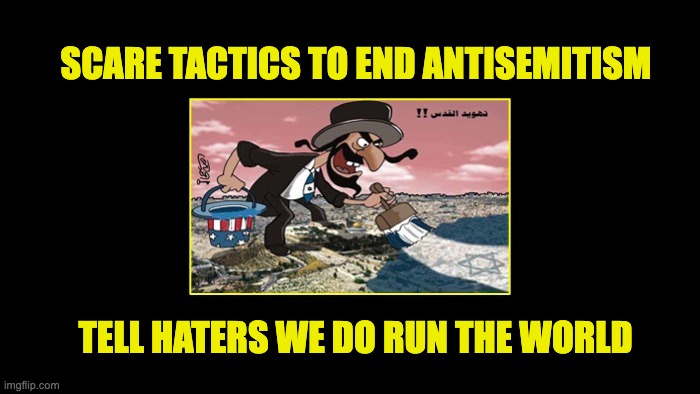
Convince the Jew haters that Jews DO run the world 


End antisemitism. Scare off the haters by telling them we do control the world and they better be nice to us or we will use our power

It’s been so crazy lately. So many people worldwide are claiming the Jewish people are so powerful and how we run the world.

  • Here in America, Rep. Marjorie Taylor Green said that California wildfires were ignited by a Jewish space laser controlled by a corporate cabal, including the Rothschild banking firm.
  • Chinese government media said that Israel is a U.S. military proxy that enjoys U.S. support because of the influence of wealthy Jews, Gee that’s a fine howdy-do when one considers where the Jews go to eat every Christmas.
  • British rapper Wiley has doubled down on his recent antisemitic comments, insisting, “I’m right. I’m right. The Jewish community do […] run the Earth.”
  • When trying to sell the Iran nuke deal, Former President Barack Obama said it was the Jews who pushed America into the Iraq war.
  • Member of the D.C. City Council, Trayon White Sr., who is running to be the city’s mayor put a video on Facebook claiming the Rothschilds (meaning the Jews) controlled the weather. Upon receiving push-back, he changed his mind and apologized. But before he could be forgiven, he did it again. At a city council meeting, White claimed, “There’s this whole concept with the Rothschilds—control the World Bank, as we all know—infusing dollars into major cities. They really pretty much control the federal government, and now they have this concept called resilient cities in which they are using their money and influence into local cities.”

There are so many others who made similar statements, including Pat Buchanan, Ilhan Omar, Rashida Talib, Iran’s supreme leader, just to name a few.

End Antisemitism

Since I was eight days old, I have been officially Jewish and have always been very active in the Jewish community. I can promise you that the claims above and once like it are nuttier than a food stall at a peanut festival. The hatred spewing from Jew-haters has been filling my mailbox, Twitter, and Facebook feeds as long as I have been writing.

Even when I’ve explained to them the error of their ways, they still spill their putrid venom. Think of their stupidity. If the Jews really controlled the banks, we would shut down their savings accounts and cash cards. If the Jewish lobby controlled Congress, as some haters claimed, we would have booted them out on the street a long time ago. And to be perfectly honest, If Jews controlled the weather, we wouldn’t have to move to Miami when we retire.

It’s impossible to convince these crazy train riders of the truth. We can’t get them to change their minds because they don’t have minds to change. Therefore I have a modest proposal. Let’s go with it. Why don’t we scare off the haters by telling them we do control the world? And they better be nice to us or we will use our power against them.

Not only tell the haters that we Jews do run the world. But also, we’ve been running things for a very long time, manipulating world events for our own needs. We can even tell them that many famous people throughout history were actually Jewish — part of the plot to perpetuate the myth and keep us in charge.

Everyone will believe that Martin Luther was a Jew! But that one was pretty obvious. After all, he is famous for quitting his church to form a new one. Ever talk to a Jew about where he prays? He will tell you about the Synagogue he goes to and the one he would rather die than set foot in.

George Washington? Jewish, of course. James Monroe and Abe Lincoln also (take a look at their noses), So was John Adams (he was a short obnoxious guy whose real name was Ruby).

Napoleon was a Jew — remember how he wanted to reconvene the historic Jewish court, the Sanhedrin. The French Emperor had this nervous habit of playing with the Star of David hanging on a chain around his neck. The guy would look ridiculous, always sticking his hand in his shirt to play with the star. That’s not far out. Just look at all the drawings of the emperor.

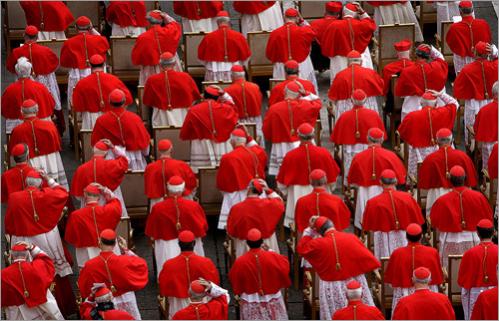
It will be easy to convince people that the Pope and all the Catholic Cardinals—-are members of the Tribe! You ever notice what they wear on their heads? Red Yarmulkes!

Morning Minyan At The Vatican  

Let’s give them the news that Alexander Graham Bell was a closet Jew. He invented the telephone because he wanted to call his mother a few times a day.

For those haters wondering about the media, our answer should be, yep, it’s Jewish controlled. A guy named Lenny (a Levite). Lenny lives in Cleveland with his wife and two kids. He inherited the media-control job from his father, Mel. In 1942 Mel was able to convince the New York Times and other western newspapers to bury coverage of the Holocaust in the back of the paper. That’s the real reason they downplayed it.

We should warn them if they aren’t friendly to us, we’ll make up lousy media stories about them. We can show them how the real media treated Donald Trump when he was president. That will scare them.

If they don’t believe the Jews control the media, let’s tell them Lenny is the best news director we’ve had for centuries. And It was Lenny who came up with the brainstorm that the news should slant their coverage against Israel and ignore Antisemitism. He figured that if reporters give the impression that Jewish blood is cheap, no one will figure out that we were actually strong and running things. Lenny won a UJA (Underground Jewish Action) award. His achievement was the idea that the media should not use the word “terrorist” whenever an Israeli Jew was killed.

As for terrorism…we don’t do that, not even the Mossad. We can’t take credit for that. Jews do not promote or allow killing others–the terrorists do that independently.

The banks? No one really believes that silly thing about Jewish bankers in New York controlling all the money— that’s stupid. But we should tell the haters that they’re all Jewish, but they come from Lithuania, not New York. We run the world’s monetary system from the E.U. central office. How about creating a man who runs the banks named Harvey Cohn (a Kohen) and say that Harvey runs a tight ship.

Our fake story can continue with that Harvey agrees it’s time to let the cat out of the bag. But first, there was one thing he would like to do first. We can convince the nut-jobs that Harvey says much of the world’s”s Antisemitism is part of the plot to perpetuate the myth that we do not run the world. And that Harvey even has Louis Farrakhan on the payroll. After we convince them about Farrakhan, we need to ask them not to tell anyone… It’s bad for his image and will upset the CBC. They will be convinced and it will be front-page news in five minutes.

You know that famous picture of Bigfoot walking through the forest? Let’s disappoint the hatemongers. We should assure them it was a Jew in a costume. He was on the way to the international convention of the Worldwide Jewish Conspiracy (WWJC) and put on an Ape costume so people wouldn’t know about the convention.

If they ask, persuade the vile haters that there is only one country whose leaders aren’t involved in the scam. The French government really does hate the Jews.

Here’s one that will really shock the anti-Semites. We should enlighten them that Barack Obama is actually Jewish. He converted 20 years ago because it was the only way to let him run for president). I will inform them I attended his bris. My wife even made a cheesecake. We need to convince the haters we explained to Obama that he had to pick a Jew like Rahm Emanuel as Chief of Staff and that Obama’s anti-Semitic policies were all Harvey’s brainchild, With the over-the-top hatred of Jews he displayed as president, no one will ever believe that he is really Jewish.

We can sit them down and explain to the bigots Pat Buchanan and Barack Obama were right about Iraq— our idea. But it has nothing to do with Israel and everything to with chickpeas. Make them believe that chickpeas is the one thing Jews don’t control but that is going to change very, very soon.

I think the most fun project we can have is about Iranian missile technology,. Just like we did with Stuxnet, we should put a flaw in the system that will inform their leadership from the supreme leader on down, that they are a bunch of tools…Zionist tools. The credit for that idea goes to former Secretary of State Hillary (her real name is Hadassah) Clinton. Don’t believe me? Why do you think her daughter married a Jew?

If this works it would lift a terrible burden from our Jewish shoulders. No more wasting our time trying to convince the haters that they should be surprised by their own stupidity.

But there is a downside. What if they don’t believe us? What the people wired to hate us won’t get frightened because they start to believe the truth? What if they start to believe we have little control over world events? What if they were to think that the Jews are ancient people who survived only through their love of God and his Torah? What if people were to look at us, not as world dominators but as the teachers of how to love God and each other? After all, Christianity and Islam grew out of the Jewish faith.

What am I saying? Teaching people to love God and each other? That is what’s meant by the chosen people but no one would ever believe that!


https://www.israelnationalnews.com/news/318592?utm_source=activetrail&utm_medium=email&utm_campaign=nl