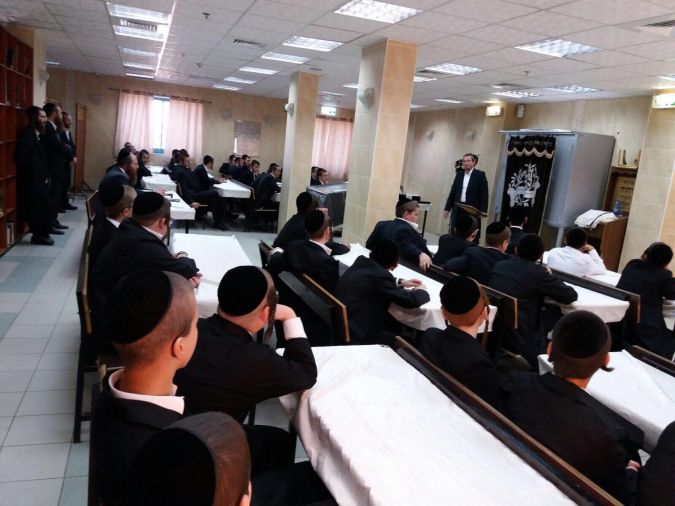
Measuring Hair at NJ's Lakewood Girls School Bnos Yaakov.
How Long Should a Schoolgirl's Hair Be?
Modesty Clampdowns Spark Anger in Haredi Circles!
A video shared on social media shows teachers measuring students' hair in a New Jersey school, while an Israeli school monitors the parents' wardrobe.
Ultra-Orthodox society is becoming more open in many ways – for instance, by allowing the teaching of non-religious subjects in some schools – but two recent incidents in the United States and Israel show that this trend may have sparked a conservative backlash.
A video clip circulating on social media shows an incident in New Jersey, which piqued a flurry of comments among the local community: Female teachers are shown measuring the hair length of schoolgirls at Lakewood Girls School Bnos Yaakov to be sure the girls meet the strict Haredi standards of modesty (tsnius).
Bnos Yaakov administrators wrote a letter to the girls’ parents, declaring that their hair may not reach more than four inches below their collarbone, with the optimal length being two inches below. The length should be measured with the hair left loose, the school wrote, though naturally while in class, any girl with below shoulder-length locks must tie them up in some fashion. If their hair exceeds the limit, the girls will be forced to have it cut, according to the letter.
The Lakewood school is not associated with conservative sects like Neturei Karta or the Satmar Hasids, but rather belongs to the relatively moderate Lithuanian stream of ultra-Orthodoxy.
The letter and the Youtube clip showing hair being measured have sparked much debate in the Haredi world – and not for the first time: In 2012 the American Jewish community was roiled by the description of hellishly painful punishment meted out to immodest girls, courtesy of Bnos Yaakov.
At present, many people, even those subscribing to the principles of tsnius, have been outraged by the school’s conduct. One anonymous response to the video was, “If the school has an issue with a child’s hair length, it should be taken up privately between the administration and the parents. How DARE this school humiliate these girls in front of their classmates and teachers.”
Other commenters blamed such regulations for causing children to go “OTD” – off the derech, in Haredi parlance – meaning to go astray.
Moms and dads, too
A second recent incident involving modesty occurred in Israel and was reported on the local Haredi website Bhadrei Haredim. The Clal Hasidei Elad girls' school sent a letter to parents demanding that they abide by certain strict policies to ensure modesty in the home.
The mother, the letter said, must be sure the wig covering her hair will not reach the bottom of the nape of her neck. There are even directives for the wig itself: It must be of a certain quality suitable to those of fine Hasidic families and it cannot have any curls. If the mother wants to use makeup, it must be applied with a delicate hand but is forbidden on the eyes.
Mothers must also undertake to eschew nail polish and not wear skirts that are any shorter than halfway up their shins, let alone to wear any tight or gaudy apparel. Nor may they wear anything made of Lycra, or bandanas, in keeping with the precept that “I am careful that not even one single hair on my head shows."
The girls’ fathers, according to Clal Hasidei Elad's administration, must wear suits and hats when leaving the house, and “not touch the beard.”
The parents must declare that they follow these directives in order for their daughters to be enrolled and to remain in the school, but its administrators are not satisfied with a mere statement: A third party must guarantee that the families are indeed adhering to the rules, and must sign a document stating: “I the undersigned guarantee that the ___ family, the signatory, will comply ... and if heaven forfend they do not, I shall make sure to remove their daughter from the school."
Chaim Walder, a religiously observant author and educational consultant in Israel, says he personally can’t understand such policies and wouldn’t send his daughter to a school like that, but stopped short of condemning it in a conversation with Haaretz.
“I haven’t heard about things like this in the past, but the parents who send their children to such a place want the strict rules. Nobody forces them to send their children there. Just as I don’t understand a person who takes jeans, tears them up [before wearing them] and thinks that looks pretty, but I don’t have a problem with it – it’s the same here," Walder said. "In contrast to many liberals, I am also liberal toward people who are not liberal. To each his own.”
Walder does agree, however, that some of the liberal trends surfacing in the Haredi world today may be causing a conservative backlash – and justifiably so, in his view, because of the mounting worry in ultra-Orthodox society about the burgeoning influence of Western culture on life today.
Menachem Bombach is waiting behind the gate outside his school
building on a dusty hilltop: long black coat, short beard, thin-rimmed
glasses, the look of a refined yeshiva student, hands folded in front of
him. He smiles and says, “Welcome, welcome!”
It’s hard to believe that this gentleman’s home has become the site
of frequent demonstrations by religious zealots. His apartment door and
lock have been smeared with tar several times; his neighborhood was
covered in pashkevilim, posters, denouncing him as a Haredi
imposter and calling on him to “return to Tel Aviv.” And when he was
recognized upon a visit to his childhood neighborhood Mea Shearim,
locals threw bottles and diapers at him, tearing off his yarmulke.
Bombach has faced this sort of protest ever since he first opened his
school in Beitar Ilit three years ago — a high school for Hasidic boys
that teaches math and science, and offers bagrut matriculation,
exams. While this model has always existed in the Haredi Lithuanian
community, though on the margins, this school is the first of its kind
in the Israeli Hasidic world, and it’s quickly beginning to attract
attention from prospective parents. A Mea Shearim Boy
Beitar Ilit is a colorless metropolis rising out of the Judean Hills,
a settlement-city 10 kilometers south of Jerusalem with a rapidly
growing population. With rent a fraction of the Jerusalem rate, Beitar
Ilit has attracted both Hasidim and Lithuanian Haredim alike, desperate
for space to accommodate their growing families. Walk down Rabbi Akiva
Street, and watch the perpetual rush of the crowd, fathers in long black
coats and black hats, mothers in headscarves and stockings, more
strollers than cars, boys with curled side-locks and girls in long
pleated skirts.
ADVERTISEMENT
“It’s a liberal city,” Bombach says.
I laugh.
“Nu, in Haredi terms, liberal,” he says, smiling. “It’s all relative.”
The zealous demonstrators, Bombach explains, are not Beitar Ilit
locals. They’re imports — either residents of Beit Shemesh, who
originally came from Mea Shearim, or Lithuanian Jerusalemite Haredim,
who are affiliated with Rabbi Shmuel Auerbach. Nothing is truly
monolithic here.
But he pays the protesters no attention. “They don’t worry me,” he
says. “After all, it’s thanks to them that many more people know about
me!” He waves his hand, as if to dismiss the shouts echoing in his mind,
and smiles calmly. “Anyways, they keep me on my feet, they’re a
constant watchdog, they keep me accountable for my actions.”
Despite his innovative thinking, Bombach is no outsider.
Raised in Jerusalem’s Mea Shearim, with a Satmar Hasidic father and a
mother from a zealous Eda Haharedit family, Bombach did not speak
Hebrew — only Yiddish — until he turned 20. After studying in a local
heder, he went on to study in the Yeshiva Ktana of Vizhnitz and then at
the Lithuanian Mir Yeshiva. When he married at the age of 20, he left
yeshiva and eventually turned to education: He moved to Migdal Haemek,
where he started as a counselor at a boys yeshiva, and within four years
became vice principal. As his children grew, he sought a more Haredi
environment for his growing family, so he moved to Beitar Ilit, where he
began working in a yeshiva for Russian immigrants. It was here that he
began to dream of opening his own boys high school.
Tapped by an administrator at the Mandel Institute’s program for
leadership development in the Haredi community, Bombach completed the
institute’s leadership training program (of which he is now a senior
project director), and then went on to complete a degree in public
policy at Hebrew University, where he picked up a fluent English as
well.
His
dream was to open a school for Hasidic boys that taught secular studies
— a radical idea in this insular community. And three years ago, he
finally launched it, calling his project “Hamidrasha Hahasidit”: Not a
“yeshiva,” but rather a Hasidic “academy.” The curriculum includes the
usual schedule of hours spent on Talmud, the Bible, Halacha and Hasidic
thought — coupled with a packed schedule of classes in English,
mathematics, literature, Hebrew language, computer science and history.
Students are prepared to take the bagrut, Israeli matriculation
exams required for university entrance — a contentious issue in the
community, with many Haredi rabbis virulently opposed to religious
youths taking the exam at all.
Menachem Bombach
Menachem Bombach teaches students in his Midrasha Hahasidit in Beitar Ilit.
The school, however, is entirely in line with Haredi societal norms:
Teachers are all male, all Haredi or Hasidic. Eventual army service is
not discussed, and the school does not recognize Israel Independence Day
— though Bombach says the students do pray for fallen Israeli soldiers
on Memorial Day.
But this program isn’t just about secular studies, he says. “It’s
teaching them to be mensches, productive citizens of society. Not to
reject others.”
But how does one teach this, practically?
“Haven’t you seen my website?” he asks me.
You have a website? I am stunned. In a community where the internet
and smartphones are purportedly forbidden? What Israeli Haredi yeshiva
that wants to be taken seriously has a website?
He gives me an amused look. “Of course I have a website,” he says, and opens a sleek, well-designed page on his desktop.
Screenshot of the Midrasha Hahasidit website
On a page titled “Life Skills”,
a list of icons appears, subjects of seminars taught over the four
years: body language, the individual and society, team work, overcoming
preconceptions, personal hygiene, relationship with his parents,
relating to the state, citizenship, nutritious eating, personal finance,
personal boundaries.
Looking at the analytics, Bombach says 600 people enter the site daily to access information on education, parenting and recordings of lectures: “I think it’s becoming a resource for people, even those outside our school.”
But most community members don’t have internet, I counter.
“People ask me for information, and I tell them, go to my site,” he
says, simply. “They tell me they don’t have internet access. So I tell
them, find a way to get internet. I don’t have time for these games. I’m
very upfront.”
When Bombach opened Hamidrasha three years ago, the protests, the
angry articles and denouncements, were almost immediate. But so was the
demand.
Quietly, inquiries began to pour in. Parents were curious about this experiment.
Bombach takes only 20 students per year; for this incoming fall, he
says, there were 80 applicants for the 20 spots available. Half of the
students are local, the rest are from all over the country and live in a
dormitory nearby. About 60% of the funds come from the state, and the
rest from foreign donations. ‘There Is No Alternative’
Just this past week, after an article on Bombach appeared in the
Israeli magazine Makor Rishon, the Haredi daily Yated Neeman blasted him
as a “spiritual murderer.”
I ask him how it felt to be shamed in what is the most widely read paper in the Haredi Lithuanian community.
“I am blessed to have support from others,” he says. “But in the end
of the day, one must accept that one is alone. I am always walking on
eggs.”
“Most people tell me I’m making a mistake,” he says. “They tell me
that I have to work ‘under the radar’ [to improve my community]. But I
say that the radar is very, very high. Even if I work under the radar,
people will see me. It’s inevitable. People are just suspicious by
nature. But listen, Yated is the past. What I’m doing, this is the
future.”
Bombach is deeply concerned about the next generation of his
community. Between the ages of 0-14, there are approximately 500,000
Haredi children in Israel today, he estimates.
“If they don’t enter the workforce, we will become a Third World
country,” he warns. “And the Haredi world will be the first to suffer
for it. It’s hard for Haredim right now to understand how this can be.
But there’s no alternative. From here, we will have the future heads of
hospital wards, engineers, high-tech companies, scientists in the
service of the public. I really believe it. “
“Haredi society is a very good society,” he explains. “There is so
much idealism here, it is truly a world of chesed [acts of kindness], a
miraculous world. And it is turned to the future, it understands there
will be challenges. And we are figuring out how to protect our identity
throughout those challenges. You have to understand, I’m not changing
the community here. I’m protecting it.”
22 suspected pedophiles arrested in Israel nationwide raids
More detentions expected after undercover operation tracked individuals who allegedly harassed and abused children online
Police arrested 22 suspected pedophiles in raids overnight Monday across Israel.
The arrests capped a three-month-long undercover operation that identified 31 suspects, police said in a statement.
The evidence indicated crimes of indecent acts and sexual harassment against children on the internet.
“We take a very serious view of any harm to
minors or those who are helpless, and that includes crime in the virtual
space,” the statement said.
Dozens of officers raided the homes of the
suspects, arrested them, confiscated their computers and cellphones, and
gathered other evidence, police said.
Officers will later in the day request an extension of their detention and more arrests are expected. According to police, the suspects, all men, were aged 24-60 and most have no criminal record.
Israel Radio reported that there was apparently no coordination or other connection between the suspects.
Police said that despite the difficulties in
acting against cyber-criminals, it uses advanced technology to “bring to
arrest criminal pedophiles who prey on our children online and endanger
their physical and emotional welfare.”
Police
arrest 4 rabbis from various cities on suspicion of fraudulently
obtaining 'fitness certificates' qualifying them for title 'rabbi'
Police
arrested four rabbis from various cities today (Wednesday) on suspicion
of fraudulently obtaining police "fitness certificates" testifying to a
criminal-free past that would enable them to qualify for the post of
"City Rabbi".
The four allegedly fraudulently obtained the certificate
without having taken the rabbinic ordination exams. In addition they
falsified scores of tests they never took, sent impostors to sit for the
exam in their stead, and even appealed directly to the examiner to ease
the test process and scoring for them.
Detectives of the Lahav 433 unit arrested the four
suspects and searched their homes in order to seize documents that were
allegedly linked to the offenses attributed to them.
The rabbis are suspected of fraud and breach of trust,
receiving benefits fraudulently under aggravated circumstances,
falsifying corporate documents, impersonating another person, and
aggravated forgery.
Police emphasized that throughout the investigation they enjoyed the cooperation of the Chief Rabbinate of Israel. The
police also clarify that the suspicions are directed against the rabbis
themselves, and not at the Chief Rabbinate or anyone operating on its
behalf.
If the allegations turn out to be true, it will not the first time that
Chief Rabbinate qualifications have been fraudulently obtained for the
purposes of career advancement.
Four rabbis were arrested this morning on suspicion of fraud, breach of
trust, falsifying documents, and impersonation, in connection to
unlawful practices they employed in applying for municipal chief rabbi
positions.
The Jerusalem Post has learned that the rabbis ran or are running
for the chief rabbi jobs in the cities of Nesher, Pardes Hannah, Lod,
and Beit Shemesh. The police have not released the names of the rabbis
who were arrested.
According to the police, the rabbis were
arrested on suspicion of fraudulently obtaining qualification
certificates which would enable them to stand for municipal chief rabbi
positions.
Only rabbis who have passed higher level and exacting ordination
exams than the standard ordination tests are able to serve municipal
chief rabbis.
The police stated that the four rabbis in question
obtained these ordination certificates fraudulently; without having
taken the exams; falsifying the registration of test scores; sending a
different person to take the exams for them; and making contact with the
exam marker to try and persuade them to mark their papers more
leniently.
Police personnel from the Lahav 433 investigative
unit arrested the four men Tuesday morning and conducted searches of
their homes for documents tying them to their alleged crimes.
The
police emphasized that the Chief Rabbinate had cooperated throughout
the investigation and only the suspects themselves were under
investigation.
If the allegations turn out to be true, it will
not the first time that Chief Rabbinate qualifications have been
fraudulently obtained for the purposes of career advancement.
A
scheme which took place between 1999 and 2003 involved helping hundreds
of IDF, police and prison service officers fraudulently obtain
certificates from the Chief Rabbinate regarding the completion advanced
religious studies, entitling them to monthly salary bonuses of between
NIS 2,000 to NIS 4,000 each, while the coordinators themselves received
millions of shekels for their part in the scam.
Former Chief Rabbi Bakshi Doron, along with at least six other rabbinate officials, including two senior figures, were convicted over the affair.
The
Neemanei Torah Va’Avodah religious-Zionist lobbying group, which
several years ago was led a successful legal challenge to the way
municipal chief rabbis are elected, said that the allegations raised the
suspicion that such elections have become “fertile ground” for people
who are unsuited for such honorable positions.
“The status of
municipal chief rabbis has been at a nadir for many years, in part
because they serve without term limits and are unaccountable to the local community,” the group said in response to the arrests.
The
group called on Religious Services Minister David Azoulai to halt all
municipal rabbi elections currently being conducted and to establish
public committee to re-examine how such rabbis are elected and the terms
of their service.
DOES PORUSH GIVE A DAMN ABOUT THE DAMAGED KIDS? OF COURSE NOT! WHAT ABOUT THE KIDS' TRAUMA? 22 CHILDREN THAT WE KNOW ABOUT!
Deputy education minister testifies for Haredi teacher charged with sexual abuse
Meir Porush asks court to allow suspect,
accused of abusing minors at Tel Aviv institution, to attend daughter's
wedding to prevent her 'trauma'
Deputy
Education Minister Meir Porush
Deputy Education Minister Meir Porush appeared in court Monday
to request that an ultra-Orthodox teacher currently facing trial for
severe physical abuse of pupils and multiple incidents of sexually
assaulting minors, be temporarily released from custody in order to
attend his daughter’s wedding.
Avraham Rosenfeld, 49, was indicted in August last year for a series
of abuse charges, including sexual assault, indecent acts, extortion
under threats, and making threats against students at the Talmud Torah
Machzikei Hadass School in Tel Aviv.
Five
other teachers from the Belz Hasidic sect school were also indicted at
the time for attacks on minors in their care. In June this year, Yisrael
Haim Shapira, 65; Haim Fishgrund, 69; Moshe Hirsch, 39; Menachem
Alberstein, 62; and Avraham Pinhas Deitish, 53, were all sentenced to
community service and ordered to pay NIS 10,000 (USD $2,800) to the
victims.
Rosenfeld’s trial, however, focusing on more serious crimes, is still
ongoing. Upon indictment, the Tel Aviv District Court ordered he be
imprisoned until the end of legal proceedings.
Last month, he filed a request to leave police custody for one
evening to attend his daughter’s wedding. Speaking during the Monday
hearing, Porush implored the judges to accept the request “for the sake
of the daughter,” according to the Ynet news website.
“We have heard many things about the accused. We are today focusing
on a bride and the most important day of her life,” Porush reportedly
said. “It is a trauma to have a wedding without one’s father.”
The deputy minister from the United Torah Judaism party said that he
would personally commit to taking Rosenfeld from the prison to the
wedding “to check that nothing happens, God forbid.”
Rosenfeld also faces charges of abuse of his own son and extortion and threats against his own wife. The state prosecution argued Monday that allowing him to attend the
wedding would “give him the opportunity to influence and impair his
wife’s testimony.”
A statement from Porush said that he had appeared at the request of the daughter, who he said was in attendance at the hearing.
The incidents attributed to Rosenfeld are alleged to have happened
between the years 2000 and 2011. Some 22 students are suspected of
having suffered abuse during that time, beginning when they were aged
three to four, and continuing on until sixth grade, when they were
around 11-12 years old.
Rosenfeld allegedly ordered individual pupils to go alone with him
into a room, offering candies as an incentive. He would then allegedly
sexually abuse the children, according to the indictments. Afterwards,
he would give the children candies and release them.
He is also accused of punishing students by making them put a
spoonful of pepper or soap into their mouths, and of refusing to let
children take bathroom breaks, leading some to soil themselves.
Embattled Lakewood rabbi steps down from controversial school
The
School for Children with Hidden Intelligence on Oak Street in Lakewood
was founded and ran by Rabbi Osher Eisemann. On Tuesday, he announced he
was stepping down as director.
(NJ Advance Media file photo)
LAKEWOOD--The founder and director of
a Lakewood school for children with special needs has stepped down from
the institution, months after he was indicted on charges of stealing
more than $630,000 in public money from the school.
The School for Children with Hidden Intelligence announced
Tuesday that Rabbi Osher Eisemann is taking a leave of absence in order
to deal with the case being brought against him by the state.
"It is with sincere regret that I voluntarily will take a leave of
absence from the institution to which I have devoted my life for over 22
years," Eisemann said in a statement. "Regrettably, baseless
allegations made against me have resulted in this decision."
Authorities say Rabbi Osher Eisemann was laundering money meant for special needs kids at private school.
According to the state attorney general's office, Eisemann is accused
of using a fundraising foundation, Services for Hidden Intelligence, to
siphon $430,000 in operating funds from the school to invest in the
now-defunct clothing company, known as TAZ Apparel, LLC.
He is also accused of transferring another $200,000 belonging to the
school through a series of bank accounts into a personal account and
then back into the school's coffers "to create the false appearance that
he was using personal funds from independent sources to repay debts he
owed to the school."
Eisemann
pleaded not guilty in April to the charges against him and had
previously indicated that he would remain in charge of the school, which
he founded in a Lakewood strip mall in 1995. It has since moved to a
modern, multi-building campus on Oak Street and enrolls hundreds of
children.
SCHI (pronounced "shy") is regarded as one of the prominent private
special-education schools in New Jersey and it's also one of the most
expensive.
With Eisemann stepping down, James Delaney, SCHI's principal, will take over as interim director.
"Even though Director Eisemann has not been accused by the state
attorney general of appropriating SCHI funds for personal use, Director
Eisemann has once again put the interests of our students first so that
the school may move on from these scurrilous allegations," Delaney said
in a statement.
Eisemann's decision to step down comes as his legal battle is ramping
up. Last week, Eisemann's attorney asked the state to throw out the
evidence against the rabbi found when the state raided six locations in
the Lakewood area in 2016.
"I
think they have real issues here," said Lee Vartan, Eisemann's
attorney, about the evidence collected in those searches. Vartan says
the search warrants were too general and they allege wrongdoing they say
happened years ago.
The state is expected to respond to Vartan's motion to suppress the
evidence on Sept. 8. The motion and the state's response will be heard
in state Superior Court in Middlesex County on Sept. 29.
Jerusalem therapist Miriam Ballin is the kind of person who takes the initiative.
Despite resistance from her Charedi Orthodox community, she became a
medic. Then she launched a pacesetting psychological first aid unit.
Clearly she was not just going to stand idly by while Tropical Storm
Harvey flooded her native Houston.
In addition to her day job as a family therapist, Ballin, 33, is the
head of the Psychotrauma Unit of United Hatzalah, a mostly Charedi
volunteer emergency service based in Jerusalem. She spearheaded the
creation of the unit last year amid a wave of Palestinian violence to
provide psychological support to those experiencing potentially
traumatic events.
The unit’s 200 or so members include medics, psychiatrists,
psychologists and social workers who are trained by some of Israel’s
leading experts on the psychology of crises. They have responded to
dozens of terrorist attacks, as well as forest fires, car accidents and
other medical emergencies.
Harvey will be their first experience with flooding. For five days,
the storm has deluged southeast Texas, including Houston, the
fourth-largest American city, with record rains. Rising floodwaters have
forced thousands of people from their homes and caused at least 30
deaths, according to local officials.
Dov Maisel, United Hatzalah’s vice president of international
operations, said the message he has received is that plenty of medical
and first responders are on the ground, but that with many people
displaced and looking for loved ones, psychological support is much
needed.
“As a small organization from a small country, we found we could make
the biggest impact by mobilizing our Psychotrauma Unit,” Maisel said.
“The provision of psychological support in the acute stages of trauma,
from incident to seven days, is something we’re leading the world in.”
Miriam Ballin and her husband, Adam, sitting at United Hatzalah headquarters in Jerusalem. (Courtesy of Ballin)
Ballin and her six team members, all drawn from the Psychotrauma
Unit, will meet Thursday in Dallas before making their way to Houston.
They will coordinate with the local and federal officials on the ground
there, as well as leaders of the Jewish community, which has been
especially hard hit. If more help is needed, a couple dozen more members
of the Psychotrauma Unit can be deployed from Israel.
American Jewish donors, many of them based in Houston, are funding the trip.
Ballin’s group will not be the only Israeli rescue workers in
Houston. Ten members of the IsraAID nongovernmental organization were
meeting Wednesday in the city to focus on relief work.
For Ballin, the effort is personal. She was born and raised in
Houston’s Reform Jewish community and still has family and friends
there. But she has since taken a very different path.
After becoming more observant in high school, she met and married an
Australian Charedi man while she was attending college in New York. They
immigrated to Israel in 2011. Soon thereafter, while earning a
certificate in family therapy from Bar-Ilan University, Ballin became
the first woman medic for United Hatzalah, whose leadership she said
embraced her ambition. The service now has over 150 female volunteers.
However, not everyone in the Charedi community, where religious
observance is strict and men and women have sharply delineated roles,
was supportive.
“We definitely did get a lot of flak from the rabbis,” Ballin
recalled. “But the way that I went about it and I dealt with it was
showing time and time again the sensitivity to those that it doesn’t
kind of sit well with. For example, I would never go to a call in the
middle of [the Charedi neighborhood] Mea Shearim.”
In April, Ballin again worked with United Hatzalah leaders to start
the Psychotrauma Unit. Her husband, Adam, a 35-year-old family physician
at Hadassah Medical Center, is also a volunteer medic and member of the
unit. They and their children live in the Rehavia neighborhood of
Jerusalem.
“Instead of getting baby sitters at night to go out to restaurants,
we get baby sitters to go out and [scan] calls in and around Jerusalem,”
she joked.
Being a woman Charedi medic has its challenges, Ballin acknowledged,
but she compensates by always being prepared. In addition to her blonde
wig and fluorescent orange medic’s vest, she has packed kosher canned
food to keep her going in Houston.
“I’ll be there with my head cover on, in my skirt, doing the work I
do,” she said. “I’ll roll up my sleeves and get the job done.”
Rabbi Chang Agreed To Be The Third On Your Bais Din - His $pecialty - JEW THEM UP!
Mark Zuckerberg and Priscilla Chan (why not Chanowitz - she has the money) welcome second daughter
Mark Zuckerberg and Priscilla Chan with their two daughters, baby August and Max.
NEW YORK (JTA) — Mark Zuckerberg and Priscilla Chan have announced the birth of their second daughter, named August.
The Facebook founder and his wife made the announcement through a post on Zuckerberg’s Facebook page Monday in which they sounded optimistic about the world’s future.
“When your sister was born, we wrote a letter about the world we
hoped she and now you will grow up in — a world with better education,
fewer diseases, stronger communities, and greater equality,” Zuckerberg
and Chan wrote. “We wrote that with all the advances in science and
technology, your generation should live dramatically better lives than
ours, and we have a responsibility to do our part to make that happen.
Even though headlines often focus on what’s wrong, we still believe
these positive trends will win out. We’re optimists about your
generation and the future.”
They also pointed out the importance of childhood.
“Childhood is magical. You only get to be a child once, so don’t spend it worrying too much about the future,” they wrote.
The couple had their first child, Max, in November 2015. Before her birth, Zuckerberg wrote about Chan’s struggles with pregnancy, including her three miscarriages.
Being Watched By The Mikveh Attendant Reminds Me Of My Sexual Assault
August 2017
by Nikki Casey
Today I am going to the mikveh and I can barely breathe. The anxiety
starts days before when I know that I have a week left until I have to
go. I put my children to sleep and begin the long process of preparing
to dip my body in the pure waters. But the weight of these waters is
heavier than anyone could imagine. It is a trigger for me that takes me
back to my past and threatens to drown me. Taking off my clothes,
donning a robe, and walking out into the center of the mikveh, leaves me
breathless. The hardest part is taking the robe off and being
completely naked with another person examining my overweight body, even
if it’s from the back. I gulp for air, go under, and come up. Then I
walk out, dripping with shame, grabbing the robe as fast as possible and
escape into room #6 to put my clothing on as quickly as possible.
I am a frum woman and this is what I have to do every month.
Nobody told me about this part of religion when I was 13 and became a
baalas teshuva. I was naïve, with wide eyes, looking to escape my sad,
broken life. I always thought that it was my mother’s various
boyfriends that abused me when I was young, but over the years of deep
searching, I discovered that it was my own mother who made me so ashamed
of my own nakedness. She was always present, a mother who did not
understand the boundaries that I desperately needed. The bathroom lock
was broken, always. She would walk in on me when I was in the bathroom,
showering. She would pull aside the shower curtain and tell me to turn
around. That she wanted to see me. “I made you and I can touch you
anytime I want. You are mine. Turn around. Let me see you.” I was 16
years old, afraid of the changes that my body was going through and
felt completely out of control over this new body. Each time the shower
curtain lifted, I felt like I wanted to die. Die of shame, of the
invasion of my privacy, of the inability to protect myself.
Going to the mikveh, reminds me of this feeling and brings up the
abuse each and every time I go. I begged the Rabbi to let me dip alone,
without an attendant. I explained to him that I was abused as a child
and it is a trigger for me now. I tried to describe myself gulping for
air, feeling like I am going to pass out each time I disrobe. To no
avail. “You have to have someone watching you. But I will talk to them
and tell them that you want it done quickly, without unnecessary
questions.” He called them and told them to be swift. When I walked into the
mikveh reception area that night, they looked at me with sorry eyes. I
was not normal, not 100% sane, mentally ill, and unnecessarily anxious.
I avoided eye contact because I was ashamed to be so bothered by
something that everyone around me did without a complaint and sometimes
even with joy and excitement. I handed them my $12 and walked into the
bathroom to get myself ready for the walk of shame.
Standing naked in
front of the bathroom mirror, I was disgusted. After giving birth to 3
children, my body morphed into something I didn’t recognize any more.
Saggy skin, rolls of fat, and the many imperfections no matter what
angle I looked at it made me look away. I put on my robe and notified
them that I was ready to dip.
“We want to make you as comfortable as possible,” the head mikveh
lady told me as I looked down into the water. Her face was full of
worry for me and wonderment as to what it might be that was bothering me
so much about this seemingly simple ritual. Abuse was a word that
became strongly feared in the frum community, and who knows what she was thinking was done to me to make me so emotionally imbalanced.
“I just want to get it over with please,” I pleaded.
“OK. That’s fine.”
I turned around, she took off my robe and I walked into the water,
panic taking over my whole mind and body. Barely breathing, I even
forgot the brocha that I was supposed to say.
“Ko-Sher” she hollered from atop the balcony.
“I’m done.” I said loudly.
She lifted the robe above her head and I quickly walked up the
stairs, turned around and wrapped the robe around my naked body. I
walked into the bathroom and put my clothing back on. Tears stung my
eyes. What made me cry was how broken I must have looked to the mikveh
ladies. It was their concern that broke my heart. Walking out of the
mikveh house, the feeling of not being normal and needing all these
special phone calls and accommodations swept over me. As I got in my
car I began to sob. Right then I knew that this was not how doing a
mitzvah was supposed to feel like. Opening myself up to a trigger for
my fears and sadness was not what G-d intended when He wrote the laws.
This cannot be purity. This cannot be joy. This experience felt more
like a punishment than a purification.
I heard there are mikvehs that allow a woman to dip without an
attendant, but when I asked the Rabbi, he gave me an adamant no. When I
spoke to my religious therapist, she insisted that I must be watched. I
had to make phone calls on behalf of myself and my fears and ask
repeatedly for the process to go as quickly as possible. But no amount
of therapy or asking will take away the pain that I feel each time I am
expected to disrobe. The wounds open once more and don’t have time to
heal. Breathing gets more difficult and my mind gets foggy with worry.
I want out of this life and a free pass on this mitzvah. But I am a
frum woman and every step I took since I was 13 led me to this point in
my life. I can’t change my course of life at this point. I have a
husband who married a religious woman. I have children who I am raising
in the paths of the Torah.
There is no turning back.
The older I get the more confused I am by this life that I lead.
When a community is so careful on being modest: covering your whole body
with skirts, long sleeve shirts, and wigs, but when it comes to going
to the mikveh, you have to do the opposite of modesty. I have to take
all the rules that make me feel safe around men, and undo them by
getting naked in front of a stranger. Granted the stranger is not a
man, but then again, my mother was a woman, too, and she inflicted so
much pain that the feeling will not go away. There must be a way or a heter out of this tunnel. I’m sure that I
am not the only Jewish woman suffering like this. I am not suffering
alone, as I speak to my therapist, but nobody can save me from what I
fear every month. Even my therapist has come up blank as to what to do
to help me. Do the Rabbis not trust that I will dip all the way and
properly? Do you need an attendant to watch you light the Shabbos
candles or dip your very new dishes in the very same mikveh? Why must
there be such a level scrutiny and not enough faith that we can do this
on our own, as it is such a private ritual? Why do we have to adhere to
this law that can be so hurtful for so many? I know that no amount of
therapy is ever going to make my fear of being naked in front of someone
else go away. So answer me: is there any way out of this painful law?
Being Watched By The Mikveh Attendant Reminds Me Of My Sexual Assault
August 24, 2017
Nikki Casey
Today I am going to the mikveh and I can barely breathe. The anxiety
starts days before when I know that I have a week left until I have to
go. I put my children to sleep and begin the long process of preparing
to dip my body in the pure waters. But the weight of these waters is
heavier than anyone could imagine. It is a trigger for me that takes me
back to my past and threatens to drown me. Taking off my clothes,
donning a robe, and walking out into the center of the mikveh, leaves me
breathless. The hardest part is taking the robe off and being
completely naked with another person examining my overweight body, even
if it’s from the back. I gulp for air, go under, and come up. Then I
walk out, dripping with shame, grabbing the robe as fast as possible and
escape into room #6 to put my clothing on as quickly as possible.
I am a frum woman and this is what I have to do every month.
Nobody told me about this part of religion when I was 13 and became a
baalas teshuva. I was naïve, with wide eyes, looking to escape my sad,
broken life. I always thought that it was my mother’s various
boyfriends that abused me when I was young, but over the years of deep
searching, I discovered that it was my own mother who made me so ashamed
of my own nakedness. She was always present, a mother who did not
understand the boundaries that I desperately needed. The bathroom lock
was broken, always. She would walk in on me when I was in the bathroom,
showering. She would pull aside the shower curtain and tell me to turn
around. That she wanted to see me. “I made you and I can touch you
anytime I want. You are mine. Turn around. Let me see you.” I was 16
years old, afraid of the changes that my body was going through and
felt completely out of control over this new body. Each time the shower
curtain lifted, I felt like I wanted to die. Die of shame, of the
invasion of my privacy, of the inability to protect myself.
ADVERTISEMENT
Going to the mikveh, reminds me of this feeling and brings up the
abuse each and every time I go. I begged the Rabbi to let me dip alone,
without an attendant. I explained to him that I was abused as a child
and it is a trigger for me now. I tried to describe myself gulping for
air, feeling like I am going to pass out each time I disrobe. To no
avail. “You have to have someone watching you. But I will talk to them
and tell them that you want it done quickly, without unnecessary
questions.”
He called them and told them to be swift. When I walked into the
mikveh reception area that night, they looked at me with sorry eyes. I
was not normal, not 100% sane, mentally ill, and unnecessarily anxious.
I avoided eye contact because I was ashamed to be so bothered by
something that everyone around me did without a complaint and sometimes
even with joy and excitement. I handed them my $12 and walked into the
bathroom to get myself ready for the walk of shame. Standing naked in
front of the bathroom mirror, I was disgusted. After giving birth to 3
children, my body morphed into something I didn’t recognize any more.
Saggy skin, rolls of fat, and the many imperfections no matter what
angle I looked at it made me look away. I put on my robe and notified
them that I was ready to dip.
“We want to make you as comfortable as possible,” the head mikveh
lady told me as I looked down into the water. Her face was full of
worry for me and wonderment as to what it might be that was bothering me
so much about this seemingly simple ritual. Abuse was a word that
became strongly feared in the frum community, and who knows what she was thinking was done to me to make me so emotionally imbalanced.
“I just want to get it over with please,” I pleaded.
“OK. That’s fine.”
I turned around, she took off my robe and I walked into the water,
panic taking over my whole mind and body. Barely breathing, I even
forgot the brocha that I was supposed to say.
“Ko-Sher” she hollered from atop the balcony.
“I’m done.” I said loudly.
She lifted the robe above her head and I quickly walked up the
stairs, turned around and wrapped the robe around my naked body. I
walked into the bathroom and put my clothing back on. Tears stung my
eyes. What made me cry was how broken I must have looked to the mikveh
ladies. It was their concern that broke my heart. Walking out of the
mikveh house, the feeling of not being normal and needing all these
special phone calls and accommodations swept over me. As I got in my
car I began to sob. Right then I knew that this was not how doing a
mitzvah was supposed to feel like. Opening myself up to a trigger for
my fears and sadness was not what G-d intended when He wrote the laws.
This cannot be purity. This cannot be joy. This experience felt more
like a punishment than a purification.
I heard there are mikvehs that allow a woman to dip without an
attendant, but when I asked the Rabbi, he gave me an adamant no. When I
spoke to my religious therapist, she insisted that I must be watched. I
had to make phone calls on behalf of myself and my fears and ask
repeatedly for the process to go as quickly as possible. But no amount
of therapy or asking will take away the pain that I feel each time I am
expected to disrobe. The wounds open once more and don’t have time to
heal. Breathing gets more difficult and my mind gets foggy with worry.
I want out of this life and a free pass on this mitzvah. But I am a
frum woman and every step I took since I was 13 led me to this point in
my life. I can’t change my course of life at this point. I have a
husband who married a religious woman. I have children who I am raising
in the paths of the Torah. There is no turning back.
The older I get the more confused I am by this life that I lead.
When a community is so careful on being modest: covering your whole body
with skirts, long sleeve shirts, and wigs, but when it comes to going
to the mikveh, you have to do the opposite of modesty. I have to take
all the rules that make me feel safe around men, and undo them by
getting naked in front of a stranger. Granted the stranger is not a
man, but then again, my mother was a woman, too, and she inflicted so
much pain that the feeling will not go away.
There must be a way or a heter out of this tunnel. I’m sure that I
am not the only Jewish woman suffering like this. I am not suffering
alone, as I speak to my therapist, but nobody can save me from what I
fear every month. Even my therapist has come up blank as to what to do
to help me. Do the Rabbis not trust that I will dip all the way and
properly? Do you need an attendant to watch you light the Shabbos
candles or dip your very new dishes in the very same mikveh? Why must
there be such a level scrutiny and not enough faith that we can do this
on our own, as it is such a private ritual? Why do we have to adhere to
this law that can be so hurtful for so many? I know that no amount of
therapy is ever going to make my fear of being naked in front of someone
else go away. So answer me: is there any way out of this painful law?
Is Orthodox Judaism compatible with biblical criticism? At first
glance this question seems absurd since Bible critics generally claim
that the Pentateuch is a historically inaccurate, incoherent work
composed of multiple sources that changed over time. But in academic
biblical studies there are lesser-known conservative scholars who
question these assumptions, arguing that the Pentateuch is more unified,
coherent, historically accurate, and ancient than most critics contend.
In his recent essay “The Corruption of Biblical Studies,”
Joshua Berman argues that there is an endemic bias in academic Bible
studies against these conservative scholars whose work is automatically
dismissed as not rigorous and “agenda-driven,” no matter the evidence.
In a response to Berman, Marc Brettler connects
a conservative approach to Bible scholarship with Orthodoxy writing
that “it is not surprising that an Orthodox Jew like Berman would resist
it [source criticism].” It would seem that Orthodox Judaism is
compatible with critical Bible study, if it is undertaken in a
conservative manner. But looking at the roots of Orthodox and
Conservative Judaism in nineteenth-century Germany, it becomes clear
that matters are much more complicated.
Orthodoxy versus Conservative Judaism in Germany
In
1845, Reform rabbis held a rabbinical conference in Frankfurt. The
attendees included Rabbi Zacharias Frankel, a self-described “moderate
reformer.” But when Frankel saw the reforms being adopted at the
conference as too radical, he walked out. Frankel’s action galvanized
like-minded Jewish religious conservatives and a year later Frankel
sought to organize a conference to solidify this group.
In 1859, Frankel presented the theory behind his theological approach in his book Darkhei Ha-mishnah,
a methodological introduction to the Mishnah. Frankel regarded himself
as propounding a conservative approach to Jewish law. While many Jewish
reformers claimed that historical criticism demonstrated that the
ancient rabbis invented new laws that they then read into the Bible
through fanciful interpretations, Frankel used historical scholarship to
argue for the antiquity of many mishnaic laws. The Mishnah was composed
in the third century CE, but Frankel argued that many of its laws were
substantially older going back at least six hundred years to the times
of Ezra. Frankel defined his ideological orientation as
“Positive-Historical” Judaism and headed the first modern rabbinical
seminary in Germany, the Jüdisch-Theologisches Seminar in
Breslau. Frankel’s seminary sought to serve all German Jews, training
rabbis that would serve in both Orthodox and Reform communities. It is
not incidental that when Conservative Judaism emerged in America it
originated in a break with Reform, called its flagship institution the Jewish Theological Seminary, and sought to train rabbis that would serve in all Jewish communities.
Rabbi
Samson Raphael Hirsch was the intellectual founder and leading figure
of German Neo-Orthodoxy. In light of his staunch opposition to Reform
Judaism, Hirsch’s contemporaries assumed that he would regard Frankel as
an ally. But when Frankel published Darkhei Ha-mishnah, Hirsch
harshly criticized it. At the core of Hirsch’s argument was his
contention that the gap between Frankel’s conservatism and Reform was
relatively minor compared to the gap between Frankel’s position and
Orthodoxy. Hirsch explained that Orthodoxy was premised on the idea that
God revealed the entire Oral Torah to Moses on Mount Sinai along with
the Written Torah (the Bible). While Frankel had argued on historical
grounds that many rabbinic laws were centuries older than the Mishnah,
Hirsch argued that this position remained completely at odds with
Orthodoxy.
Old was not enough. Even if rabbinic laws went back to
Ezra’s time or earlier, they were still composed hundreds of years after
Moses. Hirsch further showed that Frankel’s approach was grounded in
the assumption that the early scribes (soferim) had created the
Oral Law in a specific historical context that shaped its teachings.
This opened the door to arguing that the Torah’s laws should be adjusted
to fit contemporary circumstances. But for Hirsch Orthodoxy assumed
that the Oral Law was revealed to Moses by a timeless God and was
eternally valid.
While Hirsch attacked Frankel’s view of the Oral
Law, we can easily apply his arguments to the Bible. While conservative
Bible critics argue that biblical texts are much older, more coherent,
and more historically accurate than scholars commonly assume, there
remains an unbridgeable gap between these “conservative” claims and the
Orthodox view that God dictated the entire Bible to Moses, which was
preserved uncorrupted. As Hirsch never tired of pointing out, the
problem for Orthodoxy is not with the specific conclusions of a
historian, but with the historical method itself. The underlying
assumption of the historical method is naturalism, namely the belief
that texts are created by human beings in response to shifting
historical circumstances. By contrast, Orthodoxy rests on the belief
that the Torah is the product of supernatural revelation and eternally
valid. Hirsch was not the first to recognize the chasm separating
Orthodox belief about the Bible from historical criticism. Spinoza
understood it nearly two centuries before him.
Spinoza’s Clarity about the Premises of Biblical Scholarship
Berman
correctly identifies Spinoza as a founder of critical biblical study.
But he does not give him sufficient credit when he claims that before
Newton nature was presumed to be impenetrable and Newton’s discovery
that nature operates according to precise laws gave a decisive impetus
to biblical criticism. Spinoza clearly held a view of science similar to
Newton’s in vital respects. This is evident from his posthumously
published Ethics, where he describes nature as operating
according to universal laws of “motion and rest” and human thoughts and
emotions as arising according to a necessary, causal order that can be
determined. In his 1670 Theological-Political Treatise, Spinoza
compares the study of the Bible to the study of nature writing that
“the method of interpreting Scripture does not differ at all from the
method of interpreting nature, but agrees with it completely.” The only
reason Spinoza asserted that the meaning of certain words in the Bible
or the authorship of certain books could not be definitively established
was because he thought there was insufficient evidence. Spinoza never
doubted that historical study could be a precise science.
Standing
at the boundary between the medieval and modern worlds, Spinoza
understood that naturalism was the core assumption of the historical
method.
For this reason, the most important chapter of the Theological-Political Treatise
is chapter six which treats miracles. In this remarkable chapter,
Spinoza seeks to convince the religious believer that miracles are not
possible. He argues that God’s nature is incompatible with miracles and
that the Bible itself deems miracles impossible. The reason
Spinoza makes these astonishing claims is because he recognizes that a
religious believer confronted by a scholar analyzing the Bible using a
historical-critical method could simply deny that the Bible arose
through natural causes pointing to the Bible itself as evidence of its
miraculous origin. Spinoza understood that in this case historical
criticism could not disturb the religious believer’s conviction. He
therefore argues that God’s nature and the Bible itself preclude the
possibility of miracles for in that case a historical approach is the
only valid method for discerning the Bible’s meaning and compositional
history.
For Hirsch (as for Spinoza), Orthodoxy and historical
scholarship rest on mutually exclusive, utterly irreconcilable premises.
Historical scholarship assumes that history unfolds according to
natural processes and that all literature is generated by human actors
operating within specific historical contexts. When problems such as
contradictions, gaps, repetitions, etc. occur in the biblical text, the
scholar explains them as the result of errors, multiple sources,
competing agendas, etc. By contrast, Orthodox Judaism rests on the
assumption that the Torah is a unique, perfect text miraculously
dictated by God to Moses. The Bible’s contradictions, repetitions, and
gaps show that it is not a straightforward text, but rather a
hieroglyphic work consisting of multiple levels of meaning that must be
deciphered.
Orthodoxy’s Scholarly Precedence Over Academic Bible Study
While
Hirsch sees historical scholarship and Orthodox Judaism as mutually
exclusive, he claims that in an important respect, Orthodox Judaism
approaches the academic ideal of historical accuracy better than
scholarship itself. Historical scholarship seeks to understand texts as
they were originally intended. While scholarship’s interest is purely
theoretical, focused on understanding the Bible as one phenomenon within
history, Orthodox Judaism seeks to understand the Bible for a practical
purpose, namely as a guide to life. Given that the Bible presents
itself as addressing the reader with divine commandments to govern a
person’s life, Hirsch sees Orthodox Judaism’s approach to the Bible as
coming closer to the scholarly ideal of understanding texts as they were
originally intended.
Hirsch’s Assault on Orthodox Confusion
Hirsch
recognized that some Orthodox scholars of his day thought that one
could apply a historical method to the Torah. For Hirsch, this betrayed a
lack of clarity about the theological principles upon which Orthodox
Judaism depends. In 1873, Hirsch warned the scholar and staunch defender
of Orthodoxy Rabbi David Zvi Hoffmann not to publish his dissertation
“Mar Samuel: The Life of a Talmudic Sage.” Hirsch objected that
Hoffmann’s use of academic methods had led him to positions
irreconcilable with Orthodox Judaism, such as that the Mishnah and
Talmud introduced new laws in response to changing historical
circumstances and that certain halakhic decisions derived from Mar
Samuel’s “humanitarian” personality traits. For Hirsch, Hoffmann
unwittingly undermined the eternal validity of the Oral Law by
historicizing it.
From the Hirschian perspective, Berman’s
criticizing Bible scholars for having a liberal bias misses the point.
The problem is not liberal bias, but the very fact of applying the
historical method to the Torah. While conservative Bible scholarship may
sound close to Orthodoxy, it operates on the basis of the same
naturalistic presuppositions employed by liberal scholars and so ends up
undermining the eternal validity of the Torah. The point is not whether
scholars with impeccable Orthodox credentials have engaged in Biblical
criticism. Clearly they have. The point is Hirsch’s contention that an
Orthodox Jew engaged in biblical criticism is knotted in impossible
self-contradiction.
Anorexia and bulimia are amongst the most emotionally and physically destructive disorders affecting Jewish mothers - I used to say young Jewish women but now am seeing more and more middle-aged women also suffering from it. It is both a privilege and challenge to work with women suffering from disorders for the past 20 years. Although I treat patients from a wide spectrum of religious/ cultural backgrounds, I specialize in treating Orthodox Jews, as it most closely resonates with my own cultural and religious background. I would like to address two themes in my work with Orthodox Jewish patients. Although these are very worrisome Jewish problems, they are not more specifically an Orthodox Jewish problem. Interestingly, Jewish boys were also studied, and do not report higher rates than Canadian non-Jewish boys. In Israel, it is also an issue. 47% of Israeli girls were on a diet at the time of study, ± 12% only are the ones who are overweight. I don¶t need statistics to know eating disorders are a very worrisome problem.
You¶re all here today because you know at least one person who suffered from an eating disorder. It may be a full-blown clinical syndrome or a sub-clinical manifestation of the problem which also has a significant impact on psychological and physical well-being. In typical Jewish tradition, I am frequently asked why- why might there be higher rates of eating disorders and disordered eating in Jewish community?
Several hypotheses that reflect socio-cultural ideas in Jewish life come up consistently so I will preempt questions and raise them myself --- 1.Pressure of Shidduchim and the psychological impact on young women to marry and have large families 2.Shabbat and Chagim= Overabundance of food 3.Impact of Holocaust with legacy of starvation 4.Practice of kashrut itself which separates foods into permissible and non-permissible categories (good and bad)
Haredi women defraud family suffering from domestic violence, refrain from reporting beating of minors to police.
Police Fraud Investigation Unit
Two haredi women were indicted for fraud after masquerading as psychologists, the Behadrei Haredim Hebrew news site reported.
The women, residents of Jerusalem and Beitar, pretended to be
clinically-licensed psychologists in order to swindle money from
families in need of psychological assistance. They are believed to have
defrauded their victims of tens of thousands of shekels over several
years.
The case first came to light in July, 2016, when a haredi father was
indicted for beating his daughters for years. The father confessed and
was sentenced to nine years in prison and fined NIS 95,000
($26,000).
Several days after the indictment, an investigation was launched against
a haredi woman who provided counseling services to the father and his
family.
The woman was arrested on suspicion of extortion, obstruction of
justice, and failing to report individuals who posed a real and present
danger to themselves and others. A month later, one of the victims
agreed to talk to Behadrei Haredim and to give details of the
incident; "The counselor told me that I should hate my father, suggested
I divorce my husband, and extorted tens of thousands of shekels because
she threatened to publish the story."
Yesterday, the Jerusalem District Prosecutor's Office
filed an indictment against the fraudulent counselor for offenses
including extortion by threats, failure to fulfill the obligation to
report a crime and monies fraudulently received. The indictment,
published for the first time in the haredi newspaper, describes the
chain of events during the period after the woman's father was charged.
In May 2016, the complainant's grandfather discovered that his
son-in-law had been beating his granddaughters. He then turned to the
defendant S., who introduced herself to him as a psychologist - even
though she was not.
The grandfather asked S. whether she knew someone who was treating
victims of physical abuse. She replied that she herself was treating
victims of abuse and that she had a friend who was doing the same, H.,
The other woman, defendant. S. did not mention to the grandfather that
she has no experience in treating assault victims.S. contacted H., who
falsely claimed that she had experience in treating victims of abuse and
assault.
The defendants met with the daughters and agreed to counsel them, while also agreeing not to report the violence to the police.
For
about a month and a half, "treatment" meetings were held in which it
was revealed that the complainants had been severely beaten by their
father, in dozens of incidents over the years.
However, the "counselor"
defendants did not report this to the police as they were obligated to
do by law.
Knowing that the family is very concerned about publicizing the
father's actions, H. threatened them on several occasions not to abandon
the sessions or switch to a different therapist.
"You are my clients now," H. said. "If you do not have the means to pay, I will have to pass it on to the authorities.
She also threatened: "If you do not cooperate with me, I will publish
your story in the haredi community and take it to the police."
According to the indictment, the defendants extorted NIS 32,000 ($8,800) from the family.
Eventually, the family began to suspect that something was wrong. The
husband of the oldest daughter visited the Health Ministry and
discovered that the 'psychologists' were not registered and had not
opened a file with the social welfare department as they were obligated
to.
Following the discovery, the victims stopped the therapy sessions and
filed a complaint with the police against the fake therapists.