"Following the 2019 split in Gur, the leadership of the mainstream
community began enacting severe sanctions against the breakaway families
with children being harassed out of their schools and yeshivas, people
fired from their jobs and a variety of other measures taken against
those who joined Shaul Alter’s new community."
Breakaway hassidic leader greeted joyfully in US
Rabbi Shaul Alter broke away from
the mainstream Gur community in 2019 and is now establishing
institutions for his new hassidic community.
Rabbi Shaul Alter, head of a breakaway faction in the Gerrer hassidic community, at a celebration last week
The head of a breakaway faction of the haredi
(ultra-Orthodox) Gur hassidic community has been greeted rapturously in
America, where he is currently visiting, with thousands lining the
streets to greet him and participate in celebrations about his visit.
In
a dramatic sequence of events in 2019, Rabbi Shaul Alter, first cousin
of the Gur hassidic dynasty’s Grand Rabbi Yaakov Aryeh Alter, split away
from the main Gur community following years of tension between the two,
with some 300 families in Israel following him at the time.
The
split was striking because of Gur’s status as the largest, wealthiest
and most influential hassidic community in Israel. As one of the largest
hassidic movements in the world, the schism dealt a serious blow to its
prestige.
The
new community, which calls itself Ger Torah, now numbers some 500
families, with another 300 in the US, while the mainstream Gur community
in Israel is thought to number as many as 100,000 people.
Alter is currently on a trip to the US where he has been visiting members of the Gur community who have split from the mainstream sect and joined his new one.
He
has also met with hassidic grand rabbis in America who are friendly
toward him, and has been fundraising for the planned Jerusalem
headquarters of the new Gur community.
Since
leaving last Tuesday, Alter has met with some of the most senior Gerrer
officials in the US and visited some of its most established
institutions that have switched allegiance from the mainstream grouping
in Israel to Ger Torah. (Versus Ger NOT Torah)
The
climax of Alter’s visit was a tisch (joyous Hassidic celebration with
the rebbe) after Shabbat ended this past Saturday attended by an
estimated 15,000 people in Borough Park, New York, in an enormous
marquee setup for the rabbi’s visit.
Thousands of hassidim lined the street for Alter as he left the location after the event.
Shaul Alter also visited a yeshiva in Lakewood, New Jersey, and gave a Torah lesson reportedly attended by hundreds of people.
Earlier
this year, Shaul Alter’s new community conducted a wildly successful
fundraising campaign which garnered some NIS 50 million, of which NIS
40m. has been spent on the purchase of land for the new sect’s
headquarters on Jeremiah Street in Jerusalem.
One
of the main goals of Alter’s trip to the US was to raise the necessary
funds to finance the actual construction of the building.
The
headquarters, planned to be eight floors, will house the new
community’s central synagogue, study hall and its other institutions
such as schools and yeshivas.
Following
the 2019 split in Gur, the leadership of the mainstream community began
enacting severe sanctions against the breakaway families with children
being harassed out of their schools and yeshivas, people fired from
their jobs and a variety of other measures taken against those who
joined Shaul Alter’s new community.
Although
some of the families who left returned to the central Gur community
because of these reprisals, Ger Torah has grown over the last two years
as families have grown confident that they would be able to find a home
in the new community.
Alter’s
success in raising money for the new headquarters and institutions is
critical for the future of his young community since hassidic life
revolves around community institutions and events, as well as schools
and yeshivas for its children, without which such a community has little
viability.
The legislation abolishes the monopoly of the Chief Rabbinate over kashrut supervision.
Kashrut certificate in Jerusalem, July 21, 2021.
Dramatic reforms to the provision of kashrut services have passed into law after the Budget Arrangements Law was passed in the Knesset on Thursday.
The
legislation will likely have a historic impact on the provision of
kashrut supervision, and influence further changes to other religious
services in the future.
The legislation, advanced by Religious Services Minister Matan Kahana, will abolish the monopoly of the Chief Rabbinate
over kashrut supervision and open the market to competition by allowing
independent kashrut authorities to legally provide supervision
services.
The
kashrut services provided by the Chief Rabbinate and its local branches
has for years suffered from numerous forms of corruption and has been
castigated by state bodies and NGOs for failing to provide an adequate
service.
Under the
new law, the Chief Rabbinate will establish two levels of kashrut
standards, basic and stringent, and a body within the Rabbinate will be
tasked with ensuring the independent authorities comply with those
standards.
THE BUILDING of the Chief Rabbinate of Israel in Jerusalem
To
ensure the establishment of independent kashrut authorities will not be
thwarted by the Chief Rabbinate through overly stringent standards, a
panel of three rabbis with specific qualifications will be able to, if
they so wish, establish a separate set of standards.
This
provision in particular will mean that the Rabbinate will no longer
have exclusive control over the provision of kashrut in the country.
One
other major reform in the law allows the independent authorities to
give kashrut authorization for food products from abroad, something that
could reduce costs for imported food.
The law will go into effect on January 1, 2023.
But
on January 1, 2022, the current geographical districts in which only
local rabbinate branches can operate will be abolished, meaning a chief
municipal or regional rabbi anywhere in Israel could provide supervision
anywhere else.
This
is a boon for the kashrut service run by the moderate religious-Zionist
Tzohar organization, which already operates a kashrut supervision
service, through loopholes from earlier laws.
Although
until now, Tzohar and any other independent kashrut authority could not
legally issue kashrut certificates for restaurants and food businesses
stating that they are kosher in writing; the abolition of the geographic
districts will mean that such certificates will be legal.
This step will immediately boost competition in kashrut supervision before the full law takes effect.
Nearly 25 years after his bar mitzvah tutor pleaded guilty to sexual misconduct, a 40-year-old New Jersey native has sued the former tutor as well as the synagogue and day school that employed him.
The tutor, Akiva Roth, pleaded guilty in 1997 to four counts of
lewdness, and lost his jobs at the East Brunswick Jewish Center, the
former Solomon Schechter School of Essex and Union counties and Camp
Ramah in the Berkshires. But the plaintiff in the lawsuit and two other
former students of Roth who were interviewed over the past month contend
that the three institutions failed to properly inform their communities
of the situation, allowing Roth to continue teaching in other Jewish
organizations for years.
Akiva Roth was a bar mitzvah tutor convicted of four counts of lewdness in 1997.
The three men, two of whom were speaking publicly about their
experiences for the first time, said Roth’s behavior — which included
masturbating in front of middle-school boys and near-incessant talk of
pornography and penises — was an open secret at the synagogue, school
and camp in the mid 1990s. He was sentenced to 10 years probation for
his sexual behavior in front of four boys in one of their homes. But the
men said that the criminal investigation at the time was too narrow,
and expressed outrage that the Conservative movement has yet to be held
fully accountable for its handling of the situation.
“I’ve frankly been kind of disgusted and my parents have been
disgusted for years that the investigation never went past the four
kids,” said Scott Schonfeld, a former Ramah camper and student at East
Brunswick and Schechter — now known as Golda Och Academy — who alleges
that Roth was sexually inappropriate towards him.
Schonfeld, now 40 and living in California, said he had never been
contacted about Roth’s lewd behavior by detectives or administrators at
the camp, synagogue or school. “You’re literally the first person ever
to ask me about it,” he recently told the Forward.
Roth, meanwhile, worked at the Jewish Theological Seminary, Drew University’s Hillel and Yeshiva University before the Forward reported on the misconduct in 2013.
The lawsuit and other accusations come as the Conservative movement,
like other parts of the Jewish community, are undergoing a reckoning
over past handling of sexual and other misconduct.
Four years after the Harvey Weinstein scandal launched the #MeToo
movement, the Rabbinical Assembly last month made public its list of
expelled or suspended rabbis for the first time. The Assembly announced
in April a plan to revise its code of conduct, while the Reform
movement’s seminary, rabbinical organization and synagogue network have
all hired separate law firms to independently investigate allegations of
harassment and the institutions’ policies to prevent it.
The fresh allegations against Roth join a steady trickle of recent
stories about sexual misconduct with Jewish youth. Rabbi Jordan Soffer,
now head of a Jewish day school in Sharon, Mass., in August alleged
that an employee of United Synagogue Youth sexually abused him at a
convention when Soffer was 15, but continued to work in the Conservative
movement for years. Two victims of the same USY staffer filed lawsuits
against the youth group this summer, and the CEO of United Synagogue of
Conservative Judaism quickly announced it would implement new safety procedures and investigate how the organization handles complaints.
After being informed of the lawsuit and other material about Roth
gathered by the Forward, Camp Ramah said it had hired the law firm
Jackson Lewis to conduct an investigation.
“While these allegations relate to conduct 25 years ago, we take this
new information very seriously and are committed to discovering the
truth of what may have occurred,” Camp Ramah said in a statement. “We
owe it to the individuals directly involved and to our community.”
The camp also said its current employees are trained to respect
boundaries and recognize predatory behavior, and that its child-safety
policies were recently audited — at Ramah’s request — by Sacred Spaces,
a Jewish abuse-prevention organization.
“Then, as now, we stand with all victims of sexual misconduct and
recognize the courage it takes for them to come forward,” the statement
said.
Roth, who was fired by Yeshiva University after the Forward’s 2013 articles,
says on his LinkedIn profile that he now works as a Hebrew translator.
He did not respond to requests for comment made by phone and through
Facebook, where he has posted mini-sermons, including one in which he
describes Moses as “canceled.”
“He doesn’t get to see the promised land,” Roth noted. “So in one way
he was canceled. In another way it teaches an important lesson. In
cancel culture, there has to be a happy medium between canceling the
entirety of what a person has done just based on one foible or one
negative quality.”
‘It wasn’t hidden at all’
Akiva Roth grew up in the Conservative movement — his father, Rabbi
Joel Roth, was an influential leader in the Rabbinical Assembly and a
professor of Jewish law at the Jewish Theological Seminary. Roth majored
in Jewish studies and political science at Rutgers University and
graduated in 1994, according to his LinkedIn profile.
So when the East Brunswick Jewish Center’s population swelled in the
early 1990s, the younger Roth was an easy hire to help Cantor Jonas
Rosen, a Holocaust survivor and beloved pillar of the community, train
the bnai mitzvah candidates. Roth, who is now about 50, also taught at
what was then Schechter; and worked at Camp Ramah in the Berkshires
until the criminal investigation.
Yishai Cohen, now a 38-year-old who lives in Florida, was one of the
four boys whose testimony that Roth had masturbated in front of them led
to his guilty plea. He said in a recent interview that the four
attended Camp Ramah together and that he also witnessed Roth masturbate
in front of an entire bunk of boys who were in middle school.
“Everyone knew Akiva was just a pervert,” Cohen said. “That was just
known among the boys. That’s why it was so bizarre. It wasn’t hidden at
all.”
Schonfeld said he once saw Roth’s exposed penis in a bunk with other
boys, and that Roth would openly talk about penises and masturbation.
The plaintiff said his abuse went further.
“He ultimately led me into a bathroom,” the plaintiff said in the
interview. “Inside of the East Brunswick Jewish Center, not very far
from the classroom where he taught me. And proceeded to unzip his pants
in front of a standup urinal and masturbate in full sight of me, while
encouraging me to join him and participate.
“I saw him ejaculate,” the plaintiff continued. “I was 12 years old.”
The first page of a lawsuit filed by an anonymous plaintiff, now an
adult, against his bar mitzvah tutor, a synagogue and a day school for
alleged abuse when he was a child
.
The
lawsuit, filed in New Jersey’s Middlesex County Superior Court last
week, accuses Schechter — now Golda Och Academy — and the East Brunswick
Jewish Center of negligence for failing to oversee Roth and protect
their young students. The plaintiff has also sued Roth personally,
alleging sexual abuse and intentional infliction of emotional distress.
The suit seeks damages and attorney’s fees but does not specify how
much.
“I just thought he was one sick bastard,” the plaintiff said.
“Unfortunately it took me half a lifetime to realize that that’s sex
abuse.”
‘I never talked about it’
In the summer of 1996, Cohen said, one of his friends confided in his
brother about what Roth was doing. The brother told their parents, and
from there things moved quickly. Cohen recalled being interviewed by an
investigator with the Middlesex County Prosecutor’s Office, and then
hearing that Roth had been arrested and lost his job at the synagogue,
school and camp. But all three institutions chose to handle the problem
quietly.
Schonfeld and the plaintiff each said that Ramah, Schechter and the
East Brunswick Jewish Center all failed to inform parents of Roth’s
arrest or the reason his employment with them ended. Schonfeld attended
all three institutions, but said his parents only learned of Roth’s
misconduct years later from the father of one of the boys in the 1996
criminal case.
Rabbi Paul Resnick, Ramah’s executive
director in 1996, said he contacted child protective services as soon as
he heard about the allegations, which focused on Roth’s conduct at a
private home. Ramah did not, at the time, investigate whether any
misconduct took place at camp, Resnick said.
“Because these allegations were not yet fully substantiated, we did
not believe it was appropriate to share the news with our entire camp
community,” Resnick emailed in response to the Forward’s questions.
“Importantly, I did not want an internal investigation to interfere with
the state investigation.”
Schonfeld said in the interview that as a student at Schechter, he
occasionally carpooled with the son of East Brunswick Jewish Center’s
Rabbi Chaim Rogoff. After the first day of school in 1996, Schonfeld
recalled, when they arrived at the Rogoff’s home, Roth was there.
He said the rabbi and the tutor told him that Roth was no longer
working at Schechter because of inappropriate behavior involving other
boys. But instead of offering support or asking whether he had any
problems with Roth, Schonfeld said, “I do distinctly remember that Chaim
Rogoff swore me to secrecy.”
“Meaning: do not tell your parents, you cannot tell your parents,”
Schonfeld recalled. “I complied. I never talked about it. He scared me,
and it worked.”
Rogoff, who left the East Brunswick Jewish Center more than a decade ago, did not respond to a request for comment.
Charlotte Abramson, the principal of Schechter’s middle school at the
time, wrote in an email that she could not recall details about how the
school handled the case. Roth never worked for the school again after
his arrest, she said.
“I have no knowledge of that nor any recollection of what the
school’s official response may have been at the time,” Abramson said. “I
do know that a major priority and obligation of the educational
institution was — and is — to assure and protect the safety and welfare
of the students and the institution.”
The current leadership of what is now Golda Och Academy, a
non-denominational day school in West Orange, N.J., said in a statement
that there is no record of communication with parents about Roth’s case,
and that the school would notify the community and reach out to support
victims if similar allegations arose today.
“We feel deep compassion for the people victimized by Mr. Roth,” the
statement said. “Any violation of the teacher-student relationship is
unacceptable. That Mr. Roth broke the trust of students and their
parents while preparing them to become responsible members of the Jewish
community is especially reprehensible.”
Golda Och, like Ramah, said it now trains
staff to recognize and report signs of sexual abuse. “We are committed
to creating a safe and supportive environment for our entire community,”
the school said in the statement. “Our policy includes following all
state-mandated background checks, reference checking, and regular
training for faculty and staff on preventing, recognizing, and reporting
signs of sexual abuse.”
The East Brunswick Jewish Center said it would not comment due to the pending litigation.
‘The effect on me has been tremendous’
Schonfeld and the man now suing under the name John Doe both said
separately that they were never contacted by law enforcement during or
after the investigation that led to Roth’s 1996 arrest.
The Middlesex County Prosecutor’s Office said it could not locate any
records of Roth’s criminal case and declined to comment further.
Middlesex County Superior Court also did not find any records, and did
not respond to questions about whether the case was sealed.
The plaintiff in the suit said he still struggles with the emotional
impact of Roth’s actions: “The effect on me has been tremendous.”
He said it took him a long time to realize he needed to take action
to make clear that Roth’s offenses went beyond what he pleaded guilty to
in 1997 — and to hold Roth’s former employers accountable. When the
Forward reported in 2013 that Yeshiva University had hired Roth as a
lecturer despite his criminal record of abusing boys, that, he said,
helped to motivate him.
“This was a long-coming development for me,” the plaintiff said. “I
think it probably really began in earnest in 2013, when I realized that
he had abused so many children and that the truth had not been told.
“At that point I knew I was going to do it, and it was a matter of
developing the personal courage and fortitude to be able to get to this
moment.”
"While many Hasidic
groups are growing primarily through procreation, Chabad, focused as it
is on outreach, appears to be picking up a significant chunk of the
Jews who have disaffiliated from the Reform or Conservative movements or
who have never had much of an institutional affiliation to begin with.
In its recent survey, Pew estimated that among Chabad participants,24%
are Orthodox, while 26% are Reform, 27% are Conservative, and 16% don’t
identify with any particular branch of Judaism."
Chabad bet on more than $137 million in real estate during COVID
A Chicago church was bought by a Chabad emissary couple and will be converted into a synagogue and preschool.
A RUSTIC sign expresses a heartfelt welcome to the Chabad House in Utah
Facing declining membership, a mainline Protestant
congregation in Chicago’s Lakeview neighborhood listed its historic
church complex for sale in the summer of last year. Church leaders were
told it would take at least a year to complete the deal. But within
days, an attractive offer came in, and a few months later the building’s
$2.85 million sale closed.
The buyers were a pair of Chabad
emissaries who had been serving Jews in the North Side neighborhood
from their rented apartment since 2015. By converting the church
complex, the Hasidic couple, Rabbi Dovid Kotlarsky and his wife Devorah
Leah, could now realize their dream of expanding Chabad’s footprint and
establishing a synagogue and preschool.
According
to Chabad.org, key to making the purchase was a $2 million donation
from Chicago tax attorney Jaques Aaron Preis, who heads the Phillip
Leonian and Edith Rosenbaum Leonian Charitable Trust. Preis was quoted
as praising Chabad’s “authenticity” and welcoming attitude.
The
real estate transaction in Lakeview — a hub of Jewish life in Chicago,
where large Reform, Conservative and Orthodox synagogues have long
operated from stately buildings — represents just one of dozens of
investments by Chabad in new buildings or in renovating and expanding
existing properties.
In
some regards, Chabad seems like an anomaly in the Jewish world. Many
non-Orthodox Jewish institutions are unsure about what the future holds
for their physical spaces after a year and a half of largely digital
engagement — and after decades of declining synagogue membership for
Judaism’s largest American denominations. Chabad, meanwhile, whose
strictly Orthodox emissaries seek followers from across the range of
Jewish beliefs and practices, appears to be confident about its capacity
to attract large numbers of people to its centers.
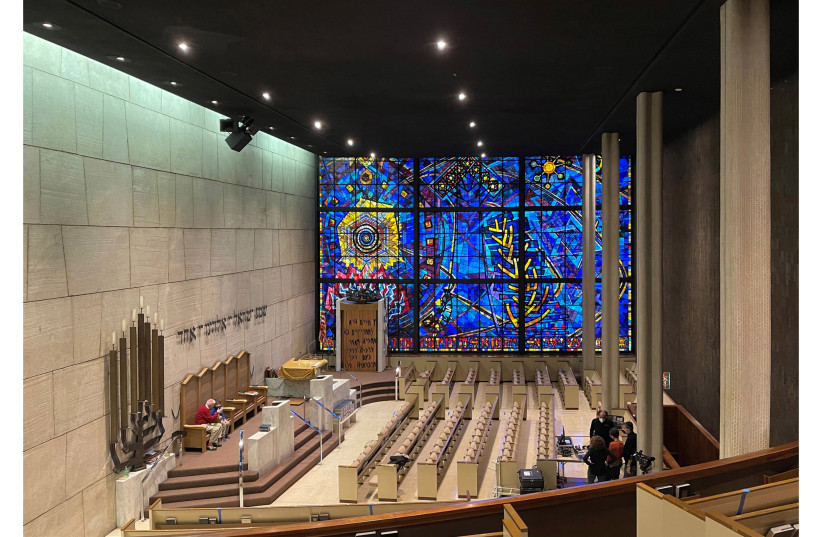
The
expansive interior of the Chicago Loop Synagogue includes its famous
stained-glass window. Synagogue leadership hopes to turn the
congregation, which has fallen on hard times, into a showcase for
similar congregation windows
The
movement has embarked on at least $137 million in real estate projects
since the start of the Covid-19 pandemic, according to numbers compiled
by Chabad.org and reviewed by the Jewish Telegraphic Agency.
In
Greenwich, Connecticut, the local Chabad paid $20 million to take over
the site of a Jewish day school that closed last year. In Durham, North
Carolina, a $3 million renovation of a historic inn — supported in part
by Sarah Bloom Raskin, the Duke University law professor who is married
to U.S. Rep. Jamie Raskin — was dedicated last week. And the Chabad at
the University of Illinois is spending more than $7 million to own and
renovate a massive Tudor-style fraternity house.
Because
the thousands of Chabad emissaries around the world fundraise
independently, Chabad’s news and public relations arm had to collect the
data by gathering media reports and by carrying out an informal survey,
according to Rabbi Motti Seligson, a Chabad spokesperson.
The
survey turned up a number of capital projects that have not yet been
publicly announced, including some purchases that are underway now.
Seligson said the true extent of Chabad’s recent real estate expansion
is likely much larger than the $137 million figure indicates.
But
he said he wanted to release the information he had in conjunction with
the 38th annual International Conference of Chabad-Lubavitch
Emissaries, which takes place this week in-person in and around
Brooklyn, New York. as well as virtually.
“We
were doing an exploration of Chabad’s impact and growth to examine the
effectiveness of various programs through this difficult time of the
pandemic,” he said. “These numbers came into sharp focus as we looked at
the level of engagement and our institutional and infrastructure
growth.”
Seligson
also pointed out that during the pandemic, Chabad minted 250 new
emissary couples who went out to serve existing Chabad centers or
establish new ones.
Even
before the pandemic growth spurt, Chabad had already engaged some 37%
of American Jewish adults in activities, according to recent survey data
from the Pew Research Center.
Over
the past 20 years, the number of Chabad synagogues in the United States
has nearly tripled, reaching 1,036 in 2020, according to a tally by
Joel Kotkin, a Chapman University professor who studies demographic
trends, and independent researcher Edward Heyman. Over that same period,
the overall number of synagogues declined by 29%.
“While
their secular counterparts are shrinking, the Hasidim and other more
traditionally observant Jewish communities in America are experiencing a
surge of growth,” Kotkin and Heyman wrote in a Tablet magazine article
analyzing their data.
While many Hasidic
groups are growing primarily through procreation, Chabad, focused as it
is on outreach, appears to be picking up a significant chunk of the
Jews who have disaffiliated from the Reform or Conservative movements or
who have never had much of an institutional affiliation to begin with.
In its recent survey, Pew estimated that among Chabad participants, 24%
are Orthodox, while 26% are Reform, 27% are Conservative, and 16% don’t
identify with any particular branch of Judaism.
“In
the present the core social needs of the Jewish world are filled by two
kinds of organizations: One is Chabad, which is expanding rapidly and
offers a full gamut of services,” Kotkin and Heyman wrote. (The other
kind of organization is the local Jewish federation and its affiliated
Jewish community centers.)
As
Chabad proliferates, it is finding among the Jews it serves many
willing donors. Sometimes, individual contributors like the Preisses in
Chicago play an outsized role, but their gift was accompanied by
$500,000 in small donations, according to Chabad.org.
In
comments to Chabad.org, the Preisses explained why they gave to Chabad.
“They focus on each mitzvah without criticizing. They’re so welcoming,”
said Jacques Preis, who was raised Reform. “It’s not a diluted
Judaism,” said Evelyn, his wife.
“Much
of the funding for these campaigns is raised locally from people whose
lives are personally enriched by Chabad in their community,” Seligson
said. “They represent people from large donors to large numbers of small
donors like college students who are committed to supporting Jewish
life and programs that inspire them with whatever they can based on
their means.”
Jailed rabbi Berland arrested in connection with murders linked to Hasidic cult
Convicted sex offender currently serving time
for fraud;he is detained in prison over alleged link to decades-old
murder of man and suspected murder of missing teen
Eliezer Berland shrouds himself with his talit (prayer shawl) at the
Magistrates Court in Jerusalem, as he is put on trial for sexual assault
charges
Jailed sex offender Rabbi Eliezer Berland was arrested Monday in
connection with decades-old homicide cases linked to his extremist
ultra-Orthodox sect, according to multiple Hebrew-language reports.
Berland entered prison last week after he was convicted of fraud in June, in a plea deal that saw him sentenced to 18 months.
He was arrested and questioned at the Nitzan Prison in Ramle.
His wife, Tehillah Berland, was later also detained by police for questioning in Jerusalem.
The rabbi, who has not been formally identified by authorities as the
individual arrested on Monday, becomes the 11th person detained
recently over the suspected murder of a teenage boy and the unsolved
murder of a man in the 1980s and 1990s.
Most details of the investigation are under a gag order that is in place until the end of the year.
The investigation into the disappearance and suspected murder of
17-year-old Nissim Shitrit and the murder of 41-year-old Avi Edri is
tied to the Shuvu Bonim sect, run by Berland.
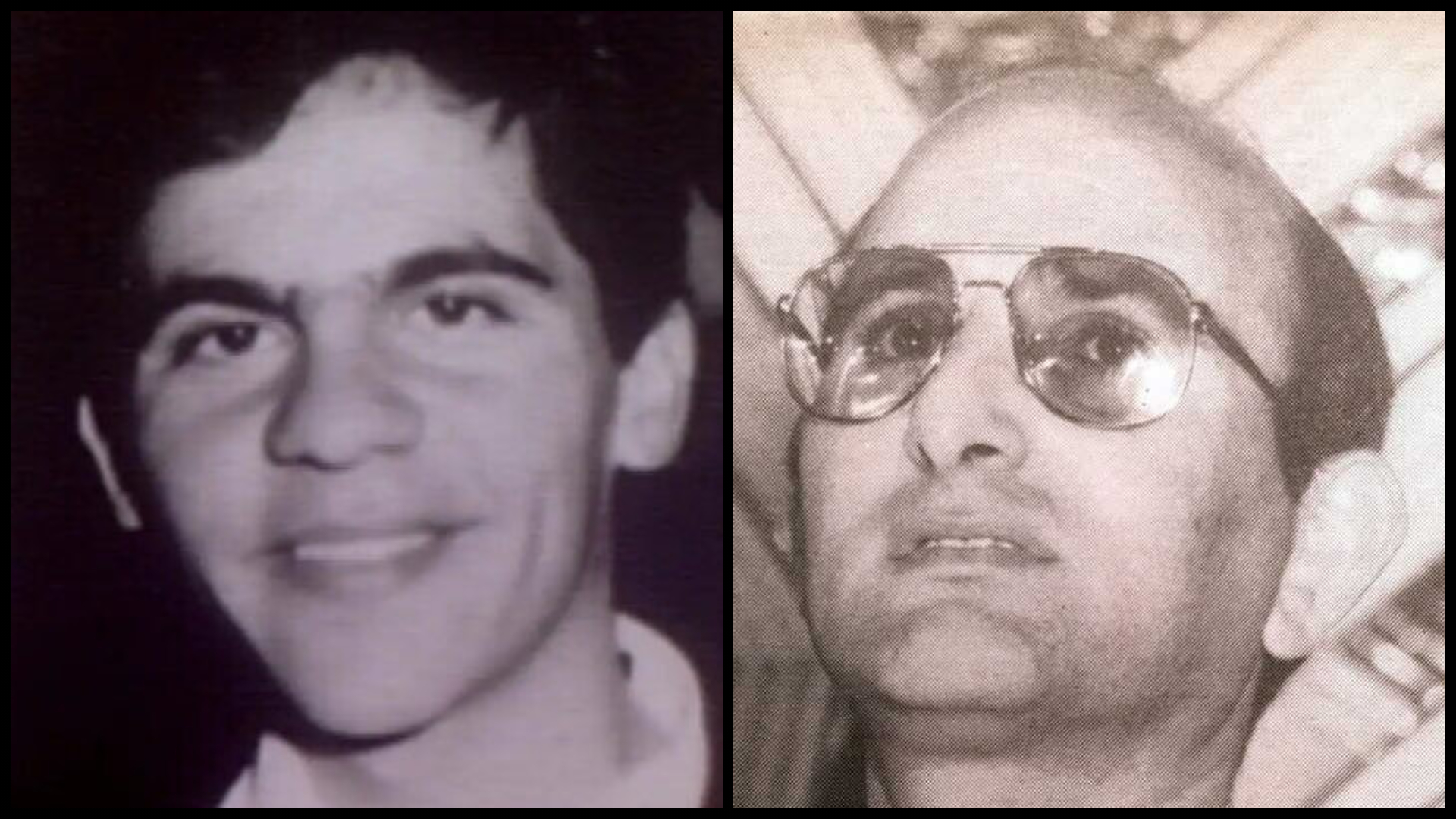
Nissim Shitrit (L) and Avi Edri in undated photos
One of those arrested earlier this month was the husband of a woman
who has told police she was forced by sect members to lure one of the
victims to a specific location. An attorney for the woman has said that
her client was a victim of the extremist sect, and is cooperating with
police in order to see justice done.
Another suspect is reportedly the son of a former senior government minister.
Police have previously said that some of those arrested were
questioned over allegations of kidnapping, murder, and conspiracy to
commit a crime. Not all are suspected of direct involvement in the
killings.
Shitrit was allegedly beaten by the sect’s “religious police” four
months before he was last seen in January 1986. In a documentary
released by Kan in 2020, one of Berland’s former disciples said that the
religious police murdered the boy, dismembered him and buried his body
in Eshtaol Forest near Beit Shemesh. His remains were never found and
the case was never solved.
Edri was found beaten to death in Ramot Forest in the north of Jerusalem in 1990.
The cult-like Shuvu Bonim offshoot of the Bratslav Hasidic sect has
had repeated run-ins with the law, including attacking witnesses.
Police guard followers of Rabbi Eliezer
Berland waiting for his arrival at the Nitzan Prison in Ramle, on
October 28, 2021
Berland fled Israel in 2013 amid allegations that he had sexually
assaulted several female followers. After evading arrest for three years
and slipping through various countries, Berland returned to Israel and
was sentenced to 18 months in prison in November 2016, on two counts of
indecent acts and one case of assault, as part of a plea deal that
included seven months of time served. He was freed just five months
later, in part due to his ill health.
Berland was arrested for fraud in February 2020, after hundreds of
people filed police complaints saying that he had sold prayers and pills
to desperate members of his community, promised families of individuals
with disabilities that their loved ones would be able to walk, and told
families of convicted felons that their relatives would be freed from
prison.
The 18-month sentence he is currently serving was set to include the
year he spent in jail before being released to house arrest in February
of this year.
Ten years after the Sandusky scandal, what did Penn State — and the nation — learn?
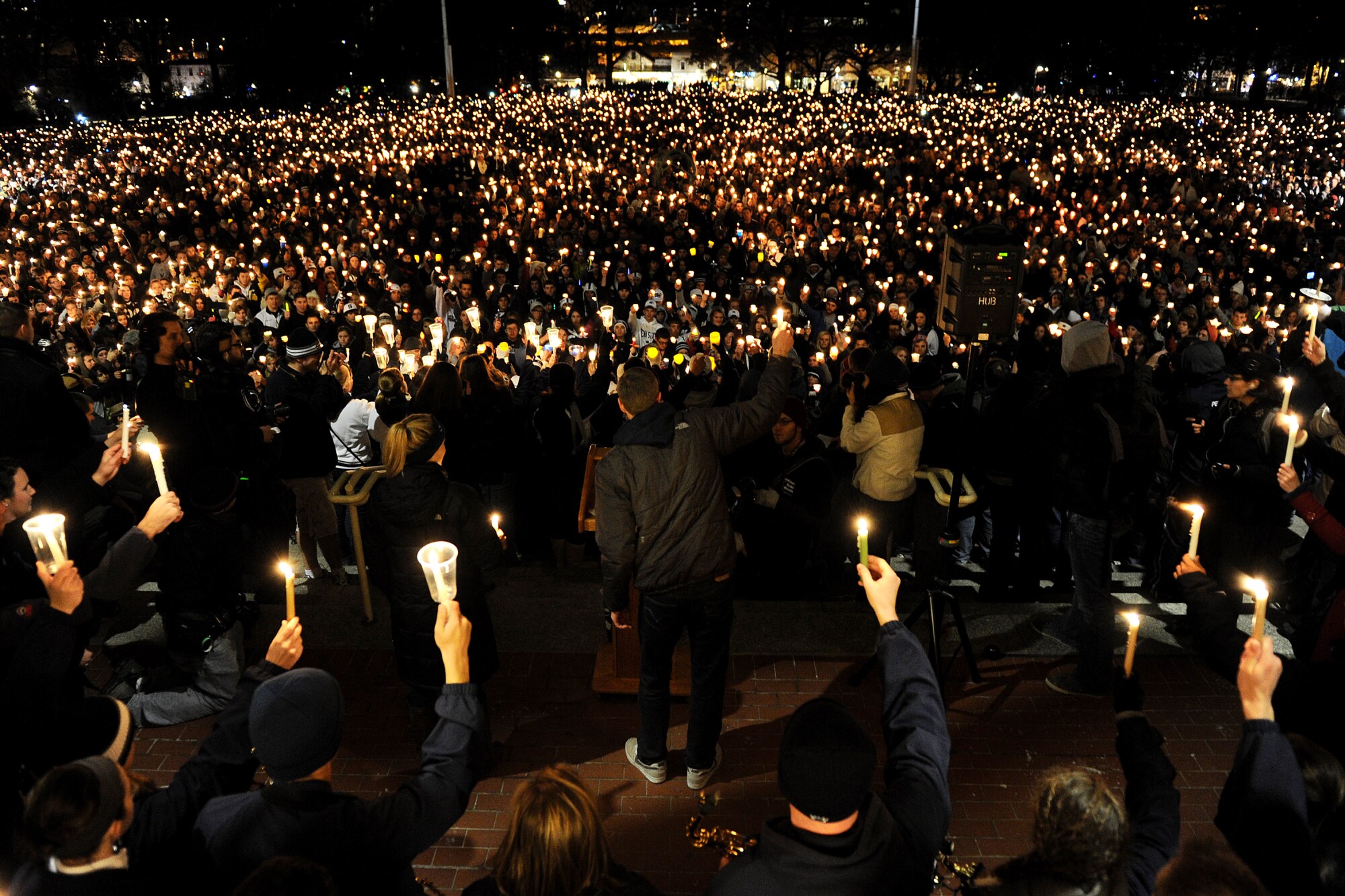
Penn State students hold a candlelight
vigil for victims in the Jerry Sandusky sexual abuse scandal on Nov. 11,
2011 in State College, Pa.
PITTSBURGH —
Before
and after football games at Penn State, many in the crowd of
100,000-plus at Beaver Stadium join to sing the university’s alma mater.
It’s a tradition meant to promote unity and school pride.
When
2011 graduate Michael Oplinger attended games in recent years, he
noticed something different about the inflection people bring to a
single line in the song, written more than a century ago.
“There’s
a line that says, ‘May no act of ours bring shame, to one heart that
loves thy name,’ ” said Oplinger, a high school teacher in Camden, N.J.
“People put more emphasis on that line now. It’s deliberate. It’s hard
to think of a more shameful act than what Jerry Sandusky did.”
The former Penn State assistant football coach was arrested
in Centre County, Pa., on Nov. 5, 2011, on charges of molesting eight
boys he had met through his Second Mile charity over a span of more than
a decade. Some of the assaults occurred at Penn State’s football
building, to which Sandusky still had access after his retirement in
1999.
The scandal that unfolded 10 years ago this month had a
profound effect on countless lives, none more so than those of the boys
Sandusky abused. Within a year, Sandusky received what amounted to a life sentence in prison, the NCAA imposed unprecedented sanctions on Penn State, and major college football’s winningest coach had been unceremoniously fired.
Yet
it’s difficult to assert that the punishment served as a deterrent.
Sexual abuse scandals have continued to surface at major universities
around the country — including in Los Angeles.
In
terms of the immediate fallout from Sandusky’s indictment, no event was
more momentous than Penn State’s dismissal of the legendary Joe Paterno,
who had worked at the university for 61 years and was head coach for 46
seasons. Although prosecutors made clear that Paterno would not face
charges, critics said he should have done more to stop Sandusky, particularly after being alerted to a 2001 assault at the football building.
Penn State coach Joe Paterno, right,
poses with defensive coordinator Jerry Sandusky during the team’s media
day Aug. 6, 1999, in State College, Pa.
Four days after Sandusky’s arrest, the Penn State board of trustees fired the 84-year-old Paterno.
The coach had announced earlier that day he would retire at the end of
the season, but the trustees said they had to act immediately.
When news of Paterno’s dismissal broke, some students took to the streets of State College in anger.
“It
was a chaotic, confusing time,” said Lexi Belculfine, who was editor in
chief of the Daily Collegian, Penn State’s student-run newspaper.
“After the board of trustees meeting, the anger and frustration boiled
over.”
Reporters were hit with tear gas, lamp posts were ripped down and a news van was flipped over, Belculfine said.
Penn State students Ryan Smith, Brennan
Pankiw and Jared Hook clean up broken glass and debris along East
College Avenue in the early morning hours on Nov. 10, 2011, in State
College, Pa.
Paterno
rejects allegations that his father had heard whispers that Sandusky was
molesting boys and ignored them to protect the high-profile football
program.
“I’ve known Jerry Sandusky for pretty much my whole
life,” he said. “I knew him as a churchgoing, non-drinking guy who was
married and ran a charity that helped a lot of kids.
“My kids were
around him. I was around him all the time when I was a kid. Do you
honestly think we would have allowed that to happen if we had any idea
of what kind of person he really was?”
“One
of the last notes he wrote before he went to the hospital for the last
time, and he never came home, was that hopefully the silver lining is
that something good would come out of this,” Jay Paterno said.
In June 2012, a jury found Sandusky guilty of 45
counts of child sexual abuse. Still proclaiming his innocence, the
68-year-old former coach was sentenced that October to 30 to 60 years in
state prison.
In July, a team led by former FBI Director Louis
Freeh released a report commissioned by Penn State’s board of trustees.
It concluded that Paterno, fired university President Graham Spanier
and two other high-ranking administrators had actively concealed the
allegations against Sandusky to protect the football program.
Spanier and the other administrators — former athletic director Tim Curley and vice president Gary Schultz — served time in jail.
When they were sentenced in 2017, judge John Boccabella castigated them
for not reporting Sandusky to the police. He did not spare Paterno.
Penn State president Graham Spanier,
left, and football coach Joe Paterno chat before a game against Iowa on
Oct. 8, 2011, in State College, Pa.
Paterno “could have made that phone call without so much as
getting his hands dirty,” Boccabella said. “Why he didn’t is beyond me.”
Eleven
days after the Freeh report was released, the NCAA announced sanctions.
It levied a fine of $60 million against Penn State, banned the team
from postseason play for four years and reduced its football
scholarships for that span. It also vacated all of Penn State’s football
victories from 1998 to 2011, costing Paterno 111 wins, and put the
program on probation for five years.
However, the NCAA retreated from the sanctions in 2015
after a judge questioned whether it had the authority to impose them.
Paterno’s wins were restored, making him again the all-time leader in
major college football. The entire $60 million would be spent in
Pennsylvania on programs to treat and prevent child sexual abuse, and
the scholarship limits and ban on bowl games were rescinded.
Penn
State and the NCAA instituted reforms to fight child abuse, sexual
misconduct and unethical actions. Today, university officials stress the
progress Penn State has made in improving safety, reporting
expectations, background checks, and ethics and compliance. The board of
trustees instituted a code of conduct that anyone remotely connected
with athletics must follow.
“It’s not talked about as frequently now, but it’s not as though everything is healed now, either.”
“The code of conduct applies to all coaches, managers and
student-athletes of NCAA-sanctioned Division I intercollegiate athletics
teams; university employees directly involved with intercollegiate
athletics teams; the university board of trustees; the president of the
university; and all members of the athletic director’s executive
committee,” Penn State spokesman Lawrence Lokman said.
The Penn State football program has rebounded
from the Sandusky scandal, although it has yet to be chosen for the
College Football Playoff. Coach James Franklin, in his eighth season at Penn State,
led the Nittany Lions to the 2016 Big Ten Conference title and had the
team ranked as high as No. 4 in this season’s Associated Press poll. The
board of trustees voted this year to spend $48 million on renovations
to the football building.
But Penn State’s continued success, leading to packed houses at
Beaver Stadium and appearances on national television, might add to the
pain of the boys — now men — Sandusky abused, particularly if they
still live in central Pennsylvania, where coverage of the Nittany Lions
is ubiquitous.
“Healing is a long-term process, and when life is
back to normal for everyone else but your life is still in upheaval, it
can be really hard,” said Anne Ard, executive director of Centre Safe in
State College, which provides counseling and advocacy to victims of
sexual and domestic violence.
Those Sandusky preyed on already faced a struggle because of the coach’s celebrity in the region, Ard said.
“This guy was a prominent member of the community, a beloved
coach in this famous football program,” she said. “A victim might say,
‘Who’s going to believe me?’ You bet Jerry Sandusky used that to his
advantage.”
The architect of Penn State’s vaunted defense
for more than 20 years, a man who helped the team win two national
championships and acquire the nickname “Linebacker U,” today resides in a
cell at State Correctional Institution — Laurel Highlands outside
Somerset, Pa., about 85 miles southwest of the university campus. He is
Inmate KT2386, 77 years old and not eligible for parole for about 21
more years.
Former Penn State assistant football
coach Jerry Sandusky arrives at the Centre County Courthouse on Nov. 22,
2019, for resentencing on his 45-count child sexual abuse conviction.
The damage Sandusky caused from his crimes is incalculable,
starting with an unknown number of boys whose innocence he stole. Penn
State, his alma mater and employer for three decades, suffered a
terrible blow to its reputation and has paid out over $100 million to
more than 30 victims. In addition, the decision to fire Paterno caused
deep divisions in the Penn State community.
“It
changed how we see the world and how we view authority and how we take
care of each other,” Belculfine said of herself and her classmates.
“When I think about that time, what stands out is the importance of
putting people who need help first.”
Sandusky’s crimes, along with
the scandals at other universities since then, have made more people
attuned to the issue of sexual abuse of young people. That is certainly
the case in Centre County, Ard said.
“Could we say categorically that something
like [the Sandusky scandal] isn’t happening right now at another
university? I don’t think we can say that.”
University of San Francisco vice president of operations Donald Heller
“I believe that we’re a much wiser community now,” she said.
“We’ve probably trained 10,000 people on looking for the signs of and
preventing child sex abuse, and that training continues. But we have to
realize that there are still sexual predators out there and we have to
be vigilant.”
Donald Heller, vice president of operations
and a professor of education at the University of San Francisco, taught
at Penn State in 2011 and has consulted on higher education policy
issues with university systems around the country.
Like virtually
everyone else at Penn State, Heller was stunned by the allegations
against Sandusky — and the university’s lack of an immediate response.
“It
was a systematic failure in the university,” he said. “As someone who
had worked with the leadership of the university on a number of issues,
it was disappointing. We wanted to see the leadership step up and
comment in support of the victims and they did not.”
In 2016, an investigation by the
Indianapolis Star led to a physician from Michigan State who had long
worked for USA gymnastics, Larry Nassar,
being implicated in sexual assaults of girls and young women going back
decades. Some of Nassar’s victims said that they had reported his abuse
to Michigan State officials and trainers over the years and the
university had not investigated.
“My reaction [to the Nassar
scandal] was one of horror, because of the allegations and the sheer
number of women who were victimized,” Heller said.
“Could we say categorically that something like [the Sandusky
scandal] isn’t happening right now at another university?” Heller said.
“I don’t think we can say that.”
Sex offender rabbi Berland begins fraud sentence as followers mass outside jail
The disease of blind faith in sub-humans on full display!
Shuvu Bonim leader goes to prison for selling
fake cures to desperate members of community; supporters hold all-night
prayer session
Police
guard followers of Rabbi Eliezer Berland waiting for his arrival at
the Nitzan Prison in Ramle, on October 28, 2021
Convicted sex offender Rabbi Eliezer Berland entered prison on
Thursday to serve out a fresh sentence for fraud, after he swindled his
sick and elderly followers out of millions of shekels.
Around a thousand of his supporters gathered outside the prison from Wednesday evening to protest his conviction.
Berland and his extremist Shuvu Bonim sect returned to the spotlight
this month with a number of arrests in connection with the suspected
murder of a teenage boy and the unsolved murder of a man in the 1980s
and 1990s.
Berland started his jail term on Thursday after he was convicted of
fraud in June, in a plea deal that saw him sentenced to 18 months. The
sentence will include time already served as Berland spent a year in
jail before being released to house arrest in February of this year.
Berland was arrested in February 2020, after hundreds of people filed
police complaints saying that he had sold prayers and pills to
desperate members of his community, promised families of individuals
with disabilities that their loved ones would be able to walk, and told
families of convicted felons that their relatives would be freed from
prison.
In the arrest raid, dozens of boxes of powders and pills were found
at Berland’s home that were given to supplicants as “wonder drugs.”
Laboratory checks revealed them to be over-the-counter pain medication
and candy, including Mentos.
Rabbi Eliezer Berland arrives for a hearing at the Jerusalem District court on February 28, 2020.
At the time of his sentencing, the judge ruled that Berland’s
offenses were “committed systematically and out of greed, taking
advantage of the complainants at their most difficult time during
periods of crisis.”
Berland’s supporters gathered outside the Nitzan Prison in Ramle on
Wednesday evening, where they held a protest and all-night study and
prayer session, surrounded by heavy police presence.
Supporters and followers of Rabbi Eliezer
Berland protest outside Nitzan Prison in Ramle, on October 27, 2021
The supporters will additionally set up a protest tent near the jail,
while Berland’s lawyers have said they will request that he be quickly
released for good behavior and cooperation, the Walla news site
reported.
Berland is starting his sentence as police make apparent progress in
the investigation into the suspected murder of a teenage boy and the
unsolved murder of a man connected to his sect, with the arrest of eight
suspects, reportedly including the son of a former senior cabinet
minister.
Supporters of Rabbi Eliezer Berland protest outside Nitzan Prison in Ramle, on October 27, 2021
According to the Kan public broadcaster, law enforcement are probing
whether Berland was personally involved in the disappearance and
suspected murder of 17-year-old Nissim Shitrit and the murder of
41-year-old Avi Edri.
Shitrit was allegedly beaten by the sect’s “religious police” four
months before he was last seen in January 1986. In a documentary
released by Kan in 2020, one of Berland’s former disciples said that the
religious police murdered the boy, dismembered him and buried his body
in Eshtaol Forest near Beit Shemesh. His remains were never found and
the case was never solved.
The second murder reportedly connected to the arrested suspects was
of Edri, who was found beaten to death in Ramot Forest in the north of
Jerusalem in 1990. Kan reported that Edri’s murder was tied to Shuvu
Bonim by former disciples. It too has remained unsolved for over 30
years.
Nissim Shitrit (L) and Avi Edri in undated photos (Courtesy)
The cult-like Shuvu Bonim offshoot of the Bratslav Hasidic sect has
had repeated run-ins with the law, including attacking witnesses.
Berland, its leader, fled Israel in 2013 amid allegations that he had sexually assaulted several female followers.
After evading arrest for three years and slipping through various
countries, Berland returned to Israel and was sentenced to 18 months in
prison in November 2016, on two counts of indecent acts and one case of
assault, as part of a plea deal that included seven months of time
served. He was freed just five months later, in part due to his ill
health.