As Russia wages war against Ukraine, This rabbi starts wearing special clothes for welcoming Messiah - - Dardanelles Strait, happens to be in Turkey Rabbi!
Russia
has officially waged war against Ukraine. Russian security officials
announced that they have successfully attacked Ukraine’s air defense
systems. neutralizing the infrastructure of Ukrainian Air Force bases as
smoke can be seen billowing from a Ukrainian military airport in
Chuguev. Ukraine also reported that enemy Russian forces have completed
seized control of two villages in the country’s east as underground
subways have been converted into bomb shelters.
And while the fear of war has sent many people scrambling for safety,
one rabbi is making preparations for the Messiah’s imminent arrival.
Rabbi Elya Ber Wachtfogel, principal of Yeshiva (seminary) Gedolah Zichron
Moshe of South Fallsburg, New York donned formal clothing only worn on
Shabat (Sabbath) clothing last week when he heard the news of the
movement of Russian warships through the Dardanelles River. The response
of the rabbi is based on the Zohar whose Kabbalistic teachings reveal
that when the Russians will cross the Dardanelles River, it will trigger
the start of a series of events before the Messiah comes.
The significance of wearing Shabbat clothes to welcome the Messiah
was initially proclaimed by the iconic rabbi – the Vilna Gaon who said
that the Jewish people need to wear Shabat clothes when the Messiah is
about to arrive.
Rav Elya Ber recently told a talmid, “I’ve been waiting for this moment for 70 years.”
Rav Elya Ber Wachtfogel, rosh yeshiva of Yeshiva Gedolah Zichron Moshe of South Fallsburg, put on Shabbos clothing last week when he heard news of the movement of Russian warships. The response of the rosh yeshiva is based on a Kabbolah that he has that when the Russians will cross the Dardanelles River, it will trigger the start of a series of events before Moshiach comes, and therefore, in his words, “Men ken shoin untun Shabbosdike kleider.”
Rav Elya Ber recently told a talmid, “I’ve been waiting for this moment for 70 years.”
Those close to Rav Elya Ber that he first heard this kabbolah when he was 10 years old from his father, the mashgiach,
Rav Nosson Wachtfogel. Rav Nosson heard it from Rav Doniel Movoshovitz
of the Kelmer Talmud Torah, who heard it from the Alter of Kelm, who
heard it from someone who heard it from Rav Chaim Volozhiner, who heard
it from the Vilna Gaon.
Dardanelles (Çanakkale Boğazı) is located in Turkey
The situation now: Ukraine’s government said it faced
“a full-scale attack from multiple directions.” Shelling and missile
strikes were reported across the country. Follow our live coverage. NYT
שר התורה רוצה את העניבה שלי?תגיד כבר משהו משמעותי--- The Sar HaTorah wants my necktie? Say something significant already!
Black Ties Matter - That's It!
עניבות שחורות חשובות--זֶה הַכֹּל.
The Haredi leadership: Crime and its punishment
'We believe victims' fliers placed on billboards of a Haredi neighborhood on December 31, 2021.
The Chaim Walder affair is not “just” a shocking case of a
prominent public figure, a Haredi educator, whose shame, hypocrisy, and
wickedness were exposed — there are many such cases, in all sectors. Nor
is it “just” a reminder of the extent of the life shattering phenomenon
of sex offenses in the Haredi sector — these are, unfortunately, common
everywhere. The affair has the real potential to effect fundamental
change in the fabric of Haredi society.
The Haredi sector’s remarkable growth since the founding of the
state is the result of a successful strategy adopted by its leaders.
First, self-segregation from Israeli society on all levels of life and
fortification behind “walls of holiness.” Second, providing an
alternative to civic leadership through the glorification of a
rabbinical leadership whose authority derives, ostensibly, from a
heavenly source.
The meticulous self-segregation and stringent adherence to leadership directives that boast da’at Torah
(infallible religious authority) have been a force multiplier vis-à-vis
Israeli society. They have enabled the Haredim, against all odds, to
preserve their unique identity, and, at the same time, become a major
factor in Israeli society. But nothing lasts forever. The Haredi
strategy, with its two components, is rapidly losing its power.
Self-segregation is made possible through control over the shaping of
communal consciousness. In recent years, however, dictators of the hashkafa tehora
or “pure view” in the community’s synagogues and yeshivot, in its
sectoral press and street-posted broadsides, have encountered a
formidable adversary — the Internet. This is a modern Tree of Knowledge,
available to everyone. Haredim can choose whether to bite into the
apple (or the device of a competing company).
It turns out that they are
gulping with gusto: about two-thirds of them are connected to the Internet. A mighty digital battering ram is striking the walls and
undermining their stability.
And then comes the Chaim Walder affair, which puts the second
component of the Haredi strategy — the leadership — to the test: The
paragon of Haredi education, a figure known and admired by the entire
community, turns out to be a sexual predator. The blood of his many
victims is boiling. This was not an unconventional Haredi like Yehuda
Meshi Zahav, the disgraced founder and chairman of ZAKA who was
similarly accused of rape and sexual assault within the Haredi
community, but rather a role model for the community — a decades-long
spokesman for the “pure view” in the Lithuanian Haredi newspaper Yated Ne’eman. The crisis is huge. How will the leadership respond?
Some of the leadership looked this religious and moral evil in the eye, and averted its gaze. Yated Ne’eman has used the honorific acronym “zt”l”
(his righteous memory should be a blessing) in regard to this man with
blood on his hands. One of the most revered Lithuanian rabbis accuses
those who revealed Walder’s wrongdoing of murder. This outrageous
inversion of the truth is a sin that will bring its own punishment.
The sin is easy to identify: the Haredi leaders who are abandoning Walder’s victims are violating an explicit prohibition: lo ta’amod al dam re’echa
— “Do not stand idly by while your brother’s blood is at stake.” The
Torah sets a standard for the moral conduct of religious leadership in
the case of the egla arufa — the decapitated calf. It says that
if the corpse of a murdered person is found in a public area and it is
not known who the killer is, the local leadership — the “elders” of the
nearest city — are responsible for conducting an atonement ritual and
declaring “Our hands did not shed this blood, nor did our eyes see it.”
The Sages ask: “Would it ever enter our minds that the elders of the
Beit Din (tribunal) were murderers?” However, because the crime took
place “on their watch,” they are required to perform an educational and
moral act of purification. Such measures are called for all the more in
the Walder affair when the criminal’s identity is known and when he
himself is regarded as a leader of that community.
And now for the punishment: the Haredi public recognizes the sin.
The fraudulent crime of some of the Haredi leadership, having
surrendered to their fears, is clear to its adherents. Brave glimmers of
this recognition can be seen everywhere – Mishpacha Magazine and Radio Kol Chai are especially worthy examples.
Rabbi Saadia Gaon (in the 10th century), explaining the
responsibility placed on the elders of the nearby city,
states that “just as it is proper to castigate one for doing what he
ought not have done, so should he be castigated for neglecting to do
what should have been done.” The elders described in the Bible neglected
their duty to safeguard the murder victim. Today’s elders are
neglecting their duty to protect the victims.
The Haredi public is shaken; many understand, and strongly
support, what is written here. It may be that, alongside the suicide of
Chaim Walder, we are witnessing the “suicide” of some of the Haredi
leadership.
The WWII Massacres at Drobitsky Yar Were the Result of Years of Scapegoating Jews
The Drobitsky Yar menorah commemorates the genocide that happened in Kharkov, and across Ukraine.
In the winter of 1941, silence fell across the Jewish
communities of Ukraine, as one by one, they were snuffed out. “This
silence is more horrifying than tears and curses; it is a silence more
terrifying than moans and piercing lamentations,” wrote Soviet-Jewish
journalist Vassily Grossman
in 1943, after the Ukraine had been liberated by the Red Army. “In
Ukraine there are no Jews. Nowhere—Poltava, Kharkov, Kremenchug,
Bristol, Yagotin… A people has been murdered.” In the following years
the quietude would be amplified as the Soviet Union, recovering from the
ravages of war, disappeared the disappeared, never acknowledging the
Jewish lives taken from its lands.
When the Germans began their occupation of the Soviet Union in the
summer of 1941, around 2.5 million Jews were trapped in the region.
After the Nazi invasion, which was expedited by local collaborators, only 100,000 to 120,000 survived.
But for more than 50 years, the details of this brutal tragedy remained
largely unknown beyond the Iron Curtain. Little information was shared
with the outside world, and inside the Soviet Union, the truth was
suppressed. Instead of death by the Nazi system of concentration camps,
the genocide of the Soviet Union’s Jews was committed via a barrage of
bullets. Among the numerous massacre sites is Drobitsky Yar, a ravine
outside the eastern Ukrainian city of Kharkov where some 15,000 Jews
were shot or forced into mass graves to die of exposure. The horrific
murders began December 15, 1941 and continued through January 1942—all
in sight of Kharkov’s non-Jewish residents.
“People died basically just outside their homes, in pits and
forests,” says Izabella Tabarovsky, a scholar at the Kennan Institute, a
part of the Woodrow Wilson International Center for Scholars. “They
were killed in full view of their neighbors. If their neighbors did not
directly murder them, they certainly witnessed them.”
The conditions that led to Ukrainians supporting such violent action
against their countrymen began decades earlier, a tangled knot of
prejudice and conspiracies. According to Tabarovsky, the legacy of the
First World War, the Russian Revolution, and the Holodomor
(a forced famine that resulted in the deaths of millions of Ukrainians
in 1932-33) created enormous strife and instability. The conditions were
almost like a 20th-century version of the Thirty Years’ War (a series of religious wars that spread across Europe and resulted in millions of deaths), she says.
Although Jewish residents of the Ukraine experienced long stretches
of peaceful coexistence with their neighbors, they were also the most
systematically oppressed minority. In 1919 alone, around 1,300 pogroms
took place in the Ukrainian territories, resulting in 50,000 to 60,000
deaths and 1 million displaced people, Tabarovsky says. When the
Bolsheviks instituted programs to promote minority culture and
representation in government, some Jews rose out of poverty and into
relatively stable careers. There were Jewish books and theater, Jews in
government positions. The sudden increase in visibility led to further
suspicion and unhappiness, which quickly spiraled into a Judeo-Bolshevik
conspiracy theory linking Jews with the communist government that
enacted murderous policies including the Holodomor.
By the time
World War II had begun, some Ukrainians initially looked to the Germans
as liberators. They welcomed the destruction of the Jews, who represented all the ills that had befallen them since the country was subsumed into the Soviet Union. By October 24, 1941, the German soldiers had crossed Ukraine and captured the eastern city of Kharkov. The Germans latched onto the Jews-as-Communists narrative, ordering the deaths of anyone who fit either of those categories.
In the occupied city of Kharkov, a decree was posted on December 14
ordering that all Jews be evacuated or shot on the spot if they
resisted. Jewish citizens were identified by their neighbors, stripped
of their clothing and valuables, and forced to a factory where they were
held for weeks. Starting from the beginning, groups of Jews were
periodically marched out to the Drobitsky Yar ravine and murdered. Men,
women and children of all ages were killed.
Engineer S. S. Krivoruchko,
one of the few survivors of the Drobitsky Yar massacre, described being
marched to the ravine, which was “strewn with bits of rags and the
remains of torn clothing… On the edge of the ravine stood a truck with
machine guns. Terrible scenes erupted when people understood that they
had been brought here to be slaughtered.”
Decades later, forensic experts uncovered 13 grave-pits
around Kharkov. The corpses in these mass graves lay “in extreme
disorder, fantastically intertwined, forming tangles of human bodies
defying description.” Their work showed that the Germans had used
bullets and carbon monoxide poisoning and fire to kill thousands of
Jews, horrible acts of murder that would have been known to Kharkov’s
residents. As historian Timothy Snyder writes,
“The Judeo-Bolshevik myth separated Jews from Soviet citizens and many
Soviet citizens from their own pasts. The murder of Jews and the
transfer of property eliminated the sense of responsibility for the
past.”
This forced distancing from the past and the truth continued even
after the Ukraine was recaptured by the Soviet army. Stalin erected
monuments, but only recognized the victims as peaceful Soviet citizens;
their Jewish ethnicity was completely ignored. Part of this was
undoubtedly due to anti-Semitism. Stalin once told Franklin D. Roosevelt
that Jews were “middlemen, profiteers, and parasites.”
But another part of this suppression had to do with creating the myth
of a singular, national identity for all members of the Soviet Union.
They needed stability and unity, or the nation would fracture.
Tabarovsky, who grew up in Russia during the Soviet period, never
even learned about the Holocaust in school, though she later grew to be a
scholar on the subject.
“Cities [in the Ukraine] used to be 70 percent Jewish, 80 percent
Jewish,” Tabarovsky says. “You come to the remnants of a Jewish cemetery
and kids wander there and have no idea what it is. That is like the
memory of an entire people is erased.”
And Tabarovsky says that although modern Ukraine is very supportive
of Israel, they aren’t taking the time to go back through the past and
understand what it means today. Tabarovsky says the only way to heal
from this history of silence and suppression is for Ukraine to revisit
the past. She believes the country could look to Germany as a model for
reconciliation, even though it will mean unearthing old, painful
problems.
“The way you deal with the past determines what kind of society you
have in the moment,” Tabarovsky says. “If you don’t address the root
causes of what happened in the past, then what’s to prevent you from
recreating that in the future?”
The amazing thing that eating 10 prunes a day does for your body.
Many people think prunes are a sure cure for constipation, yet
they have several other important benefits, especially for
postmenopausal women. How many prunes should be eaten every day?
Prunes,
which are dried plums, sound like something you eat on Tu Bishvat or
when constipated, but researchers at Penn State University suggest older
menopausal women should consider eating several prunes daily. Their study found that prunes can help prevent or delay bone loss in older women.
The
authors of the study published in the journal Advances in Nutrition
claim that prunes can reduce physical inflammation and oxidative damage,
both of which contribute to bone loss. "In postmenopausal women, lower
levels of estrogen can trigger a rise of oxidative stress and
inflammation, increasing the risk of weakening bones that may lead to
fractures," said Dr. Connie Rogers, a professor of nutritional sciences
and physiologist who conducted the study. "Incorporating prunes into the
diet may help protect bones by slowing or reversing this process."
Osteoporosis,
a condition in which the bones become brittle and weak, is quite common
in women over the age of 50. Estimates show that about 200 million
women worldwide live with osteoporosis, with the condition causing
nearly 9,000,000 bone fractures annually. Several medications for
osteoporosis are now available, but researchers believe that more and
more women are looking for holistic ways to treat or completely avoid
the condition, especially through diet.
Prunes contain essential nutrients
The
human body works to maintain its bone health through an ongoing process
which constantly builds new bone cells while removing old bone cells.
However, around the age of 40, the breakdown of old bone cells begins to
surpass the production of new bone cells in the aging body. This
imbalance may result from various factors including inflammation and
oxidative stress.
It’s
important to clarify that oxidative stress isn’t connected to feelings
of stress or pressure. Oxidative stress refers to the imbalance between
the levels of free radicals and antioxidants in cells. Prunes are full
of minerals, dietary fiber, vitamin K and phenolic compounds and all of
these nutritional benefits may help fight the harmful effects of
inflammation and oxidative damage.
Ten prunes daily can strengthen bones
The
team analyzed data from 16 preclinical studies conducted in rodents –
for this study, ten preclinical studies and two human clinical trials.
In all these studies, the results remained almost the same. Eating
prunes led to two positive benefits: less oxidative stress/inflammation
and stronger bones.
Specifically,
clinical trials found that eating about ten prunes (100 grams) daily
for an entire year improved bone mineral density within the forearms and
lower spine.
Similarly,
consumption of between 50 and 100 grams of prunes daily for six months
prevented major bone density loss and lowered inflammation levels
significantly compared to other older women who didn’t eat prunes.
The
research team assumes that prunes cause healthier changes within the
gut microbiome, and subsequently lowers inflammation in the colon.
Such developments probably reduce the levels of pro-inflammatory
cytokines as well as oxidative damage markers. Further research is
already planned to more thoroughly investigate how eating prunes
consistently over the course of a year affects bone health, inflammation
and intestinal function.
Chief Rabbi Lau visits shiva of alleged rapist Chaim Walder - Haim Walder was a suspected child rapist and serial sex offender who killed himself to avoid investigation and trial.
Rabbi Lau should be fired today from his government job which is financed by taxpayers. This is just the latest example of the moral bankruptcy of the chief rabbinate.
Lau was photographed in a tent that was set up outside the Walder home for the shiva.
Ignoring Chaim Walder’s alleged victims, Chief Rabbi David Lau
visited the haredi (ultra-Orthodox) author’s home on Tuesday night to
comfort his family, who are sitting shiva.
Walder was found dead in a cemetery on Monday in what is suspected to have been a suicide. He was facing multiple allegations of rape and sexual assault of minors since a Haaretz expose last month.
Walder was a well-known author of children’s and young adults’ books in the haredi world. His series Kids Speak (in Hebrew, Yeladim Mesaprim al Atzmam) has sold more than two million copies in communities across Israel and the Diaspora.
WALDER RECEIVED A HERO'S FUNERAL BY THE HAREDI COMMUNITY
He was accused of raping minors and young adults, all of whom he met in his line of work as a therapist and children’s author.
Lau was photographed in a tent that was set up outside the Walder home for the shiva.
Lau’s
visit to the shiva drew condemnations across social media particularly
due to his silence on the Walder affair and not saying anything about
the author’s alleged victims. So far, more than 20 testimonies have been
brought to the rabbinical court in Safed that had convened to hear the
accusations.
Stop
the חילול השם. Morally and ethically, Israel can ill afford hereditary
taxpayer-funded sinecures for clerics. Do away with the State Rabbinate.
End divisive parochial control of Judaism in Israel. It would be a
blessing. Amen. https://t.co/fZhyxc6wie
Haim Walder was a suspected rapist and serial sex offender who killed himself to avoid investigation and trial.
Rabbi Lau should be fired today from his government job which is financed by taxpayers. This is just the latest example of the moral bankruptcy of the chief rabbinate.
The
haredi media also ignored the victims and reported on the death of
“Rabbi Haim Walder” without mentioning the severe allegations that were
brought against him.
COVID Won’t End Up Like the Flu. It Will Be Like Smoking.
Hundreds of thousands of deaths, from either tobacco or the pandemic, could be prevented with a single behavioral change.
It’s
suddenly become acceptable to say that COVID is—or will soon be—like
the flu. Such analogies have long been the preserve of pandemic minimizers, but lately they’ve been creeping into more enlightened circles.
Last month the dean of a medical school wrote an open letter
to his students suggesting that for a vaccinated person, the risk of
death from COVID-19 is “in the same realm, or even lower, as the average
American’s risk from flu.” A few days later, David Leonhardt said as much to his millions of readers in the The New York Times’ morning newsletter. And three prominent public-health experts have called for the government to recognize a “new normal”
in which the SARS-CoV-2 coronavirus “is but one of several circulating
respiratory viruses that include influenza, respiratory syncytial virus
(RSV), and more.”
The end state
of this pandemic may indeed be one where COVID comes to look something
like the flu. Both diseases, after all, are caused by a dangerous
respiratory virus that ebbs and flows in seasonal cycles.
But I’d propose a different metaphor to help us think about our tenuous
moment: The “new normal” will arrive when we acknowledge that COVID’s
risks have become more in line with those of smoking cigarettes—and that
many COVID deaths, like many smoking-related deaths, could be prevented
with a single intervention.
The pandemic’s greatest source of danger has transformed from a pathogen into a behavior.
Choosing not to get vaccinated against COVID is, right now, a
modifiable health risk on par with smoking, which kills more than 400,000 people
each year in the United States. Andrew Noymer, a public-health
professor at UC Irvine, told me that if COVID continues to account for a
few hundred thousand American deaths every year—“a realistic worst-case
scenario,” he calls it—that would wipe out all of the life-expectancy
gains we’ve accrued from the past two decades’ worth of
smoking-prevention efforts.
The
COVID vaccines are, without exaggeration, among the safest and most
effective therapies in all of modern medicine. An unvaccinated adult is
an astonishing 68 times more likely to die from COVID than a boosted one. Yet widespread vaccine hesitancy in the United States has caused more than 163,000 preventable deaths and counting. Because too few people are vaccinated, COVID surges still overwhelm hospitals—interfering with routine medical services and leading to thousands of lives lost
from other conditions. If everyone who is eligible were triply
vaccinated, our health-care system would be functioning normally again.
(We do have other methods of protection—antiviral pills and monoclonal
antibodies—but these remain in short supply and often fail to make their way to the highest-risk patients.) Countries such as Denmark and Sweden
have already declared themselves broken up with COVID. They are
confidently doing so not because the virus is no longer circulating or
because they’ve achieved mythical herd immunity from natural infection;
they’ve simply inoculated enough people.
President Joe Biden said in January that “this continues to be a pandemic of the unvaccinated,” and vaccine holdouts are indeed prolonging our crisis. The data suggest that most of the unvaccinated hold that status voluntarily at this point. Last month, only 1 percent of adults
told the Kaiser Family Foundation that they wanted to get vaccinated
soon, and just 4 percent suggested that they were taking a
“wait-and-see” approach. Seventeen percent of respondents, however, said
they definitely don’t want to get vaccinated or would do so only if
required (and 41 percent of vaccinated adults say the same thing about boosters). Among the vaccine-hesitant, a mere 2 percent say it would be hard for them to access the shots if they wanted them. We can acknowledge that some people have faced structural barriers to getting immunized while also listening to the many others who have simply told us how they feel, sometimes from the very beginning.
The same arguments apply to tobacco: Smokers are 15 to 30 times more likely to develop lung cancer. Quitting the habit is akin to receiving a staggeringly powerful medicine, one that wipes out
most of this excess risk. Yet smokers, like those who now refuse
vaccines, often continue their dangerous lifestyle in the face of
aggressive attempts to persuade them otherwise. Even in absolute
numbers, America’s unvaccinated and current-smoker populations seem to
match up rather well: Right now, the CDC pegs them at 13 percent and 14 percent of all U.S. adults, respectively, and both groups are likely to be poorer and less educated.
In
either context, public-health campaigns must reckon with the very
difficult task of changing people’s behavior. Anti-smoking efforts, for
example, have tried to incentivize good health choices and
disincentivize bad ones, whether through cash payments to people who quit, gruesome visual warnings on cigarette packs, taxes, smoke-free zones, or employer smoking bans. Over the past 50 years, this crusade has very slowly but consistently driven change: Nearly half of Americans used to smoke; now only about one in seven does. Hundreds of thousands of lung-cancer deaths have been averted in the process.
With COVID, too, we’ve haphazardly pursued behavioral nudges to turn the hesitant into the inoculated. Governments and businesses have given lotteries and free beers
a chance. Some corporations, universities, health-care systems, and
local jurisdictions implemented mandates. But many good ideas have
turned out to be of little benefit: A randomized trial in nursing homes
published in January, for example, found that an intensive
information-and-persuasion campaign from community leaders had failed to budge vaccination rates
among the predominantly disadvantaged and low-income staff. Despite the
altruistic efforts of public-health professionals and physicians, it’s
becoming harder by the day to reach immunological holdouts. Booster
uptake is also lagging far behind.
This
is where the “new normal” of COVID might come to resemble our
decades-long battle with tobacco. We should neither expect that every
stubbornly unvaccinated person will get jabbed before next winter nor
despair that none of them will ever change their mind. Let’s accept
instead that we may make headway slowly, and with considerable effort.
This plausible outcome has important, if uncomfortable, policy
implications. With a vaccination timeline that stretches over years, our
patience for restrictions, especially on the already vaccinated, will
be very limited. But there is middle ground. We haven’t banned tobacco
outright—in fact, most states protect smokers from job discrimination—but
we have embarked on a permanent, society-wide campaign of
disincentivizing its use. Long-term actions for COVID might include charging the unvaccinated
a premium on their health insurance, just as we do for smokers, or
distributing frightening health warnings about the perils of remaining
uninoculated. And once the political furor dies down, COVID shots will
probably be added to the lists of required vaccinations for many more
schools and workplaces.
To
compare vaccine resistance and smoking seems to overlook an obvious and
important difference: COVID is an infectious disease and tobacco use
isn’t. (Tobacco is also addictive in a physiological sense, while
vaccine resistance isn’t.) Many pandemic restrictions are based on the
idea that any individual’s behavior may pose a direct health risk to
everyone else. People who get vaccinated don’t just protect themselves
from COVID; they reduce their risk of passing on the disease to those
around them, at least for some limited period of time. Even during the
Omicron wave, that protective effect has appeared significant: A person
who has received a booster is 67 percent less likely to test positive for the virus than an unvaccinated person.
But the harms of tobacco can also be passed along from smokers to their peers. Secondhand-smoke inhalation causes more than 41,000 deaths annually in the U.S. (a higher mortality rate than some flu seasons’). Yet despite smoking’s well-known risks, many states don’t completely ban the practice in public venues; secondhand-smoke exposure in private homes and cars—affecting 25 percent of U.S. middle- and high-school children—remains
largely unregulated. The general acceptance of these bleak outcomes,
for smokers and nonsmokers alike, may hint at another aspect of where
we’re headed with COVID. Tobacco is lethal enough that we are willing to
restrict smokers’ personal freedoms—but only to a degree. As deadly as
COVID is, some people won’t get vaccinated, no matter what, and both the
vaccinated and unvaccinated will spread disease to others. A large
number of excess deaths could end up being tolerated or even explicitly
permitted. Noel Brewer, a public-health professor at the University of
North Carolina, told me that anti-COVID actions, much like anti-smoking
policies, will be limited not by their effectiveness but by the degree
to which they are politically palatable.
Without
greater vaccination, living with COVID could mean enduring a yearly
death toll that is an order of magnitude higher than the one from flu.
And yet this, too, might come to feel like its own sort of ending.
Endemic tobacco use causes hundreds of thousands of casualties, year
after year after year, while fierce public-health efforts to reduce its
toll continue in the background. Yet tobacco doesn’t really feel
like a catastrophe for the average person. Noymer, of UC Irvine, said
that the effects of endemic COVID, even in the context of persistent
gaps in vaccination, would hardly be noticeable. Losing a year or two
from average life expectancy only bumps us back to where we were in …
2000.
Chronic problems eventually yield to acclimation, rendering them relatively imperceptible. We still care for smokers when they get sick, of course, and we reduce harm whenever possible. The health-care system makes $225 billion
every year for doing so—paid out of all of our tax dollars and
insurance premiums. I have no doubt that the system will adapt in this
way, too, if the coronavirus continues to devastate the unvaccinated.
Hospitals have a well-honed talent for transforming any terrible
situation into a marketable “center of excellence.”
COVID is likely to remain a leading killer for a while, and some academics have suggested
that pandemics end only when the public stops caring. But we shouldn’t
forget the most important reason that the coronavirus isn’t like the
flu: We’ve never had vaccines this effective
in the midst of prior influenza outbreaks, which means we didn’t have a
simple, clear approach to saving quite so many lives. Compassionate
conversations, community outreach, insurance surcharges, even
mandates—I’ll take them all. Now is not the time to quit.
Benjamin Mazer is a physician specializing in laboratory medicine.
The Omicron surge
seems to be slowing in much of the world, but a subvariant that
scientists believe is even more contagious is on the rise, and a decline
in testing has muddled the global picture, the World Health
Organization said.
New cases worldwide dropped 19 percent from Feb. 7 to Feb. 13, compared with the week before, according to the agency.
The W.H.O. also said that the subvariant of Omicron, BA.2
appeared to be “steadily increasing” in prevalence and that BA.2 had
now become dominant in several Asian countries, including China, India,
Pakistan, Bangladesh and the Philippines. Denmark was the first nation
to report that BA.2 had overtaken BA.1, the version of Omicron that
first swept through the world.
Scientists have said there is no evidence that BA.2 is more lethal than BA.1, though BA.2 could slow Omicron’s decline. Vaccines appear to be just as effective against BA.2 as they are against other forms of Omicron.
The Omicron wave has yet to crest in what the agency calls the Western Pacific
region, which includes Oceania, the Pacific islands and East Asian
countries like China and South Korea that recently celebrated the Lunar New Year,
a holiday period that typically involves large family gatherings. Cases
in the region rose 19 percent last week, the W.H.O. reported.
In
the Pacific, two island nations that had no confirmed cases until
recently are now grappling with the arrival of the virus. In Tonga, an outbreak began after ships brought aid to help the country recover from a volcanic eruption and tsunami in January. And the Cook Islands reported its first case last week.
On Wednesday,
Maria Van Kerkhove, the W.H.O.’s Covid-19 technical lead, cautioned that
a drop in testing rates around the world has meant the reported global
case numbers might not reflect the true spread of the virus.
“We need to be careful about interpreting too much this downward trend,” she said. She said the bigger concern was the increase in reported deaths from Covid-19 for the sixth week in a row.
The W.H.O’s Eastern Mediterranean
region, which includes the Middle East, reported the most fatalities,
and the Western Pacific region reported the second-most, according to
the W.H.O.
“This
will not be the last variant, and the future of the pandemic is still
extremely uncertain,” said Dr. Carissa F. Etienne, the director of the
W.H.O.’s Pan American Health Organization, adding that “a new variant could emerge at any time.”
at the subvariant of OmicronThe Omicron surge
seems to be slowing in much of the world, but a subvariant that
scientists believe is even more contagious is on the rise, and a decline
in testing has muddled the global picture, the World Health
Organization said.New cases worldwide dropped 19 percent from Feb. 7 to Feb. 13, compared with the week before, according to the agency.The W.H.O. also said that the subvariant of Omicron, BA.2
appeared to be “steadily increasing” in prevalence and that BA.2 had
now become dominant in several Asian countries, including China, India,
Pakistan, Bangladesh and the Philippines. Denmark was the first nation
to report that BA.2 had overtaken BA.1, the version of Omicron that
first swept through the woScientists have said there is no evidence that BA.2 is more lethal than BA.1, though BA.2 could slow Omicron’s decline. Vaccines appear to be just as effective against BA.2 as they are against other forms of Omicrohttps://www.nytimes.com/live/2022/02/17/world/covid-19-tests-cases-vaccine
In
this July 16, 2007, photograph, French priest Patrick Desbois, front,
and members of his team walk to what used to be a well where many Jews
were thrown dead or still alive, in Bogdanivka, Ukraine, during World
War II.
Carl Gershman’s May 28 op-ed, “Ukraine must confront its Holocaust history,” drew attention to the fact that, of 6 million Jews killed in the Holocaust, 1.5 million were murdered on Ukrainian soil.
It was not only the involvement of large numbers of Ukrainian nationals in the Einsatzgruppen mobile killing squads
that was responsible for this result but also the official
comprehensive involvement of the Ukrainian Police in assisting the
Nazis’ roundup of Jews for the more mechanized efficient killing fields
of Auschwitz, Treblinka and Belzec.
Mr.
Gershman referenced the Ukrainian town of Rava-Ruska as an example of
what happened. But it would be useful to note what a U.S. federal court
found in 1981 in the case of
U.S. v. Osidach, in which it upheld the
Justice Department’s stripping of the defendant’s U.S. citizenship. He
had been charged with having served as police chief in Rava-Ruska, where
he was responsible for rounding up the town’s 18,000 Jews.
The
court had concluded that a careful review of the record shows “that
what occurred in that town was not an isolated instance of conduct but
totally consistent with the general pattern of persecutorial conduct by
the Ukrainian police throughout the Galacia region.”
During the Germans' census of December 1941, local officials in Kharkiv
played a crucial role in identifying Jews, evicting them from their
apartments, and forcing them into a temporary ghetto in the barracks of
the Kharkiv Machine-Tool Factory and the Kharkiv Tractor Factory. The
tenth district council was particularly closely involved in
ghettoization, and formed a security team to help German soldiers
prevent escapes. Employees of that council, along with former ghetto
guards, looted the possessions of the Jews after the Germans and, with
other indigenous accomplices, helped murder them and dispose of the
bodies. The behavior of these local actors sheds new light on the
“Ordinary Men” debate.
From Weichman v. Weichman,
decided in November by the N.Y. Appellate Division (in an opinion by
Judges Mark C. Dillon, Sylvia O. Hinds–Radix, Linda Christopher, and
Joseph A. Zayas):
The parties were married in 2005. There is one child of
the marriage, born in 2006. The child was raised in accordance with the
parties' Orthodox Jewish Chasidic faith and attended an Orthodox
Chasidic yeshiva from the age of two. In March 2015, the plaintiff
commenced this action for a divorce ….
The plaintiff identifies as a member of the LGBTQ community, and
considers herself an Orthodox Jew. Following a trial on the issues of
custody and parental access, the Supreme Court issued a decision
awarding the defendant sole custody of the child, with the plaintiff to
have specified periods of parental access. The court imposed certain
restrictions on the plaintiff's periods of parental access, including a
requirement that: "The [plaintiff] shall not take the child to a place
or expose the child to an activity that violates rules, practices,
traditions and culture of the child's Orthodox Jewish Chasidic Faith.
Thus, the [plaintiff] shall ensure that the child is able to abide by
the laws and rules of the Shabbat, Jewish Holidays, Kosher Chasidic and
Glatt Kosher food requirement, and the rules of the Mosdos Chasidic
Square." …
Ordinarily, absent an agreement, the custodial parent has the right
to make educational decisions for a child. Nevertheless, "it may be
appropriate, depending upon the particular circumstances of the case, to
award some custodial decision-making authority to the noncustodial
parent." Here, there was a sound and substantial basis for the Supreme
Court's determination to award the defendant decision-making authority
on the issue of the child's education. The child had been enrolled in
the same yeshiva since he was two years old, where he was doing well
socially and academically, and the plaintiff failed to establish that
her desired plan of enrolling the child in a different type of yeshiva
or a public school would be in the child's best.
However, we agree with the plaintiff that the Supreme Court's
direction that, during her periods of parental access, she "shall not
take the child to a place or expose the child to an activity that
violates rules, practices, traditions and culture of the child's
Orthodox Jewish Chasidic Faith" must be vacated.
In the absence of a written agreement, the custodial
parent may determine the religious training of a child. Consistent with
the children's best interests, courts may properly direct noncustodial
parents, during periods of parental access, to respect the children's
religious beliefs and practices and make reasonable efforts to ensure
the children's compliance with their religious requirements. However, … a
court oversteps constitutional limitations when it purports to compel a
parent to adopt a particular religious lifestyle.
"To the contrary, '[i]t is beyond dispute that, at a minimum, the
Constitution guarantees that government may not coerce anyone to support
or participate in religion or its exercise.'" A religious upbringing
provision "should not, and cannot, be enforced to the extent that it
violates a parent's legitimate due process right to express oneself and
live freely." Thus, where the effect of a religious upbringing provision
is to compel a parent to himself or herself practice a religion, rather
than merely directing the parent to provide the child with a religious
upbringing, the provision must be stricken.
Here, the challenged restriction does not expressly require the
plaintiff to herself comply with the rules of the child's Orthodox
Jewish Chasidic faith during periods of parental access. Nonetheless, we
agree with the plaintiff that the breadth of the provision in
forbidding her to "expose" the child to any activities which violate the
child's Orthodox Jewish Chasidic faith has the same effect as the
provisions this Court struck down in [two prior cases]. The only way for
the plaintiff to ensure her compliance with the restriction is for her
to comply with all religious requirements of the child's faith during
her periods of parental access, lest she "expose" the child to
activities not in keeping with those religious requirements.
The defendant's testimony at the trial supports this conclusion and
demonstrates that he expected the plaintiff to "conduct herself in [the
child's] presence according to the rules" of the child's faith. The
defendant was especially concerned that the child would be exposed to
people involved in a "gay lifestyle" and testified that, if the
plaintiff became involved in a relationship with or married a woman, he
would request that the partner not be present during periods of parental
access because same-sex relationships are inconsistent with Chasidic
religious principles. Such restrictions on a parent's ability to
"express oneself and live freely" go beyond requiring a noncustodial
parent to support and enable the child's religious practices, and
impermissibly infringe on the noncustodial parent's rights.
The plaintiff does not challenge the Supreme Court's direction that,
during periods of parental access, she "shall ensure that the child is
able to abide by the laws and rules of the Shabbat, Jewish Holidays,
Kosher Chasidic and Glatt Kosher food requirement, and the rules of the
Mosdos Chasidic Square." That provision effectively addresses the
plaintiff's obligation to ensure the child's compliance with his
religious requirements during her periods of parental access….
Malka Leifer’s father-in-law, a Jerusalem rabbi, suspected of child sex assault
Baruch Leifer, a senior rabbi in the Khust Hasidic dynasty
Baruch Leifer, 70, was arrested last month but
his name barred from publication; suspected of molesting a family
member when she was 12; more accusations said too old to prosecute
Baruch Leifer was named Monday as the Jerusalem rabbi who was
arrested last month on suspicion of molesting children several years
ago.
A gag order barring publication of Leifer’s name was lifted Monday at the request of the Kan public broadcaster.
Leifer’s daughter-in-law Malka Leifer is currently awaiting trial in
Australia on suspicion of dozens of incidents of molesting students when
she was a school principal in Melbourne.
Baruch Leifer, a senior rabbi in the Khust Hasidic dynasty, is
suspected of multiple indecent acts against a family member when she was
12 years old, according to Kan.
Additional complaints have been lodged against him, but in those, the
alleged acts occurred too long ago to be prosecuted, the report said.
An investigation began following recent complaints received at the Beit Shemesh police station.
Police said last month — without naming Leifer — that the suspect
committed indecent acts against minors in separate cases several years
ago.
In September, a Melbourne court ruled that Malka Leifer must stand trial on 70 charges of child sex abuse at a Jewish ultra-Orthodox school where she worked.
Malka Leifer, a dual Israeli-Australian citizen who was extradited to
Australia in January 2021, denies dozens of charges, including rape,
indecent assault and child sexual abuse. The crimes allegedly took place
between 2004 and 2008.
Leifer, 55, had fled Australia for Israel after the allegations
against her surfaced in 2008, moving with her family to the Emmanuel
settlement in the West Bank. Australian authorities pressed charges in
2012 and requested her extradition two years later.
Israel’s ultra-Orthodox community has been shaken by sexual abuse allegations against several leading figures.
In December last year, prominent children’s author and rabbi Chaim Walder died by suicide
after the Haaretz newspaper published a story accusing him of sexually
assaulting nearly two dozen people, including children — allegations he
had denied.
The Walder story has been hailed as a potential turning point in the approach to sexual abuse cases within the very insular community.
Then in January, news broke
that Dudi Shwamenfeld, a popular Haredi radio host, was accused by
multiple women of sexual abuse, including one who said she was 16 when
the abuse began.
There Is Nothing Normal about One Million People Dead from COVID
Mass media and policy makers are pushing for a return to pre‐COVID times while trying to normalize a staggering death toll
A
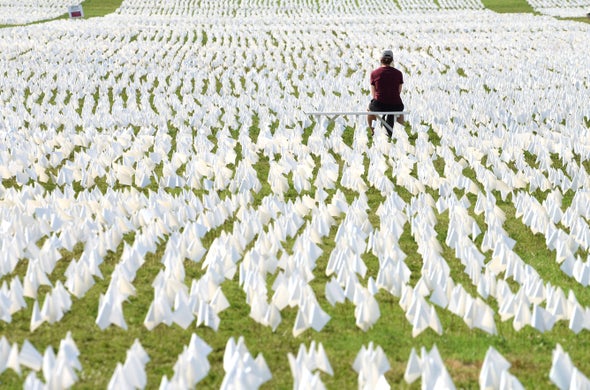
woman watches white flags on the National Mall in September 2021 in
Washington, D.C. Over 660,000 white flags were installed here to honor
Americans who have lost their lives to COVID-19 epidemic.
Sometime in the next few weeks,
the official death toll for the two-year COVID pandemic in the U.S. will
reach one million. Despite being the wealthiest nation on the planet,
the U.S. has continued to have the most COVID infections and deaths per country, by far, and it has the highest per capita death rate of any wealthy nation.
This is an unfathomable number of people dead, yet, mass media are downplaying it. This is despite an empathetic New York Times headline in May 2020 of “U.S. Deaths Near 100,000, an Incalculable Loss,” and using its entire front page to print names of some of the deceased. As Luppe B. Luppen noted on Twitter, the newspaper’s more recent headline was the cruel and callous “900,000 Dead, but Many Americans Move On.”
The Times is not alone; several large mainstream
publications, in complicity with politicians of both major political
parties, have been beating a death knell of a drum for getting “back to
normal” for months. The effect is the manufactured consent to normalize
mass death and suffering—to subtly suggest to Americans that they want to move on.
News media are helping to shape public opinion in order for business
to return to the very circumstances that have created this ongoing
crisis. A return to normal will allow profits to be reaped by people
working relatively safely from their homes (the target audience of many
news organizations’ advertisers) at the expense of people working or
studying in person who are more vulnerable.
A few weeks ago, David Leonhardt, the writer of the Times’
newsletter “The Morning,” asked Michael Barbaro, the host of the
company’s podcast “The Daily”: “If [COVID] is starting to look like a
regular respiratory virus, is it rational [emphasis by the Times] to treat it like something completely different— to disrupt all our lives in all these big and consequential ways[?]”
I was dismayed. That rhetorical move is a familiar one to me: Two
white men frame what they think is rational, deeming any questioning of
their stand as irrational.
Meanwhile, some 140,000 children in the U.S. have lost a
caregiver—about one in every 500 children. That is a big and
consequential loss, and those children are probably not among the many
who are ready to “move on” (another nearly one million Americans can’t
move on because they’re already dead). During this pandemic, Black
people have been disproportionately killed by this virus. About 50,000 people have died each month of COVID, meaning several Black children are being orphaned by SARS-CoV-2 this month, as you read this.
So is it rational? To be calling for the end of life-saving
mitigation efforts and saying they harm children when so many have been
orphaned here and worldwide?
Is it rational for Democrats, Republicans and much of the news media to press on towards what writer Tom Scocca calls a policy of “unlimited” COVID? The Democratically controlled state governments of California, New Jersey, New York and Connecticut all moved to drop indoor mask mandates just days after a near-record 3,958 people died of COVID on a single day, February 4. Even the White House reportedly
has “begun hinting at an impending ‘new normal,’ in a conscious
messaging shift meant to get people comfortable with a scenario where
the virus remains widespread yet at more manageable levels.”
Is it rational, when as many people who died of AIDS in its worst year (near 50,000 in 1995) are dying every month
of COVID, to think of the novel coronavirus as a “regular respiratory
virus”—and to think that the big and consequential disruptions to worry
about are mask wearing and ventilation, and not death and debilitation?
Is it rational to ignore the high communal viral load in
American society and to not do more to lower it so that fewer people are
exposed, become sick, transmit onwards and possibly die?
Is it rational for the Times to be advertising an
event happening in March hosted by Leonhardt called “The New Normal, a
Virtual Event on Life and Love After Omicron,” which might just coincide
with the timing of the millionth American officially dying of COVID?
Well, it depends on what it is you are trying to rationalize.
If you’re trying to get people to accept that what the nation is
doing right now is okay, and 50,000 deaths per month should be
normalized, then it’s rational.
If you don’t want people to wonder why in just two years, the U.S.
death toll for COVID is about 130 percent the size of the death toll of four decades of HIV—while global COVID deaths are less than 20 percent of the world’s AIDS deaths—then it’s rational.
If you want to manufacture consent for looser pandemic measures in
the U.S. rather than more comprehensive ones as the communal viral rate
demands, then making these claims is rational.
But it’s not ethical to manufacture what I call a viral underclass,
and it’s incorrect to pretend as though the news media have no role in
creating it nor in persuading the public that so many deaths are
inevitable.
It’s a shame that major news outlets are talking more about moving on
and returning to normal, and not running more pieces calling for an
increase in government-funded mitigation efforts (more free high-quality
masks and tests, upgraded ventilation in worksites and schools) to stem
the tide of death.
Rushing for the “urgency of normal” is “wishful thinking,” epidemiologist Gregg Gonsalves wrote in the Nation. Intentionally or unintentionally, “the urgency of normal”—a phrase cropping up a lot lately.
“We are now faced with the fact that tomorrow is today. We are
confronted with the fierce urgency of now. In this unfolding conundrum
of life and history there is such a thing as being too late.



/https://tf-cmsv2-smithsonianmag-media.s3.amazonaws.com/filer/67/4f/674fe480-4ca5-46ae-b782-001c89866763/1024px-drobitskiy_menora.jpg)