1 - Hot kugel and herring in every shul every Monday, Thursday & Shabbos with Slivovitz added on Shabbos.
2 - Every Charedi must have their white shirts and suits taken to the dry cleaners every 30 days whether needed or not.
3 - Any family with less than 13 kids, loses their Charedi status and all welfare benefits.
4 - Any child with a secular education past first grade is banned from ever shaking hands with Minister Goldknopf and any member of his family.
5 - If you are wearing a kippa sruga, you must be converted to Orthodox Judaism by Aryeh Deri.
6 - Wearing a blue shirt in public is a sign of heresy, every Charedi rabbi must ban them from ever davening in their shuls.
7 - Internet use in every government facility must be banned.
8 - Pictures of Ben-Gurion taken off the walls in every government building.
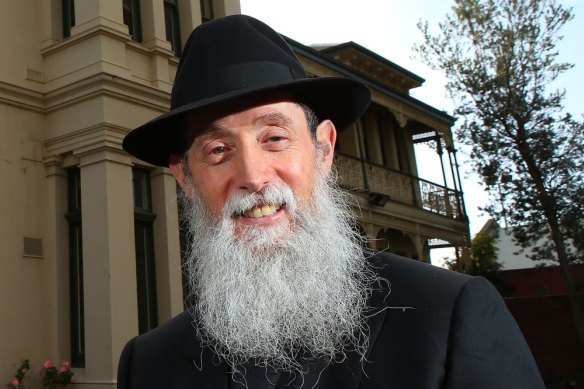
10- The Supreme Court must be dismantled and replaced with one judge - Former Chief Rabbi Yona Metzger.
Yona Metzger taken in by police
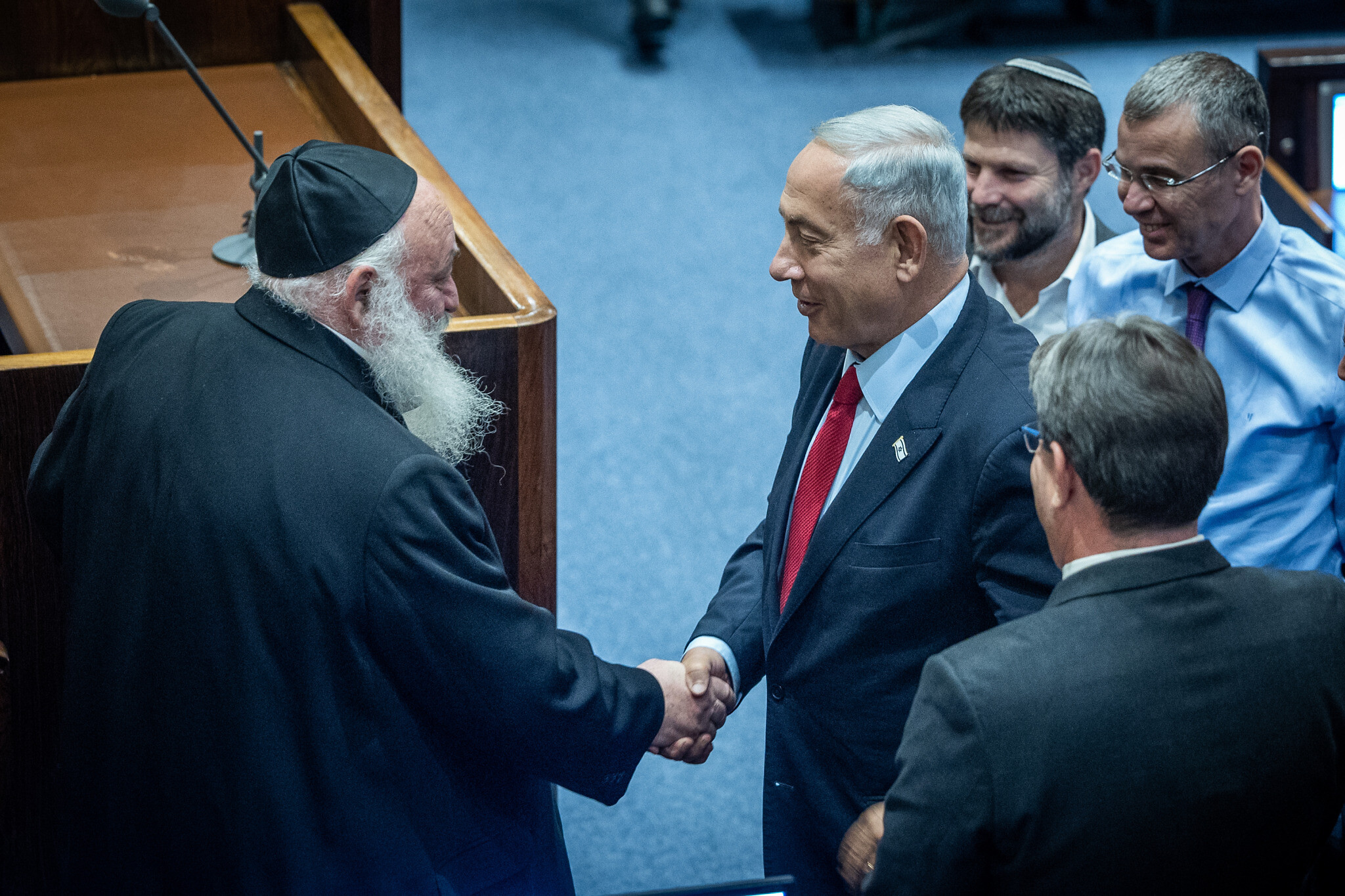
REPORT: UTJ and Likud Discuss Proposals to Dramatically Expand Religious Laws
Likud
party chairman MK Benjamin Netanyahu shake hands with MK Yitzchak
Goldknopf a plenum session in the assembly hall of the parliament
(Knesset) on November 21, 2022.
JERUSALEM — A bombshell report in the Israeli media
claims that as part of their coalition talks, Likud and the Charedi UTJ
party are discussing a number of religious proposals.
The unsourced and unsubstantiated Channel 12 report claimed that
Likud had already agreed to multiple proposals, including requiring
power plants to shut down on Shabbos, the establishment of state-funded
committees to answer questions on Halacha, the expansion of
gender-segregated beaches, and an increase of religious studies in
public schools.
However that report appears to have been debunked by both parties,
who denied any final agreement had been reached. Likud described the
proposals as “a list of demands from UTJ, not a deal that Likud has
agreed to.”
Likud also denied that it would ban energy generation on Shabbos or expand gender-segregated beaches.
UTJ leader Yitzchak Goldknopf said late Monday that the two sides
“are still currently sitting down for negotiations to formulate the
coalition agreement.”
(It is a possibility that the non-religious media, or the leftist
segment of the government, have exaggerated the report, in an effort to
stir controversy and sabotage the religious parties.)
Channel 12 laid out a series of proposals, including:
Passing a law to regulate the exemption of ultra-Orthodox youth from enlisting in the army
Having a Chief Rabbinate representative on any panel weighing permits for work on Shabbos
Barring electricity production on Shabbos
Funding special archives known as a “genizah” — to preserve “shaimos” documents and papers containing Hashem’s name
Forming and funding bodies to provide answers to the public on questions of halacha
An agreement to increase the number of gender-segregated beaches
Discounting public transportation in predominantly ultra-Orthodox cities
Providing Charedim with affirmative action when applying for jobs in state-controlled bodies
Allowing hospitals to ban chametz on Pesach
Allowing any citizen to demand in-ground burial, instead of
above-ground structures known as vertical cemeteries established to
battle overcrowding
Requiring more religious studies in the state’s secular school system
Weighing the closure of the new Reform department in the Diaspora Affairs Ministry
Mandating that all online government services also be provided via
phone for those who shun internet use, as many ultra-Orthodox do
Increasing government payouts to yeshiva students
The report also claimed that several Charedim would be appointed to
Cabinet positions, including Goldknopf as Housing and Construction
Minister, and Moshe Gafni as chairman of the Finance Committee. In
addition, Meir Porush would be appointed Minister for Jerusalem Affairs
and Tradition, and Uri Makalev as a Deputy Minister in the Ministry of
Transportation and in the Prime Minister’s Office.
Chief Rabbi Yosef: Reform, Conservative Judaism is a new religion
"Have you ever seen a Reformer [Jew]
who repented? I didn't see any, there are none. They feel they are okay;
that they have a religion, but they have a new religion."
*
“The incitement and humiliation of entire audiences in Israel by the
chief rabbi of Israel is particularly outrageous and in this matter we
await the High Court’s decision regarding the disciplinary prosecution
of the chief rabbi. On the eve of Hanukkah, it is worth stating, once
again, that the Western Wall is not the private courtyard of the rabbi
of the Western Wall or the chief rabbi, but a national and religious
site that belongs to all the people of Israel. Instead of spreading
darkness as the chief rabbi is doing and thereby alienating Jews from
Judaism."
My journey from Reform to Orthodox Judaism has taken many unusual
turns. Perhaps the most unusual is that, despite living in Jerusalem and
Brooklyn, it was not until I arrived in Peoria, Illinois, that I became
a baal teshuvah.
How did a Reform rabbi become an Orthodox Jew? I need to begin by explaining how I became a Reform rabbi.
My upbringing was totally in the Reform movement, but it was not what
I would now consider to be typical of Reform Judaism. My family was
active in a unique Reform congregation.
It was a congregation where most of the members were deeply involved
and where Jewish education was taken seriously. I went to Hebrew School
three days a week and attended Friday evening services regularly. I went
to camps run by the Reform movement and when I went to Israel for the
first time, my Hebrew was quite good and I felt myself to be a fairly
knowledgeable Jew.
I remember the first time I went to an Orthodox synagogue in Israel, I
decided very quickly that it was not for me. I spent an entire year in
Jerusalem, never once questioning who I was or making any attempt
(except for my one and only trip to a synagogue) to explore the
possibilities of Jewish life in Israel. I had many Israeli friends and
basically lived as a secular Israeli. The same thing is true of my
second year in Israel as a first-year rabbinic student at HUC-JIR.
Again, I spent a whole year in Jerusalem, not once thinking that there
was any reason to look at any other kind of Judaism. The truth is that I
was firmly rooted in Reform and, based on my experience, felt that it
was certainly as serious, if not more serious, than Orthodoxy. I
believed that Orthodoxy was out of touch with the modern world and
represented an attempt to freeze Jewish life in a moment in history,
while we Reform Jews were actively engaged in making choices that
integrated Judaism with modern life.
My wife and I moved to Brooklyn and lived on the border of Flatbush
and Boro Park for two years, while I attended HUC-JIR in New York. To
make a long story shorter, let’s say it was pretty much the same as my
two years in Jerusalem. Despite the fact that I did study a little
Talmud with our neighbor’s son (who was a yeshivah bochur) to prepare
for class, I never found myself interested in any exploration of the
Orthodox community in which we were living. I spent one week laying
tefillin at an Orthodox shul (as a class assignment) and quickly gave it
up. We went to the only Reform temple in Boro Park on Friday nights. So
what changed things for me? After three more years of rabbinical school
in Cincinnati and four years in the graduate program, I was still a
strong Reform Jew. After the birth of our second child, I decided to
leave the Ph.D. program at HUC-JIR and took a position as a rabbi in a
Reform congregation in Peoria, Illinois.
Before I begin to recount the factors that caused me to look at
things so differently, let me first say that the Jews in Peoria are
wonderful people. They have been extremely nice to me and they are
trying hard to keep Jewish life going in a small mid-western city. Also,
I do not believe that the faults I found with Reform Judaism are in any
way unique to Peoria. What I observed there has been confirmed by
surveys and by my conversations with colleagues in larger communities.
Almost immediately, I discovered that only a tiny proportion of our
congregation had any kind of serious involvement with Judaism. Very few
members even thought of themselves as religious Jews.
Clearly they were looking for something, as they had joined — but it
was a minimalist Jewish identity that mainly had to do with having a Bar
or Bat Mitzvah. I discovered that most people knew almost nothing about
Judaism. Except for Rosh Hashanah, Yom Kippur, Chanukah and the first
night of Pesach, most Jewish holidays were observed by only a small
fraction of the congregation. We had to employ all kinds of gimmicks to
get people to come. Usually it meant giving their kids a part in the
service. And then there were the demographic issues. I became very
disheartened when I saw the large number of intermarried couples and the
high percentage of children who thought they were Jewish because of
patrilineal descent. Many of my congregants were only accepted as Jews
by the Reform movement, but were not part of Klal Yisrael. Despite my
Reform upbringing, I was passionately committed to the unique importance
of the Jewish People and to the State of Israel. When I realized how
many of our congregants would not be accepted as Jews in Israel due to
traditional Jewish laws, I was devastated. I started arguing with my
colleagues that Reform was on a path to a complete separation from the
rest of the Jewish People and besides, with so few of them seriously
committed to religious life, what kind of Jewish future would this be?
After two years in Peoria, I saw the problem, but I didn’t know what
the solution could be. I can remember sitting in a restaurant with one
of my colleagues, eating a treif meal and vehemently warning him that
Reform Judaism had no future in Klal Yisrael and that most Reform Jews
would fade out of existence in the next few generations.
The power of Torah study is truly remarkable. I continued to be
interested in learning and someone lent me some study tapes for Maseches
Shabbos in the Mishnah. I sat down to start learning the mishnayos.
What I discovered had a tremendous impact on me. The issues of concern
in the Mishnah seemed to be totally removed from anything I knew, or
anything that I had ever heard of. Here I was a rabbi, and I did not
know that it was forbidden to carry on Shabbos, which is what the
Mishnah was primarily discussing. For the first time, I began to
question whether Reform was indeed a continuation of historical Judaism.
As I read and studied more, I came to see that Reform is a dramatic
break with the past, not the next step in its historical evolution as I
had believed. But I still didn’t know what the central difficulty was
until I read an article by Yeshayahu Leibowitz in which he argues that
halachah is not just an aspect of Judaism, but the defining aspect. Many
of my colleagues had called Reform “non-halachic Judaism:” I now knew
that term to be an oxymoron. But what was I to do? Most people who
become observant can still make a living — but it’s not so easy when
you’re a Reform rabbi! We were keeping strictly kosher and I was as
shomer Shabbos as I could be. For two years I still continued to serve
the Reform congregation. We sort of lived like Marranos: secretly, I had
become Orthodox, but very few people knew. I wanted to find a job where
I could live openly as an Orthodox Jew, but I couldn’t find anything
suitable. I had started davening at the traditional congregation in
Peoria and when they heard that I wanted to leave my Reform
congregation, they asked me to become their rabbi. And that is what I
have been doing for the past three years. My new congregation has been
extremely warm and welcoming. They even had to overlook their by-laws to
hire a rabbi with Reform semichah. Ever since I was a child, I have
yearned to be a religious Jew and take part in building the Jewish
future. With the help of the Chicago Torah Network, I have learned that
the Orthodox community is not stuck in the past, but is vibrant and
dynamic; and it’s the only hope for the Jewish future.
As I write this article, my wife and I are making the decision to
move to Chicago so that I can learn more intensely, and I hope to be
able to get an Orthodox semichah. I haven’t written here about the
challenges to our family life which resulted from my transformation, but
with God’s help, things have worked out. My son is a freshman at the
Skokie yeshivah and my two daughters are also making the adjustment. My
wife is rediscovering much of what she lost from her past as the
daughter of traditional Tunisian Jews who grew up in Israel. I believe
that as Orthodox Jews our lives are richer, more committed to God, and
more securely rooted in the Jewish past and in the Jewish future.
Michael Arsers is the spiritual leader of Congregation Agudas
Achim in Peoria, Illinois, and runs a home remodeling business with his
wife, Pnina.
“A significant cause for the emergence of the problems identified by
the investigators at the institutions under investigation is the
personal misconduct of Rabbi Prof. Dr. Homolka in his function as a
leader or person with great influence, which the investigators are
convinced of,” the investigators wrote in their report. He
presided over an institution ruled by a “culture of fear,” the
investigators found, leaving employees and students alike less likely to
express criticism or concerns because of the possibility of reprisals.
Prominent German rabbi exits leadership roles as report confirms allegations against him
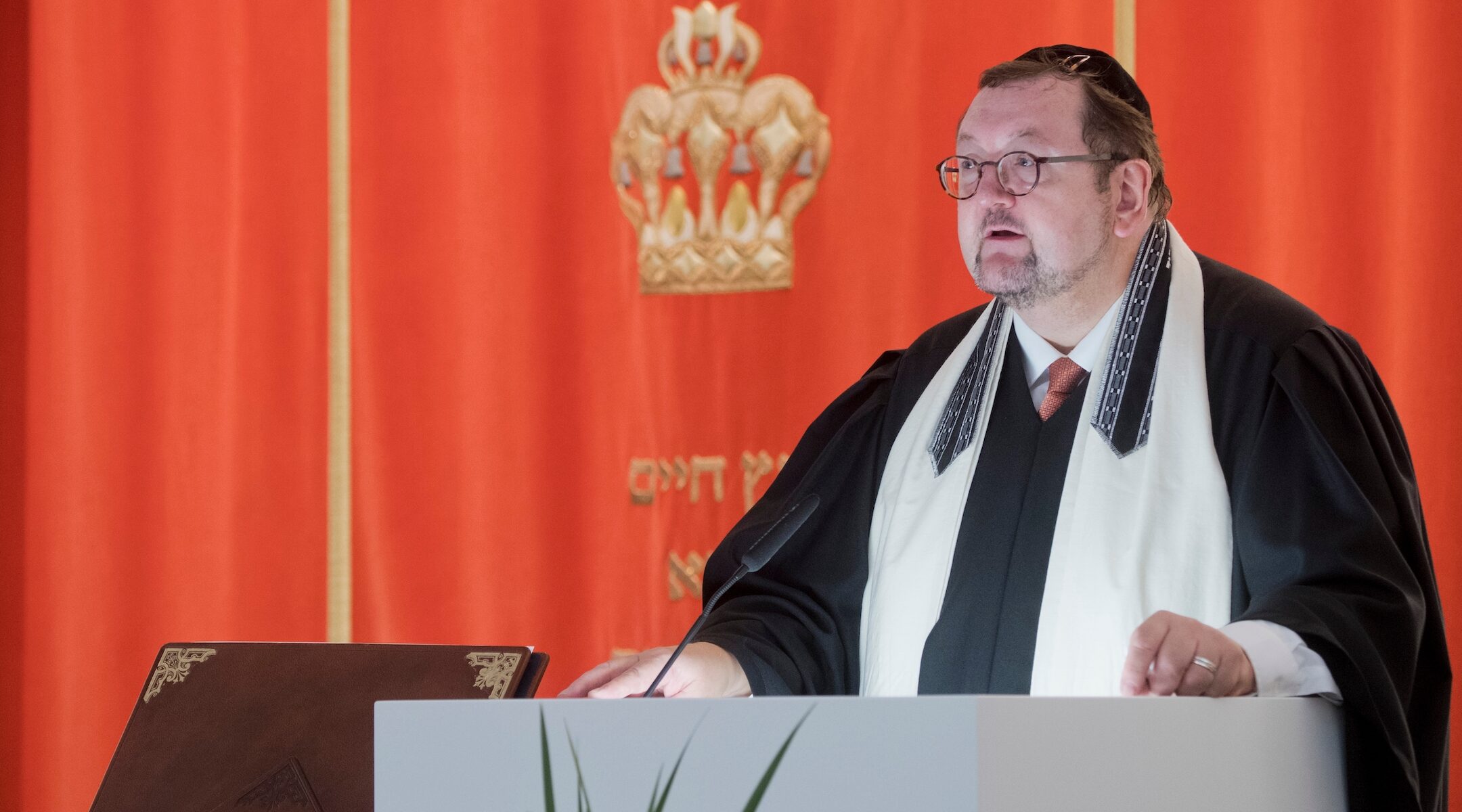
Rabbi Walter Homolka, rector of the Abraham Geiger College, in
the Liberal Jewish community's synagogue in Hanover, Germany
BERLIN (JTA)
– In a landmark step, investigators commissioned by Germany’s main
Jewish organization have concluded that abuse of power and sexual
harassment did occur at Germany’s liberal rabbinical seminary — and some
of it, they say, may have crossed the line into illegality.
The 44-page “executive summary” of an investigation initiated by the
Central Council of Jews in Germany is the latest and most damning report
about the leadership of Rabbi Walter Homolka since accusations against
him broke into public view last May.
Issued Wednesday after tense public conflict between the council and
Homolka’s attorneys, the report concludes that structural changes are
required to set Germany’s liberal rabbinical seminary, known as Abraham
Geiger College, and other related Jewish institutions on the correct
footing.
“A significant cause for the emergence of the problems identified by
the investigators at the institutions under investigation is the
personal misconduct of Rabbi Prof. Dr. Homolka in his function as a
leader or person with great influence, which the investigators are
convinced of,” the investigators wrote in their report.
Homolka announced Monday that he would withdraw from all functions in
the seminary that he and a German-born American rabbi named Walter
Jacob, founded in 1999. He also dropped out of the running on Tuesday for another term as chair of the Union of Progressive Jews in Germany.
A more comprehensive report including details about incidents in
which investigators concluded that Homolka and his husband engaged in
misconduct is due out in January, according to the Cologne-based law
firm Gercke Wollschläger.
The preliminary report was welcomed in a joint statement by the
Central Council, the German Interior Ministry and the Brandenburg State
Ministry of Science, Research and Culture, which said they would
“continue to fund the Abraham Geiger College to the same extent as
before until the structural new beginning has been completed.”
It was also greeted with relief by the former cantorial student whose complaints kicked off the scandal.
“I think the report and the subsequent documents are a blessed
development,” Itamar Cohen, now a cantor, told the Jewish Telegraphic
Agency. “It seems to confirm many suspicions which I and others share.
It does affirm that I did the right thing and [this] could be the
beginning of a new chapter of liberal Judaism in Germany.”
The scandal that erupted publicly in May began after Cohen sought
help from Jonathan Schorsch, a professor at the School of Jewish
Theology, in dealing with unsolicited pornographic material allegedly
received from Homolka’s husband, who was also an employee at the
seminary. (Abraham Geiger College is part of the School of Jewish
Theology, which itself is under the auspices of the University of
Potsdam.)
A German newspaper’s report about the allegations and an apparent
effort to obscure them opened the floodgates for criticism of Homolka
from past and current students, employees and colleagues.
Homolka took a
leave of absence from the numerous leadership roles he held with
liberal Jewish religious and educational institutions that he had helped
found since the late 1990s.
The scandal has shaken the foundations of modern liberal Judaism in
Germany, and the new report suggests that those foundations were weak
because they rested largely on one individual.
Josef Schuster, the president of the Central Council of German Jews,
said the report made it clear that Homolka could not continue in his
previous roles.
Homolka has rejected the allegations against him throughout, and his attorneys told German news media Wednesday
that they believed the entire investigation was politically motivated.
They accused Schuster of wanting to see Homolka exit Germany’s liberal
Jewish leadership and said the Central Council had failed to consider
fully the statement Homolka had given to investigators.
Rabbi
Walter Homolka. at left, with other leaders of Germany Jewry
The report is the first to emerge from a third-party investigation
into the allegations against Homolka. A separate investigation by the
University of Potsdam, released in late October, found that some of the
accusations regarding abuse of power to be justified, but did not find
any criminally actionable behavior and thus confirmed Homolka’s ongoing
employment there as professor. It did not investigate the sexual
harassment accusations, as Homolka’s husband had left his job by then.
The new report did scrutinize those allegations. The investigators
said they found 13 specific incidents involving allegations against
Homolka’s husband. German libel law bars the publication of his
name. Using what they called a “traffic light system,” the investigators
classified nine of these incidents as “red” cases, in which 25
instances of misconduct could be identified. Two of these cases involved
the “initial suspicion of a criminal offense,” they added.
Regarding allegations of abuse of power against Homolka himself, they
found — after interviewing 73 individuals — a total of 45 concrete
incidents, 14 of which they classified as “red,” involving a total of 23
instances of misconduct. A detailed account of those cases, including
responses that Homolka delivered earlier this week, will be included in
the final report in January, they said.
More broadly, they said, their interviews had illuminated a culture
of misconduct in which unchecked, unlawful or arbitrary decisions could
be made largely because of a consolidation of power under Homolka. He
presided over an institution ruled by a “culture of fear,” the
investigators found, leaving employees and students alike less likely to
express criticism or concerns because of the possibility of reprisals.
The investigators said structural changes were needed if there was
any hope of shifting the culture. “As long as institutions are in
private hands or even in the hands of an individual, or at any rate
within the essential sphere of influence of the person who, in the
opinion of the investigators, practices and exemplifies misconduct
himself, it is hardly conceivable that the causes of the deficits
identified can be remedied,” their report says.
Cohen told JTA he wants to see “real change in the leadership” of all
liberal Jewish institutions in Germany, and “an external compliance
system set up.”
He said, “I hope to see the institutions Homolka founded take a life of their own, no strings attached.”
Anticipating the report, the Abraham Geiger College had announced its
own restructuring plans on Monday, a day after ordaining four new
rabbis and two cantors at a ceremony in Berlin.
In a statement, interim director Gabriele Thöne said a new foundation
would become the provider of rabbinical training in Potsdam.
Further, Thöne said the “door is open to Zacharias Frankel College” —
the Conservative movement seminary also under the umbrella of the
School of Jewish Theology at the University of Potsdam — “to join the
new foundation on an equal basis while at the same time maintaining its
independence.”
But in a scathing response issued Wednesday, the Conservative
seminary said the Geiger College interim administration had not
consulted them about the restructuring.
“A partnership between equal parties requires joint preparation,
mutual trust, transparency and consensus. All this has been lacking so
far, and continues to be lacking,” the statement said.
Signed by Rabbi Bradley Artson, dean of Zacharias Frankel College and
the Ziegler School of Rabbinic Studies, the Conservative seminary in
Los Angeles among others, the statement also said the preliminary report
released Wednesday “confirmed the asymmetrical constellations of power
in the two Potsdam rabbinical training colleges.”
Zacharias Frankel College “was in a state of dependency on the will
of one person from the time it was founded in 2013. Our institution was
deliberately pushed into invisibility and excluded from communication
with funders in Germany,” the statement read in part.
“From the outset, the project of a Masorti rabbinical training in
Potsdam was merely a makeshift means of being able to found the School
of Jewish Theology [also in 2013] and give it the appearance of
representing several denominations, and thus of being pluralistically
positioned. Instead, however, the accumulation of power led to a
monopolization of non-Orthodox Judaism in one person” – namely, Homolka.
For their part, the government and Jewish funding organizations said
in their statement Wednesday that they were “committed to ensuring that
there will continue to be both liberal and conservative rabbinical
training in Potsdam in the future,” but that the proposals developed so
far at the Abraham Geiger College do not meet the requirement of being
“a clear cut from the previous structure and a comprehensive new
beginning.”
The release of the Central Council-commissioned report was preceded by a volley of statements by lawyers for both parties.
On Monday, the council’s attorneys announced that their preliminary
report would come out in two days. On Tuesday, Homolka’s attorneys
issued a statement criticizing the impending “sudden” release of the
report’s summary, suggesting it reeked of “prejudgment.”
The law firm representing Homolka — Behm Becker Geßner — noted that
its client had received “a list of questions with serious accusations”
from the council’s attorneys, and that he had responded in writing last
Sunday. “Should the result not take into account the meaningful
statement of our client, there would be a massive violation of
personality rights,” warned the lawyers, who have successfully battled
some critical press coverage of Homolka.
The Central Council criticized what it called Homolka’s delay
tactics, saying its attorneys had asked Homolka in early September if he
would respond to questions but had not gotten any response to questions
sent Oct. 19 until late Sunday night, well after multiple previous
deadlines. Still, the council confirmed, its investigators would take
Homolka’s responses into account.
“This tactic is the main reason why the law firm will not be able to
complete the final and detailed report of the investigation by the end
of the year,” the Central Council said. “The courage of the numerous
victims must not be sacrificed to Homolka’s delay tactics.”
Meanwhile, the Union of Progressive Jews in Germany is to meet next
week in Berlin, after a three-month postponement. Board elections will
be held for the position of chair, previously held by Homolka.
On Nov. 26, that group published a report from an investigation that
it had commissioned, which concluded that there was no proof of abuse of
power at Abraham Geiger College.
On Wednesday, a critic within the body, the State Association of
Jewish Communities of Lower Saxony, said the Central Council’s
commissioned report “supports us in our demand for the resignation of
Walter Homolka from all his offices within the Jewish community, which
we already made in May.”
And there is dissent within the General Rabbinical Conference,
Germany’s liberal rabbinical association, as well. About a dozen members
issued a statement in November, breaking from the official, cautious
tone, saying that “the abuse of power proven against Rabbi Prof. Dr.
Homolka [in the university’s report of Oct. 26] is not compatible with
the values of Jewish and general ethics.”
The association, known as ARK, issued a statement at the end of
November stating that, despite differences of opinion in their ranks,
they join the call for a structural and personal new beginning, as “a
chance for the next phase of rabbinical training in Germany.”
In a Ukrainian city liberated from Russia, local Jewish leaders are being accused of collaboration
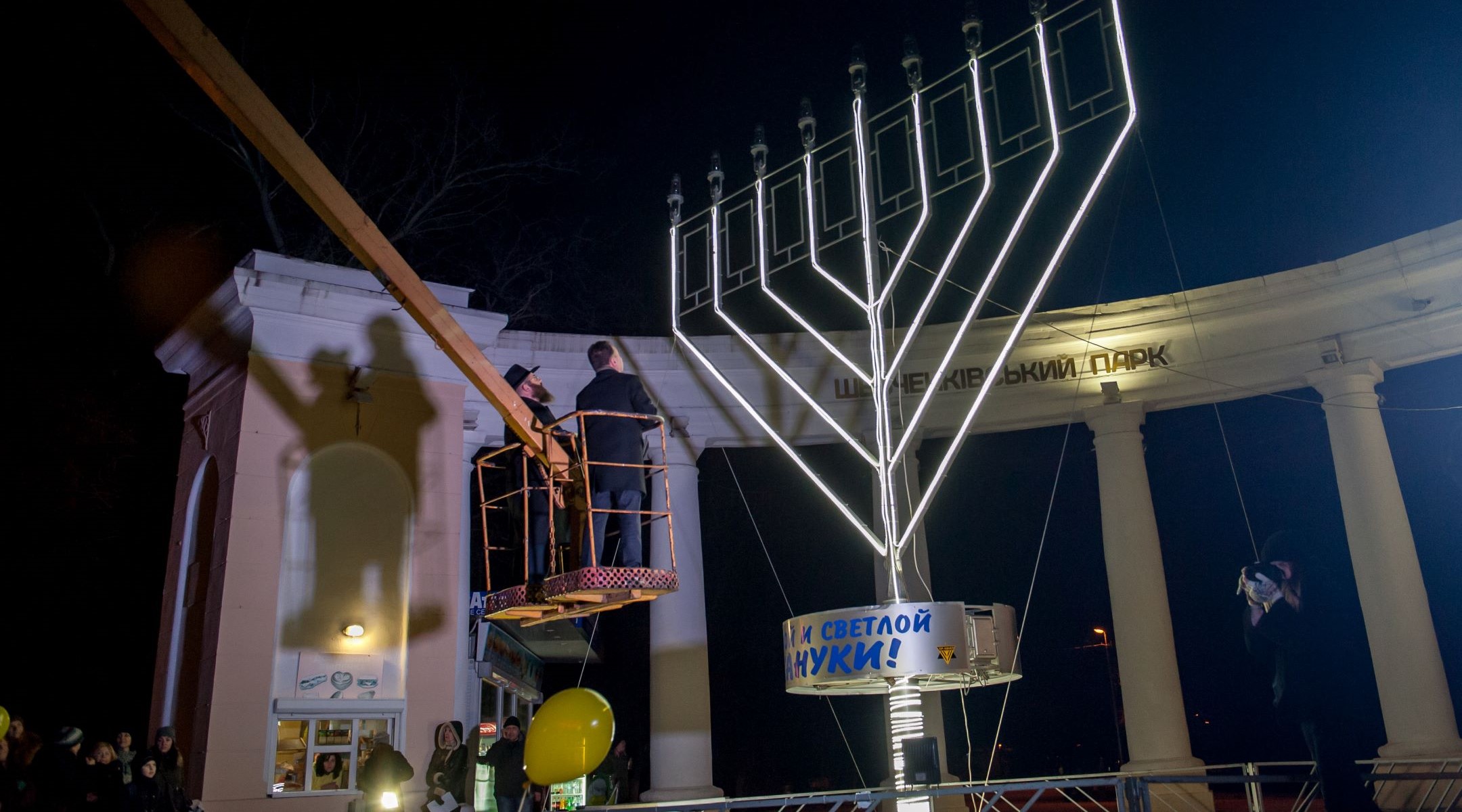
Rabbi
Yosef Yitzchak Wolff and mayor of Kherson Volodymyr Mykolaienko light
Hanukkah candles
(JTA)
— When Russian troops poured across the Ukrainian border in March,
thousands fled from the cities that would be first in their path. But in
Kherson, the southern port city with strategic value to the Russians,
Rabbi Yosef Itzhak Wolff decided to stay put.
His decision to remain put him in line with the philosophy of his
Jewish movement, Chabad-Lubavitch, whose rabbis typically commit to the
cities where they are stationed and stay there through thick and thin.
But his decision could also cost him the ability to serve Kherson’s Jews. According to a report this week in The New York Times, Wolff is now in Germany, concerned because some in Kherson accuse him of collaborating with the Russian forces.
Meanwhile, a member of his Jewish community is facing life in prison
over his actions during the chaotic early days of the war, according to
the New York Times report.
Russia captured Kherson on March 2, and for months, the city suffered
a brutal occupation that resulted in hundreds dead and scores more
“disappeared” or tortured, according to Human Rights Watch.
Among those living in the occupied city was Wolff, an Israel-born
rabbi who arrived in Ukraine nearly 30 years ago, just after the fall of
the Soviet Union and Ukraine’s independence. For the past 13 years, he
had presided over a Jewish community in Kherson estimated before the war
at 8,000 people.
In the early days of the war, Wolff’s work to supply food, medicine
and at least some semblance of a joyous Purim to his community was
highly publicized.
During one trip, the Times of Israel reported, he dodged bullets shuttling food back to the city from the border with Crimea, where his brother is also a rabbi. In another, according to Chabad.org, he went out to deliver food even as Russian tanks rolled through the town.
“Despite heavy fighting in the streets of Kherson, Rabbi Yosef Wolff
did not abandon his community for a moment, remaining in the war-torn
city through it all and serving the local population,” Rabbi Motti
Seligson, a spokesperson for the Chabad movement, told the Jewish
Telegraphic Agency. He called Wolff a “true hero of the Jewish people
and for people of good conscience everywhere.”
Before the Holocaust, Kherson was a major center of Jewish life, with
some 26 synagogues, but now, there is only Wolff’s. And before the war,
it was like Chabad centers around the world: serving a local community,
but also famously welcoming to unfamiliar faces, including foreign
visitors.
Opening the doors to newcomers took on added gravity after the war
began and Russians streamed into Kherson. For much of the year, it was
unclear whether Ukraine would regain control of the city, or whether it
would become like Crimea and remain under Russian occupation. But last
month, Ukraine liberated Kherson, generating scenes of jubilation — and
putting anyone perceived as collaborating with the Russian army under
suspicion.
Some of that suspicion landed on Wolff, who had allowed Russian
soldiers to pray in his synagogue. The soldiers were Jewish officers who
had arrived with armed guards, he told The New York Times.
In the days after liberation, he left Kherson, and Ukraine, for
Germany. Now, with efforts to penalize collaborators underway, he told
the newspaper that he is not sure when or if he will return.
Among those who remained in Kherson was a prominent member of the
Jewish community who is now being prosecuted for his choices amid the
messy reality of occupation. Karamalikov held the prisoner in a utility closet in his home for a
night, before ultimately making the decision to return him to the
Russian forces unharmed.
Illia Karamalikov, a nightclub owner and member of Kherson’s city
council, was close to Wolff, frequently allowing Chabad to use his
nightclub’s space for events, the rabbi told The New York Times.
In the early days of the occupation, Kherson descended into a state
of lawlessness. The Ukrainian civil administration fled ahead of the
Russian forces and, after conquering the city without much resistance,
Russia took little responsibility for its administration, instead
sending soldiers on to other targets such as neighboring regions of
Odessa, Mykolaiv, Kryvyi Rih — Ukrainian president Voldymyr Zelensky’s
hometown — and ultimately, Kyiv.
Looting was rampant, and cut off from power and supply lines, the
thousands of people who remained in the city faced a real risk of
starvation.
It was locals who managed to bring back some semblance of order.
Karamalikov helped organize a 1,200-strong community patrol to enforce
curfews and watch for looters.
It was in that role, according to the New York Times report, that he
found himself face to face with a lost and confused Russian pilot, whom
his men had taken into captivity.
That earned him a 12-page indictment from Ukraine, as he ran afoul of
new laws enacted at the outbreak of the war that stipulate that
“cooperation with the aggressor state, its armed formations, or its
occupation administration” are punishable as acts of collaboration under
Ukraine’s criminal code.
Many of those who spoke to The New York Times said the laws don’t account for the reality of living under occupation.
“All these people who ran away are judging us,” Wolff told the newspaper. “These are cruel times.”
Through returning the soldier, Karamalikov allegedly “organized the
further participation of a Russian serviceman in aggression against
Ukraine,” according to his indictment.
But many in Kherson are not sure what other option they had.
Karamalikov’s community watch organization was a volunteer and
non-military force whose limited power involved pressing looters into
doing community service. To have harmed the soldier would have made them
combatants against Russia.
“We wondered later: Should we have killed the soldier and kept it
secret?” one of Karamalikov’s watchmen, Andriy Skvortsov told The New
York Times. “But I’ve decided no, that wouldn’t have been good.”
“With a life in his hands, I can’t imagine Illia ever killing
anyone,” Wolff told the newspaper. “What he did was the most humane
decision he could make.”
"As he has done with just about every other issue, former President
Donald Trump is sucking the oxygen out of any discussion on the
antisemitism of rap star/fashion mogul Kanye West and his far-right
allies. Rather than express remorse for his unfathomable dinner meeting
at Mar-a-Lago with West, Holocaust-denier Nick Fuentes and fellow
alt-right hater Milo Yiannopoulos, he characteristically refused to
apologize.
The event, which provided the trio with publicity and a degree of
legitimacy in circles where his whims are treated as indisputably
rational, was itself deeply problematic. It was made worse, however, by
the fact that the focus of the debate it engendered about the rising
tide of antisemitism turned into one about Trump himself."
*
Ye x Milo x Fuentes
A has-been, a never-been, and a never-will-been walk into a bar…
Stop me if you've ever heard this one before:
Fueled
by his hatred of Jews, one of the most recognizable black man of his
era decided to forge an alliance with one of its most high-profile white
nationalist, or, at the very least, the one whose juvenile stunts
attract the most attention. One of the men behind the scenes who worked
on arranging the meeting is himself Jewish, though he has long
repudiated his heritage, is known to have engaged in antisemitism, as
well as for being a grifter, and is distrusted by many in the movement.
On the other hand, he has shown an uncanny ability to ingratiate himself
with its leaders and keep the spotlight on himself. All of this
revolving around grand political ambitions on both sides.
Obviously,
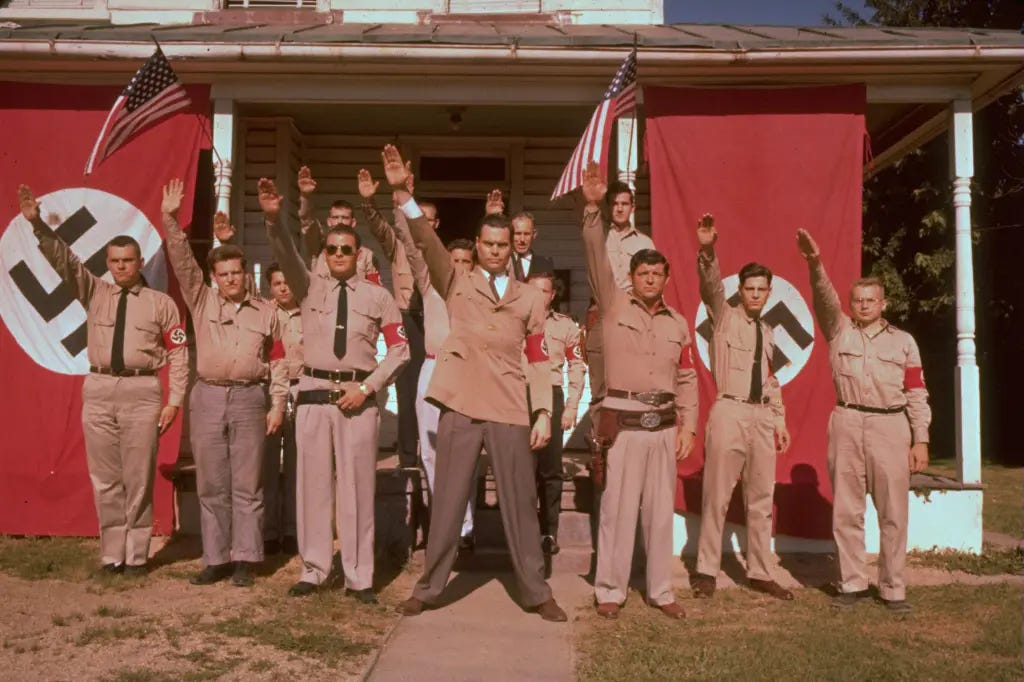
I'm referring to the infamous 1961 entente of George Lincoln Rockwell,
Malcolm X, and Daniel Burros which culminated in years of friendly
relationships between the American Nazi Party and the Nation of Islam.
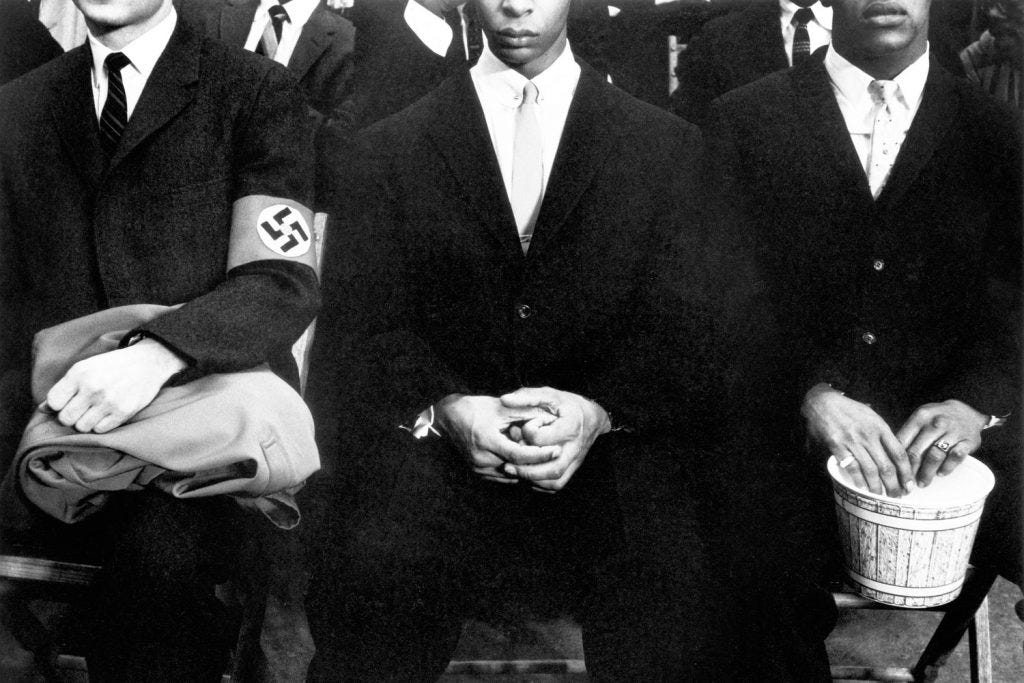
On
June 25th, 1961, ten members of the American Nazi Party quietly arrived
at the Nation of Islam rally in Washington, DC. In the Uline arena,
they were surrounded by more than 8000 members of the Nation of Islam.
They were not there to disrupt, attack the attendants, to protest the
speech; instead, they were front-row guests. That night, Elijah Muhammad
had called in sick, so Malcolm X took the stage to give the keynote
speech in his stead. Rockwell contributed $20 to the cause and, while
having his picture snapped by Jewish photographer Eve Arnold, he barked
at her, 'I'll make a bar of soap out of you.' (She answered, "As long as
it isn't a lampshade”).
At first glance, it would seem
highly bizarre that members of the American Nazi Party, in full regalia
and occasionally Sieg Heiling, would be tolerated amongst the Black
Nationalist movement. Still, it more than made sense once you realized
that they shared the same antisemitism and views on racial separatism.
There was also a historical precedent; the units described as the most
vicious, brutal, and antisemitic of the SS were the 13th Waffen Mountain
Division of the SS Handschar, composed almost entirely of Muslims.
Eight
months after their first public meeting, George Lincoln Rockwell
addressed more than 12,000 black audience members at the Chicago
International Amphitheatre, urging them to ally with Nazis to be truly
uplifted. "You know we call you niggers," he addressed the crowd. "But
wouldn't you rather be confronted by honest white men who tell you to
your face what the others all say behind your back?". He later praised
the Nation of Islam leader Elijah Muhammad as the 'Adolf Hitler of the
black man.'
Black And White Don’t Always Make Gray
It
might be ludicrous to think that a White and Black Nationalists
alliance might work, even for a short time. Yet they managed to create a
political symbiosis that held firm, at least until the death of Elijah
Muhammad in 1975. Though the alliance is not today quite what it was
back then, it is well known that Louis Farrakhan and Tom Metzger, of
White Aryan Resistance fame, have formed a friendship and alliance of
their own.
Though it's true that in the late 1950s the
American Nazi Party and Klan had fought Black Nationalists through
different (and often violent) means, by 1960 they had a ceasefire, and
by 1962 worked hand in hand. Just days before his death at the hand of
Nation of Islam shooters,Malcom X said he
had personally brokered a truce between the two organizations and that
"from this day forward the Klan had never interfered with the Black
Muslim movement in the South."
It was not a fake alliance
or purely practical, either. Rockwell genuinely admired Elijah Muhammad
and his followers, declaring that they were "admirable human beings in
spite of their color." He also wanted to launch a joint 'Back to Africa'
speaking tour with Elijah Muhammad. He wrote to his followers, "Can you
imagine a rally of the American Nazis in Union Square, protected from
Jewish hecklers by a solid phalanx of Elijah Muhammad's stalwart black
stormtroopers?" In today's alt-right lingo, he might as well have called
them based black men and offered them a place on their streaming
platform.
The resemblances don't stop there. In fact, the
antics of the Goyim Defense League or the Atomwaffens of today are very
similar to the ANP antics of yesterday. Rockwell and his boys made a
point of being juvenile and crass, publishing material such as The Diary of Anne Fink mocking
the Holocaust, had a Volkswagen van they dubbed 'The Hate Bus,' wore
rubber noses and Groucho Marx glasses during protests to mock Jews.
Rockwell even attempted to stop Martin Luther King Jr.'s 'I Have a
Dream' speech with 10,000 pro-segregationist protesters, although
ultimately only 90 showed up, and Rockwell couldn't even obtain a permit
for his protest.
Daniel
Burros was a crucial man in Rockwell's entourage, his right-hand man
until a political disagreement drove him to quit the ANP and eventually
join the Klan, becoming the leader of its New York chapter. Daniel was
also a (not-so-)nice Jewish boy from Queens. He had held the title of
'extermination planner' after they took over the government "by 1972 at
the latest," according to Rockwell. In his youth, Danny had attended the
Talmud Torah of Richmond Hills, and this is where he had celebrated his
bar mitzvah surrounded by friends, family and others in the community. A
star pupil, brilliant in his studies, the Rabbis believed he would join
their ranks one day. Yet he became radicalized until hatred consumed
his life down a few years later.
Rockwell adored Danny while the
others in the movement looked at him askew. He had bizarre ideas, like
suggesting that Rockwell and his stormtroopers parachute over New
Jersey, waving Nazi flags, and routinely picketed the White House on his
own, dressed in full Nazi uniform. Burros also loved to bring Jewish
culinary treats like knishes to Nazi meetings, but somehow they only
thought of him as quirky as a result but did not suspect him of being
Jewish.
Once he became known as the NYS Grand Dragon of the KKK,
however, someone leaked his Jewish background to the former newspaper of
record, the Times, who published an article entitled 'State Klan Leader
Hides Secret of Jewish Origins' on October 31st, 1965. Almost
immediately after seeing the headline, he returned to the friend's
apartment where he had been staying and shot himself to death.
Danny, standing at the very far right…
His
Jewishness was apparently no problem to Rockwell, who praised him in
his death and railed about how his Jewish genes had caused his
"unfortunate Jewish psychosis." Honoring his "based black men" and
"based Jewish men," George Lincoln Rockwell was indeed the roadmap to
today's Alt-Right leaders like Nick Fuentes.
This is the Remix
Today,
we may be witness history in the making, or at the very least, a
fascinating cover. One of the most influential black men of his era has
joined forces with the most prominent Gen Z white supremacist of his
generation, and there's a very shrewd and quirky Jewish man lurking in
the background.
The Torah explains that there's a concept of ירידת
הדורות, the decline of generations. It means, colloquially, that every
successive generation is weaker than the one previously. Weaker
physically, mentally, spiritually, and intellectually. When comparing
the trio of Kanye West, Nick Fuentes, and Milo Yannopolous to Malcolm X,
George Lincoln Rockwell, and Daniel Burros, one must bow to the
eternality and exactitude of the Torah’s truth. It also spells some
excellent news for Jews.
While some might regard Kanye as a
musical genius, no one would consider him a thought leader. At best, his
usefulness for the Farrakhans of this world is to serve as a
spokesperson, and considering how fickle he has been, we can always hope
he will simply have another 'epiphany' and move to a new subject very
soon or that he will have a post-Mecca Malcolm X-type change of heart.
To this day, many still advocate and push for Malcolm X's visions for
the world. The one before his trip to Mecca and the one afterward.
Either way, his words still resonate. In 60 years, it's doubtful even
Kanye's albums still will.
Nick Fuentes, while he might
undoubtedly be the public face of white supremacy in his generation, is
unlikely to gain any real traction with the rest of his own movement,
much less the population at large. His problems are threefold: his
Mexican origins, his traditional catholicism, and his proclivities.
Despite his Holocaust denial and zany rants, the fact is that Nick will
forever be seen as a profoundly self-hating homosexual non-white by
other white nationalists, and if Fuentes can't convince the people of
his own movement that he should lead them, how could he ever convince a
significant portion of the population? George Lincoln Rockwall was 6'3",
had a square Jaw, was the descendent of a long WASP bloodline, and was a
decorated Navy veteran. He still ended a failure who never attracted
more than a fringe following. At 5'6", Nick will literally never even be
able to fill Rockwell's shoes, much less push the movement further.
No
one would claim that Kanye West's new campaign manager Milo
Yannopopoulos is stupid. He might not have a 150 IQ like Burros
reportedly had, but there's no denying he has the uncanny ability to
rise up every time people think he's down for the count. And once this
new venture inevitably fails, he will most likely be around long after
Kanye and Fuentes inevitably fade into obscurity. He probably sees
himself as the puppetmaster; seeing as he towers both intellectually and
physically, it's not hard to see why. But what made Daniel Burros
operate so successfully is precisely what Milo lacks: obscurity and
anonymity. When news of Danny's Jewishness became public, he knew it was
over for him. Milo might have more than nine lives, but there's the
issue of diminishing returns. With so many scandals and a history of
leaking both to both press and alphabet agencies, who is still willing
to trust him? [Update: Milo lied about being Jewish]
So, here we have three self-appointed leaders, but the question remains: Is there going to be a movement for them to lead?
History never repeats itself, but it does often rhyme
There
is truly nothing new under the sun, and it really does feel like
history is close to, but not quite, repeating itself. The only
difference is that today’s rhymes are set to an overproduced beat.
Though I might be wrong, I have come to believe that antisemitism is not truly on the rise. Rather:
The
proliferation of social media is simply amplifying the voices of those
who would have otherwise kept their comments to themselves or for their
close friends.
The current polarization of society is
making it more acceptable to say out loud what people already believed
but kept quiet about.
Are we really supposed to think
that people liked Jews, were more tolerant, and did not hold the same
kind of views about us in the 60s, 70s, or 80s? That the 90s or 00s were
such a golden age of tolerance, but somehow antisemitism just
re-appeared out of nowhere?
The counterpoint to this would be to
say, ‘What about the historical hate crime rates in New York City? Jews
are being assaulted in record numbers!’ To which I ask: Are Jews being
assaulted in record numbers because antisemitism is rising, or is it
because the atmosphere of lawlessness and cashless bail is empowering
antisemites to act on their impulses, whereas in the days of law and
order ushered by the Giuliani administration, they knew there would be
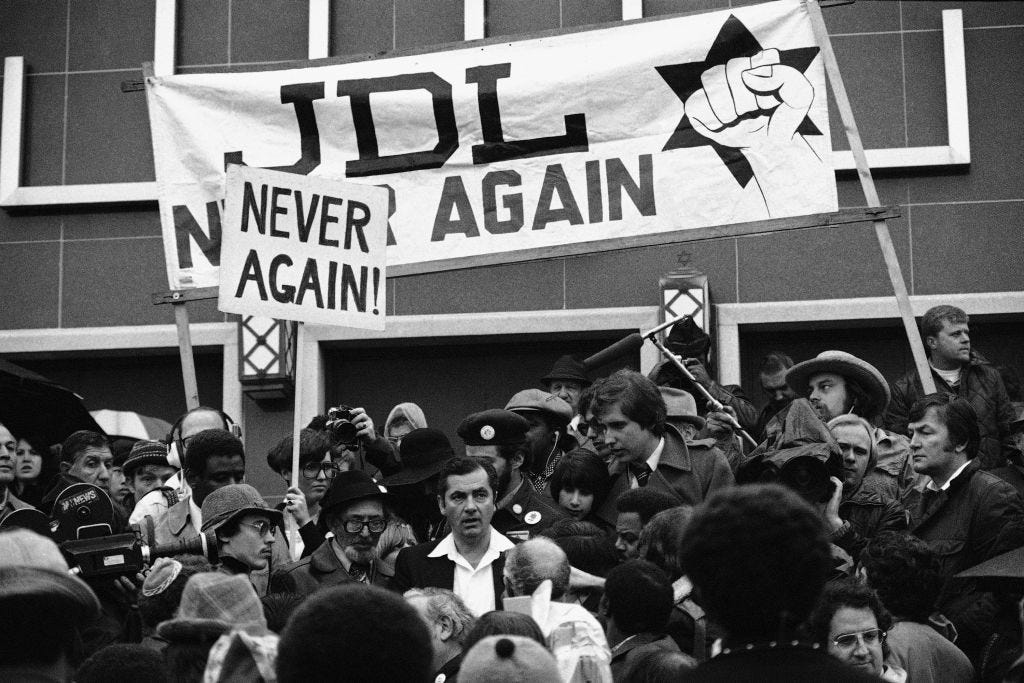
swift consequences? In the 60s and then in the 80s, when lawlessness in
New York was at its worst, the Maccabees and the JDL were formed because
of the many violent assaults against Jews being committed. No such
group exists today (yet, at least).
It’s
true that thanks to social media, antisemites can spread their message
of hate further and to a newer audience, but aren’t you required to at
least be predisposed to hate a particular group to fall for it? Isn’t
that precisely what the town square, the church pews, and taverns of
yesteryear were for? People in Petersburg did not need memes from a guy
in Santa Cruz to hate Jews 500 years ago; they had plenty of homegrown
ways to develop their hatred.
Looking back at history, and
witnessing our enemies' low quality, there is much to rejoice. From
mediocrity rarely comes anything but more of the same. If the long
alliance between the American Nazi Party and Nation of Islam fizzled out
into nothingness, we have no reason to assume anything will come out of
its poor contemporary repeat. We still have to deal with the reality of
antisemitic attacks and comments, but knowing that things aren't much
worse or different than they have been in the past few decades can at
least give us hope that things are not about to get much worse, either.
So Where Do We Stand?
We
have to comfort ourselves with the words of our Sages, realize that
there is G-d in this world, and that ultimately we see throughout our
history what happened to our enemies. Case in point:
Malcolm X was shot to death in 1965.
Daniel Burros shot himself to death in 1965.
George Lincoln Rockwell was shot to death in 1967.
Hillel's maxim about this in the 60s rings as true as ever. Sure, it was the 60s BCE, but eternally true nonetheless.
[Hillel]
also saw a skull floating upon the water. Said he to it: Because you
drowned others, you were drowned; and those who drowned you, will
themselves be drowned.
There
are consequences to our actions — consequences that reflect those
actions. If you commit murder and drown others in a river to hide your
crime, you will receive your punishment in the form of your crime. If
you invent an unjust thing to benefit yourself at the expense of others,
that unjust thing will ultimately be used against you. On the positive
side, if you introduce something that benefits others, that thing will
ultimately come to benefit you as well. It is called: midah k'neged
midah — measure for measure.
Based on a long
Rabbinical tradition, the Arizal explained that the skull Hillel saw
floating was Pharoh's. The second part of his statement was addressed to
the Jewish people, that we would ultimately see all of the Jewish
people's enemies and persecutors drowned.
The Lubavitcher Rebbe, commenting on this statement of the Arizal, declared that these words were meant
to comfort the tired souls of the exiled Jew, to the soul of one who
feels that he or she is up against an insurmountable challenge, an
impenetrable cloud of darkness. Much like the times we live in right now.
Hillel,
the great leader of Israel, turns to this person and says: "If Pharaoh,
the embodiment of evil, the man who cast fear even into the heart of
Moses, so much so that G‑d had to reassure him and say, 'Come to Pharaoh
— I will accompany you,' ended up drowned in a river, certainly all the
Pharaohs of history, all the great serpents that tried and will try to
drown you through physical and spiritual persecution —they will be
drowned as well. For evil has no leg to stand on. Like smoke, it
obscures our vision for a time but must ultimately disappear." - The
Rebbe
Pharoah died, yet we survived.
Haman died, yet we survived.
Hitler died, yet we survived.
Stalin died, yet we survived.
Nasser, Assad, Saddam, Arafat, and most of the world leaders who have tried to kill us since 1948 have died, yet we thrive.
All
of our greatest persecutors died, and we are still here. And there is
still time for the Kanyes, Fuentes, and Milos of this world to make
their choice: are you going to give up the baseless hatred rotting your
heart, or are you gonna let it consume you until it drowns you?
Just know that, whatever you choose, we will survive and we will thrive.
Students expelled after parents refuse to keep quiet on child sex abuse claims
Several
siblings have been expelled from a faith-based school in St Kilda
because their parents refused to sign a memorandum of understanding that
limited who they could talk to about the alleged sexual abuse of their
children.
The parents expressed concerns last month when the
school proposed reintegrating a student who had been the subject of a
police investigation and complaints of sexual abuse towards other,
younger students.
Families
of students at Cheder Levi Yitzchok school in St Kilda have been
counselled over a string of alleged sexual abuse incidents.Credit:Eddie Jim
Eliezer
Kornhauser, the founder and acting principal of the small private
school Cheder Levi Yitzchok, wrote to the parents on Monday that their
children’s continued presence at the school was “untenable”.
“As of Monday 5th December, your children are no longer welcome to attend the school,” he said.
The
students might be welcomed back next year, “but we would need to see
clear evidence of a change in your mindset, leading to a very different
set of behaviours on your part”, he wrote.
Kornhauser had insisted
that the parents sign an MOU if they wanted their children to remain at
the school, which caters to Melbourne’s small Jewish ultra-Orthodox
Chabad movement.
Cheder Levi Yitzchok president and acting principal Eliezer Kornhauser. Credit:Pat Scala
The
MOU said the parents should air their concerns with school leadership
or the authorities but refrain from speaking with other school staff,
parents, advocacy groups or the media.
“We are imploring you, in
the interests of maintaining our relationship, to follow our guidelines
and sign the contract and return it immediately,” Kornhauser wrote to
the family last month.
“If
you choose another course – which of course you are at liberty to do –
you cannot maintain your relationship with our school.”
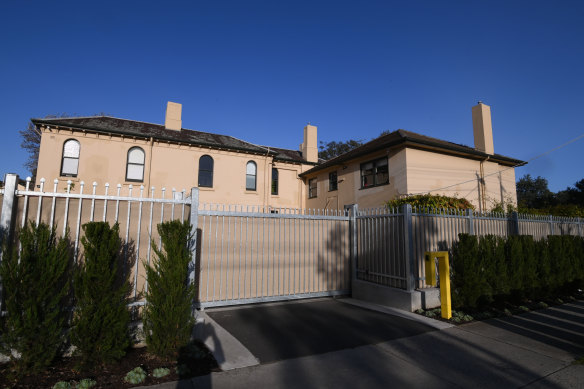
The
alleged sexual abuse did not take place at the school but at the
Yeshivah Centre, a religious centre linked with the school, in
neighbouring St Kilda East.
The school regulator, the Victorian
Registration and Qualifications Authority, recently launched a review of
the school’s adherence to child safety standards.
VoicSA, an
advocacy group addressing Jewish child sex abuse, was named in the MOU
as one organisation the parents should refrain from communicating with
about allegations or complaints about the school or its students.
VoicSA
spokesman Phillip Weinberg said the group had asked the regulator to
suspend the school’s registration “due to immediate concerns for the
safety of children”.
“Attempts
to silence victims/survivors of child sexual abuse in the interests of
protecting the reputation of an institution are abhorrent, incompatible
with the minimum standards of a registered school and contrary to Jewish
law,” Weinberg said.
On Tuesday, Kornhauser wrote an “open letter
to the Jewish community”, saying the school had been subjected to an
inaccurate and defamatory campaign of slander by VoicSA.
“Perhaps
the most slanderous of all is the persistent narrative that in light of
Jewish law, the school does not adhere to its mandatory reporting
requirements, and indeed ostracises parents if they choose to make
reports to the authorities,” he said.
“The school decries even one single act of sexual or other abuse against a child.”
Last
month, Kornhauser told the school’s parents to pray to protect their
children from abuse after they voiced concerns about sexual abuse
allegations.
If you or anyone you know needs support, you
can contact the National Sexual Assault, Domestic and Family Violence
Counselling Service on 1800RESPECT (1800 737 732) or Kidshelpline on 1800 55 1800.
Child sexual assault is a tragic reality affecting our
society. In recent years, many states have enacted legislation to
address the injustices that childhood sexual assault victims face due to
the rigid restrictions of sex abuse statutes of limitations. The California Child Victims Act
is changing previous time limits to allow more child sexual abuse
victims to bring both civil and criminal lawsuits at any age by hiring a
California child sex abuse lawyer,
no matter when the abuse happened, to finally get justice and recover
compensation for their physical injuries and ongoing emotional harm.
CALIFORNIA CHILD VICTIMS ACT: JUSTICE FOR SURVIVORS
In 2019, legislators passed the California Child Victims Act
(CA AB-218) in California, which took effect on January 1, 2020. This
important legislative Act extends the statute of limitations for
California child sexual abuse survivors reaching adulthood to initiate a
claim against their abusers.
Before January 2020, the law
required a survivor of childhood sexual assault to file a lawsuit within
three years from the date they discovered or reasonably should have
discovered that the sexual abuse resulted in their subsequent
psychological injury or illness. The primary restrictive factor linked
to the state’s statute of limitations on sex abuse claims barred a child sex abuse survivor from initiating a suit after their 26th birthday.
Studies
show that most survivors only begin to reveal their experience with
childhood sexual abuse when they reach the age of 52, more than two and a
half decades after the arbitrary cutoff of 26. This research shows that
many child sexual abuse victims in California could not previously seek
justice against both their abusers and the complicit organizations that
allowed their abuse to happen.
A combination of egregious injustices against children, including the Larry Nassar
imprisonment, the Boy Scouts of America sex abuse scandal, and the
numerous sexual assault allegations against the Catholic Church,
California legislators recognized that California sexual assault laws
needed to change. When California Governor Jerry Brown vetoed SB
131, legislators realized the grave disparity in the former law,
essentially requiring victims to bring a lawsuit before they reasonably
knew about or could acknowledge their harm.
Perceiving these
injustices, the California Legislature adopted AB 218 to encourage child
sex abuse survivors to come forward and speak up about their abuse
despite the same taking place several years ago. Advocates pushing for
these necessary legal changes celebrate, as victims can finally seek
compensation and justice against their abusers and the organizations
that allowed the abuse to happen to not only themselves but the hundreds
of thousands of victims living in the State of California.
The California Child Victims Act widens the definition of
childhood sexual abuse, compared to the previous law, to include sexual
assault. This more broad definition increases the scope of sexual
offenses against a minor that are actionable, ultimately helping a child sexual abuse victim.
The
Act also extends the time limit to the later of twenty-two years after
the minor’s 18th birthday, or within five years of the date the child
sex abuse victim discovered their psychological injury that took place
after adulthood resulting from the childhood sexual assault.
Most
victims of childhood sexual assault may now file a civil suit, or a
prosecutor may bring criminal charges against their abuser or a
responsible entity. These responsible entities can include organizations
where the abuse happened, such as the Catholic Church, a foster care home, the Boy Scouts, a school, a daycare center, or any other organization allowing abusers access to children.
The
child sex abuse victim needs to initiate their claim within five years
of discovering the causal link between the childhood assault and their
resulting psychological illness continuing into adulthood or before the
victim turns 40. This change increases the time to file a lawsuit by
fourteen years, up from the previously held law indicating the victim
only had until they turned 26 to bring a claim.
Additionally, the
California AB 218 provides a noteworthy three-year look back window
starting January 1, 2020, and ending December 31, 2022. During this
time, all childhood sexual assault victims in California can start a
civil action for money damages no matter how long ago their abuse
occurred.
After the expiry of the look back window, and if the
plaintiff files a civil lawsuit at or after the age of 40, the law
requires the plaintiff’s therapist and attorney to file certificates of
merit stating: “the attorney has reviewed the facts of the case,
consulted with at least one mental health practitioner who the attorney
reasonably believes is knowledgeable of the relevant facts and issues
involved in the particular action, and concluded on the basis of that
review and consultation that there is reasonable and meritorious cause
for the filing of the action.”
For example, a 52-year-old survivor
now has until December 2022 to file suit against their abuser. This
look back window and related legislation is an incredible win for child
sexual assault victims in California. If someone experienced abuse
decades ago, they can now file a civil lawsuit and work toward achieving
closure. This new prolonged time limit runs out on December 31, 2022, so it’s essential to speak with a law firm knowledgeable about sexual assault cases to learn how you can pursue legal action.
The
Act also provides for situations potentially entitling a victim to
obtain up to triple the number of damages (also known as “treble
damages”) against a defendant and an entity or the organizations or
supervisors aware of the abuse and participating in a cover-up of a
minor’s sexual assault. By definition, a cover-up is “a concerted effort
to hide evidence related to child sexual assault.”
You can access the full text of the California Child Victims Act AB 218 here.
WHY DO VICTIMS WAIT TO COME FORWARD
ABOUT THEIR SEXUAL ABUSE?
The previous statute of limitations failed to recognize the short- and long-term mental and emotional trauma that child sexual abuse
victims endure from the abuse. This trauma often prevents the victim
from being able to come forward to talk about or report the abuse. The
previous law thereby failed to provide the victims with a reasonable
opportunity to press charges or file civil lawsuits against their
abusers and the institutions that allowed the abuse.
There are
several reasons why survivors are reluctant to reveal information about
their abuse. The previous sexual assault statute of limitations made it
extremely difficult for victims to introduce their claims because they
often don’t realize the psychological effects of their abuse until much
later. Reasons why victims wait so long to come forward include:
Ninety
percent of victims are abused by a person they or their family know,
making it difficult for the child to come forward, as they either don’t
realize that the abuse is wrong or they fear what will happen if they
tell someone. They might also be embarrassed or believe it’s their
fault.
The abuser usually gives the child special attention or gifts to gain the child’s trust.
They believe it’s their fault, and they could’ve done something to stop the abuse or fought harder.
They feel shame or do not want to relive the abuse.
They fear they will get in trouble.
They
do not tell anyone to protect their loved ones, attempting to avoid
inflicting pain on their parents or other family members.
They fear no one will believe them.
If
the perpetrator is an admired community member, the child sexual abuse
victim fears no one will believe them, or people will be angry with
them.
The shock of the experience may stun them into silence, and they do everything they can just to carry on
The perpetrator is likely to make threats of blackmail or violence or instruct the victim not to tell anyone else.
They don’t understand that the abuse was wrong.
Shame
and self-blame often accompany each of these reasons for a child sex
abuse victim’s silence. It is never the victim’s fault, but this
tendency to blame themselves or feel guilty is all too common. Studies
show that alongside the stigma, shame, and guilt, family loyalty is a
significant factor that deters victims from speaking up when the
offender is someone attached to a family member.