BERLIN (JTA)
– In a landmark step, investigators commissioned by Germany’s main
Jewish organization have concluded that abuse of power and sexual
harassment did occur at Germany’s liberal rabbinical seminary — and some
of it, they say, may have crossed the line into illegality.
The 44-page “executive summary” of an investigation initiated by the
Central Council of Jews in Germany is the latest and most damning report
about the leadership of Rabbi Walter Homolka since accusations against
him broke into public view last May.
Issued Wednesday after tense public conflict between the council and
Homolka’s attorneys, the report concludes that structural changes are
required to set Germany’s liberal rabbinical seminary, known as Abraham
Geiger College, and other related Jewish institutions on the correct
footing.
“A significant cause for the emergence of the problems identified by
the investigators at the institutions under investigation is the
personal misconduct of Rabbi Prof. Dr. Homolka in his function as a
leader or person with great influence, which the investigators are
convinced of,” the investigators wrote in their report.
Homolka announced Monday that he would withdraw from all functions in
the seminary that he and a German-born American rabbi named Walter
Jacob, founded in 1999. He also dropped out of the running on Tuesday for another term as chair of the Union of Progressive Jews in Germany.
A more comprehensive report including details about incidents in
which investigators concluded that Homolka and his husband engaged in
misconduct is due out in January, according to the Cologne-based law
firm Gercke Wollschläger.
The preliminary report was welcomed in a joint statement by the
Central Council, the German Interior Ministry and the Brandenburg State
Ministry of Science, Research and Culture, which said they would
“continue to fund the Abraham Geiger College to the same extent as
before until the structural new beginning has been completed.”
It was also greeted with relief by the former cantorial student whose complaints kicked off the scandal.
“I think the report and the subsequent documents are a blessed
development,” Itamar Cohen, now a cantor, told the Jewish Telegraphic
Agency. “It seems to confirm many suspicions which I and others share.
It does affirm that I did the right thing and [this] could be the
beginning of a new chapter of liberal Judaism in Germany.”
The scandal that erupted publicly in May began after Cohen sought
help from Jonathan Schorsch, a professor at the School of Jewish
Theology, in dealing with unsolicited pornographic material allegedly
received from Homolka’s husband, who was also an employee at the
seminary. (Abraham Geiger College is part of the School of Jewish
Theology, which itself is under the auspices of the University of
Potsdam.)
A German newspaper’s report about the allegations and an apparent
effort to obscure them opened the floodgates for criticism of Homolka
from past and current students, employees and colleagues.
Homolka took a
leave of absence from the numerous leadership roles he held with
liberal Jewish religious and educational institutions that he had helped
found since the late 1990s.
The scandal has shaken the foundations of modern liberal Judaism in
Germany, and the new report suggests that those foundations were weak
because they rested largely on one individual.
Josef Schuster, the president of the Central Council of German Jews,
said the report made it clear that Homolka could not continue in his
previous roles.
Homolka has rejected the allegations against him throughout, and his attorneys told German news media Wednesday
that they believed the entire investigation was politically motivated.
They accused Schuster of wanting to see Homolka exit Germany’s liberal
Jewish leadership and said the Central Council had failed to consider
fully the statement Homolka had given to investigators.
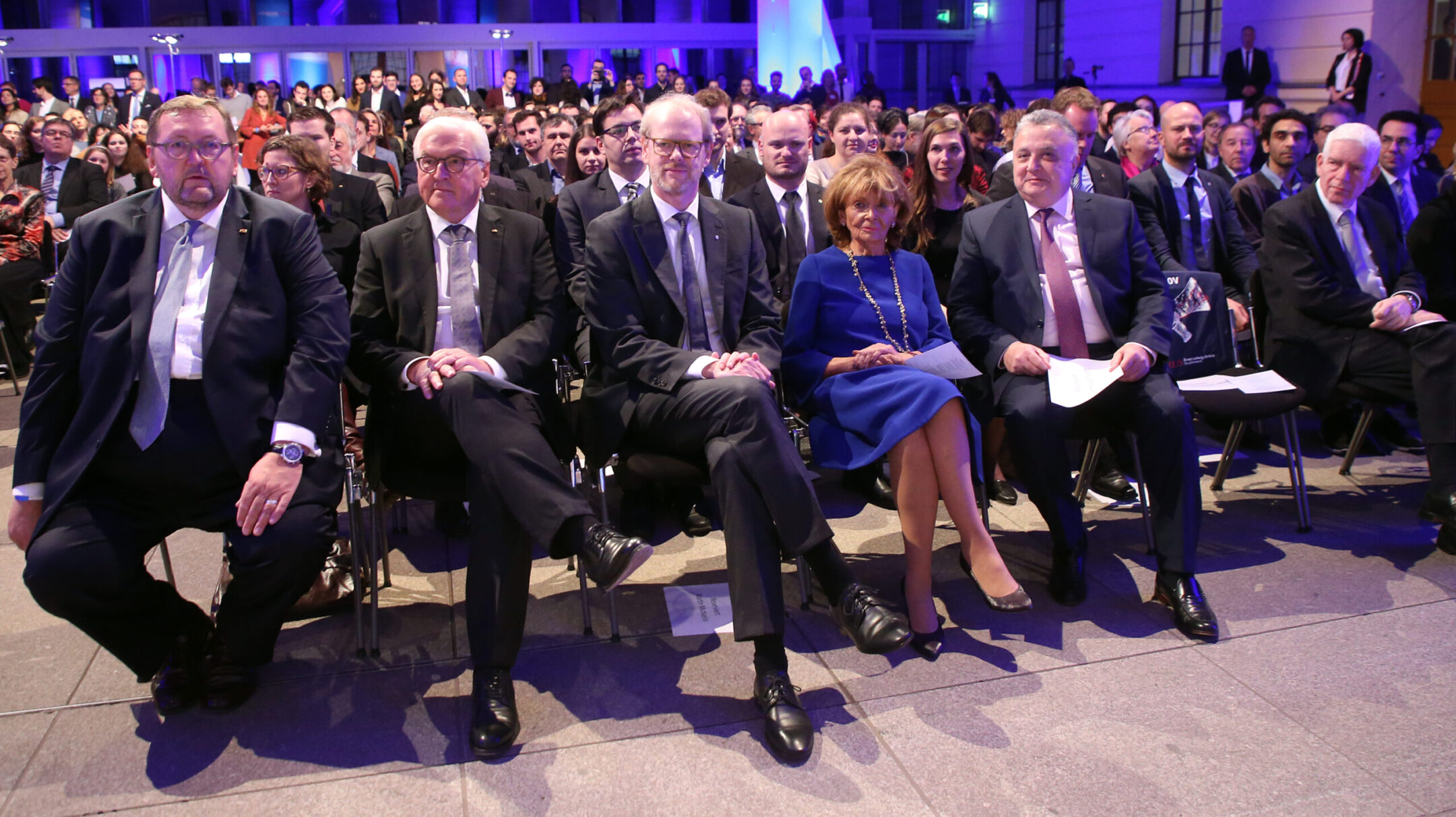
Rabbi
Walter Homolka. at left, with other leaders of Germany Jewry
The report is the first to emerge from a third-party investigation
into the allegations against Homolka. A separate investigation by the
University of Potsdam, released in late October, found that some of the
accusations regarding abuse of power to be justified, but did not find
any criminally actionable behavior and thus confirmed Homolka’s ongoing
employment there as professor. It did not investigate the sexual
harassment accusations, as Homolka’s husband had left his job by then.
The new report did scrutinize those allegations. The investigators
said they found 13 specific incidents involving allegations against
Homolka’s husband. German libel law bars the publication of his
name. Using what they called a “traffic light system,” the investigators
classified nine of these incidents as “red” cases, in which 25
instances of misconduct could be identified. Two of these cases involved
the “initial suspicion of a criminal offense,” they added.
Regarding allegations of abuse of power against Homolka himself, they
found — after interviewing 73 individuals — a total of 45 concrete
incidents, 14 of which they classified as “red,” involving a total of 23
instances of misconduct. A detailed account of those cases, including
responses that Homolka delivered earlier this week, will be included in
the final report in January, they said.
More broadly, they said, their interviews had illuminated a culture
of misconduct in which unchecked, unlawful or arbitrary decisions could
be made largely because of a consolidation of power under Homolka. He
presided over an institution ruled by a “culture of fear,” the
investigators found, leaving employees and students alike less likely to
express criticism or concerns because of the possibility of reprisals.
The investigators said structural changes were needed if there was
any hope of shifting the culture. “As long as institutions are in
private hands or even in the hands of an individual, or at any rate
within the essential sphere of influence of the person who, in the
opinion of the investigators, practices and exemplifies misconduct
himself, it is hardly conceivable that the causes of the deficits
identified can be remedied,” their report says.
Cohen told JTA he wants to see “real change in the leadership” of all
liberal Jewish institutions in Germany, and “an external compliance
system set up.”
He said, “I hope to see the institutions Homolka founded take a life of their own, no strings attached.”
Anticipating the report, the Abraham Geiger College had announced its
own restructuring plans on Monday, a day after ordaining four new
rabbis and two cantors at a ceremony in Berlin.
In a statement, interim director Gabriele Thöne said a new foundation
would become the provider of rabbinical training in Potsdam.
Further, Thöne said the “door is open to Zacharias Frankel College” —
the Conservative movement seminary also under the umbrella of the
School of Jewish Theology at the University of Potsdam — “to join the
new foundation on an equal basis while at the same time maintaining its
independence.”
But in a scathing response issued Wednesday, the Conservative
seminary said the Geiger College interim administration had not
consulted them about the restructuring.
“A partnership between equal parties requires joint preparation,
mutual trust, transparency and consensus. All this has been lacking so
far, and continues to be lacking,” the statement said.
Signed by Rabbi Bradley Artson, dean of Zacharias Frankel College and
the Ziegler School of Rabbinic Studies, the Conservative seminary in
Los Angeles among others, the statement also said the preliminary report
released Wednesday “confirmed the asymmetrical constellations of power
in the two Potsdam rabbinical training colleges.”
Zacharias Frankel College “was in a state of dependency on the will
of one person from the time it was founded in 2013. Our institution was
deliberately pushed into invisibility and excluded from communication
with funders in Germany,” the statement read in part.
“From the outset, the project of a Masorti rabbinical training in
Potsdam was merely a makeshift means of being able to found the School
of Jewish Theology [also in 2013] and give it the appearance of
representing several denominations, and thus of being pluralistically
positioned. Instead, however, the accumulation of power led to a
monopolization of non-Orthodox Judaism in one person” – namely, Homolka.
For their part, the government and Jewish funding organizations said
in their statement Wednesday that they were “committed to ensuring that
there will continue to be both liberal and conservative rabbinical
training in Potsdam in the future,” but that the proposals developed so
far at the Abraham Geiger College do not meet the requirement of being
“a clear cut from the previous structure and a comprehensive new
beginning.”
The release of the Central Council-commissioned report was preceded by a volley of statements by lawyers for both parties.
On Monday, the council’s attorneys announced that their preliminary
report would come out in two days. On Tuesday, Homolka’s attorneys
issued a statement criticizing the impending “sudden” release of the
report’s summary, suggesting it reeked of “prejudgment.”
The law firm representing Homolka — Behm Becker Geßner — noted that
its client had received “a list of questions with serious accusations”
from the council’s attorneys, and that he had responded in writing last
Sunday. “Should the result not take into account the meaningful
statement of our client, there would be a massive violation of
personality rights,” warned the lawyers, who have successfully battled
some critical press coverage of Homolka.
The Central Council criticized what it called Homolka’s delay
tactics, saying its attorneys had asked Homolka in early September if he
would respond to questions but had not gotten any response to questions
sent Oct. 19 until late Sunday night, well after multiple previous
deadlines. Still, the council confirmed, its investigators would take
Homolka’s responses into account.
“This tactic is the main reason why the law firm will not be able to
complete the final and detailed report of the investigation by the end
of the year,” the Central Council said. “The courage of the numerous
victims must not be sacrificed to Homolka’s delay tactics.”
Meanwhile, the Union of Progressive Jews in Germany is to meet next
week in Berlin, after a three-month postponement. Board elections will
be held for the position of chair, previously held by Homolka.
On Nov. 26, that group published a report from an investigation that
it had commissioned, which concluded that there was no proof of abuse of
power at Abraham Geiger College.
On Wednesday, a critic within the body, the State Association of
Jewish Communities of Lower Saxony, said the Central Council’s
commissioned report “supports us in our demand for the resignation of
Walter Homolka from all his offices within the Jewish community, which
we already made in May.”
And there is dissent within the General Rabbinical Conference,
Germany’s liberal rabbinical association, as well. About a dozen members
issued a statement in November, breaking from the official, cautious
tone, saying that “the abuse of power proven against Rabbi Prof. Dr.
Homolka [in the university’s report of Oct. 26] is not compatible with
the values of Jewish and general ethics.”
The association, known as ARK, issued a statement at the end of
November stating that, despite differences of opinion in their ranks,
they join the call for a structural and personal new beginning, as “a
chance for the next phase of rabbinical training in Germany.”
https://www.jta.org/2022/12/07/global/prominent-german-rabbi-resigns-from-leadership-roles-as-report-confirms-allegations-against-him?utm_source=JTA_Maropost&utm_campaign=JTA_DB&utm_medium=email&mpweb=1161-51537-25499