EVERY SIGNATURE MATTERS - THIS BILL MUST PASS!

EVERY SIGNATURE MATTERS - THIS BILL MUST PASS!
CLICK - GOAL - 100,000 NEW SIGNATURES! 75,000 SIGNATURES HAVE ALREADY BEEN SUBMITTED TO GOVERNOR CUOMO!

EFF Urges Court to Block Dragnet Subpoenas Targeting Online Commenters

EFF Urges Court to Block Dragnet Subpoenas Targeting Online Commenters
CLICK! For the full motion to quash: http://www.eff.org/files/filenode/hersh_v_cohen/UOJ-motiontoquashmemo.pdf

Sunday, September 10, 2023

Messages to God removed from Western Wall ---- What If G-D Did Not Get The Chance To Read Them Yet? He Has His Hands Full With The World of Today!

  SCAM ALERT - MANY POSKIM HAVE SAID THIS IS A MINHAG SHTUS

Journal of Halacha and Contemporary Society. 43-44. Yeshiva Rabbi Jacob Joseph School. 2001. p. 94. A practical issue in connection with the kotel ha'maravi is whether it is permitted to insert one's fingers or notes into the crevices of the wall" and "Others have argued that since this pollutes the kotel, and there is no halachic reasoning for this practice, that it is not proper to allow it to continue.

Online services offer petitioners the opportunity to send their notes to the Western Wall via e-mail, fax, text messaging and Internet; the note is then printed out and inserted in the Wall.[9] The Israeli Telephone Company has established such a fax service,[10] as have a number of "charitable" scam websites. 

https://tweetyourprayers.info/

Former domain of a website that ran a campaign in which you could tweet your prayers and they would be placed as notes on the Western Wall in Jerusalem.

https://aish.com/place-a-note-in-the-western-wall/

CHRISTIANS UNITED FOR ISRAEL ---- https://cufi.org/engage/pray/westernwall-prayer-request/


In today's electronic age, many online services offer petitioners the chance to send their kvitel to the Western Wall via email, fax, text messaging and Internet; the kvitel is then printed out and inserted in the cracks of the Wall.[44] The "Send a Kvitel Service" of kevarim.com receives kvitelach via Internet and then dispatches them to the gravesites of tzadikim in North America with people who travel to these gravesites.[45] The Nikolsburger Rebbe himself accepts kvitelach and pidyonos via Internet.[46]

Sending kvitelach to the grave of a Rebbe or tzadik has also become a fund-raising tool. Mosdos Kever Rachel (Kever Rachel Foundation) encourages donors to send messages and prayers which will be read out at Rachel's Tomb.[47] Similarly, the Breslov Research Institute website offers donors the opportunity to send a "digital kvitel" to be read by the grave of Rebbe Nachman of Breslov in Uman, Ukraine.[48]

 The practice of placing prayer notes in the Western Wall has also been adopted by Christian pilgrims and people of other faiths.[7] Foreign dignitaries who have publicly placed a kvitel in the Western Wall include Pope John Paul II in 2000,[33] U.S. Senator Hillary Clinton in 2005,[34] Pope Benedict XVI in 2008,[35] U.S. presidential candidate Barack Obama in 2008,[8] and U.S. presidential candidate Mitt Romney and his wife Ann in 2012.[36] Pope Francis inserted a handwritten Spanish language text of the Lord's Prayer in the Wall during his visit in 2014.[37][38][39] On May 22, 2017, Donald Trump became the first sitting U.S. President to visit the Wall; he also inserted a note.[40]

It is unclear when the practice of writing and giving kvitelach began. This practice is not mentioned in the writings of the early kabbalists, nor in the works of the school of Isaac Luria (1534–1572), the father of modern Kabbalah.[9] The first time it is mentioned is during the time of the Baal Shem Tov (1698–1762), founder of Hasidism.[10] ***It says an awful lot about the idiocy of this minhag*** PM

Journal of Halacha and Contemporary Society. 43-44. Yeshiva Rabbi Jacob Joseph School. 2001. p. 94. A practical issue in connection with the kotel ha'maravi is whether it is permitted to insert one's fingers or notes into the crevices of the wall" and "Others have argued that since this pollutes the kotel, and there is no halachic reasoning for this practice, that it is not proper to allow it to continue.

Messages to God removed from Western Wall 


The prayer notes are removed from the wall twice a year—before Passover and the High Holidays—and are buried in a Jewish cemetery.

Notes are removed from the Western Wall ahead of Rosh Hashanah, Sept. 10, 2023. Photo by Yoav Dudkevitch/TPS.
Notes are removed from the Western Wall ahead of Rosh Hashanah,
 
  One of Jerusalem’s most "iconic" (superstitious) religious traditions is custom of writing prayers on scraps of paper and placing them in the cracks of the Western Wall.

Visitors to the holy site of all faiths leave thousands of notes to God—known as ptakim—praying for personal success, a loved one’s health, peace in the Middle East and a myriad of other things.

The custom stems from the Jewish teaching that God’s presence never left the Western Wall and that prayers ascend to heaven through the adjoining Temple Mount. People unable to visit can also write notes online, which are printed out placed in the wall by staff.

Twice a year—before Passover and the High Holidays—the Western Wall Heritage Foundation removes the notes. The foundation administers the holy site’s daily affairs. The cleanup is done under the supervision of the Chief Rabbi of the Western Wall and the Holy Places Shmuel Rabinowitz, Rabbi of the Western Wall and the Holy Places.

Notes removed from the wall are buried in a Jewish cemetery on the nearby Mount of Olives. Workers are careful to respect the privacy of the prayers and do not read the notes.

At the end of August, engineers inspected the wall for safety, removing loose stones and seasonal plants. Thousands of Jews will visit the Western Wall during the High Holidays and the week-long holiday of Sukkot. The High Holidays being with Rosh Hashanah, the Jewish new year, which starts on Sept. 15 at sundown.

The Western Wall, also known as the Wailing Wall, is the only remnant of a retaining wall encircling the Temple Mount built by Herod the Great and is the holiest site where Jews can freely pray. The Temple Mount, where the First and Second Temples were built, is the holiest site in Judaism.

Worshippers at the Western Wall were able pray for a happy new year as workers made room for the next six months of notes.


https://www.jns.org/jewish-and-israeli-holidays/rosh-hashanah/23/9/10/317467/

Friday, September 08, 2023

The protection of children and other victims of abuse is of greater importance than the repentance of the perpetrator. The policy states that if a perpetrator needs a minyan one can be provided for them at a private home or a setting where no children are present.


The boundaries of repentance 


How far should forgiveness extend? What should congregations do when a sex felon wants to attend services?

One catchphrase of the High Holy Day season is “Utshuvah, Utfilah, Utzedakah ma’avirin et ro’a hagizera,” often translated as “repentance, prayer and charity will avert the evil decree.” At this time of year, our community faces the challenge to accept penitents back into the fold, allow them access to our sanctuaries, and even offer honors to the Torah. If we truly believe in the possibility of repentance, we must be willing to reintegrate them.

But what of abusers? The recently issued “Guidelines and Protocols on Child Safety and Sexual Abuse in a Congregational Setting” from the Orthodox Rabbinical Council of America (RCA) asks the same question. “One of the most difficult challenges for congregations in dealing with abusers is that of granting access to the synagogue to registered sex offenders, to those suspected of abuse, and to those charged with abuse but not convicted for a variety of reasons.”

This issue has plagued each movement. Anecdotally, most congregations do not handle it well. Rabbis are loath to refuse the repentance of a felon. At times I would be made aware “in confidence” of an abuser in the congregation. “Outing” them, especially if they had already served their sentence, would humiliate them and their family.

David Hartman (of blessed memory) taught me that “a value is only a value when it is tested.” In the past, congregations and movements have interpreted this to mean that we must be willing to forgive a person who has sinned and allow them to be part of the community once again.

But that is not how this issue should be interpreted. It stems from a basic mistranslation of the High Holiday catchphrase, which should read, “repentance, prayer and charity (may) modify the decree.”

In other words, you can repent but you are still responsible for your deeds. In this case, part of your “repentance” is to never allow a victim to feel the danger of your presence. And the perpetrator’s wish to be in the sanctuary cannot be allowed to take precedence over the trauma their presence inflicts on victims.

Thankfully, the RCA has taken a courageous stand, which is found in its opening sentence. “The primary responsibility of a congregation is to ensure the physical and emotional safety and wellbeing of its members including the victims and survivors of sexual abuse by the immediate perpetrator, potential victims, minors and their parents, and victims and survivors of other instances of sexual abuse.”

The protection of children and other victims of abuse is of greater importance than the repentance of the perpetrator.

The policy states that if a perpetrator needs a minyan one can be provided for them at a private home or a setting where no children are present.

This is not a small step on a new path. It is the beginning of a “legal correction” (takana) over the responsibilities of a community to members. One hopes that it becomes “the norm” for all movements. More to the point, one hopes that the individual congregation will implement these recommendations.

Then this will truly be a High Holy Day


https://blogs.timesofisrael.com/the-boundaries-of-repentance/

Thursday, September 07, 2023

#BanTheADL is clearly fomenting hatred. Musk seems to see the “abuse of Jews on his site” as “the consequence of Jews complaining about the abuse.”


Elon Musk wants to blame someone else for Twitter’s decline. This week, it’s the ADL.


Time For Jews To Reconsider Buying A Tesla?


Elon Musk, Tesla CEO


He asserted that the U.S. advertising revenue at X is "down 60%, primarily due to pressure on advertisers by @ADL (that’s what advertisers tell us), so they almost succeeded in killing X/Twitter!" And he tweeted that he has "no choice but to file a defamation lawsuit against the Anti-Defamation League (Code Name Jews)."

Not to put a fine point on things, but all this shows Musk to have gone utterly off the rails and over the edge of conspiracy-mongering paranoia. It's the most extreme outburst of antisemitism by a purportedly mainstream public figure in more than 100 years.

When Elon Musk first expressed interest in buying Twitter (now known as X) last year, a number of observers (including us) wondered what the world’s richest man could possibly want with an unprofitable social-media platform. Musk said that his interest in Twitter was driven in part by a desire to turn the platform—which he called the world’s “de facto town square”—into a bastion of free speech, and that he would see it as a victory if commenters from both the left and the right felt uncomfortable there. After his acquisition was finally completed in October, however, most of the changes Musk made seemed to favor the right. By December, the Atlantic tech writer Charlie Warzel had concluded that Musk had become a “far-right activist.”

Last week, we learned a little more about Musk’s motivations for buying Twitter when the Wall Street Journal published an excerpt from a new biography of Musk by Walter Isaacson, a former president of CNN and the author of a number of biographies, perhaps most notably of Steve Jobs. (The book will be released next week.) In April 2022, Isaacson reports, things were going well for Musk; shares of Tesla, his electric-vehicle company, had increased in value by about fifteen times in five years, and SpaceX, his other company, was also doing well. “It promised to be a glorious year, if only Musk could leave well enough alone,” Isaacson writes. “But that was not in his nature.” Instead, Musk’s nature was to behave impulsively. Per Isaacson, Musk decided to take over Twitter because it was “an addictive playground” and owning it would make him “king of the school yard.”

Musk told Isaacson that there was another aspect to his desire to acquire Twitter: his concern that American society had become infected with a “woke mind virus,” which he characterized as a “fundamentally anti-science, anti-merit, and anti-human in general” belief system. Unless it was stopped, he said, civilization would “never become multiplanetary.” According to Isaacson, Musk’s concern was triggered in part by Jenna, his eldest child, transitioning to a different gender and cutting off all contact with him. Jenna “went beyond socialism to being a full communist and thinking that anyone rich is evil,” Musk told Isaacson. He blamed her private school.

Once the idea of the woke mind virus got into his head, Musk saw it everywhere. Isaacson describes how Musk railed against Twitter’s cozy atmosphere when he toured the company’s headquarters, making fun of staffers’ “Stay Woke” T-shirts and the gender-neutral bathrooms. Since then, Musk has reserved some of his strongest criticism for entities that he believes have helped broaden the reach of the woke ideology. One of those entities is the Anti-Defamation League, or ADL, a nonprofit that says that its mission is to “stop the defamation of the Jewish people and to secure justice and fair treatment to all.”

This past weekend, Musk alleged in a series of posts that the ADL had pressured advertisers to remove their ads from X, and that this was the primary reason that the company’s US ad revenue was down 60 percent since he acquired the company. “They almost succeeded in killing X/Twitter,” Musk wrote. He went on to allege that the ADL would not relent unless he agreed to “secretly suspend or shadowban any account they don’t like”; that the ADL had the same relationship with Twitter before he acquired it; and that, “presumably,” they have a similar relationship with “all western search or social media orgs.” Musk concluded that the ADL was likely responsible for destroying 10 percent of X’s value, a figure he pegged at about forty billion dollars. He would have no choice, he said, but to file a defamation lawsuit (though, at time of writing, he had yet to do so).

According to a report from Rolling Stone, last Thursday, the hashtag #BanTheADL started trending on X, driven in part by a meeting between Jonathan Greenblatt, the organization’s national director, and Linda Yaccarino, X’s CEO. (Greenblatt described the meeting as “frank and productive.”) Those who worked hardest to amplify the hashtag, according to Rolling Stone, included Keith Woods, whom the magazine described as an Irish YouTuber with connections to prominent white supremacists, and Andrew Torba, the chief executive of Gab, a platform popular among right-wingers and neo-Nazis. At one point, Musk liked a post in which Woods alleged that the ADL is “blackmailing social media companies into removing free speech on their platform,” and replied with a post of his own alleging that the ADL was doing its best to kill X.

In Musk’s attacks on the ADL, many users of X saw a thinly veiled anti-Semitism. This week, in an open letter to Yaccarino, Claire Berlinski, an author and historian, called Musk “the most dangerous anti-Semite in America,” and the #BanTheADL campaign “one of the most vile public outpourings of antisemitism in American history.” By promoting it, Berlinski argued that X not only gave the accounts in question freedom of speech, but “extraordinary reach,” and that Musk personally bears responsibility for this.

Musk’s enmity toward the ADL, it should be noted, didn’t start with the hashtag campaign. As far back as last year, Greenblatt condemned Musk’s decision to reinstate Donald Trump’s account, which had been suspended after the former president incited the January 6 riot in Washington. In May, Musk, echoing an anti-Semitic trope, tweeted that George Soros, the billionaire philanthropist, “hates humanity”—a comment that the ADL criticized strongly; the same month, the ADL published a report finding that anti-Semitism on X increased dramatically following Musk’s acquisition of the platform. (The organization collected more than five thousand examples of anti-Semitic commentary in February, from more than two thousand accounts.) Per Rolling Stone, Musk and Greenblatt also clashed in August, after Musk claimed that there has been a “genocide of white people” in his native South Africa; Greenblatt said that there was no evidence to support this claim, leading Musk to respond with two exclamation marks. According to some recent tweets using the #BanTheADL hashtag, some of the group’s critics now see it as an “anti-white hate group.”

Nor is the ADL the only supposedly “woke” institution or pressure group that Musk has gone after. During his tweetstorm about the ADL, Musk also claimed that Meta had “caved to far left pressure groups and now allows them to silently dictate policy in exchange for ad money.” This appeared to be a reference to the #StopHateForProfit ad boycott, which was organized by a number of nonprofit organizations, including, in addition to the ADL, the NAACP, Free Press, Common Sense Media, Color of Change, and a group known as Sleeping Giants, which pressures websites and media companies to stop running advertisements from Breitbart and other conservative entities. According to Politico, that hashtag campaign led to more than eight hundred companies pulling their ads from Facebook.

Even if Musk ends up suing the ADL—which some observers, including The Atlantic’s Yair Rosenberg, view as highly unlikely—it wouldn’t be the first time that he has sued a nonprofit group that fights hate speech. Just last month, X filed a lawsuit against a nonprofit called the Center for Countering Digital Hate, a group that published a report finding that X failed to take down 99 percent of the hate speech posted by users who pay for the X Premium service (a subscription plan that includes a blue checkmark); the report also suggested that X’s algorithm effectively boosts “toxic tweets.” In the lawsuit, X accused the CCDH of illegally accessing data and cherry-picking posts to show a rise in hate speech, and blamed that group, too, for hitting the platform’s advertising revenue. (Jem Bartholomew of Columbia’s Tow Center for Digital Journalism spoke with Imran Ahmed, the executive director of the CCDH, about the lawsuit.)

Whatever Musk thinks about the “woke mind virus,” the available evidence suggests that he is desperately searching for scapegoats on whom he can blame the death spiral of a platform whose acquisition, as Isaacson reports, was not clearly thought through. Mike Rothschild, a disinformation researcher, perhaps put it best this week when he scoffed at the implication that “erratic management, mass layoffs, incoherent moderation… serial unbanning of racists, and crumbling infrastructure had nothing to do with twitter losing half its value.” But Musk’s enabling and promotion of campaigns like #BanTheADL is clearly fomenting hatred. And, as Rosenberg put it, Musk seems to see the “abuse of Jews on his site” as “the consequence of Jews complaining about the abuse.”


 https://www.cjr.org/the_media_today/elon_musk_adl_antisemitism.php

Wednesday, September 06, 2023

Agudath Israel Statement: The Harassment of the Catholic Church By The NYPD & The NY Board Of Education Must Stop - Remember Our Slogan - "We're In it Together"


New York priest arrested on child sex abuse charges

syracuse priest
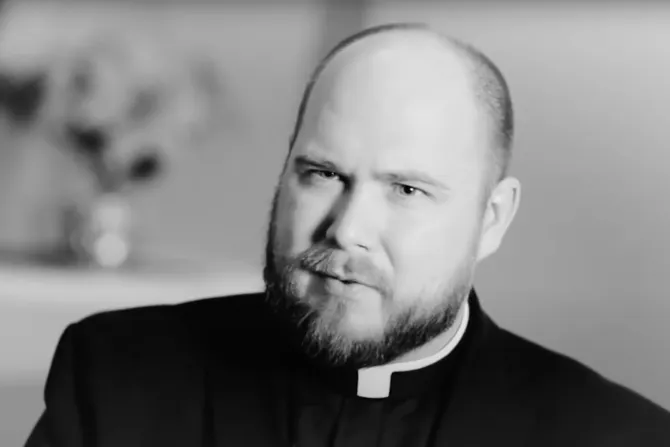
Father Nathan Brooks, 36, faces several misdemeanor charges filed Aug. 31 in Cortland County Court in central New York related to allegations of sex abuse, including that of a minor.

A Catholic priest in New York’s Diocese of Syracuse has been arrested on charges of sexual abuse, including that of a minor, for alleged incidents from 2019 to 2022. In response, the local bishop suspended the priest from ministry and called for prayers for everyone involved.

Father Nathan Brooks, 36, faces several misdemeanor charges filed Aug. 31 in Cortland County Court in central New York. These include endangering the welfare of a child, forcible touching, and sexual abuse in the third degree.

Brooks, who resides in the town of Lafayette, has been serving as administrator of three churches: Church of the Nativity at St. Joseph in Lafayette; Immaculate Conception in Pompey; and St. Leo, Tully and St. Patrick Mission in Otisco.

Bishop Douglas J. Lucia on Friday said that Brooks has been suspended from all ministry during the investigation.

“This is distressing news, most certainly to me, and to all of you,” Lucia said in a Sept. 1 statement. “As a Catholic family, we have been on a journey of trying to make amends for the great harm that was caused in the past and now we are faced with this situation. Like me, I can only assume that you have many questions, but we must prayerfully await the conclusion of the investigation.”

The Cortland County Sheriff’s Office received the allegations on Aug. 22. The sexual abuse allegedly occurred on multiple occasions between 2019 and 2022 in the town of Homer and the city of Cortland. The victim was known to Brooks, WIVT/WBGH News reports.

Bishop Lucia said the diocese will fully cooperate with the county district attorney’s office.

He asked the people of the Syracuse diocese to pray “for all parties involved” and to continue to be “ever vigilant” in adhering to the diocese’s conduct code and safe environment child protection protocols.

Brooks was ordained a priest in 2019.


https://www.catholicnewsagency.com/news/255283/new-york-priest-arrested-on-child-sex-abuse-charges

Tuesday, September 05, 2023

Bibi ---- Tell The Idiots To Stay Home!


Could tense Israel-Ukraine relations cause a humanitarian crisis in Uman?


Jerusalem Affairs and Jewish Tradition Minister Meir Porush has appealed to the prime minister to help avoid a humanitarian crisis in Uman.

MK Meir Porush arrives to coalition talks at the Likud headquarters in Tel Aviv on November 10, 2022.  (photo credit: AVSHALOM SASSONI/FLASH90)
MK Meir Porush
וַיִּפְתַּ֥ח יְהֹוָ֖ה אֶת־פִּ֣י הָאָת֑וֹוַ


(א) והיה כי יראו אתך המצרים: ....ולא סמך על הבטחת האל שהבטיחו, כי אמר שמא יגרום החטא וכן פחד יעקב אבינו אחר הבטחת האל וכן ראוי לכל צדיק שלא יסמוך במקום סכנה על הנס וישמור עצמו בכל תחבולה אשר יוכל, ועל זה אמר שלמה אשרי אדם מפחד תמיד (משלי כ״ח:י״ד) וכן אחז"ל (תענית ט') מניין שאין סומכים על הנס שנאמר לא תנסו את ה' אלהיכם (דברים ו') וכן ראינו שמואל הנביא כשהלך בשליחות האל ופחד משאול, ואמר "ושמע שאול והרגוני" (שמואל א' ט"ז) וגם האל שבח פחדו ולא אמר לו אל תפחד כי לא יהרגך, אבל אמר לו "עגלת בקר תקח בידך" והודה לו כי טובה היתה מחשבתו שהיה מפחד, וכן ראוי לכל צדיק שיעשה כן ולא יבטח על הנס.

Israel's complicated diplomacy with Ukraine will cause a humanitarian crisis along Ukraine's southern border as tens of thousands try to reach Uman for Rosh Hashanah, Jerusalem Affairs and Jewish Tradition Minister Meir Porush warned Prime Minister Benjamin Netanyahu in a letter on Monday.

Breslov hasidim traditionally spend Rosh Hashanah at the grave of Rabbi Nahman of Breslov, something that has not changed in the last couple of years since the start of the Russia-Ukraine war.

In 2022, despite Israel putting out a travel warning and Ukraine saying it could not guarantee the safety of people who traveled to Uman, thousands still made the trip.

However, due to Ukraine's skies being closed to civilian flights, Porush said that last year saw a humanitarian disaster unfold for those who tried to get to Uman.

"Due to a lack of proper preparedness, a severe humanitarian crisis was caused at the borders in which the border checkpoints could not withstand the heightened traffic, and many had to wait at the border in difficult conditions for many hours, and in some cases, even a whole day," Porush wrote to Netanyahu.

Ultra-Orthodox Jewish pilgrims celebrate the Rosh Hashanah holiday, the Jewish New Year, at the tomb of Rabbi Nachman of Breslov, amid Russia's attack on Ukraine, in Uman, Ukraine September 25, 2022. (credit: REUTERS/VLADYSLAV MUSIIENKO)
Ultra-Orthodox Jewish pilgrims celebrate the Rosh Hashanah holiday, the Jewish New Year, at the tomb of Rabbi Nachman of Breslov, amid Russia's attack on Ukraine, in Uman, Ukraine September 25, 2022

As such, Porush said that he was working with the National Security Council to figure out a way to safely and productively help worshippers get to Uman.

With the help of various ministries and embassies, Porush said that Israel has made significant deals with Moldova, Poland, and Hungary to have travelers land in their countries and cross the border on foot through them.

The issue is, however, that "the complicated diplomatic relations between Israel and Ukraine led to the authorities in Ukraine refusing to cooperate and hold talks about arranging the passage of travelers productively and safely."

Keeping a brewing humanitarian crisis at bay

Porush added that without Netanyahu's involvement, there could be another humanitarian crisis as many are unable to cross the border. He urged Netanyahu to help sort out the operation with Ukraine in any way he could, including by speaking personally with Ukrainian President Volodymyr Zelensky.

"We, as the people who are responsible for the citizens of Israel and as a country that has always looked after Israelis and Jews worldwide, cannot allow a situation where tens of thousands of people pay the price for the State of Israel's diplomatic interests," wrote Porush.

"In the absence of a change in discourse with the Ukrainian government, I will be unable to fulfill the task handed to me, and the failure will be listed in the name of the government. I will continue to do all I can to serve the traveling citizens in other ways in which I have the ability to help and improve the situation."

Israel and Ukraine have experienced tense relations in the last couple of years since the war began due to disagreement on the nature of Israel's aid. While Israel supplied Ukraine with humanitarian aid from early on in the war, Ukraine has repeatedly asked for military aid which Israel has refused to give aside from a missile early warning system that reached Ukraine in May.

Relations became more tense again after Israel announced that medical insurance had expired for Ukrainian refugees. After Zelensky and Ukrainian Ambassador to Israel Yevgen Korniychuk threatened to revoke entry permits for Israelis visiting Uman, Israel announced that medical insurance would be increased until the end of the year.

https://www.jpost.com/israel-news/article-757512?utm_source=ActiveCampaign&utm_medium=email&utm_content=Female+terrorist+attempts+to+stab+Jerusalem+police+officer&utm_campaign=September+4%2C+2023+2&vgo_ee=4%2BX1Fme1dyvQoqc3dbzHD05ArO63mKu3B8jOpQmV%2Fv487g%3D%3D%3AaU3WyQgJuE%2BV3ha5l8qA31Xd4DXy06hP

Sunday, September 03, 2023

Principals, Teachers and All Schools Need To Take Precautionary Measures To Educate & Protect Children and Naive Staff Members!


Project SARAH: The Silent Guardian of Our Community


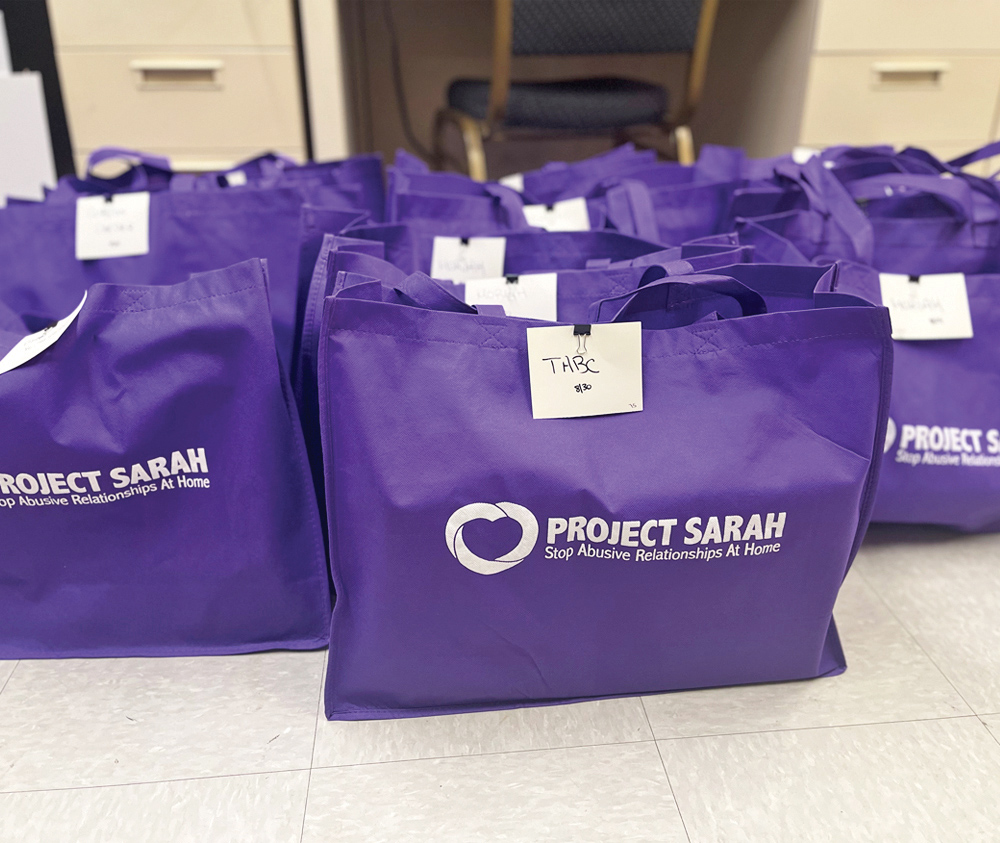
Swag bags prepared for upcoming school staff and youth group trainings.

 Just a few weeks before summer break, our team of therapists and educators at Project SARAH visited schools in the greater Bergen County area. The goal: provide teachers and other staff with the tools needed to recognize issues of abuse, and to offer children tools for keeping themselves safe.

For one of these schools, our visit came at an especially critical time. A student had accused a staff member of inappropriate touch. Given various circumstances around the accusation, abuse or misconduct appeared unlikely. Even so, our role at Project SARAH was clear: to work with the school in their thorough investigation of the alleged event, while skillfully and sensitively supporting its entire community. We offered additional staff training on appropriate boundaries and conduct according to school policy. Meanwhile, our team of presenters visited every classroom in the school, providing the vital Magen Yeladim safety program to ensure every student who went home that day left with age-appropriate skills for protecting themselves from abuse.

As for the child who had accused the school staff member, following the presentation, she was able to distinguish between touch that is okay and touch that is inappropriate—or unwelcome. Later, she spoke with her parents about how she felt her experience fell into the latter category. Now that this student understood these nuances, she was empowered to effectively report any behaviors that make her uncomfortable in a way that accurately describes what happened.

For us at Project SARAH, this story speaks volumes about why we do what we do—and why we so often hear from adults, children and families: “I wish I’d known about you sooner. I had no idea you were doing this.”

It’s true: Much of the work we do in the community with survivors of abuse happens quietly behind the scenes, to protect the confidentiality and safety of clients have been through the unspeakable. But when it comes to our prevention and outreach efforts to safeguard the well-being of our children and families, we don’t want to stay quiet.

This year alone, we have partnered with over 20 schools, camps and shuls. Our team of mental health professionals and educators has presented to staff and students at community educational institutions such as Bruriah, RYNJ, TABC and Yavneh. We’ve trained counselors at day camps such as Acheinu, Summer Playland and the Tenafly JCC, and group leaders at Rinat Israel, Bais Medrash of Bergenfield and Young Israel of Teaneck.


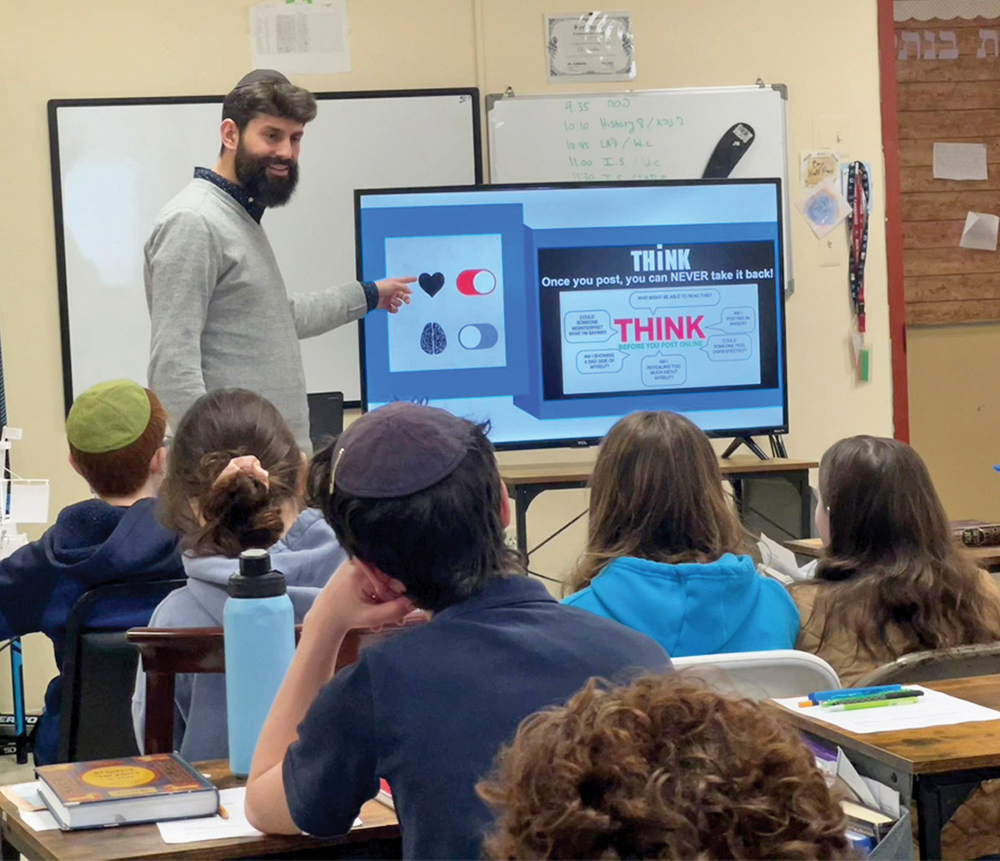
Project SARAH presenter training a middle school class in abuse prevention workshop, focusing on internet safety.

For us, the feedback from the community is a testament to the vital need our work fills. One teacher, after a presentation in her classroom, shared how engaged her students were in a discussion about healthy relationships. Parents have expressed gratitude for guidance on how to discuss internet safety at home. And perhaps most telling of all: Students who attended Project SARAH’s Magen Yeladim
Safety Programs in elementary school have invited us back to their high schools years later to discuss prevention.

Erik Kessler, executive director at the Moriah School, expressed his appreciation, stating, “Thank you for sending a team to train the entire Moriah faculty and staff over the past month. Your trainers were professional, knowledgeable and a pleasure to work with. I look forward to partnering with you in the future.”

Another school administrator remarked, “Thank you so much for bringing your program to our entire school community in such an impactful way… We truly appreciate your partnership and look forward to continuing the conversation.”

We feel honored and privileged that these esteemed institutions call upon us—partner with us—revealing our shared commitment to keeping all children and families safe. We look forward to partnering with over 15 schools and shuls over the next month to help prepare their staff to keep our children safe. 

For more information about Project SARAH or to plan a training session for your organization, contact us at hereforyou@projectsarah.org or 973-777-7638 ext. 300.


https://jewishlink.news/project-sarah-the-silent-guardian-of-our-community/


Friday, September 01, 2023

Sherer, 40, not only ensured that her father, who had been well-respected in Israeli society, was sentenced for sexual abuse, but she became the first person in Israel to sue her own father for damages and win.


In Israel, it was against the law to identify a victim of sexual abuse. “So, I can’t say my name, and I can’t tell people who my father is because he’s related to me and he’s the person who hurt me,” she said.


Woman’s fight against father turns tide on sexual abuse - ‘Hello, my name is Yael Sherer, and my father abused me’!


Yael Sherer turned being a victim of sexual abuse at the hands of her father into a lifelong battle to change the law in Israel to help fight sexual abuse.

Sherer, whose mother is South African, was in South Africa this week to speak at Limmud and to connect with many South African non-governmental organisations.

Sherer, 40, not only ensured that her father, who had been well-respected in Israeli society, was sentenced for sexual abuse, but she became the first person in Israel to sue her own father for damages and win.

She then went on to fight for the legal right to be named in a documentary she had made about this battle, and won that too.

This Israeli social activist and documentary director then tapped into her winning streak and inherent chutzpah to fight for the rights of other women and survivors of sexual abuse in Israel, which is what she does today.

She launched the Lobby for the Fight Against Sexual Violence in Israel, and over the past 11 years, has changed much legislation to help sexual abuse survivors.

As a child, though, she knew nothing of this scourge. In fact, until she was 13, this child of a nursery school teacher and a father who had a PhD in industrial law and chemistry, assumed all children had a childhood like hers.

That is, until her South African grandmother died and her mother went to help her own father deal with the loss and Sherer stumbled onto a booklet that revealed the reality and illegality of sexual violence and abuse. It dawned on her that she had been a victim at the hands of her father.

At the time, she naively hoped that he was unaware that there was something wrong or illegal about what he was doing. “After what I read, I thought I might also go to jail because of what my dad and I had done,” she said during her talk at Limmud in Johannesburg.

But her father was aware of what he was doing, and told her, “In my house, I’m the law and I’m going to do whatever I want.” When she challenged him about it, he beat her. “I had never been hit before, and this was very aggressive. He punched me in the face, and when I fell down, my father kicked me.”

Her life changed forever that day.

At school, the transformation from a seeming happy girl to a belligerent and difficult teen was noticed, but put down to being “a teenager”.

Life at home became unbearable, and desperate for help, she eventually reached out to a teacher, who reported it to the social worker, who told Sherer’s mother.

“My mom was shocked and horrified, and demanded a divorce,” said Sherer. “My father didn’t want to leave the giant house in Kokhav Ya’ir, and wanted my mom to pay him.”

She ultimately got her divorce, and Sherer was taken far away from her father. However, he refused to pay maintenance for Sherer and her two brothers, so her mother had to work three jobs.

The school social worker, however, never reported the abuse to the police, buying into Sherer’s dad’s prominence and respectability rather than trusting Sherer’s story.

At high school in a new town, Sherer’s life didn’t improve. “I don’t get along with anyone. I yell. I get into fights. I beat other students. I’m very aggressive. I curse. I misbehave. I go out at night and start drinking at a very young age. I’m not a healthy or nice girl,” she recalls.

Her mother, not being able to manage all three children, went to the municipality for help. It called for the family file from Kochav Yair, discovering the information about Sherer’s abuse, and reporting her father to the police.

“My brothers find out about the abuse and they are horrified. They don’t want it to come out. They think it’s embarrassing and taboo. You don’t speak of such things, and perhaps I am lying.”

Devastated, Sherer tried to take her life and landed up spending time in a psychiatric ward at the age of 16.

While there, she was notified that she was exempt from the Israeli army, and was furious because she really wanted to go. “I start to demand that they take me,” she says.

Eventually, around the time that the state prosecuted her father for abuse, the Israel Defense Forces (IDF) relented and took her in.

“My father was sentenced to three years in prison and got out after two for good behaviour, at the same time as I was released from the IDF,” she recalls.

“Everybody thought my future was to be a drug addict or an alcoholic or that I would die of anorexia. They had given up on me. I don’t sleep, I don’t eat, I yell, I have many outbursts, and I’m not a productive member of society.”

While working at a bookstore, Sherer was run over by a van and had to sue the insurance company to be paid out. It was then that she met a “tough but brilliant” lawyer who managed to get her payout.

She asked her lawyer whether she could also sue her father for damages. “She told me that nobody had ever done that, but that was good news because it meant that no other lawyer knew more about it than she did. So she took my dad on.”

Sherer then began studying film and decided, against her dismissive lecturers’ judgement, that she was going to create a documentary about the law suit. She managed to find a producer to fund it, and went ahead. Sherer won her case, but discovered that in Israel, it was against the law to identify a victim of sexual abuse. “So, I can’t say my name, and I can’t tell people who my father is because he’s related to me and he’s the person who hurt me,” she said.

So, once again, at the age of 29, she went to court over the right to identify herself, and won. “It cost me a lot of money to say, ‘Hello, my name is Yael Sherer, and my father abused me’,” she said.

She was one of two sexual abuse survivors – the other being the first person to challenge this law – who could be named publicly. So the media sought her out. “People wanted to hear what I had to say, even in the Knesset. I realised I wasn’t what politicians expected. They expected more of a victim. Every decision they made in this area was made with an imaginary person in mind. Now I shook their hands and they had someone to work with.”

This was an “aha” moment for Sherer, who discovered her calling in working to change the law.

She set up her organisation and for the past 11 years, she has made huge inroads for abuse and rape survivors. This includes enacting legislation to prevent convicted abusers from changing their names after serving time, and securing a budget for the creation of additional care centres in Israel, taking them from five in the country to 11 in three years.

She legislated for rape kits not to be thrown out so that the survivor could lay charges long after their attacks. She also made it mandatory for those using the kits to be a medical professional with special training.

When Sherer started in 2013, she was working on her own. Now she has five paid staff and between 80 and 90 volunteers in Israel.

In South Africa, she met many organisations, including Koleinu SA, the Teddy Bear Clinic, Tears Foundation, Mosaic, and numerous others that help people who have been sexually abused. She even met local government representatives to discuss how to improve help for survivors.

“I am so excited to have met all these people in South Africa and am committed to working with them to help them, and for them to help us. We will work together to help rape and sexual abuse survivors and try and reduce this crisis in both countries.”


https://www.sajr.co.za/womans-fight-against-father-turns-tide-on-sexual-abuse/

Thursday, August 31, 2023

It won’t undo the moral stench developed over years of Orthodox fealty to this monstrous man. The Hebrew months of Elul and Tishrei prove that Judaism is not just about developing a pious relationship with God; it’s about elevating and consecrating the relationships between yourself and others – personally and collectively.


Corrupt, amoral religious Jews in US, Israel – repent for political sins

 
EVERY LOWLIFE


So many religious politicians have behaved so irreligiously for so long that it often seems easier to believe that the more religiously Jewish you are – the less politically ethical you are. 


Inmate number P01135809

During 2024’s first Republican presidential debate last week, New Jersey’s former governor Chris Christie identified his party’s central moral and political challenge. “Someone’s got to stop normalizing this conduct,” he proclaimed. Christie insisted that “whether or not you believe that the criminal charges” against Donald Trump “are right or wrong, the conduct is beneath the office of the president of the United States.” America’s Orthodox Jews – and their religious compatriots in Israel – should learn from “Rabbi” Christie. While valuing personal morality, Judaism champions ethical politics too.

It’s complicated. Politics and ethics are like Simon and Garfunkel: both can produce beautiful music together but cannot stay together forever. To win office and protect their people, powerful leaders must make tough, real-world decisions that are often messy, even ugly. But America’s democratic politics is also rooted in the biblical search for what’s right existentially, not only what’s right for me or my people without any regard for others. 

America’s founders created a New World Order – as an idyllic vision, not an imperialist imposition. Abraham Lincoln, the first Republican president, appealed to our better angels. His heir, Ronald Reagan, saw America as a shining city upon a hill. Nevertheless, to win the Civil War, Lincoln refused to treat the Constitution as a suicide pact, and, to become president in 1980, Reagan fired old friends who failed to advance his campaign.

Reflecting that pragmatic spirit, Orthodox Jews and many passionate Zionists supported Donald Trump. Had Hillary Clinton been elected, America would not have finally, belatedly, moved its embassy to Jerusalem; the Abraham Accords would still be a fantasy; and Iran would have endured less American pressure (see Biden, Joe, too). “Hakarat Hatov,” acknowledging good deeds, is a lovely Jewish value, and we should be forever grateful to Trump for those important steps. 

 I share Christie’s disgust for Trump’s behavior, especially since Biden’s definitive November 2020 victory. By now, only fools or fanatics refuse to acknowledge how destructive Trump’s assault on American norms and the American Constitution has been. Christie’s judgment could have been harsher. Trump’s conduct is beneath the dignity of any decent patriot.

True, these crimes are the latest in a long line of Trumpian offenses. True, throughout his 2016 campaign and his presidency, Trump lied, manipulated, demagogued, and polarized, damaging the trust and mutual respect among Americans every functional democracy needs. But Trump’s extended temper tantrum on losing has undermined many Americans’ faith in the voting system, creating unhealthy precedents that will encourage sore losers for decades to come.

Today, with Trump facing multiple indictments, and disparaging America’s justice system, supporting Trump is absolutely inexcusable. This is especially true because the Republican primaries don’t offer the binary choice of November 2016 or 2020. The Republican field is filled with other, sincerely pro-Israel candidates, including former UN ambassador Nikki Haley. Her presence alone means that no serious Jew or Israel supporter should boost Trump and his cancerous campaign to make America grotesque.

Religious Jews need to repent for political sins

ALAS, VOTING for Haley, Christie, Mike Pence, or some other pro-Israel Republican or Democrat isn’t enough. It won’t undo the moral stench developed over years of Orthodox fealty to this monstrous man. The Hebrew months of Elul and Tishrei prove that Judaism is not just about developing a pious relationship with God; it’s about elevating and consecrating the relationships between yourself and others – personally and collectively.

This penitential season, many religious Jews should repent, taking responsibility for their profane behavior these last few years, in America and Israel. It’s horrifying enough that too many American Orthodox Jews justify Trump’s bad, un-American, behavior because “he’s good for Israel”; in Israel, too many religious Jews go far beyond justifying bad political behavior in a cynical deal with a pro-Israel devil. They behave badly themselves in God’s name – sullying themselves and God day-by-day. 

So many religious politicians have behaved so irreligiously for so long that it often seems easier to believe that the more religiously Jewish you are – the less politically ethical you are. 


Alas, the rot starts with ultra-Orthodox politicians who treat the Israeli Treasury as their personal piggy bank – while imposing their extreme interpretations of Judaism on Israelis through the corrupt, anti-Zionist chief rabbinate. And today, the bullying, bigoted, and bungling “Religious Zionist” Party and its allies give religion and Zionism bad names.

Zionism isn’t Americanism. While many Americans like separating religion and state, even some secular Zionists hoped that a Jewish democratic state would show how religion and liberal-democratic nationalism in balance can enrich our lives and our politics. 

As we enter this holiday season, it’s clear that Israel’s Jewishness has helped many so-called “secular” Jews live more meaningful, rooted, connected lives. But today’s zealots undermine that profound synthesis the Torah conceived and Zionism sought. 

Amoral, Trump-starred Orthodox Jews, greedy state-exploiting ultra-Orthodox Jews, and belligerent, dogmatic, chauvinistic, pro-government goonatics, prove that Roger Williams, the Puritan fanatic, was right: he didn’t want to separate church and state to protect the state from religion. He understood that a healthy distance can protect the eternal purity of religion from politics’ daily, often-necessary, sometimes-gratuitous profanities too. 

https://www.jpost.com/opinion/article-756762?utm_source=ActiveCampaign&utm_medium=email&utm_content=One+dead%2C+five+injured+in+terror+ramming+attack&utm_campaign=August+31%2C+2023+1&vgo_ee=QwgZiO5U5spM7TNoW1%2FgdEEPkWA7CQRjRoiEaY6UBiX%2B7Q%3D%3D%3Aa67lLjgAi9k91ga1Z2WqtZQ%2BluwF1RdN

Wednesday, August 30, 2023

בָּרוּךְ אַתָּה ה' אֱלֹקינוּ מֶלֶךְ הָעוֹלָם, גברים אומרים: שֶׁלֹּא עָשַׂנִי אשָּׁה נשים אומרים: שֶׁעָשַׂנִי כִּרְצוֹנוֹ. Israel Police were forced to rescue Beit Shemesh Mayor Aliza Bloch on Tuesday night after ultra-Orthodox protestors besieged her, rioting and smashing the windows of her car, according to an Israel Police spokesperson.


Israel Police rescue Beit Shemesh mayor from violent haredi protest ...(With Their Tacit Rabbinic Moronic Approval)


Ultra-Orthodox protestors besieged Mayor Aliza Bloch at a haredi school while she attended an opening ceremony.


‘LAST WEEK, the city that had effectively erased its women elected a woman to be mayor’: Aliza Bloch. (photo credit: MARC ISRAEL SELLEM)
 The city of Beit Shemesh had effectively erased its woman elected to be mayor: Aliza Bloch.

Israel Police were forced to rescue Beit Shemesh Mayor Aliza Bloch on Tuesday night after ultra-Orthodox protestors besieged her, rioting and smashing the windows of her car, according to an Israel Police spokesperson.


The protestors gathered in Ramat Beit Shemesh to violently protest Bloch's arrival for a tour of a new ultra-Orthodox school building that is set to open in the coming school year.

The protestors threw objects at the building and set fires near the school compound as well as throwing stones at police officers who were on the scene, injuring one.

Due to the violence that erupted, Bloch was stuck inside the building for roughly 30 minutes. She was later ushered safely out the back door by police officers.

A couple of hours later, Bloch released a video saying that she knew her attackers represented only a small group among the ultra-Orthodox community and that she wouldn't let them scare her from continuing her work as mayor.

“I spoke last night with Beit Shemesh Mayor Aliza Bloch after the violent attack she experienced," said Health and Interior Minister Moshe Arbel (Shas) on Wednesday morning. "Violence is a sick evil that must be uprooted. I expect law enforcement to act immediately to protect local elected officials from anyone who raises a hand to them."

“I supported Beit Shemesh's Mayor Aliza Bloch this morning following the difficult incident last night," said National Unity leader Benny Gantz on Wednesday morning. "Aliza is an example of a public figure who serves all parts of society - religious, secular, and all Beit Shemesh residents as they are. The extremists' behavior toward her is not only condemnable, but it also endangers and harms Israeli solidarity.

"For years, I've said that Beit Shemesh is a case study of Israeli society with its diverse population, and in this test, we must succeed as one people."

President Yitzhak Herzog spoke to Bloch after she was attacked last night.

“The president strengthened the mayor and strongly condemned the violence shown towards her and emphasized that this is unacceptable and intolerable,” his office said.

MK Ohad Tal (Religious Zionism) expressed support for Bloch, tweeting “The brutal violence directed last night against Beit Shemesh Mayor Aliza Bloch is a shocking event that should not become a norm. Here too, we must not let a handful of violent extremists rule us. The enforcement agencies must punish those violators.”

The mayor of nearby Modi’in Haim Bibas, wrote “I condemn any harm to local government officials. This dangerous phenomenon must be stopped immediately. Violent extremists must not be allowed to harm heads of authorities and candidates from all sectors. The enforcement agencies should act so that there are no more cases like the severe attack experienced yesterday by the mayor of Beit Shemesh, especially these days as we approach the elections for the local authorities.”

Municipal elections are scheduled for October 31 and have already seen heavy partisanship. Yesh Atid and Otzma Yehudit have forbidden their candidates from joining a coalition with the other.

Tel Aviv Mayor Ron Huldai, who is running for re-election alongside former New York consul general Asaf Zamir, and who represents the mostly secular White City, seemed to draw parallels to the current state of politics, writing “Mayors and authorities became targets for harm and elimination. Yesterday evening it was the mayor of Beit Shemesh who was forced to barricade herself in the school building she visited. Such things can happen in a place where democracy and human rights are not respected.”


Tuesday, August 29, 2023

Jewish Keyword: FREE! Sefaria offers 3,300 Jewish canonical texts online for free.


A decade in, Jewish digital library has revolutionized learning for ‘people of the book’ 


Sefaria offers 3,300 Jewish canonical texts online for free. 


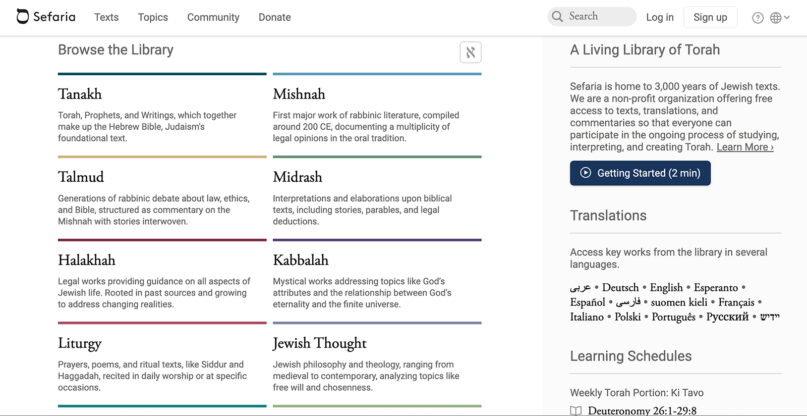
The Sefaria website offers a variety of texts. Screen grab

(RNS) — Walk into any yeshiva classroom or rabbi’s study and you will find floor-to-ceiling bookshelves filled with the golden-lettered spines of traditional Jewish texts — compilations of ancient rabbinical teaching, theological treatises and Scripture.

But fewer Jews are reaching for those books these days as a 10-year-old database has digitized almost the entirety of the Jewish canon and many other theological writings — the contents of about 3,300 volumes in all.

The database Sefaria — the word comes from the Hebrew word “sefer,” or book — has revolutionized Jewish online learning, not least in its use among a wide spectrum of Jews around the world. It is not the only Jewish digital library, but it is the most widely used among Jews and is freely accessible, with some texts available in multiple languages.

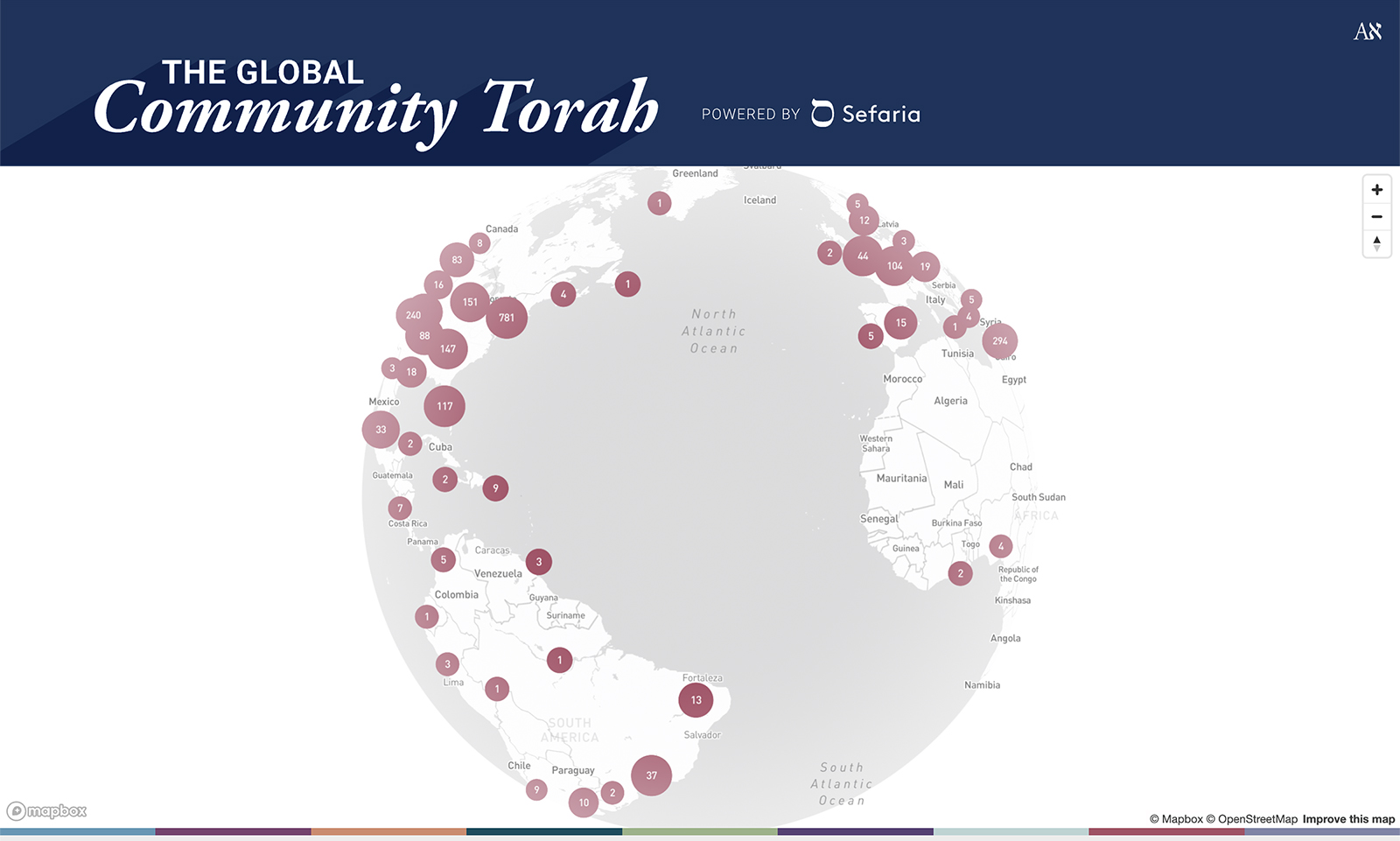
For its 10th anniversary, which it celebrated earlier this month, Sefaria launched a digital collaboration called the “Global Community Torah,” in which readers can take a small part in “writing” a digital Torah scroll by contributing to one of the Torah’s 304,805 letters. Users first pick their preferred Hebrew typeface and then enter their name and location.

So far, 2,500 online users from 72 different countries have laid claim to one of 22 Hebrew letters and have collaboratively completed the first two chapters of Genesis.


Image courtesy of Sefaria


Hovering over any of the letters will reveal the names of other participants. One three-letter Torah word, for example, was claimed by three people — one from Taiwan, another from Israel, the third from the United Kingdom.

“We aren’t really sure how long it will take to fill in the Torah,” said Chava Tzemach, Sefaria’s director of marketing and communications. “But we’re hoping to see some good progress over the next few months.”

Sefaria was founded in 2012 by author and entrepreneur Joshua Foer and Google alum Brett Lockspeiser. Back in 2011, Foer searched online for a version of the Talmud that he could read in English. The search yielded as its top result a pirated PDF copy of the multi-volume corpus of commentary on Jewish law, as well as an antisemitic website.

Foer called his friend Lockspeiser, who had just left Google. Over the course of a few conversations, the two began thinking, “Somebody should do something about this,” Foer recalled.

With help from several donors, including the Jim Joseph Foundation, they launched Sefaria in 2013. Their approach came not out of an Orthodox Jewish education but of their native world of digital technology. To make their site as widely accessible as possible, they released their code under an open source license.

In 2016, Sefaria rolled out its first mobile apps. The following year it launched a website for Israeli and Hebrew speakers. Today, Sefaria boasts 700,000 monthly users. Last year’s budget was close to $5 million.

Students of Judaism have applauded Sefaria for offering an in-book search function while also making it possible to search where a given biblical verse appears in other Jewish books. A “topics” page, meanwhile, allows searches of Jewish primary texts for terms like “abortion,” “gun-control” or “environmentalism.” 

Educators, in particular, like Sefaria because they can build source sheets directly on the site, instead of cutting and pasting verses or paragraphs from different books and then trying to format it into one streamlined document.

“Once Sefaria came around and started offering source sheets, it was a game changer,” said Yosef Gillers, founder of Grow Torah, an organization that provides environmental Torah education programs for mostly Modern Orthodox day schools.

“From the validity and the verification of the text, to the sources, the fact that you can choose what translations you use — all of that is just unbelievable. No one else does anything like it,” Gillers said.


The Sefaria website. Screen grab

The Sefaria website. Screen grab

Sefaria has drawn some detractors, most recently in May, when it added a new translation of the Torah branded by the publisher, the Jewish Publication Society, as “gender-sensitive.” That riled some Orthodox rabbis who argued that removing male pronouns referring to God was not a neutral change.

“Every word or gender reference in the Torah is purposeful, and to disregard them and apparently assume that they do not matter stems from a troubling lack of knowledge,” wrote Rabbi Avrohom Gordimer, an Orthodox rabbi, in an Orthodox Jewish journal.

But for the most part, Sefaria’s clean and easy access to a vast array of Jewish texts makes it popular among all streams of Jewish life. Chabad, the Hasidic Orthodox movement, has its own digital library of major texts. A handful of others, mostly in Hebrew, exist, some requiring paid subscription, but Sefaria’s free, non-sectarian approach makes it the heavyweight of the digital realm. Indeed, some of the other sites were built using Sefaria’s data.

A scholar who works for Chabad told RNS he uses Sefaria, among other sources, but declined to give his name; he didn’t think his bosses would appreciate comments about a competing Jewish library.

The next area of growth for Sefaria, according to its creators, will include access to more modern texts that are not yet part of the public domain. In some cases, Sefaria will pay publishers to post them online.

“We want to make sure that Sefaria is a space that works for all Jews and everyone who wants to use it,” said Tzemach.

For Jews who have for centuries been known as “people of the book,” that’s a true revolution.


Jews Are Cheap | Ep. 2 | That's Racist:

https://youtu.be/2jXsL1ZF_o8?si=0RbsaHOOsfIwpOm-

https://religionnews.com/2023/08/28/10-year-old-jewish-digital-library-revolutionizes-the-people-of-the-book/


Monday, August 28, 2023

Israeli criminologist Yitzhak Rosenblum found three salient characteristics in his research on sexual abuse in ultra-Orthodox society: lack of knowledge on the part of perpetrators, victims, and society regarding sexuality in general; the perception that sexual assault is a halachic prohibition similar to masturbation — a sin against God, rather than a harmful act to another human being; and the lack of discourse about sex education in the ultra-Orthodox education system.


Should we care about sex offenders? 


When a convicted abuser claims he's teaching you how to keep your children safe, stay far, far away from him and his manipulations 
 
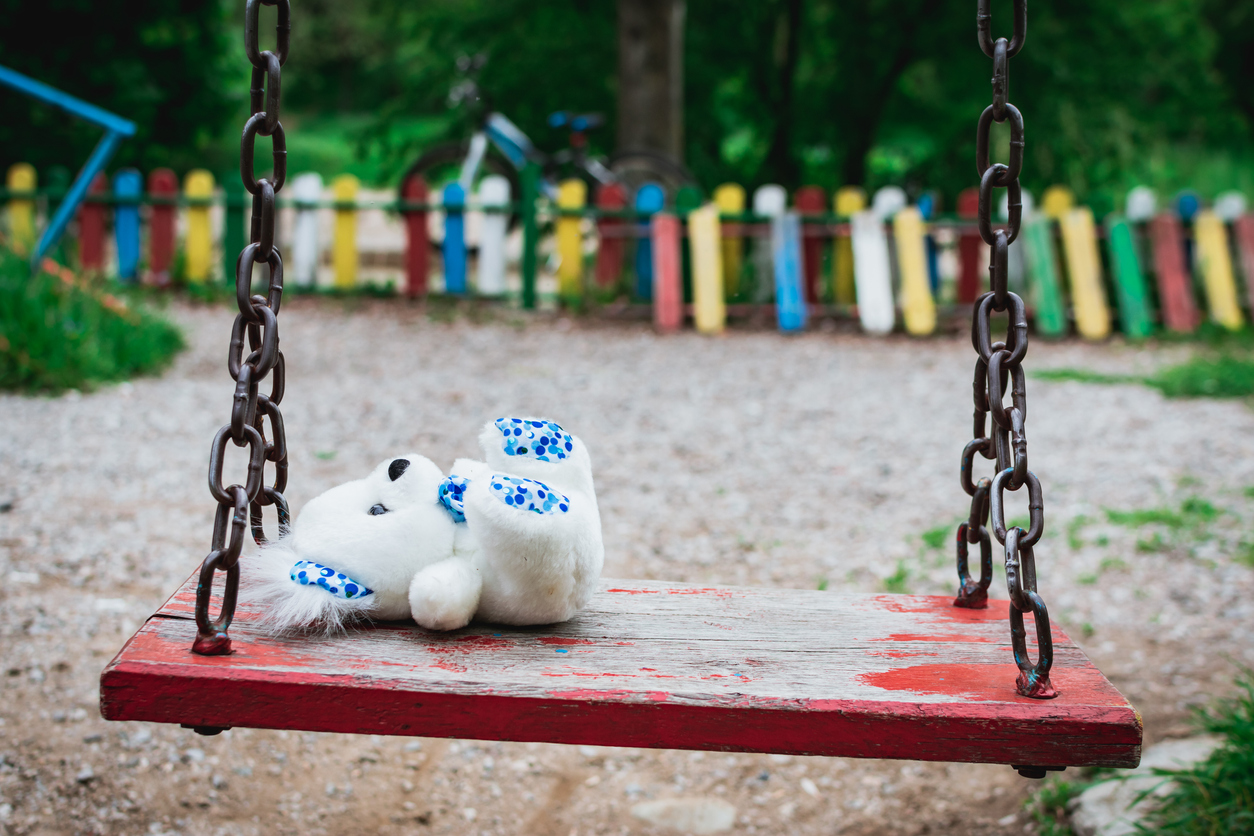
Illustrative. A teddy bear lies on an empty swing in the park. (iStock)

Warning: this article contains material regarding sexual abuse that some readers may find disturbing.

* * *

A few weeks ago, podcaster and comedian Mendy Pellin featured an interview with convicted sex offender Gershon Selinger, who recounted his struggle with pedophilia and sexual offending. Almost immediately, segments of Jewish social media were flooded with reactions. Although the podcast was followed by interviews with sex abuse prevention advocates Dr. Michael Salamon and Patty Fitzgerald, who framed Selinger’s narrative as rationalizations and distortions, many felt that Pellin’s interview irresponsibly provided a platform for a harmful and manipulative abuser. Others felt that Selinger was “brave” for coming forward with his story, seemingly with the goal of protecting children from people like himself.

Many of my mental health colleagues were quick to respond on social media. I was first alerted to the existence of the video by an Instagram post by Rachel Tuchman, a licensed mental health counselor in New York. “I don’t recommend watching the video of the convicted sex offender ‘teaching’ us how to keep our kids safe,” she warned. “That’s not all he does. Instead, he victimizes himself by blaming his victims and minimizing his own crimes. It’s classic abuser behavior, and if you found yourself believing him and sympathizing with him, you learned first-hand how manipulative these offenders actually are.” 

Watching the video, those points resonated. While Selinger talked about understanding the damage he caused, his narrative seemed rehearsed and disconnected from actual remorseful emotions or expressions of empathy for his victims. Additionally, he made alarming statements, which I identified as potentially triggering to survivors of abuse. For example, Selinger described that the little girl he had abused “just came and sat on my lap,” a clear indication that he did not hold himself completely accountable. He also claimed not knowing at the time that what he was doing was hurtful, and had his victim told him to stop, he would have. Sex abuse survivors often battle feelings of guilt for not sufficiently reacting and trying to stop what is happening. Through therapy, they learn that the “freeze response” occurs in order to survive and not because they were consenting. Selinger’s message perpetuates the false belief that the children were somehow responsible for the abuse because they did not ask him to stop. Children do not have the tools to stop abusers from hurting them. It is the abusers who need to stop abusing.

The video was difficult and disturbing to watch. As a therapist, I was skeptical, but was also curious to understand what goes on in the mind of an offender that would allow acting in such a heinous way. I am not an expert in treating sex offenders. I have far more experience treating people who were sexually abused than I do with those who abuse, but I feel empathy for people wracked with shame and guilt over unwanted sexual fantasies or fears that their desires will cause them to violate the boundaries of others.

As an advocate of sexual health, I was particularly interested in Selinger’s claim that the lack of acceptable sexual outlets in the religious world, including masturbation, resulted in his offending, and that insufficient sexual encounters with his wife would trigger him to act out as well. Although disturbing to hear, I wasn’t surprised. According to research, the combination of narcissistic entitlement and distorted cultural messages transmitted to men that they are entitled to marital sex to prevent their sexual acting out may contribute to feeling justified to get their sexual needs met elsewhere. That, of course, does not excuse such behavior. 

Problematic sexual behaviors, including non-consensual acts, are a recognized concern universally, and unfortunately, in the Haredi world as well. Israeli criminologist Yitzhak Rosenblum found three salient characteristics in his research on sexual abuse in ultra-Orthodox society: lack of knowledge on the part of perpetrators, victims, and society regarding sexuality in general; the perception that sexual assault is a halachic prohibition similar to masturbation — a sin against God, rather than a harmful act to another human being; and the lack of discourse about sex education in the ultra-Orthodox education system. 

To understand more about the connection between healthy sexuality and sexual offending, I turned to my colleague Dr. Caleb Jacobson, a clinical psychologist and sex therapist who specializes in treating pedophiles, whom he refers to as “minor-attracted persons.” He makes a deliberate distinction between those who are attracted to minors and those who offend. He cited surprising research that estimates that 10 percent of men are attracted to minors. Dr. Jacobson also cited data claiming that people who are in satisfying sexual relationships are less likely to sexually offend.

The finding that having a satisfying sexual relationship could ward off sexual offending felt uncomfortable to me. I don’t like the implication that people in healthy sexual relationships are less likely to offend because they are getting their sexual needs met sufficiently by their partners. I prefer to believe that people who are in healthy, satisfying relationships both physically and emotionally typically possess relational skills including emotional regulation, the ability to inhibit aggressive behaviors, and the ability to demonstrate empathy, and so they would never hurt others that way. Perhaps it is the lack of empathy, compassion and restraint, the narcissistic entitlement to take what you want, and the lack of concern for others, factors that also preclude being in a healthy romantic relationship, that are more likely to be what drives this anti-social behavior. Furthermore, there are many wonderful, healthy and well-adjusted people who are not sexually active or in a sexual relationship for a variety of reasons and yet they do not offend. I still wanted to formulate a response to Pellin’s interview but needed more clarity.

While this lengthy process prevented an immediate Instagram response, I do co-host a podcast with Rabbi Scott Kahn that I thought could be an appropriate forum to discuss this topic in greater depth. Our podcast, “Intimate Judaism,” has not shied away from topics deemed taboo by many. Sex and intimacy in the context of Jewish law is the main subject of our discourse, with topics ranging from masturbation to sex throughout the lifecycle, premarital sex, LGBTQ, monogamy, consent, pleasure, etc. We have also not avoided discussions of sexual trauma and abuse. Yet, we deliberated a lot about whether to respond to Pellin’s podcast. The last thing we want to do is trigger survivors of sexual abuse or sensationalize a serious and troubling problem.

After much discussion, Scott and I assembled a panel of experts, including Caleb and Shana Aaronson, director of Magen, an organization dedicated to creating safer Jewish communities by advocating for victims of sexual abuse. We met to discuss these questions for the purpose of releasing this discussion as a video and podcast. We did this for two reasons. First, and most importantly, to join the efforts to protect children. The more that is understood about people who offend and why, the better-equipped communities, schools, and parents can be. Second, while there is great stigma attached to “minor attraction,” it is important to know that there are people who specialize in treatment, and this information could ultimately prevent abuse.

Must we understand the experience of sex offenders? Unequivocally no. If you are a survivor of abuse, you are absolutely not required to listen to, understand, empathize, or forgive. But if you are a mental health professional, rabbi, teacher, camp director, community leader, parent, or anyone interested in healthy sexuality and abuse prevention on a global level, we invite you to watch our panel here or listen on Intimate Judaism or Orthodox Conundrum.


Talli Yehuda Rosenbaum is an individual and couple therapist and is certified as a sex therapist by The American Association for Sex Educators, Counselors and Therapists (AASECT) , as well as the Israeli Society for Sex Therapy (ISST). She is also an AASECT certified sex therapy supervisor. She cohosts the Intimate Judaism podcast and is co-author of the book “I am For My Beloved: A Guide to Enhanced Intimacy for Married Couples.” and co-edited the Springer textbook entitled “The Overactive Pelvic Floor.” She has authored over 40 journal articles and several book chapters on sexual pain disorders, sexual health, unconsummated marriage, and sexuality and Judaism and is an associate editor of the Sexual Medicine Reviews. Talli earned a Masters in Clinical Sociology and Counseling and a certificate in Mental Health Studies from the University of North Texas in Neve Yerushalayim. She holds a bachelors degree in Physical Therapy from Northwestern University and before training in psychotherapy, treated patients as a physical therapist for 25 years. In addition to maintaining an active private practice, Talli is the academic advisor for Yahel: The Center for Jewish Intimacy. Talli frequently lectures both in Israel and abroad, to lay as well as professional audiences. 

https://blogs.timesofisrael.com/should-we-care-about-sex-offenders/