EVERY SIGNATURE MATTERS - THIS BILL MUST PASS!

EVERY SIGNATURE MATTERS - THIS BILL MUST PASS!
CLICK - GOAL - 100,000 NEW SIGNATURES! 75,000 SIGNATURES HAVE ALREADY BEEN SUBMITTED TO GOVERNOR CUOMO!

EFF Urges Court to Block Dragnet Subpoenas Targeting Online Commenters

EFF Urges Court to Block Dragnet Subpoenas Targeting Online Commenters
CLICK! For the full motion to quash: http://www.eff.org/files/filenode/hersh_v_cohen/UOJ-motiontoquashmemo.pdf

Monday, January 29, 2024

"The Art Of The Green" Twin Brother of "The Art of The Deal"


Rabbi Art Green, prominent scholar of Hasidic Judaism, is barred from Hebrew College following sexual misconduct allegation
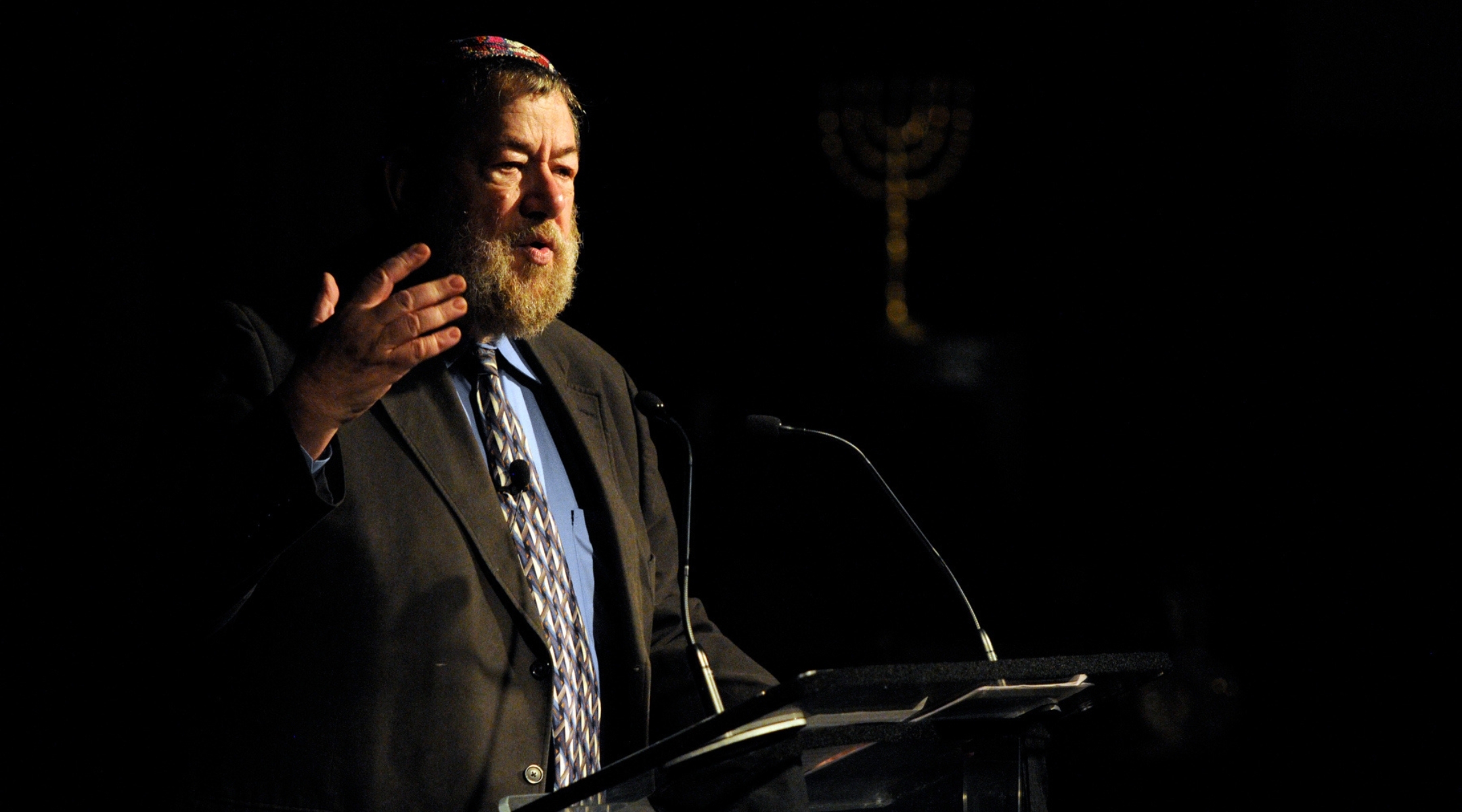
(JTA) — The founding dean of Hebrew College’s rabbinical school has been barred from its campus over the fallout from an allegation of sexual misconduct about a faculty member who was previously his student.

Rabbi Arthur Green, a prominent scholar of Jewish mysticism, retired in May 2022 after two decades at the non-denominational Boston-area seminary. In separate email announcements on the same day, both Green and the college said a private matter concerning another member of the college’s community contributed to the timing.

Last week, however, Hebrew College’s leadership informed the community that the matter cited in 2022 involved “a report by a community member of an unwanted and distressing sexual advance” by Green, and that Green is no longer allowed to set foot on campus at all.

In an email to Green informing him of the ban last week, Hebrew College’s leadership mentioned “conduct by you in a recent interaction with an individual in Israel” that it called “concerningly similar” to the previous report of sexual misconduct. It also accuses Green of breaking a confidentiality agreement he made with the college.

In an interview with JTA, Green said he inappropriately kissed the faculty member but rejected the school’s claims that a second inappropriate incident had occurred or that he had violated his agreement with the school. Green also said that following the initial incident, he carried out several steps required by the school, but stopped short of taking part in a public “ceremony” that he said had been requested.

The ban, which was announced last week in an email to the Hebrew College community hours after Green was informed about it, marks an ignominious coda to a storied career for a rabbi who is widely considered a leader in neo-Hasidism or Renewal Judaism. The author of more than a dozen books, Green served as president of the Reconstructionist Rabbinical College before founding Hebrew College’s pioneering rabbinical seminary near Boston in 2003. As a teacher and administrator there, Green oversaw the seminary as it grew and contributed to a widespread disruption of the denominational rabbinical school model.

“Rabbi Art Green is no longer employed at Hebrew College nor welcome in the Hebrew College community because he engaged in sexual misconduct that caused significant emotional harm to a member of our community and was a serious violation of our institutional policies and our communal values,” the college’s president, Rabbi Sharon Cohen Anisfeld, told the Jewish Telegraphic Agency.

She added, “Rabbi Green’s conduct and communication since the reported incident have not reflected a genuine understanding of the harm he has caused, nor has he undertaken a good faith process of teshuva,” Hebrew for repentance.

Green insists that he has not crossed a line since striking a retirement agreement with Hebrew College. Anisfeld did not describe the incident in Israel, or when it occurred. A source affiliated with Hebrew College said the college did not take steps to verify the incident.

Green does acknowledge acting inappropriately with a male faculty member who was previously his student, and expressed regret about it.

“I did something wrong,” he told JTA. “So I’m aware of that. I take responsibility for that.”

He also said he believed the incidents did not merit his ouster and questioned whether the allegations were used as a pretense to eject him from the school he shaped.

Green detailed the allegations against him and the events leading to his being barred from campus in a draft email he shared with JTA on Friday and said he intended to send to his contacts. He sent an abbreviated version of the same email on Sunday afternoon.

In the email he sent, he wrote, “I am, and have always been, a bisexual man” and had “made the difficult decision to keep this private while still a rabbinical student nearly sixty years ago” in order to build a career in the Jewish world.

In the draft email, he had written that he had been looking for companionship after the 2017 death of his wife of 49 years.

“My admittedly inappropriate loss of control was an expression of affection by a lonely old guy, not an assertion of power to demand or force sex,” Green wrote in the draft.

He also said that he believed he had been wronged by Hebrew College’s handling of the incident.

“I consider myself a victim of the extreme ‘Me-tooism’ that has come to plague our society,” he wrote in the draft, referring to the movement to hold perpetrators accountable for sexual misconduct. He added that the faculty member “reported to Sharon he had ‘felt some sexual tension’ between us on prior occasions. I would just call it closeness.”

In the sent email, he acknowledged “another unwanted kiss by me” more than 30 years ago with a different person who he said was not a student.

“I take full responsibility for these encounters, my misjudgment of the situations, and the unintentional harm I caused to people for whom I cared,” he wrote. “I have communicated with them and sought to repair the harm. I am committed to ongoing awareness about this matter and exercising extreme caution in the future.”

Through representatives, the junior faculty member declined to speak about his experience. (JTA has spoken to two people with whom he shared his account.) He has retained attorneys, including Debra S. Katz, who is known for representing alleged victims of sexual assault such as Christine Blasey Ford, who accused now-Supreme Court Justice Brett Kavanaugh of sexual assault.

The attorneys said in a statement that the faculty member had “participated in a restorative justice process with Rabbi Art Green. As part of that process, our client and Rabbi Green agreed they would alert the other party before making any public statements. We are disappointed that Rabbi Green has failed to adhere to that commitment, forcing our client to hear through the grapevine of the narrative Rabbi Green is advancing.”

The first public sign of allegations against Green came in May 2022, when he and Anisfeld sent separate messages to the Hebrew College community announcing his retirement.

In Green’s email, sent first, he mentioned “a private matter concerning an incident that occurred some time ago, which involved an act on my part that deeply impacted a colleague in our community.” He added, “I feel badly about that situation, and that too has contributed to my decision to retire this year.”

Anisfeld’s email, arriving a little less than an hour afterwards, also referenced “a private personnel matter that deeply impacted another valued member of our Hebrew College community” as part of a “combination of factors” influencing the timing of Green’s retirement. But the email also lauded Green and his contributions to Hebrew College. “I know we will continue to be blessed by Art’s lasting influence as a teacher, mentor, scholar, and friend,” she wrote.

Neither email provided any details about the “personnel matter”; both emails said Green and another party were involved in a “restorative process” with the community member and had requested privacy.

The emails were referring to the faculty member who had previously been Green’s student. Green wrote in his email draft that he and the faculty member were “quite close” from the faculty member’s student days. He said he chose the student to be a research assistant on a large project and characterized his relationship with the then-student as a “growing friendship.”

In the fall of 2019, after the student had been ordained as a rabbi and joined Hebrew College’s faculty, Green allegedly made the first unwanted sexual advance, according to the two people with whom the faculty member shared his account. Green and the faculty member were among a group that had traveled to Uman, a city in Ukraine that is the burial place of the turn-of-the-19th century Hasidic Rabbi Nachman of Breslov, and is a major pilgrimage site for his followers. Green’s “Tormented Master,” published in 1979, is considered a definitive biography of Rabbi Nachman.

According to the friends with whom he shared his account, the faculty member — once the group had arrived at their hotel — found himself in a room alone with Green, who proceeded to make an unwanted sexual advance on him. One of the friends, a former classmate, told JTA, “They were there, and Art made a sexual advance toward my friend physically.”

The classmate added, “My friend stopped him and then has spent the next many years of his life trying to put it back together again.”

Green denies that he crossed any boundaries in Uman and said any accusation that he committed sexual misconduct on that trip is “absolute nonsense.” He said people in the group were pairing off to share hotel rooms, and that he had offered to split a room with the faculty member. Once it became clear that there was no need for the two to share a room, he claimed, they slept in separate places. He did not reference the Uman incident in either version of his Sunday email.

“Since this person … is an out gay man, I thought other people might be uncomfortable sharing a room with him,” Green told JTA. “So I said that I would. It then turned out there was an extra room and we did not share a room. That’s the end of the story. Nothing happened.”

The second incident occurred that December and, according to Green’s email draft, is the allegation that prompted Hebrew College to initiate disciplinary action against him.

Green acknowledged, in his email draft and to JTA, that he kissed the faculty member “in a way I shouldn’t have” while the two were in Green’s Boston-area home.

Green attributed his behavior to having smoked marijuana with the faculty member. He said the faculty member had given him the drug, which felt particularly strong.

He wrote in his email, “What began as an expression of genuine affection was completely inappropriate and out-of-bounds to our relationship.  I accept responsibility for my behavior and regret it deeply.”

But he added in the draft that had the faculty member felt any discomfort, Green expected him to resolve the situation privately. “I figured that if he was upset, he would let me know, but he didn’t,” Green wrote in the email draft.

Subsequently, Hebrew College administrators informed Green that he had been accused of misconduct.

According to Green, the college and the faculty member’s attorneys, the college attempted to resolve the issue through a private mediation and reconciliation process between Green and the faculty member. In the email she sent to the Hebrew College community this month, Anisfeld described the allegation as an “unwanted and distressing sexual advance, which was viewed as a breach of personal and professional boundaries.”

After learning of the alleged misconduct, Green said Anisfeld imposed several penalties, including suspending him from faculty meetings, asking him to engage in a guided conversation with the faculty member, and requiring that he sign a statement saying he would not be alone in a room with a student with the door closed. Green said he acceded to all of the penalties.

Then, at the end of 2021, Green says Anisfeld called him into her office and informed him that he was to retire in the coming year.

“I was, of course, close to retirement anyway, but I did not like this feeling of being pushed out of a program that I had created,” Green wrote in the draft. “Eventually, however, I agreed, frankly because dealing with this matter had become so painful and distressing.”

To JTA, Green said he had questions about the motivations behind his ouster. He said he had been distressed when a demand that he not attend faculty meetings in December 2021 was extended to the winter term in January 2022, when the Hebrew College community convened for a series of conversations about whether to change a policy that barred students with non-Jewish partners from attending the rabbinical school.

“I said to myself, ‘How far does this ‘He’s uncomfortable with my presence’ go?’” Green told JTA. “But then I thought, well, Sharon and I have different views on this intermarriage issue. She was very much for the change in policy, and she knew I was quite strongly against it. So, she might have found this was a convenient way to exclude me from that conversation.”

He added, “I can’t prove that. But she told me no, I could not participate in that Zoom conversation because [the faculty member] would be unhappy with my presence. And I think that was bullshit, shall we say.”

Anisfeld flatly rejected the allegation. “The intermarriage policy process is completely irrelevant and unrelated to this matter,” she told JTA by email. The school removed the ban on interfaith relationships in January 2023.

Green said Anisfeld and Hebrew College officials had escalated penalties against him over time. He said he had been barred from the two most recent Hebrew College graduations and had been kicked off a school listserv.

He also said Anisfeld had asked him to participate in a “public ceremony of confession,” but he declined.

“My generation doesn’t play that game and doesn’t do that kind of thing,” he told JTA. “I just found it distasteful.”

In recent years, a reckoning over sexual misconduct allegations has changed the norms and expectations for how institutions should respond to them, with a broad move toward greater transparency and increased understanding that misconduct can harm people beyond the direct victims. In a 2018 eJewishPhilanthropy essay, two advocates for “restorative justice” — a process for institutions to address sexual harassment allegations — described a “conference or circle with survivors, offenders, and their support people” as one possible avenue.

“Ideally, the person who has been harmed asks for restorative justice but, at times, offenders or people from the community inquire about convening a process,” Alissa Ackerman and Guila Benchimol wrote in the essay. “Inclusivity and collaboration are central because restorative justice recognizes that people belong to communities and that the harm they have caused or endured impacts wide networks.”

Anisfeld did not respond to a question about a public ceremony. In their email announcing Green’s campus ban, Anisfeld and the current and former chairs of Hebrew College’s Board of Trustees blamed his unwillingness to complete all that was asked of him.

“As an institution committed to the value — and the possibility — of teshuva, we have repeatedly asked Rabbi Green to engage in a communal process regarding this matter,” they wrote. “Rabbi Green has declined, and he therefore has been prohibited from visiting campus, or attending Hebrew College programs and communal activities.”

Last week’s email from the college leadership raised questions among some of those who received it. “One of the things that was curious to me is: Why do we need to know this?” said Shaul Magid, a Jewish studies professor at Dartmouth College who counts Green as a friend and teacher and also said he holds Anisfeld in high regard. “All the letter can do is really tarnish Art’s reputation at this point. He’s already retired.”

Green said in his email that relations between him and Hebrew College had become strained in the years since the initial allegation against him. “Although I agreed to all conditions as stipulated by Hebrew College I was surprised to find additional demands and restrictions that felt, and continue to feel, vindictive and unnecessary,” he wrote in the Sunday email.

In the email, he also said Anisfeld sent the letter announcing his ban following “an alleged additional incident that occurred recently in Israel, thus supposedly justifying publicity on Hebrew College’s part.”

In the letter from the Hebrew College leadership to Green last week, they wrote, “The College has also become aware of a report of conduct by you in a recent interaction with an individual in Israel that, as described to us, is concerningly similar to your admitted conduct during the Incident.”

Anisfeld did not offer details about that incident. Green and the two other men involved in what Green believes is the incident say it took place on Purim last year and involved an encounter at Green’s home following a party celebrating the holiday. Green said he was “very drunk” when he and another man began “touching each other, holding each other, not sexually, not genitally.” Both he and that man told JTA that their encounter was consensual.

A third man in the room, who was then an acolyte of Green’s, became alarmed. Through a representative, he told JTA that he felt violated when Green “revealed his physical desire for me and my friend’s bodies.” Previously, he had seen earlier requests for him to stay at Green’s home “as service to a holy rabbi, a kabbalist and theologian.” He said he soon left but experienced the night as “a soul-shattering crisis” because of the nature of his relationship to Green.

“I served him as one would serve Rabbi Nachman or the Baal Shem Tov,” two 18th-century Hasidic sages, the man said. He added, “Not once did warning bells ring in my head.”

Green has written about rabbis who have been accused of abuse. In 2004, when Marc Gafni, a prominent rabbi in the Jewish Renewal movement, was accused of a wide range of sexual offenses, including having sex with underage girls, Green vociferously defended him in a letter to the editor of the New York Jewish Week.

Praising Gafni as “a creative teacher of Torah,” he said that Gafni’s misdeeds were long in the past and that Gafni had been “been relentlessly persecuted for those deeds by a small band of fanatically committed rodfim,” a term that in traditional Jewish texts refers to a would-be murderer who himself must be murdered.

Two years later, multiple women in Israel said Gafni had lured them into sexual relationships using his power as a spiritual leader. Green, like other U.S. rabbis who had initially stood by Gafni, dropped his defense.

“The stories were from long ago, and he had rejected and outgrown that side of himself,” Green told the Forward at the time. “These are now new cases and new investigations.”

Green had also warned about the dangers inherent in relationships between spiritual teachers and students. In a 2010 book outlining neo-Hasidic theology by reinterpreting traditional Jewish edicts, including the Seventh Commandment prohibiting adultery, Green wrote that spiritual teachers “always need to be aware of human weakness, their own before that of all others.”

The book included a reminder for teachers: “Sexual energies are always there when we flesh-and-blood humans interact with one another, anywhere this side of Eden,” he wrote.  “Check yourself always. Be aware; know your boundaries. Precisely because good teaching is an act of love, the teacher is always in danger.”

He concluded, “Make sure that all your giving is for the sake of those who seek to receive it, not just fulfilling your own unspoken needs, sexual and other.”

https://www.jta.org

Sunday, January 28, 2024

Being an Orthodox Jew Means "Never Having To Ask Your Doctor"


Measles outbreaks a wake-up call for the unvaccinated 


Measles viruses. 3D illustration showing structure of measles virus with surface glycoprotein spikes heamagglutinin-neuraminidase and fusion protein


The United Kingdom is facing a measles outbreak, while cases have also popped up in a few U.S. states in recent weeks, leading to health authorities on both sides of the pond to issue urgent warnings. 

The virus, which was declared eliminated in the U.S. in 2000, is a wake-up call for the importance of vaccination to personal and public health. The U.K. only recently reachieved measles elimination status in 2021 after having lost the distinction in 2018. 

Unlike COVID-19 vaccines, which help prevent serious illness but don’t prevent infection, the measles vaccine is almost 100 percent effective in preventing infection. And almost everyone who has been recently infected in the U.K. and U.S. is not vaccinated against measles. 

The Centers for Disease Control and Prevention (CDC) on Thursday advised health care providers to be alert for potential measles symptoms, which include a rash; cough; sore or swollen eyes; and flu-like symptoms. Providers should also be aware of patients who have recently traveled abroad. 

“Measles cases often originate from unvaccinated or undervaccinated U.S. residents who travel internationally and then transmit the disease to people who are not vaccinated against measles,” the CDC’s alert stated. 

“The increased number of measles importations seen in recent weeks is reflective of a rise in global measles cases and a growing global threat from the disease.” 

In the U.K., more than 300 probable cases — 216 of which are confirmed — have been detected since October, with the majority centered around the city of Birmingham.  

Since December, the CDC has received notice of at least 23 measles cases in the U.S., with seven having been imported by international travelers. States that have reported measles cases include Delaware, Georgia, New Jersey, Pennsylvania, Virginia, and Washington state. 

Jenny Harries, chief executive of the U.K. Health Security Agency, recently warned the infections in her country would continue to spread without urgent action — and vaccinations. 

“Immediate action is needed to boost MMR uptake across communities where vaccine uptake is low,” Harries said during a visit to Birmingham. 

In the U.K. and the U.S., MMR (measles, mumps and rubella) vaccinations remain high but have fallen away from the ideal 95 percent rate, which is the target countries aim to reach by 2030, as well as the coverage the World Health Organization recommends to prevent measles outbreaks. 

As KFF noted last summer, MMR vaccination rates in the U.S. have seen a slight decline in recent years, reaching 93 percent among kindergartners during the 2022-23 school year, the lowest this figure has been in almost a decade. The U.K. mirrored this trend, with MMR vaccination rates at the age of 5 falling to 92.5 percent, the lowest since 2010-11. 

“We’ve started to lose our herd immunity,” Keri Cohn, physician and partnership chair for the American Academy of Pediatrics, told The Hill.

“So, you really need to have 95 percent of the population vaccinated in order to have good herd immunity for measles. That number is less for other organisms, but because measles is so contagious, you really have to have such a high number,” Cohn explained.

Like many health issues occurring in the world today, experts see a link between measles outbreaks and the COVID-19 pandemic. 

“Generally, we certainly saw a real slide in the provision of essential health services like childhood vaccines during COVID. And that’s continued,” said Elisha Dunn-Georgiou, president and CEO of the Global Health Council. 

According to the CDC, more than 61 million measles vaccine doses were postponed or missed globally from 2020 to 2022, increasing the risk of outbreaks both in the U.S. and abroad. While measles is still considered endemic in countries like Yemen and India, Dunn-Georgiou said high-income like the U.S. and the U.K. shouldn’t be seeing outbreaks. 

Vaccine hesitancy and disinformation are likely contributing factors to waning immunization rates, but Dunn-Georgiou also opined that recent measles outbreaks may be a sign the U.S. is falling victim to its success in combating the disease. 

“I think there’s another piece around infectious disease that is not so much hesitancy but complacency. Like if you don’t see how terrible it is, you don’t realize how terrible it is until it happens,” she said. “When diseases get completely under control, I think there’s a little bit of amnesia.” 

Measles cases could potentially snowball in the U.K. Andrew Pollard, chair of the British government’s Joint Committee on Vaccination and Immunization, recently told The Guardian there is “a very large susceptible population of children” in the country. 

Despite the potential for spread, Dunn-Georgiou was doubtful that travel restrictions between the U.S. and the U.K. would be necessary. 

“Travel bans have not proven to be that effective of a public health control,” Dunn-Georgiou said, noting the virus appears to so far be contained in one region of the U.K., the West Midlands. 

“And measles is one of those diseases where if you are vaccinated, you won’t get it,” she added. “It would necessitate … a child under the age of seven getting on to a plane with measles and traveling to a community nobody’s vaccinated.” 

And measles always carries the risk of becoming a serious infection. Cohn noted children who get infected “are not infrequently needing hospitalization.”

“About 25 [percent] to 30 percent of them end up having complications that can range from otitis media to pneumonia to even death,” Cohn said, though she also noted that treating measles shouldn’t be a challenge for most hospitals. The real challenge when it comes to measles is identifying and isolating cases before they can spread.

https://thehill.com/


Friday, January 26, 2024

My Wife Just Told Me She Is a Survivor of Abuse!


"During moments of calm, I asked my wife what was going on. It was hard for her to understand it herself. She began to speak to a therapist on a regular basis. What happened next made me go cold. After several meetings with the therapist, it turns out that my wife slowly started uncovering memories of childhood abuse. At first, my wife did not even tell me. Then, she slowly began unraveling some of what happened and let me in. I felt happy that she was confiding in me but confused about our relationship."

Dear Dr. Chani,

I am feeling confused and upset and I am not sure where to turn. My wife and I have been married for over 30 years. We have several children and have a great relationship overall. My wife and I are usually very open with each other. We share our feelings and thoughts and constantly try to grow and improve our relationship.

A year ago, our youngest child got married. My wife kept telling me that she was dreading that she might experience empty-nest syndrome. We read up about it and asked friends and family members how they had dealt with it. As we talked a lot about it, we strengthened each other.

Despite all our preparations, I feel like I was hit by a bombshell. Suddenly, several weeks after the wedding, my wife became a different person. She started having outbreaks of rage toward me over seemingly insignificant things. She also started having bouts of crying in the middle of the day. One time, my wife called me at my office and asked me to come home early from work to be with her.

During moments of calm, I asked my wife what was going on. It was hard for her to understand it herself. She began to speak to a therapist on a regular basis. What happened next made me go cold. After several meetings with the therapist, it turns out that my wife slowly started uncovering memories of childhood abuse. At first, my wife did not even tell me. Then, she slowly began unraveling some of what happened and let me in. I felt happy that she was confiding in me but confused about our relationship.

I thought that my wife and I have such a good, open and honest relationship. Why did my wife wait so long to tell me about it? Also, why does my wife have such rage against me? What did I do? I know that I should be focusing on my wife, but I feel betrayed. How could my wife keep this secret from me for so long? And even if she felt uncomfortable about telling me, why did she not seek help sooner? I am very upset.

After I found out about my wife’s history, I reflected back over some issues we struggled with through our years together. Sometimes my wife would get triggered about little things and I did not understand why she made a big deal out of them. Knowing about her history would have helped me to understand her better and help her to heal sooner. This would have made our lives much smoother. I am upset for her, but I am also upset at her.

I cannot tell this to my wife. She is going through enough as it is. I have spoken to her therapist, who has explained some of what has been going on for my wife and why I should not be upset. I understand it, but I am still hurt and bewildered. Can you help me understand more of what is going on so that I can feel better about this and be able to help my wife?

Sincerely,
Disheartened


Dear Disheartened,

I cannot even imagine the range of emotions you and your wife are experiencing after the atomic bomb that you both discovered. Everything you are saying makes a lot of sense. You are wondering why your wife did not disclose this to you sooner. It makes you doubt the closeness that you thought you shared. It is understandable that you are feeling both confused and angry.

It can be helpful to recognize that it is not uncommon for abuse to remain buried for years. One of the reasons that your wife may not have revealed this to you is because a victim often feels that they need to keep the abuse a secret. Abusers tend to threaten their victims with repercussions if they tell anyone. This makes the victim feel the need to keep the abuse a secret. Once the victim becomes accustomed to keeping it a secret, it becomes the new norm and persists, even when the threat of telling may have disappeared.

Secondly, a major aspect of abuse is that it may evoke feelings of shame, guilt and emotional pain that are difficult for a person to express. These feelings can be so difficult that a survivor cannot find the words to talk about it. It is common for feelings of shame to be accompanied and exacerbated by feelings of worthlessness, incompetence and helplessness. These accompanying emotions can make a survivor feel that it is pointless to talk about it, because if she does, it will not accomplish anything anyway.

Thirdly, and perhaps most importantly, many survivors are unaware that they were abused. Although what happened to them was real, their mind protects them by forgetting the events, thoughts and feelings around it. In order for them to function in life, their brain unknowingly takes their pain and pushes it back into the far recesses of their mind that are not readily accessible. Therefore, even though they are survivors, they are unable to talk about what they went through.

It is common for a life event like a change in family size, employment or location to stir up the trauma and trigger some emotions or thoughts that are related to the abuse. For other people, when a person experiences life as day-to-day doldrums that are boring and unchanging, that can be the trigger that awakens the memories of abuse. It is regular for the events of abuse to only rear their head after 20 or 30 years of being forgotten. Sometimes this is related to a triggering event and sometimes it is a function of maturity. There are no rules, but it is important to realize that memories of abuse might suddenly surface later on in life after they had not been spoken about for many decades.

When it comes to the feelings of anger that your wife is expressing toward you, it might sound surprising but they may be emanating from her anger toward the abuser. Survivors can unwittingly direct negative feelings toward someone who makes them feel safe. This might be because it is the first time they can express their hurt without being punished. Your wife’s behavior toward you may stem from her lack of clarity about where her feelings of hurt are coming from. It is important for her to sort through her emotions and figure out what is causing her to act angrily toward you.

It is understandable that you are reeling from the revelation of your wife’s trauma and her ensuing reactions. You want to support your wife through her recovery, while at the same time you are also indirectly suffering from the abuse. It can be difficult to remember that your wife’s anger is coming from another source and is not really directly at you. I encourage you to speak to your own therapist to help you deal with your own emotions about what happened. The therapist can also help you understand your wife’s reactions and guide you about how to best support your wife.

Another aspect to consider is that you may feel anger toward the perpetrator, whether or not you know who it is. This person has wreaked havoc on your wife’s emotional well-being and on yours by extension. This may be a source of the anger that you are feeling toward your wife. If so, you might speak to a therapist about how to redirect your anger toward the perpetrator rather than at each other.

I pray for you to reach the light at the end of this dark tunnel as you and your wife deal with the process of healing, surviving and, with God’s help, thriving.

Wishing you all the best,

Chani


Dr. Chani Maybruch is a social psychologist who has specialized in helping people build and enhance their relationships for over two decades. If you would like to improve your relationship with yourself, your loved ones or others in your life, reach out to her at chanimaybruch.com.

https://jewishlink.news/my-wife-just-told-me-she-is-a-survivor-of-abuse/


Thursday, January 25, 2024

DANIEL SUNRAY Convicted Child Molester - Crime Description - SODOMY INDECENT ACTS/ SEXUAL ASSAULT/ ATTEMPTED SODOMY --- LAKEWOOD - FLATBUSH ALERT!


Offender Details

Anyone who uses this information to injure, harass or commit a criminal act against any person may be subject to criminal prosecution.

Domiciled

DANIEL SUNRAY - JAILED IN ISRAEL FOR 6 YEARS!


  • Offender Id48171 
  • Last NameSUNRAY 
  • First NameDANIEL 
  • Middle Name 
  • DOBDec. 8, 1966 
  • SexMale 
  • Risk Level
  • DesignationNo Designation Applies 
  • RaceWhite 
  • Ethnicity 
  • Height5' 10"  
  • Weight220 
  • HairUnknown 
  • EyesHazel 
  • Corr. LensYES 
  • Photo Date May 7, 2018 

Current Addresses

  • TypeRES (Primary)
  • County
  • Address 524 SOPHEE LANE
    LAKEWOOD, New Jersey 08701

  • TypeEMP (Primary)
  • CountyKings
  • Address 410 AVE M
    BROOKLYN, New York 11230

Law Enforcement Agency Having Jurisdiction More Info

New Jersey State Police - Sex Offender Registry 

Current Conviction

  • Description SODOMY INDECENT ACTS/ SEXUAL ASSAULT/ ATTEMPTED SODOMY 
  • Date of CrimeJune 30, 2009 
  • Date ConvictedMarch 3, 2010 
  • Victim Sex/AgeUnknown/Gender X, < 17 years
  • Arresting Agency 
  • Offense DescriptionsNone Reported
  • Relationship to VictimNone Reported
  • Weapon UsedNone Reported
  • Force UsedNone Reported
  • Computer UsedNone Reported 
  • Pornography InvolvedNone Reported 
  • SentenceProbation: 1 Year(s) Term: 6 Year(s) State Prison  

Previous Conviction(s) Requiring Registration More Info

None Reported

Supervising Agency Information More Info

None Reported

Special Conditions of Supervision More Info

None Reported

Maximum Expiration Date/Post Release Supervision Date of Sentence:

None Reported

Scars, Marks & Tattoos

None Reported

Additional Names/Aliases

SUNRAY , DANIEL , J

Current Vehicles

  • Lic. Plate No.KHH7277 
  • StateNew York 
  • Year2020 
  • Make/ModelHyundai Elantra
  • ColorAluminum/Silver 

Wednesday, January 24, 2024

A government must also look at the bigger picture, however, and in this case, it is the threat posed by Hamas that is the overriding factor in fueling this war.


A premature end to the war will leave a battered Hamas still intact and able to recover and regain its stranglehold on Gaza


 People walk by photographs of civilians held hostage by Hamas terrorists in Gaza,  in Tel Aviv. January 04, 2023.  (photo credit: MIRIAM ALSTER/FLASH90)
  Photographs of civilians held hostage by Hamas terrorists in Gaza
 

As the Gaza war lumbers on through its third month, disagreements about its direction, goals, and even the measure of its success are coming into question with increasing frequency.

We Israelis may have wandered in the desert for 40 years. Still, we’re impatient people, especially when the lives of more than 130 hostages are at stake, as well as the well-being of thousands of soldiers currently battling through the tunnels and buildings of southern Gaza.

Their goals are twin: Eliminate the Hamas presence and leadership, and locate the hostages. Yet, according to some military experts, the likelihood of achieving both those goals is slim.

According to The Wall Street Journal, US sources estimate that Israel has killed 20% to 30% of Hamas forces in Gaza. Those figures, somewhat less than the Israeli assessment, are nothing to scoff at or declare a failure.

In three months, Israel has taken out about a third of Hamas. From the beginning, Prime Minister Benjamin Netanyahu said this war would not be six days or even three weeks. A year was mentioned as part of the painstaking process of dismantling tunnels in Gaza and going door-to-door in search of terrorists and the hostages.

The IDF seems to be on track with that yearlong framework. Between external pressure over the high civilian casualties in Gaza and internal pressures over the inability to free more hostages following the November ceasefire deal, however, it remains to be seen if Israel will be given the time to complete the task.

This is when the government must stand tough. Netanyahu did as much on Sunday when he rejected a plan to end the war, withdraw from Gaza, leave Hamas in control of the enclave, release all Palestinian prisoners who were involved in the October 7 massacre, and in return, receive the remaining hostages.

 “I utterly reject the Hamas monsters’ capitulation terms,” Netanyahu said. “Were we to agree to this, our soldiers would have fallen in vain. Were we to agree to this, we would not be able to ensure the security of our citizens. We would be unable to restore the evacuees to their homes safely, and the next October 7 would be only a question of time.”

Risks of a premature end to the war

A premature end to the war will leave a battered Hamas still intact and able to recover and regain its stranglehold on Gaza and the Palestinians it has held hostage since 2006. And that’s something Israel can’t live with. Just ask Khaled Mashaal. The Hamas leader reiterated in an interview last week that post-October 7, “our Palestinian project is our right in Palestine from the sea to the river.”

The families of the hostages and their supporters are perfectly justified and correct in their ongoing protests and calls for a ceasefire and a deal to bring their loved ones home. Anyone with a family member who has been cruelly held captive for more than three months should be demanding action and accountability from their government.

A government must also look at the bigger picture, however, and in this case, it is the threat posed by Hamas that is the overriding factor in fueling this war.

The problem is a significant breach of trust regarding Netanyahu’s motives among a large population segment. We don’t know what they are, whether they are for country’s good, or for the survival of the government he leads, or to stave off the inevitable storm of blame that will likely sweep him away after the war.

If the current government was dissolved and new elections were held, there’s a good chance that the next prime minister would be someone other than Netanyahu – maybe Benny Gantz or Yair Lapid?

But despite the change at the helm or within the coalition’s makeup, the next prime minister would almost certainly adopt the same policy as Netanyahu: no withdrawal from Gaza and a continuation of fighting until Hamas is no longer in charge.

The IDF must be given time to carry out that mission in Gaza. But time is running out regarding the hostages. It’s up to the government, with Netanyahu as its leader or someone else, to stave off the pressure to accept a ceasefire while keeping the hostages’ return a top priority. 


https://www.jpost.com/opinion/article-783254

Tuesday, January 23, 2024

Bringing Musk to Auschwitz on International Holocaust Remembrance Day multiplied this betrayal by six million


In an ironic twist, Elon Musk's visit to Auschwitz highlighted the damage he did to Twitter, with many of the mendacious accounts capable of flourishing on X thanks to his policies portraying the visit as the result of 'Zionist blackmail'   


Tesla and SpaceX's CEO Elon Musk during his visit to the Auschwitz-Birkenau Nazi German death camp on Monday.
 
International Holocaust Remembrance Day should have been even more sober and contemplative than usual this year. After all, the commemorations around the event are happening less than four months after the largest massacre of Jews since the Holocaust on October 7, and amid the horrific loss of life that has come in its aftermath in Gaza.

The date of the upcoming Memorial Day – January 27 – marks the day that the Auschwitz concentration camp was liberated in 1945.

And who was invited to tread on the blood-stained ground, where so many Jews faced their deaths, in the run-up of commemorations of the historic event?

Elon Musk.

Escorted by far-right American Jewish pundit Ben Shapiro, the media was saturated Monday with images of the billionaire mogul and owner of the social media platform X touring the death camp with his young son propped up on his shoulders and holding his hand. A video showed Musk attending a Jewish religious service as a rabbi chanted the lament for the dead. The visit was billed as a "private," but Musk came to the death camp accompanied by a large entourage and multiple photographers.

Musk's contributions to fanning the flames of antisemitism have two main dimensions. One is his own comments and posts, in which he has consistently amplified anti-Jewish conspiracy theories and screeds, the latest being when he told a far-right user on his X social media platform that he spoke "the actual truth" after the poster explained why he was "deeply disinterested" in Jewish concerns over spiking antisemitism.

Musk also actively took part in the antisemitic social media campaign targeting the Anti-Defamation League. These were just the latest in a series of utterances and recommendations of accounts spreading disinformation, some of whom frequently post antisemitic slurs and condemn "the Zionist regime."

The second, and more serious Musk sin has been the destruction of guardrails against racism and hate since he became the proprietor of what was formerly known as Twitter, making blue "verified" checkmark premium accounts available to those disseminating antisemitism, Islamophobia, and xenophobia consistently.

Musk has also peddled in the politics of anti-immigrant hate in both the United States and in European countries – including cheering on the far-right Alternative for Germany (AfD) which has recently entertained plans for mass deportation of citizens of foreign origin, sparking massive protests.

It was the second such Musk-washing publicity stunt in the same number of months, with the apparent purpose of rehabilitating his image after his comments cost his social media platform millions in advertising revenues. On November 27, it wasn't Shapiro by Musk's side, but Israeli Prime Minister Benjamin Netanyahu, giving him a tour of the decimated Kibbutz Kfar Aza, where Israelis were attacked and murdered by Hamas terrorists.

It is clear what Musk gets out of these displays – less so what the benefit is to hosts like the European Jewish Association led by Rabbi Menachem Margolin, which sponsored a conference featuring an on-stage presentation which allowed Musk to tout his goal for X to be "the best source of truth in the world." (The conversation took place after a bizarre presentation of what the Holocaust would look like if it had been live-tweeted on X.)

The benefits that Shapiro and Netanyahu reap are more obvious. They are invested in painting antisemitism and hate for Israel as coming exclusively from the far left, denying its dangers in the world of authoritarian white supremacy, whether in Europe or in the pro-Trump MAGA camp in the United States.

After Bibi gave Musk his red carpet tour, Haaretz's Ben Samuels criticized the Israeli leader's cynical embrace, writing that the Israeli leader "welcoming such a toxic mogul with open arms and taking him around sites of a massacre that has been belittled, demeaned, and denied on his watch" was a cynical betrayal of the Israelis killed on October 7.

And guess where this article appeared?:https://us18.campaign-archive.com/?e=d0aaf29e28&u=d3bceadb340d6af4daf1de00d&id=66ab384400

Monday, January 22, 2024

What A Pain In The .......Shoulder!


Debilitating Phone Pain: Woman Says Life Was Ruined By Texting, Scrolling


ROSCOMMON, Ireland — A 34-year-old woman from Ireland has developed chronic shoulder pain so severe that it prevents her from even sleeping. What’s causing the issue? She believes it’s her phone.

Michelle Waldron has sought emergency medical care 10 times for this issue, yet painkillers have proven ineffective. Now, she is considering Botox injections as a potential solution to alleviate the pain, which has become so debilitating that it hinders her ability to complete simple daily tasks.

Before noticing the pain, Michelle estimates she spent approximately four hours each day using her phone.

“I can’t sleep in a bed, I can only sleep in my chair – it’s too painful in the bed, and I just can’t sleep,” Waldron says in an online video post.

“It just happened overnight – I went to bed fine and woke up in agony. I was scared because the level of pain is quite severe. It’s an awful thing, it’s quite sharp and deep. I can’t cook, clean, or do household duties anymore, and if I’m holding things in my hand, they just fall out of my hand. Chronic pain is an illness – you hear about these things, but you never expect them to happen to you.”

Michelle recalls that her problems began in December 2022 when she woke up one morning with severe pain. Being snowed in at her house, she found herself using her phone more than usual for entertainment, spending three to four hours daily on the device.

Since then, the pain has progressively worsened, evolving from a tingling and throbbing sensation to stiffness and numbness, extending down her arm to her hand. Despite consulting pain specialists and chiropractors, and undergoing acupuncture and steroid injections, Michelle continues to suffer from pain. Her pain specialist has confirmed that the discomfort could be attributed to extensive texting and phone usage.

Michelle has spent approximately $1,130 on various treatments, including visits to pain specialists and chiropractors, and for steroid injections. She plans to try Botox injections in her shoulder, hoping it will relax the muscles and alleviate the pain.

To mitigate the issue, she now uses a mobile phone stylus. Michelle aims to raise awareness about this problem and warns others, sharing that she has felt embarrassed and isolated due to her condition.

I want to isolate myself. I don’t want to be around people at all. I just want to be on my own, so it’s lonely,” Michelle says. “It’s embarrassing, and it takes a toll on your mental health. The financial cost and emotional experience are not worth it. It’s just severe pain, and I don’t want to be bothering doctors who are already busy.”

“I’ve been struggling to get appointments, hospitals are so overwhelmed – you feel like giving up hope. My advice is don’t be on your phone as much, take frequent breaks, go outside and exercise, do something more fulfilling than being on your phone.”

https://studyfinds.org/debilitating-phone-pain/

Sunday, January 21, 2024

They pretend to promote women’s rights but remain indifferent to women being raped by Hamas terrorists; they pretend to promote minority rights but remain indifferent to anti-Semitic sentiments; they pretend to promote freedom of speech but allocate it only to those who agree with them; they pretend to promote evidence-based science only when the evidence supports their opinion.


The World is Seriously Broken: Can We Still Fix It?


A distinguished professor at a prestigious university wrote to me yesterday: “I am having trouble these days getting out of bed in the morning as the world seems insane.” Her message resonated with me because it arrived just a few minutes after a meeting with my research group of students, postdocs and research associates, where I summarized my winter-break visit to Israel with the words: “Given the wars in the Middle East and Ukraine, the worldwide rise in antisemitism, the sympathy towards terrorism followed by silence after the rape of Israeli women on October 7, the subsequent turmoil at Harvard university — ranked lowest on the scale of college free speech by FIRE’s survey a month before October 7, the steady denial of evidence-based science in favor of opinion-based narratives by social media mobs and news reporters… altogether, the world appears to be seriously broken. Can we still fix it or is it a lost cause?”

The alternative response is to retreat into a “vacation mode” and enjoy our personal life and academic inquiry as long as it lasts. We are under no obligation to carry the weight of the world on our shoulders. When our home is on fire, we can take a vacation on a remote island of academic isolation. Should that be the advice I give to my research group?

Anyone who met me knows that I am not a vacation advocate. Last summer, I led an expedition to the Pacific Ocean and worked around the clock to collect evidence about the first reported meteor from outside the Solar system — based on data from US government satellites.

Why did I sacrifice my annual vacation time on the altar of science? Because an object from interstellar space might carry a message for our salvation. Any physical evidence that we are not alone in our cosmic neighborhood would make fighting over terrestrial territories look insane for the same reason that family feuds stop when neighbors show up at the doorstep.

Our political troubles stem from a tendency to congregate into tribes and engage in hate of members from other tribes. During ancient history, the size of congregations was limited by the ability of people to gather together in the same physical space. But today, tribalism and hate are amplified by social media which enable the congregation of enormous crowds on virtual platforms. The virtual world ends up shaping the real world and calamities are triggered by protestors who engage in aggressive action based on superficial opinions without fact checks or a historic perspective.

On this backdrop, devout advocates often violate the principles that they wish to promote. They pretend to promote women’s rights but remain indifferent to women being raped by Hamas terrorists; they pretend to promote minority rights but remain indifferent to anti-Semitic sentiments; they pretend to promote freedom of speech but allocate it only to those who agree with them; they pretend to promote evidence-based science only when the evidence supports their opinion. When virtue signaling fosters oxymorons, it is clear that we live in an Orwellian society doomed to destruction.

Perhaps I am naïve. But my thinking is that learning about the existence of a more intelligent civilization in outer space would inspire us to unite. It makes little sense to engage in tribalism and hate on a ship that sails through turbulent waters after receiving a message in a bottle about a safe haven that lies beyond the horizon. Scientific knowledge about an intelligent civilization could unite us in the same way that a physical proof for the existence of God would unite a religious congregation because its super-human qualities would trigger awe and suppress the ego of all spectators.

I appreciated the power of a collaborative mindset during our Pacific Ocean expedition, when all team members worked constructively for the success of the mission. Humanity’s ship is Earth and the turbulence we feel so far is our own creation on deck. Evidence about what lies beyond our horizon should serve as our inspiration.

The next scientific expedition to the Pacific Ocean will attempt to retrieve larger pieces of the first studied interstellar meteor. If the object will end up being a rock, so be it. The Galileo Project team will continue to search for other interstellar objects. Irrespective of how many interstellar rocks we identify, the first message we recover in an interstellar bottle could inspire us to come together and fix our world.

We should not rest until we extinguish the flames of tribalism and hate ignited by superficial protestors on the deck of our ship. Our long-term survival will be the ultimate manifestation of our collective intelligence.

https://avi-loeb.medium.com/the-world-is-seriously-broken-can-we-still-fix-it-d357ab55630f

Friday, January 19, 2024

The other group, which includes most of Crown Heights’ estimated 15,000 Chabad adherents plus others, especially in Israel. This group worships in the basement synagogue and is sometimes called Congregation Lubavitch. Members of the congregation believe Schneerson never died. He is in hiding, possibly in the building, and could re-emerge at any moment.


How a leaderless Chabad movement led to an illegal tunnel brawl 


The tunnel’s discovery was just the latest in a 30-year clash among factions of the Hasidic group led by the late Rebbe Menachem Mendel Schneerson, who died 30 years ago.


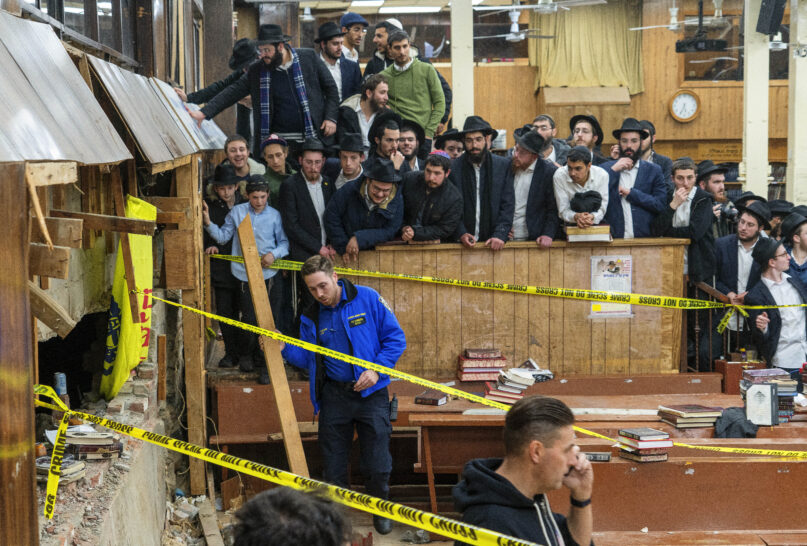
Hasidic Jewish students observe as law enforcement establishes a perimeter around a breached wall in the global headquarters of the Chabad-Lubavitch movement in the Crown Heights neighborhood of Brooklyn, New York, that led to a tunnel dug by students, Monday, Jan. 8, 2024, in New York. A group of Hasidic Jewish worshippers were arrested amid a dispute over a secret tunnel built beneath a historic Brooklyn synagogue, setting off a brawl between police and those who tried to defend the makeshift passageway. (Bruce Schaff via AP)


(RNS) — In June, it will be 30 years since the death of Menachem Mendel Schneerson, the leader of the Chabad-Lubavich Hasidic movement, known among his followers simply as “the rebbe” — or “the rabbi.”

But just who the rebbe was, and what his legacy means, is a live issue within the Chabad-Lubavich Hasidic movement, which since his death has been operating in a power vacuum.

Last week, that vacuum opened wide when a brawl broke out between rabbinical students and the New York City police after a secret tunnel was discovered underneath the global headquarters of the Chabad-Lubavitch movement in the Crown Heights neighborhood of Brooklyn, New York.

Police arrested nine men between the ages of 19 and 22 who tried to block a cement truck that had been sent to fill the tunnel. Charges included criminal mischief, reckless endangerment and obstructing governmental administration.


RELATED: Nine arrests at Chabad synagogue after students thwart filling of secret tunnel


But while it shocked Crown Heights’ Hasidic community, the tumult was just the latest in a three-decade-old clash among factions of the Chabad-Lubavitch movement, a subset of Orthodox Judaism known for its mystical devotion and strict adherence to Jewish law. Since Schneerson’s death, his disciples have divided into two main groups, and perhaps smaller subgroups.

The two groups operate separately, with their own synagogues and schools. But for three decades they have been locked in a legal dispute over the ownership of the headquarters buildings, including the iconic 770 Eastern Parkway and the adjacent 784-788, which they share, while praying separately — one group in the basement synagogue and the other upstairs in a smaller space.

“In effect, it’s chaos — every group for itself,” said Samuel Heilman, a retired sociologist at Queens College, the co-author, with Menachem Friedman, of the 2010 volume, “The Rebbe: The Life and Afterlife of Menachem Mendel Schneerson.”

Both groups share a fervent belief advanced by the rebbe that their mission is to prepare the ground for the coming of the Messiah. But while both groups believe Schneerson himself was the Messiah, they differ about whether he ever even really died.

The tunnel battle represents the latest front in that larger dispute.

The larger group, representing mainstream Chabad globally, owns the headquarters complex and oversees most of the estimated 5,000 emissaries who have established Chabad houses across the world.

This group believes the rebbe, who died in 1994, is buried in Montefiore Cemetery in Queens. It has built a synagogue and visitor center next to the rebbe’s grave, where they worship and visit frequently.

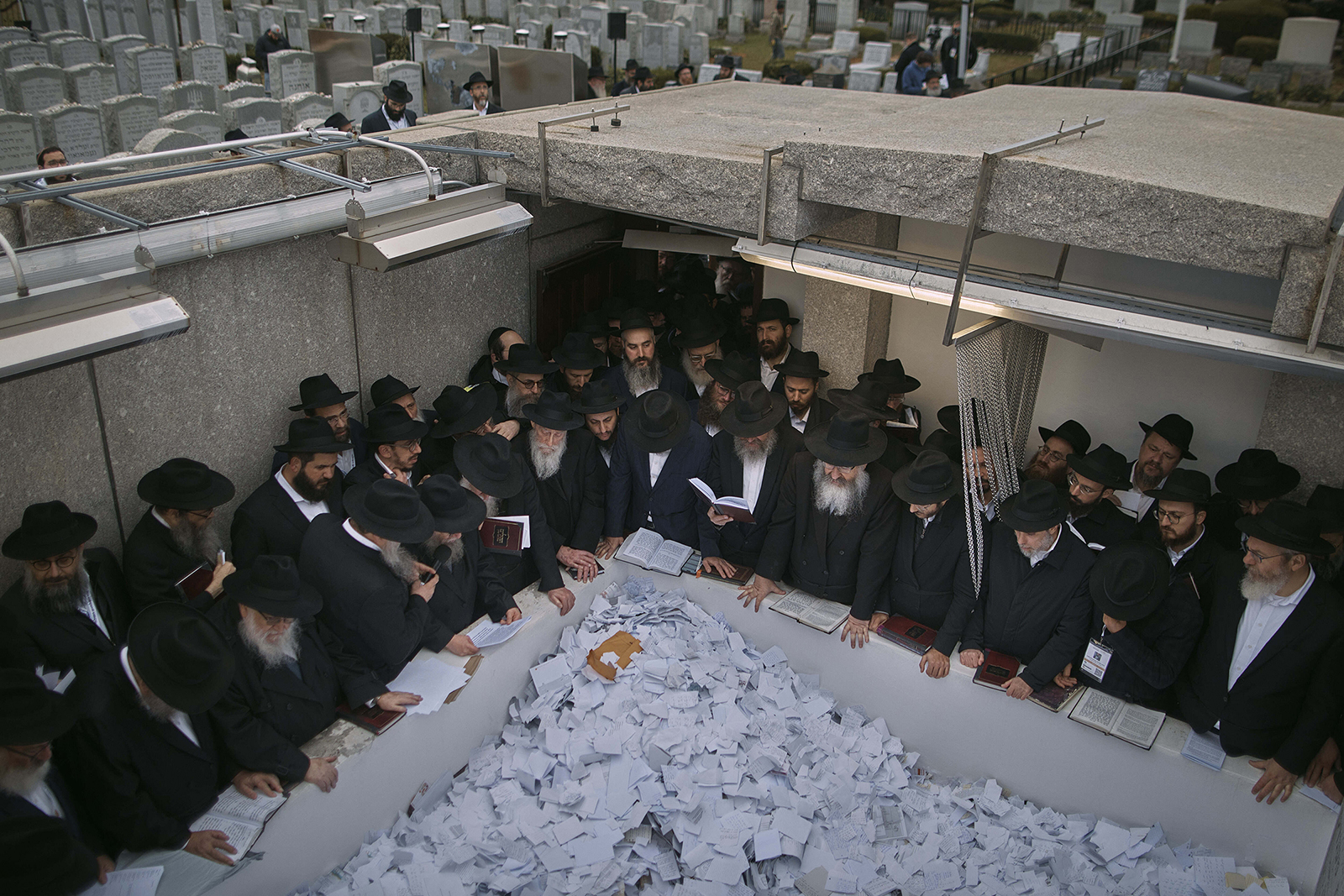
Chabad-Lubavitch rabbis pray at the resting place of the Rebbe, Rabbi Menachem Mendel Schneerson, at Montefiore Cemetery on Friday, Nov. 10, 2023, in the Queens borough of New York. This year's conference focuses on the war between Israel and Hamas, antisemitism on college campuses and Jewish spiritual awakening following the attacks of Oct. 7. (AP Photo/Andres Kudacki)

Chabad-Lubavitch rabbis at the resting/hiding place of the rebbe

This mainstream group also suspects Schneerson will eventually rise up and reveal himself as the Messiah, but they don’t publicly discuss it, believing it might detract from their mission to fulfill the Jewish commandments and bring Jews closer to God so as to hasten the Messiah’s arrival.

The other group, which includes most of Crown Heights’ estimated 15,000 Chabad adherents plus others, especially in Israel.  This group worships in the basement synagogue and is sometimes called Congregation Lubavitch. Members of the congregation believe Schneerson never died. He is in hiding, possibly in the building, and could re-emerge at any moment.

“They believe if they could expand the synagogue, it would sort of help usher in the reappearance of the rebbe, the Messianic Age, the end of times,” said Rabbi Yossi Newfield, a former Chabad member and a scholar whose family members still live in the community.

This group, which is often called “meshichist,” from the word “messianist,” refuses to visit Schneerson’s grave or refer to him in the past tense. They are known for chanting, in part or in whole, “long live our master, our teacher and our rebbe, king Messiah forever and ever.” They plaster billboards, lamp posts, mailboxes, crossing signs and cars with posters featuring a photo of the late rebbe with the word “Moshiach” or “Messiah” in big, bold letters in Hebrew or English.

Inside the synagogue, they’ll behave as though they are in the rebbe’s presence.

“They’ll (act as if) the rebbe is there,” said Joshua Shanes, professor of Jewish studies at the College of Charleston, who left the movement. “And they’ll sort of look into empty space as if the rebbe’s there and nod their heads as if the rebbe said something to them and then move on to the next person. You can go online and see videos of this.”

Many of the tunnel diggers, who Chabad media outlets are calling the “Tzfatim,” from the northern Israeli city of Tzefat or Safed, came to the U.S. for a year of study at Chabad headquarters. They are aligned with the meshichists, who, besides their ardent belief in the rebbe, are known for their exuberant worship and their willingness to scream, shout and, if necessary, resort to fistfights.

“When you are Messianic-inclined, you don’t worry about limits, you don’t worry about what seems like the rules,” Shanes said. “If the Messiah is basically already here, how much more so are you gonna be encouraged to behave that way?”

It’s not the first time meshichists have engaged in violence. In 2004, they defaced and later destroyed a plaque that the more mainstream group had affixed to the cornerstone of one of its buildings, causing the authorities to issue a temporary restraining order. The plaque referred to the rebbe in Hebrew as “of blessed memory,” which to the messianists was tantamount to blasphemy, court records show

The construction of an underground tunnel, some former Chabad adherents believe, may have been part of an effort to revive a planned expansion of the building the rebbe himself pushed for. The construction was slated to begin in 1992, two years before his death, but was never undertaken.

In an essay explaining the need for the expansion, Schneerson wrote that the synagogues and study halls can be thought of as incarnations of the Jerusalem temple in exile — places where God resided. Referring to 770 Eastern Parkway, he wrote, “it is the place where the Third Temple will first be revealed.” (The first and second Jerusalem temples were destroyed, the first by the Babylonian empire, the second by the Romans.)

“This should be a wake up call to those that are in charge of 770 to force them to get together and finally create the vehicle to expand 770,” said Rabbi Yosef Carlebach, the executive director of the Chabad House at Rutgers University.

Carlebach believes the underground dig was misguided and wrong and many of his fellow meshichists who pray at the downstairs synagogue, have distanced themselves from the rowdy students and placed the blame for the brawl on the Israeli students and the seminary that sent them. Still, he was critical at the complex’s owners for holding up the rebbe’s vision for expansion.

To him, the rebbe was Messiah, and the work that remains is to bring him back.

That makes it difficult for Chabad to appoint a new leader. If Schneerson was the Messiah, no possible successor can ever be named to lead Chabad, because appointing a new leader would be admitting that the rebbe was not the Messiah.

“Within Chabad, they became stuck on the rebbe’s messiahship,” said Newfield. “And even his death has not really changed that. They’re stuck.”

https://religionnews.com/2024/01/18/how-a-battle-over-a-legacy-of-chabads-late-rebbe-led-to-a-brawl-over-an-underground-tunnel/