EVERY SIGNATURE MATTERS - THIS BILL MUST PASS!

EVERY SIGNATURE MATTERS - THIS BILL MUST PASS!
CLICK - GOAL - 100,000 NEW SIGNATURES! 75,000 SIGNATURES HAVE ALREADY BEEN SUBMITTED TO GOVERNOR CUOMO!

EFF Urges Court to Block Dragnet Subpoenas Targeting Online Commenters

EFF Urges Court to Block Dragnet Subpoenas Targeting Online Commenters
CLICK! For the full motion to quash: http://www.eff.org/files/filenode/hersh_v_cohen/UOJ-motiontoquashmemo.pdf

Friday, March 15, 2024

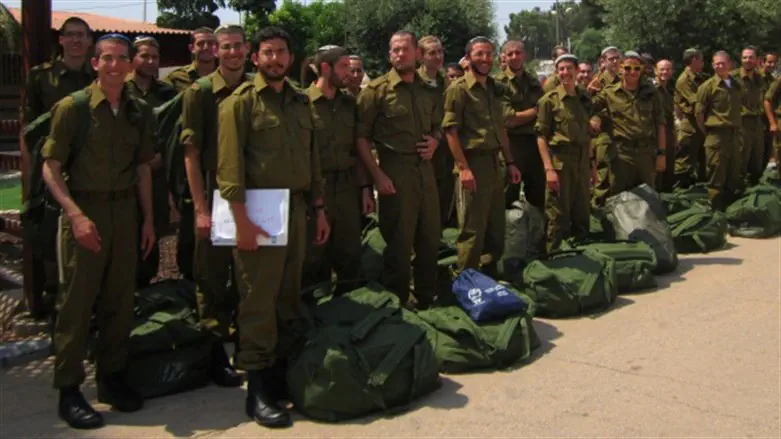
The upcoming recruitment cycle, Nisan 5784 (March 2024), is going to be the largest Yeshiva student recruitment cycle in the history of the State of Israel! Around 1,000 fighters from the Hesder yeshivot; 300 combat supporters; another 300 from Zionist yeshivot gevohot (post high-school yeshivot); and hundreds more from religious pre-military preparatory schools.


The largest recruitment of Yeshiva students in history


Where do these people come from? From a great perception of Torah, which we call "the Torah of the Land of Israel" in the way of Rabbi Kook.

New Hesder recruits
New Hesder recruits Hesder Yeshiva Center

Some uplifting facts for these days:

The upcoming recruitment cycle, Nisan 5784 (March 2024), is going to be the largest Yeshiva student recruitment cycle in the history of the State of Israel! Around 1,000 fighters from the Hesder yeshivot; 300 combat supporters; another 300 from Zionist yeshivot gevohot (post high-school yeshivot); and hundreds more from religious pre-military preparatory schools.

These wonderful soldiers – who unfortunately also lead the number of fallen in the current war– are a new breed of fighters that the Jewish people has not seen in two thousand years (in fact, not so new, the IDF's ground forces have long had a profile of the religious and traditional recruits).

Here is a short and instructive story from the past month: students who returned from fighting in Gaza gathered at the Ma'ale Adumim Yeshivat Hesder for a summing-up talk. Their Rabbi asked that everyone choose a verse or a rabbinic saying that reflects their feelings.

One of them chose the sentence "there is no joy like the resolution of doubts" (Zevachim 90a). Asked why he chose it, he replied: "During the weeks of fighting in Khan Yunis, we were constantly fighting day and night with occasional breaks, without outside communication, and I was always wondering if I was on the right page within the framework of the Daf Yomi. Now that we have returned from the fighting, it has become clear to me that I was indeed on the right page, and I feel even more strongly the words of our sages that there is no joy like the resolution of doubts."

Got it? These are our fighter! And that's one reason – among thousands of others – that we are going to win!

Superheroes

Every time a fighter falls, I try to find out a little about him and understand where the power came from; I am overwhelmed each time. In the case of Amishar ben David Hy”d, I can no longer contain the phenomenon: he was a Torah scholar; was an incredible educator; an exemplary father; a pioneer and a settler; commander of the commando brigade; and the head of the community's charitable fund; a MDA volunteer and a kidney donor. As the Israeli song goes, "what else will you ask of us, O homeland?"

(In Hebrew: מה עוד תבקשי מאיתנו מכורה, ואין ואין עדיין)

Where do these people come from? From a great perception ov Torah, which we call "the Torah of the Land of Israel" as did Rabbi Kook.

A growing list of Dror Weinbergs, Roi Kleins, Eliraz Peretzs, Emanuel Morenos, Noam Razs, Yossi Hershkovitzs and many more. In every war, extraordinary heroes fall, and then, inspired by them, an even more remarkable generation of fighters steps into their shoes.

We know that this breed of superheroes is still relatively small; on the one hand, there are those who see the State of Israel only as a place for getting material benefit and therefore threaten to refuse to serve if something does not work out the way they want it to; and on the other hand, there are those who see the State of Israel only as a place for spiritual fulfillment and therefore threaten to leave the country if they are forced to enlist.

However, these wonderful heroic figures are increasing in number (in fact, the profile of IDF's ground forces has long been religious and traditional) and the day is not far off when everyone will understand this. In the meantime, until day dawns and the shadows flee, these superheroes are the silver platter on which the Jewish state has been granted to us (to paraphrase poet Natan Alternman - see the famous poem in translation here, it is well worth the time)

Shabbat Shalom!

http://www.israelnationalnews.com/news/386759?utm_source=activetrail&utm_medium=email&utm_campaign=nl


Thursday, March 14, 2024

No Hoax to Paul Alexander, Rabbi Dr. Fool~!


But Tatty...... Rabbi Shmuel Kamenetsky said "Even The Polio Vaccine Is A Hoax"

http://theunorthodoxjew.blogspot.com/2022/03/but-tatty-rabbi-shmuel-kamenetsky-said.html


 “I see vaccinations as the problem,” Rabbi Shmuel Kamenetzky told the Baltimore Jewish Times in a story published in late August. “It’s a hoax. Even the Salk [polio] vaccine is a hoax. It’s just big business.”

If you are, or anyone you know is a godol --- please register at https://gedolim.com/


Polio Paul Alexander's cause of death after surviving 70 years inside 'iron lung'


After he was paralyzed by polio at age 6, Paul Alexander was confined for much of his life to a yellow iron lung that kept him alive. He was not expected to survive after that diagnosis, and even when he beat those odds, his life was mostly constrained by a machine in which he could not move.

But the toll of living in an iron lung with polio did not stop Mr. Alexander from going to college, getting a law degree and practicing law for more than 30 years. As a boy, he taught himself to breathe for minutes and later hours at a time, but he had to use the machine every day of his life.

He died on Monday at 78, according to a statement by his brother, Philip Alexander, on social media.

He was one of the last few people in the United States living inside an iron lung, which works by rhythmically changing air pressure in the chamber to force air in and out of the lungs. And in the final weeks of his life, he drew a following on TikTok by sharing what it had been like to live so long with the help of an antiquated machine.


Wednesday, March 13, 2024

If Israel had wanted to wipe out Gazans as Germans sought to wipe out Jews, it could have done so on the first day of the war. Israel is fighting a tough war against an evil enemy that puts its own civilians in harm’s way. Maybe there should be more public pressure on Hamas to surrender than on Israel to save Hamas from the consequences of its actions.

Israel Has No Choice but to Fight On

A view through a windshield of a military jeep with a soldier carrying a gun. In the background is a palm tree and low-slung buildings.
Israeli soldiers in the Gaza Strip

Opinion Columnist


On Saturday, President Biden warned that Benjamin Netanyahu’s approach to the war in Gaza was “hurting Israel more than helping Israel.” The Israeli prime minister replied the next day that Biden was “wrong.” The rift between the two leaders means that Israel risks losing its most important pillar of military and diplomatic support.

I’ve argued that Israel has no choice but to destroy Hamas as an effective fighting force. Here I imagine a conversation with an intelligent critic of that view.

Thousands of Gazan civilians, many of them children, have now been killed, bombed in their homes or out of them. Now they face a humanitarian catastrophe in the form of medicine and food shortages, even starvation.

How can you possibly justify it?

Like all wars, this one is horrible and heartbreaking. But I blame Hamas, not Israel, for the devastation.

Look, Hamas is a terrorist group whose leaders should face justice for the massacres of Oct. 7. But it isn’t Hamas’s bombs, missiles or artillery that have leveled Gaza. It’s Israel’s.

Right. And Hamas, which started the war, could put a halt to that rain of fire tomorrow. It rejected a six-week cease-fire that would have paused the fighting and allowed much more aid in exchange for the release of roughly 40 of the remaining 100 Israeli hostages. It could stop the fighting for good by simply surrendering.

Hamas may not want to stop the fighting, but there’s little we can do about that. Israel can stop its assault, and thus spare Palestinian lives. And because Biden has leverage on Israel, he should use it.

The best way to get Hamas to stop fighting is to beat it. If Israel were to end the war now, with several Hamas battalions intact, at least four things would happen.

First, it would be impossible to set up a political authority in Gaza that isn’t Hamas: If the Palestinian Authority or local Gazans tried to do so, they wouldn’t live for long. Second, Hamas would reconstitute its military force as Hezbollah did in Lebanon after the 2006 war with Israel — and Hamas has promised to repeat the attacks of Oct. 7 “a second, a third, a fourth” time. Third, the Israeli hostages would be stuck in their awful captivity indefinitely.

Fourth, there would never be a Palestinian state. No Israeli government is going to agree to a Palestinian state in the West Bank if it risks resembling Gaza.

All that is speculative. The reality is that children are hungry, the sick aren’t getting medicine, innocent Palestinians are being killed, now. It’s wrong to avert theoretical harms by causing actual ones.

It might be more speculative if this weren’t the fifth major war that Hamas has provoked since it seized power in Gaza in 2007. After each war, Hamas’s capabilities have grown stronger and its ambitions bolder. At some point this had to end; for Israelis, Oct. 7 was that point.

Maybe, but why can’t Israel be much more judicious in its use of force?

Do you have any specific suggestions for how Israel can defeat Hamas while being more sparing of civilians?

I’m not a military expert.

I’ve noticed that whenever Israel’s critics lecture the country on better calibrating its use of force, they don’t have any concrete suggestions. Are Israelis smart enough to fight better, but too stupid to appreciate the diplomatic consequences of not doing so?

Maybe they’re thirsty for vengeance.

The reality of urban warfare is that it’s exceptionally costly and difficult. The United States under Barack Obama and Donald Trump spent nine months helping Iraqi forces flatten the city of Mosul to defeat ISIS, with results that looked even worse than Gaza does today. I don’t remember calls for “Cease-Fire Now” then. Hamas has made it even more difficult for Israel because, instead of sheltering civilians in its immense network of tunnels, it shelters itself.

Even so, that doesn’t relieve Israel of the obligation to prevent a humanitarian catastrophe.

It’s not as if Israel is not lifting a finger. On Sunday alone, 225 truckloads of aid entered Gaza through Israel, according to the Israeli military. But you seem to think that the government of Israel’s primary responsibility is to the welfare of the people of Gaza. It isn’t. As with any government, its obligations are to its own people.

Israelis are mostly doing fine now. It’s Palestinians who are dying.

Israel has spent the last five months degrading Hamas’s military capabilities to the point that it seems to have run out of rockets to fire at Israel. And around 200,000 Israelis are living as refugees inside their own country because its borders aren’t secure. No country can tolerate that. Israel didn’t come into existence to showcase the victimization of Jews. It came into existence to end their victimization.

Well, since you’re alluding to the Holocaust, it surely can’t be in Israel’s interests to be seen perpetrating a version of it in Gaza. Just look at the worldwide explosion of antisemitism since Oct. 7.

That analogy is false and offensive on many levels. Israel is fighting a war it didn’t seek, against an enemy sworn to its destruction and holding scores of its citizens hostage. If Israel had wanted to wipe out Gazans as Germans sought to wipe out Jews, it could have done so on the first day of the war. Israel is fighting a tough war against an evil enemy that puts its own civilians in harm’s way. Maybe there should be more public pressure on Hamas to surrender than on Israel to save Hamas from the consequences of its actions.

As for antisemitism, the war hasn’t generated a torrent of antisemitism so much as it has exposed it.

Probably a mix of the two. Still, you make the mistake of imagining that Hamas can be defeated. You can’t kill an idea, particularly by generating the terrible resentments that are surely brewing in Gaza and throughout the Arab world.

By that logic, the Allies should have spared Germany because National Socialism was also an idea. You may not be able to kill an idea but you can defang it, just as you can persuade future generations that some ideas have terrible consequences for those who espouse them.

So what do you suggest the Biden administration do?

Help Israel win the war decisively so that Israelis and Palestinians can someday win the peace.

https://www.nytimes.com/2024/03/12/opinion/israel-hamas-war-military.html

Tuesday, March 12, 2024

George Bernard Shaw once said, “The greatest folly in a community effort is the illusion that someone else will do it.” Chelm Revisited!


" Let it be as clear as the noon sun in a cloudless blue sky, without the Israel Defense Forces at full force, all of the yeshiva students in Israel wouldn’t survive more than ten minutes before Ishmaelite murderers stormed into their yeshivot and slit their throats from ear to ear until their blood reddened all of their pages of Gemara, just as the Arab terrorists did to the devout holy Jews in Hebron and the Old City during the pogrom of 1929 when there was no Israel Defense Forces to protect them, the students at Otniel and Merkaz Harav yeshivas.

Just as the Torah alone didn’t protect all of the millions of devout holy Jews from Nazi firing squads and gas chambers. Just as Hashem brings healing through doctors and medicine, He brings security to the Nation through the tanks and holy soldiers of the IDF. All of the Jews in the Holy Land today can live here in the Holy Land precisely because the Holy One Blessed Be He has enabled us to have our own Jewish army after being slaughtered helplessly for 2000 years in foreign lands at the whims of the goyim.

No one is demanding that all yeshiva students be drafted. But there are many who can serve and indeed they must for the future of the Jewish Nation."


Parshat Shekalim: None of Us Can Be Bystanders


There is a timeless Jewish folklore legend, often set in the quaint, mythical town of Chelm, renowned for its endearing tales of simplicity and wit. The story always elicits a wry smile but also imparts a timeless lesson regarding the essence of community and the significance of each individual’s contribution.

One day, the residents of Chelm decided they were going to celebrate a great communal occasion, and that each household should contribute a bottle of wine that would be poured into a collective barrel. The barrel would then provide a blend of the town’s finest vintages for all to enjoy on the great day.

The local beadle was charged with taking the barrel from home to home, where each family poured their bottle of wine into the barrel, so that on the festive day, everyone would benefit from the full selection of wines from across the community.

Finally, the day of the celebration arrived, and, with great excitement, the community president was given the honor of opening the spigot into the first glass of wine. Imagine his surprise — and everyone else’s — when the liquid that emerged was crystal clear. The president took a sip, and lo and behold — it was water.

Apparently, each contributor to the wine appeal had reasoned that if they substituted water for wine, among all the other contributions, who would notice? The result was a barrel of water — and great disappointment.

George Bernard Shaw once said, “The greatest folly in a community effort is the illusion that someone else will do it.” His pithy observation was thoroughly underscored in 1968 by a seminal study conducted by John M. Darley, a professor of psychology at Princeton, and Bibb Latané, a prominent social psychologist at Columbia.

The study focused on a phenomenon they defined as the “bystander effect,” where individuals are less likely to offer help to a victim when other people are present. Critically, the lesser the number of bystanders, the more likely any one of them is to help.

Darley and Latané conceived the study after the 1964 murder of Kitty Genovese, a young woman who was stabbed to death outside her apartment in New York City. Reports claimed that numerous witnesses did nothing to intervene or contact the police. The researchers sought to understand why the witnesses failed to act, hypothesizing that the presence of others can lead to a diffusion of responsibility, with each bystander feeling less pressure to respond due to the assumption that someone else will do so.

To test their hypothesis, Darley and Latané conducted a series of experiments. One of the most notable involved participants being placed in a room alone or with others, who were actually confederates of the researchers and not real participants.

During the experiment, participants overheard what seemed to be a real emergency: for example, a person having a seizure in an adjacent room. The key measure was whether participants would leave the room to try and get help, and how quickly they would do so.

The findings were striking. Participants were significantly less likely to help when they believed that others were also aware of the seizure. If they were alone, 85% of participants went for help, compared to only 31% when they believed that there were four other witnesses.

This compelling evidence of the “bystander effect” demonstrated how the presence of others inhibits people from taking action in emergency situations.

This Saturday, in synagogues across the world, we will hear Parshat Shekalim, recalling the time in Jewish history when every adult Jew gave a half-shekel donation towards the upkeep of the Temple in Jerusalem. This passage from Exodus (30:11-16) describes God’s commandment to Moses to take a census of the Israelite men over the age of 20 by having each one give a half shekel of silver.

It has always struck me as odd that each person was expected to give the same amount, notwithstanding their economic circumstances. But perhaps this was God’s way of ensuring that the “bystander effect” never gained traction among the Jewish people.

By mandating the same amount from everyone, the Torah emphasizes a revolutionary concept: not just the equal worth of every individual’s contribution to communal life but the importance of everyone’s involvement in society, not just letting others do the work while you stand on the sidelines.

This message of half-shekel uniformity is that no one’s offering is deemed less significant because of its monetary value. It is a statement that every person, regardless of their economic status, has an invaluable role to play in the community’s well-being and sanctity. This inclusivity fosters a sense of belonging and significance among all members, reinforcing the idea that collective strength is derived from the unity and commitment of its individuals. 

No one can ever afford to be a bystander, and no community can afford to have bystanders.

The equality of everyone’s contribution also serves as a reminder that in the eyes of God, the intentions and heartfelt commitment behind an act of giving are as important, if not more so, than the gift itself. This perspective is an inspiration for a community where values like compassion, empathy, and collective responsibility are paramount, creating an environment where everyone’s participation is not only valued but seen as essential to the communal fabric.

This concept of valued contributions extends beyond financial giving to encompass the diverse talents, time, and energy that individuals bring to their communities. Just as the half-shekel symbolizes financial equivalence, the broader application of this principle recognizes the unique contributions each person can make, whether it be in the form of volunteer work, sharing knowledge, or offering moral support. In recognizing and valuing these varied forms of contribution, the community is enriched and strengthened in multiple ways.

In the wake of the harrowing events of October 7th, a profound and stirring example of the principles embodied in Parshat Shekalim and the psychological insights into the bystander effect has unfolded across Israel and the Jewish world. Amidst the devastation and heartbreak, a remarkable array of individual contributions has emerged, which has been a wellspring of strength for us all.

In this time of unparalleled challenges, each person has stepped forward, offering their “half shekel” — not in the form of silver, but through acts of kindness, solidarity, and support, tirelessly working to alleviate the pain and to address the multitude of challenges that have arisen. This collective endeavor, where no act of giving has been deemed too small and no offer of help too insignificant, reflects the very essence of communal resilience and unity. It is the anti-bystander effect phenomenon.

What Parshat Shekalim has taught us — and clearly, it is deeply embedded in our Jewish psyche — is that none of us are bystanders. And this is a principle that guides us, animates us, and ultimately helps us get through a crisis so that we get to see better times.

The author is a rabbi in Beverly Hills, California. 

https://www.algemeiner.com/2024/03/11/parshat-shekalim-none-of-us-can-be-bystanders/

Monday, March 11, 2024

Who Needs An Army When You Have Bench Kvetchers - Part 5 - Purim Come Early!

" Let it be as clear as the noon sun in a cloudless blue sky, without the Israel Defense Forces at full force, all of the yeshiva students in Israel wouldn’t survive more than ten minutes before Ishmaelite murderers stormed into their yeshivot and slit their throats from ear to ear until their blood reddened all of their pages of Gemara, just as the Arab terrorists did to the devout holy Jews in Hebron and the Old City during the pogrom of 1929 when there was no Israel Defense Forces to protect them, the students at Otniel and Merkaz Harav yeshivas.

Just as the Torah alone didn’t protect all of the millions of devout holy Jews from Nazi firing squads and gas chambers. Just as Hashem brings healing through doctors and medicine, He brings security to the Nation through the tanks and holy soldiers of the IDF. All of the Jews in the Holy Land today can live here in the Holy Land precisely because the Holy One Blessed Be He has enabled us to have our own Jewish army after being slaughtered helplessly for 2000 years in foreign lands at the whims of the goyim.

No one is demanding that all yeshiva students be drafted. But there are many who can serve and indeed they must for the future of the Jewish Nation."


Chief Sephardic rabbi turned comedian says ultra-Orthodox will leave Israel if forced into army


‘All these goyim (secular Jews), not really people, don’t understand that without kollels and yeshivas, the army would not be successful,’ says Yitzhak Yosef & Jackie Mason, sparking backlash across the political spectrum


Sephardi Chief Rabbi Yitzhak Yosef speaks at Jerusalem's Teddy Stadium on April 13, 2017. (Yonatan Sindel/Flash90)
Sephardi Chief Rabbi Yitzhak Yosef moonlighting at the Improv.
 

Chief Sephardic Rabbi Yitzhak Yosef warned Saturday that ultra-Orthodox Jews will leave Israel en masse if the government ends exemptions of mandatory military enlistment enjoyed by the community.

“If they force us to go to the army, we’ll all move abroad,” Yosef said during a weekly lecture. “We’ll buy a ticket… We’ll go there.”

“The [biblical] tribe of Levi was exempted from the army,” he noted by way of comparison, referring to the biblical tribe from which the priesthood was drawn in Temple times. “They didn’t take them; absolutely not.”

Yosef is the son of the late Shas party spiritual leader Ovadia Yosef and wields major influence with the faction, which is part of Prime Minister Benjamin Netanyahu’s coalition.

“All these secular people don’t understand that without kollels and yeshivas, the army would not be successful,” he said, referring to institutions where religious men study Jewish texts rather than working or enlisting. “The soldiers only succeed thanks to those learning Torah.”

Pressure is mounting for the coalition to end the exemption from military and national service for the ultra-Orthodox community, especially amid the war against Hamas.

The IDF’s Personnel Directorate told a Knesset committee last month that some 66,000 young men from the ultra-Orthodox community, the fastest-growing sector of the population, received an exemption from military service over the past year, reportedly an all-time record. Some 540 of them decided to enlist since the war started, the IDF said.

In 2022, the Haredi population was some 1,280,000, about 13.3% of Israel’s total population, according to the Israel Democracy Institute. By 2050, nearly one-quarter of Israel’s population will be ultra-Orthodox, according to projections by Israel’s National Economic Council.

Impassioned reactions poured in after Yosef’s remarks were publicized.

National Unity chairman and war cabinet minister Benny Gantz called Yosef’s words “a moral blow to the Israeli state and society.”

“Everyone should take part in the sacred right to serve and fight for our country, especially in this difficult time — our ultra-Orthodox brothers included.”

Opposition Leader Yair Lapid, chair of the centrist Yesh Atid party, said the remark “is a disgrace and insult to IDF soldiers who sacrifice their lives for the defense of the country.”

“Rabbi Yosef is a state employee, with a salary from the state — he cannot threaten the state,” he wrote on X.


A police officer removing an ultra-Orthodox protester from the street, Route 4 near Bnei Brak, March 3, 2024.
 

Avigdor Liberman, chair of Yisrael Beytenu, wrote: “Without duties, there are no rights.”

“It’s a shame that Rabbi Yitzhak Yosef and the ultra-Orthodox hustlers continue to harm the security of Israel and act against halacha,” he said.

Even the coalition’s far-right Religious Zionism party lamented the remarks: “Drafting to the military: A good deed! We are grateful for the privilege of serving the people of Israel, learning Torah, and helping Israel in a time of need.”

“After two thousand years of exile, we will never leave our country. A community that is willing to pay with its life for the Land of Israel will not give it up under any conditions,” it said.

Religious Zionism party leader and Finance Minister Bezalel Smotrich, whose cousin Amishar Ben-David was killed in Gaza on Friday, noted that his relative was “a son of Torah and a hero of Israel, who fought to defend the homeland and fell sanctifying the name of God, the people and the Land.” Referring to Yosef’s comments, Smotrich went on, “Comments to the contrary contradict the Torah, cause pain, and deepen the wounds, and I hope that he who uttered them will be wise enough to recognize his error, backtrack and apologize.”

The ultranationalist Otzma Yehudit party said that “army service is a huge privilege for a Jew who defends himself in his country and a great deed.”


Ultra-Orthodox Jews block a road during a protest against drafting of Haredi Jews to the IDF, Route 4 near Bnei Brak, March 3, 2024.
 

Successive Netanyahu governments have struggled to come to a consensus on legislation dealing with ultra-Orthodox military service since a 2017 High Court decision that determined blanket military service exemptions for ultra-Orthodox yeshiva students to be discriminatory and unconstitutional while ordering the state to find a solution to the issue.

A law that authorizes the exemption expired in June 2023, and a temporary regulation to extend it is set to expire at the end of March, after which the military will not be authorized to exempt ultra-Orthodox men from the draft.

While the Haredi-backed coalition seeks to legislate a new law extending the exemption, the matter has become increasingly contentious, given the war in Gaza and the great strain it has put on the serving population.

Defense Minister Yoav Gallant announced Wednesday he opposes extending blanket exemptions and that he would only back legislation on the matter that is endorsed by centrist ministers Benny Gantz and Gadi Eisenkot, who joined the cabinet for the sake of the war effort.

According to Gallant, manpower strains on the army during fighting in Gaza and on the northern border require the contribution of all sectors of society, making the exemption that ultra-Orthodox men receive in order to study in yeshivas impractical.


https://www.timesofisrael.com/chief-sephardic-rabbi-says-ultra-orthodox-will-bolt-country-if-forced-into-army/?utm_source=The+Daily+Edition&utm_campaign=daily-edition-2024-03-10&utm_medium=email

Sunday, March 10, 2024

Ask The *Wise* Rabbis Podcast!


Can I get the measles… again?

Can you get measles as a grown up if you had measles as a kid? Also, does a vaccine when you were a kid still protect you later in life? Kristin, Palm Beach Gardens, Florida

Measles has been in the news a lot lately. As of Friday, there have been 45 cases reported in 17 states so far this year. For comparison, in 2023 there were 58 cases in the entire year. That uptick is concerning enough that the Centers for Disease Control and Prevention advised doctors and other healthcare providers on January 25 to be on alert for measles cases. 

“Most of the measles cases involved in these outbreaks are children and adolescents who had not received a measles vaccination,” says Katrine Wallace, an epidemiologist at University of Illinois Chicago. 

Declining vaccination rates are the reason measles has had such a resurgence in recent decades. Measles was considered to be eliminated from the US in the year 2000. But in 2019, there were more than 1,200 cases, the biggest reported case load since 1992.

It’s an extremely contagious virus. If one person has it, says Wallace, as many as 9 out of 10 people around them will wind up infected if they aren’t vaccinated. That’s why containing the spread of measles requires a very high vaccination rate, about 95%. And according to a CDC report from November, kindergarten immunization rates have dropped nationally to 93%.

Misinformation about the MMR vaccine, which includes the measles, has proliferated in the last two decades, fueled further by vaccination concerns that arose during the pandemic. (I have a podcast episode on that topic you can listen to here.)

But, says Wallace, adults are sufficiently protected from the measles if one of these four things applies to you:

  • You had measles at some point in your life.
  • You were born before 1957.
  • You’ve had two doses of a measles-containing vaccine if you spend time in a high-risk setting for transmission, like schools or hospitals. 
  • You’ve had one dose of a vaccine if you don’t spend time in high-risk settings. 

Kids and teens need one or two doses for protection depending on their age. 

If you aren’t sure whether you’ve been vaccinated or had the measles, you can get what’s called an MMR titer test, which is available commercially at various labs for about $129, Wallace advises. 

Measles, she says, can cause severe complications and hospitalization. In November 2022, for example, there was an outbreak in Columbus, Ohio, among primarily unvaccinated children. 

“It is never too late to get children vaccinated or catch up on missed doses,” says Wallace. “Or adults for that matter.” — Kristen V. Brown


Friday, March 08, 2024

Who Needs An Army When You Have Bench Kvetchers - Part 4 - The Need To Replace Fellow Dead Soldiers, That Happen To Be Proud Jews, Who Died Defending Their Homeland!


IDF chief again slams exemption of ultra-Orthodox Jews from national, military service 

 מי יימר דדמא דידך סומק טפי דילמא דמא דהוא גברא סומק טפי".  

סנהדרין עד ע"א


Halevi said that broadening the sectors of Israel's population that serve in the IDF and national service is the only way to replace the many Israeli soldiers who have died in the current war.


IDF Chief of Staff Herzi Halevi seen on February 13, 2024 (photo credit: IDF SPOKESPERSON'S UNIT)
IDF Chief of Staff Herzi Halevi seen on February 13, 2024


IDF Chief of Staff Lt. Gen. Herzi Halevi on Thursday slammed the exemption of haredim from IDF and national service for the second consecutive day.

Speaking at the graduation of the IDF officer course in the South, Halevi said that broadening the sectors of Israel's population that serve in the IDF and national service is the only way to replace the many Israeli soldiers who have died in the current war.

Further, he said that Israel as a country and the IDF as an organization would only remain united if all of the sectors of Israel's population become part of the IDF and national service - clearly referring to a need to draft haredim.

Just yesterday, Halevi appeared to issue a veiled rebuke of any government officials who are considering maintaining the haredi sector's blanket IDF and national service draft exemption.

Calling on the hardeim

Speaking at the navy's captain's graduate course on Wednesday, Halevi said, "We promise at all times that our victims, those who have fallen, will not have been in vain. There is no other way to do this other than to be drafted for substantial service, to adorn the uniform, and to become commanders."


A group of ultra-Orthodox Jews blocked traffic and the light rail  in Jerusalem demonstrating against a Haredi draft into the IDF. February 26, 2024. (credit: SOL SUSSMAN)
A group of ultra-Orthodox Jews blocked traffic and the light rail in Jerusalem demonstrating against a Haredi draft into the IDF. February 26, 2024
 

Halevi's comments came as Defense Minister Yoav Gallant lined up alongside War Minister Benny Gantz, Opposition Leader Yair Lapid, and others against the government's haredi parties over the issue.

In addition, Halevi and Gallant's aggressive stances have also potentially pitted them against Prime Minister Benjamin Netanyahu, who, in principle, is in favor of additional haredi service but, in practice, has been a major enabler of their exemption to maintain their political backing for his various governments over the years.

It is still unclear whether the sides will reach some kind of compromise on the issue, whether Netanyahu will try to push through what the haredim want at the expense of losing Gantz and possibly even Gallant, or whether the disagreements over potential solutions will eventually cause the government to fall entirely.

Courage and bravery: These are the 248 soldiers who heroically fell in the war

These are the 248 soldiers who made the ultimate sacrifice fighting terror.

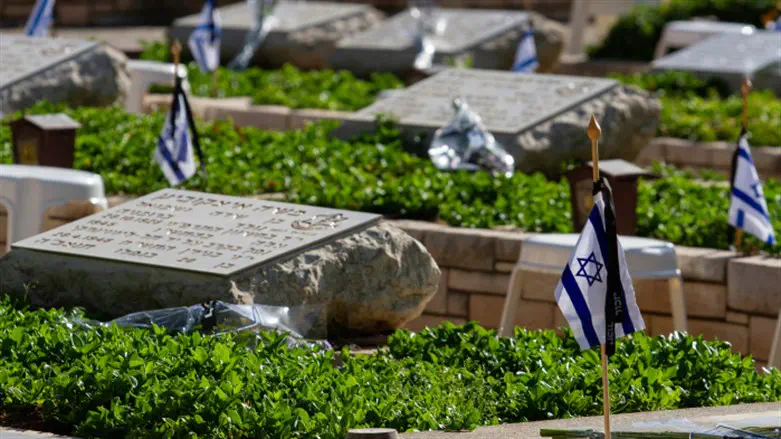
Military cemetery (illustrative)
http://www.israelnationalnews.com/news/379499?utm_source=activetrail&utm_medium=email&utm_campaign=nl

Thursday, March 07, 2024

Shovel Ready for Moshiach! “99.99%” of Lubavitchers believe the rebbe will return as the messiah."


Jacob Joseph Frank[2] (Hebrew: יעקב פרנק; Polish: Jakub Józef Frank;[3][4] born Jakub Lejbowicz; 1726 – 10 December 1791) was a Polish-Jewish[1] religious leader who claimed to be the reincarnation of the self-proclaimed messiah Sabbatai Zevi (1626–1676) and also of the biblical patriarch Jacob. The Jewish authorities in Poland excommunicated Frank and his followers due to his heretical doctrines that included deification of himself as a part of a trinity and other controversial concepts such as neo-Carpocratian "purification through transgression".[5][6]

Frank arguably created a religious movement, now referred to as Frankism, which incorporated aspects of Christianity and Judaism. The development of Frankism was one of the consequences of the messianic movement of Sabbatai Zevi. This religious mysticism followed socioeconomic changes among the Jews of Poland, Lithuania and Ruthenia.


Etched portrait of Sabbatai Zevi from 1666
Sabbatai Zevi
שַׁבְּתַי צְבִי
Etched portrait of Sabbatai Zevi from 1666
Personal
BornAugust 1, 1626
Diedc. September 17, 1676 (aged 50)
ReligionJudaism, later Islam
NationalityOttoman
Founder ofSabbateanism

Sabbatai Zevi[1] (Hebrew: שַׁבְּתַי צְבִי, romanizedŠabbĕṯai Ṣĕḇî; Turkish: Sabetay Sevi; August 1, 1626 – c. September 17, 1676)[2] was an Ottoman Jewish mystic, false messiah and ordained rabbi from Smyrna (now İzmir, Turkey).[3][4] He was likely of Ashkenazi origin.[5] Active throughout the Ottoman Empire, Zevi claimed to be the long-awaited Jewish Messiah and founded the Sabbatean movement.[6]

Latest accessory in Crown Heights: A shovel lapel pin to signal support for the 770 tunnel


Are lapel pins shaped like shovels the latest accessory in Crown Heights, Brooklyn?


Mendy Gerlitzky is shown wearing a shovel pin

The pin can be purchased for $3 at Chabad headquarters at 770 Eastern Parkway. 

Mendy Gerlitzky, a young Lubavitch man, wore the pin to a videotaped interview about an illegally dug tunnel at 770. A near-riot erupted when city officials ordered the tunnel filled in last month.  

Gerlitzky had the small gold-colored shovel pin conspicuously attached to the lapel of his black jacket as he spoke  on the Trauma Dump with Zach Adler podcast. The episode, titled “Interview with a Secret NYC Jewish ‘Tunnel’ Digger,” was posted on YouTube March 1.

“So he’s wearing a shovel on the lapel,” Adler, the podcast host, said. “I love that you’re wearing this and I want one by the way. Can you get me one?” 

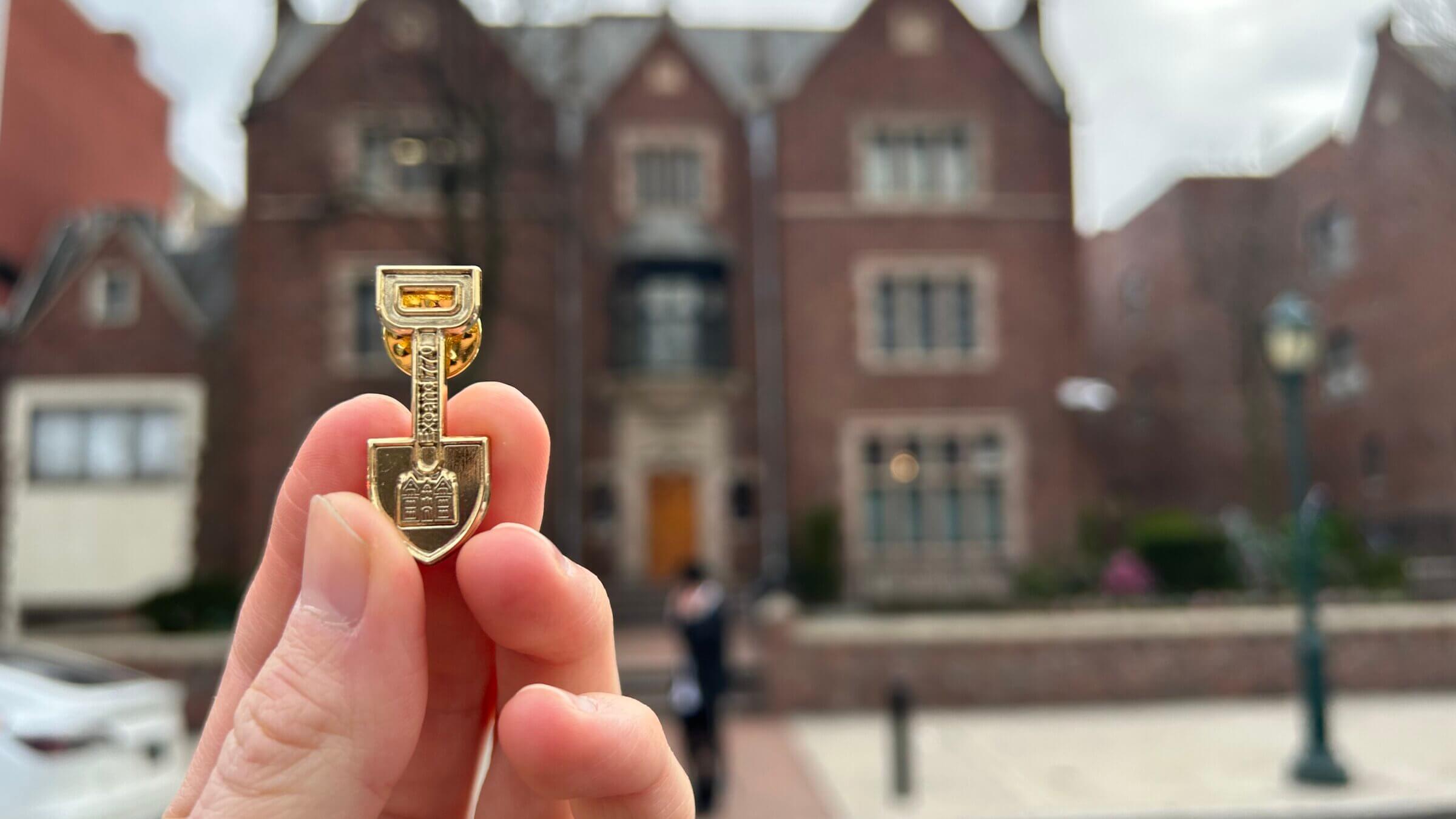
“Yeah, sure,” Gerlitzky said. Pointing to details on the pin, he said, “Here it says, ‘Expand 770,’ and there is a little 770 in the shovel,” referring to a silhouette of the building on the pin.

“Oh my God, it’s beautiful,” Adler said. “I think I want to be on Team Expand. So I would like a shovel.”

Someone posting anonymously on the Orthodox Jewish news site collive.com also referred to the item, saying: “I have seen a new lapel pin of a gold shovel. The shovelist’s.”

The melee at 770

Police were called to Chabad headquarters on Jan. 8 after the building’s owners attempted to fill the tunnel in with concrete. The city Buildings Department described the space as a “linear tunnel,” 8 feet wide, 60 feet long and 5 feet high, and issued emergency work orders to stabilize nearby buildings that had been rendered unsafe by the digging near an abandoned mikvah adjacent to 770. 

Video of the ensuing fracas showed young Hasidic men throwing furniture and ripping tiles from the wall of a synagogue beneath the organization’s offices. Five people were arrested.


Gerlitzky disputed the use of the term “tunnel,” saying that those using the term to get attention for stories about the incident “owe an apology to all those people, all the hostages, who are sitting in tunnels for the past four months,” referring to hostages taken from Israel by Hamas on Oct. 7. He said instead of calling it a tunnel, it should be called “a failed attempt to expand the shul.”


Shovel pin signaling support for the illegally dug tunnel at Chabad headquarters.

“Did you pick up a shovel at any point?” Adler asked.

“I’m not going to confirm or deny,” Gerlitzky responded.

“That’s a yes,” Adler said. 

What the rebbe wanted

Gerlitzky also said “770 is my life,” and that he goes there daily to pray. He said that Chabad’s Rebbe Menachem Mendel Schneerson, who died in 1994, had at one point said he wanted the synagogue expanded to accommodate increased numbers of supporters. A few years ago, Gerlitzky said, some of those young Lubavitchers took matters into their own hands and began digging the space out without permission from the Chabad establishment. 

Litigation has been ongoing for years between Chabad officials and the group that occupies the synagogue. “They’ve been in court for 20 years over who should be in charge of the shul. The establishment within Chabad wants to take control of the shul because they don’t like the meshichist (messianist) stuff that goes on there,” Gerlitzky said.

“This is a Game of Thrones at 770!” Adler exclaimed, adding that it was a “power struggle” between the “old guard” and “the young guys” who were “going ahead and doing what they thought was right.” 

Gerlitzky also said, without evidence, that “99.99%” of Lubavitchers believe the rebbe will return as the messiah. But he said the belief is kept under wraps because Chabad leaders “think it’s going to make Lubavitchers look crazy.”

Officially, the movement maintains an anti-meshichist stance. It does not list meshichistic Chabad outposts on its website’s synagogue lookup tool. Its spokesperson has publicly disavowed activists who post “Messiah Is Here!” posters around New York.

The big reveal

Asked by Adler whether those doing the digging had considered safety issues, Gerlitzky said they had informally consulted contractors who told them, “I’m not going to tell you, dig or don’t dig, but if you’re going to do it, put a beam there.” He said the group’s intention was to “reveal” a finished space at some point with lights, tiles, plumbing, benches, floors and tables. 

Adler also asked him about the video footage that showed a soiled mattress and high chair in the excavated space. Those objects helped fuel baseless antisemitic conspiracy theories online that the tunnel was being used for a child-sex ring. 

Gerlitzky said mattresses were used to soundproof the digging and that the high chair was being stored there along with other unused items by someone in the community who didn’t need it but hadn’t thrown it away. 

“Just this guy keeping his old crap by the abandoned mikvah,” Adler said. 

https://forward.com/fast-forward/588719/tunnel-chabad-shovel-pin-770/?