


The Ethics Yeshiva University Teaches—and the Ethics It Must Face
 |
December
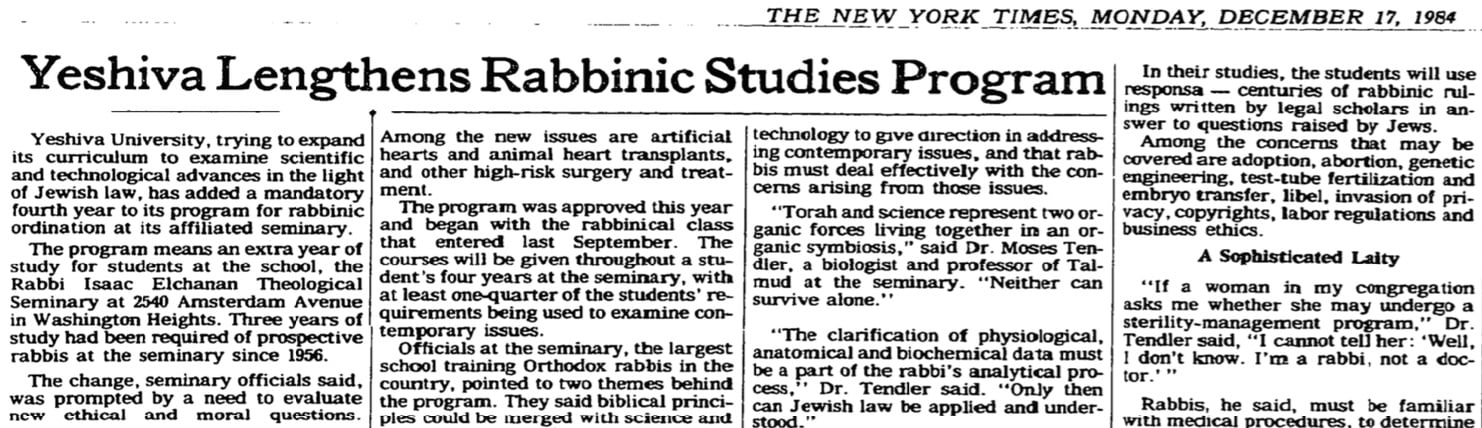
17, 1984: My New York Times report on Yeshiva University's decision to
expand rabbinical education to address contemporary ethical issues. |
‘A life of Torah cannot be compartmentalized,’ Yeshiva University declares in announcing its new ethics initiative. Forty-two years after covering a similar announcement for The New York Times, the author asks whether that principle also applies to the university itself.
Forty-two years ago, as a freelance reporter for The New York Times, I covered the announcement by Yeshiva University’s Rabbi Isaac Elchanan Theological Seminary (RIETS) that it planned to expand the curriculum of its Semikha (ordination) program to better prepare future rabbis for the ethical dilemmas of the modern world.
The message was inspiring. Jewish law, university leaders explained, could not remain frozen in an earlier age. Future rabbis would confront questions raised by medicine, technology, business and public life. Halakha had to engage the realities of contemporary society.
Last week, that same seminary announced another ethics initiative: a graduate program in Business Ethics and Jewish Law. Once again, the university and its affiliated seminary speak eloquently about responsibility, fairness, judgment and moral leadership.
Reading the announcement, I found myself returning to that article I reported in 1984.
Not because the university’s aspirations have changed.
But because history has.
In the decades since, dozens of survivors have alleged that children were sexually abused within Yeshiva University-affiliated institutions during the very years the university was publicly presenting itself as a leader in Jewish ethics. Litigation concerning those allegations continues today. The university denies wrongdoing and continues to defend itself in court, while survivors continue to seek broader access to institutional records and a fuller accounting of what occurred.
That history fundamentally changes how today’s announcement is read.
The question is not whether business ethics deserves serious study. It unquestionably does.
Nor is the question whether Jewish law has something meaningful to contribute to modern commerce. It unquestionably does.
The question is different.
Can an institution credibly teach ethical responsibility while continuing to resist full transparency concerning its own ethical decisions?
That question extends far beyond Yeshiva University. Every institution that claims moral authority—religious, educational, governmental or corporate—must ultimately be judged not only by what it teaches, but by what it is willing to examine about itself.
Ironically, the new program’s own philosophy captures the issue perfectly.
According to the university, “A life of Torah cannot be compartmentalized.”
I agree.
Neither can institutional ethics.
Ethics cannot be confined to classrooms, conferences or graduate curricula. They are tested when institutions confront their own failures—especially when those failures involve vulnerable children, public trust and the courage to pursue truth wherever it leads.
Forty-two years ago, I reported on Yeshiva University and RIETS’ vision of preparing rabbis for the ethical challenges of the future.
Today, with the benefit of hindsight, decades of reporting, publicly filed court records and personal experience, I find myself asking a far more difficult question.
Not whether Yeshiva University or its seminary can teach ethics.
Whether it has first demonstrated them.
https://blogs.timesofisrael.com/the-ethics-yeshiva-university-teaches-and-the-ethics-it-must-face/
1 comment:
Sexual abuse within the Jewish community,, ESPECIALLY within the ultra- orthodox community, is a Chillul Hashem. Absolutely disgusting.
Post a Comment