EVERY SIGNATURE MATTERS - THIS BILL MUST PASS!

EVERY SIGNATURE MATTERS - THIS BILL MUST PASS!
CLICK - GOAL - 100,000 NEW SIGNATURES! 75,000 SIGNATURES HAVE ALREADY BEEN SUBMITTED TO GOVERNOR CUOMO!

EFF Urges Court to Block Dragnet Subpoenas Targeting Online Commenters

EFF Urges Court to Block Dragnet Subpoenas Targeting Online Commenters
CLICK! For the full motion to quash: http://www.eff.org/files/filenode/hersh_v_cohen/UOJ-motiontoquashmemo.pdf

Wednesday, May 06, 2020

The Hareidi-promoted understanding of emunat hakhamim is not only rejected by significant rabbinic authorities, but is deeply offensive to those who insist on the right to think for themselves and make their own decisions. To ascribe quasi-prophetic powers to a small clique of Talmudic scholars is intellectually unsound. It undermines a thinking faith and condemns the public to sheepishly follow the opinions of an unelected group of “gedolim.”

  I'm not one to mince words. Officially I retired from my "highly paid" blogging job. But I can't help myself from commenting on the present crisis. Why? For the same reason I blogged for almost 15 years!

TO TEACH YOU THAT YOUR WORLDVIEW IS MESSED UP, and give you an opportunity to get it right! And NOW It's not only killing people emotionally, but it is bringing death to your doorstep!

The bitter reality of Covid-19 has forced you to rethink just about everything you believed before the deadly virus started killing your friends, neighbors, family members and someone you know. Yes, some of the people were elderly and maybe their time was up anyway. But the facts are if they died of Covid-19, they died of an unwarranted, tortured, suffocating death, prematurely.

So how do we process the present crisis? What should we learn from this pandemic? What mistakes were made that could have prevented this calamity, or at the very least reduced the amount of illness and death?
The day before Purim, on March 9, Agudath Israel posted a Q & A that advised individuals to continue going to shul for minyan, attending synagogue Megilla readings, and carrying on with their Purim celebrations, unless they were actually ill. And on that same day, a large group of Rabbis and leaders gathered to discuss what they deemed a pressing issue for their community: the matter of preventing government enforcement of education standards in their yeshivas. Coronavirus, which had already begun to quietly spread throughout New York, was not their prime concern.


In 1990, I met with the Chief Rabbi of a major city in Israel, a man who was known for his great erudition and who authored a number of volumes of halakhic responsa. He told me that a military leader of Israel had asked him to encourage yeshiva students to serve in the army. He had responded to the general:  instead of getting yeshiva students to serve in the army, all the soldiers should put down their weapons and start studying Torah.  He quoted a Midrash that God will protect the Jewish people if they all study Torah. I asked the rabbi if he would risk the security of Israel based on that Midrash. He told me without hesitation: “yes, of course! We don’t need an army, we need everyone to study Torah. We have the words of hazal, and our Sages spoke truth.”
 
     When I expressed my astonishment that he actually thought Israel did not need military defense, he expressed his astonishment that I doubted the truthfulness of the words of the Midrash. The two of us were operating on different sets of assumptions.
     The Chief Rabbi was living in a pre-modern spiritual/intellectual bubble. He relied faithfully on the words of our ancient Sages; they knew the real truth. Their words were uttered in pure holiness. The teachings of our Sages are absolutely reliable, far more trustworthy than anything that could be said or taught by military, political, or governmental experts—especially those who were not religiously observant.
     The Chief Rabbi thought it was a lack of faith on my part to give more credibility to the experts than to statements made by our Sages. For my part, I was horrified that an intelligent and pious Chief Rabbi would genuinely think that Israel did not need military defenses if everyone simply studied Torah and kept the mitzvoth. We sat in the same room, we believed in and observed the same Torah…but we were in different spiritual/intellectual worlds.
     The Chief Rabbi was an advocate of emunat hakhamim, requiring us to have absolute faith in our Sages and their teachings. All genuine truth existed within the ken of our Sages. All “outside” information was not credible…unless the Sages themselves gave it credibility.
     This kind of thinking has gained traction within Orthodox Judaism in recent decades. It has led to an Orthodoxy that fosters authoritarianism and obscurantism. It has relegated immense power to gedolim who are supposed to have a monopoly on truth. It has fostered negative attitudes toward secular sources of knowledge, since the Sages have the keys to all real knowledge themselves. It discredits those fine Orthodox Jews who do not share their worldview, and ostracizes Orthodox rabbis who do not fall into line with their faith in the almost infallible wisdom of the gedolim.
     A venerable exponent of the emunat hakhamim view was Rabbi Avraham Karelitz,(1878-1953) popularly known as the Hazon Ish. He taught that “everything written in the Talmud, whether in the Mishnah or in the Gemara, whether in halakha or in aggadah, were things revealed to us through prophetic powers…and whoever deviates from this tenet is as one who denies the words of our Rabbis, and his ritual slaughtering is invalid and he is disqualified from giving testimony. (Kovetz Iggerot 1:59. This is cited by David Weiss Halivni, in The Midrashic Imagination: Jewish Exegesis, Thought and History, ed. Michael Fishbane (Albany: State University of NY Press, 1993, p. 40, n. 13)
     Not only are we instructed to believe in the prophetic powers of ancient Talmudic sages (even though they never claimed these powers for themselves), we are asked to suppress our own minds to the opinions of the sages. Even if we think their statements are unreasonable, we should assume they are right and we are wrong. Thus taught Rabbi Eliyahu Dessler, an influential Hareidi leader of the 20th century:   “Our rabbis have told us to listen to the words of the Sages, even if they tell us that right is left and not to say, heaven forbid, that they certainly erred because little I can see their error with my own eyes. Rather, my seeing is null and void compared with the clarity of intellect and the divine aid they receive….This is the Torah view [daas Torah] concerning faith in the Sages. The absence of self-negation toward our rabbis is the root of all sin and the beginning of all destruction, while all merits are as naught compared with the root of all—faith in the Sages.” (Mikhtav me-Eliyahu 1:75-77, cited by Lawrence Kaplan “Daas Torah; A Modern Conception of Rabbinic Authority,” Rabbinic Authority and Personal Autonomy, ed. M. Sokol Northvale, NJ, Jason Aronson, 1992, pp. 16-17).
     Proponents of emunat hakhamim ascribe divine powers to the sages of all generations, including our own. They not only know Torah better than anyone else; their Torah knowledge gives them the right and authority to guide the Jewish people in all areas of life. In the words of Rabbi Bernard Weinberger:  “Gedolei Yisrael possess a special endowment or capacity to penetrate objective reality, recognize the facts as they really are and apply the pertinent halakhic principles. This endowment is a form of ru’ah haKodesh [Divine inspiration], as it were, bordering, if only, remotely, on the periphery of prophecy. ….Gedolei Yisrael inherently ought to be the final and sole arbiters of all aspects of Jewish communal policy and questions of hashkafa.” Cited by Lawrence Kaplan, p. 17).
     Rabbi Nachum Rabinovich has pointed out that emunat hakhamim actually has a very different meaning and intent (“Emunat Hakhamim, Mah Hi?”, in Darka shel Torah, Maaliyot Press, Jerusalem, 1998, pp. 206-214). We are expected to respect the wisdom of our sages, but not to assume their infallibility or their quasi-prophetic status. Rather than blindly following their words, we are expected to examine their comments carefully; to try to understand their intent; to accept or reject them only after careful consideration. “True emunat hakhamim requires deep analysis to seek the reasons for the words of the sages; this entails an obligation on the part of the student or questioner to a very careful and critical examination, to determine if there is place to dissent. Certainly their words have reason, but one is still obligated to clarify whether to follow [their words] in actual practice” (p. 213).   
     It is up to each individual to make informed decisions; it is wise to consult the advice and teachings of sages. But one is not allowed to suspend personal judgment. “There is a difference between one who seeks advice and then ultimately acts based on personal responsibility, and one who relies on a “great tree” without independent thought. There are those who ascribe this childish behavior under the name emunat hakhamim, whereas this is a perversion of this important virtue. Instead of acquiring true Torah, people who cling to this mistaken notion of emunat hakhamim thereby distance themselves from the light of Torah, and in the end don’t know their right from their left” (p. 214).
     For Rabbi Rabinovich, emunat hakhamim does not foster an attitude of blind obedience. On the contrary, it demands careful attention to the words of our sages…followed by a personal evaluation of whether those statements ought or ought not to be accepted. His views are very much in line with a long rabbinic tradition that calls for respect for the words of our sages, but not a belief in the infallibility or divine inspiration of their words.
     The Talmud and Midrashim are replete with statements by great sages on various topics…medical cures, demons, seemingly far-fetched interpretations of biblical verses. It is not a religious virtue to ascribe “truth” to all their statements, although it is important to try to understand the context of their words....

 Rabbi Abraham, son of Maimonides, in an important essay concerning aggada, maintained that one may not accept an opinion without first examining it carefully. (See his Ma-amar Odot Derashot Hazal, printed in the introductory section of the EinYaacov.) To accept the truth of a statement simply on the authority of the person who stated it is both against reason and against the method of Torah itself. The Torah forbids us to accept someone's statement based on his status, whether rich or poor, whether prominent or otherwise. Each case must be evaluated by our own reason.

 Rabbi Abraham stated that this method also applies to the statements of our sages. It is intellectually unsound to accept blindly the teachings of our rabbis in matters of medicine, natural science, astronomy. He noted: "We, and every intelligent and wise person, are obligated to evaluate each idea and each statement, to find the way in which to understand it; to prove the truth and establish that which is worthy of being established, and to annul that which is worthy of being annulled; and to refrain from deciding a law which was not established by one of the two opposing opinions, no matter who the author of the opinion was. 


We see that our sages themselves said: if it is a halakha (universally accepted legal tradition) we will accept it; but if it is a ruling (based on individual opinion), there is room for discussion."
READ MUCH MORE:
RE :

Sunday, March 22, 2020

A Teachable Moment For The Orthodox Jewish Community - Eat Herring With Your Rabbis - Go To Doctors For Medical Advice!

 MARCH 12, 2020 -----  KEEP YESHIVAS OPEN ---- "It is our opinion, at least as of now, and at least in cities or municipalities where public and private schools are not required to close, that yeshivos and day schools should remain open. The koach haTorah generated by tinokos shel bais rabban is inestimable, and is urgently needed in times like these.
The general consensus among health officials at this time appears to be that schools may remain open, as evidenced by the fact that most local health authorities have not at this point ordered the wholesale closing of schools, neither public schools nor private schools. We do not think that yeshivos and day schools need to hold themselves to a different standard than that determined appropriate for neighboring public or private schools."

The (Jewish) Doctor Who Helped Defeat Smallpox Explains What's Coming

Epidemiologist Larry Brilliant, who warned of pandemic in 2006, says we can beat the novel coronavirus—but first, we need lots more testing.


Larry Brilliant says he doesn’t have a crystal ball. But 14 years ago, Brilliant, the epidemiologist who helped eradicate smallpox, spoke to a TED audience and described what the next pandemic would look like. At the time, it sounded almost too horrible to take seriously. “A billion people would get sick," he said. “As many as 165 million people would die. There would be a global recession and depression, and the cost to our economy of $1 to $3 trillion would be far worse for everyone than merely 100 million people dying, because so many more people would lose their jobs and their health care benefits, that the consequences are almost unthinkable.”

Now the unthinkable is here, and Brilliant, the Chairman of the board of Ending Pandemics, is sharing expertise with those on the front lines. We are a long way from 100 million deaths due to the novel coronavirus, but it has turned our world upside down. Brilliant is trying not to say “I told you so” too often. But he did tell us so, not only in talks and writings, but as the senior technical advisor for the pandemic horror film Contagion, now a top streaming selection for the homebound. Besides working with the World Health Organization in the effort to end smallpox, Brilliant, who is now 75, has fought flu, polio, and blindness; once led Google’s nonprofit wing, Google.org; co-founded the conferencing system the Well; and has traveled with the Grateful Dead.

We talked by phone on Tuesday. At the time, President Donald Trump’s response to the crisis had started to change from “no worries at all” to finally taking more significant steps to stem the pandemic. Brilliant lives in one of the six Bay Area counties where residents were ordered to shelter in place. When we began the conversation, he’d just gotten off the phone with someone he described as high government official, who asked Brilliant “How the fuck did we get here?” I wanted to hear how we’ll get out of here. The conversation has been edited and condensed.

MORE: https://www.wired.com/story/coronavirus-interview-larry-brilliant-smallpox-epidemiologist/?utm_source=pocket-newtab

Thursday, March 12, 2020

This suggests that anyone in a position of power or authority, instead of downplaying the dangers of the coronavirus, should ask people to stay away from public places, cancel big gatherings, and restrict most forms of nonessential travel.

 POSTED ONE YEAR AGO - MARCH 12, 2020

Cancel Everything!


In an email to my children dated Monday February 24 - 5:24 PM

 My suggestion is that everyone should have at home a 2-4 week supply of non-perishable food. Matzo, water, all canned foods...keep it in the garage or basement. There are over 200 cases in EY, and known 36 cases in the US. There's a run on food in the Asian countries and starting in Europe. Costco/Amazon...Stuff that you would eat anyway. It will come here.

Love 


***********


DO NOT PAY ATTENTION TO THIS GROUP OF RABBIS ON THIS ISSUE - THE MEDICAL COMMUNITY IS THE ONLY SOURCE OF INFORMATION FOR HEALTH  RELATED MATTERS - THEY ARE TELLING EVERYONE TO KEEP YOUR CHILDREN AT HOME!


 Daily Jewish Community Novel CoronaVirus Updates as They Happen: 
 
CLICK: https://www.jta.org/2020/03/05/global/the-latest-jewish-coronavirus-updates-el-al-downsizes-services-move-online-and-more?utm_source=JTA_Maropost&utm_campaign=JTA_DB&utm_medium=email&mpweb=1161-17628-21723
 
 
We don’t yet know the full ramifications of the novel coronavirus. But three crucial facts have become clear in the first months of this extraordinary global event. And what they add up to is not an invocation to stay calm, as so many politicians around the globe are incessantly suggesting; it is, on the contrary, the case for changing our behavior in radical ways—right now.

The first fact is that, at least in the initial stages, documented cases of COVID-19 seem to increase in exponential fashion. On the 23rd of January, China’s Hubei province, which contains the city of Wuhan, had 444 confirmed COVID-19 cases. A week later, by the 30th of January, it had 4,903 cases. Another week later, by the 6th of February, it had 22,112.

The same story is now playing out in other countries around the world. Italy had 62 identified cases of COVID-19 on the 22nd of February. It had 888 cases by the 29th of February, and 4,636 by the 6th of March.

Because the United States has been extremely sluggish in testing patients for the coronavirus, the official tally of 604 likely represents a fraction of the real caseload. But even if we take this number at face value, it suggests that we should prepare to have up to 10 times as many cases a week from today, and up to 100 times as many cases two weeks from today.


The second fact is that this disease is deadlier than the flu, to which the honestly ill-informed and the wantonly irresponsible insist on comparing it. Early guesstimates, made before data were widely available, suggested that the fatality rate for the coronavirus might wind up being about 1 percent. If that guess proves true, the coronavirus is 10 times as deadly as the flu.

But there is reason to fear that the fatality rate could be much higher. According to the World Health Organization, the current case fatality rate—a common measure of what portion of confirmed patients die from a particular disease—stands at 3.4 percent. This figure could be an overstatement, because mild cases of the disease are less likely to be diagnosed. Or it could be an understatement, because many patients have already been diagnosed with the virus but have not yet recovered (and may still die).

When the coronavirus first spread to South Korea, many observers pointed to the comparatively low death rates in the country to justify undue optimism. In countries with highly developed medical systems, they claimed, a smaller portion of patients would die. But while more than half of all diagnosed patients in China have now been cured, most South Korean patients are still in the throes of the disease. Of the 7,478 confirmed cases, only 118 have recovered; the low death rate may yet rise.

Meanwhile, the news from Italy, another country with a highly developed medical system, has so far been shockingly bad. In the affluent region of Lombardy, for example, there have been 7,375 confirmed cases of the virus as of Sunday. Of these patients, 622 had recovered, 366 had died, and the majority were still sick. Even under the highly implausible assumption that all of the still-sick make a full recovery, this would suggest a case fatality rate of 5 percent—significantly higher, not lower, than in China.

The third fact is that so far only one measure has been effective against the coronavirus: extreme social distancing.

Before China canceled all public gatherings, asked most citizens to self-quarantine, and sealed off the most heavily affected region, the virus was spreading in exponential fashion. Once the government imposed social distancing, the number of new cases leveled off; now, at least according to official statistics, every day brings more news of existing patients who are healed than of patients who are newly infected.

A few other countries have taken energetic steps to increase social distancing before the epidemic reached devastating proportions. In Singapore, for example, the government quickly canceled public events and installed medical stations to measure the body temperature of passersby while private companies handed out free hand sanitizer. As a result, the number of cases has grown much more slowly than in nearby countries.


These three facts imply a simple conclusion. The coronavirus could spread with frightening rapidity, overburdening our health-care system and claiming lives, until we adopt serious forms of social distancing.

This suggests that anyone in a position of power or authority, instead of downplaying the dangers of the coronavirus, should ask people to stay away from public places, cancel big gatherings, and restrict most forms of nonessential travel.

Given that most forms of social distancing will be useless if sick people cannot get treated—or afford to stay away from work when they are sick—the federal government should also take some additional steps to improve public health. It should take on the costs of medical treatment for the coronavirus, grant paid sick leave to stricken workers, promise not to deport undocumented immigrants who seek medical help, and invest in a rapid expansion of ICU facilities.

The past days suggest that this administration is unlikely to do these things well or quickly (although the administration signaled on Monday that it will seek relief for hourly workers, among other measures). Hence, the responsibility for social distancing now falls on decision makers at every level of society.

Do you head a sports team? Play your games in front of an empty stadium.
Are you organizing a conference? Postpone it until the fall.
Do you run a business? Tell your employees to work from home.

Are you the principal of a school or the president of a university? Move classes online before your students get sick and infect their frail relatives.
 
All of these decisions have real costs. Shutting down public schools in New York City, for example, would deprive tens of thousands of kids of urgently needed school meals. But the job of institutions and authorities is to mitigate those costs as much as humanly possible, not to use them as an excuse to put the public at risk of a deadly communicable disease.

Finally, the most important responsibility falls on each of us. It’s hard to change our own behavior while the administration and the leaders of other important institutions send the social cue that we should go on as normal. But we must change our behavior anyway. If you feel even a little sick, for the love of your neighbor and everyone’s grandpa, do not go to work.

When the influenza epidemic of 1918 infected a quarter of the U.S. population, killing hundreds of thousands nationally and millions across the globe, seemingly small choices made the difference between life and death.

As the disease was spreading, Wilmer Krusen, Philadelphia’s health commissioner, allowed a huge parade to take place on September 28; some 200,000 people marched. In the following days and weeks, the bodies piled up in the city’s morgues. By the end of the season, 12,000 residents had died.


In St. Louis, a public-health commissioner named Max Starkloff decided to shut the city down.

Ignoring the objections of influential businessmen, he closed the city’s schools, bars, cinemas, and sporting events. Thanks to his bold and unpopular actions, the per capita fatality rate in St. Louis was half that of Philadelphia. (In total, roughly 1,700 people died from influenza in St Louis.)

In the coming days, thousands of people across the country will face the choice between becoming a Wilmer Krusen or a Max Starkloff.

In the moment, it will seem easier to follow Krusen’s example. For a few days, while none of your peers are taking the same steps, moving classes online or canceling campaign events will seem profoundly odd. People are going to get angry. You will be ridiculed as an extremist or an alarmist. But it is still the right thing to do.

https://www.theatlantic.com/ideas/archive/2020/03/coronavirus-cancel-everything/607675/?utm_source=newsletter&utm_medium=email&utm_campaign=atlantic-daily-newsletter&utm_content=20200311&silverid-ref=NTk0NjUwMDEzMDAyS0

Wednesday, September 18, 2019

A Time For Reflection & Introspection...

To My Friends and Readers:

As we are approaching the yimei hadin, I have decided that I will suspend writing on this Blog;  thanking HKBH for giving me the wisdom and opportunity to drum the horrible issue of abuse into the moral consciousness of the Jewish people, the failure of Jewish leadership to do anything about it, and worse, lied continuously about its existence and went out of its way to coverup these crimes, and seeing the Jewish community taking small steps to address this scourge. In that zechus I pray that my family, children and grandchildren and their children will merit a favorable gezeira from HKBH for the coming year and forever.

I will be taking time off to assess my role going forward how best to serve the Jewish community, and take a much needed break from being notified on a daily basis of the horrors that are going on in the Jewish community in front of our eyes.

I intend to travel more, spend more quality time with my family, my outstanding children and grandchildren, and disconnect for the most part from the Internet.

It has been 14 1/2 years since I went online --- March 5, 2005 --- and I must tell you that I am still affected by every heinous crime today, with the same horror, as I was when I began writing.

My hiatus, and my decision on how to best make a difference will probably be decided in about 60 - 90 days. I need some quality private time to gather my thoughts on my self-imposed communal obligations.

I will check my emails about once a week --- a_unorthodoxjew@yahoo.com

Wishing all members of the Jewish community and humankind my heartfelt good wishes, and pray that others will step in aggressively to make amends of a leadership that has run afoul of the laws of God and man.

With all of my heart and soul I urge you to keep up the good fight, for the right reasons!

Shana Tova u'Metuka

Paul Mendlowitz

The UOJ Perspective

A Time to Cry - A Time to Learn What is Genuine and What Are Lies!

The # 1 Most Widely Read Post of all 2011 


The events of the past several years, very obviously demonstrate the way you and your leaders understand our cultural history. But for the few of us that truly understand our history, as I do, untangling some of its complex strands has practical and intellectual consequences.

In my own case, the hardest - and the most challenging - is my never-ending research of Judaism's core values. I had to unlearn what I thought I knew, and was forced to shed presuppositions I had grown up with and taken for granted internally and intellectually.

This type of introspection, difficult to the extreme, has given me the depth of understanding of the Jewish doctrines to which is part of my very being, embedded in my DNA, and has assisted me in determining, at least for myself, what is divine and what is human.

For those who will never experience my struggle, there is no contradiction at all to the divine and human perception, the challenge is integrating the two. They are not diametrically opposed to one another as your ignorant rabbis would have you believe. They rule out that learned and spiritually inclined Jews, have always sought to discern spiritual truth via their intuition, reflection, senses, and creative imagination.

The rabbis that will deny you your God-given intellect, to experience on your own what humankind was destined to evolve into, a mirror-image of the beauty of what could and should be the Divine will of chochmat ha'briah; the understanding of the evolution of the intellect to adapt to today's realities of truth and practicality. What they would want you to forget, that only with the shedding of the "Church" as the arbiter of truth and morality in the U.S. Constitution, a mere couple of hundred of years ago, was then civilization, at least the United States, able to remove its intellectual shackles burdened and encumbered by nonsense, cruelty, ignorance and hell.

We've developed more in the last few hundred years, than we have in the last untold thousands. That does not come without a price, however. But that is not the thrust of this post.

Rabbis who will deny such experiences, can teach us anything they choose to about God,and have always identified themselves as our "guardians" of the ancient traditions, or Mesorah. They will preach with fire in their eyes and bimah-banging that it is only they that can determine your faithfulness - by your ability to abide by their interpretation of what was handed down from ancient witnesses -- never adding or subtracting anything unless you consult with them first. And these "guardians", who refer to themselves as the "eini ha'edah" or the eyes of the community, that this view of their role expresses appropriate humility; and it vests them and them alone of the Divine Truth, with God's own authority.

These so-called leaders, of course could not ban the imagination entirely, but they effectively channeled your religious imagination to support their opinions, no matter how cruel and ignorant they may be. Everything you are, they teach, is because you are merely an extension of them, not individuals who have the ability to know right from wrong. And if you stray; like Heaven forbid, do not consult with them if an ongoing series of heinous crimes and cover ups are transpiring under your noses, by the very rabbis that will have you consult with them only, than it is you that is the heretic, the maskil, the sheigetz, the oisvorf and the menuvel.

But in fact, these "heretics" having left the intellectual Jewish ghettos of New York, have impoverished the very system that they outgrew. These "heretics" often walk alone - despite the fact that the spiritual inquiry that they undertook, forcing them to leave their ghettos of origin behind, have become primary sources of inspiration to tens of thousands, and eventually their ideas to the vast majority of Jews, because ultimately I pray "right makes might"!

What such people seek, however, is NOT a different set of rules and obligations to their faith, but rather insights or intimations of the Divine, that would validate themselves in experience. Some who have engaged on this path pursue it in voluntary solitude; others participate in various forms of worship, prayer and action, or a combination of the above.

Engaging in such a practice requires the highest form of faith, or belief, but it also involves so much more; the trust that enables us to commit ourselves to what we hope and love. We have the knowledge and experience to declare boldly; "THIS IS NOT SO, I DO NOT ACCEPT THAT!"

The sociologist Peter Berger points out that everyone who participates in tradition today chooses among elements of that tradition. We survived thousands of years BECAUSE we were able to relive, reinvent, and transform what we received.

This act of choice - which the term heresy originally meant - leads us back to the problem that Orthodoxy meant to resolve; how can we tell truth from lies? What is genuine and thus connects us with one another and with reality, and what is shallow, self-serving, or evil? Anyone who has seen foolishness, sentimentality, delusion, and murderous rage disguised as God's truth, knows that there is no easy answer to this dichotomy. Orthodox Judaism distrusts your capacity to make such discrimination and insists on making them for us. Given the often notorious human capacity for self-deception, we can thank your so-called rabbis for this. And the many of you that wish to be spared hard work, gladly accept what these rabbis tell you.

But the fact that we do not have a simple answer, does not mean we should evade the question. We have also seen the hazards - even terrible harm - that sometimes result from unquestioning of religious authority. Rabbi Elchonon Wasserman's tyrannical, unforgivable conduct during the Holocaust comes immediately to mind. Thousands went to their death upon instruction from him. How many hundreds of thousands of "modeh ani l'fanechahs" will forever remain unsaid every morning from the mouths of children?, perhaps only God knows, but I suspect that He does not know either.

Many of us, however, sooner or later, at critical points in our lives, will have to make our own path where none exists. And that, done correctly, is a good thing. As for me, I am resolute, passionate in my beliefs, non-yielding to any ideological foe that crosses my path. I live in my head and in my contemplative soul. Any setback I view as temporary and a challenge to outhink my opponent. I never concede to evil, never...and I never will. My children and your children are counting on me, whether they know it or not.

And so are you....

As the posuk in יְשַׁעְיָהוּ Isaiah - 10:13 says, "The light of Israel will be fire and its Holy One - flame, it will burn and consume its thorns..."

Tuesday, September 17, 2019

“I know that this is an extremely difficult message to read and process on many levels,” wrote the principal, Rabbi Binyamin Krauss. “It is shocking to know that someone who we have trusted with our children has been accused of harming them....


Administrator at NY Jewish day school arrested for ‘production of child pornography’


NEW YORK (JTA) — An administrator at a prestigious Modern Orthodox Jewish middle school in New York City was arrested for production of child pornography.

Over the weekend, Rabbi Jonathan Skolnick, Associate Principal, for Judaic Studies grades 6-8 at SAR (formerly of Yeshiva of Flatbush) was arrested for production of child pornography, possession and receipt of child pornography, inducement of a minor to engage in sexual activity, and extortionate communication with that minor.

According to the complaint, he posed as a number of girls and chatted with the 14 year old male victim. Over the course of his various conversations with the victim, he solicited nude photos of him. He then instructed the victim to send more, and when the victim eventually stopped communicating with these accounts, he sent messages threatening to release the photos.

According to the FBI Skolnick admitted to soliciting nude pictures from 20-25 minor minor victims.

In an email to the school community on Monday, the principal of Salanter Akiba Riverdale Academy in the Bronx, known as SAR, informed parents that Rabbi Jonathan Skolnick, the middle school associate principal of Judaic studies, was arrested late Friday night. The email said that the school had reason to believe that SAR students may have been victims of Skolnick.

“I know that this is an extremely difficult message to read and process on many levels,” wrote the principal, Rabbi Binyamin Krauss. “It is shocking to know that someone who we have trusted with our children has been accused of harming them. Despite the practices in place to protect our children, we are not immune to breaches such as the one that seems to have taken place at SAR.”

 Skolnick, was at the school for 14 months. The school is cooperating fully with the FBI. Beyond the claim of “production of pornography” and a mention of “inappropriate photos,” the email did not contain more detail.

Last year, the school commissioned a report about its previous employment of a teacher who abused at least a dozen students at the school, according to the report. Stanley Rosenfeld, now 84, who has admitted to abusing hundreds of boys throughout his lifetime, worked as an assistant principal at SAR in the 1970s and also taught English there a decade later. The school commissioned the investigation in January, soon after learning of allegations against Rosenfeld.

“We strive to create a learning environment in which students feel comfortable coming forward with concerns or reports of misbehavior of any kind,” Krauss wrote to the Jewish Telegraphic Agency last year following the release of the report. “Nothing is more important than the safety of our students. If we were to learn of a report of abuse, we would work quickly to begin an investigation and ensure, throughout the process, that students are safe.”

Krauss wrote in his email Monday that the school’s administration will be discussing the arrest with students in the middle school on Tuesday, as well as students now in ninth grade who were under Skolnick’s authority last year. The school also encouraged parents to discuss the situation with their kids, and administrators are making themselves available to speak with parents on Tuesday and in the coming days as well.

The school instituted a sexual harassment policy in 2014. The policy requires reporting credible allegations of sexual misconduct to law enforcement, as well as guidelines for reporting allegations within the school and investigating them.

Thursday, September 12, 2019

Now, just weeks after the lookback clause went into effect, Jewish institutions across the denominational spectrum are facing legal retribution for allegedly mishandling allegations of child sexual abuse, with claims reaching as far back as the 1950s.


Through ‘Lookback Window,’ Jewish Orgs Face Retribution for Child Sex Abuse


As child abuse cases against yeshivas mount following a one-year lookback provision, questions turn to legal strategy. Are their fears of bankruptcy warranted?


Team USA volleyball player Sarah Powers-Barnhard speaks in support of the Child Victims Act on March 14, 2018 at the New York State Capitol in Albany, New York.  Getty Images


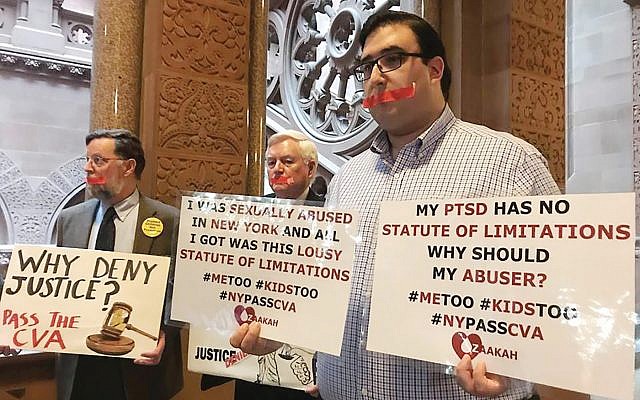
When a one-year lookback provision created by New York’s new Child Victims Act opened last month — temporarily lifting the statute of limitations on civil child sex abuse cases and allowing survivors of any age to pursue justice through the courts — youth-serving institutions across the state braced for legal fire. 

Now, just weeks after the lookback clause went into effect, Jewish institutions across the denominational spectrum are facing legal retribution for allegedly mishandling allegations of child sexual abuse, with claims reaching as far back as the 1950s. In the handful of cases filed thus far, prominent defendants include the National Ramah Commission, the Conservative movement’s camping arm; the Conservative movement’s flagship rabbinical school, Jewish Theological Seminary; Modern Orthodoxy’s flagship institution, Yeshiva University; prominent Modern Orthodox day school Salanter Akiba Riverdale High School (SAR); prominent Modern Orthodox day school Westchester Day School; Yeshiva Torah Temimah, a Brooklyn-based ultra-Orthodox school with a branch in Lakewood N.J.; Oholei Torah, a prominent Chabad yeshiva in Brooklyn; and Temple Beth Zion, a legacy Reform congregation in Buffalo. 

Claims leveled against these institutions include negligence in stopping or preventing sexual abuse; breach of fiduciary duties; and the intentional infliction of emotional distress against survivors of childhood sex abuse. Though details among the cases vary, leadership across institutions are alleged to have known about predatory behaviors and failed to act; helped alleged abusers gain entry to other youth-serving institutions; and engaged in intimidation tactics to prevent victims from coming forward.
Claims leveled against these institutions include negligence in stopping or preventing sexual abuse; breach of fiduciary duties; and the intentional infliction of emotional distress against survivors.
Yeshiva Torah Temimah, an all-boys charedi school based in Brooklyn, faces a new lawsuit for covering up the alleged sexual abuse perpetrated by Rabbi Yehuda Kolko, who taught at the school from the 1960s throughout the ’80s. Four ex-students previously sued the school, charging Kolko molested them from ages 11 to 13; at the time, the state court tossed the cases after determining claims fell outside the statute of limitations then in place.


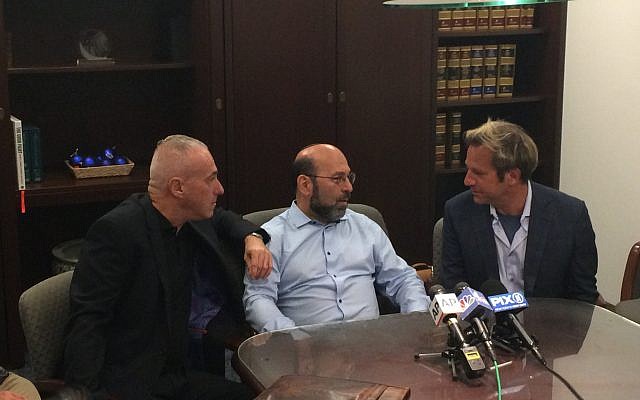
(L-R) Barry Singer, Jay Goldberg, David Bressler three of the plaintiffs in the suit against Yeshiva University at a recent press conference announcing their suit against YU


(Previously, the school agreed to pay an unprecedented $2.1 million to two former students who accused Kolko of sexually assaulting them. Details of the secret settlements emerged in 2016 when the school failed to make payments. The case marked the first time a New York yeshiva paid off alleged victims of sex abuse, experts said. Kolko, now 72, received a controversial plea deal from then-Brooklyn District Attorney Charles Hynes in May 2012 after pleading guilty to two misdemeanor counts of child endangerment; he did not have to serve jail time or register as a sex-offender.)

Now, the case is being revived under the Child Victims Act. Alleged victim Baruch Sandhaus filed a complaint in Brooklyn Supreme Court last month, alleging that Kolko and another rabbi on staff “would inappropriately touch” his private parts on various occasions between 1978 and 1980, when he was a student at Torah Temimah. 

Hank Sheinkopf, a spokesperson for the yeshiva, said the alleged events occurred “40 years ago” and so have no connection to the current administration.

“Why would a new administration know anything about what took place decades ago?” he told The Jewish Week in a phone conversation. “It’s not going on today.” The school, he said, is “financially capable of dealing with a lawsuit” and will “continue to function and turn out Torah-trained young people.” 

Sheinkopf referred to the new roster of lawsuits — including the revived case against Torah Temimah — as “a trial lawyer game to make a lot of money.”

As cases begin to play out — a process that could take years — precedents set in other states that have adopted similar lookback provisions might provide a blueprint for what institutions, and survivors, might expect, lawyers say. 

“So far, every religious institution I’ve sued has told its constituents that lawsuits would lead to bankruptcies,” said Patrick Noaker, the attorney representing plaintiffs in a new lawsuit filed last week in Kings County Supreme Court against the Chabad boys yeshiva, Oholei Torah.


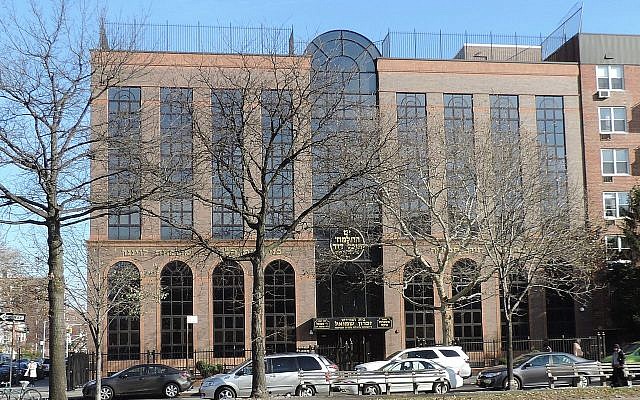
Yeshiva Torah Temima in Brooklyn, NY.


Noaker said the passage of the Child Victims Act won’t make it any easier for alleged victims to win cases. “Sometimes the time that has passed can make it hard to find witnesses and evidence that the school knew or should have known that children were in danger. We also have to prove damages,” he said. “The only thing the Child Victims Act does is open the court room doors. We still have to prove our case like any other,” he said.
“The only thing the Child Victims Act does is open the court room doors. We still have to prove our case like any other.
In February, shortly after the Child Victims Act bill passed, Agudath Israel of America — a large charedi umbrella group that long advocated against the bill alongside the Catholic Church and Boy Scouts of America — issued a statement warning its constituents that the look-back provision “could literally destroy schools, houses of worship that sponsor youth programs, summer camps and other institutions that are the very lifeblood of our community.”


Rabbi Avi Shafran, director of public affairs for Agudath Israel, told The Jewish Week this week that “the fears certainly continue,” though he was not aware of how many suits had been filed against yeshivas.


For Noaker, a Minneapolis-based lawyer who represented plaintiffs in a host of lawsuits against Catholic dioceses in Minnesota after the state passed a three-year lookback window in 2018, the line is familiar.
The argument is straight-up manipulation.
“The Catholics said lawsuits would shut down hospitals and homeless shelters — it never happened,” said Noaker. “The argument is straight-up manipulation.”

Though several of the cases he litigated did contribute to dioceses in Minnesota filing for Chapter 11 bankruptcy in order to settle hundreds of claims of sexual abuse at the hands of priests, not one diocese ceased to function because of the financial decision.


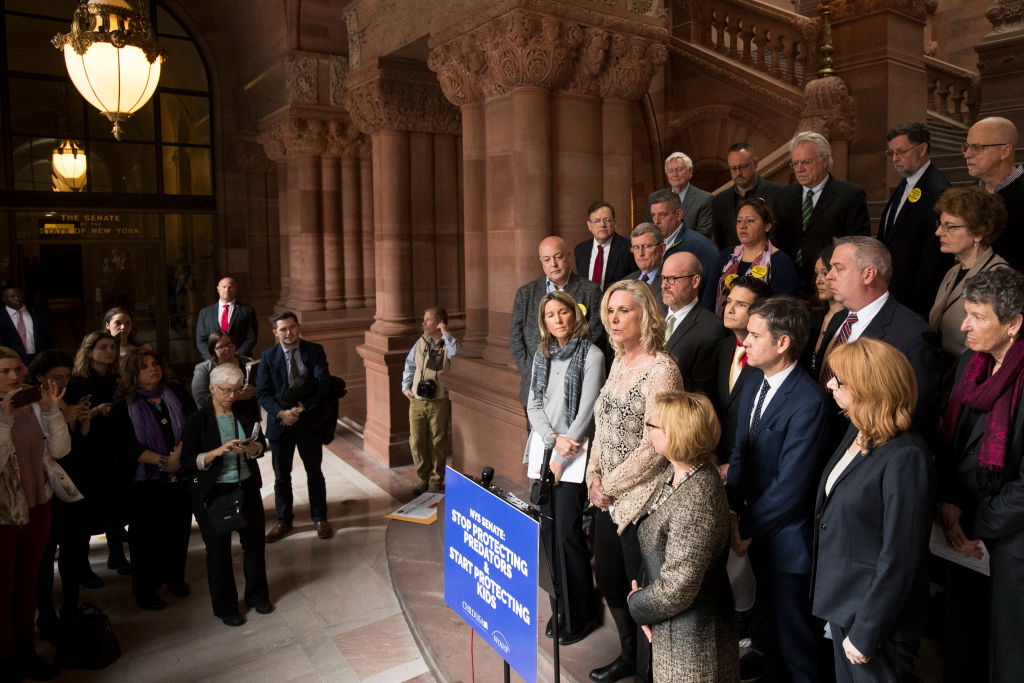
Child victims and advocates during the debate in Albany in the run-up to a vote on the Child Victims Act earlier this year.

A major benefit he has seen for states, like Minnesota and California, that implemented similar look-back provisions is a “more robust sex offender registry”; suits previously barred by strict statues of limitations “identify predators that could still have access to children.” 

For Noaker, the case against Oholei Torah, which brings new allegations of child sex abuse against Rabbi Joseph (Yossi) Reizes — a religious instructor hired by Oholei Torah in the ’80s and dogged by allegations of sexual abuse — is his first venture representing plaintiffs from the Orthodox Jewish community. Noaker, who has represented victims of child sexual abuse for 20 years, said he has more lawsuits involving the Chabad-Lubavitch community “on the way.”

Oholei Torah did not respond to request for comment.

Chaya M. Gourarie, an attorney representing plaintiffs in the newly filed lawsuit against the National Ramah Commission, said the “ideal outcome” of these lawsuits is to “change policies, not bankrupt institutions.”
The deal outcome of these lawsuits is to ‘change policies, not bankrupt institutions.’
“We hope these lawsuits will usher in a new era where institutions put in safeguards to protect against child sexual abuse,” she said. “Sometimes, it takes a radical change in the law to force the culture change we need to see.”

The complaint, filed on Aug. 29 in the New York State Supreme Court, alleges that then-counselor-in-training Harvey Erlich was allowed “unrestricted and unsupervised access to campers, whom he repeatedly molested throughout the summer of 1971.” (Erlich was arrested on sex abuse charges in 2012 in Canada, which does not have a statute of limitations on sexual abuse cases. In 2015, Erlich pled guilty to sexually abusing four minors, aged 9 to 13.)

Marci Hamilton, founder and CEO of Child USA, a nonprofit that works to prevent child abuse, stressed that “across the country, there has been no cause-and-effect relationship between statute of limitation reform and bankruptcy.”
Across the country, there has been no cause-and-effect relationship between statute of limitation reform and bankruptcy.
With new legislation passed in over 20 states and 44 states considering new legislation around statute of limitations reform, “We’ve finally reached a tipping point,” Hamilton said.

“It took a quantum of information to be out in the public square to reach this moment,” she said, mentioning the grand jury investigation of Catholic Church sex abuse in Pennsylvania, released last year; the unfolding of hundreds of allegations against Larry Nassar, the former  USA Gymnastics doctor, in 2017; and, finally, the developing allegations of child sex trafficking against financier Jeffrey Epstein, who committed suicide last month.

“The issue has become impossible to ignore,” said Hamilton. “None of this is terribly surprising for those of us who have been in the trenches for two decades, but it’s certainly gratifying.” 
More on the Child Victims Act here.


https://jewishweek.timesofisrael.com/jewish-institutions-that-mishandled-abuse-cases-decades-ago-now-fear-bankruptcy/?fbclid=IwAR21N6R4HzGfeQsWUovLVo_ZFp4kznsadUm_aevn6diMpfa6-b9_oNh_vdQ

Monday, September 09, 2019

The best way to reintroduce Torah im Derech Eretz is to restore R’ Hirsch’s ideals, both in theory and in practice, at the high school level. Specifically, this includes teaching R’ Hirsch’s classic sefer, “The Nineteen Letters,” which contains the core of R’ Hirsch’s views on the world and Torah. R’ Shraga Feivel Mendlowitz told his students in America, “I cannot understand how it is possible for an American yeshiva student to be Jewish without ‘The Nineteen Letters’” ...

Return to Basics: A Call to Revitalize R’ Hirsch’s Torah im Derech Eretz


How is it that over the past few decades, Yeshivos all over the United States have produced students that are “un-Jewish” (to use a Hirschian phrase)?

 By that I mean that, after twelve years of a Jewish education, many of them are not committed to Judaism at all. Not until after high school, when students learn in Bais Medrash/Seminary for a year or two (often in Israel), do they become committed to a Torah lifestyle. A second problem that presents itself comes as a result of the Yeshiva day school system naturally feeding into a kollel lifestyle. This lifestyle has become automatic for many Yeshiva/Bais Yaakov graduates: they do not decide as individuals whether or not a kollel lifestyle is appropriate for them. These two problems not only afflict the Yeshiva world; they also affect the insular Chassidish world.

Based on my own experiences in Yeshiva and upon anecdotal evidence heard from neighbors and friends, I can list a number of reasons why these problems exist. These include: Appearances (some parents force their children to fit into a “Yeshivish lifestyle” regardless of their child (ren)’s personality and leanings); Peer Pressure (both students and their parents desire to be like everybody else, which has resulted in a “cookie cutter” society); Apathy (today’s students are indifferent toward Judaism due to either superficial study or multiple distractions/outside temptations); Judgmentalism/ Fear (intellectually curious students are often branded as heretics for asking questions); and Insularity (studying anything other than Gemara is considered, at best, a waste of time). These ideas are probably familiar to the reader from his/her own personal experiences.

An effective solution to “un-Jewish students” or to students who have mindlessly “chosen” a kollel lifestyle, is a return to R’ Samson Raphael Hirsch’s educational system. Both the modern day Yeshiva system for boys and the Bais Yaakov movement for girls are based on R’ Hirsch’s ideal of Torah im Derech Eretz. In fact, without R’ Hirsch’s successful educational program (in the 1800s in Germany), the Bais Yaakov movement would likely not have been started and the modern day Yeshiva system would not exist as it does. Unfortunately, today’s Yeshivos and Bais Yaakovs have strayed far from their original forebear’s weltanschauung. This is undoubtedly due to a takeover of the Yeshiva system and its ideology into every phase of life – and the Hirschian school of thought has seemingly lost this struggle. To a large extent, even the supposed successors of R’ Hirsch have given up on him. What then, can be expected of everybody else?

If one learns and examines R’ Hirsch’s works, one understands that R’ Hirsch’s writings are as apropos now as they were in the 1800s. Although we do not need to confront the (now dying) Reform movement (as R’ Hirsch did), similar conditions to R’ Hirsch’s era (religious, political, technological, and social) continue to develop and expand in today’s society.

What does Torah im Derech Eretz have to offer? It provides one with an ability and wherewithal to regulate one’s interaction with this secular and material world in every phase of one’s busy and active life through Torah. Although many branches of today’s Yeshiva system choose to replicate the model of the pre-Churban Eastern European Ghetto, by rejecting this world and insulating themselves against it (these see the yeshiva/the Jewish home as a ‘taivah’), most students today seek to engage the world around them. They wish to replicate the Western European model of R’ Hirsch’s day, where Jews were out in the secular world and needed to blend their Torah values with their lives within general society. My experience has found that teenagers, in particular, are not willing to ignore the world around them, nor should they need to do so. In fact, a careful examination of the pre-Churban European Yeshiva system reveals that it was initially meant to create an elite group of Torah giants.

Most members of European Orthodox Jewish society were not expected to be successful in this elite system. Although most frum Jewish men strove to incorporate daily Torah study within their busy lives, most were not considered to have the ability to be part of that elite group of Bais Medrash/Kollel students. R’ Hirsch’s Torah im Derech Eretz system, on the other hand, is applicable to every Jewish individual and shows each one, on his/her own level, how to live a life of Torah. R’ Hirsch’s view of life is a “middle of the road” path available to all.

The best way to reintroduce Torah im Derech Eretz is to restore R’ Hirsch’s ideals, both in theory and in practice, at the high school level. Specifically, this includes teaching R’ Hirsch’s classic sefer, “The Nineteen Letters,” which contains the core of R’ Hirsch’s views on the world and Torah. R’ Shraga Feivel Mendlowitz told his students in America, “I cannot understand how it is possible for an American yeshiva student to be Jewish without ‘The Nineteen Letters’” (Klugman, 1998). Study of this seminal work will form the basis for a strong Hashkafic underpinning for all yeshiva/Bais Yaakov students. 

In order to prevent conflict and confusion in a student’s mind, secular studies must be approached from a Torah perspective. R’ Hirsch advocated having Rabbaim and frum individuals teach as many secular courses as possible. In fact, a general paradigm shift in our community’s approach to secular studies is needed. Students must be able to make a connection between secular studies and Torah. Why should students, especially young men, feel as if they are wasting their time (bittul Torah) all afternoon? One brief example as to how one aspect of secular studies broadens one’s mind will suffice. R’ Hirsch stresses how closely history is related to Torah. This means that one can see how HaShem runs the world by examining history: if one understands Torah (the foundation of all of history for all mankind), man’s place in the world, and the place of our nation, we can see HaShem’s guiding hand throughout time.

 By beginning one’s study of history with the careful study of Tanach, one sees that history is nothing more than HaShem’s hashgacha. If one does not study history with this focus, a student will not be able to truly know him/herself, nor his/her place within society. Also, by emphasizing the creation of all beings by the Oneness of the Divine Being, one’s appreciation of oneself, of all humanity, and of all facets of creation, is increased.

Once the importance of all Jewish individuals and their individual talents and endeavors is taught, a work ethic can be reinstituted. Instead of the “working boy/earner” being disparaged, as in our current yeshiva system, respect can be restored to those who combine Torah values within their workplace ethic. R’ Hirsch acknowledges that not every individual must be an exact replica of every other individual within a Torah community. In R’ Hirsch’s system, every type of individual is needed for every position. Whatever work one is doing is not considered bittul Torah; it is part of an active avodah of how one serves HaShem, as the Torah calls all Jews to an active life in this world. R’ Hirsch expresses this idea beautifully when he describes how different each of the Shevatim was (each had a unique path to HaShem), yet all twelve Shevatim were the sons of Yaakov Avinu. The Jewish people needs every kind of individual working in its “labor” force. (See for example, R’ Hirsch’s Collective Writings, Volume II, pages 361-362; Volume VII, pages 325-326; and R’ Hirsch on Bereshis 49:28).

R’ Hirsch was never afraid to examine any subject under the light of Torah. If an idea did not stand up to Torah, he dismissed it. If it did stand up under the scrutiny of Torah, that idea gave insight into HaShem’s universe. Today’s students often have keen questions in which they seek to resolve conflicts between Torah and secular perspectives. Our schools desperately need individuals who are expert enough in Torah and secular subjects, who are able to answer such questions and can assist students to examine the world with a discerning eye. Students have the right to ask questions and to receive honest answers. More importantly, students themselves have the right to be empowered to achieve this understanding. To quote R’ Hirsch:

On the other hand, it is equally true that the requirements of the child’s future occupation, and the specialized and general skills that will prepare him for it, must not in any manner be neglected. We say this not merely out of deference to his future secular career, but because our calling as Jews, the preservation of Torah-true Judaism in our era, urgently demands that its adherents must not in any way lag behind when it comes to modern, secular education. Again, this is necessary not merely so that they may be able to represent their sacred heritage in a manner that will command respect from wider social circles but, above all, in order that they may be able to view the intellectual, ethical and social developments of their time in true perspective, neither overrating nor underrating their significance but seeing them from the vantage point of Judaism in their rightful place within the Kingdom of God. Knowledge will protect our children from preconceived notions and from the errors in either direction to which the ignorant inevitably fall prey. Only the ignorant can be dazzled by spurious glitter or intimidated by empty pretense. Conversely, only the ignorant can be moved to throw away what is good and true in modern developments along with what is empty and evil. The only weapon against these pitfalls is knowledge (Hirsch, 1997).

Baruch Hashem, the study of Torah continues to be on the rise. This study of Torah must be balanced with action. As mentioned earlier, R’ Hirsch constantly stressed how Torah is applicable to the world, here and now. He neither advocated living an insular lifestyle nor keeping focused solely on the world to come. This idea of engaging with our world, which runs throughout the Torah, is in sharp contradistinction to the ideas of Christianity and Islam that stress asceticism in this world and a focus on the next world. Rabbaim must teach their students how to conduct themselves in this world and not to let the world pass them by. To quote R’ Hirsch, “I almost believe that all you homebodies would one day have to atone for your staying indoors, and when you would desire entrance to see the marvels of heaven, they would ask you, ‘Did you see the marvels of God on earth?’ Then, ashamed, you would mumble, ‘We missed the opportunity’” (Hirsch, 1997). To R’ Hirsch, putting Torah into action is its purpose.

Will R’ Hirsch’s answer be a solution for every single person? Undoubtedly, a solution that fits every single individual does not exist. Those elite individuals who desire to be completely involved in Torah exclusively are to be commended. However, demanding that level of commitment from every Jew is neither possible nor desirable. The Gemara in Brachos (35b), states that while many tried, unsuccessfully, to follow Rabbi Shimon ben Yochai, many others successfully followed Rabbi Yishmael. R’ Breuer, in his essay, “The Relevancy of the Torah im Derech Eretz Ideal,” ponders the following pertinent question: “How many victims may have been claimed by the rejection of the Torah im Derech Eretz ideology?” (Breuer, 2010). The attrition rate away from Judaism by those who have followed R’ Hirsch’s system is extremely minimal. Unfortunately, the same cannot be said of the Yeshiva system. This fact has been recognized both by proponents of and antagonists to Torah im Derceh Eretz (such as Rav Eliyahu Eliezer Dessler (see Tradition, Spring 1997, R. Shimon Schwab: “A Letter Regarding the “Frankfurt” Approach”).

R’ Hirsch’s words are as pertinent now as ever, “…but Torah im Derech Eretz is nevertheless the one true principle conducive to “truth and peace,” to healing and recovery from all ills and religious confusion. The principle of Torah im Derech Eretz can fulfill this function because it is not part of troubled, time bound notions; it represents the ancient wisdom of our Sages that has stood the test everywhere and at all times.” Like it or not, we live in the ultimate Western World. Today’s latest social and technological challenges (for example, cell phones, smart technology, and the Internet) can be met utilizing R’ Hirsch’s approach. A return to a pre-technological age (for example, banning use of technology) is neither practical nor effective. Such measures will not return disaffected Jews to Judaism. Torah im Derech Eretz is an alternative, proven approach. It has already saved the world once; it is time we allow it to do that again.

Daniel Adler studied at Yeshiva Gedolah of the Five Towns. He attained his Bachelor’s Degree from Touro College in Psychology and is currently pursuing his Master’s Degree in Speech-Language Pathology. He has taught for CAHAL at Yeshiva Darchei Torah in Far Rockaway, is an ardent follower of R’ Hirsch’s Torah im Derech Eretz ideal, and has created a syllabus to teach R’ Hirsch’s ‘Nineteen Letters’.

https://tidesociety.blogspot.com/2019/09/r-shraga-feivel-mendlowitz.html

19 LETTERS OF RAV HIRSCH:
https://www.sefaria.org/Nineteen_Letters.1?ven=Bernard_Drachman_translation,_1899&lang=bi

Even more difficult to assess, as far as spreading the word of Hirsch is concerned, is Shraga Feivel Mendelovitz. Despite vocal opposition from his Eastern European colleagues, Mendelovitz taught Hirsch’s writings to his students at Torah Vodaath and hired likeminded educators to teach at his school.74 And, like Bernard Drachman, Mendelovitz, according to his biographer, encouraged his students to learn German in order to study Hirsch’s original writings.75 Mention should also be made of the support and encouragement lent by Mendelovitz to Philipp Feldheim, when the latter established his fi rst bookstore on Manhattan’s Lower East Side in 1939. Feldheim was most instrumental in disseminating English translations of Hirsch’s writings in America, but not until a sizable German Orthodox community emerged in America.76 Nonetheless, Mendelovitz’s lasting infl uence on Torah Vodaath was mitigated by Eastern European elements that took control of the school and steered the institution away from Western thinkers like Hirsch.77

MORE: http://traditionarchive.org/news/_pdfs/0035-0053.pdf