Images of women violate Jewish family magazine’s ‘values’
Humans of the female variety are a thorn in the side of Mispacha,
a leading ultra-Orthodox weekly that found itself at the centre of a
row back in 2018 when it refused to feature a photo on its cover of
Republican politician Nikki Haley, above, then serving as America’s
ambassador to the United Nations.
According to Forward,
someone close to her approached the publication, suggesting it do an
interview with her. The magazine was open to the idea, but a sticking
point was reached when Haley said she wanted to be on the cover. It was a
“deal-breaker”, with Haley insisting their would be no interview
without the photo.
Last week, fresh light was cast on the issue when, in a podcast, Yisroel Besser, a contributing editor at Mishpacha said that Haley had challenged the magazine’s “no women” policy, which was “essential to preserve Mishpacha’s values.”
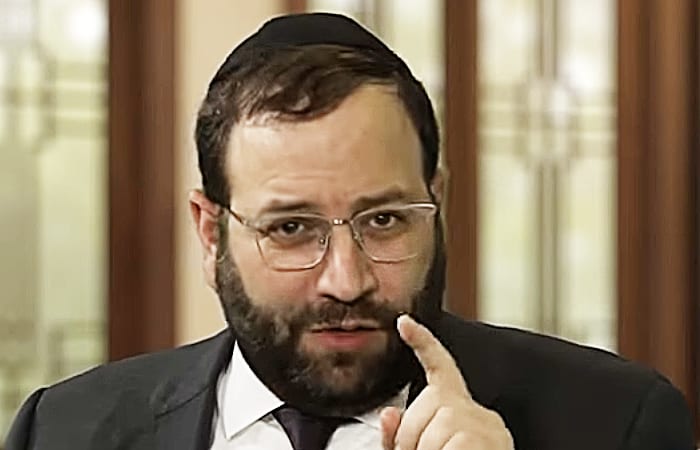
Besser, above, suggested that printing a photo of someone like Haley would eventually lead to a situation in which Mishpacha would be indistinguishable from a secular magazine.
Then in five years from now, the right store in Borough Park
comes in and says, ‘I need you to advertise a woman’s fur coat, but it
needs to show the woman’s face because otherwise you won’t see the slope
of her shoulders so you won’t appreciate it.’
And then five years after that we look like Vogue. Really? Is
that where we want to go?. And who’s going to take responsibility for
that?
The podcast host – Rabbi Efrem Goldberg of the Young Israel of Boca
Raton, a Modern Orthodox synagogue in South Florida – pushed back
against Besser’s argument.
I don’t think the slope needs to be that slippery.
Later Besser said that he had gone on the podcast to speak for
himself, not the magazine, and said the point he was trying to make was
that those who are trying to change the magazine’s policy should change
their tactics.
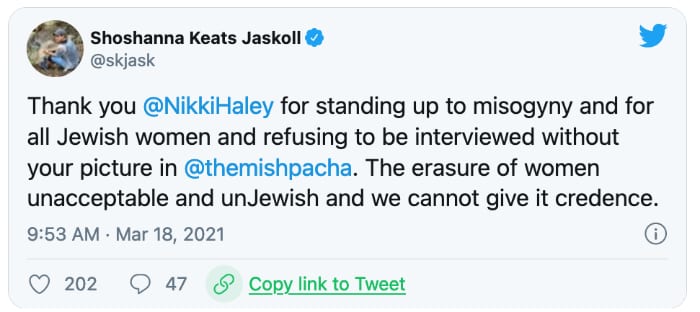
The rage tweets are counterproductive.
Here’s one.
Shoshanna Keats-Jaskoll, is co-founder of Chochmat Nashim, an Israeli advocacy group
In 2016, when Hillary Clinton was the Democratic presidential candidate, Mishpacha
featured an image of her and Donald Trump on its cover for the week of
the election. The image was heavily doctored so it did not resemble a
regular photograph.
True Charedi newspapers would never publish pictures
of women at all, even those who have reached high ranking office. These
are the directives by which we live our lives and the precautions that
surround us and they do not change in the realm of politics.
The Hamodia editorial said that the secular world
understands that Charedi publications subscribe to a high standard of
modesty that precludes the inclusion of photographs of women and that
they realize that a lack of photo coverage does not indicate a lack of
support for a particular individual but is part of the way that God
fearing Jews conduct their lives.
The publisher of Mishpacha, Eli Paley, has attributed the
decision not to publish pictures of women to what has become an
industry-wide standard that would make it impossible to cater to haredi
readers without adhering to the no-women policy.
Forward added:
The standard is seen as an outgrowth of a culture in which the
modesty of women’s dress has become increasingly scrutinized, even if
Jewish laws dealing with modesty do not extend to forbidding the
printing of women’s photos.
But women have pushed back against that standard for years,
organizing in Facebook groups and attempting to orchestrate
letter-writing campaigns to haredi publications, including Mishpacha, to
demonstrate that there is a substantial readership for a haredi
publication that would publish photos of women’s faces.
“Personally, I don't believe the Holocaust should be compared with
any other event. It was a unique occurrence in human history with a
methodical and industrial scale extermination of a nation in gas
chambers. An unprecedented event.”
“At this stage I am occupied with practical ways to help," Bennett
said. "Israelis should be proud of what we are doing for the civilians
in Ukraine. From the first moments we sent planes over with tons of
medical equipment and medicine. We are helping in many aspects
including in mediation efforts.”
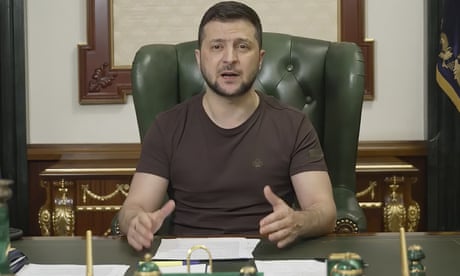
President
says Vladimir Putin intends to ‘destroy our people’ and that Israel
will have to live with its choice not to take sides
German guards and Ukrainian militia shooting a Jewish family in Miropol, Ukraine, in 1941.
Volodymyr
Zelenskiy drew links between Vladimir Putin’s “final solution” for
Ukraine and the Nazi extermination of the Jews as he challenged Israel
over its failure to impose sanctions on Russia in an uncompromising
address to the Knesset.
Speaking via video
link, Ukraine’s president warned that indifference cost lives and that
there could be no mediating between good and evil, as he challenged
Israel over both the lack of sanctions and the failure to come to
Ukraine’s aid with weapons.
Warning
Israelis that they would have to live with their choices, Zelenskiy,
who is Jewish, said Russia’s president was waging an “all-out war,
illegitimate, intended to destroy our people, our country, our cities,
our culture and our children. Everything that makes Ukrainians
Ukrainian”.
“The Russians use the terminology
of the Nazi party, want to destroy everything,” he said. “The Nazis
called this ‘the final solution’ to the Jewish question. And now … in
Moscow … they’re using those words, ‘the final solution’. But now it’s
directed against us and the Ukrainian question.”
Israel
has condemned the invasion of Ukraine, but has not followed the west in
imposing sanctions on Moscow. Under Israeli law, it can only do so to a
state formally designated as an enemy. Israel also has an understanding
with the Kremlin that allows Israeli forces to strike at Iranian arms
shipments to Hezbollah in Lebanon or other Iranian-backed militia in
Syria, where Russia has held up Bashar al-Assad’s regime.
Israel’s
prime minister Naftali Bennett has instead sought to position his
government as a mediator in the ongoing but so far fruitless peace
negotiations.
Zelenskiy went on: “Everybody
knows that your missile defence systems are the best and that you can
definitely help our people, save the lives of Ukrainians, of Ukrainian
Jews.
“We can ask why we can’t receive weapons
from you, why Israel has not imposed powerful sanctions on Russia or is
not putting pressure on Russian business. Either way, the choice is
yours to make, brothers and sisters, and you must then live with your
answer, the people of Israel.
“We are turning
to you and asking whether it is better to provide help or mediation
without choosing a side. I will let you decide the answer to the
question, but I do want to point out that indifference kills.”
While
there are significant doubts in the west about the peace talks,
Turkey’s foreign minister, Mevlüt Çavuşoğlu, claimed that agreement on
the terms of a deal was “close”. The Turkish government has also sought
to act as a “mediator and facilitator”. Çavuşoğlu said there was
“momentum” behind the negotiations.
Kyiv was
said to be open to changing its constitution to abandon aspirations to
join Nato, but wants Turkey, Germany and the five permanent members of
the UN security council to act as guarantors of any deal.
Çavuşoğlu,
who visited Russia and Ukraine this week to meet his counterparts,
said: “Of course, it is not an easy thing to come to terms with while
the war is going on, while civilians are killed, but we would like to
say that momentum is still gained … We see that the parties are close to
an agreement.”
The
UN’s human rights office said on Sunday that at least 902 civilians had
been killed and 1,459 injured as of midnight on 19 March, with the real
toll likely to be much higher.
Most of the
casualties were from explosive weapons such as heavy artillery shells
and multiple-launch rocket systems, and missile and air strikes, the
OHCHR said. It has not been able to receive or verify casualty reports
from several badly hit cities including Mariupol.
Ukraine’s government claims that 112 children are among the dead.
UNHCR,
the UN Refugee Agency, said 10 million people – about a quarter of
Ukraine’s population – had now fled their homes, with nearly 3.4 million
of the total having gone to neighbouring countries, mostly via the
Polish border.
Speaking on Sunday, the British
chancellor, Rishi Sunak, said it was “encouraging” that the talks were
continuing but that the west needed to keep a “degree of scepticism”.
However,
in an interview with CNN, Zelenskiy said that despite the doubts, he
would continue to try to find a compromise with the Kremlin. He said:
“I’m ready for negotiations. I was ready for the last two years. And
without negotiations we cannot end this war.
“All
the people who think that this dialogue is shallow, and that it is not
going to resolve anything, they just don’t understand that this is very
valuable. If there is just 1% chance for us to stop this war, we need to
take this chance, we need to do that.
“But if these attempts fail, that would mean that this is a third world war.”
An
official in Zelenskiy’s office told the Associated Press that the main
subject discussed between the two sides last week was whether Russian
troops would remain in the self-proclaimed republics in Luhansk and
Donetsk.
Olha Stefanishyna, Ukraine’s deputy
prime minister for European and Euro-Atlantic integration, told Sky News
that redrawing Ukraine‘s borders is “absolutely not” being considered
by Kyiv, a sign of the major obstacles remaining in the way of a deal.
She said: “Ukrainian territory is a territory which has been fixed [since] 1991. That is not an option for discussion.”
In
an interview with the Hürriyet newspaper, İbrahim Kalin, a spokesman
for Turkey’s president, Recep Tayyip Erdoğan, said six points were the
focus of the talks. They are Ukraine‘s neutrality, disarmament and
security guarantees, the so-called “de-Nazification” of the country,
removal of obstacles on the use of the Russian language in Ukraine, the
status of the breakaway Donbas region, and Crimea, which was illegally
annexed by Russia in 2014.
Why America Should Not Deepen Its Military Involvement in Ukraine
In his stirring address
to Congress on Wednesday, President Volodymyr Zelensky of Ukraine asked
the United States for more help as his nation defends itself against a
brutal and unjustified Russian invasion. Invoking the attacks on Pearl
Harbor and the World Trade Center, Mr. Zelensky said simply, “I call on
you to do more.”
Given the stakes, the
United States can and should do more to end the war and help alleviate
human suffering in Ukraine. We were already providing weapons for the
Ukrainians to defend themselves, such as Stinger antiaircraft missiles and Javelin antitank missiles, as well as hitting Russia with huge economic sanctions. And soon after Mr. Zelensky’s speech, President Biden announced
that the United States would send an additional $800 million in
military assistance to Ukraine, as part of the $14 billion of support he
had already approved.
But there is a
limit to how far we should go. Even as our hearts go out to the brave
Ukrainian people, the Biden administration is right to resist callstodeepen
American military involvement in Ukraine, because the consequences of a
direct confrontation between NATO and Russia could be unimaginably
dire. If Mr. Biden bows to public pressure and, for instance, attempts
to create a no-fly zone in Ukraine, we could be stepping on the path to
nuclear war. As the U.N. secretary general, António Guterres, said this week, “The prospect of nuclear conflict, once unthinkable, is now back within the realm of possibility.”
A
product of the Cold War, Mr. Biden well understands that direct
U.S.-Russian conflict could escalate to nuclear war. The Soviet Union
may have disappeared 30 years ago, but its nuclear weapons did not — and
neither did ours. If they are used, the consequences would be horrific —
instant death for people in the immediate blast area followed by
environmental destruction, possible famine and more death as the
radiation spread. It could mean the end of civilization as we know it.
The Biden administration is keenly aware of the risks. Mr. Biden said
March 11: “We will not fight a war against Russia in Ukraine. Direct
conflict between NATO and Russia is World War III, something we must
strive to prevent.” The administration has rightly ruled out sending
U.S. troops to Ukraine for now, sending them instead to NATO states,
which the administration has vowed to defend. And Mr. Biden has wisely
refused to consider anything that might provoke direct conflict with
Russia, not only rejecting a no-fly-zone but also resisting a Polish offer to provide Soviet-era MiG fighter jets to Ukraine.
But
as the humanitarian toll in Ukraine increases, so, too, will the
pressure to do more. For many here in the United States, it will be
deeply frustrating that the threat of nuclear war limits what we do.
President Vladimir Putin of Russia warned
that “anyone who tries to interfere with us” will suffer “consequences
you have never faced in your history.” He is, in effect, using his
nuclear arsenal as a terrorist weapon to hold Ukraine hostage and keep
other nations out. Is he bluffing? Maybe. But given the potential
consequences, we can’t afford to be wrong.
What
can we do? First, we must stay the course and end this brutal war. The
sanctions that have already been imposed on Russia and the weapons that
the Pentagon is sending to Ukraine are meant to raise the cost of the
conflict to Mr. Putin, so that he will eventually see the wisdom of a
political settlement.
Both of those efforts must go on, while the White House continues to
avoid direct conflict between NATO and Russian troops. The longer the
war lasts, the more painful it will become for both sides. As difficult
as it may be to watch as Ukraine suffers, escalating the war could make
it much worse.
Next, we must change
our attitude toward nuclear weapons, understanding that the old ways of
thinking are not only outdated but also dangerous. The U.S. nuclear
arsenal does nothing for us in this conflict. It did not keep Mr. Putin
out of Ukraine. Because Mr. Putin is willing to use the threat of
nuclear war to deter intervention in Ukraine, the existence of nuclear
weapons, if anything, helped enable him. Mr. Putin is the only one
suggesting a willingness to use nukes as a cover to brutalize weaker
states. We must continue to stigmatize and limit nuclear weapons to
reduce the chances that Russia will do this again.
The
Biden administration can help by changing its nuclear policies
accordingly. Mr. Putin is threatening to use nuclear weapons first in
this conflict. The Biden administration should rule out “first use,”
thereby declaring it will not start a nuclear war, and seek to build an
international consensus around the idea that the sole purpose for nuclear weapons is to deter their use by others. Mr. Biden has supported
this position for years. In addition, the United States should start
now to build international support for the deep reduction and eventual
elimination of nuclear weapons so they cannot be used by strongmen and
autocrats to enable their atrocities.
We
should all want to end this senseless war, protect Ukraine and avoid
nuclear catastrophe. The hard part is striking the right balance. To
reduce Russia’s leverage in the future, we must face the fact that
nuclear weapons are more useful to Mr. Putin than they are to the West.
The bomb is a weapon of terror, pure and simple, and we must do all we
can to keep it in check.
Ukraine’s ambassador to Israel is not happy. Ambassador Korniychuk
has demanded that Israel cut off all business dealings with Russia.
Meanwhile Ukraine’s business dealings with Iran rose over 30% and
reached nearly $2 billion. Iranian exports to Ukraine increased by 40%.
That means Iran is literally financing Islamic terrorism against Israel. And genocide.
Is Ukraine ready to stop all business dealings with Iran in exchange
for Israel ending its business dealings with Russia? Don’t be silly.
These demands only go one way.
Ukraine's President Zelensky has repeatedly invoked the Holocaust in
the influence campaign against the Russian invasion of his country.
“What is the point of saying ‘never again’ for 80 years, if the world
stays silent when a bomb drops on the same site of Babyn Yar?” he
tweeted.
A better question might be why is a country whose people were
responsible for much of the killing of Jews at Babi Yar is shamelessly
appropriating the Holocaust for its propaganda.
Especially since Ukraine, like Russia, continues to finance the modern genocide of Jews.
During the Holocaust, Ukrainian nationalists participated in large
numbers in the massacres of Jews. Including at Babi Yar. Rather than
feel any sense of shame for this, Bandera and his thugs, who were
responsible for the murder of tens of thousands of Jews, are national
heroes and continue to be celebrated in Ukraine. Including by Zelensky.
"Stepan Bandera is a hero for a certain part of Ukrainians, and this
is a normal and cool thing. He was one of those who defended the
freedom of Ukraine," Zelensky argued a few years ago.
You can wrap your cause in the Holocaust or celebrate Bandera, but you can’t do both.
“Addressing all the Jews of the world: Don’t you see why this is
happening? That is why it is very important that millions of Jews around
the world do not remain silent right now," Zelensky recently demanded
in a speech that was helpfully translated into Hebrew by his office.
What is happening in Ukraine is wrong, but it is not genocide.
Unlike Nazi Germany and its Ukranian nationalist allies, the Russians
are not marching tens of thousands of Ukrainian men, women, and
children, stripping them, shooting them, and throwing them into pits.
Nor, like Ukraine’s Iranian trading partners, is Russia plotting to drop
nuclear bombs on its cities.
Considering the centuries of actual massacres of Jews by Ukrainian
national heroes like Bogdan Chmelnitsky, Simon Petlura, and Stepan
Bandera, (who have streets and medals named after them) the willingness
of Israel to quickly rush aid and provide political support to Ukraine
ought to be appreciated. Especially since it’s another wholly one-sided
relationship.
Israel voted in support of Ukraine at the UN despite the fact that
Ukraine has repeatedly voted against the Jewish State and in support of
the terrorists trying to kill Jews.
'President Zelensky does feel a "special emotion for Israel because
his mother is Jewish," but that feeling has to be reciprocal,"
Ambassador Korniychuk was quoted as saying.
Reciprocal? What exactly have Zelensky and Ukraine done for Israel?
Last year, a Ukrainian emissary suggested that if Israel were to
provide his country with its defense demands, then it might agree to
recognize Jerusalem as Israel’s capital.
That’s about it.
President Zelensky and Ambassador Korniychuk complain that Israel
hasn’t been vocal enough in its opposition to Russia. When Israel was at
war, how vocal was Zelensky?
When Israel was last under attack, Zelensky tweeted, "The sky of
#Israel is strewn with missiles. Some cities are on fire. There are
victims. Many wounded. Many human tragedies. It is impossible to look at
all this without grief and sorrow. It is necessary to stop the
escalation immediately for the sake of people's lives." Passive voice.
No specific condemnation.
Instead of showing appreciation for the fact that Israel has gone
out on a limb to support a country that is not an ally, but has
repeatedly opposed Israel at the UN, and has extensive trade ties to
Iran, Korniychuk has escalated his demands and tirades against the
Jewish State.
Ambassador Korniychuk has repeatedly berated Israel and Israelis for
not doing enough. The latest acts of chutzpah include Korniychuk
pushing the Israeli High Court to overrule a decision by the Israeli
government on accepting Ukrainian migrants without any quotas, and
demanding that the Israeli Knesset convene specifically to listen to a
Zelensky speech.
President Zelensky is entitled to make the best possible case for
his country. Ukraine is suffering from an invasion that threatens its
national existence and it’s understandable that its government is
frantically trying to push every possible button to avert that
catastrophe.
War propaganda is an exchange of lies. And we have witnessed Putin
and Ukraine hurl accusations of Nazism at each other when in reality
both sides collaborated with the Nazis. Both sides likewise insist that
the other is part of a vast conspiracy and their defeat will lead to
WWIII.
The cold hard reality is that both sides are spewing as many crazy lies as they can to win a war.
Two ex-Soviet countries with little going for them except energy
resources are using their broken ex-Soviet militaries to fight over who
gets the profits from those energy resources.
It’s entirely reasonable to sympathize with the Ukrainians who have been invaded.
The Biden administration has chosen to express that sympathy by
making it clear that we will not intervene militarily, but will pile on
economic sanctions. That’s a move likely to inflict maximum economic
pain on Americans with a minimal military impact on Russia. That’s
convenient for Biden who can blame Putin for the disastrous economic
situation in America without having to risk American casualties and the
domestic political fallout from a war.
Israel’s best bet however is to just stay out of a mess that really does not involve it.
Zelensky happens to be of Jewish descent. A number of close allies
of Putin also happen to be Jewish. That’s every bit as significant as
the fact that both Trump and Clinton’s children have Jewish spouses. Or
that China's only non-Chinese general was General ‘Two Gun’ Cohen.
It’s possible to admire Zelensky’s doggedness in the face of a
massive invasion without bowing to him as a moral authority. He’s a very
effective advocate for his country. And, like many people of Jewish
descent who participate in antisemitic movements, he’s managed to
reconcile the conflict by putting Ukraine first and mobilizing his
Jewish ancestry in its defense.
Much as Jewish leftists do with Muslim terrorism, or Jewish
sympathizers who join far-right movements, Zelensky has puts his
‘Jewishness’ at the service of antisemites. And, unlike his willingness
to embrace personal risk during the conflict, there’s little admirable
about that.
Ukraine has no historical claim on Israel’s sympathy. And only
liberal Jews with no sense of history who know their great-grandparents
came from Ukraine, but don’t know why they got the hell out would think
otherwise. And there’s certainly no reciprocal alliance worth
mentioning.
Putin’s Russia and Ukraine are both close trading partners of Iran.
In addition, Russia supplies weapons and support for Iran. Both
repeatedly vote against Israel at the UN. Both have an ugly history when
it comes to Jews. They’re not allies or friends, they are at best
friends of enemies.
Prime Minister Bennett’s foolish attempts at acting as if he can
mediate between Russia and Ukraine have done nothing to help either end
the conflict or improve Israel’s image.
When Ukranians were surveyed at the end of last year,
71% said that they did not support either side in the conflict between
Israel and Iran. And there’s nothing surprising about that. Different
countries with no shared borders, values, or interests don’t have to
support each other.
The same is true for Israel in the conflict between Russia and Ukraine.
BEATS POLIO AND COVID IN A DAAS TORAH MINUTE - NEVER HAVE NECK PAIN AGAIN
Expert warns polio’s return could shatter Israel’s public health image, hurt tourism
There’s still only one clinical case and two
other positive tests, but Prof. Nadav Davidovitch says situation is
serious as virus can dodge elimination by spreading at small scale
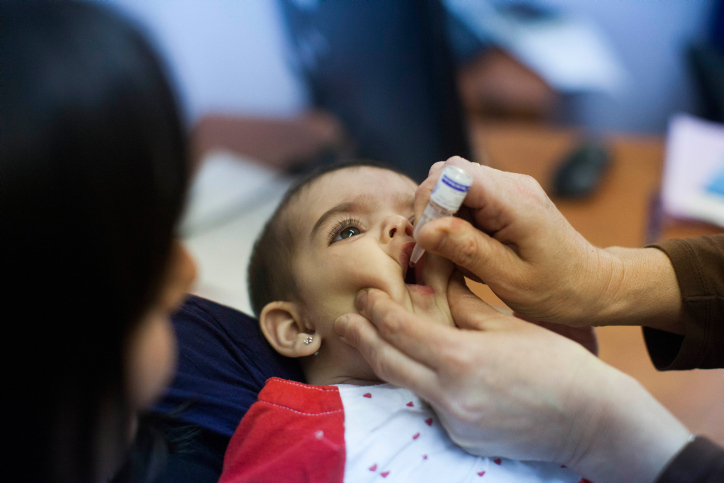
A child is given an oral vaccine for polio in Neve Yaakov, Jerusalem
The reemergence of polio could cause paralysis among dozens of
Israeli children, shatter the country’s global reputation as a leading
light in public health and discourage tourism, a top epidemiologist has
warned.
In a country used to tracking coronavirus figures, the numbers seem
tiny, but doctors are warning the situation was far more serious than
appears.
The international health community is on a mission to eradicate polio
and has reduced cases by 99 percent since launching a global initiative
in the late 1980s. With the recent discoveries, Israel is now one of
just 23 countries to report cases in the last year.
“Polio now survives only among the world’s poorest and most
marginalized communities, where it stalks the most vulnerable children,”
according to information published several years ago by the World Health Organization, which leads the initiative.
Israel, widely revered in health circles for its trailblazing
vaccination campaign against COVID-19, is now a conspicuous entry on the
WHO’s map of polio cases, which comprises far poorer countries.
Fellow entrants with a single case over the last 12 months are
Malawi, Yemen, Liberia, Burkina Faso, and Guinea. If Israel confirms
another clinical case it will rank with Somalia, Ukraine, Mozambique,
Pakistan and South Sudan.
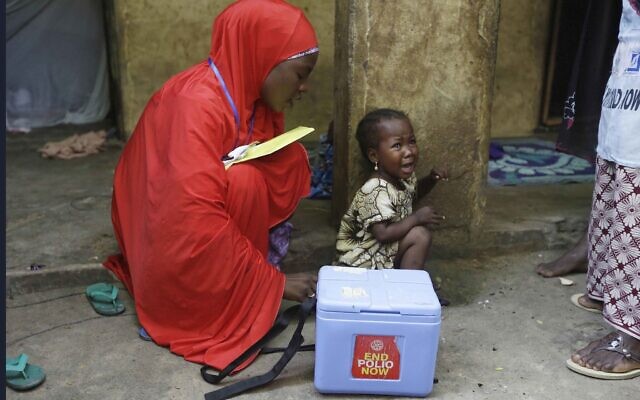
A polio vaccination site in Maiduguri, Nigeria
Epidemiologist Prof. Nadav Davidovitch, a senior official in Israel’s
doctor’s union, warned Israel’s addition to the list carries a real
stigma.
“People don’t appreciate that being marked as a country with polio is
serious, and is a category we really don’t want to be in,” he told The
Times of Israel.
“This is a disease that is marked for eradication, and the fact it
seems to now be spreading in Israel could very much harm our reputation
for advanced health, and could impact incoming travel. People could
become cautious about visiting, especially the immunocompromised.”
He also said Israel could potentially “impede the global and regional progress of eradication.”
Each country that has polio cases, even if just a few, is seen as
keeping alive a virus that should be eliminated. Only Nigeria, where the
militant Boko Haram has hampered vaccination efforts, had triple
figures of cases over the last year to 412 in total.
Aside from Nigeria, polio is dodging elimination in poor countries
with relatively small case numbers. The world’s most polio-affected
countries include Cameroon, Guinea-Bissau and Benin, each with three
cases over the last year. Yemen and Madagascar had 13, Niger had 14 and
Senegal had 15. Afghanistan had 19, the Democratic Republic of Congo had
23 and Tajikistan had 27.
Davidovitch said that Israel isn’t heading for numbers like Nigeria,
but could well see numerous cases unless polio is dealt with swiftly.
While Israel has high child vaccination rates, and polio protection
among children is well above 90 percent, families that don’t vaccinate
often live in the same areas, attend the same schools and share social
circles, increasing the chances of spread.
Davidovitch and other experts note that a mistrust of polio vaccines
in parts of the ultra-Orthodox community have led to lower-than-normal
vaccination rates in some communities, especially in the Jerusalem area.
Davidovitch said the only effective way to address the problem is by
promoting vaccination with oral drops, which contain a weakened form of
the live virus. They give protection to those who aren’t yet vaccinated.
Those who are vaccinated by the injection, which contains a killed
vaccine, are protected against illness, but not necessarily against
transmission. Drops almost eliminate their ability to transmit the
virus.
“Israel has the tools to take care of this, but needs to act
quickly,” said Davidovitch. “Unlike with COVID, vaccination needs to
happen quickly to prove effective and to prevent cases from rising.
Israel invested lots of energy into building an excellent
epidemiological and clinical surveillance system for polio and we must
invest in it, and act on the information it’s giving us.”
What has become the norm is that after every atrocity, someone
will piously intone “never again,” and then someone else will piously
intone “never again” after the next atrocity. But what about right now?
Russia’s
invasion of Ukraine, unprovoked except by paranoia, has been
devastating and deadly for Ukrainians and Russians but has also exposed
the moral weakness of the West.
Ukraine has been overrun by clichés –
Western expressions of sympathy, empathy, compassion, commiseration,
concern, condolences, solidarity, respect, admiration, and warmth.
Ukrainians have been the focus of an infinite number of prayers and the
beneficiaries of the newest Western sign of support – hashtags.
In
place of weapons they have received words, and even with weapons now
pouring in to Ukraine, it seems evident that this is being done to
assuage Western consciences more than to change the strategic equation
or enable Ukraine to survive.
With the West having from the
beginning ruled out the use of force, and currently even rejecting
repeated pleas for the creation of a no-fly zone, the carnage in Ukraine
continues unabated. Its ultimate conclusion rests in the hands of one
unpredictable Russian man who can either look for a settlement that
preserves some of his interests or carry on with an invasion that will
result in the deaths of tens of thousands and the destruction of a
country.
If Russia prevails, it is hard to conceive of a more
Pyrrhic victory. If Putin assumed that Ukraine did not constitute a
legitimate nation, Ukraine’s spirited defense of its territory and
people proves otherwise and will make for one very unpleasant
occupation.
It is hard to say that war could have been avoided. I
was in the camp of those who believed that Putin would not invade but
would succeed in gaining most of his strategic objectives without the
need for an invasion. After all, prior territorial seizures in Ukraine
were tacitly accepted by the West with strong words but little else. The
immediate response to the invasion – sanctions (which for decades now
have not deterred Cuba, North Korea or Iran from seeking their strategic
aims) – was extremely unlikely to deter Russia which, after all,
withstood the 872 day Nazi siege of Leningrad that claimed one million
Russian lives.
Projecting Western notions of morality or politics
onto Putin – he’s down in the polls, he’s losing popularity, he doesn’t
care about the material welfare of his people – was always fanciful, and
irrelevant in any dictatorship whose survival depends not on popularity
but on raw power
Ukraine,
even under Zelensky, has not once voted in support of Israel at the UN.
There is also a sizable Jewish community in Russia that is protected
but still vulnerable Putin
was certainly emboldened by the fecklessness of Western leadership – a
feeble American president, a Europe dependent on Russian energy, and a
materialistic, flaccid West tired of war and even tired of paying for
defense. When you continually announce ahead of time what you will not do, what troops or weapons you will not send,
and even wink at acquiescing to a “minor incursion,” you have
essentially invited aggression. Then again, this war was unnecessary,
the product of Putin’s paranoia that somehow, for some inexplicable
reason, NATO wishes to invade Russia and Putin’s job is to prevent that.
But
why would NATO – which has never invaded anything – want to invade
Russia? It is a concise application of the Talmudic principle (Kiddushin
70a) that “He who disqualifies others…does so with his own flaws.” A
revanchist aggressor sees everyone around him as a revanchist aggressor
as well.
And what Putin also failed to anticipate was the resolute
courage of President Zelenskyy, a stark contrast in vigor and values to
most Western leaders for whom courage usually consists of a snarky
tweet against a universally accepted and convenient target. Zelenskyy’s
fearlessness is extraordinary in modern times, especially given the
stakes and his options.
But what of the West – and what
of Israel and the Jewish people? Focusing on the humanitarian crisis is
an appropriate response but it is post facto and serves to
deflect from the main problem. To be sure, it is complicated. It was
Lord Palmerston, the 19th century British Prime Minister, who declared
with great perspicacity that nations "have no permanent alliances, only
permanent interests.." And each country responds according to those
interests. That the West (not to mention Russia) guaranteed Ukraine’s
territorial integrity in the Budapest Agreement when Ukraine
relinquished its nuclear arsenal in 1994 is as relevant as was
Eisenhower’s 1957 guarantee to maintain Israel’s freedom of passage
through the Straits of Tiran (a guarantee forgotten a decade later and
provoked the Six Day War).
The Western focus on saving refugees –
while pursuing policies that do nothing to inhibit the creation of more
refugees – is benevolent but hollow. Standing by while civilians are
being massacred, and sufficing with unleashing a torrent of verbal
condemnations, makes the bystanders feel better about themselves but
does little to help the victims. The purveyors of platitudes are talking
to themselves far more than they are talking to the aggressor. Raising
funds for refugees is noble but preventing the creation of more refugees
is even nobler.
Israel’s role is certainly, and mindbogglingly,
complex. On the one hand, the moral outrage cries out for action, not
just words. On the other hand, Israel has pursued good relations with
Russia for over a decade now, as a counterforce to US vacillations and
the encroachment of Iran. It is not an alliance but the occasional
convergence of interests. In 2016, Russia allegedly quashed an
Obama-proposed UN Security Council resolution endorsing the creation of a
Palestinian state.
Ukraine, even under Zelensky, has not once voted
in support of Israel at the UN. There is also a sizable Jewish
community in Russia that is protected but still vulnerable. To condemn
Russia outright jeopardizes Israel’s interests. To ignore wanton attacks
on civilians jeopardizes Israel’s moral posture. It is realpolitik at its most agonizing.
And
yet. Doing the right thing always entails some risk; otherwise it would
be simple and unremarkable. In six weeks, when Jews commemorate Yom
Hashoah (Holocaust Remembrance Day) one of the persistent themes we
enunciate is how the world stood by and did nothing, how they heard the
cries of the victims and were silent. Well, yes, that is so because the
world usually stands by and does nothing. The “world” is amoral; it is
the responsibility of the human beings who inhabit that world to infuse
it with morality. When those human beings make their calculations, and
struggle over the complexities, and weigh their interests and their
values on opposite sides of the scale when confronted with unfolding
atrocities, we easily discern how evil can proliferate. During the
Holocaust, each nation – and each individual – also wrestled with
competing interests and values and the results were painfully evident.
There
are three possible responses to evil: public protests against the
crimes, apathy in the face of human suffering or even hostility to the
victims. But when all three responses eventuate in passivity and
inaction, the protests are not much more than virtue-signaling, and are
not much more edifying than the latter two reactions. We don’t have much
to complain about if our reactions are similar to the reactions of
others. And it should make us even more awestruck by the actions of the
Righteous Gentiles who risked their lives to shelter Jews. That has
never been the norm of human behavior.
What has become
the norm is that after every atrocity, someone will piously intone
“never again,” and then someone else will piously intone “never again”
after the next atrocity, and so on. It is certainly better than
indifference. How much better? That is a question each person has to
answer. It would seem that a no-fly zone is the least the West should do
at this point. There is a slight risk of a nuclear exchange (Putin, I hope, is not suicidal), but the alternative is to give nuclear powers carte blanche
to indulge in mischief around the world. This is a notion that Russia
is testing, and which Iran is watching carefully. Israel should take
note as well.
Vladimir Putin Has Already Won, but Nobody Wants to Admit It
Russia is too big to fail.
I get it now.
Nothing
made sense until today, when Germany announced that it plans to keep
buying oil and natural gas from Russia, even as Vladimir Putin continues
committing every war crime on the books. China also recently came out
in support of Russia, refusing to condemn the invasion of Ukraine and
calling them a chief “strategic partner.”
Now, everything makes sense.
The
German Chancellor’s remarks remind me of 2008, back when Americans were
asked to bail out the very banks and predatory lenders that crashed the
economy. Those CEOs used our money to reward themselves with huge
bonuses and buy back stocks, even while they hiked up prices and laid
off workers. None of them saw a single day of justice. They went right
back to doing all the same things that are about to collapse the economy
again. We asked why. We were told these banks were simply “too big to
fail.” In other words, we relied on our enemy.
It’s a bad situation to be in.
And yet, here we are.
Putin knows exactly what he’s doing.
You
might call me disingenuous, a pessimist. Well, I think it’s
disingenuous to keep paying lip service to human rights and democracy,
when the unspoken truth is that much of the so-called “free world” has
painted itself into a deadly corner, where it’s largely unable to act to
save lives. We can’t do much of anything about Ukraine and all the future Ukraines
until we stop pretending we pose a threat to Russia, economically or
otherwise, and start acknowledging how badly we’ve f@#&* up.
Hence my writing…
There’s
been a steady stream of very confident opinion pieces this month
talking about the “big mistake” Putin made invading Ukraine. They speak
in a tone that sounds cavalier, even arrogant. These are the same
columnists who keep predicting the end of the pandemic.
They say Putin overplayed his hand.
They
say Putin underestimated NATO, that he underestimated western
resilience and resolve. They say he’s unhinged, that he’s spent too much
time alone in isolation from the world.
Maybe we’re wrong.
Maybe we’re the ones who don’t understand Putin’s plan, because we’re not looking at the bigger picture.
Maybe we don’t get it.
Putin is taking extreme, calculated risks.
Time
and again, westerners and Americans in particular fail to understand
the minds of men like Putin. A lot of Americans are lazy,
arrogant, entitled, and selfish — but they’re not psychopaths.
Psychopaths aren’t unhinged…
They
have a logic that works on levels most of us can’t grasp. Consider for a
minute that shelling the Zaporizhzhia nuclear power plant in Enerhodar
was entirely intentional, and not just random, thoughtless violence. If
anything, it dramatically underscored the message that Putin’s been
sending the entire world. He’ll unleash absolute devastation on anyone
who gets in his way. He’ll burn down the entire continent. Looking and
acting like you don’t give a f#$% puts you in a pretty powerful
position.
In short, it was a mind game.
It was an act of terror.
The
same strategy applies to the peace talks and humanitarian aid. They
keep dangling peace and evacuation routes, then bombing civilians as
they try to flee. One route was even peppered with land mines.
This feels intentional.
It all feels like a very cruel form of psychological warfare, designed to inflict the maximum amount of suffering.
As
for the arguments that the Russian military hasn’t taken over Ukraine
“fast enough” and that it’s a sign of Putin’s clumsy strategy, consider
America’s track record. The initial American invasion of Iraq in 2003
lasted more than a month. We spent another 17 years there as an
occupying force, and accomplished almost nothing.
America
spends trillions of dollars on its military, and we can’t do much
except blow s*** up, either. If you ask me, we’re not exactly qualified
to judge another world leader’s military prowess.
Are we?
Putin has divided us all.
Republicans are doing some interesting things lately.
On
the one hand, some of them are publicly shouting for Putin’s
assassination. Some of them are demanding we “do more” to help Ukraine,
while simultaneously whining about gas prices. Some of them are blaming
Putin’s invasion on woke pronouns.
It doesn’t make sense…
It looks dumb.
Nothing
Republicans have said or done make any sense at all until you slide in
the missing puzzle peace. These idiots are still on Putin’s payroll,
and they’re intentionally sowing division.
Stay with me for a minute.
Imagine
you’re a Republican with ties to Russian money. If nothing else, you’re
still obligated to help the enemy, because they can still expose you, along with whatever blackmail they have. Putin’s not going to get in trouble for buying American politicians.
They are.
So
if you want to help Russia while looking like an American patriot, then
you have to make a spectacle of yourself. You have to make a ton of
noise, while offering no actionable plan whatsoever. You get bonus
points if you can distract everyone from Putin, and make the
conversation about something else, like gas prices or pronouns.
See, it makes sense now.
Putin doesn’t need to conquer Europe.
The past week, I’ve mulled over Putin’s end game. It didn’t make sense until I put on my psychopath hat for a minute.
We’ve been debating whether or not Putin would invade other countries next. That doesn’t make sense.
Here’s what does:
Putin doesn’t have to invade other countries. He doesn’t even really need to capture Ukraine’s government.
He just needs to make an example out of them.
This
war already feels like it’s been going for years. In fact, it hasn’t
even been two weeks yet. Putin knows this. He knows the world is
strained and exhausted from the pandemic. He actually helped exacerbate and prolong it by facilitating the spread of anti-vaxxer propaganda.
Putin also knows the world is running short on vital supplies, largely because we’re depleting our resources.
Russia is a top exporter of:
Oil
Steel
Cereals
Grains
Wood
Fertilizer
Aluminum
Unfortunately,
this is the kind of stuff the world can’t do without. Compare that to
the top U.S. exports, like beverages, planes, and cars. You can’t make
beverages without aluminum, bro. You can’t make plastic bottles without
oil. You can’t drive cars or fly planes without it, either.
Western countries have thumped their chest about sanctions. Pundits have said Putin overplayed his hand. You know what?
I think we did.
The
world is slowly sobering up to the brutal fact that we rely on Russia
for a lot of our raw resources. We had a solid ten years to double down
on renewable energy sources. Turns out, that wasn’t just a good thing
for the planet. It was a necessary strategic move, too.
We waited too long.
Welcome to the climate wars.
Russia
is engaging in a different kind of war now.
The societies that control the natural resources will enjoy
the most power. The ones that rely on imports will lose their power. Without a sustainable energy plan, the biggest loser is the future.
Putin has won so far, at the expense of all life.
He
understands the new world economy far better than westerners think. He
understands that even if his own citizens suffer, his country controls
the raw, natural resources we need.
His ally, China, controls the rest.
Remember
that China still considers Russia its chief ally, despite its atrocious
and extremely visible violations of human rights. If that doesn’t send
chills down your spine, I don’t know what will. Between Russia and
China, American hubris is sadly outmatched.We’re trying to relive our
WWII glory days.
Companies
like Apple can brag about suspending the sale of their smartphones. It
won’t be long before they come crawling back for those rare earth
elements they need to make them.
The
harsh truth is that Russia is too big to fail. We made it that way. If
we want to win, eventually, then we have to make the actual sacrifices
we keep claiming we’re ready for. We have to make Putin irrelevant. That
means a drastic change in our values, and our economy.
"It ain't over till (oruntil) the fat lady sings" is a colloquialism which is often used as a proverb.
It means that one should not presume to know the outcome of an event
which is still in progress. More specifically, the phrase is used when a
situation is (or appears to be) nearing its conclusion. It cautions
against assuming that the current state of an event is irreversible and
clearly determines how or when the event will end.
Lockdowns spread in China as Covid surges in Shanghai and over a dozen provinces.
BEIJING
— Cinemas, theaters and museums have closed in downtown Shanghai, and
tickets have been refunded. The vast city’s school system announced late
Friday that it would switch to online learning. And across China, more
than 100 neighborhoods have been labeled medium-risk or high-risk Covid
zones, with frequent mandatory testing and partial or complete
lockdowns.
After two years of posting
one of the world’s most successful track records in managing the
coronavirus, China suddenly faces a wave of cases. The country’s
National Health Commission said Friday that 1,100 new cases had been
detected nationwide the day before.
Three-fifths
of the cases this week are in people with no symptoms, a pattern that
Chinese officials attribute to the country’s high vaccination rate, and
to extensive testing that is uncovering infections in people who appear
healthy. But health officials caution that the high proportion of
asymptomatic infections is no cause for complacency.
“From
a clinical point of view, no matter whether it is a clinically
confirmed case or a clinically asymptomatic infection, they are all
virus-positive infected people, and they are all contagious,” said Wu
Jinglei, the director of the Shanghai Health Commission.
Most
of China’s new cases have been in cities that attribute their outbreaks
to the Omicron variant. Tiny pockets of the Delta variant are still
occurring along China’s borders.
Each
day, the National Health Commission announces the number of new cases
from the day before, and it shows a steep ascent. Looking just at the
announcements on Fridays, there were 60 cases nationwide three weeks
ago, 104 cases two weeks ago, 117 a week ago and then 1,100 on Friday.
The
cases reported on Friday were in 17 of China’s 31 provinces. The
National Health Commission announced Friday that it would allow the
commercial sale of Covid rapid test kits, which China has avoided until
now in favor of nasal or throat swabs that are processed at
government-approved laboratories. Pharmacies and online stores are now
allowed to sell them.
Several entire
cities in northeastern China have gone into lockdown despite urgings
from national officials to be more selective in choosing how extensively
to restrict people’s movements. The latest city to do so was Changchun,
a large car-manufacturing center, which locked down on Friday.
China
has kept the virus under tight control until now with a national system
of quickly detecting and quarantining anyone with a fever, along with
all of that person’s contacts. Even the contacts of these contacts are
sometimes required to quarantine.
But
finding healthy yet infectious people and quickly tracing their
movements has proved more difficult. “We need to dig out the
asymptomatic people, and it is sometimes more difficult to trace,” Mr.
Wu said.
The number of people who have died because of the COVID-19 pandemic could be close to 18 million — roughly three times higher than official figures.
The difference is down to significant undercounts in official
statistics due to delayed and incomplete reporting and a lack of data in
dozens of countries. The true toll is based on excess mortality, a
comparison of the total reported deaths from all causes in a region or
country with how many deaths would be expected given trends in the past
few years. Such estimates include deaths from indirect causes, such as
people who died because of inadequate medical care in overwhelmed
hospitals.