War Breaks Out in New York’s ultra-Orthodox Community Over Measles Outbreak
Unique aspects of Haredi culture have led to an anti-vaxxer
movement developing in the community. As senior rabbis issue
contradictory rulings, medical experts are using informal gatherings to
try to spread the word about the importance of vaccinations
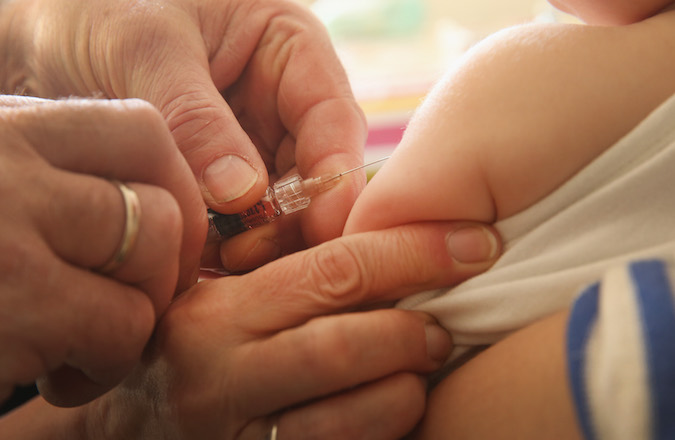
File photo: An ultra-Orthodox child getting a measles shot.Daniel Bar-On
However, it is also
leading to new approaches from medical experts trying to reach those
who, in the face of nearly 130 suspected cases of the highly contagious
disease, remain determined not to vaccinate their children.
There are now 113 confirmed cases of measles in ultra-Orthodox
(or Haredi) communities around New York City and Lakewood, New Jersey,
with another 16 suspected and under investigation by public health
authorities. Two measles-infected babies have been hospitalized in
intensive care units. And while it is mostly infants who have been
infected, some teenagers and a handful of adults have also fallen ill.
Isolated
communities could be at greater risk: in 2014 a measles outbreak hit
Ohio after Amish travelers to the Philippines contracted measles and
returned home to rural Knox County OhioAP
Why has the
anti-vaxxer perspective taken hold in pockets of the Haredi community?
The answer, say longtime observers, has to do with long-held suspicions
of government agencies, including health departments, prizing cultural
isolation, reliance on their own communities for things like emergency
services, and placing their trust in God to protect them.
U.S. public health authorities say the current outbreak started when Haredi families visited Israel last Sukkot
and brought the illness back to their communities. An 18-month-old
infant in Jerusalem’s Haredi Mea She’arim neighborhood has died and
nearly 1,500 potential cases have been reported.
Non-vaccination rates are high in Israeli areas with large Hasidic
populations, including the city of Safed and the town of Kfar Chabad.
Haredi
immunization rates have dipped in recent years as a result of
anti-immunization views taking root in the community. Now, as the number
of infected Haredim grows, some within the religious Jewish community
are initiating new efforts to reach Haredi anti-vaxxers.
Growing backlash
Tensions within the community are running high.
A Crown Heights couple, Sholom and Esther Laine, is suing Yeshiva Oholei Torah
– a Lubavitch boys’ school – for not allowing their unvaccinated son to
start kindergarten. In the suit, Esther Laine says the school is
infringing on her constitutionally protected religious right to claim
exemption from the requirement of most schools, including Oholei Torah,
that all students be immunized. Several attempts to contact the Laines
were unsuccessful.
“The
battle is getting very fierce,” says a Haredi mother, speaking to
Haaretz from her home in Lakewood. “People are getting threats if they
question vaccinations,” says the mother of three, who asked that her
name not be published for fear of being pressured or intimidated by
neighbors.
A measles vaccine is seen at Venice Family Clinic in Los Angeles, California February 5, 2015. Reuters
The ultra-Orthodox
towns Monsey and New Square are part of Rockland County, about an hour
north of New York City. There are currently 75 confirmed cases of
measles and six more suspected.
In New York City,
there are now 24 confirmed measles cases – all in the Hasidic Brooklyn
neighborhoods of Williamsburg and Borough Park – says Dr. Jane Zucker at
the Department of Health. “This outbreak would not have occurred had
the children been vaccinated,” she says.
Although
measles was officially declared eradicated in the United States in
2000, this is not the first outbreak of the disease in the
ultra-Orthodox community. In 2013, there was a significant uptick in
measles in Williamsburg and Borough Park, with 58 cases reported. There
was also another minor outbreak in New York City earlier this year,
which resulted in a miscarriage, pneumonia and hospitalizations, according to The New York Daily News.
Now there is a
growing backlash: Those known to be non-vaccinators are being ostracized
by fellow Haredim, say members of the community. “People frown upon
neighbors who aren’t vaccinating; there is animus toward them,” says
Alexander Rapaport, a Hasidic Jew who lives in Borough Park and is
founder and director of Masbia, a kosher soup kitchen and food pantry.
“You hear there’s someone in that building that doesn’t vaccinate, and
now the whole building is having tsuris with them,” he says, using the
Yiddish word for trouble.
Ultra-vaxxers and anti-vaxxers
Unvaccinated measles
carriers convey a significant risk to others who aren’t immunized –
either because they are too young or have compromised immune systems.
One person sick with measles can spread it to as many as 18 others,
public health authorities warn. Children typically get two doses of the
MMR vaccine: one between 12 and 15 months; and another between 4 and 6
years. A child who has gotten both shots is believed to be 97 percent
protected from the disease, say health experts. Now, health department
authorities are urging vaccinations for children as young as 6 months,
and to hasten the second dose so as many people as possible are fully
protected.
ILLUSTRATION: Orthodox Jewish men listen to a news conference outside City Hall, in New York, Thursday, Aug. 16, 2018. Richard Drew,AP
Rabbis beyond the New
York area are now taking steps to prevent the measles from reaching
their communities. Last week, the heads of the two main Orthodox
rabbinical courts in Chicago issued a letter stating that “nobody has a
right to endanger others by not vaccinating their children.” An
unvaccinated person exposing other people to measles during an outbreak
puts the non-immunized person in the category of someone who actively
poses a threat to life, they wrote, using the term rodef (lethal
pursuer) – which is a serious violation of Torah law.
The rabbis urged all
schools, playgroups and shuls to ban any unvaccinated child, writing,
“This is nothing less than a matter of pikuach nefesh,” referring to the
religious law in which preservation of human life overrides virtually
all other religious considerations.
Furthermore, prominent Israeli Haredi rabbis recently issued a strongly worded decree that those who refuse to vaccinate “are causing bloodshed,”
according to the ultra-Orthodox newspaper Kikar Hashabbat. Rabbi Moshe
Sternbuch, head of Jerusalem’s stringent Edah HaChareidis rabbinical
court, issued an order that every father “must ensure that his son and
daughter are immunized immediately.”
However, other influential Haredi rabbis view the issue differently.
Well-known Jewish
legal expert Rabbi Shmuel Kamenetsky and his wife, Temi, are often cited
for their anti-immunization stance, which was expressed in a 2014 Baltimore Jewish Times article: “Vaccines are a hoax. It is just big business,” Rabbi Kamenetsky was quoted as saying.
The rabbi’s status
means his views carry weight beyond his own immediate circle. He is also
a member of Agudath Israel of America’s Council of Torah Sages, which,
along with the Haredi advocacy organization in general, “will not be
taking a position on vaccinations or the measles outbreak,” says
spokeswoman Leah Zagelbaum.
Another member of the Council of Torah Sages, Lakewood’s Rabbi Malkiel Kotler, endorses the Lakewood Vaccine Coalition,
which was created last March with the aim of advocating on behalf of
those who do not want to immunize their children. The coalition’s
website, in the meantime, has disappeared and its phone number is out of
service. An email elicited no response.
An anonymous group called PEACH (Parents Teaching and Advocating for our Children’s Health) has circulated an anti-immunization booklet
throughout the religious community in the New York area and beyond. In
it, an anonymous author claims that “hundreds of thousands of children’s
lives have been ruined within hours of vaccines.” The idea that measles
is a serious illness is “a fabrication,” it adds.
There is no
identifying information about PEACH in the booklet and, with no online
presence or listed phone numbers, the group is untraceable.
Changing things from the bottom up
This anonymous
spreading of misinformation is frustrating to those who want to see
Haredi children fully protected from communicable diseases.
Blima Marcus is an
oncology nurse and president of the Orthodox Jewish Nurses Association.
The OJNA is now trying to reach out to religious parents in a personal,
informal way and has established an email address for those who want
information.
In just the first few
days, “we’ve been contacted by a few people seeking reassurance or
clarification on specific vaccines,” Marcus tells Haaretz. The OJNA is
planning to hold living-room gatherings soon. These will involve “no
physicians, no agendas, no judgment: just frum [religious] nurses coming
to listen, talk, answer questions and educate,” she says, adding, “We
have 30 nurses from around the states who already volunteered their time
to do this in their communities.”
Dr. Zackary Sholem
Berger, an associate professor of medicine at Johns Hopkins School of
Medicine, has written in Yiddish publications about medical issues in
the Orthodox community. He just held a session at a Borough Park health
clinic with the goal of hearing the concerns of Haredi doctors, nurses
and other medical professionals.
“To see any sector of
my community not vaccinate is horrifying,” says Berger. However, “If
you wag your finger at anti-vaccine people, it doesn’t work.” Persuading
them “has to come from the bottom up,” adds Berger, who has a doctorate
in epidemiology.
Anti-vaccine views
have seemingly become entrenched in some parts of Haredi communities
because of aspects of ultra-Orthodox culture.
There is a general
distrust of government authorities that is likely rooted in the Jewish
legal prohibition against one Jew turning another into the police, say
knowledgeable observers. Hasidic communities were established in Eastern
Europe at a time when government authorities themselves persecuted Jews
– or at the very least, turned a blind eye to those who did. Historical
memory in general is prized in Haredi communities and passed down from
one generation to the next, almost like cherished silver Shabbat
candlesticks.
Dangerous influence
There is also an
insularity in Haredi communities – particularly among women, who
frequently lack access to the internet – that is viewed as a negative
and dangerous influence. As a result, WhatsApp and similar phone-based
chat groups are popular among Haredi women, says the OJNA’s Marcus.
Participants in one
WhatsApp group Marcus belongs to said they don’t trust studies because
they are funded by pharmaceutical companies, she says. Furthermore, they
don’t trust the Food and Drug Administration, which must approve all
medications, because they believe “the FDA is in the pocket of
pharmaceutical companies,” Marcus adds.
Haredi communities
are also accustomed to relying on themselves rather than the outside
world for many things, notes Borough Park’s Rapaport. “They have an
off-the-grid mentality, so they don’t call 911” in case of emergency,
but call the Orthodox volunteer ambulance corps Hatzalah instead. And
instead of calling the police, they contact the volunteer patrol Shomrim
– which arrives faster anyway, he says. “It’s a mind-set which allows
something like anti-vaccination to spread,” says Rapaport.
What’s more, he adds,
there is a fondness for “old world wisdom” – like when people say: My
bubbie [grandmother] and aunt had measles, and they lived to be 90.
But Marcus cautions
that a lot of people talk about the past “as if it was a healthier or
safer time – but 100 years ago many people didn’t live past 8 years
old.” In the ultra-Orthodox world, “there’s a lot of misinformation as
to how things were different in the past,” she says.
Marcus also notes
that alternative medicine is popular among the Haredi community. “There
are large pockets of homeopathy followers in Hasidic Williamsburg, in
Monroe and in Lakewood,” she says.
One popular Borough
Park chiropractor is distributing pamphlets in his office about the
dangers of vaccines. People travel from upstate Rockland County to see
him, says Marcus. The chiropractor did not return several messages left
for him at his home and office, but the woman answering his office phone
acknowledged that they do distribute anti-immunization information.
Finally, for some
Haredi Jews, not immunizing their children is a reflection of their
ultimate trust in God. “If we believe we are protected by the One above,
we really have nothing to worry about,” the Lakewood mother tells
Haaretz. “We try to keep restrengthening our absolute belief that
nothing in the world can harm us unless it is the will of God.”
Nearly 1 in 5 U.S. Adults Has Mental Illness or Drug Problem
(UOJ ARCHIVES JULY 2017)
(HealthDay News) -- Nearly 1 in 5 American adults deals with a mental illness or substance abuse problem each year, a U.S. government study says.
Oregon
has the highest rate, and New Jersey the lowest, according to
2012-2014 data analyzed by the U.S. Substance Abuse and Mental Health
Services Administration (SAMHSA).
Overall, almost 44 million
Americans 18 or older had a diagnosable mental, behavioral or emotional
disorder in the past year, researchers said. They reviewed national
surveys on drug use and health.
"The figures in SAMHSA's report
remind us how important it is to take mental health as seriously as any
other health condition," Kana Enomoto, SAMHSA acting deputy assistant
secretary, said in an agency news release.
The overall national rate of mental illness was about 18 percent.
In
Oregon, almost 23 percent of the state residents had any type of mental
illness. Utah, West Virginia, Maine and Rhode Island were next, with
rates above 21 percent.
In New Jersey, the mentally healthiest
state, fewer than 16 percent of adults had a mental health condition,
according to the report. The other lowest rates were in Illinois, North
Dakota, Florida and South Dakota (all about 16.5 percent). (That's 1 in 6 Lakewood Guys... sooo if there are six thousand -- BEST guys in Lakewood (BMG)....Let's see how many people can come up with the difficult mathematical answer?)
Rates
varied within states, too. For example, northwestern Oregon had a high
of almost 24 percent. South Florida came in with less than 15 percent
having a diagnosable mental illness in a given year.
"The presence
of [any mental illness] in every state reinforces that mental illness
is a major public health concern in the United States," the report
noted. "Overall treatment levels remain low, and addressing the mental
health of U.S. adults remains a concern for state and national public
health officials."
Highlighting the percentage of people with a
mental illness at state and local levels can help policymakers assess
mental health needs in their communities, the researchers noted.
Examining
changes over time is a key part of such assessments. The report said
that rates of past-year mental illness among adults rose in California,
Maine, North Carolina and Rhode Island between 2010-2012 and 2012-2014.
There was no change in other states.
THE PROTEST IN FRONT OF THE NOVOMINSKER SHUL IN BORO PARK THIS PAST SUNDAY!
Abuse Survivors Press For Statute Bill (AGAIN)
In wake of stalled legislation, demonstrators call on Agudah to get behind Child Victims Act.
In a bid to turn up the pressure on Agudath
Israel of America over its policies towards sexual abuse victims,
activists and abuse survivors protested Sunday in front of the
Novominsker shul in Borough Park, the second such protest this summer.
About
30 protesters — including at least 10 of whom said they were abused as
children — spent nearly three hours demonstrating their frustration with
Rabbi Yaakov Perlow, one of the leaders of Agudath. The charedi
umbrella group is one of a few organizations in the Jewish community
that has strongly objected to the Child Victims Act, a bill that would
increase the statute of limitations for sex crimes committed against
minors in New York State. Other groups opposed to the bill include the
New York State Catholic Conference and the Boy Scouts of America; they
argue that increasing the statute of limitations would expose them to
potentially crippling legal bills.......
Rockland: Largest NY measles outbreak in decades reaches 68 cases
Rockland
County's measles outbreak has reached 68 cases, with another 11 cases
under investigation — the largest in New York state in decades — county
officials said Tuesday morning.
The outbreak,
which originated in Israel, has mainly affected the Orthodox Jewish
community, primarily in New Square, Monsey and Spring Valley.
There
are also 11 confirmed cases in Lakewood, New Jersey, and 24 in
Brooklyn: four in Borough Park and 13 in Williamsburg, according to
health departments in New York City and New Jersey.
The last large outbreak in the state was in 2013 with 58 cases when a teenager brought measles from London to New York City.
The
New York City Health Department said all the Brooklyn cases affected
children who were mostly unvaccinated or too young to be vaccinated,
while Rockland health officials said the patients were adults, teens and
children.
Rockland has a 94 percent vaccination rate, according to county officials.
Non-immunized
children are banned from attending Rockland schools that have less than
an 80 percent vaccination rate, which includes 34 local private Jewish
schools.
Rockland health officials, with the
assistance of state health officials, do daily checks at the schools to
ensure that non-immunized children are not attending, officials said.
The children will not be allowed to return until 21 days after the last
known case of measles have passed.
County and state
health departments, along with local physicians and health centers,
administered more than 6,100 doses of the measles, mumps, rubella
vaccines since the outbreak began in early October. Nearly 3,000 of
those were given by the Refuah Health Center in Spring Valley.
Refuah,
which has a large Orthodox Jewish clientele and whose name is the
Hebrew word for healing, has been working with the county and state
health departments since the outbreak began.
The
health center has been offering a daily “newborn mobile” parked outside
the building for babies under the age of 6 months who are too young for
their first shot, and a front-door triage where patients are checked for
measles symptoms before entering the center to prevent exposure to
other patients.
Symptoms, which usually appear
10-12 days after exposure but may appear as early as seven days and as
late as 21 days after exposure, include a fever, rash, cough,
conjunctivitis (red, watery eyes) or runny nose. People are considered
infectious from four days before to four days after the appearance of
the rash.
Refuah has also been providing community education and outreach to residents about measles and vaccinations.
How it started
The
first cases of measles came from three groups of travelers: one person
visiting from Israel, one person coming home from a visit to Israel and
three others traveling together after a visit to Israel.
Israel
is in the middle of a measles outbreak with more than 1,500 confirmed
cases, according to the nation’s minister of health. One child has died
there from measles.
The U.S. Centers for Disease
Control and Prevention showed 142 cases of measles and 11 outbreaks in
25 states and the District of Columbia as of Oct. 6, shortly after this
outbreak began. An outbreak is defined as three or more linked cases.
Other
recent outbreaks include one in 2015 when a visitor to Disney theme
parks in California spread measles to seven other states and two other
countries. There were 147 confirmed measles cases in that outbreak.
The
year before had the largest outbreak in the country in more than two
decades, when there were 383 cases among the largely unvaccinated Amish
community.
Outbreaks are costly. The 2013 outbreak
in New York City cost nearly $400,000 and took a total of 10,054 hours
of manpower, according to a report by Dr. Jennifer Rosen published in
JAMA Pediatrics, a medical journal from the American Medical
Association.
What is measles?
Measles
is a highly contagious respiratory disease caused by a virus that is
spread by direct contact with nasal or throat secretions of infected
people.
Measles can be dangerous, especially for babies and
young children, as it can lead to pneumonia, brain damage, deafness, and
death. About one out of four people who get measles will be
hospitalized.
There have been hospitalizations in this outbreak,
including one child in Rockland who was in the pediatric intensive care
unit, according to health care officials.
Others who are at
high risk for complications include pregnant women who are not immune,
as well as those who are immunocompromised or immunosuppressed (when
your body can't fight disease).
Individuals are considered
protected or immune to measles: if they were born before 1957; had two
doses of the MMR vaccine; had a physicians or provider confirm measles;
or have a lab test confirming immunity.
The MMR vaccine is 97
percent effective after two doses. Those who are immunized but still get
measles have much milder cases, according to county health officials.
Typically the first MMR vaccine is given at 12 to 15 months of age and
the second dose at four to six years. Vaccinations can also be given
later or in the case of an outbreak, as early as six months old.
Anyone
who is unsure of their vaccination status should contact their health
care provider. There are currently no MMR clinics scheduled. To receive a
dose of the vaccine, contact your local health care provider.
Residents
can get more information about measles by
visiting www.health.ny.gov/publications/2170.pdf and by calling the
state Department of Health toll-free Measles Information Line at
888-364-4837.
“What about the people who clean and sweep in the school?” argued
Kamenetzky. “They are mostly Mexican and are unvaccinated. If there was a
problem, the children would already have gotten sick.”“I see
vaccinations as the problem. It’s a hoax. Even the Salk vaccine [against
polio] is a hoax. It is just big business.”
R.B. reached out to Rabbi Shmuel Kamenetzky, founder and dean of the
Talmudical Academy of Philadelphia, whose wife, Temi, speaks out against
vaccinating children. The rabbi wrote a letter on R.B.’s behalf,
leading to her son’s principal relenting and apologizing.
When reached by phone, both Kamenetzkys confirmed their belief that vaccinations, not the diseases they prevent, are harmful.
“There is a doctor in Chicago who doesn’t vaccinate any of his
patients and they have no problem at all,” said the rabbi.
“I see
vaccinations as the problem. It’s a hoax. Even the Salk vaccine [against
polio] is a hoax. It is just big business.”
“What about the people who clean and sweep in the school?” argued
Kamenetzky. “They are mostly Mexican and are unvaccinated. If there was a
problem, the children would already have gotten sick.”
Sharon Billing, a Baltimore nurse and mother, said she once challenged Temi Kamenetzky at a lecture. “How can you advise young mothers to do this?” she asked the
rebbetzin. “You’re old enough to remember whopping cough and diphtheria.
As Jews, we are required to guard our health.”
Will Israel end child subsidies for anti-vaxxers?
The Israeli government is considering penalizing parents who refuse to vaccinate their children
TEL AVIV (JTA) — Each month, the Israeli
government sends a check to every Israeli family with at least one
child. The more children you have, the more money you get.
Unless, that is, you don’t vaccinate your children.
According to a clause in the coalition agreement signed
last month by the ruling Likud party and the haredi Orthodox United
Torah Judaism party, Israel will not provide child allowances to
families that refuse to vaccinate their children. Should the Likud-led
coalition enact the clause as part of next year’s government budget, it
would be a harsh penalty for so-called “anti-vaxxers.”
A 2014 State Comptroller’s report said that as of 2010 up to 10 percent of Israel’s children have “anti-vaxxer” parents. Those parents, according to a 2011 University of Haifa study, come largely from haredi and low-income populations, as well as from Israel’s upper class. In addition, according to Arab-Israeli
legal rights group Adalah, vaccination rates are low among Bedouin
Israelis due to lack of access to health services.
“There’s a phenomenon that people don’t
vaccinate their kids,” said Yaakov Isaac, spokesman for Deputy Health
Minister Yaakov Litzman, who will set criteria for which parents will
qualify for subsidies. “There are people — Bedouins, extremist haredim
— who don’t trust the health system.”
Fears that vaccines are linked to
autism — such connections have been debunked by the scientific research —
are cited less frequently in Israel than they are in the United States.
Those who support the clause say it’s a
necessary public health measure, aimed at forcing the hand of those who
refuse to vaccinate their children. A Likud spokesman did not return
calls seeking comment on the party’s support of linking vaccinations to
child subsidies.
The clause is the latest in a string of
government attempts to use child subsidies to influence citizens’
behaviors and shape the contours of Israeli society.
Haredi Orthodox parties support high
subsidies because they enable large families, typical of those parties’
constituents, to make ends meet. Secularist parties, by contrast, see
high subsidies as a counterproductive entitlement that allows parents
with many children to avoid working.
“Throughout the years [child subsidies]
became a bargaining chip in coalition agreements,” said Noam Gruber, a
senior researcher at the Shoresh Institute, a think tank focused on
socioeconomic issues. “When you give a high child subsidy, it becomes
normative that a woman will stay home and have children. That blocks the
path to education and work.”
Introduced in 1959, the subsidies got
higher as families grew larger. Until recently, the payments worked on a
progressive scale, so that parents received a larger per-child subsidy
for each subsequent child. A 2001 law penned
by a UTJ lawmaker gave a family with one child approximately $40 per
month, while a family with five children received about $600 per month
— including a $200 addition for the fifth child.
Facing an economic crisis in 2003, then-Finance Minister Benjamin Netanyahu cut the
total subsidy budget by 40 percent. Ten years later, then-Finance
Minister Yair Lapid cut the subsidies again as an incentive for haredi
men — many of whom studied Torah all day — to join the labor force.
Lapid’s cuts, which are currently in place, replaced the progressive payment scale with a flat scale. Families receive approximately $36 per month per child, no matter how many children they have.
After payments began in 1959, the number
of large families ballooned. In 1960, there were fewer than 40,000
Israeli families with four or more children. By 1975, that number had nearly tripled to 111,000.
“These families support themselves with
subsidies,” Mickey Levy, Lapid’s deputy finance minister from 2013 to
2014, told JTA. “We addressed this issue to integrate these people in
the labor force. When we were in exile in Poland, we didn’t sit and
learn Torah all day. We worked and we learned Torah.”
The subsidies are one of several Israeli
pro-natal policies, enacted in part to maintain a Jewish majority in
Israel and replenish Jewish numbers following the Holocaust, Gruber
said. Alongside the subsidies, the government provides three months of
paid maternity leave and safeguards against firing pregnant women.
“We feel we need a higher birth rate,”
Gruber said. “We don’t want to be in the situation of Western Europe and
Japan, of a population that’s getting smaller. In the context of the
Jewish nation, we want numbers.”
Now, with Lapid’s Yesh Atid party out of
the governing coalition, and haredi parties back in, subsidies are set
to rise again. The Likud-UTJ agreement includes a rollback of Lapid’s
cuts, which UTJ spokesman Yair Eiserman said is part of a package of
reforms to help poor Israelis — including, for example, free dental care
for children.
“We wanted there to be a social change,”
he said. “The last government hurt the weaker classes and the middle
class. There were dramatic blows to national insurance, welfare. We saw
to it to change the situation, to guide budgets to the weaker classes so
they won’t collapse under the economic burden.”
Critics of the anti-vaxxer clause say it will hurt poor families. According to the 2014 State Comptroller’s report,
as of 2010, the number of unvaccinated children had been growing, many
from haredi or Bedouin families who refused vaccines either because of
misinformation or an ideological opposition to vaccination. While Jewish
Israelis, on average, had fewer than three children per family
according to a 2009 Central Bureau of Statistics report, Arab Israelis had an average of 3.62 and haredi Israelis 6.53.
“We cannot agree to a precedent that
hurts children due to actions of their parents that the state does not
like,” Yizhak Kadman, executive director of the Israel National Council
for the Child, wrote in an email to JTA. “Cutting the child subsidies
will unnecessarily hurt poor families and weak populations that are
sometimes excluded from health services.”
Activists for Arab-Israeli rights also
support high subsidies due to the above-average Arab-Israeli birthrate,
as well as the community’s high rates of poverty. Eyad Snunu, chief
economist for Arab-Israeli advocacy group Mossawa, told JTA the
government should invest in Arab communities if it wants to increase
labor force participation — not cut subsidies.
“The statistics show that immediate
cancellation of the subsidies, without preparing the ground for
employment training, only deepens poverty,” Snunu said.
Gruber sees high child subsidies as an
unsustainable burden on taxpayers. But those attempting to cut the
payments, he said, should learn from previous cuts, which proved
debilitating for poor families.
“They cut a lot of money from the
subsidies and pushed families into real poverty,” he said. “On the other
hand, there wasn’t enough emphasis on giving them the tools to enter
the work force.”
LAKEWOOD
- Police have arrested a man they believe stalked a woman for three
years and installed a video camera in her shower - in part because the
woman herself fought back with surveillance videos of her own.
Jacob
A. Farkas, 42, of Lakewood is facing three counts of burglary and
charges of stalking and invasion of privacy after his arrest Tuesday,
according to township police and records from the Ocean County Jail in
Toms River, where Farkas was still locked up Wednesday.
Shortly
before noon Tuesday, members of the Lakewood Civilian Safety Watch
(LCSW) contacted police about "a possible burglary in progress,"
according to a prepared statement from police Lt. LeRoy Marshall. Police
went to a Pawnee Road home where they found and arrested Farkas
"without incident."
Police
surmised that Farkas "had been stalking the female victim for
approximately 3 years,"
Marshall wrote. "On three separate occasions,
Farkas illegally entered the victim's residence."
Police
believe Farkas entered the woman's home on Monday "and installed a
small camera in her bathroom facing the the shower," Marshall wrote
Tuesday. "The victim located the video recording device which prompted
her to install surveillance cameras in the home last night."
On
Tuesday morning the woman was watching a live feed from her own cameras
"when she observed Farkas burglarize her residence once again,"
Marshall wrote. "She alerted her husband and the LCSW who in turn
contacted the police."
Police Detective Michael P.
Cavallo led the investigation with help from officers Jason R. Yahr and
Kevin M. Bell, Marshall said. The High Tech Crimes Unit from the Ocean
County Prosecutor's Office and crime scene investigators from the Ocean
County Sheriff's Office also worked on the investigation.
"Special thanks to LCSW for their prompt notification to the Police Department," Marshall wrote.
With its recent publication of the DSM-V, the American Psychiatric Association modified the “Bible” of psychological diagnosis to include the most recent research and understanding of the entire scope of psychopathologies currently known to science.While the DSM has always placed an emphasis on cultural competency, sensitivity and understanding, many Orthodox Jewish clinicians felt the need to publish a more accurate and specific addendum to further address unique issues facing our community.They hope this will help both the Jewish and non-Jewish psycho diagnostician formulate symptomatology into concise clear syndromes, and in turn create models for further research and treatments of these conditions.Below are excerpts from this new pamphlet showing new diagnoses in several areas including anxiety disorders, addictions, personality disorders and thought disorders.
ANXIETY DISORDERS
Employment Phobia:Individual suffers from the irrational fear of any and all means of gainful employment which are defensively perceived as “Bittul Torah.” The aversion to working occurs whether the individual is actually learning Torah all day or not.
Non-heimishe Social Anxiety:Intense fear of speaking to or associating with non-frum Jews or Non-Jews. Symptoms include avoiding public amusement parks except on Chol Hamoed, or social get-togethers.Panic attacks can be triggered by exposure to people who are “not our type.”Employment and opportunities for higher education are only pursued at “all frum” institutions.To try to alleviate some symptoms, some may attend “Project Inspire” events that teach “how to speak to somebody who isn’t frum.”
“Chamishi” Phobia:The paranoid fear that an individual will get an Aliyah that does not reflect his self-perceived level of importance and status in the community, or even worse will not be given any kibbud at all.
Exposure Phobia (also called Pathological Sheltering):The aversion to any books, newspapers, magazines, publications, libraries or anything associated with secular literature or knowledge.Symptoms include banning of books including Jewish ones that show any respect for secular culture. Treatment for this phobia is made more difficult because “exposure therapy,” normally the treatment of choice for phobias is hard to do when the irrational fear is triggered by the very concept of exposure.
SEXUAL DISORDERS
Culturally Accepted Pedophilia:Individual engages in antisocial sadistic sexual behavior with minors up to and including rape.This is accepted by parents of children who “do not want to make a shtink”, and condoned by Rabbis who do not want to see their friends and baal habatim go to jail. Starting up with children of goyim is not advised because there is a chance you will get caught and incarcerated.
Parental Finances Fetish Disorder:Individual is only able to be sexually attracted to members of the opposite sex whose parents are financially able to support them and their children in the level to which they have been accustomed.
Female Marital Sexual Compliance:Women who have sex with husbands who disgust them despite aversion or lack of desire, because their husband’s rabbi told them it is their duty. (Even though, in fact the only duty of this kind in the Torah is for the man to please his wife, not the other way as in some Non-Jewish cultures.)
Modesty Fetishism:Obsessional concern with the sexuality of areas of the female body, feminine clothing, and pictures of females not usually considered erotic by most societies.This condition is mostly found in men who “don’t get out much”, and are sexually frustrated because of being damaged by their all boys’ education, guilt over masturbation, traumatization by sexual abuse as children, or shame about homosexual experimentation.As of late there has been an alarming increase in the prevalence within the adult female demographic experiencing similar symptoms.
People who suffer from this warped sense of sexuality often exhibit extreme agitation and anger upon being exposed to the elbows, ankles, knees or collarbones of females. They consider women who wear stockings that are “too thin”, or skirts that are “too long”, (yes NOT only too short) or whose top blouse button is left unbuttoned to be “whores” or “sluts”.They boycott even the most religious publication if there are any pictures of females, whether an 80 year old Rebbetzin or a female infant in an ad for diapers.Some cases are accompanied with visual hallucinations in which the sufferer can see the knees of a woman when she sits down, despite the presence of a thick skirt of a length that is several inches lower and almost is brushing the floor.
THOUGHT DISORDERS
Koolaid Induced Thought Disorder:Individuals who have been brainwashed into believing that every single thing they learned in Yeshiva was absolutely true, and that whatever the frum media wants you to know is all one needs to know about life.Symptoms include a marked deficit in critical thinking skills, and a tendency to ask rabbis before any decision in life (from whom to marry to what kind of gefilte fish is best to be served on shabbos).Koolaid drinkers often explain any bizarre, unethical or immoral behavior by saying “that’s what they oylam does.”
Gadol Hador Delusional Disorder (also: Daas Torah Syndrome):Individuals suffering from this mental condition have belief systems not unlike those in the Bible in which people worshipped all manner of idols including human beings.Similar to the Catholic Church’s espousal of the doctrine of Papal infallibility, Daas Torah seeks to imbue individual rabbis with the status of being omniscient and all knowing.Thus, anyone with a long beard whose father owned a big Yeshiva and has managed to push himself onto the Aguda’s “Council of Torah Sages” is considered not only unarguably expert in matters of Torah and Halacha, but also in all other areas of life.
Traditionally, leading rabbis were revered for humility and consulted regularly with doctors, army generals, scientists, government officials and other professionals of various expertise.In the Daas Torah Syndrome, individuals believe that the rabbis with the best fundraising abilities for their yeshivas are able to make all decisions for all areas of life for all Jews.That includes everything from which candidate to vote for, in a national election, to what is the best way to catch and stop violent criminals, to how to “cure” pedophiles”, etc.For example, for decades a Yeshiva refused to fire a rebbe who was known to them to be sexually molesting children.When adult survivors, were finally strong enough to stand up for themselves and all children and insist that the enabling Yeshiva be held accountable, the leader of a self-appointed committee of “Gedolim” publicly denounced the victims as “presumptuous,” and proclaimed that only the Gedolim can “divine” what the best thing would be for Klal Yisroel (which, of course meant letting the yeshiva off the hook.)
ADDICITION DISORDERS
Internet Addiction: This diagnosis is not meant in any way to suggest or imply that the addict uses much more of the world wide web than is considered normal for healthy functioning people.Rather what makes it pathological and appears to qualify it as addictive/compulsive behavior is the hypocritical public denial and disavowal of all things internet.Individuals with this syndrome, organize regular mass demonstrations in which they decry everything from the danger to children of having any modern technology in the home (smart phones, video recorders, computers, gameboys, etc.), social media’s power to destroy otherwise healthy, happy, harmonious and loving marriages, and the catastrophic danger of allowing the allure of the “outside world” and “heretical anti-Daas Torah viewpoints” to seep into the consciousness of religious Jews.
The denial and disconnect with reality is seen by the fact that the majority of Lakewood and virtually all of Flatbush has clandestine access to unfiltered Wifi in their homes. The secrecy and the inability to comply with the self-professed moral values are the hallmark of pathological behaviors that are typical of an addiction.
The particular uses of the internet vary from one frum individual to the next.Many use it for news on current events, or to “get the raid” on what is really going in the frum community by reading Frum Follies or Failed Messiah.These so called “blogs” are the only public sources of information on the Frum community that has not been censored by Pravda, the Yated, Hamodia or Yeshiva World News.Many use it for pornography or to “shmooz mit viber,” while in some cases, individuals have been apprehended utilizing the web to troll for underage boys and girls for sex.(They are usually helped to avoid jail time.See Culturally Accepted Pedophilia, above, and Askanus Personality Disorder, below).
PERSONALITY DISORDERS
Lack of Personality Disorder:Individual has no capacity to think for themselves, create an original idea, develop any personal interest or desire for anything outside of what they have been taught.They present as if somebody has sucked out their true identity and replaced it with a robotic computer program designed to conform in all ways to the community.
LPD is a tough differential diagnosis from Kool Aid Induced Thought Disorder.There is an overlap, but Kool Aid victims do not always lose all of their personality.Sometimes an integrated personality capable of its own individual feelings and thoughts will choose to “buy into” the party line out of laziness or out of a sense that “I gotta get a shidduch for my kids.”On the other hand, the LPD sufferer can no longer distinguish between where he or she ends and the “frum community” begins.
Frummer Than Thou Personality Disorder: These individuals tend to find new chumras to take upon themselves and soon attempt to convince others that this is the core halacha and act surprised and disappointed that others are not doing things “according to the mesorah”. Frequently, loud, in-your-face, shushing behavior is exhibited in shul during davening, causing more of a disturbance than the actual talking during davening that is the aim of the shusher.
Askanus Personality Disorder:In this condition, also known as “Askanitis”, individuals are preoccupied with saving Jews including molesters and other criminals from going to jail by “working behind the scenes” and knowing “the right people” to pull strings.Askanim do help the community in other ways, like intervening with politicians for sensitivity for the religious community’s needs (mostly monetary).These “fixers” should be differentiated from "machers" or "tutzuchs" who do a lot of good for the community as well but are motivated by more simple rewards like being able to show off their involvement in Hatzala, Shomrim or Chaveirim (Hatzala for cars).
OTHER CONDITIONS OF CLINICAL CONCERN
Mass Religious Hysteria:Communal overreaction to social concerns incommensurate with the magnitude of the problem, and responded to in an emotional, and impulsive way. (Treif chickens being sold in Monsey causing entire houses to be torn down; Indian human hair sheitels being used for idol worship causing bonfires to eradicate them, etc.)
Mass Relgious Paranoia:The communally held belief that non-frum Jews in Israel want to eradicate all vestiges of Judaism or Torah learning.This irrational belief is based on the call for Charedim help out by risking their lives together with all of the other Jews, in order to protect their own and other Jewish children from the multiple enemy armies of the Arabs.
Medical Condition Resulting from Religious Eating Disorder:Obesity and malnutrition stemming from the aversion to eating many types of fruits and vegetables because of hallucinatory perceptions of bugs.Another etymological factor is the belief that cholent, kishka and kugel are the staples of a good heart healthy nutritional diet, because if it worked in “the heim” why not here?