For ultra-Orthodox newspapers, women and the Web present growing challenges......
DEHUMANIZING YOUR MOTHER, GRANDMOTHER, AND ALL THAT CAME BEFORE THEM!
“You open the Gannett
paper and you find they are mocking you. They say you are an idiot.”... Well you are Pinny!
The biggest nightmare the
country’s major ultra-Orthodox Jewish newspapers and magazines face
these days is that Hillary Clinton will be elected president. It’s not
just her politics that worries these publications, although they are far
to the right of Clinton on most issues. More troublesome is her gender.
For reasons of tradition and modesty, and in line with some
interpretations of Jewish law, the ultra-Orthodox publications do not
run pictures of women in their pages. When they publish articles about
Clinton, they are likely to run images of her campaign posters, a
picture of her house in Chappaqua, NY, or a photo of her husband, Bill.
Occasionally, they will run a caricature of Hillary Clinton from a
political cartoon, but not a photo.
It was one thing to avoid printing Clinton’s picture when she was
First Lady or a United States senator, or even Secretary of State. But
how can you not show the President of the United States?
In interviews, the editors of four major English-language
ultra-Orthodox publications, three of them published in New York and one
in Jerusalem, said that they are reevaluating their no-women policy in
light of the Clinton candidacy, but would not make any final decisions
alone. As with all important decisions, they will take the question to
the boards of rabbinical advisors with whom final authority over the
publications’ content rests. One of the editors, a rabbi himself, said
that a Clinton victory could spell a change in the longstanding no-women
policy in his paper and the others. “I think we’re going to have to
rethink it,” Rabbi Yitzchok Frankfurter, the executive editor of
Ami Magazine, told me. Not to do so, he said, “would be disrespectful.”
A September 9 issue of the Brooklyn-based daily
newspaper Hamodia features a lineup of male presidential candidates. To
the right, candidate Hillary Clinton appears not in a photo but in an
unflattering caricature.
The renewed discussion about women in these newspapers is a sign of
the resistance to change in the isolated world of ultra-Orthodox
journalism in the United States. Many of these publications are in
Hebrew and Yiddish, but those most attuned to the shifting landscape are
the four major English-language newspapers and magazines:
Ami (“my people”),
Hamodia (“the informer”),
Mishpacha (“family”), and
Yated Neeman
(“the faithful peg,” a reference to Isaiah 22:23, where the prophet
speaks of placing a divine servant as a “peg in a sure place.”) Taken
together, these four publications have a circulation of about 100,000.
Their mission, their editors say, is to provide “kosher news” for their
readers, who, as strictly observant Jews, are decidedly
counter-cultural. The papers do not print articles about celebrities,
avoid gossip, and steer clear of scandals and references to sex. You
won’t read here about Caitlin Jenner, Bill Cosby, Miley Cyrus, or the
latest crush on American Idol.
It is a formula that is working. While mainstream print journalism
has been in a downward spiral over the last 20 years, these publications
have been experiencing a growth spurt in both number and circulation,
in part because the internet—the very thing that has been killing
traditional print journalism—is viewed with great suspicion by the
ultra-Orthodox, who try to severely limit its use. In fact, there is one
day, the Jewish Sabbath, when Orthodox Jews do not use computers at
all—not for work, not for commerce, and not for pleasure. Among the
ultra-Orthodox, the internet is seen as a dangerous and intrusive force
whose use must be carefully monitored, even during the other six days of
the week. Many ultra-Orthodox have “kosher filters” on their computers
and cell phones that help them stave off what they see as negative
influences of the outside world. Newspapers aren’t just a luxury; in
this community, as in so many others before the advent of digital news,
they are a necessity.
“I don’t think we’d survive one day without Shabbes,” Rabbi Frankfurter told me, using the Yiddish word for the Sabbath.
There are, of course, also contradictions and surprises in this world
of Orthodox journalism. One is that even though they won’t run photos
of women, the papers are largely run by women, who by and large have
stronger secular educations than ultra-Orthodox men. The publisher of
Hamodia,
for example, is Ruth Lichtenstein whose father, a rabbi, edited a
Hebrew version of the paper in Israel in the 1950’s. Mrs. Lichtenstein
founded the English language version in Brooklyn in 1998.
Lichtenstein runs the paper out of an office whose walls are adorned
with portraits of her father and other bearded ancestor involved in
ultra-Orthodox journalism. At the start of our interview, she turned to
the wall and indicated her reverence for these men, saying, “I always
say I have to give a report.” Like the character in the old Hebrew
National commercial, she claims to answer to a higher authority.
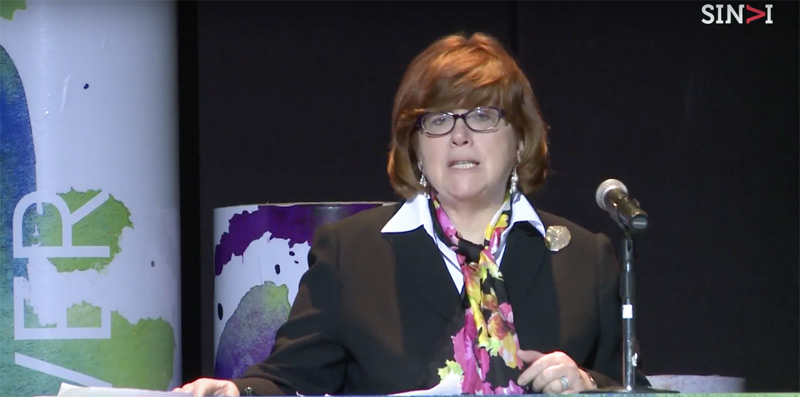
Hamodia publisher Ruth Lichtenstein
speaks last spring at Sinai Indaba, an annual Torah convention.
“It’s hard to be a publisher,” she tells me. “It doesn’t matter if
you’re a woman or a man. In every generation there are challenges. I
continue under sometimes impossible circumstances because of the
tradition I preserve.”
When I asked her about women, she said excluding them in photos was a
matter of modesty. “Purity and modesty are natural to women, not public
exposure,” she said. “It is unfortunate that modern times deny women
this precious quality and instead turn them into objects.” She said that
the paper’s policy not to publish women’s photos comes out of “respect
for women’s rights for privacy and modesty.”
“We are backed by thousands of years of Jewish tradition,” she added. “We do not compromise our values.”
But even as she adheres to tradition, change is in the air. The
publications have stepped gingerly into the digital age. They all have
Websites, but these are more akin to mainstream newspaper Websites 10 or
15 years ago than today. They do not have a presence on Facebook or
Twitter, and they do not enable readers to comment outside of
traditional letters to the editor.
Yated Ne’eman, which
can run over 100 pages a week, has only four or five articles on its
homepage. It is primarily a place for visitors to subscribe to the print
edition, promising readers $30 off a two-year subscription.
Ami’s
website has only headlines and pictures—and a paywall. “To get the rest
of this article, please buy this issue or subscribe to Ami,” the site
says.
Until recently,
Hamodia’s
website only offered readers the opportunity to “browse today’s print
edition.” The paper now has a proper home page, but it is just an online
version of the print paper. It is updated once a day.
When I first sat down with Lichtenstein in July, she told me that she was on the cusp of a big announcement about
Hamodia’s
website, rolling out a new product that would be updated “24/6,” the
code that Orthodox use for full-time, minus the Sabbath. But the
announcement still hasn’t come. “We’re not quite ready,” she said. But
she assured me that it is going to happen in the near future.
She’s not alone in her hesitation. A year ago, one of the editors of
Mishpacha,
Eytan Kobre, was told to “drop everything” and come to Israel for an
urgent meeting on rolling out an online edition, he told me. “I arrived
and they changed their minds,” he said. “Nothing happened.” Like the
other papers,
Mishpacha has a website, but it’s mostly meant to attract print subscribers.
The only difference between The New York Times and us is that we make money.”
In the meantime, the ultra-Orthodox papers continue to write and
publish the old fashioned way, mostly on paper, and with their old
fashioned values. The way they covered this summer’s landmark Supreme
Court decision legalizing same-sex marriage is a good example. Rabbi
Frankfurter’s
Ami ignored it altogether, as if it never happened.
Hamodia, the only daily among them, reported that the court “legalized the recognition of immorality.”
Mishpacha, the only one based in Jerusalem, spoke of “same gender coupling,” thus avoiding the words “sex” and “marriage”; and
Yated Ne’eman simply said that the court “redefined marriage.”
These publications invest heavily in their paper editions, which are
beautifully done, often with glossy magazine supplements that include
vivid color, professional photographs (many of food), and smart
graphics. (A feature in
Mishpacha, called “Day in the Life,”
runs with arrows, dates, and photographs of ultra-Orthodox Jews with
unusual professions, including a hypnotherapist.) There are opinion
columns, Torah lessons, motivational stories, and even classified ads
for apartments, cars, jobs, and matchmakers.
The papers are also carefully copy edited, something of a dying art
at many mainstream publications. And they continue to attract
advertisers who have few other ways of reaching their core readership.
They are thick with ads for kosher food, vacations in Israel, Jewish
schools, modest clothing, sacred texts, and fundraising pitches for a
variety of charities and organizations. They have a healthy mix of
subscription and newsstand sales.
There are an estimated 500,000 ultra-Orthodox Jews in the United
States, according to Dr. Pearl Beck, a demographer with Ukeles
Associates, Inc. She based the figure on a 2011 UJA-Federation survey
that counted 336,000 in the New York area alone. The ultra-Orthodox make
up 22 percent of New York area Jews and roughly 10 percent of Jews
nationwide. New York, Baltimore, Cleveland, Miami, and Chicago are among
the major cities where they live (and where these publications
circulate). You can find these papers in kosher megastores in all these
cities, like Seasons, Brach’s, Pomegranate, and EverGreen.
The combined circulation of the four publications is probably less
than 100,000 but the editors say that readership is many times that
number for two essential reasons: Orthodox Jews tend to have large
families, and they have one day, the Jewish Sabbath, when they devote
much of the day to reading. “Our readers spend hours and hours of time
relaxing and rejuvenating with family,” said Shoshana Friedman, the
editor of
Mishpacha, a weekly that comes in three sections, one
that has news and feature articles, a second for women (called “Family
First”), and a third for children (simply called “Jr.” that also
includes “Teen Pages”). In addition to news and features, there are
serialized works of fiction, like the melodramatic “Flashback,” which
runs episodically in
Mishpacha. According to the summary of one
recent installment: “Michal’s effort to get Ashi to talk about his
relationship with his deceased father is only partially successful; Ashi
reveals that it’s a painful subject but he promises he will never be
like his father.”
“We like to think there is something for everyone,” said Friedman. “That’s people’s entertainment on Shabbes.”
Indeed, the publications serve many purposes that secular papers
don’t. “We’re not into journalism per se,” said Rabbi Pinchos Lipschutz,
the editor of
Yated Ne’eman, which he publishes out of his
commodious home in Monsey, a hamlet in Rockland County, N.Y., with many
synagogues, kosher restaurants, both meat and dairy, and Jewish schools.
“We’re into education and making people better Jews. The newspaper is
our vehicle.”
There is also a community-building aspect to these publications.
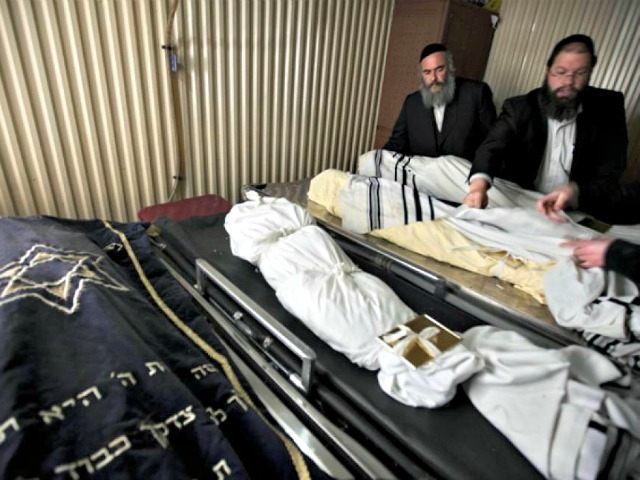
During times of tragedy, such as the freak Friday night fire that
took the lives of seven children
from a Brooklyn family in March, the publications rallied around the
surviving family members. They raised money for the family, and
published fire safety precautions to warn others.
“I’m proud of what we produce,” Rabbi Lipschutz said pointing to that
week’s issue of the paper. He flipped it over. “One hundred and
sixty-four pages, plus our magazine, which is another 56 pages.”
Like the other editors, Rabbi Lipschutz did not criticize his
ultra-Orthodox competitors, but he did take a swipe at the local general
interest newspaper,
The Journal News, which he said is filled
with celebrity news and other frivolous content. “You open the Gannett
paper and you find they are mocking you. They say you are an idiot.”
At the same time, he admires
The New York Times. On the day I visited, a well-read copy lay on his desk. He called it his “Bible.” “I read it every day,” he told me.
Some ultra-Orthodox criticize the
Times for what they see as
unfairness to Israel, but Lipschutz was more worried about what he
views as its lavish expenditures. “It took three people to write that
story on Greece?” he said pointing to the front page. “The only
difference between
The New York Times and us,” he said with a smile, “is that we make money.”
Yated Ne’eman, which Lipschutz founded in 1987, has a
full-time staff of three; about a half dozen others come in on
production days. It gets the bulk of its international news from
JNS.org, a free news service that is an arm of
Israel Today, a free daily newspaper in Israel owned by Sheldon Adelson, the American philanthropist and Las Vegas casino magnate.
Israel Today, like the ultra-Orthodox papers, is unquestioning in its support of the right-leaning Prime Minister Benjamin Netanyahu.
Instead of movie stars, supermodels and sports figures,
Yated
and the other papers run photo after photo of bearded rabbis. In their
columns, the rabbis answer readers’ questions about Jewish practice,
education, personal interaction, and matrimony. “How do I get my husband
to stop smoking?” one reader asked. “How do I get better results for my
children from the matchmaker?” wondered another.
Purity and modesty are natural to women, not
public exposure. It is unfortunate that modern times deny women this
precious quality and instead turn them into objects.”
Hamodia, which publishes Monday to Friday, has more news,
much of it taken from the Associated Press and Reuters, with an
occasional bylined story from Israel. Its biggest paper of the week is
distributed on Wednesdays, with a special women’s section, a weekly
magazine, and a children’s supplement. And like
Mishpacha, it runs serialized fiction.
All of the editors said that the practice of not using women’s
photographs started with the Israeli papers, which set the standard.
Most of them said that the vast majority of their subscribers read other
publications with pictures of women, but that they declined to use
women’s pictures out of fear of alienating the more observant segment of
their readership.
This leads to curious situations. For example, this summer
Mishpacha
had a cover story on Rachelle Frankel, the mother of one of three
teenage boys murdered last summer in Israel, a killing that was part of
the lead-up to the war in Gaza. The article talks about how Mrs. Frankel
emerged as a spokeswoman for the bereaved and quotes her extensively.
However, there are no photos of her or the other mothers; the only
pictures are of her son and his fellow victims.
The women’s issue
made headlines in 2011, when a Yiddish newspaper that serves the ultra-Orthodox community,
Di Tzeitung,
published in Brooklyn, digitally removed Mrs. Clinton from a picture of
the White House situation room on the night of the military operation
that assassinated Osama bin Laden. The English-language papers did not
use Photoshop, but one of them,
Ami,
cropped her out
of the picture. The picture the paper ran included the President, the
Vice President, the Chairman of the Joint Chiefs of Staff, and the White
House Chief of Staff, but not the Secretary of State.
While the editor of
Di Tzeitung apologized for manipulating a White House photo, which is a violation of the licensing agreements, Rabbi Frankfurter of
Ami defended his stance, saying that cropping is “done routinely by most papers and magazines.”
The ultra-Orthodox papers also managed to artfully crop Prime
Minister Angela Merkel out of a picture of the huge rally in Paris after
the murder of the
Charlie Hebdo cartoonists.
But continually cropping out President Hillary Clinton might prove
too much even for Rabbi Frankfurter. “We would be locking ourselves out
of a lot of opportunities,” he said. “We couldn’t even run photos of the
White House Hanukkah party.”
Members of the ultra-Orthodox community said that they saw no
contradiction in the fact that the papers will not print photos of
women, yet many of them are run by women. In the ultra-Orthodox world,
women are often administrators who make things happen behind the scenes.
Men put their energies elsewhere.
“Men are focused on Torah study,” explained Rabbi Avi Shafran, a
spokesman for the Agudath Israel of America, an ultra-Orthodox group,
who has written columns and articles for many of the papers. “The
highest ideal is for full-time Torah study.”
He acknowledged that women get a better secular education and tend to
be better readers and writers in English. Both Friedman of
Mishpacha and Lichtenstein of
Hamodia
went to college. Rabbis Frankfurter and Lipschutz, both of whom
graduated from prominent rabbinical seminaries, went only as far as high
school in their secular education.
Friedman, who at 36 is the youngest of the editors I interviewed,
said that being a woman editor who doesn’t run photos of women sometimes
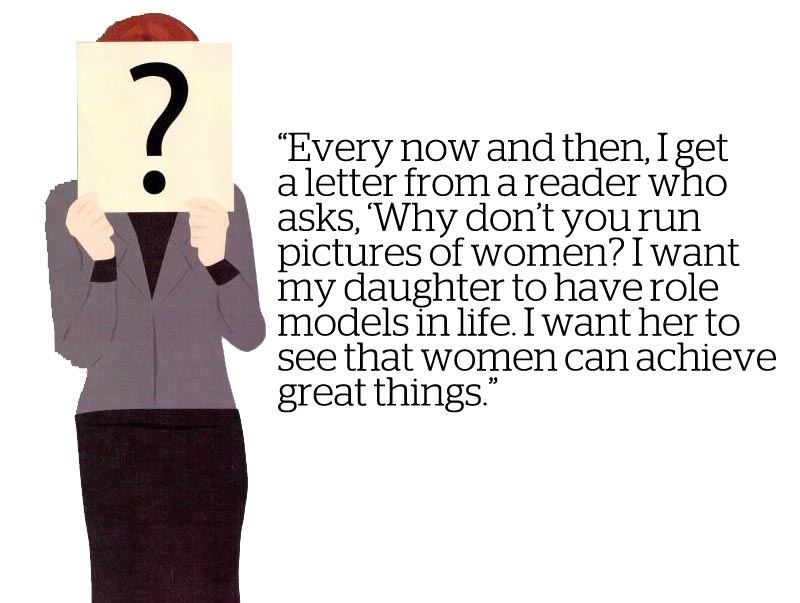
puts her in an uncomfortable position. “Every now and then, I get a
letter from a reader who asks, ‘Why don’t you run pictures of women? I
want my daughter to have role models in life. I want her to see that
women can achieve great things.’ ”
Friedman added sadly: “For these women I don’t have a good answer.”
http://www.cjr.org/the_feature/for_ultra-orthodox_newspapers_women_and_the_web_present_growing_challenges.php